Pew Research Center

FOR RELEASE NOVEMBER 20, 2019

Mobile Divides in Emerging Economies

Some still do not have mobile phones, and even phone owners struggle with connectivity and costs; they also face security issues

BY Laura Silver, Emily A. Vogels, Mara Mordecai, Jeremiah Cha, Raea Rasmussen and Lee Rainie

FOR MEDIA OR OTHER INQUIRIES:

Communications Department
202.419.4372
www.pewresearch.org

RECOMMENDED CITATION

Pew Research Center, November 2019, "Mobile Divides in Emerging Economies"

About Pew Research Center

Pew Research Center is a nonpartisan, nonadvocacy fact tank that informs the public about the issues, attitudes and trends shaping the world. It does not take policy positions. The Center conducts public opinion polling, demographic research, computational social science research and other data-driven research. It studies politics and policy; news habits and media; the internet and technology; religion; race and ethnicity; international affairs; social, demographic and economic trends; science; research methodology and data science; and immigration and migration. Pew Research Center is a subsidiary of The Pew Charitable Trusts, its primary funder.

© Pew Research Center 2026

Table of contents

  • About Pew Research Center
  • Mobile Divides in Emerging Economies
  • 1. Non-mobile phone users: What hinders their access?
  • 2. Phone sharers: What limits their mobile use?
  • 3. Mobile owners: What they struggle to do
  • 4. Obstacles to using phones
  • Acknowledgments
  • Methodology
  • Appendix A: About the focus groups
  • Appendix B: How the hardship scales were created and coded
  • Appendix C: Co-occurrence rates for each country
  • Appendix D: Older people, more affluent tend to have fewer hardships using mobile devices

Mobile Divides in Emerging Economies

Some still do not have mobile phones, and even phone owners struggle with connectivity and costs; they also face security issues

In some emerging economies, many do not own – or even share – mobile phones

As ownership of mobile phones, especially smartphones, spreads rapidly across the globe, there are still notable numbers of people in emerging economies who do not own a mobile phone, or who share one with others. A Pew Research Center survey in 11 emerging economies finds that a median of 6% of adults do not use phones at all, and a median of 7% do not own phones but instead borrow them from others. The mobile divides are most pronounced in Venezuela (32%), India (30%) and the Philippines (27%), countries where about three-in-ten adults do not own a mobile phone.

What is a median?

Throughout this report, median percentages are used to help readers see overall patterns. The median is the middle number in a list of figures sorted in ascending or descending order. In a survey of 11 countries, the median result is the sixth figure on a list of country-level findings ranked in order.

We can see a lot of things on a smartphone. You can learn more about life.Woman, 40, Tunisia

At the same time, the new findings show that mobile divides even exist for phone owners. Significant numbers of owners struggle to use their phones to full advantage. A median of 46% in these countries say they frequently or occasionally have difficulties getting reliable phone connections, 37% say it can be a challenge to pay for their phones and 33% report finding places to charge their phones is a problem at least occasionally. In addition, a median of 42% report frequently or occasionally avoiding some activities on their phones because they use too much data.

Many mobile phone owners struggle with expenses and connections

[Owning a smartphone] is not my priority. My priority is basic needs. Woman, 37, Philippines

In some countries, mobile owners’ problems are particularly striking. In Lebanon, for example, 77% of phone owners report having problems getting reliable mobile connections, and about two-thirds (66%) say they avoid doing things with their phones because those activities use too much data. In Jordan, nearly half (48%) report having trouble paying for their phone, while in Tunisia four-in-ten (40%) say it can be a challenge to find places to recharge their phones.

Cost and loss of device are most-cited reasons why people share phones

Beyond those concerns, other issues can disrupt life for a portion of phone users and sharers. Around three-quarters or more mobile phone owners in every country except India report concerns about identity theft, and around nine-in-ten or more in Mexico (95%), Colombia (94%), Tunisia (90%), South Africa (89%) and the Philippines (89%) say they are at least somewhat concerned.

Mobile phone sharers, too, are often quite concerned about identity theft; outside of India and Lebanon, at least half of mobile phone sharers in every country report being very concerned about this issue. For mobile sharers, too, concerns about device security can play a role in why people choose not to own their own devices. While cost is the primary reason mobile phone sharers give for why they do not personally have a phone (a median of 34% across eight countries reports this), the second most commonly cited reason is that a previous mobile phone was lost, broken or stolen. Another 2% say they do not own their own mobile phone because of concerns that it will be stolen.

Which countries are included and which are excluded?

Throughout this report, there are times when we report 11-country medians and times when we report eight-country medians. This is because Pew Research Center maintains a threshold where we do not report on groups with fewer than around 100 people. In the case of both mobile phone non-users and mobile phone sharers, respectively, there are three countries that do not meet our threshold. Given this, when we talk just about mobile phone non-users or sharers, we only report on the countries with sufficient sample size, and the medians depicted will be based on eight countries. There are even fewer countries on which we can report when we want to compare across our three groups of interest – mobile phone owners, sharers and non-users – because the countries that do not meet our standards for reporting about non-users and sharers are not the same.

Additionally, because of the different experiences that non-users, sharers and owners have with mobile technology, they were often asked different questions. As a result, some questions and analyses can only be reported for certain subsets of the population. For more information on who was asked which questions, please see Appendix C.

Some mobile owners have trouble finding content in their preferred language

Additionally, a median of 29% of mobile owners in these 11 emerging economies say they have frequently or occasionally experienced problems finding information online in their preferred language. This problem ranges from 17% of mobile owners in Jordan to 37% in South Africa.

People cite a variety of reasons why they don’t own or share mobile phones

Costs are key reason people across emerging economies don’t use phones

The cost of phones themselves and data plans are important factors in why people don’t own or feel compelled to share mobile phones. But costs are hardly the only deterrent.

Among non-mobile phone users, a median of 51% across eight countries say the cost of a phone is a reason they do not have one, with non-users in Venezuela (89%) and Tunisia (71%) topping the list. A median of 34% of non-mobile users in these eight countries report that data costs are a reason. Non-users in Tunisia (63%), Venezuela (50%) and Mexico (45%) were particularly likely to cite data costs as a reason for not having a phone.

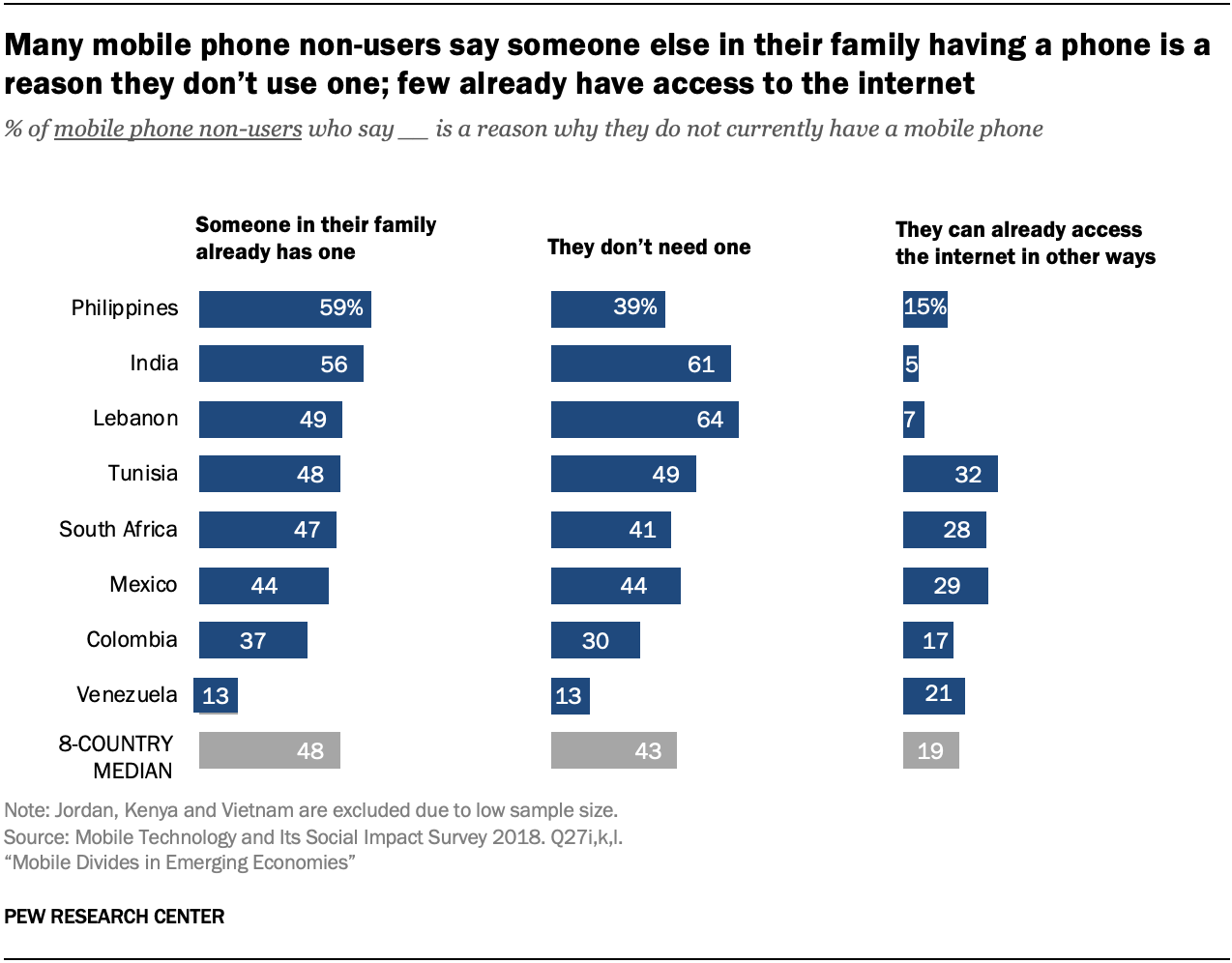
At the same time, a median of 48% of non-users in eight of these countries report the reason they personally do not have a phone is that another family member has a phone. This reason was especially likely to be cited by non-mobile phone users in the Philippines (59%), India (56%), Lebanon (49%) and Mexico (44%). This may be because these non-users can accomplish some kinds of mobile communications and other activities by relying on that other family member.

You can borrow a [family member’s] phone, right? They will say, ‘Why don’t you buy a [smart]phone like this?’ I answered, ‘I don’t have enough money.’Man, 49, Philippines

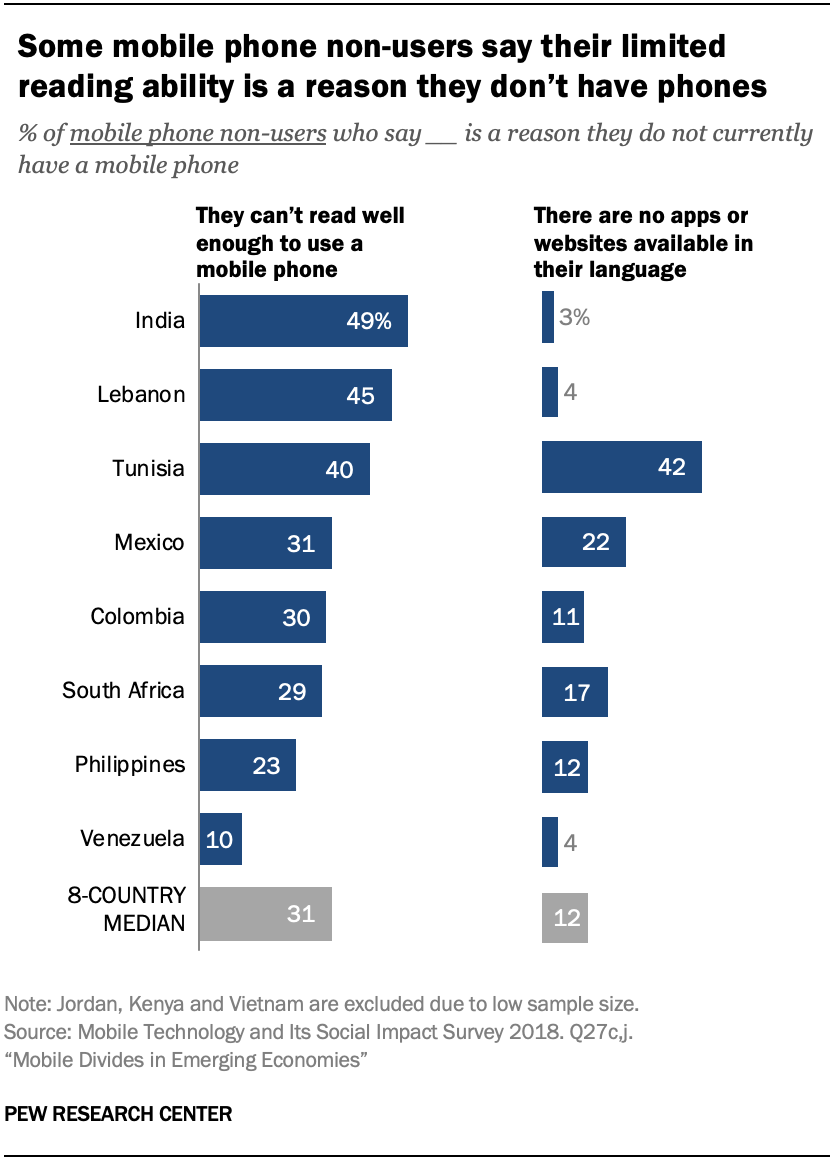
Technological literacy and general literacy issues also figure into the situation. A median of 43% of non-users say phones are too complicated for them, and 31% report they cannot read well enough to use a phone. Reading problems are particularly likely to be cited as a factor in India (49%) and Lebanon (45%).

A median of 43% of non-users in these countries say they have no need for a mobile phone. This is often the case in countries where relatively high levels of nonowners say other members of their family have mobile phones like India, Tunisia and Lebanon.

Phone hardships often come in multiples

Security, financial issues among the most common hardships faced regarding accessibility of mobile phones

As part of the analysis, Pew Research Center created four scales related to the different kinds of hardships people might experience related to mobile phones – whether they own them, share them or don’t use them at all. The scales synthesized people’s answers related to connectivity problems, financial difficulties, language issues and security woes, flagging cases where the issue prevented or frequently impaired mobile use. (A full description of the development of the scales can be found in “Obstacles to using phones” and Appendix B.)

This analysis finds that security hardships are the most commonly experienced across the 11 emerging economies studied, hitting a median of 69% of adults in these countries, followed by financial struggles (a median of 60%), connectivity difficulties (28%) and language issues (13%).

Outside of India, half or more adults report facing at least one security-related hardship, meaning many are very concerned about the security of their information or the physical security of their device. These hardships are especially common in Colombia (84%), Mexico (82%) and South Africa (79%).

Financial hardships are highest in Kenya, where 74% of adults report an issue related to affording mobile devices and/or data.

Connectivity issues are most common in Lebanon, where about four-in-ten adults (41%) report a frequent difficulty with connectivity. But, few mobile users have difficulty both getting reliable service and charging their phones.

The highest rate of language issues is found in South Africa, where about a quarter (23%) report a language issue. This may be due in part to the diversity of languages found in South Africa.

Co-occurrence rates of persistent issues in the Philippines

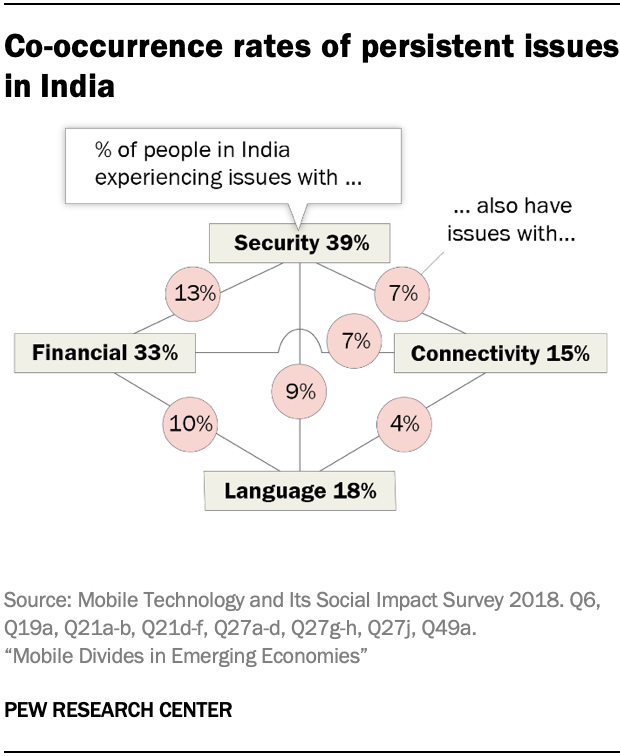
A key finding from this analysis of hardships is that barriers to mobile use do not occur in isolation. Between 27% and 67% of individuals in each country simultaneously experience two or more types of hardship, and between 1% and 7% of individuals experience all four types of hardship we asked about.

For the two most common hardships – security and financial – between 13% and 56% of individuals in each country surveyed experience both hardships concurrently. For example, around four-in-ten Filipinos (39%) simultaneously experience security and financial issues (for all country-specific numbers, see Appendix C). In fact, aside from India, roughly half or more who experience one of these issues also experiences the other (between 56% and 87%).

Some other findings from this analysis of hardships include:

  • Smartphone use is associated with higher rates of security issues in most countries – that is, people who use smartphones are either more likely to report concerns about their phone being stolen or about identity theft than non-smartphone users, or they are more likely to currently share a device because their last device was stolen, lost or broken.
  • Younger adults ages 18 to 29 experience higher levels of connectivity issues like poor service or problems charging their devices in several countries.
  • Those who can read some English face fewer language-related issues with mobile phones in most countries, including difficulties finding online content in their preferred language or feeling there were no apps or websites in their native language.

Those living in lower-income households face more financial hurdles.

Wide range of opinions on whether non-users would like a device

Mobile phone non-users from different countries disagree over whether they want a device in the future

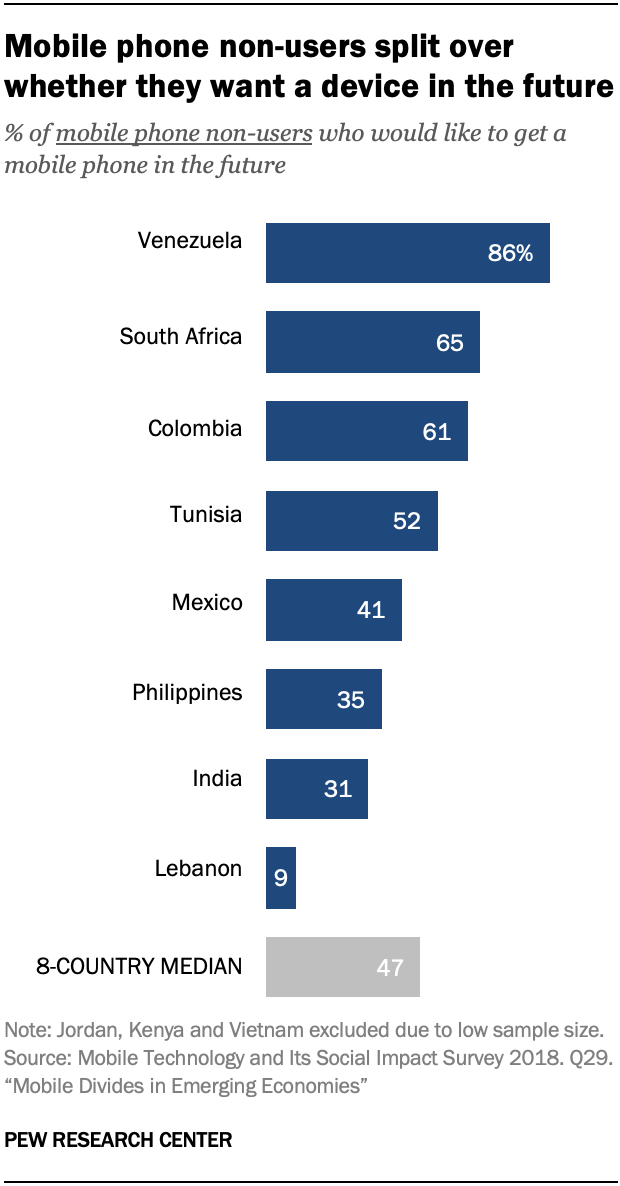
Despite these issues, a share of those who do not use phones in some of these emerging economies would like to do so. That is not universally the case, however. A median of 47% of non-users say they would like to have a mobile phone. That sentiment among non-users ranges from 86% of non-users in Venezuela to 9% in Lebanon.

It is possible that the people who report wanting to get a phone in the future desire to do so in part because they believe mobile phones have been beneficial to their societies. Indeed, in six of the seven countries for which this analysis is possible, majorities of mobile phone owners and nonowners alike say mobile phones have mostly been a good thing for their society.

These are among the major findings from a Pew Research Center survey conducted among 28,122 adults in 11 countries from Sept. 7 to Dec. 7, 2018. It is part of a series of reports about the mobile landscape in emerging economies. Previous reports have covered the benefits and drawbacks people feel mobile connectivity has brought to them and their societies, perceptions about the impact of mobile phones on politics and information and the broader social networks of smartphone and social media users in these countries.

In addition to the survey, the Center conducted focus groups with diverse groups of participants in Kenya, Mexico, the Philippines and Tunisia in March 2018, and their comments are included throughout the report (see Appendix A for more information).

1. Non-mobile phone users: What hinders their access?

Mobile phones are common across many emerging economies. Yet, mobile phone ownership is not equally embraced either among nations or within them. Across the 11 emerging economies surveyed as part of this report, up to one-in-five people do not own or even share a mobile phone.

While myriad factors affect why people don’t own or use mobile phones, a few key ones stand out. First, non-mobile phone users tend to be put off by the cost of owning mobile phones – and, particularly, the cost of the device itself, more so than the cost of data. Second, many non-users see limited value to mobile phones for their lives. Linguistic difficulties and technological literacy also affect non-users, though at somewhat lower rates. Non-users are also concerned about the security of mobile phones and the sensitive information they contain.

And, while majorities of non-users would like to own a phone in some countries surveyed, non-users elsewhere are content to continue without digital connectivity.

The share of mobile phone non-users varies in emerging economies

The number of mobile phone non-users varies in emerging economies

Across the 11 countries, a median of 6% say they neither own their own mobile phone nor regularly use someone else’s device. Nonuse varies across these countries – ranging from a low of just 2% in Vietnam to a high of 20% in the Philippines.

Nonuse tends to be more common among adults with lower levels of income and education.1 In the Philippines, for instance, 10% of people with more education say they do not use a phone, compared with 38% of those with lower levels of education. This pattern exists in all 11 countries surveyed. Similarly, across most nations surveyed, older people are more likely than younger to be non-users.

However, gender differences in nonuse vary markedly by country. For example, in India, 24% of women are non-users, compared with 11% of men. In most other countries, there are smaller or no significant differences in nonuse by gender.

Given that mobile phone use is relatively common, the main analysis in this chapter involves only the eight countries where there are sufficient sample sizes (about 100 mobile phone non-users or more) to allow for additional analysis of non-users’ experiences.

Multiple factors contribute to why people don’t use mobile phones

In each country, mobile phone non-users were asked whether each of 12 factors was part of the reason they do not use a mobile device. These factors ranged from issues related to cost – whether of data or the device itself – to issues of digital literacy or linguistic difficulty, among others. If non-users mentioned that more than one of the 12 factors played into their decision not to use a phone, they were also asked which of those they had named was the top factor hampering their use.

Device costs are a key reason people across emerging economies don’t use mobile phones

Results indicate that, while myriad factors have an impact on people’s decisions not to use phones, financial constraints are key. Across the eight countries with a sufficient sample size to analyze, a median of 51% say the cost of a mobile device is a reason they do not own a mobile phone. Among those who gave multiple reasons that they did not use a phone, device cost also is the top reason people cite for not owning a mobile device (a median of 17% of non-users across eight countries). A median of 34% also say data costs are a factor in why they do not use a mobile phone, though a median of only 5% say this is their top reason.
Others may simply not find a mobile phone imperative for themselves or their families: A median of 48% say they do not use a phone because their family already has a device, and another 43% say they simply have no need for one. Concerns about complexity also rank as a key issue for many: A median of 43% say they do not use a mobile phone because the device is too complicated, while 31% say they cannot read well enough to do so.

The cost of the device itself most concerns non-users

Device costs, more than data costs, are a reason people don’t use mobile phones

In five countries, around half or more mobile phone non-users say device costs are a reason they do not own a mobile phone. This ranges from a low of 30% who cite device costs as an issue in India to a high of 89% in Venezuela.

For most non-users, the cost of data is less of a concern. In Venezuela, for example, while around nine-in-ten (89%) see device costs as prohibitive, half say the cost of data is a reason they don’t use a device. While the relative gap between device and data costs may be smaller in other countries, more people in each country say device costs are a hurdle to ownership than say the same of data costs.

Still, data costs are a deterrent for many; a median of 34% say data costs are a reason they do not use a mobile phone. This is highest in Tunisia (63%).

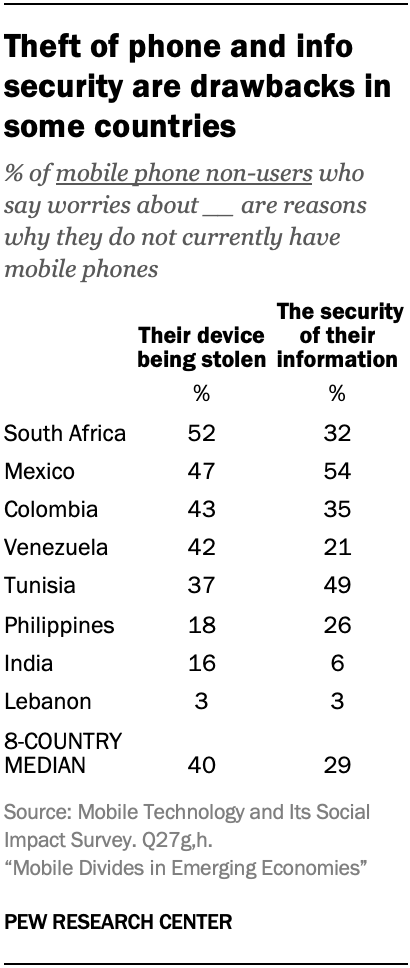
Worries about theft of a phone and information security deter some from owning phones

Theft of phone and info security are drawbacks in some countries

Certain publics view security as more of an issue than others. More than three-in-ten mobile phone non-users in Colombia, Mexico, South Africa and Tunisia report both worries over theft of the device itself and information security as reasons for non-ownership. While Venezuelan non-users worry about theft at a similar rate, information security worries there are half as prevalent. Lebanese and Indians who don’t have mobile phones are less concerned about both the physical security of their devices and information security. In Lebanon, for example, 3% of mobile phone non-users report worries about the device being stolen and information security, respectively, as reasons for non-ownership.

However, when it comes to identity theft in general, about nine-in-ten Mexican (91%), Colombian (89%) and Venezuelan (87%) non-users say they are at least somewhat concerned. In all of these countries, two-thirds or more say they are very concerned about the general possibility of identity theft.

Some mobile non-users see little use for a device or have other means of accessing the internet

In five countries, around half or more say they do not have a mobile phone because someone else in their family does. In contrast, few non-users say they do not use mobile phones because they have other means of accessing the internet; a median of only 19% across the eight countries say this.

Reported lack of need for mobile connectivity is highest among non-mobile phone users in Lebanon (64%) and India (61%); in most countries, around a third or more of non-users cite this as a reason. Only in Venezuela, where rapid inflation has left large swathes of the country in dire poverty, do few non-users (13%) report that not needing a device contributes to them not using one. Similarly, 89% of Venezuelans report device costs as a reason why they do not currently have a mobile phone.

Many mobile phone non-users say someone else in their family having a phone is a reason they don’t use one; few already have access to the internet
Mobile phone complexity is a deterrent to ownership

In addition, some also say they opt not to use a phone simply because they perceive phones to be too complicated. Across the eight countries, a median of 43% say this is the case for them. It is not just smartphones that non-users may see as too complicated. In Mexico – the country where feature phone ownership is highest – 58% of non-users say that perceived difficulty is part of their rationale for not using mobile devices. In Lebanon, too, around half of non-users say the difficulty and complexity of phones affects them.

Literacy, language difficulties can be an obstacle to mobile-phone use

Some mobile phone non-users say their limited reading ability is a reason they don’t have phones

For those with limited reading abilities, mobile phones may hold less appeal, even though technology companies are working to make communication via voice activation, image and video easier for less-literate users.

This survey shows that people’s evaluations of their own reading ability contribute to whether they have a mobile phone. Across the eight countries, a median of 31% say their own limited reading ability is a factor in why they don’t use a device.

Limited reading ability is a greater factor in non-users’ assessments in countries with lower levels of adult literacy. For example, in India, the country with the lowest level of adult literacy among the eight discussed here (74%, according to the World Bank), nearly half of all mobile phone non-users say their limited reading ability contributes to them not using mobile phones. At the other extreme is Venezuela, where 97% of the adult population is literate, and only 10% say limited reading ability has an impact on their decision to not use a phone.

In most countries, the availability of applications and websites in people’s preferred languages is rarely cited as an issue. Across the eight countries, a median of 12% say the fact that they can’t find information in their desired language on apps or websites contributes to their lack of phone use. Only in Tunisia and Mexico do one-in-five or more non-users say this is a factor for them.

A share of non-users cite limited mobile service as a reason they don’t use a phone

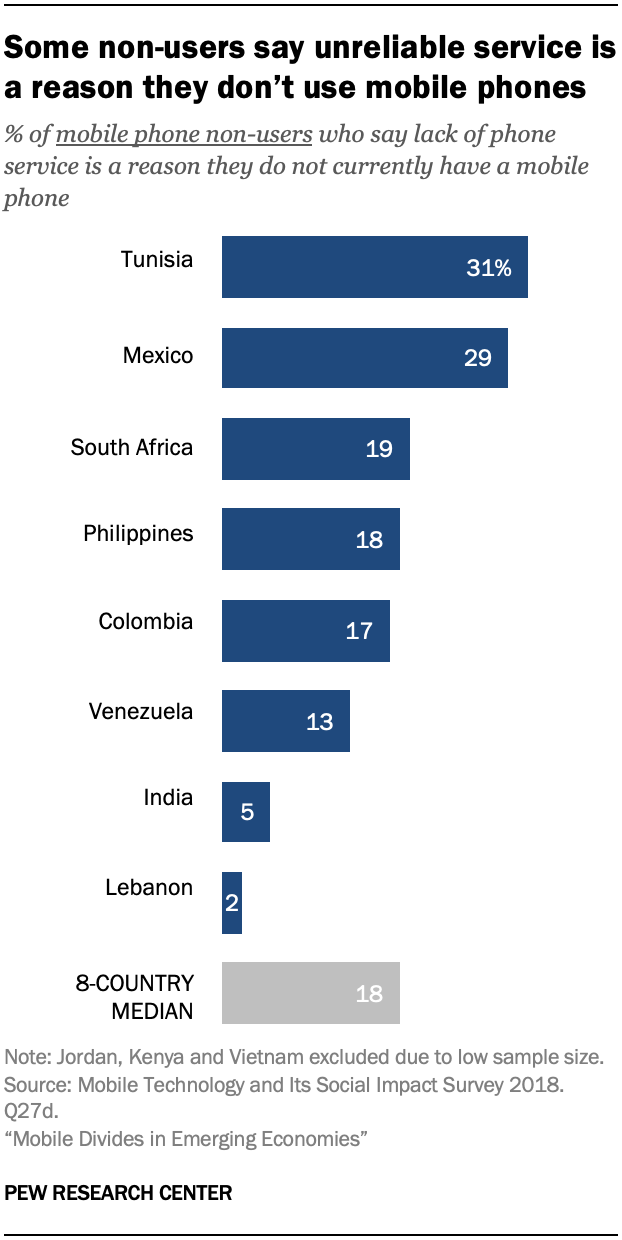
Some non-users say unreliable service is a reason they don’t use mobile phones

Although access to reliable mobile service varies across the countries surveyed, lack of service is not a key reason most non-users give for why they don’t use mobile phones.

Across the eight countries, a median of 18% say limited mobile service is a reason they don’t use mobile phones, ranging from a high of 31% in Tunisia to a low of only 2% in Lebanon.

Many but not all non-users would like to have a mobile phone

Mobile phone non-users split over whether they want a device in the future

Despite the perceived challenges and barriers, many non-users would like to own a mobile phone in the future. Venezuelan non-users stand out for their keen interest in acquiring a mobile phone; 86% of mobile phone non-users in Venezuela say they would like to get a phone in the future. Elsewhere, these numbers vary markedly, from around half or more desiring a mobile phone in South Africa (65%), Colombia (61%) and Tunisia (52%), to fewer than half in Mexico (41%), the Philippines (35%), India (31%) and Lebanon (9%).

2. Phone sharers: What limits their mobile use?

A median of 7% across the 11 countries surveyed say they do not own a phone but do use someone else’s regularly. Although there are relatively few sharers in each country, they face the challenge of relying on others for their connectivity. Many individuals who share a mobile device report struggling financially with owning and maintaining a mobile phone.

Nearly a third of mobile phone sharers (eight-country median of 31%) report that the main reason they share a phone is that they previously owned a mobile phone, but it was lost, broken or stolen. However, few sharers cite a fear of a future phone being lost, broken or stolen as the main reason they use someone else’s phone.

Connectivity and language barriers also color many mobile sharers experiences, but few experience these issues on a frequent basis. For example, medians of no more than one-in-five report frequently experiencing any of the potential hardships they were asked about, though many say they have some difficulties at least occasionally.

Few in emerging economies share mobile phones

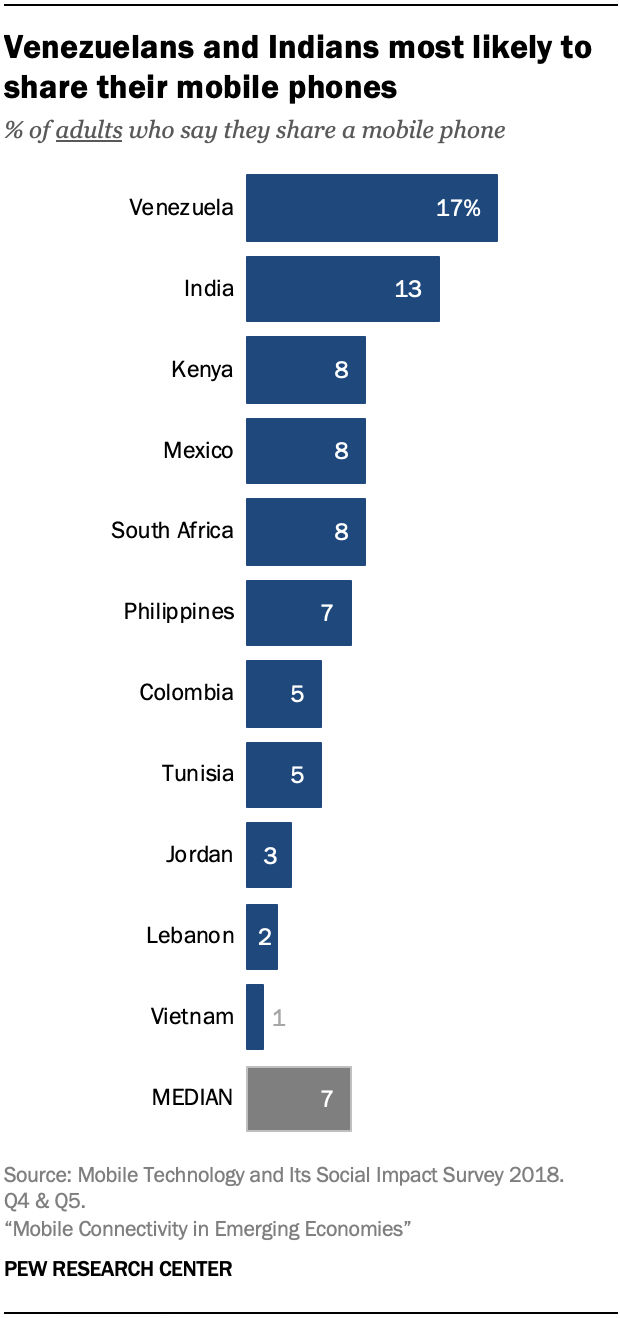
Venezuelans and Indians most likely to share their mobile phones

Phone sharing is relatively rare in most of these 11 countries – ranging from just 1% in Vietnam to a high of 17% in Venezuela. As sharing is relatively uncommon, only eight counties have sufficient sample sizes (roughly 100 or more sharers) to allow for additional analysis of sharers’ experiences.

Sharing tends to be more common among adults with less education and lower levels of income. For example, 12% of Filipinos with lower levels of educational attainment report sharing a phone, compared with 4% of those with more education. Lower income is a factor in countries like India, where individuals with lower incomes (17%) are nearly twice as likely to share a phone as those with higher incomes (9%).

In India – where women are less likely than men to own their own mobile phones – significantly more women (20%) than men (5%) report sharing a device with someone else. In other countries, there are small or no differences between men and women with regard to their likelihood of sharing a phone.

Many share phones because of financial constraints

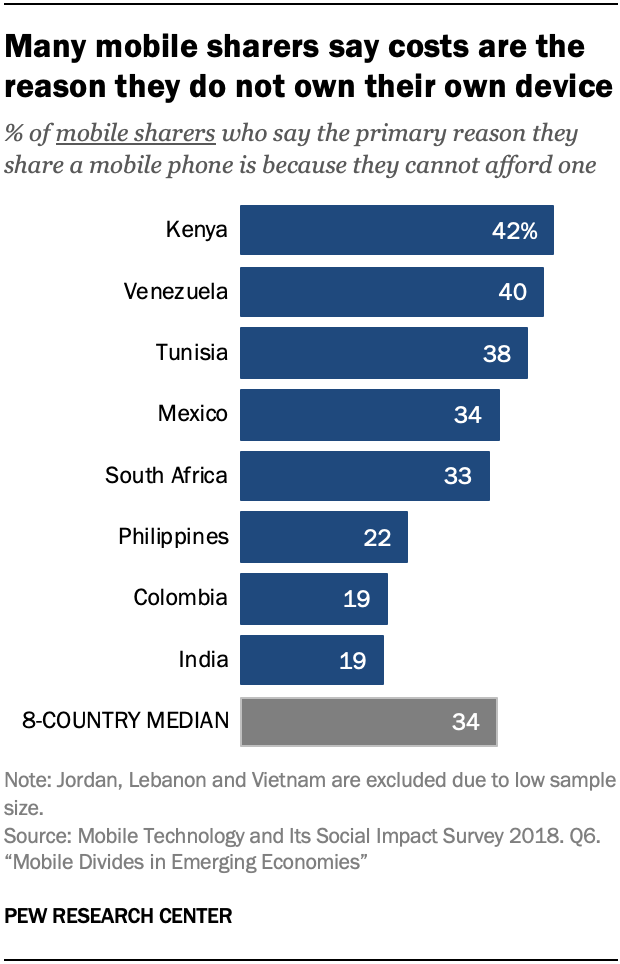
Many mobile sharers say costs are the reason they do not own their own device

Mobile phone sharers often say they use other people’s phones, rather than their own, because of the costs associated with mobile connectivity. When asked for the primary reason they share a mobile phone, an eight-country median of 34% say they do so largely because they cannot afford their own. This ranges from a high of around four-in-ten in Kenya (42%), Venezuela (40%) and Tunisia (38%) to a low of 19% in Colombia and India. In Colombia, India, Mexico, Tunisia and Venezuela, a plurality of phone sharers cite this as the main reason why they don’t own a phone.

I can’t afford to buy one [a smartphone] as I need to spend money on other things.Man, 50, Tunisia

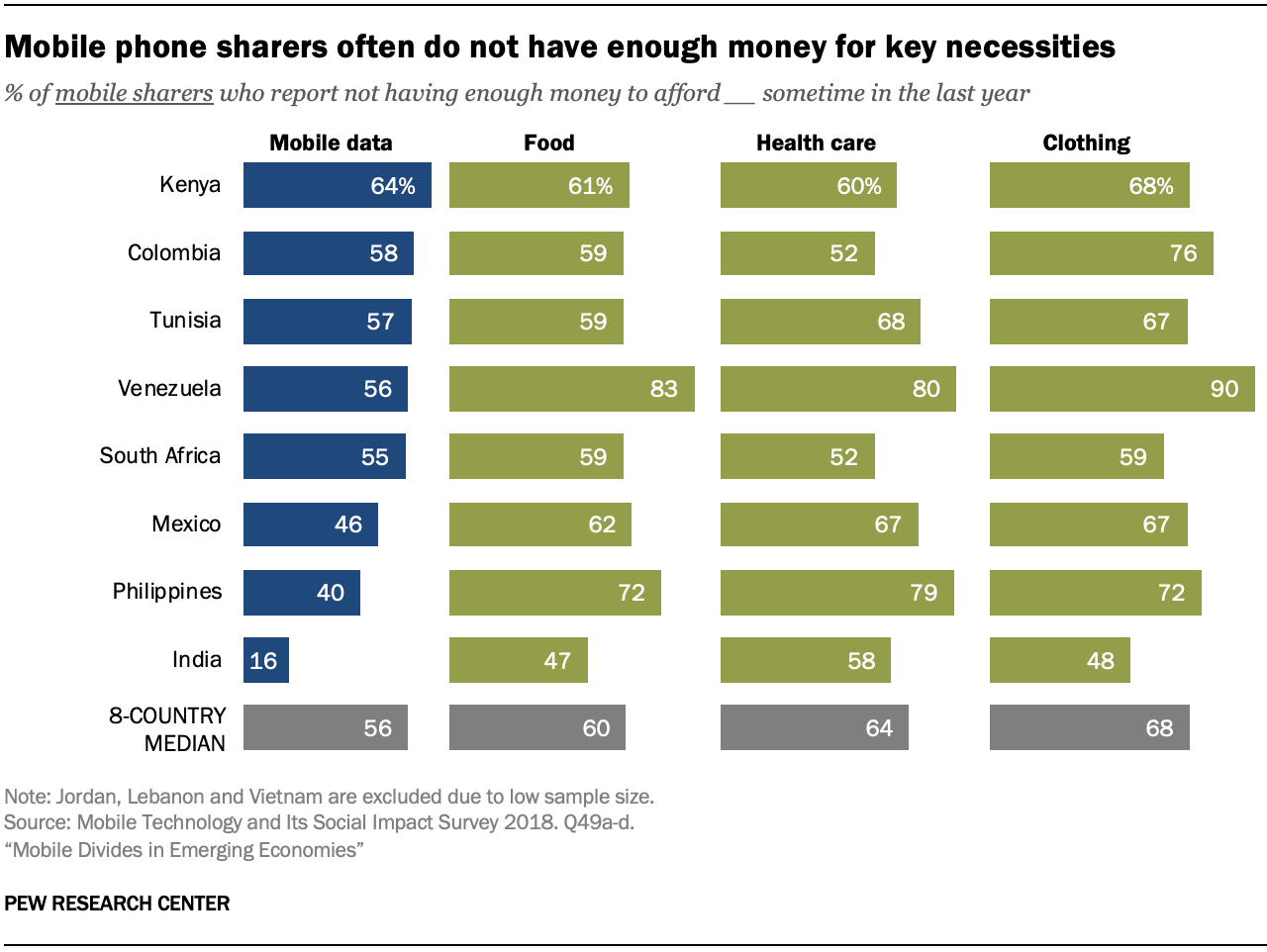
Majorities of mobile phone sharers in five of the eight countries also report that there were times when they did not have enough money to buy mobile data in the last year.

To get a sense of how sharers’ struggles to pay for their phones and data compare with their difficulties in affording other key expenses, the survey asked if there had been times during the past year when people did not have enough money to afford purchases of food, health care and clothing. In most countries, a majority or near-majority of mobile sharers consistently struggled with expenses in all these areas, including mobile data.

Mobile phone sharers often do not have enough money for key necessities
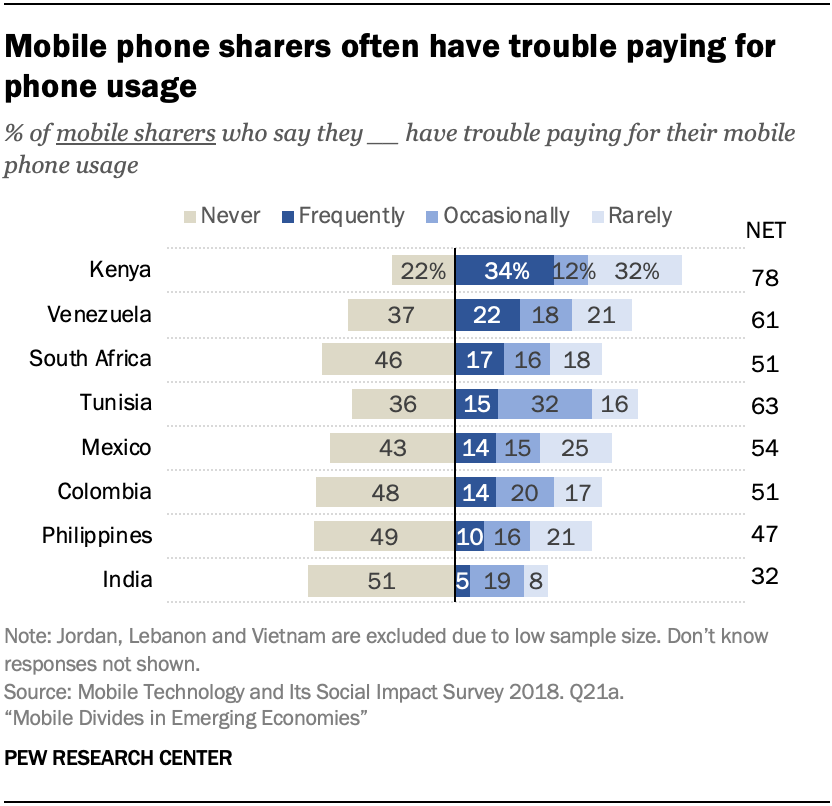
Mobile phone sharers often have trouble paying for phone usage

In some cases, like Kenya and South Africa, the frequency with which mobile sharers struggled to pay for mobile data was similar to their struggle with some other expenses. In other countries such as Venezuela, Mexico, the Philippines and India, however, it was more likely the case that more mobile sharers struggled to afford paying for food, health care and clothing expenses. For example, about two-thirds of Mexican mobile phone sharers could not afford food (63%), medical care (67%) or clothing (67%) in the past year. That compares with 46% who say there were times in the past year they did not have enough money to pay for mobile data.

A separate question in the survey focused on how frequently, if at all, mobile phone users and sharers had trouble paying for their mobile usage. Over half the mobile sharers in six of the eight countries report having had at least some financial difficulty paying for their mobile usage at some point.

And, around a quarter or more in Kenya (34%) and Venezuela (22%) report frequently having trouble paying for their mobile phone use. One-in-ten or more say the same in every country other than India.2

Using the internet on phones also requires a lot of money; people spend a lot of money on the phone bills today, repairing is also costly.Woman, 23, Tunisia

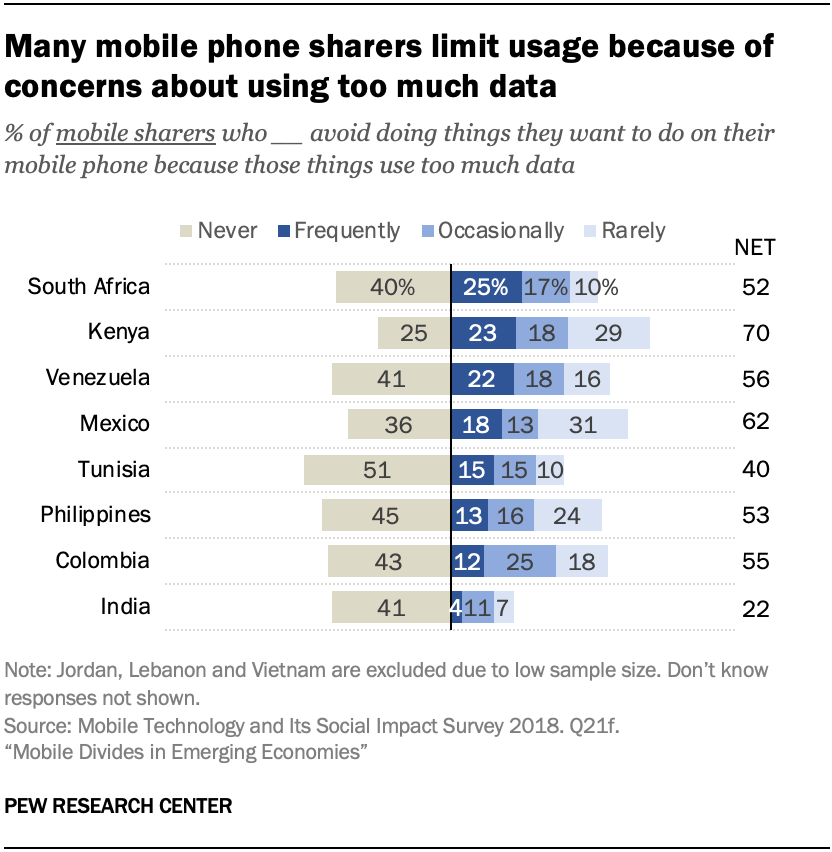
Many mobile phone sharers limit usage because of concerns about using too much data

Concerns about mobile phone costs may cause some people to limit their data usage. Around half or more mobile phone sharers in six of eight countries report avoiding certain activities on their phones because those things use too much data. Sharers in South Africa (25%), Kenya (23%) and Venezuela (22%) are most likely to report frequently avoiding using their phones due to data usage concerns.

I have to use my data bundles, so I restrict what I see. So sometimes I do not go on Instagram because it consumes a lot of bundles.Woman, 24, Kenya

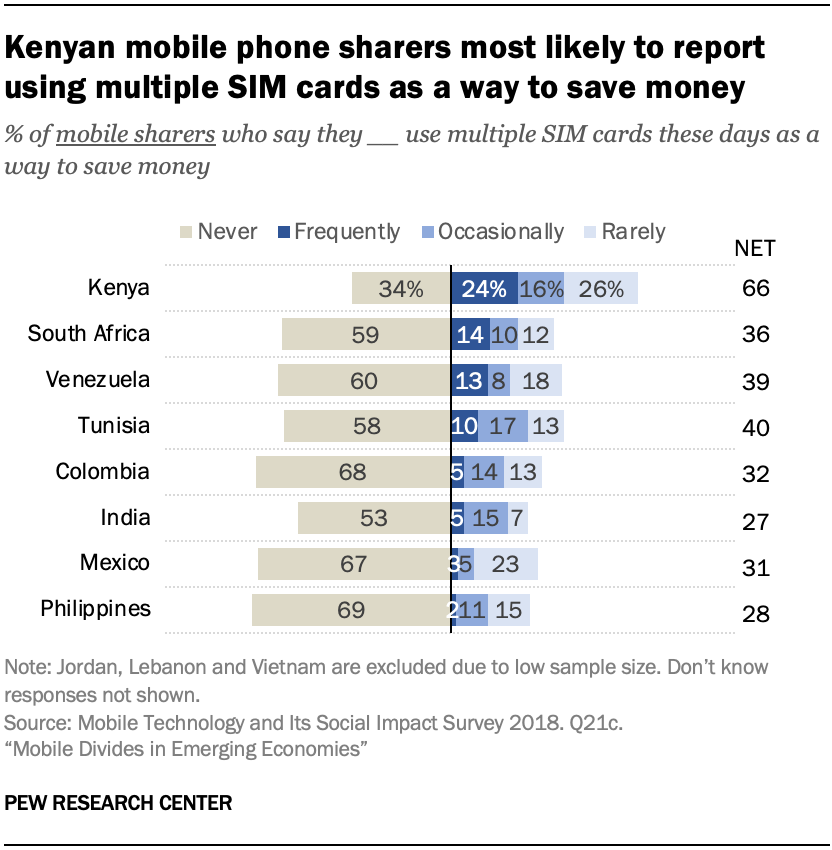
Kenyan mobile phone sharers most likely to report using multiple SIM cards as a way to save money

Cost concerns may also lead some mobile phone users to use multiple SIM cards. This technique may be more useful in some countries than others, as cost-saving strategies. For example, some phone companies offer cheaper rates for users to communicate with people in the same network rather than across networks.3

Now if I go to [a remote village], I will not use the Airtel line, I will use the Safaricom. Normally, Airtel is cheaper than Safaricom.Woman, 24, Kenya

Across the surveyed countries, phone sharers in Kenya were the most likely to report that they have used multiple SIMs as a way to save money. This practice is least common in the Philippines, Colombia and Mexico, where around two-thirds in each country report never doing so.

Concerns about security may lead some to share, rather than own, phones

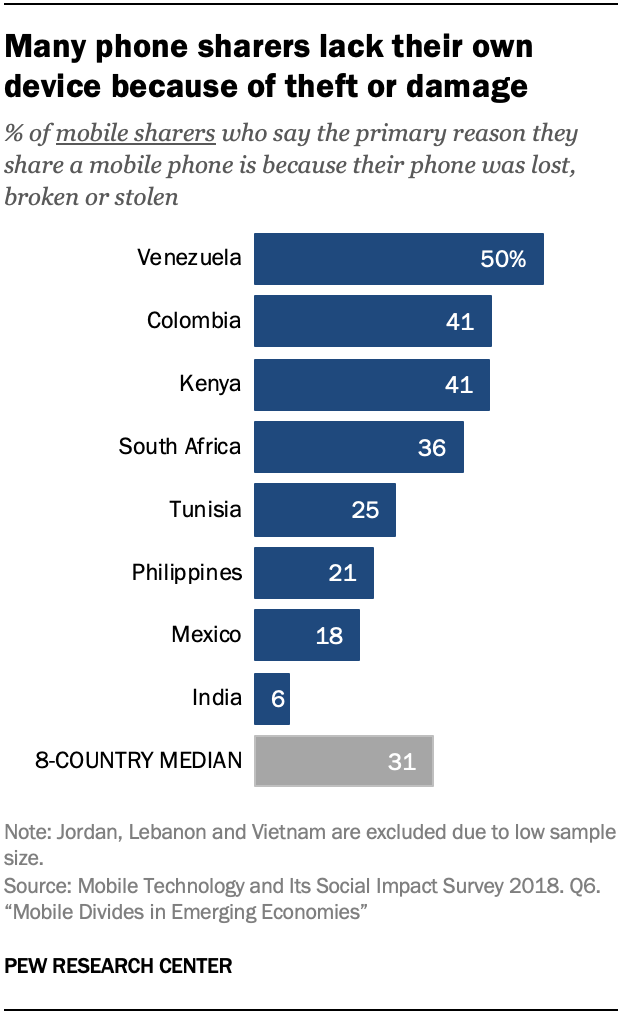
Many phone sharers lack their own device because of theft or damage

Mobile phone sharers may also opt not to have their own devices in part because of security concerns, though this is a lesser concern for most mobile phone sharers than financial or connectivity-related issues. Very few individuals report that fear of their phone being stolen is the main reason for sharing a mobile phone. These fears are highest in Colombia, where 8% say fear of their phone being stolen is the primary reason they do not have one. Elsewhere, no more than 3% cite this as their primary reason for lacking their own device.

Still, even if concerns over phones being stolen is not a dominant reason that many lack their own devices, in some countries, many sharers currently lack access because a past device of theirs was lost, broken or stolen. Half of Venezuelan mobile phone sharers say this is the primary reason they share a device. About two-in-five in Colombia (41%) and Kenya (41%) also report this reason.

I was robbed my address, my data … They enter there and see all your pictures. All that you have is taken away from you, and you don’t know who can see all that.Woman, 34, Mexico

Security concerns may also extend beyond people’s fears about theft of the device. Those worries might also apply to the information contained within the phone. Around two-thirds or more sharers from each country report concerns about identity theft. More than nine-in-ten mobile phone sharers in Colombia (94%), Mexico (94%), Venezuela (92%) and the Philippines (91%) say they are at least somewhat concerned. Further, outside of India and Kenya, at least half of mobile phone sharers in every country report being very concerned about this issue.

Lack of reliable connections also impede mobile phone sharers

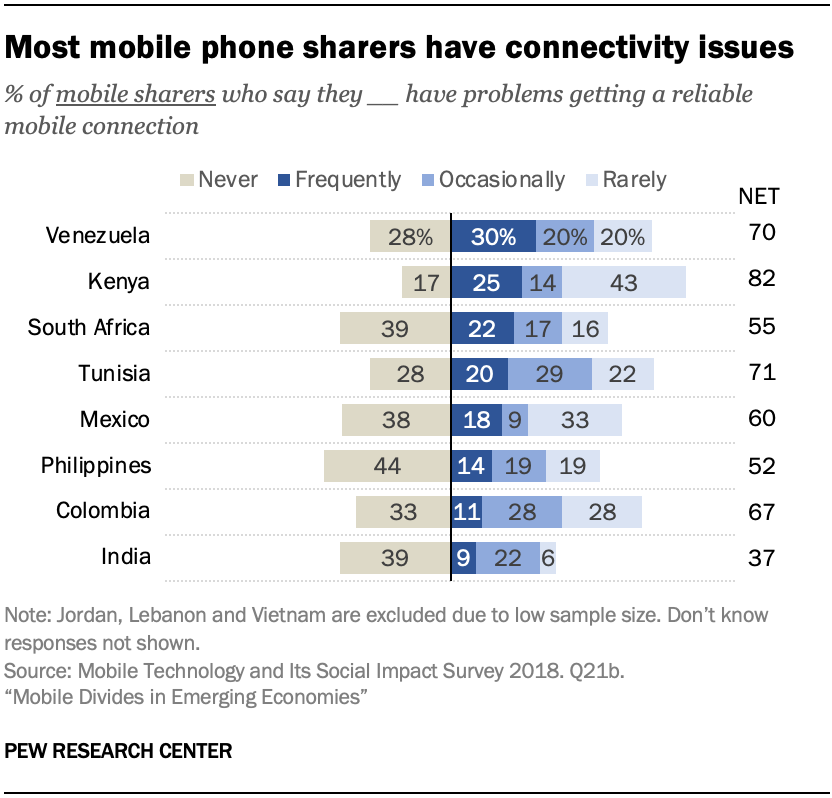
Most mobile phone sharers have connectivity issues

In addition to financial and security hardships, many mobile phone sharers report experiencing problems with connectivity. In every country, around half or more say they had difficulty getting a reliable mobile connection at least every so often. Those in Venezuela (30%) and Kenya (25%) are most likely to report frequently having mobile connection issues.

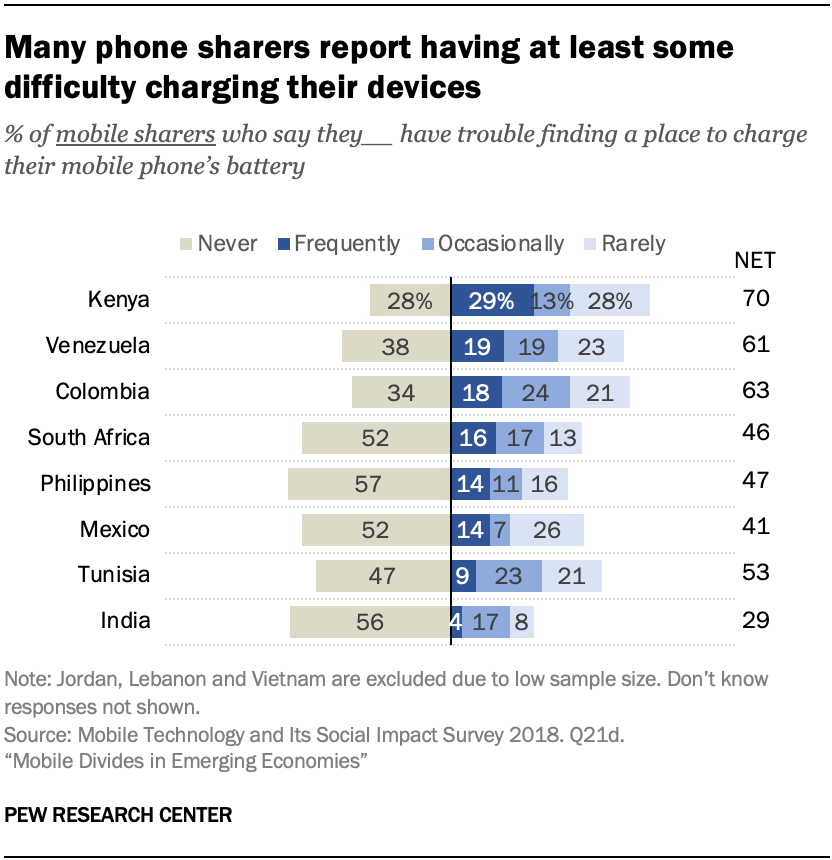
Many phone sharers report having at least some difficulty charging their devices

Mobile phone use may not only be restricted by these sharers’ mobile connection but also by their access to charging locations. Again, Kenyan mobile sharers (70%) are most likely to report having trouble finding a place to charge their phone, and Kenyans (29%), Venezuelans (19%) and Colombians (18%) are the most likely to report that this is a problem they frequently experience.

In some countries, an additional connectivity hurdle may be whether they are allowed to use a mobile phone due to familial or societal constraints. But, when asked whether this was the primary reason people shared, rather than owned, a phone, fewer than 5% in any country cited it as their primary reason.

Once my phone was uncharged at work and it shut down, when I put in charge to turn it on and I found like more than 10 calls from work, and that caused me trouble. Man, 43, Tunisia

Difficulties with language, technology may encumber some phone sharers

Mobile phone sharers often cannot find information online in their preferred language

Language barriers may also be a difficulty that mobile phone sharers face when using technology. Over half of mobile phone sharers in four of eight countries report that information they want or need online is, at times, not available in their preferred language. South Africans (28%) and Kenyans (20%) are most likely to report this happening frequently, while Tunisians (51%) are most likely to say it never happens.

As a substantial portion of web content is available in English, being able to read at least some English can allow for more content to be accessible to users. However, mobile sharers are less likely to say they can read English than mobile owners in every country surveyed. For example, 44% of Venezuelan mobile owners can read at least some English, compared with 28% of Venezuelan mobile sharers.

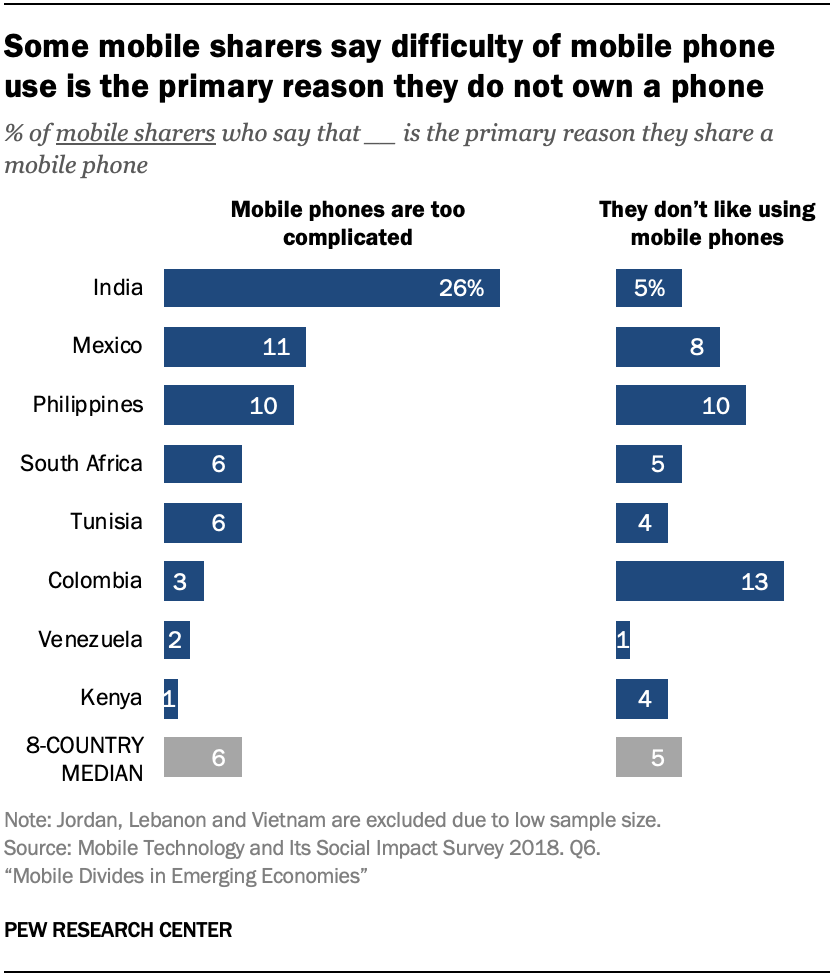
Some mobile sharers say difficulty of mobile phone use is the primary reason they do not own a phone

Mobile phone sharers were also asked explicitly whether the difficulty of using a phone was the primary reason why they shared, rather than owned, a device. In some countries, this issue of technological literacy is particularly pronounced. For example, around a quarter of Indians (26%) say the primary reason they share a phone is because it is too complicated to use, followed by Mexicans (11%) and Filipinos (10%). Almost no Kenyans (1%) report this as the primary reason why they share a phone.

While some mobile phone sharers simply don’t like using mobile phones, this is not a dominant reason people share, rather than own, mobile technology. Colombians (13%) are most likely to cite not liking using mobile phones as their primary reason for sharing a phone, followed by Filipinos (10%). Almost no Venezuelans (1%) report this issue.

3. Mobile owners: What they struggle to do

In every country surveyed, a majority of people own mobile phones, and, in most countries, mobile phone ownership is nearly ubiquitous. Across the 11 countries surveyed, a median of 89% say they own phones, compared with a median of 7% who share phones and 6% who don’t own or share phones.

While phone owners clearly have overcome one major obstacle with regard to using technology – namely, they have their own devices – many nonetheless regularly encounter difficulties using their phone to its fullest capacity. Most notably, phone owners are routinely affected by connectivity-related and financial challenges.

Problems getting reliable mobile coverage is one of the most common issues cited by phone owners, but few cite poor network coverage as a frequent issue. An 11-country median of 72% say they have had at least some challenges getting reliable mobile connection, but only a median of one-in-five (20%) experience this issue frequently. When it comes to financial hurdles, a median of 62% say they have limited their activity on their phone to conserve data at some point, and nearly as many (median of 58%) have had issues paying for their phone use. Phone owners are somewhat less likely to face issues related to language, though this, too, can affect some phone owners.

Finances a major hurdle to using phones for many mobile phone owners

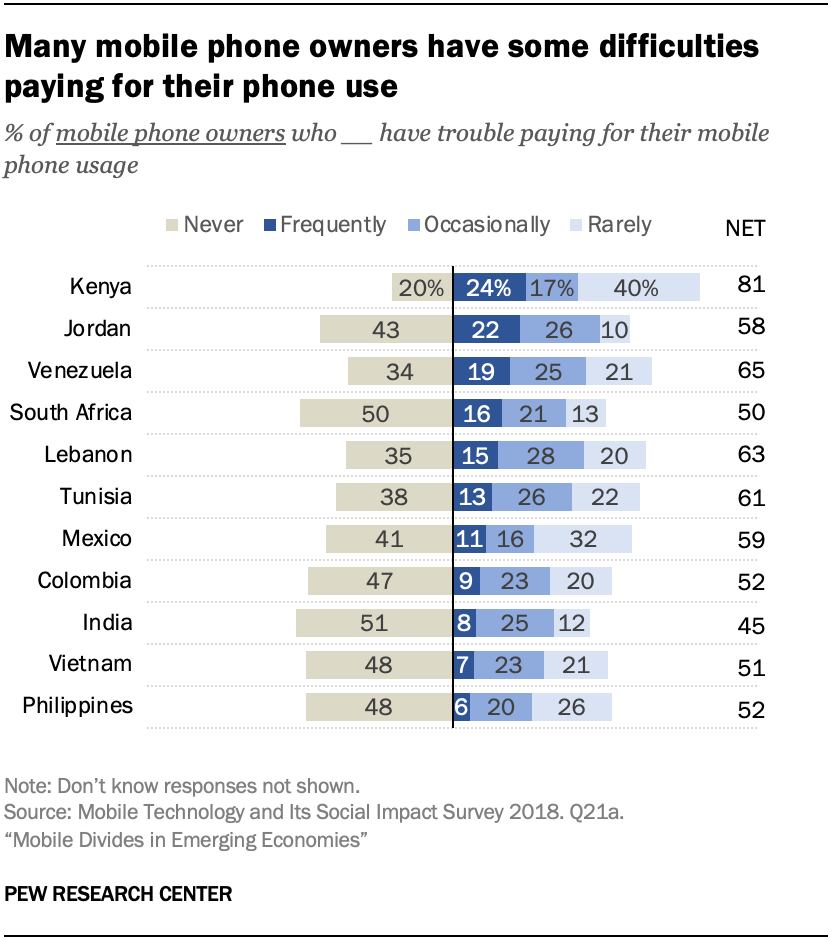
Many mobile phone owners have some difficulties paying for their phone use

Most mobile phone owners have at least some difficulty paying for their mobile phones. In almost all countries surveyed, around half or more say they have, at some point, had trouble paying for their phone use. But around one-in-four or fewer in each country surveyed say they frequently have such financial difficulties. Frequent difficulty paying for mobile phone use is highest in Kenya (24%), Jordan (22%) and Venezuela (19%) and is lowest in India (8%), Vietnam (7%) and the Philippines (6%).

When you know you will come into some money in the week, you can borrow that 500 and use it on data and then replace it. You are forced to go beyond your budget. Female, 35, Kenya

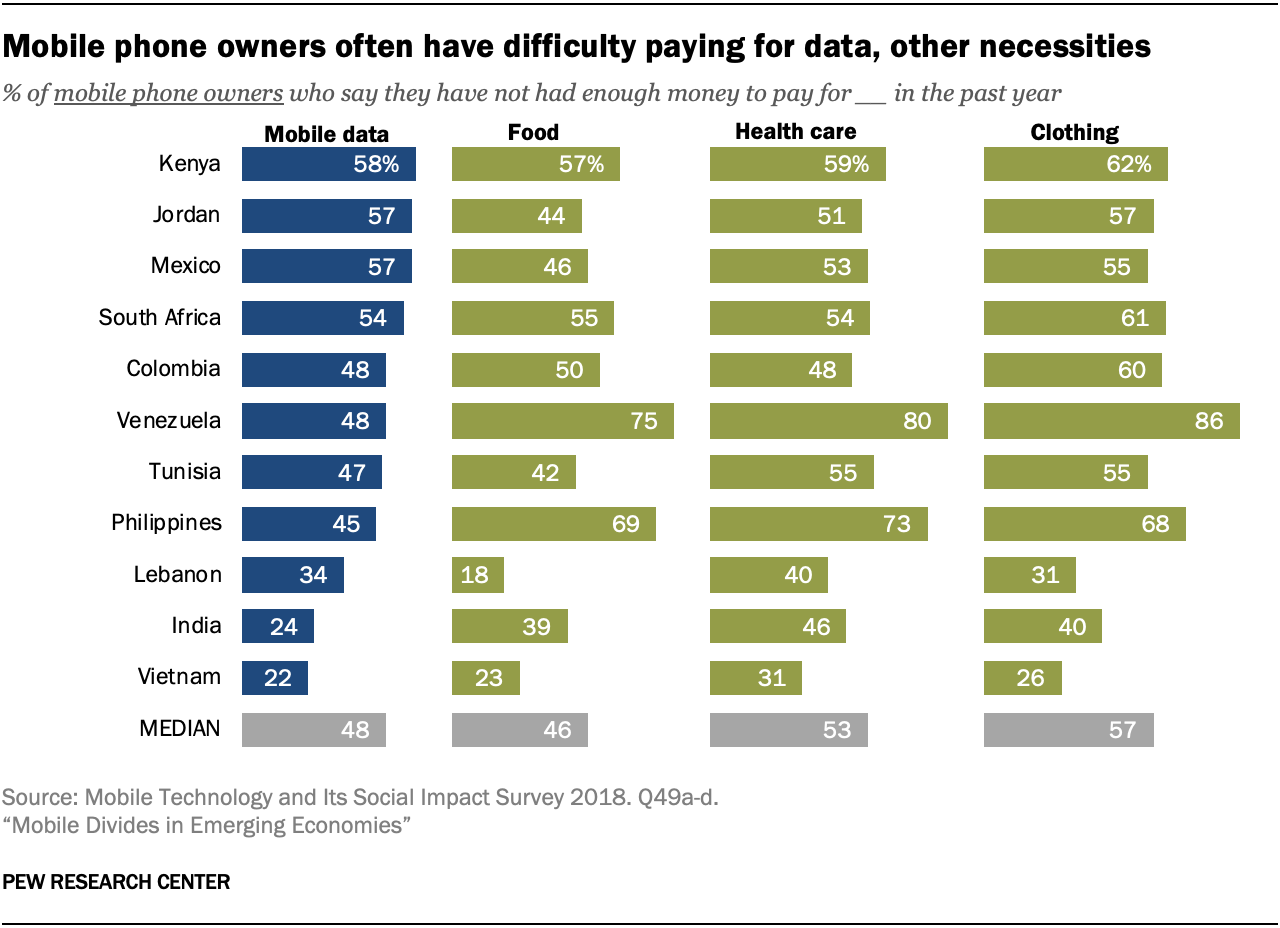
For many mobile phone owners, the cost of data can present real difficulties. A median of 48% say they have not had enough money to pay for their mobile data over the past year, ranging from a high of 58% in Kenya to a low of 22% in Vietnam. In most countries, this was comparable with the percentage of mobile phone owners who had difficulty paying for other necessities whether it be food, health care or clothing. For example, Colombians are about as likely to say they had trouble paying for mobile data over the past year (48%) as to say they had trouble affording food (50%) and health care (48%), despite the differing costs of these various necessities.

Mobile phone owners often have difficulty paying for data, other necessities

Facebook is quite famous here in the Philippines because of our free Facebook. Woman, 30, Philippines

But, in two countries – the Philippines and Venezuela – many fewer mobile phone owners had difficulties paying for data than the other necessities asked about. In the Philippines, this may reflect the relative affordability of mobile data and free access to Facebook via Facebook Basics, coupled with the country’s recovery from a typhoon.

In Venezuela, where the International Monetary Fund calculates the 2018 inflation rate to be a whopping 65,370%, three-quarters or more say they had times over the past year where they had difficulty affording food (75%), health care (80%) or clothing (86%), while far fewer say the same about data (48%). As in the Philippines, Venezuela has relatively inexpensive data, with one of the most popular plans running for 100 bolivars ($0.15) per month on the black market.

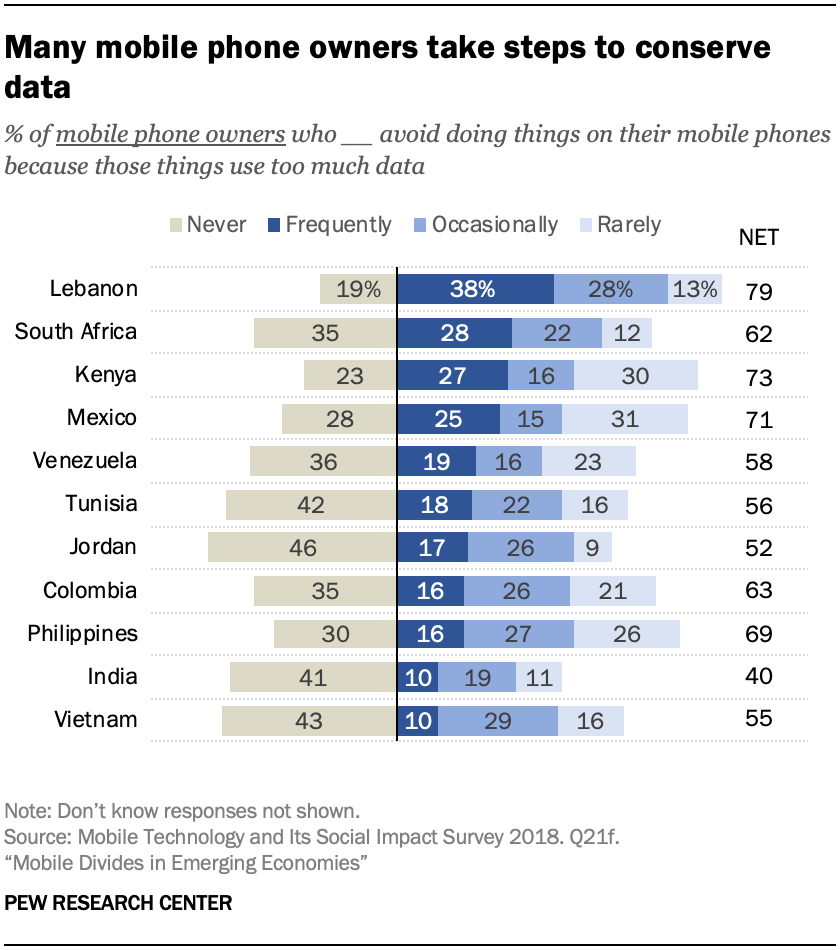
Many mobile phone owners take steps to conserve data

In light of financial concerns, mobile phone owners across the 11 countries often take steps to conserve data. A median of 18% say they frequently avoid doing things on their mobile phones because they use too much data. This share varies across countries, with 38% of Lebanese phone owners frequently taking steps to conserve data, compared with only 10% of Vietnamese or Indian phone owners.

Owning a mobile means money, you might not be able to afford, both in terms of the device and of the service, you ought to pay. Since I’m only devoted to my family, I’d only reach them if I must, and if I’m to be reached, I’d rather I got those through my landline. Woman, 42, Mexico

A greater share has tried to conserve data, even if they don’t do so regularly. Across all countries surveyed, a median of 62% say they have at some point taken steps to conserve data by limiting their mobile activities, compared with a median of 35% who say they have never done so.

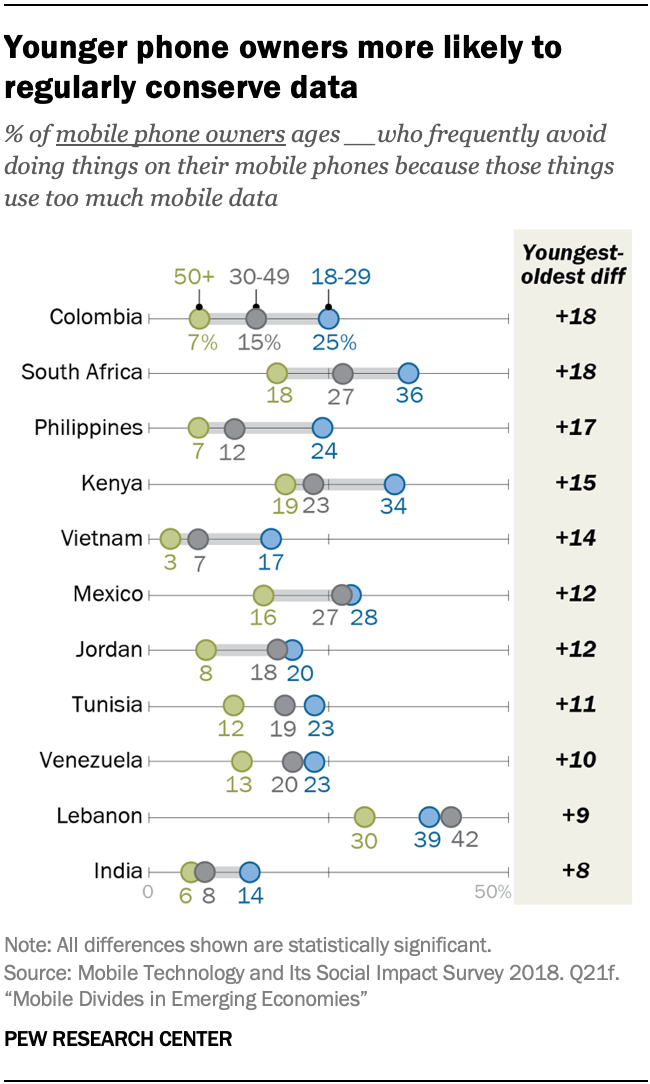
Younger phone owners more likely to regularly conserve data

In all countries surveyed, younger phone owners are more likely to frequently conserve their data than older phone owners. For example, in Colombia, 25% of those under 30 say they regularly limit activity on their phones to conserve data, compared with 7% of those ages 50 and older.

Financial constraints may also lead some mobile phone owners to use multiple SIM cards as a way to save money, whether by taking advantage of discounts offered by different companies or to ensure that they are communicating with people on other networks as cheaply as possible.

For example, in focus groups in the Philippines conducted by Pew Research Center, participants detailed the exact benefits offered by different companies such as TM, Smart and Globe and described using each SIM for particular promos and savings (see Appendix A for more information on the focus groups). In another group, a Kenyan participant who used multiple SIMs described doing so to maximize coverage in different areas of the country.

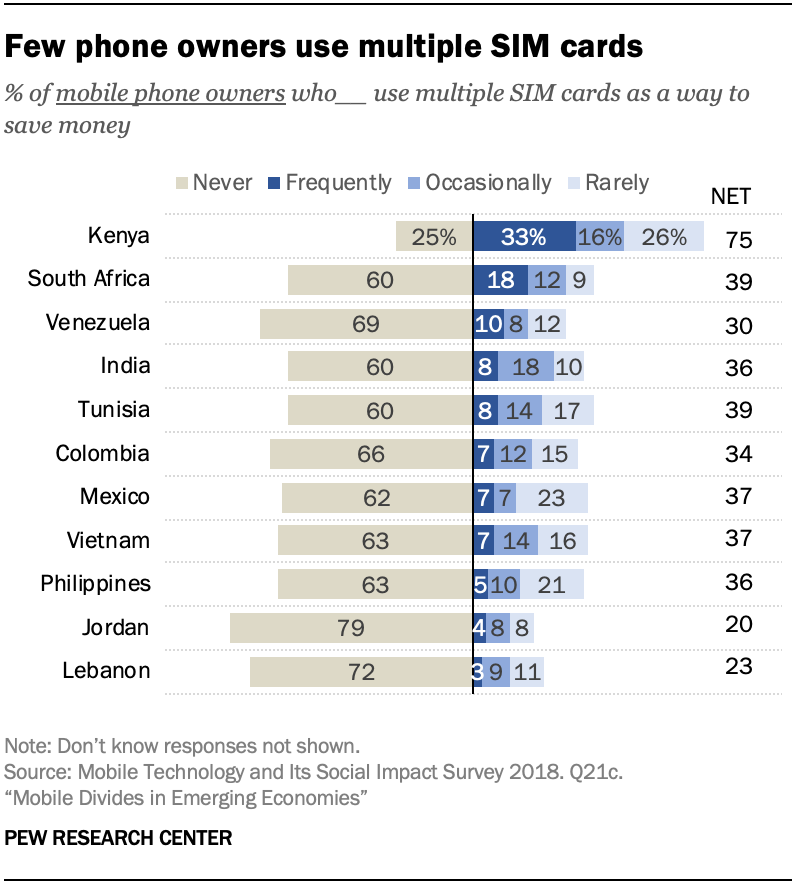
Few phone owners use multiple SIM cards

Across the countries surveyed, a median of 7% say they frequently use multiple SIM cards to save money. This share is lowest among Lebanese (3%) and Jordanian (4%) mobile phone owners and much more common in Kenya, where a third (33%) of phone users say they frequently use multiple SIM cards to save money.

In some countries, younger people, men and more educated people are also more likely to use multiple SIMs to save money, suggesting that this cost-effective method may also require some technological savvy and know-how.

Security concerns are widespread among mobile phone owners, particularly more affluent ones

My sister had a problem, somebody used her identity and she had problems with her fiancée. Some people had problems because some other people are using their identity. Woman, 25, Tunisia

Mobile phone owners may also face obstacles using their mobile phones because of concerns about security. Around two-thirds or more in every country report concerns about identity theft. Around nine-in-ten mobile phone owners in Mexico (95%), Colombia (94%), Tunisia (90%), South Africa (89%) and the Philippines (89%) say they are at least somewhat concerned. A median of 65% of phone owners across all countries surveyed are very concerned about identity theft. Aside from India, half or more individuals in every country say they are very concerned about identity theft.

In most countries, phone owners with higher incomes and education levels are more likely to report being very concerned about identity theft than those with lower incomes and educations. For example, around half of Kenyan mobile owners with less education (52%) say they are very concerned about identity theft, whereas 68% of Kenyan mobile owners with more education report being very concerned.

Mobile connectivity is an obstacle for many phone owners

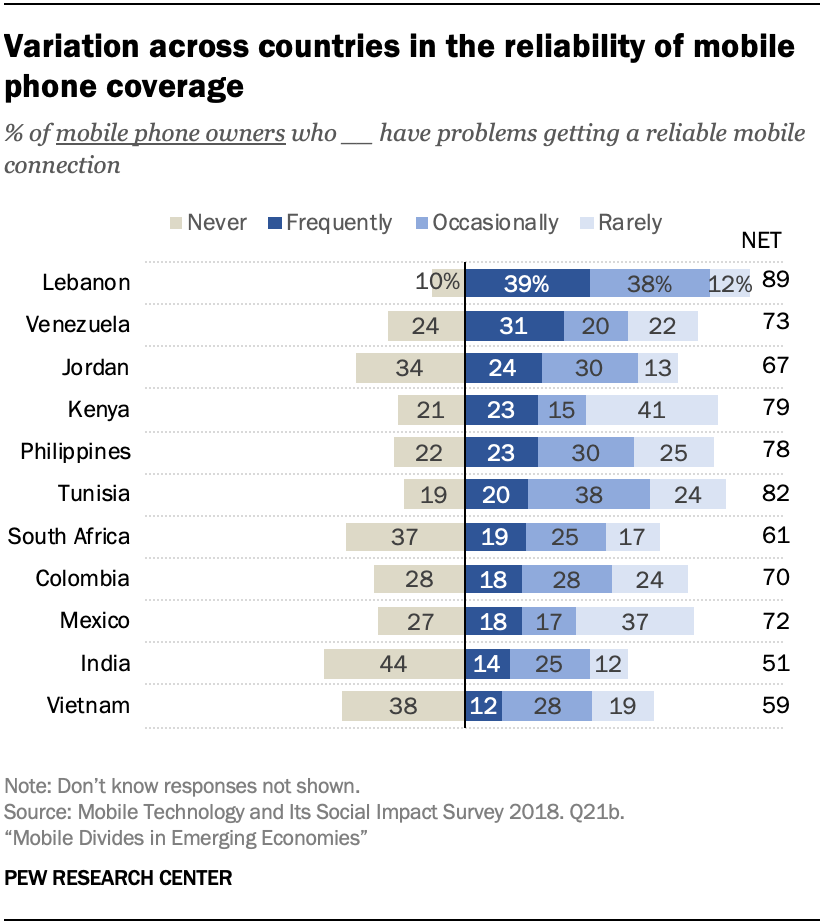
Variation across countries in the reliability of mobile phone coverage

Many mobile phone owners report connectivity issues in using their devices. A median of 20% say they frequently have problems getting a reliable mobile connection. However, there is substantial variation across countries, ranging from highs of more than three-in-ten in Lebanon (39%) and Venezuela (31%) to only around one-in-ten in Vietnam (12%) and India (14%).

And, when it comes to experiencing these types of connectivity issues in general, a much greater share say they have had at least some trouble getting reliable coverage, even if it has been rare. A median of 72% report ever having difficulties with reliable connections, while only a minority in most countries say this has never happened to them (median of 27%).

I’d be more concerned [about battery use] because it’s not something you can fix right away. You need either to wait until you get home or ask someone for a charger. Woman, 46, Mexico

The connectivity challenges faced by phone owners in the survey countries are not limited to mobile coverage. In eight of the 11 countries surveyed, majorities have at least some trouble finding a place to charge their phones. Further, an 11-country median of 13% of phone owners say they frequently have trouble finding a place to charge their phones, ranging from a high of almost two-in-ten (19%) in Kenya to a low of fewer than one-in-ten (9%) in Vietnam and India.

Phone owners have few issues finding online content in their language

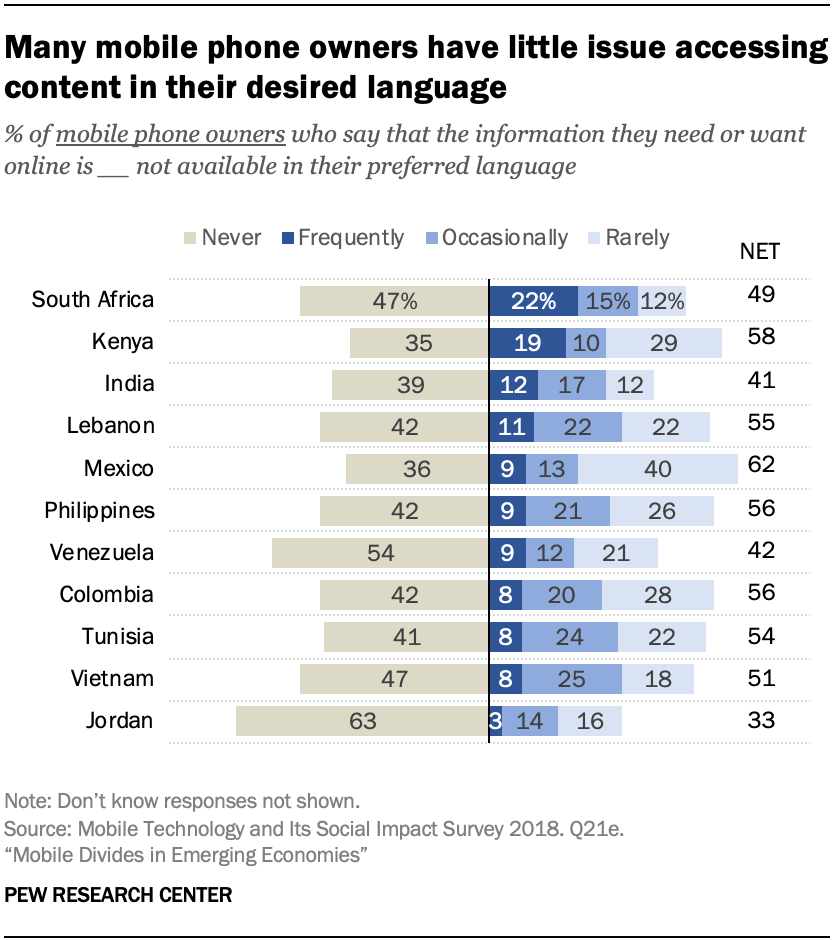
Many mobile phone owners have little issue accessing content in their desired language

While people can use their phones and the internet in many languages, those who speak less-commonly spoken languages or whose primary languages are infrequently written may face challenges finding content they want online. Moreover, much information on the internet is in English or in a few other – primarily European – languages.

However, most mobile phone owners in these 11 emerging economies are, nonetheless, able to find information in their desired language. A median of only 9% report frequently being unable to access information they want in their preferred language. Less frequent difficulties do occur, though; in eight of the countries surveyed, around half or more have, at some point, experienced issues finding information online in their language of choice.

Many mobile phone owners have some English abilities

In South Africa and Kenya, around two-in-ten phone owners say they frequently have trouble finding information in their language of choice. In Kenya, while 83% say they can read at least some English, when given the choice during fieldwork, more than half (53%) of mobile phone owners opted to be interviewed in Swahili, suggesting they may be dominant in languages that are less common online.

In South Africa, too, English-reading ability is relatively widespread among phone owners (89%), yet many phone owners may prefer content in other languages, including Zulu, North Sotho, Xhosa, SeSotho or Afrikaans – some of the languages used during fieldwork.

4. Obstacles to using phones

Individuals face many potential hardships when trying to access mobile technology. As discussed in previous chapters, these can range from limited access to electricity to low literacy to financial constraints or some combination of these and other factors.

Given this complexity, we wanted to understand who experiences which types of problems using mobile phones and the regularity with which they experience them. Additionally, we wanted to explore the differences among mobile phone owners, sharers and non-users, who were each analyzed separately in earlier chapters. To do this, we created four scales, each addressing a different type of issue that can affect people’s phone use: connectivity, financial, language and security.

Each scale is composed of between three and six questions related to that topic. On questions that measured the regularity of different problems, people were given a score of “1” if they “frequently” experienced that issue or if that issue prevented them from owning or sharing a phone and “0” if they did not frequently experience it. For example, individuals were identified as having a persistent language issue if they said information they want or need on the internet is frequently unavailable in their preferred language, among other questions. (For more on how other questions are coded as part of the scale, see Appendix B).

Although each scale is composed of three to six questions, no one was asked every question because phone owners, phone sharers and non-users were asked different questions. For example, only owners and sharers were asked whether information they sought online was regularly unavailable in their language, and only non-users were asked whether inability to read well was a reason they did not use a mobile phone. But all adults were asked at least one question included in each of the scales and thus are included in the following analyses (for more details, see Appendix B).

Defining different types of hardships

Connectivity hardship – Individuals are identified as having a connectivity hardship if they report difficulty using mobile phones because of poor service coverage or few places to charge a device (owners and sharers) or if lack of service prevents them from using a phone (non-users).

Financial hardship – Mobile phone users are identified as having a financial hardship if they report frequently having trouble paying for mobile data, frequently avoiding doing things on their phone because they use too much data or if they did not have enough money to afford mobile data at some point in the last year. Mobile sharers were asked an additional question about whether the main reason that they do not have their own phone is because they cannot afford one. Non-users with financial hardships are those who say the cost of a mobile device or mobile data is one of their reasons for not using a mobile phone or who said they did not have enough money to afford mobile data at some point in the last year.

Language hardship – Phone owners and sharers have a language-related issue if they report content they want or need online is frequently not available in their preferred language. Non-users are identified as having language issues if they say they do not use mobile phones because they do not think there are apps or websites in their language or if they say they cannot read well enough to use a mobile phone.

Security hardship – This measure includes all adults who report being very concerned about their personal information being stolen. Among those who say they share a phone, this includes adults who report worry their phone could be stolen or because their phone was previously lost, broken or stolen. Non-users with security hardships are those who say they do not use a mobile device for fear it would be stolen or have concerns about the security of their information.

Security-related hardships are among the most common

Security, financial issues among the most common hardships faced regarding accessibility of mobile phones

Security-related hardships are relatively common in the 11 emerging economies surveyed, with a median of 69% reporting at least one security hardship. Outside of India, half or more report facing at least one security-related hardship, meaning most individuals are concerned about the security of their information or the physical security of their device. These hardships are especially common in Colombia (84%), Mexico (82%) and South Africa (79%). These countries all rank at or above the median for robbery rates, according to a report from the United Nations Office on Drugs and Crime.

Many individuals also report experiencing financial hardships regarding access to mobile phones (median of 60%). Outside of India and Vietnam, a majority in every country reports experiencing at least one financial hardship. This is highest in Kenya, where 74% of adults report issues affording mobile phones or data.

But while experiencing at least one financial hardship is common, among mobile users, few people experience multiple financial hardships (median of 22%).

Across the 11 countries surveyed, fewer report experiencing a connectivity issue (median of 28%). In every country, fewer than half say they frequently have issues related to reliable service or charging their phone. Connectivity issues are most common in Lebanon, where about four-in-ten adults (41%) report connectivity difficulties.

Most mobile users do not report any connectivity hardships (median 71%). Among those who do have a connectivity hardship, however, few have problems both getting reliable service and charging their phones. Rather, most tend to experience only one of these issues. For example, 66% of mobile phone users in Kenya say they experience no frequent issues, compared with 25% who frequently face one connectivity obstacle and 9% of mobile phone users who say they frequently experience two.

In every country surveyed, only a minority report a language-related issue using their phones (median of 13%). The highest rate of language issues is found in South Africa, where about a quarter (24%) report a language issue. This may be due, in part, to the diversity of languages found in South Africa. As such, some individuals may perceive limited availability of content in their preferred language, even if they are able to read and understand content in other languages.

Smartphone owners experience more security-related concerns

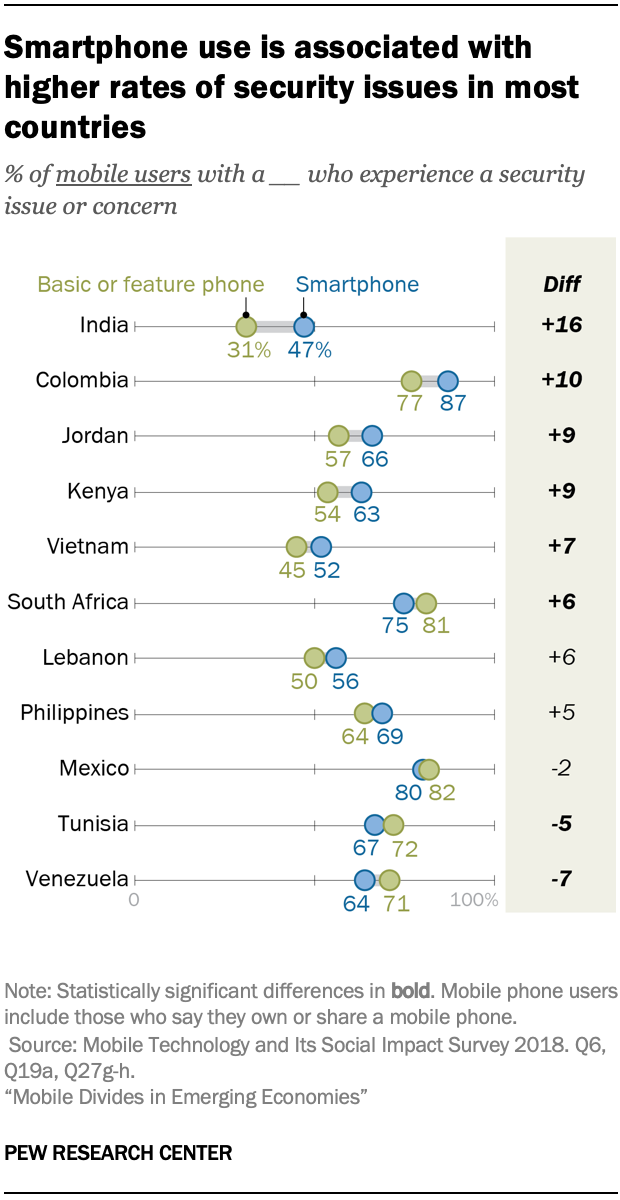
Smartphone use is associated with higher rates of security issues in most countries

Among mobile phone users, smartphone users are more likely than basic or feature phone users to report a security-related concern. In India, for example, 47% of smartphone users say they worry about security issues, compared with 31% of basic or feature phone users who say the same.

In five countries, those with more education are more likely to report concerns regarding the security of mobile phones and the information they may contain. In Kenya, 69% of individuals with more education report a security issue, compared with 54% of individuals with less education. But, in Tunisia and Venezuela, these patterns are reversed: Those with lower levels of education are more likely to experience a security-related issue.

Those who are lower income face more financial hurdles to mobile technology

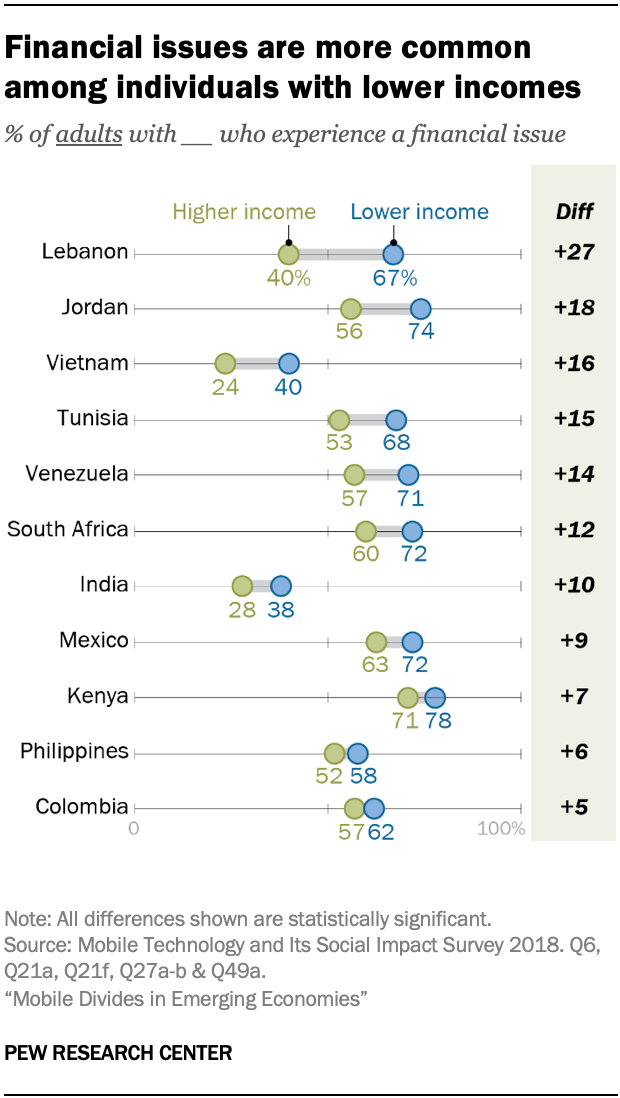
Across all 11 countries surveyed, individuals with lower incomes are more likely than those with higher incomes to have a financial difficulty that affects their technological access. For example, 67% of lower-income Lebanese experience a financial issue, compared with 40% of higher-income Lebanese.

You can’t really use your [smart]phone on public transit as it could be stolen. Man, 21, Tunisia

Financial issues are more common among individuals with lower incomes

In most countries, younger adults (those ages 18 to 29) are more likely than older adults to report a financial issue. For example, while around half (49%) of South African adults ages 50 and older report financial issues, around three-quarters (77%) of those 18 to 29 say the same.

In six of the 11 nations, those with less education are more likely to experience a financial hardship. Take Jordan as an example: 72% of people with lower levels of education report a financial issue, compared with 58% of those with higher levels of education.

In three countries for which the analysis is possible, mobile phone owners are less likely to report a financial issue than sharers or non-users. The greatest differences are in Venezuela, where 61% of mobile phone owners experience a financial issue, compared with 81% of sharers and 94% of non-users.

When looking at only mobile phone users (both owners and sharers), smartphone users are more likely than those with a basic phone to report a financial issue in most countries. In South Africa, 57% of basic or feature phone users report a financial issue, compared with 71% of smartphone users.

Younger people often have more connectivity-related issues

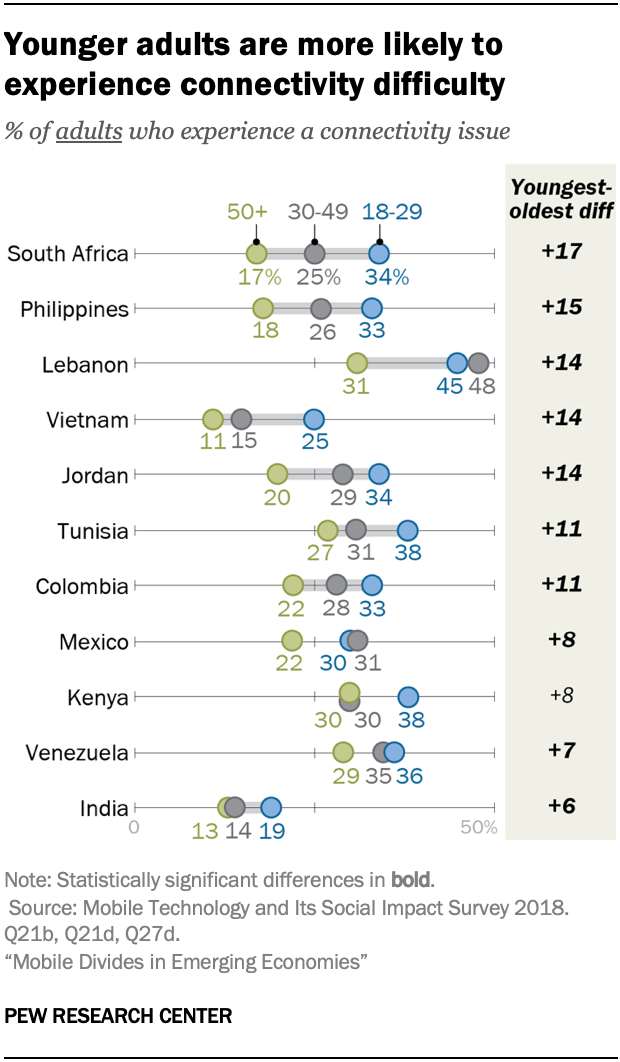
Younger adults are more likely to experience connectivity difficulty

In all countries but Kenya and Lebanon, those ages 18 to 29 are more likely than those 50 and older to report a connectivity issue. For example, about a third of younger Filipinos (33%) have a connectivity issue, whereas 18% of older adults report the same. In contrast, in most countries, gender, income and education have little bearing on whether people experience a connectivity issue.

Those with a smartphone are also more likely to report a connectivity issue than those who use a basic or feature phone in seven of the countries surveyed. For example, in Jordan, 32% of smartphone users experience a connectivity issue, compared with 17% of basic or feature phone users.

I have that behavior where I ask people if I can charge my [smart]phone for two seconds. Woman, 49, Kenya

People with basic English literacy face fewer language-related hardships

In all countries surveyed, experiencing a language-related hardship is relatively uncommon. But, in some countries, those with lower levels of education are more likely to experience this hardship than those with higher levels. For example, 17% of Mexicans with lower levels of education experience a language-related issue, compared with 9% of those with more education.

In six countries, those who can read at least some English are less likely to experience a language-related hardship. For example, in the Philippines, 12% of individuals who can read at least some English say they have a language issue, while nearly twice as many Filipinos who cannot read English report the same (22%).

Non-mobile phone users are more likely than phone sharers or owners to report having a language issue in many countries for which the analysis is possible.4 In Tunisia, for example, 57% of non-users report a language-related issue, compared with 8% of both mobile sharers and owners.

Many people experience concurrent barriers to mobile accessibility

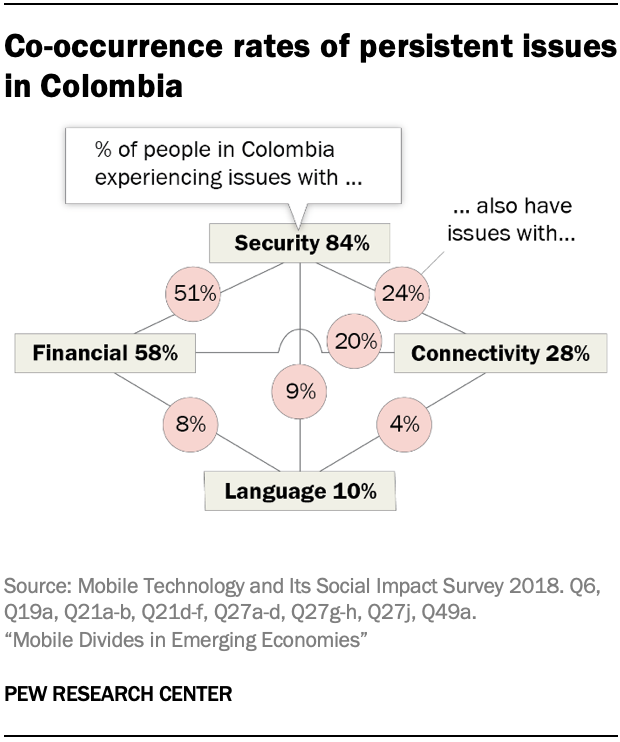
Co-occurrence rates of persistent issues in Colombia

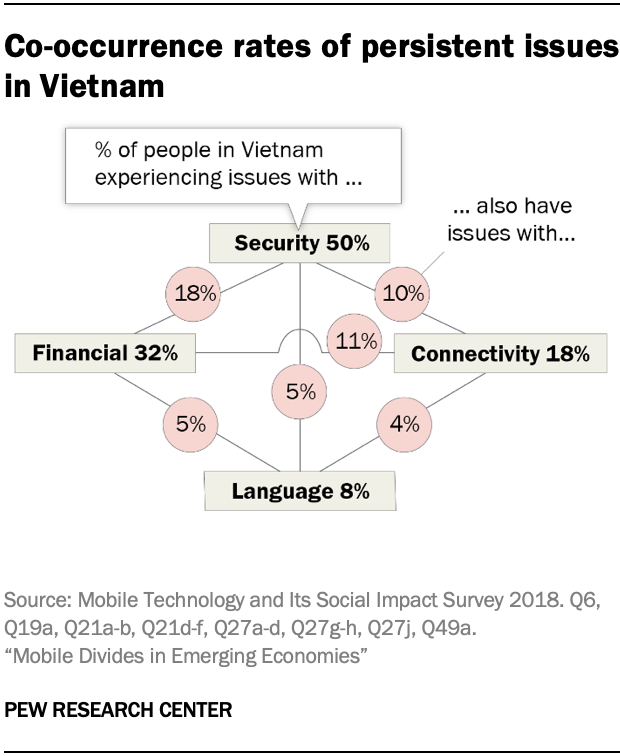
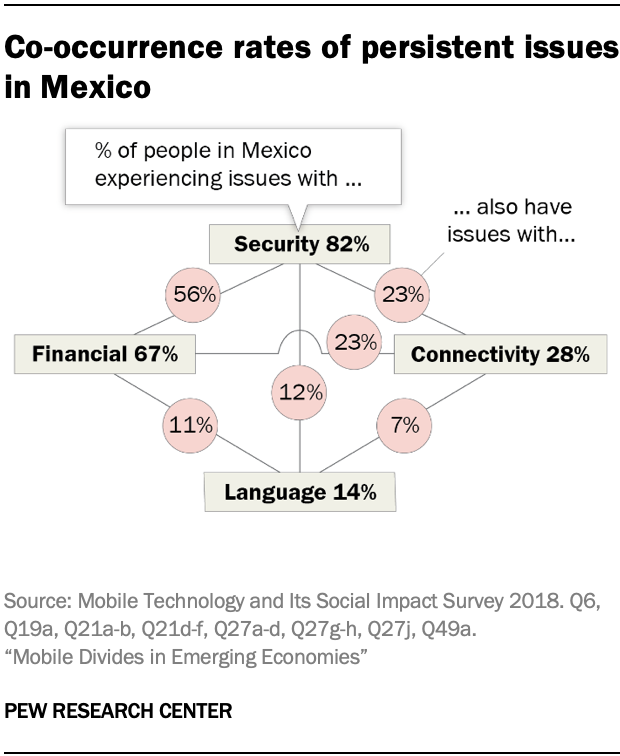
Barriers to mobile use do not occur in isolation. Between 27% and 67% of individuals in each country simultaneously experience two or more types of hardship, and between 1% and 7% of individuals experience all four types of hardship we asked about.

For the two most common hardships – security and financial – between 13% and 56% of individuals in each country surveyed experience both hardships concurrently. For example, roughly half of Colombians (51%) simultaneously experience security and financial issues (for all country-specific numbers, see Appendix C). In fact, aside from India, roughly half or more who experience one of these issues also experiences the other (between 56% and 87%).

[You need an] additional budget because of the load and electricity, because you need to charge it. Before I paid for 100 but now it’s 200 already. Woman, 26, Philippines

Although language issues occur at low rates, individuals in most countries who experience a language-related issue are significantly more likely than those not facing language issues to also face a financial, security or connectivity issue. For example, only 10% of Colombians experience language issues, but the vast majority of that group also experience security issues (overall, this amounts to 9% of the Colombian public who experience both).

Based on statistical analysis that controls for multiple factors concurrently, we find that individuals with higher incomes experience fewer total hardships, whereas smartphone users report experiencing a greater number of hardships. Adults ages 50 and older experience fewer issues than younger adults even after controlling for other demographic factors (for hierarchical linear regression results, see Appendix D).

Difficulties do not shape how people feel about mobile phones in society, but financial difficulties impact perceived personal benefits

Do people who have more difficulty using mobile phones – whether because of costs, service, language or other factors – see them as less beneficial? On the one hand, one might expect that people who have more difficulty using mobile phones could see them as less personally beneficial – and maybe less beneficial to society, as well. On the other hand, those who are endeavoring to use mobile phones – despite the hardships – may be doing so because they see them as more valuable.

Results of this survey suggest that, regardless of hardships associated with mobile phones, people tend to feel similarly about the benefits mobile phones bring to society. In most countries, these evaluations are quite positive. More than half in all countries but Venezuela say that mobile phones have been a good thing for society, ranging from 53% in Jordan 86% in Kenya.

If I pay [for my phone’s] internet, I will get money from there. I will be able to call people from outside and they will give me money. Man, 32, Kenya

Regardless of the type of hardship people face, those who face more challenges accessing mobile phones are still as likely as those facing fewer hardships to see positive societal benefits stemming from digital connectivity.

When asked about specific kinds of impacts  mobile phones might have on various aspects of national life, evaluations are more mixed. But these attitudes are not generally colored by whether individuals have difficulties using their mobile phones due to any of the challenges they might have experienced – such as connectivity, financial, security and language. Rather, people who do not face hardships using their phones and those who do tend to feel similarly about how mobile phones impact their country’s economy, education and even children in the country.

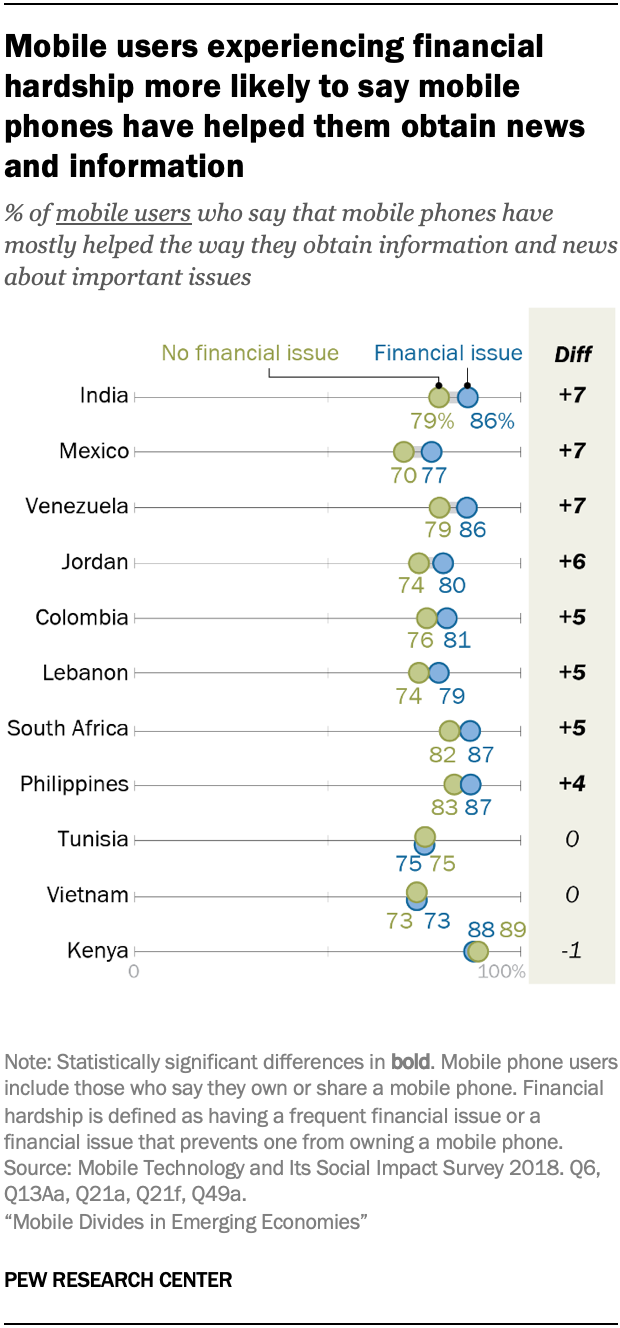
Overall, people say mobile phones have been personally beneficial regardless of whether they have experienced hardship in accessing them. Aside from Venezuela, where only around half (49%) see personal benefits, in every other country surveyed, roughly three-quarters or more say they gain personally from mobile devices. When it comes to particular types of personal benefits, though, mobile users who face financial hardships are somewhat more likely to see mobile phones positively impacting them when it comes to obtaining news and information, earning a living, concentrating and getting things done, and communicating face-to face.

Mobile users experiencing financial hardship more likely to say mobile phones have helped them obtain news and information

For example, 86% of Venezuelan mobile users reporting a financial issue say that mobile phones help them obtain information and news, compared with 79% of those not reporting a financial issue. Similarly, 73% Indian mobile users who report a financial issue say mobile phones have mostly helped them earn a living, compared with 63% of Indian mobile users who do not report a financial issue.

Acknowledgments

This report is a collaborative effort based on the input and analysis of the following individuals.   

Laura Silver, Senior Researcher Emily A. Vogels, Research Associate Mara Mordecai, Research Assistant Jeremiah Cha, Research Assistant Raea Rasmussen, Intern Lee Rainie, Director, Internet and Technology Research

Sara Atske, Associate Digital Producer James Bell, Vice President, Global Strategy Peter Bell, Design Director Shawnee Cohn, Communications Manager Stefan Cornibert, Communications Manager Claudia Deane, Vice President, Research Kat Devlin, Research Associate Moira Fagan, Research Analyst Shannon Greenwood, Digital Producer Christine Huang, Research Assistant Courtney Johnson, Research Associate Michael Keegan, Senior Information Graphics Designer David Kent, Copy Editor Martha McRoy, Research Methodologist Patrick Moynihan, Associate Director, International Research Methods Stacy Pancratz, Research Methodologist Andrew Perrin, Research Analyst Margaret Porteus, Information Graphics Designer Audrey Powers, Senior Operations Associate Aaron Smith, Associate Director, Research Kyle Taylor, Research Analyst Richard Wike, Director, Global Attitudes Research

Pew Research Center also received helpful advice and feedback for this report from a panel of expert advisers: Michael Kende, visiting professor at the Graduate Institute, Geneva; Christopher Yoo, John H. Chestnut professor of law, communication, and computer & information science, and director, Center of Technology, Innovation & Competition at the University of Pennsylvania; and Joshua A. Tucker, professor of politics, director of the Jordan Center of the Advanced Study of Russia and co-director of the Social Media and Political Participation (SMaPP) lab at New York University. While the analysis was guided by our consultations with these advisers, Pew Research Center is solely responsible for the interpretation and reporting of the data.

Methodology

Results for the survey are based on face-to-face interviews conducted under the direction of D3 Systems Inc. The results are based on national samples. More details about our international survey methodology and country-specific sample designs are available here.

Appendix A: About the focus groups

Pew Research Center conducted a series of focus groups to better understand how people think about their own mobile phones and the impact of these devices on their society. Five focus groups were held in each of the following four countries: Kenya, Mexico, the Philippines and Tunisia.

Each focus group consisted of 10 adults coming together for an hour and a half for a discussion led by a local, professional moderator using a guide developed by Pew Research Center.

In each country, the groups were structured according to the following criteria:

  • Group 1, “basic phone” – all participants either owned or shared a basic phone that could not connect to the internet and were 36 years old or older;
  • Group 2, “younger, smartphone” – all participants owned or shared a smartphone and were under the age of 30;
  • Group 3, “older, smartphone” – all participants owned or shared a smartphone and were at least 30 years old;
  • Group 4, “women phone users” – all participants were women who either owned or shared a phone (including a minimum of five participants who owned or shared a smartphone) and at least two participants were married and two were unmarried;
  • Group 5, “migrant phone users” – all participants either owned or shared a phone (including a minimum of five participants who owned or shared a smartphone), and all either lived in a place that was different from where they grew up or had a family member who lived elsewhere.

All focus groups also required participants to have at least some interest in politics, and, aside from group 4, which was all women, they were balanced with regard to gender. Aside from group 1, participants were also required to use their phone at least once a week. Where feasible, participants were recruited to ensure diversity with regard to education levels, employment status, rural and urban location, and the duration for which they have owned their phones.

Focus groups were held in the following locations and on the following dates:

  • Mexico City, Mexico: March 13-15, 2018
  • Manila, Philippines: March 21-23, 2018
  • Nairobi, Kenya: March 26-28, 2018
  • Tunis, Tunisia: March 28-30, 2018

D3 Systems Inc. worked with local field partners in each of the four countries to recruit the participants using a screener designed by Pew Research Center. All participants were given financial remuneration for their time.

These groups were primarily used to help shape the survey questions asked in each of the 11 countries. But, throughout the report, we have also included quotations that illustrate some of the major themes that were discussed during the groups. Quotations are chosen to provide context for the survey findings and are not necessarily representative of the majority opinion in any particular group or country. Quotations may have been edited for grammar, spelling and clarity.

Appendix B: How the hardship scales were created and coded

Connectivity scale coding

Three items were used to create the persistent connectivity hardship scale. Two questions were asked of mobile users (owners and sharers), and one question was asked of non-users. If an individual’s response on any item related to connectivity was coded as hardship, the individual was considered to have a persistent connectivity issue.

ASKED ONLY OF MOBILE USERS (OWNERS AND SHARERS)

Q21b. How often do you have problems getting a reliable mobile connection?

  • Frequently [coded as connectivity hardship = yes (1)]
  • Occasionally / rarely / never / don’t know / refused [coded as connectivity hardship = no (0)]

Q21d. How often do you have trouble finding a place to charge your mobile phone’s battery?

  • Frequently [coded as connectivity hardship = yes (1)]
  • Occasionally / rarely / never / don’t know / refused [coded as connectivity hardship = no (0)]
ASKED ONLY OF NON-MOBILE USERS

Q27d. There is no mobile phone service where you live – is this a reason why you do not currently have a mobile phone, or not?

Response options:

  • Yes, this is a reason [coded as connectivity hardship = yes (1)]
  • No, this is not a reason / don’t know / refused [coded as connectivity hardship = no (0)]

Financial scale coding

Six items were used to create the persistent financial hardship scale. One question was asked of all respondents. Two questions were asked of mobile users (owners and sharers), one question was asked of only mobile sharers and two questions were asked of non-users. If an individual’s response to any item related to finances was coded as a hardship, that individual was considered to have a persistent financial issue.

ASKED OF ALL RESPONDENTS

Q49d. Have there been times during the last year when you did not have enough money to buy mobile data – yes or no?

Response options:

  • Yes [coded as financial hardship = yes (1)]
  • No / does not apply to me / don’t know / refused [coded as financial hardship = no (0)]
ASKED ONLY OF MOBILE USERS (OWNERS AND SHARERS)

Q21a. How often do you have trouble paying for your mobile phone usage?

Response options:

  • Frequently [coded as financial hardship = yes (1)]
  • Occasionally / rarely / never / don’t know / refused [coded as financial hardship = no (0)]

Q21f. How often do you avoid doing things you want to do on your mobile phone because those things use too much mobile data?

Response options:

  • Frequently [coded as financial hardship = yes (1)]
  • Occasionally / rarely / never / don’t know / refused [coded as financial hardship = no (0)]
ASKED ONLY OF MOBILE SHARERS

Q6. Please tell me the primary reason why you share a mobile phone, rather than owning your own.

Response options:

  • Can’t afford one [coded as financial hardship = yes (1)]
  • Don’t need to use one regularly [coded as financial hardship = no (0)]
  • Think it’s too complicated to use [coded as financial hardship = no (0)]
  • Not allowed to have your own [coded as financial hardship = no (0)]
  • Don’t like using mobile phones [coded as financial hardship = no (0)]
  • Your phone was lost/broken/stolen [coded as financial hardship = no (0)]
  • Afraid your phone will be stolen [coded as financial hardship = no (0)]
  • Other reason [coded as financial hardship = no (0)]
  • Don’t know [coded as financial hardship = no (0)]
  • Refused [coded as financial hardship = no (0)]
ASKED ONLY OF NON-MOBILE USERS

Q27a. The cost of data is too expensive – is this a reason why you do not currently have a mobile phone, or not?

Response options:

  • Yes, this is a reason [coded as financial hardship = yes (1)]
  • No, this is not a reason / don’t know / refused [coded as financial hardship = no (0)]

Q27b. The cost of a mobile device is too high – is this a reason why you do not currently have a mobile phone, or not?

Response options:

  • Yes, this is a reason [coded as financial hardship = yes (1)]
  • No, this is not a reason / don’t know / refused [coded as financial hardship = no (0)]

Language scale coding

Three items were used to create the persistent language hardship scale. One question was asked of mobile users (owners and sharers), and two questions were asked of non-users. If an individual’s response on any item related to language was coded as hardship, they were considered to have a persistent language issue.

ASKED ONLY OF MOBILE USERS (OWNERS AND SHARERS)

Q21e. How often is the information you want or need online not available in your preferred language?

Response options:

  • Frequently [coded as language hardship = yes (1)]
  • Occasionally / rarely / never / don’t know / refused [coded as language hardship = no (0)]
ASKED ONLY OF NON-MOBILE USERS

Q27c. You can’t read well enough to use a mobile phone – is this a reason why you do not currently have a mobile phone, or not?

Response options:

  • Yes, this is a reason [coded as language hardship = yes (1)]
  • No, this is not a reason / don’t know / refused [coded as language hardship = no (0)]

Q27j. There are no apps or websites available in your language – is this a reason why you do not currently have a mobile phone, or not?

Response options:

  • Yes, this is a reason [coded as language hardship = yes (1)]
  • No, this is not a reason / don’t know / refused [coded as language hardship = no (0)]

Security scale coding

Five items were used to create the persistent security hardship scale. One question was asked of all participants. Two questions were asked of mobile sharers, and two questions were asked of non-users. If an individual’s response on any item related to security was coded as hardship, that individual was considered to have a persistent security concern/issue.

ASKED OF ALL PARTICIPANTS

[IF CONCERNED]

Response options:

  • Very concerned [coded as security hardship = yes (1)]
  • Only somewhat concerned [coded as security hardship = no (0)]
  • Not concerned [coded as security hardship = no (0)]
  • Don’t know [coded as security hardship = no (0)]
  • Refused [coded as security hardship = no (0)]
ASKED ONLY OF MOBILE SHARERS

Q6. Please tell me the primary reason why you share a mobile phone, rather than owning your own.

Response options:

  • Your phone was lost/broken/stolen [coded as security hardship = yes (1)]
  • Afraid your phone will be stolen [coded as security hardship = yes (1)]
  • Don’t need to use one regularly [coded as security hardship = no (0)]
  • Can’t afford one [coded as security hardship = no (0)]
  • Think it’s too complicated to use [coded as security hardship = no (0)]
  • Not allowed to have your own [coded as security hardship = no (0)]
  • Don’t like using mobile phones [coded as security hardship = no (0)]
  • Other reason [coded as security hardship = no (0)]
  • Don’t know [coded as security hardship = no (0)]
  • Refused [coded as security hardship = no (0)]
ASKED ONLY OF NON-MOBILE USERS

Q27g. You are worried it might get stolen – is this a reason why you do not currently have a mobile phone, or not?

Response options:

  • Yes, this is a reason [coded as security hardship = yes (1)]
  • No, this is not a reason / don’t know / refused [coded as security hardship = no (0)]

Q27h. You are worried about the security of your information – is this a reason why you do not currently have a mobile phone, or not?

Response options:

  • Yes, this is a reason [coded as security hardship = yes (1)]
  • No, this is not a reason / don’t know / refused [coded as security hardship = no (0)]

Total number of hardships scale coding

To assess how many total hardships mobile users faced, each mobile user received a score between zero (no hardship responses) and seven (all hardship responses) based on the number of hardship responses they gave for the items asked of mobile users (including the two items asked of all participants).

Count of hardship responses for questions: Q19a, Q21a, Q21b, Q21d, Q21e, Q21f and Q49d.

Appendix C: Co-occurrence rates for each country

Co-occurrence rates of persistent issues in India
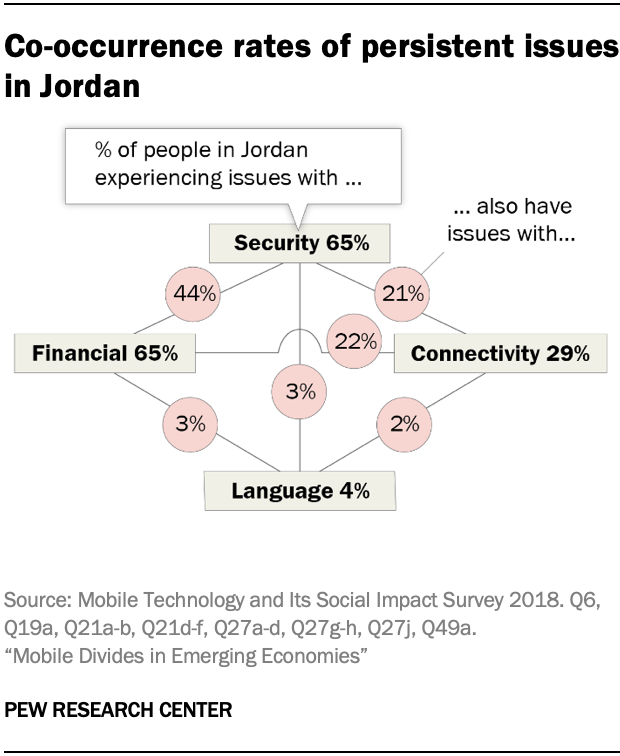
Co-occurrence rates of persistent issues in Jordan
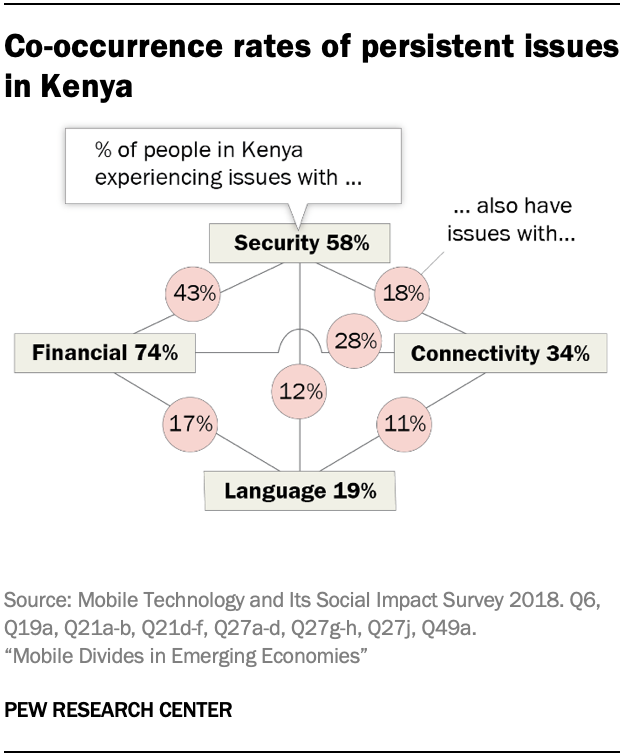
Co-occurrence rates of persistent issues in Kenya
Co-occurrence rates of persistent issues in Lebanon
Co-occurrence rates of persistent issues in Mexico
Co-occurrence rates of persistent issues in the Philippines
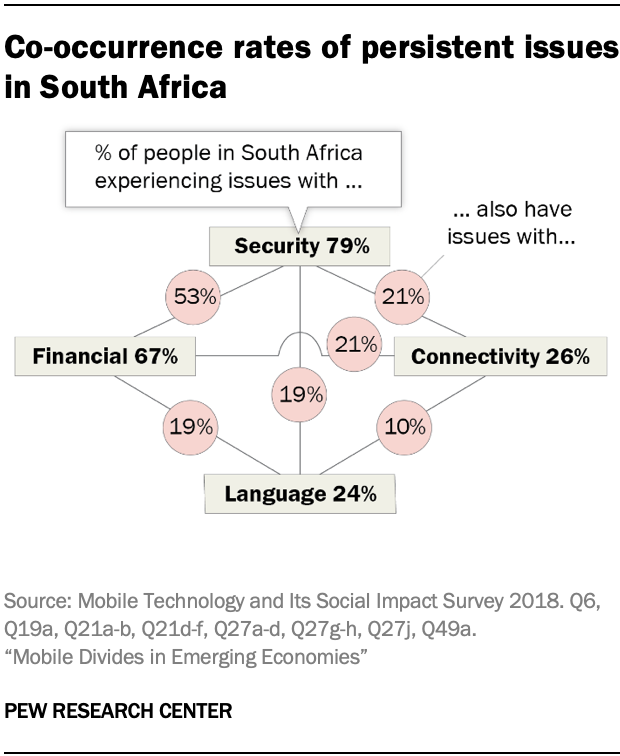
Co-occurrence rates of persistent issues in South Africa
Co-occurrence rates of persistent issues in Tunisia
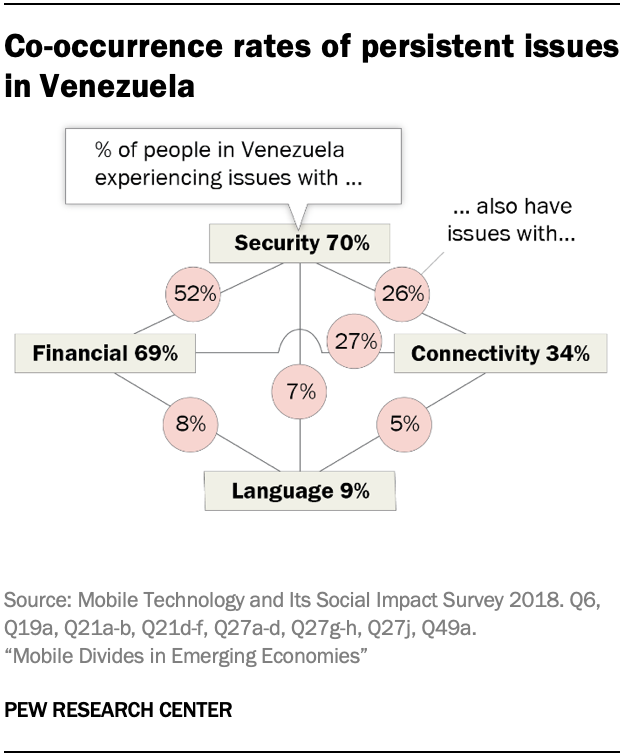
Co-occurrence rates of persistent issues in Venezuela
Co-occurrence rates of persistent issues in Vietnam

Appendix D: Older people, more affluent tend to have fewer hardships using mobile devices

In this report, we explored demographic differences associated with mobile phone use and hardships. To do this, we used a hierarchical linear regression to predict the total number of hardships people experience, controlling for other factors that affect mobile phone use.

We used Stata’s mixed function to estimate a weighted, mixed-effect linear model with random intercepts by country and robust standard errors. In addition to this pooled model, we evaluated the robustness of the results by estimating the model for each country separately. These country-specific models yielded similar conclusions.

The number of hardships people experience serves as the dependent variable. We created a scale that counts the number of hardships mobile users (owners and sharers) report experiencing out of seven possible hardships: frequently experiencing poor service coverage, frequently having trouble finding a place to charge their phone, frequently having trouble affording data, frequently avoiding doing things on their phones in order to save data, not having enough money to afford data at some point in the last year, frequently struggling to find content in their preferred language and being very concerned about identity theft. Scores ranged from zero (reported no hardships) to seven (reported all of the hardships). The independent, or predictor, variables include gender, age, income, education, English literacy and phone type.

Overall, we find that gender, education and being able to read at least some English are not significantly related to the number of hardships mobile users experience. Higher income is associated with a decrease in the number of hardships experienced. Conversely, using a smartphone is associated with more hardships. Holding other demographics factors constant, being older is associated with fewer hardships. Adults age 50 and older experience .36 fewer hardships accessing mobile phones than younger adults. These findings suggest that the age differences seen in other chapters in the report are not due solely to income, educational or phone-type differences.