Pew Research Center

FOR RELEASE MAY 13, 2019

Publics in Emerging Economies Worry Social Media Sow Division, Even as They Offer New Chances for Political Engagement

Many who use social media say they regularly see false and misleading content along with new ideas
BY Aaron Smith, Laura Silver, Courtney Johnson and Jingjing Jiang

FOR MEDIA OR OTHER INQUIRIES:

Communications Department
202.419.4372
www.pewresearch.org

RECOMMENDED CITATION

Pew Research Center, May 2019, "Publics in Emerging Economies Worry Social Media Sow Division, Even as They Offer New Chances for Political Engagement"

About Pew Research Center

Pew Research Center is a nonpartisan, nonadvocacy fact tank that informs the public about the issues, attitudes and trends shaping the world. It does not take policy positions. The Center conducts public opinion polling, demographic research, computational social science research and other data-driven research. It studies politics and policy; news habits and media; the internet and technology; religion; race and ethnicity; international affairs; social, demographic and economic trends; science; research methodology and data science; and immigration and migration. Pew Research Center is a subsidiary of The Pew Charitable Trusts, its primary funder.

© Pew Research Center 2026

Table of contents

  • About Pew Research Center
  • Publics in Emerging Economies Worry Social Media Sow Division, Even as They Offer New Chances for Political Engagement
  • 1. Users say they regularly encounter false and misleading content on social media – but also new ideas
  • 2. More people are comfortable discussing politics in person than on their phones or via social media
  • 3. Publics think technology impacts the political environment in both positive and negative ways
  • Acknowledgments
  • Methodology
  • Appendix A: About the focus groups
  • Appendix B: Technology-related surveys regularly find that people see connectivity bringing positives and negatives
  • Appendix C: Detailed tables

Publics in Emerging Economies Worry Social Media Sow Division, Even as They Offer New Chances for Political Engagement

Many who use social media say they regularly see false and misleading content along with new ideas

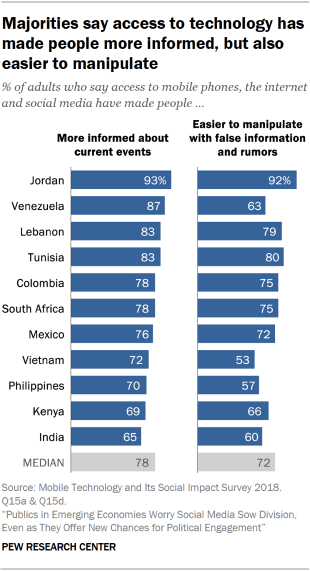
Chart showing that majorities in emerging economies say access to technology has made people more informed, but also easier to manipulate.

In recent years, the internet and social media have been integral to political protests, social movements and election campaigns around the globe. Events from the Arab Spring to the worldwide spread of #MeToo have been aided by digital connectivity in both advanced and emerging economies. But popular social media and messaging platforms like Facebook and WhatsApp have drawn attention for their potential role in spreading misinformation, facilitating political manipulation by foreign and domestic actors, and increasing violence and hate crimes.

Recently, the Sri Lankan government shut down several of the country’s social media and messaging services immediately after Easter day bombings at Catholic churches killed and wounded hundreds. Some technology enthusiasts praised the decision but wondered if this development marked a change from pro-democracy, Arab Spring-era hopes that digital technology would be a liberating tool to a new fear that it has become “a force that can corrode” societies.

In the context of these developments, a Pew Research Center survey of adults in 11 emerging economies finds these publics are worried about the risks associated with social media and other communications technologies – even as they cite their benefits in other respects. Succinctly put, the prevailing view in the surveyed countries is that mobile phones, the internet and social media have collectively amplified politics in both positive and negative directions – simultaneously making people more empowered politically and potentially more exposed to harm.
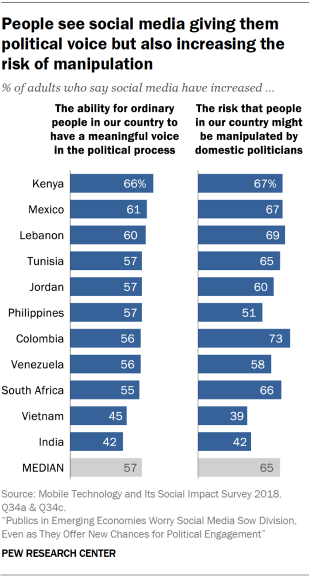
Chart showing that people in emerging economies see social media giving them political voice but also increasing the risk of manipulation.

When it comes to the benefits, adults in these countries see digital connectivity enhancing people’s access to political information and facilitating engagement with their domestic politics. Majorities in each country say access to the internet, mobile phones and social media has made people more informed about current events, and majorities in most countries believe social media have increased ordinary people’s ability to have a meaningful voice in the political process. Additionally, half or more in seven of these 11 countries say technology has made people more accepting of those who have different views than they do.

But these perceived benefits are frequently accompanied by concerns about the limitations of technology as a tool for political action or information seeking. Even as many say social media have increased the influence of ordinary people in the political process, majorities in eight of these 11 countries feel these platforms have simultaneously increased the risk that people might be manipulated by domestic politicians. Around half or more in eight countries also think these platforms increase the risk that foreign powers might interfere in their country’s elections.

Similarly, the widespread view that technology has made people more informed about current events is often paired with worries that these tools might make people vulnerable: Majorities in 10 of these countries feel technology has made it easier to manipulate people with rumors and false information. Further, a recent report by the Center found that a median of 64% across these 11 countries say people should be very concerned about exposure to false or incorrect information when using their phones.

What is a median?

Throughout this report, median percentages are used to help readers see overall patterns. The median is the middle number in a list of figures sorted in ascending or descending order. In a survey of 11 countries, the median result is the sixth figure on a list of country-level findings ranked in order.
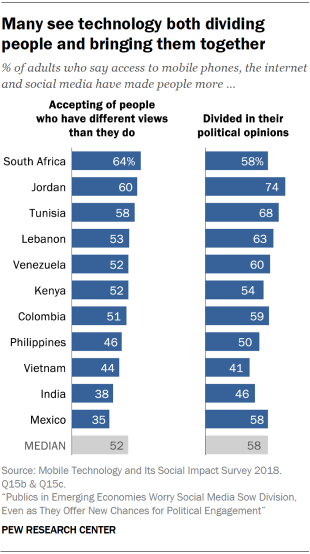
Chart showing that many in emerging economies see technology both dividing people and bringing them together.

Publics in these countries are also conflicted over the extent to which technology is broadening people’s personal horizons or causing their politics to become more tribal – and many seem to see elements of both. An 11-country median of 52% say technology has made people more accepting of those who have different views than they do, while a median of 58% say it has made people more divided in their political opinions. In most countries, larger shares say technology is causing people to be more divided than say it has caused them to be open to different groups of people.

The public’s opinion is easily manipulated through social media. Videos circulating about politicians can either make them famous and likable or break them down.WOMAN, 23, TUNISIA

WOMAN, 23, TUNISIA

Those most attuned to digital technology’s potential benefits are often also most aware of its downsides

It is not simply the case that certain segments of the public have consistently positive views about the political impacts of digital technology while others feel consistently more negative. In many instances, individuals who are most attuned to the potential benefits technology can bring to the political domain are also the ones most anxious about the possible harms.

For instance, in 10 of the 11 countries surveyed, the view that technology has made people more informed is correlated with the view that technology has made people easier to manipulate with rumors and false information. And in most countries, the view that technology has made people more accepting of each other is correlated with the view that it has made people more divided in their political opinions.

The social media landscape in the 11 countries surveyed

This report is the second in a series exploring mobile connectivity in 11 emerging economies. Because the first report goes into detail on mobile phone ownership and social media use, we will only briefly summarize it here.

In most of the 11 countries surveyed, a majority of adults report using at least one of the seven social media platforms or messaging apps included in this survey: Facebook, WhatsApp, Twitter, Snapchat, Instagram, Viber and Tinder. Social media use is especially common in Lebanon, Jordan, Colombia and Mexico, where about three-quarters or more use at least one of these services. Kenya and India are the only countries where a majority of adults do not use at least one of these social media or messaging services.

In each of these countries, Facebook or WhatsApp are the most widely used digital platforms among the seven asked about. A median of 62% of adults in these countries report using Facebook, and a median of 47% say they use WhatsApp. Using multiple social platforms is common: In all countries but the Philippines, India and Vietnam, around a third or more say they currently use more than one social media platform or messaging app. Among adults who use only one of these platforms, Facebook or WhatsApp tend to be dominant.

In most countries, each of these social media and messaging services are more likely to be used by younger adults. Educational gaps in usage are also significant for most of these services, with people who have a secondary education or higher being more likely to use them.

Certain groups – such as those with higher levels of education and those who are social media users – are especially likely to note both the positive and negative impacts of technology.1, 2 Across all 11 countries, adults with a secondary education or higher are more likely to say technology has made people more informed about current events relative to those who do not have a secondary education. Yet, in nine countries, those with higher levels of education are also more inclined to say technology has made people more subject to false information and rumors. More highly educated adults are also more likely to say technology has contributed to both political divisions and tolerance of opposing viewpoints in seven of these countries (Colombia, India, Kenya, Lebanon, the Philippines, Tunisia and Vietnam).

Similarly, social media users in all 11 countries are more likely than non-users to say technology has made people more informed about current events. Users are also generally more likely to say technology has made people more accepting of those with different views, and more willing to engage in political debates. However, users are also more likely to say technology is making people more divided in their political opinions and easier to mislead with misinformation.

The public’s sense that technology brings both promise and problems is mirrored in social media users’ experiences on these platforms
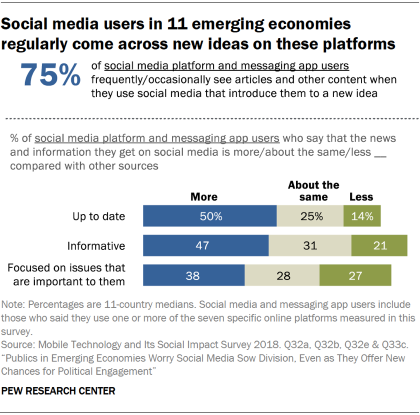
Chart showing that social media users in 11 emerging economies regularly come across new ideas on these platforms.

These broad public views about the positive and negative impacts of technology on the political and information environment are echoed in social media users’ lived experiences on these platforms.

In some respects, social media users indicate that the nature of the content on these platforms is quite positive. In every country surveyed, for instance, majorities of social media users say they frequently or occasionally encounter content there that introduces them to new ideas. Similarly, pluralities of social media users in most countries say the news and information they get on these platforms is more up to date and more informative compared with other sources.
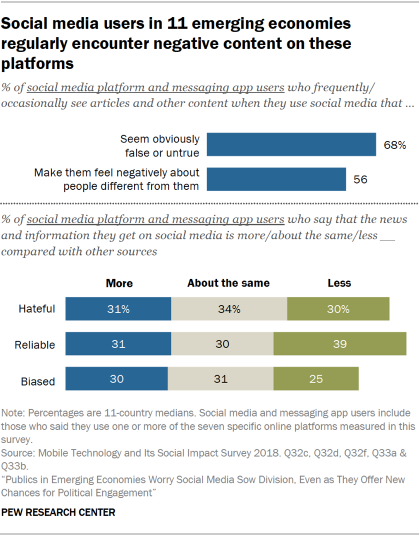
Chart showing that social media users in 11 emerging economies regularly encounter content on these platforms that seems obviously false or untrue and that makes them feel negatively about people different from them.

But as was true of views of the overall technology landscape, social media users see challenges as well as benefits. Most notably, majorities of social media users in 10 of these 11 countries frequently or occasionally encounter content that seems obviously false or untrue, and majorities of users in six countries regularly encounter content on these platforms that makes them feel negatively about groups of people who are different than they are.

Social media users also express mixed opinions about the characteristics of the social media environment relative to other information sources. Only in Vietnam do a plurality of users say these platforms are more reliable than other sources they encounter. In other countries, users are more divided about whether the information on social media is about as reliable – or less so – than what they see elsewhere. Opinion is also relatively mixed across the 11 countries as far as whether the news people get on these platforms is more hateful than what they get elsewhere.

We have to understand that there are scores of websites and articles on the internet that are false and inaccurate, purely opinion, or extremely biased or slanted.WOMAN, 22, PHILIPPINES

WOMAN, 22, PHILIPPINES

This range of experiences and attitudes is also reflected in at least some users’ personal interactions on social media platforms. An 11-country median of 36% of social media users – including around half in Kenya and Venezuela – say they have learned someone’s political beliefs were different than they had thought based on things that person posted to social media. In all 11 countries surveyed, those who have been surprised by someone’s political beliefs in this way are more likely to say technology has made people more divided in their political opinions. In seven countries, however, these users are also more likely to say access to technology has made people more accepting of those who have different views.

More people are comfortable talking politics in person than in digital spaces
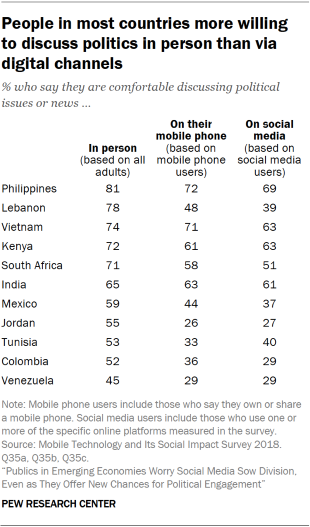
Table that shows that people in most of the surveyed countries are more willing to discuss politics in person than via digital channels.

Even as social media have offered citizens new ways to encounter and share information, more people are comfortable speaking about politics in person than via mobile phones or social media. These differences are especially pronounced in Lebanon: 78% of Lebanese overall say they are comfortable discussing political issues in person, but 48% of Lebanese mobile phone users are comfortable discussing these issues on their phones and just 39% of Lebanese social media users say they are comfortable broaching these issues on those platforms.

People who are comfortable discussing politics in digital spaces tend to be more optimistic about the impact these technologies have on politics in their country. For example, social media users who are comfortable discussing politics there are more likely to say the internet has had a good impact on politics and that social media have increased ordinary people’s ability to have a meaningful voice in politics. They also are usually more likely to describe the news they get on social media platforms positively – as more up to date, informative, reliable and focused on issues they care about – compared with other sources. And they are more likely to say they see articles on social media that introduce them to new ideas. But they are also somewhat more likely to say they regularly encounter articles or other content that makes them feel negatively about groups of people who are different from them.

Although publics in most countries are more comfortable discussing politics in person than via digital methods, people in certain countries are generally more comfortable discussing politics – whether in person, using their mobile phone or over social media – than people in other countries. The Philippines, Vietnam, Kenya and India are countries where majorities are comfortable discussing politics in person, and majorities of users are comfortable talking politics on a mobile phone or via social media. However, people’s comfort levels have little relationship with overall measures of civil liberties in their country or measures of how democratic the country is (or is not). And countries with higher levels of interpersonal trust are not more likely to be comfortable discussing politics in any of these venues.3

You know, there’s a politician that sends text messages to us saying ‘Happy birthday, from Senator this-and-that.’ Even with that, they have already got your number. What more [do they have] if you’re already on social media?MAN, 44, PHILIPPINES

MAN, 44, PHILIPPINES

These are among the major findings from a new Pew Research Center survey conducted among 28,122 adults in 11 countries from Sept. 7 to Dec. 7, 2018. In addition to the survey, the Center conducted focus groups with diverse groups of participants in Kenya, Mexico, the Philippines and Tunisia in March 2018, and their comments are included throughout the report (see Appendix A for more information).

Second report in a series about mobile connectivity in emerging economies

After more than a decade of studying the spread and impact of mobile devices in the United States, Pew Research Center has intensified its exploration of the impact of such connectivity in emerging economies. This report is the second of several reports about mobile use and attitudes toward digital connectivity in these 11 countries.

The first report covered general topics such as the impact of mobile connectivity on the economy, children and communication. It also found that people experience myriad tensions with their devices. Some examples include:

  • In every country, around half or more adults say the increasing use of mobile phones has had a good influence on education – making it one of the factors where people see the most positive impact from the technology. But few think the increasing use of mobile phones has had a good influence on children in their country, and a median of 79% say people should be very concerned about children being exposed to harmful or immoral content when using their mobile phones.
  • Large majorities of mobile phone users in all 11 countries say their devices have helped them stay in touch with those who live far away. At the same time, a median of 48% of adults say people should be very concerned about people losing the ability to communicate face-to-face when using their mobile phones.
  • Mobile phone users in each of the 11 countries surveyed are more likely to say their phone is something that frees them than something that ties them down. Mobile phone users in most countries are also more likely to describe their phone as something that helps them save time rather than waste time. Although many mobile users view their phones as useful, they do not always see them as necessities. For instance, a majority of Venezuelans say their phone is something that frees them and helps them save time, but just 29% say they couldn’t live without their phone. Conversely, a majority of Jordanians say they couldn’t live without their phone – even as they are more likely to describe it as a time waster than a time saver.

These types of tensions are common in many Pew Research Center surveys about technology in the United States. For more, see Appendix B.
1. Users say they regularly encounter false and misleading content on social media – but also new ideas

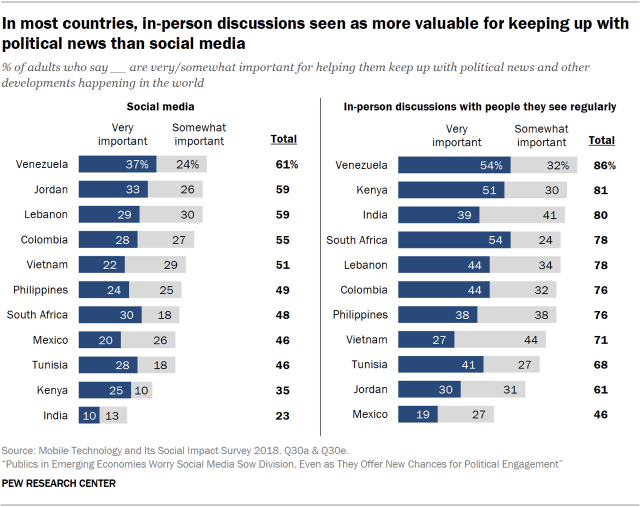
Social media use has increased in emerging and developing nations in recent years. And, across the 11 emerging economies surveyed for this report, a median of 28% of adults say social media are very important for helping them keep up with political news and other developments happening in the world.

4

At the same time, opinions are divided when it comes to the reliability, bias and hateful nature of social media content when compared with other sources. And when asked about the kinds of material they encounter on these sites, majorities in most countries report at least occasionally seeing content that seems obviously false or untrue or that makes them feel negatively about groups different from them. Across almost all these measures, those who say social media are very important sources of political information see these platforms in different – and often more extreme – terms than other social media users.

Fewer rely on or trust social media for political news than say the same of in-person discussions

Even as social media use has become more common in many emerging countries, in only four of the 11 countries surveyed do a majority of people say these platforms are an important source of political information – and nowhere does a majority say social media are very important for learning about politics. All told, a median of 28% of adults say social media are very important for helping them keep up with political news and other developments happening in the world.

In every country, many fewer people say social media are very important for helping them keep up with political events than say the same about a more traditional form of social networking – having discussions in person with people they see regularly. In every country but Mexico, a majority says in-person discussions are an important way they stay informed. Around four-in-ten or more in most countries say these conversations are very important.

Chart showing that in most countries included in the survey, in-person discussions are seen as more valuable for keeping up with political news than social media.

Some of the reason people place less importance on social media might stem from the fact that social media use can vary widely across these 11 countries – from a low of 31% in India to a high of 85% in Lebanon. But even among those who use these platforms, only in four of the 11 countries surveyed (South Africa, Tunisia, Venezuela and Kenya) do about half or more social media users say these platforms are very important sources for helping them keep up with political news and global happenings.

In every country, younger and more educated people are more likely to say social media are very important to them for political news.5 However, in many instances this is largely due to high levels of social media adoption among the young and more educated. Among those who say they use social media, people with higher and lower levels of education are equally likely to say these platforms are a very important source of political news in seven of these 11 countries, and the same is true of older and younger social media users in six countries.

If you haven’t watched the news today, at least you can still watch it on Facebook.MAN, 40, PHILIPPINES

MAN, 40, PHILIPPINES

Publics in these countries more likely to trust political information from in-person conversations than from social media

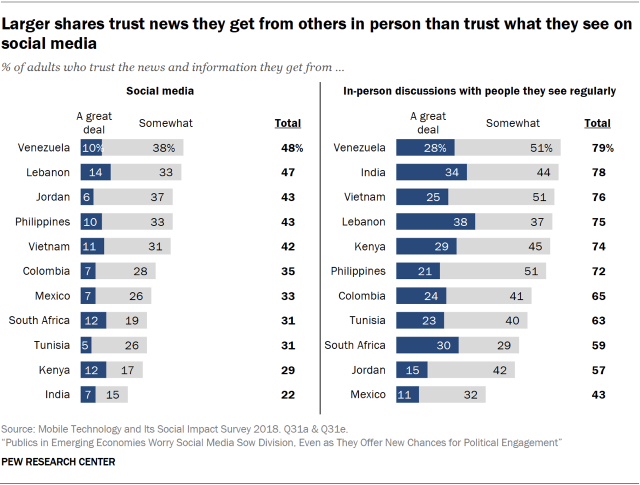
More broadly, relatively few adults in these countries say they trust the information they get from social media platforms. Among all adults, a median of 35% trust the political news they get on social media, including a median of just 10% who trust it a great deal. Among the subset of adults in these countries who use social media, an 11-country median of 55% say they trust the information they find on social media at least somewhat – ranging from highs of about seven-in-ten in the Philippines, Kenya, India and Venezuela to lows of less than half in Colombia and Mexico. Few users in most countries trust the news they get on social media a great deal – varying from only 8% of Jordanian social media users to 31% of Kenyan users.

Chart showing that larger shares in the surveyed countries trust news they get from others in person than those who trust what they see on social media.

These levels of trust stand out in comparison with the faith people place in the information they gather from face-to-face conversations with people they see regularly. When it comes to in-person conversations, a median of 72% of adults say they trust the information they glean from these discussions, and in eight countries, around a quarter or more say they trust the information a great deal.

Social media users regularly see incorrect information and content that makes them feel negatively about other groups

Social media users report a mix of positive and negative experiences related to the content they see on these platforms. This survey asked about the frequency with which people encounter three specific types of content on social media: content that introduces them to new ideas, that seems obviously false or untrue, or that makes them feel negatively about groups of people who are different from them. Although in no country do a majority of social media users see any of these types of content frequently, in many countries a majority reports seeing all of them at least occasionally.

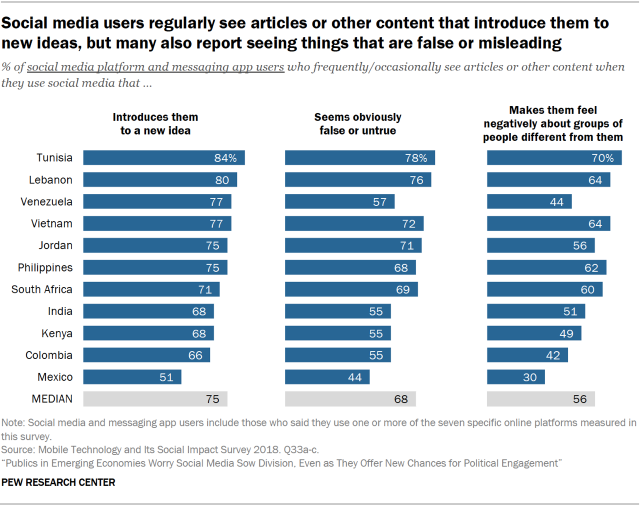
A median of three-quarters of social media platform and messaging app users say they frequently or occasionally see articles or other content that introduce them to a new idea, ranging from more than eight-in-ten in Tunisia to about half in Mexico. Smaller shares see this content frequently – around four-in-ten or fewer in most countries.

Publics are more likely to say they regularly see content that introduces them to a new idea than to say they regularly see content that seems obviously false or untrue, or that provokes negative feelings toward others. Still, majorities of social media users in most countries surveyed see both at least occasionally, including about two-thirds or more in Tunisia, Lebanon and Vietnam. And very few social media users say they never see content like this: A median of 17% of social media users report never seeing articles that make them feel negatively toward groups of people different from them, and just 8% never see content that appears to be obviously false or untrue.

Chart showing that social media users in emerging economies regularly see articles or other content that introduce them to new ideas, but many also report seeing things that are false or misleading.

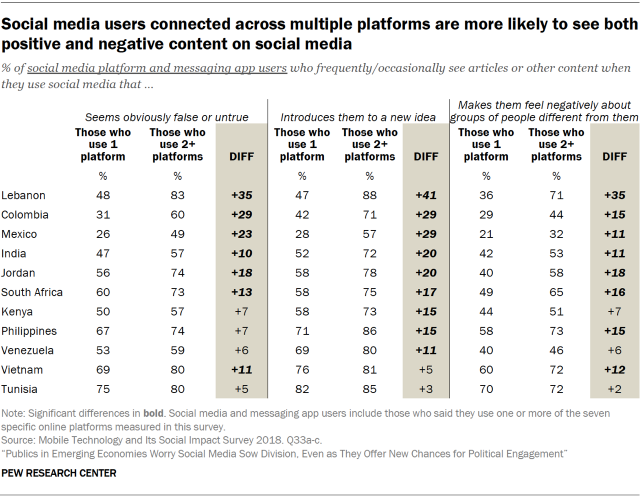
Social media users who access more than one platform are more likely than those who just use a single platform to come across all three kinds of content. The differences are especially large in Lebanon: 83% of Lebanese who access multiple social media sites regularly see articles that seem obviously false or untrue, compared with only about half (48%) of those who use a single site. In Tunisia, on the other hand, access to multiple platforms is not linked with someone’s likelihood of coming across these kinds of content.

Table showing that social media users in emerging economies who are connected across multiple platforms are more likely to see both positive and negative content on social media.

These differences in platform use are themselves related to social media users’ age and education. Older and less educated social media users are more likely to use only one site, while younger and more educated users are more likely to use many. Consequently, younger and more educated social media users are generally more likely to encounter all kinds of content than older and less educated users.

It’s bad enough that websites like Facebook already cocoon users because the author serves you information that he thinks you want to see and hear, based on what you’ve already seen and heard …. Now we learn on top of this, the information may not be true.MAN, 25, PHILIPPINES

MAN, 25, PHILIPPINES

Users have mixed opinions about the nature of the content they find on social media

In addition to encountering a mix of positive and negative content on these platforms, social media users in these countries also have mixed opinions about the nature of what they see on social media relative to other information sources. In most countries, larger shares say these social media platforms are more up to date, informative and focused on issues that are personally important to them. But there is much more disagreement over whether these platforms are more reliable, hateful or biased than other information sources.

Pluralities in most countries see social media as more informative than other sources

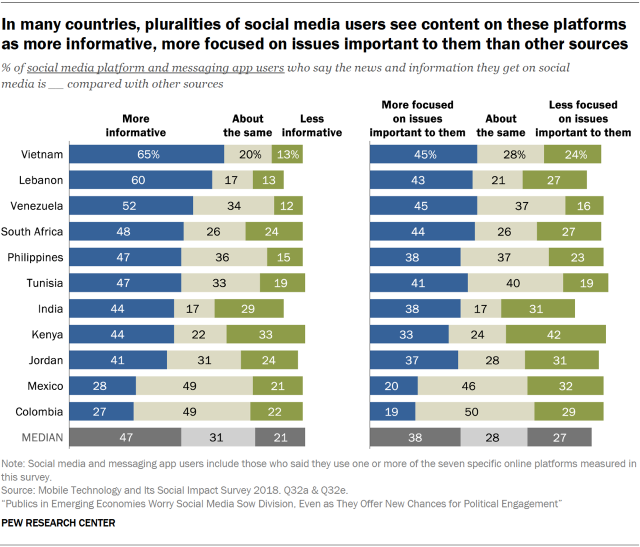
Pluralities of social media users in most countries surveyed say social media are more informative and focused on issues important to them compared with other sources: Six-in-ten or more in Lebanon and Vietnam say these platforms are more informative, while about half say the same in Venezuela, South Africa, Tunisia and the Philippines. But Mexicans and Colombians take a different view. In these countries, only about a quarter of social media users say these platforms are more informative than other sources, with roughly half saying they are similarly informative.

[Facebook] identifies you and it sends you whatever you like the most. The information is more precise and it corresponds to your personality.WOMAN, 34, MEXICO

WOMAN, 34, MEXICO

Meanwhile, in no country does a majority say the news and information they get on social media is more focused on issues important to them compared with other sources. Instead, many say the news they get on social media is about as focused on issues they care about as other sources, if not less so. Half of Colombian social media users, for example, say the news and information they get on social media is about as focused on issues that are important to them as the news they get elsewhere. And about four-in-ten Kenyan users feel it is less focused on personally relevant issues.

Chart showing that in many countries included in the survey, pluralities of social media users see content on these platforms as more informative and more focused on issues important to them compared to other sources.

These views are closely related to one another. In every country surveyed, social media users who feel these platforms deliver content that is more personally relevant than other sources are also more likely to say social media are more informative – and the reverse is also true.

More say social media deliver timely material than say the platforms are reliable

In most countries, about half or more social media users say the content they get from social media is more up to date than what they get from other sources. Jordanians, Lebanese, Venezuelans and Vietnamese are especially likely to rate social media as more up to date than other sources, while Colombians are least likely to do so.

Chart showing that social media news is viewed by people in emerging economies as more up to date, but fewer say it is more reliable.

When I compare social media and the media houses, the media houses are more reliable … on social media you find some bloggers who are conveying false information and false news just to hurt other people, or to just lie.MAN, 26, KENYA

MAN, 26, KENYA

By contrast, in each of the 11 countries surveyed, smaller shares say the news and information they get on social media is more reliable than what they get elsewhere. But although relatively few think social media are more reliable than other sources, in no country does a majority think social media are less reliable. Instead, many say that social media are about as reliable as other sources. Only in the Philippines and Vietnam does the largest share of users view these platforms as more reliable than other sources.

In addition, individuals who rate social media positively in one of these respects are also more likely to rate it positively in the other. Those who say the news and information on social media is more up to date are also more likely to say it is more reliable, and vice versa. Consider South Africa: More than half of South Africans (53%) who say social media news is more up to date also say it is more reliable than other sources, and a majority of South Africans who say it is less up to date (55%) say it is less reliable than other sources.

Social media users divided over whether content there is more biased, hateful than other sources

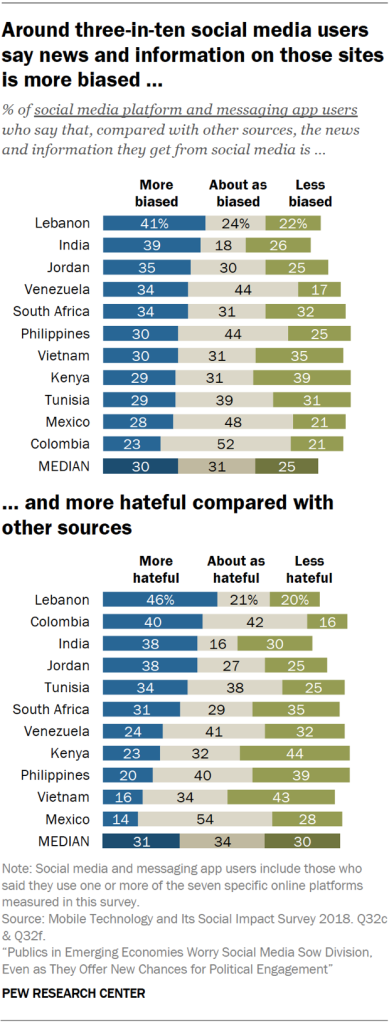
Charts showing that around three-in-ten social media users in emerging economies say news and information on social media sites is more biased and more hateful compared with other sources.

Social media users have mixed views when it comes to the degree of bias they see on social media. Pluralities in five countries – Colombia, Mexico, the Philippines, Venezuela and Tunisia – view content on social media as comparably biased to what they get elsewhere. But in other countries, the balance of sentiment points in different directions: A plurality of Indian and Lebanese social media users say social media content is more biased, while a plurality of Kenyan users say it is less biased.

There is also a nearly even split across countries in people’s views of how hateful the news and information on social media is. A median of 31% say social media content is more hateful than content from other sources, while 30% say it is less hateful and 34% say they are about the same. Four-in-ten or more Lebanese and Colombians see more hateful content on social media than elsewhere, while similar shares of Kenyans and Vietnamese see less.

As with assessments of the timeliness and reliability of social media, views of bias and hatefulness also go together. People who say social media are more biased than other sources are more likely to say these sources are more hateful, and vice-versa.

Before and during the election, there was incitement and violence and social media fueled this. … But the same social media brings togetherness and peace in this country.MAN, 26, KENYA

MAN, 26, KENYA

These attitudes vary only modestly by age and educational attainment. Larger shares of social media users with a secondary education or more say social media are more biased and hateful than other sources in Colombia, India and Mexico, but these assessments do not vary by educational attainment in the other countries surveyed. And age-related differences are even less common. Only in Mexico, Kenya and Vietnam do those ages 50 and older and those under 30 differ in their views of the bias on social media, and only in India do they differ when it comes to hatefulness.

Those who view social media as a very important source of political information tend to have more positive views of these platforms

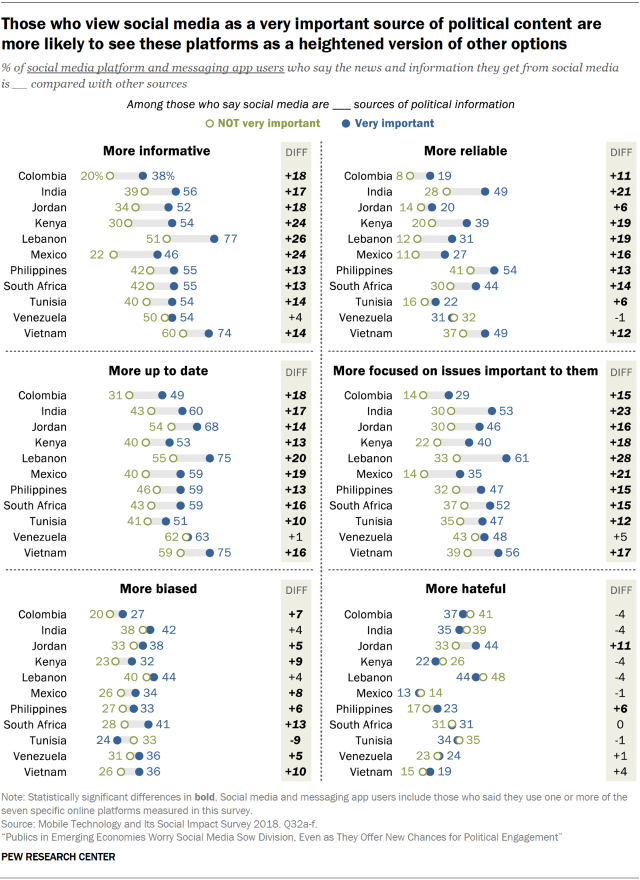
Across many of these attributes, those who say social media are very important for helping them get political information stand apart from social media users who do not say these platforms are very important political news sources. They are more likely than other social media users to call the news and information they get on social media more informative, timely, reliable and focused on issues important to them than other users in every country but Venezuela. In eight countries, they are more likely to call the information they get from social media more biased compared with other sources. But when it comes to the potentially hateful nature of news on social media, in most countries, social media users tend to view news on these platforms in similar terms.

Charts showing that those in emerging economies who view social media as a very important source of political content are more likely to see these platforms as a heightened version of other options.

2. More people are comfortable discussing politics in person than on their phones or via social media

Some people in the 11 countries surveyed stand out for their comfort discussing politics in a variety of venues – whether face-to-face, via mobile phone or on social media. In general, those who identify with a political party, younger people and those with higher levels of education tend to be more comfortable discussing political news and issues, regardless of the way in which the discussions take place. But in most countries, more people are comfortable talking about political issues and news face-to-face, rather than digitally.

You can comment on something [on social media] – maybe a product. But politically, there is some fear of posting things. I don’t think we are free to say something politically.WOMAN, 35, KENYA

WOMAN, 35, KENYA

Those who do feel comfortable discussing politics via mobile phone or on social media tend to be more positive about the influence digital technologies have on politics and tend to say social media are a very important source in their lives for acquiring political news and information. People who are comfortable discussing politics on social media are also more likely to say the news they get there is more informative, up to date, reliable and focused on issues they care about compared with other sources.

More prefer in-person conversations about politics to discussions on mobile phones or social media

Chart showing that people in emerging economies often feel comfortable talking about politics face-to-face.

In nearly all of the emerging economies surveyed, more than half of adults say they feel comfortable discussing political issues or news by talking to someone in person. This feeling is most widespread in the Philippines, Lebanon, Vietnam and Kenya, where about three-quarters or more say they would feel comfortable talking about politics face-to-face. The only country where fewer than half say they are comfortable talking about politics in person is Venezuela: 51% say they would not be comfortable discussing politics face-to-face, while 45% say they would be comfortable doing this.

Both politics and religion are controversial to even consider talking [about], so you’d better spare yourself the trouble.WOMAN, 39, MEXICO

WOMAN, 39, MEXICO

In 10 of the 11 countries surveyed, people who are comfortable discussing politics in person are far more likely to describe these discussions as very important for helping them keep up with political news and other world developments. They are also more likely to trust the news and information they get from these face-to-face discussions. In Lebanon, for example, the vast majority (84%) of people who are comfortable talking about politics face-to-face say they trust the information they get from in-person discussions, compared with only 42% of those who say they don’t feel comfortable engaging in such discussions.

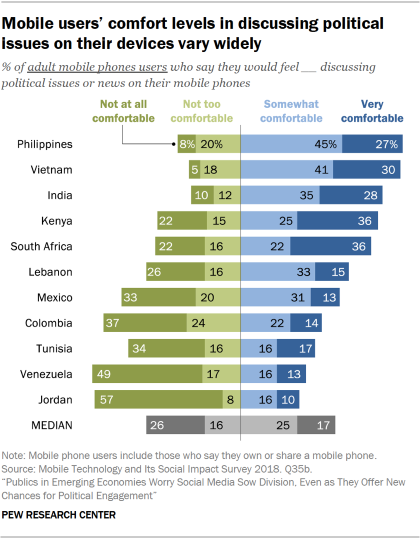
Chart showing that mobile users’ comfort levels in discussing political issues on their devices vary widely in emerging economies.

But although majorities of adults in most of the countries surveyed say they feel comfortable discussing politics in face-to-face settings, people are often less likely to feel comfortable talking about these issues on their mobile phones. Across the 11 countries, Filipinos are the most comfortable with using their mobile phones to discuss political issues: 72% of Filipino mobile phone users say they’d be comfortable doing so, including around a quarter who would be very comfortable.

Majorities of mobile users also say they would be comfortable discussing politics on their phone in Vietnam, India, Kenya and South Africa. Other publics stand out for their apprehension in using mobile phones to discuss political issues or news. Majorities of mobile users in Venezuela, Jordan and Colombia say they would be uncomfortable talking about politics with someone via mobile phone, with Jordanians feeling particularly strongly: A majority of the country’s mobile users (57%) say they would be not at all comfortable discussing politics on their phones. About half of Venezuelan mobile users (49%) also say they would not feel comfortable at all discussing politics via mobile device.

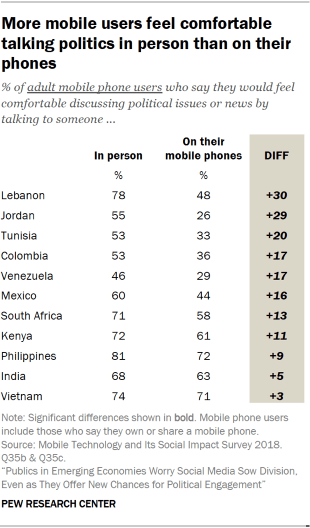
Table showing that more mobile users feel comfortable talking politics in person than on their phones in emerging economies.

In every emerging economy surveyed, mobile phone users are more likely to say they would be comfortable talking about politics in person than on their mobile phones. In Lebanon, for example, a majority of mobile users (78%) say they would be comfortable talking about politics with someone in person, but only about half (48%) say they would be comfortable doing so on their mobile phones. In nearby Jordan, a similarly large gap is seen.

In 10 of the 11 countries surveyed, people who are comfortable discussing politics on their mobile phones are more likely to say mobile phones have had a good influence on politics. In the Philippines, for example, a majority of mobile users who are comfortable discussing politics on their phone (57%) say these devices have had a good influence on politics, compared with just 42% of those who are uncomfortable talking about politics on their phone.

Substantial variation across countries in people’s willingness to discuss political topics on social media

6

Chart showing that across surveyed countries, social media users are divided about whether they would feel comfortable talking about politics there.

Jordanians, Venezuelans and Colombians – who are the most likely to feel uncomfortable talking about politics on mobile phones – also stand out for their hesitancy to discuss politics on digital platforms. More than six-in-ten social media users in these countries say they would not be comfortable discussing politics on social media. A majority of Mexican users (58%) also say they would be uncomfortable discussing political news and issues on social media. Users in South Africa, Tunisia and Lebanon are somewhat divided over whether they would be comfortable discussing politics on social media platforms.

As was the case with mobile phones, social media users are more likely to say they would feel comfortable discussing politics face-to-face than on social media. For example, 78% of Lebanese social media users say they would be comfortable talking about political issues with someone in person, but just 39% say they would be comfortable doing this on social media.

If you express your political opinion on social media, it could impact your work life. You might get in trouble for that. That’s why we prefer to remain neutral.WOMAN, 29, TUNISIA

WOMAN, 29, TUNISIA

People who are comfortable talking about politics on social media tend to feel more positively about the internet’s impact on politics more broadly in nine of the 11 countries surveyed. And no matter the medium of conversation – face-to-face, mobile phone or social media – people who identify with a political party, younger people and those with higher levels of education tend to feel more comfortable discussing political news and issues (see Appendix C for detailed tables).78 Meanwhile, men in Colombia, Mexico, South Africa and Venezuela report feeling more comfortable talking about politics than women, regardless of the setting.

Majorities have not been surprised by someone’s political views on social media or blocked a person for political reasons

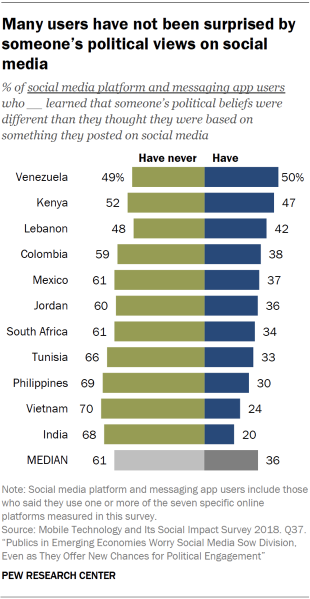
Chart showing that many users have not been surprised by someone’s political views on social media.

In most countries, a minority of social media and messaging app users say they have learned that someone’s political beliefs were different than they originally thought because of something that person posted to social media. Venezuelans and Kenyans stand out as the two publics where around half of social media users say they have learned someone’s political beliefs are different than they originally assumed. By comparison, a 2016 survey of U.S. adults found that half of social media users had been surprised by someone’s political views based on their social media posts.

More-educated social media users are more likely to say they have been surprised by someone’s political views on social media. To a lesser degree, age and gender play a role in some countries; younger social media users and male users are more likely to have been surprised.

And in Colombia, India, South Africa, Lebanon and Tunisia, people with partisan identifications are more likely than those who say no party represents them to say they have been surprised by someone’s political views on social media. In six of the 11 countries, people who are comfortable engaging in political discussions on social media are also more likely to have been surprised by someone’s beliefs.

Chart showing majorities of social media users in emerging economies have never blocked someone due to their political views.

Meanwhile, modest shares of social media and messaging app users (median of 34%) say they have unfriended, blocked or hidden someone from their social media feed because of their political views. Blocking another social media user because of his or her political views is most common in the Philippines (42% of users) – the country where users are most likely to say they feel comfortable discussing politics via social media. And in every country surveyed, people who say they’ve been surprised by someone’s political views on social media are more likely to have blocked someone. In Jordan, Lebanon, the Philippines and South Africa, younger social media users (ages 18 to 29) are more likely than users 50 and older to have blocked someone because of their political views. In five of the countries surveyed – and particularly in Jordan (by 18 percentage points) – male social media users are more likely to have blocked people than female users. But in most countries, partisans are no more likely than nonpartisans to have blocked someone.

One of my colleagues at work shouted at me when I expressed my opinion. He deleted me from Facebook because we do not have the same mentality.WOMAN, 45, TUNISIA

WOMAN, 45, TUNISIA

3. Publics think technology impacts the political environment in both positive and negative ways

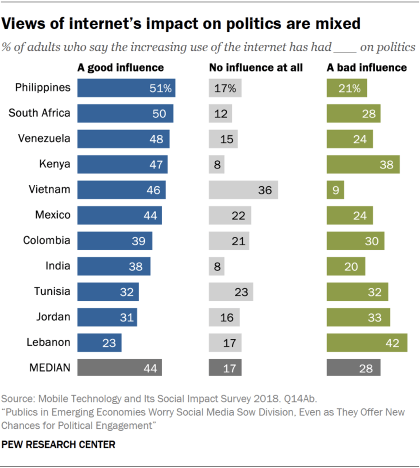
Beyond their views of the personal impact of various technologies, publics in these countries are divided over how the internet in general has impacted politics in their societies. An 11-country median of 44% say the increasing use of the internet has had a good impact on politics, but 28% feel that impact has been largely bad – and this balance of opinion is most negative in Tunisia, Jordan and Lebanon.

Adults in these countries also feel access to technology has had a variety of both positive and negative impacts on their fellow citizens. On the positive side of the ledger, a median of 78% say access to the internet, mobile phones and social media has made people more informed about current events. And when asked about the impact of social media on the broader political process, majorities in nine of these 11 countries say they have increased the ability for ordinary citizens to take part in the political process.

At the same time, an 11-country median of 72% say these technologies have made people easier to manipulate with rumors and false information. And majorities in eight countries say social media have increased the risk that citizens might be manipulated by domestic politicians.

Mixed attitudes about the internet’s overall impact on politics

Chart showing that views of internet’s impact on politics are mixed in emerging economies.

Adults in these countries express mixed views about the overall influence of the internet on politics. In most countries, larger shares say the internet has had a good impact on politics than say the same about issues such as children or morality. But notably smaller shares say the internet has had a good impact on politics than say this about its effect on issues such as education, the economy or local culture (for more, see the first report in this series).

Adults in these countries also make little distinction between the impact of the internet and mobile phones when it comes to politics. Nearly identical shares say the internet and mobile phones have had a good, bad or negligible impact on politics.

9

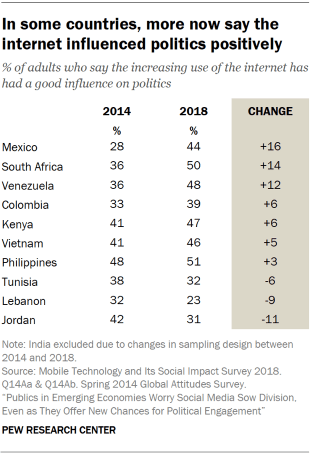
Table showing that in some of the surveyed countries, more now say the internet has influenced politics positively.

Across these 11 countries, public opinion about the internet’s impact on politics is most negative in Jordan, Lebanon and Tunisia. In Lebanon, nearly twice as many say the internet has had a bad (42%) rather than good (23%) influence on politics. And in Jordan and Tunisia, the shares saying the internet’s impact on politics has been good are comparable to the shares saying it has been bad.

In addition to having a comparably negative balance of sentiment relative to the other countries in this survey, publics in these three countries have also turned somewhat less upbeat in recent years in their assessments of the internet’s impact on politics. From 2014 to 2018, the share of adults in these countries saying the internet has had a good influence on politics has declined by 11 percentage points in Jordan, 9 points in Lebanon and 6 points in Tunisia. By contrast, sentiment in the other seven countries for which trends are available either grew more positive or stayed largely the same over that time. This positive shift has been most pronounced in Mexico, South Africa and Venezuela.

Many think technology has made people better informed – but also easier to manipulate

When asked about the impact of mobile phones, the internet and social media on various political behaviors and attitudes, people in these nations tend to express seemingly dual views of how technology has brought “more” to society: that it has made people more informed, yet more manipulatable; more divided, yet sometimes more accepting of others.

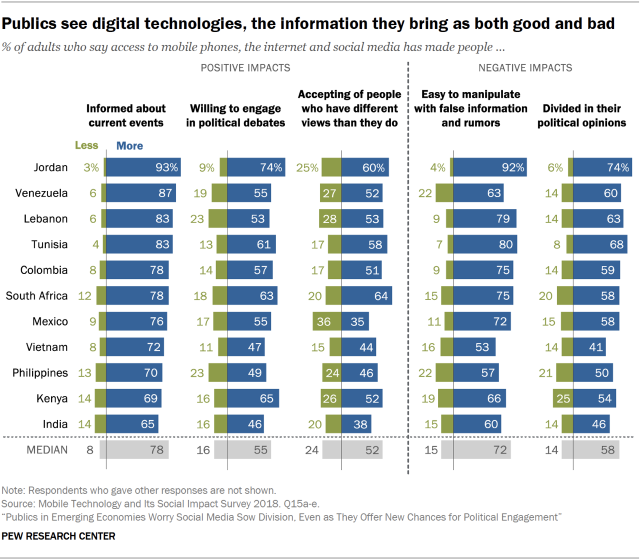
Chart showing that publics in emerging economies see digital technologies and the information they bring as both good and bad.

At one level, publics in these countries believe that technology simultaneously makes people more informed and more gullible. Majorities in every country – and an 11-country median of 78% – say access to technology has made people more informed about current events. At the same time, majorities in every country except for Vietnam – and an 11-country median of 72% – say technology has made it easier to manipulate people with false information and rumors.

We become numb to the news, like the presidential campaigns in Mexico. A term ago, we were struggling to get more political awareness, and now everything is made a meme and laughed at. It defeats the purpose of the internet.MAN, 28, MEXICO

MAN, 28, MEXICO

The survey highlights similar tensions over whether these technologies make people more divided or more accepting of others. A median of 58% say access to mobile phones, the internet and social media has made people more divided in their political opinions. At the same time, a median of 52% say these technologies have made people more accepting of those who have different views than they do. And a median of 55% say they have generally made people more willing to engage in political debates.

These positive and negative views of technology’s impact on political attitudes are often related. In 10 of the 11 countries surveyed, those who believe technology has made people more informed are more likely than others to say technology has also made people easier to manipulate.

Similarly, in most countries those who say technology has made people more accepting of diverse viewpoints are simultaneously more likely to say it has made people more divided in their political opinions.

Through our mobile phones, since there is that social media, it has really led to the spread of hatred and tribalism amongst ourselves.MAN, 38, KENYA

MAN, 38, KENYA

These same costs and benefits are visible when it comes to technology’s impact on political news and discussion. For instance, people in these countries overwhelmingly feel mobile phones have improved people’s ability to obtain news. Yet an 11-country median of 64% say people should be very concerned about exposure to false information when using their mobile devices.

People in some countries stand out for their views on the influence of technology on politics

Especially large shares of Jordanians feel technology has made people more receptive to most of the political impacts measured in the survey, and this is especially true of the notion that technology makes people more informed but also easier to manipulate. Around nine-in-ten Jordanians say access to mobile phones, the internet and social media has made people more informed about current events, but a similar share says this access makes them more vulnerable to being manipulated with rumors and false information. And roughly three-quarters of Jordanians say technology has made people more divided in their political opinions, but also more willing to engage in political debates.

By contrast, Vietnamese adults are relatively likely to say access to these technologies hasn’t changed much compared with those in the other countries surveyed. One-third or more Vietnamese say these technologies haven’t had much impact on people’s willingness to engage in political debates (33%), how divided they are in their political opinions (35%) or how accepting they are of those with different views (35%), while 26% say they haven’t had much impact on how easy people are to manipulate. In each instance, these represent the largest shares among the 11 countries surveyed.

Meanwhile, Mexicans stand out for their assessment of the impact of technologies on people’s tolerance of different viewpoints. Some 35% of Mexicans say technology has made people more accepting of people who have different views than they do, but a nearly identical share (36%) says technology has had a negative impact in this regard. Younger Mexicans are especially likely to say technologies have made people less tolerant to people who hold different views: 41% hold this view, compared with 30% of Mexicans ages 50 and older.

Social media users, those affiliated with a political party and the more educated are more likely to see both positive and negative political impacts of digital technologies

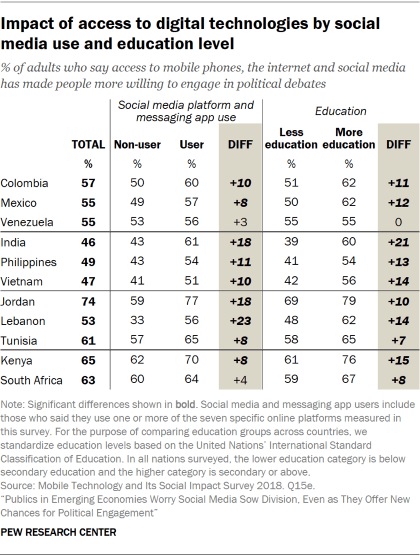
Table showing that views of technology’s impact on people’s willingness to debate politics vary by social media use and education level in emerging economies.

Certain groups are especially likely to cite both the positive and negative impacts of technology on political engagement.

For example, social media users are more likely than non-users to say technology has made people more informed about current events in all 11 countries surveyed; more accepting of people with different views in eight countries; and more willing to engage in political debates in nine countries.10 At the same time, in nine countries a larger share of users say technology is making people more divided in their political opinions – and in 10 countries a larger share of social media users say technology is making people easier to mislead with misinformation (see Appendix C for detailed tables).

These attitudes also vary by education level.11 Across all 11 countries, adults with a secondary education or higher are more likely to say technology has made people more informed about current events relative to those who do not have a secondary education. And in nine countries, adults with higher levels of educational attainment are more inclined to say technology has made people more subject to false information and rumors.

Meanwhile, adults with higher levels of educational attainment are more likely to say technology has contributed to both political divisions and tolerance of opposing viewpoints in seven of these countries (Colombia, India, Kenya, Lebanon, the Philippines, Tunisia and Vietnam).

In eight of the nine countries for which partisan information is available, those who have a partisan affiliation are somewhat more likely than those who don’t identify with any particular party to say technology has made people more willing to engage in political debate.12 And in five of those countries, those with a partisan affiliation are more likely to say access to technology has made people more divided in their political opinions. But in most countries, similar shares of the affiliated and unaffiliated say technology has made people more informed, more accepting of those with different viewpoints and more susceptible to misinformation.13

Lastly, social media users’ assessments of the impact of technology on political attitudes are somewhat related to whether they view social media as an important news source. In seven out of the 11 countries, those who say social media are a very important news source for them to get political news and information are more likely than users who do not think social media are as important to say technology has made people more informed about news and current events.

Social media seen to confer benefits – but also risks – on the overall political process

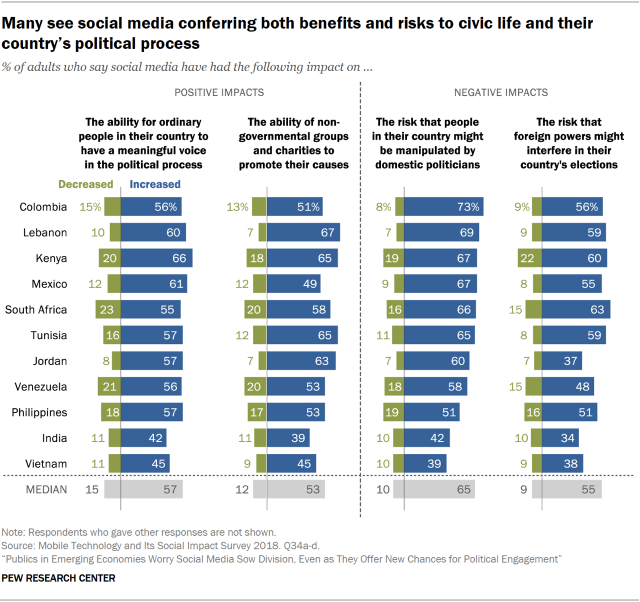
When asked about different impacts social media have had on their country’s political process, publics in these countries are more likely than not to say social media offer new avenues for political engagement. A median of 57% – and majorities in every country except for Vietnam and India – say social media have increased the ability for ordinary people in their country to have a meaningful voice in the political process. And a median of 53% say these platforms have increased the ability of nongovernmental organizations to promote their causes.

But these perceived benefits from social media are matched with perceived costs. An 11-country median of 65% say social media have increased the risk that people in their country might be manipulated by domestic politicians. And when asked whether these platforms might facilitate foreign interference in their country’s elections, a median of 55% say these platforms have indeed increased this risk – although a median of 27% feel they have not had much effect either way.

Now it is much easier for our countrymen to know about the plans of our government for our OFW [Overseas Filipino Workers].WOMAN, 48, PHILIPPINES

WOMAN, 48, PHILIPPINES

Among those who use social media, there are only minimal differences between the views of younger (ages 18 to 29) and older adults (those ages 50+) on these questions. However, there are some differences based on how extensively people rely on these platforms for information. In most countries, those who say social media are a very important news source are more likely to say these platforms have increased ordinary people’s ability to have a meaningful voice in politics, and that they have helped nongovernmental groups to promote their causes. At the same time, in seven countries this group is also more likely to say these platforms have increased the risk of people being manipulated by domestic politicians, compared with users who do not see social media as a very important source of information.

Chart showing that many in emerging economies see social media conferring both benefits and risks to civic life and their country’s political process.

In several countries, sizable shares say they do not know how these platforms have impacted the broader political system

These questions were asked of all adults – regardless of whether they themselves use social media platforms or not. And in several of these countries, sizable shares of those who do not use any social media platforms are unable to offer an opinion on how social media have impacted these aspects of the political process. This is especially true in Jordan, Lebanon, India and Vietnam. Among people in these countries who do not use social media, as many as 21% of Vietnamese, 34% of Jordanians, 41% of Lebanese and 51% of Indians either do not know the answer to these individual questions or refused to offer a guess.

Similarly, demographic groups who use social media at low rates (such as older adults or those with lower levels of education) are often more likely to say they do not know how social media have impacted these elements of the political process.

Acknowledgments

This report is a collaborative effort based on the input and analysis of the following individuals.

Aaron Smith, Associate Director, Research Laura Silver, Senior Researcher Courtney Johnson, Research Associate                                 Kyle Taylor, Research Analyst Jingjing Jiang, Research Analyst

Sara Atske, Assistant Digital Producer Monica Anderson, Senior Researcher James Bell, Vice President, Global Strategy Peter Bell, Design Director Shawnee Cohn, Communications Manager Stefan Cornibert, Communications Manager Claudia Deane, Vice President, Research Christine Huang, Research Assistant Michael Keegan, Senior Information Graphics Designer David Kent, Copy Editor Martha McRoy, Research Methodologist Patrick Moynihan, Associate Director, International Research Methods Stacy Pancratz, Research Methodologist Andrew Perrin, Research Analyst Margaret Porteus, Information Graphics Designer Audrey Powers, Senior Operations Associate Lee Rainie, Director, Internet and Technology Research Ariana Rodriguez-Gitler, Digital Producer Alissa Scheller, Information Graphics Designer Richard Wike, Director, Global Attitudes Research

Pew Research Center also received helpful advice and feedback for this report from a panel of expert advisers: Michael Kende, Visiting Professor at the Graduate Institute, Geneva; Christopher Yoo, John H. Chestnut Professor of Law, Communication, and Computer & Information Science, and Director, Center of Technology, Innovation & Competition at the University of Pennsylvania; and Joshua A. Tucker, Professor of Politics, Director of the Jordan Center of the Advanced Study of Russia and Co-Director of the Social Media and Political Participation (SMaPP) lab at New York University. While the analysis was guided by our consultations with these advisers, Pew Research Center is solely responsible for the interpretation and reporting of the data.

Methodology

About Pew Research Center’s Mobile Technology and Its Social Impact Survey 2018

Results for the survey are based on face-to-face interviews conducted under the direction of D3 Systems, Inc. The results are based on national samples. More details about our international survey methodology and country-specific sample designs are available here.

Appendix A: About the focus groups

Pew Research Center conducted a series of focus groups to better understand how people think about their own mobile phones and the impact of these devices on their society. Five focus groups were held in each of the following four countries: Kenya, Mexico, the Philippines and Tunisia.14 Each focus group consisted of 10 adults coming together for an hour and a half for a discussion led by a local, professional moderator using a guide developed by Pew Research Center.

In each country, the groups were structured according to the following criteria:

  • Group 1, “basic phone” – all participants either owned or shared a basic phone that could not connect to the internet and were 36 years old or older;
  • Group 2, “younger, smartphone” – all participants owned or shared a smartphone and were under the age of 30;
  • Group 3, “older, smartphone” – all participants owned or shared a smartphone and were at least 30 years old;
  • Group 4, “women phone users” – all participants were women who either owned or shared a phone (including a minimum of five participants who owned or shared a smartphone), and at least two participants were married and two were unmarried;
  • Group 5, “migrant phone users” – all participants either owned or shared a phone (including a minimum of five participants who owned or shared a smartphone) and all either lived in a place that was different from where they grew up or had a family member who lived elsewhere.

All focus groups also required participants to have at least some interest in politics, and, aside from group 4, which was all women, they were balanced with regard to gender. Aside from group 1, participants were also required to use their phone at least once a week. Where feasible, participants were recruited to ensure diversity with regard to education levels, employment status, rural and urban location, and the duration for which they have owned their phones.

Focus groups were held in the following locations and on the following dates:

  • Mexico City, Mexico: March 13-15, 2018
  • Manila, Philippines: March 21-23, 2018
  • Nairobi, Kenya: March 26-28, 2018
  • Tunis, Tunisia: March 28-30, 2018

D3 Systems Inc. worked with local field partners in each of the four countries to recruit the participants using a screener designed by Pew Research Center. All participants were given financial remuneration for their time.

These groups were primarily used to help shape the survey questions asked in each of the 11 countries. But, throughout the report, we have also included quotations that illustrate some of the major themes that were discussed during the groups. Quotations are chosen to provide context for the survey findings and are not necessarily representative of the majority opinion in any particular group or country. Quotations may have been edited for grammar, spelling and clarity.

Appendix B: Technology-related surveys regularly find that people see connectivity bringing positives and negatives

Findings in this survey highlight that publics generally see both benefits and harms emerging from mobile phones, the internet and social media in their societies. In many cases, the more a person sees benefits – such as technology making people more informed – the more they are also likely to see negatives, such as connectivity making people easier to manipulate.

Pew Research Center has found a similar pattern in domestic surveys. For example, while 56% of Americans say social media make it easier to hold powerful people accountable, roughly seven-in-ten (71%) say that these platforms may make people think they’re making a difference when they really aren’t. Similarly, around two-thirds of Americans say social media can help highlight important issues that may not otherwise get a lot of attention, even as around three-quarters say they also run the risk of distracting people from issues that are truly important. In election contexts, Americans have said they believe the internet makes it easier to meet others with similar political views but also increases political extremism.

Some of these tensions may reflect that people generally see digital technologies as more beneficial for themselves than for society at large. Across the 11 emerging economies surveyed in this report, a median of 82% say mobile phones have been mostly a good thing for them personally, compared with a median of 70% who say mobile phones have positively impacted society. Once again, this same pattern exists in the United States; 88% of online American adults say the internet has been mostly good for them, while only 70% say the internet has been mostly good for society.

Surveys also show that people are often confident in their own ability to navigate technology, even if they are concerned about broader societal harms. For example, a median of 79% of adult mobile phone users across these 11 emerging economies say that their phone has mostly helped their ability to get information and news about important issues, even while about two-thirds of adults say people should be very concerned about exposure to false or incorrect information when using their mobile phones. And in the U.S., a large majority of adults are very or somewhat confident in their ability to recognize made-up news, although nearly two-thirds say it has caused a great deal of confusion about the basic facts of current events.

Appendix C: Detailed tables

Table showing people's comfort discussing political issues or news by talking to someone on their mobile phone in emerging economies, by age, gender, education and partisanship.
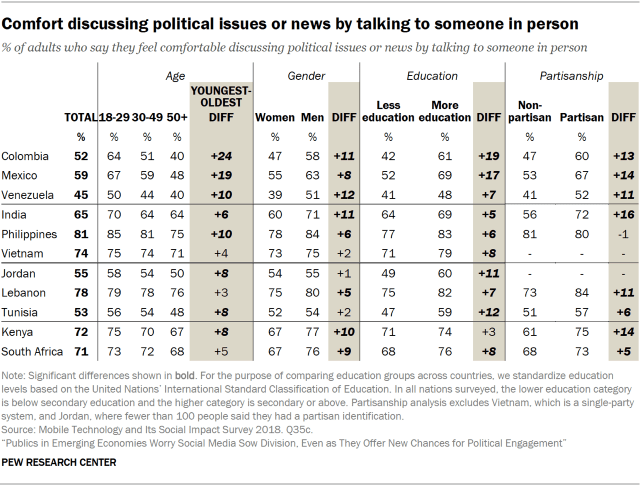
Table showing people's comfort discussing political issues or news by talking to someone in person in emerging economies, by age, gender, education and partisanship.
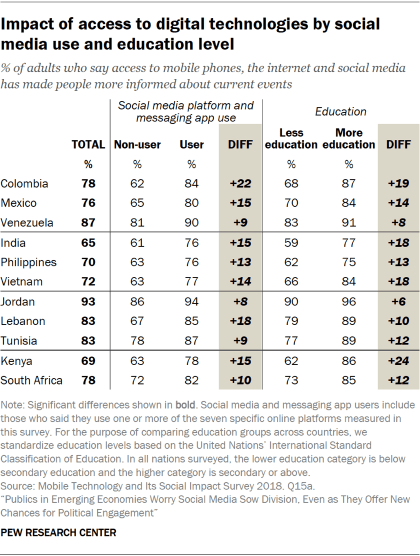
Table showing people's views on whether access to digital technologies has made people more informed about current events, by social media use and education level in emerging economies.
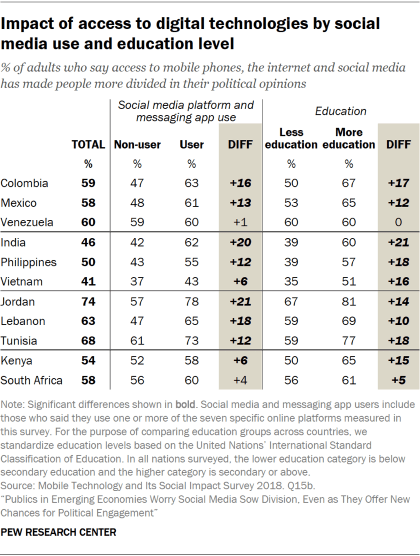
Table showing people's views on whether access to digital technologies has made people more divided in their political opinions, by social media use and education level in emerging economies.
Table showing people's views on whether access to digital technologies has made people more accepting of people who have different views than they do, by social media use and education level in emerging economies.
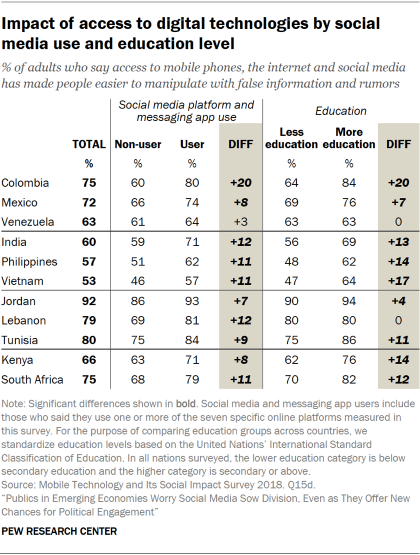
Table showing people's views on whether access to digital technologies has made people easier to manipulate with false information and rumors, by social media use and education level in emerging economies.
Table showing people's views on whether access to digital technologies has made people more willing to engage in political debates, by social media use and education level in emerging economies.