How Teens and Parents Navigate Screen Time and Device Distractions
54% of U.S. teens say they spend too much time on their cellphones, and two-thirds of parents express concern over their teen's screen time. But parents face their own challenges of device-related distraction

Amid roiling debates about the impact of screen time on teenagers, roughly half of those ages 13 to 17 are themselves worried they spend too much time on their cellphones. Some 52% of U.S. teens report taking steps to cut back on their mobile phone use, and similar shares have tried to limit their use of social media (57%) or video games (58%), a new Pew Research Center survey finds.
Teens’ sometimes hyperconnected relationship with their devices is also evident in other findings from the Center. Fully 72% of teens say they often or sometimes check for messages or notifications as soon as they wake up, while roughly four-in-ten say they feel anxious when they do not have their cellphone with them. Overall, 56% of teens associate the absence of their cellphone with at least one of these three emotions: loneliness, being upset or feeling anxious. Additionally, girls are more likely than boys to feel anxious or lonely without their cellphone.
Parents, too, are anxious about the effects of screen time on their children, a separate survey shows. Roughly two-thirds of parents say they are concerned about their teen spending too much time in front of screens, and 57% report setting screen time restrictions for their teen in one way or another.
At the same time, some parents of teens admit they also struggle with the allure of screens: 36% say they themselves spend too much time on their cellphone. And 51% of teens say they often or sometimes find their parent or caregiver to be distracted by their own cellphone when they are trying to have a conversation with them.
Additionally, 15% of parents say they often lose focus at work because they are distracted by their phone. That is nearly double the share of teens (8%) who say they often lose focus in school due to their own cellphones.
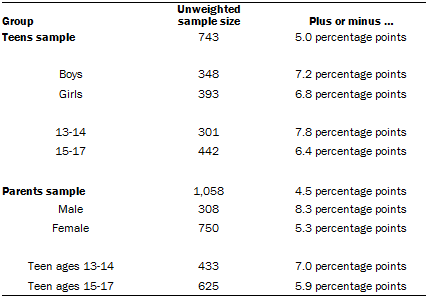
These are some of the main findings from the Center’s survey of 743 U.S. teens and 1,058 U.S. parents of teens conducted March 7-April 10, 2018. Throughout the report, “teens” refers to those ages 13 to 17, and “parents” refers to parents of at least one child ages 13 to 17.
Teens express mixed views about whether they spend too much time in front of screens, but half or more have cut back on the time they spend using various technologies
Teen life is suffused with technology. The vast majority of teens in the United States have access to a smartphone, and 45% are online on a near constant basis. The ubiquity of social media and cellphones and other devices in teens’ lives has fueled heated discussions over the effects of excessive screen time and parents’ role in limiting teens’ screen exposure. In recent months, many major technology companies, including Google and Apple, have announced new products aimed at helping adults and teens monitor and manage their online usage.
As they look at their own lives and those of their peers, most teens see things that worry them. Roughly nine-in-ten teens view spending too much time online as a problem facing people their age, including 60% who say it is a major problem.
When it comes to evaluating their own online habits, teens express mixed views about whether or not they themselves spend too much time on various screens. Roughly half (54%) believe they spend too much time on their cellphone, while 41% say they spend too much time on social media. By contrast, only around one-quarter (26%) believe they spend too much time playing video games – comparable to the share (22%) who say they spend too little time gaming. Meanwhile, roughly four-in-ten teens say they spend about the right amount of time on social media or gaming.
Despite these varying views about screen time, roughly half or more teens say they have tried to limit the amount of time they spend on each technology. Some 52% have ever cut back on the time they spend on their cellphone, while 57% have limited their time spent on social media and 58% have cut back on their time playing video games.

Interestingly, there is little association between teens’ views of how much time they spend on various screens and whether or not they have tried to limit their time on those devices. For instance, 53% of teens who say they spend too much time on their cellphone have ever cut back the amount of time they spend on their phone. That is nearly identical to the 55% of teens who say they spend about the right amount or too little time on their phone who have tried to limit their mobile usage.
Boys and girls have differing perceptions of the amount of time they spend using various technologies. Girls are somewhat more likely than boys to say they spend too much time on social media (47% vs. 35%). By contrast, boys are roughly four times as likely to say they spend too much time playing video games (41% of boys and 11% of girls say this).1 There are no notable statistically significant differences by race and ethnicity or household income.
A majority of teens check their phones for messages or notifications as soon as they wake up, with 44% saying they often do this

Cellphones are deeply embedded in the everyday experiences of most U.S. teens. Most notably, 72% of teens say they at least sometimes check for messages or notifications as soon as they wake up (with 44% saying they often do this). And 57% feel they often or sometimes have to respond to messages from other people immediately. Meanwhile, 31% of teens say they lose focus in class because they are checking their cellphone – though just 8% say this often happens to them, and 38% say it never does.
Teens across a range of demographic groups respond in similar ways to these questions about their cellphone use. However, teens ages 15 to 17 are particularly likely to say they check for messages as soon as they wake up – 49% say they often do this, compared with 37% of teens ages 13 to 14.
Teens encounter a range of emotions when they do not have their cellphones, but anxiety tops the list

The survey asked about five different emotions teens might feel when they do not have their cellphones, and “anxious” (mentioned by 42% of teens) is the one cited by the largest share. Around one-quarter say they feel lonely (25%) or upset (24%) in these instances. In total, 56% associate the absence of their cellphone with at least one of these negative emotions. Even so, 17% each say they feel relieved or happy when their cellphone is not around. And 28% say none of these words describe their feelings when they are without their phones.
Girls are more likely than boys to express feelings of anxiety (by a 49% to 35% margin) and loneliness (by a 32% to 20% margin) when they do not have their phone with them. Meanwhile, boys are somewhat more likely to say they feel none of these particular emotions when they are without their cellphone (33% vs. 23%).
Device distractions and concerns about screen time occur among parents and teens alike

Along with asking teens about their views of screen time and distractions due to the technologies in their lives, the Center also fielded a separate survey in which parents of teenagers shared their views about a subset of these issues. At a broad level, this survey finds that parents are somewhat less concerned about their own technology use than teens are about theirs. Around one-third of parents (36%) say they spend too much time on their cellphone, and 23% say the same about their social media use. Slightly more than half of parents (55% in each case) believe they spend the right amount of time on their cellphone or on social media.2 For the most part, parents of different genders, races and ethnicities, and income levels report similar levels of concerns about their own technology use.

When asked to reflect on their teen’s cellphone use, a majority of parents (72%) feel their teen is at least sometimes distracted by their cellphone when they are trying to have a conversation with them. Indeed, 30% of parents say their teen often does this. At the same time, this sense of distraction caused by cellphones is not an entirely teen-specific phenomenon. When asked this question about their parent’s behavior, half of teens say their parent is distracted by their own phone at least sometimes during conversations between them (51%), with 14% of teens reporting that their parent is often distracted in this way.
Compared with teens, parents are less likely to check their phones as soon as they wake up – but are more likely to report distractions away from home

When responding to questions related to their cellphone use, parents and teens diverge in some ways but not in others. Teens are much more likely than parents to say they often check their cellphone for messages or notifications as soon as they wake up (44% vs. 26%). But similar shares of parents and teens often feel as if they have to respond to others’ messages immediately (18% of teens and 20% of parents say this). And parents are actually more likely than teens to report out-of-home distractions due to their cellphone. Some 15% of parents say they often lose focus at work because they are checking their cellphone – double the share of teens (8%) who say they often lose focus in class for that reason.
Roughly two-thirds of parents are concerned their teen spends too much time in front of screens; a slightly smaller share limits how often their teen can be online or on their phone

While teens’ opinions about whether they spend too much time on technologies vary, parents largely agree that too much screen time for their teen is an area of concern. Overall, around two-thirds of parents (65%) say they worry to some extent about their teen spending too much time in front of screens, with one-third saying this worries them a lot. Additionally, more than half of parents (57%) say they limit when or how long their teen can go online or use their cellphone, including about a quarter who say they often do this. Using a somewhat different question wording, a 2014-2015 Pew Research Center survey of parents found that a similar share of parents said they ever set screen time restrictions for their teen.
Parents across numerous demographic groups report similar levels of concern over their teen’s screen time, but certain subgroups are more likely than others to say they put screen time limits on their teen. Most notably, parents of teens ages 13 to 14 are significantly more likely to set screen time restrictions than parents of teens ages 15 to 17. Fully 71% of parents of younger teens regularly do this, compared with 47% of parents of older teens. This finding is also consistent with the Center’s previous survey of parents and teens. In addition, moms of teens are more likely than dads to say they often or sometimes limit how long or when their kids can go online or use their cellphone (62% vs. 51%).
On the other hand, parents of boys and girls are equally concerned about their teen spending too much time in front of a screen, and parents are also about equally likely to set screen time limit for boys and girls.
Interestingly, parents who express heightened worries about their teen’s screen exposure are more likely to say they set screen time restrictions than those who do not. Some 63% of parents who worry a lot or some about their teen’s screen time say they at least sometimes set limits on that behavior, but that share falls to 47% among parents who worry not too much or not at all.
Not only do the majority of parents take actions to limit their teen’s screen time, but most parents are at least somewhat confident that they know how much screen time is appropriate for their child (86%). This pattern holds true across multiple demographic groups such as gender, race and ethnicity, and educational attainment. In fact, four-in-ten parents are very confident about the right amount of screen time for their teen.