Pew Research Center

FOR RELEASE JULY 11, 2017

Online Harassment 2017

Roughly four-in-ten Americans have personally experienced online harassment, and 62% consider it a major problem. Many want technology firms to do more, but they are divided on how to balance free speech and safety issues online

BY Maeve Duggan

FOR MEDIA OR OTHER INQUIRIES:

Communications Department
202.419.4372
www.pewresearch.org

RECOMMENDED CITATION

Pew Research Center, July 2017, "Online Harassment 2017"

About Pew Research Center

Pew Research Center is a nonpartisan, nonadvocacy fact tank that informs the public about the issues, attitudes and trends shaping the world. It does not take policy positions. The Center conducts public opinion polling, demographic research, computational social science research and other data-driven research. It studies politics and policy; news habits and media; the internet and technology; religion; race and ethnicity; international affairs; social, demographic and economic trends; science; research methodology and data science; and immigration and migration. Pew Research Center is a subsidiary of The Pew Charitable Trusts, its primary funder.

© Pew Research Center 2026

Table of contents

  • About Pew Research Center
  • Online Harassment 2017
  • 1. Experiencing online harassment
  • 2. Online harassment in focus: Most recent experience
  • 3. Witnessing online harassment
  • 4. The broader context of online harassment
  • 5. Other types of negative experiences online
  • Acknowledgments
  • Methodology

Online Harassment 2017

Roughly four-in-ten Americans have personally experienced online harassment, and 62% consider it a major problem. Many want technology firms to do more, but they are divided on how to balance free speech and safety issues online

To borrow an expression from the technology industry, harassment is now a “feature” of life online for many Americans. In its milder forms, it creates a layer of negativity that people must sift through as they navigate their daily routines online. At its most severe, it can compromise users’ privacy, force them to choose when and where to participate online, or even pose a threat to their physical safety.

A new, nationally representative Pew Research Center survey of 4,248 U.S. adults finds that 41% of Americans have been personally subjected to harassing behavior online, and an even larger share (66%) has witnessed these behaviors directed at others. In some cases, these experiences are limited to behaviors that can be ignored or shrugged off as a nuisance of online life, such as offensive name-calling or efforts to embarrass someone. But nearly one-in-five Americans (18%) have been subjected to particularly severe forms of harassment online, such as physical threats, harassment over a sustained period, sexual harassment or stalking.

Social media platforms are an especially fertile ground for online harassment, but these behaviors occur in a wide range of online venues. Frequently these behaviors target a personal or physical characteristic: 14% of Americans say they have been harassed online specifically because of their politics, while roughly one-in-ten have been targeted due to their physical appearance (9%), race or ethnicity (8%) or gender (8%). And although most people believe harassment is often facilitated by the anonymity that the internet provides, these experiences can involve acquaintances, friends or even family members.

For those who experience online harassment directly, these encounters can have profound real-world consequences, ranging from mental or emotional stress to reputational damage or even fear for one’s personal safety. At the same time, harassment does not have to be experienced directly to leave an impact. Around one-quarter of Americans (27%) say they have decided not to post something online after witnessing the harassment of others, while more than one-in-ten (13%) say they have stopped using an online service after witnessing other users engage in harassing behaviors. At the same time, some bystanders to online harassment take an active role in response: Three-in-ten Americans (30%) say they have intervened in some way after witnessing abusive behavior directed toward others online.

Yet even as harassment permeates many users’ online interactions, the public offers conflicting views on how best to address this issue. A majority of Americans (62%) view online harassment as a major problem, and nearly eight-in-ten Americans (79%) say online services have a duty to step in when harassment occurs on their platforms. On the other hand, they are highly divided on how to balance concerns over safety with the desire to encourage free and open speech – as well as whether offensive content online is taken too seriously or dismissed too easily.

Four-in-ten U.S. adults have personally experienced harassing or abusive behavior online; 18% have been the target of severe behaviors such as physical threats, sexual harassment

Around four-in-ten Americans (41%) have been personally subjected to at least one type of online harassment – which this report defines as offensive name-calling online (27% of Americans say this has happened to them), intentional efforts to embarrass someone (22%), physical threats (10%), stalking (7%), harassment over a sustained period of time (7%) or sexual harassment (6%). This 41% total includes 18% of U.S. adults who say they have experienced particularly severe forms of harassment (which includes stalking, physical threats, sexual harassment or harassment over a sustained period of time).

The share of Americans who have been subjected to harassing behavior online has increased modestly since Pew Research Center last conducted a survey on this topic in 2014. At that time, 35% of all adults had experienced some form of online harassment.1

A wide cross-section of Americans have experienced these behaviors in one way or another, but harassment is especially prevalent in the lives of younger adults. Fully 67% of 18- to 29-year-olds have been the target of any of these behaviors, including 41% who have experienced some type of severe harassment online. At the same time, harassment is increasingly a fact of online life for Americans in other age groups. Nearly half of 30- to 49-year olds (49%) have personally experienced any form of online harassment (an increase of 10 percentage points since 2014), as have 22% of Americans ages 50 and older (an increase of 5 points over the same time period).

Harassment is often focused on personal or physical characteristics; political views, gender, physical appearance and race are among the most common

Personal or physical traits are easy fodder for online harassment, particularly political views. Some 14% of U.S. adults say they have ever been harassed online specifically because of their political views, while roughly one-in-ten have been targeted due to their physical appearance (9%), race (8%) or gender (8%).2 Somewhat smaller shares have been targeted for other reasons, such as their religion (5%) or sexual orientation (3%).

Certain groups are more likely than others to experience this sort of trait-based harassment. For instance, one-in-four blacks say they have been targeted with harassment online because of their race or ethnicity, as have one-in-ten Hispanics. The share among whites is lower (3%). Similarly, women are about twice as likely as men to say they have been targeted as a result of their gender (11% vs. 5%). Men, however, are around twice as likely as women to say they have experienced harassment online as a result of their political views (19% vs. 10%). Similar shares of Democrats and Republicans say they have been harassed online as a result of their political leanings.

Americans are widely aware of the issue of online harassment, and 62% consider it a major problem; online companies are seen as key actors in addressing online harassment

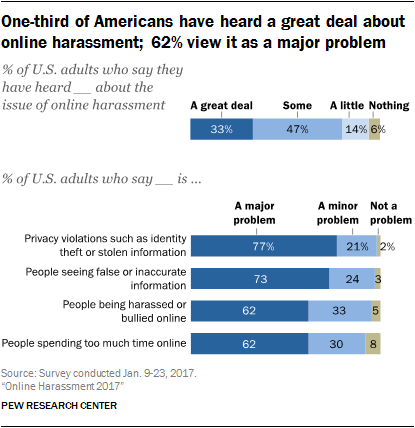
Public awareness of online harassment is high: 94% of U.S. adults have some degree of familiarity with this issue, and one-third have heard a lot about it. Overall, 62% of the public considers online harassment to be a major problem, while just 5% do not consider it to be a problem at all.

When asked who should be responsible for policing or preventing abuse online, Americans assign responsibility to a variety of actors – most prominently, online companies and platforms. Roughly eight-in-ten Americans (79%) feel that online services have a responsibility to step in when harassing behavior occurs on their platforms, while just 15% say that these services should not be held responsible for the behavior and content of its users. Meanwhile, 64% say online platforms should play a major role in addressing online harassment, and 35% believe that better policies and tools from these companies are the most effective way to address online harassment.

At the same time, the public recognizes its own role in curbing online harassment. Fully 60% of Americans say that bystanders who witness harassing behavior online should play a major role in addressing this issue, and 15% feel that peer pressure from others is the single-most effective way to address online harassment. They also see a significant role for law enforcement in dealing with online abuse: 49% think law enforcement should play a major role in addressing online harassment, and 31% say stronger laws are the single-most effective way to address this issue. Simultaneously, a sizable proportion of Americans (43%) say that law enforcement currently does not take online harassment incidents seriously enough.

Americans are divided on the issues of free speech and political correctness that underlie the online harassment debate

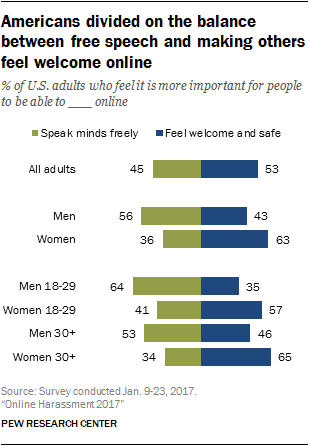
Despite this broad concern over online harassment, Americans are more divided over how to balance protecting free expression online and preventing behavior that crosses into abuse. When asked how they would prioritize these competing interests, 45% of Americans say it is more important to let people speak their minds freely online; a slightly larger share (53%) feels that it is more important for people to feel welcome and safe online.

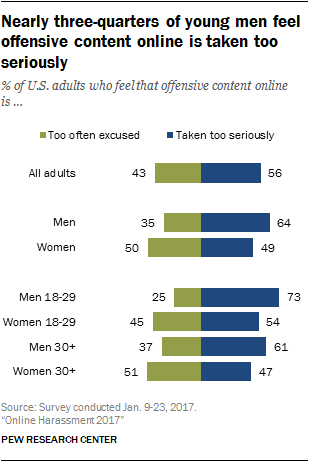
Americans are also relatively divided on just how seriously offensive content online should be treated. Some 43% of Americans say that offensive speech online is too often excused as not being a big deal, but a larger share (56%) feel that many people take offensive content online too seriously. The latter view is prominent among men in general, and among young men in particular: 73% of 18- to 29-year-old men feel that many people take offensive online content too seriously.

Experiences and attitudes toward online harassment vary significantly by gender

Men and women experience and respond to online harassment in different ways. Overall, men are somewhat more likely to experience any form of harassing behavior online: 44% of men and 37% of women have experienced at least one of the six behaviors this study uses to define online harassment. In terms of specific experiences, men (30%) are modestly more likely than women (23%) to have been called offensive names online or to have received physical threats (12% vs. 8%).

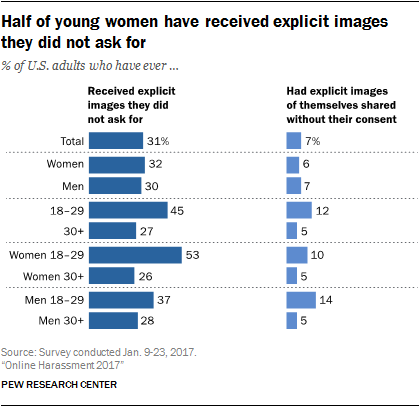
By contrast, women – and especially young women – encounter sexualized forms of abuse at much higher rates than men. Some 21% of women ages 18 to 29 report being sexually harassed online, a figure that is more than double the share among men in the same age group (9%). In addition, roughly half (53%) of young women ages 18 to 29 say that someone has sent them explicit images they did not ask for. For many women, online harassment leaves a strong impression: 35% of women who have experienced any type of online harassment describe their most recent incident as either extremely or very upsetting, about twice the share among men (16%).

More broadly, men and women differ sharply in their attitudes toward the relative importance of online harassment as an issue. For instance, women (63%) are much more likely than men (43%) to say people should be able to feel welcome and safe in online spaces, while men are much more likely than women to say that people should be able to speak their minds freely online (56% of men vs. 36% of women). Similarly, half of women say offensive content online is too often excused as not being a big deal, whereas 64% of men – and 73% of young men ages 18 to 29 – say that many people take offensive content online too seriously. Further, 70% of women – and 83% of young women ages 18 to 29 – view online harassment as a major problem, while 54% of men and 55% of young men share this concern.

Attitudes toward different policies to prevent online harassment also differ somewhat by gender. Men are more likely than women to believe that improved policies and tools from online companies are the most effective approach to addressing online harassment (39% vs. 31%). Meanwhile, women are more likely to say that stronger laws against online harassment are the most effective approach (36% vs. 24%), and they are also more likely to feel that law enforcement currently does not take online harassment incidents seriously enough (46% vs. 39%).

Harassment exists on a spectrum of severity: Those who have experienced severe forms of online harassment differ sharply in their reactions and attitudes

Many online harassment experiences begin and end with offensive name-calling or efforts to be embarrassed, behaviors that are often easy enough to shrug off as a nuisance of life online. But the 18% of Americans who have experienced more severe forms of harassment – such as physical threats, sustained harassment, sexual harassment and/or stalking – differ dramatically in their personal reactions and broader attitudes toward online harassment.

In the immediate aftermath of an online harassment incident, those with severe experiences are more likely to report a variety of consequences, ranging from problems with their friends and family to damage to their reputation. They are more likely to say that a personal characteristic – like their gender or race/ethnicity – was ever the root of their harassment, and to respond to their harassment by deleting their profile or changing their username, ceasing to attend certain offline places, or contacting law enforcement.

Those with severe harassment experiences are also more likely to report a strong reaction to their abuse. More than four-in-ten (44%) say their most recent experience caused mental or emotional stress, 44% say they found the incident “extremely” or “very” upsetting, and 29% felt their physical safety (or the physical safety of those close to them) was at risk. Those who have ever been targeted with severe harassment behaviors are also more likely to feel high levels of anxiety when they witness others being harassed online, more likely to actively protect themselves and their online identities in response to online harassment, and more likely to seek support from a number of sources.

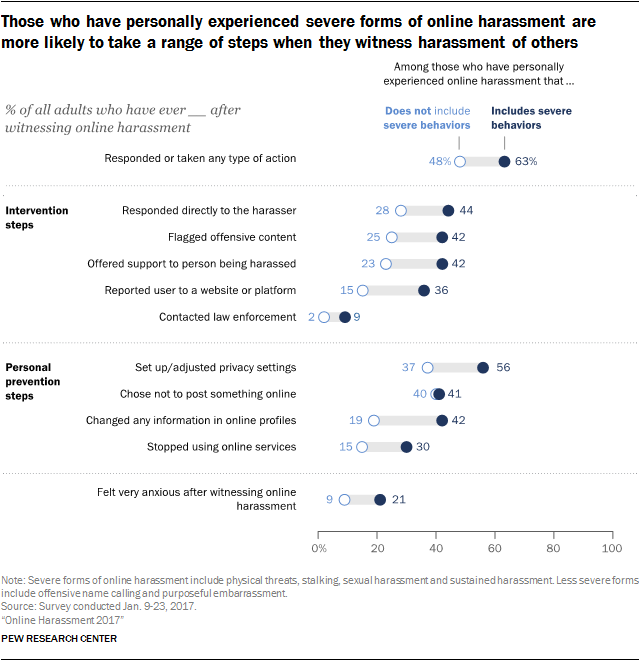
Perhaps most striking, those with severe harassment experiences show a high tendency to intervene when they see others going through similar situations. Almost two-thirds (63%) of those who have ever been targeted with severe behaviors say they have taken action to intervene when they saw someone else harassed online, compared with 48% whose harassment does not include severe behaviors.

At the same time, the attitudes each group has toward the underlying issues of online harassment are closely aligned. For instance, about six-in-ten U.S. adults (62%) say they consider online harassment to be a major problem, regardless of the severity of their personal experiences with online abuse. On issues such as the relative balance between free speech and safety online, or whether online harassment is taken too seriously or dismissed too easily, there are no differences based on the severity of one’s own experiences with online harassment. Further, majorities of both groups agree that online services should play a major role in addressing harassment, and similar shares look to stronger laws and better policies and tools from companies as ways to effectively curb harassment.

Online harassment is often subjective – even to those experiencing the worst of it

Although this survey defines online harassment using six specific behaviors, the findings also indicate that what people actually consider to be “online harassment” is highly contextual and varies from person to person. Among the 41% of U.S. adults who have experienced one or more of the six behaviors that this survey uses to define online harassment, 36% feel their most recent experience does indeed qualify as “online harassment.” At the same time, 37% say they do not think of their experience as online harassment, and another 27% are unsure if they were victims of online harassment or not. Strikingly, 28% of those whose most recent encounter involved severe types of abusive behavior – such as stalking, sexual harassment, sustained harassment or physical threats – do not think of their own experience as constituting “online harassment.” Meanwhile, 32% of those who have only encountered “mild” behaviors such as name-calling or embarrassment do consider their most recent experience to be online harassment.

Two-thirds of Americans have witnessed abusive or harassing behavior toward others online

Beyond their own personal experiences, a substantial majority of Americans (66%) say they have witnessed some type of harassing behavior directed toward others online, with 39% indicating they have seen others targeted with severe behaviors such as stalking, physical threats, sustained harassment or sexual harassment. As was true of the harassment Americans experience personally, younger adults are especially likely to witness harassing behavior toward others online. Fully 86% of 18- to 29-year-olds say they have witnessed at least one of these six behaviors, and 62% have seen others targeted for severe forms of abuse.

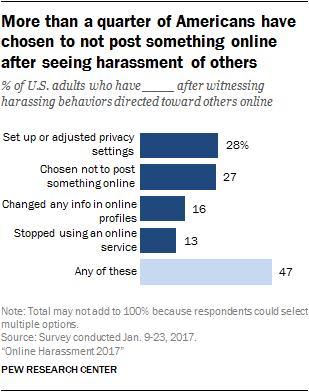
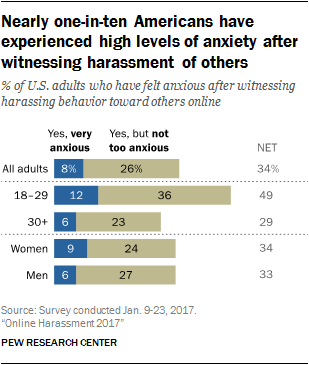
Exposure to these behaviors can have pronounced impacts on those witnessing them. In some cases, this involves people taking basic precautions to protect themselves: 28% of Americans say that observing the harassment of others has influenced them to set up or adjust their own privacy settings. But in other cases, widespread abusive behavior can have a more pronounced chilling effect: 27% of U.S. adults say they have refrained from posting something online after witnessing the harassment of others, and 13% of the population has elected to stop using an online service due to the harassment of others they observe. Additionally, 8% of all adults (and 12% of 18- to 29-year-olds) say they have been very anxious after witnessing harassment of others online.

Anonymity is seen as a facilitating factor in encouraging the spread of harassment online

Users increasingly see the internet as a place that facilitates anonymity. Some 86% of online adults feel that the internet allows people to be more anonymous than is true offline. This represents a notable increase from the 62% who said this in Pew Research Center’s 2014 survey. And this ability to be anonymous online is often tied to the issue of online harassment. Roughly half of those who have been harassed online (54%) say their most recent incident involved a stranger and/or someone whose real identity they did not know. More broadly, 89% of Americans say the ability to post anonymously online enables people to be cruel to or harass one another.

Among other findings:

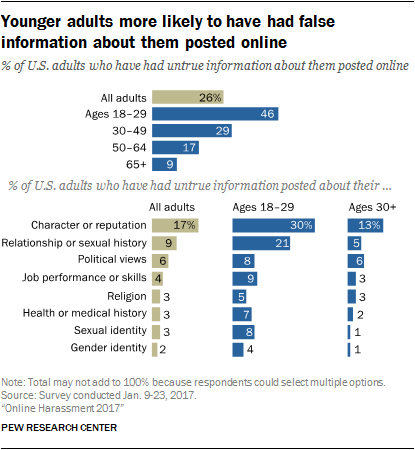
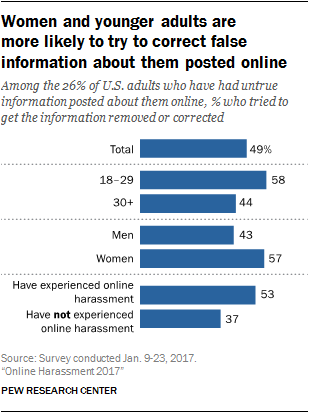
  • About one-quarter of all adults (26%) have had untrue information about them posted online, most commonly about their character or reputation (17%). Half (49%) of those who had untrue information posted about them tried to get the inaccurate claims removed or corrected, and around one-in-ten Americans (9%) say they have experienced mental or emotional stress because of something untrue posted about them online.
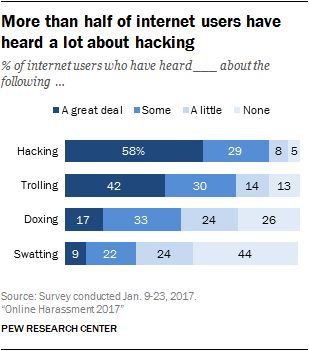
  • Large majorities of internet users have heard about hacking (95%) and trolling (86%), and 18% each have personally been hacked or trolled. Doxing – that is, posting someone’s personal information online without their consent – and swatting – which refers to calling in a fake emergency to the police – are recognized by smaller shares of the online population (73% and 55%, respectively).

1. Experiencing online harassment

Even in its most basic form – say, a bad name or off-color joke – online harassment is a malleable concept. It can be highly contextual and often a matter of personal interpretation. And while certain behaviors would seem to “cross a line,” that line can vary from one person to the next.

Defining online harassment

This report measures online harassment using six distinct behaviors:

  • Offensive name-calling
  • Purposeful embarrassment
  • Stalking
  • Physical threats
  • Harassment over a sustained period of time
  • Sexual harassment

Respondents who indicate they have personally experienced any of these behaviors online are considered targets of online harassment in this report. Further, this report distinguishes between “more severe” and “less severe” forms of online harassment. Those who have only experienced name-calling or efforts to embarrass them are categorized in the “less severe” group, while those who have experienced any stalking, physical threats, sustained harassment or sexual harassment are categorized in the “more severe” group.

This study measures the prevalence and patterns of online harassment by examining six broad categories of abusive behavior (see “Defining online harassment” in the accompanying box). These categories are identical to those used in Pew Research Center’s 2014 examination of online harassment. They are designed to capture a broad range of experiences – not just severe forms of abuse, but also everyday forms of harassment that users might overlook.

All told, 41% of Americans have been the target of harassing behavior online, a modest increase from the 35% of adults who were targets of online harassment in the Center’s 2014 report on the topic. As was the case then, this survey finds that two types of harassing behavior are especially widespread. About a quarter of American adults (27%) say they have been called offensive names online – up 4 percentage points from 2014 – while 22% say that someone online has tried to purposefully embarrass them.

For many, name-calling and embarrassment are the starting and ending point for their harassment. Some 22% of Americans – or roughly half of those who have experienced harassment at all – have encountered online harassment that went no further than these two behaviors. While these experiences can certainly be troubling, those whose encounters with harassment are limited to these behaviors generally find them to be a tolerable nuisance of life online. Throughout this report, the 22% of adults who have only experienced name-calling or efforts to embarrass them – and none of the other four experiences measured in the survey – are referred to as targets of “less severe” forms of online harassment.

Smaller – though still notable – shares of Americans have encountered more pernicious forms of harassment. One-in-ten have had physical threats directed at them online, while 7% each have encountered sustained harassment or stalking, and 6% have been sexually harassed.

In total, 18% of U.S. adults have experienced one or more of these “severe” behaviors online. To be sure, these more serious behaviors are not isolated from name-calling and embarrassment: 72% of those who have experienced these more serious types of harassment have also been called offensive names or purposefully embarrassed. But for this analysis, the 18% of Americans who have encountered any of these serious behaviors are referred to as targets of “severe” forms of online harassment. As will be discussed later in this report, those who face these more serious behaviors are generally more likely to report significant negative consequences from their experiences.

Experiences with online harassment vary by age, gender and race/ethnicity

Many Americans have experienced harassing behavior online, but harassment is an especially common fact of online life for younger adults. Nearly half of Americans ages 18 to 29 say they have been called offensive names online (46%) while more than a third say someone has tried to purposefully embarrass them (37%). And beyond these behaviors, noteworthy shares of young adults have been subject to more serious forms of abuse. One-quarter (25%) have received physical threats online, while smaller but still notable proportions have been sexually harassed (15%), harassed for a sustained period of time (16%) or stalked (13%) online. All told, roughly two-thirds of young adults (67%) have been subject to some type of online harassment – with 41% having experienced severe forms of harassment. All of these figures are statistically unchanged from the Center’s previous survey of online harassment conducted in 2014.

Although young people are exposed to harassment online at especially high levels, the proportion of Americans in other age groups who experience online harassment is notable – and growing. Fully 49% of adults ages 30 to 49 have personally experienced any form of online harassment, up from 39% in 2014. And almost one-quarter of Americans 50 and older (22%) have been the target of online harassment, an increase of 5 percentage points from 2014.

Overall, men and women differ modestly in the types of harassment they encounter online. Men are somewhat more likely to be called offensive names (30% vs. 23%) and to receive physical threats online (12% vs. 8%), although other behaviors – like embarrassment, stalking or sustained harassment – show no statistically significant differences by gender. Overall, men are slightly more likely to experience any form of online harassment (44% vs. 37% of women).

Still, sexual harassment is more common among women than among men and is a particular problem for young women. Among adults ages 18 to 29, women are more than twice as likely as men to report experiencing sexual harassment online (21% vs. 9%). And among the youngest adults – those ages 18 to 24 – women are more than three times as likely to be sexually harassed online (20% vs. 6% of men).

As was true in the Center’s 2014 survey of online harassment, blacks also tend to encounter harassment online at high levels. Overall, 46% of blacks – and 59% of black internet users – have experienced any type of online harassment. In terms of specific behaviors, blacks who go online are especially likely to say that they have been called offensive names (38% compared with 28% of white internet users) or to say that someone has tried to purposefully embarrass them (34% vs. 23%).

In their own words: Gender and online harassment

“Any woman who has an opinion online is bound to get men who through anonymity feel the need to threaten and assault them. I had a friend who got a stalker from posting a political Facebook post.”

“Usually men harassing or threatening females for posting any provocative pictures or an opinion different from his own.”

“Sexual harassment, extreme name-calling, taking sexual abuse I went through and broadcasting it in such a way that I was asking for what happened to me, more lies, that I am an immodest woman for breastfeeding my daughter …”

“I have friends in atheism, feminism and social justice. All have been trolled or harassed to varying extents. There’s usually more of a sexual component when the targets are women, like rape threats and such, but I’ve seen men threatened with physical violence, too. I’ve also seen the harassment flow the other direction, like outraged feminists doxing or otherwise harassing men they’ve decided deserve it.”

“Mostly on dating websites my friends have had experiences where once turned down, men threaten to beat and rape them, murder them, call them names, threaten to ruin their reputation, etc. I have never used a dating website because of what I have seen.”

Political views, physical appearance, gender and race are among the top reasons people say they are harassed online

Many Americans who have encountered online harassment feel their experience is at least in part the result of some aspect of their identity. This ranges from traits like one’s political views to their race/ethnicity or gender.

The survey asked about a number of specific reasons people might experience harassing behaviors online. Some 14% of Americans – representing 35% of those who have encountered any type of harassment online – say they have been targeted with abusive behavior online because of their political views, making this the most common response. Men are more likely than women to say they have been harassed as a result of their politics: 19% of men and 10% of women say they have been harassed online for this reason. Democrats and Republicans are equally likely to be harassed online for their political views.

In their own words: Politics and online harassment

“The recent election caused folks on Facebook to get pretty ugly with their comments regarding their beliefs vs. the beliefs of others who did not agree. Some people I know left Facebook until after the election was over because they were offended or offensive.”

“I got into a political debate and the person did not agree with me. They threatened to find information about me and make it go viral. After I called them a troll they threatened to physically harm me.”

“Eh, just this guy got in a fight with me about gun control, and he started saying really weird, personal things about my family. I petitioned the owner of the thread to remove his comments and he did. I don’t think it really did any lasting damage, but it did make me feel uncomfortable.”

“I made a comment regarding the recent presidential election and was called many names and stereotypes regarding my race.”

“Liberals calling foul things to those who support Trump. Using profane language calling supporters ‘racists, bigots and f****** conservatives.’ ”

“People disagree on my support for Trump. They will use profanity. So I respond the same since I think they are morons.”

“There have been comments between friends on Facebook that have divided friends and families. This past election truly brought out the worst in many people I know. There were insults thrown around on Facebook, at our jobs, and between family members that were blatantly designed to inflict pain.”

“Anything I see is around Trump vs. anti-Trump. The hateful language is upsetting.”

“Never have I seen people being so malicious to each other than after the election. People being bullied and called names simply for expressing their opinions or because they disagree with someone’s politics or views.”

“People who expressed negative feelings or posted negative content toward Donald Trump were called derogatory or obscene names.”

Along with political views, 9% of Americans say they have been harassed online because of their physical appearance, while 8% each have been targeted because of their gender or race/ethnicity. Gender-based harassment is more common among women: 11% of women (and 21% of young women ages 18 to 29) have encountered this type of harassment, compared with 5% of men. Similarly, 25% of all black adults and 10% of Hispanics have experienced harassment online as a result of their race or ethnicity; just 3% of whites say this has happened to them.

In addition to these factors, smaller shares of Americans say they have been subjected to online harassment as a result of their religion (5%), sexual orientation (3%), occupation (3%) or disability status (1%).

In their own words: Race/ethnicity and online harassment

“Race issues seem to have a big market on Facebook and that really brings out ugliness and an issue that should not be on social media in my opinion.”

“I have noticed many racial slurs posted about President Obama. Additionally, people making awful racial slurs in comment sections of articles about minorities and Muslims.”

“I was called a racist on Facebook by a ‘friend.’ I defended myself but it hurt the relationship nearly beyond repair.”

“I’ve seen a lot of racial slurs online. Especially ever since Trump got voted in.”

“A talk about police killings of unarmed black people turned into a full-on verbal assault with racial slurs being hurled at the people who opposed the police killings.”

[direct messages]

“I told a group discussion that I thought that the group should have more compassion for the immigrant children. A woman went off about my background and my father’s background, and she made references to finding me and ‘taking care’ of me, which I took as a threat.”

More than a tenth of Americans have experienced mental or emotional stress (and 8% have experienced problems with friends and family) as a result of online harassment

In many cases, the repercussions of online harassment extend beyond the online environment.

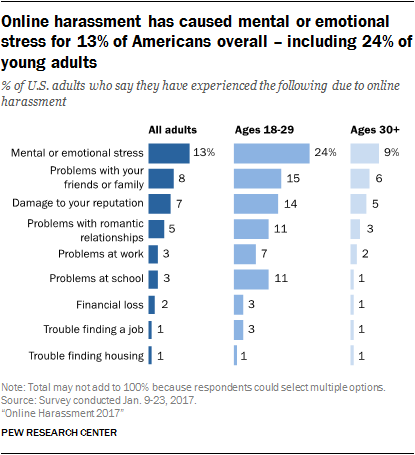
Most prominently, 13% of U.S. adults (or 31% of those who have experienced harassment online) say they have experienced mental or emotional stress as a result of online harassment. Another 8% indicate that these experiences have caused problems with their friends or family, 7% say their reputation has been damaged and 5% say their romantic relationships have been harmed. Smaller shares say that online harassment has led to problems either at their job or school (3% each), a financial loss (2%), trouble finding a job (1%) or trouble finding housing (1%). Overall, one-in-five Americans (20%) say they have faced any of these consequences as a result of their harassment experiences.

Young people tend to experience these aftereffects of online harassment at relatively high levels. Roughly a quarter of 18- to 29-year-olds (24%) have experienced mental or emotional stress as a result of their online harassment (24%). Another 15% report problems with their friends or family, 14% say their reputation has been damaged, 11% each have had problems with romantic relationships or problems at school and 7% have had problems at their job. In all of these cases, young adults report these consequences at significantly higher levels compared with their older counterparts.

Those who have faced severe forms of online harassment are more likely to say they were targeted over aspects of their identity and to face offline consequences

As noted earlier in this chapter, 18% of Americans have experienced severe forms of online harassment such as physical threats, stalking, sexual harassment or sustained harassment. And compared with Americans who have “only” been called offensive names or embarrassed online, this group is much more likely to experience offline consequences due to their harassment online.

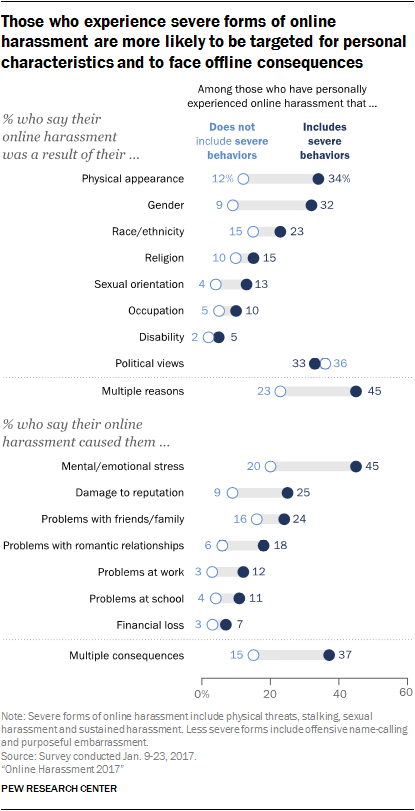
Those who have experienced severe forms of harassment are especially likely to say that they have been targeted because of specific personal characteristics. About one-third of those with severe harassment experiences say they have been targeted due to their gender (32%) or physical appearance (34%), and sizable shares have been targeted due to their race or ethnicity (23%) or sexual orientation (13%). In addition, 45% say they have been targeted due to more than one aspect of their identity.

Those who have faced severe forms of harassment are also more likely to report a range of offline consequences. Fully 45% say online harassment has caused them mental or emotional stress, around one-quarter say it has caused problems with their friends or family (24%) or damage to their reputation (25%), and 18% say it has resulted in problems with their romantic relationships. This group is also more likely to say that online harassment has led to problems at their job or at school, financial loss, or trouble finding housing. And as was true of the reasons people might be targeted for abuse, those who have faced severe types of online harassment are more than twice as likely to experience more than one of these offline consequences (37%, compared with 15% of those whose harassment does not include severe behaviors).

2. Online harassment in focus: Most recent experience

In order to gain a more detailed understanding of the daily realities of online harassment, the 41% of adults who have been targeted online were asked a series of questions about their most recent experience.3 These questions cover the venues in which their online harassment took place, its perpetrators, the actions people took in response (if any), whether people sought support from those around them and how upsetting they found the experience.

Most online harassment targets say their most recent experience occurred in a single venue, often social media

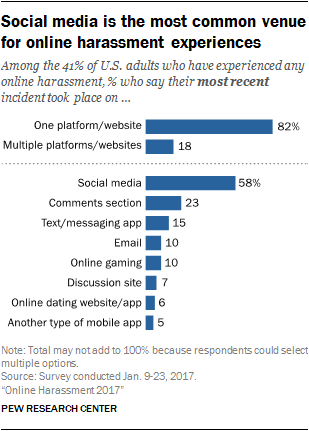
By a substantial margin, social media stands out as the most common venue in which online harassment takes place. When asked where their most recent experience with online harassment occurred,4 nearly six-in-ten targets of harassment (58%) say it took place on social media. Similarly, a majority cited social media as the scene of their most recent harassment in Pew Research Center’s 2014 survey on online harassment.

Along with social media, 23% of those who have been harassed online say their most recent incident took place in the comments section of a website, 15% say it involved text or messaging apps, and 10% each say it took place over email or on an online gaming site. Other environments – such as discussion forums and dating websites – are cited by fewer than 10% of those who have been harassed.

There are relatively few demographic differences related to where harassment takes place, with gaming being a major exception. Men who have experienced harassment are nearly four times as likely as women to cite gaming as the scene of their most recent incident (15% vs. 4%). Similarly, young adults are more likely than older adults to say they have faced online harassment while gaming. Some 18% of those ages 18 to 29 cited gaming as a platform where they were harassed most recently, compared with 5% of those ages 30 and older. Younger men are especially likely to say that their most recent harassment experience occurred in an online gaming space: 31% of 18- to 29-year-old men with harassment experiences say this, compared with just 4% of women in the same age group.

The common practice of maintaining multiple profiles or accounts can leave users exposed to harassing behavior across a variety of online spaces, and around one-in-five harassment victims (18%) say their most recent experience happened across multiple sites or platforms. However, the vast majority of those who have experienced online harassment (82%) say their most recent experience occurred on one specific site or platform.

In their own words: Gaming and online harassment

“In online role-playing games, the under-30 crowd tends to be aggressive. Calling each other mean names and going after each other in rants that seem to go on forever.”

“Most of these experiences were on a poker-related forum several years ago. The ‘culture’ of the forum was very confrontational and crude. It made no apologies and members understood what they were getting into. Alternatives existed for those who didn’t want to be subjected to the behavior they found objectionable.”

“I play a lot of online games. Depending on the game, people can be terrible to each other via in-game chat (verbal or text). Anything perceived as poor in-game performance can lead to name calling and escalate to personal threats and attacks in seconds.”

“A friend of a friend found out I’m female on the gaming platform Steam. The harassment and constant sexual overtures were bad enough I contacted Steam to change all my information, effectively closing my account and opening a new one.”

“Most of these situations happened in game rooms or on forums where smack talk is common and no one takes it too seriously, but personal details are usually left out.”

“My wife plays online games (as do I). Over the years I’ve seen guys exhibit disturbing behavior toward her, for no other reason than she’s a woman. Sometimes it’s just calling her offensive names, sometimes it has been actual sexual harassment.”

Anonymity looms large in online harassment experiences: More than half of those targeted do not know the person behind their most recent incident

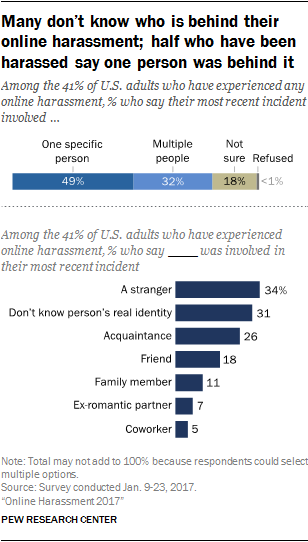
Many of those who experience online harassment are uncertain of who is perpetrating it: 34% say that the source of their harassment was a stranger, while another 31% say they do not know the real identity of the person(s) harassing them. Taken together, 54% of online harassment targets say the person behind their most recent incident fell into one of these two categories, a figure that is statistically unchanged from the 50% who said the same in 2014.

At the same time, many people report that their harassers are known to them – in some cases, very well known. Roughly one-quarter of those who have been harassed (26%) say an acquaintance was responsible for their most recent incident. Meanwhile, 18% of those who have been harassed say their most recent incident involved a friend, while 11% say it involved a family member. Fewer than one-in-ten say their most recent experience involved a former romantic partner (7%) or a co-worker (5%).

And just as harassment may take place across multiple sites, it can also be at the hands of multiple perpetrators. Roughly one-third of those who have been harassed online (32%) say multiple people were responsible for their most recent incident, while almost half (49%) say just one individual was responsible. Another 18% are not sure if their most recent incident was perpetrated by one person or multiple people.

A majority of those who have been harassed online simply ignored their most recent incident; those who responded favored easy, digital steps and personal confrontations

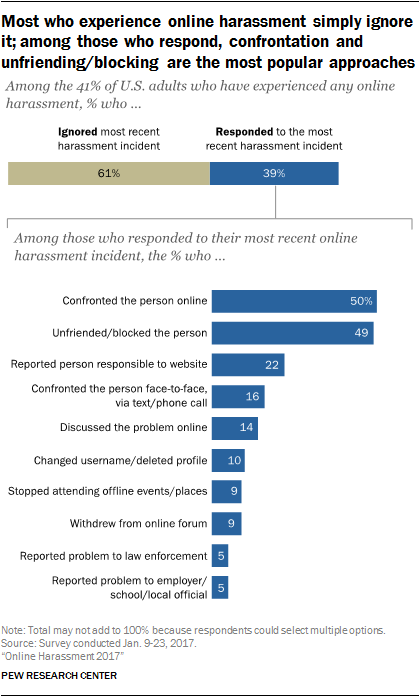
As was the case in 2014, people often try to ignore online harassment when it occurs. Fully 61% of those who have experienced online harassment say they ignored their most recent incident, while 39% chose to take some sort of step in response.

Among those who did respond to their most recent online harassment incident,5 half (50%) chose to confront the person responsible online while 49% unfriended or blocked that person. Another 22% reported the person responsible to a website or online service, and 14% discussed the problem online to draw support for themselves. Other online steps – such as changing a username, deleting a profile or withdrawing from an online forum – were less common.

Others relied on established relationships to address the problem. Some 16% of those who responded to their harassment confronted the person face to face, via text message, or by phone. This approach was especially common in instances where the target knew their perpetrator, such as when the person or people involved were friends, family, ex-romantic partners or acquaintances. Responses involving some sort of offline location or intervention – like refraining from attending offline events or places, or reporting the problem to an authority figure – were taken by a relatively small share of those who responded to their most recent harassment incident.

Regardless of whether people chose to ignore or respond to their harassment, most express satisfaction with the result. Some 74% of those who took action in response to their most recent harassment incident said it was effective at making the situation better – as did 69% of those who chose to ignore the behavior. However, there is some evidence that ignoring online harassment has perhaps gotten less effective over time: In 2014, 82% of those who chose to ignore their most recent incident said that it made the situation better.

Finding support during online harassment incidents often involves friends and family or others online

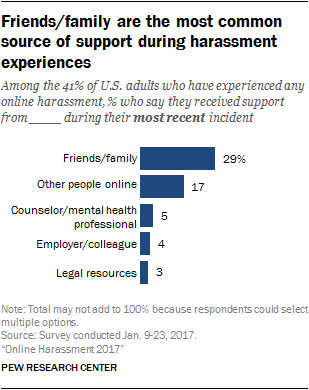
Beyond steps harassment targets can take individually to address or mitigate harassment online, a number of people sought personal help or support during their most recent experience. Most commonly, this involved turning to friends and family: 29% of those who have experienced harassment online say they received help or support from friends or family during their most recent incident. Women are more likely than men to have sought out or received this kind of support during their most recent experience (34% vs. 25%).

Along with friends and family, 17% of those who have experienced harassment online say they received support from other people online during their most recent incident. Smaller shares sought help from a counselor or mental health professional (5%), an employer or colleague (4%) or legal resources (3%).

That said, the largest share of harassment targets go it alone: 56% either did not seek or did not receive support from any of these sources during their most recent incident. Men were more likely than women to say they did not seek or receive any of these types of support (60% vs. 51% of women).

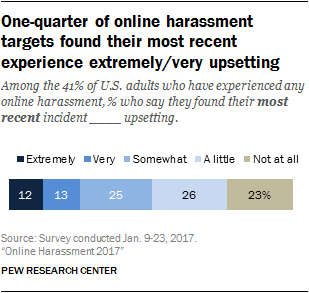
One-quarter of those who have experienced online harassment say their most recent incident was extremely or very upsetting; roughly one-in-ten say they felt in physical danger

Just as online harassment exists along a spectrum of severity, those who have encountered some form of harassment feel its impact in various ways. At one end, about half of those who have experienced online harassment say that their most recent incident was either “a little” (26%) or “not at all” (23%) upsetting. Still, others find these experiences deeply troubling: 25% say their most recent harassment incident was either “extremely” (12%) or “very” (13%) upsetting.

Women are especially likely to be deeply impacted by their harassment experiences. Among women who have been harassed, 35% found their most recent experience either “extremely” or “very” upsetting, more than double the share of men who said the same (16%).

And for a minority, online harassment can even threaten their personal safety. Among those who have experienced harassment online, 12% say they felt a threat of physical danger for themselves or people close to them during their most recent harassment incident.

Online harassment is often highly subjective – even for those experiencing the ‘worst’ of it

To capture the many forms online harassment can take – from casual name-calling to more targeted campaigns – this report uses a broad definition of harassment. And while defining and categorizing harassment in this way allows for a holistic analysis, the data suggest that what constitutes “online harassment” can be highly subjective to those who experience it.

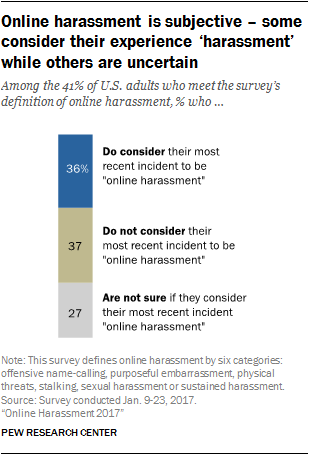
To that end, respondents who met the definition of online harassment used in this report were also asked if they themselves considered their most recent experience to be online harassment. Some 36% say they do in fact consider their experience to be online harassment. At the same time, 37% do not consider their most recent experience to be online harassment and another 27% are not sure if they consider it harassment or not.

Women are more likely than men to describe their most recent experience as “online harassment” (42% vs. 31%). But in general, the responses to this question highlight the subjective nature of online harassment. For instance, 28% of those whose most recent incident meets this report’s definition of “severe” harassment do not consider their experience to be online harassment (another 21% say they weren’t sure). Meanwhile, 32% of those who have only encountered “mild” behaviors such as name-calling or embarrassment do consider their most recent experience to be online harassment.

Those who have faced severe forms of harassment are more likely to say their most recent experience was deeply upsetting and to feel they were in physical danger

Across almost every dimension of this survey, those whose most recent incident with online harassment involved severe behaviors differ in their responses and reactions to the experience, compared with those whose most recent incident involved less severe behaviors such as offensive name-calling and efforts to embarrass them.

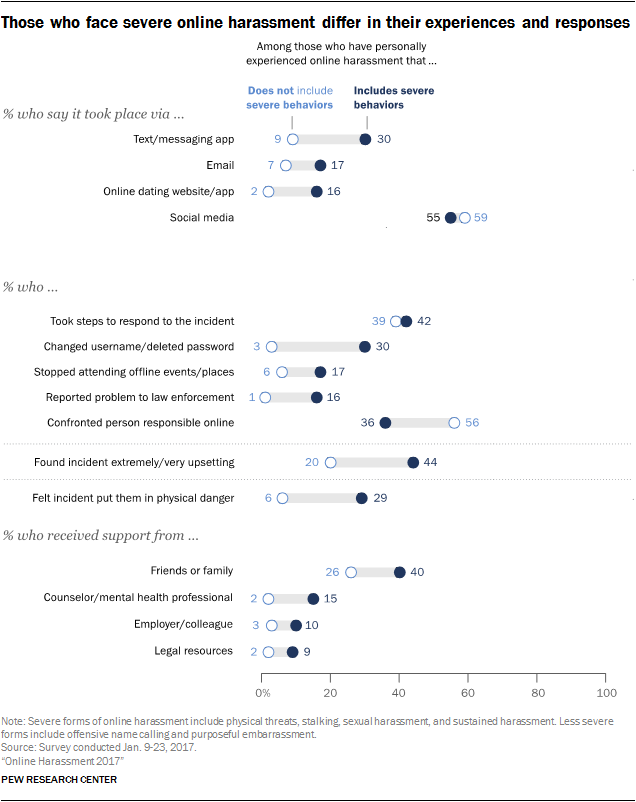
First, these groups differ in terms of where their online harassment took place. Social media is the most common scene of online harassment regardless of the severity of one’s experience, but those with severe experiences are significantly more likely to say their most recent incident took place via a phone or messaging app (30% vs. 9%), personal email (17% vs. 7%) or an online dating site (16% vs. 2%). They are also more likely to say that their harassment spanned multiple online venues (27% vs. 14%).

Some 42% of those whose most recent incident included severe forms of harassment took steps to respond to the behavior, similar to the 39% of those whose most recent experience involved less severe behaviors. But there is a good deal of variation in the steps that each group took in response. Those whose most recent incident involved severe forms of harassment are more likely to say they changed their username or deleted their profile, stopped attending offline venues or reported the incident to law enforcement. On the other hand, those responding to less severe forms of harassment were much more likely to confront their harasser directly online.

Those whose most recent online harassment experience involved severe behaviors are also more likely to say they received support from a number of sources, such as friends or family, a counselor or other mental health professional, an employer or colleague, or legal resources. This group is also much more likely to say they were deeply unsettled by the experience: 44% say they found their most recent incident to be “extremely” (28%) or “very” (17%) upsetting.

Similarly, 29% of those whose most recent incident involved severe behaviors say they felt they or someone close to them were in physical danger during the experience, more than four times the proportion of those whose harassment did not include severe behaviors (6%).

3. Witnessing online harassment

Harassment does not have to be personally experienced in order to leave an impact. In addition to their own personal experiences, a majority of Americans have witnessed harassment directed at someone else online. This chapter explores the role these bystanders play in addressing online harassment when they see it, how often they intercede and by what means. It also explores a more subtle side effect of witnessing online harassment – whether observing these behaviors causes a “chilling effect” or prompts people to adjust their online presence and privacy settings.

Two-thirds of U.S. adults have witnessed potentially harassing behavior directed toward others online

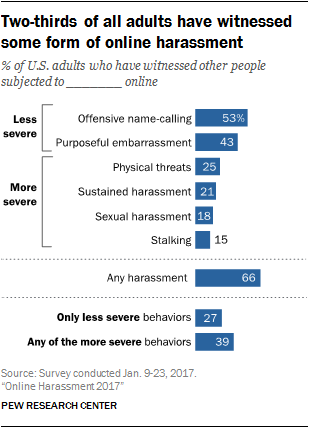
As noted in Chapter 2, 41% of Americans have personally experienced harassing behavior online. But an even larger share of the population – 66% in total – has witnessed these behaviors directed at others online. As was true of the harassment people experience directly, offensive name-calling and efforts to embarrass someone are the most common types of harassment people witness online. Over half of all adults (53%) say they have witnessed others being called offensive names online, and another 43% have witnessed someone being purposefully embarrassed. Smaller – though still notable – shares of Americans say they have witnessed more severe forms of online harassment. One-quarter of Americans say they have seen someone being physically threatened online, while 21% have seen others harassed for a sustained period of time. Another 18% report that they have witnessed someone being sexually harassed online and 15% say they have seen a person being stalked. All told, 39% say they have seen others experience particularly severe forms of online harassment (which includes stalking, physical threats, sustained harassment, or sexual harassment).

The proportion of adults who have witnessed any form of online harassment is roughly the same as in 2014: At that point, 65% of U.S. adults had witnessed any of these behaviors and 34% had witnessed these more severe forms.

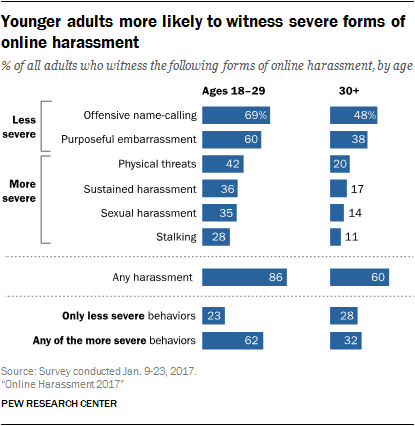
Just as younger adults are more likely than older adults to personally experience online harassment, they are also more likely to see others being harassed online. Fully 86% of 18- to 29-year-olds have witnessed harassing behaviors online, compared with 60% of those ages 30 and older.

Name-calling and embarrassment are the most common forms of harassment that young adults witness (69% and 60%, respectively), but their exposure to more severe forms of harassment is especially striking. About six-in-ten adults ages 18 to 29 (62%) have witnessed some form of severe harassment online: 42% have seen others make physical threats, 36% have witnessed sustained harassment directed against someone, 35% have seen sexual harassment and 28% have witnessed stalking online. Younger adults are much more likely to witness each of these behaviors compared with adults 30 and older.

Still, the exposure to online harassment that older adults witness is notable. About three-quarters of those ages 30 to 49 (78%) and half of adults 50 and older (48%) say they have witnessed some form of online harassment. In particular, substantial minorities of adults 50 and over have seen others called offensive names online (35%) or witnessed someone purposefully being embarrassed (29%).

Three-in-ten Americans have responded or taken action after witnessing potentially harassing behavior online

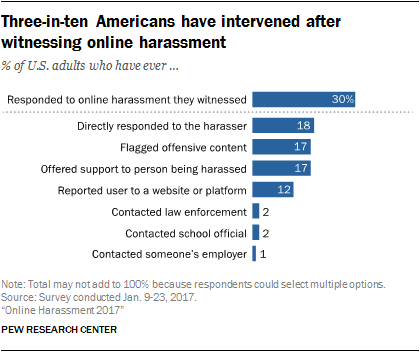
Witnesses to harassment can often play a decisive role in someone else’s harassment online by choosing to intervene or offer their support. This survey finds evidence that a portion of Americans have indeed taken action after witnessing harassment online – although a similar share has seen these behaviors but never taken any action to address it. Three-in-ten U.S. adults (30%) say they have ever responded or taken some sort of action after witnessing potentially harassing behavior directed at someone online. Meanwhile, 35% have witnessed this type of behavior but have never responded to it. The remaining 24% of adults have never witnessed any type of harassing behavior online in the first place.

The specific steps that people take to respond to harassment of others tend to fall into three categories. In some cases, they reach out to either the attacker or the victim directly: 18% of Americans have directly responded to the perpetrator of harassment, while a similar share (17%) has offered support to someone they thought was being harassed. In other instances, they elect to utilize technological solutions such as flagging offensive content (17% of all adults say they have done this in response to witnessed harassment) or reporting someone to a website or online platform where harassment was taking place (12%). Relatively few say they have gone even further after witnessing an online harassment incident by contacting law enforcement (2%), a school official (2%) or someone’s employer (1%).

In their own words: Reporting online harassment

“I have witnessed people on Facebook call others ugly names, make racist and sexist comments, and denigrate specific religions and groups on many occasions. I usually report it but Facebook rarely if ever does anything. I also report fake profiles and Facebook ignores that, too.”

“When I was a teacher in a middle school, the students sometimes shared some of the negative comments and information that was shared online. There were times I had to call law enforcement, their parents, administration, etc.”

[A]

“Name-calling involving sexually explicit names, people having derogatory comments posted so often they have to close posts and even websites, people having sexually explicit posts in comments, and one person who felt unsafe and had to leave the internet. I had to get a lawyer to write a letter asking for a retraction that was grudgingly given.”

“I ignored the offender and blocked them from ever contacting me again. Which did solve the problem.”

The ‘chilling effect’ of online harassment: 27% of Americans have chosen to not post something online after witnessing harassment of others

Observing harassment online can lead to a number of potential negative consequences. Witnesses may feel anxious or unsafe about their own interactions or participation online, and many are concerned that widespread harassment contributes to an environment in which people are scared or unwilling to speak freely for fear of retribution. This survey finds evidence of both of these outcomes.

Almost three-in-ten Americans (27%) say that witnessing online harassment of others has caused them to refrain from posting something online, while a nearly identical share (28%) say it has encouraged them to set up or adjust their own privacy settings. In addition, 16% have changed the information in their online profile(s), 13% have stopped using an online service after seeing these behaviors and 3% say they have taken some other step beyond the four listed here. In total, roughly half (47%) of all adults have taken at least one of these steps as a result of witnessing harassment of others.

Younger adults are especially likely to engage in this sort of “profile management” after witnessing harassment online: 47% of adults ages 18 to 29 have adjusted their privacy settings for this reason, while 30% say they have changed some of the information in any of their online profiles. And an especially large share of women ages 18 to 29 (45%) have chosen to not post something online after witnessing harassment of others.

Exposure to the online harassment of others also can lead to personal and emotional impacts. For instance, nearly one-in-ten adults (8%) report that they have felt “very anxious” after witnessing harassing behaviors online because they were worried they might be targeted for similar treatment. Another 26% say they have felt mildly anxious, but not overly so, after seeing these behaviors online.

These feelings of anxiety are present at some level across a relatively broad cross-section of Americans, but are especially prominent among younger adults. Nearly half (49%) of those ages 18 to 29 have felt anxious after witnessing online harassment directed toward others, with 12% indicating that they have felt “very anxious” at one point or another that something similar might happen to them.

Those who have personally experienced severe forms of online harassment are more likely to respond when they see others harassed and to take steps to protect themselves

Whether someone has personally experienced online harassment themselves is highly correlated with how that person responds and reacts toward online harassment happening to others. This is especially true for people who have encountered severe forms of harassment, such as stalking, physical threats, sexual harassment or harassment over a sustained period of time.

Those who have themselves experienced severe forms of harassment are especially likely to say they have felt high levels of anxiety after seeing harassment directed at others. Roughly two-thirds (65%) of those who have experienced severe harassment say they have felt some level of anxiety after witnessing harassment of others, with 21% indicating that they have been made “very anxious.”

Those who have experienced severe forms of online harassment are also more responsive when they see others targeted online. Almost two-thirds (63%) of those with severe harassment experiences say they have taken some type of active step to respond after seeing someone else targeted online, including directly responding to someone’s harasser (44% have done this), offering their support to the target (42%), flagging offensive content (42%), reporting the offender to a website (36%) or contacting law enforcement (9%). These responses are all less common among both those whose harassment does not include severe behaviors, as well as among those who have not experienced any online harassment at all.

Likewise, those who have been the target of severe forms of harassment are especially likely to take steps to protect their online presence after seeing others being harassed. More than half of those with severe harassment experience (56%) have adjusted their privacy settings after witnessing harassment, 42% have changed the information in any of their online profiles and 30% say they have stopped using an online service because of harassment concerns.

4. The broader context of online harassment

Outside of the specific behaviors discussed thus far in this report, online harassment presents broader issues and implications for the tone and culture of interacting in the digital age. Most Americans have heard of online harassment and many consider it a major problem, but the public is more divided on foundational issues such as the appropriate balance between freedom of speech and safety online. Similarly, most agree that online companies should be held responsible for dealing with harassment on their platforms, but the public also sees a role for law enforcement, elected officials and even ordinary users in addressing harassment. And while many see anonymity as a key enabler of online harassment, many Americans also see the benefits of anonymity in other contexts.

The vast majority of Americans have heard about the issue of online harassment; nearly two-thirds consider it a major problem

Among the public, there is widespread awareness of the issue of online harassment. Roughly one-third (33%) of Americans have heard a great deal about this issue, and fully 94% have heard at least a little about it. Awareness is high across a broad range of demographic groups, though younger adults are especially likely to have heard a great deal about it.

Along with this widespread awareness, a majority of Americans (62%) consider harassment and bullying online to be a major problem. Compared with other common problems online, that is identical to the share that thinks people spending too much time online is a major problem (62%), but somewhat smaller than the share that considers people’s exposure to false or inaccurate information (73%) or privacy violations such as identity theft (77%) to be serious issues.

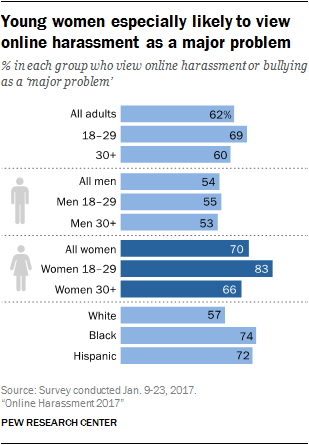
Certain groups of Americans tend to view online harassment as a more serious problem than others, with young women among the most prominent. Fully 83% of women ages 18 to 29 describe online harassment as a major problem, a substantially larger share than either men in the same age group (55%), women 30 and older (66%) or men 30 and older (53%). In fact, a larger share of young women view online harassment as a major problem than any of the other three issues measured in this survey; they are the only major demographic group for whom this is true. Broadly speaking, women are more likely than men (by a 70% to 54% margin) to say that people being harassed or bullied online is a major problem.

Americans’ views of online harassment also vary based on age and race: 18- to 29-year-olds are more likely than those 30 and older to view online harassment as a serious issue (69% vs. 60%), while blacks (74%) and Latinos (72%) are more likely to say that online harassment is a major problem compared with whites (57%).

Americans who have experienced online harassment in their own lives are more likely than those who have not been harassed to consider this a major issue – though not by an especially dramatic margin. About two-thirds (65%) of Americans who have experienced any type of online harassment describe this issue as a major problem. At the same time, online harassment is viewed as a major problem by 58% of Americans with no direct experience with this issue.

Likewise, Americans who have witnessed others being targeted with potentially harassing behavior are more likely to view it as a major issue – although again by a relatively modest margin. Roughly two-thirds (64%) of Americans who have witnessed these types of behaviors directed toward others consider online harassment or bullying to be a major problem, compared with 55% of those who have not personally witnessed harassment online.

A larger share of online adults think the internet allows people to be more anonymous than in 2014 – although that anonymity can have positive as well as negative impacts

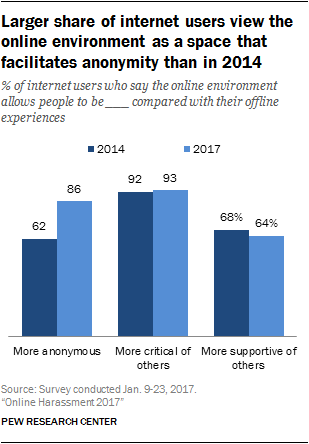
Anonymity is often blamed as a key enabler of cruelty and abuse in discussions of online harassment, and this survey finds evidence that the internet is indeed viewed as a much easier place to be anonymous than was true just three years ago. Fully 86% of internet users now say the online environment allows people to be more anonymous than is true offline – a 24-percentage-point increase from 2014, when 62% of online adults held this view. By contrast, the share of internet users who say the online environment allows people to be more critical (93%) or supportive (64%) of others is largely unchanged over the same time period.

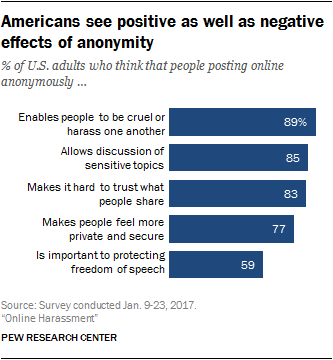
But the impression that anonymity is more widespread online is not universally viewed in a negative way: Americans see both upsides and downsides to anonymity online. On the positive side, 85% of Americans feel anonymity allows people to discuss sensitive topics freely, 77% think anonymity makes people feel more private and secure, and 59% say it is important to protecting freedom of speech. On the negative side, 89% feel that anonymity facilitates harassment and cruelty, while 83% say it makes it hard to trust what people are saying online.

In their own words: Anonymity online

“Mostly childish behavior between individuals taking advantage of the anonymity afforded by social media and online tools. One person accuses another of something and it becomes some ludicrous exchange of insults.”

“People being generally rude and feeling safe behind their keyboard.”

“Just the normal of what I call internet muscles. Talking lots of trash because you don’t know who’s saying what.”

“Usually it’s about someone’s comments online and an individual going out of their way to insult, degrade or personally attack them from a place of anonymity. Mostly it implies some sexual, mental or otherwise degrading accusation about them and has more profanity than wit.”

“Cyberbullies who are anonymous are relentless. They find a weakness and hammer it over and over.”

“Anonymous individuals using their ‘freedom of speech’ and anonymity to purposefully antagonize others, attack those with differing opinions, or merely to exercise the illusion of power over another. People commonly go far beyond what would be deemed culturally or socially acceptable in a normal interaction.”

Online platforms and digital bystanders are seen as leaders in tackling online harassment

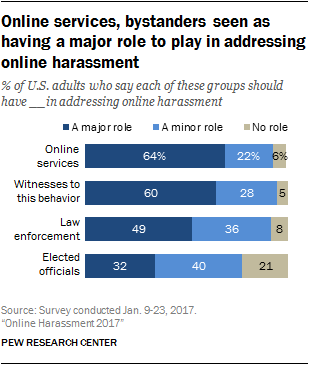
When asked about the variety of actors that might be responsible for preventing or minimizing abuse online, the public sees two playing an especially prominent role. Almost two-thirds (64%) of Americans6 say that online services (such as social media platforms or other websites) should play a major role in addressing online harassment, while another 60% say ordinary users share in this responsibility. Outside the digital realm, smaller but still substantial proportions of Americans say that law enforcement (49%) and elected officials (32%) should play a major role in addressing online harassment.

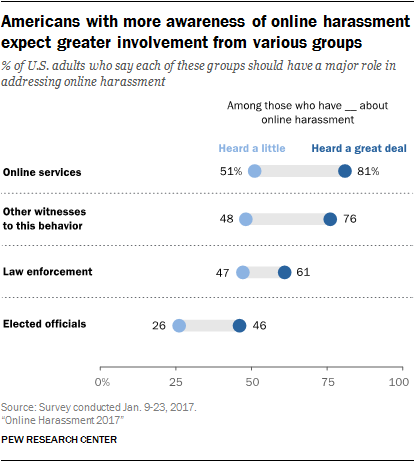
Americans who have heard a great deal about the issue of online harassment see a more prominent role for all of these groups in combating harassment online. Compared with those who have only heard a little bit about the issue, this group is substantially more likely to see a major role for online services (81% vs. 51%), others who see harassment happen (76% vs. 48%), law enforcement (61% vs. 47%) and elected officials (46% vs. 26%).

Interestingly, even as views on this question vary significantly based on one’s familiarity with the issue of online harassment, there is not any variation based on personal experiences with harassment. Americans who have themselves experienced harassment online (even if that harassment is severe) have nearly identical views to those who have not been targeted in such a way.

In general, a majority of men and women think each of these groups should play some role in addressing online harassment; but women are somewhat more likely than men to think three of these entities should play a major role in tackling the issue. For instance, 54% of women say law enforcement should play a major role in addressing online harassment, compared with 43% of men. Women are also a bit more likely than men to say that bystanders (63% vs. 57%) and elected officials (35% vs. 29%) have a major role to play in addressing online harassment.

There are also age differences on this issue, with older adults tending to favor more involvement from traditional institutions, like the criminal justice system or elected officials. Around six-in-ten adults ages 65 and older (58%) think law enforcement should play a major role in addressing online harassment, and around four-in-ten (38%) say the same of elected officials. Those shares drop to 37% and 28%, respectively, among 18- to 29-year-olds.

Around eight-in-ten Americans think online services should be responsible for harassment that takes place on their platforms

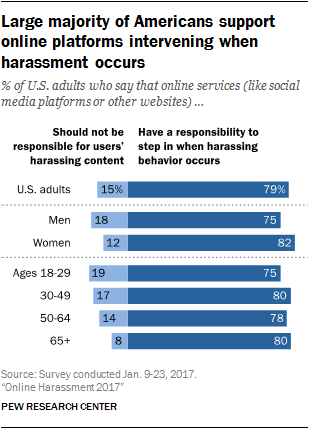
The Communications Decency Act of 1996 provides that online hosts are not legally responsible for the content users post on their platforms. Nonetheless, this survey finds that roughly eight-in-ten U.S. adults (79%) feel that online services have a responsibility to step in when harassing behavior occurs on their sites: Just 15% say these services should not be responsible for the content users post or share on their site, even when the material is harassing.

Majorities of all major demographic groups agree that online platforms have a responsibility to confront abusive behavior on their sites, though some are more supportive of a “hands-off” approach than others. For instance, men are slightly more likely than women to feel that online services should not be held responsible for harassing behavior on their platforms (18% vs. 12%). And adults younger than 30 are more than twice as likely as those 65 and older to hold this view (19% vs. 8%).

Better policies from online platforms and stronger laws seen as most effective methods to address online harassment

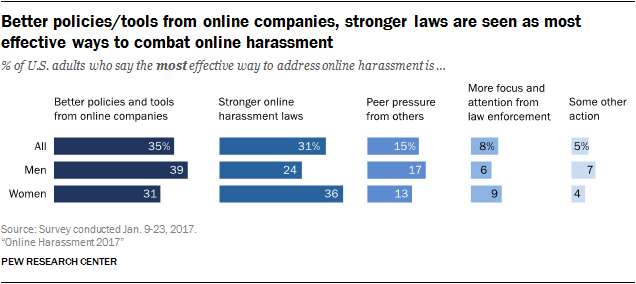
When presented with a list of possible ways to address online harassment and asked to choose the one they think is most effective, just over one-third of Americans (35%) say that better policies and tools from online companies are the most effective approach. A slightly smaller share (31%) feels that stronger laws against online harassment and abuse are the most effective way to combat this behavior. Another 15% cite peer pressure from other users, while 8% select increased focus and attention from law enforcement and 5% cite some method other than the four provided in the survey.

Men and women differ in their perceptions of these solutions, particularly when it comes to the effectiveness of stronger online harassment laws. About a third of women (36%) say that stronger laws are the best way to prevent online harassment, compared with 24% of men. And young women are especially likely to say increased attention from law enforcement is the key to addressing online harassment (14% vs. 5% of young men). Meanwhile, men are somewhat more likely to say that better policies and tools from online companies are the best solution to combatting online harassment (39% vs. 31%).

Public mixed on whether or not law enforcement takes online harassment seriously enough

In several recent cases of online harassment, the targets have expressed frustrations with the ability of law enforcement to properly address this issue, and in some instances have argued – accurately or not – that law enforcement may not take online abuse as seriously as other types of crime they patrol.

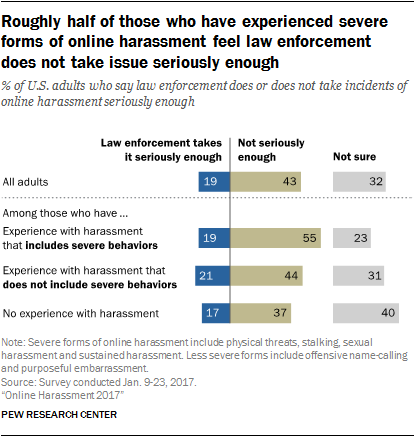
Overall, the public expresses somewhat mixed views on this subject. A plurality of U.S. adults (43%) say that law enforcement does not take incidents of online harassment seriously enough. However, 19% feel that law enforcement does take harassment complaints seriously – and 32% say they are uncertain whether or not law enforcement takes online harassment seriously enough.

Americans’ views on this subject differ by respondents’ own awareness of, and personal experiences with, abusive behavior online. Almost half (49%) of those who have experienced some type of harassing behavior – including 55% of those who have experienced severe types of harassment – feel that law enforcement does not take online harassment incidents seriously enough. But that figure falls to 37% among those who have not experienced any type of online harassment themselves.

Similarly, 58% of those who have heard a great deal about online harassment do not think law enforcement takes the issue seriously enough; that share drops to 40% among those with some familiarity with the issue and 35% among those with little familiarity.

Along with these differences, women are a bit more likely than men to say that law enforcement does not take this type of harassment seriously enough (46% vs. 39%), while men are a bit more inclined to agree that law enforcement does in fact take online harassment seriously (22% vs. 16%).

In their own words: Police and law enforcement involvement with online harassment

[I’ve seen]

“I was sent lewd photos from an anonymous person that ended up being a student at the school I work for. He was persistent, despite getting law enforcement involved. It resulted in an extreme anxiety and stress for me.”

“One individual took objection to another user’s offensive language and racist comments on a particular website. The individual objecting was threatened with bodily harm. Police needed to get involved and a restraining order was issued to keep the individual making the threats away from the individual that originally complained.”

“An individual was trying to cyberstalk another individual while online. I witnessed the action and got law enforcement involved. An arrest resulted from the action. Those of us that have been on the receiving end tend to be protective of those we see getting similar experiences.”

“When I was in my first year of college I was at a school-sponsored event and met a guy who seemed nice. We exchanged numbers, but soon he was stalking me physically as well as online. He even used the school’s computers to find out my class schedule when I hadn’t told him. Eventually I had to call the campus police as he was messaging me on social media and constantly showing up wherever I was even after I told him I wasn’t interested.”

“A friend experienced two years of online harassment and extremely embarrassing and personally damaging postings, all of which made him retire from his job and move away, and law enforcement didn’t take it seriously. He got almost no support from them.”

Americans are relatively divided on the appropriate balance between protecting the ability to speak freely and making people feel welcome and safe online

The debate over online harassment has long been marked by a tension between allowing people to speak freely on a wide range of issues while simultaneously maintaining a baseline level of safety online. And this survey finds that the public as a whole is divided on how to prioritize these issues. When asked which they feel is more important, 45% of Americans say it is more important that people are able to speak their minds freely online; a slightly larger share (53%) says it is more important that people are able to feel welcome and safe online.

Although the public as a whole is relatively divided on this question, certain groups feel more strongly that one of these two objectives should be given priority over the other. Most prominently, men are substantially more likely than women to say it is more important for people to be able to speak their minds freely when they are online: 56% of men choose this option, compared with 36% of women. By contrast, women are much more likely to say that people should be able to feel welcome and safe in online environments: 63% of women take this side of the debate, compared with 43% of men.

Interestingly, Americans who have themselves encountered various types of potentially harassing behaviors online – even those who have experienced relatively extreme forms of harassment – do not differ substantially from other Americans in their prioritization of these two issues. About half (52%) of Americans who have personally experienced severe forms of online harassment feel it is more important for people to be able to speak their minds freely online, slightly more than the share (46%) that feels it is more important to make people feel safe and welcome in these spaces.

A slight majority of Americans feel that many people today take offensive content online too seriously

Another common debate around online harassment concerns the question of just how seriously users should take offensive content. When presented with two statements that might describe their views on this subject, a slight majority of Americans (56%) support this statement: “Many people take offensive content they see online too seriously.” Meanwhile, 43% agree with the statement: “Offensive content online is too often excused as not being a big deal.”

Young men are particularly likely to believe that offensive content online is taken too seriously. Fully 73% of 18- to 29-year-old men feel that too many people take offensive content online more seriously than they should, nearly three times the share that feels people make too many excuses for offensive content online (25%). Among men of all ages, 64% feel that offensive online content is taken seriously by too many people. Women, on the other hand, are much more closely split on this issue: 50% feel that too many people excuse offensive content online as not being a big deal, but 49% feel that this sort of content is generally taken too seriously.

As was true with the free speech data discussed above, Americans who have themselves experienced online harassment do not prioritize this issue in a markedly different way from the population as a whole. Even among Americans who have experienced some type of severe online harassment, 60% side with the notion that many people take offensive content online too seriously (compared with 39% of the same group who feel that too many people make excuses for offensive content online).

In their own words: Is online harassment taken too seriously?

“Just trolls being trolls, nothing to worry about.”

“After expressing an opinion online, someone with a different view tried to start an argument after calling me several names. It’s pretty easy to just ignore them. Just don’t stoop to their level.”

“Cursing and name-calling in comment sections but I believe that’s part of the territory. You got to have thicker skin if you’re going to get online and don’t take everything so personally.”

“Welcome to the internet, where statements are just statements. People will always have an opposing point of view, just move on.”

“People saying they’ll ‘beat your a**’ or telling someone to ‘kill yourself.’ People calling someone a ‘f****t.’ These are the most prevalent but they are almost always posted by anonymous users that are most likely complete strangers. I don’t understand why people are so easily offended by a troll from the nether sphere. Just turn the computer off or avoid the comment section. It’s not difficult to avoid cyber bullying.”

“Like an adult, I turned off the computer and walked away. No one is forcing me to be online.”

5. Other types of negative experiences online

While the main focus of this report is the prevalence and impact of specific harassing behaviors, the phenomenon of online harassment takes place within a broader context of negative experiences. This chapter documents three other categories of invasive or inappropriate behaviors people might encounter online: nonconsensual sexual imagery, untrue information and “emergent” forms of invasive and targeted abuse. Each of these topics has garnered a great deal of media attention and sparked conversations about the relative trade-offs of privacy and reputation online. For instance, high-profile incidents of nonconsensual sexual imagery have made headlines for featuring private photos of celebrities (or in a recent instance, members of the military) and testing the legal limits of state and federal law. But this survey finds that it is remarkably common for everyday people to encounter nonconsensual sexual imagery online.

Similarly, the spread of untrue information online was widely covered in the 2016 presidential campaign, which introduced both the broad phenomenon of “fake news” and striking examples of misinformation, such as “Pizzagate,” in which a Washington, D.C., pizza restaurant was falsely accused of harboring a child sex trafficking ring linked to Hillary Clinton. Most incidents of false information online do not command national attention, but many Americans have had problems as a result of untrue statements being posted about them.

Finally, some forms of abuse take advantage of digital vulnerabilities. Tactics like hacking or doxing exploit potential security weaknesses to obtain or publish personal information. Trolling and swatting are designed to overwhelm – the former by manipulating someone’s emotions or reactions, and the latter by calling in fake emergencies so authorities will unexpectedly arrive at someone’s house or other location. While many Americans are not aware of these behaviors, they have all been used to escalate abuse online.

Roughly three-in-ten Americans – and just over half of young women – have had explicit images sent to them without their consent

New forms of digital communications have made it easier to share explicit images in a way that bypasses consent. Two questions in this survey gauge the extent to which Americans encounter this type of nonconsensual content: if they have ever had explicit images sent to them that they did not ask for, or if they ever had explicit images of themselves shared online without their consent.

Overall, 31% of Americans say that someone has sent them explicit images that they did not ask for, while 7% say that someone has shared explicit images of them without their permission.

Nearly half of younger Americans (45%) say they have received explicit images they did not ask for, although this experience is not uncommon among older adults either: One-in-five Americans ages 65 and older (20%) have also received this type of unwanted content. Overall, men (30%) and women (32%) are about equally likely to have had someone send them explicit images they did not ask for. But young women in particular encounter this behavior at exceptionally high rates. About half (53%) of women ages 18 to 29 have had someone send them explicit content without their consent, significantly higher than the share of similarly aged men (37%), older men (28%) or older women (26%) who have had this experience.

In their own words: Explicit imagery online

“Men trolling a friend’s sites by sending d**k pics through Messenger. Then when they didn’t reply the guy stalked them for a year online, commenting, sending more and more private and public messages. It was crazy. She had to block him on a number of occasions and at least once he made a new page with a semi-different spelling to his name.”

“Particularly with my female friends, there is a large amount of sexual harassment thrown at their online presences. Sometimes it’s lewd comments on a Facebook photo (even though the commenter is publicly visible), but the worst are on sites like Reddit where users are fully anonymous and they find out about my friends’ gender and begin sending harassing messages or sending lewd pictures.”

“Someone shared explicit photos of a friend of mine without her consent.”

“Revenge porn posted by daughter’s ex-boyfriend.”

“My sister’s ex-husband posted revenge porn. As a way to retaliate.”

“Someone posted explicit pictures of me without my permission on a ‘revenge girlfriend’ website.”

Meanwhile, young adults of both genders are more likely than adults ages 30 and older to have had explicit images of them shared without their consent (12% vs. 5%).

These experiences often go hand-in-hand with the other types of harassing behaviors discussed elsewhere in this report. Among those who have experienced severe forms of online harassment (such as physical threats, stalking, sexual harassment or sustained harassment), 63% have received unwanted explicit images, while 21% have had explicit images of themselves shared without their consent.

One-in-four Americans have had false information about them posted online

Roughly one-quarter of Americans (26%) say that someone has posted something untrue about them online. The most common type of untrue statement involves people’s personal character or reputation: 17% of Americans say that this type of untrue information about them has been posted online. In addition, roughly one-in-ten Americans say that someone posted something untrue about their relationship or sexual history (9%), while others indicate that someone has posted something untrue related to their political views (6%), job performance (4%), religion (3%), medical history (3%), sexual identity (3%) or gender identity (2%).

This experience is especially common among younger adults: 46% of 18- to 29-year-olds say someone has posted something about them online that was not true. At the same time, 29% of 30- to 49-year-olds have had this happen to them, as have 17% of those ages 50 to 64 and 9% of Americans 65 and older.

In terms of specific types of untrue content, younger adults are more than twice as likely as those ages 30 and older to say someone has posted untrue statements relating to their character or reputation (30% vs. 13%) or their relationship or sexual history (21% vs. 5%).

Overall, there are relatively modest gender differences on this issue. Similar shares of men (28%) and women (23%) say someone has posted something untrue about them online, and men and women tend to experience specific types of untrue content at largely comparable levels. However, a notable minority of young men report that others have posted certain types of untrue content about them. For instance, 11% of men ages 18 to 29 say that someone has posted false information online pertaining to their sexual identity (compared with 4% of similarly aged women and 2% of women as a whole). And 7% of these younger men say someone has posted something untrue about their gender identity (compared with 2% among younger women and just 1% of all women).

Having something untrue about oneself posted online might not be considered “online harassment” in a strict sense, but there is often a great deal of overlap between this issue and the other types of harassing behavior discussed elsewhere in this report. About half (51%) of those who have experienced any type of online harassment – including 61% of those who have experienced severe forms of harassment – also say that someone has posted untrue things about them online. By contrast, only 8% of those who have not experienced any type of online harassment indicate that someone has posted something about them online that was not true.

In their own words: Untrue information

“Someone said I lied about my degree. I was a poser. My husband of two months questioned me. Even my mother, who did not actually get to attend my graduation, questioned me. This person weaved a pretty convincing story.”

“I had to take back my business that I was selling to a couple and when they finally had to give it up, they spread rumors that I had been in jail for stealing and I was a meth head and selling drugs on the streets. Then they confiscated my Facebook and posted humiliating things that were going on in my business and that I was hiring some very offensive people to work in my school. And it kept up for about 6-8 months. They finally were run out of town … But they stole a credit card from the business and went on a very large spending spree before letting it go!!!!!”

“I have seen friends who had a disagreement spread lies and personal stories of one another.”

“A friend was the target of an organized campaign to label her a pedophile because they didn’t agree with her politics.”

“Libel – someone purposely made false statements about me and my business. Everyone who knows me knows these names were inaccurate. Problem is that people who don’t know me think the business has prejudiced employers/employees.

Roughly half of those who have had untrue information about them posted online have attempted to get it corrected or removed; about seven-in-ten were successful, though many found the process difficult

People who have had something untrue posted about them online are split over whether or not they tried to get that information taken down. Roughly half (49%) say they have made some effort to get false information about them corrected or removed, while a similar share (47%) say they have not.

Certain groups are more likely than others to try to address false information that gets posted about them. Women are more likely than men to attempt to have this sort of information taken down (57% vs. 43%), and younger adults are more active in this regard than are those ages 30 and older (58% vs. 44%). Meanwhile, about half (53%) of those who have encountered online harassment have attempted to take down untrue information about themselves when it is posted online, compared with 37% of those who have not been harassed online in the past.

When asked how successful they were in their efforts to remove or correct untrue information about them posted online, a majority (72%) of those who made the attempt say they ultimately succeeded. However, this group is divided between those who found the process of getting the information removed to be easy (39%) and those who found it difficult (33%). The remaining 28% of those who have tried to get untrue information about them removed were ultimately unsuccessful in their efforts.

Roughly one-in-ten Americans have experienced mental or emotional stress because something untrue was posted about them online

In some cases, finding untrue information about oneself posted online can take a significant toll. Some 9% of Americans (or 35% of those who have had untrue information posted about them online) have experienced mental or emotional stress as a result of this experience, while similar shares have experienced damage to their reputation (8%) or problems with their friends or family (6%). Others have experienced problems with romantic relationships (4%), problems at school (2%) or work (2%), or financial loss (1%) as a result of untrue information about them being posted online.

Younger adults – who, as noted above, are especially likely to encounter situations in which someone has posted untrue information about them online – experience many of these consequences at relatively high rates. Some 17% of 18- to 29-year-olds have experienced mental or emotional stress because something untrue about them was posted online (compared with 7% of those 30 and older). And comparatively large shares of young adults say that untrue information about them online has caused damage to their reputation (15%), problems with friends and family (12%), or problems with romantic relationships (11%).

Public awareness of some ‘emergent’ forms of online harassment is mixed

Beyond the other issues discussed in this report, the survey also asked about four “emergent” behaviors that have played a prominent role in recent public instances of online harassment. These include:

  • Hacking – illegally accessing someone’s accounts to collect personal information or impersonate them
  • Trolling – intentionally provoking or upsetting people online
  • Doxing – posting someone’s personal information online without their consent
  • Swatting – calling in a fake emergency so that the police will be sent to someone’s house

Internet users’ awareness of these emergent issues is relatively mixed. The vast majority of internet users (95%) have heard of hacking, with 58% having heard a great deal about it. Similarly, 86% have heard of trolling, with 42% having heard a great deal. Around one-in-five internet users have experienced these behaviors personally (18% each).

On the other hand, doxing and swatting are comparatively less-recognized. Some 73% of online adults have heard of doxing – but only 17% have heard a lot about this issue. In total, 3% of online adults report that they have been doxed. Meanwhile, 55% of internet users have heard of swatting, but only 9% have a great deal of familiarity with this issue.

As with many of the behaviors discussed in this chapter, these invasive experiences often go hand-in-hand with other forms of online harassment. Those who have been the targets of some form of online harassment are more likely than those with no harassment experiences to have been trolled (36% vs. 4%), hacked (22% vs. 14%) or doxed (6% vs. 1%).

Acknowledgments

This report was made possible by The Pew Charitable Trusts. It is a collaborative effort based on the input and analysis of the following individuals:

Primary researchers

Maeve Duggan, Research Associate Aaron Smith, Associate Director, Research

Research team

Monica Anderson, Research Associate Kenny Olmstead, Research Associate Paul Hitlin, Senior Researcher Lee Rainie, Director, Internet, Science and Technology Research Claudia Deane, Vice President, Research

Editorial and graphic design

Margaret Porteus, Information Graphics Designer David Kent, Copy Editor

Communications and web publishing

Dana Page, Senior Communications Manager Tom Caiazza, Communications Manager Shannon Greenwood, Associate Digital Producer

Methodology

The American Trends Panel (ATP), created by Pew Research Center, is a nationally representative panel of randomly selected U.S. adults recruited from landline and cellphone random-digit-dial (RDD) surveys. Panelists participate via monthly self-administered web surveys. Panelists who do not have internet access are provided with a tablet and wireless internet connection. The panel is being managed by Abt SRBI.

Data in this report are drawn from the panel wave conducted Jan. 9-23, 2017, among 4,248 respondents. The margin of sampling error for the full sample of respondents is plus or minus 2.9 percentage points.

Members of the ATP were recruited from two large, national landline and cellphone RDD surveys conducted in English and Spanish. At the end of each survey, respondents were invited to join the panel. The first group of panelists was recruited from the 2014 Political Polarization and Typology Survey, conducted Jan. 23 to March 16, 2014. Of the 10,013 adults interviewed, 9,809 were invited to take part in the panel and a total of 5,338 agreed to participate.7 The second group of panelists was recruited from the 2015 Survey on Government, conducted Aug. 27 to Oct. 4, 2015. Of the 6,004 adults interviewed, all were invited to join the panel, and 2,976 agreed to participate.8

The ATP data were weighted in a multistep process that begins with a base weight incorporating the respondents’ original survey selection probability and the fact that in 2014 some panelists were subsampled for invitation to the panel. Next, an adjustment was made for the fact that the propensity to join the panel and remain an active panelist varied across different groups in the sample. The final step in the weighting uses an iterative technique that aligns the sample to population benchmarks on a number of dimensions. Gender, age, education, race, Hispanic origin and region parameters come from the U.S. Census Bureau’s 2015 American Community Survey. The county-level population density parameter (deciles) comes from the 2010 U.S. decennial census. The telephone service benchmark comes from the January-June 2016 National Health Interview Survey and is projected to 2017. The volunteerism benchmark comes from the 2015 Current Population Survey Volunteer Supplement. The party affiliation benchmark is the average of the three most recent Pew Research Center general public telephone surveys. The internet access benchmark comes from the 2015 Pew Survey on Government. Respondents who did not previously have internet access are treated as not having internet access for weighting purposes. Sampling errors and statistical tests of significance take into account the effect of weighting. Interviews are conducted in both English and Spanish, but the Hispanic sample in the ATP is predominantly native born and English speaking.

This report compares some internet-related estimates from 2017 to estimates for the same questions measured in 2014 and discusses change over time. In order to make the estimates comparable and isolate real change in the public during this time, it was necessary to account for an administrative change in the ATP survey panel. In 2014 the panel used mail mode for adults without home internet or without email. By 2017 the panel provided these adults with tablets and internet access so that all interviewing is now conducted online. In the 2014 survey, 106 panelists who had access to the internet but chose to take their surveys by mail were not asked questions about internet use and online experiences. These cases have been excluded from the analysis in this report, and the data have been reweighted. The weights for the 2017 survey were also adjusted to ensure comparability between the 2014 and 2017 samples with respect to the share of the population with internet access. As a result, estimates in this report differ slightly from estimates in other reports that use these data, but these estimates best measure real change in the public from 2014 to 2017.

The following table shows the unweighted sample sizes and the error attributable to sampling that would be expected at the 95% level of confidence for different groups in the survey:

Sample sizes and sampling errors for other subgroups are available upon request.

In addition to sampling error, one should bear in mind that question wording and practical difficulties in conducting surveys can introduce error or bias into the findings of opinion polls.

Open-ended responses have been edited for punctuation and clarity.

The January 2017 wave had a response rate of 81% (4,248 responses among 5,268 individuals in the panel). Taking account of the combined, weighted response rate for the recruitment surveys (10.0%) and attrition from panel members who were removed at their request or for inactivity, the cumulative response rate for the wave is 2.7 %.9