Pew Research Center

FOR RELEASE DECEMBER 7, 2016

Information Overload

Most Americans like their choices in today’s information-saturated world, but 20% feel overloaded. Tensions occur when institutions place high information demands on people.

BY John B. Horrigan

FOR MEDIA OR OTHER INQUIRIES:

Communications Department
202.419.4372
www.pewresearch.org

RECOMMENDED CITATION

Pew Research Center, December 2016, "Information Overload"

About Pew Research Center

Pew Research Center is a nonpartisan, nonadvocacy fact tank that informs the public about the issues, attitudes and trends shaping the world. It does not take policy positions. The Center conducts public opinion polling, demographic research, computational social science research and other data-driven research. It studies politics and policy; news habits and media; the internet and technology; religion; race and ethnicity; international affairs; social, demographic and economic trends; science; research methodology and data science; and immigration and migration. Pew Research Center is a subsidiary of The Pew Charitable Trusts, its primary funder.

© Pew Research Center 2026

Table of contents

  • About Pew Research Center
  • Information Overload
  • 1. Worries about information overload are not widespread
  • 2. People generally feel good about their abilities to deal with information, but stresses are real for some Americans
  • 3. The ‘gadget poor’ feel the stresses of information more than the ‘gadget rich’
  • Acknowledgments
  • Methodology

Information Overload

Most Americans like their choices in today’s information-saturated world, but 20% feel overloaded. Tensions occur when institutions place high information demands on people.

Since the 1970s, the term “information overload” has captured society’s anxiety about the growth in the production of information having potentially bad consequences for people as they struggle to cope with seemingly constant streams of messages and images. The advent of the internet, it was thought, would only exacerbate this, with the onset of ubiquitous connectivity turning information overload into something even more debilitating.
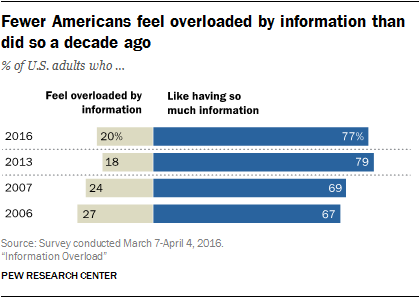
A new Pew Research Center survey finds that, for the most part, the large majority of Americans do not feel that information overload is a problem for them. Some 20% say they feel overloaded by information, a decline from the 27% figure from a decade ago, while 77% say they like having so much information at their fingertips. Two-thirds (67%) say that having more information at their disposals actually helps to simplify their lives.

The survey shows that most Americans are comfortable with their abilities to cope with information flows in their day-to-day lives. Moreover, those who own more devices are also the ones who feel more on top of the data and media flows in their lives. Those who are more likely to feel information overload have less technology and are poorer, less well-educated and older.
The Pew Research Center survey in April 2016 of 1,520 Americans age 18 and older measures how they cope with information demands in their lives and how they feel about the volume of information they encounter. Generally, Americans appreciate lots of information and access to it.

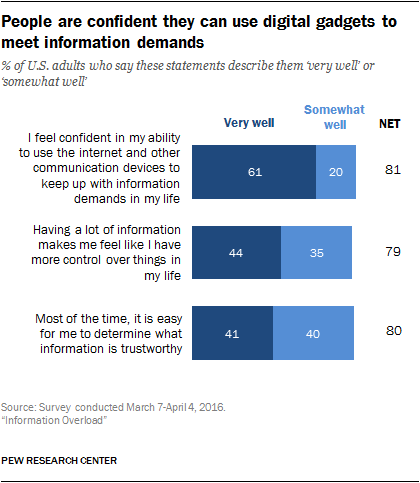
  • 81% of adults say this statement describes them “very well” (61%) or “somewhat well” (20%): “I feel confident in my ability to use the internet and other communications devices to keep up with information demands in my life.”
  • 80% say this statement describes them “very well” (41%) or “somewhat well” (40%): “Most of the time, it is easy for me to determine what information is trustworthy.”
  • 79% say this statement describes them “very well” (44%) or “somewhat well” (35%): “Having a lot of information makes me feel like I have more control over things in my life.”

Still, even as many feel they have a relatively easy time handling information flows, there are two tensions around information that emerge in the survey results. First, those with fewer pathways to the internet are more likely to express concerns about information overload and to report difficulty in finding information they need. We highlight three kinds of access pathways – home broadband, smartphone and tablet computer ownership – as a way to characterize people with “access abundance” (that is, they have all three) compared to those with relative “access scarcity” (that is, those with one or none of those access assets). Those with “access abundance” say they have easier times managing information than others. Just one quarter (24%) of these adults say they sometimes have difficulty finding information. By contrast, half (49%) of those with relative access scarcity say this.

Second, when institutions expect people to bring a lot of information with them to carry out tasks, some Americans find it can be burdensome to keep track of the volume of information needed. Nearly half (46%) of Americans say this statement describes them “very well” or “somewhat well”: “A lot of institutions I deal with – schools, banks or government agencies – expect me to do too much information gathering in order to deal with them.” Those who feel this way are more likely than others also to say that keeping track of information is stressful for them (56% vs. 30%).

These findings suggest that information overload may not be the right way to frame anxieties about the volume of information in people’s lives. Rather, information overload is more situational: Specific situations may arise, such as when institutions impose high information demands on people for transactions, which create a sense of information burden for some Americans.

1. Worries about information overload are not widespread

The advent of new communications and information media – the book, the printing press, the telegraph, the radio, the television, the computer – are reliably accompanied by apprehensions about how to handle the flow of information. The ancients worried that the book would supplant the oral tradition of exchanging information and ideas among the elite. The printing press brought worry over the quality of written materials as more were produced more easily – and perhaps by those with less important things to say.

In a mid-twentieth century world more connected by mass media, the proliferation of knowledge, it was feared, would overwhelm experts trying to keep up with developments in their fields. One proposed solution to organize all this information was the “memex” or, to use the term that caught on, the connected computer.

New digital tools seem only to have exacerbated worries about information overload, not soothe them. By the early 2000s, experts were already bemoaning how the volume of digitally driven information could undercut personal productivity, undermine social ties and foster distraction. The anxious social critic feared that constant flow of digital messages would result in shallow connections among people but not meaningful conversations. It might also create anxiety among people who fear they cannot keep up with information demands. In the workplace, these demands would create stress for workers and also inhibit creativity.

Notwithstanding these worries, there is a potential upside to the vast and rapid flow of information in society. The optimists noted that people’s abilities to access information online can open new doors to knowledge, facilitate connections with friends and make all sorts of transactions more convenient. Those hoping for the best argued that in conjunction with effective use of filters, new tools to access information – smartphones, tablets and other computing devices – may help navigate the information landscape in ways that are satisfying and empowering.

A Pew Research Center survey shows that concerns about information overload are not widely shared by the public. The survey explored people’s perceptions about information overload, whether information makes their lives seem more complex, and their attitudes about coping with information demands.

One measure of information overload came in response to the following question: “Some people say they feel overloaded with too much information these days. Others say they like having so much information available. How about you? Do you feel overloaded, or do you like having a lot of information available?” Some 20% of adults say they feel overloaded and 77% say they like having so much information. These figures are essentially unchanged since 2013 but the share of Americans who say they feel overloaded is lower than 10 years ago.

There are clear patterns in the types of Americans who feel overloaded by information, but in no major demographic group do more than a third say they are overwhelmed. Those whose annual household incomes are $30,000 or less are somewhat more likely to say they feel overloaded by information: 25% do, compared to 15% of those living in households whose annual incomes exceed $75,000. There are small differences, too, when it comes to educational attainment: 24% of those with high school diplomas or less feel information overload, compared with 16% of college graduates. The sentiment is also most prominent among senior citizens: 31% of those ages 65 and older feel information overload, while just 13% of those ages 18 to 29 report that.

A second measure of information overload involved a question about the degree to which people felt information makes their lives complex. Some 27% say that the volume of information makes their lives seem more complex, while two-thirds (67%) say information helps to simplify their lives. There are not many demographic differences evident in these answers. Only older Americans (those ages 65 and older) and lower-income Americans (those in homes with annual incomes of $30,000 or less) show notable differences, with 34% and 30%, respectively, saying information makes their lives more complex.

2. People generally feel good about their abilities to deal with information, but stresses are real for some Americans

When asked how they feel about the volume of information in their lives, people for the most part see information as something that helps them manage their lives and are confident in their abilities to determine the trustworthiness of information.

  • 81% of adults say this statement describes them “very well” (61%) or “somewhat well” (20%): “I feel confident in my ability to use the internet and other communication devices to keep up with information demands in my life.”
  • 79% say this statement describes them “very well” (44%) or “somewhat well” (35%): “Having a lot of information makes me feel like I have more control over things in my life.”
  • 80% say this statement describes them “very well” (41%) or “somewhat well” (40%): “Most of the time, it is easy for me to determine what information is trustworthy.”

Young adults and college graduates are especially likely to express positive feelings about navigating today’s information-rich world.

Institutional expectations, information management and retrieval can be a burden for some

Even with people’s general sense of confidence in dealing with information, the survey finds that noteworthy numbers have some level of unease with keeping up with information demands. When queried about statements about the possible burdens of information, substantial minorities say that such statements describe them at least somewhat well:

  • 46% of Americans say this statement describes them “very well” or “somewhat well”: “A lot of institutions I deal with – schools, banks or government agencies – expect me to do too much information gathering in order to deal with them.”
  • 42% say this statement describes them “very well” or “somewhat well”: “I sometimes feel stressed about all the information I have to keep track of.”
  • 36% say this statement describes them “very well” or “somewhat well”: “It is sometimes difficult for me to find the information I need.”

There are some demographic variations in people’s responses on possible tensions that come with information gathering. One broad pattern is that those with lower levels of household income and lower levels of education say they are struggling more than those at the higher end of the socio-economic spectrum.

For instance, 45% with high school degrees or less sometimes feel stressed about the amount of information they have to follow, compared with 39% of those with college degrees or more. And half of lower income Americans (50%) say institutions expect them to do too much information gathering to deal with them, compared with 42% among those whose annual household incomes are $75,000 or more.

More stress about institutional demands ties to other information stress

As it turns out, the greater the feeling that institutions expect people to gather too much information to transact with them, the more likely people are to say they have problems with information in several ways. More than half (56%) of those who feel institutions like schools and banks expect them to do too much information gathering in order to deal with them say that they feel stressed about the information they have to keep track of. Some 30% of them say they do not feel that stress.

Similarly, 47% of those who feel information burdened by institutions say it is sometimes difficult for them to find the information they need, compared with 26% who say that does not fit their situations.

In other words, in general, people manage information demands fairly well when these demands come to them on their own terms. However, when outside entities, such as schools, banks and government agencies, expect too much from people when it comes to information gathering, some stresses are evident. For those people, the stress of having to keep track of information or difficulties in finding it makes information gathering something of a burden.

3. The ‘gadget poor’ feel the stresses of information more than the ‘gadget rich’

Those who have more pathways to access digital information express fewer concerns about information overload. The survey measured three key technological “access pathways” to information:

  • 70% of U.S. adults have home broadband subscriptions.
  • 72% have smartphones.
  • 48% have tablet computers.

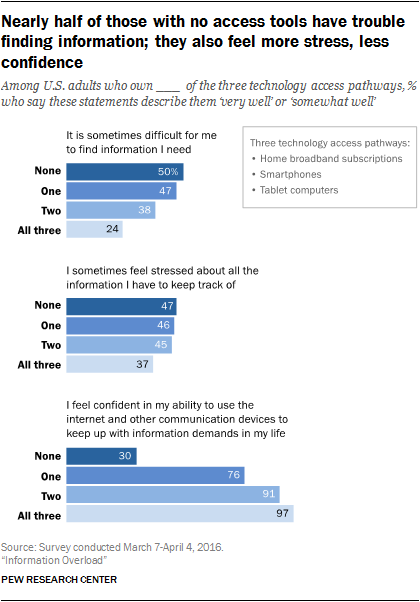
Overall, 39% of adults have all three access pathways; 28% have two of the three; 17% have one of the three; and 16% have none of them.

The key finding is that, perhaps contrary to conventional wisdom, it is those with more ways to access the internet that report being less overwhelmed by the amount of possible information in the modern technological world. Overall, 84% of those with all three access pathways say they like having so much information available, compared with 55% of those who have none of the three access pathways.

At the same time, those with fewer gadgets are more likely than others to say that information makes their lives more complex. Those with none of the three access pathways are significantly more likely than those with relative access abundance to feel information overload – by a 37% to 14% margin. The survey did not establish why this might be so, but one possible explanation is that people who are not comfortable with technology, and don’t have a lot of technology options, also know there is a modern world of digital information available to those who are proficient with digital tools. They might suspect that it could take more effort on their part to get the information they need than it would take people who have lots of digital access.

Similarly, when asked to consider whether information simplifies their lives or makes it more complex, half of those with none of the three access tools (52%) say information helps simplify their lives. For those with either two or three access tools, more than seven-in-ten say information helps to simplify their lives.

Those with fewer online access pathways are also more likely to report issues over managing the flow information in their lives. Among Americans with no digital access paths, 47% say they feel stressed about the information they have to follow. And half (50%) say they sometimes have difficulty finding the information they need. Those with no internet access devices are far less confident in their abilities to use internet-connected devices to keep up with information demands than those with one or more gadgets.

And the flip side is true, too: Those with more gadgets pursue more kinds of information

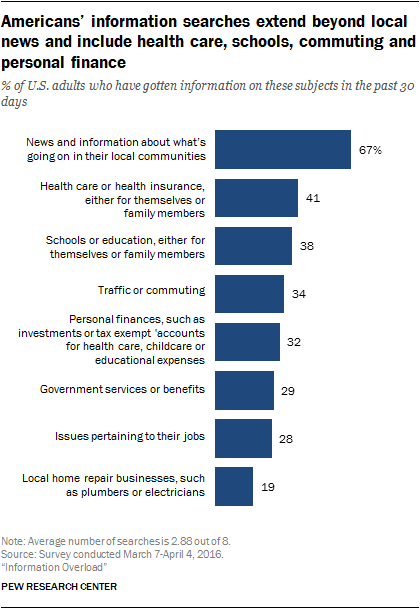
Beyond questions about information overload and the stresses that might be associated with it, the survey also explored the information needs and yearnings of Americans. We asked people if, in the prior 30 days, they had searched for information about eight different topics. Note that the question was framed about searching for information and did not cast the query in terms of tools people might use to gather information, such as the internet, print media, other people or libraries.

Some of the findings: 67% of adults said in the past month they had gotten information about what’s going in their communities; 41% got some kind of health-related information; 38% got material about schools or education; and 28% got information pertaining to their jobs. The nearby chart covers all eight of the subjects queried.

The differences in the incidence of information searching are stark when comparing those with “access abundance” (that is, each of the three pathways) to those with “access scarcity” (those with none of the access tools). In most cases, those with access abundance were substantially more likely to have done each of these searches than those with access scarcity. For instance, 76% of those with all three access pathways had searched for community news and information in the past month, compared with 48% of those with none of the pathways. Those with access abundance were three times more likely to seek information about schools or education as those without any of the access paths, and they were four times more likely to have searched for information about traffic and commuting and personal finances.

We are not able to determine causality here – that is, whether the availability of more access pathways makes people search for more information or vice versa. Some people may purchase more tech gadgets because they have high levels of demand for information or desire lots of information – and, thus, they show higher incidence of information searching.At the same time, the availability of tech gadgets may also draw people to satisfying their information needs by using those resources. The size of the differences are such that it is likely that some of both is going on, i.e., those with high information demands buy more gadgets and the availability of information tools and information institutions stimulates the frequency of information searching. In any case, these associations are significant when holding other socio-economic and demographic factors constant.1

Acknowledgments

This report was made possible by The Pew Charitable Trusts, which received support for the project through a grant from the Bill & Melinda Gates Foundation. It is a collaborative effort based on the input and analysis of the following individuals.

The findings and conclusions contained within are those of the authors and do not necessarily reflect positions or policies of the Bill & Melinda Gates Foundation.

Primary researcher

John B. Horrigan, Senior Researcher

Research team

Lee Rainie, Director, Internet, Science, and Technology Research Andrew Perrin, Research Assistant Aaron Smith, Associate Director, Research Claudia Deane, Vice President, Research

Editorial and graphic design

Margaret Porteus, Information Graphics Designer Shannon Greenwood, Copy Editor

Communications and web publishing

Shannon Greenwood, Associate Digital Producer Dana Page, Senior Communications Manager

Methodology

The analysis in this report is based on a Pew Research Center survey conducted March 7-April 4, 2016, among a national sample of 1,520 adults, 18 years of age or older, living in all 50 U.S. states and the District of Columbia. Fully 381 respondents were interviewed on landline telephones, and 1,139 were interviewed on cellphones, including 636 who had no landline telephones. The survey was conducted by interviewers at Princeton Data Source under the direction of Princeton Survey Research Associates International. A combination of landline and cellphone random-digit-dial samples were used; both samples were provided by Survey Sampling International. Interviews were conducted in English and Spanish. Respondents in the landline sample were selected by randomly asking for the youngest adult male or female who was at home. Interviews in the cellphone sample were conducted with the person who answered the phone, if that person was 18 years of age or older. For detailed information about our survey methodology, visit: https://alpha.pewresearch.org/pewresearch-org/methodology/u-s-survey-research/

The combined landline and cellphone samples are weighted using an iterative technique that matches gender, age, education, race, Hispanic origin and nativity, and region to parameters from the 2013 Census Bureau’s American Community Survey and population density to parameters from the Decennial Census. The sample also is weighted to match current patterns of telephone status (landline only, cellphone only or both landline and cellphone) based on extrapolations from the 2014 National Health Interview Survey. The weighting procedure also accounts for the fact that respondents with both landlines and cellphones have a greater probability of being included in the combined sample and adjusts for household size among respondents with landline phones. The margins of error reported and statistical tests of significance are adjusted to account for the survey’s design effect, a measure of how much efficiency is lost from the weighting procedures.

The following table shows the unweighted sample sizes and the error attributable to sampling that would be expected at the 95% level of confidence for different groups in the survey:

Sample sizes and sampling errors for other subgroups are available upon request.

In addition to sampling error, one should bear in mind that question wording and practical difficulties in conducting surveys can introduce error or bias into the findings of opinion polls. Pew Research Center undertakes all polling activity, including calls to mobile telephone numbers, in compliance with the Telephone Consumer Protection Act and other applicable laws.

Pew Research Center is a nonprofit, tax-exempt 501(c)(3) organization and a subsidiary of The Pew Charitable Trusts, its primary funder.