Some users enjoy the opportunities for political debate and engagement that social media facilitates, but many more express resignation, frustration over the tone and content of social platforms
BYMaeve Duggan and Aaron Smith
About Pew Research Center
Pew Research Center is a nonpartisan, nonadvocacy fact tank that informs the public about the issues, attitudes and trends shaping the world. It does not take policy positions. The Center conducts public opinion polling, demographic research, computational social science research and other data-driven research. It studies politics and policy; news habits and media; the internet and technology; religion; race and ethnicity; international affairs; social, demographic and economic trends; science; research methodology and data science; and immigration and migration. Pew Research Center is a subsidiary of The Pew Charitable Trusts, its primary funder.
Some users enjoy the opportunities for political debate and engagement that social media facilitates, but many more express resignation, frustration over the tone and content of social platforms
In a political environment defined by widespread polarization and partisan animosity, even simple conversations can go awry when the subject turns to politics. In their in-person interactions, Americans can (and often do) attempt to steer clear of those with whom they strongly disagree.
But online social media environments present new challenges. In these spaces, users can encounter statements they might consider highly contentious or extremely offensive – even when they make no effort to actively seek out this material. Similarly, political arguments can encroach into users’ lives when comment streams on otherwise unrelated topics devolve into flame wars or partisan bickering. Navigating these interactions can be particularly fraught in light of the complex mix of close friends, family members, distant acquaintances, professional connections and public figures that make up many users’ online networks.
A new Pew Research Center survey of U.S. adults finds that political debate and discussion is indeed a regular fact of digital life for many social media users, and some politically active users enjoy the heated discussions and opportunities for engagement that this mix of social media and politics facilitates. But a larger share expresses annoyance and aggravation at the tone and content of the political interactions they witness on these platforms. Among the key findings of this survey:
More than one-third of social media users are worn out by the amount of political content they encounter, and more than half describe their online interactions with those they disagree with politically as stressful and frustrating
The roughly two-thirds of American adults who use social media sites express a relatively wide range of opinions on the political interactions they witness and take part in on these platforms. Many feel overloaded by political content and view their social media interactions with those they disagree with as a source of frustration and annoyance. At the same time, a substantial minority of users enjoy the ability to consume political content and engage in discussions with people on the other side of issues:
Nearly twice as many social media users say they are “worn out” by the amount of political content they see in their feeds (37%) as say they like seeing lots of political information (20%). Still, about four-in-ten (41%) indicate that they don’t feel particularly strongly one way or the other about the amount of political content they encounter on social media.
59% say their social media interactions with those with opposing political views are stressful and frustrating – although 35% find them interesting and informative.
64% say their online encounters with people on the opposite side of the political spectrum leave them feeling as if they have even less in common than they thought – although 29% say they end these discussions feeling that they have more in common than they might have anticipated.
Many users view the tone of political discussions on social media as uniquely angry and disrespectful – although a sizeable share feels that these discussions simply reflect the broader political climate
When asked how they view the tone of the political discussions they see on social media, a substantial share of social media users feel these platforms are uniquely angry and disrespectful venues for engaging in political debate. Some 40% of users agree strongly with the notion that social media are places where people say things while discussing politics that they would never say in person (an additional 44% feel that this statement describes social media somewhat well).
Meanwhile, roughly half of users feel the political conversations they see on social media are angrier (49%), less respectful (53%) and less civil (49%) than those in other areas of life. At the same time, a notable minority feels that the political discussions they see on social media are largely reflective of the political discussions they witness in other areas of their lives: For instance, 39% of users feel that these interactions are no more less respectful than other political interactions they encounter. And a small share finds political debates on social media to be more civil (7%), more informative (14%) and more focused on important policy issues (10%) than those they see elsewhere.
Most users try to ignore political arguments on social media as best they can; when that fails, they take steps to curate their feeds and avoid the most offensive types of content
For the most part, social media users try to refrain from engaging with the political arguments that enter their feeds: 83% of them say that when their friends post something about politics that they disagree with they usually just try to ignore it, while 15% usually respond to these posts with a post or comment of their own.
When ignoring problematic content fails, social media users tend to utilize technological tools to remove troublesome users from their feeds entirely. Nearly one-third of social media users (31%) say they have changed their settings in order to see fewer posts from someone in their feed because of something related to politics, while 27% have blocked or unfriended someone for that reason. Taken together, this amounts to 39% of social media users – and 60% of them indicate that they took this step because someone was posting political content that they found offensive.
Despite these annoyances, some users – especially those with high levels of political engagement – enjoy talking, debating and posting about political issues on social media
Yet for all of the tensions and annoyances that accompany political debates on social media, some users do see a good side to these interactions. This is especially true of those Americans who indicate a high level of interest and involvement in the political process more broadly.
These highly engaged social media users express many of the same frustrations about the tone and tenor of political discussions on social media – but many of them simultaneously view social media platforms as valuable tools for political action and discussion. Roughly one-in-five politically engaged users (19%) indicate that they often comment, discuss or post about political issues with others on social media (just 6% of less politically engaged users post with this level of frequency). And nearly one-third of these politically engaged users feel that social media sites do “very well” at bringing new voices into the political discussion (31%) or helping people get involved with issues that matter to them (30%).
Frustration over politically oriented social media discussions is a bipartisan phenomenon
Even as their overall political attitudes differ dramatically, Democrats and Republicans (including independents and other nonpartisans who “lean” toward either party) tend to view and utilize social media in largely comparable ways. For instance, they are equally likely to say that they comment, post about or engage in political discussions on social media (10% of Republican users and 8% of Democrats do so often). And a nearly identical share from each party feels worn out by the amount of political material they encounter on social media (38% of Democrats and 37% of Republicans who use social media report this) or feel that the conversations they see on social media are angrier and less civil than in other venues where these conversations occur. However, Democrats who use social media are somewhat more likely to view these sites as useful vehicles for bringing new voices into the political arena.
Political content is as prevalent on Facebook (where users mostly follow people they know personally) as it is on Twitter (where users tend to follow a wider mix of connections)
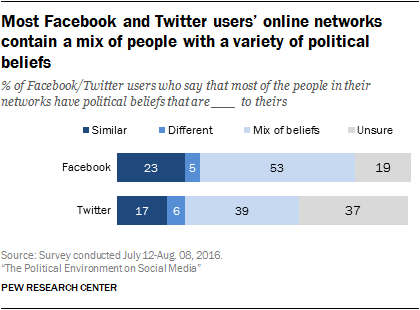
The concerns and frustrations outlined above are occurring in a broader context: namely, one in which political discussions are encroaching into a range of different social spaces. Two of the more common social media platforms – Facebook and Twitter – are illustrative in this regard. Facebook users tend to be friends primarily with people they know personally (66% of Facebook users say they mostly follow people they already know), while Twitter users are much more likely to follow people they do not know personally (48% of Twitter users indicate that most of the people they follow are in this category). And a large share of Facebook and Twitter users report that they follow a relatively broad mix of people with differing political views and opinions (indeed, just 23% of Facebook users and 17% of Twitter users say that they mostly follow people with political views that are similar to theirs). But despite these differences in the social and political composition of their networks, an identical share of Facebook users and Twitter users report that they frequently encounter political posts and engage in political discussions among the people in their networks.
1. Political content on social media
For several election cycles, Pew Research Center has documented the extent to which Americans are turning to social media for political information and action. The current political environment – featuring exceptionally high levels of interest in the election, partisan antipathy and political polarization – makes for an especially complex atmosphere for today’s social media users. The typical social media user inhabits a digital world that contains a wide mix of connections, ranging from close friends and family members to public figures or distant acquaintances. Often these friend networks represent a potentially combustible mixture of conflicting political opinions, and this intermingling of the personal and the political can lead to frustration and annoyance for users as they attempt to make their way through these digital spaces.
The chapter that follows examines the basic contours of how users encounter and navigate political discussion and debate in the context of social media.
9% of social media users say they often discuss, comment or post about politics or government on these platforms
Roughly one-third of social media users indicate they often (9%) or sometimes (23%) comment, discuss or post about government and politics on social media; meanwhile, nearly seven-in-ten indicate that they hardly ever (30%) or never (38%) do this.1 Younger adults tend to rely much more heavily than older adults on social media as a source of campaign news, but older users more than hold their own when it comes to discussing or commenting on political issues on these sites. Some 10% of social media users ages 50 and older often do this, nearly identical to share of users under the age of 50 who do so (8%). In addition, Republicans and Democrats who use social media (including independents and other nonpartisans who “lean” toward the parties) are equally likely to say that they often comment, discuss or post about political issues on these sites: 10% of Republican users and 8% of Democrats do so with this frequency.
Political content is as prevalent on Facebook (where users mostly follow people they know personally) as it is on Twitter (where users tend to follow a wider mix of connections)
In addition to asking about their participation in political discussions on social media generally, the survey also included a series of questions about the composition of users’ friend networks and the political content they encounter on two specific social media platforms: Facebook, which is the most popular social media platform by a substantial margin (used by 62% of American adults) and Twitter, which is smaller (used by 20% of Americans) but has attracted an audience that is heavily invested in news and current events. This survey finds that Facebook and Twitter users tend to follow a very different mix of people – but political content is equally prevalent for users of each site, and users of both sites are connected to people holding a broad range of political viewpoints.
The vast majority of Facebook users indicate that their Facebook friends are either mostly people they know personally (66%) or are a mix of people they know and don’t know (30%). Just 3% of Facebook users indicate that most of their friends are people they do not know personally. By contrast, Twitter users report that their networks are much more oriented toward public figures and other users that they themselves do not know. Just 15% of Twitter users say that they mostly follow people they know personally, while nearly half (48%) say they mostly follow people they do not know personally and 37% say they follow a mix of people.
Yet despite these differences in the types of people they follow (and Twitter’s long-standing reputation as the domain of news and politics junkies), users of each platform report that they encounter a similar level of political content and discussion. The vast majority of users of each site indicate that they see at least a little bit of political content in their feeds, and about one-quarter of both Facebook (25%) and Twitter (24%) users report that “a lot” of what they see on each site is related to politics. Meanwhile, 6% of Facebook users and 8% of Twitter users indicate that “a lot” of what they themselves post on the site is politically related.
In other words, users of Facebook and Twitter are equally likely to encounter political material and to engage in political discussions – regardless of whether they are on a site where they are mostly connected to people they know personally (as in the case of Facebook) or on a site where they are connected to a wider range of people they may or may not have ever met in person (as in the case of Twitter).
Most users’ friend networks on both Facebook and Twitter contain people with a range of political beliefs
In addition to being exposed to a relatively substantial amount of political content from a range of differing people, users of both Facebook and Twitter must navigate interactions with people holding a wide variety of political viewpoints.
To be sure, some users have online networks whose political views largely mirror their own: 23% of Facebook users and 17% of Twitter users say most of the people in their networks hold political beliefs similar to theirs. And a notable proportion of users simply don’t pay much attention to the political characteristics of the people in their networks: 19% of Facebook users and 37% of Twitter users say they are unsure of the political beliefs of their friends and followers.
But for many users, friend networks that encompass a range of political beliefs are the norm. Roughly half of Facebook users (53%) and more than one-third of Twitter users (39%) say that there is a mix of political views among the people in their networks. And an additional 5% of Facebook users and 6% of Twitter users indicate that most of the people they associate with in these spaces hold different political beliefs from their own (Note: a Pew Research Center survey of news consumption habits conducted in 2014 similarly found that Facebook users are exposed to a relatively broad range of posts that they agree and disagree with).
2. The tone of social media discussions around politics
As political discussions move into otherwise personal social media spaces, users are confronted with a range of social challenges, such as navigating posts from friends and family members that they vehemently disagree with or find offensive. This survey highlights the contradictions and tradeoffs (as well as benefits) of social media interactions in an era of widespread political polarization and partisan antipathy. For many social media users, this influx of political content is a source of frustration and annoyance. A substantial share of social media users are worn out by the tone and volume of political material they encounter on these platforms and view social media as an inherently angry and disrespectful medium in comparison to other venues for discussing politics.
At the same time, a smaller group of dedicated political junkies view the political discussions they encounter on social media in a much more positive light. And even as they lament the day-to-day annoyances that go hand in hand with talking politics on social media, many users recognize that these sites can play a useful role in helping people get involved with issues and candidates that are important to them. Indeed, these spaces can even lead to users changing their minds about political matters: Roughly one-in-five social media users have changed their minds about a political candidate, or a social issue, because of material they encountered on social media.
One-in-five social media users like seeing lots of political content, but 37% say they are worn out by political discussions on these platforms
By a roughly two-to-one margin, social media users express resignation rather than excitement over the volume of political content in their social feeds. One-in-five social media users (20%) indicate that they like to see lots of posts about politics on social media, but nearly twice that share (37%) describe themselves as being “worn out” by how many political posts and discussions they see. The remaining 41% of social media users don’t feel strongly one way or another. This general feeling of resignation is bipartisan: A nearly identical share of Democrats (38%) and Republicans (37%), including independents and other nonpartisans who “lean” toward the parties, report being worn out by political posts and discussions on social media.
One group of users in particular stands out as being receptive toward political discussions on social media: those who regularly discuss or post their own content about political issues. Some 39% of users who often or sometimes post their own political material on social media indicate that they also like seeing lots posts from others (although 35% report feeling worn out by how many posts and discussions about politics that they see). By contrast, just 11% of those who hardly ever or never post their own political content say that they like seeing lots of political discussion on these sites.
For many users, social media add an additional element of stress to already-fraught political discussions
In a Pew Research Center survey of partisanship and political animosity conducted earlier this election season, a majority of Americans (61%) indicated that they usually find they have less in common than they thought when they talk to people who they disagree with politically; by contrast, 36% find that they usually have more in common than they anticipated.
When asked a similar question in this survey about the discussions they specifically have on social media, users respond in roughly similar proportions. Around two-thirds of social media users (64%) find that they typically have less in common than they thought when they discuss politics on social media with people they disagree with, while 29% indicate that they usually find that they have more in common than they anticipated.
At the same time, this survey finds evidence that political discussions and arguments on social media can be stressful to many people in ways that in-person arguments are not. The survey noted above also included a broad question about how people view their interactions with those who they disagree with politically: In that study, 46% of Americans described these interactions as “stressful and frustrating” while a similar share (51%) described them as “interesting and informative.” By contrast, in this survey some 59% of social media users indicate that they find it stressful and frustrating to talk about politics on social media with people they disagree with, while just 35% say that these discussions are generally interesting and informative.
Democratic and Republican social media users are equally likely to say that it is stressful and frustrating to talk about politics with people they disagree with on these platforms. And users in both political camps are also equally likely to say that they generally find they have less in common than they thought with the people on the other side of these arguments.
Many users view social media as places where people say things they would never say in person, while a smaller share views these platforms as places where people are afraid to speak their minds for fear of criticism
A substantial majority of social media users feel that people on social media act in ways that are at odds with their typical in-person demeanor. Fully 84% of social media users feel that the statement, “People say things when discussing politics on social media that they would never say in person” describes these sites either very (40%) or somewhat (44%) well. But even as they see social media as a place where people go beyond the boundaries of face-to-face discourse, other users – although a notably smaller share – feel that people refrain from speaking their minds about political issues on social media out of concern that they will lose friends or get criticized. Some 64% of social media users feel that this describes social platforms either very (14%) or somewhat (50%) well.
As with many of the issues examined in this survey, users’ views on this topic do not differ in a substantive way based on party affiliation. Democratic and Republican social media users are equally likely to feel that each of these statements describes social media well.
Many users view political discussions on social media as uniquely angry and disrespectful – but a comparable share feels that these spaces simply mirror the broader political climate
Despite their overall negativity toward the political tone on social media, users are largely split on the question of whether this negativity is inherent to the social media environment itself, or whether it simply mirrors the broader political landscape. The survey included a series of questions asking respondents to evaluate the tone and content of the political discussions they see on social media in comparison to other places where people might discuss political issues. And while a substantial share of social media users consider social platforms to be an angrier, less respectful and less civil place than other venues, many indicate they don’t see too much difference between political conversations on social media and those taking place elsewhere.
Of the seven different attributes evaluated in the survey, users feel that four in particular describe political interactions on social media relatively well. Roughly half of social media users (53%) feel that the political discussions they see on social media are less respectful than those they see elsewhere, while a similar share feels that these social media discussions are less likely to come to a resolution (51%), less civil (49%) and more angry (49%) than discussions in other venues. At the same time, a substantial minority of users (ranging from 39% to 43%) feel that social media discussions are about the same as political discussions in other venues in each of these respects. And a small number feel that the political interactions they see on social media are actually an improvement over the interactions they encounter in other spaces.
On other attributes evaluated in the survey, users have mixed – but ultimately not particularly positive – views about the tone of political discussions on social media. Some 45% of users feel that political discussions on social media are less focused on important policy debates than conversations they encounter elsewhere, although 10% feel they are more focused on policy and 43% think they are about the same in this regard. Meanwhile, 41% of users feel that social media discussions are less politically correct than other places where people discuss politics, but a majority feels that social media is either more politically correct (8%) or about the same as other venues (47%).
Lastly, around one-third (34%) of users consider the political discussions they see on social media to be less informative than those they encounter elsewhere – but 14% say that these discussions are more informative, and 49% say that they are about the same.
There is no variation on these questions in terms of party affiliation: Republican and Democratic social media users respond in nearly identical ways on each of these attributes. However, when people’s ideological beliefs are added to the mix, conservative Republicans and liberal Democrats stand out from their peers in seeing social media as a uniquely angry place. Some 56% of conservative Republicans and 59% of liberal Democrats who use social media feel that the political discussions on these platforms are angrier than those occurring elsewhere. That compares with 39% of moderate and liberal Republicans and 37% of conservative and moderate Democrats.
When users encounter political content on social media that they disagree with, they tend to ignore it rather than engage in discussion
When they disagree with political content posted by one of their friends, the vast majority of social media users (83%) say that they usually just ignore the post and move on. However, a minority of users actively engage with political content that they disagree with: 15% indicate that they typically respond to these posts with a comment or post of their own.
In general, social media users of various kinds tend to respond to posts they disagree with in similar ways. Men are a bit more likely than women to say that they typically respond with their own post (19% vs. 12%), but there are few other major demographic differences on this question based on age or party affiliation. There is one major exception, however: Users who regularly post political content of their own are much more likely to engage when others post something that they disagree with. One-third (33%) of social media users who often or sometimes discuss or post about political issues say they typically engage with posts they disagree with by responding with their own commentary, compared with just 7% among those who post political content less frequently.
39% of social media users have taken steps to block another user or minimize the content they see from them because of something related to politics
Although relatively few social media users consistently wade into contentious political conversations, a notable share takes active steps to filter out certain users or types of content for political reasons. Nearly one-third of social media users (31%) say they have changed their settings in order to see fewer posts from someone in their feeds because of something related to politics, while 27% have blocked or unfriended someone for that reason.2 In total, 39% of social media users have taken at least one of these two steps to mute political content or those who post it.
When asked about specific reasons why they might have taken these steps to disconnect from someone they follow, the largest share (60% of these users who have blocked, unfriended or minimized content from someone) indicates that they have taken this step because that person posted something they found offensive: that works out to 23% of all social media users. Smaller shares have blocked or unfollowed someone because that person posted too much political content, posted things that they disagreed with, or because they were abusive or harassing.
Pew Research Center has examined this behavior in surveys conducted during the 2012 presidential campaign as well as the 2014 midterm elections. And as was the case in each of those studies, political liberals who use social media are more likely than conservatives to change their settings to see less of someone (41% vs. 26%) as well as to block or unfriend someone (35% vs. 26%) because of something related to politics. Along with political liberals, social media users under the age of 50 are more likely to take these steps than older users.
Even as they express annoyance at the tone of political discussions on social media, some users view these platforms as useful tools for political engagement
Despite their negative view of the tone of political conversations on social media, some users view social media in a relatively positive light when it comes to facilitating engagement and involvement with political issues. A total of eight-in-ten social media users feel that these platforms help users get involved with issues that matter to them either very (22%) or somewhat (57%) well, while a similar share feels that social media have helped bring new voices into the political discussion very (21%) or somewhat (53%) well. Meanwhile, a slight majority feel that social media help people learn what political candidates are really like very (9%) or somewhat (45%) well.
Demographic differences on these questions are relatively modest: For the most part, social media users of various types tend to have similar attitudes toward these platforms when it comes to political involvement. However, there is some variation on these questions around race and ethnicity. Black and Latino users feel relatively strongly that social media help people get involved with issues that matter to them: 27% of blacks and 29% of Latinos feel this describes social media very well, compared with 18% of whites. These groups also respond relatively positively to the notion that social media sites are a good way to learn about what political candidates are really like: 15% of blacks, 17% of Latinos and 6% of whites think this describes social media very well.
Along with non-whites, Democrats tend to view social media somewhat more positively than Republicans in the context of political involvement. Some 26% of Democrats who use social media feel that these tools do very well at helping to bring new voices into the political discussion (15% of Republicans feel similarly strongly), while 25% of Democrats (and 18% of Republicans) feel that social media functions very well at helping people get involved with issues that matter to them.
Half of social media users have been surprised by someone’s political views based on their postings
As their social connections go about sharing and commenting on political issues, social media users often find their friends’ political opinions differ from what they expect. Indeed, fully half (50%) of social media users say they have been surprised by the political views of someone in their online network because of something that person posted.
Users who said they were surprised by friends’ views based on their social media postings were asked to describe a recent situation where this happened, a number of themes emerged when these comments were coded and analyzed. In particular, a substantial share of these respondents indicated that they had been surprised to learn that someone they knew felt positively toward a specific candidate in this year’s presidential race. Here is a selection of these responses:
“Someone who posted a pro-Trump post, who [being from] an immigrant family would likely be someone that the Trump camp would not like at all.”
“Someone who I assumed never ever bothered to vote and I’ve never heard talk about politics at all has been a big vocal supporter of Trump. Mostly for the wrong bigoted and misinformed reasons. It was surprising to see such a nice person jump on the hateful bigot bandwagon.”
“I thought my neighbor was a true diehard Republican until he began to post negative things about Trump and began hitting the button when somebody posted positive things about Secretary Clinton. What a surprise!!!”
“It has shocked me to think that people really feel that Clinton, in spite of all the wrong that she has done still would be a positive for presidency … how can she not be held accountable for Benghazi, emails, and everything?”
Another portion of these respondents expressed surprise that someone they knew was more conservative or liberal than they previously thought, while other responses covered a range of issues – including race, the Black Live Matter movement, guns, police and abortion.
Roughly one-in-five social media users have changed their minds about a political issue or about a candidate for office, because of something they saw on social media
Despite their often-negative views about the political interactions they see on social media, people can sometimes end up changing their minds about political matters after these encounters. One-in-five social media users (20%) say they have modified their views about a political or social issue because of something they saw on social media, while 17% say they have modified their views about a particular political candidate.
When asked to describe a recent situation in which this had happened to them, a substantial share of respondents made reference to Hillary Clinton and Donald Trump – in many cases indicating that social media content had changed their opinions of these candidates for the worse. Here is a sample of some of their responses:
“Became more wary of Hillary Clinton based on what I saw on social media.”
“Trump continues to voice his opinion incredibly ignorantly about immigration and made my respect for him tank.”
“My opinion on Trump is MUCH worse after reading his tweets.”
“All the videos circulating about Hillary Clinton and her email debauchery. Now I think she is even more evil and corrupt than originally thought.”
Other issues on which users indicated that they had changed their minds thanks to material on social media include race and race relations, guns and gun control, gay marriage, and immigration. Here is a selection of these responses:
“Videos of black people being murdered by police made me more angry and therefore more outspoken about Black Lives Matter.”
“I saw some of my friends were animated about left-leaning things like Bernie Sanders and gay marriage. Originally I was against gay marriage and have now accepted it.”
“I don’t know that anything specifically has changed, but I’m pretty open-minded and I always try to take other people’s opinions to heart and learn from them. There are issues, such as global warming and immigration – just to name two – that I have softened my stance on, because I see another perspective, and understand it better based upon social media posts.”
Still, it is important to note that the majority of social media users are not swayed by what they see in their networks. Some 82% of social media users say they have never modified their views on a particular candidate – and 79% say they have never changed their views on a social or political issue – because of something they saw on social media.
One-quarter of social media users follow political figures – mostly those who hold similar beliefs to their own
Candidates for office are increasingly using social media to reach out directly to the public, and this survey finds that 25% of social media users follow candidates or other political figures on various social media platforms. When asked about the types of figures they follow, roughly two-thirds of these users (65%) say they mostly follow people who share their own political views. Another 31% say they follow a mix of people with different political views, while a small minority (3%) say they mostly follow people who do not share their views (a practice that is sometimes referred to as “hate-following”).
A previous Pew Research Center study found that a similar share of Americans have engaged with social media content from each of the two major-party candidates for president this election season, and in this survey a similar share of Republican and Democratic social media users indicate that they follow political figures and candidates. Republicans and Democrats also report that they follow a similar mix of people they agree with and people whose views they do not share.
Social media users who follow at least some political figures with whom they disagree provide several reasons for doing so. By far the most common is that they simply want to stay informed about what people on both sides of the political debate are saying: 86% of these users cite this as a reason. A much smaller share indicates that they follow political figures they disagree with because they find it entertaining (26%), because they like to argue with the other side’s followers (14%) or because they like to share information with their own followers that makes the other side look bad (12%).
3. Social media and political engagement
For those who are heavily interested in politics, social media offers an especially compelling environment for engaging with news, information and discussion about political issues. But although social media can help facilitate connections to the causes people care about, it can also expose these same users to negative or aggressive speech and require them to more attentively curate their social feeds.
This chapter of the report examines the experiences and attitudes of highly politically engaged social media users. For the purposes of this report, highly engaged Americans are defined as those who are registered to vote; who say that they always or almost always vote in elections; and who have volunteered or contributed money to political parties, campaigns or groups in the past year.3
Social media users with high levels of political engagement take an active approach to curating the content they consume and the users they are connected to
Compared to those with lower levels of political engagement, highly-engaged social media users take a fairly active role when it comes to entering into political discussions or otherwise engaging with political content. Roughly one-in-five (19%) of these highly engaged social media users “often” comment, post or discuss political or government issues with others on social media, triple the share among social media users who are less politically engaged (6%).
These highly engaged users also take a more active role when it comes to curating their online political networks. For instance, they are more likely to follow political candidates or figures: 53% do so, compared with 21% of users with low levels of political engagement. And when one of their friends posts political content they disagree with, some 30% of highly engaged social media users say they typically respond with a comment or post of their own. That is more than double the share of less-engaged social media users who typically respond in this way (13%). In addition, 42% of these politically active users have changed their settings to see fewer posts from someone they follow because of politics (30% of less-engaged users have done so), and 34% have blocked or unfriended someone as a result of politics (compared with 26% of less-engaged users). However, the root causes that each group give for doing so are largely the same: by a substantial margin, both groups say that the top reason they take these steps is because someone posted political content that they found offensive.
Highly engaged social media users see greater levels of negativity in the tone of social media discussions – but also express greater optimism about the ability of social media to facilitate political action
When asked about the political interactions they see on social media, many politically engaged users are dismayed at the negativity and tone of political discourse. For instance, a slight majority of these users (53%) agree that the statement “people say things when discussing politics on social media that they would never say in person” describes social media very well; 38% of less-engaged users feel equally strongly.
These highly engaged social media users are also more likely to feel that the discussions they see on social media pertaining to politics are less enjoyable in a variety of ways than the political discussions they see occurring elsewhere. This is especially notable in the context of political correctness: Fully 57% of highly engaged social media users feel that social media conversations are less politically correct than those they see elsewhere: Just 39% of less-engaged users feel the same way. And a substantial majority of highly engaged users see social media as angrier, less civil and less respectful than other venues for discussing politics.
Yet even as they express heightened concern at the tone and tenor of social media conversations, highly politically engaged users also express greater appreciation for the ability of social media to foster inclusivity and to connect people to causes that are important to them. Nearly one-third of highly engaged social media users (31%) feel that social media bring new voices into the political discussion “very well” (vs. 20% of less engaged users). Similarly, 30% of highly engaged users say social media help people get involved with issues that matter to them “very well,” compared with 21% of less-engaged users. And these politically engaged users are around twice as likely as less-engaged users to say that they ultimately like seeing lots of political content on social media (35% do so, compared with 18% of less-engaged users).
Maeve Duggan, Research Associate
Aaron Smith, Associate Director, Research
Research team
Lee Rainie, Director, Internet, Science and Technology Research
Paul Hitlin, Senior Researcher
Meg Hefferon, Research Assistant
Andrew Perrin, Research Assistant
Editorial and graphic design
Margaret Porteus, Information Graphics Designer
Shannon Greenwood, Copy Editor
Communications and web publishing
Dana Page, Senior Communications Manager
Shannon Greenwood, Associate Digital Producer
Methodology
The American Trends Panel (ATP), created by Pew Research Center, is a nationally representative panel of randomly selected U.S. adults living in households. Respondents who self-identify as internet users and who provided an email address participate in the panel via monthly self-administered Web surveys, and those who do not use the internet or decline to provide an email address participate via the mail. The panel is being managed by Abt SRBI.
Data in this report are drawn from the July wave of the panel, conducted July 12-Aug. 8, 2016, among 4,579 respondents (4,165 by web and 414 by mail). The margin of sampling error for the full sample of 4,579 respondents is plus or minus 2.4 percentage points.
Members of the American Trends Panel were recruited from two large, national landline and cellphone random-digit-dial (RDD) surveys conducted in English and Spanish. At the end of each survey, respondents were invited to join the panel. The first group of panelists was recruited from the 2014 Political Polarization and Typology Survey, conducted Jan. 23 to March 16, 2014. Of the 10,013 adults interviewed, 9,809 were invited to take part in the panel and a total of 5,338 agreed to participate.4 The second group of panelists was recruited from the 2015 Survey on Government, conducted Aug. 27 to Oct. 4, 2015. Of the 6,004 adults interviewed, all were invited to join the panel, and 2,976 agreed to participate.5
Participating panelists provided either a mailing address or an email address to which a welcome packet, a monetary incentive and future survey invitations could be sent. Panelists also receive a small monetary incentive after participating in each wave of the survey.
The ATP data were weighted in a multi-step process that begins with a base weight incorporating the respondents’ original survey selection probability and the fact that in 2014 some panelists were subsampled for invitation to the panel. Next, an adjustment was made for the fact that the propensity to join the panel and remain an active panelist varied across different groups in the sample. The final step in the weighting uses an iterative technique that matches gender, age, education, race, Hispanic origin and region to parameters from the U.S. Census Bureau’s 2014 American Community Survey. Population density is weighted to match the 2010 U.S. Decennial Census. Telephone service is weighted to estimates of telephone coverage for 2016 that were projected from the January-June 2015 National Health Interview Survey. Volunteerism is weighted to match the 2013 Current Population Survey Civic Engagement Supplement. It also adjusts for party affiliation using an average of the three most recent Pew Research Center general public telephone surveys. Internet access is adjusted using a measure from the 2015 Survey on Government. Frequency of internet use is weighted to an estimate of daily internet use projected from the 2013 Current Population Survey Computer and Internet Use Supplement. Sampling errors and statistical tests of significance take into account the effect of weighting. Interviews are conducted in both English and Spanish, but the Hispanic sample in the American Trends Panel is predominantly native born and English speaking.
The following table shows the unweighted sample sizes and the error attributable to sampling that would be expected at the 95% level of confidence for different groups in the survey:
Sample sizes and sampling errors for other subgroups are available upon request.
In addition to sampling error, one should bear in mind that question wording and practical difficulties in conducting surveys can introduce error or bias into the findings of opinion polls.
The web component of the July wave had a response rate of 82% (4,165 responses among 5,064 web-based individuals in the panel); the mail component had a response rate of 74% (414 responses among 557 non-web individuals in the panel). Taking account of the combined, weighted response rate for the recruitment surveys (10.0%) and attrition from panel members who were removed at their request or for inactivity, the cumulative response rate for the July ATP wave is 2.9%.6