Pew Research Center

FOR RELEASE SEPTEMBER 9, 2016

Libraries 2016

Trends in visiting public libraries have steadied, and many Americans have high expectations for what their local libraries should offer

BY John B. Horrigan

FOR MEDIA OR OTHER INQUIRIES:

Communications Department
202.419.4372
www.pewresearch.org

RECOMMENDED CITATION

Pew Research Center, September 2016, "Libraries 2016"

About Pew Research Center

Pew Research Center is a nonpartisan, nonadvocacy fact tank that informs the public about the issues, attitudes and trends shaping the world. It does not take policy positions. The Center conducts public opinion polling, demographic research, computational social science research and other data-driven research. It studies politics and policy; news habits and media; the internet and technology; religion; race and ethnicity; international affairs; social, demographic and economic trends; science; research methodology and data science; and immigration and migration. Pew Research Center is a subsidiary of The Pew Charitable Trusts, its primary funder.

© Pew Research Center 2026

Table of contents

  • About Pew Research Center
  • Libraries 2016
  • 1. Americans’ attitudes toward public libraries
  • 2. Library usage and engagement
  • 3. A portrait of those who have never been to libraries
  • Acknowledgments
  • Methodology

Libraries 2016

Trends in visiting public libraries have steadied, and many Americans have high expectations for what their local libraries should offer

Most Americans view public libraries as important parts of their communities, with a majority reporting that libraries have the resources they need and play at least some role in helping them decide what information they can trust. When asked to think about the things that libraries could do in the future, notable numbers of Americans respond in a way that can be boiled down to one phrase: “Yes, please.”

Public libraries, many Americans say, should offer programs to teach people digital skills (80% think libraries should definitely do this) and help patrons learn how to use new creative technologies like 3-D printers (50%). At the same time, 57% of Americans say libraries should definitely offer more comfortable places for reading, working and relaxing.

Yet, Americans are also divided on a fundamental question about how books should be treated at libraries: 24% support the idea of moving books and stacks in order to make way for more community- and tech-oriented spaces, while 31% say libraries should not move the books to create such spaces. About four-in-ten think libraries should maybe consider doing so.

A Pew Research Center telephone survey of 1,601 Americans ages 16 and older conducted from March 7 to April 4, 2016, finds that Americans continue to express largely positive views about the current state of their local public libraries. For instance, around three-quarters (77%) say that public libraries provide them with the resources they need. And 66% say the closing of their local public library would have a major impact on their community ­ although notably, just 33% say this would have a major impact on them personally or on their family.

There is also a growing sense that libraries can help people decide what information they can trust: 37% of Americans feel that public libraries contribute “a lot” in this regard, a 13-point increase from a survey conducted at a similar point in 2015.

A majority of Americans feel libraries are doing a good job of providing a safe place for people to hang out or spend time (69% feel libraries contribute “a lot” to their communities in this regard) as well as opening up educational opportunities for people of all ages (58%). And roughly half think their libraries contribute “a lot” to their communities in terms of helping spark creativity among young people (49%) and providing a trusted place for people to learn about new technologies (47%).

As in past Pew Research Center surveys of library use, the April 2016 survey also measured Americans’ usage of and engagement with libraries. Overall, 53% of Americans age 16 or older have had some interaction with a public library in the past year – either through an in-person visit, using a library website, or via a mobile app. Some 48% of adults specifically visited a library or bookmobile in the past 12 months, a modest uptick from the 44% who said that in late 2015. There was a four-point drop, though, in the number who visited library websites in the previous 12 months – falling from 31% who said they’d done so in 2015 to 27% in 2016.

What to do with the books at the library? The public is not settled on this

Last year, Pew Research Center reported a growth in public support for libraries moving some books and stacks out of the public spaces in libraries and instead creating meeting areas or technology spaces. Nearly one-third (30%) in 2015 said libraries should definitely move books out of public spaces in favor of using that space for other purposes, an increase from 20% in 2014. However, the 2016 survey recorded another shift, as the number of people age 16 and older who said this fell six points to 24%. Correspondingly, the share saying libraries should definitely not move books increased in 2016 to 31%, up from 25% last year.

The one figure that did not change, which reflects the tentativeness people may bring to thinking about this issue, is the share of people who say libraries maybe should move books and stacks from public places. A plurality (40%) said this in 2016, the same share who has said this since 2012.

There are a range of findings in the survey that might be surprising to those who are not deeply versed about events in and around libraries:

  • Young adults are more likely to have visited a library in the past 12 months than those ages 65 and older: 53% of those ages 18 to 29 visited a library or bookmobile in person in the past year, compared with 40% of those 65 and older.
  • 19% of American adults say they have never visited a public library, including 11% of those who have college or graduate degrees. This report profiles those who say they have never in their lives been to public libraries.
  • The act of borrowing printed books is still by far the most popular activity at libraries, even compared with using computers: 64% of library users ages 16 and older checked out a book in the last 12 months, compared with 29% who used a computer at the library in the same time frame.
  • An emerging library “service” is its Wi-Fi connection, which can be used separately from the hours library buildings are open: 7% of those 16 and older say they have connected to a library’s Wi-Fi system when the library building itself was closed.
  • 44% of those 16 and older say their public libraries loan out e-books, while 10% say this is not true of their communities’ libraries. Researchers at the University of Maryland report that 90% of libraries have e-book lending programs. So, many of Americans are not aware of this core service available at most local libraries.
  • The idea that libraries serve communities at times of crisis is now pretty well established. Some 55% of those ages 16 and older say libraries contribute a lot (19%) or somewhat (37%) when a natural disaster or major problem strikes the community. There have been dramatic examples of libraries becoming refuges and outposts, for instance after Hurricane Sandy in the Northeast in 2013.
  • The idea of “outreach librarian” is taking hold: 7% of those 16 and older have been visited in some way by a librarian in the past 12 months and another 4% have had that experience, but not in the past year.

1. Americans’ attitudes toward public libraries

Libraries have been in flux since the dawn of the digital age. They face changes in the materials they provide, in use of their services, in the composition of their patron populations, and in demands for new services. It is a set of disruptions as far-reaching and disorienting as the changes that are occurring in the news media as the nature of news is redefined and its distribution mechanisms are revolutionized.

Pew Research Center has been tracking these changes through surveys, especially in library usage patterns, since 2011.

The 2016 survey shows that, within the context of evolving library usage patterns, public attitudes are largely positive about the library’s role in communities. Many Americans are interested in libraries offering a range of services – including those that help people improve their digital skills and learn how to determine what information is trustworthy. People think that libraries are a major contributor to their communities in providing a safe place to spend time, creating educational opportunities for people of all ages, and sparking creativity among young people.

Overall, a large majority of Americans age 16 and older (77%) think libraries provide them with the resources they need. This is especially true for young people: 84% of those between the ages of 16 and 29 say this.

Similarly, two-thirds (66%) say that if their local public libraries were closed it would have a major impact on their communities as a whole. On this question, there are several notable demographic differences. Among those most likely to say that a library closing would have a major impact on their communities: women (74%); those between the ages of 50 and 64 (73%); and college graduates (71%). Those least likely to report that a library closing would have any kind of impact on their communities: those without high school degrees (15% say a local library closing would have no impact on their communities); non-internet users (15%); and those in households earning less than $30,000 (10%).

Thinking about the impact of a library’s closing specifically on them and their families, the perceived impacts are more muted. Some 33% say that a library closing would have a major impact on them or their families, and this feeling is especially prominent among Latinos (48% believe that their libraries closing would have a major impact on their families); 50- to 64-year-olds (42%); those with annual household incomes of $30,000 or less (41%); and women (39%). Those least likely to report that a library closing would have any kind of impact on them and their families: men (37% say this would have no impact on them and their families); those ages 18 to 29 (39%); those without high school degrees (40%); and those without minor children (36%).

People generally say that libraries contribute, to some extent at least, to their communities in a variety of ways. Of particular note is the role libraries play in helping people decide what information they can trust. There was a large increase in people saying libraries help “a lot” in deciding what information they can trust from 2015, when the figure stood at 24%, to 2016, where it now stands at 37%.

Opportunity is also a notion that comes to people’s mind in thinking about libraries – whether that means a safe place to spend time, a place to pursue educational opportunity, or a place where creative juices flow. Those ages 16 and older were asked to consider how much their local public libraries contribute to their communities:

  • 69% say their local libraries contribute “a lot” to providing a safe place for people to spend time.
  • 58% think they contribute “a lot” toward creating educational opportunities for people of all ages.
  • 49% believe they contribute “a lot” to sparking creativity among young people.
  • 47% agree libraries contribute “a lot” to providing a trusted place for people to learn about new technologies.
  • 38% say they contribute “a lot” to promoting a sense of community among different groups within their local areas.
  • 37% believe they contribute “a lot” to helping people decide what information they can trust.
  • 33% assert they contribute “a lot” to helping people when they seek health information.
  • 29% believe they contribute “a lot” to serving as a gathering place for addressing challenges in their communities.
  • 22% say they contribute “a lot” to helping people find jobs or pursue job training.
  • 19% think they contribute “a lot” when natural disasters or major problems strike their communities.

Women are more likely than men to think that libraries make several of these contributions to their communities, including providing a safe place (74% of women say libraries help do this “a lot” vs. 65% of men), providing a trusted place for helping people learn about new technologies (52% vs. 42%) and helping people decide what information they can trust (41% vs. 32%). These gender differences might result from the fact that women are more likely than men to have used libraries in the past year.

When asked to think about how libraries might change to better serve the public, Americans have a pretty clear message: help people learn digital skills without neglecting traditional functions. Specifically:

  • 80% of those ages 16 and older say libraries should “definitely” offer programs to teach people, including kids and senior citizens, how to use digital tools like computers and smartphones. This is a similar pattern captured in a 2015 survey.
  • 57% think libraries should “definitely” have more comfortable spaces for reading and working. This is down slightly from the 64% who said this in 2015.
  • 50% believe libraries should “definitely” buy 3-D printers and other digital tools to allow people to use them. This compares with 45% who said this in 2015.
  • 24% say libraries should “definitely” move some print books and stacks out of public locations in order to free up more space for such things as tech centers, reading rooms and meeting rooms. This is a decrease from the 30% who said this in 2015.

Blacks and Hispanics are more likely than whites to say that libraries should definitely undertake several of these acts. For instance, 69% of blacks and 68% of Hispanics think libraries should provide more comfortable spaces for working and reading, while 51% of whites say that the same. Additionally, 69% of blacks and 63% of Hispanics say libraries should definitely buy 3-D printers and other high-tech tools, compared with 44% of whites. And 37% of blacks and 34% of Hispanics say libraries should definitely move books and stacks to provide other kinds of working spaces, while only 18% of whites think that.

2. Library usage and engagement

Americans’ use of public libraries has fluctuated in recent years, and this survey shows that just under half of all those age 16 and older (48%) say they have visited a public library or bookmobile in person in the prior year. The high-water mark for library visits in Center surveys is 53% in 2012, in the aftermath of the recession when other research showed that visits to libraries for job searches were more prevalent than they are today. The 2015 figure was 44% who had visited a library or bookmobile in the previous 12 months.

Americans with college degrees are especially likely to have visited a public library in the past year (59% have done so), as are women (57%), parents (55%), and 16- to 29-year-olds (55%). Additionally, 52% of blacks and 50% of Americans living in households with annual incomes of $30,000 or less have visited the library in the past year.

The frequency in which library users visit libraries has also remained relatively stable since 2013. Among those who visited libraries in person in the previous year, 30% say they visit several times a month or more – which is comparable to the share of users who visited libraries that frequently in 2013 (31%) and 2015 (28%).

When it comes to accessing library websites, the survey finds that people are somewhat less likely to do this than in the past. Some 27% of respondents age 16 or older used a library’s website in the previous 12 months, down modestly from 31% in 2015. Use of mobile apps to access library resources is not too common among Americans: 8% said they had used public library mobile apps in the past year, compared with 12% who said they had done this in 2015.

For those who do visit public library websites, mobile access plays a large role. Half (49%) of those who have visited a public library website in the past year used handheld mobile devices (such as smartphones or tablets). That is largely unchanged since the spring of 2015, when 50% said this. But it is up from 2012, when 39% of library website users visited using handheld devices.

Two-thirds of library visitors borrow print books; around half go to read, study or engage with media

When asked why they visit public libraries in person, large numbers of library users cite fairly traditional reasons. These include borrowing printed books (64% of library visitors do this, down slightly from the 73% who did in 2012, but similar to the 66% who did so in 2015) or just sitting and reading, studying, or engaging with media (49%, identical to the share who did so in 2012).

Other reasons for visiting libraries have grown more or less popular in recent years. In particular, far fewer library users are visiting libraries in order to get help from librarians: In 2012, 50% of library users had visited a library for this purpose, but that share decreased to 42% in 2015 and to 35% in 2016. On the other hand, 27% of library users have attended classes, programs or lectures at libraries in the last year ­ a 10-point increase from the 17% who did so in 2015. Not a lot of Americans go to their libraries to use 3-D printers or other new tech devices: 13% did this in the previous year, a figure that is not significantly different from 2015.

People use computers and internet connections at libraries for the basics

People also go to libraries to use tech resources. In this survey, 29% of library-using Americans 16 and older said they had gone to libraries to use computers, the internet, or a public Wi-Fi network. (That amounts to 23% of all Americans ages 16 and above.) The library computer user figures are essentially the same as in 2015. In this context, it is worth noting that 7% of all Americans age 16 and older have used libraries’ Wi-Fi signals outside when libraries are closed.

Library users who take advantage of libraries’ computers and internet connections are more likely to be young, black, female, and lower income. Specifically, compared with the 29% of all library users who use computers at the library:

  • 45% of library users between the ages of 16 and 29 used computers, the internet or the library’s Wi-Fi.
  • 42% of black library users used libraries’ computers and internet connections.
  • 35% of those whose annual household incomes are $30,000 or less used these resources.
  • 33% of women used these things at the library.

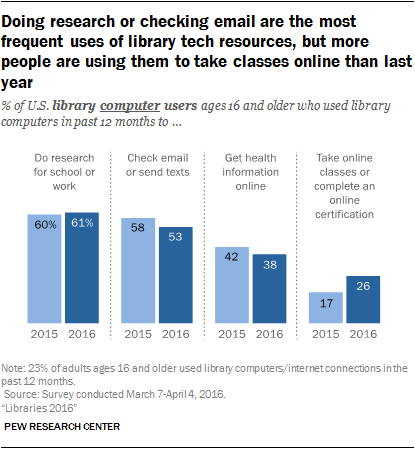
When using tech resources at the library, most people do research for school or work (61% of library tech users did in the previous 12 months), followed by checking email or sending texts (53%). A share also get health information (38%) and 26% have taken online classes or completed a certification.

Although there have been modest changes in some activities using libraries’ digital resources, there has been a boost in the share of library tech users taking some sort of class or certification online.

Library websites are used for finding available resources or renewing books

For the 27% of people who have used library websites or mobile apps in the past 12 months, searching library catalogues, reserving or placing holds on items, renewing items, or doing research or homework are most prevalent. Here is what those who have used a public library’s websites or apps have done using those tools in the past 12 months:

  • 58% of those who have used library websites in the past 12 months to search a library’s catalogue.
  • 44% of those website users reserved or placed holds on printed books, audiobooks, e-books, CDs or DVDs.
  • 44% conducted research or got homework help.
  • 40% renewed books, DVDs or CDs.
  • 37% used online databases.
  • 31% read book reviews or got book recommendations.

3. A portrait of those who have never been to libraries

Nearly half (48%) of Americans visited libraries in the past year. Roughly a third (32%) say they have used libraries at one time or another, though not in the past 12 months. Additionally, one-in-five (19%) say they have never visited a public library or a bookmobile. This has been a persistent trend in Pew Research Center surveys for five years, and we consistently see patterns in who these non-users are and how their views about libraries differ from more recent library users.

Those who have never been to a public library are more likely to be male (24% have never been to a library), ages 65 and older (26%), Hispanic (32%), black (28%), high school graduates or less (29%), or living in households earning less than $30,000 (27%). At the same time, the data show there are members of other demographic groups that have had no direct experience with libraries, including: 11% of those with college degrees and 12% of those in households earning $75,000 or more. Additionally, one-in-six parents of minor children (17%) say they have never been to a public library.

Despite the fact that they have no direct personal experience with libraries, many who have never been have relatively positive and affirming views about libraries, even though their level of enthusiasm is not as high as recent library goers. Recall that 77% of all Americans age 16 and above say libraries provide them with the resources they need. For those who have never used libraries, nearly two-thirds (65%) agree with this, possibly because other friends and family members get materials from libraries that are helpful. At the same time, 90% of those who are recent library goers say public libraries provide the resources they need.

In the same vein, more than half (56%) of those who have never been to a library say that the closing of their local libraries would have a major impact on their communities. Fully 77% of those who have visited their public libraries in the past year say that. When they consider the possibility of their local libraries closing, 19% of those who have never used libraries believe the closing would have a major impact on them and their families. That compares with 48% of recent library users who believe it would have the same impact.

As to attitudes about libraries, the main difference between library users and non-users has to do with trust and information. People who have used libraries in the past year are more likely than others to say that libraries are a resource that can help them decide what information to trust. Some 43% of library users say they agree “a lot” that libraries are a place that helps people decide what information to trust, while 29% of those who have never been say this. Again, this might stem from the possibility that non-users gain access to library resources through family and friends who are active library users.

Acknowledgments

This report was made possible by The Pew Charitable Trusts, which received support for the project through a grant from the Bill & Melinda Gates Foundation. It is a collaborative effort based on the input and analysis of the following individuals:

The findings and conclusions contained within are those of the authors and do not necessarily reflect positions or policies of the Bill & Melinda Gates Foundation.

Primary researchers

John B. Horrigan, Senior Researcher Lee Rainie, Director, Internet, Science and Technology Research    

Research team

Aaron Smith, Associate Director, Research Andrew Perrin, Research Assistant Claudia Deane, Vice President, Research           

Editorial and graphic design

Margaret Porteus, Information Graphics Designer Shannon Greenwood, Copy editor

Communications and web publishing

Dana Page, Senior Communications Manager Shannon Greenwood, Associate Digital Producer

Methodology

The analysis in this report is based on a Pew Research Center survey conducted March 7-April 4, 2016, among a national sample of 1,601 adults, 16 years of age or older, living in all 50 U.S. states and the District of Columbia. Fully 401 respondents were interviewed on landline telephones, and 1,200 were interviewed on cellphones, including 667 who had no landline telephone. The survey was conducted by interviewers at Princeton Data Source under the direction of Princeton Survey Research Associates International. A combination of landline and cellphone random-digit-dial samples were used; both samples were provided by Survey Sampling International. Interviews were conducted in English and Spanish. Respondents in the landline sample were selected by randomly asking for the youngest adult male or female who was at home. Interviews in the cellphone sample were conducted with the person who answered the phone, if that person was 16 years of age or older. For detailed information about our survey methodology, visit: https://alpha.pewresearch.org/pewresearch-org/methodology/u-s-survey-research/

The combined landline and cellphone samples are weighted using an iterative technique that matches gender, age, education, race, Hispanic origin and nativity, and region to parameters from the 2013 Census Bureau’s American Community Survey and population density to parameters from the Decennial Census. The sample also is weighted to match current patterns of telephone status (landline only, cellphone only or both landline and cellphone), based on extrapolations from the 2014 National Health Interview Survey. The weighting procedure also accounts for the fact that respondents with both landline phones and cellphones have a greater probability of being included in the combined sample and adjusts for household size among respondents with landline phones. The margins of error reported and statistical tests of significance are adjusted to account for the survey’s design effect, a measure of how much efficiency is lost from the weighting procedures.

The following table shows the unweighted sample sizes and the error attributable to sampling that would be expected at the 95% level of confidence for different groups in the survey:

Sample sizes and sampling errors for other subgroups are available upon request.

In addition to sampling error, one should bear in mind that question wording and practical difficulties in conducting surveys can introduce error or bias into the findings of opinion polls. Pew Research Center undertakes all polling activity, including calls to mobile telephone numbers, in compliance with the Telephone Consumer Protection Act and other applicable laws.

Pew Research Center is a nonprofit, tax-exempt 501(c)(3) organization and a subsidiary of The Pew Charitable Trusts, its primary funder.