Parents monitor their teen’s digital behavior in a number of ways, but using technical means like parental controls is less common
BYMonica Anderson
About Pew Research Center
Pew Research Center is a nonpartisan, nonadvocacy fact tank that informs the public about the issues, attitudes and trends shaping the world. It does not take policy positions. The Center conducts public opinion polling, demographic research, computational social science research and other data-driven research. It studies politics and policy; news habits and media; the internet and technology; religion; race and ethnicity; international affairs; social, demographic and economic trends; science; research methodology and data science; and immigration and migration. Pew Research Center is a subsidiary of The Pew Charitable Trusts, its primary funder.
Parents monitor their teen’s digital behavior in a number of ways, but using technical means like parental controls is less common
The widespread adoption of various digital technologies by today’s teenagers has added a modern wrinkle to a universal challenge of parenthood – specifically, striking a balance between allowing independent exploration and providing an appropriate level of parental oversight. Digital connectivity offers many potential benefits from connecting with peers to accessing educational content. But parents have also voiced concerns about the behaviors teens engage in online, the people with whom they interact and the personal information they make available. Indeed, these concerns are not limited to parents. Lawmakers and advocates have raised concerns about issues such as online safety, cyberbullying and privacy issues affecting teens.
A Pew Research Center survey of parents of 13- to 17-year-olds finds that today’s parents1 take a wide range of actions to monitor their teen’s online lives and to encourage their child to use technology in an appropriate and responsible manner.
[tweetable url="http://pewrsr.ch/1OAZ9zT" alt="Some 55% of parents say they limit the amount of time or times of day their teen can be online"]
When it comes to monitoring their child’s digital use and interactions, parents tend to take a hands-on approach to monitoring what their children do:
[tweetable url="http://pewrsr.ch/1OAZ9zT" alt="61% of parents say they have ever checked which websites their teen visits.]61% of parents say they have ever checked which websites their teen visits.
60% have ever checked their teen’s social media profiles.
56% have ever friended or followed their teen on Facebook, Twitter or some other social media platform.
48% have ever looked through their teen’s phone call records or text messages.
In addition, nearly half (48%) of parents know the password to their teen’s email account, while 43% know the password to their teen’s cellphone and 35% know the password to at least one of their teen’s social media accounts.
But even as parents use a number of these hands-on methods to monitor their teen, they are relatively less likely to use technology-based tools to monitor, block or track their teen. This is a consistent pattern that has also emerged in previous Pew Research Center surveys of technology use by parents and teens. For instance, the new survey results show:
39% of parents report using parental controls for blocking, filtering or monitoring their teen’s online activities.
16% use parental controls to restrict their teen’s use of his or her cellphone.
16% use monitoring tools on their teen’s cellphone to track their location.
In addition to taking a range of steps to check up on their teen’s online behavior, the vast majority of parents also try to take a proactive approach to preventing problems by speaking with their teen about what constitutes acceptable and unacceptable online behavior. Specifically:
94% of parents say they have ever talked with their teen about what is appropriate for them to share online, with 40% doing so frequently.
95% have ever talked with their teen about appropriate content for them to view online, with 39% doing so frequently.
95% have ever talked with their teen about appropriate media to consume (such as TV, music, books, magazines or other media), with 36% doing so frequently.
92% of parents have ever spoken with their teen about their online behavior towards others, with 36% doing so frequently.
A note about the findings in this survey
These findings are based on a national survey of parents of teens ages 13 to 17, conducted Sept. 25-Oct. 9, 2014, and Feb. 10-March 16, 2015. One parent and one teenage child participated in each survey. If a parent had more than one child in the specified age range, one teen in the household was randomly selected for the survey. The data in this report about parenting behavior pertain specifically to parenting behavior towards the specific teen who also completed the survey.
This report differs from Pew Research Center surveys of parents and technology conducted prior to 2014 in that this survey was administered using an online panel to a nationally representative cohort of teens. Pre-2014 surveys of teens and technology were conducted via telephone, cellphones as well as landlines. Due to differences in modes, figures presented in this report will not be directly compared to Pew Research Center studies of teens conducted prior to 2014.
At the same time, there are a number of broad trends that resonate in both our current and previous work. As in past Pew Research Center studies, this research finds that a majority of parents report discussing acceptable online behavior with their teen as well as checking up on what websites their teen visits. Meanwhile, the share of parents who use more technologically oriented methods, like parental monitoring software, to monitor their teen’s digital life continues to remain comparatively low.
1. How parents monitor their teen’s digital behavior
Much like their children, parents of teenagers now live in a world that is heavily influenced by digital devices and online platforms. Among parents of 13- to 17-year-olds, 94% own a desktop or laptop computer; 76% own a smartphone; 72% use Facebook; and 84% go online at least occasionally using a smartphone, tablet or other mobile handheld device. (For full details on technology ownership and use among parents of teens, see Appendix A of this report).
And as these devices have become more prominent in the lives of parents and teens, many parents are now faced with the challenge of how to effectively monitor their child’s behavior, interactions and time spent in various online spaces. Ultimately, parents today report taking a number of steps to influence their child’s digital behavior, from checking up on what their teen is posting on social media to limiting the amount of time their child spends in front of various screens.
Parents of younger teens report they tend to take a more active role in policing their teen’s behavior, but parents of all demographic backgrounds tend to rely more heavily on personal engagement and monitoring than on technological solutions. Parents also generally monitor the digital lives of teen boys and teen girls in similar ways.
A majority of parents have personally monitored their teen’s web history or social media profile – but fewer use parental controls or tracking tools
Parents take a number of different steps to monitor their child’s behavior and interactions in digital spaces, with personal monitoring being the most prominent of these steps. Fully 61% of parents say they have checked which websites their teen has visited, while 60% report checking their teen’s social media profile. Teens are increasingly using mobile technologies to communicate, share and go online and nearly half (48%) of parents say they have looked through the phone call records or messages on their child’s cellphone.
On the other hand, parental monitoring by technological means is somewhat less common. Some 39% of parents say they turn to parental controls or other technological tools to block, filter or monitor their teen’s online activities. And even fewer parents report using parental controls to restrict their teen’s use of his or her cellphone (16%) or using monitoring tools on their teen’s cellphone to track his or her location (16%).
In total, 84% of parents report taking at least one of these six steps to monitor or restrict their child’s online activities, while 16% indicate that they have not taken any of these actions with their teen. Another 16% say they do one of these activities, while just under half of parents (45%) take between two or three of these actions. Other parents are especially vigilant: 19% have taken four or five of these steps, while 5% indicate that they have taken all six.
Parents of younger teens tend to keep a more watchful eye on the types of websites their teen visits and are also more likely to use parental tools to monitor or block online content
Regardless of their teen’s age, a majority of parents say they check their child’s web browsing history, yet parents of younger teens are somewhat more likely to do so. Roughly two-thirds (68%) of parents of 13- to 14-year-olds have checked which websites their teen visits, compared with 56% of parents of 15- to 17-year-olds.
Parents of younger teens are also more likely to use tech-based tools to block or monitor what their teen does or sees online. Some 46% of parents of younger teens report using parental controls to monitor their child’s online activities, compared with 34% of parents of older teens.
On the other hand, parents of older teens are somewhat more likely than parents of younger teens to check up on their teen’s social media profiles (63% vs. 56%). Notably, older teens have higher rates of usage across a range of social media platforms.
Overall, parents of older and younger teens are equally likely to say they monitor their child’s mobile behaviors. However, when analyzing parents whose teen currently has a cellphone, a pattern of more intensive monitoring of younger teens emerges.
Half (50%) of parents of 13- to 14-year-olds say they look at their teen’s phone call records or messages, similar to the 47% of parents of 15- to 17-year-olds who engage in this behavior.
But looking specifically at parents of teen cellphone users, 67% of those whose teen is 13- to 14-years-old say they look at call records or messages on their teen’s phone, compared with 54% of parents of 15- to 17- year-olds.
Just as younger teens are more likely to experience certain types of parental monitoring, younger parents are more likely to report taking a number of these actions. Roughly two-thirds (68%) of parents under 45 years of age say they have checked which websites their teen visited, compared with 53% of parents 45 and older. Younger parents are also more likely than their older counterparts to check their teen’s social media profiles (66% vs. 53%); to use parental controls or other technological means of blocking, filtering or monitoring their teen’s online activities (44% vs. 34%); and to look through their teen’s phone call records or messages (55% vs. 41%).
Other than parental or child age, there are relatively few demographic differences regarding digital monitoring. Mothers and fathers tend to monitor their teen’s digital behavior in a similar fashion, while the data show few differences in digital monitoring based on race and ethnicity, household income, or educational attainment.
Nearly two-thirds of parents have limited their teen’s screen time as punishment, and just over half limit how much time their teen is allowed to spend online
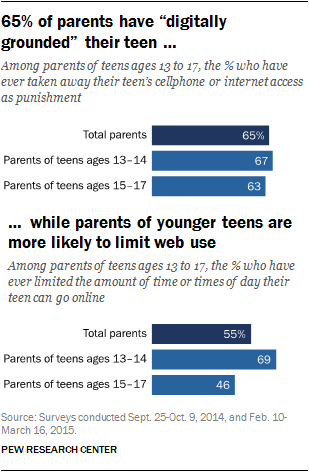
Technology plays a central role in the way that teens connect and engage with both friends and romantic partners. Thus, the parental threat to take away digital devices is a potentially potent form of punishment. Indeed, 65% of parents report that they have punished their teen by taking away their teen’s cellphone or internet access.
Furthermore, a majority of parents say they place restrictions on their teen’s internet use, regardless of their behavior: 55% of parents say they limit the amount of time or times of day their teen can go online.
Parents of younger teens (ages 13-14) are much more likely to say they limit how long or when their teen can go online – 69% have done so, compared with 46% of parents of 15- to 17-year-olds. Still, parents of older and younger teens are equally likely to indicate that they have grounded their teen from using the internet or their cellphone.
And as was the case with digital monitoring, younger parents are more likely than older parents to engage in each of these behaviors. Fully 61% of parents under the age of 45 limit the amount of time or times of day their teen can go online, compared with 50% of parents 45 and older. Younger parents are also more likely than older parents to say they have taken away their teen’s cellphone or internet privileges as punishment (68% vs. 61%).
Just under half of parents are friends with their teenage child on Facebook, while one-in-ten follow their teen on Twitter
Along with monitoring their child’s social media profile in a general sense, many parents take the additional step of actually friending or following their teenage child on Facebook, Twitter or other social media platforms.
This behavior is especially common on Facebook, which is the most-used social networking site for parents and teens alike (72% of parents and 71% of teens report that they are Facebook users). Overall, 44% of all parents indicate that they are Facebook friends with their teen.
In addition to Facebook, 9% of parents indicate that they follow their child on Twitter, while 17% indicate that they follow their child on some other social networking site. In total, some 56% of parents indicate that they are friends with their teen on Facebook, Twitter and/or some other social media platform.
Half of parents know the password to their teen’s email account, while one-in-three parents are privy to their teen’s social media passwords
In addition to monitoring their child’s postings or other communications, some parents require their child to provide access to the passwords on their accounts and devices. This behavior is relatively common, but far from universal: 48% of parents say they know the password to their teen’s email account, 43% are privy to their teen’s cellphone password, and 35% know the password to at least one of their teen’s social media accounts.
As is true of many digital monitoring behaviors, parents of younger teens are more likely than parents of older teens to have access to their child’s email passwords. Among parents of 13- to 14-year-olds, 54% say they know their child’s email password (compared with 44% of parents of 15- to 17-year-olds).
Overall, parents of older and younger teens are equally likely to know their teen’s cellphone password, but, as with checking call records or messages on their teen’s phone, there are differences when specifically looking at only parents of teens who currently have a cellphone. Among parents of teen cellphone users, 61% of parents of teens ages 13 to 14 say they know the password to their teen’s cellphone, compared with 46% of parents of teens ages 15 to 17.
There are no difference based on a teen’s age when it comes to parents having the password to one or more of their child’s social media accounts.
Younger parents are more likely than older parents to know the passwords to their teen’s cellphone (47% vs. 38%) as well as their social media profiles (41% vs. 29%).
There are also some modest differences on this issue based on race and ethnicity as well as educational attainment. White parents are a bit more likely to know their teen’s email account password, compared with Hispanic parents (51% vs. 39%). Similarly, parents who have attended college are more likely than those with no college experience to know their teen’s email password: 54% of parents with some college experience and 50% of college graduates report having their teen’s email account password, compared with 42% of parents with a high school education or less.
2. How parents talk to teens about acceptable online behavior
In addition to examining the actions parents take to monitor their teen’s internet and cellphone use, Pew Research Center also asked parents how often they talk with their teen about appropriate and inappropriate behavior in various spaces, from what they share and view online to how they treat others online or conduct themselves in their everyday lives.
The vast majority of parents talk with their teen about appropriate conduct in their digital lives, but discussions about appropriate offline behavior tend to be more frequent
When it comes to guiding their teen about making the right decisions, parents discuss “real life” behaviors somewhat more often than online behavior. Virtually all parents – 98% – report ever speaking with their teen about what is appropriate or inappropriate conduct in school, at home and in their social lives, with 56% saying they have these conversations frequently.
Similarly, nearly all parents say they talk with their teen about appropriate behavior in various online platforms. For example, 94% of parents say they ever talk with their teen about what they should share online, while 92% say they talk with their teen about what constitutes appropriate online behavior towards others.
At the same time, discussions about appropriate online behavior tend to occur with somewhat less frequency than discussions of how to behave at home or in school. Four-in-ten parents frequently communicate with their teen about what they should share online; 39% frequently discuss the online content their teen views; 36% frequently discuss appropriate television, music, books, magazines or other media; while another 36% frequently talk with their teen about their online behavior towards others.
Other research shows a similar pattern of parents using personal conversations to inform teens of how to conduct themselves online. According to a 2015 Common Sense Media report, a majority of teens say their parents have talked with them about online safety and responsibility.2
Regularly communicating views about acceptable behavior online is more prevalent among parents of younger teens
Parents of younger teens are more likely than parents of older teens to speak with their child about appropriate and inappropriate behavior in a variety of online and offline spaces – and this is especially true when it comes to discussions about online and media content.
Half (49%) of parents of 13- to 14-year-olds say they frequently talk with their teen about what types of online content are acceptable for them to view, compared with 32% of parents whose teens ages 15 to 17. Parents of younger teens are also significantly more likely to frequently talk with their child about what is appropriate to share online, types of media to consume and online behavior towards others.
Mothers tend to take the lead in communicating with their teen about appropriate conduct
In general, mothers and fathers report taking similar steps to monitor their teen’s digital behavior. However, mothers tend to have more frequent conversations with their teen when it comes to outlining appropriate behavior – online as well as offline.
Some 63% of mothers say they frequently talk with their teen about appropriate behavior in school, at home and in their social lives, while 48% of fathers say they frequently have these discussions. Mothers are also more likely than fathers to frequently discuss right and wrong behavior in a variety of online spaces and media environments.
Regular conversations about appropriate online and offline conduct are more prevalent among less affluent and less educated parents
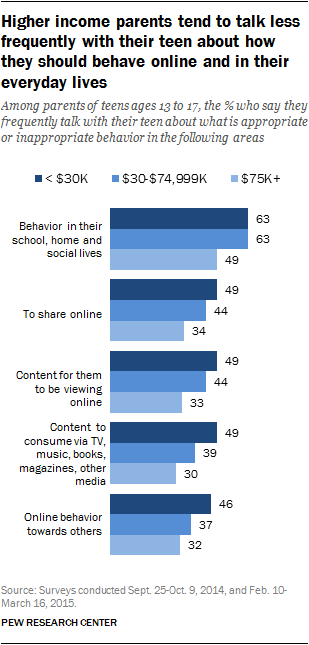
While there are relatively few differences based on income and educational attainment in terms of how parents oversee their teen’s online and mobile behavior, parents that are less affluent and have lower levels of educational attainment are more likely to speak regularly with their teen about the do’s and don’ts of both the online and offline world.
Among parents whose annual household income is less than $30,000, nearly two-thirds (63%) report frequently speaking with their teen about the right and wrong way to behave in school, at home and in their social lives. This is the same share as those living in households earning $30,000-74,999 yearly. In contrast, 49% of parents in households earning $75,000 or more per year frequently discuss this issue with their child. Similar differences can be seen when it comes to conversations about what teens share and view online, the media they consume and how they treat others online.
In addition, parents who have not attended college are more likely than those with a bachelor’s or advanced degree to frequently talk with their teen about their online and offline activities.
The biggest gap relates to appropriate online content, as some 47% of parents with a high school diploma or less say they frequently speak with their teen about the type of online content they view (compared with 34% of those with at least a college degree).
Parents with less formal education are also more likely than those with a bachelor’s degree or more to say they frequently speak with their teen about what is appropriate to share online (44% vs. 35%), appropriate traditional media content (41% vs. 35%), or their online behavior towards others (42% vs. 34%).
Hispanic parents are especially likely to talk with their teen frequently about appropriate online behavior and media habits
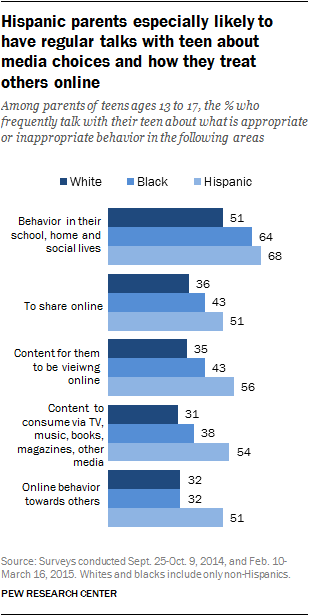
Parental monitoring of teen’s online and mobile activities tends to vary little by race and ethnicity. There are differences, however, in how often parents of different racial and ethnic backgrounds engage in conversations about appropriate online and offline behavior.
For instance, Hispanic parents are more likely than either white or black parents to frequently speak with their teen about appropriate online behavior towards others: 51% of Hispanics parents do this frequently, compared with 32% of both blacks and whites. Hispanics are also more likely than either white or black parents to frequently talk with their teen about appropriate media content, as well as appropriate content to view online.
These findings are in line with a recent Common Sense Media report of American youth, which found that Hispanic adolescents were more likely than whites to report that their parents talk about when they can use media, how much media time they are allowed and how to be respectful and responsible on the web.
Meanwhile, both Hispanic and black parents are more likely than whites to report frequently speaking with their teen about appropriate behavior in school, at home and in their social lives.
Although this survey did not ask parents for specific reasons why they communicate with their teen about certain topics, minority teens tend to go online with greater frequency compared with whites, which may impact the frequency of parental discussions about online behavior. A 2015 Pew Research Center report found that 34% of black teens and 32% of Hispanic teens say they go online “almost constantly,” compared with 19% of white teens. Another Pew Research Center study from late 2015 found that Hispanic parents tend to worry more than white or black parents on a number of measures, including bullying.
For most parents, the phone is the default device for quickly getting in touch with their teen
When parents need to reach their teen quickly, phone-based communication is the preferred method. About half (49%) of parents say they most often will use text messaging when they need to get in touch with their child quickly, while 41% most often call their child on the phone. By contrast, just 2% of parents most often message their child on social media when they want to get in touch quickly, while just 1% typically send an email. Some 8% of parents say they most often use another method to get a hold of their child quickly, other than the ones listed here. Among this 8%, many parents cited “in-person” communication as the most common way they get in touch with their teen.
Parents across a range of demographic categories tend to reach for the phone when they need to get in touch with their teen, although higher-income parents are a bit more likely to use text messaging, rather than a voice call. Roughly half (51%) of lower income parents (those with an annual household income of less than $30,000) say they call their teen on the phone when they need to get in touch quickly, compared with 38% of parents whose household income is $75,000 or more a year. More affluent parents first send a text message when they need to speak with their teen – 57% say they do so, compared with 31% of lower income parents.
Acknowledgments
This report is a collaborative effort based on the input and analysis of the following individuals. Find related reports online at: pewresearch.org/pewresearch-org/internet
Monica Anderson, Research Analyst
Aaron Smith, Associate Director, Internet, Science, and Technology Research
Lee Rainie, Director, Internet, Science and Technology Research
Maeve Duggan, Research Associate
Andrew Perrin, Research Assistant
Dana Page, Senior Communications Manager
Margaret Porteus, Information Graphics Designer
Shannon Greenwood, Assistant Digital Producer
Amanda Lenhart, Researcher, Data & Society Research Institute
Methodology
The Pew Research Center’s Teen Relationship Study was funded, designed and analyzed by Pew Research Center staff. Quantitative fieldwork was conducted by the GfK Group (GfK, formerly Knowledge Networks). Specifically, the survey examined the attitudes of teens ages 13 to 17 years old, as well as those of their parents, toward technology. The survey examined friendships and romantic relationships within the context of technology use. The survey was conducted using sample from KnowledgePanel®.
Quantitative Sample Definition
The target population consists of the following: parents of teens ages 13 to 17 and teens 13 to 17 years old residing in the United States. To sample the population, GfK sampled households from its KnowledgePanel, a probability-based web panel designed to be representative of the United States. The survey consisted of three stages: initial screening for the parents of teens ages 13 to 17, the parent survey and the teen survey.
The main data collection field periods were from Sept. 25, 2014, through Oct. 9, 2014, and from Feb. 10, 2015, to March 16, 2015. The second data collection was targeted toward black parents and teenagers, with the intent of increasing to reportable levels the number of black teens in the sample. Parents completed the parent section of the survey in six minutes (median). Teens completed the teen section of the survey in 16 minutes (median). The survey was conducted in English and Spanish. Parents and teens could select different languages for the survey.
Survey Completion and Sample Sizes
The number of respondents sampled and participating in the survey, the survey completion rates for the screener and main interview, and the incidence/eligibility rate are presented below.
While 1,084 parents completed the parent section of the main survey, 1,060 teens completed the teen section of the main survey; the 24 unpaired parents were not included in the final counts. The margin of error for the full sample of teens (n=1,060) or parents (n=1,060) is plus or minus 3.7 percentage points. Please see the adjacent chart for the margin of error for this and other subsamples in this study.
Survey Cooperation Enhancements
As a standard, email reminders to non-responders were sent on day three of the field period. Beyond the standard email reminder on Day Three of the field period, the following steps were also taken:
Additional email reminders to non-responders were sent on Day Seven of the field period;
Teens received a cash-equivalent of $5 for their participation;
Documentation regarding KnowledgePanel sampling, data collection procedures, weighting and IRB-bearing issues are available at the below online resources.
KnowledgePanel’s recruitment process uses an Address Based Sampling (ABS) methodology for selecting panel members. This probability-based sampling methodology improves population coverage and provides a more effective sampling infrastructure for recruitment of hard-to-reach individuals, such as young adults and those from various minority groups. It should be noted that under the ABS recruitment households without internet connection are provided with a web-enabled device and free internet service.
After initially accepting the invitation to join the panel, participants are asked to complete a short demographic survey (the initial profile survey); answers to which allow efficient panel sampling and weighting for future surveys. Completion of the profile survey allows participants to become panel members, and all respondents are provided the same privacy terms and confidentiality protections.
ABS Recruitment
The ABS recruitment protocol relies on probability-based sampling of addresses from the United States Postal Service’s Delivery Sequence File (DSF). The key advantage of the ABS methodology is that it allows sampling of almost all United States households. Regardless of household telephone status, all households can be reached and contacted through postal mail. Pre-identified ancillary information about addresses was used to construct and target households in the following four sampling strata:
Hispanic ages 18-29
Non-Hispanic ages 18-29
Hispanic ages 30+
Non-Hispanic ages 30+
As detailed below, specific adjustments are applied to compensate for any oversampling that is carried out to improve the demographic composition of the panel.
Randomly sampled addresses from the DSF are invited to join KnowledgePanel through a series of mailings, including an initial invitation letter, a reminder postcard and a subsequent follow-up letter. Given that approximately 45% of the physical addresses can be matched to a corresponding landline telephone number, about five weeks after the initial mailing, telephone refusal-conversion calls are made to households for whom a telephone number was matched to the sampled address. Invited households can join the panel by:
Completing and mailing back a paper form in a postage-paid envelope
Calling a toll-free hotline phone number maintained by GfK
Going to a designated GfK website and completing the recruitment form at the website
Household Member Recruitment
For all recruitment efforts, during the initial recruitment survey, all household members are enumerated. Following enumeration, attempts are made to recruit every household member who is at least 13 years old to participate in KnowledgePanel surveys. For household members aged 13 to 17, consent is collected from the parents or the legal guardian during the initial recruitment interview. If no consent is given, no further direct communication with the teenagers is attempted.
Survey Sampling from KnowledgePanel
For this survey, a nationally representative sample of U.S. parents of teens ages 13 to 17 was selected. The general sampling rule is to assign no more than one survey per week to individual members. Allowing for rare exceptions during some weeks, this limits a member’s total assignments per month to four or six surveys.
Survey Administration
Once assigned to a survey, members receive a notification email letting them know there is a new survey available for them to take. This email notification contains a link that sends them to the survey questionnaire.
After three days, automatic email reminders are sent to all non-responding panel members in the sample. If email reminders do not generate a sufficient response, an automated telephone reminder call can be initiated. The usual protocol is to wait at least three to four days after the email reminder before calling. To assist panel members with their survey taking, each individual has a personalized “home page” that lists all the surveys that were assigned to that member and have yet to be completed.
GfK also operates an ongoing modest incentive program to encourage participation and create member loyalty. Members can enter special raffles or can be entered into special sweepstakes with both cash rewards and other prizes to be won.
The typical survey commitment for panel members is one survey per week or four per month with duration of 10 to 15 minutes per survey. In the case of longer surveys, an additional incentive is typically provided.
Sample Weighting
For selection of general population samples from the Knowledge Panel (KP), however, a patented methodology has been developed that ensures the resulting samples behave as EPSEM (Equal Probability of Selection Method) samples. Briefly, this methodology starts by weighting the entire KP to the benchmarks secured from the latest March supplement of the Current Population Survey (CPS) along several dimensions. This way, the weighted distribution of the Knowledge Panel matches that of the US adults – even with respect to the few dimensions where minor misalignments may result from differential attrition rates.
Study-Specific Post-Stratification Weights
Once the study sample has been selected and fielded, and all the survey data are edited and made final, design weights are adjusted for any survey nonresponse as well as any under- or over-coverage imposed by the study-specific sample design. Depending on the specific target population for a given study, geo-demographic distributions for the corresponding population are obtained from the CPS, the American Community Survey (ACS) or in certain instances from the weighted KP profile data. For this purpose an iterative proportional fitting (raking) procedure is used to produce final weights that will be aligned with respect to all study benchmark distributions simultaneously. In the final step, calculated weights are examined to identify and, if necessary, trim outliers at the extreme upper and lower tails of the weight distribution. The resulting weights are then scaled to the sum of the total sample size of all eligible respondents.
For this study, the following benchmark distributions of parents with teens ages 13 to 17 from the 2010-2012 American Community Survey (ACS) were used for the raking adjustment of weights for parents (par_weight):
Gender (Male/Female) by Age (18-39, 40-49, and 50+)
Metropolitan Area (Yes, No) by Census Region (Northeast, Midwest, South, West)
Education (Less than High School, High School, Some College, Bachelor and beyond)
Household income (under $25k, $25K to <$50k, $50K to <$75k, $75K to <$100k, $100K+)
Primary Language (English-dominant, Bilingual, Spanish-dominant, Non-Hispanic)
Age (18-39, 40-49, and 50+) by Race/Hispanic ethnicity (White/Non-Hispanic, Black/Non-Hispanic, Other/Non-Hispanic, 2+ Races/Non-Hispanic, Hispanic)
Gender (Male/Female) by Race/Hispanic ethnicity (White/Non-Hispanic, Black/Non-Hispanic, Other/Non-Hispanic, 2+ Races/Non-Hispanic, Hispanic) (collapsed metro status together for Others/2+ Races because of not enough cases)
Census Region (Northeast, Midwest, South, West) by Race/Hispanic ethnicity (White/Non-Hispanic, Black/Non-Hispanic, Other/Non-Hispanic, 2+ Races/Non-Hispanic, Hispanic)
Education (Less than High School, High School, Some College, Bachelor and beyond) by Race/Hispanic ethnicity (White/Non-Hispanic, Black/Non-Hispanic, Other/Non-Hispanic, 2+ Races/Non-Hispanic, Hispanic) (collapsed HS/LHS for AA and HS/LHS for Others/2+ Races)
Household income (under $25k, $25K to <$50k, $50K to <$75k, $75K to <$100k, $100K+) by Race/Hispanic ethnicity (White/Non-Hispanic, Black/Non-Hispanic, Other/Non-Hispanic, 2+ Races/Non-Hispanic, Hispanic) (collapsed income into two categories for Others/2+ Races — (under $50K, $50K+))
Metropolitan Area (Yes, No) by Race/Hispanic ethnicity (White/Non-Hispanic, Black/Non-Hispanic, Other/Non-Hispanic, 2+ Races/Non-Hispanic, Hispanic) (collapsed metro status together for Others/2+ Races because of not enough cases)
The following benchmark distributions of children ages 13 to 17 from the 2014 March Supplement of the Current Population Survey (CPS) were used for the raking adjustment of weights for teens (teen_weight):
Gender (Male/Female) by Age (13, 14, 15, 16, 17)
Teen Race/Hispanic ethnicity (White/Non-Hispanic, Black/Non-Hispanic, Other/Non-Hispanic, 2+ Races/Non-Hispanic, Hispanic)
Metropolitan Area (Yes, No) by Census Region (Northeast, Midwest, South, West)
Age (13, 14, 15, 16, 17) by Teen Race/Hispanic ethnicity (White/Non-Hispanic, Black/Non-Hispanic, Other/Non-Hispanic, 2+ Races/Non-Hispanic, Hispanic)
Gender (Male/Female) by Teen Race/Hispanic ethnicity (White/Non-Hispanic, Black/Non-Hispanic, Other/Non-Hispanic, 2+ Races/Non-Hispanic, Hispanic)
Census Region (Northeast, Midwest, South, West) by Teen Race/Hispanic ethnicity (White/Non-Hispanic, Black/Non-Hispanic, Other/Non-Hispanic, 2+ Races/Non-Hispanic, Hispanic)
Metropolitan Area (Yes, No) by Teen Race/Hispanic ethnicity (White/Non-Hispanic, Black/Non-Hispanic, Other/Non-Hispanic, 2+ Races/Non-Hispanic, Hispanic)
Parental Education (Less than High School, High School, Some College, Bachelor and beyond) by Parental Race/Hispanic ethnicity (White/Non-Hispanic, Black/Non-Hispanic, Other/Non-Hispanic, 2+ Races/Non-Hispanic, Hispanic) (collapsed HS/LHS for AA and HS/LHS for Others/2+ Races)
The starting weight for teens is the final parent weight multiplied by the number of children ages 13 to 17 years old in the household (1, 2+).
Detailed information on the demographic distributions of the benchmarks is available upon request. Please contact Kyley McGeeney at KMcGeeney@PewResearch.org for more information about the study methodology.
Pew Research Center is a nonprofit, tax-exempt 501(c)3 organization and a subsidiary of The Pew Charitable Trusts, its primary funder.
Appendix A: Detailed tables
Technology ownership and usage among parents of 13- to 17-year-olds