Pew Research Center

FOR RELEASE DECEMBER 15, 2015

Gaming and Gamers

49% of American adults ever play video games, and 10% consider themselves gamers. Public attitudes toward games – and the people who play them – are complex and often uncertain

BY Maeve Duggan

FOR MEDIA OR OTHER INQUIRIES:

Communications Department
202.419.4372
www.pewresearch.org

RECOMMENDED CITATION

Pew Research Center, December 2015, "Gaming and Gamers"

About Pew Research Center

Pew Research Center is a nonpartisan, nonadvocacy fact tank that informs the public about the issues, attitudes and trends shaping the world. It does not take policy positions. The Center conducts public opinion polling, demographic research, computational social science research and other data-driven research. It studies politics and policy; news habits and media; the internet and technology; religion; race and ethnicity; international affairs; social, demographic and economic trends; science; research methodology and data science; and immigration and migration. Pew Research Center is a subsidiary of The Pew Charitable Trusts, its primary funder.

© Pew Research Center 2026

Table of contents

  • About Pew Research Center
  • Gaming and Gamers
  • 1. Who plays video games and identifies as a “gamer”
  • 2. Public debates about gaming and gamers
  • 3. Attitudes about video games
  • Acknowledgments
  • Methodology

Gaming and Gamers

49% of American adults ever play video games, and 10% consider themselves gamers. Public attitudes toward games – and the people who play them – are complex and often uncertain

In recent years, major debates have emerged about the societal impact of video games and the effect they have on the people who play them. Among the disputes: whether men predominate in gaming; whether games portray women and minorities poorly; whether violent games promote aggressive behavior; and whether games encourage positive attributes such as problem-solving skills, communication and teamwork.

A new survey from Pew Research Center covers these and other issues. The key results:

Equal numbers of men and women ever play video games, although men are twice as likely to call themselves “gamers”

Half of American adults play video games; 10% consider themselves “gamers”

About half of American adults (49%) “ever play video games on a computer, TV, game console, or portable device like a cellphone,” and 10% consider themselves to be “gamers.”

A majority of American adults (60%) believe that most people who play video games are men – a view that is shared by 57% of women who themselves play video games. But the data illustrates that in some ways this assumption is wrong: A nearly identical share of men and women report ever playing video games (50% of men and 48% of women).

However, men are more than twice as likely as women to call themselves “gamers” (15% vs. 6%). And among those ages 18 to 29, 33% of men say the term “gamer” describes them well, more than three times the proportion of young women (9%) who say the same.

Four-in-ten adults believe that violence in video games is related to violent behavior

Americans are relatively divided over whether there is a possible link between violent games and actual violence. A slight majority of the public (53%) disagree with the statement “people who play violent video games are more likely to be violent themselves.” But 40% agree that there is a relationship between video game violence and violent behavior. Some 32% of those who play video games themselves see a connection between games and violence, along with 26% of self-identified gamers. Women are more likely than men to agree (by a 47% to 31% margin) that people who play violent games are more likely to be violent themselves.

Among the general public, attitudes toward games are complex and often uncertain

Mixed feelings, uncertainty among general public about video games

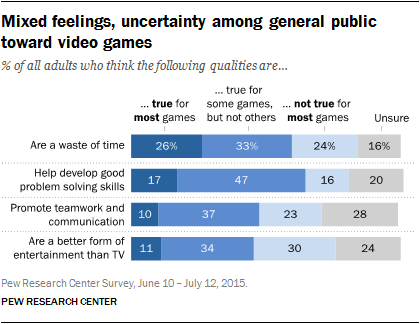
The public is closely split on some other major debates surrounding the content of games and their impact on users. For instance, a quarter of all adults (26%) think most video games are a waste of time, while 24% think most games are not a waste of time. One-third think some games are a waste of time while others are not. And 16% of the public is unsure what to think about this issue.

A similar pattern is evident on the question of whether or not “most games help develop good problem solving and strategic thinking skills.” Some 17% of adults think this is true of most games, while 16% think this is not true of most games. Additionally, 47% think this is true of some games but not others, and 20% are not sure.

Asked whether games promote teamwork and communication, 23% of adults do not think most games promote these traits – more than double the 10% who think most games do promote these qualities. Some 37% think some games but not others promote teamwork and communication, while 28% say they are unsure. Similarly, 30% of adults do not think most games are a better form of entertainment than TV, almost triple the 11% who think this is true.

Public unsure if video games portray minorities and women poorly

The public is much less certain on other aspects of gaming. Fully 47% of all adults are unsure if most video games portray minorities poorly, while 40% are unsure if most video games portray women poorly.

Compared with those who do not play video games, game players are more likely to agree with the positives and disagree with the negatives associated with games

Those who play video games themselves are more likely than non-game players to think positively about gaming:

  • 25% of those who play games (and 39% of self-identified gamers) think most video games help develop good problem solving and strategic thinking skills, compared with just 8% of those who do not play games.
  • 17% of those who play video games (and 34% of those who call themselves gamers) think most games are a better form of entertainment than TV. This compares with just 5% of those who do not play games.
  • 15% of video game players (and 28% of self-described gamers) think most games promote teamwork and communication. Just 6% of those without gaming experience agree.

Game players are also particularly likely to disagree with negative portrayals of video games:

  • 35% of those who play video games (and 53% of those who identify as gamers) think most games are not a waste of time. This compares with just 13% of those who do not play video games.
  • 33% of those who play video games (and 46% of self-described gamers) do not think minorities are portrayed poorly in most games. At the same time, 9% of game players (and 10% of gamers) think most games do portray minorities poorly. Fully 61% of those who do not play video games are unsure what to think on this issue.
  • 26% of those who play video games (and 35% of self-identified gamers) do not think women are portrayed poorly in most games. Meanwhile, 16% of game players (and 24% of self-identified gamers) think most games do portray women poorly. A majority of those who do not play video games (55%) are unsure what to think on this topic.

1. Who plays video games and identifies as a “gamer”

Half of men and a comparable number of women say they ever play video games on a computer, TV, game console, or portable device like a cellphone. However, men are more than twice as likely as women to identify as “gamers.” Some 50% of men and 48% of women play video games, while 15% of men and 6% of women say the term “gamer” describes them well.

Young adults are particularly likely to play video games, as well as to identify as “gamers.” Two-thirds (67%) of those ages 18 to 29 say they play video games, while 22% say the term “gamer” describes them well.

Young men in particular play games and identify as “gamers.” Fully 77% of men ages 18 to 29 play video games (more than any other demographic group), compared with 57% of young women – a 20-point difference. Additionally, one-third of young men agree that the term “gamer” describes them well, more than three times the proportion of young women (9%) who describe themselves as gamers.

Although playing video games is especially popular among young adults, a substantial number of older adults play video games as well. More than half (58%) of those ages 30 to 49 play video games, along with 40% of those ages 50 to 64 and 25% of those 65 or older.

The relationship between gaming and gender is also much different among older adults than it is among younger age groups. In stark contrast to young adults, women ages 50 or older are actually more likely to play video games than men of the same age. Among adults ages 50 and older, 38% of women play video games compared with 29% of men.

Although a notable number of older adults play video games, very few identify as gamers. For instance, just 4% of Americans ages 50 or older feel that this term describes them well. The gender gap in gamer identification also decreases substantially for older age cohorts. As noted above, men ages 18 to 29 are more than three times as likely as their female counterparts to identify as gamers (33% vs. 9%). Among 30- to 49-year-olds, men are twice as likely to identify as gamers (15% vs. 7%). However, among those 50 and older, gamer identification is all but identical between men and women (4% vs. 3%).

While there are no differences by race or ethnicity in who plays video games, Hispanics are more likely than whites or blacks to say the term “gamer” describers them well. Some 19% of Hispanics self-identify as a gamer, compared with 11% of blacks and 7% of whites.

For detailed demographic data on who plays video games and gamer identification, see Appendix B.

2. Public debates about gaming and gamers

Of the many conversations about video games in the public discourse, two themes have drawn particular attention: the number of women who play games and participate in the gaming community, as well as the question of whether some video games encourage violent behavior by the people who play them. The former drew extensive attention during the ongoing Gamergate controversy, a debate centered on the identity politics of the gaming community. The latter is a recurring conversation in the aftermath of violent events in which the perpetrator was known to play violent video games.

Most Americans – including a majority of female game players – believe that most video game players are men

Fully 60% of American adults agree with the statement “most people who play video games are men.” Just 31% disagree with this statement, while another 9% don’t know if it is true or not. Contextually, men and women are equally likely to say they ever play video games, while men are twice as likely as women to consider themselves “gamers.”

A majority of women (including women who play games themselves) believe most video game players are men

Interestingly, men and women are equally likely to assume that most video game players are men regardless of whether they themselves play games. Some 59% of men (and 63% of men who play video games) agree with this statement, nearly identical to the 61% of women (and 57% of women who play video games) who say the same.

Young adults are particularly likely to agree that most people who play video games are men. Fully 71% of 18- to 29-year-olds say this, a figure that is substantially higher than every other age group. And while young men are more likely than young women to play games themselves, there is no difference in opinion between the overall populations of men and women ages 18 to 29 about the gender makeup of the gaming population.

At the same time, opinions within the gaming community closely mirror those of the general population. Fully 60% of those who play games (and 58% of self-identified “gamers”) agree that most people who play video games are men, and men and women who play games are also equally likely to agree (63% of male game players and 57% of female game players).

A substantial minority believe that those who play violent video games are more likely to be violent themselves

Game players, men and young adults are less likely to see a link between violent games and violent behavior

When it comes to the link between video game violence and actual violence, 40% of Americans agree that “people who play violent video games are more likely to be violent themselves.” A slight 53% majority disagree with that statement, while 7% say they don’t know.

In contrast to their views about men in gaming, men and women have highly divergent opinions on the impact of violence and video games. Women are more likely than men to agree (by a 47% to 31% margin) that people who play violent games are more likely to be violent themselves. Men, on the other hand, are more likely to disagree (by a 62% to 44% margin) that there is a link between these behaviors.

Along with men, young adults are relatively likely to deny a link between video game violence and real-world violence. For instance, 71% of 18- to 29-year-olds disagree that violent video games are related to violent behavior, compared with 59% of those ages 30 to 49 and 40% of those 50 and older. On the other hand, older adults are more likely to see a link between video games and violent behavior. Almost half (48%) of adults ages 50 or older agree that people who play violent video games are more likely to be violent themselves.

Hispanics are more likely than whites or blacks to agree that people who play violent video games are more likely to be violent themselves (52% vs. 39% of blacks and 37% of whites). Those with lower educational attainment and household income are also more likely to see a connection between violent games and actual violence.

Most people who play video games do not believe violent games are related to violent behavior – 64% disagree that people who play violent video games are more likely to be violent themselves. But about a third of game players (32%) agree with this statement, including 26% of self-identified gamers.

Much like in the general population, men and women who play video games differ in their opinions on the link between violent play and violent behavior. Female game players are almost twice as likely as male game players to agree that people who play violent video games are more likely to be violent themselves, 42% vs. 22%. On the other hand, fully 76% of male game players disagree with this notion. This compares with 52% of female game players who disagree, a proportion that is substantially lower than their male counterparts, but still a majority.

3. Attitudes about video games

As gaming has gained exposure to a wider audience and increasingly become part of the cultural mainstream, the content of games themselves has come under increased scrutiny. To test public attitudes toward some of these ongoing arguments, the survey presented Americans with some potential impacts of games and asked whether they consider these attributes to be true of most games, not true of most games, or whether they apply to some games but not others.

Overall, the public has mixed feelings about certain aspects of video games and their relative benefits and drawbacks. The results show:

Mixed feelings, uncertainty among general public toward video games

“Video games are a waste of time” – About one-quarter of all adults (26%) think most video games are a waste of time, while a similar number (24%) do not think this is true of most games. One-third thinks some video games are a waste of time while others are not, and 16% are not sure. Whites (28%), those ages 65 or older (32%), and those with at least a high school diploma (27%) are more likely than others to think most video games are a waste of time.

“Video games help develop good problem solving and strategic thinking skills” – Some 17% of adults think most video games promote problem solving and strategic thinking skills, but a roughly equal proportion, 16%, thinks this is not true for most games. Meanwhile, 47% say some games develop these skills while others do not, and 20% are unsure. Those under age 50 are more than twice as likely as those 50 or older to think most game develops problem solving and strategic thinking skills (22% vs. 10%), while men are slightly more likely than women to think so (19% vs. 14%).

“Video games promote teamwork and communication” – Almost a quarter of all adults (23%) think most video games do not promote teamwork and communication, more than double the 10% who think most games do promote these qualities. However, a plurality (37%) thinks this is true of some games but not others, and 28% are unsure. Men and younger adults are more likely than women and older adults to believe most video games promote these qualities. Some 17% of those ages 18 to 29 think teamwork and communication are promoted by games (compared with 9% of those 30 and older), along with 12% of men (vs. 9% of women).

“Video games are a better form of entertainment than watching TV” – Three-in-ten adults do not think video games are a better form of entertainment than television, almost triple the 11% who think most video games are indeed a better form of entertainment than TV. Still, a third of all adults (34%) think this is true of some video games but not others, while 24% are not sure. Almost a quarter of those ages 18 to 29 say most video games are a better form of entertainment than TV (24% vs. 7% of those 30 and older), as do 14% of men vs. 8% of women.

For some aspects of gaming – such as the portrayal of minorities and women in video games – the public is much less certain:

Public unsure if video games portray minorities and women poorly

“Video games portray minority groups poorly” – Fully 47% of adults say they are not sure whether video games portray minority groups poorly. Almost a quarter of all adults (23%) think most video games do not portray minority groups poorly, more than double the 9% of adults who think minority groups are portrayed poorly in most games. Some 20% think minority groups are portrayed poorly in some games but not others. Interestingly, just 13% of blacks and 11% of Hispanics think most video games portray minority groups poorly, compared with 7% of whites. Young adults are slightly more likely than their older counterparts to think most games portray minorities poorly – 13% of those 18 to 29 say so, compared with 7% of those 50 or older.

“Video games portray women poorly” – Similarly, 40% of Americans say they are not sure whether video games portray women poorly. Another 18% say this is not true for most games, while 14% say this is true for most games. More than a quarter of all adults (27%) say this is true for some video games but not others. Notably, the responses to this question show no differences by gender. Young adults are split on the portrayal of women – 24% each of those 18 to 29 think most video games do and do not portray women poorly.

Compared with those who do not play video games, game players tend to agree with more positive depictions of gaming

While the public is largely uncertain what to think about video games, within the gaming community there is more consensus. Put simply, people who play video games are more likely to respond to the positive aspects of their pastime while they disagree with certain negative portrayals. And certain groups of game players – namely men and young adults – hold particularly strong and affirming beliefs about gaming.

Game players more likely to find positive attributes in video games

Among the benefits that game players are more likely to value:

  • 25% of those who play games (and 39% of self-identified gamers) think most video games help develop good problem solving and strategic thinking skills, compared with just 8% of those who do not play games. Among game players, men are more likely than women to think most games develop problem solving and strategic thinking skills (28% vs. 22%). Likewise, 31% of game-players ages 18 to 29 think this is true of most games, compared with 18% of those 50 and older.
  • 17% of those who play games (and 34% of self-described gamers) say most video games are a better form of entertainment than watching TV. This is triple the proportion of non-game players (5%) who say the same. Among those who play video games, men are more likely than women to say most games are better entertainment than TV (23% vs. 10%), along with 31% of game players ages 18 to 29.
  • 15% of those who play video games (and 28% of self-described gamers) think most video games promote teamwork and communication. This compares with just 6% of those who do not play video games. Again, men and those ages 18 to 29 who play video games are more likely than their counterparts to think most games promote teamwork and communication. Some 19% of male game players think so (compared with 12% of female game players), as do 21% of game players ages 18 to 29 (compared with 11% of those 50 and older).
Game-players more likely to think negative representations of gaming are untrue

Additionally, game players are more likely than others to shy away from negative assertions about the impact of video games, including:

  • 35% of those who play games (and 53% of self-described gamers) do not think most video games are a waste of time. Men who play games are particularly likely to feel this way – 40% say games are not a waste of time, compared with 30% of female game players. Younger game players also tend to feel relatively strongly about this issue — fully 43% of game players ages 18 to 29 say most games are not a waste of time, compared with 31% of those 30 and older.
  • 33% of game players (and 46% of self-described gamers) do not think most video games portray minority groups poorly. Minority game players are more likely to agree with this statement than whites. Some 15% of black and 12% of Hispanic game players feel that most video games portray minority groups poorly, compared with 7% of white players. At the same time, 39% of Hispanics and 24% of blacks who play games feel that most games do not portray minorities poorly. And once again, men are particularly likely to disagree with negative views of games: 36% of men who play say most games do not portray minorities poorly, compared with 30% of women.

On the other hand, people who play games are a bit more divided on how women are portrayed in video games:

  • One-quarter (26%) of video game players (and 35% of self-described gamers) disagree that most video games portray women poorly. Still, 16% of game players (and 24% of gamers) think most video games do portray women in a negative light. Some 34% of those who play video games (and 30% of self-identified gamers) say this is true of some games but not others. Interestingly, there are few gender differences among those who play video games – women who play games are somewhat more likely to be unsure than men (27% vs. 21%).

Despite their relatively positive views toward video games compared with non-game players, a substantial portion of game players have mixed feelings on many of these issues. For instance, 55% of video game players think some games develop good problem solving and strategic thinking skills, while other games do not. Similarly, 37% of game players feel that some video games are a waste of time, even while others are not. Finally, even people who play games are not always sure what to think – for example, 31% of game players say they are unsure whether or not most games portray minority groups poorly.

Acknowledgments

This report is a collaborative effort based on the input and analysis of the following individuals. Find related reports online at pewresearch.org/pewresearch-org/internet

Maeve Duggan, Research Associate Aaron Smith, Associate Director, Internet, Science, and Technology Research Lee Rainie, Director, Internet, Science, and Technology Research Andrew Perrin, Research Assistant Dana Page, Senior Communications Manager Margaret Porteus, Information Graphics Designer Shannon Greenwood, Assistant Digital Producer

Methodology

The analysis in this report is based on a Pew Research Center survey conducted June 10, 2015 through July 12, 2015 among a national sample of 2,001 adults, 18 years of age or older, living in all 50 U.S. states and the District of Columbia. 701 respondents were interviewed on a landline telephone, and 1,300 were interviewed on a cellphone, including 749 who had no landline telephone. The survey was conducted by interviewers at Princeton Data Source under the direction of Princeton Survey Research Associates International. A combination of landline and cellphone random digit dial samples were used; both samples were provided by Survey Sampling International. Interviews were conducted in English and Spanish. Respondents in the landline sample were selected by randomly asking for the youngest adult male or female who was at home. Interviews in the cellphone sample were conducted with the person who answered the phone, if that person was 18 years of age or older. For detailed information about our survey methodology, visit: https://alpha.pewresearch.org/pewresearch-org/methodology/u-s-survey-research/

The combined landline and cellphone samples are weighted using an iterative technique that matches gender, age, education, race, Hispanic origin and nativity, and region to parameters from the 2013 Census Bureau’s American Community Survey and population density to parameters from the Decennial Census. The sample also is weighted to match current patterns of telephone status (landline only, cellphone only or both landline and cellphone), based on extrapolations from the 2014 National Health Interview Survey. The weighting procedure also accounts for the fact that respondents with both landline and cellphones have a greater probability of being included in the combined sample and adjusts for household size among respondents with a landline phone. The margins of error reported and statistical tests of significance are adjusted to account for the survey’s design effect, a measure of how much efficiency is lost from the weighting procedures.

The following table shows the unweighted sample sizes and the error attributable to sampling that would be expected at the 95% level of confidence for different groups in the survey:

Gaming and Gamers Methodology

Sample sizes and sampling errors for other subgroups are available upon request.

In addition to sampling error, one should bear in mind that question wording and practical difficulties in conducting surveys can introduce error or bias into the findings of opinion polls.

Pew Research Center is a nonprofit, tax-exempt 501(c)(3) organization and a subsidiary of The Pew Charitable Trusts, its primary funder.