Pew Research Center

FOR RELEASE AUGUST 26, 2015

Americans’ Views on Mobile Etiquette

‘Always on’ mobile connectivity poses new challenges for users about when to be present with those nearby or engaged with others on their screens

BY Lee Rainie and Kathryn Zickuhr

FOR MEDIA OR OTHER INQUIRIES:

Communications Department
202.419.4372
www.pewresearch.org

RECOMMENDED CITATION

Pew Research Center, August 2015, "Americans’ Views on Mobile Etiquette"

About Pew Research Center

Pew Research Center is a nonpartisan, nonadvocacy fact tank that informs the public about the issues, attitudes and trends shaping the world. It does not take policy positions. The Center conducts public opinion polling, demographic research, computational social science research and other data-driven research. It studies politics and policy; news habits and media; the internet and technology; religion; race and ethnicity; international affairs; social, demographic and economic trends; science; research methodology and data science; and immigration and migration. Pew Research Center is a subsidiary of The Pew Charitable Trusts, its primary funder.

© Pew Research Center 2026

Table of contents

  • About Pew Research Center
  • Americans’ Views on Mobile Etiquette
  • Chapter 1: Always on Connectivity
  • Chapter 2: Phone Use in Public Areas
  • Chapter 3: When it is acceptable — or not — to use cellphones in public spaces
  • Chapter 4: Phone use in social gatherings
  • About This Report
  • Methods

Americans’ Views on Mobile Etiquette

‘Always on’ mobile connectivity poses new challenges for users about when to be present with those nearby or engaged with others on their screens

Cellphones and smartphones have become a mainstay in the lives of many Americans, and this has introduced new challenges into how users and non-users alike approach basic social norms and etiquette. People are sorting through new rules of civility in an environment where once-private conversations can easily be overheard in public places and where social gatherings can be disrupted by participants focusing on digital screens instead of their in-person companions.

This Pew Research Center report explores newly released survey findings about Americans’ views about the appropriateness of cellphone use in public places and in social gatherings and the way those views sometimes conflict with their own behaviors.

The results are based on a nationally representative survey of 3,217 adults on Pew Research Center’s American Trends Panel, 3,042 of whom are cellphone users.

For many Americans, cellphones are always present and rarely turned off — and this constant connectivity creates new social challenges

This “always-on” reality has disrupted long-standing social norms about when it is appropriate for people to shift their attention away from their physical conversations and interactions with others towards digital encounters with people and information that are enabled by their mobile phone.

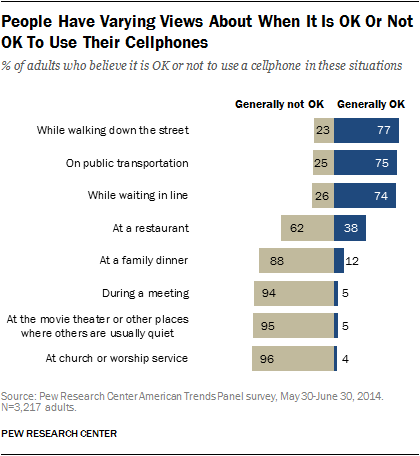
It turns out that people think different kinds of public and social settings warrant different sensitivities about civil behavior. For instance, fully 77% of all adults think it is generally OK for people to use their cellphones while walking down the street and 75% believe it is OK for others to use phones on public transit. But only 38% think it is generally OK for others to use cellphones at restaurants and just 5% think it is generally OK to use a cellphone at a meeting.

Mobile devices play a complex role in modern social interactions — many Americans view them as harmful and distracting to group dynamics, even as they can’t resist the temptation themselves

People Have Varying Views About When It Is OK Or Not OK To Use Their Cellphones

As a general proposition, Americans view cell phones as distracting and annoying when used in social settings — but at the same time, many use their own devices during group encounters.

When asked for their views on how mobile phone use impacts group interactions, 82% of adults say that when people use their phones in these settings it frequently or occasionally hurts the conversation. Meanwhile, 33% say that cell phone use in these situations frequently or occasionally contributes to the conversation and atmosphere of the group. Women are more likely than men to feel cell use at social gatherings hurts the group: 41% of women say it frequently hurts the gathering vs. 32% of men who say that the same. Similarly, those over age 50 (45%) are more likely than younger cell owners (29%) to feel that cellphone use frequently hurts group conversations.

Fully 89% of cellphone owners say they used their phone during the most recent social gathering they attended

In spite of this widespread feeling that cellphone use during social gatherings can be more of a hindrance than a help, it is almost universally the case that people use their own cellphones during these gatherings and observe other members of their social groups doing the same.

89% of Cell Owners Used Their Phones During Their Most Recent Social Activity with Others

When asked about some specific ways they might have used their cellphone during their most recent social gathering, a majority of cell owners indicated they used their phone to send or read a message, take photos or videos, or receive an incoming call. Fewer used their phones for such things as checking to see if they had any alerts, placing a call, using an app, or searching or browsing the web. In all, 89% of cellphone owners reported using their phone in at least one of these eight ways during their most recent social gathering.

Many are using their phones in social settings for purposes that are connected to the gathering

In addition to asking how these individuals used their mobile phones during their most recent social gathering, the survey also included a follow-up question asking what those users are hoping to accomplish by using their phone.

As it turns out, a share are trying to avoid or disengage from the people they are physically present with: 16% used their phone because they are no longer interested in what the group was doing; 15% wanted to connect with other people who are strangers to the group; and 10% used their phone to avoid participating in what the group was discussing.

However, it was more often the case that people used their cellphone in a manner tied to the gathering:

  • 45% used their phone to post a picture or video they had taken of the gathering.
  • 41% used their phone to share something that had occurred in the group by text, email or social networking site.
  • 38% used their phone to get information they thought would be interesting to the group.
  • 31% used their phone to connect with other people who are known to the group.

In all, 78% cited at least one of these four “group-contributing” reasons, compared with 30% who used their phone for one of the three “retreating-from-the-group” reasons.

When using their cellphones in public spaces, most users do so for information gathering and social purposes, rather than explicitly anti-social purposes

Constant mobility is also changing the ways in which Americans can interact with information and other people while outside the bounds of explicitly “social” settings. Indeed, many cellphone owners are using their mobile devices while out in public for a variety of reasons, and while their visible actions might seem rude or inconsiderate to an outside observer, in many instances they are using their phone to further their social engagement with others.

Cellphone users frequently use their phones while in public for basic social or information-oriented tasks, such as:

  • looking up information about where they are going or how to get there: 65% of cell owners do that frequently or occasionally
  • coordinating get-togethers with others: 70% do that frequently or occasionally
  • catching up with family and friends: 67% do that frequently or occasionally.

Many also report using their phones to pass the time or catch up on other tasks or to get information about the people they are planning to see, but these activities are less frequent.

People Use Their Cellphones in Public for a Variety of Purposes
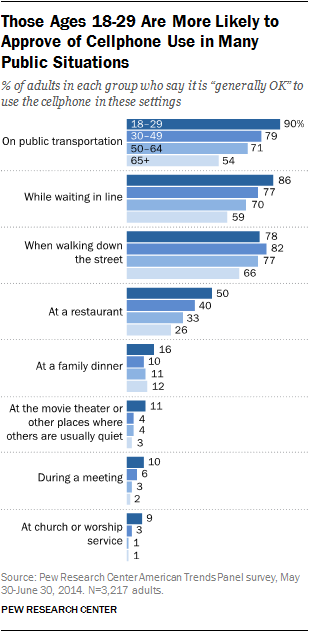
Those Ages 18 to 29 Are More Likely to Approve of Cellphone Use in Many Public Situations

Young adults have higher tolerance for cellphone use in public and in social settings; they also are more likely to have used their phone during a recent social gathering

Young Adults Are the Most Likely to Use Their Cellphones In Public Places for a Variety of Reasons

Those ages 18 to 29 stand out from their elders on virtually every aspect of how mobile activities fit into their social lives, how they act with their phones and their views about the appropriateness of using phones in public and social settings. Younger adults are more engaged with their devices and permissive in their attitudes about when it is OK to use a mobile phone. Of course, older adults, especially senior citizens, are generally less likely than younger adults to own a mobile phone in the first place and are also less likely to use their phone for activities other than voice calls. This might be a factor in some of these differences.

It is important to note, though, that Americans of all ages generally trend in the same direction about when it is OK or not to use cells in public settings. Fully “public” venues are viewed by all age groups as generally acceptable places to use one’s cellphone, while usage in quiet or more intimate settings is mostly frowned upon by all.

Young Adults Are the Most Likely To Have Used Their Phones During a Recent Social Gathering

Along with being more tolerant than their elders about cellphone use in public, younger adults also tend to use their phones for a wider range of purposes while out and about in public. For instance, 52% of cellphone owners ages 18 to 29 say that they frequently use their phone to look up information about where they are going while out in public, compared with 9% of cell users 65 and older who do this frequently. Similarly, 49% of younger cell users say they frequently use their phone to coordinate getting together with others while they are out and about, compared with just 12% of seniors.

Young adults who have cellphones are also more likely than seniors to have used their cellphone during their most recent social gathering. Fully 98% of young adults used their cellphone for one reason or another during their most recent get-together with others, compared with 69% of cell owners 65 and older.

About This Survey

Data in this report is drawn from Pew Research Center’s American Trends Panel, a probability-based, nationally representative panel. This survey was conducted May 30, 2014 through June 30, 2014 among 3,217 adults, including 3,042 cellphone users. The margin of error on the full sample is plus or minus 2.2 percentage points and for the cell-user sample is 2.3 points. For more information on the American Trends Panel, please see the Methods section at the end of this report and these further details about the panel’s construction, composition and maintenance.
Chapter 1: Always on Connectivity

For most Americans, the cellphone is no longer an auxiliary or supplementary device to their landline telephone. Roughly nine-in-ten Americans own a cellphone and nearly two-thirds own a smartphone. Recent research from the U.S. government shows that almost 43% of adults live in a cellphone-only household – that is, without a landline. As mobile devices become more common and essential, Americans are creating and navigating new norms around these gadgets’ use in social gatherings and public spaces.

Cellphones can be a source of instant connection — and constant distraction. Many are concerned that people’s attention to mobile devices in public and in social spaces prompts them to live “Alone Together,” as the title of MIT professor Sherry Turkle’s book puts it. Such a life, in her view, is socially stunted and damaging to communities. On the other hand, researcher Keith Hampton, who has studied how people use mobile devices in public spaces, has found evidence that cellphones are not encroaching on group social interactions, but rather are serving to fill time during periods of waiting and other interstitial moments.

These are intriguing and important issues. Norms of etiquette are not just small-scale social niceties. They affect fundamental human interactions and the character of public spaces. That is why Pew Research Center conducted a survey on the subject.

The poll found that Americans have varied and nuanced views on the new contours of civil behavior. They are sorting through the neo-etiquette of mobile life — sometimes attesting that constant connectivity brings social payoffs and other times lamenting what screen distractions do to social gatherings; sometimes appreciating the instantaneous availability of people and information and other times feeling aggrieved when others want to take advantage of that; sometimes declaring the importance of being present with others and other times glancing at screens while in-person conversation swirls around them.

This chapter starts to explore these cross-pressures with a look at the basics of “always-on” connectivity.

Americans’ cellphones are generally with them and rarely turned off

Fully 92% of American adults own a cellphone, including the 67% who own a smartphone. As cellphones and smartphones become more widely adopted and play a larger role in people’s daily communications, their owners often treat them like body appendages. Nine-in-ten cellphone owners1 (90%) say they “frequently” carry their phone with them, while 6% say they “occasionally” have their phones with them. Just 3% say they only “rarely” have their cellphones with them and 1% of cellphone owners say they “never” have their phone with them.

Though the vast majority of members of all age groups carry their phones with them frequently, there are still some differences by age. For instance, cellphone owners ages 30 to 49 are more likely to have their cell phone with them frequently (95%) than any other age group; cellphone owners ages 65 and older are least likely to carry their phone with them frequently (81%).

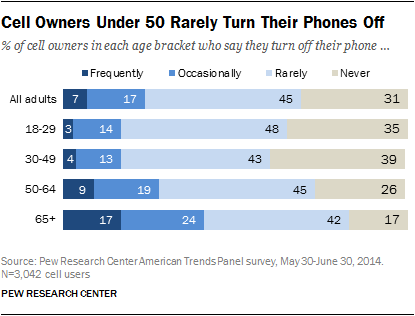
Cell Owners Under 50 Rarely Turn Their Phones Off

Beyond that, the majority of cell owners almost always keep their phones on. Most cell owners say they turn their phone off either rarely (45%) or never (31%). Cell owners under age 50 are most likely to say they never turn their phone off, and cell owners ages 65 and older are most likely to say they frequently do. Still, over half of these older adults still say they rarely or never turn off their phone.

Most smartphone owners say they rarely (47%) or never (36%) turn their phones off. Just 4% of smartphone owners say they turn their phones off frequently, and 14% say they turn them off occasionally. However, “feature phone” owners (those who do not own smartphones) are more likely to turn their phones off at least some of the time: 16% say they turn them off frequently and 24% say they turn them off occasionally. Still, a majority still say they turn their cellphones off either rarely (40%) or never (20%).

A share of smartphone users say they use their phones’ apps or browsers “continuously”

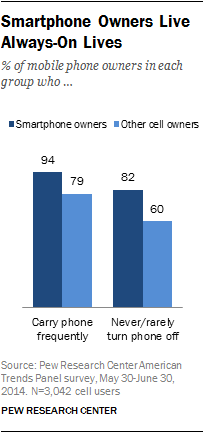
Those who own smartphones are more likely than other mobile phone users to have their phone with them and powered on. Some 94% of smartphone owners carry their phone with them frequently and 82% say they never or rarely turn their phones off.

Smartphone Owners Live Always-On Lives

In addition, most smartphone owners take advantage of other features of their device, with 59% reporting they use apps on their phones at least several times a day and 27% saying they use them “continuously.”

Web browsing is somewhat less intense in usage: most smartphone owners browse the web on their phones at least several times a day, although only 14% use their phones’ browser continuously (roughly half the proportion who continuously use apps).

As with many other technology-related activities, there are substantial differences between age groups. Younger smartphone owners use apps and browse the web on their phones more often than older adults. Some 43% of smartphone owners ages 18 to 29 describe their app usage as “continuous,” compared with 26% of smartphone owners in the next highest age group (ages 30 to 49). Meanwhile, among older smartphone owners, just 7% use apps on a continuous basis and about half (48%) of those 65 and older say they use apps on their phones once a day or less.

Chapter 2: Phone Use in Public Areas

One of the key parts of this survey centered on questions about how cell owners use their phones in public places — for instance, whether they use their phones to look up information about where they are going or to avoid interacting with other people nearby. It emerged that people use their phones in a host of ways, many of which are clearly for social purposes.

How people use their phones in public

When they are in public places, cellphone owners say they most frequently use their phones for basic social or information-oriented tasks. For instance:

  • 65% say they frequently or occasionally look up information about where they are going or how to get there
  • 70% frequently or occasionally coordinate get-togethers with others
  • 67% frequently or occasionally catch up with family and friends.

Many also report using their phones to pass the time, catch up on other tasks or get information about the people they are planning to see, but these activities are less frequent.

Among the activities we queried, the least common activity was using one’s phone specifically to avoid interacting with others nearby. Most cellphone users say that they rarely or never use their phone to avoid interacting with others, while 23% say they do this at least occasionally.

As a rule, smartphone users are more likely to do these things frequently than other cellphone owners, and younger adults are more likely to do these things frequently than older adults.

People Use Their Cellphones in Public for a Variety of Purposes

A closer examination of each activity follows:

Look up information about where you are going or how to get there

A majority of cellphone owners (65%) say that when they are in public places, they use their cellphone at least occasionally to look up information about where they are going or how to get there. Some 33% of all cellphone owners do this frequently, making it one of the most common activities we queried. Among smartphone owners, roughly eight-in-ten (82%) look up this type of information at least occasionally when in public, with 44% doing so frequently. As with almost all of the cellphone activities we asked about, younger cellphone users are more likely to do this frequently than those in older age groups.

To coordinate getting together with others

Most cellphone owners (70%) also say that they at least occasionally use their phones while in public spaces to coordinate getting together with others, with 29% doing so frequently. By age: 81% of cell owners ages 18 to 29 do this at least occasionally, compared with 76% of cell users ages 30 to 49, 65% of those ages 50 to 64 and 48% of those 65 and older.

Smartphone Owners Use Their Phones Frequently for a Variety of Reasons

To catch up with family and friends

Two-thirds (67%) of cellphone owners say that when they are out in public spaces, they use their phone to catch up with family and friends at least occasionally, with 29% doing so frequently. Women are more likely than men to say they frequently use their phone to catch up with family and friends in this way. This difference holds across age groups: 41% of young women under age 50 say they do this frequently, compared with 29% younger men, and 25% of women ages 50 and older do this frequently, compared with 17% of older men.

For no particular reason, just for something to do

About half of cellphone owners say that when they are in public, they use their phones for no particular reason — just for something to do — either frequently (18%) or occasionally (32%). By age, the differences are noteworthy: 76% of cell owners ages 18 to 29 use their phone at least occasionally in public for no particular reason, just for something to do. That compares with 63% of cell owners ages 30 to 49, 34% of those ages 50 to 64 and just 16% those ages 65 and above.

To catch up on other tasks you need to accomplish

Similarly, about half (52%) of cellphone owners say that they at least occasionally use their phone to catch up on other tasks when they’re in public spaces, with 18% doing so frequently. Among smartphone owners, 61% do this at least occasionally and 23% do so frequently. Additionally, black cellphone owners are more likely to frequently use their phones to catch up on other tasks (31%) in this way compared with white (16%) and Hispanic (21%) cell owners.

Get information or details about people you are planning to see

Around a third of cellphone owners (36%) say they at least occasionally use their phones to get information or details about people they are planning to see when they’re in public spaces, with 12% doing so frequently.

Avoid interacting with others who are near you

Overall, around one-quarter (23%) of cellphone owners say that when they are in public spaces they use their phone to avoid interacting with others who are near them at least occasionally, including 6% who do this frequently. Female cellphone owners under age 50 are relatively more likely than other groups to say they frequently use their phones to avoid others while in public, with 12% of younger women ages 18 to 49 saying they do this frequently, compared with 5% of younger men and 4% of older adults of either gender. Among cellphone owners, blacks (12%) and Hispanics (10%) are also more likely to say they use their phone to avoid interacting with others than whites (5%), though the bulk of cellphone owners (regardless of racial or ethnic background) say that they rarely or never do this.

This list of reasons people might use their phones in public places is neither exhaustive nor exclusive. It is certainly possible that reasons such as “just for something to do” or “to avoid interacting with others” are an underlying motivation for many other types of phone use in various situations in public. However, cellphone users are far more likely to say that they tend to use their phones explicitly to connect with others than specifically to avoid those around them. Thus, it appears that anti-social behavior itself is rarely a primary motivator. At the same time, those around the cellphone user may still experience that other person’s phone use as anti-social, even if that was not the explicit intention of the user.

Chapter 3: When it is acceptable — or not — to use cellphones in public spaces

People’s cellphone use has injected itself into public spaces. This has blurred the line between private and public as often-intimate and occasionally blustering phone conversations have now become a common part of the background noise during bus rides, grocery shopping excursions, picnics, sidewalk strolls, waits in airport terminals and many other public venues.

People Have Varying Views About When It Is OK Or Not OK To Use Their Cellphones

To see how people are responding to these changes, people were asked about their views on general cellphone etiquette in public. About three-quarters of all adults, including those who do not use cellphones, say that it is “generally OK” to use cellphones in unavoidably public areas, such as when walking down the street, while on public transportation or while waiting in line. At the same time, the majority of Americans do not think it is generally acceptable to use cellphones in restaurants or at family dinners. Most also oppose cellphone use in meetings, places where others are usually quiet (such as a movie theater), or at church or worship service.

It is important to note that the survey did not specify what “using a cellphone” meant, and so the question was open to interpretation. It is possible that people who use their phones more often and in more diverse ways may have wider definition of what “cellphone use” entails, including less intrusive or more social activities such as sending a text message, checking email or taking a photo. Clearly, less frequent users and non-users may more strongly associate the idea of “cell use” with voice calls, which may be seen as more disruptive.

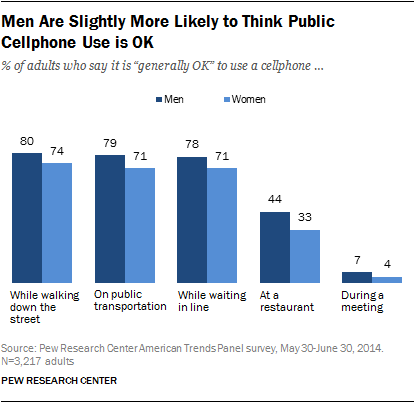
Men Are Slightly More Likely to Think Public Cellphone Use is OK

In general, younger age groups are more likely to view cellphone use in a variety of situations as generally acceptable, and men are more likely than women to say that phone use in almost all of these settings is OK. A more detailed overview of each situation follows:

When walking down the street

Roughly three-quarters (77%) of Americans say that it is “generally OK” to use a phone while walking down the street, and men are slightly more likely than women to say that cellphone use in this situation is acceptable (80% vs. 74%).

Notably, this is the only activity for which young adults ages 18 to 29 are not necessarily more accepting than older age groups. Some 78% of young adults ages 18 to 29 say that using a phone while walking down the street is generally OK, while 82% of those ages 30 to 49 also say this.

On public transportation

Three-quarters (75%) of Americans say that it is generally OK to use a cellphone on public transportation. Men (79%) are more likely than women (71%) to say this was generally OK. Public transportation is one of the situations in which younger age groups are much more likely to say phone use is acceptable, compared with older adults: 90% of young adults ages 18 to 29 say that it is generally OK to use a cellphone on public transportation vs. 54% of those ages 65 and older.

Smartphone Owners Are More Accepting of Cellphone Use in Public Settings

While waiting in line

Some 74% of Americans say it is generally acceptable to use a cellphone while waiting in line. Men (78%) are somewhat more likely than women (71%) to say it is generally OK to use a cellphone in this situation.

At a restaurant

Some 38% of Americans say that it is generally OK to use a phone at a restaurant. Men (44%) are more likely than women (33%) to say it is generally OK to use a cellphone in this situation. This is another situation in which younger age groups are much more likely to say phone use is acceptable relative to older adults: Though 50% of young adults say it is generally acceptable to use cellphones at a restaurant, less than half of older adults — including just 26% of those 65 and older — say that this is generally acceptable.

At a family dinner

Overall, just 12% of Americans, including equal shares of men and women, feel that it is generally acceptable to use a cellphone at a family dinner. Some 13% of men say cell use at dinner is OK and 11% of women say this. Interestingly, people without smartphones are not especially more or less likely than smartphone owners to say it is generally OK to use one’s phone at a family dinner: 14% of regular cellphone owners and 19% of non-cellphone owners say that cell use in this situation is generally acceptable, compared with 10% of smartphone owners. For almost all of the other activities we asked about, smartphone owners are more likely to say that cellphone use in these situations is acceptable.

During a meeting

Some 5% of Americans said that it is generally OK to use a cellphone during a meeting. Men (7%) are somewhat more likely than women (4%) to say this was generally acceptable, though few said this overall.

Those Ages 18-29 Are More Likely to Approve of Cellphone Use in Many Public Situations

At the movie theater or other places where others are usually quiet

Just 5% of Americans say that it is generally OK to use one’s phone at the movie theater or other places where others are usually quiet.

At church or worship service

Only 4% of Americans say that it is generally acceptable to use a cell phone at church or worship service. Along with using a phone at a meeting or at a movie theater, this is one of the situations that the vast majority of Americans agree are off-limits to cellphone use.

Younger adults are more tolerant of cellphone use in public

In broad strokes, Americans of all ages rank these locations similarly when it comes to cellphone usage — explicitly “public” venues are viewed as generally acceptable places to use one’s cellphone, while usage in quiet or more intimate settings is frowned upon. At the same time, younger adults are generally more permissive than their elders about cellphone use in most of these situations.

As the accompanying table shows, a majority of all age groups agree that it is generally acceptable to use a phone in three general public situations: when walking down the street, while on public transportation, and while waiting in line. Using a phone at a restaurant is the only situation in our survey for which half (50%) of young adults find it generally acceptable to use a cellphone, but for which a majority of older adults consider cellphone use to be generally not acceptable. The vast majority of Americans — including young adults — do not think it is acceptable to use phones at a family dinner, during a meeting, at a movie theatre, or at church or worship service.

Many observe loud or annoying cellphone behavior in public

Fully 79% of adults say they encounter loud or annoying cellphone behavior in public at least occasionally, including 30% who say they frequently encounter people acting in this way.

We also asked how often people hear or see intimate details of other people’s lives while they are using their cellphone in public. Over half of Americans (53%) say they overhear such details either frequently (18%) or occasionally (35%). There are few differences between age groups or by race or ethnicity. Women (23%) are more likely than men (13%) to say they “frequently” hear these sorts of details.

Chapter 4: Phone use in social gatherings

This section of the report focuses on cellphone usage in group settings and social gatherings — encounters where people’s use of cellphones might change the basic dynamic of the group.

The survey probed these issues in several ways. The findings show that people use their phones in such gatherings with mixed impacts on the social dynamic of the group and varied feelings about the appropriateness of their phone usage. There are times when people use their phones to further the activities of the group and there are times when phone use is a tactic of social disengagement.

Americans Believe Cellphone Use in Social Gatherings More Often Hurts than Helps Conversation

In general, Americans feel that when people use their cellphones in social gatherings it hurts the conversation more often than it helps

In the main, Americans think that when people focus on their phones instead of their companions, it hurts the group in which they are participating. This Pew Research Center survey attempted to measure feelings about this complicated issue from both directions — respondents were asked first about whether cellphone use might hurt social gatherings, and then whether cell phone use might help gatherings. It was possible for them to answer “yes” to both questions, or “no” to both.

The social balance sheet they constructed looks like this:

  • Phone use hurts gatherings: 82% of all adults (not just cell owners) say that when people use their cellphones at social gatherings, it at least occasionally hurts the conversation and atmosphere of the gathering. Some 37% say it “frequently” hurts the gathering and another 45% say it “occasionally” hurts the gathering, while only 18% say it “rarely” or “never” hurts the gathering.
  • Phone use helps gatherings: On the other hand, 33% of Americans say that when people use their phones at social gatherings it at least occasionally contributes to the conversation and helps the atmosphere of the gathering. Only 5% say such phone use “frequently” helps and 29% say it “occasionally” helps. Meanwhile, 66% feel that when people use their cellphones at social gatherings it “rarely” or “never” helps the tenor of the event.
Older Adults Are More Bothered by Cellphone Use at Social Gatherings

The strongest objections to phone use during social get-togethers come from women, whites and older cellphone users. Older women are especially bothered when people turn to their screens during a gathering: 52% of women age 50 and older say that cellphone use at social gatherings “frequently” hurts the occasion; similarly, 35% of women in that age bracket say that cellphone use “never” contributes to a gathering. Overall, adults 65 and older are especially likely to say that cellphone use in social settings frequently harms the gathering and also to say that it never helps the gathering.

Additionally, 85% of whites say that cell use during social gatherings frequently or occasionally hurts the gathering, compared with 71% of blacks and 76% of Hispanics who say the same. And 69% of whites say such phone use rarely or never contributes to the atmosphere of the gathering, compared with 62% of blacks and 60% of Hispanics.

Inevitably, there is variance in views among the young and the old, as the nearby chart illustrates.

Despite the consensus that cellphone use harms group interactions, most cellphone owners think their phone use does not necessarily take their attention away from the group

In addition to asking about their views on cellphone use in group settings generally, the survey also asked cellphone owners about the impact of their own mobile device usage during group interactions. Some 75% said their phone use took none (32%) or only “a little” (43%) of their attention away from the group; 18% say their phone use took some of their attention away from the group; another 6% say their use took “a lot” of their attention away from their immediate social setting.

In many cases, people use their phones in the midst of social settings to connect to another person — so they are being social in a way, even if they are not being social with those nearby. Some 41% of cell owners indicate that at least some of their cellphone usage in group social gatherings is for the purpose of connecting to others: 14% of cellphone owners say that “a lot” of their phone use in group social settings is to get in touch or connect with someone else, while 27% say that “some” of their phone use is for this purpose. Meanwhile, a majority of cellphone users say that only a little (36%) or none (23%) of their cell use in social settings is to get in touch or connect with others.

89% of Cell Owners Used Their Phones During Their Most Recent Social Activity with Others

In spite of their misgivings about the impact of mobile devices on group interactions, many cell owners pick up their own mobile devices when they are at social gatherings

Despite their general concerns about the impact of cellphones in social settings, the vast majority of cell owners say they themselves use their phones during their own social gatherings. However, they often say they use their phones in these settings in order to do things that connect to the group.

In this survey, cellphone owners were asked to think about the most recent time they were at a social gathering and to indicate whether they used their cellphone in various ways during that gathering. Overall, 89% of cellphone owners ages 18 and older say that they used their phone in at least one of the ways we asked about. A majority of cell owners indicated that they used their phone to read or send messages, take photos or videos, or receive an incoming call during their most recent social gathering. Fewer used their phones to disengage entirely from the group, such as checking to see if they had any alerts, placing a call, using an app, or searching or browsing the web.

In general, smartphone owners were significantly more likely to have done many of these at a recent social gathering, even when the activities are not necessarily smartphone-specific. For instance, 73% of smartphone owners read a message such as a text or email, compared with 30% of regular cellphone owners. In addition, 70% of smartphone owners took a photo or video during their most recent social gathering, compared with 27% of regular cellphone owners, and 64% of smartphone owners sent one, compared with 22% of regular cellphone owners.

Smartphone Owners Are More Likely to Use Their Phone During Their Most Recent Social Gathering
Young Adults Are the Most Likely To Have Used Their Phones During a Recent Social Gathering

Moreover, younger cellphone owners were far more likely to have used their phones in each of these ways at a recent social gathering than older cell users. Fully 98% of young adults used their phone for at least one of these reasons during a recent gathering, compared with 69% of cell owners 65 and older.

Cellphone owners ages 18 to 29 are more likely to have turned to their screen during a recent social gathering for some of the individual activities we queried, including reading messages, sending messages, using apps, looking for alerts and browsing the web.

There are also some differences between men and women. At their most recent social gathering, among cellphone owners, men were more likely than women to:

  • receive a call: 56% of cellphone-owning men did this vs. 48% of cellphone-owning women
  • check to see if they had received an alert: 37% of cellphone-owning men did this vs. 31% of cellphone-owning women
  • place a call: 37% of cellphone-owning men did this vs. 30% of cellphone-owning women
  • use an app: 34% of cellphone-owning men did this vs. 24% of cellphone-owning women
  • search or browse the web: 30% of cellphone-owning men did this vs. 21% of cellphone-owning women

People often use their cells during social gatherings to add to the group’s interactions

In a follow-up question, we asked those who said they had recently used their phone at a social gathering the reasons for their cellphone use. Among the reasons we asked about, the most common responses relate to activities that add to the immediate gathering, rather than retreat from it. A relatively large number of those who used their phone during a recent social gathering did so to:

  • post a picture or video of the group (45%)
  • share something that had occurred in the group by text, email or social networking site (41%)
  • get information that would be interesting to the group (38%)
  • connect with other people who are known by the group (31%)
At Social Gatherings, Most Use Their Cellphones To Do Things that Could Enhance the Group

Overall, 78% cited at least one of these four “group-contributing” reasons.

On the other hand, a share of those cell users who used their phone in a recent social gathering said they had used their phone in order to disengage with the group in one way or another. Some 16% said they used their phone because they are no longer interested in what the group was doing; 15% used their phone to connect with people outside the group (and who are not known to the other people in attendance); and 10% said they used their phone to avoid participating in what the group was discussing. Overall, 30% cited at least one of these three “group-detracting” reasons.

Perhaps unsurprisingly, smartphone users are more likely than other cell users to have used their phones for most of these activities. However, smartphone owners are not significantly more likely than regular cell users to say they used their phone to avoid participating in what the group was discussing.

Younger adults are more likely to use their phone for “group-enhancing” reasons — but also are more likely to use their phones in ways that detract from the group at hand

Among cell phone owners who recently used their phone at a social gathering, younger users are more likely than older users to say they had used their phones for each of the reasons we asked about. These differences are especially pronounced when it comes to using one’s cellphone for getting information that would be interesting for the group and connecting with people known by the group, but also for all three of the activities that might distance people from the group.

Young Adults Are the Most Likely to Use Their Cellphones at Social Gatherings to Engage but Also to Disengage

What others did at a recent social gathering

A separate question asked all respondents (not just cellphone users) about others’ cellphone use at a recent group event. In response, 86% of adults said that they remember someone else using their phone at the most recent social gathering they attended.

Some 90% of the cell users who said they used their phone in a recent social gathering also said that someone else at that the gathering also used their cellphone. By comparison, just 68% of cellphone users who did not use their cell in a recent social gathering said someone else used a phone at that gathering. This raises some questions as to the role of group social norms in setting standards of behavior around cellphone use: Those who use their phones in groups may also be more likely to be in groups where phone use is more common and therefore have higher expectations that people’s cell use will be part of the gathering’s environment.

A similar dynamic applies to the age of cell owners. Those under age 50 (91%) are more likely than older adults to say someone else used a phone at their most recent social gathering, particularly those ages 65 and older (78%). Smartphone users also more likely than regular cell users to say someone else used a phone, as are people living in higher income households or those who have higher levels of education. There are no significant differences by gender or by race or ethnicity.

About This Report

This report is a collaborative effort based on the input and analysis of the following individuals. Find related reports online at www.pewresearch.org/pewresearch-org/internet

Lee Rainie, Director, Internet, Science, and Technology Research Kathryn Zickuhr, Research Associate Aaron Smith, Associate Director, Research Maeve Duggan, Research Associate Andrew Perrin, Research Assistant Kyley McGeeney, Research Methodologist Scott Keeter, Director, Survey Research Cary Funk, Associate Director, Research Diana Yoo, Art Director Dana Page, Communications Manager Shannon Greenwood, Assistant Digital Producer Margaret Porteus, Information Graphics Designer

Methods

The American Trends Panel (ATP), created by Pew Research Center, is a nationally representative panel of randomly selected U.S. adults living in households. Respondents who self-identify as internet users (representing 89% of U.S. adults) participate in the panel via monthly self-administered Web surveys, and those who do not use the internet participate via telephone or mail. The panel is being managed by Abt SRBI.

Data in this report are drawn from the June wave of the panel, conducted May 30, 2014 through June 30, 2014 among 3,217 respondents (2,849 by web and 368 by mail). The margin of sampling error for the full sample of 3,217 respondents is plus or minus 2.2 percentage points.

All current members of the American Trends Panel were originally recruited from the 2014 Political Polarization and Typology Survey, a large (n=10,013) national landline and cellphone random digit dial (RDD) survey conducted January 23, 2014 through March 16, 2014, in English and Spanish. At the end of that survey, respondents were invited to join the panel. The invitation was extended to all respondents who use the internet (from any location) and a random subsample of respondents who do not use the internet.2

Of the 10,013 adults interviewed, 9,809 were invited to take part in the panel. A total of 5,338 agreed to participate and provided either a mailing address or an email address to which a welcome packet, a monetary incentive and future survey invitations could be sent. Panelists also receive a small monetary incentive after participating in each wave of the survey.

The ATP data are weighted in a multi-step process that begins with a base weight incorporating the respondents’ original survey selection probability and the fact that some panelists are subsampled for invitation to the panel. Next, an adjustment was made for the fact that the propensity to join the panel varied across different groups in the sample. The final step in the weighting uses an iterative technique that matches gender, age, education, race, Hispanic origin and region to parameters from the U.S. Census Bureau’s 2012 American Community Survey. Population density is weighted to match the 2010 U.S. Decennial Census. Telephone service is weighted to estimates of telephone coverage for 2014 that are projected from the January-June 2013 National Health Interview Survey. It also adjusts for party affiliation using an average of the three most recent Pew Research Center general public telephone surveys, and for internet use using as a parameter a measure from the 2014 Survey of Political Polarization. Sampling errors and statistical tests of significance take into account the effect of weighting. The Hispanic sample in the American Trends Panel is predominantly native born and English speaking.

The following table shows the unweighted sample sizes and the error attributable to sampling that would be expected at the 95% level of confidence for different groups in the survey:

Methodology

Sample sizes and sampling errors for other subgroups are available upon request.

In addition to sampling error, one should bear in mind that question wording and practical difficulties in conducting surveys can introduce error or bias into the findings of opinion polls.

The Web component of the June wave had a response rate of 60% (2,849 responses among 4,729 Web-based individuals enrolled in the panel); the mail component had a response rate of 66% (368 responses among 556 non-Web individuals enrolled in the panel). Taking account of the response rate for the 2014 Survey of Political Polarization (10.6%), the cumulative response rate for the June ATP wave is 3.5%.