Pew Research Center

FOR RELEASE AUGUST 6, 2015

Teens, Technology and Friendships

Video games, social media and mobile phones play an integral role in how teens meet and interact with friends

BY Amanda Lenhart

FOR MEDIA OR OTHER INQUIRIES:

Communications Department
202.419.4372
www.pewresearch.org

RECOMMENDED CITATION

Pew Research Center, August 2015, "Teens, Technology and Friendships"

About Pew Research Center

Pew Research Center is a nonpartisan, nonadvocacy fact tank that informs the public about the issues, attitudes and trends shaping the world. It does not take policy positions. The Center conducts public opinion polling, demographic research, computational social science research and other data-driven research. It studies politics and policy; news habits and media; the internet and technology; religion; race and ethnicity; international affairs; social, demographic and economic trends; science; research methodology and data science; and immigration and migration. Pew Research Center is a subsidiary of The Pew Charitable Trusts, its primary funder.

© Pew Research Center 2026

Table of contents

  • About Pew Research Center
  • Teens, Technology and Friendships
  • Introduction
  • Chapter 1: Meeting, Hanging Out and Staying in Touch: The Role of Digital Technology in Teen Friendships
  • Chapter 2: How Teens Hang Out and Stay in Touch With Their Closest Friends
  • Chapter 3: Video Games Are Key Elements in Friendships for Many Boys
  • Chapter 4: Social Media and Friendships
  • Chapter 5: Conflict, Friendships and Technology
  • About This Report
  • Methods

Teens, Technology and Friendships

Video games, social media and mobile phones play an integral role in how teens meet and interact with friends

This report explores the new contours of friendship in the digital age. It covers the results of a national survey of teens ages 13 to 17; throughout the report, the word “teens” refers to those in that age bracket, unless otherwise specified. The survey was conducted online from Sept. 25 through Oct. 9, 2014, and Feb. 10 through March 16, 2015, and 16 online and in-person focus groups with teens were conducted in April 2014 and November 2014.

For today’s teens, friendships can start digitally: 57% of teens have met a new friend online. Social media and online gameplay are the most common digital venues for meeting friends
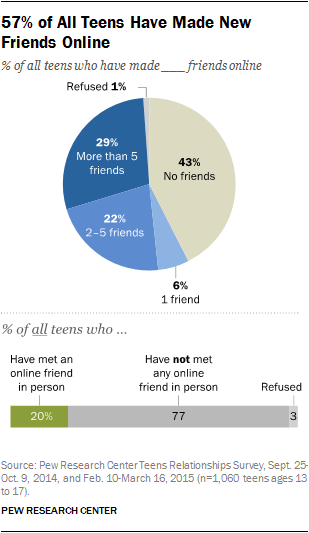
57% of Teens Have Made New Friends Online
  • Boys are more likely than girls to make online friends: 61% of boys compared to 52% of girls have done so.
  • Older teens are also more likely than younger teens to make online friends. Some 60% of teens ages 15 to 17 have met a friend online, compared with 51% of 13- to 14-year-olds.

The most common spots for meeting friends online are social media sites like Facebook or Instagram (64% of teens who have made a friend online met someone via social media), followed by playing networked video games (36%). Girls who have met new friends online are more likely to meet them via social media (78% vs. 52% of boys), while boys are substantially more likely to meet new friends while playing games online (57% vs. 13% of girls).

Text messaging is a key component of day-to-day friend interactions: 55% of teens spend time every day texting with friends

The vast majority of teens (95%) spend time with their friends outside of school, in person, at least occasionally. But for most teens, this is not an everyday occurrence. Just 25% of teens spend time with friends in person (outside of school) on a daily basis.
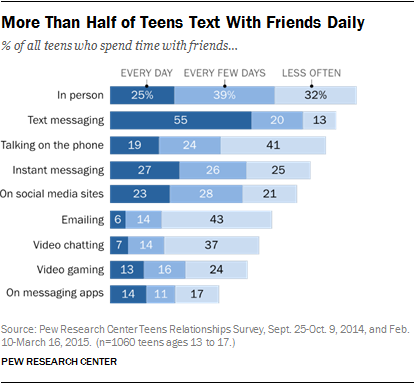
More Than Half of Teens Text With Friends Daily
[tweetable url="http://pewrsr.ch/1JMmZ9W" alt="Some 88% of teens text their friends at least occasionally, and fully 55% do so daily."]
  • Instant messaging: 79% of all teens instant message their friends; 27% do so daily.
  • Social media: 72% of all teens spend time with friends via social media; 23% do so daily.
  • Email: 64% of all teens use email with friends; 6% do so daily.
  • Video chat: 59% of all teens video chat with their friends; 7% video chat with friends daily.
  • Video games: 52% of all teens spend time with friends playing video games; 13% play with friends daily.
  • Messaging apps: 42% of all teens spend time with friends on messaging apps such as Kik and WhatsApp; 14% do so every day.

Video games play a critical role in the development and maintenance of boys’ friendships

Overall, 72% of teens ages 13 to 17 play video games on a computer, game console or portable device. Fully 84% of boys play video games, significantly higher than the 59% of girls who play games. Playing video games is not necessarily a solitary activity; teens frequently play video games with others. Teen gamers play games with others in person (83%) and online (75%), and they play games with friends they know in person (89%) and friends they know only online (54%). They also play online with others who are not friends (52%). With so much game-playing with other people, video gameplay, particularly over online networks, is an important activity through which boys form and maintain friendships with others:

  • 38% of all teen boys share their gaming handle as one of the first three pieces of information exchanged when they meet someone they would like to be friends with; just 7% of girls share a gaming handle when meeting new friends.
  • [tweetable url="http://pewrsr.ch/1JMmZ9W" alt="Of teens who have met a friend online, 57% of boys have made a friend playing video games."]Of teens who have met a friend online, 57% of boys have made a friend playing video games. That amounts to 34% of all teenage boys ages 13 to 17.
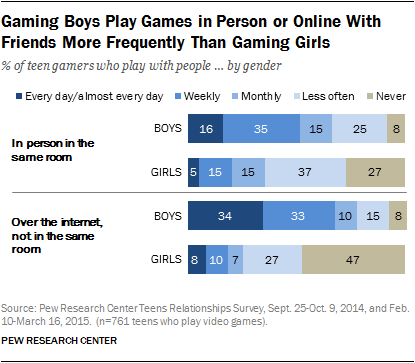
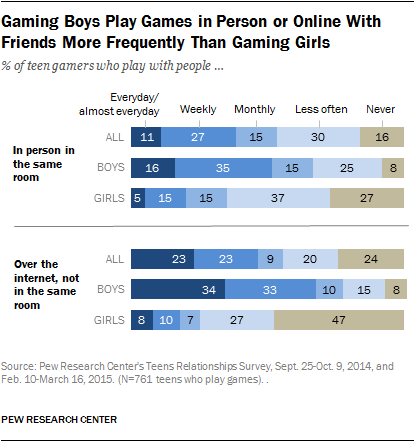
Gaming Boys Play Games in Person or Online With Friends More Frequently Than Gaming Girls

Much more than for girls, boys use video games as a way to spend time and engage in day-to-day interactions with their peers and friends. These interactions occur in face-to-face settings, as well as in networked gaming environments:

  • 16% of boy gamers play in person with friends on a daily or near-daily basis, and an additional 35% do so weekly. That amounts to 42% of all teen boys ages 13 to 17.
  • 34% of boy gamers play over the internet with friends on a daily or near-daily basis, and another 33% do so weekly. That amounts to 55% of all teen boys ages 13 to 17.

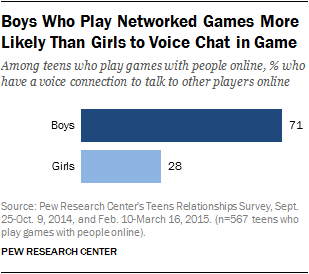
When playing games with others online, many teen gamers (especially boys) connect with their fellow players via voice connections in order to engage in collaboration, conversation and trash-talking. Among boys who play games with others online, fully 71% use voice connections to engage with other players (this compares with just 28% of girls who play in networked environments).
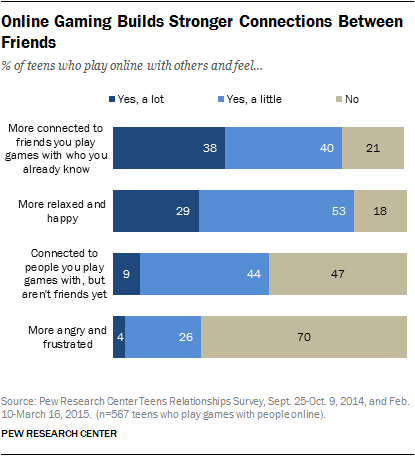
Online Gaming Builds Stronger Connections Between Friends

All this playing, hanging out and talking while playing games leads many teens to feel closer to friends.

  • 78% of teen online gamers say when they play games online it makes them feel more connected to friends they already know. That amounts to 42% of all teens ages 13 to 17.
  • 52% of online-gaming teens feel more connected to other gamers (whom they do not consider friends) they play with online. That amounts to 28% of all teens ages 13 to 17.
  • Gaming boys are more likely than girls to report feeling more connected to other networked gamers.
    • 84% of networked-gaming boys feel more connected to friends when they play online, compared with 62% of girls.
    • 56% of boy gamers feel more connected to people they play networked games with who are not friends, as do 43% of gaming girls.

Teen friendships are strengthened and challenged within social media environments

Social media also plays a critical role in introducing teens to new friends and connecting them to their existing friend networks. Some 76% of teens ages 13 to 17 use social media and:

  • 64% of teens who have met at least one new friend online report meeting a friend through social media.
  • 62% of teens share their social media username as one of the first pieces of information they share as a way to stay in touch when they meet a brand new friend.
  • 72% of all teens say they spend time with friends on social media; 23% say they do so every day.
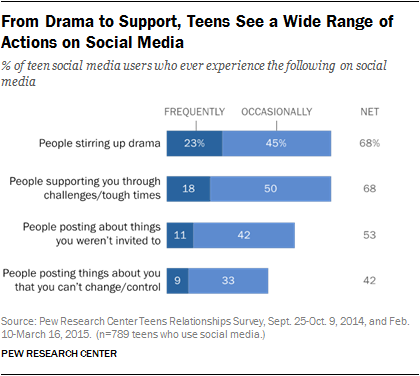
From Drama to Support, Teens See a Wide Range of Actions on Social Media

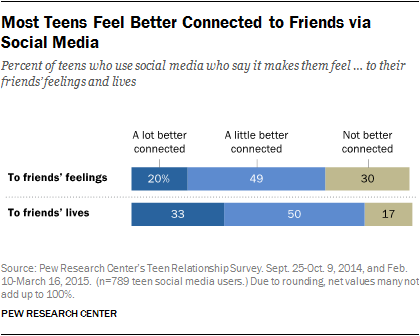
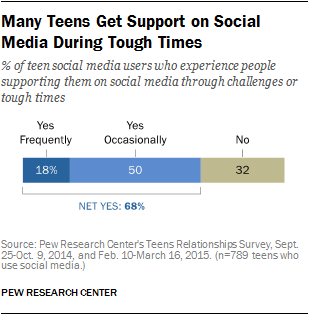
Social media helps teens feel more connected to their friends’ feelings and daily lives, and also offers teens a place to receive support from others during challenging times.

  • 83% of teen social media users say social media makes them feel more connected to information about their friends’ lives.
  • 70% of social media-using teens feel better connected to their friends’ feelings through social media.
  • 68% of teen social media users have had people on the platforms supporting them through tough or challenging times.

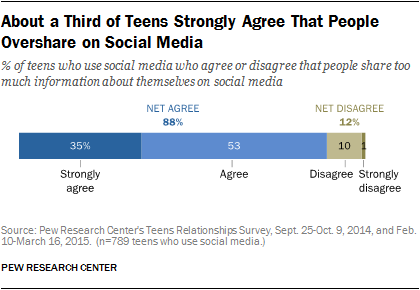
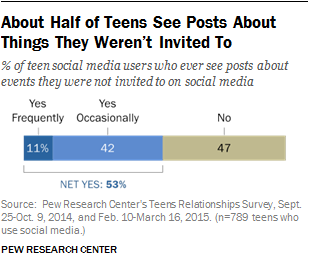
But even as social media connects teens to friends’ feelings and experiences, the sharing that occurs on these platforms can have negative consequences. Sharing can veer into oversharing. Teens can learn about events and activities to which they weren’t invited, and the highly curated lives of teens’ social media connections can lead them to make negative comparisons with their own lives:

  • 88% of teen social media users believe people share too much information about themselves on social media.
  • 53% of social media-using teens have seen people posting to social media about events to which they were not invited.
  • 42% of social media-using teens have had someone post things on social media about them that they cannot change or control.
  • 21% of teen social media users report feeling worse about their own life because of what they see from other friends on social media.
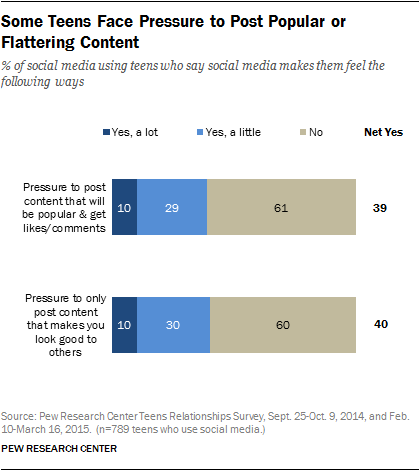
Some Teens Face Pressure to Post Popular or Flattering Content

Teens face challenges trying to construct an appropriate and authentic online persona for multiple audiences, including adults and peers. Consequently, many teens feel obligated to project an attractive and popular image through their social media postings.

  • 40% of teen social media users report feeling pressure to post only content that makes them look good to others.
  • 39% of teens on social media say they feel pressure to post content that will be popular and get lots of comments or likes.

Some conflict teens experience is instigated online

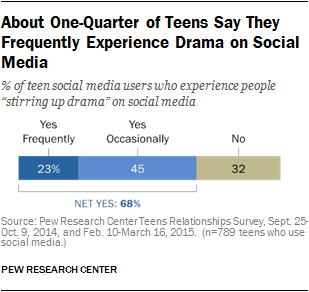
  • 68% of teen social media users (52% of all teens) have experienced drama among their friends on social media.
  • 26% of all teens have had a conflict with a friend over something that happened online or over text messages.

Girls are more likely to unfriend, unfollow and block former friends

After a Friendship Ends, Girls More Likely Than Boys to Take Steps to Unfriend, Block or Untag Photos of Former Friends

When friendships end, many teens take steps to cut the digital web that connects them to their former friend. Girls who use social media or cellphones are more likely to prune old content and connections:

  • 58% of teens who use social media or cellphones have unfriended or unfollowed someone they used to be friends with, and 45% of teens have blocked an ex-friend.
  • 63% of girls who use social media or cellphones have unfriended or unfollowed an ex-friend, compared with 53% of boys.

53% of social media- or cellphone-using girls have blocked someone after ending a friendship, compared with 37% of boys.

Teens spend time with their closest friends in a range of venues. Texting plays a crucial role in helping close friends stay in touch
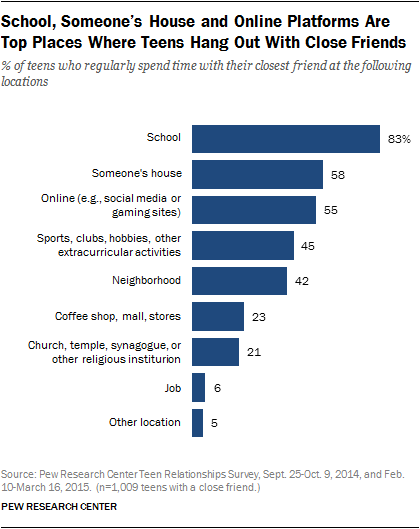
School, Someone’s House and Online Platforms Are Top Places Where Teens Hang Out With Close Friends

Along with examining the general ways in which teens interact and communicate with their friends, this report documents how and where teens interact with the friends who are closest to them. These “close friend” relationships loom large in the day-to-day social activities of teens’ lives, as 59% of teens are in touch with their closest friend on a daily basis (with 41% indicating that they get in touch “many times a day”).

School is the primary place teens interact with their closest friends. However, these best-friend interactions occur across a wide range of online and offline venues:

  • 83% of teens spend time with their closest friend at school.
  • 58% spend time with their closest friend at someone’s house.
  • 55% spend time with their closest friend online (such as on social media sites or gaming sites or servers).
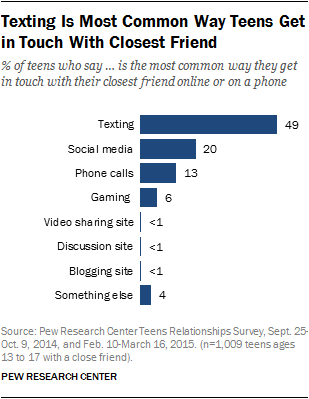
Texting Is Most Common Way Teens Get in Touch With Closest Friend

Teens also use a wide range of communication tools to get in touch with their closest friend.

  • 49% of teens say text messaging (including on messaging apps) is their first choice of platform for communicating with their closest friend.
  • 20% say social media is their first-choice communication tool when talking with their closest friend.
  • 13% say phone calls are the method they would choose first to talk with their closest friend.
  • 6% say video games are their first-choice platform for talking with their closest friend.

Teens who live in lower-income households are more likely than higher-income teens to say they use social media to get in touch with their closest friend. Lower-income teens, from households earning less than $30,000 annually, are nearly evenly split in how they get in touch with these friends, with 33% saying social media is the most common way they do so and 35% saying texting is their preferred communication method. Higher-income teens from families earning $30,000 or more per year are most likely to report texting as their preferred mode when communicating with their closest friend. Modestly lower levels of smartphone and basic phone use among lower-income teens may be driving some in this group to connect with their friends using platforms or methods accessible on desktop computers.

Smartphone users have different practices for communicating with close friends

Nearly three-quarters (73%) of teens have access to a smartphone, and smartphone-using teens have different practices for communicating with close friends. Teens with smartphones rely more heavily on texting, while teens without smartphones are more likely to say social media and phone calls are preferred modes for reaching their closest friend.

  • 58% of teens with smartphone access prefer texting when communicating with their closest friend, while just 25% of teens without smartphone access say the same.
  • 29% of teens without smartphone access say social media is the most common way they get in touch with a close friend; 17% of smartphone users say the same.
  • 21% of teens without smartphones say they make phone calls to their closest friend as a primary mode of communication, compared with 10% of smartphone users.

Girls are more likely to use text messaging – while boys are more likely to use video games – as conduits for conversations with friends

Girls More Likely to Spend Time With Friends Daily via Messaging, Social Media; Boys Do the Same Through Video Games

Compared with boys, girls tend to communicate more often with friends via texting and instant messaging:

  • 62% of girls spend time with friends every day via text messaging, compared with 48% of boys.
  • 32% of girls spend time with friends every day using instant messaging, compared with 23% of boys.

On the other hand, boys are much more likely than girls to interact and spend time with friends while playing video games:

  • 74% of teen boys talk with friends while playing video games together, while 31% of girls report the same.
  • 22% of boys talk daily with friends while playing video games, compared with just 3% of girls.

Phone calls are less common early in a friendship, but are an important way that teens talk with their closest friends

Some 85% of teens say they spend time with friends by calling them on the phone, and 19% do so every day. The perceived intimacy of the phone call as a communication choice means teens are less likely to use it immediately upon meeting a new friend, but they often prefer it when talking to close friends.

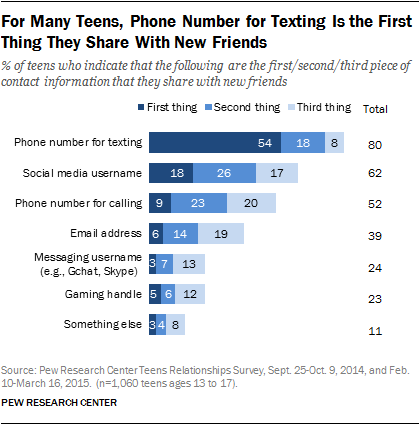
  • About half of teens (52%) indicate that a phone number for calling is one of the first three things they would share with a new friend, but just 9% indicate that this is the first thing they would share.
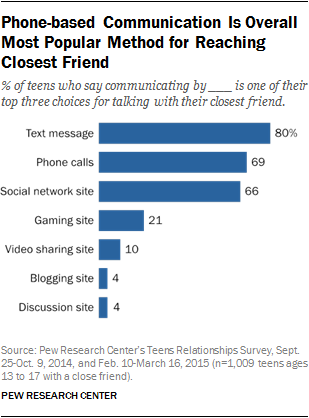
  • And when teens want to talk to their closest friend, phone calls are the second most popular method overall, with 69% of teens citing phone calls as one of their three choices.

84% of black teens say phone calls are one of the three most common methods they use to get in touch with close friends, compared with 69% of whites and 63% of Hispanic teens.

Introduction

In the past generation, parents, policymakers, advocates and journalists have paid particular attention to the possible pathologies that can arise from youths’ use of digital tools – from fears about online predators and bullying, to young adults’ purported narcissism, to the allure and distractions of screen-based life. Less attention has been focused on how teens have woven their technology use into the fundamentals of their social lives, particularly where friendships start and relationships deepen.

Friendships are a critical element in the lives of teens. The teen years are marked by the increasing importance of peers and friends in teens’ social and emotional lives. Friends supplant parents and other adults as the central relationships for teens. And, as with many elements of our modern world, the creation, maintenance and conflicts of these critical peer relationships have moved, at least partially, onto interactive digital platforms like texting, online video gaming and social media. Previous qualitative research1 has shown the importance of digital media in teens’ friendships in helping to create “always-on intimate communities.”2

This report fills in the details and quantifies the ways teens use digital tools in the context of friendships. It follows the arc of friendships and explores the role of social media, video games and mobile phones at each phase. It starts with the way teens use digital technology to meet and make new friends, addressing how and where teens meet other teens, and what modes of communication teens use to stay in touch with newfound friends.

The report then looks at how teens use digital media to maintain their friendships. Much of the focus here is on an individual teen’s closest friend. The report investigates the ways in which teens communicate with their closest friend and where they hang out digitally and in person.

After that, the report does a deep dive into the role of specific digital platforms. It looks at teens and their practices with video gaming as they relate to friendships. It also shows the import and meaning of social media as a site of teens’ interactions with friends.

The study ends by looking at conflict among friends and what happens when friendships end – particularly, the role digital media plays as friendships break apart.

The report details the results of a national survey of teens ages 13 to 17. Throughout the report, the word “teens” means those in that age bracket, unless otherwise specified. This report also covers the findings from 12 in-person and four online focus groups of teenagers that were conducted in the spring and fall of 2014.

Chapter 1: Meeting, Hanging Out and Staying in Touch: The Role of Digital Technology in Teen Friendships

More Than Half of Teens Have Made at Least One Friend Online

For American teens, making friends isn’t just confined to the school yard, playing field or neighborhood. More than half (57%) of teens say they have made new friends online: 6% have made just one friend, 22% have made between two and five new friends, and 29% have made more than five new friends online. Relatively few of these digital friendships yield in-person friendships; only 20% of teens who have made an online friend have met that friend in person.

57% of Teens Have Made New Friends Online

Boys are more likely to make friends online than girls: 61% of boys and 52% of girls say they have made at least one friend online. Perhaps because they have spent more time online and have become more familiar with digital platforms, older teens are more likely than younger teens to have made friends online: 60% of those ages 15 to 17 vs. 51% of those ages 13 to 14. Older boys are especially likely to have made friends online (67% have done so). Hispanic teens (64%) are more likely than whites (53%) to have made friends online. Among black teens, 57% have connected in this way.

[he’s]

[the PlayStation gaming system]

Older Teen Boys Most Likely to Make Online Friends

Other teens meet online friends through other friends. One middle school boy told us: “I don’t really know people that are out of the country. I mostly meet people that are around my age, maybe a year or two older. And I’ll just talk to them, and I’ll introduce them to one of my friends, and then we’ll, like, play with each other.”

Occasionally, meeting people online is not a positive or comfortable experience for teens. One high school boy described his experience.

Male: Yeah, I had an incident. Someone kept like trying to message me, asking me for my name and asking me for my Facebook. I gave it to them and they were sending me weird pictures.

Interviewer: So somebody tried to become your friend and that was really weird.

Male: Yeah, it’s pretty weird … wanted to become a good friend.”

Gamers and social media users are particularly likely to make friends online

Teens’ access to — and use of — various technology platforms is tightly linked with their tendency to make friends online. Specifically, teens who use networked online environments like gaming or social media platforms tend to be more likely to make friends online than other teens.

Fully 72% of all teens ages 13 to 17 play video games on a computer, game console or portable device. Teen gamers play video games in a variety of ways and with a variety of companions; 83% play with others in person and 75% play with others online. Teens also play with friends they know in person (89%), friends they know only online (54%) and online with others who are not friends (52%).

Frequent Online Gamers Most Likely to Start Friendships Online

In the gaming context, teens who play games online with others — especially those who do so on a regular basis — are more likely than other teens to make friends online, and are also more likely to make a large number of online friends. Among those who play games online with others daily, roughly three-quarters (74%) have made friends online and 37% have made more than five friends online. By contrast, among teen gamers who never play with others online, just 40% have made any friends online, and only 20% have made more than five friends online.

61% of Teens on Social Media Make Friends Online

When it comes to social media — another major networked environment in teens’ lives — teenage social media users are more than twice as likely as those not on social media to have made online friends (61% vs. 23%). And, as is the case with gaming, social media use is heavily correlated with making a relatively large number of friends online. Fully 31% of teen social media users have made more than five friends online, compared with just 10% of teens who do not use social media.

Finally, teens with access to a smartphone are more likely than other teens to make friends online. Six-in-ten teens with smartphone access (60%) have made friends online, compared with 48% of those who do not use smartphones.

Social Media and Gaming Environments Are the Top Venues for Making New Friends

Teens use an array of online sites and digital platforms that facilitate meeting and interacting with new people, including discussion boards, social media platforms, networked and online video games, online video sites and blogging sites, among others. In addition to asking whether they have made friends online in a general sense, the survey also followed up and asked teens where they have met new friends by asking about a number of specific platforms and venues.

As noted above, teens who spend their time playing video games online with others or using social media are more likely to make new friends online in general. These same venues emerge as the most common locales for making and developing friendships online.

Among all teens, 36% have made friends on a social media site like Facebook or Twitter, while 21% have met someone while playing a video game online. Some 6% of teens have met friends through a video-sharing site like YouTube or Vine, while 4% have done so on a blogging site like Tumblr or Blogger.

Girls are especially likely to meet new friends through social media; boys are much more likely to make friends through online gaming

For girls, social media sites are the dominant way to meet friends online. Fully 41% of all girls have made friends through Facebook, Twitter or another social media site. Some 43% of older teen girls, ages 15 to 17, have done so, as have 37% of younger girls, ages 13 to 14. Small shares of younger and older girls have met friends in any other forum, although 9% of older girls have met friends on a blogging site.

Teens Most Likely to Make Online Friends Through Social Media Sites, Online Video Games

While many teen boys also make friends on social media sites (31%), they are substantially more likely than teen girls to make friends while playing video games online. About one-third of all teen boys (34%) have met friends while playing a video game online, compared with just 7% of teen girls.

Boys are about equally as likely to make friends through gaming as they are to make friends through social media. Among teen boys, 31% have met friends through social media, and a similar share (34%) has met friends through an online video game.

[friend]

[through a]

Black teens are more likely than whites to make friends on social media and video sites

Black teens are more likely than white teens to have made friends through a social media site (45% vs. 32%). Among Hispanic teens, 39% have made online friends that way.

Black Teens More Likely to Use Social Media and Video Sites to Meet New Friends

Black teens are more likely than either whites or Hispanics to have made friends on video-sharing sites: 14% of black teens have done so, compared with 4% of white teens and 6% of Hispanics.

There are few other significant differences by race and ethnicity around the places teens meet friends online. About two-in-ten white teens (22%) and Hispanic teens (21%) have made friends playing online video games, which is not significantly different from the share of black teens (14%) who have met friends while online gaming.

A previous Pew Research study of teens found that smartphones are facilitating deeper interactions with a range of online content. This new study finds that teens with smartphone access are more likely than those without a smartphone to have met friends in a variety of online venues. Smartphone-using teens are more likely than teens without a smartphone to have made friends online whom they first met through a social media site (39% vs. 28%) or online video games (23% vs. 16%).

Additionally, teens from families with annual household incomes of less than $50,000 are more likely than those with higher family incomes to report making friends on social media sites (42% vs. 33%).

One-in-Five Teens Have Met a Friend in Person After Meeting Online

A substantial majority of teen friendships that begin online remain exclusively online. Overall, 57% of teens have made at least one friend online and just 35% of that group have eventually met their online friends in person. In total, 20% of all teens have met someone in person whom they first became friends with online.

Older Teens More Likely to Meet Online Friends in Person

Overall, boys and girls are about as likely to have met someone face to face whom they first befriended online (20% for boys and 19% for girls). Older teens are more likely than younger teens (24% vs. 14%) to have met someone in person after becoming friends online.

Although boys ages 15 to 17 are the subgroup most likely to have made friends online, they are not significantly more likely than girls of the same age to have met people in person with whom they first connected online (24% vs. 23%).

[online friends]

In other instances, teens meet online friends through other people they already know personally, and have their network vouch for the person they are meeting. As one middle school boy described: “I use iMessaging and like I joined a group with a couple of my friends and my friend invited one of his friends. And then we all just kind of met through the group chat.”

Some teens reported that online friends were driving relatively long distances to meet them in person. “I’ve had people from Florida, like, contact me. … Yeah. It’s weird,” said a high school boy. “So people drive out here just to hang out. I’ve met some from Ohio, Indiana, New York, Wyoming and Colorado through Twitter and Instagram.” For other teens, such distance is a roadblock to in-person meetings. A high school boy explained, “I know the guy fairly well digitally, but yeah. He lives like five states away.”

When Meeting New Friends, Most Teens Expect to Stay in Contact via Text Message

For Many Teens, Phone Number for Texting Is the First Thing They Share With New Friends

To solidify a new friendship, individuals exchange information so they can stay in touch. Teens today have an array of communication tools at their fingertips to choose from when figuring out how best to stay in touch with a new friend. For the largest number of teens, the first item they share is their phone number, with the expectation that friends will text them.

When meeting a new friend they might want to keep in touch with, 80% of teens share a phone number so their friend can use it to text or message them. For 54% of teens, a phone number to text is the first piece of contact information they share with a potential new friend.

About half of teens (52%) indicate that a phone number for calling is one of the first three things they would share with a new friend, but just 9% indicate that this is the first thing they would share. Roughly six-in-ten (62%) share a social media username with a new friend, and nearly four-in-ten (39%) share an email address.

Boys Substantially More Likely Than Girls to Give Out Gaming Handle to New Friends

Teens with access to a smartphone are more likely than other teens to share their phone number for texting (89% vs. 58%) as one of the first three pieces of information they share with a new friend. Teens with smartphones are also more likely to share a social media username (65% vs. 54%). On the other hand, teens without smartphones are more likely to share their email address with a new friend (48% list this as one of the first three things they would share, compared with 36% of smartphone users).

The contact information that teens first share with new friends depends somewhat on their age and gender.

Sharing a phone number for texting is the top response for teens of all ages, but boys ages 13 to 14 are less likely than others to do so: 70% of them share phone numbers for this purpose, compared with 80% or more of girls ages 13 to 14 and older teens of both genders.

Sharing a social media username as a way to get to know a new friend is more common among girls (65% list this as one of their top three things, vs. 58% of boys) and among older teens (66% among those ages 15 to 17 vs. 54% for those ages 13 to 14). Girls also are more likely than boys to share a messaging program username as one of the first three things they share with a new friend (29% vs. 19%).

On the other hand, boys are about five times more likely than girls to share a gaming handle as one of the first pieces of contact information they give to new friends (38% vs. 7%). Fully 42% of younger teen boys and 36% of older teen boys share their gaming handles initially, compared with 8% of younger teen girls and 7% of older teen girls.

Teens are about equally likely to share a phone number for calling or an email address, regardless of gender or age.

Teens in our focus groups deployed a wide variety of options and strategies for getting in touch with new friends. One teen said, “I think probably I’d just give them my Twitter name.” Another favored Instagram over texts: “We say here’s my Instagram name. That’s … the main source of communication. People really don’t read texts nowadays. It’s just on Instagram if you want to get somebody, just get up there.” Another teen told us, “They have your number. … But they don’t use it. Instagram is easier.” And yet another teen girl told us, “I’d probably ask for a phone number or something.”

Some teens are especially enthusiastic with new friends and give them multiple avenues for reaching them. “I usually just go crazy,” said one high school girl. “I’m like here’s my Facebook, Snapchat, Instagram, my number and yeah.”

[you]

New friends are also vetted through social media profiles. Two high school girls explained:

Girl 1: Oh yeah. Like if you’re friends with them, you kind of like search through their pages to see what kind of person they are.

[and see]

Teens Spend Time with Friends in a Variety of Venues, but Text Messaging Dominates for Daily Interactions

Once teens have established a friendship, they weave mobile, social and gaming technologies into their patterns of communication and interaction. Teens have a variety of options at their disposal when it comes to spending time with friends – from the classic face-to-face chats, to phone calls, to exchanges on social media platforms, video games, video chat, email and an array of different messaging choices.

More than Half of Teens Text With Friends Daily

Despite concerns that teens are constantly buried in devices, they do spent many hours a day in face-to-face, in-person communication in school. This study focused on in-person interactions outside of school, where teens have more control over how they interact with friends and peers.

Virtually all teenagers (95%) say they spend time with friends in person outside of school, but they do not necessarily spend time with them on a daily basis outside of school. Among all teens, a quarter interact with friends outside of school every day, 39% say they do so every few days, and about a third (32%) say they do so less often. Another 4% say they never hang out with friends in person.

Some 85% of teens say they spend time with friends by calling them on the phone, and 19% do so every day. But another phone-based activity — text messaging — is done much more frequently. Some 88% of teens use texting to connect with friends (similar to the share that does so via voice call), but more than half (55%) of teens say they text their friends on a daily basis. That makes text messaging — by a substantial margin — the most popular choice for teens’ daily communication with friends.

Along with texting and calling, teens are incorporating a number of other devices, communication platforms and online venues into their interactions with friends, including:

  • Instant messaging: 79% of all teens instant message their friends; 27% do so daily.
  • Social media: 71% of teens spend time with friends on social media; 23% do so every day.
  • Email: 64% of all teens use email with friends; 6% do so daily.
  • Video chat: 59% of all teens video chat with their friends; 27% video chat with friends daily.
  • Video games: 52% of all teens spend time with friends playing video games; 13% play with friends daily.
  • Messaging apps: 42% of all teens spend time with friends on messaging apps, such as Kik and WhatsApp; 14% do so every day.

And when we asked teens in our focus group about what they were talking about with friends through messaging or social media, we got a variety of answers. One high school boy told us that he and his friends ask each other questions like: “How is life? How have you been? What have you been doing?” Another boy in the same group stated his topics of conversation with his friends succinctly as about “females.” A middle school boy talked about “sports and games” when talking through social media or video games. Others, including a number of girls, noted the prevalence of “gossip” as a major topic of online conversation.

Affluent teens are more likely to hang out with friends in person

Even though great majorities of all teens hang out with friends in person, teens who are from more affluent households are more likely than those from lower-income households to say they hang out with friends in person outside of school. Fully 99% of teens from relatively well-off households (those earning $75,000 or more annually) spend time with friends, in person, outside of school at least occasionally, compared with 89% of teens from households earning less than $30,000 a year. Lower-income teens are more likely to say they never spend time with friends in person outside of school, (with 11% of teens from homes earning less than $30,000 report that, compared with 3% of teens from households that earn more.)

Teen girls are somewhat more likely than boys to text friends in general and are substantially more likely to text friends every day: 62% of girls do so, versus 48% of boys. In fact, 15% of boys never spend time with friends using text messaging.

72% of teens spend time with friends via social media; 23% interact daily with friends on social media

Social media is also an important digital channel through which teens communicate with their friends — 72% of teens (and 94% of social media-using teens) say they spend time with friends by posting on social media sites. Some 23% of all teens say they connect with friends this way every day, while 28% do so every few days. Teenagers from lower-income households — those with annual income below $50,000 — are more likely to interact with friends every day through social media than teens whose annual household income exceeds $50,000 (29% vs. 19%). A similar share of social media-using boys and girls say they spend time with friends over social media.

Girls More Likely to Spend Time With Friends Daily via Messaging, Social Media; Boys Do The Same Through Video Games

Girls, black teens and low-income youth are more likely to use messaging apps to connect with friends

Some 42% of all teens (and 48% of cellphone users) use messaging apps like WhatsApp or Kik to spend time with friends, and 14% do so every day. A slightly greater percentage of girls (46%) than boys (38%) use messaging apps to spend time with friends.

There are also racial differences in messaging-app use. About half of black (52%) and Hispanic (50%) teens use messaging apps to communicate with friends, compared with 37% of white teens. Daily use also is strong among minority teens — while only 10% of white teens use messaging apps to communicate with their friends every day, this figure increases to 19% among Hispanic teens and 28% among black teens.

Older teens and teens who have made friends online often turn to instant or online messaging to communicate with friends

Instant messaging is another digital tool teens use to hang out with each other. Some 79% of teens instant or online message their friends, with about a quarter (27%) doing so every day; 26% do so every few days and 25% do so less often.

Older teens and girls use instant or online messaging to hang out with friends at relatively high rates. Some 84% of older teens (ages 15-17) use instant messaging as a way to hang out with friends, substantially more than the 71% of 13- to 14-year-olds who do so. Overall, the differences between boys and girls who employ instant messaging with friends are not statistically significant, but girls are more likely to do so every day. About a third (32%) of teen girls use instant messaging on a daily basis to connect with friends, while for boys, that share is 23%.

Along with girls and older teens, teens who have met a friend online are also avid users of these services: 87% of teens who have made a friend online turn to instant or online messaging to spend time with friends, compared with 68% of teens who have never met a friend online.

Boys are more likely than girls to use video games as conduits for conversations with friends

Overall, 52% of American teens spend time talking with their friends while playing video games together. While girls communicate with friends daily via texting, social media and instant messaging more often than their male peers, boys are much more likely than girls to talk with friends while playing video games.

Fully 74% of teen boys say they communicate with friends while playing video games, compared with almost a third (31%) of girls. There is also a sizeable gender gap in the frequency with which teens spend time together while gaming. About one-in-five boys (22%) say they talk daily with friends while playing video games, but only 3% of girls do so.

Teens use email to communicate with friends, but not very often

Email is still a tool used by teens to talk with friends, but not with great frequency. Roughly two-thirds (64%) of teens ever use email to connect with friends. Just 6% of teens communicate with friends over email on a daily basis, while 43% say they spend time with friends over email monthly or less often.

Teens from more affluent households and whose parents have higher levels of education are more likely than other teens to use email to connect with friends. For example, 71% of teens whose parents have a college degree communicate via email with friends, compared with 56% of teens whose parents have a high school diploma or less. Roughly two-thirds (67%) of teens whose annual household income is $50,000 or greater turn to email to hang out with friends. This compares with 56% of teens from households earning less than $50,000 a year.

59% of teens video chat with friends; 7% do so daily

Like email, a majority of teens spend time with friends, at least occasionally, using video chat — 59% do so. But, also like email, few teens make video chatting an integral part of how they communicate with friends: Just 7% video chat with friends on a daily basis.

One-in-Five Teens Has Shared a Password With a Friend

White Teens Are Most Likely to Share a Password With a Friend

Sharing passwords has long been about displaying trust and closeness among friends. One-in-five teens (19%) report that they have shared a password with a friend. White teens are more likely than black teens to have shared one of their passwords with a friend; 22% of white teens and 9% of black teens say they have shared passwords. The 16% of Hispanic youth who have shared passwords are not significantly different from either white or black youth in their likelihood of sharing. There are no significant differences for teens who share passwords by gender, age group, household income, parents’ education or community type.

As the number of social media sites a teen uses grows, so too does their likelihood of sharing passwords with friends. Among teens who use two or more sites, 23% report sharing a password. By comparison, among those who use less than two social media sites, only 11% have shared a password. Teens who use five or more sites are among the most likely to have shared a password with a friend — 34% have done this.

As Number of Social Media Platforms Used Grows, so Does Likelihood of Sharing a Password

Sharing passwords is often about showing trust in peers or partners. A high school girl in one of our focus groups described a social media game that highlights this: “I know they have this game on Instagram where you’d be like, ‘do you trust me? Give me your password and I’ll post a picture and then log back off.’”

Teens in our focus group shared experiences that suggest that even if they do not directly share a password, sometimes the intimacy of a friendship or romantic relationship means that another teen may know enough about them to be able to guess usernames and passwords. One high school boy explained, “But you have some girls that are just so good at what they do, you know that. … They know your email and they know your question would be ‘what’s your favorite city?’ They know those questions because they know you. They can easily get into your account.”

A middle school girl in an online focus group explained why she doesn’t share her password with anyone: “Because that’s how stuff gets stolen. No matter how long you know them they could have it written down and accidentally give it to someone else.” Another middle school girl in the same group wrote, “NO I would never bc then they could do something. If we get in a fight they could do something really mean.”

Other teens take a more nuanced approach, “Nooooo, haha. I’ve let my friends on my account when I was around, but letting them have the password would expose my personal life too much,” said one high school boy.

Chapter 2: How Teens Hang Out and Stay in Touch With Their Closest Friends

Teens have many different kinds of friends. There are casual acquaintances, associates, classmates, school friends, friends from camp or church or dance or soccer, all with varying and shifting degrees of closeness. The preceding chapter of this report examined the role of digital technologies in the broad scope of teens’ friendships. In this chapter, we focus on the ways in which teens interact and spend time — both digitally and in person — with the person they consider to be their “closest friend.”

The intimacy and closeness of these important friend relationships is special3 and examining it here shines a brighter light on teens’ digital friendship practices. In contrast to the analysis in Chapter 1, this portion of the survey involved questions that asked teens to focus on all of the ways in which they spend time and interact with the friend who is closest to them. By stressing these particular relationships, we can focus our participants’ responses on one particular and meaningful tie.

In the context of the survey and the analysis that follows, a teen’s “closest friend” is defined as “someone you can talk to about things that are really important to you, but who is not a girlfriend or boyfriend.” Some 4% of teens in this survey indicated that they do not have anyone in their life who fits this criteria, and an additional 1% were not willing to indicate whether they have a closest friend or not. Therefore, the analysis that follows is based on the 95% of teens who explicitly indicated that they do have someone they consider to be their closest friend. Throughout this chapter, the term “teen” refers to teens with a close friend, unless otherwise noted.

Most Common Places Teens Spend Time With Close Friends Are School, Friends’ Houses and Online

In order to gain a broad understanding of the places – including online places – teens spend time with their closest friends, the survey presented nine different venues, activities or locations and asked teens to indicate whether they regularly spend time with their closest friend at each of these venues or activities.

Overall, school is by far the top location where teens say they spend time with their closest friends. More than four-in-five teens, (83%), say they spend time with that friend at school on a regular basis. The percentage of teens who spend time with their closest friend at school is largely consistent across a wide range of demographic groups.

School, Someone’s House and Online Platforms Are Top Places Where Teens Hang Out With Close Friends

Other than school, the next most common place to spend time with a best friend is at someone’s house – 58% of teens say they spend time with their closest friend on a regular basis at someone’s house. More than half (55%) of teens say they spend time with their closest friend online, doing things like interacting on social media or playing video games.4 Additionally, 45% say they spend time with their closest friend doing extracurricular activities like sports, clubs or hobbies and a similar 42% say they spend time with their closest friend in a neighborhood setting.

Roughly one-quarter (23%) of teens say they spend time with their closest friend at places like a coffee shop, mall or store. About one-in-five teens (21%) say they spend time with each other at a place of worship, 6% said they spend time with their friend at a job and 5% of teens cited another location.

Wealthier and white teens are more likely to spend time with a close friend at someone’s house

Teens from more affluent households are more likely to spend time with their closest friend at someone’s house or engaged in hobbies, sports and clubs outside of school than teens from lower-income families. Fully 61% of teens from households with an annual income of $50,000 or more spend time with their closest friend at someone’s house, compared with 52% of teens from homes with a lower annual income. Moreover, teens from wealthier households are more inclined than those from less affluent households to say they hang out with friends through sports, clubs, hobbies or other activities (48% versus 37%).

White teens (65%) are somewhat more likely than blacks (51%) or Hispanics (46%) to say they spend time with their closest friend at someone’s house.

More than half of teens hang out with friends in online settings

Many teens say they “hang out” with their closest friend in online settings, like on social media sites or through gaming websites. Fully 55% of teens spend time with their closest friend online on a regular basis, which is similar to the share of teens who spend time with close friends at someone’s house. Teenage boys are especially likely to spend time online with close friends, as 62% do so regularly, compared with 48% of teen girls.

Many (65%) of those who have met a friend online say they spend time with their closest friend on a regular basis online, which is somewhat higher than the 41% of teens who have not met a friend online. While this does not necessarily mean that a teen’s best friend is an online friend, it does suggest a certain comfort with interacting with friends and peers in an online space for this group of teens.

Boys and black teens are more likely than other groups to hang out with their closest friends in a neighborhood

Neighborhoods also are a popular place for teens to connect with one another – 42% of teens spend time around a neighborhood with their closest friend. Boys are more likely than girls to spend time with their closest friend in a neighborhood: Nearly half (48%) of teenage boys say this is where they regularly spend time with their closest friend, compared with 36% of girls.

Similarly, black teens are more likely than their white and Hispanic counterparts to hang out in a neighborhood. Some 64% of black teens spend time with their closest friend in this type of setting, compared with 41% of Hispanics and 39% of white teens.

About a third of teen girls spend time with their closest friend at a coffee shop or shopping center

Roughly one-quarter (23%) of teens regularly spend time with their closest friend at a coffee shop, mall or store. Girls are twice as likely as boys to hang out at these places: 30% of teen girls regularly spend time with their closest friend at a coffee shop, mall or store, compared with only 16% of boys.

Frequent Contact With Closest Friend Is Facilitated by Mobile Devices and Social Media

Teens today have more ways to stay in touch with friends than ever before. Beyond daily interactions at school, teens are increasingly connected by smartphones, social media, gaming, and the internet. These new avenues of communication broaden what it even means to be “friends,” changing how teens connect and how they share with one another.

Girls Stay in Touch With Closest Friend Frequently

This survey asked teens how often they are in touch with their closest friend through face-to-face contact, phone calls, text messages, or any other digital method. Fully 59% of teens are in touch with their best friend daily, with 41% saying they are in touch many times a day. Another 28% of teens say they are in touch weekly with their closest friend, and just 8% say they communicate less often than that.

Girls are especially likely to be in touch with their closest friend on a regular basis. Fully 64% of teen girls say they are in touch with their closest friend daily, including 47% who communicate many times a day. This compares with 54% of boys who stay in touch daily, and 35% who do so multiple times a day.

Black teens are less likely than their white and Hispanic peers to communicate daily with their closest friend. Some 40% of black teens do so, compared with 61% of whites and 62% of Hispanic teens.

While there were no major differences by age, the economic and educational status of their parents or where they live, teens who have access to certain technologies are particularly likely to be in more frequent contact with their closest friend.

Social media and mobile devices help facilitate frequent connections between close friends

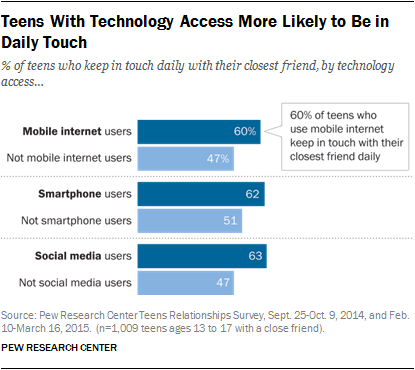
Teens who have mobile internet access – whether through a phone, tablet or other mobile device – are significantly more likely than those without this kind of access to be in frequent touch with their closest friend. A full 60% of these teen mobile internet users are in touch daily with their closest friend (including 42% who make contact many times a day). This compares with 47% of those without mobile internet access who communicate daily with their closest friend, including 27% who do so many times a day.

Focusing in on smartphone users, teens who have access to a smartphone also are likely to be in daily touch with their closest friend. Some 62% of teens with smartphone access are in touch with their closest friend daily, and 45% are in touch multiple times a day. In contrast, 51% of teens who do not have a smartphone (48% of whom have no access to a cellphone at all) are in daily contact with their closest friend.

Teens With Technology Access More Likely to Be in Daily Touch

Social media use also is correlated with more frequent friend interactions. Some 63% of teen social media users are in daily contact with their closest friend, including 44% who are in touch with their best friend multiple times a day. Among teens who do not use social media, 47% are in daily communication with their closest friend, and 30% connect with their closest friend many times a day. Teens who use a large number of social media platforms communicate even more frequently. Fully 78% of teens who use five or more social media sites say they are in touch with their closest friend daily, and about two-thirds say they are in touch many times a day.

Half of Teens Say Texting Is the Most Common Way They Communicate With Close Friends

Teens today have a number of ways to get in touch with each other, and they use them in various combinations. Some methods, however, are more favored than others. This survey asked teens about their preferred modes of digital communication with their closest friend – the first, second, and third most common way they get in touch online or on their phones.

Texting Is Most Common Way Teens Get in Touch With Closest Friend

Text messaging is the dominant form of digital communication among teens. Some 49% of all teens say text messaging is the most common way they get in touch with their closest friend.

Following general texting patterns, teen girls are significantly more likely than teen boys to say texting is their first choice for getting in touch with their closest friend. Some 55% of girls say so, compared with 43% of boys. Older teens are also particularly likely to use texting as their primary means of getting in touch with a friend. Fully 54% of teens ages 15 to 17 say texting is the most common way they communicate with their closest friend, compared with 41% of teens ages 13 to 14.

Teens from affluent and highly educated households favor texting when communicating with close friends; minority teens and those from low-income, low-education households are more likely than other teens to rely on social media

Teens who live in relatively affluent households tend to rely more heavily on texting as a primary means of communication, while teens in lower-income households tend to say social media is how they stay in touch.5 Teens who live in households with an annual income of $75,000 or more are the most likely to say texting is the most common way they get in touch with their closest friend – fully 58% say so compared with 41% of teens in households with an annual income less than $75,000.

Teens who live in households with the lowest annual income – $30,000 or less – are more likely than many wealthier teens to say social media is the most common way they get in touch with their closest friend. A third of teens in this group say so, compared with 16% of those in households with an annual income of $50,000 or more. Further, the 33% of low-income teens who say social media is the most common way they stay in touch is statistically similar to the 35% who say texting is their preferred method of communication.

Black and Hispanic youth are also more likely to say social media is the most common way they get in touch with their closest friend. Some 32% of black teens and 30% of Hispanic teens use social media as their primary communication method, both significantly higher than the 14% of whites who do so.

Teens with access to personal technology text their closest friend, while those without it use phone calls or social media to stay in touch. Smartphone owners notably differ from those with a basic phone or no phone.

Teens who access the internet via mobile devices such as smartphones or tablets are more likely to say texting is the most common way they get in touch with their closest friend. Some 52% of teen mobile internet users say this, compared with 15% of those without access. This reflects the higher rates of smartphone access among teen mobile internet users – 78% say they have or have access to a smartphone, compared with 9% of non-users.

In turn, teens who have access to a smartphone are more likely to say texting is the most common way they get in touch with their closest friend. This is true of 58% of teens with smartphone access, compared with 30% of teens who only have access to a basic cellphone, and 19% who do not have access to a cellphone at all.

Teens without access to a smartphone are more likely to say social media is the most common way they get in touch with their closest friend. Some 29% of teens without smartphone access say so, including 23% who only have access to a basic cellphone, and 37% who do not have access to any type of cellphone. This compares with 17% of teens with smartphone access.

Teens without access to a smartphone are also more likely to say phone calls are the most common way they get in touch with their closest friend. Some 21% of teens without smartphone access say so, including 22% of teens who only have access to basic phones, and 19% of teens who do not have access to any type of cellphone. Just 10% of teens with smartphone access say phone calls are the primary way they get in touch with their closest friend.

Phone-Based Methods Are Overall the Most Popular Ways That Teens Communicate With Closest Friends

Looking at the overall picture – combining answers to the first, second and third most common ways teens get in touch with their closest friend – texting comes out on top. Some 80% of teens say they use this as one of the three most common ways they get in touch. But phone calls – a technology from the analog era – are the second most popular method overall, with 69% of teens citing it as one of their choices. This is followed closely by the 66% of teens who say social media is in their top three preferences, while just 21% of teens noted gaming in any of their choices. Other communication methods, like video sharing, blogging and discussion sites were cited by 10% of teens or less.

Phone-based Communication Is Overall Most Popular Method for Reaching Closest Friend

Some 21% of teens, however, said “something else” to any of the three most common ways they get in touch with their closest friend. Write-in answers reveal that some teens use video chatting, like the popular iPhone service FaceTime, to get in touch with one another, as well as email.

Preferred method of getting in touch varies by demographic group

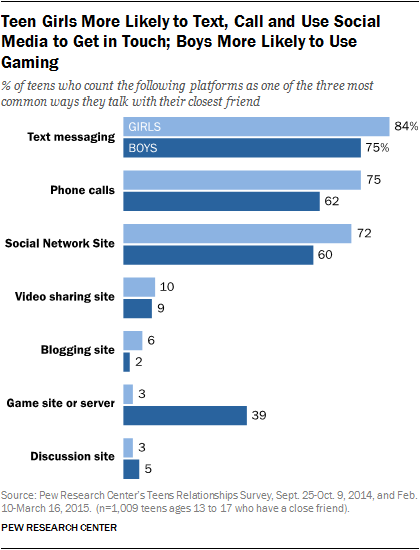
Girls are more likely to say they use texting, phone calls and social media as any of their three most common ways to get in touch with their closest friend. Some 84% of teen girls say texting is one of their preferred methods, while 75% say they use phone calls and 72% use social media. This compares to 75% of boys who text, 62% who make phone calls, and 60% who use social media. Teen boys, however, are more likely to note gaming among their top three methods of communication with close friends – 39% vs. only 3% of teen girls.

Teen Girls More Likely to Text, Call and Use Social Media to Get in Touch; Boys More Likely to Use Gaming

Black teens are more likely than their white and Hispanic peers to say phone calls are one of their three preferred methods of getting in touch with close friends. Some 84% of black teens say so, compared with 69% of whites, and 63% of Hispanic teens.

Teens who live in households with an annual income of $75,000 or higher are more likely than teens in lower-income households to say texting is one of the three most common ways they stay in touch with a close friend. This is true of 85% of teens from the most affluent households, compared with 71% of teens from households with annual incomes of less than $50,000.

Teens who have access to smartphones are more likely to note texting, phone calls and social media among the top three ways they prefer to get in touch with their closest friend. Some 86% of teens with smartphone access say texting is one of their top three ways, compared with 62% who do not have access to a smartphone. Some 71% of teens with smartphones make phones calls, a significant difference compared with the 62% of teens without smartphone access. Finally, some 68% of teens with access to a smartphone use social media to get in touch with a close friend, compared with 60% of teens without smartphone access. Teens without smartphones are more likely to report that they use “something else” to communicate with friends. In the open-ended response to this question, teens without smartphones notably told us that they used video chat platforms like Skype and FaceTime, as well as email, as some of their top ways to stay in touch with their best friend.

Why teens choose different platforms for talking with friends

Teens in our focus groups described the calculus they made in choosing different ways to communicate with friends for different purposes. One high school girl explained, “Like if you want to hang out with them, you would text them and be like, ‘Hey. You want to do something?’ If you’re just trying to be like, ‘you exist,’ then you’d Snapchat them and be like, ‘Hi! I love you!’”

Teens also tell us that they make different communication choices when talking with close friends and acquaintances – usually choosing phone-based communication for closer relationships. One high school boy described the distinction: “But for the direct message6 and stuff, that’s usually for less close friends. For closer friends, I usually text or Snapchat.” Another boy in the same group explained his choices, “Direct message on Instagram and messages on Facebook, it’s not usually for close friends unless my phone isn’t working for some reason.”

A high school girl explains why she chooses to make voice calls with her best friend. “If it’s your best friend. You’d be on the phone with them. It’s because you have a lot to talk about. But like if it’s just a regular friend, or you guys just associate from time to time, you typically text them because you don’t really have anything to talk about.”

For many teens, calling is reserved for more serious or intimate conversations. One high school girl explains, “It’s awkward on occasion. For some people, I have to call them just because they don’t have, like, Skype or anything. But I don’t know. Calls are usually for just more important things.”

For some teens, the platform they pick may be based on their friends’ preferences. One high school girl told us, “One of my friends just doesn’t like to talk on the phone, so I primarily text with her. But then my other friends, we FaceTime all the time. So it just depends on who I’m talking to.”

For some teens, getting access to their phone number is something new friends must earn. One high school girl explained: “I’m just real picky because I don’t like a lot of drama. So … it took like basically a whole year. In the beginning of the school year, we continued to talk, and then …we switched Kiks7 and then phone numbers. … A lot of people tend to play on the phone, still. So young. So I just want to make sure that the person was capable of, like, being able to have my phone number.”

Chapter 3: Video Games Are Key Elements in Friendships for Many Boys

Video games8 and gameplay are pervasive in the lives of most American teens – and for boys in particular, video games serve as a major venue for the creation and maintenance of friendships. Fully 72% of all teens play video games on a computer, game console or portable device like a cellphone, and 81% of teens have or have access to a game console.

72% of Teens Play Video Games; Rises to 84% of Teen Boys

Over the past two decades, video game and internet technology have shifted, eliminating the need to be in the same room as a requirement for playing games with friends and others. Innovations in game design and platforms have increased the opportunities to interact and socialize while playing. These changes have enabled teen gamers to play games both with others in person (83%) and online (75%). Teen gamers also play games with different types of people – they play with friends they know in person (89%), friends they know only online (54%), and online with others who are not friends (52%). These capabilities have enhanced teens’ opportunities to interact and spend time with friends and others in meaningful ways while gaming. Boys are substantially more likely than girls to report access to a game console (91%, compared with 70% of girls) and to play games (84% of boys, compared with 59% of girls), a pattern we have seen previously in game device ownership and play.

As was noted in Chapter 1 of this report, games play an important role in the creation of teens’ friendships — and this is especially true for boys:

  • More than half of teens have made new friends online, and a third of them (36%) say they met their new friend or friends while playing video games. Among boys who have made friends online, 57% have done so by playing video games online (compared with just 13% of girls who have done so).
  • Nearly a quarter (23%) of teens report that they would give a new friend their gaming handle as contact information. Fully 38% of teen boys would share a gaming handle, compared with 7% of teen girls.

In the analysis that follows, we investigate more deeply the role of video games in teen friendships, with a particular focus on the way in which gaming spaces impact and contribute to friendships among boys.

Gaming Boys Play Games in Person or Online With Friends More Frequently Than Gaming Girls

16% of boys play games with others in person on a daily or near-daily basis; 34% play games with others online almost every day

Video games are not simply entertaining media; they also serve as a potent opportunity for socializing for teens with new friends and old. Fully 83% of American teens who play games say they play video games with others in the same room, with 91% of boys and 72% of girls doing so. And boys do this more frequently. Drilling down, 16% of boys play games this way every day or almost every day, compared with just 5% of girls. A third (35%) of boys say they play together with others on a weekly basis, compared with 15% of girls who report in-person group play this often. Indeed, more than a quarter (27%) of girls who play video games say they never play with other people who are in the same room, while just 8% of boys say this.

Younger boys who game are especially likely to play together in same room as others – more likely than any groups of girls who game. Among teen gamers, 94% of 13- to 14-year-old boys do this, compared with 84% of girls the same age and 64% of girls ages 15 to 17.

91% of video-gaming boys play with others who they are connected with over a network; one-third of boys say they play this way every day or almost every day

Advances in networks, as well as console and computer capabilities, mean there are more ways to play with others than there have been in the past. Often, these modes of group play are more accessible than in-person group play.

Three-quarters of teens who play games play them with others with whom they are connected over the internet. Nine-in-ten boys (91%) who play games play with others online – identical to the percentage of boys who play games together in person. Just over half of girls who play games (52%) say they play together with others over the internet, fewer than those who report playing with others in person.

Not only are boys more likely than girls to play games with others over a network, they do so with much greater frequency. While a third (34%) of boys play video games with others over a network daily or almost every day, only 8% of girls do. Another third of boys (33%) play with others over a network weekly, while 10% of girls report playing this way. Girls who play games, on the other hand, are most likely to report that they play networked games with others less often than monthly (27%) or that they never play in such a manner (47%).

Teens mostly play networked games with friends; more than half of boys also play with online only friends and strangers

Boys More Likely to Play Networked Games With Online-Only Friends

Many teens play games with pals as a part of in-person friendships. But teens also play with people they know only online. Among boys and girls who play games with others over a network, 90% of networked-gaming boys and 85% of girls are playing these games with friends they know in person (for a total of 89% of all teens). But when it comes to friends known only online or individuals who aren’t friends, but are game partners, boys who play online games are substantially more likely to say they play with or against these types of people. While 40% of girls who play with others online play with friends they know only online, 59% of boys say they play with online-only friends, and that number rises to 62% of boys ages 15 to 17.

Teens who play games in a networked environment also play with and against other people they do not consider to be friends. Just over half of teens who play with others online say they play with people they don’t consider friends. Similar to the percentage with online-only gameplay friends, 57% of boys and 40% of girls say they play games with people they do not consider their friends. And again, the oldest boys (ages 15 to 17) are more likely (60%) than girls of any age to report playing with or against others who are not friends.

[with]

Some teens noted they particularly enjoy playing with people who are not their friends. Some teens told us that they relish the competitive aspect of playing with unknown quantities. “It’s more competition like that,” said one high school boy. Another added, “It’s more fun like that, too. … Because, like, you don’t know what they’re capable of and you don’t know if they can do it. … When you’re playing with people you don’t know, it’s like you’re trying, like, to play harder and see what they’re about.”

Other teens told us they liked playing games because they could be a different person. A high school boy explained how “you use an alter ego” when playing. And still others benefit from the opportunity to take out their frustrations on people they would never interact with again. As a high school boy told us, “If you, like, have a bad game, instead of throwing your controller, you can just take it out on them.”

59% of teens who play online with others use a voice connection when they play

Boys Who Play Networked Games More Likely Than Girls to Voice Chat in Game

Networked online gameplay becomes a vehicle for friendship, interaction and trash talk when the players connect with each other by voice as well as through the mechanics of the game. Nearly six-in-ten teens who play games online with others use a voice connection – through the console, the game or a separate platform (e.g. Skype). Use of a voice connection is heavily skewed towards boys – 71% of boys who play networked games use a voice connection so they can talk with other players as they play, compared with 28% of girls who play games online with others. Older boys drive this finding, with 75% of boys 15 to 17 who play networked games with others using a voice connection when they play online.

These voice connections enable all types of communication through the game – conversations about mundane things, strategizing in-game play and trash talking.

One middle school boy in our focus groups explained that he and a gaming friend talked about a mix of things pertaining to the game and their lives: “Like, we were talking about the game and then I’d be like, so, what do you like to do? And we would just share thoughts. Stuff.” Other teens told us that this type of interaction was “very rare.” And that usually it’s, “No hi’s. No bye’s. No hellos.”

Focus group data suggests that trash talking is pervasive in online gaming and that it can create a challenging conversational climate. As one high school boy told us, “If you’ve ever been on any form of group chat for a game, yeah. It’s harsh. … It’s funny, though. Unless you take it seriously. Cause some people take certain things personally.”

[me]

Other teens told us that they only trash talk with people they know: “Oh, with my friends? Yeah. I trash talk,” said a middle school boy. “Overall, with people I don’t know, I don’t.” Teens told us this was because their friends knew they were “just kidding.”

Some teens do not use the voice connection to trash talk, but instead to plan game play. In one of our focus groups, an interviewer asked “And are you talking about other stuff, or are you mostly trash-talking about the game?” And a high school boy responded. “Not trash-talking; strategizing.”

A high school girl described how she used Skype to strategize and socialize with friends while gaming: “Skype. … I use Skype with my friends pretty often … because we play a lot of games together, so … I Skype them, and then we get into the same game together. That way we can hear each other and tell each other, like, where we are.”

And some younger teens were put off by the language and name-calling of trash talking. As one middle school boy explained, “For ‘Call of Duty,’ there’s like no filter. So you have those 20-year-old rage people that every time you make mistakes they’re like screaming and swearing at you and it’s really annoying. You have to leave.”

[my friend]

Older teen boys talked about how younger teens, in this case siblings, needed to learn how to handle trash talk in games. “No, they have to do the same thing,” said a high school boy. “It’s for the game.”

Talking with friends while playing a video game is a major way boys talk with friends

Whether on headsets or in person, teens who play networked games talk with their friends while they play. Nearly three-quarters of teens who play online video games say they’ve talked with friends while they played together. Nearly nine-in-ten online video-gaming boys (88%) say they talk with their friends while playing, while about half (52%) of online gaming girls do.

Boy Gamers Talk More Frequently While Playing

Boys talk with friends while playing games more frequently than girls as well, with 26% of teen boys who play games reporting that they talk with friends every day while they play, and another 32% of gaming boys talking with friends over games every few days. Girls, by contrast, report substantially lower frequencies, with 5% of girls who play networked games talking with friends every day while they play and 9% talking while playing every few days.

And as noted previously, when comparing talking by video gaming to other modes of communication and interaction with friends, gaming ranks substantially higher for boys as a mode of daily communication than it does for girls, for whom it ranks at the very bottom.

For the bulk of teens who play games online with others, playing makes them feel connected to friends

Playing games can have the effect of reinforcing a sense of friendship and connectedness for teens who play online with friends. Nearly eight-in-ten online-gaming teens (78%) say they feel more connected to existing friends they play games with. For teen boys, this is especially true – 84% of boys who play networked games say they feel more connected to friends when they play, compared with 62% of girls. The depth of teens’ sense of connectedness to friends when playing online with others is evenly divided for both genders, with about 38% of teens saying “yes, a lot” in response to the connectedness question and another 40% replying “yes, a little.”

Online Gaming Builds Stronger Connections Between Friends

Networked gameplay is less effective at connecting online-gaming teens with those who are not yet their friends. Just about half (52%) of teens say playing networked games helps them feel connected to the people they aren’t otherwise connected to. Once again, boys are more likely to report ever feeling this way than girls, with 56% saying they feel more connected to other players, and 43% of girls reporting such feelings. Further, most teens who say they feel connected to the people they play with or against say these feelings are relatively minor, with most teens saying they feel connected “a little” to the people (who are not their friends) they play games with online.

Online gameplay also has the ability to provoke anger and frustration as well as relaxation and happiness in the teens who play. A larger percentage of teens say playing games allows them to feel more relaxed and happy than the percentage who report anger and frustration. Fully 82% of teens say they feel relaxed and happy when they play, with 86% of boys and 72% of girls reporting these experiences. Girls who play these games are less likely to say they feel relaxed and happy when they play, with 28% reporting they don’t feel that way, compared with 14% of boys.

Gaming Girls Feel Less Connected Than Gaming Boys to Other People When Playing Online

The flip side is that playing games also can provoke feelings of anger or frustration in those who play games with others online. While fewer teens report feelings of anger or frustration than more positive emotions, when they play online with other people, 30% say they feel more angry or frustrated, with one third of boys and 20% of girls reporting these feelings.

A middle school boy in one of our focus groups describes getting angry while playing video games. “Like say I’m playing ‘Call of Duty’ with my friends and we’re on the same team. Sometimes if I mess up or he messes up, we’ll get mad at each other and then we’ll delete each other as a friend. And then, like, we’ll get all mad at each other the next day and we won’t talk to each other. Then when we get home, we’ll make up. So, I mean, it’s kind of just like getting mad at each other for dumb reasons over the internet.”

[With video games]

Teens, Video Games and Friends: Other Demographic Differences

Teens’ gaming habits vary little by family income, education or race and ethnicity. Below we highlight the most notable differences between groups in how their use of video games intersects with their friendships.

Higher-income teens are more likely to play networked game with friends they know in person

Higher-income teens are more likely than low-income ones to play networked games with friends they know in person; 94% of teens whose families earn more than $50,ooo annually play networked games with in-person friends, 78% of teens from families earning less say they play online with in-person friends. Teens from all income groups are equally likely to say they play with friends they know only online or people they play with online, but don’t consider friends.

Lower-Income Teens Less Likely to Play Networked Games With In-Person Friends

Gaming teens from middle- and upper-income households earning more than $50,000 a year are also more likely to have a voice connection to other players – which allows them to strategize and talk to one another – when they play games online. Fully 63% of teens from households earning more than $50,000 have a voice connection, while just half (51%) of teens from households earning less do.

Teens from the lowest-income homes are the most likely to say they feel connected to people they are not friends with when they play online games with others. Nearly two thirds (64%) of teens from families earning less than $30,000 annually say they feel connected to others who aren’t friends when they play games online, compared with just half of teens from families earning more than $30,000 per year.

Teens from families earning less than $50,000 annually are more likely to say they feel relaxed and happy when they play games online with others with nine-in-ten (90%) teen online gamers from lower-income households saying they feel that way, compared with 78% of networked teen gamers from wealthier households.

Urban and suburban teens more likely to play networked games with others

Rural teens are less likely to play with others online, but, if they do, they are more likely to play with people they know only online. Fully 78% of urban teens and 77% of suburban teens who play games do so in a networked environment with others, while 59% of rural gamers report such gameplay.

Suburban kids who play networked games are more likely than rural kids to play games online with friends they know in person; 92% of suburban kids play with friends they know in person, compared with 77% of online-gaming rural teens. Conversely, rural teens who play networked games are more likely than suburban teens to play with friends that they only know online. A full 70% of rural teens play games online with friends they know only online, while just half (51%) of suburban teens play online with online-only friends. Networked gamer teens from all types of communities are equally likely to play online games with people they don’t know and don’t consider friends.

Teens of different racial and ethnic groups sometimes have different experiences and reactions when they are gaming

There are few differences between black, Hispanic and white teens when it comes to friends and video gameplay. While black teens (83%) are more likely to play video games than white teens (71%) or Hispanic teens (69%), white teens are more likely than black teens (62% vs. 40%) to have a voice connection when they play networked games with other people – which allows players to strategize and talk while playing.

White Teen Gamers More Likely Than Blacks to Report Feeling Angry While Playing Online

White and Hispanic teens are more likely than black teens to report feeling more angry and frustrated when they played networked games with others. Nearly a third of white teens (32%) and 29% of Hispanic teens report ever feeling more angry and frustrated (although most of these teens say this is something that happens only “a little”) when they play online with others, while just 11% of black teens report these types of emotions while playing networked games.

Chapter 4: Social Media and Friendships

Given the thorough integration of social media into the lives of the majority of American teens, it is no surprise that these sites play an important role in the establishment of friendships and the everyday back and forth of peer relationships. This chapter takes an in-depth look at the role of social media in teens’ friendships, looking at teen friendships more broadly defined.

Social media is an important venue for interaction and conversation among America’s youth. Fully 76% of all teens use social media. Facebook is the dominant platform, with 71% of all teens using it. Instagram and Snapchat also have become increasingly important, with 52% of teens using Instagram and 41% using Snapchat. One-third of American teens use Twitter and another third use Google Plus. Fewer teens use Vine or Tumblr.

Social media plays a critical role in connecting teens to new friends, allowing teens to learn more about new friends and get to know them better. Nearly two-thirds (64%) of teens who have made a new friend online say they have met new friends on a social media platform. Two-thirds (62%) of teens say they’ve shared their social media username with a brand new friend as a way to stay in touch.

Beyond making new friends, social media is major way that teens interact with their existing friends. More than nine-in-ten teens (94%) say they spend time with friends on social media. Fully 30% say they spend time with friends on social media every day, and another third (37%) say they do so every few days. When asked to rank the ways they communicate with friends, social media sites like Facebook or Twitter are one of the top ways of communicating with friends for two-thirds (66%) of teens.

A Majority of Teens Say Social Media Better Connects Them to Their Friends’ Feelings and Lives

As discussed earlier in the report, social media is a critical platform for making and staying in touch with friends. Given this, and the frequency with which many teens use social media, it is not surprising that teen social media users report that social media makes them feel better connected to their friends’ feelings and to information about what is going on in their friends’ lives. More than eight-in-ten (83%) social media-using teens say social media makes them more connected to information about what is happening in their friends’ lives and 70% say these social platforms better connect them to their friends’ feelings.

Girls who use social media are more likely than boys to say they are “a lot” better connected to information about their friends’ lives (40% vs. 26% boys) and their friends’ feelings (24% vs. 16% of boys) thanks to social media.

Most Teens Feel Better Connected to Friends via Social Media

While teens of all races and ethnicities are equally likely to feel more connected to information about what’s going on in their friends’ lives through social media, black youth are more likely to say they feel “a lot” more connected. Hispanic teens are more likely than whites to say they feel more connected to friends’ feelings through social media, with 78% of Hispanic youth saying this compared with 65% of white youth.

Smartphones offer near constant access to friends and for social media users, their friends’ online postings. Not surprisingly, teens who have access to smartphones and use social media are more likely to report that they feel “a lot” more connected to what’s happening in their friends lives than teens without a smartphone. While both groups are equally likely to say they feel more connected to friends through their social media use, 36% of smartphone owners say they feel “a lot” better connected to friends while a quarter (25%) of teens without smartphone access report the same degree of connectedness.

Teens from our focus groups told us that they appreciate the way social media keeps them in the loop with friends. One high school boy explained, “One good thing to come out it is you can find out what your friends do and check on them if you’re not there. So like find out who they hooked up with and what they did…”

Teens also enjoy the way social media better connects them to more people. As one high school boy said, “And you can talk to people a lot more often ‘cause you don’t need to see them in person.”

Nearly nine-in-ten social media-using teens believe people overshare on these platforms

Even as teens often feel better connected to friends’ feelings and information about their lives through social media, they also report that they are sometimes too connected to their friends’ lives. Fully 88% of social media-using teens agree that people share too much information about themselves on social media, with 35% agreeing strongly. These data hold true regardless of which social media platforms teens use.

About a Third of Teens Strongly Agree That People Overshare on Social Media

Teens from rural areas are more likely to agree strongly that people share too much information about themselves on social media than their urban or suburban counterparts, with 46% of rural teens strongly agreeing, compared with 31% of suburban teens and 39% of urban youth.

Nearly Seven-in-Ten Teens Receive Support From Friends Through Social Media During Tough Times

Social media not only connects teens to information and friends, but also connects them to opportunities for social support from their friends, peers and broader social networks. Among teens, 68% have received support on social media during challenges or tough times.

Many Teens Get Support on Social Media During Tough Times

Following adult gender patterns around asking for and receiving social support on social media, girls are more likely to report receiving such support on social media, with nearly three-quarters (73%) of girls garnering support, compared with 63% of social media-using boys.

When examining overall support on social media during tough times, white social media-using teens are more likely than Hispanic teens to report receiving support on the platforms. Nearly three-quarters (72%) of white teens who use social media receive support for tough times on these platforms, while 59% of Hispanics receive similar encouragement. Digging down into the data, black teens who use social media are just as likely overall as white and Hispanic teens to garner support on social media in these situations. Still, they are more likely than white youth who use social media to say they receive that support frequently – with 28% of black teens reporting frequent support, while 15% of white teens report similar boosting from their online network during tough times.

Social media-using teens from households with more modest incomes are more likely than teens from the wealthiest families to say people frequently support them through challenges on social media. While 23% of teens from families earning less than $50,000 annually say they frequently have people supporting them on social media, 14% of teens from families earning more than $75,000 per year report frequent support.

Smartphone users are more likely than teens without access to smartphones to say people support them through challenges or tough times through social media. Fully 71% of smartphone-using teens who use social media say people support them through tough times on those platforms, while 58% of teens without a smartphone say the same.

Negative Feelings From Social Media Viewing

Even as social media connects teens to friends’ feelings and experiences in ways both positive and excessive, that same sharing can reveal events and activities to which teens weren’t invited, and can lead to negative comparisons between their own lives and the lives of those they are connected to on social media.

53% of social media-using teens have seen people posting to social media about events to which they were not invited

A bit more than half (53%) of social media-using teens have witnessed others posting to social media about gatherings, events or parties that they weren’t invited to. Most teens don’t experience this very often, with the bulk of teens (42%) saying it happens occasionally and just 11% saying it happens frequently.

About Half of Teens See Posts About Things They Weren’t Invited To

Teens from households with more highly educated parents are more likely to say they haven’t been invited to events they later saw posted on social media. Two-thirds (65%) of teen social media users with parents with a college education or more say they’ve seen postings for events they weren’t invited to, as have half (50%) of teens whose parents have completed some college and 47% of teens whose parents have a high school diploma or less.

Most teens don’t feel worse about their lives based on what they see from others on social media

Social media exposes teens and adults to information about the lives of their friends. Given what we know about how teens curate and manage information posted to their social media platforms, some profiles post a highlight reel of individual lives, rather than a fuller picture of ups and downs. And while some youth feel worse about their own lives because of what they see on friends’ social media postings, the majority of teen social media users say they generally do not feel bad about their lives based on what they see on these platforms.

More than three-quarters (78%) of teens say they do not feel worse about their own lives based on what others post to social media, while 21% of teens say they do. Among those who do feel worse about their lives based on what they see on social media, most do not feel this particularly acutely; 17% say they feel “a little” worse and 4% say they feel “a lot” worse.

Hispanic youth are somewhat more likely to report that they feel worse about their own lives because of social media

More than a quarter (28%) of Hispanic teens report feeling worse about their lives because of social media postings, significantly more than the 12% of black youth who feel this way. The difference between these two groups and the 21% of white teens who say they feel worse is not statistically significant.

Self-Presentation and Curation of Social Media Presence

Teens as well as adults spend time curating and planning how to present themselves in online social spaces. Adults have often admonished teens to think carefully about what they post and share online, and in many cases, teens have taken this to heart. Online profiles and presence are constructed things for youth. With this need to be careful comes a need to present themselves to multiple audiences – to be authentic and compelling to peers and to simultaneously present a potentially sanitized and appropriate digital persona to adults like parents, teachers, future employers and college admissions officers.

Teens struggle to balance the needs of their different audiences and it shows in the pressures they experience and the attitudes they express about how their peers present themselves.

A large majority of teen social media users agree that people get to show different sides of themselves on social media that they cannot show offline

Some 85% of teen social media users agree that people get to show different sides of themselves on social media that they cannot show offline. This sentiment is consistent across most major demographic groups.

Teens with access to smartphones are also more likely to say people show different sides of themselves on social media, with 88% of smartphone owners agreeing with that statement, compared with 76% of teens without a smartphone.

In one of our focus groups, a high school girl explains what she considers a positive side of social media: “It allows you to show, like, a different side of yourself. … I mean, you can talk about different things. If you’re in person with them, you can joke around. But then like if you’re texting with them or talking about something serious, you can talk about serious things and politics and stuff, and it shows a different side of yourself that you might not talk about with them in person.”

Most Teens Think Social Media Allows People to Be Less Authentic and Show a Different Side of Their Personality

Roughly three-quarters of teens think people are less authentic and real on social media than they are offline

Even as teens have the opportunity to share parts of themselves on social media that they can’t share in person, those same self-presentations don’t always feel authentic to their peers. Roughly three-quarters (77%) of social media-using teens agree people are less authentic and real on social media than they are offline.

Again, there are few major differences among different groups of teens in their agreement with this statement.

Many teens feel pressure to curate positive and well-liked content

While a majority of teens do not feel pressure to post content that makes them look good to others (such as parents or peers), 40% of teens do report feeling pressure to post positive and attractive content about themselves. The bulk of teens (30%) report feeling “a little” pressure, while just 10% say they feel “a lot” of pressure.

Some Teens Face Pressure to Post Popular or Flattering Content

Teens with more highly educated parents are substantially more likely than teens who have parents with less education to report pressure to only post content that makes them look good. More than half (54%) of social media-using teens whose parents have a college degree or more report such pressure, while about of third of teens whose parents have some college experience or a high school diploma or less say the same. The bulk of teens whose parents have a college degree (42%) report feeling the pressure “a little” – just 12% feel “a lot” of pressure to post only positive content about themselves to social media. There are no significant differences between boys and girls, different ages or races and ethnicities in feeling this pressure.

Teens who are generally more interactive with others in a digital space – using it to make friends or play games with people they have never met – are all more likely to feel pressure to only post content that makes them look good to others.

Many teens want to be liked by friends and peers and that extends to digital “likes” as well.

In addition to the pressure some teens feel to post content that makes them look good, teens also feel pressure to post content that others like and comment on. Similar to the percentage of teens who feel pressure to post content that makes them look good, 39% of teens on social media say they feel pressure to post content that will be popular and get lots of comments or likes.

One middle school girl in our focus groups explained the pressure to post cool content to Instagram and how that led to the end of a friendship: “So it’s on Instagram. In my school, it’s like so you post quality pictures, I guess, and that makes you cool. I don’t know. It’s like a lot of girls have … they buy cameras just to do this – expensive cameras. So anyway, I guess K was accusing C of like being too much like her, and one of the reasons was because C was posting pictures. So she would edit her pictures like in such a way that it would look cool. … I don’t know how to describe it. It’s just a quality cool thing, I guess. So like they lost their friendship, and part of the reason was because of her social media account.”

Teens with more highly educated parents are more likely to report feeling pressure to post content that will garner likes or comments on social media. Nearly half (47%) of teens with parents with a college degree or more report feeling such pressure, while just 36% of teens whose parents have some college experience and 35% of teens whose parents have a high school diploma or less report feeling pressure to post well-liked content.

However, there are no differences between boys and girls, younger and older teens, or those of different racial or ethnic backgrounds when it comes to feeling pressure around posting content that others will like or comment on.

Teens who feel pressure to post content that garners likes or comments frequently feel that they must post only content that makes them look good. Fully 59% of teens who feel “a lot” of pressure to post popular content feel similarly pressured to post content that makes them look good to others.

42% of teens have had someone post things about them that they cannot change or control; older teens and white teens are especially likely to report this

Few Teens Say They Often Experience People Posting Things About Them That They Can’t Control

The pressure to post content that others like and find appealing may be, in part, to counteract another challenge that teens and adults face on social media platforms: People posting content about them that they cannot control. Some 42% of teen social media users experience people posting things about them that they can’t change or control, with 9% indicating that this happens to them “frequently.”

Older teen social media users are more likely to say they’ve experienced this: 46% of teens ages 15 to 17 say they’ve had people posting things about them that they can’t change, compared with just over a third (35%) of teens ages 13 to 14. Broadly, there are no differences between boys and girls in their likelihood of having people posting things about them that they can’t change or control.

White teen social media users are more likely than Hispanic teens to report that people have posted things about them that they can’t control: 45% of white teens have experienced this, as have 32% of Hispanic teens. The 38% of black youth who have experienced this is not significantly different than white or Hispanic teens. All groups, but especially white teens, are likely to say this happens occasionally rather than frequently.
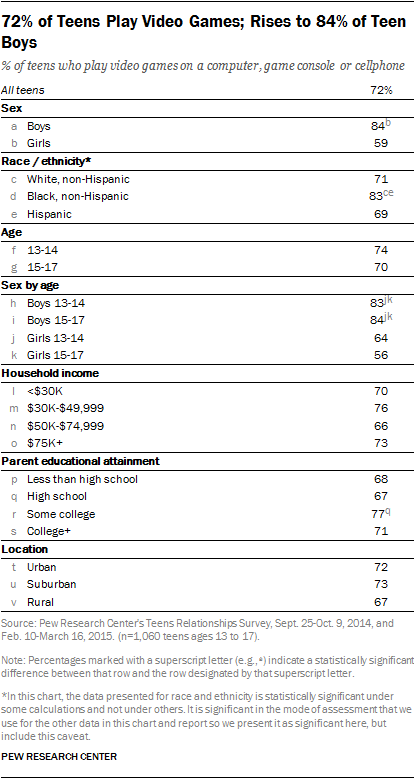
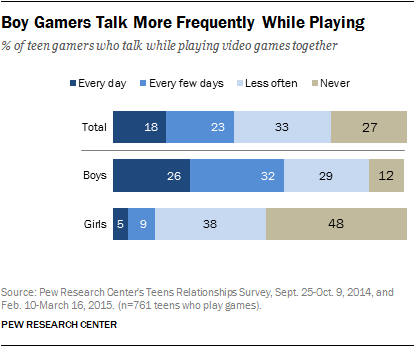
Among social media-using teens, those with more highly educated parents are more likely than teens with parents with lower levels of educational attainment to experience people posting things about them that they can’t change or control. Nearly half (48%) of social media-using teens whose parents have a college degree or more say content has been posted about them on social media that they can’t control, while 38% of teens whose parents have a high school diploma or less report similar experiences.

Chapter 5: Conflict, Friendships and Technology

Friendships also have a less pleasant side – one that includes conflict, disagreements and in some cases, the end of the relationship. Digital media plays a role in these less happy elements of teens’ friendships, both as a source of and platform for drama and conflict, and as a conduit through which the connection can be severed and walls erected when a friendship ends.

About One-Quarter of Teens Say They Frequently Experience Drama on Social Media

A Majority of Social Media-Using Teens Experience People Stirring Up Drama on Social Media

Previous research by Pew Research and others has noted that many teens use the term “drama” to describe conflict between peers, often in lieu of the term bullying. In this most recent study, 68% of teens who use social media have witnessed people stirring up drama on these platforms.

Girls are more likely than boys to say they witness the creation of drama on social media, with 72% of social media-using girls and 64% of boys encountering drama on the platforms. In a similar vein, older teens are also more likely to witness others stirring up drama on social media, with 72% of social media-using 15- to 17-year-olds seeing such behavior, compared with 62% of 13- and 14-year-olds. The oldest girls are the most likely of all groups to witness drama on social media, with 78% of them reporting such an experience.

Teens from higher-income households and whites are more likely to see people stirring up drama on social media

Teens from higher-income households are more likely to report people stirring up drama on social media sites than teens from lower-income households. Among social media-using teens whose families earn less than $30,000 in income annually, 59% say they experience people creating drama on social media, while 70% of social media-using youth from wealthier families say the same. Among both groups, teens are more likely to say they witness drama occasionally rather than frequently.

Nearly three-quarters (73%) of white teens who use social media see people foment drama on the platforms, compared with 58% of Hispanic youth. Fully 68% of black teens report seeing drama instigated on social media, a difference that is not statistically significantly from white or Hispanic teens.

Among social media users, those who use Snapchat, Twitter and Instagram are more likely than those who do not use these platforms to report seeing others create drama on social media, and Twitter and Snapchat users are among the most likely to say they see it “frequently.” Roughly eight-in-ten Snapchat users (79%) say they see this behavior on social media, with a full 28% saying they see it frequently. Among those who do not use Snapchat, 58% say they see drama created on social media and 18% see it happen frequently. Three-quarters of Twitter users see drama created through tweets and profiles and 29% say it happens frequently, compared with 64% of those who do not use Twitter (but use other social media platforms), including 19% who say it happens frequently. Among Instagram users, 73% say they see drama on social media, while 60% of those who don’t use Instagram as one of their social media platforms say the same.

[Facebook]

One thoughtful teen explains the way the disinhibiting effects and group relationships on social media can escalate conflict. “Things blow up a lot more on social media because a lot of things people say, they wouldn’t say to, like, your face in person. Things they kind of hide behind their screen or their phone. So it blows up a lot more on social media. And then, so once it blows up, people like start feeding in or they start feeding into somebody else. It’s like if you’re at school and like that person goes to school, it just becomes so big ‘cause they like come to confront you all the sudden ‘cause they have all these people over here, and it just turns worse.”

[of]

26% of Teens Have Fought With a Friend Because of Something That Happened Online

When it comes to fights moving from online to offline, most teens say digital technology has not been a main cause of disagreement among friends.

About one-in-four teens (26%) have fought with a friend because of something that first happened online or because of a text message. Still, a majority of teens (73%) have not been involved in a fight with a friend because of something that happened online.

Girls are more inclined than boys to report this type of experience: 32% of girls have been involved in a disagreement that first began online or because of a text message, compared with only 20% of boys.

32% of Teen Girls Have Fought With a Friend Because of Something That First Occurred Online or via Texting

Besides gender, there are also racial and ethnic differences. White teens are more likely than blacks to say they have had a fight with a friend that started in the digital realm: 29% of white teens have experienced this, compared with 15% of African-Americans. For Hispanic teens, that share is 25%, which is not a statistically significant difference from either black or white teens.
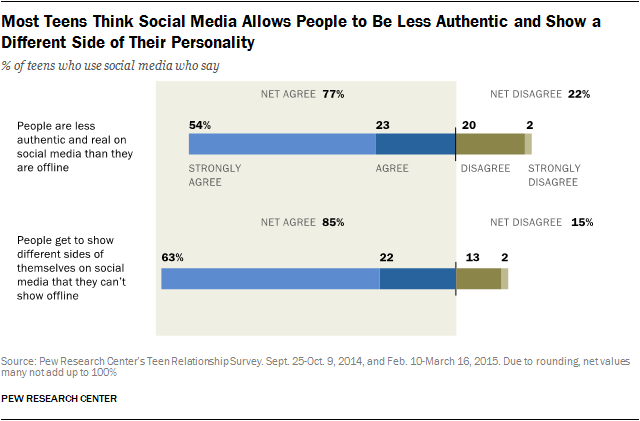
There are no significant differences between younger and older teens.

And while there are no significant differences based on household income, there are some variances based on the level of educational attainment of a teen’s parent. Among teens whose parents have a bachelor’s or advanced degree, 30% said yes when asked if they have had a disagreement with a friend about something that happened online or via text. That share is only 18% for teens whose parents have less than a high school education.

31% of social media users have fought with a friend over something that occurred online

Besides demographics, how teens use and interact with technology is correlated with whether they have had negative experiences facilitated by the web or a text message.

Social media use is a big predictor of whether a teen has been involved in a fight over something that occurred in a digital space. Some 31% of social media-using teens say they have quarreled with a friend because of something that happened online or by text; for teens who do not use social media, that share falls to 11%.

Teens who have a smartphone are more likely than those with basic phone or no phone at all to say they have had a disagreement with a friend about something that started online. Moreover, teens who access the web via a mobile device are more than twice as likely to say they have been involved in a fight with a friend that started online than teens who are not mobile internet users (28% vs. 12%).

Teens Who Have Access to Mobile Technology Are More Likely to Be Involved in Conflicts That Originate Online or in Text Messages

Teens in our focus group described some of the factors that contribute to online conflict. As one high school girl recounted, “Yeah … I had that happen before. It was a little misunderstanding on the way I typed something on Facebook. I’m like a really sarcastic person and … I don’t know. It was just the way I worded something … they took it seriously. We got into a really big fight over that. Afterwards, more people were involved. It was just like really petty and stupid. It was just ridiculous.”

A teen girl in one of our focus groups talked about challenges with closure and trust at the end of online fights versus in-person conflicts. “I feel like there’s more closure when you do something – when you, like, finish a fight – in person rather than online because then you know for a fact, like, what this person is saying to you is true and nobody else is a part of it. But when it’s online and you resolve something, you don’t know if it’s really resolved or if someone else was like typing for them or something like that. So it’s just really confusing sometimes.”

Many Teens Have Taken Steps to Alter Their Online Presence After a Friendship Ends

Whether precipitated by conflict, growing apart or some other factor, teen (and adult) friendships end. Along with questions about online disagreements, Pew Research also asked teens about what happens in digital spaces once a friendship has ended. Fully 60% of all teens have taken an action like unfriending, blocking or deleting photos of a former friend; girls are especially likely to have done at least one of these things.

After a Friendship Ends, Girls More Likely Than Boys to Take Steps to Unfriend, Block or Untag Photos of Former Friends

58% of teens have unfriended and unfollowed an ex-friend

When a friendship ends, teens can sever ties with their former buddy by disconnecting from them on social media, either by unfriending or unfollowing, depending on the social media platform. Fully 58% of teens who are on social media or have a cellphone have unfriended or unfollowed someone that they used be friends with. As with fights that start online, girls are more likely than boys to report doing this (63% vs. 53%). Older teens are more likely than their younger counterparts to unfriend or unfollow a former friend online. Some 61% of 15- to 17-year-old teens have unfriended or unfollowed someone they used to be friends with, compared with 52% of younger teens ages 13 to 14. There are few differences among racial and ethnic groups in reporting these actions.

Older teens and girls are more likely to have blocked a former friend

Beyond unfriending, teens have another option for removing someone from their digital network: blocking. Among teens who use social media or have a cellphone, 45% have blocked someone they were once friends with. Some 53% of girls reported that they have blocked someone after their friendship ended, while 37% of boys have done so. Blocking a former friend is less prevalent among the youngest teens. For example, while 33% of 13 year-olds have blocked someone they used to be friends with, nearly half (48%) of 17 year-olds have done so.
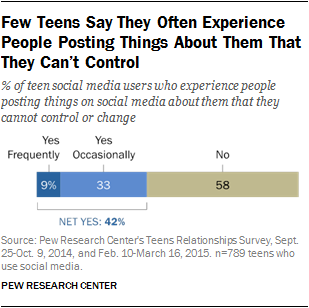
Four-in-ten teens prune photos at the end of a friendship

Another step that some teens take after a friendship ends is going online and removing photos of a former friend. About four-in-ten (42%) teens who use social media or cellphones have untagged or deleted photos of themselves and someone they used to be friends with. This is done much more frequently among girls, as half (49%) of girls have done this compared with only about a third (35%) of boys.

Some teens have taken multiple steps to digitally disconnect from an ex-friend

Roughly a third (32%) of teen social media or cellphone users have taken all three steps of unfriending or unfollowing, blocking and untagging or deleting photos after a friendship ends. Some 16% of this group has done two of the actions and another 16% has only done one of these items.

Teen girls (38%) are more likely than their male counterparts (26%) to have done all three of these actions after the breakup of a friendship. On the opposite end of the spectrum, boys are more likely than girls to say they have not taken any of these steps — 42% of teen boys who use social media or have a cellphone have never unfriended or unfollowed, blocked, or untagged or deleted photos of a former friend, compared with 29% of girls.

About This Report

This report is a collaborative effort based on the input and analysis of the following individuals who variously helped design (and translate) the quantitative instrument, conduct focus groups, analyze data, write the report and design graphics. This is the second of three reports based on this data collection that broadly examine how teens use technology particularly in the context of peer friendships and romantic relationships. The first report was Teen Social Media and Technology Overview 2015 and the third report on romantic relationships will follow later this year. Find related reports online at www.pewresearch.org/pewresearch-org/internet

Amanda Lenhart, Associate Director Lee Rainie, Director, Internet, Science, and Technology Research Aaron Smith, Associate Director Monica Anderson, Research Analyst Maeve Duggan, Research Associate Andrew Perrin, Research Assistant Kim Parker, Director, Social & Demographic Trends Eileen Patten, Research Analyst Anna Brown, Research Assistant Seth Motel, Research Assistant Ana Gonzalez-Barrera, Research Associate Margaret Porteus, Information Graphics Designer Shannon Greenwood, Assistant Digital Producer Aleksandra Sandstrom, Copy Editor

Methods

Study Design & Documentation

Introduction

The Pew Research Center’s Teen Relationship Study was funded, designed and analyzed by Center staff. Quantitative fieldwork was conducted by the GfK Group (GfK, formerly Knowledge Networks.) Specifically, the survey examined the attitudes of teens age 13 to 17 years old, as well as those of their parents, toward technology. The survey examined friendships and romantic relationships within the context of technology use. The survey was conducted using sample from KnowledgePanel®.

The study also conducted 12 in-person focus groups and four online focus groups. The in-person groups interviewed a total of 70 teens ages 13 to 17 years old in three cities in the United States in November 2014. In-person focus groups ranged in size from four to eight participants, and were separated by gender and divided by middle schoolers and high schoolers. Additionally, participants in four of the high school groups (two each with boys and girls) were required to have had some romantic relationship experience, either currently or in the past, to be in the group. Participants were paid a $50 incentive as a thank you for their participation in the research. Participants were recruited with the help of Resolution Research. The online focus groups, conducted in April 2014, ranged in size from seven to nine teens from around the United States in each group. The online groups interviewed a total of 32 teens ages 13 to 17. Each group was gender and age segregated (boys/girls and middle school/high school.) Each participant received a $60 incentive for their participation. The online focus groups were recruited and hosted by 20|20 Research and moderated by the lead author.

The rest of the Methods section describes details about the recruitment, interviewing and weighing of the quantitative survey.

Quantitative Sample Definition

The target population consists of the following: parents of teens age 13 to 17 and teens 13 to 17 years old residing in the United States. To sample the population, GfK sampled households from its KnowledgePanel, a probability-based web panel designed to be representative of the United States. The survey consisted of three stages: initial screening for the parents of teens age 13 to 17, the parent survey, and the teen survey.

The main data collection field periods were from September 25, 2014 through October 9, 2014 and from February 10, 2015 to March 16, 2015. The second data collection was targeted toward black parents and teenagers, with the intent of increasing to reportable levels the number of black teens in the sample. Parents completed the parent section of the survey in 6 minutes (median). Teens completed the teen section of the survey in 16 minutes (median). The survey was conducted in English and Spanish. Parents and teens could select different languages for the survey.

Survey Completion and Sample Sizes

The number of respondents sampled and participating in the survey, the survey completion rates for the screener and main interview, and the incidence/eligibility rate are presented below.

Key Survey Response Statistics: In-Field Screening

  • N Sampled for Screener: 4111
  • N Complete Screener: 1637
  • Screener Survey Completion Rate: 39.8%
  • Qualified for Main Survey: 1060
  • Incidence Rate: 64.7%
Margins of Error

While 1,084 parents completed the parent section of the main survey, 1,060 teens completed the teen section of the main survey; the 24 unpaired parents were not included in the final counts. The margin of error for the full sample of teens (n=1060) or parents (n=1060) is plus or minus 3.7 percentage points. Please see the adjacent chart for the margin of error for subsamples in this study.

Survey Cooperation Enhancements

As a standard, email reminders to non-responders were sent on day three of the field period. Beyond the standard email reminder on day three of the field period, the following steps were also taken:

  • Additional email reminders to non-responders were sent on day 7 of the field period;
  • Teens received a cash-equivalent of $5 for their participation;

Documentation regarding KnowledgePanel sampling, data collection procedures, weighting, and IRB-bearing issues are available at the below online resources.

  • http://www.knowledgenetworks.com/ganp/reviewer-info.html
  • http://www.knowledgenetworks.com/knpanel/index.html
  • http://www.knowledgenetworks.com/ganp/irbsupport/

KnowledgePanel Methods Information

Complete and current information about KnowledgePanel sampling and recruitment methodology and design is available at: http://www.gfk.com/Documents/GfK-KnowledgePanel-Design-Summary.pdf

KnowledgePanel’s recruitment process uses an Address Based Sampling (ABS) methodology for selecting panel members. This probability-based sampling methodology improves population coverage, and provides a more effective sampling infrastructure for recruitment of hard-to-reach individuals, such as young adults and those from various minority groups. It should be noted that under the ABS recruitment households without Internet connection are provided with a web-enabled device and free Internet service.

After initially accepting the invitation to join the panel, participants are asked to complete a short demographic survey (the initial profile survey); answers to which allow efficient panel sampling and weighting for future surveys. Completion of the profile survey allows participants to become panel members, and all respondents are provided the same privacy terms and confidentiality protections.

ABS Recruitment

The ABS recruitment protocol relies on probability-based sampling of addresses from the United States Postal Service’s Delivery Sequence File (DSF). The key advantage of the ABS methodology is that it allows sampling of almost all United States households. Regardless of household telephone status, all households can be reached and contacted through postal mail. Pre-identified ancillary information about addresses was used to construct and target households in the following four sampling strata:

  • Hispanic ages 18-29
  • Non-Hispanic ages 18-29
  • Hispanic ages 30+
  • Non-Hispanic ages 30+

As detailed below, specific adjustments are applied to compensate for any oversampling that is carried out to improve the demographic composition of the panel.

Randomly sampled addresses from the DSF are invited to join KnowledgePanel through a series of mailings, including an initial invitation letter, a reminder postcard, and a subsequent follow-up letter. Given that approximately 45% of the physical addresses can be matched to a corresponding landline telephone number, about 5 weeks after the initial mailing, telephone refusal-conversion calls are made to households for whom a telephone number was matched to the sampled address. Invited households can join the panel by:

  • Completing and mailing back a paper form in a postage-paid envelope
  • Calling a toll-free hotline phone number maintained by GfK

Going to a designated GfK website and completing the recruitment form at the website

Household Member Recruitment

For all recruitment efforts, during the initial recruitment survey, all household members are enumerated. Following enumeration, attempts are made to recruit every household member who is at least 13 years old to participate in KnowledgePanel surveys. For household members aged 13 to 17, consent is collected from the parents or the legal guardian during the initial recruitment interview. If no consent is given, no further direct communication with the teenagers is attempted.

Survey Sampling from KnowledgePanel

For this survey, a nationally representative sample of U.S. parents of teens ages 13 to 17 was selected. The general sampling rule is to assign no more than one survey per week to individual members. Allowing for rare exceptions during some weeks, this limits a member’s total assignments per month to four or six surveys.

Survey Administration

Once assigned to a survey, members receive a notification email letting them know there is a new survey available for them to take. This email notification contains a link that sends them to the survey questionnaire.

After three days, automatic email reminders are sent to all non-responding panel members in the sample. If email reminders do not generate a sufficient response, an automated telephone reminder call can be initiated. The usual protocol is to wait at least three to four days after the email reminder before calling. To assist panel members with their survey taking, each individual has a personalized “home page” that lists all the surveys that were assigned to that member and have yet to be completed.

GfK also operates an ongoing modest incentive program to encourage participation and create member loyalty. Members can enter special raffles or can be entered into special sweepstakes with both cash rewards and other prizes to be won.

The typical survey commitment for panel members is one survey per week or four per month with duration of 10 to 15 minutes per survey. In the case of longer surveys, an additional incentive is typically provided.

Sample Weighting

For selection of general population samples from the Knowledge Panel (KP), however, a patented methodology has been developed that ensures the resulting samples behave as EPSEM (Equal Probability of Selection Method) samples. Briefly, this methodology starts by weighting the entire KP to the benchmarks secured from the latest March supplement of the Current Population Survey (CPS) along several dimensions. This way, the weighted distribution of the Knowledge Panel matches that of the US adults – even with respect to the few dimensions where minor misalignments may result from differential attrition rates.

Study-Specific Post-Stratification Weights

Once the study sample has been selected and fielded, and all the survey data are edited and made final, design weights are adjusted for any survey nonresponse as well as any under- or over-coverage imposed by the study-specific sample design. Depending on the specific target population for a given study, geo-demographic distributions for the corresponding population are obtained from the CPS, the American Community Survey (ACS) or in certain instances from the weighted KP profile data. For this purpose an iterative proportional fitting (raking) procedure is used to produce final weights that will be aligned with respect to all study benchmark distributions simultaneously. In the final step, calculated weights are examined to identify and, if necessary, trim outliers at the extreme upper and lower tails of the weight distribution. The resulting weights are then scaled to the sum of the total sample size of all eligible respondents.

For this study, the following benchmark distributions of parents with teens age 13 to 17 from the 2010-2012 American Community Survey (ACS) were used for the raking adjustment of weights for parents (par_weight):

  • Gender (Male/Female) by Age (18–39, 40–49, and 50+)
  • Race/Hispanic ethnicity (White/Non-Hispanic, Black/Non-Hispanic, Other/Non-Hispanic, 2+ Races/Non-Hispanic, Hispanic)
  • Metropolitan Area (Yes, No) by Census Region (Northeast, Midwest, South, West)
  • Education (Less than High School, High School, Some College, Bachelor and beyond)
  • Household income (under $25k, $25K to <$50k, $50K to <$75k, $75K to <$100k, $100K+)
  • Primary Language (English-dominant, Bilingual, Spanish-dominant, Non-Hispanic)
  • Age (18–39, 40–49, and 50+) by Race/Hispanic ethnicity (White/Non-Hispanic, Black/Non-Hispanic, Other/Non-Hispanic, 2+ Races/Non-Hispanic, Hispanic)
  • Gender (Male/Female) By Race/Hispanic ethnicity (White/Non-Hispanic, Black/Non-Hispanic, Other/Non-Hispanic, 2+ Races/Non-Hispanic, Hispanic) (collapsed metro status together for Others/2+ Races because of not enough cases))
  • Census Region (Northeast, Midwest, South, West) by Race/Hispanic ethnicity (White/Non-Hispanic, Black/Non-Hispanic, Other/Non-Hispanic, 2+ Races/Non-Hispanic, Hispanic)
  • Education (Less than High School, High School, Some College, Bachelor and beyond) by Race/Hispanic ethnicity (White/Non-Hispanic, Black/Non-Hispanic, Other/Non-Hispanic, 2+ Races/Non-Hispanic, Hispanic) (collapsed HS/LHS for AA and HS/LHS for Others/2+ Races)
  • Household income (under $25k, $25K to <$50k, $50K to <$75k, $75K to <$100k, $100K+) by Race/Hispanic ethnicity (White/Non-Hispanic, Black/Non-Hispanic, Other/Non-Hispanic, 2+ Races/Non-Hispanic, Hispanic) (collapsed income into two categories for Others/2+ Races — (under $50K, $50K+))
  • Metropolitan Area (Yes, No) by Race/Hispanic ethnicity (White/Non-Hispanic, Black/Non-Hispanic, Other/Non-Hispanic, 2+ Races/Non-Hispanic, Hispanic) (collapsed metro status together for Others/2+ Races because of not enough cases)

The following benchmark distributions of children age 13 to 17 from the 2014 March Supplement of the Current Population Survey (CPS) were used for the raking adjustment of weights for teens (teen_weight):

  • Gender (Male/Female) by Age (13, 14, 15, 16, 17)
  • Teen Race/Hispanic ethnicity (White/Non-Hispanic, Black/Non-Hispanic, Other/Non-Hispanic, 2+ Races/Non-Hispanic, Hispanic)
  • Metropolitan Area (Yes, No) by Census Region (Northeast, Midwest, South, West)
  • Age (13, 14, 15, 16, 17) by Teen Race/Hispanic ethnicity (White/Non-Hispanic, Black/Non-Hispanic, Other/Non-Hispanic, 2+ Races/Non-Hispanic, Hispanic)
  • Gender (Male/Female) by Teen Race/Hispanic ethnicity (White/Non-Hispanic, Black/Non-Hispanic, Other/Non-Hispanic, 2+ Races/Non-Hispanic, Hispanic)
  • Census Region (Northeast, Midwest, South, West) by Teen Race/Hispanic ethnicity (White/Non-Hispanic, Black/Non-Hispanic, Other/Non-Hispanic, 2+ Races/Non-Hispanic, Hispanic)
  • Metropolitan Area (Yes, No) by Teen Race/Hispanic ethnicity (White/Non-Hispanic, Black/Non-Hispanic, Other/Non-Hispanic, 2+ Races/Non-Hispanic, Hispanic)
  • Parental Education (Less than High School, High School, Some College, Bachelor and beyond) by Parental Race/Hispanic ethnicity (White/Non-Hispanic, Black/Non-Hispanic, Other/Non-Hispanic, 2+ Races/Non-Hispanic, Hispanic) (collapsed HS/LHS for AA and HS/LHS for Others/2+ Races)

The starting weight for teens is the final parent weight multiplied by the number of children age 13 to 17 years old in the household (1, 2+).

Detailed information on the demographic distributions of the benchmarks is available upon request. Please contact Kyley McGeeney at KMcGeeney@PewResearch.org for more information about the study methodology.

Pew Research Center is a nonprofit, tax-exempt 501(c)3 organization and a subsidiary of The Pew Charitable Trusts, its primary funder.