Pew Research Center

FOR RELEASE JULY 16, 2015

Parents and Social Media

Mothers are especially likely to give and receive support on social media

BY Maeve Duggan, Amanda Lenhart, Cliff Lampe and Nicole B. Ellison

FOR MEDIA OR OTHER INQUIRIES:

Communications Department
202.419.4372
www.pewresearch.org

RECOMMENDED CITATION

Pew Research Center, July 2015, "Parents and Social Media"

About Pew Research Center

Pew Research Center is a nonpartisan, nonadvocacy fact tank that informs the public about the issues, attitudes and trends shaping the world. It does not take policy positions. The Center conducts public opinion polling, demographic research, computational social science research and other data-driven research. It studies politics and policy; news habits and media; the internet and technology; religion; race and ethnicity; international affairs; social, demographic and economic trends; science; research methodology and data science; and immigration and migration. Pew Research Center is a subsidiary of The Pew Charitable Trusts, its primary funder.

© Pew Research Center 2026

Table of contents

  • About Pew Research Center
  • Parents and Social Media
  • Introduction
  • Main Findings
  • Parents, social support and outreach on social media
  • Seeking parenting advice on social media
  • Concerns about children, social media and technology use
  • About This Report
  • Appendix A
  • Methodology

Parents and Social Media

Mothers are especially likely to give and receive support on social media

Social media networks have become vital channels for Americans’ daily interactions. Users rely on these platforms to keep in touch with family and friends, gather information and share what is important to them. This report explores how parents – 75% of whom use social media – turn to social media for parenting-related information and social support.1

Mothers Give and Receive Support on Social Media

Mothers are heavily engaged on social media, both giving and receiving a high level of support via their networks.

Social media networks are host to a wide range of human experiences; they help connect people with one another in both good times and bad. Parents – in this study defined as those with children under 18 – are especially likely to try to respond to the good news others post, answer others’ questions or receive support via online networks. This is true for all kinds of personal matters they encounter – not just parenting posts. While somewhat less common, a majority of parents agree that they try to respond to bad news as well. Mothers are more likely than fathers to engage their networks across a variety of these outreach and support examples:

  • 81% of parents who use social media try to respond to good news others share in their networks, including 45% of social-media-using parents who “strongly agree” that they do so. Some 53% of mothers say they “strongly agree,” compared with 33% of fathers who say that.
  • 74% of parents who use social media get support from their friends there.2 Digging into the data, 35% of social-media-using parents “strongly agree” that they get support from friends on social media. Fully 45% of mothers who use social media “strongly agree” that they get support from friends on social media, compared with just 22% of fathers.
  • 71% of all parents on social media try to respond if they know the answer to a question posed by someone in their online network. About a third (32%) of parents who use social media “strongly agree” that they try to respond to questions. Mothers and fathers are relatively similar in their responsiveness to questions on social media; 35% of mothers say they “strongly agree” that they make an effort to respond to questions, compared with 28% of fathers.
  • 58% of parents who use social media try to respond when a friend or acquaintance shares bad news online. Mothers are particularly likely to “strongly agree” that they try to do this – 31% say so, compared with 21% of fathers.

Social media is broadly viewed as a source of useful information and as one parenting tool among a collection of options. Mothers use it as a parenting resource slightly more often than fathers.

While a large share of parents find value in social media as a general information resource, fewer say they come across useful parenting information while using social media. At the same time, one-in-four say they get support from their networks for parenting issues, and mothers who use social media are more than three times as likely as fathers to say they get support.

  • 79% of parents who use social media agree that they get useful information via their networks. One-in-three (32%) “strongly agree” that they get useful information. Mothers are just as likely as fathers to “strongly agree” that they find useful information through their social media networks (35% vs. 27%).
  • Social Media is One of Many Sources for Parenting Advice and Information

    59% of social-media-using parents indicate that they have come across useful information specifically about parenting in the last 30 days while looking at other social media content. Mothers are particularly likely to encounter helpful parenting information – 66% have done so in the last 30 days, compared with 48% of fathers.

  • 42% of these parents have received social or emotional support from their online networks about a parenting issue in the last 30 days. This includes 50% of mothers, compared with 28% of fathers on social media.
  • 31% of parents who use social media have posed parenting questions to their online networks in the last 30 days. Mothers and fathers are equally likely to do so.

Few parents say they have felt uncomfortable when information about their children is shared by other family members or caregivers on social media.

Most parents have not felt uneasy about the content posted about their children by other family members or caregivers on social media.

  • 12% of all parents of children under 18 say they have ever felt uncomfortable about something posted about their child on social media by a spouse, family member or friend. Fully 88% say they have not felt this way.
  • 11% of all parents have ever asked for content about their child posted by a family member, caregiver or friend to be removed from social media.

Parents, like non-parents, use a variety of social media platforms.

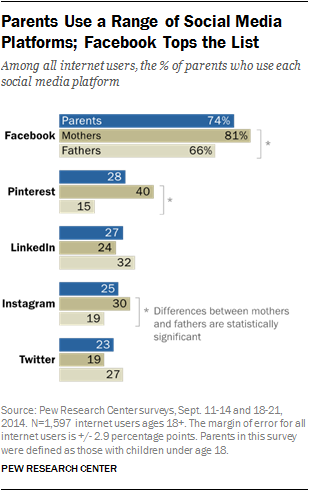
This survey also took a broad look at the social media habits of parents. Among internet-using parents,3 social media use across a variety of platforms is common. Parents look a lot like non-parents in this regard, though there are differences between mothers and fathers:

  • Parents Use a Range of Social Media Platforms; Facebook Tops the List

    Three-quarters of online parents use Facebook, as do 70% of non-parents. Mothers are more likely to use Facebook than fathers, with 81% of moms and 66% of dads using the platform.

  • 28% of online parents use Pinterest, including 40% of mothers and 15% of fathers.
  • 27% of online parents use LinkedIn. Mothers and fathers are equally likely to use LinkedIn.
  • 25% of online parents are Instagram users. Mothers are more likely than fathers to use the platform, 30% vs. 19%. Younger parents (those under 40) also are more likely to use Instagram than older parents, 33% vs. 18%.
  • 23% of online parents use Twitter. Moms and dads are equally as likely to use Twitter.

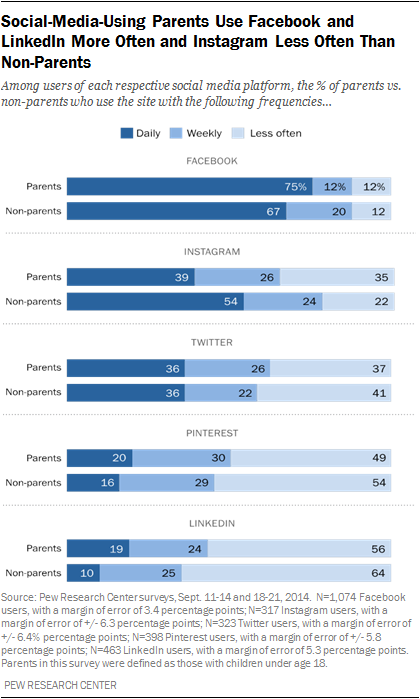
Parents are particularly active on Facebook and LinkedIn, while non-parents use Instagram more frequently.

  • Social-Media-Using Parents Use Facebook and LinkedIn More Often and Instagram Less Often Than Non-Parents

    Parents on Facebook are especially avid users: 75% log on daily, including 51% who do so several times a day. This is a statistically significant difference when compared with non-parents, of whom 67% log on to Facebook daily, including 42% who do so several times a day. Mothers on Facebook are more likely to check the platform several times a day compared with fathers, 56% vs. 43%.

  • Parents who use LinkedIn are more likely than non-parents to use the site daily (19% vs. 10% of non-parents).
  • Parents who use Instagram are not as active as non-parent users. Some 54% of non-parents who use Instagram say they use the site daily, compared with 39% of parents.
  • Among Twitter and Pinterest users, there are few statistically significant differences in how frequently parents and non-parents use the platforms.

How parents use Facebook

Given Facebook’s status as the most popular social media platform, this report takes a deeper look into the network composition and habits of parents on the network: Three-quarters (74%) of parents use Facebook.

Parents, particularly mothers, interact with their networks frequently.
Mothers More Likely to Interact With Their Facebook Networks

Fully 94% of Facebook-using parents share, post or comment on Facebook (as opposed to simply reading or viewing content), with 70% of parents doing so “frequently” or “sometimes.” This compares to a statistically similar 93% of non-parents who say they ever post content to the platform.

Overall, mothers and fathers who use Facebook are equally likely to say they ever share, post, or comment on Facebook. However, mothers are more likely to do this with greater frequency. Some 76% of mothers on Facebook say they do so “frequently” or “sometimes,” compared with 61% of fathers who say the same.

A typical parent has 150 Facebook friends. One-third of them are “actual” friends.

Among parents, the median number of Facebook friends is 150, while the typical non-parent Facebook user has a median of 200 friends. The largest group of parents on Facebook (42%) have between 0 and 100 Facebook friends on the network. Another 20% of parents say they have between 101 and 250 friends, while 23% have between 251 and 500 friends. Non-parents are more likely than parents to have very large Facebook networks — 16% of non-parent Facebook users have more than 500 Facebook friends, compared with 11% of parents.

Facebook networks are composed of a variety of people, not all of whom are necessarily considered close. Parents who use Facebook were asked how many of their friends on the platform they considered “actual friends.” A majority, 76%, said they considered between 0 and 100 of their Facebook friends “actual friends.” The typical parent reports a median of 50 “actual” Facebook friends, while the typical non-parent counts 40 of their Facebook friends as “actual” friends. As noted above, parents report having a median of 150 Facebook friends, and non-parents report having a median of 200 Facebook friends. Thus, a typical parent’s Facebook network is about one-third “actual” friends, while non-parents typically report that less than a quarter of their network is made up of actual friends.4

More Than a Few Good Friends
Family and friends make up the bulk of Facebook networks for parents and non-parents alike.

Family and friends, both new and old, are the most common types of connections in users’ Facebook networks.

  • 93% of parents who use Facebook are friends with family members other than their parents or children on the network.
  • 88% are Facebook friends with their current friends.
  • 88% are connected with friends from the past, such as high school or college classmates.
  • 60% are friends with their work colleagues.
  • 53% are friends with their parents.
  • 47% are friends with their children on Facebook.
  • 41% are connected with people they have never met in person.
  • 41% are friends with their neighbors.

Parents are more likely to be Facebook friends with their parents than non-parents, 53% vs. 40%. They also are more likely to be friends with their neighbors on the network, 41% vs. 34% of non-parents.

Age is a major factor in who makes up the bulk of parents’ Facebook networks. Some 93% of younger parents (those under age 40) who use Facebook are connected with friends from the past. This is significantly more than the 83% of older parents (those ages 40 and older) who say the same. Younger parents also are more likely to be Facebook friends with their own parents (71% vs. 35%).

Older parents, those ages 40 and above, are more likely to be friends with their children on Facebook. Some 65% said so, compared with 30% of younger parents. These findings likely reflect the fact that Facebook requires users to be ages 13 and older.5

Parents More Likely to Be Friends With Their Own Parents and Neighbors

The data reported here were collected in two telephone surveys conducted by PSRAI and fielded from Sept. 11 to 14, 2014, and Sept. 18 to 21, 2014. The surveys interviewed a nationally representative sample of 2,003 American adults ages 18 and older. Telephone interviews were conducted by landline (1,002) and cell phone (1,001, including 594 without a landline phone). Interviews were conducted in English and Spanish by Princeton Data Source from Sept. 11 to 14, 2014, and Sept. 18 to 21, 2014. Statistical results are weighted to correct known demographic discrepancies. The margin of sampling error for the complete set of weighted data is ± 2.5 percentage points.
Introduction

Social media have become significant platforms for meaningful and important human interactions. While there are many ways that people use social networking sites to engage in politics and civic activities,6 exchange important health information,7 interact with government,8 learn in formal and informal settings9 and perform their jobs,10 people also use social media to offer each other social and emotional support. For instance, recent research has looked at how Facebook users broadcast requests for help to their networks.11 Those who reported trying to respond to requests from their friends had higher perceptions of support from their networks, highlighting the reciprocal nature of giving and getting support on social media.12 In addition, asking for help – posting requests to one’s network – is an important part of getting support through social media.13

This report documents the variety of ways parents use social media in their lives – in many cases for the purpose of receiving or offering support. Research on how mothers use social media shows that while mothers do have concerns about privacy and oversharing, they still see benefits from sharing information about their children via the social support and validation they receive.14 Social media also allow parents to share their own experiences with parenting, through answering questions and sharing information about their own children. This report also measures which social media platforms parents are using and how parents construct their networks of connections on those networks. And, finally, the report takes a deeper dive into parents’ use of Facebook, the most widely used social media platform.

Main Findings

Parents use a variety of social network sites, with Facebook being the most popular. Usage rates for social media are similar to those of non-parents.

Fully 91% of parents15 in this survey use the internet. This is significantly higher than rates seen in the general adult population 16 and among those adults who are not parents.

Parents Use a Range of Social Media Platforms; Facebook Tops the List

Among these internet-using parents, social media use across a variety of platforms is common, with 83% of parents using social media.17 The most popular platform among parents (and non-parents) is Facebook. Almost three-quarters of online parents (74%) use Facebook, a proportion similar to the 70% of non-parents who use the platform. Online mothers are more likely than online fathers to use Facebook – 81% vs. 66%. This reflects broader trends in social media use. While men and women are equally likely to say they use social networking sites18, women are more likely to be users of specific platforms19 like Facebook, Instagram, and Pinterest.

Mothers and fathers differ in their use of Instagram and Pinterest.

Parents and non-parents are equally embrace Pinterest and Instagram – among parents, 28% use Pinterest and 25% use Instagram. The greatest variation in use of the platforms is between moms and dads. Online mothers are more than twice as likely to use Pinterest than online fathers – some 40% of mothers do so compared with 15% of fathers. This echoes the popularity of Pinterest among online women more generally – they are three times as likely to use Pinterest as online men, 42% vs. 13%. A similar pattern emerges with Instagram. Mothers who use the internet are more likely than fathers to use Instagram, 30% vs. 19%. Again, this tracks with the broader trend that online women are more likely than men to use Instagram, 29% vs. 22%.

A quarter (27%) of online parents use LinkedIn, and 23% use Twitter. Again, these levels of use are consistent with the usage of non-parents. And, with these platforms, there is not a statistical difference in use of Twitter or LinkedIn between moms and dads.

There are few demographic differences among parents across platforms. Younger parents (those under 40) are more likely to use Instagram than are older parents, 33% vs. 18%. Parents of younger children also are more likely to be Instagram users. Among online parents who only have children ages 5 or under, 35% use Instagram. This is a significant difference when compared with the 22% of remaining parents with children over age 5 who use Instagram.

Parents — particularly moms and younger parents — are active users of Facebook.

Social-Media-Using Parents Use Facebook and LinkedIn More Often and Instagram Less Often Than Non-Parents

Facebook is not only the most popular social media site overall, it also has an especially engaged network of parents. Among parents who use Facebook, fully 75% log on daily, including 51% who do so several times a day. This proportion of daily users is significant compared with non-parents, 67% of whom log on daily, including 42% who use Facebook several times a day. Another 12% each of Facebook-using parents log on weekly and less often, respectively.

Moms who use Facebook are more likely to check the platform several times a day compared with dads (56% vs. 43%). Younger parents (those under age 40) also are more likely to use Facebook on a daily basis than are parents ages 40 and older. Some 82% of parents under age 40 log on daily, compared with 68% of older parents. Older parents are more likely to log on weekly; 18% use the site weekly vs. 7% of younger parents.

Instagram users also tend to log on frequently, although parents use the site less often when compared with non-parents. Some 39% of parents on Instagram use the platform daily, significantly less than the 54% of non-parents who do so.

Parents who are LinkedIn users are more likely than non-parents to use the site daily – 19% do so vs. 10% of non-parents. There are no statistically significant differences in how frequently parents and non-parents use Twitter or Pinterest.

Parents, social support and outreach on social media

Parents reach out in a variety of ways to provide social support to their networks online. Mothers are particularly active in responding to their networks in both good times and bad.

Social media is used by parents to reach out to friends, family, and acquaintances – particularly in moments of celebration or hardship. To gauge what role social media plays in these connections, social media users were asked a series of questions about the social support they both give and receive online.

In general, parents tend to engage with the positive online, such as responding to good news others post, answering others’ questions, or receiving support via their social networks. Still, a majority agreed that they try to respond to the bad news shared in their network as well.

Mothers are particularly likely to say they both give and receive support via social media. Fathers, on the other hand, are more likely to disagree that they use social media in this way.

Half of mothers and one-third of fathers strongly agree that they try to respond to good news posted on social media.

Parents, Particularly Mothers, Respond to Good News on Social Media

Good news likes company on social media – almost eight-in-ten (79%) social media users agree that when they see a friend or acquaintance sharing good news, they “try to respond.” Of all the support questions asked, this received the most positive response, with 39% of social media users saying they “strongly agree.”

Parents on social media are particularly likely to “strongly agree” that they try to respond to good news shared on social media – 45% say so compared with 36% of non-parents. More than half of mothers (53%) “strongly agree” that they try to respond to good news, substantially more than the one-third of fathers who say the same. A quarter of fathers (26%) “disagree” or “strongly disagree” that they try to respond to good news shared on social media – this compares to 11% of mothers who say the same.

Nearly three-quarters of parents receive support from others on social media.

Mothers Give and Receive Support on Social Media

Almost three-quarters of parents on social media (74%) agree that they receive support on the platforms, 35% of whom “strongly agree.” This is similar to the 70% of non-parents who agree they are supported on social media, including 31% who “strongly agree.”

Mothers who use social media are particularly likely to say they agree – 80% say they “somewhat” or “strongly” agree that they receive support via social media, compared with 65% of fathers. Among mothers, 45% “strongly” agree, compared with just 22% of fathers who say they receive social support through social media. Conversely, fathers who use social media are more likely to disagree than mothers that they receive support via social media, 31% vs. 19% of mothers.

Mothers are more likely to agree that they try to respond if they know the answer to a question asked on social media.

About two-thirds of social media users (68%) agree that they try to respond if they know the answer to a question asked by someone on social media, and 29% “strongly agree.” This matches closely with parents and non-parents alike. About seven-in-ten parents on social media (71%) try to respond to questions; of those, about a third “strongly agree” they try to do so (32%). Likewise, two-thirds of non-parents on social media agree that they respond to questions, including 28% who “strongly agree.”

Mothers who use social media are particularly likely to agree, with 77% saying they “somewhat” or “strongly” agree that they try to answer the questions of others on social media. This compares with 64% of fathers, a significant difference. Fathers who use social media are particularly likely to say they “somewhat” or “strongly disagree” – 35% compared with 21% of mothers.

More than half of parents try to respond to bad news on social media.

When responding to bad news on social media, parents are not very different from the overall social-media-using population. Some 58% of parents, like the 59% of social media users generally, agree that they try to respond to bad news, including 27% who “strongly agree.” Mothers are particularly likely to “strongly agree” that they try to respond to others who share bad news on social media – 31% say so compared with 21% of fathers.

Seeking parenting advice on social media

Social media is broadly viewed as a source of useful information and as one tool in parenting toolkits. Mothers use social media as a parenting resource slightly more often than fathers.

While a large share of parents find value in social media as a general information resource, fewer say that they come across useful parenting information while using social media. At the same time, two-in-five parents who use social media say they got support from their networks for parenting issues over the past month, and mothers who use social media are nearly twice as likely as fathers to say they get support.

A majority of social media users and parents agree that social media is a source of useful information.

More than three-quarters (79%) of parents who use social media agree that they get useful information from their social media networks, including 32% who “strongly agree,” a proportion similar to that of all social media users (75%) and non-parents.

Social Media is One of Many Sources for Parenting Advice and Information

While parents are avid users of social media, not all seek it out as a primary parenting resource.

Parents who use social media were asked about the advice they seek, the useful parenting information they come across while looking at other content and the emotional support they receive via social media.20

59% of parents have come across useful information about parenting while looking at social media in the last month.

Many parents come across useful parenting information incidentally, as they browse other content on social media. Some 59% of parents who are social media users said they had ever come across useful information about parenting while looking at social media content in the past 30 days. Just 7% say this happens “frequently,” while 26% each say this occurs “sometimes” or “hardly ever.”

Mothers who use social media are particularly likely to encounter helpful parenting information while looking at social media content – 66% have ever done so in the past 30 days, compared with 48% of fathers. A third of mothers (34%) say they “sometimes” get helpful parenting information from their social networks, and an additional 10% say this occurs “frequently.” This compares with 14% of fathers who “sometimes” find useful parenting information on their social networks and 3% who do so “frequently.” Furthermore, fathers are more likely than mothers to say they “never” come across useful parenting information on social media– 51% vs. 33%.

Parents living in households with an annual income of less than $50,000 are somewhat more likely to come across useful parenting advice with greater frequency –10% do so “frequently” compared with 4% of higher-income parents on social media. Conversely, affluent parents are more likely to say they “hardly ever” come across useful parenting information – 37% say so compared with 15% of less-affluent parent social media users.

42% of social-media-using parents received social or emotional support around a parenting issue on social media in the last month.

Parents use social media for support around parenting topics, although they do not necessarily do so particularly frequently. Overall, 42% of parents who use social media say that in the previous month, they received social or emotional support around a parenting issue on social media, while 58% said they never received such support. Just 8% of parents on social media said they received this kind of support “frequently,” over the previous month, while 16% said they did so “sometimes” and another 18% said this “hardly ever” occurred.

Mothers are again more likely to experience this support on social media. Half of mothers on social media said they received social or emotional support about a parenting issue over the previous month, including 11% who say this happens “frequently” and another 22% who said it occurred “sometimes.” This compares with 28% of fathers who had received this kind of support over the last month. Another 72% of fathers on social media said they had “never” received social or emotional support about a parenting issue, a significant difference compared to the 49% of mothers who say the same.

Previous studies have shown that while social media is certainly a source of support, support is not always a primary motivation for many users who participate in these networks online. Some 23% of Facebook users said receiving support from people in their network is a “major” reason they use the site. Other benefits, like sharing photos and seeing humorous content, were more frequently cited.21

About a third of social-media-using parents have asked a parenting question of their social media networks in the last month.

Some parents on social media ask questions of their networks about parenting issues, but they do not do so frequently. Overall, 31% of parents had asked parenting questions of their online social networks over the previous month. Just 3% asked such questions “frequently,” while another 10% did so “sometimes” and 18% said they “hardly ever” did this. Fully 69% of parents on social media said they “never” asked questions about parenting over the past 30 days. There are no significant differences between demographic groups.

Concerns about children, social media and technology use

One-in-three parents say they have had concerns or questions about their child’s technology use in the last year.

Previous research about teenagers and technology shows that parents of teens are both supportive and wary of their child’s use of the internet, social media, and cell phones.22 Many also take an active role in monitoring their teen’s online behavior and engaging in conversations about what is and is not appropriate to share online.23

In this survey, 33% of parents24 said they have had concerns or questions about their child’s technology use in the past 12 months. Mothers and fathers are equally likely to have had concerns and questions. Parents who have children over the age of 5 are significantly more likely than parents who only have children under age 5 to say they have had questions or concerns of this type over the past year (36% vs. 21%).

Most parents say they have not felt uncomfortable about the information posted about their child by others online; few have requested content be removed.

Parents show relatively low levels of concern about what others have posted about their child online. Just 12% of parents say they have ever felt uncomfortable about something a spouse, family member, or friend posted about their child on social media. Fully 88% say they have not felt this way.

Parents of younger children tend to be a bit more sensitive about the content that is posted about their child. Among parents who only have children age 11 or younger, 14% say they have ever felt uncomfortable about something a spouse, family member, or friend posted about their child on social media. This compares with 3% of parents who only have children age 12 and older. There were no other significant differences by demographic group.

However, when parents do feel uncomfortable, many are likely to ask the poster to remove the offending content. Overall, 11% of parents have ever asked a family member, caregiver, or friend to take something about their child down from social media.

Parents and their Facebook Networks

Given the ubiquity of Facebook and its status as the most popular social networking site, this survey took a deeper dive into the interactions and characteristics that make up users’ networks, revealing where parents’ networks are similar and different compared with non-parents.

The typical parent has 150 Facebook friends.

Parents 25 on Facebook have a median of 150 friends, while non-parents typically have 200 Facebook friends. Digging into the data, the largest group of parents on Facebook (42%) has between 0 and 100 friends on the network. Another 20% of parents say they have between 101 and 250 friends, while 23% have between 251 and 500 friends. There are no statistically significant differences between parents and non-parents at these levels.

When looking at those with more than 500 Facebook friends, however, non-parents are more likely to have the largest networks. Some 16% of non-parents on Facebook say they have more than 500 Facebook friends, compared with 11% of parents on Facebook. There are no statistically significant differences in the size of Facebook networks between parent demographic groups like age, gender, income, and education level.

Parents Have Similar Network Sizes to Non-Parents
One-third of parents’ Facebook friends are “actual” friends; less than a quarter of non-parents’ Facebook friends are actual friends.

Facebook networks are composed of a variety of people, not all of whom are necessarily considered close. Facebook users were asked how many of their friends on the platform they considered “actual friends.”

The typical parent says they have 50 “actual” friends on Facebook, while the typical non-parent counts 40 of their Facebook friends as “actual” friends.26 As noted above, parents typically have 150 Facebook friends, and non-parents typically have 200 Facebook friends. Thus, a typical parent’s Facebook network is about one-third “actual” friends, while non-parents typically report that less than a quarter of their network is made up of actual friends.

There were no demographic differences in the number of “actual” friends on Facebook between parents by age, gender, income, or education level.

A Few Good Friends

Mothers are more likely than fathers to share, post or comment on Facebook

Mothers More Likely to Interact With Their Facebook Networks

Overall, 94% of parents who use Facebook ever post, share or comment on the platform. And parents are relatively active sharers of content. Fully 70% of parents on Facebook say they “frequently” or “sometimes” share, post, or comment on Facebook as opposed to simply reading or viewing content, including 30% who do so “frequently.” Parents, as a whole, are not different from non-parents in their likelihood or frequency of posting to Facebook, but, among parents, mothers and fathers do differ in their frequency of sharing.

Mothers are significantly more likely than fathers to engage with others on Facebook – 76% do so “frequently” or “sometimes” compared with 61% of fathers who say the same. Some 37% of mothers share, post, or comment “frequently,” which is substantially higher than the 20% of fathers who do so. Fathers are more likely to “hardly ever” or “never” share content – 39% report this compared with 24% of mothers.

Parents are more likely to connect digitally with neighbors and their own parents; non-parents are more connected to current friends.

Family and friends new and old are the most common types of connections in users’ Facebook networks. Fully 93% of parents on Facebook say they are friends with family members other than their parents and children, while 88% each say they are connected with current friends and friends from the past, such as high school or college classmates. Six-in-ten parents on Facebook are friends with their work colleagues.

Other types of family connections are also common in parents’ Facebook networks. Some 53% of parents on Facebook are friends with their parents, and 47% are friends with their children. 27 Some 41% of parents are friends with their neighbors, and another 41% are friends with people on Facebook who they have never met in person.

Parents More Likely to Be Friends With Their Parents and Neighbors, Non-Parents More Likely to Connect With Current Friends

Parents and non-parents have largely similar network compositions, although there are a few differences. Parents are more likely to be Facebook friends with their own parents than are non-parents, 53% vs. 40%. They are also more likely to be friends with their neighbors on the network (41% vs. 34% of non-parents).

Younger parents on Facebook (those under age 40) are more likely to be connected with friends from the past on Facebook (93% vs. 83% of parents ages 40 and older). This is likely because Facebook users and social media users in general tend to be younger, so connections may be easier to find. Younger parents also are more likely to be Facebook friends with their own parents (71% vs. 35%), again likely a factor of age.

In a similar vein, parents with relatively young children are more likely to be friends with their own parents on Facebook. Among Facebook-using parents who only have children ages 11 or younger, 63% are friends with their own parents, compared with 44% of all other parents.

Among older parents on Facebook (ages 40 and older), 65% are friends with their children on Facebook, compared with 30% of parents under 40. As older parents are more likely to have children old enough to have their own Facebook accounts (Facebook only permits users ages 13 and older), this is not surprising.

Parents who have at least one older child are more likely to be friends with their children on Facebook. Three-quarters of Facebook-using parents who have at least one child age 12 or older are friends with their children on Facebook. This compares with 18% of parents who only have children age 11 or younger. While Facebook requires users to be at least 13 years old, respondents may be referring to children who are over 18. This survey defines “parents” as those who have at least one child under 18.

About This Report

The findings reported here were collected in surveys underwritten by the University of Michigan. The survey questions were designed by Pew Research Center in consultation with Dr. Nicole Ellison and Dr. Cliff Lampe from the University of Michigan’s School of Information. Further reports with more details about how people use social media will be produced later this year.

This report is a collaborative effort based on the input and analysis of the following individuals. Find related reports online at pewresearch.org/url.

Maeve Duggan, Research Associate, Pew Research Center Amanda Lenhart, Associate Director, Pew Research Center Cliff Lampe, Associate Professor, University of Michigan Nicole B. Ellison, Professor, University of Michigan Mary Madden, Senior Researcher, Pew Research Center Lee Rainie, Director, Pew Research Center Shannon Greenwood, Assistant Digital Producer Margaret Porteus, Information Graphics Designer Dana Page, Communications Manager

Appendix A

This survey analyzed two groups of parents: (1) survey respondents who are parents of children under age 18; and (2) a second, smaller, randomly selected sub-sample of these parents, who were asked a number of more detailed questions about how they use social media in their parenting (questions UM1-UM7). The table below presents and compares the demographics of these two groups.

Demographics of All Parents

Methodology

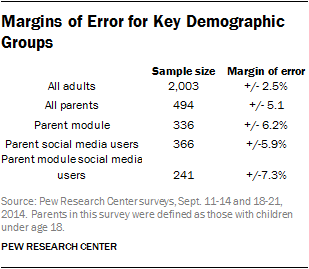
The PSRAI September 2014 Omnibus Weeks 2 and 3 obtained telephone interviews with a nationally representative sample of 2,003 adults living in the continental United States. Telephone interviews were conducted by landline (1,002) and cell phone (1,001, including 594 without a landline phone). The survey was conducted by Princeton Survey Research Associates International (PSRAI). Interviews were done in English and Spanish by Princeton Data Source from September 11 to 14, 2014 and September 18 to 21, 2014. Statistical results are weighted to correct known demographic discrepancies. The margin of sampling error for the complete set of weighted data is ± 2.5 percentage points.

The margins of error for key demographic groups cited in this report are represented in the table below:

Margins of Error for Key Demographic Groups

Note on the “actual Facebook friends” question included in the survey: Although many researchers use a measure of “total Facebook friends,” Ellison et al. (2011) introduced an additional measure called “Actual Friends.” Participants were asked to report their total number of Facebook Friends and what proportion of these Friends were considered ‘actual’ friends. The creators of these questions intentionally did not specify what ‘actual friends’ meant in order to tap into individual understandings of friendship.