Pew Research Center

FOR RELEASE JANUARY 29, 2015

Public and Scientists’ Views on Science and Society

Despite broadly similar views about the overall place of science in America, there are striking differences between the public and scientists’ views on a host of science-related issues.

BY Cary Funk and Lee Rainie

FOR MEDIA OR OTHER INQUIRIES:

Communications Department
202.419.4372
www.pewresearch.org

RECOMMENDED CITATION

Pew Research Center, January 2015, "Public and Scientists’ Views on Science and Society"

About Pew Research Center

Pew Research Center is a nonpartisan, nonadvocacy fact tank that informs the public about the issues, attitudes and trends shaping the world. It does not take policy positions. The Center conducts public opinion polling, demographic research, computational social science research and other data-driven research. It studies politics and policy; news habits and media; the internet and technology; religion; race and ethnicity; international affairs; social, demographic and economic trends; science; research methodology and data science; and immigration and migration. Pew Research Center is a subsidiary of The Pew Charitable Trusts, its primary funder.

© Pew Research Center 2026

Table of contents

  • About Pew Research Center
  • Public and Scientists’ Views on Science and Society
  • Chapter 1: Pew Research Center Initiative on Science and Society
  • Chapter 2: Perspectives on the Place of Science in Society
  • Chapter 3: Attitudes and Beliefs on Science and Technology Topics
  • Chapter 4: AAAS Scientists’ Views on the Scientific Enterprise
  • Appendix A: About the General Public Survey
  • Appendix B: About the AAAS Scientists Survey

Public and Scientists’ Views on Science and Society

Despite broadly similar views about the overall place of science in America, there are striking differences between the public and scientists’ views on a host of science-related issues.

An elaboration of the findings in the AAAS member survey

Scientific innovations are deeply embedded in national life — in the economy, in core policy choices about how people care for themselves and use the resources around them, and in the topmost reaches of Americans’ imaginations. New Pew Research Center surveys of citizens and a representative sample of scientists connected to the American Association for the Advancement of Science (AAAS) show powerful crosscurrents that both recognize the achievements of scientists and expose stark fissures between scientists and citizens on a range of science, engineering and technology issues. This report highlights these major findings:

Science holds an esteemed place among citizens and professionals. Americans recognize the accomplishments of scientists in key fields and, despite considerable dispute about the role of government in other realms, there is broad public support for government investment in scientific research.

The key data:

  • 79% of adults say that science has made life easier for most people and a majority is positive about science’s impact on the quality of health care, food and the environment.
  • 54% of adults consider U.S. scientific achievements to be either the best in the world (15%) or above average (39%) compared with other industrial countries.
  • 92% of AAAS scientists say scientific achievements in the U.S. are the best in the world (45%) or above average (47%).
  • About seven-in-ten adults say that government investments in engineering and technology (72%) and in basic scientific research (71%) usually pay off in the long run. Some 61% say that government investment is essential for scientific progress, while 34% say private investment is enough to ensure scientific progress is made.

At the same time, both the public and scientists are critical of the quality of science, technology, engineering, and math (STEM subjects) in grades K-12.

The key data:

  • Only 16% of AAAS scientists and 29% of the general public rank U.S. STEM education for grades K-12 as above average or the best in the world. Fully 46% of AAAS scientists and 29% of the public rank K-12 STEM as “below average.”
  • 75% of AAAS scientists say too little STEM education for grades K-12 is a major factor in the public’s limited knowledge about science. An overwhelming majority of scientists see the public’s limited scientific knowledge as a problem for science.

Despite broadly similar views about the overall place of science in America, citizens and scientists often see science-related issues through different sets of eyes. There are large differences in their views across a host of issues.

Opinion Differences Between Public and Scientists

The key data:

  • A majority of the general public (57%) says that genetically modified (GM) foods are generally unsafe to eat, while 37% says such foods are safe; by contrast, 88% of AAAS scientists say GM foods are generally safe. The gap between citizens and scientists in seeing GM foods as safe is 51 percentage points. This is the largest opinion difference between the public and scientists.
  • Citizens are closely divided over animal research: 47% favor and 50% oppose the use of animals in scientific research.1  By contrast, an overwhelming majority of scientists (89%) favor animal research. The difference in the share favoring such research is 42 percentage points.
  • In some areas, like energy, the differences between the groups do not follow a single direction — they can vary depending on the specific issue. For example, 52% of citizens favor allowing more offshore drilling, while fewer AAAS scientists (32%), by comparison, favor increased drilling. The gap in support of offshore drilling is 20 percentage points. But when it comes to nuclear power, the gap runs in the opposite direction. Forty-five percent of citizens favor building more nuclear power plants, while 65% of AAAS scientists favor this idea.
  • The only one of 13 issues compared where the differences between the two groups are especially modest is the space station. Fully 64% of the public and 68% of AAAS scientists say that the space station has been a good investment for the country; a difference of four percentage points.

Compared with five years ago, both citizens and scientists are less upbeat about the scientific enterprise. Citizens are still broadly positive about the place of U.S. scientific achievements and its impact on society, but slightly more are negative than five years ago. And, while a majority of scientists think it is a good time for science, they are less upbeat than they were five years ago. Most scientists believe that policy regulations on land use and clean air and water are not often guided by the best science.

The key data:

  • While a majority of the public sees U.S. scientific achievements in positive terms, the share saying U.S. scientific achievements are the best in the world or above average is down 11 points to 54% today, compared with 65% in 2009.
  • 79% of citizens say that science has made life easier for most people, while just 15% say it has made life more difficult. However, the balance of opinion is slightly less positive today than in 2009 when positive views outpaced negative ones by a margin of 83% to 10%. A similar pattern is found in views about the effect of science on the quality of health care, food, and the environment. In each case, while most adults see a positive effect of science, there is a slight rise in the share expressing negative views.
  • 52% of AAAS scientists say this is generally a good time for science, down 24 percentage points from 76% in 2009. Similarly, the share of scientists who say this is generally a good time for their scientific specialty is down from 73% in 2009 to 62% today. And, the share of AAAS scientists saying that this is a good or very good time to begin a career in their field now stands at 59%, down from 67% in 2009.
  • Only 15% of scientists say they believe policy choices about land use are guided by the best science most of the time or always; 27% think the best science frequently guides regulations about clean air and water; 46% think the best science is frequently used in food safety regulations and 58% say the same when it comes to regulations about new drug and medical treatments.

These are some of the findings from a new pair of surveys conducted by the Pew Research Center in collaboration with the AAAS. The survey of the general public was conducted by landline and cellular telephone August 15-25, 2014 with a representative sample of 2,002 adults nationwide. The margin of sampling error for results based on all adults is plus or minus 3.1 percentage points. The survey of scientists is based on a representative sample of 3,748 U.S.-based members of AAAS; the survey was conducted online from Sept. 11 to Oct. 13, 2014.2

A Sizable Opinion Gap Exists Between the General Public and Scientists on a Range of Science and Technology Topics

PI_2015-01-29_science-and-society-00-02

Citizens’ and scientists’ views diverge sharply across a range of science, engineering and technology topics. Opinion differences occur on all 13 issues where a direct comparison is available. A difference of less than 10 percentage points occurs on only two of the 13.

The largest differences between the public and the AAAS scientists are found in beliefs about the safety of eating genetically modified (GM) foods. Nearly nine-in-ten (88%) scientists say it is generally safe to eat GM foods compared with 37% of the general public, a difference of 51 percentage points. One possible reason for the gap: when it comes to GM crops, two-thirds of the public (67%) say scientists do not have a clear understanding about the health effects.

Chapter 3 looks at public and scientists’ attitudes on each of these issues in more detail along with several topics asked only of the general public, including access to experimental medical treatments, bioengineering and genetic modifications.

Both the Public and Scientists See U.S. Scientific Achievements in a Positive Light. But They Are Critical of K-12 STEM Education.

PI_2015-01-29_science-and-society-00-03

Despite differences in views about a range of biomedical and physical science topics, both the public and scientists give relatively high marks to the nation’s scientific achievements and give distinctly lower marks to K-12 education in science, technology, engineering and mathematics (known as STEM). Just 16% of AAAS scientists and 29% of adults in the general public considers K-12 STEM education in the U.S. to be the best or above average compared with other industrialized countries. Both groups see U.S. scientific achievements and medical treatment in a more positive light, by comparison.

About half of Americans (54%) consider U.S. scientific achievements to be above average or among the best in the world. The only aspect of American society rated more favorably is the U.S. military system (77%). About half (51%) also see U.S. medical treatment as in the top tier compared with other industrialized countries. Public views about K-12 STEM are markedly more negative: 29% say it is the best or above average, while 39% say it is average and another 29% say it is below average. (For more on public assessments of key institutions and industries, including the economy, health care, and the political system see Chapter 2.)

Compared with the general public, scientists are even more positive about the place of U.S. scientific achievements. Fully nine-in-ten (92%) AAAS scientists consider scientific achievements in the U.S. to be the best in the world (45%) or above average (47%). 

PI_2015-01-29_science-and-society-00-04

Scientists also have largely positive views about the global standing of U.S. medical treatment (64% say it is the best in the world or above average) as well as other aspects of science and technology including doctoral training (87%), cutting edge basic research (87%) and industry research and development innovation (81%). Just 16% of scientists say the same about K-12 STEM.

PI_2015-01-29_science-and-society-00-05

Among scientists, the public’s knowledge about science — or lack thereof — is widely considered to be a major (84%) or minor (14%) problem for the field.

And when asked about four possible reasons for the public having limited science knowledge, three-quarters of AAAS scientists in the new survey say too little K-12 STEM education is a major factor.

Citizens Are Still Broadly Positive About the Achievements of American Science and Its Impact on Society, But Slightly More Are Negative than Five Years Ago. Scientists Are Also Still Largely Positive, But Less Upbeat than Five Years Ago.

A number of the questions asked in these new surveys repeat questions that Pew Research Center asked citizens and scientists in 2009. In key areas, both the public and AAAS scientists are less upbeat today.

Among the public, perceptions of the scientific enterprise and its contribution to society, while still largely positive, are a little less rosy than five years ago. Fewer citizens see U.S. scientific contributions as top tier compared with other nations. And, while most adults see positive contributions of science on life overall and on the quality of health care, food and the environment, there is a slight rise in negative views in each area. Similarly, most citizens say government investment in research pays off in the long run, but slightly more are skeptical about the benefits of government spending today than in 2009. While the change is modest on several of these measures, the share expressing negative views on each is slightly larger today than in 2009.3

Scientists’ views have moved in the same direction. Though scientists hold mostly positive assessments of the state of science and their scientific specialty today, they are less sanguine than they were in 2009 when Pew Research conducted a previous survey of AAAS members. The downturn is shared widely among AAAS scientists regardless of discipline and employment sector.

Perception of U.S. Scientific Achievements

PI_2015-01-29_science-and-society-00-06

Overall, 54% of adults consider U.S. scientific achievements to be either the best in the world (15%) or above average (39%) compared with other industrial countries. Of the seven aspects of American society rated, only one was seen more favorably: the U.S. military. Compared with 2009, however, the share saying that U.S. scientific achievements are the best in the world or above average is down 11 points, from 65% in 2009 to 54% today. More now see U.S. scientific achievements as “average” in the global context (up from 26% in 2009 to 34% today) or “below average” (up slightly from 5% in 2009 to 9% today). Perceptions of some other key sectors, including U.S. health care, also dropped during this timeframe. See Chapter 2 for details.

Partisan groups tend to hold similar views of U.S. scientific achievements and, the drop in ratings of U.S. scientific achievements since 2009 has occurred across the political spectrum.

When it comes to policy prescriptions, however, a partisan divide emerges. A separate Pew Research Center report released this month finds that Democrats are more likely than Republicans to prioritize “supporting scientific research” for the President and the Congress in the coming year. Younger adults are also more likely than their elders to say supporting scientific research should be a top priority for the President and the new Congress.4

Effects of Science on Society

PI_2015-01-29_science-and-society-00-07

Overall the American public tends to see the effects of science on society in a positive light. Fully 79% of citizens say that science has made life easier for most people, while just 15% say it has made life more difficult. However, the balance of opinion is slightly less positive today than in 2009 when positive views outpaced negative ones by a margin of 83% to 10%.

Similarly, a majority of adults says the effect of science on the quality of U.S. health care, food and the environment is mostly positive as was also the case in 2009. The share saying that science has had a negative effect in each area has increased slightly. For example, 79% of adults say that science has had a positive effect on the quality of health care, down from 85% in 2009 while negative views have ticked up from 10% in 2009 to 18% today.

Perceived Contributions of Scientists, Engineers, and Medical Doctors to Society

A 2013 Pew Research report found the military at the top of the list of 10 occupational groups seen as contributing “a lot” to society (78%), followed by teachers (72%), medical doctors (66%), scientists (65%) and engineers (63%). The order of ratings for each of the 10 groups was roughly the same in 2013 as in 2009, though there were modest declines in public appreciation for several occupations.

Public appreciation of scientists’ contribution dropped 5 points from 70% in 2009 to 65% in 2013 with a corresponding uptick to 8% in those saying scientists contribute “not very much” or “nothing at all” compared with 5% in 2009. Views of medical doctors’ contribution fell 3 points from 69% in 2009 to 66% in 2013. Those of engineers stayed about the same (64% in 2009 and 63% in 2013).

Adults under age 50 and college graduates tended to be more upbeat in their assessments of scientists, engineers and medical doctors. Partisan and ideological differences were found in views about the contribution of scientists and engineers but not in views about medical doctors. For details see “Public Esteem for Military Still High,” July 11, 2013.

When it comes to food, 62% of Americans say science has had a mostly positive effect, while 34% say science has mostly had a negative effect on the quality of food. The balance of opinion is a bit less rosy on this issue compared with 2009 when positive views outstripped negative ones by a margin of 66% to 24%.

Similarly, more say science has had a positive (62%) than negative (31%) effect on the quality of the environment today. But, the balance of opinion on this issue has shifted somewhat compared with 2009 when 66% said science had a positive effect and 23% said it had a negative effect.

These modest changes over time have occurred among both Republicans (including independents who lean Republican) as well as Democrats (including independents who lean Democratic). However, Republicans’ views about the effect of science on health care and food have changed more than those of Democrats.

Both Republicans and Democrats have shifted by about the same amount in their assessment of science’s effect on the quality of the environment; there are no significant differences by party affiliation when it comes to the overall effect of science on the environment. Two-thirds (66%) of Republicans and independents who lean to the Republican Party say the effect of science on the quality of the environment in the U.S. has been mostly positive, as do 61% of Democrats and independents who lean toward the Democratic Party. (A detailed look at attitudes about science and technology topics by political groups is forthcoming later this year).

Public Support for Research Funding Since 2009

PI_2015-01-29_science-and-society-00-08

A majority of the public sees societal benefit from government investment in science and engineering research. Roughly seven-in-ten adults say that government investment in engineering and technology (72%) as well as basic science research (71%) pays off in the long run while a minority says such spending is not worth it (22% and 24%, respectively). Positive views about the value of government investment in each area is about the same as in 2009, though negative views that such spending is not worth it have ticked up 5 points for engineering and technology research and 6 points for basic science research.

PI_2015-01-29_science-and-society-00-09

Views about the role of government funding as compared with private investment show steady support for government investment (61% in 2014 and 60% in 2009) but, there is a slight rise in the view that private investment, without government funds, will be enough to ensure scientific progress (from 29% in 2009 to 34% today). The modest difference over time stems from more expressing an opinion today than did so five years ago.

Mixed Perceptions About the Degree of Scientific Consensus

PI_2015-01-29_science-and-society-00-10

The general public tends to hold mixed views about the degree to which they believe there is scientific consensus on three hot-button science topics — the “Big Bang” theory, climate change and evolution.

Asked whether scientists generally believe that the universe was created in a single violent event often called “the Big Bang,” about four-in-ten (42%) say yes while about half (52%) say scientists are generally divided about this issue.

When it comes to climate change and evolution, a majority of adults see scientists as generally in agreement that the earth is getting warmer due to human activity (57%) or that humans have evolved over time (66%), though a sizeable minority see scientists as divided over each. Perceptions of where the scientific community stands on both climate change and evolution tend to be associated with individual views on the issue.

Scientists Are Still Largely Positive, But Are Less Upbeat About the State of Science Today Than They Were Five Years Ago.

PI_2015-01-29_science-and-society-00-11

Scientists’ overall assessments of the field, while still mostly positive, are less upbeat than they were in 2009 when Pew Research conducted a previous survey of AAAS members.

Today, about half of AAAS scientists (52%) say this is good time for science, down 24 percentage points from three-quarters (76%) in 2009.

Scientists are more positive, by comparison, when it comes to the state of their scientific specialty. But here, too, scientists are less rosy in their assessments than five years ago: 62% of AAAS scientists say this is a good time for their specialty area, down 11 percentage points from 2009.

These more downbeat assessments occur among AAAS scientists across all disciplines, among those with both a basic and applied research focus,5 and across all employer types.

Some 59% of AAAS scientists say this is a good or very good time to begin a career in their specialty, down from 67% in 2009. Assessments about the state of their specialty for new entrants is about the same as 2009 for those focused on applied research (71% in 2009 and 69% today say it a good or very good time), but it is down 15 percentage points among those doing basic research, from 63% in 2009 to 48% today saying this is a good or very good time to begin a career in their specialty area.

PI_2015-01-29_science-and-society-00-12

There are a number of possible reasons for scientists’ less optimistic assessments over this period including the different economic and political contexts,6 heightened concerns among scientists about the research funding environment, and, perhaps, what scientists see as the limited impact their work is having on policy regulations.

Fully 83% of AAAS scientists report that obtaining federal research funding is harder today than it was five years ago. More than four-in-ten say the same about industry funding (45%) and private foundation funding (45%) compared with five years ago. Further, when asked to consider each of seven potential issues as a “serious problem for conducting high quality research today,” fully 88% of AAAS scientists say that a lack of funding for basic research is a serious problem, substantially more than any of the other issues considered.7

PI_2015-01-29_science-and-society-00-13

Scientists have, at best, mixed views about the impact of the research enterprise on four areas of government regulations. A majority of AAAS scientists (58%) say that the best scientific information guides government regulations about new drug and medical treatments at least most of the time, while about four-in-ten (41%) say such information guides regulations only some of the time or never. Views about the impact of scientific information on food safety regulations are more mixed with 46% saying the best information guides regulations always or most of the time and a slightly larger share (52%) saying it does so only some of the time or never. Scientists are largely pessimistic that the best information guides regulations when it comes to clean air and water regulations or land use regulations: 72% and 84%, respectively, say this occurs only some of the time or never.

PI_2015-01-29_science-and-society-00-14

Scientists’ views about the impact of research on government regulations in each domain tend to be associated with their views about the state of the overall science environment.

For example, those who see a more frequent impact of scientific findings on land use regulations also tend to be more upbeat about the state of science today; 62% say this is generally a good time for science. By comparison, those who say the best science guides land use regulations only some of the time or never are less positive. Half (50%) of this group says it is a good time and an equal share says it is a bad time for science overall. The same pattern holds for each of the four types of regulations considered in the survey. Scientists who perceive a more frequent influence of the best science on regulations are also more likely to say this is a good time for science compared with scientists who see less frequent impact of the best scientific information on policy rules.

Roadmap to the report

What is the AAAS?

The American Association for the Advancement of Science (AAAS) is the world’s largest general scientific society, and as such, encompasses all disciplines in the scientific community. Founded in 1848, AAAS publishes Science, one of the most widely-circulated peer-reviewed scientific journals in the world. It is an international non-profit organization whose mission is broadly defined as seeking to “advance science, engineering, and innovation throughout the world for the benefit of all people.”

The remainder of this report details the findings on both public and scientists’ views about science, engineering and technology topics. Chapter 1 briefly outlines related Pew Research Center studies and reviews some of the key caveats and concerns in conducting research in this area. Chapter 2 looks at overall views about science and society, the image of the U.S. as a global leader, perceived contributions of science to society, and views about government funding for scientific research. Chapter 3 covers attitudes and beliefs about a range of biomedical and physical science topics. It focuses on comparisons between the public and AAAS scientists and also covers public attitudes on access to experimental drugs, bioengineering of artificial organs, genetic modifications and perceptions of scientific consensus. Chapter 4 examines the views of AAAS scientists about the scientific enterprise, issues and concerns facing the scientific community, and issues for those newly entering careers in science. It also includes the experiences and background characteristics of the AAAS scientists in the survey. Appendices provide a detailed report on the methodology used in each survey as well as the full question wording and frequency results for each question in this report.

About This Report

This report is based on a pair of surveys conducted by the Pew Research Center in collaboration with the American Association for the Advancement of Science (AAAS). It looks at the views of the general public and scientists about the place of science in American culture, their views about major science-related issues, and the role of science in public policy.

This is the first of several reports analyzing the data from this pair of surveys. This report focuses on a comparison of the views of the general public and those of AAAS scientists as a whole. Follow up reports planned for later this year will analyze views of the general public in more detail, especially by demographic, religious, and political subgroups. And, some results from the survey of AAAS scientists will be presented in a follow-up report in mid-February.

The fieldwork for both surveys was conducted by Princeton Survey Research Associates International. Contact with AAAS members invited to participate in the survey was managed by AAAS staff with the help of Princeton Survey Research Associates International; AAAS also covered part of the costs associated with mailing members. All other costs of conducting the pair of surveys were covered by the Pew Research Center. Pew Research bears all responsibility for the content, design and analysis of both the AAAS member survey and the survey of the general public.

Acknowledgements

Special thanks to Jeanne Braha and Tiffany Lohwater of AAAS who facilitated the interactions between Pew Research and AAAS staff to conduct the survey of members and to Ian King, director of marketing at AAAS, as well as Elizabeth Sattler and Julianne Wielga, who prepared the random sample of members and sent out all contacts with AAAS members selected for participation. We are also grateful to the team at Princeton Survey Research International who led the data collection efforts for the two surveys.

Chapter 1: Pew Research Center Initiative on Science and Society

About the General Public and AAAS Scientist Surveys

The general public survey was conducted August 15-25, 2014, by landline and cellular telephone, among a nationally representative sample of 2,002 adults. The survey tracks public attitudes about science in society and maps the contours of opinion on a wide range of issues within the domain of science and technology. The margin of error for results based on the full sample is +/- 3.1 percentage points. See Appendix A for more details on the survey methodology.

The survey of AAAS scientists was conducted online with a random sample of 3,748 U.S.-based members of AAAS from Sept. 11 to Oct 13, 2014. The margin of sampling error for estimates about the full U.S.-based membership of AAAS is plus or minus 1.7 percentage points See Appendix B for details about the survey methodology.

Where possible, comparisons are made to a similar pair of surveys conducted in 2009. The general public survey was conducted April 28-May 12, 2009 by landline and cellular telephone with 2,001 adults nationwide. The survey of AAAS members was conducted online May 1 to June 14, 2009 with a random sample of 2,533 U.S.-based members of AAAS. See “Public Praises Science; Scientists Fault Public, Media,” July 9, 2009.

Science is a big, sprawling cluster of subjects that has drawn regular attention from the Pew Research Center since its founding. Public attitudes about science-related policy matters from pollution to space exploration to medical practices have been part of Pew Research’s values questions since the late 1980s. The relative priority that citizens assign to science-related policy issues has been a standard query since the mid-1990s as the center asked people to rank the issues that mattered most to them. Questions about the intersection of people’s spiritual and moral beliefs on such matters as evolution, cloning, or end-of-life treatment issues have been subjects of study by the Pew Research Center’s since the 1990s. The particular place of digital technology in people’s lives has been an ongoing subject for study at Pew Research since 2000.

With this report, the Pew Research Center marks a more deliberate and formal commitment to study the intersection of science with all aspects of society from public opinion, to politics and policy-making, to religious and ethical considerations, to education and the economy. In the coming years, Pew Research plans a sustained effort to understand what citizens and scientists think about science-related matters, how scientific information is disseminated and understood in the new media ecology, where Americans stand in terms of their knowledge about science, how amateurs are contributing to scientific endeavors, where “big data” is making an impact on scientific inquiry, and where people’s moral and spiritual issues connect with scientific innovations and shape policies around them.

Pew Research is doing this because scientific advances and challenges are influencing an ever-greater share of American and global life. The pace of innovation and the urgency of scientific issues have captured a growing share of policy energy and at times generated more and more dispute.

Studying science-related topics comes with some inherent challenges. The breadth and complexity of the issues can be daunting. Translating complicated scientific ideas into research questions that can be addressed by the general public can be particularly hard to do. Even understanding who engages in the scientific enterprise has long been a subject where reasonable minds hold differences of opinion. Thus, we offer this work with some caveats.

Caveats about the survey questionnaires

This pair of surveys is designed to cover a broad spectrum of science, engineering and technology attitudes, but the collection of topics is by no means comprehensive. In the end, the set of topics reflects Pew Research editorial judgment about issues of wide enough public attention to feasibly include in a survey as well as practical time and space limits inherent to the research method.

Most of the survey questions ask for relatively simple judgments about potentially complex issues. For example, questions about the appropriate use of medical advances ask for respondents’ summary judgments about what can be difficult ethical issues. Similarly, asking about whether one favors or opposes the increased use of hydraulic fracturing is but one of many questions one could ask about “fracking.” It does not capture related judgments about the issue, such as perceived risks or benefits of “fracking” or the relative value of “fracking” compared with other forms of energy development.

In future research, we expect to explore specific topics related to science and technology in more depth. The trade-off in this pair of surveys was to cover a wider range of topics with just one, two or sometimes three questions about each.

Caveats about surveying scientists

Our survey of AAAS scientists canvasses the views of a broad-ranging group of professionally-engaged scientists.8 They come from a variety of disciplines, employment sectors, and stages of career, from student to retiree. Unlike the broader labor force working in science and engineering occupations, most respondents to the survey hold one or more doctorate degrees. All belong to the AAAS, the largest multidisciplinary scientific professional society in the world. While not intended to be representative of all scientists in the U.S., the survey of AAAS scientists provides a relatively rare window into the views of the scientific community.

There are a number of other possible approaches to identifying U.S. scientists.9 Some consider only a narrow set of fields to be “science” or “science and engineering” careers. Others, such as the National Science Foundation’s National Center of Science and Engineering Statistics program, canvass a broad set of disciplines when tracking science and engineering indicators which include: agricultural, physical, earth, atmospheric and ocean sciences, engineering, biological sciences, computer sciences, medical and health sciences, psychology, mathematics and statistics and social sciences. When identifying the science and engineering workforce, the National Science Foundation uses a similarly broad definition: Those who either hold a degree in a science and engineering-related field at the bachelor’s level or above or work in a science and engineering-related field.10 This is an important distinction since about half of those with a degree in science and engineering are working in field-related occupations while roughly half of those with such training at the bachelor’s level or above are working in other occupations.

Help Navigating These and Other Pitfalls

We have tried to be conscious of these issues and to obtain the advice of the scientific community and other stakeholders to help inform this research. We are grateful to a number of outside advisors who shared their expertise with us during the development of the questionnaires and/or in reviewing a draft version of this report. These include: John Besley, associate professor and the Ellis N. Brand chair in public relations at Michigan State University; Bill Colglazier, visiting scientist at the Center for Science Diplomacy; Banning Garrett, independent consultant on global trends; Frank Macrina, vice president for research and innovation at Virginia Commonwealth University; and Cliff Zukin, professor of public policy and political science at Rutgers University. Senior staff at AAAS also generously shared their expertise. These include: Alan Leshner, chief executive officer; Marcia McNutt, editor-in-chief of Science; Joanne Carney, director of government relations; Edward Derrick, chief program director of the Center of Science, Policy and Society Programs; Shirley Malcom, head of education and human resources programs; Vaughan Turekian, chief international officer and editor-in-chief of Science & Diplomacy; Jennifer Wiseman, director of the Dialogue on Science, Ethics, and Religion; Ginger Pinholster, director of the office of public programs; Jeanne Braha, public engagement manager and Tiffany Lohwater, director of meetings and public engagement. Pew Research Center retains sole responsibility for any errors.

Chapter 2: Perspectives on the Place of Science in Society

Science holds an esteemed place in the public imagination and in the minds of professionals. Americans are proud of the accomplishments of their scientists in key fields and, despite considerable dispute about the role of government in other realms, there is broad public support for government investment in scientific research.

At the same time, scientists and citizens are critical of the K-12 education system when it comes to the quality of teaching about science, technology, engineering, and math (called STEM subjects). Scientists are also pessimistic about the state of funding for their research, even as the public largely supports it.

This chapter covers the core findings about the overall place of science as found in the Pew Research survey of the general population and that of a representative group of scientists who belong to the American Association for the Advancement of Science.

The Public Image of the U.S. as a Global Leader in Key Sectors

In the survey, we wanted to understand the public’s views about science in the context of other key American institutions and industries, including some outside the realm of science and technology. A mixed picture emerges in people’s responses as they generally value U.S. scientific achievements but are critical about the state of science and math education to primary and secondary school students.

Overall, 54% of adults consider U.S. scientific achievements to be either the best in the world (15%) or above average (39%) compared with other industrial countries. In this question series, the only aspect of American society rated more favorably is the U.S. military system, with 77% of adults saying the U.S. military is the best in the world or above average.

The public’s views of how the education system is teaching science, technology, engineering, and math (called STEM) to K-12 students is considerably less glowing. About three-in-ten (29%) adults consider U.S. STEM education for grades K-12 to be above average or better compared with other industrialized countries, another 39% say it is average and 29% say it is below average.11

Public assessments of the U.S. medical system vary strongly, depending on the focus of the question. Half of the survey respondents were asked to rate “U.S. medical treatment” while the other half were asked about “U.S. health care.” Americans’ views of “medical treatment” in the U.S. were considerably more positive than their views of “health care.” Some 51% of those asked about medical treatments rated it the best in the world or above average. On the other hand, only 26% said U.S. “health care” was the best or above average. These differences likely arise from different connotations associated with each term. Those assessing “treatments” might have been thinking about medical advances in fighting diseases and creating medical devices and felt the science community is making notable progress. On the other hand, those asked about “health care” might have been making a broader assessment about the system of providing health care in America, the subject of considerable public dispute in recent years.

Public assessments of the U.S. political system and the economy are mixed. Fully 34% of adults say the U.S. political system is the best or above average, another 32% say it is average and 31% say it is below average compared with other industrialized countries. Similarly, a third (33%) of adults say the U.S. economy is the best or above average, 36% say it is average and 29% say is below average.

Changes in Public Image of U.S. Institutions
PI_2015-01-29_science-and-society-02-02

Americans’ views about the relative rank order of the topmost institutions is about the same as it was in 2009, when Pew Research last asked the public to rate sectors in this way. But, the public is less enthusiastic about the standing of the U.S. compared with other industrialized countries in several areas including the political system, scientific achievements, and health care.

Public esteem for the military is down modestly from 2009 although most Americans still hold the military in high regard. Fully 77% of adults say the military is among the best or better than average compared with other industrialized countries, down from 82% in 2009.

Scientific achievements, while also seen in largely positive terms, are down 11 points from 65% in 2009 to 54% today saying U.S. scientific achievements are the best or above average compared with other industrialized countries. More now see U.S. scientific achievements as “average” in global comparisons (up from 26% in 2009 to 34% today) or “below average” (up slightly from 5% in 2009 to 9% today).

The public’s still-positive ratings of U.S. scientific achievements are followed closely by those for medical treatments with 51% saying it is the best in the world or above average. (The 2009 survey did not ask about medical treatment.)

By contrast, just 26% of adults today say that U.S. “health care” is above average or the best in the world, down 13 points from 39% in 2009.12 Political differences explain much of this change. In 2009, Republicans and independents who lean to the Republican Party were much more inclined than their Democratic counterparts to see the U.S. health care system in a positive light (55% vs. 28% of each group, respectively, said it was the best in the world or above average). But Republicans’ opinions about the place of U.S. health care in a global context have dropped sharply since 2009, while views among Democrats’ have dropped a more modest 6 points. These partisan differences are likely related to the debate over the Affordable Care Act, also called “Obamacare,” during the same period. As a result, both groups now hold roughly similar views of how U.S. health care stacks up in a global context.

Perceptions of the U.S. political system have also dropped over the same time period. Yet, unlike perceptions of health care, people’s views about the political system are not associated with party affiliation. Today, 34% of adults say the U.S. political system is the best in the world or above average compared with other industrialized countries, down 16 points from 50% in 2009. Partisan groups hold similar views about the political system, as was also the case in 2009.

People’s perceptions of the U.S. economy in global comparison have held steady. A third of adults (33%) says the U.S. economy is the best or above average relative to other industrialized countries, roughly the same as in 2009 (34%).

Patterns Among the General Public

There were some modest demographic differences among respondents in assessing U.S. scientific achievements today. Men are more likely than women (60% vs. 48%) to consider U.S. scientific achievements to be at least above average compared with other nations. Those with a college degree tend to give higher marks to U.S. scientific achievements (as well as several other domains) than do those with less formal education. But, those with a degree in a science field do not differ from other college graduates in their views about U.S. scientific achievements. And, there are no significant differences on this rating by age or political orientation.

There are no or only modest differences in assessments of K-12 STEM education by gender, age, or political leanings. But unlike ratings of U.S. scientific achievements, education is inversely related to ratings of STEM education for grades K through 12: 35% of college graduates say K-12 STEM is below average compared with other nations while 23% of those with no more than a high school diploma say the same.

Comparing Public and AAAS Scientists’ Views
PI_2015-01-29_science-and-society-02-03

Scientists are far more positive about the country’s scientific achievements and its medical treatments than the general public. But, scientists are also more downcast about K-12 STEM education than the public.

Fully nine-in-ten (92%) AAAS scientists say scientific achievements in the U.S. are the best in the world (45%) or above average (47%). In 2009, 94% of scientists said the same. Scientists are also positive about the global standing of U.S. medical treatment; nearly two-thirds of scientists (64%) consider U.S. medical treatment to be above average or better than other industrialized countries. About half of the general public (51%) says the same.

But both AAAS scientists and the general public are markedly less positive about K-12 STEM education – and the scientists are the most critical. Just 16% of scientists and 29% of the general public say that U.S. STEM for grades K-12 is above average or the best in the world.

Scientists are Less Upbeat Than They Used To Be

PI_2015-01-29_science-and-society-02-04

Despite their overall positive views, scientists are more downbeat about the general state of science compared with five years ago. Today, 52% of AAAS scientists say this is good time for science, down from 76% in 2009.

Scientists tend to be more positive, by comparison, when it comes to the state of their scientific specialty. Yet, here too, scientists today are less rosy in their assessments than in our previous survey. Some 62% of AAAS scientists say this is a good time for their specialty area, down 11 percentage points from 2009.

The drop since 2009 in views about the state of science occurred among AAAS scientists of all disciplines, those with a basic and applied research focus, and among those working in industry and those in academia. For more on scientists’ assessments of science and technology today and in comparison with other industrialized nations, see Chapter 4.

Effects of Science on Society

PI_2015-01-29_science-and-society-02-05

The general public tends to see the role of science in society positively. About eight-in-ten adults (79%) say that science has made life easier for most people while just 15% say it has made life more difficult. The balance of positive to negative views is a bit less rosy today than in 2009 when 83% said that science had made life easier and 10% said it made life more difficult.

Further, a majority of adults say that the effect of science has been positive when it comes to the quality of three specific aspects of life. Fully 79% say science has been a positive force in the quality of U.S. health care; 62% say science’s impact on food is positive; and, 62% say the same thing about the impact of science on the environment.

These positive public views about the effect of science in each domain are down modestly from 2009 for health care (6 percentage points lower), for food quality (4 percentage points lower) and for the quality of the environment (4 percentage points lower). The corresponding uptick in negative views is a bit larger (8 to 10 percentage points) because more expressed a judgment on these issues in 2014 than did so in 2009. Thus, the balance of public views is somewhat less positive today than in 2009 for all three areas.

Patterns Among the General Public
PI_2015-01-29_science-and-society-02-06

Any differences in assessments of the effect of science overall or across these domains by gender, age, education or political leanings tend to be modest. Adults under age 50 are more positive about the effects of science on life for most people and about the effect of science on health care than are those ages 50 and older. But, both age groups have about the same views when it comes to the effect of science on the quality of food and the environment. And, college graduates are more positive than those with less education on three of these four assessments.

Despite increased political differences on assessments of climate change in recent years, two-thirds (66%) of Republicans and independents who lean toward the Republican Party say that the effect of science on the quality of the environment in the U.S. has been mostly positive, as do 61% of Democrats and independents who lean toward the Democratic Party. (A detailed analysis of the differences and similarities among those with different political views about science and technology topics will be issued later this year.)

Funding for Research

PI_2015-01-29_science-and-society-02-07

A solid majority of the public expresses support for government funding for science and technology. About seven-in-ten adults say that government investments in engineering and technology (72%) and in basic scientific research (71%) usually pay off in the long run. While support for funding is about the same as in 2009, negative views that each type of funding is “not worth it” have edged up (5 percentage points for engineering and technology and 6 points for basic science research).

PI_2015-01-29_science-and-society-02-08

A majority of the public considers government funding critical to the scientific enterprise. Fully 61% say that government investment is essential for scientific progress while 34% say that “private investment will ensure that enough scientific progress is made, even without government investment” in research. A similar share in 2009 said that government investment was essential (60%) and a slightly smaller share, 29%, said private investment would be enough to ensure progress.

Patterns Among the General Public

Support for government funding of research tends to be widespread across the demographic spectrum. Fully 74% of women and 68% of men say that government funding of basic science pays off in the long run; men and women are about equally likely to say that government funding of engineering pays off in the long run (72% each). College graduates tend to express more support for research funding than do those with less formal education. Similarly, younger generations are a bit more likely than older ones to say research funding pays off in the long run, but a majority of all age groups say that government funding of both basic science and engineering research pays off in the long run.

Scientists’ Views about Funding
PI_2015-01-29_science-and-society-02-09

[its]

Fully 83% of AAAS scientists say that getting government funding in their specialty area is harder today than it was five years ago, just 2% say getting federal funding is easier today and 13% say it is about the same. Some 45% of AAAS scientists also say it is harder to get research funding from industry sources or from private foundations today compared with five years ago.

Further, when asked to consider whether each of seven potential issues is a “serious problem for conducting high quality scientific research today” only one was selected by a majority of scientists: lack of funding for basic research. Some 88% of AAAS scientists report that lack of research funding hinders research today.

A majority of AAAS scientists identity funding as a serious problem for conducting research today, regardless of discipline, employment setting, or a basic or applied research focus in their own research.

For more on AAAS scientists’ views about funding, problems for conducting research and other issues in science today, see Chapter 4.

Chapter 3: Attitudes and Beliefs on Science and Technology Topics

Citizens and scientists often see science-related topics issues through different sets of eyes. This is hardly a new reality, but there are particularly stark differences across the board in these surveys.

The largest differences are found in beliefs about the safety of eating genetically modified foods. Fully 88% of AAAS scientists say it is generally safe to eat genetically modified (GM) foods compared with 37% of the general public who say the same, a gap of 51 percentage points. Sizable opinion differences occur on both biomedical science as well as physical science topics: Only two of the 13 comparisons find a difference of less than 10 percentage points.

There is no single direction of differences between the groups. For example, when it comes to building more nuclear power plants scientists are more inclined than the general public to favor the idea (65% vs. 45%, respectively), while when it comes to increasing the use of hydraulic fracturing scientists are less inclined than the general public to favor the idea (31% vs. 39%, respectively).

The remainder of this chapter looks at attitudes of the public and scientists on each of these issues. In addition, we look at opinions on several issues asked only of the general public related to bioengineering, genetic modifications, and perceptions of scientific consensus on evolution, climate change, the creation of the universe, and health effects of genetically modified organisms (GMOs). Throughout, we briefly evaluate patterns in science and technology attitudes by gender, age, race/ethnicity and education. More details on views among the general public by subgroups, including by education, science knowledge, religion and political groups, are forthcoming in a separate report.

Safety of Genetically Modified Foods – 51-Point Gap

PI_2015-01-29_science-and-society-03-02

A minority of adults (37%) say that eating genetically modified foods is generally safe, while 57% say they believe it is unsafe. By contrast, nearly all AAAS scientists (88%) say they consider eating GMOs to be generally safe.

PI_2015-01-29_science-and-society-03-03

The general public also tends to be skeptical about the scientific understanding of GMO effects. A minority of adults (28%) say they think scientists have a clear understanding of the health effects of genetically modified crops while 67% say their view is that scientists do not clearly understand this.

Patterns Among the General Public

Among the general public, those with a college degree are closely divided over whether eating genetically modified foods is safe: 49% of those with college degrees say it is generally safe, while 47% say it is generally unsafe. Those with a college degree are still substantially less likely than AAAS scientists to consider GM foods safe to eat, however (49% compared with 88%).

Fewer women (28%) than men (47%) believe eating GM foods is safe. Opinions also tend to vary by race and ethnicity with fewer blacks (24%) and Hispanics (32%) than whites (41%) saying that GM foods are safe to eat. Views about GMOs are roughly the same among both younger (ages 18 to 49) and older (50 and older) adults.

PI_2015-01-29_science-and-society-03-04

About half of U.S. adults report that they always (25%) or sometimes (25%) look to see if products are genetically modified when they are food shopping. Some 31% say they never look for such labels and 17% say they do not often look.

Not surprisingly, those who consider GM foods unsafe tend to check for GM food labels more often: 35% of this group always looks to see if products are genetically modified, compared with 9% among those who consider such foods generally safe to eat.

Animal Research – 42-Point Gap

PI_2015-01-29_science-and-society-03-05

The general public is closely divided when it comes to the use of animals in research. Some 47% favor and a nearly equal share (50%) oppose animal research. Support for the use of animals in research is down slightly from 52% in 2009. By contrast, there is strong consensus among AAAS scientists for the use of animals in research (89% to 9%).

Patterns Among the General Public

Among the general public, men and women differ strongly in their views about animal research. Six-in-ten men favor the use of animal research. By contrast, 35% of women favor animal research while 62% oppose it. College graduates, especially those who studied science in college, tend to express more support than do those with less education for using animals in scientific research.

Food Grown with Pesticides – 40-Point Gap

PI_2015-01-29_science-and-society-03-06

A similar pattern occurs when it comes to the safety of eating foods grown with pesticides. About seven-in-ten (69%) adults say that eating such foods is generally unsafe, while 28% say it is safe. By contrast, 68% of AAAS scientists consider eating foods grown with pesticides to be generally safe, and 31% say it is generally unsafe.

Patterns Among the General Public

As with views about the safety of eating GM foods, those with more education are more likely than those with less schooling to say that foods grown with pesticides are safe to eat. And, more men than women say such foods are safe, though a minority of both groups consider eating foods with grown with pesticides to be safe (38% among men and 18% among women). There are no differences in views on this issue by age.

Beliefs about Human Evolution – 33-Point Gap

PI_2015-01-29_science-and-society-03-07

About two-thirds (65%) of Americans say that “humans and other living things have evolved over time” while 31% say “humans and other living things have existed in their present form since the beginning of time.” Public beliefs about human evolution are similar to when asked in previous Pew Research surveys, including the 2009 poll.

PI_2015-01-29_science-and-society-03-08

Roughly half of those who say that humans have evolved over time believe that evolution has occurred from natural processes such as natural selection (35% of all adults), while a somewhat smaller share (24% of all adults) believe a supreme being guided the evolution of humans and other living things.

Patterns Among the General Public

Three-quarters (75%) of college graduates believe that humans have evolved over time, compared with 56% of those who ended their formal education with a high school diploma or less. Beliefs about evolution also differ strongly by religion and political group, as was also the case in past surveys. A detailed analysis of religious and political group beliefs about science and technology topics based on these new survey findings is forthcoming.

PI_2015-01-29_science-and-society-03-09

Regardless of their personal beliefs about evolution, 66% of the public say they believe that scientists generally agree that humans have evolved over time while 29% say that scientists do not agree about this.

About half (47%) of those who personally believe that humans have existed in their present form since the beginning of time also see scientists as generally in agreement that humans have evolved. Three-quarters of those who believe humans have evolved also see scientists as largely in agreement about evolution.

Perceptions of scientific consensus around the creation of the universe are less uniform. Some 42% of the public as whole says that scientists generally agree the universe was created in a single event often called “the big bang,” while 52% say that scientists are divided in their views about creation of the universe.

Patterns Among the General Public

PI_2015-01-29_science-and-society-03-10

Perceptions of scientific consensus on both evolution and the creation of the universe tend to vary by education. About three-quarters of college graduates (76%) say scientists generally agree about evolution, compared with 58% of those with a high school education or less. Similarly, about half of those with a college degree (52%) say that scientists generally believe the universe was created in a single, violent event compared with 33% of those with a high school degree or less education who say the same. Perceptions of scientific consensus also tend to vary by age with younger generations (ages 18 to 49) more likely than older ones to see scientists as in agreement on these topics.

Vaccines and Access to Experimental Treatments – 18-Point Gap

PI_2015-01-29_science-and-society-03-11

Asked about whether vaccines for childhood diseases such as measles, mumps, rubella (MMR) and polio should be required or left up to parental choice, 68% of adults say such vaccines should be required while 30% say that parents should be able to decide whether or not to vaccinate their children. Scientists are more likely than the general public to say that such vaccines should be required for all children: 86% of scientists say this compared with 68% among the general public.

Opinion about childhood vaccines among both the public and scientists is about the same as in 2009. Scientists are a bit more likely to say that vaccines should be required (up from 82% to 86% today). Thus the divide between public and scientists’ views has ticked up from 13 to 18 percentage points today.

Patterns Among the General Public

Younger adults are less inclined than older generations to believe vaccines should be required for all children: 37% of adults under age 50 say parents should be able to decide not to vaccinate their children compared with 22% of those ages 50 and older. Men and women hold similar views about requiring vaccines. There are no significant differences in views about this issue by education or race and ethnicity.

Climate Change – 37-Point Gap

PI_2015-01-29_science-and-society-03-12

Public attitudes about climate change have become increasingly contentious over the past several years. The new Pew Research survey included two separate measures to gauge public attitudes about climate change. When asked to pick among three choices, 50% say that climate change is occurring mostly because of human activity such as burning fossil fuels, 23% say that climate change is mostly because of natural patterns in the earth’s environment, and another 25% say there is no solid evidence the earth is getting warmer. The share of the public saying climate change is due to human activity is about the same as when last asked in a 2009 Pew Research survey, but more now say there is no solid evidence of warming (25% today, up from 11% in 2009) and fewer say that warming is occurring due to natural patterns in the environment (23% today, down from 36% in 2009).

PI_2015-01-29_science-and-society-03-13

AAAS scientists’ views about climate change, using the same three-choice measure, contrast starkly with that of the public. Fully 87% of scientists say climate change is occurring due to human activity, 9% say climate change is mostly due to natural patterns and just 3% of this group says there is no solid evidence the earth is getting warmer. An overwhelming majority of AAAS scientists from all disciplinary specialties believe that climate change is mostly due to human activity. Those with a primary specialty in the earth sciences hold about the same views as all AAAS scientists surveyed (89% say climate change is mostly due to human activity). In 2009, 84% of AAAS scientists said the earth was warming mostly because of human activity.17

Scientists are also considerably more inclined than the general public as a whole to see climate change as a problem. Fully 77% of AAAS scientists say that climate change is a very serious problem. In a 2013 Pew Research survey, a third of adults said that “global warming” was a very serious problem. The highest share of those holding that view since the question was first asked in 2006 was 45% in 2007.

PI_2015-01-29_science-and-society-03-14

There are a number of ways to canvass opinion about climate change issues. In a separate series of questions, adults in the general public were asked whether or not there is solid evidence that the average temperature of the earth has been getting warmer over the past few decades. Fully 72% of adults say there is solid evidence of warming, while a quarter (25%) say there is no solid evidence of this.

Follow-up questions find that most of those who believe the earth is warming think warming is due to human activity (46% of all adults), rather than natural patterns in the earth’s environment (22% of all adults). Those who say there is no solid evidence the earth is getting warmer are split between those who say the evidence is not yet clear (11% of all adults) and that warming is not occurring (13% of all adults).

PI_2015-01-29_science-and-society-03-15

Americans’ views of the evidence related to climate change have fluctuated somewhat over the last few years. Since 2012, roughly two-thirds or more of Americans see solid evidence the earth is warming, up from roughly six-in-ten in 2009 to 2010. But when the Pew Research Center asked this question in August 2006 and early 2007, 77% said there was solid evidence that the average temperature on earth had been increasing.

Views about the role of human activity in climate change have followed a similar trajectory.

Patterns Among the General Public

Views about climate change tend to differ by party and political ideology, as also was the case in past surveys. Democrats are more likely than either political independents or Republicans to say there is solid evidence the earth is warming. And, moderate or liberal Republicans are more likely to say the earth is warming than are conservative Republicans. Past Pew Research surveys have also shown more skepticism among Tea Party Republicans that the earth is warming.18

Consistent with past surveys, there are wide differences in views about climate change by age, with adults ages 65 and older more skeptical than younger age groups that there is solid evidence the earth is warming.

PI_2015-01-29_science-and-society-03-16

A majority of Americans (57%) say they believe that scientists generally agree that the earth is warming because of human activity, while 37% say that scientists generally do not agree. Perceptions of where the scientific community stands on climate change have fluctuated from a low of 44% in 2010 who said that scientists agree about human activity as the main cause of warming temperatures to a high of 57% saying this today.19

PI_2015-01-29_science-and-society-03-17

These public perceptions tend to be associated with individual views on the issue. For example, those who believe the earth is getting warmer due to human activity are most inclined to see scientists as in agreement on this point. Those who say either that climate change is occurring due to natural patterns in the earth’s environment or who do not believe there is solid evidence of climate change are more inclined to see scientists as divided.

Patterns Among the General Public

As with perceptions of scientific consensus on other topics, public perceptions that scientists tend to agree about climate change tend to vary by education and age. College graduates are more likely than those with less formal education to say that scientists generally agree the earth is getting warmer due to human activity. Younger generations (ages 18 to 49) are more likely than older ones to see scientists in agreement about climate change.

Population Growth and Natural Resources – 23-Point Gap

PI_2015-01-29_science-and-society-03-18

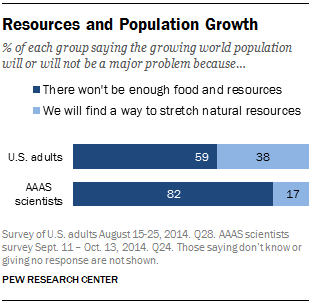
A majority of Americans express concern that world population growth will strain the planet’s natural resources: 59% of adults have a pessimistic view about the effect of population growth saying it will be a major problem because there will not be enough food and resources to go around. Nearly four-in-ten (38%) take the view that growth will not be a major problem because the world will find a way to stretch its natural resources.

By comparison, AAAS scientists are particularly likely to express concern about world population growth and natural resources. Fully 82% say population growth will be a major problem while 17% say this will not be a major problem because the world will find a way to stretch its natural resources.

Patterns Among the General Public

African-Americans are more optimistic that new solutions will emerge to address the strains on natural resource caused by a growing world population. Whites and Hispanics, by comparison, are more likely to see the growing world population as leading to a major problem. There are no differences or only modest differences in viewpoints about this issue by gender, age or education.

Energy Issues

Off-shore Drilling and Nuclear Power each has a 20-Point Gap; Fracking has 8-Point Gap
PI_2015-01-29_science-and-society-03-19

There is a 20-point gap between public and scientists’ views on two older energy technologies: offshore oil drilling and nuclear power, but the gap runs in opposite directions for each.20

About half of Americans (52%) favor allowing more offshore oil drilling in U.S. waters, while 44% are opposed. By contrast, most AAAS scientists oppose more offshore drilling by a margin of 66% to 32%.

The opposite pattern occurs in views about nuclear power. About half of Americans (51%) oppose building more nuclear power plants, while 45% are in favor. AAAS scientists show more support for nuclear power: 65% favor building more nuclear power plants while 33% are opposed. A majority of scientists support more nuclear power plants regardless of disciplinary specialty.

PI_2015-01-29_science-and-society-03-20

One newer form of energy development — increased use of genetically-engineered plants as a fuel alternative to gasoline — draws strong support among both the public and AAAS scientists. Fully 68% of Americans and 78% of AAAS scientists favor increased use of this technology.

Views about the increased use of hydraulic fracturing or ”fracking” tilt in the opposite direction. A minority of the public (39%) supports the increased use of fracking to extract oil and natural gas from underground rock formations, while about half (51%) are opposed. By comparison, opinion about fracking among AAAS scientists is more negative: 31% of scientists favor the increased use of fracking while 66% are opposed. However, scientists’ views about fracking vary across specialty areas. Engineers are more supportive of the increased use of fracking (53% favor) while those with biological or medical specialties are less supportive (25% favor). Those with a specialty in the earth sciences fall somewhere in between these two groups (42% favor).

Public support for the increased use of fracking has declined since March 2013 when there was more support (48%) than opposition (38%). An earlier Pew Research analysis found that opposition to increased fracking has grown since 2013 particularly among Midwesterners, women, and those under age 50.21

Patterns Among the General Public

Men express more support than women for building nuclear power plants, more offshore drilling, and increased use of fracking. Both men and women hold about the same views when it comes to bioengineered fuel alternatives from plants. There are no or only modest differences by education on these energy issues.

Views about the U.S. Space Program

View of Human Astronauts 12-Point Gap; Modest Difference on Value of Space Station

PI_2015-01-29_science-and-society-03-21

Many Americans, particularly those among the older generations, recount memories of the “space race” era and the historic events of NASA’s Apollo 11 landing a manned aircraft on the moon in 1969.22 NASA’s space shuttle program, which helped build the International Space Station, came to an end in 2011.

A majority of Americans see the space station as a good investment for the country: 64% say the space station has been a good investment, 29% say it has not. Views among AAAS scientists are also broadly positive: 68% of scientists say the space station has been a good investment for the country and 31% dissent from that view.

PI_2015-01-29_science-and-society-03-22

While sending humans into space has been a prominent feature of the U.S. space program in past decades, the future role of human astronauts in the U.S. space program is unclear.23The Pew Research survey asked respondents to consider whether the use of human astronauts in the U.S. space program is essential or not essential given the relative costs of manned vs. robotic space exploration. A majority of Americans (59%) take the view that human astronauts are an essential part of future U.S. space exploration. AAAS scientists, by contrast, are closely divided over whether or not human astronauts are essential in the space program going forward; 47% say that human astronauts are essential while 52% say they are not essential.

There are only modest differences among scientists by specialty area about this issue. Among those who identify their specialty as physics or astronomy 41% say human astronauts are essential and 58% say they are not essential for the future U.S. space program.

Patterns Among the General Public

Men are more likely than women to say that human astronauts are essential for the future of the U.S. space program (66% vs. 52%, respectively). Views about this issue are roughly the same among age, education racial and ethnic groups.

Access to Experimental Drugs

PI_2015-01-29_science-and-society-03-23

The Pew Research survey also asked the general public (but not the AAAS scientists) for their views about giving more people access to experimental drug treatments before clinical trials have shown whether such drugs are safe and effective for a specific disease or condition. The general public tends to favor this idea by a margin of 54% to 43%.24

Patterns Among the General Public

Some 59% of whites favor this idea, compared with about half of Hispanics (48%) and 36% of African-Americans.25 College graduates and those with higher family incomes tend to be more strongly in favor of this idea than are those with less education or income, respectively. Men and women are about equally likely to favor increased access to experimental drugs before clinical trials are complete, as are those under and over age 50.

Bioengineering

PI_2015-01-29_science-and-society-03-24

New technologies in science and medicine are generating an increasingly wide array of medical treatments. One such treatment involves creating artificial organs such as hearts or kidneys for transplant in humans needing organ replacement. The Pew Research survey asked the general public (but not the AAAS scientists) whether or not they felt the use of bioengineering to create artificial organs was an “appropriate use of medical advances” or was “taking such advances too far.” Fully 74% of adults say that bioengineering of organs is appropriate while 23% say this is taking medical advances too far.

Patterns Among the General Public

Whites are more inclined than African-Americans and Hispanics to say bioengineered organs are appropriate, although majorities in each of the three groups say this is appropriate. There are also modest differences in views about this issue by education and gender; college graduates more so than those with less education say bioengineering of organs is an appropriate use of medical advances. In addition, men more than women say bioengineered organs are an appropriate use of medical advances.

Modifying a Baby’s Genes

PI_2015-01-29_science-and-society-03-25

The survey also asked the public about two possibilities in the realm of genetic modifications. One question sought people’s views about changing a baby’s genetic characteristics in order to make the baby more intelligent. A separate question asked about changing a baby’s genetic characteristics in order to reduce the risk of serious diseases. Public views about the appropriateness of genetic therapies of this sort differ widely depending on the circumstances considered.

An overwhelming majority of adults (83%) say that modifying genetic characteristics to make a baby more intelligent is “taking medical advances too far.” Just 15% say this would be an appropriate use of medical advances.

By comparison, fewer are negative about genetic treatment to reduce the risk of serious diseases. But opinion about this circumstance is closely divided, with about half of adults (50%) saying genetic changes for this purpose would be taking medical advances too far and a nearly equal share of 46% saying this would be an appropriate use of medical advances.

Patterns Among the General Public

Women are a bit more negative than men about genetic modifications to reduce the risk of serious diseases (54% among women vs. 47% among men say this would be taking medical advances too far). Strong majorities of both men and women are opposed to modifications aimed at increasing a baby’s intelligence, although opinion is more negative among women (87%) than it is among men ( 78%). There are no differences, or only modest differences, in views about genetic modification in these circumstances by race, ethnicity, or education. Younger and older adults also tend to hold similar views on these questions However, those under age 30 are a bit more likely than older adults to say that changing a baby’s genetic characteristics in order to reduce disease risk is appropriate.

Chapter 4: AAAS Scientists’ Views on the Scientific Enterprise

As scientists size up the culture and their place in it, a majority think it is a good time for science and their own specialty. However, they are notably less upbeat than they were five years ago and express serious concerns about public knowledge of science and the way scientific findings are covered by journalists. Moreover, most scientists believe that policy regulations related to land use and clean water and air are not often guided by the best scientific findings. Notable numbers also say they do not think the best scientific information is often used in crafting policies around food safety and new drug and medical treatments. Additionally, scientists are worried about the prospects for future funding of science and about attracting talent to their fields. This chapter sorts through those issues.

Evaluating Science Today

PI_2015-01-29_science-and-society-04-01

AAAS scientists are generally less sanguine about the state of science today than they were five years ago at a time when the Great Recession was taking hold.26 About half of scientists (52%) say this is generally a good time for science, down 24 percentage points from 76% in 2009. Similarly, the share of scientists who say this is generally good time for their scientific specialty is down from 73% in 2009 to 62% today. The drop in positive assessments about the state of science since 2009 occurred among scientists of all disciplines, those with a basic and applied research focus, as well as those working in academia and those working in industry.

When it comes to their own scientific specialty, 59% of AAAS scientists in the Pew Research survey say that this is a good or very good time to begin a career in their field, down from 67% in 2009. Positive assessments about the state of their specialty for new entrants is about the same as in 2009 for those focused on applied research where scientific discoveries are aimed toward a practical purpose. But they are down 15 percentage points among those doing basic research about the scientific foundations of things. Among basic science researchers views have fallen from 63% who felt it was a good time in 2009 for their discipline to 48% today. Scientists working in a university setting are more downbeat about entering their specialty today than they were in 2009: 49% say it is a good or very good time to begin a career, down 14 points from 63% in 2009. Some 71% of AAAS scientists working in industry say it is a good or very good time to begin a career in their specialty, about the same as said this in 2009 (70%).

U.S. Science Compared with Other Industrialized Countries

PI_2015-01-29_science-and-society-04-02

AAAS scientists largely agree that U.S. achievements in science are a cut above other industrialized countries. Roughly nine-in-ten (92%) say that U.S. scientific achievements are the best in the world or above average compared with other industrialized countries and there are similarly high assessments when it comes to doctoral training (87%), and cutting-edge basic research (87%). About eight-in-ten scientists (81%) also say that industry research and development (R&D) innovation is above average in a global comparison. Nearly two-thirds (64%) say that U.S. medical treatment is above average.

But when it comes to K-12 science, technology, engineering, and math (STEM) education in America, just 16% of AAAS scientists say that the U.S. is above average or the best in the world compared with other industrialized countries. Some 38% of these AAAS scientists say K-12 STEM education in the U.S. is average, and 46% consider it below average.

The esteem shown for the scientific enterprise in the U.S. is about the same as in 2009. In that survey, 94% of AAAS scientists said that U.S. scientific achievements were the best in the world or above average compared with other industrialized countries. (This is the only question where a comparison over time is available.)

Evidence-Based Government Regulations?

PI_2015-01-29_science-and-society-04-03

Scientists’ views about the frequency with which the best science is implemented in government regulations tend to vary by domain. Some 58% of AAAS scientists say that the best science “always” (4%) or “most of the time” (54%) guides regulations when it comes to new drug and medical treatments while 41% say some of the time (40%) or never (1%).

Nearly half of AAAS scientists (46%) say the best science guides regulations related to food safety at least most of the time.

Views about the use of scientific information in clean air and water regulations are less favorable. Fully 72% of scientists say the best science guides such regulations no more than some of the time. Similarly, when it comes to land use regulations, 84% of AAAS scientists think the best scientific information guides regulations no more than some of the time.

Scientists’ Views about the Effect of the Public and Media on Science

PI_2015-01-29_science-and-society-04-04

The predominant view among scientists is that limited public knowledge about science, and journalism about science, pose problems for science. Fully 84% of AAAS scientists call the limited public knowledge about science a major problem and 14% say it is a minor problem for science.

About eight-in-ten AAAS scientists (79%) say news reports that don’t distinguish between well-founded and not well-founded scientific findings are a major problem. About half of scientists (52%) say that oversimplification of science findings by the media and public expectations for a quick solution (49%) are major problems, Opinions on these questions are about the same as in 2009. There has been a modest uptick in the share saying news media not distinguishing between well-founded and not well-founded results is a major problem for science (79% today and 76% in 2009) A slight rise also occurred in the share saying that media oversimplifying research findings is a major problem (52% today and 48% in 2009).

Perceived Reasons for Limited Public Science Knowledge

PI_2015-01-29_science-and-society-04-05

The Pew Research survey asked AAAS scientists to consider the degree to which each of four possible reasons contribute to the public’s limited knowledge about science. Three-quarters of scientists consider too little STEM education in grades K through 12 a major reason the public has a limited knowledge about science, another 22% say this is a minor reason.

A majority of scientists also fault public interest levels in science: 57% say the lack of interest in science news contributes to limited public knowledge. By comparison, fewer fault the media or scientists themselves. About four-in-ten (43%) say a major reason for limited public knowledge about science is a lack of media attention to scientific developments while 40% say that too few scientists communicating their findings through the media and online (40%) is a major reason for limited public knowledge about science. (These questions were not asked in 2009.)

Perceived Problems in the Research World Today

PI_2015-01-29_science-and-society-04-06

The survey of AAAS scientists included a series of questions to identify how the rules and regulations governing the scientific community and the research they conduct are working today and how they are affecting scientific research.27

Funding concerns dominate responses to this list of seven potential issues facing researchers: 88% of AAAS scientists say that lack of funding for basic research is a serious problem. Concerns about adequate funding are widely shared among scientists of all disciplines and employment sectors.

While a majority of AAAS scientists (56%) say they have received some kind of research funding within the past five years, the problem of lack of funding is cited by both those who have recently received funding (91%) and those who have not (83%) as a serious problem. As noted in Chapter 2, 83% of AAAS scientists consider the federal funding environment to be harder today than it was five years ago and a sizable minority view funding from industry (45%) and private sources (45%) to be harder today.

Another question focused on scientists’ concern about the degree to which foundational research studies are replicated by independent researchers. About half of scientists (48%) say that “not enough data replication of previous research studies” is a serious problem for conducting high quality scientific research. One reason for concern about this issue stems from the building-block nature of scientific progress that may start, for example, with animal research and move to clinical trials and eventually to new medical treatments.28 If important studies are not replicated, it is harder to know how valid they are and how much to base other research on those findings.

Another challenge cited by a sizeable share of scientists was difficulty that foreign scientists face in gaining entrance to the U.S. More than a quarter of the science and engineering workforce is foreign-born, with many in the U.S. on the H1B visas for highly-skilled workers, and more than a third of doctorate recipients in science and engineering fields are international students in the U.S. on temporary visas.29 Some 32% of AAAS scientists say that visa issues facing foreign scientists wanting to study or work in the U.S. are a problem for conducting quality research. Fully 55% of AAAS scientists who are themselves foreign born and not U.S. citizens cite visa and immigration problems as a serious problem. U.S. citizens, whether foreign-born or U.S.-born, are less inclined to say this is a problem (32% and 30% do so, respectively).

Further down the list of problems cited by scientists as serious problems for research: regulations governing animal research (13% of AAAS scientists say it is a serious problem); the way Institutional Review Boards30 (IRBs) implement rules to protect human research subjects (12% say it is a serious problem); conflict of interest rules used by publications (8% say it is a serious problem); International Traffic in Arms (ITAR) regulations that limit the way American technology can be used overseas (6% say it is a serious problem).

PI_2015-01-29_science-and-society-04-07

When it comes to funding, most scientists say that funders in their field emphasize lower-risk, lower-reward projects over higher-risk projects that have the potential for scientific breakthroughs. A majority of AAAS scientists (56%) say that, overall, funding in their specialty places greater emphasis on projects expected to make incremental progress with lower risk of failure over those with potential for scientific breakthroughs but with a higher risk of failure. In 2009, 59% said funding decisions emphasized projects expected to make incremental progress with a lower risk of failure.

PI_2015-01-29_science-and-society-04-08

Some 74% of AAAS scientists say the incentive to do research where funding is readily available has too much influence on the direction of research, while 23% disagree, saying such incentives do not have too much influence. Concerns about an undue influence of funding availability on the research process are roughly the same as in 2009.

A 69% majority also say that a focus on projects expected to yield quick results has too much influence on the direction of research while 29% disagree. In 2009, 66% of the scientists in this sample said emphasis on quick results had too much influence on the direction of research in their specialty.

There has been a modest uptick in concerns about two other possible influences on research. A majority (55%) of scientists say that political groups or officials have too much influence on the direction of research in their specialty, up 5 points from 50% in 2009 who said the same.

Additionally, 47% of scientists say the emphasis on developing marketable products has too much influence on research directions, while 51% say it does not. Concerns about market influences are up from 2009 when 40% said this had too much influence and 56% said it did not.

Entering a Career in Science Today

PI_2015-01-29_science-and-society-04-09

While a majority of AAAS scientists consider this a good or very good time to begin a career in their specialty areas, scientists are more downbeat about entering the profession today than they were five years ago. Some 59% of scientists surveyed say this is a good time to enter their specialty area, down 8 percentage points since 2009. The more pessimistic assessments are primarily among scientists working in basic research as compared with applied research, and among those working in university settings as compared with business or industry.

PI_2015-01-29_science-and-society-04-10

Among scientists whose research is focused on basic knowledge questions 48% say it is a good or very good time to start a career, down 15 points from 63% in 2009. Some 69% of those in applied research say this is a good time to enter their specialty area, roughly the same share as said this in 2009 (71%). Similarly, among all those working in a university setting, 49% say this is a good or very good time to enter their specialty, down 14 points from 2009. Views among those working in industry have held steady: 71% today and 70% in 2009.

Fully 58% of AAAS scientists consider it harder to attract the best people to the profession today than it was five years ago, 32% say it is about the same and just 9% say it is easier today. Basic researchers (62%) are more likely than applied researchers (55%) to say attracting talent is harder today.

PI_2015-01-29_science-and-society-04-11

Scientists see a number of hurdles facing new career entrants today. Fully 85% of AAAS scientists say the lack of adequate funding for research is a serious problem for new entrants. They also cite the limited number of tenure-track jobs (73% of AAAS scientists say it is a serious problem) in university settings and too few R&D jobs in industry (54% say it is a serious problem). Half of scientists (50%) consider salary levels to be a serious problem for new career entrants and 46% say the long hours needed to succeed in a research career is a serious problem. By comparison, fewer fault the graduate training being offered today. About three-in-ten (31%) say training that doesn’t meet todays’ needs is a serious problem.

Looking across a wide range of survey responses, there are relatively few differences in views by age among those responding. To the extent there are differences, they are modest.31 Larger differences by age among scientists emerge when it comes to perceptions of the hurdles facing new career entrants. Younger scientists (ages 18 to 49) are more likely to see four of the six possible problems asked about in the survey as a serious problems for new career entrants, (too few tenure-track openings, salaries below market competition, long hours needed to succeed and graduate training that doesn’t meet today’s needs). Scientists under age 50 and those ages 50 to 64 are about equally likely to see the lack of adequate research funding as a serious problem for new entrants (90% and 87%, respectively) while those ages 65 and older are less likely to cite this as a serious problem (78%). There are no differences by age in the perception that the number of job openings in industry R&D is a problem for people entering science research careers.

Motivations for Their Own Careers in Science

PI_2015-01-29_science-and-society-04-12

The survey also asked AAAS scientists to mention the one or two most significant experiences in their own path towards science.32 Open-ended responses to this question were wide-ranging with some thinking back to childhood experiences and even lifelong expectations of being a scientist and others mentioning adult life events or the serendipity of life experiences.

In all, 30% of AAAS scientists mentioned an intellectual curiosity or desire for intellectual challenge, often saying this was present from their earliest memories. Another 8% talked about wanting to make a difference or contribute society. Some 4% simply offered that they were good at it.

Many talked about the influence of mentors and teachers (24%), courses and schools (6%) or other course-related experiences (6%) that influenced their choices.

Another 8% mentioned childhood experiences that set them on a science path, including extensive time in nature, visiting science museums, or experimenting with a chemistry set; 13% mentioned science fairs or specific lab, fieldwork or internship experiences; and, 8% mentioned some kind of job experience that helped shape their path towards science, and sometimes away from other directions.

One in eight (12%) mentioned the importance of encouragement or inspiration from their family. Others talked about the influence of books, movies and TV shows –either non-fiction or fiction—that were influential in their lives (7%) and some talked about the influence of the space race era (4%) or more practical concerns such as the availability of research funding or job opportunities (4%).

Profile of AAAS scientists surveyed

PI_2015-01-29_science-and-society-04-13

AAAS is the largest multidisciplinary scientific society in the world. Those eligible to participate in this survey reflect a broad definition of the professionally-engaged scientific community in the U.S. They come from a range of disciplines and backgrounds, with about half identifying their primary specialty area in the biomedical disciplines and the remainder from a range of other disciplines. They are about evenly divided between those who consider their primary focus to be basic knowledge and applied research.

As a group, they differ from the general public in a number of ways. AAAS scientists are lopsidedly male (71%) and older than the general public as whole (median age 59 years). Both a gender skew favoring men and a relatively older age are also characteristic of the total U.S. workforce in science and engineering.33

AAAS scientists are a highly educated group. An overwhelming majority has some post-graduate education, including 72% who have at least one doctoral level degree. Those in science and engineering occupations typically have more schooling than the general public. But, AAAS scientists as a whole stand out for their high levels of education even in comparison to the broader science and engineering workforce.34

PI_2015-01-29_science-and-society-04-14

Compared with the total science and engineering workforce, AAAS scientists are also distinctive for the high share with a background in the biological and medical sciences and for their employment in the educational sector.35

PI_2015-01-29_science-and-society-04-15

More than eight-in-ten (82%) AAAS scientists consider their specialty “interdisciplinary” and many have taken part in some kind of activity that draws from more than one discipline. For example, 57% of AAAS scientists say they published a research study with a multidisciplinary team and nearly all (92%) report reading a journal article outside of their primary specialty area in the past year.

PI_2015-01-29_science-and-society-04-16

A majority (56%) of AAAS scientists have received research funding within the past five years. Seven-in-ten scientists currently working full-time have received funding within the past five years as have 76% of those working in an academic setting.

Those with recent funding are most likely to have received federal grant funds for research (78%); 46% received direct research support from a university or college and about a third received funding from a private foundation. Smaller shares report funding from industry sources (25%), state government (15%) or from a scientific professional association (6%).

Appendix A: About the General Public Survey

The general public survey was conducted by telephone with a national sample of adults (18 years of age or older) living in all 50 U.S. states and the District of Columbia. The results reported here are based on 2,002 interviews (801 respondents were interviewed on a landline telephone and 1,201 were interviewed on a cell phone). Interviews were completed in English and Spanish by live, professionally trained interviewing staff at Princeton Data Source under the direction of Princeton Survey Research Associates International from August 15 to 25, 2014.

Survey Design

A combination of landline and cell random digit dial (RDD) samples was used to reach a representative sample of all adults in the United States who have access to either a landline or cellular telephone. Both samples were disproportionately stratified to increase the incidence of African-American and Hispanic respondents. Within each stratum, phone numbers were drawn with equal probabilities. The landline samples were list-assisted and drawn from active blocks containing one or more residential listings, while the cell samples were not list-assisted but were drawn through a systematic sampling from dedicated wireless 100-blocks and shared service 100-blocks with no directory-listed landline numbers. Both the landline and cell RDD samples were disproportionately stratified by county based on estimated incidences of African-American and Hispanic respondents.

Margin of Sampling Error

PI_2015-01-29_science-and-society-A1-01

Statistical results are weighted to correct known demographic discrepancies, including disproportionate stratification of the sample. The margins of error table shows the unweighted sample sizes and the error attributable to sampling that would be expected at the 95% level of confidence for different groups in the survey.

The survey’s margin of error is the largest 95% confidence interval for any estimated proportion based on the total sample – the one around 50%. For example, the margin of error for the entire sample is ±3.1 percentage points. This means that in 95 out of every 100 samples drawn using the same methodology, estimated proportions based on the entire sample will be no more than 3.1 percentage points away from their true values in the population. Sampling errors and statistical tests of significance used in this report take into account the effect of weighting. In addition to sampling error, one should bear in mind that question wording and practical difficulties in conducting surveys can introduce error or bias into the findings of opinion polls.

Interviewing Procedures

All interviews were conducted using a Computer Assisted Telephone Interviewing (CATI) system, which ensures that questions were asked in the proper sequence with appropriate skip patterns. CATI also allows certain questions and certain answer choices to be rotated, eliminating potential biases from the sequencing of questions or answers.

For the landline sample, interviewers asked half of the time to speak with the youngest adult male currently at home and the other half of the time asked to speak with the youngest adult female currently at home, based on a random rotation. If no respondent of the initially requested gender was available, interviewers asked to speak with the youngest adult of the opposite gender who was currently at home. For the cell phone sample, interviews were conducted with the person who answered the phone; interviewers verified that the person was an adult and could complete the call safely.

Both the landline and cell samples were released for interviewing in replicates, which are small random samples of each larger sample. Using replicates to control the release of the telephone numbers ensures that the complete call procedures are followed for all numbers dialed. As many as seven attempts were made to contact every sampled telephone number. The calls were staggered at varied times of day and days of the week (including at least one daytime call) to maximize the chances of making contact with a potential respondent.

Questionnaire Development

The Pew Research Center developed the questionnaire. The design of the questionnaire was informed by consultation with a number of staff at the Pew Research Center, senior staff of the AAAS, and several outside advisors. Questionnaire development is an iterative process. A pilot study was conducted August 5-6, 2014 with 101 adults living in the continental U.S. The sample was drawn from fresh RDD landline phone numbers (n=25) and a sample of cell phone numbers from respondents interviewed in recent RDD omnibus studies (n=76). The tested questionnaire included a number of open-ended questions to gauge what respondents had in mind when thinking about the positive and negative effects of science on society. As a final step, a traditional pretest was conducted August 12, 2014, with 24 adults living in the continental U.S. The sample was drawn from fresh RDD landline phone numbers and a sample of cell phone numbers from respondents interviewed in recent RDD omnibus studies. The interviews were conducted in English under the direction of Princeton Survey Research Associates International. The interviews tested the questions planned for the study questionnaire in the full survey context. The final questionnaire lasted about 22 minutes, on average.

Weighting

Several stages of statistical adjustment or weighting are used to account for the complex nature of the sample design. The weights account for numerous factors including (1) the different, disproportionate probabilities of selection in each strata, (2) the overlap of the landline and cell RDD sample frames and (3) differential nonresponse associated with sample demographics.

The first stage of weighting accounts for different probabilities of selection associated with the number of adults in each household and each respondent’s telephone status.36 This weighting also adjusts for the overlapping landline and cell RDD sample frames and the relative sizes of each frame and each sample. Due to the disproportionately stratified sample design, the first-stage weight was computed separately for each stratum in each sample frame.

After the first-stage weight adjustment, two rounds of poststratification were performed using an iterative technique known as raking. The raking matches the selected demographics to parameters from the U.S. Census Bureau’s 2012 American Community Survey data.37 The population density parameter was derived from 2010 census data. The telephone usage parameter came from an analysis of the July-December, 2013 National Health Interview Survey.38 Raking was performed separately for those asked each form of the questionnaire using sample balancing, a special iterative sample weighting program that simultaneously balances the distributions of all variables using a statistical technique called the Deming Algorithm. The raking corrects for differential nonresponse that is related to particular demographic characteristics of the sample. This weight ensures that the demographic characteristics of the sample closely approximate the demographic characteristics of the population.

The first round of raking was done individually for three race/ethnicity groups (Hispanics, non-Hispanic blacks, and all other non-Hispanics). The variables matched to population parameters for each race/ethnicity group were gender, age, education and region. The variables matched to population parameters for Hispanic respondents also included nativity (U.S. born versus foreign born). The variables for other non-Hispanic respondents also included race (white race versus some other or mixed race).

A second round of poststratification raking was performed on the total sample for each form. Each form was raked to the following demographic variables: gender by age, gender by education, age by education, census region, race/ethnicity, population density and household telephone status (landline only, cell phone only, or both landline and cell phone).

Appendix B: About the AAAS Scientists Survey

The survey of scientists was conducted online with a random sample of 3,748 U.S.-based members of the American Association for the Advancement of Science (AAAS) from September 11 to October 13, 2014. AAAS is the world’s largest general scientific society, and includes members from all scientific fields. Founded in 1848, AAAS publishes Science, one of the most widely circulated peer-reviewed scientific journals in the world. Membership in AAAS is open to all. The survey was conducted under the direction of Princeton Survey Research Associates International.

Sampling

A simple random sample of AAAS members was selected for participation by the staff of AAAS. Eligibility was limited to U.S. members but otherwise used a broad definition of the scientific community. AAAS members of any discipline or background were eligible to participate except for those whose membership type indicated that they were primary or secondary educators. AAAS staff and institutional members were also excluded from eligibility.

The sample was designed to replicate that used in the 2009 survey of AAAS members, and thus to maximize comparability of samples between the two time points. While it’s possible that the composition of AAAS members could have changed in substantive ways over time, comparisons of population characteristics in the AAAS membership database for 2009 and 2014 as well as sample characteristics from survey respondents suggest that AAAS member characteristics have stayed about the same on a variety of demographic and professional characteristics.

Weighting

Survey-based estimates of the population of AAAS members could be biased if some members are more or less likely than others to participate in the survey. To help ensure sample representativeness, the data were weighted to match population characteristics of AAAS membership for three characteristics: membership category, fellowship status and email availability. Membership categories of the organization adjust for a somewhat lower response rate among student members and a somewhat higher response rate among other membership types including emeritus and professional memberships. AAAS fellows also had somewhat higher response rates compared with non-fellow members and thus weighting adjusts for that differential response rate. As expected, those with no email availability responded at somewhat lower rates, perhaps due to the greater difficulties this group faces participating in an online survey. Weighting also included an adjustment for contact via email or mail-only. Post data collection statistical adjustments require procedures that reflect departures from simple random sampling. The total design effect for this survey is 1.10.

PI_2015-01-29_science-and-society-A2-01

The margins of error table shows the unweighted sample sizes and the error attributable to sampling that would be expected at the 95% level of confidence for different subgroups. The survey’s margin of sampling error is the largest 95% confidence interval for any estimated proportion. For example, the margin of error for the entire sample is ±1.7 percentage points. This means that in 95 out of every 100 samples drawn using the same methodology, estimated proportions based on the entire sample will be no more than 1.7 percentage points away from their true values in the population, in this case, U.S.-based scientists in the AAAS. Sampling errors and statistical tests of significance used in this report take into account the effect of weighting. In addition to sampling error, one should bear in mind that question wording and practical difficulties in conducting surveys can introduce error or bias into the findings of opinion polls.

Survey Administration

PI_2015-01-29_science-and-society-A2-02

A total of 19,984 members were mailed a letter requesting participation in the survey. The bulk of selected members (n=18,682) had both an email address and a physical address in the membership database while some had only a physical address available (n=1,302). Multiple contacts via postal mail and email, if available, were made to encourage participation in the online survey.

The invitation letter described the nature and purpose of the survey and included the URL and other access information to the online survey, it used a letterhead showing both AAAS and the Pew Research Center logos, and was signed by the head of each organization. An initial email was also sent to those with email addresses containing information similar to that on the advance letter in addition to a hyperlink to the survey login. A postcard reminder was sent to all who had not yet responded to the survey about two weeks after the initial mailing. A follow up email or letter (if no email address) was sent to those who had not yet responded roughly three weeks after the initial mailing. The online survey was closed as of Oct 13, 2014.

A total of 3,748 members completed the survey for an overall response rate of 18.8%.