
Pew Research Center

FOR RELEASE JANUARY 15, 2015

Social Media and the Cost of Caring

Frequent use of social media is not directly related to higher stress. But stress can be contagious through social media channels: Social media users are often more aware of the stressful events in others' lives, and this awareness itself can lead to higher stress.

BY Keith Hampton, Lee Rainie, Weixu Lu, Inyoung Shin and Kristen Purcell

FOR MEDIA OR OTHER INQUIRIES:

Communications Department
202.419.4372
www.pewresearch.org

RECOMMENDED CITATION

Pew Research Center, January 2015, "Social Media and the Cost of Caring"

About Pew Research Center

Pew Research Center is a nonpartisan, nonadvocacy fact tank that informs the public about the issues, attitudes and trends shaping the world. It does not take policy positions. The Center conducts public opinion polling, demographic research, computational social science research and other data-driven research. It studies politics and policy; news habits and media; the internet and technology; religion; race and ethnicity; international affairs; social, demographic and economic trends; science; research methodology and data science; and immigration and migration. Pew Research Center is a subsidiary of The Pew Charitable Trusts, its primary funder.

© Pew Research Center 2026

Table of contents

  • About Pew Research Center
  • Social Media and the Cost of Caring
  • Psychological Stress and Social Media Use
  • The Cost of Caring
  • Appendix A: Regressions
  • Appendix B: Method

Social Media and the Cost of Caring

Frequent use of social media is not directly related to higher stress. But stress can be contagious through social media channels: Social media users are often more aware of the stressful events in others' lives, and this awareness itself can lead to higher stress.

For generations, commentators have worried about the impact of technology on people’s stress. Trains and industrial machinery were seen as noisy disruptors of pastoral village life that put people on edge. Telephones interrupted quiet times in homes. Watches and clocks added to the de-humanizing time pressures on factory workers to be productive. Radio and television were organized around the advertising that enabled modern consumer culture and heightened people’s status anxieties.

Inevitably, the critics have shifted their focus onto digital technology. There has been considerable commentary about whether internet use in general and social media use in particular are related to higher levels of stress.1 Such analysts often suggest that it is the heaviest users of these technologies that are most at risk. Critics fear that these technologies take over people’s lives, creating time pressures that put people at risk for the negative physical and psychological health effects that can result from stress.

This research explores whether the use of social media, mobile phones and the internet is associated with higher levels of stress. In a Pew Research Center survey of 1,801 adults,2 we asked participants about the extent to which they felt their lives were stressful, using an established scale of stress called the Perceived Stress Scale (PSS).3 This scale is based on people’s answers to 10 questions that assess whether they feel that their life is overloaded, unpredictable and uncontrollable. Perceived stress, as measured through the PSS, can be viewed as an assessment of the risk that people face for psychological disorders related to stress, such as anxiety and depression, as well as physical illnesses, such as cardiovascular disease and susceptibility to infectious diseases.

There are a number of well-known factors that tend to make people feel more stress, including things like the economic uncertainty of unemployment, and the absence of a spouse or a partner with whom to confide. Previous studies have even found that awareness of stressful events in others’ lives is a major contributor to people’s appraisal of their own stress levels. The relationship of frequent use of digital technologies to stress has been an unknown. We also explored the possibility that the social component of some digital technologies makes people more aware of stressful events in the lives of their close friends and family, as well as in the lives of more socially distant acquaintances, and that this in turn is related to higher levels of stress.

The survey analysis produced two major findings that illustrate the complex interplay of digital technology and stress:

  • Overall, frequent internet and social media users do not have higher levels of stress. In fact, for women, the opposite is true for at least some digital technologies. Holding other factors constant, women who use Twitter, email and cellphone picture sharing report lower levels of stress.
  • At the same time, the data show there are circumstances under which the social use of digital technology increases awareness of stressful events in the lives of others. Especially for women, this greater awareness is tied to higher levels of stress and it has been called “the cost of caring.” Stress is not associated with the frequency of people’s technology use, or even how many friends users have on social media platforms. But there is one way that people’s use of digital technology can be linked to stress: Those users who feel more stress are those whose use of digital tech is tied to higher levels of awareness of stressful events in others’ lives. This finding about “the cost of caring” adds to the evidence that stress is contagious.4

How can it be that social media use is not directly associated with stress, but for some, social media use can still lead to higher levels of stress?

The answer: The relationship between stress and social media use is indirect. It is the social uses of digital technologies, and the way they increase awareness of distressing events in others’ lives, that explains how the use of social media can result in users feeling more stress.

Imagine a typical Facebook user. He or she is also likely to use other digital technologies, such as email and text messaging. All these technologies allow him or her to share information with friends and family in the form of photos, short textual messages and other contacts. As a result of this communication, he or she is aware and reminded of more activities in the lives of friends and family.

On the one hand, there are benefits from this contact. According to previous research by the Pew Research Center, compared with non-social media users and those who are not as active on Facebook, this person likely: has more close friends; has more trust in people; feels more supported; and is more politically involved. While some might assume that this typical user of Facebook and other digital technologies experiences peer pressure to participate or keep up, and a fear of missing out, if such pressures exist, our typical user does not feel more stress than what he or she would otherwise have experienced, or the social benefit of using these technologies cancels out those additional costs. He or she is unlikely to feel more stress than those who are not using or are less active on social media.

On the other hand, there is the common exception to this relatively positive situation. Sometimes, a social media user’s awareness of events in others’ lives includes knowledge about undesirable events, a friend or family member getting fired or losing someone close to them. Learning of such events in the life of a friend or family member can result in higher feelings of stress.

In sum, social media users are not any more likely to feel stress than others, but there is a subgroup of social media users who are more aware of stressful events in their friends’ lives and this subgroup of social media users does feel more stress.

Gender differences are a major part of this story. Women and men have different levels of stress; their use of digital technologies varies; and the impact of their technology use is different.

The broad patterns are:

  • Overall, women tend to report more stress than men. But, those women who use a number of digital technologies to communicate with others tend to report less stress than women who do not use these technologies.
  • Women are more aware of stressful events in the lives of their closest friends and family.
  • Social media use is related to even higher levels of awareness of the stressful events that unfold in the lives of people they know.
  • Awareness of stressful events in others’ lives is a significant contributor to people’s own stress. It is the only factor that we found that is common to both social media use and psychological stress. The number of undesirable events associated with stress is greater for women than for men.

Elaborating on the Major Findings

Overall, women tend to report more stress than men. But, women who use a number of digital technologies to communicate with others report less stress than women who are non-users.

In this survey, women report an average score of 10.5 out of 30 on the Perceived Stress Scale (PSS). Men reported an average score of 9.8 — a figure that is 7% lower than women.

Because men and women tend to experience stress differently, we ran each of our analyses separately for men and for women. We did statistical modeling allowing us to more fully understand the relationship between stress and the use of different technologies. The use of regression analysis allowed us to control for such things as age, unemployment, education levels and marital status — all of which are related to how much stress people tend to report in their lives independent of whether they use technologies or not.5

When it comes to stress, there was no statistical difference in stress levels between men who use social media, cellphones, or the internet and men who do not use these technologies. However, some tech activities were linked to less stress among women — Twitter use, email use and photo sharing via cellphones. Compared with a woman who does not use these technologies, a women who uses Twitter several times per day, sends or receives 25 emails per day, and shares two digital pictures through her mobile phone per day, scores 21% lower on our stress measure than a woman who does not use these technologies at all.

We do not know what it is about these specific technology uses that are associated with lower stress. However, existing studies have found that social sharing of both positive and negative events can be associated with emotional well-being and that women tend to share their emotional experiences with a wider range of people than do men.6 Sharing through email, sending text messages of pictures of events shortly after they happen and expressing oneself through the small snippets of activity allowed by Twitter may provide women with a low-demand and easily accessible coping mechanism that is not experienced or taken advantage of by men. It is also possible that the use of these media replaces activities or allows women to reorganize activities that would otherwise be more stressful.

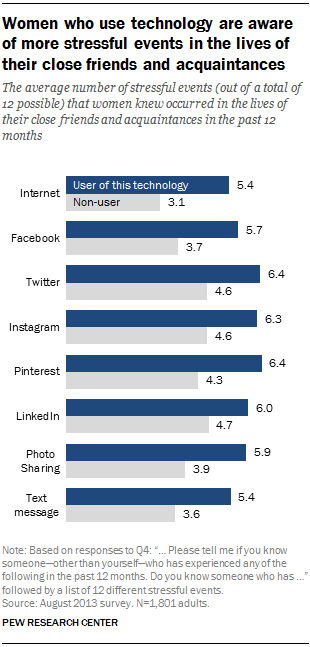
Women are more aware of stressful events in the lives of their closest friends and family.

In the survey we asked people if they were aware of whether any of a list of 12 stressful events had happened to someone close to them, an acquaintance, or both in the past year. The events were selected from a list of major life events that are known social stressors.7 Our list ranged from relatively common to less common events: hospitalization, death in the family, divorce or marriage, being fired/laid off, being accused of a crime, starting a job, demotion/pay cut, being a victim of a crime, having a child move away or return home, pregnancy or child birth, and moving to a new house.

Of the 12 stressful events that we studied, on average, women were aware of a larger number of events that had occurred among people they knew. On average, men were aware of 7% fewer stressful events among their closest social ties.

Social media users tend to be more aware of stressful events in the lives of people they know.

PI_2015-01-15_social-media-stress-01

Different technologies are associated with varying levels of awareness of stressful events that have occurred to others — and there is also variation depending on whether the events have occurred to those who are close ties, compared with more-distant acquaintances.

Facebook was the one technology that for both men and women provides higher levels of awareness of stressful events taking place in the lives of both close and more distant acquaintances. Other technologies are more specialized: some provide awareness of major events in the lives of close relationships, while others provide an awareness of activities in the lives of acquaintances who are less socially close. It is not a new finding that people tend to use different technologies to communicate with social ties of different strengths. For example, other studies have found that cellphones and instant messaging are more likely to be used with family and close friends.8 To add to this complexity, we found that men and women used digital technologies differently, and this is important for understanding how people are exposed to information about stressful events in others’ lives.

Among Facebook users:

  • A woman with an average size network of Facebook friends is aware of 13% more stressful events in the lives of her closest social ties, compared with an equivalent woman who does not use Facebook. And that average woman user is aware of 14% more stressful events in the lives of her more-distant acquaintances.
  • A typical male Facebook user who comments regularly on others’ posts is aware of 8% more stressful events amongst his closest social ties. A man with an average size network of Facebook friends is aware of 6% more major events in the lives of his acquaintances, compared with an equivalent male who does not use Facebook.

For women, awareness about stressful events in others’ lives was also likely to be related to sharing pictures online, use of Pinterest and Twitter. For men, awareness was particularly likely to be related to email, LinkedIn and text messaging on their cellphone. These patterns are a result of both the tendency for men and women to use different technologies, and for them to use different technologies to keep in touch with different types of people — friends, family, workmates and acquaintances.

Awareness of stressful events in others’ lives is a significant contributor to people’s own stress. The number of undesirable events associated with stress is greater for women than for men.

The cost of caring is particularly felt by women. This is a result of two facts about women and stress: first, women report higher levels of stress to begin with, and second, women are aware of more stressful events in the lives of their friends and family.

Holding other factors constant, women who were aware that …

  • Someone close to them experienced the death of a child, partner or spouse scored 14% higher on our measure of stress.
  • Someone close has been hospitalized or experienced a serious accident or injury reported 5% higher stress.
  • An acquaintance had been accused of or arrested for a crime scored 11% higher on the stress measure.
  • An acquaintance experienced a demotion or cut in pay reported 9% higher stress in their own lives.

For men, of the events we explored, only two predicted stress. Holding other factors constant, men who were aware that …

  • Someone close to them had been accused of or arrested for a crime scored 15% higher on our measure of stress.
  • An acquaintance had experienced a demotion or pay cut at work report 12% higher stress.

While the little sips of information sent through social media may not seem like much, they can add up to a big gulp. This study suggests that the information transferred through social media translates into awareness of all kinds of extra things, including an awareness of undesirable events in the lives of family, friends and acquaintances. Whether as a result of social media, or more traditional forms of interaction, awareness of undesirable events in others’ lives generates a cost in terms of increasing psychological stress, and with it, higher risk for the physical and psychological problems that often accompany stress.

About this Survey

The analysis in this report is based on findings from a nationally representative survey of 1,801 American adults (ages 18+) by the Pew Research Center fielded August 7-September 16, 2013. The survey was conducted in English and Spanish on landline and cellphones (N=900). The margin of error for the full sample is plus or minus 2.6 percentage points. Some 1,076 respondents are users of social networking sites and the margin of error for that subgroup is plus or minus 3.3 percentage points.

Psychological Stress and Social Media Use

It makes sense to wonder if the use of digital technology creates stress. There is more information flowing into people’s lives now than ever — much of it distressing and challenging. There are more possibilities for interruptions and distractions. It is easier now to track what friends, frenemies, and foes are doing and to monitor raises and falls in status on a near-constant basis. There is more social pressure to disclose personal information. These technologies are said to takeover people’s lives, creating time and social pressures that put people at risk for the negative physical and psychological health effects that can result from stress.

Stress might come from maintaining a large network of Facebook friends, feeling jealous of their well-documented and well-appointed lives, the demands of replying to text messages, the addictive allure of photos of fantastic crafts on Pinterest, having to keep up with status updates on Twitter, and the “fear of missing out” on activities in the lives of friends and family.9

We add to this debate with a large, representative study of American adults and explore an alternative explanation for the relationship between technology use and stress. We test the possibility that a specific activity, common to many of these technologies, might be linked to stress. It is possible that technology users — especially those who use social media — are more aware of stressful events in the lives of their friends and family. This increased awareness of stressful events in other people’s lives may contribute to the stress people have in their own lives. This study explores the digital-age realities of a phenomenon that is well documented: Knowledge of undesirable events in other’s lives carries a cost — the cost of caring.10

This study explores the relationship between a variety of digital technology uses and psychological stress. We asked people an established measure of stress that is known as the Perceived Stress Scale (PSS).11 The PSS consists of ten questions and measures the degree to which individuals feel that their lives are overloaded, unpredictable and uncontrollable. Participants were asked:

In the last 30 days, how often have you:

  1. Been upset because of something that happened unexpectedly
  2. Felt that you were unable to control the important things in your life
  3. Felt nervous and “stressed”
  4. Felt confident about your ability to handle any personal problems
  5. Felt that things were going your way
  6. Found that you could not cope with all the things that you had to do
  7. Been able to control irritations in your life
  8. Felt that you were on top of things
  9. Been angered because of things that were outside of your control
  10. Felt difficulties were piling up so high that you could not overcome them

Participants responded on a 4-point scale from “frequently” to “never.” The ten items were combined so that a higher score indicates higher psychological stress (the scale ranges from 0-30 with zero representing no stress and 30 representing the highest level).12

Overall, women experience more stress than men.

The average American adult scored 10.2 out of 30 on the PSS. One of the starkest contrasts in our survey was between the level of reported stress experienced by men and women. On average, women report experiencing significantly higher levels of stress than men. The average women scores 10.5 on the PSS while the average man scores 9.8.13 On average, men reported stress levels that were 7% lower than for women.

There are other demographic characteristics that are related to stress. On average, older adults, and those who are employed tend to have less stress.

How we studied psychological stress and technology use

In the survey, respondents were asked about their use of social networking sites: We asked people about the frequency with which they use different social media platforms, such as Facebook (used by 71% of internet users in this sample), Twitter (used by 18% of internet users), Instagram (17%), Pinterest (21%), and LinkedIn (22%).

Given the popularity of Facebook, we also asked very specific questions about users’ networks and what people do on that platform: number of friends (the average was 329), frequency of status updates (the average was 8 times per month), frequency of “Liking” other people’s content (the average was 34 times per month), frequency of commenting (the average was 22 times per month), and how often they send private messages (the average was 15 times per month).14

We asked people how many digital pictures they share online (the average was 4 times per week), how many people they email (9 people/day), and how many emails they send and receive (an average of 25 per day). We also asked about their use of their mobile phone; the number of messages they text (an average of 32 messages per day), pictures sharing via text (an average of 2 pictures per day), and the number of people that they text with (an average of 4 people per day).

Given the important differences in stress levels based on age, education, marital status, and employment status, we used regression analysis to control for these factors. By using regression analysis we are able determine the degree to which technology use is specifically associated with stress by holding demographic characteristics constant. Since men and women tend to experience stress differently, we ran separate analyses for each sex.

Those who are more educated and those who are married or living with a partner report lower levels of stress.

We found that women, and those with fewer years of education, tend to report higher levels of stress, while those who are married or living with a partner report less psychological stress (see Table 1 in Appendix A). For women (but not men), those who are younger, and those who are employed in paid work outside of the home also tend to experience less stress.

The frequency of internet and social media use has no direct relationship to stress in men. For women, the use of some technologies is tied to lower stress.

For men, there is no relationship between psychological stress and frequent use of social media, mobile phones, or the internet more broadly. Men who use these technologies report similar levels of stress when compared with non-users.

For women, there is evidence that tech use is tied to modestly lower levels of stress. Specifically, the more pictures women share through their mobile phones, the more emails they send and receive, and the more frequently they use Twitter, the lower their reported stress. However, with the exception of Twitter, for the average person, the relationship between stress and these technologies is relatively small. Women who are heavier participants in these activities report less stress. Compared with a woman who does not use these technologies, a women who uses Twitter several times per day, sends or receives 25 emails per day, and shares two digital pictures through her mobile phone per day, scores 21% lower on our stress measure than a woman who does not use these technologies at all.

From this survey we are not able to definitively determine why frequent uses of some technologies are related to lower levels of reported stress for women. Existing studies have found that social sharing of both positive and negative events can be associated with emotional well-being and that women tend to share their emotional experiences with a wider range of people than do men.15 Sharing through email, sending text messages of pictures of events shortly after they happen, and expressing oneself through the small snippets of activity allowed by Twitter, may provide women with a low-demand and easily accessible coping mechanism that is not experienced or taken advantage of by men. It is also possible that the use of these media replaces activities or allows women to reorganize activities that would otherwise be more stressful. Previous Pew Research reports have also documented that social media users also tend to report higher levels of perceived social support. It could be that technology use leads to higher levels of perceived social support, which in turn moderates, or reduces stress, and subsequently reduces people’s risk for the physical diseases and psychological problems that often accompany stress.16

Awareness of Other People’s Stressful Life Events and Social Media Use

This report pays particular attention to social stress. This kind of stress comes from exposure to stressful life events. It is not directly a measure of whether someone feels that their own life is overloaded. Rather, it assesses people’s stress by understanding their social environment.17 Those who experience stressful life events often suffer a range of negative physical outcomes, including physical illness and lower mental health.18

It is possible that technology users — especially those who use social media — are more aware of stressful events in the lives of their friends and family. This increased awareness of stressful events in other people’s lives may contribute to the stress people have in their own lives.

Previous Pew Research reports have documented that social media users tend to perceive higher levels of social support in their networks. They also have a greater awareness of the resources within their network of relationships — on and offline. This awareness has generally been perceived as a social benefit. Individuals who are aware of the things that are happening with their friends and the informal resources available to them through their social ties have more social capital. The extra flows of personal information in social media, what we have termed “pervasive awareness,” are one of the potential benefits of digital technologies.19 However, it is also possible that this heightened awareness comes with a cost.

We wanted to know if the awareness afforded by the use of digital technologies was limited to an awareness of what others could provide (social capital), or if it also included an awareness of the problems and stressful events that take place in the lives of friends, family, and acquaintances. Such awareness is not inherently negative. In fact, an awareness of the problems and hurdles faced by others is a precondition of empathy,20 a dimension of social intelligence (social interest),21 and facilitates the provision of social support. However, awareness can also have an emotional impact – a “cost of caring.”22

To measure awareness of other people’s stress we asked participants if they knew someone – other than themselves – who experienced any of a dozen major life events in the past 12 months. We additionally asked if the person(s) the event happened to was someone close to them (a strong tie), or an acquaintance whom they were not very close with (a weak tie), or both. Our list was composed of major life events that are known sources of stress in people’s lives.23

The survey findings were that in the previous 12 months:

  • 57% of adults said they know someone who had started a new job
  • 56% know someone who had moved or changed homes
  • 54% know someone who had become pregnant, given birth, or adopted a child
  • 50% knew someone who had been hospitalized or experienced a serious accident or injury
  • 50% knew someone who had become engaged or married
  • 42% knew someone who had been fired or laid off
  • 36% knew someone who had experienced the death of a child, partner, or spouse
  • 36% knew someone who had a child move out of the house or move back into the house
  • 31% knew someone who had gone through a marital separation or divorce
  • 26% knew someone who had experienced a demotion or pay cut at work
  • 22% knew someone who had been accused of or arrested for a crime
  • 22% knew someone who had been the victim of a robbery or physical assault

Unsurprisingly, given that most people have few close social ties compared with the number of acquaintances they have, for all of the events we queried, people were more likely to know a weak tie (an acquaintance) than a strong tie who had experienced one of these stressful events.

The average adult in our sample knew people who had experienced 5 of the 12 events that we asked about.

How we studied awareness of stressful events in other people’s lives

As with our analysis of psychological stress, regression analysis was used to test if the use of different digital technologies was related to higher or lower levels of awareness of stressful events in other people’s lives. This allows us to determine the role of different technologies in helping different users be aware of stressful events in others’ lives, controlling for likely differences in awareness that are related to demographic factors such as age, education, race, marital and employment status.

Knowing that the sexes tend to be very different in their awareness of stressful event in the lives of those around them, we further divided our analysis into a comparison of women and men. We also anticipated that some technologies might be more commonly used for communication with close social ties, and primarily provide for an awareness of major events in the lives of close friends and family, while others may be more suited for awareness of events in the lives of looser acquaintances (Appendix A: Table 2).

Women are more aware than men of major events in the lives of people who are close to them.

Previous research has found that women tend to be more aware of the life events of people in their social network than are men.24 When we compared men and women based on the average number of life events that someone in their social network had experienced in the past year, women were consistently more aware than men, although the average was only statistically significant for close relationships.

More educated and younger people are more aware of events in other people’s lives.

A number of demographic factors were consistently related to a higher level of awareness of major events within people’s social networks. For both men and women, those who were younger and those with more years of education tended to know of more major events in the lives of people around them.

In addition, we found that women who were married or living with a partner, and women employed in paid work outside the home, were more aware of events in the lives of their acquaintances (weak ties), but that this was not related to awareness of events in the lives of close friends and family.

Social Media Users Are More Aware of Major Events in the Lives of People Close to Them

Social media use is clearly linked to awareness of major events in other people’s lives. However, the specific technologies that are associated with awareness vary for men and women.

PI_2015-01-15_social-media-stress-02
PI_2015-01-15_social-media-stress-03

Among both men and women, Pinterest users have a higher level of awareness of events in the lives of close friends and family. The more frequently someone used Pinterest, the more events they were aware of:

  • Compared with a woman who does not use Pinterest, a woman who visits Pinterest 18 days per month (average for a female Pinterest user) is typically aware of 8% more major life events from the 12 events we studied amongst her closest social ties.
  • Compared with a man who does not use Pinterest, a man who used Pinterest at a similar rate (18 days per month) would tend to be aware of 29% more major life events amongst their closest ties.
PI_2015-01-15_social-media-stress-04

Men who used LinkedIn, men who send text messages to a larger number of people, and men who comment on other people’s posts more frequently on Facebook also tend to be more aware of major events in the lives of people close to them. These same technologies had no impact on woman’s awareness of events in the lives of people close to them.

Compared with a man with similar demographic characteristics that does not use the following technologies:

  • Those who send text messages to four different people through their mobile phones on an average day (the average for a male cellphone user) tend to be aware of 16% more events amongst those who are close to them.
  • A male user of LinkedIn visits the site fifteen times per month and is typically aware of 14% more events in the lives of their closest social ties.
  • A male Facebook user, who comments on other Facebook users content 19 times per month, is, on average, aware of 8% more events in the lives of their closest friends and family.

For women, the more friends on their Facebook network and the more pictures they shared online per week, the more aware of major life events in the lives of close friends and family. Compared with demographically similar women who do not use these technologies:

  • A woman who shares 4 photos online per week tends to be aware of 7% additional major events in the lives of those who are close to her.
  • A female Facebook user with 320 Facebook friends (the average for women in our sample) is, on average, aware of 13% more events in the lives of her closest social ties.

Similarly, men experienced higher levels of awareness as a result of a larger number of different technologies.

Facebook use is associated with more awareness of major events in the lives of acquaintances.

Looking beyond people’s close relationships to include a looser set of their acquaintances, we find that Facebook use is a consistent predictor of awareness of stressful events in others’ lives for both men and women. Specifically, the more Facebook friends people have, and the more frequently they “Like” other people’s content, the more major events they are aware of within their network of contacts.

  • Compared with a non-Facebook user, a male Facebook user with 320 Facebook friends is, on average, aware of 6% more major events in the lives of their extended acquaintances. A female Facebook user with the same number of friends is aware of 14% more events in the lives of their weak ties.
  • A male or female Facebook user who “Likes” other people’s content about once per day, is typically aware of 10% more major events in the lives of their extended acquaintances.

For women, Instagram is related to lower awareness of major events in the lives of acquaintances, while Twitter and photo sharing are related to higher awareness.

Women are also likely to have higher awareness of their extended network as a result of the number of pictures they share online and through frequent use of Twitter. Compared with a demographically similar woman who does not use these technologies:

  • A female Twitter user, who uses the site once per day, tends to be aware of 19% more events in the lives of their extended network.
  • A woman who shares 4 digital pictures per week is typically aware of 6% more events in their network of lose social ties.

Use of Instagram was the only technology use that we found to predict lower levels of awareness, and only for women. This might be the case because Instagram is used differently that some other kinds of social media. Scholars have found that many people make cellphone calls and exchange text messages predominantly with their closest ties. They have argued that this is “tele-cocooning,”25and they believe that people’s use of mobile phones leads to contact with more intimate relations at the expense of weaker and more diverse social ties. Instagram use may be tied to a similar pattern. Those who use Instagram might reduce their focus on the lives of their social ties that are not considered especially close. Controlling for other factors, a female user of Instagram who uses the platform a few times per day is, on average, aware of 62% fewer major events in the lives of their extended network than someone who does not use Instagram at all.

For men, text messaging, email, and Pinterest are related to higher awareness of major events in the lives of acquaintances.

In addition to use of Facebook, men’s awareness of stressful events in their friends’ lives tends to be higher for those who email and send text messages to a larger number of people. Compared with someone who does not use these technologies:

  • A male email user who is in contact with 9 different people by email per day is generally aware of 13% more events in the lives of their distant social circle.
  • A male who sends text messages to four people per day is, on average, aware of 11% more major events in the lives of their weaker social ties.

The Cost of Caring

People undergoing major life events can be at higher risk of physical and psychological distress, including depressive symptoms.26 Even awareness of others’ difficulties might add to stress – while at the same time offering people a chance to give support and comfort to those in the networks.

A number of recent studies have pointed out that emotions may be contagious through social networks.27 28 Stress may be one such contagion. Indeed, awareness of other people’s problems is associated with a range of negative outcomes, such as depression.29 The “cost of caring” associated with awareness of other people’s stressful events may be a negative consequence of social media use because social media may make users more aware of the struggles of those in their network.

To test whether social stress is contagious — that the heightened awareness of stressful events in other people’s lives is related to higher psychological stress in people’s own lives — we use regression analysis to explore the relationship between the use of digital technologies, awareness of major events in other people’s life, and psychological stress. By doing this, we are able to determine if awareness of any specific type of life events is associated with higher or lower levels of psychological stress (Appendix A: Table 1).

Stress is contagious

Awareness of some of the major events happening to their friends was related to stress in people’s own lives. But not all the events were tied to stress. Of course, because our list of twelve events is a sample from a lengthy potential list of stressful major life events, the true effect of the “cost of caring” is possibly much larger than we document here.30

The number of events related to higher stress was greater for women than it was for men. Unsurprisingly, all the events associated with higher levels of stress were events that were likely to negatively impact the lives of friends and family. On average, a woman who is aware that:

  • Someone close to them experienced the death of a child, partner, or spouse scored 14% higher on their own measure of stress, holding other things constant.
  • Someone close has been hospitalized or experienced a serious accident or injury reported 5% higher psychological stress.
  • An acquaintance had been accused of or arrested for a crime scored 11% higher on the stress measure.
  • An acquaintance experienced a demotion or cut in pay reported 9% higher levels of psychological stress.

For men, of the events we explored, only two predicted stress. On average, men who were aware that:

  • Someone close to them had been accused of or arrested or a crime reported 15% higher on our measure of psychological stress.
  • An acquaintance had experienced a demotion or pay cut at work report 12% higher stress.

For both men and women, we found no relationship between their own stress (higher or lower levels) and awareness of more positive (but generally still stressful) events in their friends’ lives, such as an engagement or marriage.

People can become aware of undesirable events in the lives of friends and family through a variety of means. Digital technologies are only one new way that people become aware of these events.

It is clear from this analysis that the cost of caring is particularly felt by women. This is a result of both the larger number of events related to women’s stress, and the higher level of awareness that women tend to have of major events in the lives of people around them. Controlling for other factors, in the unlikely example that a women is aware of all of the events we covered in the survey, she would typically score 32% higher than the average woman on our measure of perceived stress. A man would score 27% higher than the average man.

The joy of missing out

There is one other factor to note in our findings. We found that women who were aware that an acquaintance — someone not very close to them – had experienced the death of a child, partner or spouse, reported lower levels of psychological stress. This is the opposite of how women feel when aware that someone close to them suffered the same experience. At first glance, this finding might be interpreted as somewhat uncaring — perhaps a sign of “schadenfreude,” or the pleasure derived from the misfortune of others. In fact, this finding is more likely to be an extension of the cost of caring. It could be seen as “the joy of missing out.” When women see more-distant acquaintances struggling with stressful events, it might have the effect of inducing relief that this particular event has not happened to someone closer to them. It is a reminder that the lives of close friends/family could, after all, be much worse. Controlling for other factors, the joy of missing out was typically associated with a score that was about 6% lower on our scale of perceived stress.

Appendix A: Regressions

PI_2015-01-09_social-media-stress-appendix_08

Appendix B: Method

This report is based on the findings of a survey on Americans’ use of the Internet. The results in this report are based on data from telephone interviews conducted by Princeton Survey Research Associates International from August 7 to September 16, 2013, among a sample of 1,801 adults, age 18 and older. Telephone interviews were conducted in English and Spanish by landline (901) and cellphone (900, including 482 without a landline phone). For results based on the total sample, one can say with 95% confidence that the error attributable to sampling is plus or minus 2.6 percentage points. For results based on Internet users (n=1,445), the margin of sampling error is plus or minus 2.9 percentage points. In addition to sampling error, question wording and practical difficulties in conducting telephone surveys may introduce some error or bias into the findings of opinion polls.

A combination of landline and cellular random digit dial (RDD) samples was used to represent all adults in the United States who have access to either a landline or cellular telephone. Both samples were provided by Survey Sampling International, LLC (SSI) according to PSRAI specifications. Numbers for the landline sample were drawn with equal probabilities from active blocks (area code + exchange + two-digit block number) that contained three or more residential directory listings. The cellular sample was not list-assisted, but was drawn through a systematic sampling from dedicated wireless 100-blocks and shared service 100-blocks with no directory-listed landline numbers.

New sample was released daily and was kept in the field for at least seven days. The sample was released in replicates, which are representative subsamples of the larger population. This ensures that complete call procedures were followed for the entire sample. At least 7 attempts were made to complete an interview at a sampled telephone number. The calls were staggered over times of day and days of the week to maximize the chances of making contact with a potential respondent. Each number received at least one daytime call in an attempt to find someone available. For the landline sample, interviewers asked to speak with the youngest adult male or female currently at home based on a random rotation. If no male/female was available, interviewers asked to speak with the youngest adult of the other gender. For the cellular sample, interviews were conducted with the person who answered the phone. Interviewers verified that the person was an adult and in a safe place before administering the survey. Cellular sample respondents were offered a post-paid cash incentive for their participation. All interviews completed on any given day were considered to be the final sample for that day.

Weighting is generally used in survey analysis to compensate for sample designs and patterns of non-response that might bias results. A two-stage weighting procedure was used to weight this dual-frame sample. The first-stage corrected for different probabilities of selection associated with the number of adults in each household and each respondent’s telephone usage patterns. This weighting also adjusts for the overlapping landline and cell sample frames and the relative sizes of each frame and each sample.

The second stage of weighting balances sample demographics to population parameters. The sample is balanced to match national population parameters for sex, age, education, race, Hispanic origin, region (U.S. Census definitions), population density, and telephone usage. The Hispanic origin was split out based on nativity; U.S born and non-U.S. born. The White, non-Hispanic subgroup was also balanced on age, education and region. The basic weighting parameters came from the US Census Bureau’s 2011 American Community Survey data. The population density parameter was derived from Census 2010 data. The telephone usage parameter came from an analysis of the July-December 2012 National Health Interview Survey.

Following is the full disposition of all sampled telephone numbers:

PI_2015-01-09_social-media-stress-appendix_09

The disposition reports all of the sampled telephone numbers ever dialed from the original telephone number samples. The response rate estimates the fraction of all eligible respondents in the sample that were ultimately interviewed. At PSRAI it is calculated by taking the product of three component rates:

  • Contact rate — the proportion of working numbers where a request for interview was made
  • Cooperation rate — the proportion of contacted numbers where a consent for interview was at least initially obtained, versus those refused
  • Completion rate — the proportion of initially cooperating and eligible interviews that were completed

Thus the response rate for the landline sample was 8 percent. The response rate for the cellular sample was 10 percent.