Pew Research Center

FOR RELEASE FEBRUARY 27, 2014

The Web at 25 in the U.S.

The overall verdict: The internet has been a plus for society and an especially good thing for individual users

BY Susannah Fox and Lee Rainie

FOR MEDIA OR OTHER INQUIRIES:

Communications Department
202.419.4372
www.pewresearch.org

RECOMMENDED CITATION

Pew Research Center, February 2014, "The Web at 25 in the U.S."

About Pew Research Center

Pew Research Center is a nonpartisan, nonadvocacy fact tank that informs the public about the issues, attitudes and trends shaping the world. It does not take policy positions. The Center conducts public opinion polling, demographic research, computational social science research and other data-driven research. It studies politics and policy; news habits and media; the internet and technology; religion; race and ethnicity; international affairs; social, demographic and economic trends; science; research methodology and data science; and immigration and migration. Pew Research Center is a subsidiary of The Pew Charitable Trusts, its primary funder.

© Pew Research Center 2026

Table of contents

  • About Pew Research Center
  • The Web at 25 in the U.S.
  • About This Report
  • Part 1: How the internet has woven itself into American life
  • Part 2: Americans’ views about the role of the internet in their lives
  • Methods

The Web at 25 in the U.S.

The overall verdict: The internet has been a plus for society and an especially good thing for individual users

Summary of Findings

The World Wide Web turns 25 on March 12, 2014. It is one of the most important and heavily-used parts of the network of computer networks that make up the internet. Indeed, the invention of the Web by Sir Tim Berners-Lee was instrumental in turning the internet from a geeky data-transfer system embraced by specialists and a small number of enthusiasts into a mass-adopted technology easily used by hundreds of millions around the world.1
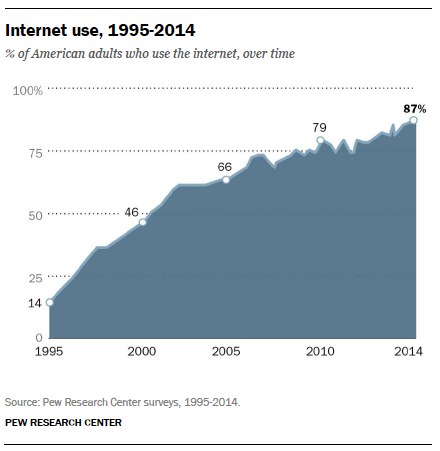
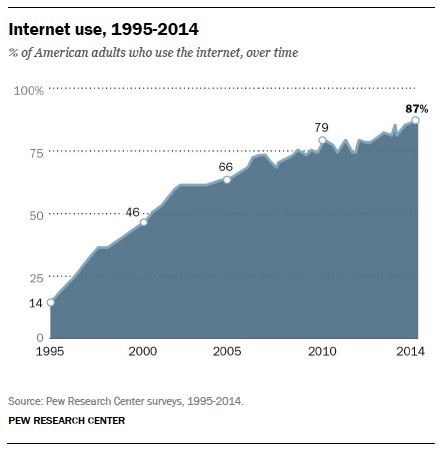
Internet use 1995 - 2014

The Web’s birthday provides an occasion to take stock of the impact of the rapid growth of the internet since its invention and the attendant rise of mobile connectivity. Since 1995, the Pew Research Center has documented this explosive adoption of the internet and its wide-ranging impacts on everything from: the way people get, share, and create news; the way they take care of their health; the way they perform their jobs; the way they learn; the nature of their political activity; their interactions with government; the style and scope of their communications with friends and family;  and the way they organize in communities.

In a new national survey to mark the 25th anniversary of the Web, Pew Research finds further confirmation of the incredible spread and impact of the internet:

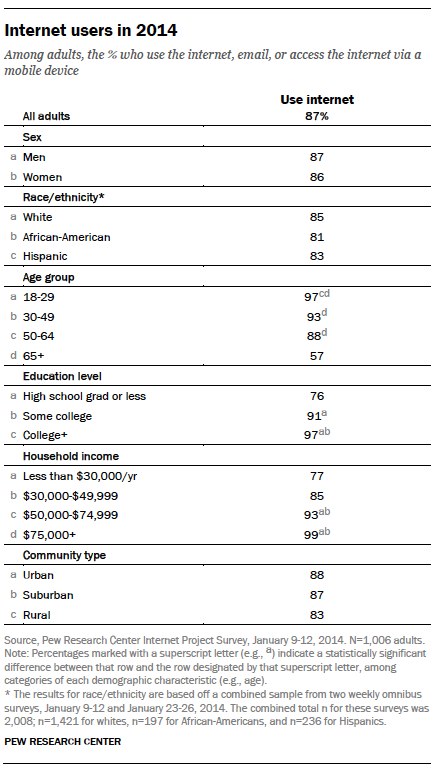
Adoption: 87% of American adults now use the internet, with near-saturation usage among those living in households earning $75,000 or more (99%), young adults ages 18-29 (97%), and those with college degrees (97%). Fully 68% of adults connect to the internet with mobile devices like smartphones or tablet computers.

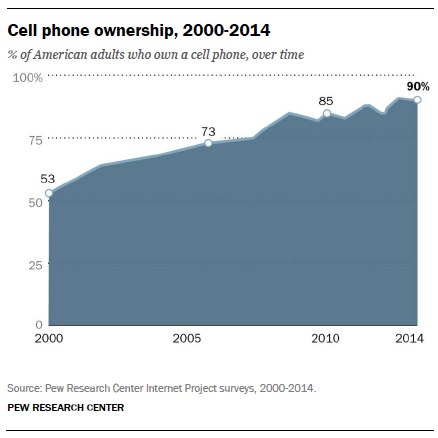
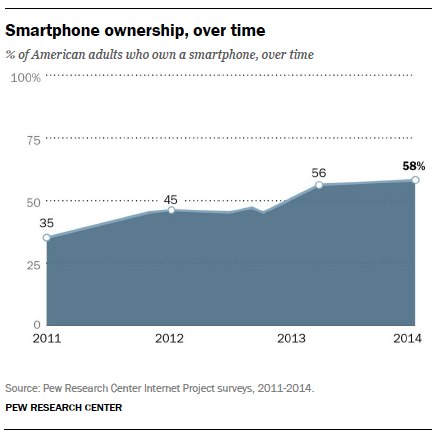
The adoption of related technologies has also been extraordinary: Over the course of Pew Research Center polling, adult ownership of cell phones has risen from 53% in our first survey in 2000 to 90% now. Ownership of smartphones has grown from 35% when we first asked in 2011 to 58% now.

Impact: Asked for their overall judgment about the impact of the internet, toting up all the pluses and minuses of connected life, the public’s verdict is overwhelmingly positive:

  • 90% of internet users say the internet has been a good thing for them personally and only 6% say it has been a bad thing, while 3% volunteer that it has been some of both.
  • 76% of internet users say the internet has been a good thing for society, while 15% say it has been a bad thing and 8% say it has been equally good and bad.
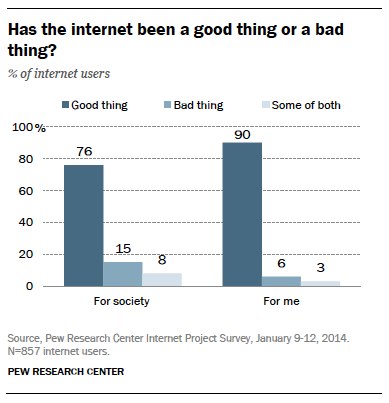
Is the internet a good or bad thing?

Digital technology is viewed as increasingly essential

Technologies that would be very hard to give up

We asked the adults who use basic technologies whether it would be hard to give them up and users of the internet and mobile phones made clear those technologies feel increasingly essential, while more traditional technologies like landline phones and television are becoming easier to part with:

  • 53% of internet users say the internet would be, at minimum, “very hard” to give up, compared with 38% in 2006. That amounts to 46% of all adults who now say the internet would be very hard to give up.
  • 49% of cell phone owners say the same thing about their cell, up from to 43% in 2006. That amounts to 44% of all adults who now say cell phones would be very hard to give up.
  • Overall, 35% of all adults say their television would be very hard to give up, a share that has dipped from 44% who said that in 2006.
  • 28% of landline telephone owners say their phone would be very hard to give up, a major drop from 2006 when 48% of landline owners said it would be very hard to give up their wired phone. That amounts to 17% of all adults who now say their landline phones would be very hard to give up.

In addition to this enthusiasm, a notable share of Americans say the internet is essential to them. Among those internet users who said it would be very hard to give up net access, most (61% of this group) said being online was essential for job-related or other reasons. Translated to the whole population, about four in ten adults (39%) feel they absolutely need to have internet access. Among those most deeply tied to the internet, about half as many (some 30%) said it would be hard to give up access because they simply enjoy being online.

Most internet users think online communication has strengthened their relationships and the majority report the environment is kind

There is considerable debate about whether online communication—through email, messaging, or social media—has strengthened or weakened relationships. Internet users’ own verdict is overwhelmingly positive when it comes to their own ties to family and friends: 67% of internet users say their online communication with family and friends has generally strengthened those relationships, while 18% say it generally weakens those relationships.

Interestingly enough, there are no significant demographic differences tied to users’ feelings about the impact of online communication on relationships. Equal proportions of online men and women, young and old, rich and poor, highly educated and less-well educated, veterans and relative newbies say by 3-to-1 or better that online communication is a relationship enhancer, rather than a relationship detractor.
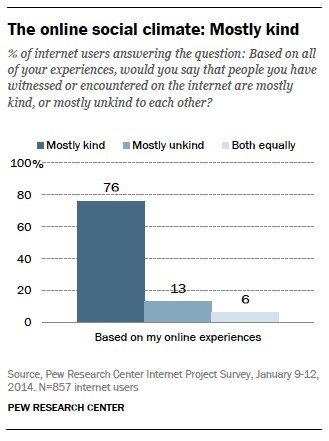
The online social climate is mostly kind

Asked for a broad perspective about the civility or incivility they have either witnessed or encountered during their online tenure, 76% of internet users said the people they witnessed or encountered online were mostly kind and 13% said people were mostly unkind.

People were also considerably more likely to say they themselves had been treated kindly than they had been treated unkindly or attacked. And internet users were more likely to say online group behavior they had seen had been helpful, rather than harmful.

  • 70% of internet users say they had been treated kindly or generously by others online. That compares with 25% who say they have been treated unkindly or been attacked.
  • 56% of internet users say they have seen an online group come together to help a person or a community solve a problem. That compares with 25% who say they have left an online group because the interaction became too heated or members were unpleasant to one another.

About this survey

The results in this report are based on data from telephone interviews conducted by Princeton Survey Research Associates International from January 9-12, 2014, among a sample of 1,006 adults, age 18 and older. Telephone interviews were conducted in English and Spanish by landline and cell phone. For results based on the total sample, one can say with 95% confidence that the error attributable to sampling is plus or minus 3.5 percentage points. For results based on internet users (N=857), the margin of sampling error is plus or minus 3.9 percentage points.
About This Report

This report is the first part of a sustained effort through 2014 by the Pew Research Center to mark the 25th anniversary of the creation of the World Wide Web by Sir Tim Berners-Lee. Lee wrote a paper on March 12, 1989 proposing an “information management” system that became the conceptual and architectural structure for the Web.  He eventually released the code for his system—for free—to the world on Christmas Day in 1990. It became a milestone in easing the way for ordinary people to access documents and interact over a network of computers called the internet—a system that linked computers and that had been around for years. The Web became especially appealing after Web browsers were perfected in the early 1990s to facilitate graphical displays of pages on those linked computers.

It thus became a major layer of the internet. Indeed, for many, it became synonymous with the internet, even though that is not technically the case. The internet is rules (protocols) that enable computer networks to communicate with each other. The Web is a service that uses the network to allow computers to access files and pages that are hosted on other computers. Other applications that are different from the Web also exploit the internet’s architecture to facilitate such things as email, some kinds of instant messaging, and peer-to-peer activities like internet phone calling through services like Skype or file sharing through torrent services.

Using the Web—browsing it, searching it, sharing on it—has become the main activity for hundreds of millions of people around the globe. Its birthday offers an occasion to revisit the ways it has made the internet a part of Americans’ social lives.

This first report looks back at the rapid change in internet penetration over the last quarter century, and covers new survey findings about Americans’ generally positive evaluations of the internet’s impact on their lives and personal relationships. In the coming months, the Pew Research Center’s Internet Project in association with Elon University’s Imagining the Internet Project will further mark the 25th anniversary of the Web by releasing eight reports about emerging trends in digital technology that are based on surveys of experts about the future of such things as privacy, cybersecurity, the “internet of things,” and net neutrality. We will also explore some of the economic change driven by the spectacular progress that made digital tools faster and cheaper. And we will report on whether Americans feel that the explosion of digital information coursing through their lives has helped them be better informed and make better decisions.

This report is a collaborative effort based on the input and analysis of the following individuals.

Lee Rainie, Director, Internet Project      

Susannah Fox, Associate Director, Internet Project                             

Maeve Duggan, Research Assistant                                 

Find related reports about the future of the internet at https://alpha.pewresearch.org/pewresearch-org/internet/topics/future-of-the-internet/. Find related data about the long-term trends in technology adoption at https://alpha.pewresearch.org/pewresearch-org/internet/three-technology-revolutions/.

Part 1: How the internet has woven itself into American life

In possibly the first survey of its kind, in 1983, polling firm Louis Harris & Associates asked U.S. adults if they had a personal computer at home and, if so, if they used it to transmit information over telephone lines.2 Just 10% of adults said they had a home computer and, of those, 14% said they used a modem to send and receive information. The resulting estimate was that 1.4% of U.S. adults used the internet.

Personal computer owners were then asked, “Would your being able to send and receive messages from other people…on your own home computer be very useful to you personally?” Some 23% of the computer owners said it would be very useful, 31% said it would be somewhat useful, and 45% of those early computer users said it would not be very useful. And 74% of computer owners agreed with the statement, “The trouble with purchasing and bill-paying by computer is that it will be too easy to buy too many things that aren’t in the family budget.”

Looking back, this should come as no surprise. A blinking cursor on a blank screen was not exactly an invitation to dream, at least by most people’s estimates. The internet would remain a clunky, text-based resource for another six years.

In 1989, Tim Berners-Lee changed all that by introducing the concept of a “distributed hypertext system,” which could link files in an ever-expanding network shaped more like a cobweb than like a chain or tree structure, as was standard at the time. The World Wide Web was born.

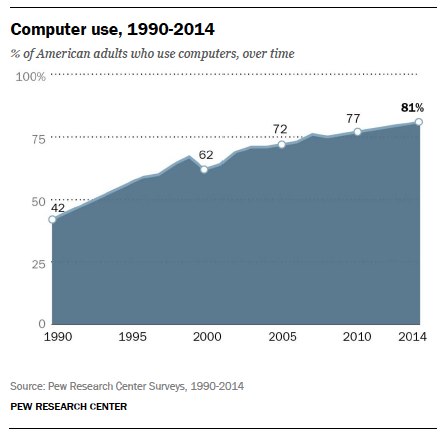
Within a year, the Pew Research Center fielded its first question about computer use in a national survey. In February 1990, 42% of U.S. adults said they used a personal computer, even if only rarely. Men and women were about equally as likely to use computers, as were whites and blacks. College graduates were the most likely group to say they use computers on a regular basis: 46%, compared with 16% of those who had completed high school.

But counting the number of computer users was not going to cut it among people who took the internet’s potential seriously.

In 1994, Donna Hoffman and Thomas Novak, professors at the Owen Graduate School of Management at Vanderbilt University, wrote, “Current approaches to estimating the number of users of the internet are akin to estimating the number of people in the U.S. by sampling the number of buildings, without regard to their function or contents. We propose a completely different way—rather than inferring the number of users by counting and sampling machines, sample the users themselves.”3

The computer connection

In 1995, the Pew Research Center did just that, finding 14% of U.S. adults with internet access.4 Most were using slow, dial-up modem connections—just 2% of internet users were comparatively screaming along with an expensive 28.8 modem.

To put things into further perspective, 42% of U.S. adults had never heard of the internet and an additional 21% were vague on the concept—they knew it had something to do with computers and that was about it. Yet even then, 63% of people who used a computer at home said they would miss it “a lot” if they no longer had one.

Early researchers were not too far off the mark, however, focusing on computer penetration into American households, schools, and businesses. Twenty-five years ago, anyone who wanted to use the internet needed to have access to a computer. Again, in 1990, 42% of U.S. adults said they used a computer at their workplace, at school, at home, or anywhere else, even if only occasionally.

Now, eight in ten U.S. adults (81%) say they use laptop and desktop computers somewhere in their lives—at home, work, school, or someplace else.

Computer use, 1990 - 2014

Education has always been a significant factor when it comes to predicting someone’s likelihood to use a computer. In both the 1990 and the current sample, there is about a 30 percentage point gap in computer use between adults with a college degree and adults with a high school diploma. Age is also a durable predictor for computer use: 56% of adults ages 65 and older now say they use a computer, compared with 89% of 18-29 year olds, for example.

Current computer user demographics

Cell phones and mobile connectivity

Nowadays, desktop or laptop computer access is no longer a prerequisite for internet access. Ninety percent of U.S. adults have a cell phone and two-thirds of those say they use their phones to go online. One third of cell phone owners say that their primary internet access point is their phone, not some other device such as a desktop or laptop computer.

Cell phone ownership, 2000 - 2014

The Pew Research Center’s earliest measure of cell phone ownership was in 2000, when 53% of U.S. adults said they had a cell phone.

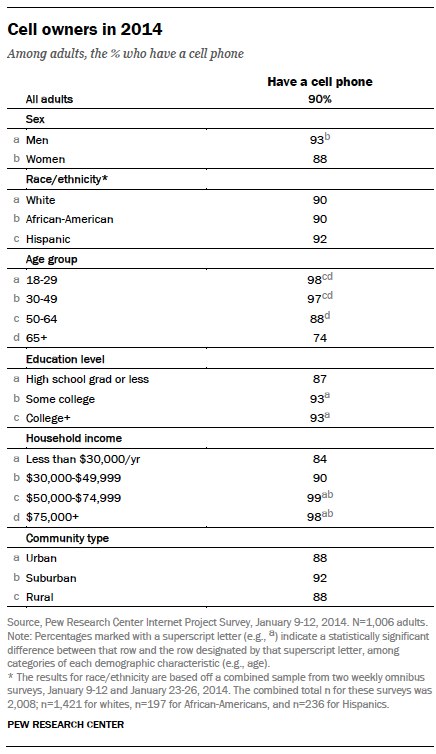
Education is less of a factor in predicting cell phone ownership than in predicting computer use: 93% of adults with a college degree have a cell phone, compared with 87% of adults with a high school education or less. Age, however, is a factor: 98% of 18-29 year-olds say they have a cell phone, compared with 74% of adults ages 65 and older.

Current cell owner demographics


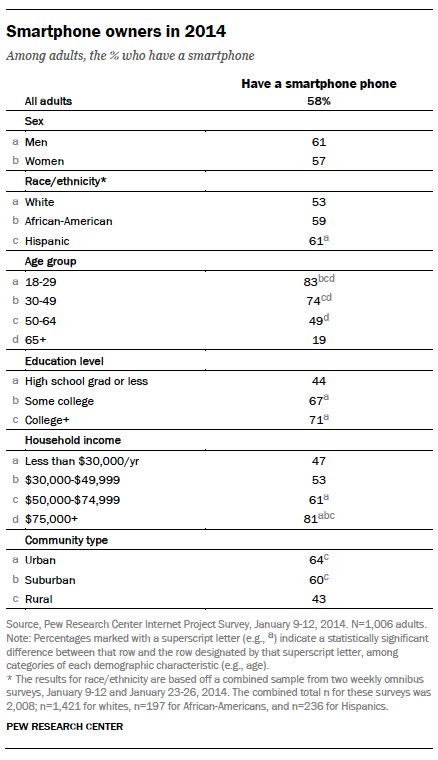
Mobile access to the internet took a huge leap forward when smartphones were introduced in mid-2007 with the introduction of the iPhone. Now, 58% of U.S. adults say they have a smartphone. Higher education is associated with smartphone use, as is being younger than age 50.

Smartphone ownership over time
Smartphone owner demographics

Internet adoption over time

Adding all of these access points together, 87% of U.S. adults say they use the internet, at least occasionally—the highest percentage captured in a Pew Research Center poll since we began measuring it in 1995, when just 14% of U.S. adults had access.

Internet use, 1995 - 2014

The latest findings illustrate remarkable growth in internet adoption across all demographic groups. Yet, there still are notable differences in adoption: Those ages 65 and older are considerably less likely to use the internet than younger Americans; those with college degrees are more likely than those with high school diplomas or no high school diploma to be online; and those in higher-income households are more likely to be online than less well-off Americans. More Pew Research material on digital differences can be found here.

Current internet user demographics

Another way to look at the increasing importance of the internet is to look at the frequency with which people go online. Seventy-one percent of all American adults say they use the internet on a typical day. This is a significant increase from the year 2000, our first measure, when just 29% all adults said they went online on a typical day.

The vast majority of internet users go online from home on a typical day—90% say that, up from 76% in 2000. The percentage of internet users who go online from work has not changed as much in the past 15 years: 44% of internet users say they go online from work on a typical day in 2014, compared with 41% of internet users who said that in 2000.

The rise of mobile device use represents the biggest shift in access over the past ten years: 68% of U.S. adults now say they access the internet on a cell phone, tablet, or other mobile device, at least occasionally.

All of this data covers the mechanics of the internet’s spread— the how of access—but it doesn’t address why people flocked online.

Is it because they could access a seemingly limitless amount of information? Is it because they could communicate, in real time, with friends and family across the globe? Is it because they could share their deep expertise in a subject? Is it because they really liked that cute boy and wanted to know if he is single? Like the parable of the blind men describing an elephant—one feels the leg and says it is like a pillar, another feels the tail and says it is like a rope—people’s experiences of the internet are highly subjective. Instead of guessing at why people were drawn to it, or were required to start using it, we asked people to assess the role of the internet in their lives more generally.

Part 2: Americans’ views about the role of the internet in their lives

In addition to asking people about their internet adoption, Pew Research explored user attitudes about the role of various technologies in their lives. We started with a dependency question: How hard would it be for users to give up various technologies in their lives? The survey shows that older technologies like television and landline phones are losing stature as essential technologies and the internet and cell phones have risen as key technologies for users:

  • 53% of internet users say the internet would be, at minimum, very hard to give up, compared with 38% in 2006.5 That amounts to 46% of all adults who say now that the internet would be very hard to give up. Online women are somewhat more likely than online men to say this (56% vs. 48%) and those with higher levels of education and household income are more likely than others to report it would be difficult to give up the internet. In addition, longtime internet veterans are more likely than relative newcomers to say the internet would be very hard to give up: 62% of those who started online in 1999 or sooner say so, compared with 46% of those who started online in the 21st Century.
  • 49% of cell phone owners say their cell would be, at minimum, very hard to give up, compared with 43% in 2006. That amounts to 44% of all adults who say now that their cell phone would be very hard to give up. The cell phone users who live in households earning $75,000 or more are most likely to report this: 59% say it would be very hard, notably more than those in lower income households. In addition, the cell owners ages 30-49 are more likely than other age groups to say they would have a very hard time giving up their cells.
  • Harder to give up cell phones than landlines

    35% of all adults say their television would be very hard to give up, compared with 44% who said that in 2006. And the numbers are particularly striking for young adults: Only 12% of those ages 18-29 say television would be very hard to give up.

  • 36% of internet users say email would be very hard to give up, similar to the 34% who said that in 2006. That amounts to 31% of adults who say now that email would be very hard to give up. Those who live in higher-income households and college graduates are more likely to be wedded to email than those in lower-income households and those without college degrees. And longtime internet veterans (those who first went online in 1999 or sooner) are more likely than those who went online more recently to say email would be very hard to give up (44% vs. 30%).
  • 28% of landline telephone owners say their phone would be very hard to give up, a major drop from 48% in 2006. The current reading means that 17% of all adults would find their landline very hard to give up. Women who own landlines are more likely than men to say their wired phone would be very hard to give up (34% vs. 20%). Those ages 65 and older are the most likely to say it would be very hard for them to lose their landline: 46%, compared with 7% of those ages 18-29.
  • 11% of internet users say social media would be very hard to give up. That comes to 10% of all adults. This is the first time we have asked this question, so there are no trend data to report.

The chart below shows the varying levels of enthusiasm for different technologies among their users.

How hard would it be to give up these technologies

In addition to this enthusiasm, a notable share of Americans say the internet is essential to them. Among those internet users who said it would be very hard to give up net access, most (61% of this group) said being online was essential for job-related or other reasons. Translated to the whole population, about four in ten adults (39%) feel they absolutely need to have internet access. Among those most deeply tied to the internet, about half as many (some 30%) said it would be hard to give up access because they simply enjoy being online. And 7% said both reasons applied to them—it is essential and enjoyable in equal measure.

The internet’s social impact

There is considerable debate about whether people’s use of the internet has enriched their relationships or not and whether the online environment is friendly or menacing. We asked questions about that and found that for the American public, the balance sheet is considerably more positive than negative.

  • 70% of internet users say they had been treated kindly or generously by others online. That compares with 25% who say they have been treated unkindly or been attacked by someone online.
  • 56% of internet users say they have seen an online group come together to help a person or a community solve a problem. That compares with 25% who say they have left an online group because the interaction became too heated or members were unpleasant to one another.

Young adult internet users—those ages 18-29—are more likely than older internet users to say they have encountered both the good and the ugly online: They are more likely than their elders to have been treated kindly and unkindly and to have seen people band together and people attack each other online.

kindness and cruelty online

Online women are more likely than online men to have encountered some of these things: Women who use the internet are more likely than men to have been treated kindly (74% vs. 66%); to have seen an online group come together to help someone or a community solve a problem (63% vs. 50%); and to have left an online group because the interaction became too heated or members were unpleasant to each other (28% vs. 22%). There were not statistically significant differences between online women and men when it comes to being treated unkindly or attacked by someone online.

Asked for a broad perspective about the civility or incivility they have either witnessed or encountered during all of their online tenure, 76% of internet users said that the people they witnessed or encountered online were mostly kind and 13% said people were mostly unkind. Some 6% said both kindness and unkindness were there in equal measure. Interestingly, the oldest internet users (ages 65+) were the most likely to say people were mostly kind—85% of them said so.

The impact of online communication on relationships

There is considerable discussion about whether people’s use of the internet has made their relationships richer or more superficial.

Impact of online communications on relationships

On this 25th anniversary of the web survey, we also asked internet users for their own summary judgment and by a more than 3-t0-1 margin they say they think their online communication has generally made them socially richer: 67% of internet users say their online communication with family and friends has generally strengthened  those relationships, while 18% say it generally weakens those relationships.

Interestingly enough, there are no significant demographic differences tied to users’ feelings about the impact of online communication on relationships.

Equal proportions of online men and women, young and old, rich and poor, highly educated and less-well educated, and veterans and relative newbies say by 3-to-1 or better that online communication is a relationship enhancer, rather than a relationship detractor.

The overall verdict: The internet has been a plus for society and an especially good thing for individual users

Overall has the internet been a good or bad thing

As the web reaches this benchmark, we asked internet users: “Overall, when you add up all the advantages and disadvantages of the internet, would you say the internet has mostly been a good thing or a bad thing for society?”  By a 76%-15% margin, internet users said the internet has been good for society and another 8% volunteered the answer that they believe it had been both good and bad.

This sweeping judgment came across the board among different demographic groups of internet users.

Then we asked about the users themselves: “Overall, when you add up all the advantages and disadvantages of the internet, would you say the internet has mostly been a good thing or a bad thing for you?” And the margin of affirmation was even bigger: 90% of internet users say that overall the internet had been a good thing for them and 6% said it was a bad thing. Another 3% volunteered the answer that it had been both good and bad for them.

Moving across the demographic spectrum, this overwhelmingly positive view applies to all major groups.

Methods

This survey is based on telephone interviews with a nationally representative sample of 1,006 adults living in the continental United States. Telephone interviews were conducted by landline (502) and cell phone (504, including 288 without a landline phone). The survey was conducted by Princeton Survey Research Associates International (PSRAI). Interviews were done in English and Spanish by Princeton Data Source from January 9 to 12, 2014. Statistical results are weighted to correct known demographic discrepancies. The margin of sampling error for the complete set of weighted data is ± 3.5 percentage points.