How American couples use digital technology to manage life, logistics, and emotional intimacy within their relationships
BYAmanda Lenhart and Maeve Duggan
About Pew Research Center
Pew Research Center is a nonpartisan, nonadvocacy fact tank that informs the public about the issues, attitudes and trends shaping the world. It does not take policy positions. The Center conducts public opinion polling, demographic research, computational social science research and other data-driven research. It studies politics and policy; news habits and media; the internet and technology; religion; race and ethnicity; international affairs; social, demographic and economic trends; science; research methodology and data science; and immigration and migration. Pew Research Center is a subsidiary of The Pew Charitable Trusts, its primary funder.
How American couples use digital technology to manage life, logistics, and emotional intimacy within their relationships
Summary of Findings
The internet, cell phones, and social media have become key actors in the life of many American couples— the 66% of adults who are married or in committed relationships. Couples use technology in the little and large moments. They negotiate over when to use it and when to abstain. A portion of them quarrel over its use and have had hurtful experiences caused by tech use. At the same time, some couples find that digital tools facilitate communication and support. A majority of those in couples maintain their own separate email and social media accounts, though a smaller number report sharing accounts and calendars. And fully two-thirds of couples share passwords. The broad statistical picture looks like this:
The overall impact of technology on long term relationships
10% of internet users who are married or partnered say that the internet has had a “major impact” on their relationship, and 17% say that it has had a “minor impact.” Fully 72% of married or committed online adults said the internet has “no real impact at all” on their partnership.
74% of the adult internet users who report that the internet had an impact on their marriage or partnership say the impact was positive. Still, 20% said the impact was mostly negative, and 4% said it was both good and bad.
Tech as a source of support and communication
25% of married or partnered adults who text have texted their partner when they were both home together.
21% of cell owners or internet users in a committed relationship have felt closer to their spouse or partner because of exchanges they had online or via text message.
9% have resolved an argument with their partner online or by text message that they were having difficulty resolving in person.
Tech as a source of tension
25% of cell phone owners in a marriage or partnership have felt their spouse or partner was distracted by their cell phone when they were together.
8% of internet users in a committed relationship have had an argument with their spouse or partner about the amount of time one of them was spending online.
4% of internet users in a committed relationship have gotten upset at something that they found out their spouse or partner was doing online.
Young adults more likely to report that technology has an impact—good and bad.
Young adults are more likely to report feeling closer to their spouse or partner thanks to technology
41% of 18-29 year olds in serious relationships have felt closer to their partner because of online or text message conversations.
23% of 18-29 year olds in serious relationships report resolving an argument using digital tools that they were having trouble resolving in person.
At the same time, young adults are more likely to report tension in their relationships over technology use
42% of cell-owning 18-29 year olds in serious relationships say their partner has been distracted by their mobile phone while they were together (25% of all couples say this).
18% of online 18-29 year olds have argued with a partner about the amount of time one of them spent online (compared with 8% of all online couples).
8% say they have been upset by something their partner was doing online (compared with 4% of all online couples).
Overall, young adults are more likely to report that the internet has had an impact on their relationship
45% of internet users ages 18-29 in serious relationships say the internet has had an impact on their relationship, while just one in ten online adults 65 and older say the same.
Shared passwords:
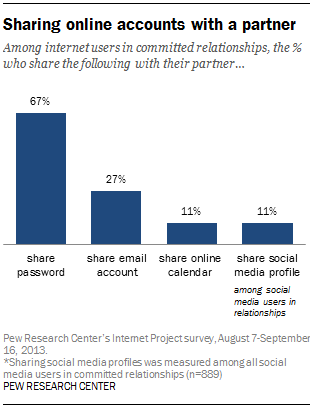
67% of internet users in a marriage or committed relationship have shared the password to one or more of their online accounts with their spouse or partner.
Shared accounts:
27% of internet users in a marriage or committed relationship have an email account that they share with their partner. Older adults and those who have been in their relationship for longer than ten years are especially likely to share an email account.
11% of these couples have an online calendar that they share. Sharing of online calendars tends to be most prevalent among couples in their logistics-intensive middle-age period (i.e. mid-20s through mid-40s).
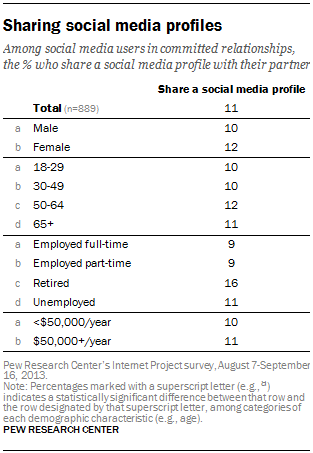
11% of partnered or married adults who use social networking sites share a social media profile.
As a broad pattern, those who have been married or partnered ten years or less have digital communication and sharing habits that differ substantially from those who have been partnered longer. Some of this is about timing— technology a decade ago was squarely in the pre-Facebook, pre-smartphone era, and just ten years into the development of the commercially popular Web. Those who were already together as a couple at the advent of a new platform or technology were a bit more likely to jump on together, as a unit, while those who begin relationships with their own existing accounts and profiles tend to continue to use them separately as individuals.
Long-term couples tend to view and utilize technology quite differently compared with those who have been together for a shorter period of time
Couples who have been together for 10 years or less show different patterns of technology usage in the context of their relationship compared with those who have been together for a longer period of time. Couples who have been together for a decade or less—also typically younger than those who have been together for longer—are much more likely to have used dating services or the internet to meet their partner, to use technology to help with the logistics and communication in their relationship, and to report that the internet had an impact on their relationship. Adults who are long-partnered use technology in their relationship, but are more likely to use some of it together—by sharing email addresses and social media profiles as a couple.
Sexting among adults is up since 2012
Technology in relationships is not just limited to coordination and logistics, it now encompasses even the more intimate moments. Sexting, or sending sexually suggestive nude or nearly nude photos and videos via cell phone, is practiced by couples and singles alike.
9% of adult cell owners have sent a sext of themselves to someone else, up from 6% of cell owners who said this in 2012.
20% of cell owners have received a sext of someone else they know on their phone, up from 15% who said this in 2012.
3% of cell owners have forwarded a sext to someone else – unchanged since 2012.
Married and partnered adults are just as likely as those not in a relationship to say they have sent sexts; single adults are more likely to report receiving and forwarding such images or videos.
About this survey
This report is based on the findings of a survey on Americans’ use of the internet. The results in this report are based on data from telephone interviews conducted by Princeton Survey Research Associates International from April 17 to May 19, 2013, among a sample of 2,252 adults, age 18 and older. Telephone interviews were conducted in English and Spanish by landline (1,125) and cell phone (1,127, including 571 without a landline phone). For results based on the total sample, one can say with 95% confidence that the error attributable to sampling is plus or minus 2.3 percentage points. For results based on married or partnered adults (n=1,428), the margin of sampling error is plus or minus 2.9 percentage points and for cell phone owners (n=2,076) the margin of sampling error is plus or minus 2.4 percentage points.
Main Report
As digital technology becomes more and more of a fixture in Americans’ daily lives, it has infiltrated all sorts of domains, including how people meet, communicate with their romantic partners and manage their lives together. In an earlier report, Online Dating and Relationships, the Pew Research Center detailed the meeting part of the equation, looking at how adults use technology to find, date and interact with potential romantic partners. This report looks at the next step in the process – how couples in committed relationships use technology to manage their digital and offline lives, but also how couples feel technology has enhanced or detracted from a sense of intimacy and connection with their partner.
The focus of this report is on couples who are in an existing marriage or other type of committed relationship. Specifically, this includes anyone who describes themselves as:
Living with a partner (6% of Americans fall into this category)
Not married or living with a partner, but are currently in a “committed romantic relationship” (12% of Americans are in a committed relationship of this kind)
Throughout this report, when we refer to “couples,” or to people who are in a “marriage or committed relationship,” we are referring to the 66% of the American public that falls into one of the three categories listed above. Additional demographic details about these groups can be found in the appendix at the end of the online dating report.
Technology plays a prominent role in the lives of partnered Americans. Among those who are married or in a committed relationship:
88% use the internet (as do 85% of American adults)
71% use social networking sites (as do 72% of all internet users)
93% have a cell phone (as do 91% of adults)
The remainder of this report, with the exception of the discussion of sexting, examines the role of these technologies in the lives of Americans who are married or in a committed relationship. The sexting analysis focuses more broadly on all adult cell phone owners, both single and those in couples.
Digital Sharing & Logistics
While most American couples tend to operate their online accounts independently, a subset of couples utilizes email, social media and other digital tools together as a unit. Sharing email accounts between couples is relatively prevalent—although far from a majority activity. Meanwhile, sharing an online calendar or social networking profile is relatively uncommon:
27% of internet users who are married or in a committed relationship share an email account.
11% of such couples share an online calendar.
11% of couples who use social networking sites such as Facebook or Twitter say that they share a social networking profile.
Although fully “joint accounts” are relatively uncommon when it comes to online communication platforms, many more couples share passwords with their spouse or significant other. Some 67% of internet users in a marriage or committed relationship say that they have shared an online password with their spouse or current partner.
27% of internet users in couples share an email account with their partner. Older couples are especially likely to share an email account.
Among internet users who are married or are in a committed relationship, some 27% share an email account with their partner. The likelihood of sharing an email account becomes steadily greater with age – just 12% of married or committed adults ages 18-29 share an email address with their partner, compared with 47% among adults ages 65 and older. Adults earning more than $50,000 in household income are substantially more likely to share an email address with a partner or spouse than those who earn less, with 18% of those earning less than $50,000 a year reporting sharing an email address, while 32% of those couples earning more share an address. White adults in committed relationships or marriages are more likely to share a joint email address than similarly married or committed African-American adults (28% vs. 17%). Retirees are also substantially more likely to share an email account with their spouse or partner, with 42% of them reporting a shared email address, compared with 24% of those employed full time.
11% of internet users who are in a couple share an online calendar with their spouse or partner. Sharing online calendars is most prevalent among parents and middle aged couples.
Sharing online calendars is less common than sharing email accounts—11% of internet users in a couple say that they share an online calendar with their spouse or partner. Sharing online calendars is not especially prevalent for any demographic subset of committed couples, but is most common among couples at a stage in life in which logistical scheduling can be challenging. In particular, the following groups have relatively high rates of online calendar sharing (all figures are based on internet users in a marriage or committed relationship):
Middle aged couples
– 16% of 25-34 year olds, and 12% of those ages 35-44, share an online calendar with their partner. Calendar sharing also increases at retirement age, as 11% of those 65 and older share an online calendar with a partner.
Couples with children living at home – 13% of parents share an online calendar.
Those who are employed full-time – 12% of those who are employed full-time share an online calendar with their spouse or partner.
Those with higher income and/or education levels – 16% of college graduates, and 15% of those with an annual household income of $75,000 or more per year, share an online calendar with their spouse or partner.
Individuals who own a smartphone, or who use social networking sites, are also more likely to share a calendar with a partner or spouse compared with non-adopters of these technologies.
11% of social network site users in a marriage or committed partnership share a social media profile with their spouse or partner.
Sharing of social networking profiles is also relatively uncommon. Among adults in a couple who use social networking sites, just 11% say that they share a profile with their spouse or partner. There is also relatively little demographic variation when it comes to this behavior—for example, social media users of all ages are equally likely to share a profile with their spouse or partner. However, those who have only completed high school are a bit more likely to say they share a social media profile compared to those with a college degree (15% vs. 9%).
67% of committed couples have shared a password with partner or spouse
Sharing of online passwords between partners is much more common than creating joint accounts. Fully 67% of internet users in a marriage or committed relationship have shared an online password with their partner or spouse. Password sharing does not vary by age, but it is more prevalent in higher-income households. Couples who earn more than $50,000 a year in household income are more likely to share passwords with each other than those who earn less (76% vs. 56%). Parents are also a bit more likely to report sharing passwords than those without children at home. Some 71% of parents share passwords with their partner or spouse as do 65% of those who are not parents.
Couples who share one type of digital tool or account tend to share others as well
Couples who share one type of digital tool will more often share other tools and accounts. Among adults who share a calendar with their spouse or significant other, more than 2 in 5 also share an email account, 18% share a social media profile and nine in ten share passwords with their partner.
Couples who share an email address also share other online tools and materials – one quarter of email sharers also co-own a social media profile, 16% share an online calendar and 87% share passwords with their partner.
Long-term couples are more likely to approach their online accounts as a joint undertaking.
Couples who have been together for a longer period of time—and therefore may have first encountered many of these technologies as a couple, rather than as single individuals—tend to have higher rates of account sharing compared with couples who have been together for a shorter period of time.
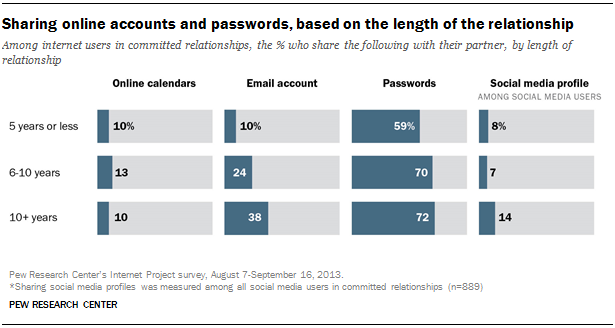
Among the married and partnered, there are big differences between those in relationships of long duration and the more newly partnered: the longer partners in a couple have been together, the more likely they are to share an email address. For those married or partnered for 5 years or less, just 10% share an email. This rises to 24% for those together for 6 to 10 years and 38% for those married or in a committed relationship for more than ten years. The age of the individual is not as strong a factor in email sharing as how long a couple has been together.
Couples who have been together for more than ten years are more likely than those who have shared their lives for shorter periods to say they share a social media profile. Fourteen percent of the long-married or internet users in couples who have been together for more than ten years share a profile, while just 8% of those married or partnered for less than a decade do so. As with email, the duration of the relationship is a more important factor than the age of the individuals.
Couples who have been married or partnered for 6 years or more are also more likely to have shared a password with their partner than those married less than 6 years (59% vs 71%).
Sharing calendars is the only activity where the length of the relationship does not seem to have an impact.
Impacts and Experiences
Most couples say that the internet has had no real impact one way or the other on their relationship—but for those who say it has had an impact, that impact is overwhelmingly positive.
For a substantial majority of couples, the internet plays a modest role in their relationships. Just 10% of internet users in couples say that the internet has had a “major impact” on their relationship, while 17% say that it has had a “minor impact.” On the other hand, fully 72% of married or committed online adults said the internet has “no real impact at all” on their partnership.
Although most couples believe that the internet’s impact on their relationship has been minimal, the proportion saying it does have some impact has increased since we first asked this question in 2005. At that point, a total of 16% of internet users in couples said that the internet had either a major or minor impact on their relationship, compared with a total of 27% who say so today.2
Among the adult internet users who report that the internet had an impact on their marriage or partnership, the majority of them say the impact was positive, with three quarters of adult internet users reporting a positive impact. Still, 20% said the impact was mostly negative, and 4% said it was both good and bad.
Younger and more tech-savvy Americans tend to view the internet as having a more pronounced impact on their relationships
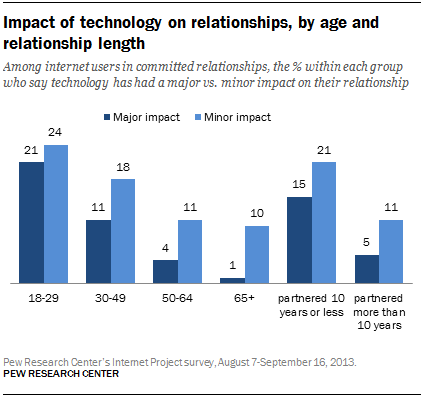
Overall, just 27% of internet users in couples say that the internet has had some impact on their relationship—but this varies substantially by age. Some 45% of internet users in couples ages 18-29 say that the internet has some impact on their relationship (21% say it has had a “major” impact, and 24% say it has had a “minor” impact). On the other hand, just 11% of such internet users in couples ages 65 and older say that the internet has an impact on their relationship (and only 1% of these older adults say that the internet has a “major” impact on their marriage or partnership).
Relationship duration shows a similar pattern – internet users who have been married or partnered ten years or less are substantially more likely to say the internet has had an impact on their relationship than those in longer partnerships. While 15% of more newly partnered people say the internet has had a major impact on their partnership, just 5% of those partnered more than a decade say the same.
As the earlier Online Dating and Relationships report shows, adults in partnerships or marriages of ten years or less look quite similar to single and dating adults in their use of the internet and social media for the work of meeting, flirting and checking up on people they are about to date or have dated in the past. These adults have already incorporated the technology in the beginnings of their relationship, and now continue to do so as they enter a more stable phase of their romantic lives. For more details on married and partnered adults’ use of social media and the internet to manage meeting, flirting, breaking up and checking up, see the Online Dating and Relationships report.
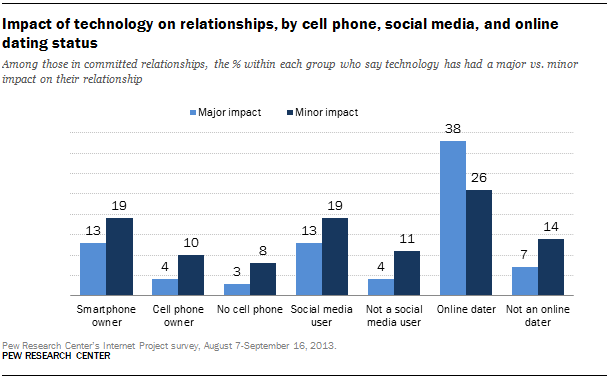
Adults with a wider range of technology assets – for instance, those who use social media sites or own smartphones—are also more likely to say that the internet has had an impact on their relationship. Some 13% of smartphone owners in committed relationships say the internet had a “major” impact on their relationship, compared with just 4% of non-smartphone owners, and 3% of those without a cellphone at all. Similarly, 13% of coupled social media users say the internet has had a major impact on their relationship, compared with just 4% of internet users who do not use social media. And 38% of those in committed relationships who have used online dating sites say the internet has had a major impact on their partnership, compared with 7% of those who have not used online dating sites.
In addition, parents are more likely than non-parents to say that the internet has had an impact on their relationship, and urban dwellers (and to a lesser extent, suburbanites) are more likely than those living in rural areas to say that the internet has had an impact on their relationship.
Among adults in couples who say that the internet has an impact on their relationship, a majority say the impact is positive.
Among internet users in couples who report that the internet has at least a minor impact on their marriage or partnership, a substantial majority—74%–say that the internet has a positive impact. An additional 20% say that the impact of the internet on their relationship is mostly negative, while 4% say that its impact is both good and bad.
As the proportion of online couples who say that the internet has had some impact on their relationship has increased over time, the proportion saying that its impact on their relationship is negative has also increased. When we asked this same question of online couples who felt that the internet had an impact on their relationship in 2005, some 84% said that the internet had a positive impact on their relationship—a figure that has dropped to 74% today. Similarly, at that time 13% of these online couples said that the impact of the internet on their relationship was mostly negative—today 20% of these couples say that the internet has had a negative impact on their relationship overall.
The number of respondents who answered this question (n=328) is too small to conduct a detailed analysis of demographic subgroups.
For younger adults and those in relatively new relationships, technology can be a source of frustration and distraction—even as it offers new sources of intimacy.
Couples communicate. In the last two decades, the options that couples have at their fingertips for communication within or outside of the partnership have diversified tremendously. Voice and text based communication on phones of all kinds, social media postings, instant and email messages, photos, videos and video chatting all have changed how couples can communicate with one another.
Technology can be a source of tension in relationships…
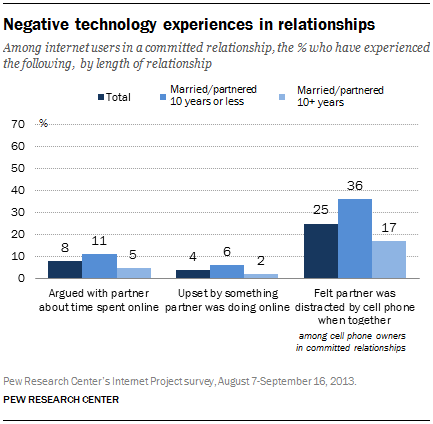
Some 8% of online adults in a marriage or partnership have argued with their partner about the amount of time one of them was spending online, and 4% have been upset by something they found out their partner was doing online.
Those who have been with their partner for ten years or less were significantly more likely than those in longer relationships to have encountered these negative experiences. Young adults (those ages 18-29 years old) were especially likely to say they had an argument with their partner about the amount of time one of them was spending online (18% have experienced this), and this experience is also relatively common along with those living in households with an annual income under $30,000 (15%). Both of these groups were also likely to say they found the online activity of their partner upsetting (8% of young adults and 9% of low-income people have experienced this).
Beyond these general annoyances, cell phones seem to have a particularly distracting effect on relationships. Fully 25% of cell phone owners in a committed relationship have felt that their spouse or partner was distracted by their cell phone when spending time together. Cell phone distractions are especially common among younger couples—some 42% of 18-29 year olds in marriages or serious relationships have experienced this issue. Other groups of couples who have experienced this at relatively high rates include parents, college graduates, and those with relatively high household incomes.
42% of 18-29 year olds felt that their partner was distracted by their cell phone when they were together
29% of those ages 30-49 said the same
32% of those living in households with an annual income of more than $75,000/year said their partner was distracted by their cell phone
31% of parents reported that their partner was distracted by their cell phone in their presence
28% of college graduates reported similar phone-based distractions.
…but can also add a new level of emotional intimacy to communication between partners
But even as it introduces new sources of annoyance and frustration, technology can also add a level of emotional intimacy to one’s communications that many couples find helpful in their relationships. For example, 21% of internet users or cell phone owners in committed relationships have felt closer to their partner because of exchanges or conversations they had online or by text message. Another 9% have resolved an argument with their partner online or by texting that they had difficulty resolving in person. And 25% of text messaging users who are in relationships have texted their partner while both were home together. Those who have been in relationships for ten years or less were more likely than those in longer relationships to exhibit all three of these behaviors.
Even as they are more likely to experience some negative consequences of technology in the form of distraction and arguments with their partners, young people (those ages 18-29) are also particularly likely to experience more positive outcomes with respect to technology and relationship communication. Some 33% of text messaging users in this age group who are in a committed relationship have texted their partner while both are at home, while 41% of young internet users or cell phone owners in relationships have felt closer to their partner due to online or text conversations, and 23% have resolved an argument in the digital sphere that was difficult to resolve in person. Parents were also likely to describe feeling closer to their partner due to technology (26% of internet users or cell owners in relationships) and to text while at home together (30% of texters in relationships).
Sexting on the Rise
People – whether in couples or not – are also using technology to share some of the most intimate aspects of their relationship. Sexting – receiving, sending, or forwarding sexually suggestive photos or videos via cell phones– is on the rise among cell phone owners. Some 9% of cell phone owners have sent a suggestive picture or video, while 20% have received one. These are both statistically significant increases from the last time we asked about these behaviors in 2012 when 6% of cell owners had sent a sext and 15% had received one. Just 3% of cell owners have forwarded a sext, a figure that is unchanged from the percentage who did so in 2012.
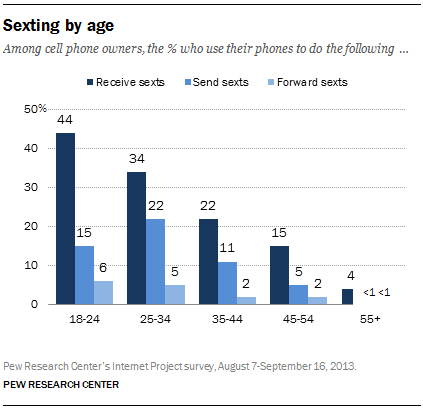
As in 2012, age remains the strongest demographic predictor of sexting. Younger adults are more likely than their older counterparts to send, receive, and forward sexts. Cell owners ages 18-24 are the most likely to say they receive sexts (44%), while those in their mid-twenties through mid-thirties are more likely than older adults to say they send sexts (22%). Forwarding sexts is not highly popular among any age group – just 6% of those 18-24 do so along with 5% of those 25-34.
Across all age groups, the proportion of cell owners that says they send and receive sexts has increased since the last time we asked in 2012. The largest gains were reported by those ages 18-24. In previous surveys, those in their mid-twenties through mid-thirties were the most likely to both send and receive sexts. For the first time, however, those ages 18-24 are the most likely of any age group to say they receive sexts (44%). This represents a significant increase from 2012, when 26% of those 18-24 said they received sexts.
Overall, fewer cell phone owners report sending sexts than receiving them. But this behavior, too, has also seen increases since 2012 across every age group except those 55 and older.
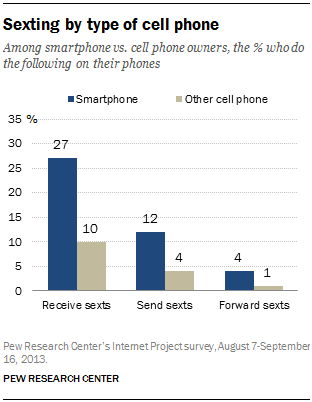
The rise in sexting also correlates with the growing popularity of smartphones, which make it easy to take and share pictures and videos. Some 56% of American adults own a smartphone (including 80% of those 18-29), up from 46% in 2012. Smartphone owners are significantly more likely than other cell phone owners to sext. Some 27% have received a sext, more than double the 10% of other cell owners who have received one. Smartphone owners are also more likely to send sexts – 12% vs. just 4% of non-smartphone cell owners. Forwarding sexts is also somewhat more popular among smartphone owners (4%) than other cell owners (1%).
Those who are actively dating are also more likely to sext. Cell phone owners who said they were “single and looking” are significantly more likely than those who are single but not looking to say they send, receive, and forward sexts. Fully 42% of single and looking cell phone owners have received a sext, 23% have sent one, and 10% have forwarded a suggestive picture or video.
Cell phone owners who date online are even more likely to sext. Over half (55%) have received a suggestive image, almost a third (31%) have sent one, and 9% have forwarded a sext. They are significantly more likely than cell owners who do not use online dating to perform all three activities.
Sexting, however, is not just for daters. Adults in marriages or committed relationships are just as likely to say they have sent sexually suggestive texts as single individuals. Some 9% of those in a relationship have sent sexts, along with 10% of those not in a relationship. But when it comes to receiving and forwarding sexts, those not in a relationship are significantly more likely to do both. A quarter of those not in a relationship say they have received sexts compared to 18% of those not in a relationship. Some 4% of singles say they forward sexts along with 2% of those in a relationship, both relatively low figures. Sexting has been with us since cameras were added to cell phones – so it is possible that partnered (or single) adults could be referring to past sext-sending rather than current activity.
Among those in relationships, cell owners who have been partnered for ten years or less are significantly more likely than those who have been in a relationship for more than ten years to sext. A third (32%) of those in shorter relationships have received a sext, more than five times the proportion of those in longer relationships to say so (6%). Some 17% of those partnered for ten years or less have sent a sext, compared to just 2% of those in a relationship for more than ten years. Another 4% of those in shorter relationships have forwarded a suggestive picture or video, while a slim 1% of those in longer relationships have done so.
Methods
About this study
This report is based on the findings of a survey on Americans’ use of the internet. The results in this report are based on data from telephone interviews conducted by Princeton Survey Research Associates International from April 17 to May 19, 2013, among a sample of 2,252 adults, age 18 and older. Telephone interviews were conducted in English and Spanish by landline (1,125) and cell phone (1,127, including 571 without a landline phone). For results based on the total sample, one can say with 95% confidence that the error attributable to sampling is plus or minus 2.3 percentage points. For results based on internet users (n=1,895), the margin of sampling error is plus or minus 2.5 percentage points. For results based on cell phone users (n=2,076), the margin of error is plus or minus 2.4 percentage points. For results based on married adults or adults in a committed relationships (n=1428), the margin of error is plus or minus 2.9 percentage points. In addition to sampling error, question wording and practical difficulties in conducting telephone surveys may introduce some error or bias into the findings of opinion polls.
A combination of landline and cellular random digit dial (RDD) samples was used to represent all adults in the United States who have access to either a landline or cellular telephone. Both samples were provided by Survey Sampling International, LLC (SSI) according to PSRAI specifications. Numbers for the landline sample were drawn with equal probabilities from active blocks (area code + exchange + two-digit block number) that contained three or more residential directory listings. The cellular sample was not list-assisted, but was drawn through a systematic sampling from dedicated wireless 100-blocks and shared service 100-blocks with no directory-listed landline numbers.
New sample was released daily and was kept in the field for at least five days. The sample was released in replicates, which are representative subsamples of the larger population. This ensures that complete call procedures were followed for the entire sample. At least 7 attempts were made to complete an interview at a sampled telephone number. The calls were staggered over times of day and days of the week to maximize the chances of making contact with a potential respondent. Each number received at least one daytime call in an attempt to find someone available. For the landline sample, interviewers asked to speak with the youngest adult male or female currently at home based on a random rotation. If no male/female was available, interviewers asked to speak with the youngest adult of the other gender. For the cellular sample, interviews were conducted with the person who answered the phone. Interviewers verified that the person was an adult and in a safe place before administering the survey. Cellular sample respondents were offered a post-paid cash incentive for their participation. All interviews completed on any given day were considered to be the final sample for that day.
Weighting is generally used in survey analysis to compensate for sample designs and patterns of non-response that might bias results. A two-stage weighting procedure was used to weight this dual-frame sample. The first-stage corrected for different probabilities of selection associated with the number of adults in each household and each respondent’s telephone usage patterns. This weighting also adjusts for the overlapping landline and cell sample frames and the relative sizes of each frame and each sample.
The second stage of weighting balances sample demographics to population parameters. The sample is balanced to match national population parameters for sex, age, education, race, Hispanic origin, region (U.S. Census definitions), population density, and telephone usage. The Hispanic origin was split out based on nativity; U.S born and non-U.S. born. The basic weighting parameters came from the US Census Bureau’s 2011 American Community Survey data. The population density parameter was derived from Census 2010 data. The telephone usage parameter came from an analysis of the January-June 2012 National Health Interview Survey.
Following is the full disposition of all sampled telephone numbers:
The disposition reports all of the sampled telephone numbers ever dialed from the original telephone number samples. The response rate estimates the fraction of all eligible respondents in the sample that were ultimately interviewed. At PSRAI it is calculated by taking the product of three component rates:
Contact rate – the proportion of working numbers where a request for interview was made
Cooperation rate – the proportion of contacted numbers where a consent for interview was at least initially obtained, versus those refused
Completion rate – the proportion of initially cooperating and eligible interviews that were completed
Thus the response rate for the landline sample was 10 percent. The response rate for the cellular sample was 13 percent.