The Impact of Digital Tools on Student Writing and How Writing is Taught in Schools
In a survey of Advanced Placement and National Writing Project teachers, a majority say digital tools encourage students to be more invested in their writing by encouraging personal expression and providing a wider audience for their work.
BYKristen Purcell, Judy Buchanan and Linda Friedrich
About Pew Research Center
Pew Research Center is a nonpartisan, nonadvocacy fact tank that informs the public about the issues, attitudes and trends shaping the world. It does not take policy positions. The Center conducts public opinion polling, demographic research, computational social science research and other data-driven research. It studies politics and policy; news habits and media; the internet and technology; religion; race and ethnicity; international affairs; social, demographic and economic trends; science; research methodology and data science; and immigration and migration. Pew Research Center is a subsidiary of The Pew Charitable Trusts, its primary funder.
The Impact of Digital Tools on Student Writing and How Writing is Taught in Schools
In a survey of Advanced Placement and National Writing Project teachers, a majority say digital tools encourage students to be more invested in their writing by encouraging personal expression and providing a wider audience for their work.
A survey of 2,462 Advanced Placement (AP) and National Writing Project (NWP) teachers finds that digital technologies are shaping student writing in myriad ways and have also become helpful tools for teaching writing to middle and high school students. These teachers see the internet and digital technologies such as social networking sites, cell phones and texting, generally facilitating teens’ personal expression and creativity, broadening the audience for their written material, and encouraging teens to write more often in more formats than may have been the case in prior generations. At the same time, they describe the unique challenges of teaching writing in the digital age, including the “creep” of informal style into formal writing assignments and the need to better educate students about issues such as plagiarism and fair use.
The AP and NWP teachers surveyed see today’s digital tools having tangible, beneficial impacts on student writing
Overall, these AP and NWP teachers see digital technologies benefitting student writing in several ways:
96% agree (including 52% who strongly agree) that digital technologies “allow students to share their work with a wider and more varied audience”
79% agree (23% strongly agree) that these tools “encourage greater collaboration among students”
78% agree (26% strongly agree) that digital technologies “encourage student creativity and personal expression”
The combined effect of these impacts, according to this group of AP and NWP teachers, is a greater investment among students in what they write and greater engagement in the writing process.
At the same time, they worry that students’ use of digital tools is having some undesirable effects on their writing, including the “creep” of informal language and style into formal writing
In focus groups, these AP and NWP teachers shared some concerns and challenges they face teaching writing in today’s digital environment. Among them are:
an increasingly ambiguous line between “formal” and “informal” writing and the tendency of some students to use informal language and style in formal writing assignments
the increasing need to educate students about writing for different audiences using different “voices” and “registers”
the general cultural emphasis on truncated forms of expression, which some feel are hindering students willingness and ability to write longer texts and to think critically about complicated topics
disparate access to and skill with digital tools among their students
challenging the “digital tool as toy” approach many students develop in their introduction to digital tools as young children
Survey results reflect many of these concerns, though teachers are sometimes divided on the role digital tools play in these trends. Specifically:
68% say that digital tools make students more likely—as opposed to less likely or having no impact—to take shortcuts and not put effort into their writing
46% say these tools make students more likely to “write too fast and be careless”
Yet, while 40% say today’s digital technologies make students more likely to “use poor spelling and grammar” another 38% say they make students LESS likely to do this
Overall, these AP and NWP teachers give their students’ writing skills modest marks, and see areas that need attention
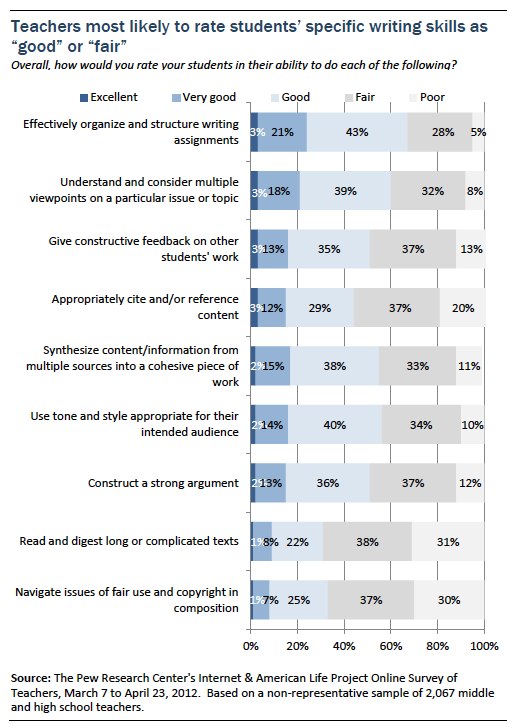
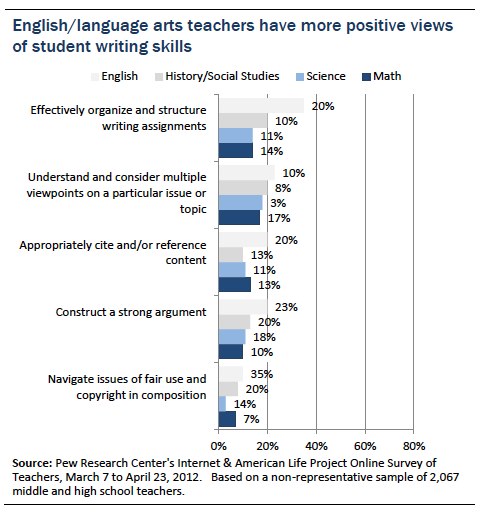
Asked to assess their students’ performance on nine specific writing skills, AP and NWP tended to rate their students “good” or “fair” as opposed to “excellent” or “very good.” Students were given the best ratings on their ability to “effectively organize and structure writing assignments” with 24% of teachers describing their students as “excellent” or “very good” in this area. Students received similar ratings on their ability to “understand and consider multiple viewpoints on a particular topic or issue.” But ratings were less positive for synthesizing material into a cohesive piece of work, using appropriate tone and style, and constructing a strong argument.
These AP and NWP teachers gave students the lowest ratings when it comes to “navigating issues of fair use and copyright in composition” and “reading and digesting long or complicated texts.” On both measures, more than two-thirds of these teachers rated students “fair” or “poor.”
Majorities of these teachers incorporate lessons about fair use, copyright, plagiarism, and citation in their teaching to address students’ deficiencies in these areas
In addition to giving students low ratings on their understanding of fair use and copyright, a majority of AP and NWP teachers also say students are not performing well when it comes to “appropriately citing and/or referencing content” in their work. This is fairly common concern among the teachers in the study, who note how easy it is for students today to copy and paste others’ work into their own and how difficult it often is to determine the actual source of much of the content they find online. Reflecting how critical these teachers view these skills:
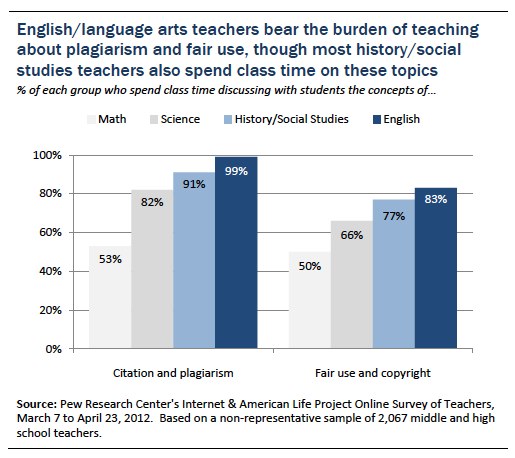
88% (across all subjects) spend class time “discussing with students the concepts of citation and plagiarism”
75% (across all subjects) spend class time “discussing with students the concepts of fair use and copyright”
A plurality of AP and NWP teachers across all subjects say digital tools make teaching writing easier
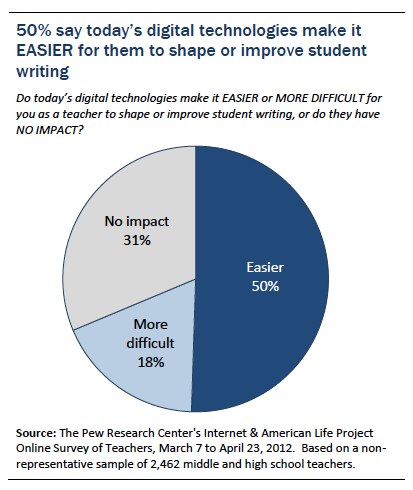
Despite some challenges, 50% of these teachers (across all subjects) say the internet and digital tools make it easier for them to teach writing, while just 18% say digital technologies make teaching writing more difficult. The remaining 31% see no real impact.
Positive perceptions of the potential for digital tools to aid educators in teaching writing are reflected in practice:
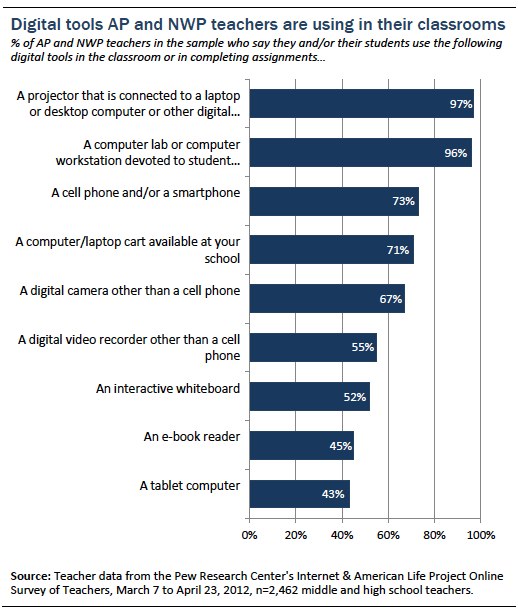
52% of AP and NWP teachers say they or their students use interactive whiteboards in their classes
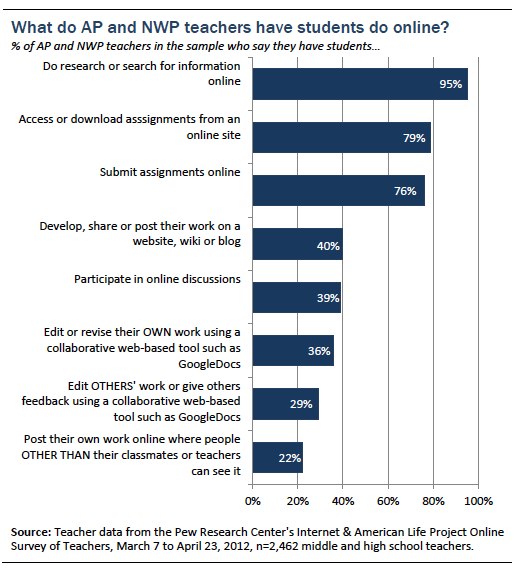
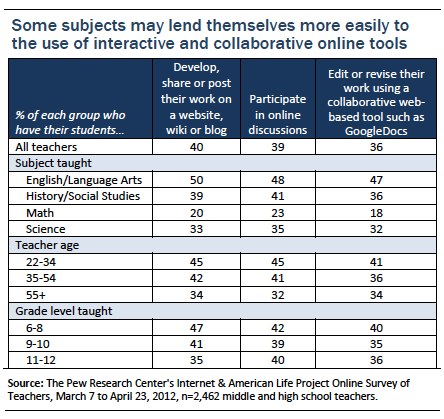
40% have students share their work on wikis, websites or blogs
36% have students edit or revise their own work and 29% have students edit others’ work using collaborative web-based tools such as GoogleDocs
In focus groups, teachers gave a multitude of examples of the value of these collaborative tools, not only in teaching more technical aspects of writing but also in being able to “see their students thinking” and work alongside students in the writing process. Moreover, 56% say digital tools make their students more likely to write well because they can revise their work easily.
These middle and high school teachers continue to place tremendous value on “formal writing”
While they see writing forms and styles expanding in the digital world, AP and NWP teachers continue to place tremendous value on “formal writing” and try to use digital tools to impart fundamental writing skills they feel students need. Nine in ten (92%) describe formal writing assignments as an ��essential” part of the learning process, and 91% say that “writing effectively” is an “essential” skill students need for future success.
More than half (58%) have students write short essays or responses on a weekly basis, and 77% assigned at least one research paper during the 2011-2012 academic year. In addition, 41% of AP and NWP teachers have students write weekly journal entries, and 78% had their students create a multimedia or mixed media piece in the academic year prior to the survey.
Almost all AP and NWP teachers surveyed (94%) encourage students to do some of their writing by hand
Alongside the use of digital tools to promote better writing, almost all AP and NWP teachers surveyed say they encourage their students to do at least some writing by hand. Their reasons are varied, but many teachers noted that because students are required to write by hand on standardized tests, it is a critical skill for them to have. This is particularly true for AP teachers, who must prepare students to take AP exams with pencil and paper. Other teachers say they feel students do more active thinking, synthesizing, and editing when writing by hand, and writing by hand discourages any temptation to copy and paste others’ work.
About this Study
The basics of the survey
These are among the main findings of an online survey of a non-probability sample of 2,462 middle and high school teachers currently teaching in the U.S., Puerto Rico and the U.S. Virgin Islands, conducted between March 7 and April 23, 2012. Some 1,750 of the teachers are drawn from a sample of advanced placement (AP) high school teachers, while the remaining 712 are from a sample of National Writing Project teachers. Survey findings are complemented by insights from a series of online and in-person focus groups with middle and high school teachers and students in grades 9-12, conducted between November, 2011 and February, 2012.
This particular sample is quite diverse geographically, by subject matter taught, and by school size and community characteristics. But it skews towards educators who teach some of the most academically successful students in the country. Thus, the findings reported here reflect the realities of their special place in American education, and are not necessarily representative of all teachers in all schools. At the same time, these findings are especially powerful given that these teachers’ observations and judgments emerge from some of the nation’s most advanced classrooms.
In addition to the survey, Pew Internet conducted a series of online and offline focus groups with middle and high school teachers and some of their students and their voices are included in this report.
The study was designed to explore teachers’ views of the ways today’s digital environment is shaping the research and writing habits of middle and high school students, as well as teachers’ own technology use and their efforts to incorporate new digital tools into their classrooms.
About the data collection
Data collection was conducted in two phases. In phase one, Pew Internet conductedtwo online and one in-person focus group with middle and high school teachers; focus group participants included Advanced Placement (AP) teachers, teachers who had participated in the National Writing Project’s Summer Institute (NWP), as well as teachers at a College Board school in the Northeast U.S. Two in-person focus groups were also conducted with students in grades 9-12 from the same College Board school. The goal of these discussions was to hear teachers and students talk about, in their own words, the different ways they feel digital technologies such as the internet, search engines, social media, and cell phones are shaping students’ research and writing habits and skills. Teachers were asked to speak in depth about teaching research and writing to middle and high school students today, the challenges they encounter, and how they incorporate digital technologies into their classrooms and assignments.
Focus group discussions were instrumental in developing a 30-minute online survey, which was administered in phase two of the research to a national sample of middle and high school teachers. The survey results reported here are based on a non-probability sample of 2,462 middle and high school teachers currently teaching in the U.S., Puerto Rico, and the U.S. Virgin Islands. Of these 2,462 teachers, 2,067 completed the entire survey; all percentages reported are based on those answering each question. The sample is not a probability sample of all teachers because it was not practical to assemble a sampling frame of this population. Instead, two large lists of teachers were assembled: one included 42,879 AP teachers who had agreed to allow the College Board to contact them (about one-third of all AP teachers), while the other was a list of 5,869 teachers who participated in the National Writing Project’s Summer Institute during 2007-2011 and who were not already part of the AP sample. A stratified random sample of 16,721 AP teachers was drawn from the AP teacher list, based on subject taught, state, and grade level, while all members of the NWP list were included in the final sample.
The online survey was conducted from March 7–April 23, 2012. More details on how the survey and focus groups were conducted are included in the Methodology section at the end of this report, along with focus group discussion guides and the survey instrument.
There are several important ways the teachers who participated in the survey are unique, which should be considered when interpreting the results reported here. First, 95% of the teachers who participated in the survey teach in public schools, thus the findings reported here reflect that environment almost exclusively. In addition, almost one-third of the sample (NWP Summer Institute teachers) has received extensive training in how to effectively teach writing in today’s digital environment. The National Writing Project’s mission is to provide professional development, resources and support to teachers to improve the teaching of writing in today’s schools. The NWP teachers included here are what the organization terms “teacher-consultants” who have attended the Summer Institute and provide local leadership to other teachers. Research has shown significant gains in the writing performance of students who are taught by these teachers.1
Moreover, the majority of teachers participating in the survey (56%) currently teach AP, honors, and/or accelerated courses, thus the population of middle and high school students they work with skews heavily toward the highest achievers. These teachers and their students may have resources and support available to them—particularly in terms of specialized training and access to digital tools—that are not available in all educational settings. Thus, the population of teachers participating in this research might best be considered “leading edge teachers” who are actively involved with the College Board and/or the National Writing Project and are therefore beneficiaries of resources and training not common to all teachers. It is likely that teachers in this study are developing some of the more innovative pedagogical approaches to teaching research and writing in today’s digital environment, and are incorporating classroom technology in ways that are not typical of the entire population of middle and high school teachers in the U.S. Survey findings represent the attitudes and behaviors of this particular group of teachers only, and are not representative of the entire population of U.S. middle and high school teachers.
Every effort was made to administer the survey to as broad a group of educators as possible from the sample files being used. As a group, the 2,462 teachers participating in the survey comprise a wide range of subject areas, experience levels, geographic regions, school type and socioeconomic level, and community type (detailed sample characteristics are available in the Methods section of this report). The sample includes teachers from all 50 states, Puerto Rico, and the U.S. Virgin Islands. All teachers who participated in the survey teach in physical schools and classrooms, as opposed to teaching online or virtual courses.
English/language arts teachers make up a significant portion of the sample (36%), reflecting the intentional design of the study, but history, social science, math, science, foreign language, art, and music teachers are also represented. About one in ten teachers participating in the survey are middle school teachers, while 91% currently teach grades 9-12. There is wide distribution across school size and students’ socioeconomic status, though half of the teachers participating in the survey report teaching in a small city or suburb. There is also a wide distribution in the age and experience levels of participating teachers. The survey sample is 71% female.
About the Pew Research Center’s Internet & American Life Project
The Pew Research Center’s Internet & American Life Project is one of seven projects that make up the Pew Research Center, a nonpartisan, nonprofit “fact tank” that provides information on the issues, attitudes and trends shaping America and the world. The Project produces reports exploring the impact of the internet on families, communities, work and home, daily life, education, health care, and civic and political life. The Pew Internet Project takes no positions on policy issues related to the internet or other communications technologies. It does not endorse technologies, industry sectors, companies, nonprofit organizations, or individuals. While we thank our research partners for their helpful guidance, the Pew Internet Project had full control over the design, implementation, analysis and writing of this survey and report.
About the National Writing Project
The National Writing Project (NWP) is a nationwide network of educators working together to improve the teaching of writing in the nation’s schools and in other settings. NWP provides high-quality professional development programs to teachers in a variety of disciplines and at all levels, from early childhood through university. Through its nearly 200 university-based sites serving all 50 states, the District of Columbia, Puerto Rico and the U.S. Virgin Islands, NWP develops the leadership, programs and research needed for teachers to help students become successful writers and learners. For more information, visit www.nwp.org.
Part I: Introduction
This report is the third installment of an expansive study of middle and high school teachers by the Pew Research Center’s Internet & American Life Project. The study combined a national survey and focus groups to examine teachers’perceptions of the impacts of a rapidly evolving technological environment on both their students and their role as educators. Building on a decade of Pew Internet research on the growing use of the internet and digital tools among both U.S. adults and teens, this study explores the impact of these tools on students’ research and writing habits, as well as the extent to which teachers incorporate digital technologies into classroom pedagogy.
This report covers survey and focus group findings on how the internet and other digital technologies are shaping the way today’s middle and high school students write and think about writing, as well as how middle and high school teachers are using these tools to teach writing. Overall, data suggest that teachers view positively the impact of the internet and digital technologies on student writing, particularly the way it expands audience for students beyond just their teachers and provides more opportunities for writing on a daily basis. Teachers report that interactive online tools have enhanced their ability to teach writing and allow them to work more collaboratively with their students. At the same time, however, teachers see some downsides to learning how to write in a digital age, and as was the case with students’ research abilities, most teachers give their students only modest ratings when it comes to specific writing skills.
Adult and Teen Internet Use
The current study builds on Pew Internet’s extensive research on how U.S. adults and teens gather information online, communicate using digital tools, and use these tools for their own training and education. Pew Internet’s prior surveys have shown that:
Online information gathering (in the form of search engine use) tops the list of the most popular online activities, along with email2
Adults as well as teens have become increasingly reliant on mobile tools, particularly smartphones, to communicate and engage with online content3
Social networking has become one of the most popular online activities with teens and adults. While teens and young adults initially led the foray into this online social milieu, the past several years have seen particular growth in social network site use among older adults4
Both teens and adults are heavily engaged in consuming and curating online video and pictures, and often remix the content available online into their own creations5
Texting has become the major form of communication among 12-17 year-olds in the U.S., and is growing dramatically among adults as well6
Given these trends, we felt it would be useful to examine how middle and high school teachers are experiencing these digital transformations in their classrooms. These are important questions, as educators remain a main point of contact for teens growing up in a fairly new digital ecosystem. The extent to which their teachers use, understand, and are critical of or optimistic about these tools and their impact on learning all shape how often, and how effectively, digital tools are used in today’s classrooms.
This is the third of three major reports emerging from the study. Issued in succession, the three reports have been guided by the following questions:
Report One: How Do Teens ‘Do Research’ in Today’s Digital World? (released October 30, 20127)
How students define and conduct research in today’s tech environment
If and how new technologies are changing how research is taught
Whether and how the topics of digital literacy and information literacy are currently being taught in schools
What are the key skills students need to learn to conduct effective research given today’s digital environment
Potential changes in assessments, curriculum, and the school environment teachers feel are necessary in response to today’s evolving digital environment
Report Two: Teachers and Technology (released February 28, 20138)
Teachers’ personal use of and attitudes toward different digital technologies
Whether and how new technologies enable and enhance teacher professional development and collaboration
The different ways digital technologies are being incorporated into classroom pedagogy
School policy and resource issues affecting teachers’ abilities to incorporate new technologies into their classrooms
How teachers experience and manage digital access issues among their students
Report Three: The State of Teen Writing in Today’s Digital World
The specific impacts of digital technologies on student writing skills and habits
If and how new technologies encourage student collaboration, creativity, and personal expression
If and how digital technologies are changing how writing is taught in middle and high school classrooms
Part II: How Much, and What, do Today’s Middle and High School Students Write?
AP and NWP teachers participating in the survey report giving students written assignments ranging from research papers to short responses, journaling, and creative writing. The type and frequency of written assignments varies considerably by the subject being taught and grade level, but on the whole these AP and NWP teachers place tremendous value on formal written assignments.
These teachers also point out that “writing” can be defined more broadly than written work assigned in an academic setting. In focus groups, many teachers noted that in addition to the “formal” writing students do for class, they are engaged in many forms of writing outside of the classroom, much of it using digital tools and platforms such as texting and online social networking. How to define these new types of writing and determining what impact they have on the “formal writing” students do in class remains an open question for many of these teachers. But most agree that among students, “writing” continues to be defined as assignments they are required to do for school, as opposed to textual expression they engage in on their own time.
The writing assignments AP and NWP teachers give their students
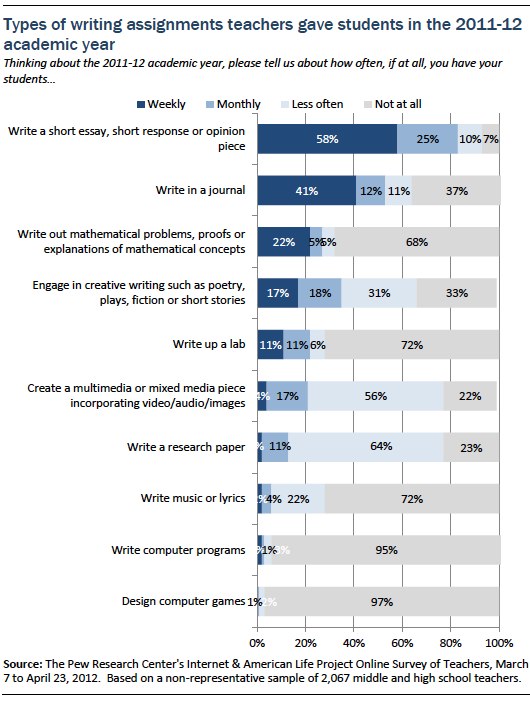
The survey quantified what types of writing exercises AP and NWP teachers assign to their middle and high school students. As the graphic below suggests, among this group of teachers, short essays and journaling are the most commonly assigned writing tasks. More than half of the sample (58%) report having their students write short essays, short responses, or opinion pieces at least once a week. Four in ten (41%) have students journal on a weekly basis.
Research papers, multimedia assignments, and creative writing in the form of plays or short stories, while not assigned by many teachers on a weekly basis, are assigned at some point during the academic year by most of these AP and NWP teachers. Just over three-quarters report having students complete a research paper (77%) or a multimedia project (77%) at some point during the current academic year. Two-thirds (66%) have students engage in creative writing, such as poetry, a play, a short story or piece of fiction, at least once a year.
In contrast, more specialized types of writing assignments such as writing out mathematical problems or proofs, writing up labs, writing computer programs, designing computer games, and writing music or lyrics are assigned rarely, if ever, by most AP and NWP teachers surveyed.
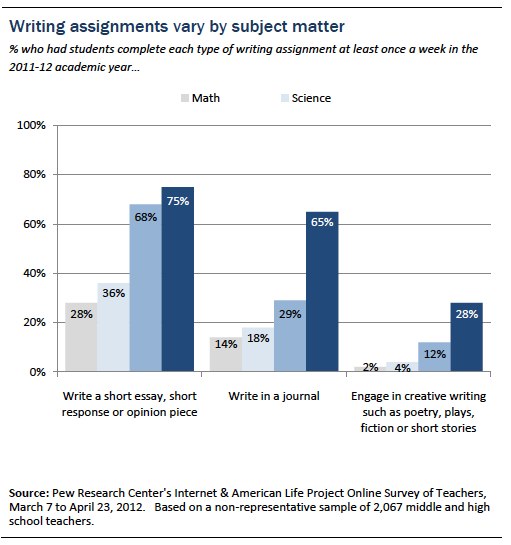
The type and frequency of written work assigned is obviously highly dependent on the subject matter being taught. Among Math teachers, for example, 81% report having students write out mathematical problems, proofs or concepts on at least a weekly basis. And among science teachers, 51% have students write up labs at least once a week and 56% have students write out mathematical concepts or problems. All of these percentages are much higher than those for teachers of other subjects.
In addition, while 94% of English teachers and 83% of history/social studies teachers had their students write a research paper in the 2011-2012 academic year, that figure is 68% among science teachers and 36% among math teachers. A similar pattern emerges for multimedia or mixed media assignments, with English (84%) and history/social studies (82%) teachers most likely and math teachers least likely (51%) to have given their students this type of assignment in the prior academic year. Science teachers (70%) fall in the middle.
How do teachers—and students—define “writing” in the digital world?
A fundamental question posed to the AP and NWP teachers in the current study is how they and their students define “writing.” Specifically, we asked teachers which forms of writing in the digital age—academic writing assignments, texting, social network site posts, blogs, tweets, etc.— are “writing” in their eyes, and which are not? In a 2008 Pew Internet survey of teens on this topic, the consensus among 12-17 year-olds was that there is a fundamental distinction between their digital communications with friends and family and the more formal writing they do for school or for their own purposes. Only the latter is considered “writing” in teens’ eyes.9 Survey and focus group findings in the current study indicate this perception has not changed, either among students or their teachers, and that there remains a fairly strong conceptual divide between “formal” and “informal” writing. For both groups, much day-to-day digital communication falls into the latter category.
Asked in focus groups to clarify what, specifically, they consider “writing,” the majority of teachers indicated that “formal writing” and “creative writing” fit their definition of “writing.” Slightly fewer said they would classify “blogging” as writing, and very few said they would consider texting as a form of writing. Asked how they thought students would categorize these same writing forms, the results are comparable. Most of these teachers do not think their students consider texting writing, but rather confine their definition of “writing” to those exercises they are required to do for school. A handful of teachers went even further, saying that some students define “writing” only as something that requires them to use complete sentences.
On how students define “writing,” AP and NWP teachers say…
[students]
Our kids, over the course of their lives, will write infinitely more than we ever will. I’m 43 years old–half of my life was lived without email, texting, social networking, etc. The fact is, that is writing. Kids have more access points today and those access points are literally at our fingertips and beeping and buzzing blipping…nudging us to write. Incredibly though, students do not see this as “writing.”
Because students still write journals in some classes, I think they still distinguish this from blogging. I think they see journaling as writing, but not blogging quite yet. Although, I think that is starting to change as they start blogging for classes. I think blogging will be viewed as more official writing in the future.
While most AP and NWP teachers in the focus groups said they do not consider texting, blogging, or micro-blogging (posting on social network sites) “writing” in the traditional sense, they believe these digital formats do spur thinking and encourage communication among their students, which may lead to deeper thinking and self-expression. Several teachers characterized these shorter online posts as “pre-writing” that may get a student engaged in a topic or discourse enough to want to write a longer piece about it or explore it further. In some teachers’ eyes, these digital forms of expression are building blocks for lengthier, more formal writing.
On newer digital forms of writing, AP and NWP teachers say…
These digital technologies give students a reason to write. Social media and texting are very engaging for them; they write reflexively. It is not classic academic writing for sure. But, they do use the written language to communicate. This requires a certain amount of composition activity. Texters must decide the most efficient set of words to include in their message in order to convey meaning. These activities are “pre-academic writing”, but nevertheless for some kids they are formative processes that can lead to more sophisticated composition skills.
Students can write and voice ideas in many different registers. It is often not “academic” writing in the sense that many teachers would consider. However, I think the kinds of real world applicability of student work in classes makes these new digital tools much more relevant for students beyond their schooling years.
I read a fascinating article that talked about the impact of micro-blogging on writing. The piece started talking about how everyone just assumed that when things like Twitter and Facebook began to become more prevalent we would see a decline in our society’s willingness to take the time to write. What the article went on to explain however, was that many people who blurt something out on these sites are also actually taking the time to digest what others are saying on the matter, collaborate or chat with the others who are talking about the same thing, and then in turn they feel more compelled to go on and take the time to compose a longer piece of writing – such as a blog post. I see a lot of truth to this idea. In essence, the micro-blog has become to some their pre-writing.
Teachers in the study say today’s students are expressing themselves more, and more often
Though most AP and NWP teachers who participated in the study do not characterize activities such as texting, tweeting, blogging or micro-blogging on social network sites as “writing” in the strictest sense, there is almost universal agreement among them that the digital ecology in which today’s teens live provides many more avenues for personal expression. In addition, most agree that many forms of personal expression are more accessible to the average student than has been the case for past generations. Ultimately, most of these teachers see their students expressing themselves in text (and other formats) more so than was the case when they themselves were in middle and high school. Asked in focus groups, if students today simply write more, in sheer quantity, most participating AP and NWP teachers agree this is the case.
On whether today’s students write more than prior generations, AP and NWP teachers say…
Digital technologies provide many opportunities to practice writing through participation. Mobile technologies allow one to write, capture, edit, & publish while on the go, anytime, anywhere. Be it at a museum, walk through the old neighborhood, or on a wilderness hike. Writing is no longer limited to a designated time or location.
They enjoy writing. When you talk to these kids, they like to write. They don’t like to write when you tell them, ‘I want you to write this.’ But in fact they love to write, and when you look at what they’re writing, they’re talking about themselves and expressing themselves. Maybe not well but they are speaking their minds, so they are, I think, exploring who they are and what they’re about and they’re reading what other people are writing and looking at, and exploring other people’s feelings and ideas.
The informality of the written word and how students use the language is the downside of technology, but the upside is that students are communicating in the written form much more than I ever did at their age.
The ease of accessibility brought via technology has opened the availability of writing opportunities for students today. Some devices have tempted students to write everything as if it were a text, but teacher focus on this issue can channel the text craze into more academic writing. I think like all technologies, there are good and bad points, but at least the thought processes of writing are taking place.
I think they’re writing more, more than ever, and I think they have a much more positive outlook on writing, not just because of the school…you have Facebook, you have email, you have Twitter…they’re writing constantly.
[other teacher]
92% of AP and NWP teachers surveyed describe writing assignments as “essential” to the formal learning process, and “writing effectively” tops their list of skills students need to be successful in life
The survey gauged AP and NWP teachers’ sense of the overall importance of incorporating writing into formal learning today, and asked them to rank the value of effective writing vis a vis other skills students may need to be successful in life. The vast majority (92%) say the incorporation of writing assignments in formal learning is “essential,” with another 7% saying it is “important, but not essential.” Only 11 teachers out of more than 2,000 describe the incorporation of writing assignments into formal learning as “only somewhat important” or “not important.”
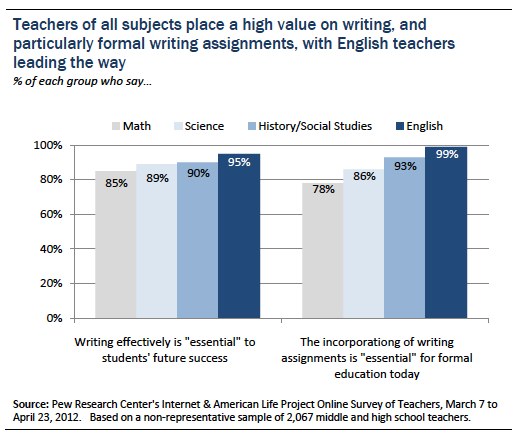
These results are not surprising, given the large number of writing teachers in the sample and the focus on formal writing in much of the U.S. educational system. But the high value placed on writing extends across AP and NWP teachers of all subjects. While 99% of English teachers in the sample say that writing assignments are essential to the formal learning process, the same is true for 93% of history/social studies teachers, 86% of science teachers, and 78% of math teachers.
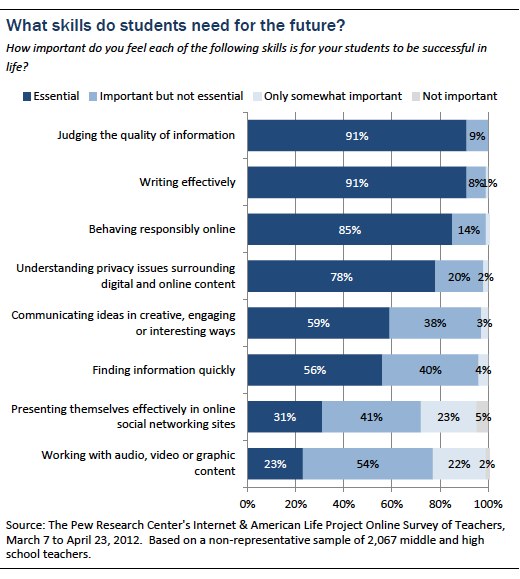
Asked to place a value on various skills today’s students may need in the future, “writing effectively” tops the list of essential skills, along with “judging the quality of information.”10 Each of these skills is described as “essential” by 91% of AP and NWP teachers surveyed. Again, while large majorities of teachers of all subjects respond this way, English teachers are slightly more likely than others to say that “writing effectively” is an “essential” skill for students’ future success.
Other skills relevant to the current digital culture also rank high as life skills, with large majorities of these teachers saying that “behaving responsibly online” (85%) and “understanding privacy issues surrounding online and digital content” (78%) are “essential” to students’ success later in life. Skills that fewer of these AP and NWP teachers view as essential for students’ success in life include “presenting themselves effectively in online social networking sites” and “working with audio, video, or graphic content.” Fewer than one in three AP and NWP teachers in the sample describes either of these skills as “essential” to their students’ futures, though pluralities do describe each of these skills “important, but not essential.”
Do AP and NWP teachers see continued value in longer writing assignments?
The tremendous value most AP and NWP teachers place on writing of all forms, and particularly “formal” writing, was reflected throughout focus group discussions. For some AP and NWP teachers, the extent to which today’s middle and high school students engage in what many see as “informal” writing means that “formal” writing assignments are more critical than ever. Moreover, many see tremendous value in longer writing assignments that require students to organize their thoughts and fully develop complex ideas (particularly because they often have to present ideas on standardized tests in this format). They see longer, formal writing assignments as an important juxtaposition to the more informal and often more truncated styles of expression in which their students regularly engage. Throughout focus groups, AP and NWP teachers expressed the belief that students must master all styles of writing in order to be successful across social domains and to communicate with different audiences.
On the value of longer writing assignments in the digital world, AP and NWP teachers say…
There is great purpose and value in teaching students to write long and formal texts. Again, there are a whole lot of ideas that simply cannot be reduced simply without serious distortion or reduction. Consequently, developing complex ideas and thinking often requires longer texts. Writing is a demonstration of thinking, after all. So the deeper and more complex the thinking, the more that is reflected in the writing. As for formal texts, academia certainly requires a greater level of formality but so does a lot of work in the political, legal, and commercial world. Formal writing is almost always a factor that can be used for exclusion. Inability to write formal texts potentially robs students of voice and power. Arguably more important is the ability to recognize and adjust to the context that is appropriate for a given purpose. So knowing when and how to write with greater formality is an essential skill.
The organization and critical thinking skills that must be employed when students write a longer, more formal piece are skills that will students to become better, more engaged citizens. The processes of brainstorming, researching, evaluating, selecting, analyzing, synthesizing, revising are all skills that help students become more critical citizens, more discerning consumers, and better problem-solvers.
To carry an idea out to see if it is “true” to the thinker or not, I think this is so important. I want students to grapple with the complexity of a subject, to see it from all sides by way of a formal written response. Further, I think breaking down that response into its finer parts help me to teach the components that would go into an extended response. An example of this would be a section of their packet simply titled, DEFINITION. Before going into their response, I ask my students to define their terms and to set their parameters for the paper, not only as a service to their readers, but as a guidepost for themselves.
Writing is thinking—and, quite honestly, I don’t think any of us fully knows what our writing is (will be) about until we write it. Writing develops our thoughts and allows us to grapple with the “whats” and the “whys” of life. In this respect, writing informal and formal texts serves as role playing exercises as much as they do anything else. It is practice in being critical, analytical, reflective, informative and so on. We’re shipping young people out into the world where they are going to have to buy a car, a lawn mower, a stove…and they are going to want to read informative reviews before they spend their money. Writing it allows us to become familiar with it–we may never write an informative review once we leave school, but some…many…will want to read reviews before they spend their own money on something. Beyond buying something, I want to emphasize “writing is thinking is role play for life” as a cross-curricular ideal that too often becomes buried as just an English class objective.
Long texts give students the opportunity to deeply analyze an idea. Longer texts are essential to articulate complex concepts and beliefs. Although not everyone will be asked to write a long academic paper for their jobs, the reflection that goes behind this type of writing is critical for everyone. The process of making thinking transparent and clear to others is essential to knowing the why behind the what. The notion of form al texts supports the idea of knowing how to communicate with various audiences. The more registers a person has in his or her arsenal, the more effective that person will be when communicating with a diverse group.
I think that there is value of having long and well organized thoughts about a topic. I think that when we delve deeply into a topic and have to provide an argument or exploration then we must be able to write logically and coherently and be able to develop a point without getting off track. We must be able to write for an audience and provide evidence and delve deeply. I think there are also audience needs to be met when deciding on what level of formality we will write with so I see the value in teaching formal writing. People have to produce reports for colleagues and prospective business partners and college professors so this is obviously a skill that needs to be learned.
Writing is crucial across the curriculum. Good writing teachers teach students how to communicate a logical argument that is well-researched. At my school, I am impressed with the amount our English and history students write as well as the amount our science students write. The IB program does not have many multiple choice tests; therefore, students have to be good writers to perform well on IB exams… The IB program places such a heavy emphasis on communication that the students (and teachers) have adapted their definition to include anything that involves clearly stating ideas and explaining rationale.
While many focus group participants stressed the importance of learning to write in multiple styles—including more “formal” styles—and to write lengthier pieces on complex topics, other teachers questioned the “term paper mentality” and the tendency of some educators to equate length of assignment with complexity of thought. Some AP and NWP teachers in the study debated the value of longer textual expression today, not just for students but for society as a whole. As many digital tools encourage shorter, more concise expression, these teachers questioned whether mastering more traditional writing styles will be critical for their students moving forward. While these skills may be valued in standardized testing and in the college and university settings, there was some debate about how useful these skills are beyond those two arenas. Moreover, some teachers questioned whether lengthy writing assignments are the most effective format for teaching students specific writing skills.
On the value of longer writing assignments in the digital world, AP and NWP teachers say…
[teachers]
Regardless of the length of a student’s writing, I think it is more important to teach students to develop their thoughts completely. If development of thought can come through length or formality then so be it. More important than length or formality would be for students to have a firm understanding about how to organize their ideas in such a way where they can effectively communicate their thoughts and ideas. I certainly don’t think that a teacher should only teach any one kind or length of writing, but the most often I hear the reason we should teach students to write lengthy formal essays is because that is the way they will have to write in high school, which in turn is how they will have to write in college. While I would say there can be value in getting a student dedicated to deeply investigating a certain topic through a longer writing assignment, I would never be willing to teach kids formal writing just because that is the way they do it in high school – there would have to be another purpose.
This almost starts to get at the “how many words should this be question.” I tend to find that when I say 500 words long, kids work to that end and stop. Sometimes they seem to like this better…it’s easy and sure. Usually, I say to make a plan and work to thoughtful response to the assignment and the feedback from their peers. This usually drives more from their thought process that my giving them a word count. Is this a formal text? Not really, but yes at the same time. I think many teachers panic when students deviate from the 5 paragraph essay that they know and understand. The belief seems to be that this serves their needs on the near future high stakes test that are demanded on students. I’m not sure that this serves them past this point.
I don’t think length is a point to pound home with any student. We need to look at the content of a students’ writing the most. If that means a paper has 8-10 pages to it, then so be it, but students need to learn how to sort out what is relevant and irrelevant details and information. Students need to produce well planned, thought out papers that get to the point.
Part III: Teachers See Digital Tools Affecting Student Writing in Myriad Ways
Majorities of AP and NWP teachers in the study see digital tools having several distinct, beneficial impacts on student writing, including providing a broader audience for student work, encouraging creativity and personal expression in a multitude of formats, and offering more opportunities for collaboration, interaction and feedback. Many teachers say that taken together, these three impacts of digital technologies make writing both more meaningful and less intimidating for many students, while also encouraging greater commitment to, and personal investment in, what they produce.
Yet many of these AP and NWP teachers also express concerns about how digital tools and platforms are shaping the way their students approach writing. Of most concern are what some perceive as diminishing grammatical skills and vocabulary, which they attribute largely to the informal writing in which today’s students are heavily engaged. In addition, some AP and NWP teachers worry that rather than encourage greater understanding of and appreciation for different audiences, digital tools actually blur the boundaries between formal and informal audiences and discourage student sensitivity to these distinctions. Finally, many of these middle and high school teachers worry that their students are losing the ability to develop, organize and express complex thoughts because they generally communicate in more concise forms of expression.
Majorities of AP and NWP teachers see digital tools benefiting student writing in several key ways
Asked whether they agree or disagree with a series of statements about potential impacts digital tools may be having on today’s students, majorities of AP and NWP teachers in this sample agree that:
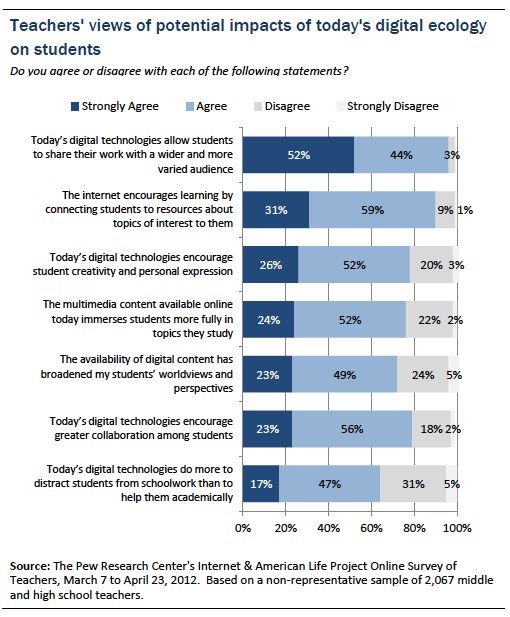
Today’s digital technologies allow students to “share their work with a wider and more varied audience” (52% strongly agree, 44% agree)
Today’s digital technologies “encourage student creativity and personal expression” (26% strongly agree, 52% agree)
Today’s digital technologies “encourage greater collaboration among students” (23% strongly agree, 56% agree)
In focus groups, teachers spoke at length about how these three perceived impacts benefit student writing. Many said that not only are their students are doing considerably more writing outside of the classroom than they would without these digital tools, but they have the unique experience of writing for broad and varied audiences because of the internet. Exposing student writers to a wider audience via online platforms is a considerable change from a time when only one’s teacher and perhaps a few classmates would read a student’s writing.
Not only do many of these teachers use online platforms such as GoogleDocs to have students edit each others’ work in a public way, but many have students work together on Wikis, use whiteboards to share and edit student work in class, and have students “publish” their work in other online forums. While teachers acknowledge that some middle and high school students may struggle in this more public learning environment, overall these AP and NWP teachers felt that more students benefited from writing for a broader audience than were inhibited by it. Many of these teachers see exposure to a wider audience as an opportunity for students to get more diverse feedback on their work, which encourages them to think more consciously about audience as they write, and in turn leads to greater investment in what is written.
In addition, many AP and NWP teachers noted that digital tools encourage personal expression in many forms, not just “writing.” This benefits students who might otherwise struggle to express themselves in formal writing, and pushes those more comfortable with self-expression to be even more creative. According to these teachers, the many diverse forms of self-expression available today make the process of communicating one’s ideas less intimidating and more accessible for students today. Several teachers noted that for many students, digital tools take the “scary” factor out of “formal writing.”
On AUDIENCE, AP and NWP teachers say…
One way these tools help young writers is to see their work in another forum. Many students are used to only “desktop” publishing. They write on their desktop, finish their writing, and put it on the teacher’s desk. I have found that students take a closer look at their writing when they know that the audience will include their peers. At RAW INK Online, their work is often seen by teachers and authors from outside of our school. So, students take a closer look at their blog posts and responses. Through having students share their writing with their peers in these modalities, I have seen them become more at ease with the writing process. They are more willing to put their ideas down in writing when writing for an authentic audience. The students begin to develop an awareness for the need to write/communicate in a way that makes sense to the reader and communicates clearly their intended message.
Based on my own personal experiences I would have to agree that today’s digital technologies have provided students more opportunities to develop and share their thoughts creatively. When I was in school, if I wanted my voice to be heard by more people than just my three best friends, I would have had to write something up to submit it to the school newsletter or the local paper. Whether or not what I wrote was published would then be left up to the one editor that read my piece. Today I can simply tweet something to my several hundred followers and immediately incite some kind of response. Personally, I feel my voice matters more because I know that when I tweet something or post it to my blog it has the potential to be read by a lot of people, and the positive feedback that I receive when I do post propels me to want to write more. I know my students feel the same way. I have seen a heightened sense of responsibility on the part of my students to be more thoughtful in articulating their ideas because they know others will read their work. Additionally, I have seen where students feel empowered to contribute on seemingly niche subjects (specialized knowledge about video games, etc.) because they know they have knowledge that will add to what is being shared on the web about that subject.
For my students, this is an issue of communication, of meeting the standards not only as writers, but as people very aware that the audience is not their teacher, but a much broader venue. I try to help them see a bigger space for their writing than just the four walls of our room. For my students it comes down to developing something to say, and then creating the most effective means to say it. Their writing is not really “long, formal writing,” but rather it’s writing that gets their point across in the most effective way, developing a sense of style (not necessarily formal) and engaging an audience. We spend a while unpacking the relevant standards – drawn from the Common Core, and, a key component is engaging an audience and orienting them to a point of view of specific context for the issue. So, effective writing is a key part of that, but for most of the work my students do, writing is one component, and at times it’s just a basis for the videos or other multimedia they’ll create.
When my students make digital films we screen them together, talk about their work together, and then students subsequently post links to their films on Facebook, etc. So, if a kid is engaged, this writing has a whole new element that traditional writing did not have. The audience enlarges, the retrospective self evaluation increases and the com position matters m ore because it will be publically shared.
In my experience the extended audience provided by online writing encourages students to be more deliberate and thoughtful. My students have been using a Ning and m ore recently their own blogs to post writing pieces and then use the comment features to provide peer feedback. While at first students were hesitant and shy both to post work and make thoughtful and useful comments about others’ writing, once the routine was established and the community proved to be a safe one, student writing has benefitted.
Another thing that I love is the authentic audience that digital tools can provide for students. I have my students blogging—meaning that students “publish” a variety of different types of writing to a public site where anyone can read and comment on their work. I had a student share that a pastor from somewhere in the country had commented on her blog. She was beyond ecstatic to read that someone thought her work was excellent. I can, and do, tell her that all day long, but when she hears that from someone else she is convinced. I have seen students able to develop a stronger voice in their writing when they post it to their blog as opposed to them just turning it in for the teacher.
On COLLABORATION, AP and NWP teachers say…
GoogleDocs is used as a drafting and revision tool that can easily be shared among one another. We engage in response writing on a daily basis to: a TED talk, or a Podcast, or an episode of This American Life. These responses are posted onto the schools Ning to be shared with the class as a whole and can be seen by other educators. These formats allow the students to share their thoughts, interruption and understating of the material with one another in a real time form. It’s all about connecting. I believe that students are reading, writing, creating and sharing more than ever through digital media. By being able to connect with others they remain invested and passionate about what they are creating.
I think writing becomes less hinged on the types of length requirements I remember focusing on in high school and college. We are a more collaborative writing group: editing our school Wikipedia page, editing work simultaneously on GoogleDocs or sending texts via polleverywhere means everyone is producing and authoring short and long texts simultaneously. Writing can feel less high risk as a result.
I think we’ve always been a creative species that has produced a lot of thoughtful articulation of ideas. I don’t know that digital technologies have really changed that. And there have always been a lot of opportunities to write. Back in the day I wrote a lot of songs, poems and stories in notebooks, on napkins and scraps of paper; my students today do more of that kind of drafting digitally. I think what’s different now is the conversations around writing. There are more ways writers can talk back to others about their compositions now – chats in Google Docs, via comments on their Flickr content, etc. The opportunities to collaborate have created more chances to converse with a more diverse audience. Writing is m ore social now, and my students are much more aware of audience than I was when I was a teen.
Digital technologies have allowed my students to be more collaborative in their writing experiences and to experience writing for a larger audience. My expository writing class is now a high school version of a blended course. Students are able to respond to one another through an online academic social network. Through this site they brainstorm together, share responses to writing in forums and share resources through shared links and wiki creation. They also share their writing through sites like GoogleDocs or wiggio. We even collaborate on how we pace our writing assignments through an online calendar. Students research together by sharing links through diigo. In my freshman class students are able to use elireview.com for online peer review, which is especially nice for them so they can easily share their writing and focus their responses to one another. We also collaborate with other classes. We have six American Literature classes at my high school and we’re all connected through our online academic social network. We post on forums and create wikis together and share resources across classes. Students now have around 180 peers as their audience for a lot of their writing, instead of just a teacher or one class.
I teach at a New Tech school, in which everything we do is a project-based learning model and our projects are always completed collaboratively, whether in pairs or larger groups. My students use GoogleDocs extensively as they move through their projects for planning and then com position. I think the collaboration allowed on GoogleDocs is really changing the way people and our students write. Most of the students I teach have been learning in this model for the past three years and for the most part have been using GoogleDocs along with other digital tools increasingly during that time. At this point they are very comfortable writing with one another, editing each other’s writing, and accepting feedback from one another. I love the transparency of GoogleDocs as well – the history is all there for students and teachers to revisit past editions and know who has contributed what.
I have seen students more willing to go back and revise or improve their work in order to provide more clarity when using digital tools than when they are writing it on paper. Many times after we have had a conference I hear students saying, “Ok, can I go back and fix that?” It’s music to my ears. I am actually interested in seeing how digital writing plays out a little more because I think it does give us more reason to go back and evaluate, fix, add to, change any given work over time.
On CREATIVITY, AP and NWP teachers say…
[digital tools]
I think this generation of students have many more opportunities, not only to write (in many forms) and learn to express themselves, but the added benefit that social media and GoogleDocs have to offer is to provide them with an audience for these thoughts and expressions. We know our students can write–they text all day. My students’ expressions make up the majority of my Twitter stream. While in the past we may have written in our diaries and journals and hid them under our pillows, students today write and post their feelings for the world to see. I do see this as helping them to articulate their thoughts and I often wonder what the effect is of them having an audience, the opportunity for immediate two-way communication or at least validation of their musings (the Like button) and what that does to their confidence as writers/thinkers.
I think students are writing and reading more because of their online lives than ever before. But it’s not just writing, of course. I have students who are reluctant, ill-educated writers who produce videos and organize websites. There is a lot more self-directed learning happening now than I’ve seen before. And it’s exciting to get out of the way of this.
[in the digital age]
With all of these technologies, I think writing is at the heart, but our students are also driven to take it a step further to include video, sound, hyper links, images, animation, etc. That’s a huge boost in creativity.
In focus groups, AP and NWP teachers were careful to point out that simply having access to a wider audience and more platforms for self-expression does not necessarily translate into effective writing and communication. Writing for varied audiences, and particularly writing for online audiences, is a skill that must be taught. Likewise, communicating in the appropriate style for a particular venue and/or audience is something many students have not mastered, according to these teachers. As a result, many teachers report spending class time teaching just these skills.
On collaboration, AP and NWP teachers say…
The ability to have wider and more frequent conversations about their composition I think has helped my students’ writing. But just having the potential for wider conversations and a larger audience doesn’t always mean more people are listening. I mean, we’ve got to explicitly teach the art of online conversation.
[as a blog post]
I do feel like students are writing more than I did. Instead of notes, students are sending texts and emails, instead of calling, students are messaging. There is so much more communication centered around writing today. One thing we do need to address is the careful crafting of these electronic messages. They are easily misinterpreted without the visual and verbal cues. This is where intention, audience, tone, etc. need to be taught. It’s the whole notion of identity and perception. How did you mean to represent yourself in that message? What do you think the perception of your identity and your message is by others? These are skills that need to be addressed and taught.
I think it is important for students to have a sense of a discourse community when it comes to researching and sharing out from that research. To understand that one side of the continuum are the blissfully-unaware and on the other are the highly-qualified respondents. When they draft a response, revise a paper, post a blog, enter a discussion thread, they become—almost automatically–a part of that discourse community. Can the student self-identify where they appear upon this continuum? What might this tell the student about their place in the conversation? To which end do they stand with the response they are offering when they offer it?
These technologies also have helped my students understand various rhetorical situations for their writing because we explore how our academic social network is different from other sites or other writing experiences. For instance, some Facebook qualities are in our site, but students know they also have a very formal audience for their work too. I think teaching about concepts of writing actually makes a lot of sense when we are direct in explaining how writing is impacted by audience and purpose and medium. Students understand that texts have characteristics that research papers do not and they understand that they need to be mindful of the differences in writing based on audience, purpose and medium of writing.
Overall, when these three key impacts are taken together – a broader audience, increased opportunities for creativity and personal expression, and greater collaboration – the vast majority of AP and NWP teachers participating in the study see a tremendous upside to writing in the digital age. In focus groups, teachers repeatedly used the words “investment” and “engagement” to describe the impact they see digital tools having on student writing.
On whether today’s students are more invested in their writing, AP and NWP teachers say…
In thinking about digital writing and the potential for audience, I think that idea of someone beyond myself reading their work is a real key factor in what drives many of my students to extensively stick with a piece of writing and keep digging in, revising, working on things m ore, and really feeling an investment in a piece. I know that at the start of one of my courses, when students understand that the writing we’ll be doing is for a mass audience, the idea can be intimidating for some students right off, but once they understand that they have extensive support from me as their coach, and that we have a process where work is developed and really built, then that apprehension goes away. Once we get to the stage where we’re ready to publish work, students are so proud of what they’ve produced that they’re psyched to see it going public. So, I’ve steadily seen students having a real investment when they are writing publicly.
I see an improvement in students’ writing as a result of new technologies in the classroom: Students are more aware of audience and thoughtfully consider their purposes for writing and what readers will gain from their work. Shy students often come alive online in ways they don’t in class because they have time to think and compose before sharing their ideas and opinions. My students respond to each other’s writing through our Edmodo page and learn how to provide constructive feedback. Technology tools increase students’ engagement and interest in writing. Students collaborate more through Googledocs, Edmodo, and our class blog. Students consider their online presence.
In a way, technology has made writing for a public audience less intimidating. If we exploit the possibilities of using these forums to share ideas and to enhance writing skills, that would be a very exciting thing. So, our goal may be to go forth and eradicate the poor grammar and spelling, as well as the odd contractions (might’ve???) and get our students’ work out there!
I still know some teachers that insist students hand write everything because she doesn’t want them cheating on their notes. To her there are a lot of negative thoughts about using technology because it makes it easier to cheat. I don’t guess she realizes they cheat more on her assignments than they do mine. For her the other problem is that the teacher has to relinquish a little more control to the students if you are allowing the students to collaborate and think freely. I find that a huge benefit, but other teachers who have to be in 100% control all the time, find the use of technology a huge downside. For me, the negative impacts are minor because real world connection, collaboration, and creativity kids are able to use when using technology far outweighs any of the negative things.
Along with these benefits, 68% of these AP and NWP teachers say digital tools make students more likely to take shortcuts and not put effort into their writing
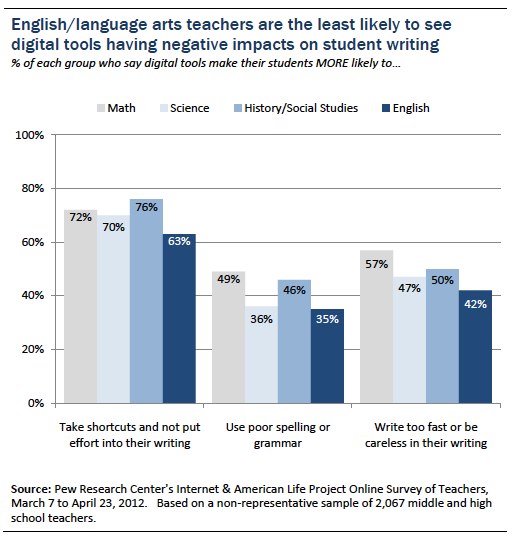
Asked about specific impacts digital tools may have on student writing, AP and NWP teachers in this sample expressed the greatest concern about these tools increasing the likelihood their students will “take shortcuts and not put effort into their writing.” Just over two-thirds of these AP and NWP teachers (68%) say that digital tools are having this impact. Fewer teachers, but still a sizeable percentage, also say these tools make students more likely to “write too fast and be careless” (46%) and more likely to “use poor spelling and grammar” (40%). (On the latter measure, teachers are fairly divided, with 38% saying digital tools make students LESS likely to use poor spelling and grammar—an indication of the tension between the positive and negative effects of automated spellcheck and grammar check.)
This question was originally posed in a 2007 Pew Internet nationally representative telephone survey of teens and their parents. At that time, 49% of teens 12-17 said the use of computers and other digital tools for writing made them more likely to take shortcuts and not put effort into their writing, and 41% said that digital tools make them more likely to write too fast or be careless. In addition, 42% said these tools make them more likely to use poor spelling or grammar. Parents’ views in the 2007 survey generally aligned with those of their teens.11
English/language arts teachers have the most positive view of the impact of digital tools on student writing
On all three of these measures, English teachers in the sample express the most positive view of the impact of digital tools. They are the least likely to say that digital tools make students more likely to take shortcuts in their writing, use poor spelling or grammar, or write too fast and be careless.
Conversely, most AP and NWP teachers surveyed (56%) say digital tools also make students more likely to revise and edit their work
Reflecting the mixed impact teachers see digital tools having on student writing habits, many note potential positive impacts as well. More than half of the AP and NWP teachers in the sample feel these technologies increase the likelihood their students will revise and edit their work. In 2007, a similar percentage of teens (59%) said this was the case. Math (64%) and English/language arts (60%) teachers are more likely than both science (53%) and history/social studies (48%) teachers to feel that digital tools are having this positive effect on student writing.
Also on the positive side, a plurality of teachers (50%) say digital tools make students more likely to “be creative,” a finding which is consistent across AP and NWP teachers of different subjects. Yet on other potential impacts, these AP and NWP teachers are divided. For example, 32% of AP and NWP teachers surveyed say today’s digital tools make students MORE likely to communicate well, but almost as many (28%) say these tools make students LESS likely to communicate well.
Despite lengthy discussion in focus groups about the benefit of learning to write for varied audiences in today’s digital ecology, just 24% of AP and NWP teachers feel that digital tools make today’s students MORE likely to write in multiple genres and styles. Instead, most teachers (63%) say digital tools have no impact on student writing in this regard.
Focus group discussions revealed some additional concerns about the impact of digital tools on student writing
In addition to the concerns captured in the survey of AP and NWP teachers, focus group discussions revealed other concerns these teachers have about the potential impact of digital tools on student writing. In these discussions, three main concerns emerged:
diminishing grammatical skills and vocabulary,
an increasingly blurry line between formal and informal writing, resulting in the creep of “text speak” into formal writing, and
a general emphasis on short forms of expression
As use of today’s digital technologies—including the internet, cell phones and social networking sites—becomes more prevalent in the classroom and in students’ personal lives,12 some AP and NWP teachers say the overall quality of student writing is declining. The clearest evidence they point to is the “creep” of more casual language and grammar (sometimes referred to as “textspeak”) into students’ academic writing. Because more informal settings such as texting and social network site posts have distinct norms about what is acceptable (such as incomplete sentences, misspellings, widespread use of abbreviations, a generally informal tone), some AP and NWP teachers worry that they ultimately undermine students’ formal writing.
While some AP and NWP teachers in the study described these informal expressions as a unique language or register that can benefit student self-expression when used in the right venue, others worry that their students are increasingly unable to draw a distinction between informal and formal writing. In focus groups, teachers were divided as to whether the transference of rules and norms from one writing domain to another was the result of students simply not recognizing the distinction across domains, or if it was conscious disregard for those distinctions.
On GRAMMAR and VOCABULARY, AP and NWP teachers say…
Technology has increased the amount of writing students do, but decreased the quality. For instance, instead of writing letters, quick texts are sent instead. Also, students use substandard grammar, or become overly reliant upon spelling and grammar checkers on the computer.
[of digital technologies is]
I tell them, I have sophomores and juniors and I tell them, read pre-1970 writing. It’s richer vocabulary. Most of them have very poor vocabulary just because they simply do not read books and they certainly don’t read things written before the 1980s.
“The one that always jumps out at me and I find really frightening is they have horrifically bad vocabularies. I primarily blame that on just simply not reading and certainly not reading anything with any challenge to it. Like a lot of the more recent books that they will read, they just don’t have the depth of language. They don’t have that complexity of language or the complexity of vocabulary.”
In addition, some AP and NWP teachers note a potential decline in vocabulary and grammatical skills among their students, exacerbated by an overreliance on automated grammar, spellcheck and dictionary tools built into word processing programs. While these tools have unquestionably made word processing faster and easier, and can benefit students when used thoughtfully, some teachers worry they can also undermine students’ understanding of and attention to basic writing principles.
On the BLURRING LINE BETWEEN FORMAL AND INFORMAL WRITING, AP and NWP teachers say…
Texting has spilled over into so much of my students’ writing that trying to decipher what they are writing has become difficult. They don’t see the problem, and feel that as long as they have written something, it should be accepted no matter how it’s written.
Although my students probably don’t see texting and entries on Facebook as writing, I guess they are still writing. However, I have seen the negative effects because much of this writing uses incorrect grammar, spelling, and capitalization. I have a hard time with some students using the lowercase i and abbreviations in their essays.
I think my students would say that any ‘writing’ they do is for specific assignments in classes, essays, research papers, etc. Outside of the classroom they are texting a lot. While texting is a form of communication, it is not ‘writing’ in my opinion, and because of texting, I think there are some serious issues that are surfacing more and more these days. A lot of students don’t know how to write a complete thought. They can’t use correct punctuation, and they don’t start sentences with capital letters. They are supposedly learning all this in class, but it is their outside communication that seems to predominate in their ability to communicate. There is a definite laziness happening with the students and writing.
I see them as minor issues. I see Text Talk as another language. There’s a time and place for it, but not everyone understands it. Still, there are those contexts where it is socially acceptable and expected. I wouldn’t rob them of that, but it is my job to teach them how to negotiate the many registers and codes they use in language every day. To me, this code-switching is an important part of being literate.
What is hard to discern is how much of this is due to the influx of all the technology at their fingertips and the actual developmental stage of a typical adolescent. There is a definite challenge for many students in making adjustments in formality and purpose, because so much of the writing they do is casual in nature, mainly due to the array of digital technologies afforded to them driven by instant connection. Adjusting to an academic mode, for example, proves more difficult than might be expected.
Texting may have a negative impact on students’ writing in that the informalities of texting are definitely seeping into their writing, but that is not what I want to comment on. Texting has created a greater connection between myself and my students and an ability to respond quickly to their questions. My students often text me with questions about assignments and I love that I can quickly and easily answer their questions.
I believe that writing has been somewhat negatively impacted by technology. With texting is a key form of expression there is little thought or effort put into essential elements of writing, such as spelling, grammar and exposition. That transfers over to students’ attitude about writing for school assignments.
The biggest challenge is to get them to write well in a math class. They do not feel it is important because to them math is “not English class.” Because of the prevalence of texting, they are lazy writers and expect you to “know what they meant” when they poorly word responses.
Automated word processing tools, and the speed that accompanies them,may contribute to an additional concern expressed by AP and NWP teachers—a lack of patience among some students to execute longer writing assignments. Some teachers in the study question whether a growing cultural emphasis on speed and on truncated forms of expression (from tweets to status updates to blog posts) has conditioned students today to write, and think, in morselized, less developed pieces. These teachers are particularly concerned that what appears as impatience or carelessness is actually a diminishing set of cognitive skills in this area, or a lack of appreciation for subtly constructed arguments.
On TRUNCATED EXPRESSION, AP and NWP teachers say…
[of digital tools on writing]
One big thing that is apparent to me is that students actually write a lot m ore than we often believe. What, how, and why they write might not be what is always desired in school, but it seems to me they actually do write more than ever. What is interesting is that very few think of themselves as writers. There seems to be a disconnect. So a lot of writing has a careless quality to it. The writing is sloppier and unpolished more often than not. For example, ask them to write or develop some kind of personal correspondence, regardless of mode, and they are more able to be successful.
Most students lack craft, which certainly is not new, yet because they spend so much time engaged in these sort of shorter, more direct, unruly writing tasks, there can be a tendency to resist technique and craft instruction. Thus, truly developing anything at sophisticated level of depth is difficult. So the prospect of writing with longer, complexly constructed structures, modeled on the likes of sentences from Faulkner or Dickens takes a lot of assistance. In fact, the writing is directly linked to the reading, where many struggle to unpack even mildly sophisticated text in reading, because they have an ingrained expectation that everything can be short and direct, even if they intellectually understand the limitations of the expectation. It is common for students to see pieces of writing as repetitive, rather than recognizing the subtle wrinkles or different color that might be used in restatement of an idea or theme. In their own writing, they tend to think of development as “filler.”
Part IV: Teachers Assess Students on Specific Writing Skills
Asked to assess their students’ current writing skills, these AP and NWP teachers give students modest ratings. Despite seeing many positive effects of today’s digital tools on student writing, teachers rate the actual writing skills of their students as “good” or “fair” in most cases, rather than “excellent” or “very good.” On each of nine specific writing skills asked about, a majority of these middle and high school teachers rate students “good” or “fair,” indicating most view their students’ writing skills as average and needing improvement.
Teachers rate most students’ writing skills “good” or “fair”
Of nine specific skills asked about in the survey, AP and NWP teachers rated students highest on their ability to “effectively organize and structure writing assignments.” About one-quarter of these teachers describe their students as very good (21%) or excellent (3%) when it comes to this aspect of writing. In addition, about one in five teachers rate their students very good (18%) or excellent (3%) when it comes to “understanding and considering multiple viewpoints on a particular topic or issue.” Yet even for these top rated skills, more teachers describe their students’ performances as “fair” or “poor” than as “very good” or “excellent.” This was true of all nine writing skills asked about in the survey—more teachers rate their students at the bottom of the scale than at the top.
Of particular concern to these teachers is their students’ ability to “read and digest long or complicated texts” and to “navigate issues of fair use and copyright in composition.” On both of these measures, more than two-thirds of AP and NWP teachers in the sample describe their students’ performance as “fair” or “poor.” In addition, 57% of these teachers rate students “fair” or “poor” on “appropriately citing and/or referencing content,” and half give their students low ratings on “giving constructive feedback on other students’ work” and “constructing a strong argument.”
When it comes to rating students’ writing skills, it is the English/language arts teachers among this sample of AP and NWP teachers who again have a more positive view. They were more likely than teachers of other subjects to give their students ratings of “excellent” or “very good” on most of the specific writing skills asked about.
A large majority of AP and NWP teachers surveyed devote class time to teaching about fair use, copyright, and citation
As noted above, the skill for which these AP and NWP teachers give students the lowest rating is “navigating issues of fair use and copyright in composition” and most of these teachers also rate their students “fair” or “poor” on their ability to “appropriately cite and/or reference content.” With so much material available publicly in digital form, the temptation for students to copy and paste others’ work into their own is a concern for many teachers, as is the difficulty many students have discerning the source of material they find online and citing that source correctly.
Clearly, AP and NWP teachers feel students need to improve in these areas, and large majorities are devoting class time to developing these skills. Across teachers of all subjects, 88% spend class time discussing with students the concepts of citation and plagiarism, and 75% report using class time to discuss the concepts of fair use and copyright. The focus and time spent on these issues reflects not only one of the key skills teachers say students need to improve, but also one of the unique challenges these educators face teaching writing in the digital age.
While overall, large majorities of this group of AP and NWP teachers report spending class time teaching about both fair use and plagiarism, the burden falls mainly to English/language arts teachers. Virtually all of the English/language arts teachers surveyed (99%) spend class time teaching their students about plagiarism and proper citation, while 83% work with students on understanding the concepts of fair use and copyright.
AP and NWP teachers discuss the issues of plagiarism and citation…
[students]
Whether accidental or blatantly intentional, there is a tremendous disconnect with how to correctly use and cite outside research. I’m very much at a loss for this quagmire as well.
The biggest challenge has been getting them to analyze sources for credibility. Also, citation and plagiarism are issues. It seems because the information is so freely found, copied, and pasted, students don’t stop to think about what needs to be cited.
The media person has put together a ppt on plagiarism, so the first two days of the semester, we spend time going over these two topics so we are all on the same page. (We have a two day drop and add period then). In a perfect world, the students would come to us with these skills, but in reality they don’t have them.
What everyone else has stated is what I believe. Being able to verify the accuracy of the sources is important. Students use the first few sites they come across and don’t verify the information from additional sites. They should start learning this during elementary school so by the time they get to high school, it becomes second nature. The other part is being able to put this material into their own words. Everyone, including parents, believe that copying and pasting into a report is doing research, even after the concept of plagiarism is explained to them.
[about plagiarism and fair use]
Amazingly, I think students understand things a whole lot better than we teachers often give them credit. Students intimately understand the desire to be given credit for what they produce. Starting from that recognition helps solve most problems from the start. I definitely address issues of fair-use, where appropriate and have spent a lot of time over the last few years invested in deepening my own understanding on this. There continues to be so much misinformation and misunderstanding on copyright issues.
Nearly all plagiarism issues that I have encountered are more learning experiences than efforts to get over on anyone. The incidents have more to do with subtle distinctions. The biggest issue I see is that there are too many tasks given to students that are invitations to plagiarize. I try really hard to create tasks and assignments that require more of them, synthesizing something new. Approaching things in that way preemptively addresses a lot of copyright and plagiarism issues.
We talk about this as we design projects together; we keep track of sources; we give increasingly detailed credit as we learn how and why to recognize others’ contributions to our works. We talk about how much more likely we are to plagiarize when we don’t understand what we’re reading, so we work hard to find texts that make sense to us and that we can paraphrase and credit.
In focus group discussions, teachers disagreed as to whether most plagiarism and violations of fair use are conscious choices to misuse content based on willful disregard or laziness, or if these concepts are generally misunderstood by well-meaning students. Some AP and NWP teachers questioned their own understanding of these complicated and ever-changing concepts—as well as the norms that stem from them—and said they were not surprised to see middle and high school students struggle with them.
Many AP and NWP teachers in the sample also use digital tools to combat plagiarism among their students
The AP and NWP teachers surveyed also note the value of digital tools in helping them detect and combat plagiarism by their students. This “digital monitoring” can be done in many ways, the most common being requiring students to submit all assignments in digital form so that they can be easily checked for lifted passages using tools such as Turnitin.com. Survey data reveal that 71% of this group of AP and NWP teachers check student work for plagiarism using tools like Turnitin.com and/or entering student text into search engines.
AP and NWP teachers discuss using digital tools to combat plagiarism…
I give them essay prompts where they’re required to have at least three bibliographical entries. They then submit their work through turnitin to check for plagiarism. Since I have juniors and seniors, they come to me with whatever research skills they’ve acquired in their English classes.
Going online, typing in key words, and finding so many different sources makes research so much easier today. But sometimes I long for the days of going to the library and actually doing research by looking up information, reading, taking notes and then writing things in your own words. At least you know that the students did much of the work themselves. It is too easy to just cut and paste somebody’s work and call it your own. Even with great programs like turnitin which allows you to check authenticity, the concept of research today is not what it used to be.
Our English teachers have really led the charge on teaching good research habits (thank you to all English teachers!), I only need to echo what they’ve learned from their English teachers and remind them of academic honesty and turning in a product that is really their own. The English teachers have been wonderful about teaching students to distinguish reliable sources from those that are not, and knowing to use sites with .edu and .org as a starting point. Knowing that I will check their work for plagiarism and there will be severe consequences for the grade if there is plagiarism helps students take seriously the task of making a product that is original work.
My gut instinct tells me that resources like turnitin.com aren’t solutions, but band aids. Personally, I tend not to opt for the scare tactic…”if you plagiarize I’ll catch you!” Again, I’d rather have them research and write in smaller chunks more often about different subjects–teach the skill, make it manageable and recursive. As an 8th grade teacher I feel responsible for the skill – practice with the larger research project or paper can come later.
When I first started teaching at the middle school level, our media specialist came in and delivered an awesome lesson on fair use and plagiarism. Now, with budget cuts, that service is not provided. When I begin our research project in the spring, I take time to discuss with my students what plagiarism is and how I can find it within their papers. Fair use is addressed when the issue comes up in class. Our school doesn’t have the funding to use an online resource such as turnitin.com. I simply type in a few words of a student’s paper if I suspect plagiarism. Usually I can find if they have been plagiarizing.
It is kind of interesting, the only time I have had a real problem with plagiarism is when the student felt so short on time and feels completely under pressure to perform that they feel as though cheating is the only way. We do talk about fair use and plagiarism in my classroom, but I have found my students, the few who have done it, to be pretty poor plagiarizers. I usually recognize it pretty quick and can copy and paste it just into Google and it will pop up.
While technology is great and has given students access to much more information, I am concerned with the information overload students encounter. Too many sources available, too much information, and students need to learn better how to evaluate a source to determine whether or not it is valid and reliable. I also yearn for days when kids would use the good old periodical guides in the library. Kids are much more likely to download and print sources and then highlight passages instead of taking notes over sources. And yes, many merely cut and paste passages into their papers and try to pass it off as their own. Thankfully our school uses TurnItIn and this helps catch those plagiarizers pretty well.
Part V: Teaching Writing in the Digital Age
Given the myriad ways teachers see digital tools shaping how students approach writing, it is critical to understand how the digital ecosystem is shaping how writing is taught in schools today. On the whole, AP and NWP teachers in the study say that digital tools make teaching writing easier, particularly collaborative online platforms that allow them to work alongside students in the editing process and observe their students’ thinking and work in progress. In focus groups, these middle and high school teachers shared countless examples of the unique ways they use digital tools—ranging from whiteboards to GoogleDocs to wikis—to teach key writing skills. Such lessons are used to address all aspects of writing, including grammar, organization, voice, tone, critical thinking, and persuasion.
AP and NWP teachers surveyed use a wide range of digital tools to teach writing
It was evident in focus groups that in addition to the many impacts of digital technologies on student writing, these tools also have a considerable and largely positive impact on AP and NWP teachers’ perceptions of their own ability to teach writing effectively. Many of these teachers say interactive technologies are currently part of their learning environments, including using interactive whiteboards (52%), having students develop, share or post their work on a website, wiki or blog (40%), and having students edit their own work (36%) or others’ work (29%) using collaborative web-based tools such as GoogleDocs and Moodle.
The use of e-readers and cell phones as a learning tool varies by the subject matter being taught. It is not surprising that English and language arts teachers are the most likely to report e-readers being part of the learning environment. Math teachers, in contrast, are particularly unlikely to say that they or their students use cell phones in the learning process.
Likewise, some groups of AP and NWP teachers are more likely than others to employ more collaborative online tools. For instance, the youngest teachers in this group (those under age 35) are the most likely to have students develop or share work on a website, wiki or blog (45% v. 34% of teachers age 55 and older). They are also more likely than the oldest teachers to have students participate in online discussions (45% v. 32% of teachers age 55 and older) and use collaborative web-based tools such as GoogleDocs to edit work (41% v. 34% of teachers age 55 and older). Middle school teachers (those teaching grades 6-8) are the most likely to have students develop and share work on wikis, webpages or blogs. Just under half of middle school teachers (47%) have their students use these collaborative tools, compared with 41% of 9th-10th grade teachers and 35% of 11th-12th grade teachers.
One could argue that some subjects lend themselves more easily to these types of online collaborative tools, and survey results reflect this. English teachers are the most likely to say they have students use these types of tools, often by a wide margin over teachers of other subjects. Conversely, math teachers are least likely to make use of these tools.
Overall, teachers say digital tools have made teaching writing easier
In both the survey and the focus groups, AP and NWP teachers described the impact of utilizing digital tools in the teaching process in largely positive terms. Overall, half of the teachers who completed the survey said that today’s digital technologies make it EASIER to shape or improve student writing, while just 18% said they make it MORE DIFFICULT.
More experienced teachers are no more or less likely than their younger colleagues to say that digital tools make it easier for them to shape student writing. The only striking difference among teachers is again in comparing teachers of different subject matters. Among these AP and NWP teacher, English/language arts teachers (64%) are much more likely than teachers of math (32%), science (38%) and history/social studies (45%) to say digital tools make teaching writing easier.
This positive sentiment about the impact of digital technologies on teaching writing was also reflected in many focus groups comments. In general, teachers noted how these technologies generally enabled them to “see their students thinking,” and move from talking about writing with their students to actually manipulating student writing in an interactive way. They also lauded these technologies for giving students a “hands on” experience in editing their own and others’ writing.
Asked to describe how they teach writing, focus group participants said that the basics of writing are taught in English classes, and then skills are honed in other classes through practice. Teachers try to provide students with examples of good and poor writing, and will assign essays, papers, and free response questions throughout the year to give students the opportunity to work on their writing skills. Many noted the value of digital tools to provide students with writing examples, both good and bad; tools most commonly noted for this purpose were smart boards and teaching platforms such as Elmo and WebAssign.
Thus, beyond simply providing students more opportunities to practice their writing skills, teachers noted that digital tools can be critically important in providing specific feedback to students on where and how their writing can improve. Many felt this interactive feedback helps make students more receptive to improving their writing. As students implement suggested changes in their writing, they (students) begin to see improvements and start to gain confidence. Moreover, by working on both their own and others’ work, they learn to identify and appreciate good writing. This is where teachers in the study see digital tools having the biggest impact.
EXAMPLES of how AP and NWP teachers use digital tools to teach writing…
I utilize Turn It In with my AP students primarily to prevent plagiarism. It’s a good resource, though, because the kids can also use it to check grammar, to peer edit, and to view previous students’ essays. I use it with my Smart Board to bring up essays to evaluate, critique, etc. I also use the Smart Board to study other types of writing as well as other forms of media (on line sources, photos, etc). These help with thinking, which indirectly helps with writing. It also helps kids see different forms of persuasion with also helps with their writing. I will occasionally use the Smart Board for grammar-type exercises to help with issues that creep up in their writing.
Participation in scheduled, threaded-interactions at Twitter have helped some of my students to be in the same place and time as authors of the books they are invited to read. One instance of this was when I hosted a threaded discussion, which looked at two books that came out last fall, Laurel Snyder’s BIGGER THAN A BREADBOX and Anne Ursu’s BREAD CRUMBS. In my experience, so many of our students have underestimated the power of social media for making larger connections than those they currently realize by simply walking down the hallways of their own schools.
My senior AP students are reading Dead Man Walking as a model of persuasive writing. I’ve taught this book for a number of years now, and one of the things I try to impress upon them is how many rhetorical strategies the author uses to try to justify her position. In the past I would have my students keep track of those strategies that they noticed (and that I pointed out) in a spiral notebook. But I had this feeling that they weren’t getting enough out of this activity. This year I had the class create a wiki to pool their resources. One of the things I wanted them to learn was the idea that there’s a progression from weaker to stronger pieces of evidence as an argument progresses. So after they entered their piece of evidence in the wiki, I had the class do an online activity with a GoogleDoc/Form where they ranked the evidence on those pages. This at least helped them look at all the examples of analogy, for instance, and then think about which ones were stronger than others. I suppose I could have done this with butcher paper and markers, but I only have so much wall space.
GoogleDocs is wonderful for collaborative composing as well as quick feedback that students can see in real time. Last year, my students collaborated to compose Declarations of Education. This was the first time for them to use GoogleDocs. They were amazed by how easy it was, but also how quickly their writing could be seen and receive feedback. Knowing that their writing was being viewed motivated them to produce. Knowing that they were collaborating and their group could see what they were contributing amazed them. When they saw a comment, I heard things like, “Wait! Who is that? Let me respond!”
Social media and the Internet provide students with mentors and mentor texts from whom and which they learn genres of writing and characteristics of effective communication. For example, I use social media to make appointments with a filmmaking mentor for a student; the student has learned editing/ composition techniques, as well as script-writing conventions from the web-app ScriptBuddy thanks to interactions with the mentor.
Ning is used as a digital classroom portfolio to display students working projects: articles, photography, writing reflections, video production, class projects, digital storytelling,…There is a great video on called “Problems have Solutions,” where the students use technology to learn how to solve the Rubik’s cube, then construct a machine that solves the Rubik’s cube using logarithms. It is a place where we as a learning community can post and place our “working projects.” We believe it is better to have an imperfect something, than a perfect nothing.
EXAMPLES of how AP and NWP teachers use digital tools to teach writing…
GoogleDocs and SmartBoard combo also allows us to unpack the revision process, which back in my pre-Internet classroom days was pretty much a black box. Students used to print up a copy, do some peer editing, take some of feedback home, and return with a revision. A week ago, for instance, I had students take a stand on a controversial issue. The next day in class I had them find evidence to support their position in three ways: 1. where they normally find information (pretty much a basic Google search for most of them), 2. EBSCO database, and 3. Opposing Viewpoints. Yesterday they wrote a draft in class as per these instructions. Since they had shared their drafts with me, I was looking in on their com posing process as they wrote. This worked in a couple of ways. Obviously, I was able to supervise the kiddies and keep them on task. But more importantly, I was able to see the students thinking. At times I would comment on a student’s composing habits, other times students could ask a question and I could view the draft with them (with or without projecting it for the whole class to see). If I saw an interesting strategy or stylistic device a student was using, I could point that out to the group. Also, to see how struggling writers worked through a draft was instructive. I probably popped into their drafts most often.
One of my favorite parts of utilizing these tools is the added level of collaboration students can have with their writing. I find it funny that for so many things we let students work in partners to collaborate and share ideas, but often when it comes to writing we make them do it independently. For some time I have thought that writing can be just as collaborative as any other activity we do with our students. One year, my students decided that we needed to improve our school’s Wikipedia page. We started thinking about all of the different things that would be needed to add to our Wikipedia page so we created our own Wikispace where we began to dump all sorts of information that we would need. Then, students broke up into groups to start composing the text that would be included on the page. It was so neat to look on the history tab of each page and see how different students had gone back and forth editing and revising the work to compose a more cohesive paragraph.
Another thing I like to do with students is have them use something like Today’s Meet to brainstorm ideas when they are beginning a writing assignment. This is so helpful for all students because they are able to take, change, and add to ideas being shared by the whole class in order to further develop their own thoughts about a piece. I have found that many students like to talk out their writing ideas before they ever put something officially down on paper, and there are so many digital technologies that can assist students in this way.
GoogleDocs has afforded students the opportunity to work with peers on research papers, to seek & receive feedback on a piece of writing, on a specific trait. They are able to read each others’ responses or writing and gain perspectives other than their own. Students begin to recognize a well written piece of writing by their ability to identify the specific traits of the piece, juxtapose a piece of writing that has not been edited. Software such as Word and Pages offer a safe place to become a better writer by providing a private platform to express themselves free from the conventions police. Conventions matter, but some of the students have expressed they will forgo attempting to express anything that is not “safe” and free from convention correction when writing for someone else or a specific person. They have expressed that it is deflating to only receive feedback on conventions, and little to none on sentence structure, voice, word choice…again, conventions matter! Digital technologies are tools and resources that have personally improved my students’ ability to express their ideas, aid in their sentence structure/flow, increase their lexicon, encourages them to develop their voice, and make conventions relevant.
I was just reading a paper in Google Docs, commenting, etc. and was joined by my student in that document. She must have received an email that I commented, went to check out the document while I was grading it, and sat and watched as I read and commented. There’s something to that.
I use the Mastering Biology site that comes with the Campbell Biology program. I also use the CPS “clickers” in class for review and during lecture notes. We also use a lot of technology in lab for both AP Biology and APES. This technology does not directly teach writing skills, but I can use the information and data collected with this technology to help students learn how to assemble the information into coherent written communication.
EXAMPLES of how AP and NWP teachers use digital tools to teach writing…
I utilize Turnitin with my AP students primarily to prevent plagiarism. It’s a good resource, though, because the kids can also use it to check grammar, to peer edit, and to view previous students’ essays. I use it with my Smart Board to bring up essays to evaluate, critique, etc. I also use the SmartBoard to study other types of writing as well as other forms of media (on line sources, photos, etc). These help with thinking, which indirectly helps with writing. It also helps kids see different forms of persuasion with also helps with their writing. I will occasionally use the Smart Board for grammar-type exercises to help with issues that creep up in their writing.
Technology allows students to get faster feedback on their writing and allows the teacher to give that feedback flexibly and conveniently. We don’t have to wait for class to go over student work.
I’m thinking about technology that’s actually really helped me to improve their writing. I’m thinking specifically about GoogleDocs, emailing, some other systems kind of like iBooks or the Amazon Kindle app where it’s allowed me to say, “Here, this right here is what you’re not understanding.” I’ve had three or four lines going back and forth on GoogleDocs on one sentence because that sentence just happens to be on a thesis and I’m not getting the thesis. I can do that with every student in my class in a reasonable amount of time because of that technological tool. Whereas if I was using paper the way that people used to do it, it’s much more difficult to say, “Here,” and then have a conversation going back and forth. I mean I would think it’s almost impossible to hand it back and then have another student hand back another piece of paper.
All the classrooms in our school are equipped with Smartboards. This technology has allowed our students to move to another level in writing. They are more engaged with classmates’ writings and also able to analyze other works of art as a class. The more our students are able to engage with the writings of exemplary authors, the better writers they become themselves. It is one thing to just talk about the writing, but another to be able to manipulate it.
At the same time they use digital tools to teach writing, 94% of AP and NWP teachers surveyed encourage their students to do at least some of their writing by hand
In conjunction with the extensive use of digital tools in many classrooms, almost all of the AP and NWP teachers in the sample say they encourage their students to do at least some of their writing by hand. Their reasons vary, but in focus groups many teachers noted that because students are required to write by hand on standardized tests, it continues to be a critical skill for them to have. This is particularly true for AP teachers, who must prepare students to take AP exams with pencil and paper.
In focus groups, others expressed the belief that students do more active thinking, synthesizing, and editing when writing by hand. Because of the temptation online to copy and paste others’ work into their own, some teachers said they feel the only way to ensure their students are original thinkers is to have them complete writing assignments entirely without the aid of the internet and digital tools.
Still others say they have found that not all of their students are comfortable writing digitally. A common assumption about the current generation of middle and high school students—popularly referred to as “digital natives”—is that they all enjoy and are comfortable with using digital tools. Yet some AP and NWP teachers pointed out this is not the case, and that some of their students are more effective or more comfortable writers when writing by hand with pencil or paper.
Finally, there was a small group of teachers in the study who do not see enough added value in digital tools to incorporate them into the teaching process. Where teaching writing is concerned, these AP and NWP teachers feel that tried and true methods continue to be the most effective.
Why AP and NWP teachers have students do some writing by hand…
I don’t incorporate technology at this time to help students learn writing skills. We use good old fashioned paper and pencil format. I am open to incorporating technology, but only if it truly enhances learning and I am not aware of any technology piece that would do it better than what I am currently doing.
[In Spanish class]
I do not incorporate technology at all to help students with writing skills. I require students to write in class using a pen and paper. I feel that this allows me to see their thoughts, not what they can find online.
I like old-fashioned pen or pencil and paper. Technology is fine, and I am a blogger myself, but I like to see learning on pen and paper.
[AP]
[we find]
Recently I was having a conversation with a colleague who is concerned about how little writing students are willing to do for him in class. I have the same students. We use GoogleDocs and social media and they are on their cell phones and in on their Facebook pages or Tumblr blogs all day. I suggested to this colleague that when he asks them to write using pen and paper he is adding an unfamiliar element to their work. It’s most natural for them to compose on a screen. Quickly, I added that there are a few students who still prefer to write on paper first, but not many. This conversation came to mind when I saw your question because — as this example shows — I’ve begun to ask the question in reverse: What impact does it have on students’ writing when they don’t have the tools they normally use to communicate?
Our 8th grade students are fairly well versed in their GoogleDocs Skills. We have been incorporating these tools for about the past four years, and at this point, the usage has become automatic and a deeply ingrained part of our learning process. It has been a goal of mine for about the past two years to build class in a way that these skills are just “the way we do things” so that they are as second nature as paper and pencil. However, because our high stakes state assessments are still paper based (for a few more years at least) we still do have writing and assessment on demand that is paper and pen based. Recently, we asked students to record their scores on various skill components…both digitally and with paper and pen. I assumed that the work composed on the computer would be much more “clean and refined”, but this was not always the case. We actually found that about 50% of the students scored better in mechanics and development when using paper and vice versa. We spent some time talking about this and really worked to help students to define what medium worked best for them. The plan is that if students know that they tend to compose better with paper and pen, then they (and we) will know to be more careful when composing digitally– and the reverse as well. This was a really interesting conversation. Especially, since we always hear about the “digital natives” of today, and it came through clearly that roughly half of students are upset that they may be required to do all testing digitally in the relatively near future. Curious…
Additional challenges faced teaching writing in today’s digital environment
While half of the teachers surveyed report that digital tools make teaching writing EASIER, 18% report that they make the task more difficult. The survey asked teachers to tell us the biggest challenge they face teaching writing today, and several core themes emerged:
disparate access to digital tools and widely varying skill levels among students
a “digital tools as toy” mentality among students
a lack of critical thinking skills in their middle and high school students
a limited definition among students of what constitutes “writing”
The first theme, disparate access to digital tools across schools and among students, pervaded survey findings, with teachers of low income students reporting very different attitudes toward and impacts of the use of digital tools among their students. The topic of persisting digital divides in the educational arena was covered in depth in the second report in this series13, which discussed how teachers of the lowest income students not only worry that their students do not have the access to digital tools they need at home or at school, but that teachers at those schools are not receiving adequate support and training in how to use these tools effectively in the classroom. Together, many teachers say, these disparities are creating a wider gap between more advantaged and less advantaged schools and school districts.
However, in addition to disparate access to digital tools, AP and NWP teachers point to widely varying tech skill levels students bring with them to the classroom. While some students have advanced tech skills and are very comfortable working with digital tools, others lack exposure or do not share the same comfort level. The assumption that all children who make up the generation widely referred to as “digital natives” are equally comfortable with and skilled in the use of the latest digital tools can be very damaging, these AP and NWP teachers noted. They often must remind themselves this is the case as they create assignments and decide which tools to use in their classes, and often devote class time covering what many would consider basic tech skills in order to ensure all students are on a level playing field.
Students’ disparate access to, and skills using, digital tools…
One challenge emerges with some things like GoogleDocs, blogs and others, and that comes for students who are working at a remedial level. When they haven’t had much previous exposure to things like sharing documents or, for some, even fully navigating email, then they’re not only behind in terms of meeting content standards, but they also tend to struggle in getting up on navigating some of the digital basics. I see it especially with some students who are not only struggling readers and writers, but also extremely slow on a keyboard, and since often they’re from lower income households, they don’t have the familiarity with things like texting and using a keyboard extensively. So, at times, there winds up the need for a balancing act: helping students improve their literacy skills, but also helping them master the basic digital tools so that they can improve their literacy skills.
What we’ve created with technology is a piece of paper and pencil which can appear anywhere around the Earth in a nanosecond. That is pretty amazing. And, for better or for worse, that is where the world is heading. We are establishing that those with digital abilities to read and write will have the access to the information. Access to information is power.
Our class has a Wiki…again, they don’t naturally take to knowing how to manage it physically. Basic digital skills (what I consider basic) such as setting up a link back to an essay on GoogleDocs is something I have to constantly review with them . 8th graders are so apt to click first and ask questions later…no matter how often and precisely cued.
Coming from a very rural poverty area, most of my students do not have computer access at home. The only place they experience technology is at school. This is very unfortunate for my kiddos, because the department of education and our school have very rigid filters in place. This allows for no interaction between the students on social networks, Wikis, or blogs. We do have a computer lab in our school that is used as a language and math lab, but the students are not really taught computer skills or allowed to work in GoogleDocs. The lack of computer knowledge and proficiency is a scary thing, because very soon our students will be expected to take high stakes tests on computers.
I believe today’s digital technologies have the potential to provide students more ways to tap into their creativity and their critical thinking skills. I’m a proponent of technology in the classroom and wish that my students had these tools available to them at school. In reality, however, I teach in a high poverty, rural district (m ore than 70 percent of the students receive free and reduced lunch). Our principal is of the theory that if you can’t do it with pencil and paper, then it doesn’t need to be done. Students do not have access to social media, Wikis or GoogleDocs. They are not allowed to use cell phones during school. Many students and staff (including myself and our principal) do not have Internet access at home because of where we live.
Many of these AP and NWP teachers also noted the challenge they face shifting students’ perceptions of digital tools as “toys” to be used for social activities to viewing digital tools as important parts of the learning process. Several teachers described the “tool as toy” mentality many children develop through their early exposure to digital technologies at home. A child’s first experience with these technologies is often in the realm of play, entertainment, and communication with loved ones, which encourages the perception of digital tools as useful only for these tasks. When AP and NWP teachers use digital tools such as cell phones as a learning device in class, they note, it is not uncommon to have to “retrain” their students to see these devices as learning tools.
Teaching students to see digital technologies as important tools for learning is a challenge…
[of using digital technology in the classroom]
We’re both a Google and Apple oriented school–teachers are encouraged to use Google Apps, Docs, etc. In my class, we set up our Google Reader app earlier this year. They learned what RSS stands for and what it means to use an aggregator such as Flipbook. My intention is to use that tool as an ongoing product for research–to encourage the concept that research is no isolated in on project or paper, but it is always a good idea to read and explore ideas as we write. I wouldn’t say my students are resistant to it, but it is definitely a literacy skill that they have little experience with…let alone comfort.
At the 8th grade level, digital literacy is a real a ground floor venture. It is proving to be more about exposure and developing knowledge rather than setting them on their own to be digital readers and writers. Today, for instance, we tried cel.ly in class. Students are so trained to leap into texting for fun, and in that they expect immediate results, I was surprised at how specific and slow I had to be in instruction—text this phrase to this number–for kids who text to each other all the time, that basic engagement did not come naturally. Once we got into the lesson, they were able to warm to the idea of texting responses, offering their confusion, etc. about the short story they read the night before.
Many of these teachers expressed the belief that teaching writing is less about the actual writing mechanics and more about the students’ ability to think critically. In focus groups, several teachers said they find today’s students so rushed in everything they do, and so accustomed to getting and processing information quickly, that they often approach the organization of their thoughts for a writing assignment the same way. Many teachers say a major challenge is getting their students to slow the process down, take sufficient time to analyze information closely and carefully, and only then begin the writing process. Instead, according to teachers’ accounts, they often see students speed through these tasks and underestimate the time it takes to produce a solid piece of writing containing a coherent and persuasive argument that synthesizes material well.
Teaching students to take their time and think critically is a challenge…
The biggest challenge is of course the students’ willingness to write and be patient in the process. There is always a level of frustration on their part because they want immediate results. I think with technology the process may be more efficient and students are able to get more immediate feedback from programs such as turnitin.com and criterion.
The biggest obstacle in teaching writing is really not so much about the writing as it is about the thinking. Good writing relies on clear thinking. Getting students to think and communicate logically will always be hard; thinking clearly hurts! Technology allows students to get faster feedback on their writing and allows the teacher to give that feedback flexibly and conveniently. We don’t have to wait for class to go over student work.
The survey included an open-end question asking teachers the biggest challenge they face teaching today’s students to write well. While many themes emerged, including grammatical issues, plagiarism, and having them develop an appreciation for the importance of writing well, one theme stood among the others – that was getting students to slow down and take their time. These AP and NWP teachers repeatedly mentioned the tendency of today’s students to want instant gratification, which they see as a serious detriment to the writing process. Not only do teachers tell us that getting students to think before they begin writing is a challenge, it is also a challenge to have them revise their work and produce multiple drafts.
Asked “What is the biggest challenge today in teaching your students to write well, AP and NWP teachers say…
Encouraging students to take their time in planning what they want to write. Students are always in a hurry to just write what they know and then show you. I want my students to show relationships in the content of what they write. Don’t just throw an answer out there or a topic out there.
They are not as patient given the time commitment required to write a successful piece. Text speak is taking over. It’s all about getting things done FAST.
Getting past their conditioning for immediate gratification. Truly effective writing takes time and students are not generally accustomed to working on projects which take longer than a class period.
Getting them to really read and analyze what they are supposed to be writing about. They want the quick answer. They don’t want to have to search for it. They don’t want to have to analyze it. They want to go to Google, type a term in and find the info. They are not interested in really understanding that info.
To do pre-writing activities so that they have thought through what they want to write before starting. Students tend to want to jump right in without thinking through their essay, story or poem.
They want instant results and it is difficult to show them that writing is a process. It is not something you put in a search engine and receive results in .1222 seconds.
In science, it is actually the critical thinking required to write analytically more so than the actual writing itself. For the writing itself, being able to write a coherent paragraph seems to be the biggest challenge. Most students seem to write simplistically and in a steam-of-consciousness manner.
Teaching students that writing is a slow, deliberative process — a first draft can never be a final draft!
The biggest challenge is to get students to slow down, think carefully, and revise their writing.
The biggest challenge for teaching students to write well is planning and revising. Students do not often take the TIME to plan a well organized essay nor do they find it beneficial to revise.
Time management. Students need time to proofread, peer review, edit, revise and rewrite. Too often pushing deadlines creates hurried work with poor structure and mechanics simply because they need a good proofread!
Taking the time to evaluate and revise their writing.
Writing is a process, and many students rush the process, and it is hard to get them to revise and edit.
Convincing students that there is a need to revise and edit and revise again. Students tend to be too content with their first draft.
Ultimately, most of these AP and NWP teachers say the value of digital technology in teaching does not lie within the tool itself, but rather in how it is used
Ultimately, most AP and NWP teachers in the study say, digital tools used in the learning process are only as valuable as the pedagogy behind their use, and this speaks to the need for effective professional development in this area. While most of these teachers report having at least some training in how to use digital tools effectively in the classroom, they most often seek out that training on their own.14 What many desire is a more structured and comprehensive approach to the use of digital technologies in the learning process, as well as sufficient access to the tools and support that both teachers and students need.
These tools do not accomplish these goals straight out of the box. The devil is in the details. Students need teachers who construct thoughtful assignments and inquiry projects, a classroom community and school culture which values creativity and expression and has structures in place to push students to continually further their craft. But, whether it be blogs or GoogleDocs or tweets or marble composition notebooks, students need to write frequently in low stakes ways to work these cognitive muscles. Also, we must constantly remember that the tool is not the thing — the learning and the literacies are the thing.Teaching kids to use GoogleDocs cannot replace teaching organization and developement. Perhaps it is now more important since so much writing can easily become first draft published writing (Tweets, blog posts, and even GoogleDocs positions) without the proper support and encouragement to thoughtfully revise.
Technology tools do not replace quality instruction or a strong literacy community in the classroom. It concerns me that we rush to embrace these tools without understanding that access to technology in the classroom does not instantly improve students’ learning. We limit the potential of these tools (and our students’ potential) if we do not use digital technologies alongside a strong pedagogical foundation.Powerpoint presentations shown on a projector become 21st Century overhead transparencies. Multiple choice worksheets in GoogleDocs are still worksheets. Posting writing online isn’t better than turning it in to the teacher’s tray if she is the only person who reads your work. I do see that my students write m ore because they have more outlets for publishing their work and authentic reasons for writing, but they still must learn how to write well, work with others, manage deadlines, conduct research, and use the right tool for the task.
I’m constantly reminded of two things as I continue to incorporate digital resources: a) it is always about the pedagogy–if you do not have a good plan, the technology itself is really an impotent tool without…it is no better than a toy b) training…training…training…we are not training our teachers enough in this area
Methods
Data collection was conducted in two phases. In phase one, Pew Internet conductedtwo online and one in-person focus group with middle and high school teachers, as well as two in-person focus groups with students in grades 9-12. Focus group findings were instrumental in shaping the development of a 30-minute online survey, which was administered in phase two of the research to a national sample of middle and high school Advanced Placement and National Writing Project Summer Institute teachers, drawn from sample files provided by the College Board and the National Writing Project, respectively.
Phase One—Focus Groups
Focus group discussions were designed to elicit from teachers and students their perceptions of the different ways digital technologies such as the internet, search engines, social media, and cell phones are impacting and shaping students’ research and writing habits and skills. Teachers were also asked to speak in depth about their experiences teaching research and writing to middle and high school students today, any challenges they encounter, how they incorporate digital technologies into their classrooms and assignments, as well as how these technologies play a role in their professionalization.
In-person focus groups were led by two Pew Internet researchers, and were held on-site at a College Board school in the northeastern United States, immediately following school hours. Each discussion was approximately 1.5 hours in duration, and students and teachers were provided with Barnes & Noble gift cards as a token of appreciation for their participation ($25 for students, $50 for teachers). Focus group discussions were recorded and transcribed.
Two online focus groups were also held with teachers. The first utilized an existing online research community of 150 Advanced Placement teachers. A series of discussion questions or “exercises” designed by Pew Internet were administered to this group by panel administrators using an online, asynchronous platform. Panel administrators then provided Pew Internet with transcripts of responses to the exercises.
The second online teacher focus group was administered by Pew Internet staff using an online focus group platform. Participants in this group consisted of 30 National Writing Project teachers recruited by NWP site administrators. The asynchronous 3-day focus group was moderated by Pew Internet staff, and all participants were able to see and respond to one another’s comments as well as questions and comments from the moderators. Transcripts of the focus group were downloaded following completion of the discussion.
All focus group sessions were analyzed to identify key themes, and discussion guides were revised and adjusted between groups to better probe emergent themes. All focus group discussion guides are available at the end of this section.
Phase Two—Online Survey
Following completion of focus group discussions, Pew Internet designed and fielded a 30-minute online survey with a national sample of middle and high school teachers. The sample is not a probability sample of all teachers because it was not practical to assemble a sampling frame of this population. Instead, two large lists of teachers were assembled: one included 42,879 AP teachers who had agreed to allow the College Board to contact them (about one-third of all AP teachers), while the other was a list of 5,869 teachers who participated in the National Writing Project’s Summer Institute during 2007-2011. A stratified random sample of 16,721 AP teachers was drawn from the AP teacher list, based on subject taught, state, and grade level, while all members of the NWP list were included in the sample.
Email invitations containing a link to the survey and unique username and password were sent to members of the sample; teachers could not opt-in to the sample. The response rate was 12% for the AP teachers and 14% for the NWP teachers. Given the nature of the sampling frames used for the study, no margin of error has been computed.
The online survey was conducted from March 7–April 23, 2012, and was completed at least in part by 2,462 teachers (2,067 teachers completed the entire survey; partial completes were kept, and all percentages reported are based on those answering each question).
The teachers who participated in the survey
The survey results presented here are not based on a representative sample of U.S. middle and high school teachers, yet every effort was made to administer the survey to as broad a sample of educators as possible from the samples available. Overall, the 2,462 Advanced Placement and NWP Summer Institute teachers who participated in the survey comprise a fairly wide range of subject areas, experience levels, geographic regions, school type and socioeconomic level, and community type (full sample characteristics below).
The final sample includes teachers from all 50 states, Puerto Rico and the U.S. Virgin Islands. All teachers who participated in the survey teach in physical schools/classrooms, as opposed to teaching online or virtual classes. English/Language Arts teachers make up a significant portion of the sample (36%), reflecting the intentional design of the sample. Only 9% of the final sample is middle school teachers, with the other 91% reporting that they currently teach grades 9-12. While half of the teachers participating in the survey report teaching in a small city or suburb, there is fairly wide distribution across school size and students’ socioeconomic status. There is also a wide distribution in terms of teachers’ ages and experience levels.
Interpreting the results
There are several important ways the teachers who participated in the survey are unique, which should be considered when interpreting the results reported here. First, 95% of the teachers who took the survey teach in public schools, thus the findings reported here reflect that environment almost exclusively. Moreover, and perhaps more importantly, the majority of teachers in this sample (56%) teach AP, honors and accelerated courses, thus the population of middle and high school students they work with skew heavily toward the highest achievers. These accelerated classes may have resources and support at their disposal—particularly in terms of specialized training and access to digital tools—that are not available in all classrooms.
In addition, it is critical to keep in mind that almost a third of the sample (NWP teachers) has received extensive training in how to effectively teach writing in today’s digital environment. The National Writing Project’s mission is to provide professional development, resources and support to teachers to improve the teaching of writing in today’s schools. The NWP teachers included here are what the organization terms “teacher-consultants” who have attended the Summer Institute and provide local leadership to other teachers. Research has shown significant gains in the writing performance of students who are taught by these teachers.15
Thus, the population of teachers participating in this research might best be considered “leading edge teachers” who are actively involved with the College Board and/or the National Writing Project and are therefore beneficiaries of resources and training not common to all teachers. It is likely that teachers in this study are developing some of the more innovative pedagogical approaches to teaching research and writing in today’s digital environment, and are incorporating classroom technology in ways that are not typical of the entire population of middle and high school teachers in the U.S.
More information about this study’s survey questions and focus groups can be found at the beginning of this report.