Pew Research Center

FOR RELEASE JANUARY 15, 2013

Health Online 2013

35% of U.S. adults have gone online to figure out a medical condition; of these, half followed up with a visit to a medical professional.

BY Susannah Fox and Maeve Duggan

FOR MEDIA OR OTHER INQUIRIES:

Communications Department
202.419.4372
www.pewresearch.org

RECOMMENDED CITATION

Pew Research Center, January 2013, "Health Online 2013"

About Pew Research Center

Pew Research Center is a nonpartisan, nonadvocacy fact tank that informs the public about the issues, attitudes and trends shaping the world. It does not take policy positions. The Center conducts public opinion polling, demographic research, computational social science research and other data-driven research. It studies politics and policy; news habits and media; the internet and technology; religion; race and ethnicity; international affairs; social, demographic and economic trends; science; research methodology and data science; and immigration and migration. Pew Research Center is a subsidiary of The Pew Charitable Trusts, its primary funder.

© Pew Research Center 2026

Table of contents

  • About Pew Research Center
  • Health Online 2013
  • Information Triage
  • Peer-to-Peer Health Care
  • Appendix
  • Methodology

Health Online 2013

35% of U.S. adults have gone online to figure out a medical condition; of these, half followed up with a visit to a medical professional.

One in three American adults have gone online to figure out a medical condition

Thirty-five percent of U.S. adults say that at one time or another they have gone online specifically to try to figure out what medical condition they or someone else might have.

These findings come from a national survey by the Pew Research Center’s Internet & American Life Project. Throughout this report, we call those who searched for answers on the internet “online diagnosers.”

When asked if the information found online led them to think they needed the attention of a medical professional, 46% of online diagnosers say that was the case. Thirty-eight percent of online diagnosers say it was something they could take care of at home and 11% say it was both or in-between.

When we asked respondents about the accuracy of their initial diagnosis, they reported:

  • 41% of online diagnosers say a medical professional confirmed their diagnosis. An additional 2% say a medical professional partially confirmed it.
  • 35% say they did not visit a clinician to get a professional opinion.
  • 18% say they consulted a medical professional and the clinician either did not agree or offered a different opinion about the condition.
  • 1% say their conversation with a clinician was inconclusive.

Women are more likely than men to go online to figure out a possible diagnosis. Other groups that have a high likelihood of doing so include younger people, white adults, those who live in households earning $75,000 or more, and those with a college degree or advanced degrees.

It is important to note what these findings mean – and what they don’t mean. Historically, people have always tried to answer their health questions at home and made personal choices about whether and when to consult a clinician. Many have now added the internet to their personal health toolbox, helping themselves and their loved ones better understand what might be ailing them. This study was not designed to determine whether the internet has had a good or bad influence on health care. It measures the scope, but not the outcome, of this activity.

Clinicians are a central resource for information or support during serious health episodes — and the care and conversation take place mostly offline

To try to capture a focused picture of people’s health information search and information-assessment strategies, we asked respondents to think about the last time they had a serious health issue and to whom they turned for help, either online or offline:

  • 70% of U.S. adults got information, care, or support from a doctor or other health care professional.
  • 60% of adults got information or support from friends and family.
  • 24% of adults got information or support from others who have the same health condition.

The vast majority of this care and conversation took place offline, but a small group of people did communicate with each of these sources online. And, since a majority of adults consult the internet when they have health questions, these communications with clinicians, family, and fellow patients joined the stream of information flowing in.

Infographic 1

Eight in 10 online health inquiries start at a search engine

Looking more broadly at the online landscape, 72% of internet users say they looked online for health information of one kind or another within the past year.  This includes searches related to serious conditions, general information searches, and searches for minor health problems. For brevity’s sake, we will refer to this group as “online health seekers.”

When asked to think about the last time they hunted for health or medical information, 77% of online health seekers say they began at a search engine such as Google, Bing, or Yahoo. Another 13% say they began at a site that specializes in health information, like WebMD. Just 2% say they started their research at a more general site like Wikipedia and an additional 1% say they started at a social network site like Facebook.

Half of health information searches are on behalf of someone else

When asked to think about the last time they went online for health or medical information, 39% of online health seekers say they looked for information related to their own situation. Another 39% say they looked for information related to someone else’s health or medical situation. An additional 15% of these internet users say they were looking both on their own and someone else’s behalf.

Infographic 2

One in four people seeking health information online have hit a pay wall

Twenty-six percent of internet users who look online for health information say they have been asked to pay for access to something they wanted to see online.  Of those who have been asked to pay, just 2% say they did so. Fully 83% of those who hit a pay wall say they tried to find the same information somewhere else. Thirteen percent of those who hit a pay wall say they just gave up.

The social life of health information is a low-key but steady presence in American life

In past surveys, the Pew Internet Project has not defined a time period for health activities online. This time, the phrase “in the past 12 months” was added to help focus respondents on recent episodes. We find once again that there is a social life of health information, as well as peer-to-peer support, as people exchange stories about their own health issues to help each other understand what might lie ahead:

  • 26% say they read or watched someone else’s experience about health or medical issues in the last 12 months.
  • 16% of internet users say they went online in the last year to find others who might share the same health concerns.

Health-related reviews and rankings continue to be used by only a modest group of consumers. About one in five internet users have consulted online reviews of particular drugs or medical treatments, doctors or other providers, and hospitals or medical facilities. And just 3-4% of internet users have posted online reviews of health care services or providers.

About this study

The results reported here come from a nationwide survey of 3,014 adults living in the United States. Telephone interviews were conducted by landline (1,808) and cell phone (1,206, including 624 without a landline phone). The survey was conducted by Princeton Survey Research Associates International. Interviews were done in English and Spanish by Princeton Data Source from August 7 to September 6, 2012. Statistical results are weighted to correct known demographic discrepancies. The margin of sampling error for the complete set of weighted data is ±2.4 percentage points.

The Pew Internet & American Life Project is an initiative of the Pew Research Center, a nonprofit “fact tank” that provides information on the issues, attitudes and trends shaping America and the world. The Project is nonpartisan and takes no position on policy issues. Support for the Project is provided by the Pew Charitable Trusts.

Support for this study was provided by the California HealthCare Foundation, an independent philanthropy committed to improving the way health care is delivered and financed in California.

Information Triage

For one-third of U.S. adults, the internet is a diagnostic tool

As of September 2012, 81% of U.S. adults use the internet and, of those, 72% say they have looked online for health information in the past year.

Since online personal diagnosis is a scenario that has intrigued observers for years – and caused some anxiety about people’s ability to navigate the online information landscape – the Pew Research Center’s Internet & American Life Project explored it in some depth in its most recent health survey. Of those who have looked online for health information, 59% say they have ever gone online specifically to try to figure out what medical condition they or someone else might have. That translates to 35% of U.S. adults.

Women are more likely than men to go online to figure out a possible diagnosis. Other groups that have a high likelihood of doing so include younger people, white adults, those in the highest income bracket, and those with more education (see table below for details).

The following analysis is based on questions asked only of that 35% of the population who answered that they have gone online to figure out what they or someone else might have. We will refer to them as “online diagnosers.”

First, online diagnosers were asked if the information they found online led them to think that this was a condition that needed the attention of a doctor or other medical professional, or that it was perhaps something they could take care of at home:

  • 46% of online diagnosers say that the condition needed the attention of a doctor;
  • 38% say it could be taken care of at home; and
  • 11% said it was either both or in-between.

Fifty-three percent of online diagnosers say they talked with a medical professional about what they found online, 46% did not (see table below for details).

Separately, we asked if a medical professional confirmed what they thought the condition was and found that:

  • 41% of online diagnosers say yes, a medical professional confirmed their suspicions. An additional 2% say a medical professional partially confirmed them.
  • 35% say they did not visit a clinician to get a professional opinion.
  • 18% say a medical professional either did not agree or offered a different opinion about the condition.
  • 1% say their conversation with a clinician was inconclusive – the professional was unable to diagnose what they had.

Table

There is no statistically significant difference between those who have health insurance and those who do not when it comes to using the internet to figure out an illness.

It is important to note what these findings mean – and what they don’t mean. Historically, people have always tried to answer their health questions at home and made personal choices about whether and when to consult a clinician. Many have now added the internet to their personal health toolbox, helping themselves and their loved ones better understand what might be ailing them. This study was not designed to determine whether the internet has had a good or bad influence on health care. It measures the scope, but not the outcome, of this activity.

Eight in ten online health inquiries start at a search engine

Again, 72% of internet users say they looked online for health information within the past year. For brevity’s sake, we will refer to this group as “online health seekers.”

When asked to think about the last time they did so, 77% of online health seekers say they began at a search engine such as Google, Bing, or Yahoo. Another 13% say they began at a site that specializes in health information, like WebMD. Just 2% say they started their research at a more general site like Wikipedia and an additional 1% say they started at a social network site like Facebook.

Using a search engine is somewhat associated with being younger. For example, 82% of online health seekers age 18-29 years old say they used Google, Bing, Yahoo, or another search engine, compared with 73% of those ages 50 and older.

Overall, this pattern matches what we found in our very first health survey, conducted in 2000, when just half of U.S. adults had internet access. Then, as now, eight in ten online health seekers started at a general search engine when looking online for health or medical information.

Clinicians are a central resource for information or support

To try to capture an accurate picture of people’s health information seeking strategies, we asked respondents to think about the last time they had a serious health issue and to whom they turned for help:

  • 70% of U.S. adults got information, care, or support from a doctor or other health care professional.
  • 60% of adults got information or support from friends and family.
  • 24% of adults got information or support from others who have the same health condition.

The vast majority of this care and conversation took place offline (see table below).

Figure 2

Certain groups are significantly more likely to report calling upon a clinician for health advice: women, adults ages 50 and older, non-Hispanic whites, and adults with at least some college education. Fully three-quarters of people who have health insurance consulted a doctor or other health care professional, compared with half (49%) of the uninsured.

Women are more inclined than men to seek information, care, or support from friends and family:  68% vs.  53%. Non-Hispanic whites, adults with health insurance, and those with some college education are also more likely than other groups to turn to friends and family. Almost two-thirds (63%) of those with insurance approached friends and family, while half (48%) of the uninsured did so.

Differences among demographic groups are less apparent when looking at peer health support, but two groups stand out: women and people with health insurance. Twenty-eight percent of women have sought advice from others who have the same health condition, compared with 21% of men. One-quarter (26%) of the insured sought out others with the same health condition, compared to 19% of those without insurance.

These findings reflect differences we first observed in 2010, with little change over the past two years.

Half of online health inquiries are on behalf of someone else

When asked to think about the last time they went online for health or medical information, 39% of internet users who have done this type of research say they looked for information related to their own situation. Another 39% say they looked for information related to someone else’s health or medical situation. And 15% of these internet users say they were looking both on their own and someone else’s behalf.

Online health seekers age 65 and older are more likely than those in the middle age groups to say their last search was on their own behalf: 48%, compared with 39% of 50-64 year-olds, for example. Parents are more likely than non-parents to look on behalf of someone else: 44%, compared with 36%.

This trend has not changed significantly since we first began tracking it in 2000: more than half of health searches are conducted on behalf of someone not touching the keyboard.

Specific diseases and treatments continue to dominate people’s online queries

In past surveys, the Pew Internet Project has not defined a time period for health searches online. This time, the phrase “in the past 12 months” was added to help focus respondents on recent searches.

As one would expect, the percentages dipped for each of the topics we include in the list. For example, 55% of internet users say they looked online for information about a specific disease or medical problem in the past year, compared with 66% of internet users who, in 2010, said they had ever done such a search.

Figure 3

Women are more likely than men to seek health information online, as are internet users with higher levels of education:

Table

There are only four significant differences among white, African American, and Latino internet users when it comes to health topics: specific diseases, weight control, a drug seen in advertising, and pregnancy. Differences among age groups are a much more mixed bag of topics.

Table

Internet users with health insurance are significantly more likely than those without health insurance to research certain topics, such as a specific disease or treatment. Other topics, such as food and drug safety, are moderately more popular among internet users with health insurance, compared with those who do not report having insurance coverage.

Figure 6

Internet access drives information access

Since one in five U.S. adults do not go online, the percentage of online health information seekers is lower when calculated as a percentage of the total population: 59% of all adults in the U.S. say they looked online for health information within the past year.

There are two forces at play: access to the internet and interest in health information. For example, women and men are equally likely to have access to the internet, but women are more likely than men to report gathering health information online, which explains the gender gap in the chart below. For the other groups, their overall lower rate of internet adoption combined with lower levels of health information seeking online drives their numbers down significantly when compared with other adults.

Table

Younger adults and minorities lead the way with mobile health information search

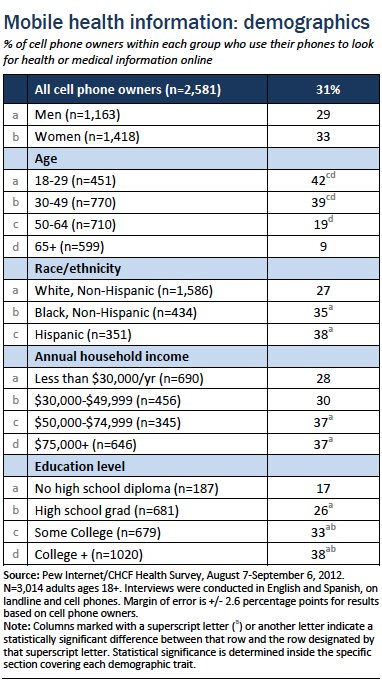
Some 85% of U.S. adults own a cell phone and, of those, 31% say they have used their phone to look for health or medical information online. Some groups are more likely than others to look for health information on their phones: Latinos, African Americans, those between the ages of 18 and 49, and those who have attended at least some college education.

Table

Half of smartphone owners have used their phone to look up health information

Half of cell phone owners in the U.S. (53%) say that they own a smartphone. This translates to 45% of all American adults. Younger people are more likely than older adults to own a smartphone, as are people with higher income and education levels.

Table

Fifty-two percent of smartphone owners have looked up health information on their phone, compared with just 6% of other cell phone owners.

A person’s likelihood to use his or her cell phone to look for health information is amplified by each of the characteristics identified in the tables above: relative youthfulness, having a higher level of education, living in a higher-income household, being Latino, being African American  – and owning a smartphone. Each of these observations holds true under statistical analysis isolating each factor. In other words, it is not just that smartphone owners are likely to be younger than other American adults and both groups are likely to use their phones to look up health information. Each characteristic has an independent effect on mobile health information consumption.

One in four people seeking health information online have hit a pay wall

Twenty-six percent of internet users who look online for health information say they have been asked to pay for access to something they wanted to see online. Seventy-three percent say they have not faced this choice while seeking health or medical information online.

Of those who have been asked to pay, just 2% say they did so. Fully 83% of those who hit a pay wall say they tried to find the same information somewhere else. Thirteen percent of those who hit a pay wall say they just gave up.

Men, women, people of all ages and education levels were equally likely to report hitting a pay wall when looking for health information. Respondents living in lower-income households were significantly more likely than their wealthier counterparts to say they gave up at that point. Wealthier respondents were the likeliest group to say they tried to find the same information elsewhere. No income group was more likely to say they paid the fee.

Peer-to-Peer Health Care

Some seek counsel from fellow patients and caregivers

We have been interested in the social aspect of online health resources since the very beginning of our project. In 2000, we asked people if they had emailed a doctor and if they participated in an online support group for people who shared the same health issues. As social tools proliferated, we adapted our survey questions to fit the current reality.

Now, instead of naming certain websites or services, we describe an activity and track people’s use of these resources over time. For example, in the current survey, we did not ask specifically about Facebook, instead focusing on more general social interaction which may take place on a variety of sites. We trust that people know what we mean when we ask if they have, for example, posted a health-related question online and we do not particularly need to know how or where they posted it.

The social life of health information is a steady presence in American life. As we noted above, one in four adults (24%) says that they turned to others who have the same health condition during their last bout with illness, essentially the same finding as in our 2010 survey. One in four internet users (26%) have read or watched someone else’s experience about health or medical issues in the last 12 months. And 16% of internet users have gone online to find others who might share the same health concerns in the last year. We explored this phenomenon in greater depth in the 2011 report, Peer-to-peer Healthcare.

Eleven percent of internet users say they have signed up to receive email updates or alerts about health or medical issues in the past year. Twelve percent of internet users have downloaded forms online or applied for health insurance online in the past year, including private insurance, Medicare, or Medicaid. Some of the most striking differences were between those who have health insurance and those who do not (see table below).

Figure 10

Eight percent of internet users say they have, in the past 12 months, posted a health-related question online or shared their own personal health experience online in any way.  Of those:

  • 40% say they posted comments or stories about personal health experiences
  • 19% say they posted specific health questions
  • 38% say they posted both

In addition, 78% of those who posted a comment, story, or question about their health say that they did so to reach a general audience of friends or other internet users. Eleven percent say they posted somewhere specifically to get feedback from a health professional. Four percent replied that they posted for both a general and a professional audience and 5% said neither of those choices fit.

Health care reviews have not caught on among general consumers

The Pew Internet Project has tracked the use of online consumer reviews since 2000 and it has always ranked among the most popular activities in the commercial realm: 8 in 10 internet users say they have researched a product or service online. By contrast, only about one in five internet users have consulted online reviews and rankings of health care service providers and treatments.

When it comes to writing reviews of general-interest items, 37% of internet users say they have rated a product, service, or person online and 32% have posted a comment or review online about product they bought or service they received. People are much less likely to post a review of a treatment, hospital, or clinician – between 3-4% of internet users have done so.

The results for health-related reviews are comparable to those we recorded in 2010.  Consulting online reviews of particular drugs or medical treatments, however, took a noticeable dip in the last two years.  Some 18% of internet users do so today, compared to 24% in 2010.

Figure 11

Internet users between the ages of 30-64 years old are the most likely group to say they have consulted online reviews and rankings of health treatments and services.  Suburban internet users are more likely than rural internet users to consult online health care reviews.

Figure 12
Figure 13
Figure 14
Figure 15

Posting online health reviews and rankings is comparatively infrequent.  Just 7% of internet users have ever posted reviews or rankings on any of the the three health topics we surveyed: drugs and medical treatments, doctors, and hospitals.  This translates into 6% of American adults.

Figure 16

Unlike consulting online health rankings and reviews, there are no clear demographic trends when it comes to posting.  (See Appendix for details.)

Appendix

Additional details about who has searched for specific health topics.

Table
Table

Additional details about who has posted online health reviews and rankings:

Table

Additional details about the health insurance landscape in the U.S.


Appendix 3

Women are more likely to have health insurance than men, along with whites and African-Americans compared to Hispanics.  Those with a higher income and level of education are also more likely to have health insurance.  Very nearly all adults over 65 have health insurance (99%), mostly due to Medicare.

Table

Methodology

The 2012 Health Survey, sponsored by the Pew Research Center’s Internet & American Life Project and the California HealthCare Foundation, obtained telephone interviews with a nationally representative sample of 3,014 adults living in the United States. Telephone interviews were conducted by landline (1,808) and cell phone (1,206, including 624 without a landline phone). The survey was conducted by Princeton Survey Research Associates International. Interviews were done in English and Spanish by Princeton Data Source from August 7 to September 6, 2012. Statistical results are weighted to correct known demographic discrepancies. The margin of sampling error for the complete set of weighted data is ±2.4 percentage points.

A complete explanation of the survey design and data collection procedures can be found in the PDF of the topline or of the report.