
Pew Research Center

FOR RELEASE SEPTEMBER 26, 2011

How people learn about their local community

Citizens' media habits are surprisingly varied as newspapers, TV, the internet, newsletters, and old-fashioned word-of-mouth compete for attention. Different platforms serve different audience needs.

FOR MEDIA OR OTHER INQUIRIES:

Communications Department
202.419.4372
www.pewresearch.org

RECOMMENDED CITATION

Pew Research Center, September 2011, "How people learn about their local community"

About Pew Research Center

Pew Research Center is a nonpartisan, nonadvocacy fact tank that informs the public about the issues, attitudes and trends shaping the world. It does not take policy positions. The Center conducts public opinion polling, demographic research, computational social science research and other data-driven research. It studies politics and policy; news habits and media; the internet and technology; religion; race and ethnicity; international affairs; social, demographic and economic trends; science; research methodology and data science; and immigration and migration. Pew Research Center is a subsidiary of The Pew Charitable Trusts, its primary funder.

© Pew Research Center 2026

Table of contents

  • About Pew Research Center
  • How people learn about their local community
  • Part 2: The local topics people follow and the information sources they use
  • Part 3: The role of newspapers
  • Part 4: The role of local TV news
  • Part 5: The role of the internet
  • Part 6: Mobile, social networks and apps in the local information landscape
  • Part 7: The role of other sources of local information
  • Methodology

How people learn about their local community

Citizens' media habits are surprisingly varied as newspapers, TV, the internet, newsletters, and old-fashioned word-of-mouth compete for attention. Different platforms serve different audience needs.

Contrary to much of the conventional understanding of how people learn about their communities, Americans turn to a wide range of platforms to get local news and information, and where they turn varies considerably depending on the subject matter and their age, according to a survey by the Pew Research Center’s Project for Excellence in Journalism and Internet & American Life Project, produced in association with the John S. and James L. Knight Foundation that asks about local information in a new way.

Most Americans, including more tech-savvy adults under age 40, also use a blend of both new and traditional sources to get their information.

Overall, the picture revealed by the data is that of a richer and more nuanced ecosystem of community news and information than researchers have previously identified.

The survey echoes longstanding research that more Americans report watching local TV news than any other source—which has led to widely held idea that people go there for most of their community news and information. But it also finds that Americans tend to rely on the medium for just a few topics—mainly weather, breaking news, and to a lesser degree, traffic. These are the most widely followed local subjects. Yet consumers rely on other sources for most other local topics. Younger adults, moreover, rely on local television less, a fact that suggests more vulnerability for the medium in the future.

The survey also yields some striking findings for newspapers. Most Americans (69%) say that if their local newspaper no longer existed, it would not have a major impact on their ability to keep up with information and news about their community.

Yet the data show that newspapers play a much bigger role in people’s lives than many may realize. Newspapers (both the print and online versions, though primarily print) rank first or tie for first as the source people rely on most for 11 of the 16 different kinds of local information asked about—more topics than any other media source.1 But most of these topics—many of which relate to civic affairs such as government—taxes, etc., are ones followed by fewer Americans on a regular basis.

In other words, local TV draws a mass audience largely around a few popular subjects; local newspapers attract a smaller cohort of citizens but for a wider range of civically oriented subjects.

Click here for a detailed and interactive chart spelling out which local information sources people rely on for different topics.

The survey also sheds light on the emerging role of the internet as people seek local news and information. The internet is defined here as web-only online destinations. For adults generally, the internet is a main source for information about restaurants and other local businesses, and it is tied with newspapers as a top source for material about housing, jobs and schools—all areas that place a special value on consumer input. Yet when one looks at the 79% of Americans who are online, the internet is the first or second most relied-upon source for 15 of the 16 local topics examined. For adults under 40, the web is first for 11 of the top 16 topics—and a close second on four others.
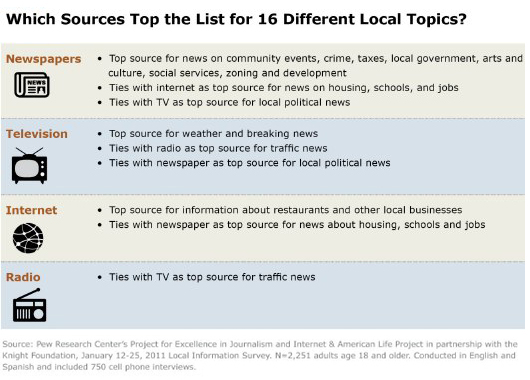
Top sources for different topics

At the same time, the survey finds both citizen-based information sources and some very old forms of media remain vital as well. Print newsletters, online listservs and old-fashioned word of mouth are important means by which people learn in particular about community events and local schools.

In all, the data in a new national survey show that the majority (64%) of American adults use at least three different types of media every week to get news and information about their local community—and 15% rely on at least six different kinds of media weekly.

And nearly half of all American adults, 45%, say they do not even have a favorite local news source. Instead, in the modern local news information system, different media outlets, and in many cases entire platforms, are gaining footholds for specific topic areas.

While this can help news sources establish an identity with audiences, it also raises a critical question: If a platform were to wither or disappear, would parts of the community go unmonitored?

About the survey

The new survey was administered from January 12-25 among a nationally-representative sample of 2,251 adults age 18 and older on landline and cell phones. It has an overall margin of error of plus or minus 2 percentage points.

Conventional research has tended to ask people about local news and information generically with some variation of a simple question: Where do people turn most often for their news? Asked that way, the majority of people answer local TV, which has made it the most popular news source in America. That is reinforced by ratings data that shows that the combined ratings of local television news programs exceeds that of other local media. The biennial media consumption survey of the Pew Research Center for the People and the Press similarly finds that local TV news is the medium most people turn to for news and information of any type. And this new survey, too, finds that local TV is the most frequently used medium for news and information, with 74% watching local newscasts or visiting local TV websites at least weekly, compared with 50% who turn to newspapers and their websites, 51% to radio (on air and online), and 47% who turn to web-only sources.

But this survey also took a new approach as well, asking people about the information sources they rely on to get material about 16 different specific local information areas.

The result is a more complex portrait of how people learn and exchange information about community. The new data explodes the notion, for instance, that people have a primary or single source for most of their local news and information.

Rather, Americans appear to discern significant differences in the strengths of different information sources. They recognize that there may be more information about their child’s school on a parent-run listserv than on television or even their neighborhood weekly paper. They recognize that if they want information about zoning or local government, it may be more available in the newspaper they do not regularly buy than on the television station they watch many days for traffic and weather.

(For this survey, the “internet is defined as web-only sources such as search engines, specialty-topic websites, and social networking sites. If respondents said they relied on the website of a newspaper, it was considered reliance on the newspaper and was combined with references to the print version of the local newspaper. Similarly, if respondents said a local television website was their preferred sources for a particular type of local news, it was combined with references to watching local news on television and considered reliance on the local TV news platform rather than the internet.)

Other key themes

Other notable themes that emerge from the survey:

  • The most popular local topics are weather (89% of people get it), breaking news (80%); local politics (67%) and crime (66%). The least popular on our list of topics are zoning and development information (30%), local social services (35%), job openings (39%) and local government activities (42%).
  • Nearly half of adults (47%) use mobile devices to get local news and information. Not surprisingly, mobile is particularly popular for “out and about” categories of information, such as restaurants. And 41% of all adults can be considered “local news participators” because they contribute their own information via social media and other sources, add to online conversations, and directly contribute articles about the community. Both these groups are substantially more likely than others to use the internet to get local news and information on almost all topics.
  • Social media is becoming a factor in how people learn about their local community, but it is not as popular as other digital forms. In all, 17% of adults say they get local information on social networking sites like Facebook at least monthly.
  • Mobile phone applications, or “apps,” have yet to emerge for most local topic areas. Even now, though, 5% of Americans say they rely on a mobile app for weather information.
  • Old-fashioned word of mouth is still a factor in sharing local news and information, especially at the neighborhood level for information about local businesses, restaurants and schools. In all 55% of all adults get local news and information via word of mouth at least once a week. Word of mouth is particularly likely to be cited by younger residents as one of their top platforms for community events. Adults age 40 and older are more likely to prefer word of mouth as a source for local politics, local government activity, housing and real estate, zoning, and social services.
  • The websites of newspapers and TV stations do not score highly as a relied-upon information source on any topics. They have gained modest footholds as sources that users rely upon for a variety of topics, including weather information, crime, politics, and breaking news, but overall they consistently score in the low single digits when it comes to being the source that people rely upon on any of the topics we queried.

Age is the most influential demographic

While there are a variety of demographic dimensions that are linked to the way people get local news and information, the most striking is the difference between younger and older information consumers. Simply put, one generation into the web, older consumers still rely more heavily on traditional platforms while younger consumers rely more on the internet. Among adults under age 40, the web ranks first or ties for first for 12 of the 16 local topics asked about.

If someone is under age 40, she tends to get the following kinds of local news and information from the following places:

  • Internet: weather, politics, crime, arts/cultural events, local businesses, schools, community events, restaurants, traffic, taxes, housing, local government, jobs, social services, and zoning/development
  • Newspapers: crime, arts/cultural events, community events, taxes, local government, jobs, social services, zoning/development
  • TV stations: weather, breaking news, politics, crime, traffic, local government, and social services
  • Radio: traffic
  • Word of mouth: Community events

If she is 40 or older, she tends to get the following kinds of news in the following places:

  • Newspapers: politics, crime, arts/cultural events, local businesses, schools, community events, restaurants, taxes, housing and real estate, government activities, jobs, zoning/development, social services
  • TV stations: weather, breaking news, politics, traffic, crime
  • Internet: local businesses, restaurants

This move by younger users to rely on the internet for local information puts considerable pressure on traditional news organizations. Even though most have moved aggressively online with ambitious websites and social media strategies, there is evidence in the data that people find specialty websites and search engines a preferable way find the local material they want.
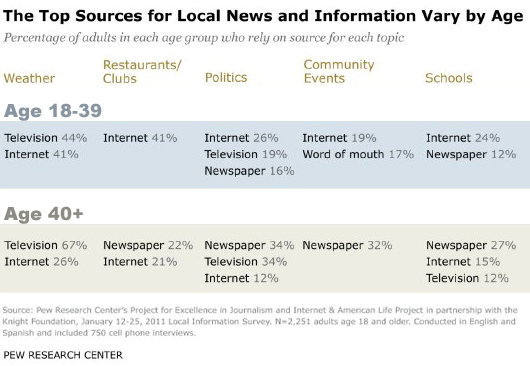
Top sources by age

Part 2: The local topics people follow and the information sources they use

Overview

The local news and information environment is changing in ways that most people believe makes it easier for them to get the specific information they want about their communities. More than half of Americans (55%) say it is easier today to get the local information they want than it was five years ago. Just 12% say it is harder, and 30% say they have noticed no change over that time. Younger adults and those with the most access to technology (especially broadband and smartphones) express the most enthusiasm about the increased ease of using the local news and information ecosystem over the past five years.

Despite that, people do not believe they are getting all the local news they need. Indeed, just 31% of adults say their local sources give them all of the local news and information that matters to them. The majority (58%) say they get only some of the news and information that matters, while 8% say they get little or none.

Local topics people follow

Figure 3

One of the newer realities of this environment is that people now have greater ability to get material on the subjects that most matter to them and not bother with those that don’t. It is clear from this survey that not all local topics are equally popular. The survey asked a nationally- representative sample of adults whether they ever get news and information about 16 different local topics. Data show that while some local topics are followed by the large majorities of adults (weather, breaking news, politics and crime), others (zoning and development, social services, job openings) interest much smaller segments of adults.

Moreover, the demographic portrait of the audience changes by topic, and often in turn reflects the platforms they rely on. For instance, if a subject is particularly appealing to older consumers, traditional platforms such as television news and newspapers are often the primary sources. On the other hand, if the subject is particularly relevant to younger adults, then the internet is likely to be the top source for that information.

The figure below indicates which adults are most likely to seek specific kinds of local information. (Click here for a larger version.)

Sources of information

In addition to the topic-specific demographic patterns noted in these graphics, several broad local news consumption patterns emerged. As a rule, those with higher levels of education and higher levels of income are more likely to follow most of the local news topics asked about, particularly those with a civic dimension such as politics, government news, and community events.  In addition, those who are older and those who have lived in their communities longer are more likely than younger people and community newcomers to be tuning in to information about many local topics, including social services, tax issues, and local schools.

The sources people use to get local news and information

While the main focus of the survey were the questions in which respondents were asked which sources they “rely on most” when gathering news and information about 16 different local topics, it also included a broader question about the overall frequency with which people use various platforms for getting local news and information.

The figure below indicates the sources people use at least once a week to get “local news and information,” in descending order.

5

Part 3: The role of newspapers

Perceptions of the importance of local newspapers

The survey indicated that newspapers play a far more complex role in the civic life of communities than many Americans believe.

On the surface, most people do not feel that their local newspaper is a key source that they rely on for local information.  For instance, when asked, “If your local newspaper no longer existed, would that have a major impact, a minor impact, or no impact on your ability to keep up with information and news about your local community?” a large majority of Americans, 69%, believe the death of their local newspaper would have no impact (39%) or only a minor impact (30%) on their ability to get local information.

Younger adults, age 18-29, were especially unconcerned. Fully 75% say their ability to get local information would not be affected in a major way by the absence of their local paper.  The same was true of heavier technology users: 74% of home broadband users say losing their paper would have no impact or only a minor impact on their ability to get local information.

Yet when asked about specific local topics and which sources they rely on for that information, it turns out that many adults are quite reliant on newspapers and their websites. Of the 16 specific local topics queried, newspapers ranked as the most, or tied as the most, relied upon source for 11 of the 16.

Local newspapers continue to be a key information source

Among all adults, newspapers were cited as the most relied-upon source or tied for most relied upon for crime, taxes, local government activities, schools, local politics, local jobs, community/neighborhood events, arts events, zoning information, local social services, and real estate/housing.

This dependence on newspapers for so many local topics sets it apart from all other sources of local news.  The internet, which was cited as the most relied upon source for five of the 16 topics, was a distant second to newspapers in terms of widespread use and value.

This sense from the public that newspapers are a place where they can turn to for information on a wide range of local topics, more so than other sources, confirms findings from other Pew Research Center studies, particularly a report on which news organizations tend to break new information in local news reporting conducted in Baltimore and research on what news is available from different sources produced as part of the State of the News Media 2006 report.2

6

The problem for newspapers is that many of these topics are followed by a relatively small percentage of the public. As noted in Part 2 of this report, just 30% of adults get information about zoning, 35% about social services, 42% about local government, and 43% about real estate. Thus, overall, the total number of Americans who rely on newspapers for the local information that matters to them is smaller than is the case for other platforms such as television.   

For instance, 48% of those who get information about taxes turn to newspapers, more than double the percentage who turn to the next most popular platforms, the internet (20%) and TV news (19%).  But when translated as a percentage of all citizens, just 22% of Americans rely on newspapers for tax information. Thus, while newspapers command this subject area, most people simply do not seek out information about the subject of local taxes.

People may be making quite logical choices in this. Past PEJ studies have found that local newspapers typically have 70 to 100 stories a day. The typical half-hour local TV newscast is closer to 15.3 So it is logical that newspapers would offer coverage of more topics in a community, while television might concentrate on a more limited number that attract the widest audience. Indeed, as PEJ found in a 2006 study, “In local metro dailies, citizens were far more likely to learn about things like taxes, education, zoning commissions and the activities of government than they would in most other media.”4

This, however, also has implications about what could happen if a newspaper in town were to disappear. If television has focused on covering weather, traffic, and breaking news, and that is what people look to this platform for, will television begin to cover taxes and zoning and education if the local newspaper no longer exists? Would new digital sources emerge to cover the hole if a local newspaper cut back its coverage or vanished altogether? And would the approach of these new sources be fully journalistic in nature?

Newspapers matter less to adults under age 40 as a local information source

Generational preferences add yet another layer of complexity. For adults under age 40, newspapers do not hold nearly the same appeal. Consider this stark difference: among all adults, newspapers are the clear top source for seven local topics (and tied with the internet as the top source for four other topics). Yet, among adults under 40 newspapers are the clear top choice for one topic, taxes, are tied with TV news for another topic, crime, and tie with the internet for four other topic areas. (The specifics of these differences are spelled out in Part 5 of this report.)

For all ages, the strength of newspapers comes from aggregating an audience by offering a wide range of information, even if each subject or story has limited audience. That model may be vital from a civic standpoint, but it is traditionally expensive and it is not clear what the incentive is to replicate it if newspapers were to disappear. 

Part 4: The role of local TV news

Local TV is a critical source for everyday news

For many years, polls have shown that local TV is the most popular medium in America for news. This survey, however, adds interesting and limiting dimensions to that finding.

Local TV (which for the purposes of this survey includes both televised broadcasts and local television websites) is the most popular source for the two topics that almost everyone is interested in—weather and breaking news. It has made itself essential in people’s lives for events happening right now, though the survey also finds that the internet is creeping into those territories.

7

It is also striking and potentially significant for the future that local TV ranks relatively low on the list of key sources for other local topics that garner more limited interest but reflect much of the day-to-day activities of local civic life.

Overall, 89% of adults say they get information about local weather and 80% follow local breaking news. When asked what source they rely on most for this kind of news, local TV clearly ranks first.  Fully 58% of adults say they turn to local TV for weather information; 55% named local TV as their top source for breaking news. The internet ranks second for both of these topics, but with a gap of more than 25 percentage points (32% turn to the internet for weather and 16% for breaking news).

8

Local television is also the outlet of choice for adults interested in traffic and transportation news and information, though less than half of those surveyed (47%) say they follow this topic at all. 

For breaking news, local television’s dominance cuts across age groups.  Even among adults under 40, roughly twice as many turn to TV as turn to the internet, 47% versus 22%.

When it comes to weather updates, however, the under-40 audience is nearly split: 44% name local TV as their primary source and 41% cite internet sources other than local television or newspaper websites.  The same TV versus web divide occurs among social network users and mobile news consumers—two practices still most heavily used by younger generations.

9

(Men seem to be making the switch to Web-based sources for local weather more than women. While most men, 55%, turn to local TV for weather, 36% rely on the internet as their top source. Just 28% of women say the internet is their top source for weather.)  

Local TV is just one of several key sources for political coverage

One area in which television finds itself in head-to-head competition with other platforms is local politics. Two-thirds of Americans follow news and information about local political matters, and roughly the same percentage turn to television newscasts (or television websites) for this information (28%) as turn to the local newspaper or its website (26%). The internet is third at 17%, and the data suggest over time its share of the audience will grow. Among adults under age 40, the internet is already the top source for local political information and news — 26% of adults in this age group name the internet as their top source for this topic, while 19% name local TV news. 

Where local politics are concerned, a clear boost for television news comes from minority populations. Hispanics are more than four times more likely to name local television as their top source for local politics as they are to name newspapers (38% versus 11%). African-American adults also prefer local TV over local newspapers as a source for this topic, though not quite to the same degree (38% versus 23%).

10

Television also clearly beats out newspapers as a source for local political news among non-internet users (41% to 27%) and among the less educated and those with lower household incomes. 

Beyond these four local topics, though, television news is rarely named as a primary source. In fact, in half of the topic areas asked about, fewer than 10% of adults name television as their primary source. This includes information about housing, jobs, community events and taxes.

In short, local TV news has thrived by developing a franchise around a handful of topics that have the widest appeal.  

What does all this portend for the future of the medium? Local television still has a hold on some of the most sought-after local topics, and ones that people seek out most often. But these are also topics for which convenience and timeliness are key features, and television might easily be replaced by mobile platforms that are even more accessible than TV. For weather, this may already be happening–as roughly a third 32% cite the internet as a primary source and 7% cite mobile devices. Weather apps and websites can often have as much or more information on local weather, and can localize it even more narrowly, than a local TV newscast might.

And for most of the local topics that require more deep reporting and analysis, such as taxes or zoning or local business, consumers already turn to platforms other than television.  As news outlets try to find their place in the evolving information ecosystem, then, local news may be in a vulnerable position. What television has that others do not is the force of personality of local anchors and reporters on camera.  

Part 5: The role of the internet

The internet has become a significant local information source

The internet has already surpassed newspapers as a source Americans turn to for national and international news.9 The findings from this survey now show its emerging role as a source for local news and information as well.

Among all adults, the internet is either the most popular source or tied with newspapers as the most popular source for five of the 16 local topics in the survey—from restaurants and businesses to housing, schools and jobs.

Among the 79% of Americans who are online, the internet is an even more significant source for local news and information. Looking just at this group, the internet is the first or second most important source for 15 of the 16 local topics examined. The internet ran a distinct third place for local crime news, a category for which internet users are more likely to turn to newspapers and television. However, for most local information topics asked about—from local restaurants to weather to politics to local businesses—internet users have found online-only sources that they rely upon—and this does not include the websites of legacy media.10

Among adults under age 40, similarly, the internet rivals or surpasses other platforms on every single topic area except one (breaking local news). It is first or tied for first on 12 topics and a second choice for three others. This poses a major challenge to more traditional news providers, especially newspapers, which have often aspired to be a relatively comprehensive source of information on all of these topics.11

11

Beyond the topics for which it is the top source, the internet is often the second-most important source of information on a variety of other topics. They include community events, weather, and local arts and cultural activities. 

Interestingly, even as the web has gained traction, there is one major area where it still lags well behind—breaking news. Here, local television news (which includes local TV websites but is driven almost entirely by broadcasts) still well outpace online sources. Among all adults, 55% say they rely on local TV for breaking news, compared with 16% who say they rely on the internet and 14% who rely on newspapers.

The internet is a key source for peer-generated information

The two local topics for which the internet already takes the clearest lead, even when including adults with no access to the web, are restaurants and local businesses. With its ability to sort data quickly and assimilate large numbers of consumer reviews, the internet is gaining as a way to give people information that is personal and particular, such as what kind of nearby restaurant might be widely praised and patronized for a certain kind of cuisine. At the same time, the internet has also become a place where locally-oriented content creators can share material directly with specific audience groups that traditional news organizations have not covered comprehensively. (It is worth noting that this survey did not take account of location-based services that have just recently become available on mobile devices and are starting to be used by early adopters.12)

In the past, reviews of restaurants and sometimes local businesses were provided by traditional news organizations – especially newspapers. At times, other companies provided guides that critiqued locale fare. Now, information services like Yelp, which offers citizen reviews and restaurant information, or Craigslist.com, which carries local classifieds, are mainstays of this information in many communities. Those services might have been developed by traditional news companies but were not and the audience has gravitated to the new platforms. The newer online services are also helped by the fact that their material is permanently searchable and therefore more comprehensively available to would-be patrons in ways that traditional newspapers and broadcasts are not.

Only small percentages of adults said they relied most on social networking websites like Facebook and Twitter for local information.  Those sites are included in the internet category, but within this category run a distant third behind search engine and special topic sites.

The five topics for which the internet is the most relied upon source

Below is a detailed look at the local information topics where the internet is a primary source.


Restaurants, clubs and bars: Some 55% of adults surveyed said they at least occasionally get information about local restaurants, clubs, or bars. As noted in Part 2 of this report, those who seek such information are disproportionately female, age 18-39, college-educated, urban or suburban, and internet users. 

The internet has become the most popular source for this information in significant part because search engines outpace other sources for information about restaurants, clubs, or bars. Some 21% of adults say they rely on search engines for this information; that is particularly true for the young, the upscale, those who have lived in their communities a relatively short amount of time, and those who live in urban and suburban areas. In addition to search, some 9% of adults use websites specially focused on entertainment establishments like restaurants, such as Yelp or Trip Advisor; another 2% say they rely on social networking sites provide them such information. Here too young adults stand out as being more likely than their elders to rely on these internet sources, as are those who live in non-rural areas.


Other local businesses: Some 60% of all adults say they get information about local businesses other than restaurants and bars. In Part 2, we noted that the people who get such information are disproportionately those who have college experience, live in relatively well-off household, and are age 40 or older.

Overall, 28% of all adults say they rely on the internet to get this information versus 18% who turn most to newspapers and newspaper websites, 13% who rely on word of mouth referrals, and 5% who look to TV news broadcasts and websites.

And again, it is the search engines which are the biggest draw. Fully 21% of adults say they turn to search engines when seeking this information; and that is particularly true for those under age 40, those with some college education or college degrees, those who are parents, those who live in suburban and urban areas, and those who have relatively recently moved into a community. Some 10% of adults use websites with particular information about local businesses and just 1% social networking sites like Facebook and Twitter provide them such information.


Local schools and education: Fully 58% of American adults say they get information about local schools and education. As Part 2 noted, these users tend to be parents of minor children, ages 30-49, and more often female than male.

On this topic, newspapers and the internet share the lead as the source they rely on most. Some 21% of all adults say they rely on their local newspaper and its website for material about schools and education, while 18% say they rely on the internet. Those who turn to the newspaper are more likely to be 40 or older and more likely to be longtime residents of the community. Those who rely on the internet are more likely to be parents of minor children, women, Latinos, and college graduates.

When it comes to getting information about local schools on specific domains on the internet, 10% of adults say they rely on specialty sites and 9% rely on search engines.


Local jobs: In this survey, 39% said they seek information about local job openings and they are disproportionately African-American, under age 40, and living in lower income households.

Of those who seek local job information, the internet and newspapers are relied upon in roughly equal measure. Some 17% of adults say they rely most on newspapers for local jobs information, while 16% say they rely most on the internet. However, the profiles of the two groups differ markedly. Those who count on newspapers tend to be 40 or older, have no college education, and are longtime residents of the community. Those who count on the internet are likely to be under age 40, with some college education or a college degree, and to have lived in their community for less than 10 years.

For those who prefer the internet for job searches, specialty websites are particularly popular. One in ten adults (10%) get information about local job openings from specialty sites, while 8% rely on search engines and fewer than 1% say social networking sites are their primary source.

The role of the internet in getting local jobs information becomes more important among younger Americans (those under age 40).  Some 24% of all those under age 40 rely most on the internet to get jobs information, compared with 17% who rely on newspapers. 


Local housing and real estate: Some 43% of all Americans say they get information about housing and real estate. Those who do are more likely to be relatively upscale in household income and educational levels.

Here, too, newspapers and the internet are statistically tied as the No. 1 source people rely upon. Among all adults, 19% say they rely on newspapers to get information about local housing and real estate and 17% say they rely on the internet. Those who turn to newspapers tend to be over age 40 and are longtime residents of the community. On the other hand, those who rely on the internet are under 40, suburbanites, and relatively newer arrivals in their communities.

For those who use the internet to get information on local housing, there is an even split between relying on search engines (9% of adults use them) and specialty sites (9% use them).

The websites of local newspapers and TV stations do not rank highly

It is noteworthy that the websites of traditional local news platforms do not register at major levels on most of the subjects probed in the survey. It could be the case that those websites are not the most important source that people rely upon but they still see value in those sites as a supplemental resource or as a starting point for deeper research on a local topic that matters to them. According to online traffic data of news websites, for instance, legacy media—and particularly newspapers—tend to rank quite high relative to other sources.13 Still, taking people at their word about legacy media online, there are some topics on our list that websites of news organizations could conceivably be even more potent than traditional newspapers or TV broadcasts and yet they are not. These include breaking news, weather, crime, and activities related to topics that are highly personalized like restaurants, housing and real estate, community events, and jobs.

In none of our topics did more than 6% of respondents say they depended on the website of a legacy news organization. Some 6% said they relied on a TV station’s website for weather information and that was the high mark for any traditional news organization’s web operation. In addition 5% said they relied on a TV station website when there was breaking news in their community, and 3% relied on local TV websites for local political news. After that, TV news websites barely registered.

Some 5% said the website of their local newspaper was the platform they most relied upon to get crime news. On that topic the printed newspaper was considerably ahead of other platforms as the most relied-upon resource. Newspaper websites had a small foothold on some other subjects, as well.  Four percent cited the newspaper site as their primary source for local political information, while 3% said it was their primary source for breaking news, local jobs, taxes, arts and cultural news, restaurants, and local taxes.

Part 6: Mobile, social networks and apps in the local information landscape

Two other factors seem to drive people to the internet when it comes to getting information about local subjects: mobile connections via smartphones or tablet computers and participation in the digital environment by sharing or creating local material themselves.

Mobile and participatory news consumers

This survey measured mobile local news and information access by asking questions about how people used smartphones and tablets. In all, 47% of adults get at least some local news and information via their smartphones or tablet computers.10  Thus, while mobile does not top the list of preferred sources for any of the 16 topics asked about, it is clearly a widely used supplemental source. Specifically:

  • 36% of all adults said they used a smartphone or tablet computer to check weather reports
  • 31% of all adults said they used those mobile devices to find local restaurants or local businesses
  • 25% of all adults said they used those mobile devices to get news about their local community
  • 20% of all adults said they used those mobile devices to check local sports scores and get updates
  • 19% of all adults said they used those mobile devices to get information about local traffic or public transportation
  • 16% of all adults said they used those mobile devices to get or use coupons for discounts at local stores

In addition, 13% of adults say they get news alerts about their community sent to their phones by text messages or email. And 11% of adults say they get local news from apps for their smartphones.

On the participatory side, 41% of adults can be considered “local news participators.” That means they said “yes” to at least one of the following:

  • 25% of adults share links to local stories or videos online with others
  • 16% of adults have commented on local news stories or blogs they read online
  • 16% of adults have posted news or information about their local community on a social networking site like Facebook
  • 8% of adults contribute to online discussions or message boards about their community
  • 6% of adults have “tagged” or categorized online local news content
  • 5% of adults have contributed articles, opinion pieces, photos or videos about their local community online
  • 2% of adults have posted news or information about their local community on Twitter

Interestingly, though, online social networks have yet to become a main source for most areas of local information. Only very small percentages named social networks as the places they turn to most for any of the 16 topics areas. For instance, the topics on which social networks ranked highest were local restaurants and community events, with just 2% of adults naming these sites as a key source. For the other 14 types of community news and information, social networks were cited even less often.

If someone is interested in getting local information on a handheld device or participates in circulating local information, she is significantly more likely than others to say she relies on the internet for most of the topics we explored. This is particularly true for participators, who are enthusiastic news consumers with more wide-ranging appetites than other local information consumers.

12

The unknown direction of apps culture

One major unknown in the future is how powerful mobile device apps will become in delivering content that people want about their communities. At the moment, apps use barely registered on any subject in the survey.

The main indicator of the potential future of apps comes in getting the weather: 5% of adults say they rely most on a mobile app for getting such information. But in every other subject, 1% or less of the adult population cited apps as a key source. However, it is easy to imagine a scenario where apps become highly useful – and highly used – for several of these local topics in the future, including traffic, breaking news, restaurants, neighborhood events and local cultural events (on a topic-driven community calendar), schools and education, and even social services.

Part 7: The role of other sources of local information

Overview

In addition to the three biggest media platforms—newspapers, television and the internet—the local news and information ecosystem involves a complex mix of other sources as well. And for several local topics, citizen-based systems such as word of mouth (which does not include online social networking), print newsletters and bulletins, and the local government itself make appearances as sources that some residents rely upon. At the same time, the survey finds that radio emerges as a local news and information source of fairly limited recognition.

Word of mouth

“Word of mouth” through friends, family, neighbors and colleagues is a substantial source of community news and information. Overall, 55% of adults reported getting local news and information from this source at least weekly.  And for 14 of the 16 local topics asked about, the survey found that word of mouth was the fourth most cited source or higher—usually ahead of radio.

For information about community events, such as parades or block parties, word of mouth was tied with the internet as the second most relied upon source. Just over half of all U.S. adults (57%) say they get information about community or neighborhood events.  These adults most commonly cite local newspapers as their main source for information about this topic; one-quarter of all U.S. adults (25%) say local papers are the source they rely on most for this information.  Yet another 13% say they hear about community events most often through word of mouth.  Overall, word of mouth is cited as often as the internet (12%) as a key information source for community events, and is a particularly important source of information about community events for adults under age 40. 

Among young adults, both word of mouth (17%) and the internet (19%) top local newspapers (13%) as a primary source of information about community events.  Among adults age 40 and older, just 11% cite word of mouth and 9% cite the internet as their main source, while 32% say they rely on their local newspaper for this information.

13

Restaurants and local businesses are among the most followed local topics, with 55% and 60% of adults, respectively, reporting they get information about these topics.  For information about both local restaurants and other local businesses, word of mouth is the third most popular source, in each case cited by 13% of adults as the source they rely on most.  For each of these topics, word of mouth follows the internet and the local newspaper as the top two key sources, in order. 

An equally high number of adults (58%) get information about their local schools, and for them, the local newspaper (21%) and the internet (18%) are the most commonly cited sources.  Yet, one in ten adults cites word of mouth as the source they rely on most for this information, the same percent that cite local television news as their main source. 

Word of mouth is also the fourth most-cited source for local politics, campaigns and elections, a topic about which two-thirds of adults (67%) report getting information.   For 7% of adults, word of mouth is the source they rely on most for this information.  This is driven mainly by adults age 40 and older, among whom 9% say this is their main source.  Just 4% of younger adults say word of mouth is their top source for local political information, preferring the internet as a main source instead.

Radio

Radio is a key information source for the most time-sensitive local news and information topics.  Just under half of adults (47%) report getting information about local traffic and transportation.  Along with local television news, radio tops the list of sources for this information, reflecting the widespread use of radio by those commuting to and from work.  While 19% of adults say that local television is their main source for traffic and transportation news and information, 15% cite the radio as their main source. 

Roughly one in ten adults (9%) cite the radio as a key source for breaking news and weather.  This makes radio the fourth most popular source for breaking news (behind, in order, television, newspaper and the internet) and it follows only television and the internet as a primary source for weather information.  In addition, 5% of adults cite radio as a main source for both local political and arts and cultural information, while 4% rely on radio for crime updates.

Yet on a range of other topics, only 3% or fewer adults rely on radio as a source. Those low-registering topics are: local businesses (3%), community events (2%), taxes (2%), schools (2%), government activities (2%), social services (2%), restaurants (1%), housing and real estate (1%), zoning (1%), and local jobs (1%).

Print bulletins, newsletters and listservs

For the most part, print bulletins, newsletters and listservs are infrequently cited as a key source of local news.  However, 7% of adults cite print bulletins and newsletters as their main source of information about both community events and local schools. 

For community events, just as many adults rely on bulletins and newsletters as rely on local television news as their main source of information.  Adults age 40 and older are slightly more reliant on print newsletters and bulletins for community event information than are younger adults, the latter preferring to learn about community events through the internet and word of mouth. 

While local newspapers and the internet are far and away the most popular sources for information about local schools, cited by 21% and 18% of adults respectively, print bulletins and newsletters (preferred by 7% of adults) rival television (preferred by 10%) and word of mouth (also preferred by 10%). 

The local government as information source

In contrast to citizen produced information such as newsletters, or commercially produced online information (not to mention professionally produced journalism), the efforts by local government to communicate directly to citizens barely registers as a key source of information for the majority of local topics included in the survey.  Just 3% of adults say they rely on their local government (including both local government websites or visiting offices directly) as the main source of information for both taxes and for local social services, and even fewer cite their local government as a key source for other topics such as community events, zoning and development, and even local government activity. 

Interestingly, in the case of local social services, non-internet users and older adults—populations generally more in need of such services—are more likely to rely on word of mouth as their key source of information about social services than to go directly to their local government.  For both of these groups, local newspapers and television news are the top sources, but word of mouth is the third most cited source.

Methodology

This report is based on the findings of a survey on Americans’ use of the Internet. The results in this report are based on data from telephone interviews conducted by Princeton Survey Research Associates International from January 12 to 25, 2011, among a sample of 2,251 adults, age 18 and older.  Telephone interviews were conducted in English and Spanish by landline (1,501) and cell phone (750, including 332 without a landline phone). For results based on the total sample, one can say with 95% confidence that the error attributable to sampling is plus or minus 2.4 percentage points.  For results based Internet users (n=1,762), the margin of sampling error is plus or minus 2.7 percentage points.  In addition to sampling error, question wording and practical difficulties in conducting telephone surveys may introduce some error or bias into the findings of opinion polls.

A combination of landline and cellular random digit dial (RDD) samples was used to represent all adults in the continental United States who have access to either a landline or cellular telephone. Both samples were provided by Survey Sampling International, LLC (SSI) according to PSRAI specifications.  Numbers for the landline sample were selected with probabilities in proportion to their share of listed telephone households from active blocks (area code + exchange + two-digit block number) that contained three or more residential directory listings. The cellular sample was not list-assisted, but was drawn through a systematic sampling from dedicated wireless 100-blocks and shared service 100-blocks with no directory-listed landline numbers.

New sample was released daily and was kept in the field for at least five days. The sample was released in replicates, which are representative subsamples of the larger population. This ensures that complete call procedures were followed for the entire sample.  At least 7 attempts were made to complete an interview at a sampled telephone number. The calls were staggered over times of day and days of the week to maximize the chances of making contact with a potential respondent. Each number received at least one daytime call in an attempt to find someone available. For the landline sample, interviewers asked to speak with the youngest adult male or female currently at home based on a random rotation. If no male/female was available, interviewers asked to speak with the youngest adult of the other gender. For the cellular sample, interviews were conducted with the person who answered the phone. Interviewers verified that the person was an adult and in a safe place before administering the survey. Cellular sample respondents were offered a post-paid cash incentive for their participation. All interviews completed on any given day were considered to be the final sample for that day.

Weighting is generally used in survey analysis to compensate for sample designs and patterns of non-response that might bias results. A two-stage weighting procedure was used to weight this dual-frame sample. The first-stage weight is the product of two adjustments made to the data – a Probability of Selection Adjustment (PSA) and a Phone Use Adjustment (PUA). The PSA corrects for the fact that respondents in the landline sample have different probabilities of being sampled depending on how many adults live in the household. The PUA corrects for the overlapping landline and cellular sample frames.

The second stage of weighting balances sample demographics to population parameters. The sample is balanced by form to match national population parameters for sex, age, education, race, Hispanic origin, region (U.S. Census definitions), population density, and telephone usage. The White, non-Hispanic subgroup is also balanced on age, education and region. The basic weighting parameters came from a special analysis of the Census Bureau’s 2010 Annual Social and Economic Supplement (ASEC) that included all households in the continental United States. The population density parameter was derived from Census 2000 data. The cell phone usage parameter came from an analysis of the January-June 2010 National Health Interview Survey.11

Following is the full disposition of all sampled telephone numbers:

table 2

The disposition reports all of the sampled telephone numbers ever dialed from the original telephone number samples. The response rate estimates the fraction of all eligible respondents in the sample that were ultimately interviewed. At PSRAI it is calculated by taking the product of three component rates:

  • Contact rate – the proportion of working numbers where a request for interview was made
  • Cooperation rate – the proportion of contacted numbers where a consent for interview was at least initially obtained, versus those refused
  • Completion rate – the proportion of initially cooperating and eligible interviews that were completed

Thus the response rate for the landline sample was 13.4 percent. The response rate for the cellular sample was 15.5 percent.

Topline Survey Results

The topline for this report is available to download as a PDF here.