Pew Research Center

FOR RELEASE JUNE 18, 2010

Adults and Cell Phone Distractions

Adults are just as likely as teens to have texted while driving and are substantially more likely to have talked on the phone while driving.

BY Mary Madden and Lee Rainie

FOR MEDIA OR OTHER INQUIRIES:

Communications Department
202.419.4372
www.pewresearch.org

RECOMMENDED CITATION

Pew Research Center, June 2010, "Adults and Cell Phone Distractions"

About Pew Research Center

Pew Research Center is a nonpartisan, nonadvocacy fact tank that informs the public about the issues, attitudes and trends shaping the world. It does not take policy positions. The Center conducts public opinion polling, demographic research, computational social science research and other data-driven research. It studies politics and policy; news habits and media; the internet and technology; religion; race and ethnicity; international affairs; social, demographic and economic trends; science; research methodology and data science; and immigration and migration. Pew Research Center is a subsidiary of The Pew Charitable Trusts, its primary funder.

© Pew Research Center 2026

Table of contents

  • About Pew Research Center
  • Adults and Cell Phone Distractions
  • Major findings
  • About and methodology

Adults and Cell Phone Distractions

Adults are just as likely as teens to have texted while driving and are substantially more likely to have talked on the phone while driving.

Adults are just as likely as teens to have texted while driving and are substantially more likely to have talked on the phone while driving.

In addition, 49% of adults say they have been passengers in a car when the driver was sending or reading text messages on their cell phone. Overall, 44% of adults say they have been passengers of drivers who used the cell phone in a way that put themselves or others in danger.

Beyond driving, some cell-toting pedestrians get so distracted while talking or texting that they have physically bumped into another person or an object.

These are some of the key findings from a new survey by the Pew Research Center’s Internet & American Life Project:

  • Nearly half (47%) of all texting adults say they have sent or read a text message while driving. That compares to one in three (34%) texting teens ages 16-17 who said they had “texted while driving” in a September 2009 survey.3
  • Looking at the general population, this means that 27% of all American adults say they have sent or read text messages while driving. That compares to 26% of all American teens ages 16-17 who reported texting at the wheel in 2009.
  • Three in four (75%) cell-owning adults say they have talked on a cell phone while driving. Half (52%) of cell-owning teens ages 16-17 reported talking on a cell phone while driving in the 2009 survey.
  • Among all adults, that translates into 61% who have talked on a cell phone while driving. That compares to 43% of all American teens ages 16-17 who said they had talked on their phones while driving in the 2009 survey.
  • Half (49%) of all adults say they have been in a car when the driver was sending or reading text messages on their cell phone. The same number (48%) of all teens ages 12-17 said they had been in a car “when the driver was texting.”4
  • 44% of all adults say they have been in a car when the driver used the cell phone in a way that put themselves or others in danger. About the same number of teens (40%) said they had been in a car when the driver used a cell phone in a dangerous way.
  • Beyond driving, one in six (17%) cell-owning adults say they have physically bumped into another person or an object because they were distracted by talking or texting on their phone. That amounts to 14% of all American adults who have been so engrossed in talking, texting or otherwise using their cell phones that they bumped into something or someone.

These new findings for those ages 18 and older come from a nationwide phone survey of 2,252 American adults (744 of the interviews were conducted on cell phones) conducted between April 29 and May 30. In that survey, 1,917 were cell owners and 1,189 used text messaging. The margin of error in the full sample is two percentage points and in the cell subpopulation is three percentage points.

The findings for teens are based on previously released data from a separate nationwide telephone survey conducted by Princeton Survey Research International between June 26 and September 24, 2009, among a sample of 800 teens ages 12-17 and a parent or guardian.  For a full discussion of the results from this survey, please see the “Teens and Distracted Driving” report.

Introduction and background

Cell phones appeal to Americans for many reasons, starting with the benefits of constant connection to family and friends. In the era of smart phones , instant and ubiquitous access to information, news, and games on handheld devices also draws users into deeper engagement with their mobile devices. Cell phones have become so popular that the number of adults who own mobile phones has often outpaced the percentage of adults who are online. A new Pew Internet survey finds that 82% of American adults (those age 18 and older) now own cell phones, up from 65% when we took our first reading in late 2004.  Some 58% of adults now send or receive text messages with their cell phones. By comparison, a September 2009 Pew Internet survey found that 75% of all American teens ages 12-17 own a cell phone, and 66% text.

Many of these cell owners take advantage of the technology by performing all kinds of tasks in all kinds of places, including in the car and while they are walking. At times, their cell use is distracting and dangerous because it takes place when their attention is best focused elsewhere.  Studies at Virginia Tech and elsewhere show that drivers using phones are four times as likely to cause a crash as other drivers.5 According to research from the National Highway Traffic Safety Administration, in 2008 alone, there were 5,870 fatalities and an estimated 515,000 people were injured in police-reported crashes in which at least one form of driver distraction was reported.

As a result, seven states and the District of Columbia now ban all handheld cell use while driving, 28 states ban all cell use by novice drivers, 18 states ban all cell use for bus drivers, and 28 states ban texting while driving.6 The Distracted Driving Prevention Act, introduced last fall by Sen. Jay Rockefeller (D-WV), would provide incentive grants to states that ban texting and handheld cell phone use for all drivers and would require a complete ban on cell phone use by drivers under the age of 18.

This report covers related findings from a recent Pew Internet survey.

Major findings

47% of texting adults say they have sent or read a text message while driving

Close to half (47%) of all adults who use text messaging say they have sent or read messages while behind the wheel. That compares to one in three (34%) texting teens ages 16-17 who said they had “texted while driving” in our September 2009 survey. 

In the general population this means that 27% of all American adults say they have texted while driving.

Male texters are more likely to report texting at the wheel; 51% of men who use text messaging say they have sent or read messages while driving while 42% of women texters say the same.

Those in the Millennial generation (ages 18-33) are more likely than any other age group to report texting while driving. While 59% of texting Millennials say they have sent or read messages at the wheel, 50% of text-using Gen Xers (ages 34-45) and 29% of texting Baby Boomers (ages 46-64) report the same.

Texting while driving

75% of cell-owning adults say they have talked on a cell phone while driving

Three in four cell phone-owning adults say they have talked on a mobile phone while driving. That compares to just half (52%) of cell-owning teens ages 16-17who reported talking on a cell phone while driving in our 2009 survey.

In all, 61% of American adults say they have had conversations on a cell phone while behind the wheel.

Again, men are more likely than women to report this distraction; 78% of cell-owning men say they have talked while driving, compared with 72% of cell-owning women.

Eight in ten cell-using Millennials say they have talked on their mobile phones while driving. However, Gen X stands out as the group most likely to chat at the wheel when compared with older generations. While close to nine in ten (86%) Gen Xers who own cell phones talk while driving, just 73% of Boomer cell owners and 50% of those age 65 and older say they talk on their phones while at the wheel.

Parents are more likely than non-parents to say they have talked on a cell phone while driving; 82% of cell-owning parents report this, compared with 72% of non-parents.

Talking on cell phone while driving

49% of all adults say they have been in a car when the driver was sending or reading text messages on their cell phone

Half of all American adults (49%) say they have been passengers in cars with other texting drivers. The same proportion (48%) of all teens ages 12-17 said they had been in a car “when the driver was texting” in our 2009 survey.

Men and women are equally as likely to say they have been in a car when the driver was texting. However, non-white American adults are more likely than whites to say they have been passengers of texting drivers. While 56% of black adults and 58% of Hispanic adults say they have been passengers of texting drivers, 46% of white adults report the same.

The likelihood that someone will be a passenger of a texting driver decreases dramatically with age. While one in three (75%) Millennials say they have been passengers in a car with a texting driver, 59% of Gen Xers, 37% of Boomers and just 18% of adults age 65 and older say they have had that experience.

Parents are considerably more likely than non-parents to say they have been passengers of distracted drivers; 58% all parents say they have been passengers when the driver was texting, compared with 45% of non-parents.

44% of all adults say they have been in a car when the driver used the cell phone in a way that put themselves or others in danger

While cell phones are most commonly used for talking and texting, there is a range of other potentially distracting behaviors—such web browsing, video watching, picture-taking and gaming—that can divert a driver’s attention away from the road. In all, 44% of adults say they have been passengers in a car with a driver who used a cell phone in a way that put themselves or others in danger. About the same number of teens (40%) said they had been in a car when the driver used a cell phone in a dangerous way in the 2009 survey.

Men are more likely than women to report being passengers of cell-distracted drivers (48% vs. 40%). 

Millennials and Gen X are about equally as likely to report being passengers of drivers who use the cell phone in a dangerous way (59% vs. 52%). However, both groups are considerably more likely than older generations to report this experience. Just 37% of Boomers say they have been passengers in a car while the driver used a cell phone in a dangerous way and only 21% of adults age 65 and older say they have had that experience.

Again, parents are more likely than non-parents to say they have been passengers of cell-distracted drivers (49% vs. 42%).

A sixth of cell phone owners have bumped into someone or something while using their handhelds

Of the 82% of American adults who own cell phones, fully 17% say they have bumped into another person or an object because they were distracted by talking or texting on their mobile phones. That amounts to 14% of all American adults who have been so engrossed in talking, texting or otherwise using their cell phones that they bumped into something or someone.

Millennials who own cell phones are by far the most likely to have bumped into someone or something: 33% have done so, compared with 15% of cell owners in GenX, 8% of Baby Boomers who have handhelds, and 3% of those over age 65 who own cells.

The physically-distracted crowd is also slightly more urban and well-educated than others. Cell owners who live in cities are more likely than rural residents to bump into other people and things (20% vs. 13%). And cell owners with college degrees are more likely than those with high school diplomas to be looking at their screens when they should be looking at their surroundings (20% vs. 14%).

Distracted driving - Table

About and methodology

About the Pew Research Center’s Internet & American Life Project

The Pew Research Center’s Internet & American Life Project is one of seven projects that make up the Pew Research Center, a nonpartisan, nonprofit “fact tank” that provides information on the issues, attitudes and trends shaping America and the world. The Project produces reports exploring the impact of the internet on families, communities, work and home, daily life, education, health care, and civic and political life. The Project aims to be an authoritative source on the evolution of the internet through surveys that examine how Americans use the internet and how their activities affect their lives.

The Pew Internet Project takes no positions on policy issues related to the internet or other communications technologies. It does not endorse technologies, industry sectors, companies, nonprofit organizations, or individuals.

Pew Internet logo

Methodology and survey questions

This report is based on the findings of a daily tracking survey on Americans’ use of the Internet. The results in this report are based on data from telephone interviews conducted by Princeton Survey Research Associates International between April 29 and May 30, 2010, among a sample of 2,252 adults, age 18 and older.  Interviews were conducted in English.  For results based on the total sample, one can say with 95% confidence that the error attributable to sampling and other random effects is plus or minus 2.4 percentage points.  For results based Internet users (n=1,756), the margin of sampling error is plus or minus 2.7 percentage points.  In addition to sampling error, question wording and practical difficulties in conducting telephone surveys may introduce some error or bias into the findings of opinion polls.

A combination of landline and cellular random digit dial (RDD) samples was used to represent all adults in the continental United States who have access to either a landline or cellular telephone. Both samples were provided by Survey Sampling International, LLC (SSI) according to PSRAI specifications.  Numbers for the landline sample were selected with probabilities in proportion to their share of listed telephone households from active blocks (area code + exchange + two-digit block number) that contained three or more residential directory listings. The cellular sample was not list-assisted, but was drawn through a systematic sampling from dedicated wireless 100-blocks and shared service 100-blocks with no directory-listed landline numbers.

New sample was released daily and was kept in the field for at least five days. The sample was released in replicates, which are representative subsamples of the larger population. This ensures that complete call procedures were followed for the entire sample.  At least 7 attempts were made to complete an interview at a sampled telephone number. The calls were staggered over times of day and days of the week to maximize the chances of making contact with a potential respondent. Each number received at least one daytime call in an attempt to find someone available. For the landline sample, half of the time interviewers first asked to speak with the youngest adult male currently at home. If no male was at home at the time of the call, interviewers asked to speak with the youngest adult female. For the other half of the contacts interviewers first asked to speak with the youngest adult female currently at home. If no female was available, interviewers asked to speak with the youngest adult male at home. For the cellular sample, interviews were conducted with the person who answered the phone. Interviewers verified that the person was an adult and in a safe place before administering the survey. Cellular sample respondents were offered a post-paid cash incentive for their participation. All interviews completed on any given day were considered to be the final sample for that day.

Non-response in telephone interviews produces some known biases in survey-derived estimates because participation tends to vary for different subgroups of the population, and these subgroups are likely to vary also on questions of substantive interest. In order to compensate for these known biases, the sample data are weighted in analysis. The demographic weighting parameters are derived from a special analysis of the most recently available Census Bureau’s March 2009 Annual Social and Economic Supplement. This analysis produces population parameters for the demographic characteristics of adults age 18 or older. These parameters are then compared with the sample characteristics to construct sample weights. The weights are derived using an iterative technique that simultaneously balances the distribution of all weighting parameters.

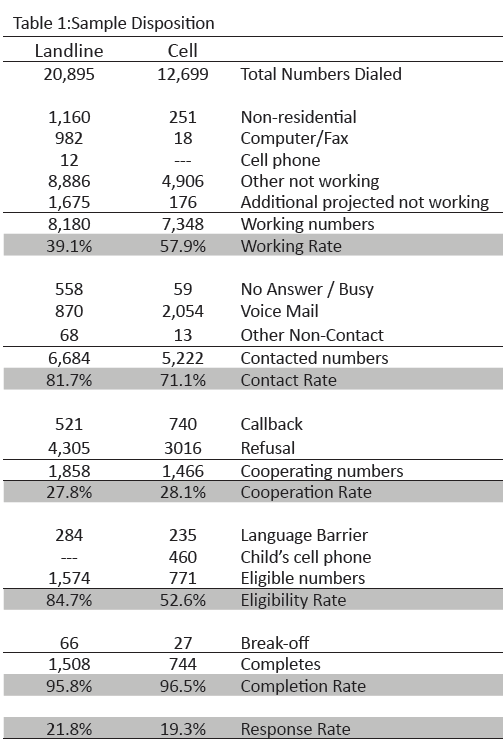
Following is the full disposition of all sampled telephone numbers:
 

Table 1 - Sample disposition

The disposition reports all of the sampled telephone numbers ever dialed from the original telephone number samples. The response rate estimates the fraction of all eligible respondents in the sample that were ultimately interviewed. At PSRAI it is calculated by taking the product of three component rates:

o   Contact rate – the proportion of working numbers where a request for interview was made

o   Cooperation rate – the proportion of contacted numbers where a consent for interview was at least initially obtained, versus those refused

o   Completion rate – the proportion of initially cooperating and eligible interviews that were completed

Thus the response rate for the landline sample was 21.8 percent. The response rate for the cellular sample was 19.3 percent.


Spring Change Assessment Survey 2010
Near-Final Topline | 6/4/10

Data for April 29 – May 30, 2010

Princeton Survey Research Associates International for the Pew Research Center’s Internet & American Life Project

Sample: n= 2,252 national adults, age 18 and older, including 744 cell phone interviews

Interviewing dates: 04.29.10 – 05.30.10

  • Margin of error is plus or minus 2 percentage points for results based on Total [n=2,252]
  • Margin of error is plus or minus 3 percentage points for results based on internet users [n=1,756]
  • Margin of error is plus or minus 3 percentage points for results based on cell phone users [n=1,917]

[INSERT IN ORDER]


YES

NO

Don’t know

Refused

a.       Been in a car when the driver was sending or reading text messages on their cell phone

49

51

*

0

b.       Been in a car when the driver used a cell phone in a way that put themselves or others in danger

44

56

*

*

Item C: Based on cell phone users who text message [N=1,189]


c.        Sent or read a text message while driving

47

53

0

0

Item D: Based on cell phone users [N=1,917]


d.       Talked on a cell phone while driving

75

25

*

0

e.        Physically bumped into another person or object because you were distracted by talking or texting on your phone

17

83

*

0