Pew Research Center

FOR RELEASE JULY 15, 2009

The Internet and the Recession

Some 69% of Americans have used the internet to cope with the recession as they hunt for bargains, jobs, ways to upgrade their skills, better investment strategies, housing options, and government benefits.

FOR MEDIA OR OTHER INQUIRIES:

Communications Department
202.419.4372
www.pewresearch.org

RECOMMENDED CITATION

Pew Research Center, July 2009, "The Internet and the Recession"

About Pew Research Center

Pew Research Center is a nonpartisan, nonadvocacy fact tank that informs the public about the issues, attitudes and trends shaping the world. It does not take policy positions. The Center conducts public opinion polling, demographic research, computational social science research and other data-driven research. It studies politics and policy; news habits and media; the internet and technology; religion; race and ethnicity; international affairs; social, demographic and economic trends; science; research methodology and data science; and immigration and migration. Pew Research Center is a subsidiary of The Pew Charitable Trusts, its primary funder.

© Pew Research Center 2026

Table of contents

  • About Pew Research Center
  • The Internet and the Recession
  • The state of the economy
  • How the internet, and other sources, have helped people cope with the recession
  • The role the internet plays as people try to make sense of the recession and react to it
  • The impact of the internet
  • About Us, Methodology

The Internet and the Recession

Some 69% of Americans have used the internet to cope with the recession as they hunt for bargains, jobs, ways to upgrade their skills, better investment strategies, housing options, and government benefits.

69% of all Americans have used the internet in the past year for help in coping with the recession and understanding it.

More than two-thirds of Americans – 69% – have used the internet to help them with personal economic issues that have arisen in the recession and to gather information about the origins and solutions to national economic problems. That amounts to 88% of the adult internet users in the country.

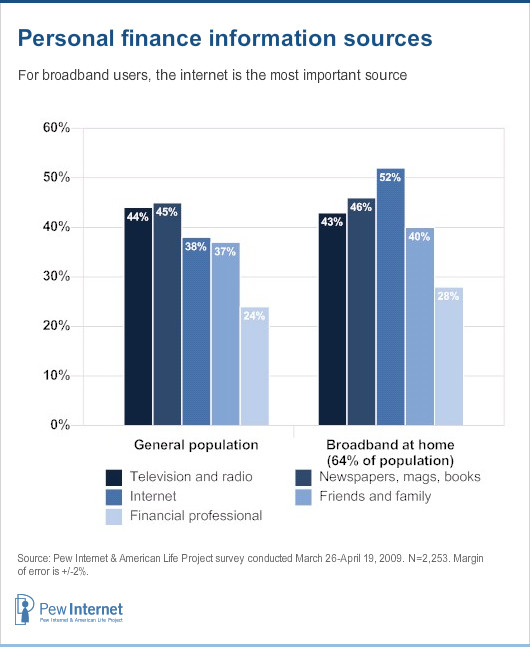
The internet ranks high among sources of information and advice that people are seeking during hard times, especially when it comes to their personal finances and economic circumstances. At the same time, broadcast media outpace the internet as sources of news about national economics and broadcast sources still overshadow the internet among all Americans for information and advice related to their personal financial circumstances.
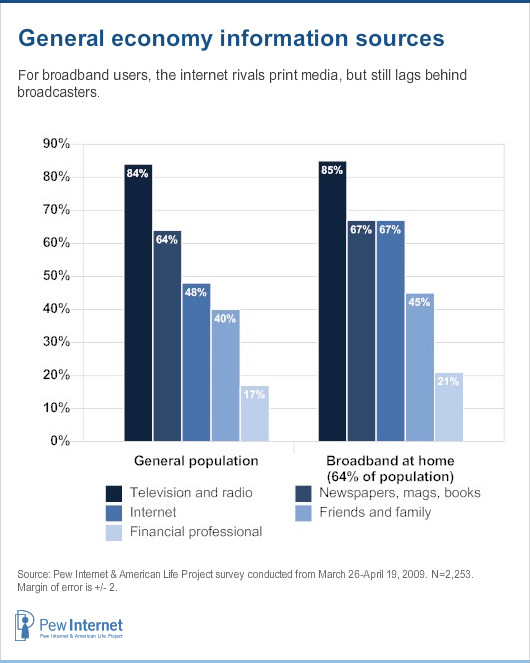
General economy info sources

Personal finances info sources

For most of those interested in learning about personal and global finances, though, the quest for understanding and meaning is not an “either/or” matter. People do not either talk to others or consult a single media platform. They forage among sources and communicate with a range of people.

The average American is using two-to-three sources of information to make sense of what is happening and plan personal coping strategies. The process is best understood as networked individuals interacting with networked information. They talk to people, seek updates from media sources like newspapers and broadcast media, and actively search for insights that will help them explain what has happened to the economy and how they might adjust to those changes. Sometimes, they also launch an online conversation or otherwise pitch their ideas into the debate.

Still, the quest for information and advice online is not very intense for most Americans. About a fifth of online adults (18%) say they search at least once a day for recession-related material. About half of internet users say they get such material every few days or less frequently than that.

52% of Americans have been hard hit by economic troubles.

Many of the most active searchers and communicators are those who have been stung badly by the recession. Some 52% of Americans have been hard hit in at least one of these ways:

  • 35% of Americans have seen their investments lose more than half their value.
  • 27% of those who are employed full time or part time have had their pay cut, their hours reduced or lost benefits.
  • 27% of homeowners have seen the value of their home reduced by at least half.
  • 14% of Americans have been laid off or lost their jobs in the recession.

Bargains and job-related searches lead the way among the kinds of information “online economic users” have sought.

Much of this report deals with a subpopulation we call “online economic users.” They are the 69% of all Americans (and 88% of internet users) who have used the internet for recession-related purposes. Here are the main activities of online economic users in the past year – and in most cases, the hard-hit significantly outpace those who have avoided major economic problems in the past year:

  • Price comparisons: 67% of online economic users have used the internet to find the lowest price available for something they need to buy.
  • New jobs: 41% of online economic users have sought information in the past year about jobs that might be available.
  • Seeking online coupons for savings: 40% of online economic users searched on the internet for cost-saving coupons.
  • Help in spending less on everyday items: 27% of online economic users have used the internet to get material on the cost of everyday purchases.
  • Earning more money and second jobs: 27% of online economic users have been online hunting for tips about ways to earn more money or exploring the prospects for getting a second job.
  • Advice about protecting personal finances: 25% of online economic users have gone online seeking information about ways to protect their finances in a difficult economy.
  • Improving skills for a better job: 25% of online economic users have used the internet to seek material about how to improve their skills to qualify for better jobs.
  • Sell personal items online: 23% of online economic users have used auction sites or classified ad sites to sell personal items to raise money.
  • Unemployment benefits: 22% of online economic users sought material online about unemployment and other government benefits.
  • The value of my house: 18% of online economic users have used the internet to check up on the value of their house.
  • Rankings or reviews of financial companies and professionals: 17% of online economic users went online to check reviews of financial firms and professionals.
  • Information about getting a loan: 13% of online economic users went online to check out ways to get loans.
  • Filing for bankruptcy: 3% of online economic users used the internet to look for information about filing for bankruptcy.

The impact of the internet on people’s views and strategies for coping with the recession.

Most online Americans say their internet use had not changed much and the things they did online did not have tremendous influence on their beliefs and actions.

Still, a sizeable portion of online economic users – the 69% of Americans who have gone online for economic-related purposes during the recession – have reported changes in their views and their actions:

        More worried, less confident: Asked whether the things they have learned online have made them more confident or more worried about certain things, more said they were made more anxious than the opposite:

  • 39% of online economic users said they were more worried about the stability of banks by what they read online, compared with 5% who said they were more confident.
  • 37% of online economic users said they were more worried about the nation’s economic future by what they read online, compared with 10% who said they were more confident.
  • 36% of online economic users said they were more worried about their family’s future by what they read online, compared with 6% who said they were more confident.

On a personal level, though, online economic users were not dejected after their online searches about their own ability to make good decisions about their finances and career. Some 17% said they were more confident about their ability after their internet searches and 14% said they were more worried.

        Improved understanding: 36% of online economic users say the things they have learned online have improved their understanding of the nation’s financial crisis, compared with 11% who say they are now more confused because of what they have encountered online.

        Going online more often: 31% of online economic users say they have been using the internet more often to get information about the economy in the past year; 10% of online economic users say they are going online less.

        Going on alert: 13% of online economic users have signed up to receive updates about general economic news or personal financial issues.

34% of online economic users have contributed their own reactions and ideas about the recession on the internet. Their contributions include activities on social network sites and Twitter.

Some 34% of online economic users – about 30% of the online population and 23% of the entire adult population — have contributed content and commentary about the recession online. We calculate the 34% figure by adding up all the online economic users who said “yes” they had done any of the following things:

  • 12% of online economic users say they have tagged or categorized content about the nation’s economic problems.
  • 11% of online economic users have shared photo, video, or audio files about economic issues on the internet.
  • 9% of online economic users have posted comments about economic issues on any kind of website such as a financial or news site.
  • 8% of online economic users have used social network sites such as Facebook to contact others about job possibilities. That amounts to 17% of online economic users who use social network sites.
  • 8% of online economic users have contributed their comments about financial matters to online discussions, listservs or other online discussion forums.
  • 7% of online economic users have contributed comments about the nation’s financial matters on a social network site such as Facebook. That amounts to 15% of the online economic users who use social network sites.
  • 7% of online economic users have used social network sites such as Facebook to discuss the possibility that they or someone they know might lose their job. That amounts to 15% of the online economic users who use social network sites.
  • 6% of online economic users have contributed such comments on a blog.
  • 5% of online economic users have shared their own stories about their financial experiences on social network sites such as Facebook. That amounts to 9% of online economic users who use social networking sites.
  • 2% of online economic users have posted comments about the nation’s economic matters using a micro-blogging service such as Twitter. That amounts to 15% of all Twitter users who are also online economic users.
  • 2% of online economic users have started or joined a finance-related group on a social network site such as Facebook. That amounts to 4% of all the online economic users who use social network sites.

The state of the economy

Introduction

The American economy has been staggered by financial problems that started in the housing industry and financial sectors but have now spread to most other parts of the domestic and global economy. Families are struggling as large numbers of jobs are being lost or being put at risk, as their ability to keep their houses is challenged, and as their investments lose significant value. Citizens also have to assess the consequences of the massive government bailout of the banking industry and a gigantic portfolio of federal stimulus spending.

This is the most significant economic crisis in the internet era and a unique period of information seeking and communication. There have been other economic crises since the mid-1990s and the beginning of mass adoption of the internet, but none have taken place when the internet was so widely deployed or when the particulars of the crisis have been so extreme. The Pew Research Center’s Internet & American Life Project wanted to examine how Americans were gathering and sharing information in their quest to cope with economic woes. The Project fielded a nationally representative phone survey between March 26 and April 19 to see how Americans were using the internet and other channels for two purposes: first, in seeking information that might help them cope with personal economic tribulations and, second, in getting material to help them understand the causes and proposed policy solutions to the crisis. In all, 2,253 adults were canvassed in the phone survey, including 561 via their cell phones.

In addition to the phone survey, the Project sought extra insight and commentary from Americans in an online survey that was completed by 172 respondents. The respondents were part of a panel of volunteers who have agreed to answer questions from us in occasional surveys. They were asked some, but not all, the same questions as those in the general phone survey and a number of open-ended questions designed to gather qualitative insights into how people were using the internet in the recession. The online survey is not representative of the general population. It was conducted to gather reactions and details that could be included in this report as the “human voice” of the online community. This report will quote from the answers people gave about their searching and coping strategies as they try to make sense of the recession and figure out how to adjust to it.

The starting point for our phone survey was to assess people’s sense of their personal economic circumstances and the nation’s situation. And there was a notable gap between people’s sense of their own lives compared with what they thought was going on in the rest of the nation. They were more upbeat about their own situation than the nation’s as the Infographic below demonstrates:

State of the economy

The general pattern to these judgments is easily explained: Those who live in poorer households are more likely to express concern than those who live in upper-income households. Those who have been seriously affected by the economic downturn are more likely to be downcast than those who have been relatively untouched. (See discussion of the “hard hit” below.)

One notable trend comes in the judgments of “worried well-off” about the national economy relative to their own circumstances: 45% of those in households earning more than $75,000 say the state of the national economy is “only fair” while 73% of them describe their own circumstances are excellent or good. Another noteworthy pattern is that the employed report their own financial situation is in decent shape (52% say it is excellent or good), but they are just as likely as the unemployed or retired to say they think the overall economy is troubled. Some 55% of the employed say general economic conditions are poor and 59% of non-workers feel the same way.

Furthermore, compared with non-internet users, those who use the internet were a bit more downcast about the overall economy, but somewhat more upbeat about their own economic situation. Internet users were more likely to say that the general condition of the economy was “only fair” (37% vs. 24% of non-users). Still, 43% of internet users said their personal financial situation was in good shape compared with 28% of non-users who said the same thing. These answers were likely driven by the fact that internet users are more likely than non-users to be employed and to have relatively high income and higher levels of education.

[2008]

52% of American adults have suffered a major economic loss during this recession.

More than half of Americans – 52% – have been hit hard in one way or another by the recession. Throughout this report this group will be called the “hard hit.” Those who have suffered major blows include:

  • 35% of Americans who say they have seen their investments lose more than half their value.
  • 27% of those who are employed full time or part time have had their pay cut, their hours reduced or lost benefits. In this sample, 46% of adults have full-time jobs, 13% have part-time jobs, 19% are retired, and 17% are not employed for pay.
  • 27% of homeowners who have seen the value of their home reduced by at least half. In this sample, 63% of adults are homeowners and 28% rent their housing, while 8% have other living arrangements.
  • 14% of Americans who have been laid off or lost their jobs in the recession.

A comparison of the impact of the recession on internet users and non-users shows the following: They were equally likely to report being laid off or losing a job; internet users were more likely to report investment losses and a major drop in the value of their homes; and non-internet users were more likely to report cuts in hours and benefits. Overall, 55% of internet users have been hard hit by the recession because at least one of these four major blows had befallen them and 41% of non-users had suffered such a blow. This is mostly a reflection of the fact that internet users are more likely than non-users to be home-owners and investors and to have been hit by major financial losses in those realms.

Hard hit by recession

69% of Americans have used the internet to get news, information, and advice about the recession. We call them “online economic users.”

The impact of the recession has been widespread and many Americans are worried about the future. That would give them some incentive to use online resources to stay on top of economic events and interact with others to share news and tips. Indeed, the majority of Americans are using the internet at least modestly for those purposes. Asked a series of questions about whether they have used the internet to get news, information, or advice about the recession, 69% of Americans say they have used the internet for these reasons. This cohort of “online economic users” amounts to 88% of the online population.

A profile of online economic users shows that Americans in these groups are less likely to be in the online economic user population: women, blacks, those over age 65 (and the retired), those with less education, those who live in households with less than $30,000 income, and those in rural areas.

One respondent to our qualitative online survey described her reaction to the news that began to break during the summer of 2008: “I am having more alerts sent to me via email or SMS.  I have a very secure position with the State of Maryland, and am not monitoring my own situation more, but I am monitoring my spending more closely than previously.   I will probably delay my retirement by a few years because my 401(k) supplemental plan has lost a lot of value.  I am old enough to remember my parent’s reaction/response to the 1974 recession, when I was fresh out of college, and see parallels between now and then.”

Overall, internet users are not intensely monitoring breaking economic news, market conditions, or soliciting advice for coping with economic challenges. Some 18% of internet users have gone online for recession-related material at least once a day and for the rest of “online economic users” the frequency of online activity is episodic. Here is the breakdown of how frequently internet users go online for information, news, or advice:

  • 6% of online Americans use the internet several times a day to get recession-related material.
  • 12% use the internet about once a day.
  • 18% use it every few days.
  • 14% use it once a week.
  • 22% use it less often than that (the figures do not add up to 88% because this question is only one component of our definition of an online economic user).

Online economic users

Online economic users

Interestingly, there is no distinct pattern of online activity by those who have been hard hit by the recession. The internet users who have suffered serious setbacks in their jobs and investments are no more likely to be frequent searchers than those who have skirted trouble. Similarly, the online Americans who have a dour sense of the national economy are no more or less likely to do recession-related online activities than those who are relatively sanguine. However, the internet users who describe their own financial situation as good are somewhat more likely to do recession-related searches daily than those who describe their situation as troubled (23% vs. 14%).

In overall terms, people’s frequency of online use for economic searches is quite similar to the patterns Pew Internet has seen in other research about online Americans’ use of the internet for general news and political news. Online men are more likely than wired women to be daily users (22% vs. 13%); well-educated internet users are more likely than those with high school diplomas to be daily users (28% vs. 13%); and well-off internet users are more likely than those who are less well off to be daily users (27% of those living in households earning more than $75,000 vs. 13% of those in households earning less than $50,000). Suburban and urban internet users are online more frequently getting recession news than wired rural residents. And internet users who are employed are a bit more vigilant than those out of the workforce.

Despite the familiarity of the pattern, though, for some online economic users, the recession has spurred them into greater vigilance and more wide-ranging searches. Lynda Armbruster, a business teacher at Santiago Canyon College in Orange, California is emblematic. She says she has started subscriptions to several sources of economic information this year, set up alerts to monitor developments in the real estate and credit industries, and bookmarked a number of new sites that contain information on general financial news, economic trends at various levels (local, national and international). “I have paid much more attention to financial and economic news since the crisis began because I’m nearing retirement age and we have less time to recover from mistakes or downturns,” she wrote in our non-representative online survey. “Since the US started talking about bailouts, I’ve increased my focus on these topics, doing research into historic economic fluctuations (online, of course) and trying to understand all of the complex issues we’re facing in these uncertain times.”

She noted that most of her friends or acquaintances have an interest in these topics, so “perhaps because we are all affected by them so deeply so we communicate via email, phone and in some cases, in person. Some friends are ‘far away’ so our entire conversation on the topics is conducted via email.”

In general, more and more people are handling their financial affairs, economic activity, and financially-related information searches online.

All this activity in the midst of the recession takes place amidst other trends showing that Americans are increasingly likely to perform financial and commercial transactions online and turn to the internet for information about economic matters. This survey included questions about a number of online activities related to personal finances to measure the change in the size of the user population over time. These questions have been asked during times of national economic growth and prosperity as well as more recently in the recession. In this survey:

  • Buy products: 59% of adult Americans said they have used the internet to buy products such as books, music, toys or clothing. We first asked about this activity in March 2000 and at that time 22% of adults had used the internet this way.
  • Travel arrangements: 52% of adult Americans said they have used the internet to book travel reservations like hotels, airline tickets, or rental cars. We first asked about this activity in March 2000 and at that time 17% of adults had used the internet this way.
  • Online banking: 45% of adult Americans said they have used the internet to do banking and bill paying. We first asked about this activity in June 2000 and at that time 8% of adults had used the internet this way. On a typical day online now, about 880% more people are doing online banking than was the case in 2000.
  • Online classified ads: 39% of adult Americans said they have used online classified ads such as Craigslist.1 We first asked about this activity in February 2005 and at that time 24% of adults had used the internet this way.
  • Market information: 31% of adult Americans said they have used the internet to get financial information online such as stock quotes or mortgage information. We first asked about this activity in March 2000 and at that time 20% of adults had used the internet this way. 
  • Online auctions: 21% of adult Americans said they have used the internet to participate in online auctions. We first asked about this activity in March 2000 and at that time 7% of adults had used the internet this way.
  • Charitable donations: 15% of adult Americans said they have used the internet to make a donation to a charity. We first asked about this activity just after the September 11, 2001 terror attacks and at that time 4% of adults had used the internet this way.
  • Stock and bond transactions: 9% of adult Americans said they have used the internet to buy and sell stocks and bonds. We first asked about this activity in March 2000 and at that time 6% of adults had used the internet this way.

Clearly, people see the internet as an increasingly useful medium for conducting transactions, making purchases, and seeking information. But they have other choices, too, for all these activities and it is time to turn to a fuller understanding of the sources of information and advice people have used during the past year as they encountered more economic trials.

Though he might not be typical of the entire population, an internet enthusiast like William Kuhns describes why the internet increasingly makes sense as a place for him to manage his finances and act as a consumer:

First and foremost, I use the net, with rare exception, to access and manage all of my/our Life expenses, utility bills, banking etc., and have for many years. As more and more companies and institutions evolved to user-friendly, well-thought-out and secure “store fronts,” the more I was inclined to interact and operate at the cyber level. Financially personally, the net has been an on-demand, critical tool over the last 15 or so years. I rely on easy access to content and easy comparability of information.

I constantly monitor all of my banking and expense issues. I started a while back to re-do our personal budgeting in a more granular way in MS Excel, week by week, and sticking to it. I customize all the pages I can for specific emphasis on world news-world financial news-science and discovery, among other less serious stuff.

My one last wild observation: I think because it is a 7×24, space- and time-independent, flattened, truly connected world, the speed at which “the chickens come home to roost” has increased. It’s hard to deny there are problems when they are in your lap in an instant.

How the internet, and other sources, have helped people cope with the recession

Americans have used several sources of information and advice in the recession.

People have a range of options when it comes to seeking information and advice about their personal economic circumstances and how to change them. We asked everyone in our survey about the places they had gotten information and advice in the past 12 months about their financial or job situation.

Sources people use for personal finances

For the general population – internet users and non-users alike – we found that traditional media outlets were the most important resources. Printed news media, television, and radio were at the top of the list, ahead of the internet, friends and family members, and professionals. At the same time, we found that for the 79% of Americans who are online, the internet was an equally important source to traditional media and for the 63% of Americans who have high-speed broadband connections at home, the internet was the topmost source. That also holds true for the 54% of Americans who connect to the internet through wireless links.

It was notable that people did not seem to use the internet as a substitute for other kinds of information and personal encounters. The segment of the online economic user cohort that used the internet at least daily to get financial and personal economic information was just as likely as those who used the internet less to cite the newspapers/magazines, family/friends, and professionals as sources of information. Heavier uses among the economic user cohort were somewhat more likely than lighter users to cite the internet than radio and television as a primary resource.

The internet was more likely to be cited as a key source by men, younger adults and upscale Americans than by other groups. At the same time, there were shifting patterns among different age cohorts and socio-economic groups.

Generational search patterns

Search tactics by classes

Those who have been seriously hurt by the recession in their job situation or their investments are considerably more likely to have sought information from several kinds of sources compared with those who have not been hurt. They are more likely than those who have been less severely affected to have used printed material (51% vs. 39%), the internet (44% vs. 31%), and financial professionals (31% vs. 18%). Indeed 27% of those who have not been seriously hurt by the recession have consulted none of the sources that we queried in our survey.

Many information seekers turned to multiple sources of information and aid.

It is also striking to note how extensively people were consulting several sources and reaching out to multiple players in their quest for help. Internet users’ search for advice and understanding was very much a networking activity as people got information and ideas from multiple places and batted them around with the members of their network.

The average American has turned to 1.94 of the sources for information and advice about their personal financial and economic situation during the recession in the past year. Home broadband and wireless users are more intense and broad-ranging searchers than others: broadband users used an average of 2.2 sources and wireless users also used an average of 2.2 sources, while those without internet connections used 1.3 sources. And these heavily connected Americans are more likely to have turned to human sources – that is, friends and family members and professionals – than those who do not have broadband or wireless connections. For instance, 42% of those who connect wirelessly said they have talked to family and friends about their personal financial situation, compared with 25% of those who have no internet connection who have talked to family and friends.

Here is one of the stories from our online survey showing how people networked through their personal and informational sources to help make a decision: “We had been in the market to buy a home for a little less than a year.  As the housing bubble burst our neighborhood (Park Slope, Brooklyn) saw a stagnation in housing prices.  We felt with our rental lease up we should pounce.  We used NYTimes.com to check out open houses. That came after a year in which we had talked to a lot of brokers to get a sense of what we needed to ask. We used online forums (Brooklynian.com and others) to find out about the area and get recommendations for our lawyer.  We talked with our parents and siblings (home owners) and we talked with friends working in finance to determine if it really did make sense to buy. After all this work, we decided it did. We found a place being sold by someone not using a broker. We got approved for the mortgage and got the place.”

The population can be split into four categories of information and advice seekers when it comes to their own personal situation during the recession:

  • Non-seekers: 20% of Americans have consulted none of the five specific sources we mentioned. They tend to be the retired, those who live in households earning less than $30,000, rural residents, those with no internet connection, those who think the overall economy is in “good” or “excellent” shape, and those who have not suffered a major economic hit during the recession.  
  • Low-level seekers: 21% have consulted one of the sources. There are not many demographically distinguishing traits in this group. It is somewhat oriented to those who have a high-school diploma or did not complete high school. It also tends a bit towards those who have not personally suffered a major economic blow and it is somewhat more centered among urban residents, compared with other community types.
  • Medium-level seekers: 43% have consulted two or three of the sources. Hispanics are somewhat more likely than other groups to fall into this group. Otherwise, there is no major demographic characteristic of the cohort.
  • High-level seekers: 16% have consulted four or five of the sources. These omnivores are more likely to have broadband at home and wireless connections. They have notably higher levels of education and household income than other groups (e.g. 28% of those with college degrees have consulted many sources), and they are more likely to have been hit hard by the recession.

The 59% of Americans who are either medium- or high-level seekers show obvious signs of “networking” behavior. They talk to people, seek updates from media sources like newspapers and broadcast media, and actively search for insights that will help them explain what has happened to the economy and how they might adjust to those changes.

[located]

The kinds of information economic users seek out online

Online economic users – the 69% of adults who search for recession-related material at least occasionally – have been seeking out all kinds of information on the internet to help them cope with the impact of the recession directly on their lives. In descending order, here are the broad categories of information that online economic users have been seeking in their internet searches in the past year:

        Price comparisons: 67% of online economic users have used the internet to find the lowest price available for something they need to buy. There were no notable differences in these kinds of searches that were driven by economic circumstances. The hard hit and those not hard hit were equally likely to perform such searches and there were no appreciable differences among households with different income levels. At the same time, younger online economic users (those ages 18-29) were especially active in this area. This was also an area where those with wireless internet connections stood out.

        New jobs: 41% of online economic users have sought information in the past year about jobs that might be available. This type of search is especially prevalent among those who had been hard hit by the recession. Job-searches were also popular with young users: 64% of online economic users ages 18-29 have done such searches. Blacks and Hispanics are more likely than whites to have conducted such searches, as are those earning less than $70,000 in household income.

        Job searches were a commonplace internet activity even before the recession. In this survey, we found that 41% of all Americans have searched online for jobs, up from 17% when we first asked about the activity in March 2000. On any given day, 9% of internet users were looking for information about a job during the course of this survey.

        Seeking online coupons for savings: 40% of online economic users searched on the internet for cost-saving coupons. The hard hit were more likely than those not severely affected by the recession to have sought coupons. And this was an activity that female online economic users were more likely than men to have performed (47% vs. 33%). Similarly, middle-aged online economic users were more likely than younger or older users to have been coupon hunting.

        Help in spending less on everyday items:  27% of online economic users have used the internet to get material on the cost of everyday purchases. Among online economic users, women were more likely than men to have done this in the past year (33% vs. 21%) and younger online economic users were more likely to have done this than older users. It was also a particularly popular use of the internet for parents: 32% of such online economic users had done such searches, compared with 24% of non-parents.

        Earning more money and second jobs: 27% of online economic users have been online hunting for tips about ways to earn more money or exploring the prospects for getting a second job. The hard hit were more likely than those less affected by the recession to have conducted such searches. Those living in households earning less than $50,000 were more likely to have looked for ways to earn more money than those earning more than that. In addition, blacks and Hispanics were more likely than whites to have searched for information about earning more money and second jobs.

        Advice about protecting personal finances: 25% of online economic users have gone online seeking information about ways to protect their finances in a difficult economy. Again, the hard-hit are more likely to have conducted such searches, as are those on the higher end of the socio-economic spectrum. Those in households earning more than $75,000 and those with college degrees or more are more likely than those with less household income or education to have searched for advice about protecting their personal finances.

        Improving skills for a better job: 25% of online economic users have used the internet to seek material about how to improve their skills to qualify for better jobs. This is an especially popular search with younger adults: 43% of the economic users ages 18-29 have done such searches, compared with 19% of those between the ages of 30 and 64. Searches for improving skills were also popular among those in households earning less than $50,000.

Here is a story from our qualitative online survey about how a respondent worked through the process of deciding how to upgrade his skills while seeking the job of an insurance analyst: “I applied for, was interviewed for (a 4-step process), and was offered a new position at my company.  Many of the responsibilities of this new position are familiar, but there is one subject area that I wasn’t very familiar with, so I researched this online, gathered information, saved information for later review and analysis, and made my decision accordingly.  There are professional/educational organizations that deal with this topic (Data Quality), and an industry-standard certification process sponsored by one of these organizations, so I sought out materials online from these groups and reviewed these more carefully.  In addition, I reviewed vendor materials about the data quality tools and resources they offer, although I gave these less importance than I did the trade organization information because of the fact that they are in essence marketing materials and may not be as factual.  And finally I researched the topic of data quality control and assessment in general through science and technology articles in sources such as periodicals and newspapers.  All of this research was done online.”

        Sell personal items online: 23% of online economic users have used auction sites or classified ad sites to sell personal items to raise money. Interestingly, there do not appear to be any economic drivers of this behavior. The hard hit and not hard hit, the well to do and the less well off, the employed and not employed are all equally likely to have used the internet to sell goods during the recession. Online economic users under age 50 are somewhat more likely to have done this than their older counterparts.

        Unemployment benefits: 22% of online economic users sought material online about unemployment and other government benefits. The hard hit (29%) and those not in the labor force (43%) were especially active doing these searches. And those in lower-income households were also more likely than those in higher income households to have conducted such searches, as were those who only have high school educations or less education than that.

        The value of my house: 18% of online economic users have used the internet to check up on the value of their house. Some 64% of economic users are homeowners and 24% of them used the internet to see about their property’s value and perhaps compare it to other housing.

        Rankings or reviews of financial companies and professionals: 17% of online economic users went online to check reviews of financial firms and professionals. Male online economic users were more likely than women to have done this.

        Information about getting a loan: 13% of online economic users went online to check out ways to get loans. Those under age 50 were more likely than older online economic users to have done such searches. And those who are employed were more likely than those outside the labor market to have sought such information.

        Filing for bankruptcy: 3% of online economic users used the internet to look for information about filing for bankruptcy. Those younger than age 50 were more likely than others to have done used the internet this way.

Info economic users seek

The average online economic user got material on 3.5 of the 13 items which we queried and there were some notable differences between those who were low-level seekers and those who were high level. About 15% of online economic users did not get any material online about the issues that we queried. Presumably they got news and general information about the recession, but were not hunting for any information related to these personal financial issues that we queried.

Some 27% of online economic seekers are “low-level” seekers who have gotten information on one or two of the 13 items. These seekers are somewhat more likely to have avoided a major economic blow during the recession and they are more likely to be male, have high school diplomas or less, and be over age 50.

“Medium-level” seekers are those who have gotten information on three or four of the items on our list. These make up 27% of online economic seekers. They are more likely to be female and have some college courses under their belt but no degree. Otherwise, their demographic profile has no striking elements.

Some 32% of online economic users are “high-level” seekers who have found information about five or more of the items on our list. They are much more likely to be under age 30, have wireless connectivity, have been hard hit by the recession than to have skirted problems (42% vs. 31%), live in households earning $30,000-$50,000.

The role the internet plays as people try to make sense of the recession and react to it

Americans have used multiple sources to try to make sense of what is happening in the general economy.

Just as people have options in getting material that helps them cope with stressful circumstances, they also can consult a variety of sources as they try to understand what has happened to the economy and the policies that are being proposed as remedies. So, we also asked respondents in our survey about the methods they had used to try to comprehend what had happened to the financial system and economy.

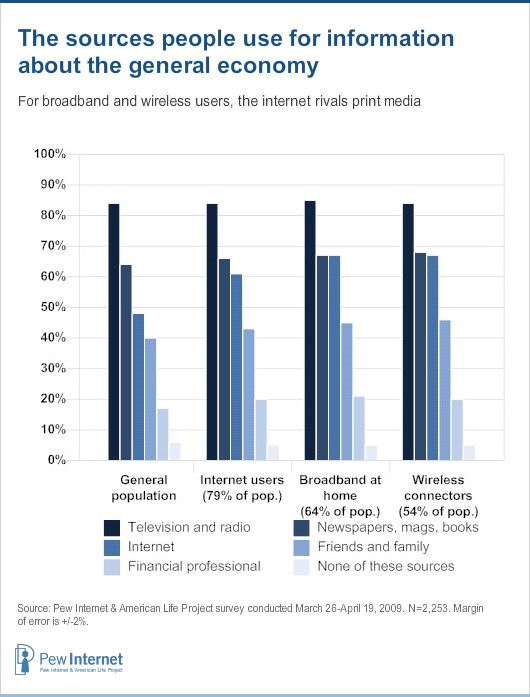
For the general population – internet users and non-users alike – we found that traditional media outlets were even more important to people as they tried to understand the nation’s economic problems than they were in helping people cope with their own financial issues. For all Americans, printed news media, television, and radio were at the top of the list, ahead of the internet, friends and family members, and professionals. At the same time, we found that for the 79% of Americans who are online, the internet rivaled newspapers as a significant source of information, though internet users still cited television and radio as their top sources. For the 63% of Americans who have high-speed broadband connections at home, the internet again was behind broadcast media, but it ranks aside printed media such as newspapers and magazines as a source of information. That was also the case for the 54% of Americans who connect wirelessly.

In the answers to the online survey among volunteer panelists, there is a pervasive sense that people became more and more transfixed over time by the story of the financial storm that was sweeping the nation through 2008. A typical response came from GeorgeAnn Wence:  

I have occasionally monitored the stock market.  As it began to tumble dramatically I took a much more close interest by monitoring every day.  Prior to that, the particular moment for me that caused me to begin to worry about the turn the economy was taking was learning about the shenanigans the financial institutions were up to and how it was destroying some families’ lives…. Now I watch what is happening with the mortgage companies, loan lenders, automakers, etc. worrying about the devaluation my house is undergoing because of this situation. I check throughout each week for what major company/corporation is going bankrupt, being consumed by larger sharks, and dread what might happen to my own financial institution.  I pay closer attention to how rapidly the dollar is devaluing.  I worry about where all this will end, knowing that even when it does it will take a very long time for the American economy to recover.

General economy info sources

Many seekers turned to multiple sources to comprehend the national problem.

Like Wence, many consulted several sources and reaching out to multiple players in their quest for understanding about what had befallen the national economy and the proposals offered to fix it. The average American has turned to 2.6 of the sources for information and advice about the national economy. Non-internet users averaged 1.8 sources, while home broadband users and wireless connectors averaged 2.9 sources.

The pattern of search and chatter aimed at comprehending the national economy mirrored the networking pattern people pursued when they were trying to meet their personal needs on financial matters. These heavily-connected Americans are more likely to have turned to human sources – e.g. friends and family members and professionals – than those who do not have broadband or wireless connections. For instance, 46% of those who connect wirelessly said they have talked to family and friends about their personal financial situation, compared with 26% of those who have no internet connection who have talked to family and friends about the national economy.

The population can be split into four categories of information and advice seekers when it comes to getting information from various sources about the national economy:

  • Non-seekers: 6% of Americans have consulted none of the five specific sources we mentioned. They tend to be senior citizens and those who live in less well-off households. Many do not have internet connections. 
  • Low-level seekers: 15% have consulted one of the sources. There are not many demographically distinguishing traits in this group. This group is somewhat overrepresented in rural areas, and among those living in households earning less than $30,000. It is somewhat oriented to those who have a high-school diploma or did not complete high school. It also tends a bit towards those who have not personally suffered a major economic blow.
  • Medium-level seekers: 55% have consulted two or three of the sources. This group is slightly more urban, and overrepresented by those living in households earning between $50,000 and $75,000.
  • High-level seekers: 25% have consulted four or five of the sources. These omnivores are more likely to have broadband at home and wireless connections. They have notably higher levels of education and household income than other groups. For instance, 40% of those with college degrees have consulted many sources and 41% of those in households above $75,000 in income have done so. And those who have been hit hard by the recession are more likely than those not hit hard to have used four or five sources (29% vs. 20%).  

The 80% of Americans who are either medium- or high-level seekers are also networkers. They consume media, do online searches, and talk to people all in a quest to understand what has befallen the economy.

52% of online economic users have used the internet to try to help them understand the nation’s economic woes.

We asked the 69% of American adults whom we call online economic users whether they had specifically turned to the internet to help them try to understand nation’s economic problems. More than half – 52% – said they had. Those who were the most likely to have done so included online economic users who had full- or part-time jobs, those under age 50, and those with college educations and relatively high household income.

It was striking that there were no notable distinctions between those who had been hard hit by the recession and those who had so avoided the worst in their personal economic lives.  There was a general sense in some of the written responses to our online survey that the internet was important as an antidote to traditional media. For instance, Barbara Ellestad wrote: “I rely on Internet sources of information and news more than traditional sources. I think it’s more complete and not based on 30-second blips of filtered news. I can access many different sources of information on the Internet. If I feel any source is biased – as is the main stream media – I can easily go to another source.”

Mary Ann Remnet described a similar motive in the online survey: “Since we live in a ‘sound bite’ society, it is difficult to grasp what is being talked about. I don’t trust analysts and commentators because their job is to ‘spin’ the news. So if I listen to them, I usually go to actual text of legislation, and see if there is anything i can or need to do to protect myself.  I don’t believe that the legislators protect my interests as much as they protect their careers.”

It was also interesting to note that those who voted for Barack Obama in the last election were more likely than backers of John McCain to use the internet to try to understand the nation’s economic problems (61% vs. 51%).

The quest for understanding and meaning is also a networking process. Online survey respondent Sharon Hockensmith wrote about the way she searches and then seeks to comprehend: “I have a friend who is an economist and I email him with questions and comments since he writes a blog. I have friends whose intellect I admire and we talk and email about financial, economic, and news events. I also listen to commentators on Fox Financial News such as Cramer and those on Fox programs like Opening Bell and Happy Hour. I’ve been listening and talking to them about the automakers bailout and have pretty much decided that bankruptcy would be a better route since it would allow the companies to renegotiate labor and vendor contracts to more sustainable levels.”

34% of online economic users have contributed their own reactions and ideas about the recession on the internet. Their contributions include activities on social network sites and Twitter.

Some 34% of online economic users – about 30% of the online population and 23% of the entire adult population — have contributed content and commentary about the recession online. We calculate the 34% figure by adding up all the online economic users who said “yes” they had done any of the following things:

  • 12% of online economic users say they have tagged or categorized content about the nation’s economic problems.
  • 11% of online economic users say they have shared photo, video, or audio files about economic issues on the internet.
  • 9% of online economic users have posted comments about economic issues on any kind of website such as a financial or news site.
  • 8% of online economic users have used social network sites such as Facebook to contact others about job possibilities. That amounts to 17% of all those who use social network sites.
  • 8% of online economic users have contributed their comments about financial matters to online discussions, listservs or other online discussion forums.
  • 7% of online economic users have contributed comments about the nation’s financial matters on a social network site such as Facebook. That amounts to 15% of those who use social network sites.
  • 7% of online economic users have used social network sites such as Facebook to discuss the possibility that they or someone they know might lose their job. That amounts to 15% of social network site users.
  • 6% of online economic users have contributed such comments on a blog.
  • 5% of online economic users have shared their own stories about their financial experiences on social network sites such as Facebook. That amounts to 9% of all those who use social networking sites.
  • 2% of online economic users have posted comments about the nation’s economic matters using a micro-blogging service such as Twitter. That amounts to 15% of all Twitter users.
  • 2% of online economic users have started or joined a finance-related group on a social network site such as Facebook. That amounts to 4% of all users of social network sites.

This participatory class on economic matters, like many other online groups of participators, is overrepresented in several groups. It is predominantly made up of younger internet users: 40% of online economic users ages 18-29 are participators, compared with 30% of those who are over age 30. It is also more male and more upscale than the general internet population.

A good example of a participator – and influencer – in our online survey is commercial real estate agent Roy Fuchs who has been an active contributor to an extensive group-email discussion that has unfolded over several months:

When I hear something new I first consider the source when I analyze it, then try to place each source or opinion into context.  I have no qualms about passing on a thought to friends, then revising it as I learn more. I spent entirely too much time with a wrench in my hand in high school, 50 years ago, and have retained an interest in the automobile industry ever since.  I remember when GM was the powerhouse of the US auto market.  No more. 

So the auto industry bailout story is particularly riveting. Part of my career has been in finance and strategic planning, so I have the context to understand and evaluate the bailout story.  I have believed from the outset that it should seek a pre-packaged Chapter 11 because its first need is to downsize (fewer dealerships, fewer factories, lower costs for its retirees…), and many stories were to the effect that many contracts were voidable only under the protection of the Court. 

I have also believed from the outset that blaming their problems on an absence of credit is an act of denial and an easy way to avoid responsibility for over 30 years of poor and in-bred management.  As I heard the CEO testify I came to believe that a process that takes a certain amount of control out of hands would also serve the taxpayer/lender better.   The single point I heard argued against bankruptcy was that no one will buy a car from a bankrupt company.  On one hand I was struck by the fact that too many people in this country don’t know the difference between Barack Obama, Saddam Hussein and Osama bin Laden, so how would they begin to understand the difference between Chapter 11 and Chapter 7?

Still, the participators are not necessarily high-tech or highly-specialized experts. They are moved in some way to use the tools they have to share information or spotlight a cause that matters to them. One illustrative story in our online survey came from Iowan Glenn Leach, who is a Catholic Church volunteer focused on social justice issues: “I have large mailing lists and several listservs devoted to social justice, and economics is certainly central to social justice.  I use these tools to pass on information, to receive information, to communicate with other organizations (non-government organizations, faith-based groups, and legislators) to evaluate issues and respond to them in action or advocacy.”

[global positioning]

The impact of the internet

There are any number of ways to assess the impact of the internet during a big, ongoing event like the recession. Our survey attempted to get at some them. The response from the majority of online Americans is that their internet use had not changed much and the things they did online did not have tremendous influence on their beliefs and actions.

For instance: 76% of online economic users say their use of the internet has had no impact on whether to change jobs; 73% say their internet use has had no impact on helping them upgrade their job skills; 56% say they are going online for economic news at about the same frequency as they usually have; and 51% say their online activities have made no difference to their understanding of the nation’s financial crisis.

Still, a notable portion of online economic users – the 69% of adults and 88% of internet users who have gone online for economic-related purposes during the recession – have reported changes in their views and their actions:

        More worried, less confident: Asked whether the things they have learned online have made them more confident or more worried about certain things, more said they were made more anxious than the opposite. That is probably a reflection of the general tenor of public and private conversation about the state of the economy as much as it reflects the tone of online material itself:

  • 39% of online economic users said they were more worried about the stability of banks by what they read online, compared with 5% who said they were more confident. Some 54% said the online information made no difference in their views.
  • 37% of online economic users said they were more worried about the nation’s economic future by what they read online, compared with 10% who said they were more confident. Some 50% said the online information made no difference in their views.
  • 36% of online economic users said they were more worried about their family’s family future by what they read online, compared with 6% who said they were more confident. Some 56% said the online information made no difference in their views.

On a personal level, though, online economic users were not dejected after their online searches about their own ability to make good decisions about their finances and career. Some 17% said they were more confident about their ability after their internet searches and 14% said they were more worried, while 67% said their online searches made no difference to their views.

        Improved understanding: 36% of online economic users say the things they have learned online have improved their understanding of the nation’s financial crisis, compared with 11% who say they are now more confused because of what they have encountered online. Interestingly, those who have been hard hit during the recession are more likely than the unaffected to say internet information has left them more confused (13% vs. 8%) , while those unaffected by the recession are more likely to say their internet searches have improved their understanding (34% vs. 25%). 

    The online economic users who have college educations are more likely than those with high school diplomas to report their internet use has been helpful and those younger than 50 are more likely than older internet users to say the same.

        Going online more often: 31% of online economic users say they have been using the internet more often to get information about the economy in the past year. At the same time, 10% of online economic users say they are going online less. People’s economic circumstances do not appear to be a significant influence on whether they are going online more often or not. Those who rate the overall economic situation as “only fair” or “poor” are more likely than those with positive views to be going online more often (33% vs. 16%). Those who are employed are more likely than those outside the labor market to be checking on things more often (34% vs. 26%). Those who voted for Obama are more likely than those who voted for McCain to be logging on more often for economic updates (41% vs. 29%). And those under age 50 are more likely than older Americans to be logging on more often.

The flow of economic coverage on every channel is so abundant that some respondents cannot avoid near-constant exposure. Here is how one respondent to our qualitative online survey described things: “Usually heard about bailouts from online sources and TV.  Since the flow is so constant, I can’t really recall where I heard it first because it all blurs together — each builds on the other and it circles around and around as each piece or story grows.  Truthfully, I wouldn’t want only one source. I like the different levels of detail and the different perspectives from the different sources.  Also, magazines are good for the BIG picture summaries and analysis at different milestones.  Online gives the cliff notes, but detail comes from paper and TV news series — not the nightly news, but the analysts talking about a subject.”

Some people followed a mixed strategy of paying less attention to their personal finances but more attention to national news. A respondent to our online survey named Eliza explained her reaction this way: “I am hardly monitoring my personal financial situation now at all.  When I get letters in the mail that look like they contain statements from my IRAs and other accounts, I throw them out.  I’m not going to fix it, so why look at it?    I am, however, monitoring the general financial status of the country and world through NYTimes.com and WSJ.com and ABA.com – all of whom email me alerts.”

        Going on alert: 13% of online economic users have signed up to receive updates about general economic news or personal financial issues. Those hard hit by the recession in their job situation or investments are twice as likely to have signed up for alerts as those who have been relatively unscathed (16% vs. 8%). College graduates are more likely than those with high school educations to have arranged for economic alerts; as are those with wireless internet connections compared with those who just have wired internet connections.

About Us, Methodology

About the Pew Research Center’s Internet & American Life Project

The Pew Internet Project is an initiative of the Pew Research Center, a nonprofit “fact tank” that provides information on the issues, attitudes and trends shaping America and the world. The Pew Internet Project explores the impact of the internet on children, families, communities, the work place, schools, health care and civic/political life.  The Project is nonpartisan and takes no position on policy issues. Support for the Project is provided by The Pew Charitable Trusts. More information is available at www.pewresearch.org/pewresearch-org/internet

Methodology

This report is based on the findings of a daily tracking survey on Americans’ use of the Internet. The results in this report are based on data from telephone interviews conducted by Princeton Survey Research International between March 26 to April 19, 2009, among a sample of 2,253 adults, 18 and older.  For results based on the total sample, one can say with 95% confidence that the error attributable to sampling and other random effects is plus or minus 2.4 percentage points.  For results based Internet users (n=1,687), the margin of sampling error is plus or minus 2.7 percentage points.  In addition to sampling error, question wording and practical difficulties in conducting telephone surveys may introduce some error or bias into the findings of opinion polls.

A combination of landline and cellular random digit dial (RDD) samples was used to represent all adults in the continental United States who have access to either a landline or cellular telephone. Both samples were provided by Survey Sampling International, LLC (SSI) according to PSRAI specifications.  Numbers for the landline sample were selected with probabilities in proportion to their share of listed telephone households from active blocks (area code + exchange + two-digit block number) that contained three or more residential directory listings. The cellular sample was not list-assisted, but was drawn through a systematic sampling from dedicated wireless 100-blocks and shared service 100-blocks with no directory-listed landline numbers.

New sample was released daily and was kept in the field for at least five days. The sample was released in replicates, which are representative subsamples of the larger population. This ensures that complete call procedures were followed for the entire sample.  At least 5 attempts were made to complete an interview at sampled telephone number. The calls were staggered over times of day and days of the week to maximize the chances of making contact with a potential respondent. Each number received at least one daytime call in an attempt to find someone available.  For the landline sample, interviewers asked to speak with the youngest male currently at home. If no male was available, interviewers asked to speak with the youngest female at home. This systematic respondent selection technique has been shown to produce samples that closely mirror the population in terms of age and gender.  For the cellular sample, interviews were conducted with the person who answered the phone. Interviewers verified that the person was an adult and in a safe place before administering the survey. Cellular sample respondents were offered a post-paid cash incentive for their participation. All interviews completed on any given day were considered to be the final sample for that day.

Non-response in telephone interviews produces some known biases in survey-derived estimates because participation tends to vary for different subgroups of the population, and these subgroups are likely to vary also on questions of substantive interest. In order to compensate for these known biases, the sample data are weighted in analysis. The demographic weighting parameters are derived from a special analysis of the most recently available Census Bureau’s March 2008 Annual Social and Economic Supplement. This analysis produces population parameters for the demographic characteristics of adults age 18 or older. These parameters are then compared with the sample characteristics to construct sample weights. The weights are derived using an iterative technique that simultaneously balances the distribution of all weighting parameters.

Following is the full disposition of all sampled telephone numbers:

methodology

The disposition reports all of the sampled telephone numbers ever dialed from the original telephone number samples. The response rate estimates the fraction of all eligible respondents in the sample that were ultimately interviewed. At PSRAI it is calculated by taking the product of three component rates:

  • Contact rate – the proportion of working numbers where a request for interview was made
  • Cooperation rate – the proportion of contacted numbers where a consent for interview was at least initially obtained, versus those refused
  • Completion rate – the proportion of initially cooperating and eligible interviews that were completed

Thus the response rate for the landline sample was 20.6 percent. The response rate for the cellular sample was 18.2 percent.