Pew Research Center

FOR RELEASE NOVEMBER 17, 2002

Parents Online

Parents are more wired than non-parents and they are more enthusiastic about technology than non-parents and more likely to use the Web for health information, for their work or training, and for getting religious information.

BY Katherine Allen and Lee Rainie

FOR MEDIA OR OTHER INQUIRIES:

Communications Department
202.419.4372
www.pewresearch.org

RECOMMENDED CITATION

Pew Research Center, November 2002, "Parents Online"

About Pew Research Center

Pew Research Center is a nonpartisan, nonadvocacy fact tank that informs the public about the issues, attitudes and trends shaping the world. It does not take policy positions. The Center conducts public opinion polling, demographic research, computational social science research and other data-driven research. It studies politics and policy; news habits and media; the internet and technology; religion; race and ethnicity; international affairs; social, demographic and economic trends; science; research methodology and data science; and immigration and migration. Pew Research Center is a subsidiary of The Pew Charitable Trusts, its primary funder.

© Pew Research Center 2026

Table of contents

  • About Pew Research Center
  • Parents Online
  • Main Report: Parents Online
  • Part 1: The Online Life of Parents
  • Part 2: Online Children and Families
  • Part 3: The Information Parents Seek Online
  • Part 4: Single Parents
  • Part 5: Mothers and Fathers
  • Part 6: Parents of Younger and Older Children

Parents Online

Parents are more wired than non-parents and they are more enthusiastic about technology than non-parents and more likely to use the Web for health information, for their work or training, and for getting religious information.

In this report, we present a synthesis of several years of findings from our general research on the impact of the Internet on Americans. The material has been gathered from numerous surveys that the Pew Internet & American Life Project conducted with American adults and teenagers.

Parents are more wired

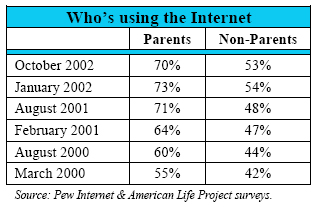
We have consistently found that parents with children under 18 are more likely to have used the Internet than non-parents. (In our surveys, non-parents are those who do not have a minor child living at home.) In our survey from October 7-27, we found that 70% of the U.S. parents with a child under age 18 use the Internet, compared to 53% of non-parents. That means there are almost 45 million online parents in the United States today, and they make up 43% of all U.S. Internet users.1

Our October survey also showed that parents are generally more enthusiastic about technology and less burdened by technological change than non-parents. For instance, parents, whether they use the Internet or not, are more apt than non-parents to say they like all the information that is available today from all kinds of media. Similarly, parents are also more likely than non-parents to say they like computers and technology and to assert that technology tools give them more control over their lives. Parents are also more likely than non-parents to own cell phones, DVD players, and pagers.

One strong incentive for parents to have Internet access is for their children. The vast majority of parents believe that their children need to know about computers and the Internet in order to succeed. Not surprisingly, parents who do not have access are more likely than non-parents to show interest in going online eventually.

Yet, parents are less fervent Internet users than wired non-parents

Parents are less likely than non-parents to use the Internet on a typical day. In a survey in September, we found that 54% of the parents with Internet access were online on an average day, compared with 60% of the non-parents who have Internet access. Parents also go online less frequently than non-parents. In September, 44% of the connected parents said they went online at least once a day from home, compared to 53% of non-parents who have Internet access at home.

In earlier surveys, we found that even when parents go online, they are likely to spend somewhat less time using the Internet on a typical session than non-parents are. For instance, in March 2000 we found that a parent spent an average of 81 minutes online during an average day’s worth of Internet use compared to an average 94 minutes for a non-parent’s sessions. In subsequent surveys we found the gap fluctuated from 7 minutes to 15 minutes, but always favored non-parents.

Parents are more likely to access health, lifestyle-enhancing, and religious information

Online parents show more interest than non-parents in getting health and medical information from the Web. Parents are more likely than non-parents to look at several sites during their searches, but they are less vigilant than non-parents in checking the source and sponsorship of the information. In addition, parents are more likely than non-parents to have used the Internet to gather religious information. Here are some of the other ways parents’ online behavior differs from non-parents:

  • Online parents are more likely than wired non-parents to do research for school or training or research for their jobs.
  • Parents are more likely than non-parents to participate in online banking.
  • Parents are more likely than non-parents to use the Internet to contact a local community group or association, a support group, or a religious organization.
  • Parents are more likely than non-parents to say the Internet played a role in their finding a new place to live, dealing with a medical condition (their own or a loved one’s), and starting a hobby.

A family helper for some

Use of the Internet has hardly revolutionized the activities of parenthood. Online parents generally use the Internet as one of the technology tools that helps them get through their lives – not just as parents, but also as friends, work colleagues, consumers, hobbyists, and generally as information seekers and contributors. The impact of the Internet on life inside their homes is relatively modest. Asked in December 2000 about the impact of Internet use on some of the core activities of family life:

  • 34% of online parents said their use of the Internet improves the way they plan weekend outings and family trips.
  • 27% said it improves the way they shop for birthday and holiday gifts.
  • 26% said it improves the way they spend time with their children.
  • 19% said it improves the way they care for their children’s health.

A life helper for many

In some other surveys, online parents were relatively enthusiastic about the way their Internet use affected their lives. In March 2001, we found:

  • 73% of online parents said their use of the Internet helped them learn new things.
  • 61% said their use of the Internet improved the way they connect with friends.
  • 52% said their use of the Internet improved the way they connect with members of their family.
  • 42% said their use of the Internet improved the way they shop.
  • 41% said their use of the Internet improved the way they get health care information.
  • 41% said their use of the Internet improved their ability to do their jobs.
  • 22% said their use of the Internet improved the way they manage their personal finances.
  • 22% said their use of the Internet improved their ability to find ways to deal with problems in their lives.

Single parents are less Internet-connected than married parents

Our March-May 2002 survey showed that 58% of single parents use the Internet, compared with 71% of married parents. About 6.5 million single parents in the United States go online; about 4 million of these are single mothers. Single parents tend to have less Internet experience than married parents, but they access the Internet about as often as married parents do. Single fathers go online more often than single mothers.

Single parents use the Internet to communicate; married parents use it to research

Single parents are more likely than married parents to take part in Internet activities that revolve around communication, such as instant messaging, chat rooms, and posting to bulletin boards. Married parents are more likely to participate in research-oriented online activities, such as looking for financial and health information.

Mothers are looking for health information; fathers are looking for news and leisure

There are 24 million online mothers and 21 million online fathers in the United States. Mothers tend to be newer to the Internet and to spend less time online. Fathers are more likely to go online from both work and home, and mothers are more likely to go online just from home.

Mothers are more likely than fathers to seek medical, fitness, weight-loss and spiritual information. Fathers are more likely than mothers to look for information about a hobby, visit news and government Web sites, and look for financial information.

Main Report: Parents Online

Introduction

Parents are offered thousands of Web sites offering answers, advice, resources, and products that purportedly relate to them. Among other things, the Internet can help parents find ratings of violence and adult content in television shows, get advice on how to help a child who is afraid of the dark, and link up with other parents of twins or triplets if they have a home with multiple birth children in it.

This report looks at what parents do online and how they say their Internet use affects them. It contains our most recent figures about the size and scope of the online parent population, analysis of more than two years of previously unreleased data about wired parents online, and material we have explored in some of our previous reports. Moreover, it outlines some of the differences in Internet use between parents and non-parents, single parents and married parents, parents of younger children and parents of older children, and mothers and fathers.

A brief overview of the populations

Parents vs. Non-Parents: How the demographics differ (March-May 2002)

For survey and report purposes, we define a “parent” as one who responds yes to the following question, “Are you the parent or guardian of any children under age 18 now living in your household?” Thus, our definition excludes parents of children older than 18, parents of children who do not live in the same household as their children, and – because we generally only survey individuals who are 18 or older – parents who are not yet 18 years old.2

Because we exclude parents of grown children, our parent population is significantly younger than the non-parent population, and much less likely to be retired. Parents also tend to be better educated than non-parents. For instance, in a survey we conducted between March 1 and May 19 this year, we found the demographic breakdown in the table above.

Below, is a breakdown of the single and married parent populations in that March-May sample. Single parents we define as those who are divorced, separated, widowed, or never married.

Our population of single parents is younger and less educated than the married parents we surveyed. These single parents also more likely than married parents to have lower household income and are more likely to be African-American. Women make up more than two-thirds of the single parents group.

Single Parents vs. Married Parents: Looking at the demographics (March-May 2002)

Part 1: The Online Life of Parents

More Parents Go Online and Use Computers

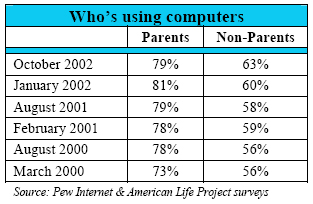
The latest survey by the Pew Internet & American Life Project from October 7-27 shows that parents of minor children at home are considerably more likely than non-parents to use computers and go online.  Some 45 million American parents – 70% of those with children under 18 living at home – use the Internet. Parents make up almost 43% of all the adult users of the Internet in America, even though they make up just 36% of the overall adult population in the United States.

Using the Internet

Pew Internet Project surveys from 2000 through the fall of 2002 consistently show that parents are more likely than non-parents to say they use the Internet. While high levels of Internet adoption correlate with high education and income, we find that after adjusting for these demographic characteristics the reality of having a child living at home still matters when it comes to having Internet access. All other things being equal, people who are parents are more likely to be online than those who are not. Or, put another way, the fact that someone is a parent at least partially explains his or her decision to use the Internet.

Using computers

Some of our previous research suggests some of the reasons that parenthood is a prod for going online. For starters, many parents first use the Internet after their children have done so. It is likely that these children nudge their parents online. Our survey of teens and parents in late 2000 showed that 25% of teenagers had been online longer than their parents. Many of these children who learn to use the Internet at school, from friends, or are self-taught subsequently teach their parents how to use the Internet. In addition, data from our March-May 2002 survey indicate that, of those parents who are not online, 56% said they will probably or definitely go online at some point. This is significantly larger than the 34% of non-parents who said they think they will eventually go online. One strong reason for parents’ enthusiasm about the Internet is that the vast majority believe that it is very important for their children to learn how to use the Internet in order to succeed later in life.

Parents are More Enthusiastic about Technology

In our October 2002 survey, we asked several questions about people’s general attitude towards information and technology and we found, invariably, that parents were more enthusiastic and interested than non-parents. Asked to pick between two statements, one expressing concern about information overload and another expressing appreciation for having so much information to choose from, parents were more likely than non-parents to express appreciation for having information available from so many sources: 74% of parents supported that statement, compared to 64% of non-parents.

Do computers and technology give people more control or less control over their lives?

Similarly, respondents were asked how they felt about computers and technology: 68% said they like technology, compared to 58% of non-parents. Finally, parents were also more likely than non-parents to say that technology gives them more control over their lives.

Parents are Less Frequent, Less Heavy, and Less Experienced Internet Users

For parents, access to the online world does not necessarily translate into heavy Internet use. Comparing online parents and online non-parents, we find that parents are somewhat less likely to be online on any given day, are somewhat less likely to report they use the Internet frequently, and spend somewhat less time online during the periods when they are online. For instance, in a survey in March-May this year, we found that 54% of online parents were online during a typical day, compared to 60% of online non-parents. Asked another question about the frequency of their Internet use, 53% of online non-parents said they go online at least once a day, compared to 44% of online parents who said they use the Internet that frequently. In our survey in March 2000, we found that during an average day parents with Internet access spent 13 fewer minutes online than non-parents. In subsequent surveys we found the gap fluctuated from 7 minutes to 15 minutes, but always favored non-parents.

Parents Are Less Experienced Internet Users

Another important difference between online parents and non-parents is their level of Internet experience. Online non-parents as a group have been online longer. In our March-May 2002 survey, we found that 55% of online non-parents had first gone online more than three years ago, compared with 48% of online parents. Our previous studies show similar trends: in January 2002, 50% of wired non-parents had been using the Internet for more than three years compared with 41% of wired parents.

The Places Where Parents Access the Internet

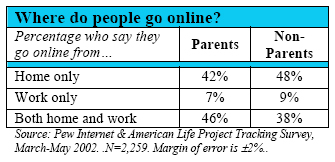
Online parents and non-parents reveal different patterns in where they access the Internet. Online parents are more likely than non-parents to have access at both home and work, while non-parents are more likely to have access only at home. This is not an unexpected difference. The age demographics of each group can explain different types of access. Since a large percentage of non-parents are relatively young or retired, this helps explain why more non-parents have Internet access only at home. Parents are in their core working years and are likely to have access on the job.

We have found that growing numbers of Internet users also access the Internet from places other than work or home. About 14% of parents say they go online from a place other than home or work, compared to 23% of online non-parents who say they go online from another spot. Wired parents are more likely than non-parents to use a library to go online; wired non-parents are more likely to go online from school. Both groups are equally likely to use a neighbor’s or a friend’s computer to access the Internet.

Where do people go online?

Part 2: Online Children and Families

Introduction

In a December 2000 survey of 754 parents and an equal number of children in their homes between the ages of 12 and 17, we found that Internet use is changing some of the ways teens interact with their friends. We also saw that the Internet is introducing new dynamics into family life. In their overall judgment, parents think that the Internet’s role in their children’s lives is beneficial. More than half of parents of online youth (55%) believe the Net is generally a good thing for their children and only 6% believe it is bad for their children. Some 38% do not think it has had an effect on their child one way or the other.

Parents do have concerns about the amount of time that their children spend online and about the people and material they will encounter in cyberspace. These worries prompt many parents to impose rules on Internet use, to monitor their children’s online activities, and to install software to prevent their children from accessing objectionable material.

In a quarter of families who have Internet access, a child has mastered a technology before the parents. In fact, teens often take the lead in getting the family online and teaching their parents how to use the Internet.

Teens are more Net savvy

Teens Know the Net Better Than Their Parents

Nearly two-thirds of youth and parents agree that the children know more about the Internet than their parents do. More online boys than girls say that they know the Internet better than their parents. Similarly, older teens are more likely than younger teens to say their knowledge surpasses their parents. This view is also especially prevalent among online teens from families with modest incomes and those who live in single-parent homes.

The more recently a parent has gone online, the more likely it is that the teenager believes he knows more about the Internet than his parents. Fully 70% of online teens whose parents went online in the last year say they know more, compared to 53% of online teens whose parents have been online for more than three years.

When it comes to parents, more online fathers than mothers say they know more about the Internet than their children; more college-educated parents say this than those without college degrees.

How Parents and Youth Learn about the Net

Forty percent of online teens report teaching themselves how to use email and the Internet. And they are not just teaching themselves – often, they often go on to teach their families. “At the time this was all beginning, no one else in our household beside myself knew how to do anything on any computer,” reported a 17-year-old boy in an online discussion group we conducted in 2001. “I had to write out instructions and tape them to sides of the monitor so that they’d know how to turn the computer on.” Another 30% of teens report learning it from their parents. Only 5% learned from a class. “I learned the basics of the Internet (browsing, searching, E-Mail) at a summer course at school, but I taught myself the rest (downloading programs, instant messaging, etc.),” said a girl, 15, in the online discussion group.

Teens with the most knowledgeable parents (those who have been online longer than 3 years) were the most likely to be taught by their parents (43%). Those teens whose parents don’t go online mainly learned how to use the Internet from friends (33%) or by teaching themselves (39%). Girls are more likely to have learned from their parents than boys, and boys are more likely to report being self-taught. A shift back to more traditional parent-child roles may be occurring, though, because a plurality of younger teens, regardless of gender, reported learning to use the Internet from their parents. Among 12- to 14-year-olds, 41% were taught by parents, compared to 22% of older teens who said they were taught by their parents. More than half (51%) of teens 15 to 17 report learning to use the Internet on their own.

Who taught the teens

Some of the differences between how teens of different ages learned to use the Internet can be explained by the pattern of Internet adoption in the U.S. About three years ago, Americans, both adults and teens started going online in droves.

Often older teens with more interest and leisure time mastered the new technology and taught it to friends and family. Youth who are aged 12 through 14 are more likely to have parents who went online before they did. Many of these parents had Internet access at work or school, and thus were already familiar enough with the technology, even if they did not have it at home, to teach their children how to use it.

Teens say they go online for the first time for a variety of reasons. “My dad got the Internet at home because he wanted us all to ‘get with the times’ so to speak,” said one 16-year-old boy in our online discussion group. Other parents decide to go online because they felt it was vital to the education of the children in the family. “I got it because I needed it for school and because it keeps me out of trouble,” wrote a 17-year-old girl. And some families got the Internet because the children really wanted it. “My dad decided to get the net because I begged and begged him for it,” said a 14-year-old girl also in the online discussion group.

The Internet’s Impact on Relationships with Friends and Family

The conflicts surrounding time use as well as content accessed on Internet-connected computers may be part of the reason why teens do not think the Internet is helping their relationships with their families. In fact, most teens (61%) do not think that the Internet helps their relationships with their families at all. Almost two-thirds of online teens (64%) express a generalized concern that young people’s use of the Internet takes away time they would spend with their families. Some 69% of girls say that and 59% of boys agree.

Effect on relationship with families

When asked whether the Internet has improved how they spend time with their children, 79% of parents say it has not helped at all or has only helped a “little bit.” The frequency with which both parent and child go online is closely associated with the level of improvement they report. Parents who go online every day and parents of children who go online daily both report a greater sense of improvement in how they spend time with their children. 

Parents and their children are evenly split on the question of whether the Net improves their children’s relationships with their friends. Almost half of each generation (48%) believe Internet use is tied to improved friendships. “When I did not have any classes with my best friend the other year, we emailed each other every day and told each other the details of our day,” said a 17-year-old girl in the online discussion group. “That brought us much closer together. That was when our friendship became stronger.” The teens who are the most active Internet users are the most likely to express these positive feelings. In addition, fathers are more likely to report positive feelings than mothers, and the parents who use the Internet the most are the most enthusiastic about the beneficial impact of the Internet on their children’s relationship with friends.

The Internet’s Impact on Family Activities

In most online homes, parents do not think the Internet has affected intrafamily relations much. Still, some believe that the Internet has contributed at least somewhat to enjoyable family activities. More than a third (34%) of parents say the Internet has helped them plan weekend outings; 27% say it has helped them shop for birthday and holiday gifts for family members; 26% say it has improved the way they spend time with their children; and 19% say it has improved the way they care for their children’s health.

There are sharp differences in the views held by online veterans compared to newbies on all these issues. The longer a parent has been online, the more likely it is for that parent to have quite positive things to say about the impact of the Internet on family life. 

Experience makes a difference

In our parents and teens survey in December 2000 we also saw that that 28% of online parents use email to communicate with their children’s teachers and 20% of parents email the parents of their children’s friends. In addition, our holiday season survey in 2001 found that 27% of parents with Internet access look for celebration-related material for the holidays, such as crafts and recipes. Some 21% of non-parents say they had done this.

Part 3: The Information Parents Seek Online

Introduction

Wired parents and non-parents participate in many Internet activities in roughly the same proportions. These include using email, searching for financial information, accessing online news, participating in auctions and online, and doing general browsing. However, we have found in our analysis of the most common online activities that certain behaviors characterize online parents as a group and differentiate them from non-parents. These include looking for religious, weight loss/fitness, and health and medical information, but they also include banking online and doing research for a job or for school. Meanwhile, some activities appeal more to non-parents than parents, such as instant messaging and visiting chat rooms.

How parents and non-parents compare

Dr. Mom on the Web

The search for health information online is one of the most important activities we have studied and it is something more women do online than men. Similarly, online parents are somewhat more likely than wired non-parents to seek health information. Not surprisingly, then, mothers are among the most fervent online health seekers. In our March-May survey 72% of online mothers said they had gone online to look for health or medical information. That compares to 57% of wired fathers who said they had done so.

Online mothers are often searching for information related to their children. Some 71% of online mom health seekers say they have gotten information online related to their role as a caregiver, according to our survey of health seekers in August 2001. Asked in that poll about their most recent e-health search, 34% of online mom health seekers said they were searching on behalf of their child. Another 27% were looking on behalf of their husbands and 16% were looking for a parent. These health seeker mothers were most often looking for information about what certain illness symptoms could mean or the kind of medication or treatment that certain illnesses require.

Parents are More Anxious about the Privacy of Online Health Information

Because parents must tend to their children’s health in addition to their own, they show a greater interest than non-parents in Web sites that provide health information. Our surveys show that a consistently larger percentage of parents visit health-related Web sites than non-parents. Among other things parents are more likely than non-parents to say it is important to them to be able to get e-health information at any hour. Parents are also more likely than non-parents to say the Internet has improved the way they get health information. In addition, our parents and teen survey in 2000 found that 19% of online parents say the Net had improved the way they care for their children’s health.

Health Information Online: What Parents Are Concerned About

Wired parents are more rigorous than non-parents in their online health searches in some respects. First, parents tend to visit more sites and spend more time on a search. Second, they take a more deliberative approach to search engine results. They are more likely to read the explanations of a search engine result instead of just starting at the top and working down. And third, they are more likely to talk to their doctor about what they find online.

Yet, at the same time parents are less likely than non-parents to check for the source of the information on the Web sites they consult, check on the timeliness of the information that is posted, and check on the sponsor of the Web sites they visit.

One other difference is worth noting. Parents usually expressed more fear than non-parents about the privacy implications of their e-health searches. In August 2000, we asked survey respondents several questions related to online health. Parents were more likely than non-parents to state that they were “very concerned” that the health information they were finding was unreliable, that a health Web site might sell or give away information about what they had done online, or that their employers, insurance companies, or simply other people would discover what health sites they had visited.

The result is a jumble of contradictory – and somewhat unexplainable – behaviors: more health searching corresponds with less scrutiny of Web sites, but more follow up with other Web sites and medical professionals and more concern about who might be watching.

Parents and Privacy

These parental concerns about the privacy of online health information extend to the broader sphere on online privacy. As a rule, parents are even more sensitive than non-parents to privacy concerns. For instance, in a survey in the summer of 2000, we found that 84% of online parents think Internet companies should have to ask for permission to use any personal information that they collect, compared to 76% of non-parents.

Parents with Internet access whose children also go online are much more nervous about computer viruses, perhaps out of concern that their children will unwittingly infect the family machine. Sixty-two percent of these wired parents worry about downloading a virus to their computer, compared to 50% of non-parents.

Parents who are online are also less friendly and more wary of other people than non-parents online. Only 20% of parents have responded to an email from someone they didn’t know, compared to 30% of non-parents. Similarly, online parents are also less likely to make friends online: 20% of wired parents said they had made online friends, compared to 28% of non-parents who have Internet access.

Parents and Online Religious Information

The Internet has become an important resource for those seeking religious information and those who are members of a faith community. Survey data reveal that this is especially true of parents. According to our October 2002 survey, 31% of parents have gotten religious information online, compared to 23% of non-parents who have done that. Religion is more of a factor in parents’ lives than non-parents’. A greater proportion of parents belong to a church than non-parents.

Looking for religion

Our August 2001 survey of those who get religious information online showed that parents are more likely than non-parents to make prayer requests via email, to download religious games, and to download religious music.

The parents who get religious material online have a relatively positive view of the overall impact of the Internet on people’s spiritual lives. Some 44% of the online religious seekers say they think the Internet has had a positive influence on how people practice their religion. These parents are also somewhat more likely than non-parents to say that online spiritual information encourages religious tolerance, though they also worry that it is too easy for fringe groups to use the Internet to hurt people. Parents are also more likely than non-parents to say that there is too much sacrilegious material online.

There are other indications in our data that show that parents are relatively more interested than non-parents in online spiritual material. For instance, a January 2001 survey showed that 24% of online parents had used the Internet to get in contact with or get information from a religious group or organization, which is somewhat higher than the 18% of online non-parents who said they had done this.

Parents, the Internet, and Major Life Moments

Our January 2002 survey asked respondents whether or not their use of the Internet had affected any major life decisions they had made. Parents were more likely than non-parents to say that the Internet had played a role in finding a new place to live, dealing with their own medical condition or the medical condition of a loved one, and starting a hobby. The figures are:

  • 72% of the online parents who had started a new hobby in the past two years said the Internet played at least some modest role in their new interest. About 62% of online non-parents who had recently started hobbies said the Internet played a role.
  • 65% of the online parents who said that they had dealt with a major illness in the past two years said the Internet had played a role in their coping with the illness. Some 53% of online non-parents who had been seriously ill said the Internet played a role.
  • 63% of the online parents who had helped another person cope with a serious illness in the past two years said the Internet played a role in their helping another cope with the illness. Some 54% of the wired non-parents who helped another with a serious medical situation said the Internet played a role.
  • 42% of the online parents who had found a new place to live in the past two years said the Internet played a role in their finding their housing. Some 31% of the wired non-parents who found housing recently said the Internet played a role.

It was also evident that online parents who had gotten significant training for their jobs in the past two years were almost twice as likely as wired non-parents to say that their use of the Internet played a crucial role in their getting that training.

Overall, parents with Internet access were much more likely than non-parents to report that the Internet played some role in a variety of important recent events in their lives.

How Parents Participate in Online Communities

In January 2001, we studied how the Internet is used for helping people connect to organizations and groups to which they belong – and also to see how they use the Internet to connect to new groups. We found that 32% of online parents have used the Internet to get information or contact a local community group, compared to 27% of non-parents. Not surprisingly, online parents are more likely than non-parents to have used the Web to get information about local schools, youth group activities like scouting, and community sports leagues.

Generally, parents seem more aware than non-parents about the places they can go online near where they live. Some 59% of parents say they know of a place in their community where Internet access is publicly available, while 47% of non-parents say they know of such public access.

The time strains on parents’ lives also showed up in this survey. Even though many online parents say they use the Internet to stay in touch with groups and organizations, a significant number of parents reported that they mostly lurked in those groups, rather than actively participated in them. Some 57% of wired parents said they only read the messages posted to the Web sites of their key organizations and 43% said they posted material on bulletin boards. That is different from wired non-parents: 40% said they had only read the bulletin board of a key organization in their life and 59% said they read and posted material to the bulletin boards of the Web sites of their key organizations.

Parents are Less Likely to Say Email Helps Them Maintain Relationships

In March 2001, we studied people’s attitudes, concerns, and behaviors related to email use. These data show that online parents were less likely than wired non-parents to report that their use of email helps them with their key relationships. In addition, non-parents were more likely to report that email has helped their ability to meet new people.

Despite the fact that online parents were less likely to say that email was very valuable to their relationships, they were more likely than non-parents to report that they had used email for serious purposes. The March 2001 survey asked respondents to name the one family member he or she emailed the most. Wired parents were more likely than non-parents to reply that they emailed this person about something they were upset or worried about, and were also more likely to email this person for advice. Non-parents were more likely to email their family members to tell them about their jobs or other activities.

Parents see less value in email

Part 4: Single Parents

Single Parents Lag Behind Married Parents in Computer and Internet Use

Note: All numbers and percentages in this section regarding single parents were derived from combined data from Pew Internet & American Life tracking surveys from 2001 to 2002, unless otherwise noted. Combining data sets was necessary to amass a large enough sample to probe meaningful and statistically relevant differences between single parents and married parents. The combined survey samples contain interviews with 18,017 adults (age 18 and older), of whom 6,161 are parents of children under 18. In that sample, 1,501 are single parents. The interviews were conducted in several surveys taken at various points between February 1, 2001 and May 15, 2002.

The Pew Internet & American Life Project estimates that there are 6.5 million single parents of children 18 and younger in the United States who use the Internet. About 4 million of these are single mothers and 2.5 million are single fathers.

Internet access

There are significant differences between parents who are single and parents from two-parent households. Single parents are less likely to use a computer or the Internet than are married parents. Some 69% of single parents use computers, compared to 80% of married parents. In addition, 58% of single parents use the Internet, compared with 71% of married parents. This technological divide is most likely attributable to the lower average household income of a single parent family, which makes the price of a computer and monthly Internet service a larger financial burden.

Of the parents who do go online, married parents tend to be the more experienced Internet users. Single parents are twice as likely as married parents to be Internet newbies – those who have gotten online in the past six months. At the other end of the experience scale, 33% of online single parents have been Internet users for more than 3 years, compared to 43% of online married parents have used the Internet for this long.

This difference in technology adoption between single-parent households and two-parent households is also evident when it comes to children’s access to computers and the Internet. Our surveys have found that youth between the ages of 12 and 17 are less likely to be Internet users if they live in a single-parent household. According to our March-May 2002 survey, 62% of single parents with children this age said at least one of their children in this age group goes online. That compares to 73% of married parents said at least one of their children 12 to 17 years old goes online.

Single Fathers Are Frequent Internet Users

Single parents who use the Internet go online with about the same frequency as online married parents: 35% of both groups go online several times a day. Among single online parents, single fathers are more frequent users of the Internet than single mothers, with 40% of single fathers reporting that they use the Internet several times a day. Only 33% of single mothers said they went online this frequently.

Single and married parents differ somewhat in the places where they have Internet access. Married parents are more likely to have Internet access at both work and home. Single parents are twice as likely as married parents to have access only at work.

Single Parents Communicate Online, Married Parents do Research

In our survey of 754 parents and their teenagers in December 2000 we found that children who live in single-parent households were more likely than children in two-parent homes to go online for fun, visit chat rooms, and play or download games online. Children of married parents were more likely than those in single-parent homes to search for news and to buy products online. It might be the case that this difference might indicate that the computer plays the role of a babysitter or companion more often for children of single parents.

This also reflects parental patterns: Single parents are more likely than adults in two-parent homes to go to chat rooms and go online for fun then their married counterparts. This might be linked to the fact that single parents tend to be younger than married parents. It also might reflect the way that some Web sites cater to single parents. For example, many Web sites that advertise themselves as resources for single parents have a readily accessible link to an online dating service and a chat room.

Different directions: Single and Married Parents Vary in What They Do on the Internet

Another difference between the two groups is that single parents are more likely to go online “just for fun or to pass the time” than married parents. Pew Internet surveys from August 2001 through January 2002 indicate that 70% of online single parents go online just for fun, compared to 60% of married parents. And single parents are more likely than married parents to play online games.

On the other hand, married parents with Internet access are more likely to buy products and seek financial information. This financial focus might be partially explained by the higher average household income of married parents. With more money in their budgets, they are more prone to spend and manage it online.

Married parents are slightly more likely than single parents to look for health and medical information online. And, as mentioned earlier, mothers – both single and married – are more likely to look for health information than fathers. Married mothers show the most interest in health Web sites; single fathers show the least.

Looking for health information online

Part 5: Mothers and Fathers

Moms Look for Medical Information, Dads Look for News and Leisure

There are approximately 24 million mothers and 21 million fathers who use the Internet. Many of the patterns of their online use can be attributed to their gender or age, more so than their parental status. Still, there are some points to make about mothers and fathers: They are equally likely to go online, but a larger percentage of online parents with minor children living at home are female. Mothers tend to be newer to the Internet – only 45% of wired mothers have been online longer than three years as opposed to 55% of wired fathers. Fathers are more likely to go online from both work and home; mothers are more likely to go online just from home. And fathers go online more frequently than mothers; 41% of online fathers go online several times a day, compared with 34% of online mothers.

When they go online, mothers and fathers often do different things. Mothers are more likely than virtually anyone else to have looked for online health information. Fathers are more likely than mothers to read the news online, visit a government Web site, buy or sell stocks, or look for information about a particular person. Fathers are also more likely to look for financial information or information about a hobby. Mothers are more likely than fathers to look for religious information and fitness and weight loss information.

Moms and Dads Online: Percent Who Participate in Internet Activities

Part 6: Parents of Younger and Older Children

Parents of Younger and Older Children and the Difference Experience Makes

In order to analyze the difference between parents of young children and parents of teenagers, we divided the parent population into two subgroups: parents of children 11 years or younger, and parents of children 12 to 17 years old. Parents with children in both age groups were put into the latter group because they share the same level of parental experience as others who have raised children into their teens. In addition, the fact that there is at least one teen in the home probably affects the concerns and behaviors of those parents regardless of the ages of other children.

Parents of younger children are more likely to use the Internet than parents of older children; as of May 2002, 81% of parents with children 11 and younger are online and 75% of parents with children 12 to 17 years of age are online. Parents of younger children have also been online longer: 51% of parents of younger children have been online more than 3 years; 45% of parents of older children have been online this long. However, between the two groups, parents of older children go online more frequently than parents of younger children. This might be attributable to the time it takes to care for small children.

These two groups of parents also do different things when they go online. Online parents of young children are more likely to read the news online, buy a product online, and go online just for fun than online parents of older children. On the other hand, those online parents with children 12 to 17 are more likely to visit government Web sites and look for health information.

Parents of Younger and Older Children: Percent Who Participate in Online Activities