Pew Research Center

FOR RELEASE FEBRUARY 17, 2026

What Makes People Proud of Their Country?

From diversity in Indonesia to food in France: People in 25 countries share what makes them proud, in their own words

BY Laura Silver, Laura Clancy, Maria Smerkovich, Sneha Gubbala, William Miner, Julia Armeli, Andrew Prozorovsky, John Carlo Mandapat and Janakee Chavda

FOR MEDIA OR OTHER INQUIRIES:

Communications Department
202.419.4372
www.pewresearch.org

RECOMMENDED CITATION

Pew Research Center, February 2026, "What Makes People Proud of Their Country?"

About Pew Research Center

Pew Research Center is a nonpartisan, nonadvocacy fact tank that informs the public about the issues, attitudes and trends shaping the world. It does not take policy positions. The Center conducts public opinion polling, demographic research, computational social science research and other data-driven research. It studies politics and policy; news habits and media; the internet and technology; religion; race and ethnicity; international affairs; social, demographic and economic trends; science; research methodology and data science; and immigration and migration. Pew Research Center is a subsidiary of The Pew Charitable Trusts, its primary funder.

© Pew Research Center 2026

About this research

This Pew Research Center report looks at what makes people feel proud of their country. We asked an open-ended question allowing people in 25 countries to share, in their own words, what makes them proud.  

Why did we do this?

Pew Research Center does research to help the public, media and decision-makers understand important topics. This project adds context to the Center’s long-standing work on national identity and national pride, in the U.S. and around the world. 

Learn more about Pew Research Center.  

How did we do this?

We surveyed 33,486 people across 25 countries: Argentina, Australia, Brazil, Canada, France, Germany, Greece, Hungary, India, Indonesia, Israel, Italy, Japan, Kenya, Mexico, the Netherlands, Nigeria, Poland, South Africa, South Korea, Spain, Sweden, Turkey, the United Kingdom and the United States. For more on how we conducted the survey in each country, read Appendix A.

Responses to the open-ended question were recorded verbatim and professionally translated to English. Researchers then developed a codebook and coded each response. We are reporting the percentage of respondents in each country who mentioned each topic. Because people are often less likely to answer open-ended questions and because we coded 28 different topics, the percentages are sometimes fairly low. For more on the coding process or the codebook itself, read Appendix B or Appendix C, respectively.

Here is the survey question used for this report, with findings by topic. For a full, ordered list of topics by country, refer to the detailed tables in Appendix E.

Open-ended responses highlighted in the text of this report were chosen to represent the key themes researchers identified. They have been edited for clarity and, in some cases, shortened for brevity.

Table of contents

  • About Pew Research Center
  • About this research
  • What Makes People Proud of Their Country?
  • Where in the world are people proud of their country’s culture and lifestyle?
  • Where in the world are people proud of their nation’s politics and economy, and why?
  • Where in the world are people proud of their nation’s people and diversity?
  • Where, and why, people aren’t proud of their country
  • Acknowledgments
  • Appendix A: Survey methodology
  • Appendix B: Coding methodology
  • Appendix C: Codebook
  • Appendix D: Political categorization
  • Appendix E: Detailed tables

What Makes People Proud of Their Country?

From diversity in Indonesia to food in France: People in 25 countries share what makes them proud, in their own words

We asked more than 30,000 people in 25 countries, “What makes you feel proud of your country?” They spoke broadly about the people and diversity in their country, their government and economy, and their culture and lifestyle. To learn what people said in their own words, explore each country below.

Select a country:
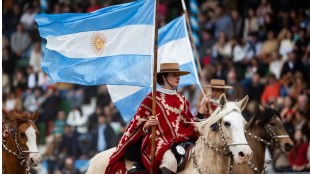
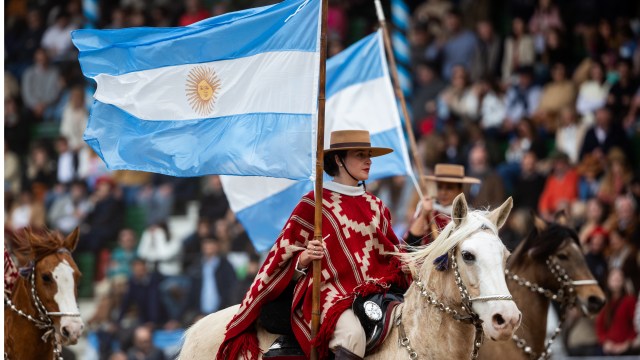
A woman on horseback holds an Argentine flag as part of the Expo Rural in July 2024 in Buenos Aires. (Tomas Cuesta/Getty Images)

Argentines are particularly proud of the people in their country. They note their “solidarity” and how “supportive and empathetic” people are. And while pride in the citizenry is common in many of the countries surveyed, the share who bring it up in Argentina (35%) is notably high.

Argentines also emphasize being born in Argentina or having Argentine ancestry (15%), as well as the country’s arts and culture (14%). One 85-year-old man says he is proud simply “because I was born here and I love it.” Compared with other countries, relatively few mention something negative when asked about what makes them proud.
“The quality of the people. I have lived in other countries and they do not compare to us. We are very human, we have a lot of warmth.”

– Woman, 44, Argentina

“The citizens, because they are a big block of unity, the people are very supportive. We are a country very rich in land and very prosperous. Many people immigrate here because they feel it is a sociable country to grow in.”

– Man, 27, Argentina

“All the people, our culture, our history, strength and that great things were created: scientists, art, language, history and music.”

– Man, 48, Argentina

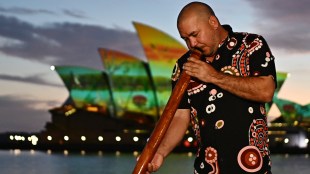
Musician Cameron Leon performs with a didgeridoo near Sydney Opera House for Australia Day on Jan. 26, 2025. (Ayush Kumar/AFP via Getty Images)

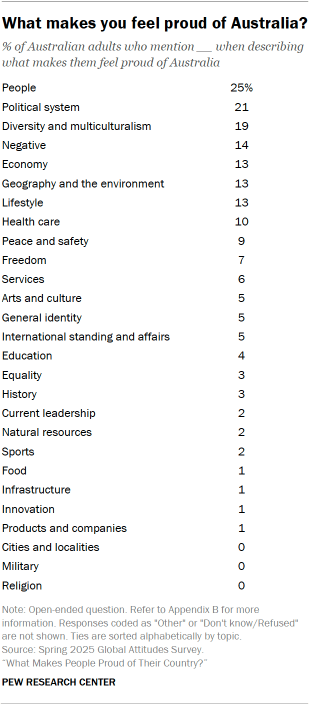
Australians are most proud of the people of their country. A quarter (25%) emphasize the “mateship” they feel with other Australians as well as how they “lend a hand” in times of need, such as natural disasters. They are also proud of their country’s political system and governance (21%) and its diversity (19%). People mention the contributions and “rich cultural history” of the Aboriginal and Indigenous people, as well as how welcoming the country is to immigrants and to all nationalities and religions.

Australians are also among the most likely to mention the country’s lifestyle (13%) as a source of pride, characterized by a “laid-back” attitude.
“We are a welcoming and tolerant country. We have a high standard of living. In my part of Australia, we respect everyone’s right to live their life as they want; a farmer or a retail worker is just as important and appreciated as someone in politics or a doctor or a billionaire. We, as a nation, love our relaxed and easygoing natures.”

– Woman, 70, Australia

“Our laid-back attitude, not having the churches in government, our freedom, having good relationships with other countries, slowly acknowledging our First Nations people, the cleanliness of our country, the thought and planning of our cities, and in emergencies and natural disasters, everyone helps and looks out for each other.”

– Man, 50, Australia

“I feel proud that we live in a wealthy country with a multitude of different cultures. We have great opportunities regarding work and education and generally don’t discriminate about age, race, religion or class. Most Australians I encounter have an outwardly easygoing, honest, open-minded and personable nature.”

– Woman, 30, Australia

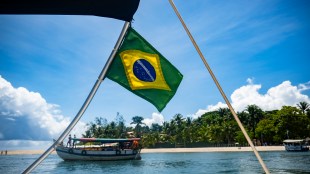
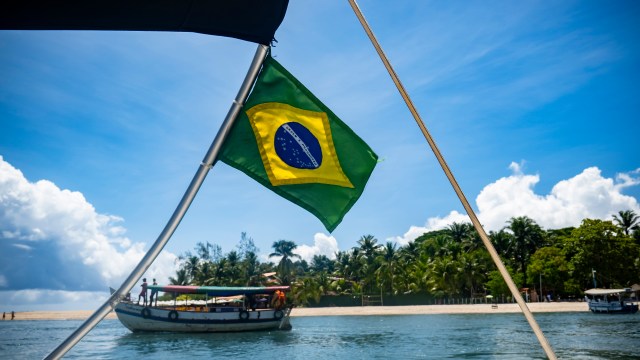
A Brazilian flag hangs on a boat off the island of Boipeba in Brazil. (Emmanuele Contini/NurPhoto via Getty Images)

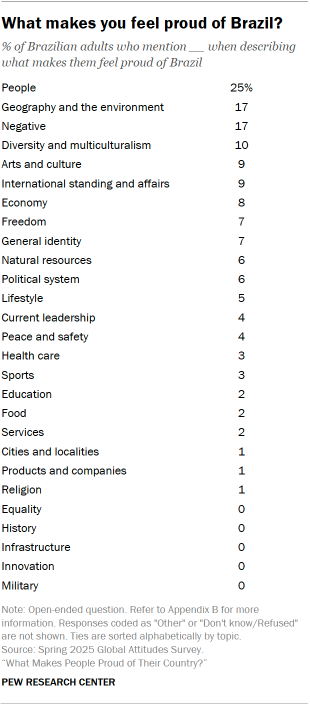
A quarter of Brazilians (25%) say they are proud of the people in their country, describing them as welcoming and accepting, as well as highlighting the positive social climate in Brazil.

Brazilians also mention their country’s landscape and geography at a fairly high rate (17%), saying it has “postcard-worthy places.” They name the Amazon, the beaches of Santa Catarina and Pantanal as things that make them proud, and they even mention the lack of natural disasters.

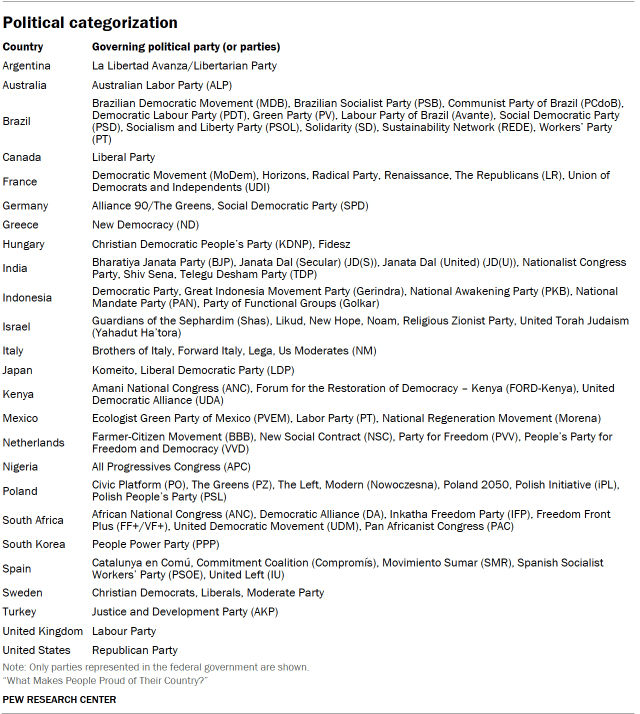
Nearly one-in-five also mention something negative when asked what makes them proud (17%) – and this is about three times as common among those who do not identify with a party in the government as among those who do (21% vs. 8%).
“A land that welcomes all peoples and nations, that fights for democracy. It is a very rich country, with many natural beauties, but it becomes weakened and lacks global recognition due to widespread corruption.”

– Woman, 59, Brazil

“We don’t have natural disasters like they do abroad – such as tsunamis, hurricanes, earthquakes. We have a lot of natural wealth that we export to other countries, such as coffee and açai.”

– Woman, 25, Brazil

“Brazilians are welcoming by nature. They are helpful, warm and go out of their way to serve and help others.”

– Man, 63, Brazil

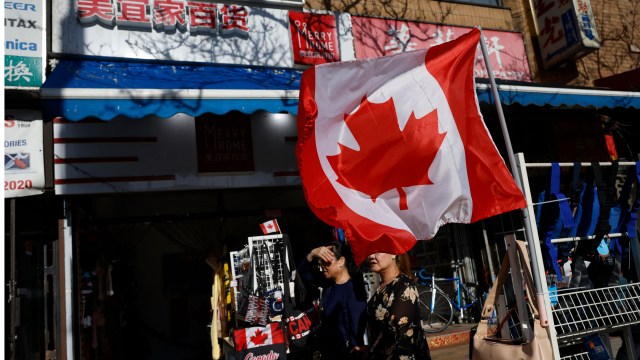
People walk through downtown Toronto’s Chinatown in April 2023. (Cole Burston/AFP via Getty Images)

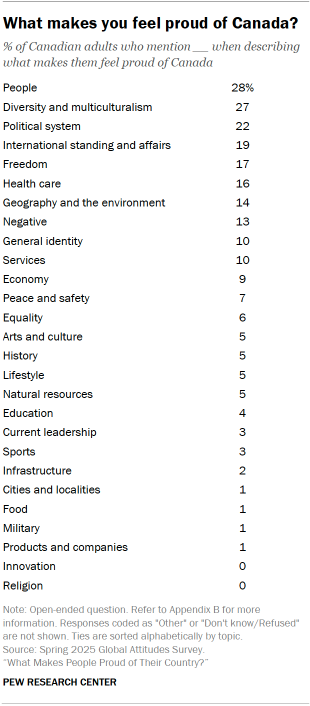
Canadians most commonly say they are proud of the people in their country (28%) as well as its diversity and multiculturalism (27%). They often emphasize the tolerant, kind and welcoming nature of Canada and describe it as a multicultural “mosaic.”

Canadians are also more likely to name their international standing as a source of pride (19%) than people in any other country surveyed, particularly emphasizing its independence from the United States by saying things like “we are NOT American.” (The survey was fielded in spring 2025, when U.S. President Donald Trump made several statements calling Canada the “51st state.”) They also highlight the country’s important role in global missions. One man said, “We have always listened to the rest of the world and tried to be a peacekeeper.”

Canadians are also quite proud of their country’s political system (22%), its freedoms (17%) and its “free health care” (16%).
“Our democracy works well. We have respect for all nationalities [and] all sexualities. We treat everyone with respect, all nationalities. We [aren’t] perfect but we are a country that tries to do the right thing. We are standing up to the United States. I am very proud of my country.”

– Woman, 66, Canada

“A government that reflects the will of the people …. Our publicly funded health care that will take care of everyone without putting them in significant amount of debt, strong social safety net, beautiful landscape, and my family ties are in Canada.”

– Man, 35, Canada

“I am proud that we are always willing to stand beside and behind our allies, that we are more interested in peacekeeping than war, that when our neighbors and allies needed us we do not hesitate, and that we never instigate conflict. And hockey.”

– Woman, 47, Canada

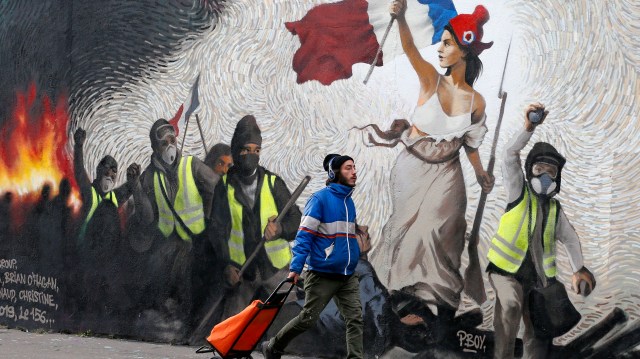
A pedestrian walks past artist Pascal Boyart’s mural “Liberty Leading the People 2019” in Paris in January 2019. (Chesnot/Getty Images)

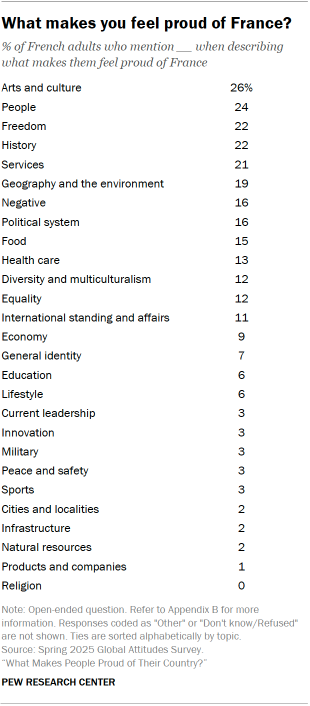
About a quarter of French adults (26%) say they are proud of their arts and culture – one man dubbing it “culture with a capital C” – and praise the know-how of artists, like the “craftsmen and women who rebuilt [the] Notre Dame” cathedral. France stands out as one of the countries where people are most likely to express pride in their food (15%), mentioning “French cuisine” and their ability to “enjoy good wine and cheese.”

The country’s people (24%), history (22%) and the services available to the French public (21%) are also key sources of national pride. So is the country’s natural beauty (19%), such as its “sea, mountains and countryside.”

The national motto – “Liberty, Equality, Fraternity” – is another thing the French take pride in. About two-in-ten (22%) are proud of the freedom in their country, including the freedom of expression that French people enjoy, or their “ability to complain.”

“I’m proud of our history, what we represent on the international stage, and our health care system, even if it’s not perfect. [It is] a beautiful country with a lot of diversity. Great artists and craftsmen [with] recognized know-how.”

– Woman, 53, France

“Its history, its heritage, its culture. Let France be the land of light. Let it be a breeding ground for great minds. The country, that is to say its territory, its landscape. The beauty of the country.”

– Woman, 74, France

“The spirit of the Enlightenment and all that comes from it – science, culture, progress. The prestige of the schools and all the scientific spirit that emanates from them. The diversity of culture, landscapes, heritage and agriculture. The richness of the regions and French values: liberty, fraternity, etc.”

– Man, 45, France

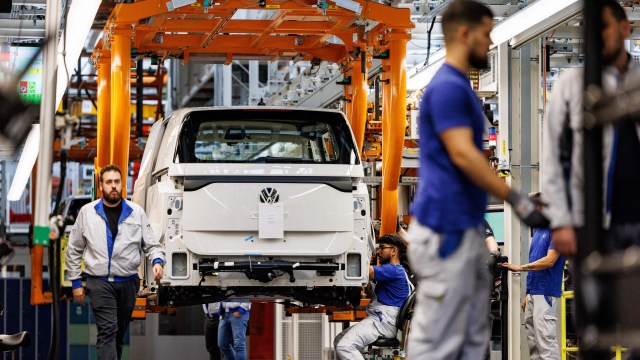
Mechanics assemble an ID. Buzz all-electric minivan at the Volkswagen plant in Hanover, Germany, in June 2022. (Axel Heimken/AFP via Getty Images)

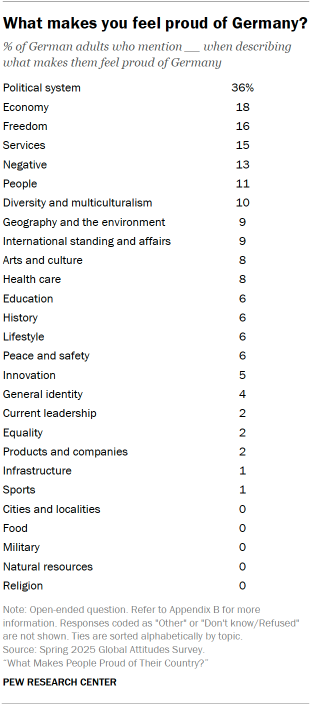
Germans are most likely to say their democracy and the federal system of government (36%) make them proud. In fact, Germany stands out as one of only a few countries where the political system is the top source of national pride.

Relative to most other countries, Germans are proud of their economy (18%), praising its strength and stability. Many are also proud of the freedom they enjoy in their country (16%), like “freedom of expression” and the right to “move freely.” Some specifically mention the services provided by Germany (15%), including their social system, as something that makes them proud.
“The nature of democracy and the social market economy, inclusive community, health insurance, long-term care insurance, pension insurance, infrastructure and quality, German engineering.”

– Man, 35, Germany

“I am proud that democracy still works well in Germany. That Germany deals with its history responsibly, that there is an awareness of history in Germany, that Germany is a strong economic location. And what is still very important in Germany is the awareness of a diversity of cultures and other things.”

– Man, 67, Germany

“I think we have a strong economy. I think we are doing a lot right with the asylum policy, we have a very stable social health system, and also press freedom and freedom of expression.”

– Woman, 42, Germany

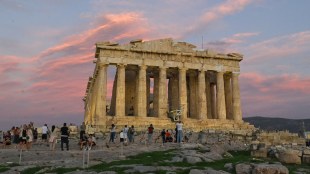
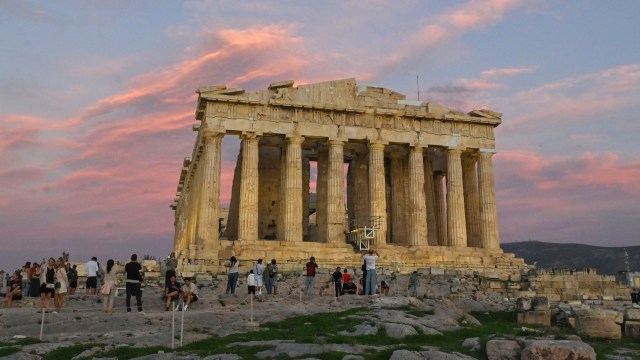
Tourists enjoy sunset outside the Parthenon at the Acropolis in Athens after scaffolding was removed in October 2025. (Milos Bicanski/Getty Images)

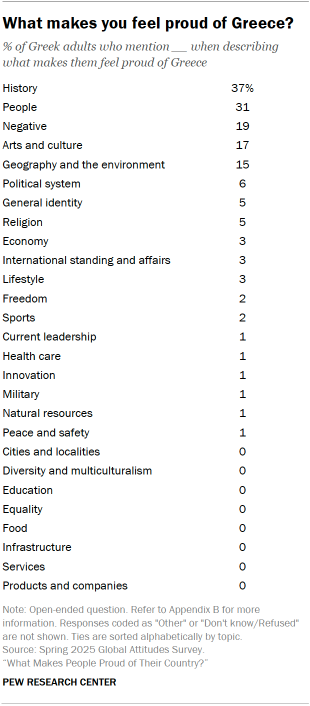
Greeks are most proud of their history (37%), often boasting about their “ancient civilization” as well as “the wars of our ancestors,” including the Greek War of Independence and World War II. Indeed, Greece stands out as the country most likely to mention history as a source of pride.

Greeks are also proud of their people (31%), describing them as “hospitable and warm.” Many also express pride in those who participated in protests about the government’s handling of a tragic train crash (protests on the second anniversary of the crash were taking place during our survey).

Greeks are also fairly likely to name the geography and natural environment (15%) as a source of pride. While many mention the country’s national beauty and geographical location, some simply are proud of “the sun and the sea.” However, 19% are not proud at all or share some criticism of their country.

“The breadth and quality of the country’s history, the complexity of the people’s minds and the adaptability of the average Greek to adversity.”

– Man, 65, Greece

“The only thing I’m proud of is our ancient ancestors. The modern Greeks have achieved nothing.”

– Woman, 60, Greece

“Mainly about the quality of the Greeks, in the sense of character and ancient civilization. Everywhere I have been, everyone recognizes our civilization and the Greek culture.”

– Woman, 50, Greece

Hungarian children hold up Rubik’s Cubes during a flash mob celebrating the 50th anniversary of Hungarian architect Erno Rubik’s invention, in Budapest on June 12, 2024. (Ferenc Isza/AFP via Getty Images)

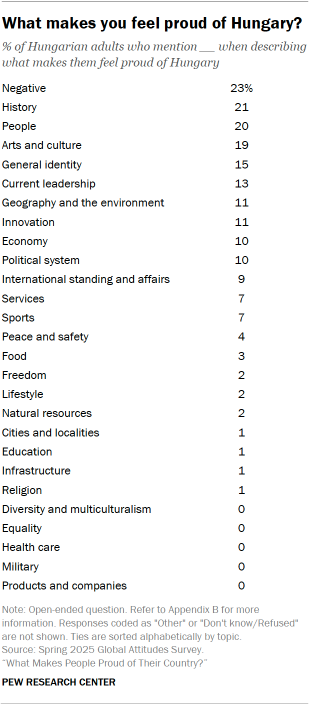
Hungarians are proud of their history (21%) and people (20%). Still, they are equally likely to say they are not proud of Hungary (23%) and share their reasons for that when asked what makes them proud. Hungary stands out as one of only a few countries where negative responses are as common as the most popular sources of pride.

Hungarians are also among the most likely of the countries surveyed to emphasize their current leadership (13%) as a source of pride. People mention Prime Minister Viktor Orban’s economic policies, saying he “supports young people and pensioners alike,” while others reference his strongman stance within the European Union and his policies against immigration.

Notably, pride in current leadership is clustered among those who identify with parties in Orban’s coalition, relative to those who do not (33% vs. 3%). And negative responses are much more common among nonsupporters than supporters (30% vs. 8%).

The country’s history of innovation is also a source of pride for Hungarians (11%), much more than most other countries. Several respondents highlight the country’s “many Nobel Prize winners,” especially given its size, as well as “world-famous scientists” and inventions such as the Rubik’s Cube.
“I am proud of the leader of Hungary, who stands up for Hungary, for Hungarian people, for the economy in every way. I’m proud of the Nobel Prize winners, athletes, sports facilities and the investments that are paving the way for the future. Of maintaining good relations with neighboring countries.”

– Man, 72, Hungary

“I’m proud of the country because I was born here, my parents lived here, they brought me up well, they taught me to work, and the nature is very beautiful in the country; there are nice people, but more and more people are becoming bitter, who see their life as hopeless because of their situation and therefore prefer to leave our country. There are people in my family who have had to go abroad to survive, to get on in life.”

– Woman, 62, Hungary

“A thousand-year-old Christian nation. In my opinion, with a stable sense of identity. It has a lot of inventors, scientists and very highly educated people. And last but not least, Olympic athletes, sportsmen and women.”

– Man, 36, Hungary

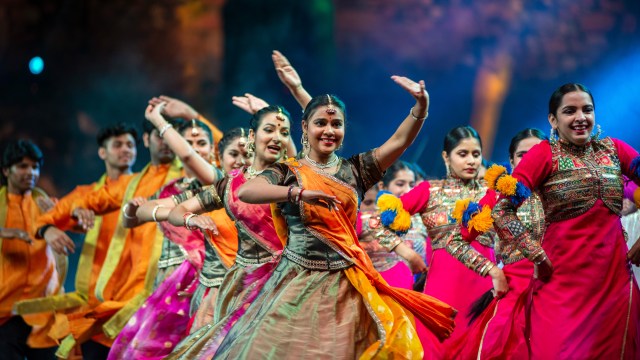
Kathak dancers perform in New Delhi in February 2022 for a celebration of India’s 75 years of independence. (Pradeep Gaur/SOPA Images/LightRocket via Getty Images)

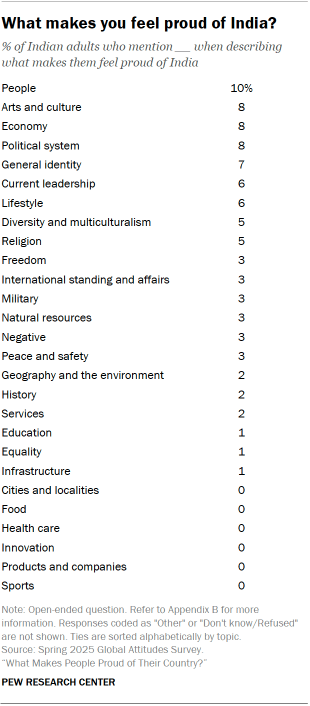
Indians are proud of their country’s political system (8%) and the economy (8%), as well as their country’s current leadership (6%), with some specifically mentioning Prime Minister Narendra Modi and the Bharatiya Janata Party (BJP). Many also highlight India’s “good economic development” as a point of pride. People are also proud of India being an agricultural country and a “land of villages.”

Indians also emphasize their pride in the Indian people (10%), the country’s arts and culture (8%), their own Indian heritage (7%), the lifestyle in the country (6%) and the country’s diversity and multiculturalism (5%). Respondents point to how “people from different communities live together in harmony” – often with direct mentions of this, including people of different religions, castes and languages coexisting.
“The government is good, the BJP government is good. [They are doing the right thing], giving employment, providing electricity and water 24 hours a day …. [There is] money for farmers coming directly to the bank under digital India.”

– Man, 35, India

“India is our country, it is a strong country. All castes have equal rights to express their views, there is democracy, political parties participate in all the festivals of the country.”

– Man, 24, India

“Our India is a golden bird, which we are very proud of, and it is also an agricultural country, which we are very proud of.”

– Woman, 50, India

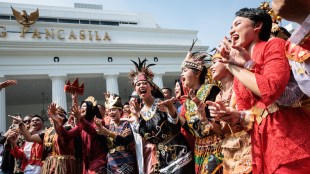
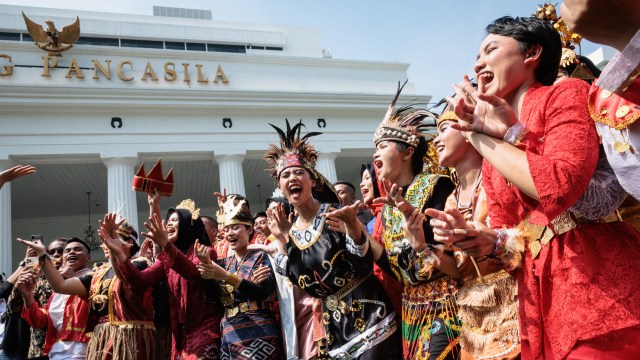
Performers celebrate Pancasila Day, a holiday honoring Indonesia’s national identity and unity, in Jakarta on June 2, 2025. (Yasuyoshi Chiba/AFP via Getty Images)

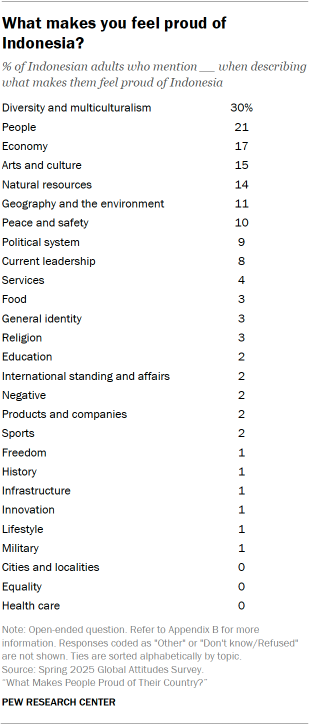
Indonesians are most proud of their country’s diversity and multiculturalism (30%), and Indonesia is one of just a few surveyed countries where this is a top source of pride. People highlight the various tribes, local languages, races and religions that characterize Indonesia. This extends to the “abundance” of arts and the cultural diversity that makes 15% of Indonesians proud. They also share pride in the Indonesian people (21%), including how they live in harmony.

Indonesians are also proud of their natural resources (14%), more so than in most other countries surveyed. They emphasize the abundance of “fertile land” for agriculture, spices and palm oil, among other natural resources. The economy – especially its recent and ongoing development – is another common source of pride for Indonesians (17%). 
“Indonesia has a lot of diversity, cultural diversity. It has many agricultural products from various regions such as cloves, nutmeg, cinnamon and palm oil.”

– Woman, 18, Indonesia

“A country rich in interesting islands for tourist destinations but still lacking in management. Indonesian people are friendly. Food in each region is different and has many varieties. Food that is rich in spices … for example rendang, semur, yellow rice and even jengkol.”

– Woman 32, Indonesia

“The citizens are very good, friendly, do not hurt each other. The family system is very good, helping each other. Tolerance is very high. A very strong family system, good natural resources.”

– Woman, 34, Indonesia

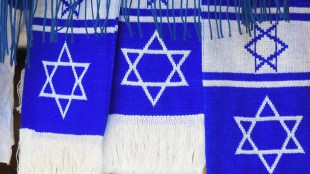
Knit scarfs bearing the Star of David and Israel’s national colors for sale in Jerusalem’s Old City in 2020. (Artur Widak/NurPhoto via Getty Images)

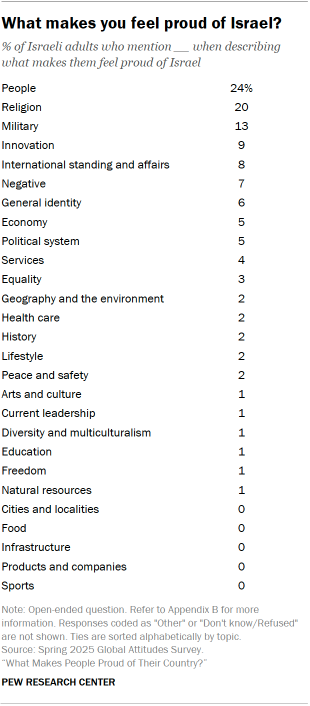
Israelis are proud of their people (24%), as well as the religious nature of their state (20%). Religion comes up as a source of national pride in Israel more than in any other country surveyed, with many mentions of “the chosen people” and references to Israel as “the Holy Land” or “the promised land of the Jewish people.”

Israelis are also among the most likely to say they are proud of their country’s military (13%) and innovations (9%). They frequently mention the Israel Defense Forces (IDF), their country’s “brave warriors” or specific military actions in its most recent conflicts. Israelis also point to their country’s high-tech industry and advancements in military technology, as well as scientists and Nobel Prize winners from Israel, as sources of national pride.

“The Jewish national home serves as a spiritual pride, elevation and light for the whole world with an exemplary army.”

– Man, 69, Israel

“We are the chosen people and see that Israel is number one in developments and inventions.”

– Woman, 20, Israel

“The mobilization of the Jewish people at this time when there is a major immigration of Jews to the land of Israel. This shows the moral and ethical strength of the Jewish people in the world.”

– Woman, 63, Israel

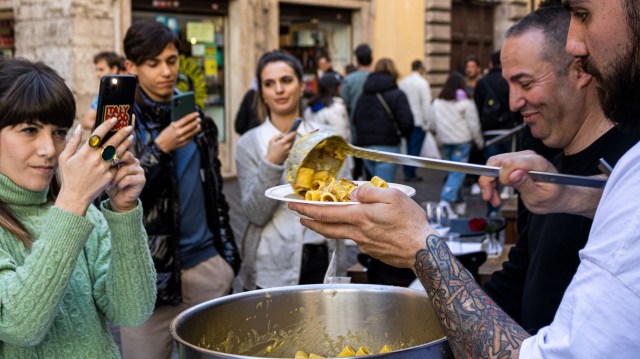
Online influencer Matteo Di Cola dishes up free plates of pasta alla carbonara on April 6, 2023, in Rome as part of National Carbonara Day. (Stringer/AFP via Getty Images)

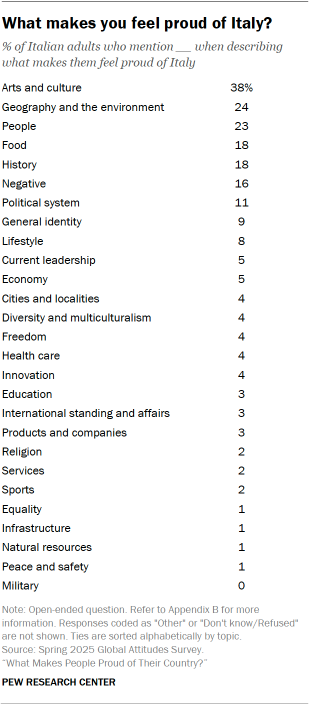
Italians are particularly proud of their arts and culture (38%). They mention “beautiful architecture” as well as the legacy of the Renaissance and their “artistic heritage.” They are also proud of their history (18%), calling Italy an “ancient country” and expressing their admiration for figures like Leonardo da Vinci and Galileo.

Italians are also among the most likely to say they are proud of their country’s food (18%), with one naming “tortellini, Parmigiano-Reggiano, Chianti wine and humble people.”

Many Italians express pride in their geography (24%) and praise the variety of Italian landscapes, “from the spectacular Alps to the wonderful sea.” A similar share (23%) are proud of their fellow Italians.

“What makes me proud is ancient art, beautiful architecture, music, painting, and general cultural goods and climate.”

– Man, 77, Italy

“Being Italian. We are great workers, cultural history, important sociopolitical history. Welcoming and humble people.”

– Woman, 56, Italy

“Our ability to solve problems with few resources, our style, the made-in-Italy, our food industry, our wines, in general our ideas … even the metal mechanics industry. … The fact is we have brands such as Ferrari.”

– Man, 61, Italy

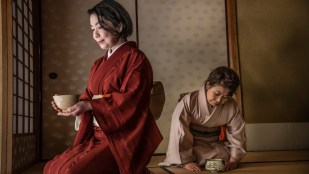
Women participate in a traditional Japanese tea ceremony at Daishoin Temple on the island of Miyajima. (Karen Kasmauski/Design Pics Editorial/Universal Images Group via Getty Images)

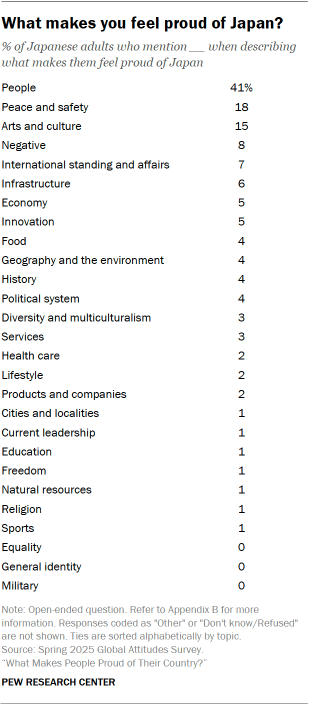
In Japan, people are most proud of the Japanese people themselves (41%). They cite people as a source of pride more than any other country surveyed, often focusing on how Japanese people are “serious,” “hardworking,” “respectful,” “modest” and “sincere,” among other positive attributes. People also emphasize the dexterity and ingenuity of the people, as well as “the traditional craft culture of artisans.” Pride in the arts and culture of Japan is relatively common (15%).

Japanese adults also emphasize peace and safety (18%) as a source of pride more than people in most other countries. They are proud that Japan is “peaceful” and that they “renounce war,” both domestically and on the international stage.
“Low crime rate and good public safety. Good manners. Infrastructure is well maintained. The norms of daily life have been established through education. Caring for others and hospitality. Compared to other countries, economic disparity is low.”

– Woman, 71, Japan

“The traditional craftsmanship and technical manufacturing of Japan from long ago are wonderful. I am proud of the Japanese people’s sense of compassion and empathy toward others.”

– Woman, 55, Japan

“The Japanese people are hardworking. Their economy is doing well, and they are making efforts to provide assistance and support to the rest of the world.”

– Man, 86, Japan

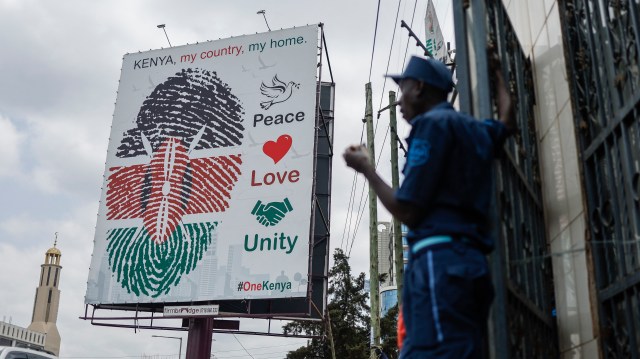
A billboard in Nairobi, Kenya, in August 2024. (Simon Maina/AFP via Getty Images)

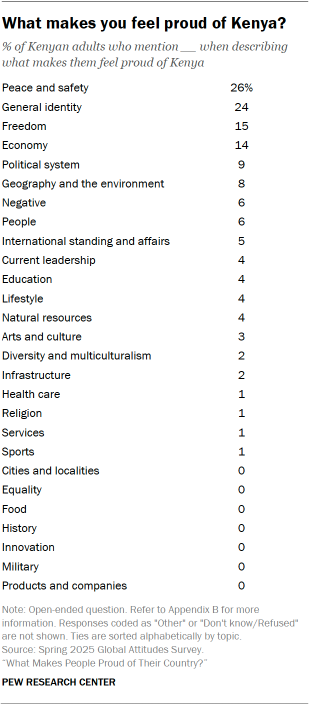
Peace and safety is one of the things that makes Kenyans most proud of their country (26%). They say Kenya has little conflict, particularly compared with other countries, and regularly mention “peace and love” or how “peaceful” Kenya is as things that make them proud. Kenya stands out as one of two countries where peace and safety is among the top sources of pride.

Kenyans are also relatively proud of simply being born in Kenya or being Kenyan (24%). Some also highlight the country’s freedom (15%) and the economy (14%) as sources of pride, and few mention anything negative.

“Living in Kenya, you live freely. There are other countries that have conflicts, but in Kenya there is none. You have freedom to move anywhere. There is no fraud.”

– Man, 52, Kenya

“Kenya is a peaceful country and Kenya has good infrastructure. Kenya attracts tourists from foreign countries.”

– Man, 27, Kenya

“In my country I have freedom for everything. Freedom to worship, freedom to do business and freedom to study…. Peace is OK.”

– Woman, 62, Kenya

Women wear traditional costumes during the Afro-Mestizo Carnival in the Mexican town of Alto Tio Diego on Feb. 11, 2024. (Hector Quintanar/Getty Images)

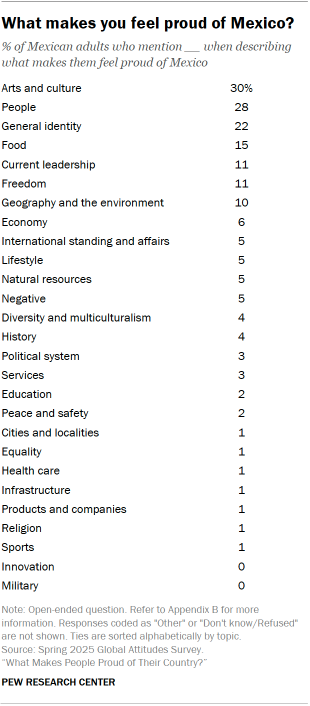
Mexicans are proud of their country’s arts and culture (30%) – emphasizing their “customs and traditions” more than many other countries surveyed. They are also among the countries most likely to mention pride in their food and cuisine (15%).

Mexicans are also particularly proud of the Mexican people (28%). Many are also proud to have been born in Mexico (22%), describing their Mexican “roots” and heritage.

Mexicans are also among the most likely to mention their current leadership as a source of pride (11%). Many mention both the current president, Claudia Sheinbaum, as well as former President Andrés Manuel López Obrador, both of the left-leaning Morena party.
“Very much its culture. The people, how we are with everyone, because we are very empathetic. The food. That we support each other, for example, if a tire went flat in the street. We support each other.”

– Man, 23, Mexico

“We are a country with a lot of freedom, with a culture, roots, tradition and a very united people.”

– Man, 55, Mexico

“Culture. In general, that we have a lot of diversity, both cultural and biodiversity, Mexican cuisine, the way we are the society in general.”

– Woman, 33, Mexico

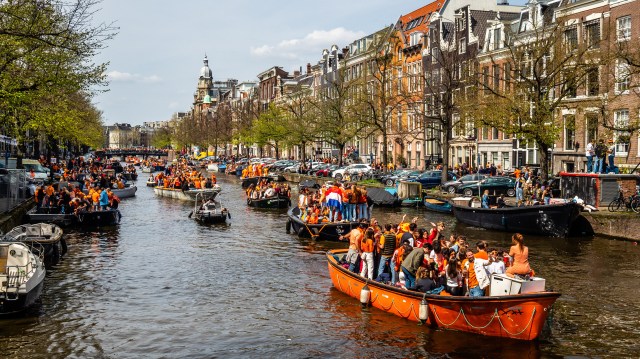
People celebrate on boats sailing along Amsterdam’s canals for King’s Day on April 27, 2023. (Ana Fernandez/SOPA Images/LightRocket via Getty Images)

Dutch people are particularly proud of the freedoms they enjoy (24%), their economy (21%) and their political system (21%). Many point out that despite its small size, the Netherlands is “functioning well” economically and politically. They also praise its “large degree of freedom of speech.” The Netherlands is one of only a few countries where freedom and the economy are top sources of national pride.

The Dutch are also among the most likely to say they are proud of their country’s infrastructure – often marveling at their roads and management of the Dutch waterways.
“[The] Netherlands [is] doing well economically, democracy is functioning well and we let one another be free. Good trade spirit. Good that Dutch people donate to good causes. They are technically and structurally strong when it comes to water. They excel in sports.”

– Woman, 70, Netherlands

“Everything is pretty well organized in a small country. Most people can apply for benefits, good roads and well maintained.”

– Man, 18, Netherlands

“Our diversity; I think that’s very important. We have our affairs in order. We have rules that ensure that society runs smoothly. We are a democratic country with a multiparty system. We have good health care and good education. We are a prosperous country. Freedom of speech is paramount here.”

– Woman, 58, Netherlands

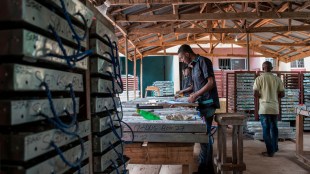
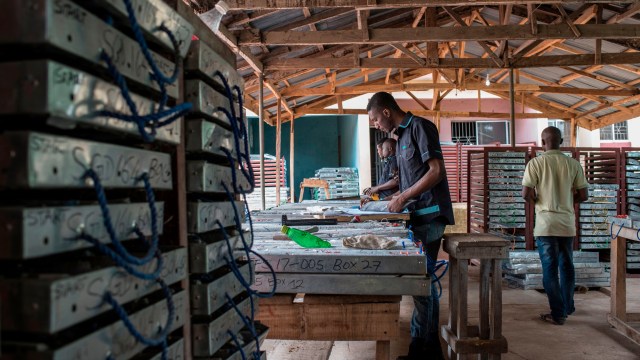
Geologists process samples from a mineral survey at the Segilola Gold Project, Nigeria’s first large-scale gold mine, in 2018. (Stefan Heunis/AFP via Getty Images)

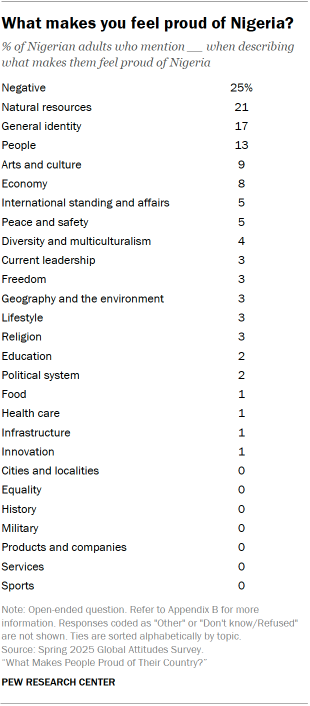
Nigerians are quite proud of their country’s natural resources (21%) – mentioning this at a higher rate than people in any other country surveyed. Most focus on Nigerian “crude oil,” gas and minerals, and also praise the “fertile soil” for agriculture.

Nigerians are also among the most likely to mention something they are not proud of (25%). Many of these negative responses focus on “bad leaders” and the “bad economy.” Nigerians who support the governing All Progressives Congress party (APC) are about twice as likely to be proud of the economy than nonsupporters (14% vs. 7%), while those who do not support the APC are about twice as likely to mention something negative (29% vs. 13%).
“Nigeria is a rich land, endowed with a lot of resources. The problem is our leaders who mismanage the resources.”

– Man, 31, Nigeria

“We have wealth within the country, and we have more peace of mind and enjoyment of life than some other countries, even though our leaders do not care about the affairs of the poor.”

– Woman, 18, Nigeria

“It’s my country, my father’s land [and] the way we farm is easy. We have our rainy season on time and we can cultivate any crop on our land.”

– Man, 19, Nigeria

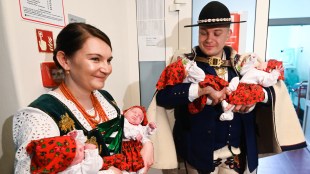
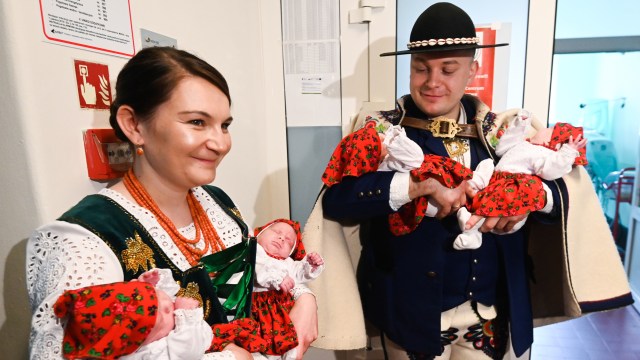
Parents of quadruplets pose with their children at University Hospital in Krakow, Poland, in April 2024. (Jakub Porzycki/Anadolu via Getty Images)

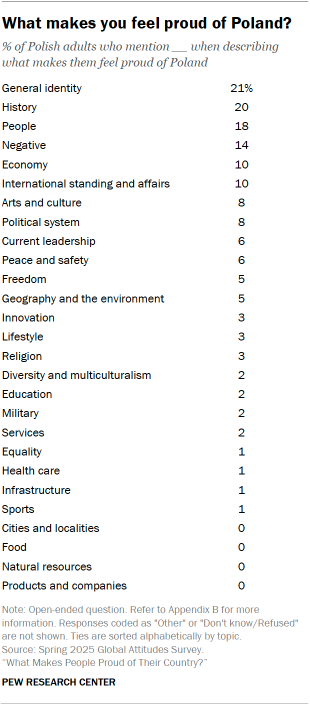
Poles are proud of their heritage – being Polish, being born in Poland, or having Polish ancestry (21%). Many also mention the country’s history (20%), making Poland one of a few countries where history is a top source of pride. Some Poles specifically say they are proud of their “fight for independence” and democracy, with some even mentioning “emerging from communism.”

Poles are also proud of the people in their country (18%), praising their patriotism, diligence and hard work. One-in-ten are also proud of Poland’s role in international affairs (10%), highlighting the country’s support for Ukraine and membership in the EU and NATO.
“That I was born here, I live here, I have family here, my roots are here. I’m proud of how our ancestors fought.”

– Man, 44, Poland

“The fact that I am a Pole. Poland took part in various battles, and Poles were always the first and did not refuse to help.”

– Man, 79, Poland

“That despite its difficult history it regained its independence [and] joined the EU after the fall of communism.”

– Woman, 40, Poland

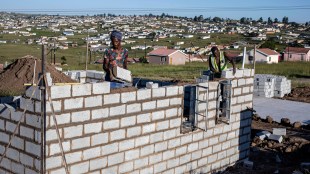
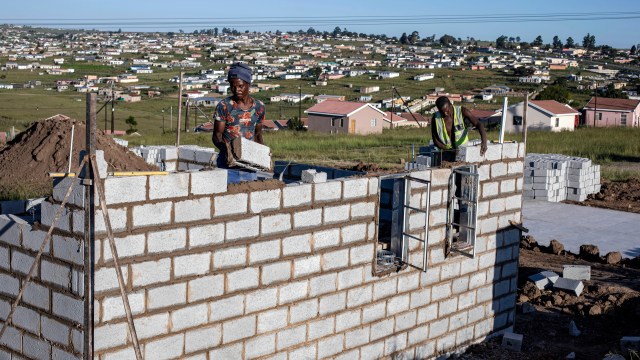
Construction workers build government-funded houses for low-income residents outside Mthatha, South Africa, in February 2024. (Per-Anders Pettersson/Getty Images)

South Africans are proud of their country’s services (24%), such as housing, “social grants,” police and pensions – and mention these more often than people in most other countries. Many are also proud of their “outstanding” education (13%), praising the fact that “children go to school for free.” The country’s freedoms (11%) are another source of pride, as is the economy (14%), specifically the fact that the government “gives out jobs.”

Still, South Africans quite often say they are not proud (19%). People who aren’t proud of South Africa often talk about economic struggles, namely the fact that even with government assistance, there is a “lack of employment.”
“It is a country that is well-suited for us. It fights for us. It builds schools for us. Children don’t pay school fees anymore. There are clinics and home affairs.”

– Woman, 71, South Africa

“It does not have apartheid, no one is discriminated. It helps older women and disabled children with grants, electricity and water without rates, health care for free, and rights.”

– Woman, 24, South Africa

“We have democracy. Things are better than during apartheid. [The] government helps us with social grants and jobs.”

– Man, 54, South Africa

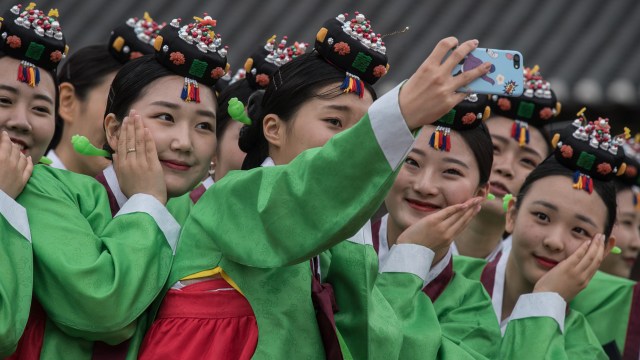
South Korean students pose for a selfie following a traditional coming-of-age ceremony in Seoul in 2017. (Ed Jones/AFP via Getty Images)

South Koreans are most proud of the people in their country (28%). They praise the “strong national character” of the Korean people and the “diligent and sincere workforce.”

Some are proud of the country’s political system (15%) and its economy (13%), saying South Korea is “a country that has achieved democracy and economic development.” Others mention South Korean arts and culture (12%), also known as “K-culture,” which includes things like K-pop and the national alphabet (Hangul). Still, 15% list things they are not proud of or say they are not proud of anything.

South Korea stands out as one of the countries where people are most likely to mention a specific product or industry that makes them proud, often highlighting Samsung or semiconductors.
“Outstanding intellectual ability, manufacturing-centered powerhouse, righteous solidarity.”

– Woman, 56, South Korea

“The fact that we are a democratic country that has joined the ranks of advanced countries.”

– Man, 28, South Korea

“Although it is a small country, it exports Samsung’s electronics, steel, Hyundai’s automobiles, and nuclear power plants to the world.”

– Man, 47, South Korea

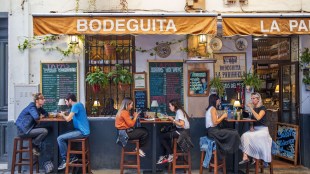
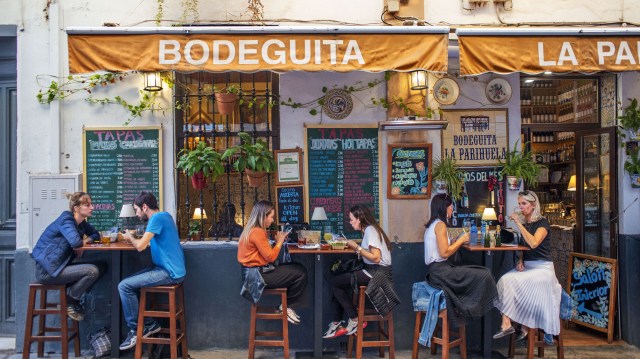
Locals enjoy food at a tapas bar in Seville, Spain. (Sergi Reboredo/VWPics/Universal Images Group via Getty Images)

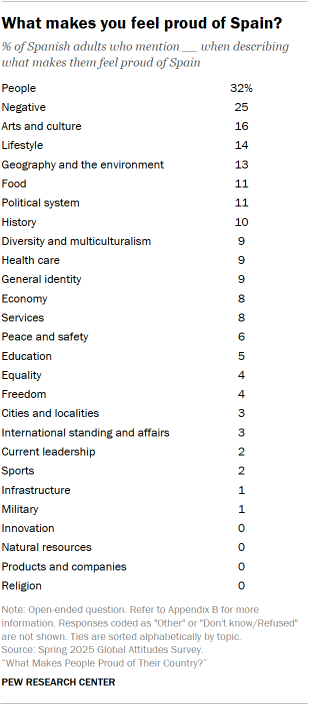
Spaniards are most proud of the people of their country (32%). They mention the solidarity among the public, as well as how “hardworking” and “welcoming” people can be. They are also more likely to mention the lifestyle in their country as a point of pride (14%) and praise the “Spanish way of being” than people in nearly all other countries.

Spaniards also mention things they are not proud of fairly often (25%), highlighting dissatisfaction with politicians and the governance of the country. Pride in the country’s arts and culture (16%) as well as its “good climate” and geography (13%) is also fairly common.
“I am very proud of the way of life, the environment, the people, the society in general, the places we have to live, the environment, and the way of life we have in spite of the economic problems and the political management of the country.”

– Man, 55, Spain

“Well, everything but the government. I like its history, its culture, its sense of patriotism, and in general I like everything except those who govern it. I do not like the autonomous [regions], they should be abolished to reduce public spending.”

– Woman, 35, Spain

“The way of life, the pace of life, the way people work, the variety of characters, and how open and innovative people are.”

– Woman, 47, Spain

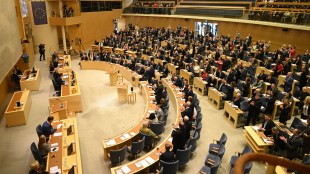
Lawmakers in Sweden’s Parliament applaud after electing Ulf Kristersson prime minister on Oct. 17, 2022. (Jonathan Nackstrand/AFP via Getty Images)

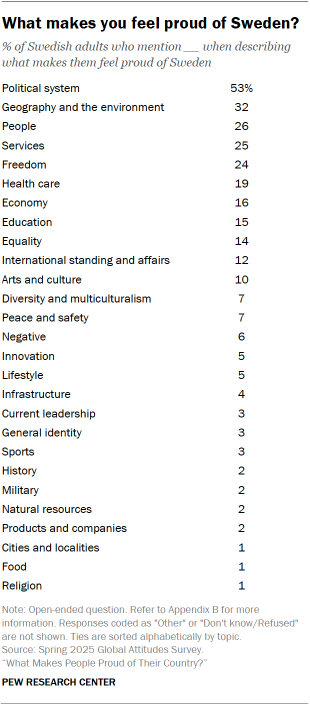
Swedes are most proud of their country’s political system (53%) – which they cite more than any other country surveyed. They are proud that their democracy “works quite well,” with “transparent authorities” and “rule of law.” Many also mention governmentally provided services (25%), including their “well-developed welfare system” and “parental insurance.”

Swedes also highlight their freedoms (24%) as a source of pride, especially their “very strong freedom of speech.” And they mention health care (19%) and education (15%) – which they often note are “free” for everyone – much more than many other people.

Swedes also stand out for their relative emphasis on geography and the environment (32%) compared with other countries. While people mention the “beautiful nature” in the country, they also highlight their legal “right of public access” to nature and emphasize how “environmental issues are actively discussed and taken seriously” in Sweden.
“I am proud that we are a democracy with freedom of speech. We have an independent justice system. We have a good welfare system. We have good education for everyone. We have the right of public access. We have a good road network. We have good relations with our neighbors. We have environmentally friendly electricity production. In general we have a positive view of our fellow human beings. We trust each other. We have a competent military.”

– Man, 55, Sweden

“I think we have a stable democracy. We have beautiful nature. Good economy. Fair systems. Strong government institutions. Free health care. Free university education. We have transparent authorities. Swedes have confidence in the state.”

– Woman, 46, Sweden

“That Sweden is a free country and we have a functioning democracy. And we have very beautiful nature and very good food production. We have good health care, good schools, and the people are peaceful, and we have quite a few religious communities. People accept differences here. Everyone can be themselves here.”

– Man, 57, Sweden

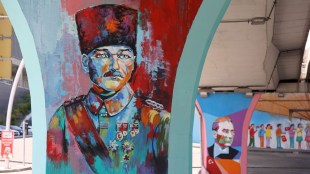
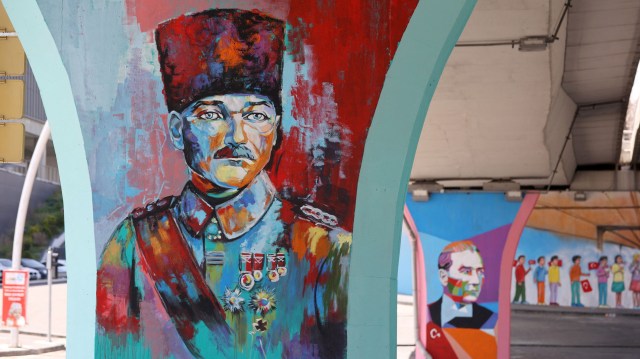
Murals depicting Mustafa Kemal Ataturk, founder of the Republic of Turkey, on pylons of a bridge in Ankara ahead of an upcoming youth and sport day in 2021. (Adem Altan/AFP via Getty Images)

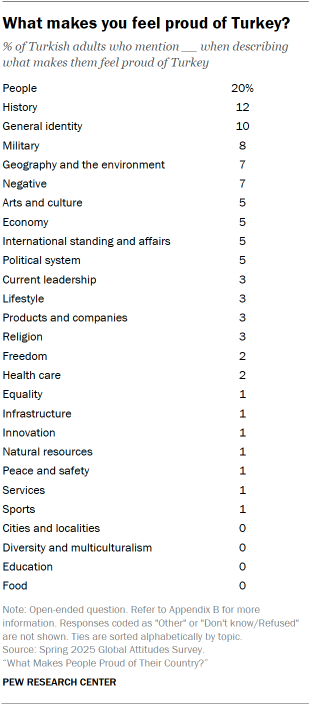
Turks are most proud of their people (20%), with an emphasis on how Turks are “hospitable” and “patriotic.” Some express pride that Turks are “warriors.”

Turks are proud of their country’s history (12%), mentioning the Turkish War of Independence and historical leaders like Kemal Ataturk. They are also more likely to mention their “military power” (8%) as a source of pride than many in other countries, often emphasizing their “defense industry” and mentioning their drones.

“Being a nationalist people with a warrior spirit and at the same time having a compassionate army.”

– Woman, 26, Turkey

“As Ataturk said, ‘How happy is the one who says I am a Turk.’ This alone is enough to make one proud.”

– Man, 65, Turkey

“Hospitality, standing by the oppressed, unity and solidarity of the people.”

– Man, 30, Turkey

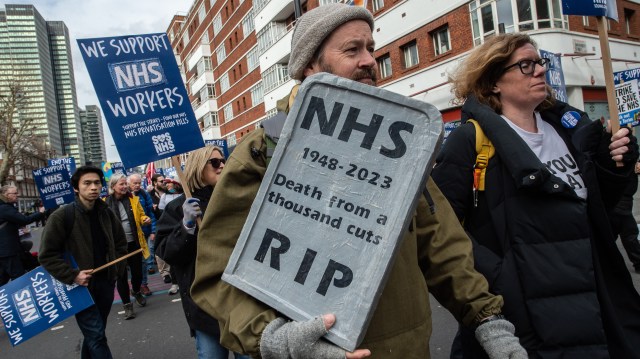
Protesters in London march to call for emergency funding for the National Health Service in March 2023. (Guy Smallman/Getty Images)

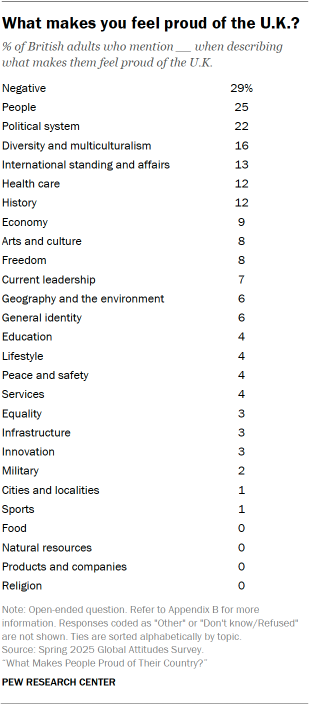
People in the U.K. are proud of the “kind” and “honest” British people (25%), but they just as frequently mention things they are not proud of (29%). Some negative responses refer to specific issues, like “Brexit was a bad idea,” while others simply say there is “not much to feel proud [of] at the moment.” There are few countries where people mention things they are not proud of as frequently as the British.

Interestingly, while people who support the governing Labour Party are less likely to say something negative than those who do not support it, supporters and nonsupporters don’t differ on other sources of pride. This includes the political system (mentioned by 22% of Britons), diversity and multiculturalism (16%) and health care (12%), especially the “National Health Service.”
“I suppose it’s a bit questionable, but overall it’s a democratic country, religious tolerance [but] I’m not as proud of it as I used to be. It’s difficult. I’m not proud of my country because it seems to be falling apart.”

– Woman, 73, U.K.

“I am proud to be born and [bred] here. The British people … are willing to help others. I am proud of our democracy and how it works … we can have discussion with different parties without getting in a conflict. … We help other people both inside and outside of our borders.”

– Man, 67, U.K.

“The royal family. [And] that we have nature; forests and mountains. That’s it.”

– Woman, 18, U.K.

An aerial view of the Statue of Liberty in New York City in November 2021. (Dominik Bindl/Getty Images)

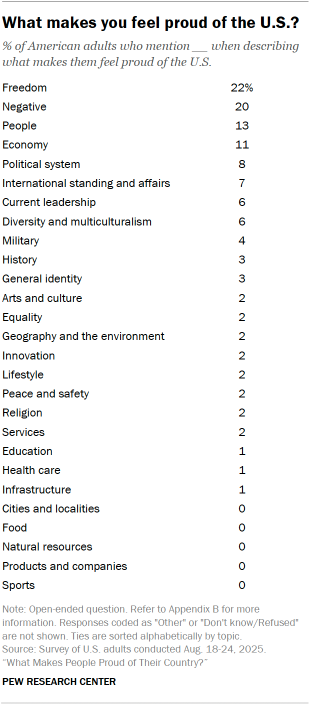
Americans are particularly proud of the country’s “freedoms and liberties” (22%); the U.S. is one of a few countries surveyed in which this is the case. Interestingly, it is the only country surveyed in which there are significant partisan differences in pride in the country’s freedoms (32% of Republicans mention it, compared with 15% of Democrats).

When the topic of national pride comes up, the U.S. is one of several countries where something negative is a common response (20%). Once again, this is partisan (8% of Republicans vs. 32% of Democrats), though that is also the case in most other surveyed countries. 

Other factors mentioned regularly include the American people (13%) and the economy (11%), with some emphasizing their pride in “the American dream” and having “plenty of opportunities.”

Related: 6 facts about national pride in the U.S.

“I am proud that the United States has a commitment to individual liberty, freedom of religion and speech for its citizens. I’m proud of the opportunities available and the environment where big dreams are possible. I’m extremely proud of those who serve in the military.”

– Woman, 54, U.S.

“The diversity and land of opportunity. A country where anyone has the opportunity to succeed regardless of race or financial circumstances. The many freedoms Americans have.”

– Woman, 52, U.S.

“Greatest country on the planet. Large, wealthy and powerful. While many freedoms are eroding, we still have the most freedoms and most opportunities to advance. This is why foreigners want to be here.”

– Man, 38, U.S.

Explore more countries

Where in the world are people proud of their country’s culture and lifestyle?

When asked what makes them proud of their country, many people around the world point to their national arts and culture, as well as their lifestyle. They also express pride in things like the history of their country or its food.

“I am proud of the art, the culture, the good food, the beauty of all places, and the creativity that people have in dealing with anything.”

– Woman, 47, Italy

These responses were collected as part of a survey conducted in the spring and summer of 2025. We asked over 30,000 adults in 25 countries to describe what makes them proud of their country, in their own words.

  • People in Italy are the most likely to mention something related to their national arts and culture, while Greeks are exceptionally proud of their history.
  • Spaniards and Australians are particularly likely to praise the way of life in their country.
  • In many places, younger and more educated people express pride in the arts and culture of their country at higher rates than older people and those with less education.

For more on other sources of pride, read “What Makes People Proud of Their Country?” or specific analyses about pride in politics and the economy, people and those who say they are not proud. For the full, ordered list of topics by country, refer to the detailed tables in Appendix E.

Where is pride in arts and culture most common?

When it comes to pride in various aspects of cultural heritage – customs and traditions, national symbols, art and architecture – Italy stands out.

About four-in-ten Italians (38%) say they are proud of Italian arts and culture. This is the top source of national pride for Italians. And compared with all other surveyed countries, people in Italy are the most likely to list arts and culture as a source of national pride.

But pride in arts and culture is not limited to Italy: This is among the top three most common topics mentioned in 11 of the 25 countries surveyed. Roughly one-in-four or more in both Mexico (30%) and France (26%) point to their national arts or culture when asked what makes them proud.

Who is most likely to be proud of the arts and culture in their country?

When talking about what makes them proud of their country, younger people tend to mention arts and culture more often than older people. In fact, in many countries, those ages 18 to 34 are at least twice as likely as those 50 and older to be proud of their national culture.

“I think there are influences from other countries, but even taking them into consideration, I feel that this is a country where something connected as a single culture has been handed down.”

– Woman, 25, Japan

For instance, in Hungary, roughly a third (31%) of adults younger than 35 say they are proud of their national arts and culture. Only 12% of Hungarians 50 and older say this. Likewise, in France, the share of younger adults who mention something related to arts or culture is about double the share of older adults who do the same (37% vs. 19%).

One 23-year-old man in France said he was proud of the French “cultural influence,” including “cinema, literature, opera [and] theater.” A 24-year-old French woman agreed: “Culture, literature, cuisine. That’s all there is.”

In several countries, those with more education mention arts and culture as points of pride more often than those with less education. In Mexico, almost half (47%) of those with at least an upper secondary education say they are proud of some aspect of Mexican culture, compared with 16% of those with a lower secondary education or less.

“It is a culturally rich country,” said one Mexican man. “There is a lot of culture we have, like the antiquity of the Mayas,” a Mexican woman said. “Our roots [are] well defined.”

What aspects of arts and culture make people proud?

A bar chart showing that Around the world, many are proud of their national arts and culture

In some countries, people are proud of having rich and enduring traditions. This is common in Japan: One Japanese woman said she was proud that her country “values the old culture.” “We are preserving our culture from generation to generation,” said a Japanese man.

South Koreans, on the other hand, tend to be proud of their contemporary culture and its global reach. Many reference the growing popularity of “K-culture” around the world, including K-pop, K-dramas, K-beauty and Korean food. “A powerhouse in cultural content,” said one Korean woman.

In nearly every country surveyed, people express pride in their national customs and traditions. For many, this means holidays, festivals and public celebrations. Australians frequently mention “Australia Day,” while Mexicans praise their “Day of the Dead.” One Brazilian woman listed “Carnival, June festivals … and Círio de Nazaré,” a Catholic festival honoring Our Lady of Nazareth. In the Netherlands, a woman said she was proud of “Dutch celebrations, such as King’s Day or Sinterklaas.”

“Having Australia Day every year. To see Aussie flags flying, BBQs, the cricket on TV and everyone just having fun, a beer and enjoying themselves and being proud to be Australian.”

– Man, 60, Australia

Elsewhere, people are proud of cultural expressions like traditional clothes and dance. “Our folk dances and our folk costumes are beautiful, and I am very proud of that,” said a Hungarian woman. One man in Mexico said he was proud of the traditional “arrieros dance,” and several in Brazil mentioned “samba” and “capoeira.”

Some express pride in their national arts, including architecture, media, music and crafts. One Italian woman said she was proud of “the works in the churches, paintings, sculpture … most places in Italy have something beautiful.” “Italy is an open-air museum,” said an Italian man.

In Japan, many are proud of their traditional craftsmanship as well as more modern forms of art, like animation and video games. “Handmade things, delicate, dexterous and skilled craftsmanship that cannot be done by machines are amazing,” said one Japanese man. And in France, where many express pride in French know-how as well as their monuments, several praised “the craftsmen and craftswomen who rebuilt Notre Dame.”

“The tricolor flag that we have encompasses everything: Red is for the color of the blood our soldiers have shed … during the world wars, white represents democracy, green is for hope, because we Italians always manage.”

– Man, 56, Italy

In most countries, there are those who express pride in national symbols. For instance, some people are proud of their flag, especially in India and Turkey. “The flag of our country is recognized all over the world, hence I am very proud,” said one man in India. Another source of pride is national anthems. One American woman said she was particularly proud of “the stirring in our hearts when our national anthem is played.”

For some, national pride is tied to the language they speak. This is common in France, Greece and Poland – but especially in Hungary. “We can express ourselves better with Hungarian because it is more emotional than other languages,” said one Hungarian woman. “It’s the most wonderful and complex language in the world,” said a Hungarian man. And in South Korea, many say Hangul, the Korean alphabet, makes them proud.

In some places, including Canada, India, Indonesia, South Africa and Spain, people are proud that multiple languages are spoken in their country. One woman said she was proud of South Africa because “it’s the only country that has 11 official languages.” And in Spain, a man said he was proud because “we have three official languages; we are polyglots.”

For more on pride in diversity, read “Where in the world are people proud of their nation’s people and diversity?”

Where are people proud of their country’s food?

Another national symbol people are proud of is their country’s food. More than one-in-ten in Italy, France, Mexico and Spain say their national cuisine is a source of national pride. One Italian woman said that although she has little pride in Italy, she at least is proud of “tortellini, Parmigiano-Reggiano, Chianti wine and humble people.”

A dot plot showing that In some European countries and Mexico, people are particularly proud of their cuisine

Italian wines are a common source of national pride, as are French wines and cheeses or, as one French man put it, “knowing how to enjoy good wine and cheese.” In Mexico and Spain, people are proud of traditional foods, including one Mexican woman who said she was proud of Mexican street food or “antojitos” and a young Spanish man who replied, “the flag of Spain and paella.”

In several places, people are proud not just of the food but the atmosphere surrounding it. “We can drink wine or beer on a terrace,” said one French woman; “Japanese food and alcohol culture,” said one Japanese woman; and an Argentine woman mentioned “drinking maté,” a regional caffeine-rich drink that serves as a national symbol for friendship.

Food is sometimes used as a counterweight for those who are dissatisfied with the general direction of their country. For instance, one Hungarian man said he was “proud of our goulash soup … but not of our current politics.”

For more on what people aren’t proud of in their country, read “Where, and why, people aren’t proud of their country.”

Where do people express pride in their country’s lifestyle?

“I am happy. I recognize that life is good and there are few places where I would like to live other than here.”

– Man, 51, Spain

As for pride in lifestyle, people in Spain and Australia are particularly likely to praise the way of life in their country (14% and 13%, respectively).

In Spain, for example, many say they enjoy a vibrant social life, with one man describing Spain as a place where people live well “because they go out … they don’t stay at home.”

Several other responses from Spain echo this sentiment. “We enjoy ourselves; we like to party,” said one Spanish woman, while another was proud of “our way of living life … we like to enjoy life, the sun, being with friends and family.” “There is joy,” a Spanish man said.

A dot plot showing that Spaniards and Australians are the proudest of their lifestyles

People in Australia express pride in the “relaxed” nature of their lifestyle. Some Australians are proud of “being able to live a relatively carefree life,” describing their lifestyle as “easygoing” and “laid-back.” Others call it “outdoor” or “healthy.” “I … feel Australia is a good place to live and raise children,” said one Australian man. “Happy place,” said another. 

Italians tend to praise the “lifestyle that Italy allows” and “the ability to recognize and enjoy the important things in life.” And in France, people are proud of their “savoir-vivre” or “art of living.”

Other responses that mention lifestyle focus on the comfort and ease of everyday life. One man described Brazil as “a tranquil country.” Another Brazilian man offered, “I don’t worry about anything.” “I have a comfortable life. I don’t have very much outside pressure that I cannot manage,” a Canadian man said.

And in several countries, some say they are proud because they live better lives than people elsewhere. These responses are common in the Netherlands and Sweden. “People living in Sweden have good lives compared to so many other countries,” said one Swedish woman. And a Dutch woman explained, “With all the misery in the world, we cannot complain. We have it good.”

What parts of a country’s history make people proud?

A bar chart showing that Across several European countries, many are proud of their history

More than a third of Greeks (37%) are proud of their country’s history, especially their ancient history and its influence. “Our ancient origins are the birthplace of democracy, and [our] ancient philosophers are taught all over the world,” said one Greek man. Another said he was proud of “Socrates, Aristotle [and] the heroism of the ancestors,” and several Greeks mentioned “the golden age of Pericles.”

In France, too, many are proud of their country’s history and its impact on the world, citing its Declaration of the Rights of Man and of the Citizen. One French woman said she was proud of the “history and worldwide influence” of her country, specifically its “commitment to human rights.” And a French man praised the democratic legacy of the French Revolution, saying he was proud of “having guillotined [and] overthrown the monarchy.”

Some who are proud of their history mention their ancestors who survived through hard times, like a Polish woman who said, “Our nation has gone through a lot and, despite adversity, has dealt with it well,” or a Hungarian woman who said, “I’m proud of [Hungary’s] history, its traditions [and] the perseverance of our ancestors.”

Elsewhere, too, people are proud of their country for having overcome difficult periods in their history. One German man who said he is proud of “how we have defeated fascism and achieved reunification and succeeded economically.” “It makes me proud that Germany has faced up to its past and come to terms with it,” said a German woman. Similarly, in Spain, people are proud of “having passed from a dictatorship to a stable democracy.”

People often express pride in specific historical events. In Hungary and Turkey, people take pride in their national wars of independence, and in South Korea, several are proud of their “ancestors’ independence movement.” One Mexican man called Mexico “a heroic country” because of events like “the Battle of Puebla, the Pipila in Guanajuato [and] the siege of Cuautla with Morelos.”

Others are proud of specific historical figures, such as Ataturk in Turkey, Gandhi in India, or Napoleon and de Gaulle in France. Poles, for their part, are especially proud of composer Frédéric Chopin, Marie Curie and Pope John Paul II.

However, many who say they are proud of their national history are critical of the present day, like a Greek woman who, when asked what she was proud of, said: “Nothing anymore, only our history.” “I am proud of the U.S. because of our past. Not so much about the present,” said one American man, and another echoed: “I am proud only of what it used to be.”

For more on national pride in the United States, read “6 facts about national pride in the U.S.”

Where in the world are people proud of their nation’s politics and economy, and why?

“I am proud that we are a democracy with freedom of speech. We have an independent justice system. We have a good welfare system. We have good education for everyone. We have the right of public access. We have a good road network. We have good relations with our neighbors.”

– Man, 55, Sweden

In 2025 we asked more than 30,000 people in 25 countries to answer, in their own words, “What makes you feel proud of your country?” Though responses vary from nation to nation, at least some people in each country say they are proud of their politics and economy.

  • The political system is a common source of national pride in several high-income countries, especially Sweden and Germany. But people elsewhere are also proud of the way their country is governed, including their democracy, constitution, elections, political stability and how their country engages with the world.
  • Freedom is another source of pride. Americans are more likely to say they’re proud of their freedom than anything else. And people in France and Sweden regularly mention equality as something they are proud of.
  • People also say they are proud of their economy – including about two-in-ten in Germany, Indonesia and the Netherlands – and the services provided by their government such as health care, education and infrastructure. Swedes and South Africans are among the most likely to be proud of these things.

For more on other sources of pride, read “What Makes People Proud of Their Country?” or specific analyses about pride in culture, people and those who say they are not proud. For the full, ordered list of topics by country, refer to the detailed tables in Appendix E.

Where are people proud of their political system?

A bar chart showing that Swedes and Germans stand out for their pride in their political systems

People in each country surveyed are proud of their political system, including democracy itself, elections, the constitution and more.

For example, one man called Sweden “a country of justice and democracy.” In fact, 53% of Swedes say they are proud of the way their country is governed – the largest share to name a single source of national pride in any country surveyed.

Germans are also more likely to say they are proud of their country’s system of government (36%) than anything else. Several claim their democracy is “the best” in the world.

Democracy is a source of pride in every country surveyed. People are proud to have it, that it has grown, and that it functions well. For many, their pride comes from elements of democracy such as the “separation of powers” and elections. “Our democratic system is very good and we actually have it all well organized. There’s a good judiciary that is independent, and there are enough institutions that monitor that,” said one Dutch man.

People who rate their democracy highly are far more likely to be proud of their political system, especially in Europe. For example, in Spain, 24% of those who are satisfied with the way their democracy is working mention their government as a source of pride. Just 5% of those who are dissatisfied with democracy do the same.

“I am proud of the democratic structures, our constitution and the basis for good coexistence. Germany is a welfare state and part of a strong European integration.”

– Woman, 26, Germany

Other people say they are proud of their elections, often mentioning that they are “free” and “regular.” In a country like the Netherlands, which has a large network of political parties, one man said he was proud to “have more political parties to choose from.” And in Australia, several people take pride in their compulsory voting system.

In Japan, the Netherlands, Spain, Sweden and the United Kingdom, people are proud of their monarchies. One Japanese man mentioned his country’s centuries-long “unbroken line of succession” and said the Imperial House “maintains the bonds and communication between people, and culture of the country.”

Some people – including many Americans – express pride in their constitution. One young woman in the United States said she is proud of “the Constitution and the values it holds.” A Brazilian man said he is proud of “the constitution, because it exists and it works.”

For some, being proud of their country is more about stability and unity in the government rather than a particular structure or law. One Greek man called his country “a pillar of stability.”

People also express pride in their country’s relative strength and influence in the international system. Americans are proud to consider the U.S. “the most powerful country in the world,” while Nigerians refer to their country as “the giant of Africa.” “I think [Canada] has a moderating influence globally,” said one Canadian man. And a French man said he was proud because “we are respected in the world.”

Where are people proud of their freedom?

A dot plot showing that People in the Netherlands, Sweden, France and the U.S. are especially proud of freedom in their country

In every country, some respondents say they are proud of their country because of the freedom it allows. About two-in-ten or more in France, the Netherlands, Sweden and the U.S. say freedom is a source of national pride. But exactly which freedoms people are proud to have varies.

Some talk about their freedom of speech and expression, like a 68-year-old in France who said he was proud because “we have the right to express ourselves and dress the way we want. We have the right to criticize our employer, the government, politicians, our neighbors, everyone.” A woman in Argentina said, “We have the right to say what we want.”

“Freedom to speak. Freedom to worship. Freedom to vote. Freedom to assemble. Freedom to associate. Freedom to own guns. Freedom to choose a profession and employer. Freedom to communicate electronically without fear of government watching my every word. Freedom to travel. Mostly free markets. Gratitude for those who sacrificed so that I can have freedom.”

– Man, 59, U.S.

Others are proud of their religious freedoms. “I am proud of the freedoms we’re guaranteed here, particularly freedom of religion,” said one American man. One Swedish woman said she’s proud that “you can be yourself,” in reference to Sweden’s freedom of religion and speech.

People are also proud of their freedom of movement. “Brazil is a free country in every sense…. Here, we have the right to come and go,” said one Brazilian woman. And a British man said he’s proud of “the freedom of movement and the freedom of everything.”

Equal rights are another source of national pride, especially in Sweden (14%) and France (12%). Swedes are proud that their gender equality is “better than in other countries.” It is the only country where women are somewhat more likely than men to say equality makes them proud of their country.

“This is the land of declarations of human rights.”

– Man, 80, France

In France, many are proud of the national motto, “Liberty, Equality, Fraternity.” Others mention human rights and the fact that “all citizens are equal before the law.”

In some places, people express pride in their country’s approach to human rights, both at home and internationally. “I believe that we are an open country in which human rights are respected,” said one Spanish woman. And a man in the U.K. said he was proud of “our human rights record.”

Others are proud of their country for providing aid to those who need it. Canadians, for example, emphasized pride in their country being “willing to help when asked.” One Swedish man said he was proud of “Sweden’s position in the world as a humanitarian power.” And across Europe, many mention their support for Ukraine in its war with Russia.  

Where are people proud of their economy and government services?

A bar chart showing that The economy is a top point of national pride in around a third of countries surveyed

Around the world, many are proud of their economy as well as the services their country provides them.

The economy is a common source of national pride, appearing as one of the top responses in around a quarter of the countries surveyed. Roughly one-in-five in Germany, Indonesia and the Netherlands say they are proud of their economy.

Some say they are proud to live in a “rich” country, or to have a “strong” or “stable” economy. One German man expressed his pride in “the prosperity that Germany offers its citizens.”

Others praise the standard of living or “livelihood” in their countries. One Dutch man explained he is proud of “the general level of prosperity” in the Netherlands.

Many are proud of the opportunities, work and jobs available to them in their country. One American woman said she is proud of “the overarching idea of being the land of opportunity and giving everyone who lives here the opportunity to achieve the American dream.”

In several countries, including Poland, South Korea and India, many express pride in their country’s economic growth. “In 20 years [Poland] has risen from economic ruin,” said one Polish man.

Some are proud of their country’s relative economic power and cooperation with other countries. One man in Germany said he was proud of “our global trade … and good neighborly relations.” “Indonesia is rich … in terms of trade relations with China, which are strong,” said an Indonesian woman. People in Brazil, Indonesia and South Africa mention their countries’ involvement in BRICS, while in Europe, many are proud of their membership in the European Union.

On the topic of trade, some express pride in specific products or companies from their country. For example, some South Koreans mention technological giants like Samsung and semiconductor exports, while several Turks are proud of Togg cars and defense manufacturing.

A dot plot showing that Around a quarter of Swedes and South Africans take pride in government services

For others, national pride is about the government services and benefits they interact with and rely on day to day.

People around the world express pride in their national welfare programs, health care, education and infrastructure. Pride in services like these is especially common in Sweden, South Africa, France, Germany and the Netherlands.

Many are proud of their social security and welfare systems, while others mention their “social safety net.” One Dutch woman said she is proud of the Netherlands “because it’s a good welfare state. You get good help with everything.”

“Social health insurance. We are actually one of the better ones, I think. Supporting people who can’t work, for example. People with disabilities.”
– Woman, 55, Netherlands

People who are proud of their government services mention not only what benefits them personally, but also what helps the most vulnerable in their country. Many say they are proud of the “care” and “help” offered to all citizens, particularly the elderly, children and the poor. “There is a concern for the most vulnerable people both in Sweden and the world,” said one Swedish woman.

In some countries, people name specific social programs that make them proud:

  • In South Africa, where services are a common source of national pride, many say they are grateful for social grants and subsidized housing offered by the government.
  • Some Indonesians take pride in an initiative that offers free food assistance to students.
  • Hungarians express pride in pension policy and government support for families.

“Free universal health care would be my #1 point of pride in Australia.”

– Man, 30, Australia

In many of the countries surveyed with universal health care people express pride in their health systems, emphasizing free health care that everyone can access. One 62-year old Spanish man said he was proud of “universal public health care [that] is envied by the rest of the world.”

In some of the countries that stand out for pride in their health care system, people on the ideological left are more likely than those on the right to mention it. In Canada, for example, the share on the left who are proud of their health care is about double the share on the right who say this (23% vs. 12%).

Education is another source of national pride, especially in Sweden and South Africa. Some are proud of free education or children’s access to education, while others mention the “high level of education” in their country. One French man said he was proud of “the ability to give your children a proper education.”

South Africans frequently mention government economic assistance for education. One South African student said his college is paid for through a government program and he is proud “to go to school for free.”

Some are proud of their country’s infrastructure, including the condition of roads – “money well spent,” according to one French woman – as well as the cleanliness of public spaces, water and energy infrastructure, and transit systems. “No litter anywhere you go,” said one Japanese woman, while several in the Netherlands said they were proud of their “water management.”

And some express pride in their country’s safety and security, their police, and having “no wars.” This is especially the case in Japan and Kenya. “Safety. You can go outside alone. You can go outside without locking your door, go abroad relatively freely, and due to little crime, you can move around without worrying about your surroundings,” said one Japanese man.

Where in the world are people proud of their nation’s people and diversity?

We asked more than 30,000 adults across 25 countries to share, in their own words, what makes them proud of their country. For many, the question is not just about what evokes national pride, but rather who. In nearly every country surveyed, people are one of the most common topics mentioned.

A dot plot showing that Many find the people of their country to be a point of national pride

In the sections below we’ll explore pride in the following:

  • The people in their country, whether it’s their characteristics or the unity that they feel.
  • The diversity in their country, including variety in religion, ethnicity, race and more.
  • Their personal identity as someone born in or otherwise tied to the country.

For more on other sources of pride, read “What Makes People Proud of Their Country?” or specific analyses about pride in culture, politics and the economy, and those who say they are not proud. For the full, ordered list of topics by country, refer to the detailed tables in Appendix E.

How people describe pride in their country’s diversity and people

Canadians and Indonesians are the most likely to point to their country’s multicultural society as a source of national pride, with roughly three-in-ten in each country saying this.

“Nigeria is incredibly diverse with hundreds of ethnic groups and language. This rich tapestry of cultures [creates] a vibrant and dynamic society.”

– Woman, 19, Nigeria

In Indonesia, respondents mention the diversity of their society more than any other topic, pointing to the variety of religions, cultures, languages and ethnicities living together in harmony. Some explicitly mention the official national motto, “Bhinneka Tunggal Ika,” meaning “Unity in Diversity.” One Indonesian man said, “Indonesia has many tribes, although they are different, but they are still one Indonesia.”

Canadians instead describe their society as a multicultural “mosaic.” One Canadian man said, “It’s a country that allows various cultures, they are allowed to exist and remain unassimilated, instead of being a melting pot.” In South Africa, many refer to the country as a “rainbow nation,” describing the diverse array of cultures, languages and races present as a point of pride. South Africans also commonly refer to the concept of ubuntu, a philosophy emphasizing the interconnectedness of individuals.

Many refer not only to the presence of different types of people in their country, but also to the tolerance exhibited by the people. One Swedish man said that “the people are peaceful and we have quite a few religious communities. People accept differences here. Everyone can be themselves here.”

Similarly, when describing why people in their country make them proud, many emphasize solidarity and unity, like one Argentine man who said his pride in Argentina comes from “the people, because in spite of all the difficulties the country is going through, the people continue to have hope.” Indeed, in Argentina, people are the top sources of pride in the country.

In Australia, respondents refer specifically to the concept of “mateship,” including one woman who said she is proud of “mateship and community spirit: Australians are known for their friendliness, resilience, and willingness to help each other, especially in tough times.”

Some mention persistence and resilience as reasons to be proud of the people in their country, such as one American woman who said she was proud of “the people trying to make things better, even though everything is against it.” And one Greek woman said, “I am proud of the young people who do not give up and want to change things, even though we are paying for many mistakes of the previous generation.”

“Everything. … How we are as people, our kindness, our empathy with others, our patriotism, all the diversity that exists in the country.”

– Woman, 43, Mexico

Many across countries are also proud of the patriotism exhibited by the people of their country. This sentiment is common in Turkey, such as one man who referenced “the presence of people who love their country” as a source of pride.

Not all mentions of diversity and people are favorable in nature, though. Some express negative attitudes toward the presence of various identities in their country. For example, although 16% in the United Kingdom point to diversity as a point of national pride, others are critical of the cultural and economic changes they see brought about by immigration. For more on what makes people not feel proud, jump to “Where, and why, people aren’t proud of their country.”

In a few places, others instead point to their country’s homogeneity or lack of diversity as a point of national pride. As one South Korean man noted, he is proud “because it is a nation comprised of a single ethnic group, we have a national character that allows us to unite and wisely overcome difficult problems that arise.”

In some of the countries where diversity is more frequently mentioned, it is those on the ideological left who are more likely to include the topic in their response. For example, over a third of Canadians on the left include diversity as a point of pride in their country, compared with about two-in-ten among those on the right who also mention diversity. A similar pattern exists in Australia, Brazil, the Netherlands, Sweden, the U.K. and the United States.

Ancestry, roots and heritage are another source of pride

“Because I am Polish, this is my nation, my homeland, here I was born and raised … here I have my roots, my grandparents, great-grandparents. Polish blood flows in my veins … wherever I am in the world, I am not ashamed of my Polishness.”

– Woman, 59, Poland

In some places, people point to their own identity as a source of pride: having been born in the country, having ancestors from that country or just generally “being” the nationality.

Many describe their country as their homeland or motherland ordiscuss familial or ancestral ties to the country, with one Mexican woman saying she is “proud that my parents are from here.”

In over half the countries surveyed, adults 50 and older were more likely than their youngest counterparts to mention their national identity when describing what makes them proud of their country. For example, in Poland, those 50 and older are 18 percentage points more likely than adults under 35 to mention their identity as a source of pride in their country.

What specific characteristics of people are a source of pride?

Among the many who point to the people of their country as a source of pride, some mention more particular values and skills of the citizenry. For example:

  • In Japan, where 41% mention the Japanese people as a source of pride in their country, people mention traits such as respectfulness, modesty, honesty and diligence. One Japanese man said, “Japanese people are known worldwide for their honesty, integrity, resilience and perseverance.”
  • Some Brazilians find pride in things like “the love of Brazilians … the empathy that we have for each other, the ability to put ourselves in other people’s shoes.” Brazilians also mention people as a source of pride more than any other topic.
  • In Greece, where the country’s people are among the most frequently mentioned sources of pride, some describe their fellow Greeks as “open-hearted.” Others speak to their “hospitality and goodwill.”
  • In South Korea – another country where the people are the most common source of pride – people are proud of their hardworking citizenry, with one South Korean man referencing a “diligent and sincere workforce.”

For more on how people across countries uniquely find pride in their own country, jump to “What Makes People Proud of Their Country?”

Where, and why, people aren’t proud of their country

In a survey of more than 30,000 adults across 25 countries in 2025, we asked respondents to explain, in their own words, “What makes you feel proud of your country?”

However, plenty of people say they are not proud of their country. And many of them share specific reasons why. These range from “dishonest politicians” to “rising taxes” to the sense that “people are very unfriendly and rude.”

In the sections below, we’ll explore who is most likely to say they are not proud, and why. For more on what does make people feel proud in each country, read “What Makes People Proud of Their Country?” or specific analyses about pride in culture, politics and the economy, or people.

Where are people most likely to not feel proud of their country?

A bar chart showing that When asked what makes them proud of their country, some people say they are not proud

In the United Kingdom, Nigeria, Spain, Hungary and the United States, at least two-in-ten say they are not proud of their country when asked about national pride. And in 11 nations, this is among the most common responses given. For instance:

  • In the U.K., people are about as likely to say they are not proud of the country (29%) as to say they are proud of the British people (25%). 
  • In the U.S., 22% say they are proud of the freedom in their country, while 20% say they are not proud of the country.
  • Brazilians are most proud of their people (25%), but they are as likely to say they are not proud as they are to mention their country’s geography (17% each).
  • For the full, ordered list of topics by country, refer to the detailed tables in Appendix E.

Related: 6 facts about national pride in the U.S.

Who is most likely to not feel proud of their country?

A dot plot showing that People who do not identify with the governing party more likely to say they are not proud of their country

In many countries, the people who do not feel proud tend to be those who do not identify with the governing party or parties. This aligns with the political nature of many of the criticisms raised by people who say they aren’t proud. This is also consistent with our findings that governing party supporters are more satisfied with their democracies and pleased with their economies.

For example, Hungarians who do not feel close to Prime Minister Viktor Orban’s Fidesz party (or their coalition partner KDNP) are 22 percentage points more likely than those who do to say they are not proud.

In a handful of countries, older adults – those 50 and older – give negative responses more often than their younger counterparts (ages 18 to 34). This is the case in Canada, France, Hungary, Mexico, the Netherlands, Spain, Sweden and the U.K. (In Hungary, older adults are also more likely to offer any response.)

Why aren’t people proud of their country?

For many, there is simply “nothing” about their country to be proud of. But some people in each country surveyed detail specific reasons they are not proud. The following are common themes across countries:

Current leadership | Democratic backsliding | The economy and jobs | Immigration | International affairs

Current leadership

“I am not proud at all, especially of the current leaders of this country. I am thinking of the 130 ‘brave’ people who sit in the Hungarian parliament. They fatten their livers. They have the 3-4 million HUF [Hungarian forint] earnings and don’t give a damn about pensioners.”

– Man, 76, Hungary

For some who are not proud of their country, the current government leadership is the root of the problem. One American man said he is not proud of “a lot right now, with [Donald] Trump in office.” In France, one man asked for President Emmanuel Macron “to think before he speaks.” A young Nigerian man said he is not proud “because our leaders have messed the entire country up.”

People’s dissatisfaction with the people and parties in power is not a new finding in our research. In 2023, we asked another open-ended question – “What do you think would help improve the way democracy in your country is working?” – and the clear top answer across countries was better or different politicians.

Democratic backsliding

“We’ve got a democracy that’s not working well, a democracy that’s not respected, public services that are getting worse with time, a democracy that’s become a plutocracy.”

– Man, 60, France

Some people question or criticize their government system more than its leadership. This is especially common in high-income countries in Europe and North America. Said simply by one German man: “The democracy that exists is a disaster.” Another man in Canada said, “The only problem about Canada now is that it is not really a democracy. There is no freedom of speech, it’s either their way or no way. We can become a dictatorship.”

More specifically, people in several countries point to corruption in politics as the reason they are not proud. One American woman said the “government will always be corrupt.”

The economy and jobs

In many countries, people do not feel proud due to the state of their economy. This includes frustrations with wages, the price of goods, debt and other economic issues:

  • “Inflation is high.” – Man, 22, India
  • “It’s depressing knowing I won’t be able to afford my own house one day because prices will keep going up.” – Woman, 25, U.S.
  • “The debt policy is disastrous.” – Man, 50, Germany
  • “I don’t like the rise in taxes that will make poor people suffer.” – Woman, 52, South Africa
  • “I see the forint [Hungary’s currency] losing its purchasing power.” – Man, 63, Hungary
  • “The economy is in a bad place; renewal electricity policy is making it unaffordable.” – Man, 75, Australia
  • “Nothing because the economy isn’t good. … Wages are low, things are very expensive.” – Man, 22, Brazil

“Everything is so bad, they left us in need of bread on charity shelves, the rents are so high, the economy is terrible, unemployment is very high.”

– Man, 51, Turkey

People in several countries also struggle to feel proud due to the lack of jobs and the associated economic hardships. Said one South African man: “I have lost all hope on the government of South Africa. We are parents, there are no jobs. The R350 grant [a social grant for the unemployed] is not enough, even the children can’t use school transport because the money is not enough.”

Immigration

“The Australian values we developed over generations have been eroded by poor immigration policies and weak politicians too scared to offend minority groups. It is now considered racist to advocate for old Australian values.”

– Man, 50, Australia

Some people say they are not proud because of immigration trends, policies and outcomes. One Swedish man said, “I am proud of everything in Sweden except immigration.” A young woman in Turkey said, “There is only one thing about my country that I’m not proud of, and that is accepting too many refugees from foreign countries.”
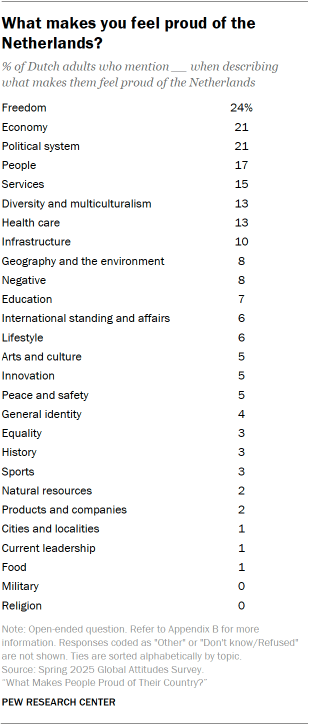
Others feel their country should be more welcoming to immigrants. Said one Briton, “Our commitment to immigration is really lacking at the moment.” Still, diversity and multiculturalism is a relatively common source of pride for people in the U.K., especially those on the ideological left (23% vs. 11% on the right). Some Americans share criticisms of the “persecution” of immigrants, citing “detention centers” and “people being disappeared.” Similarly, diversity is a more of a source of pride for Americans on the left than the right (11% vs. 4%).
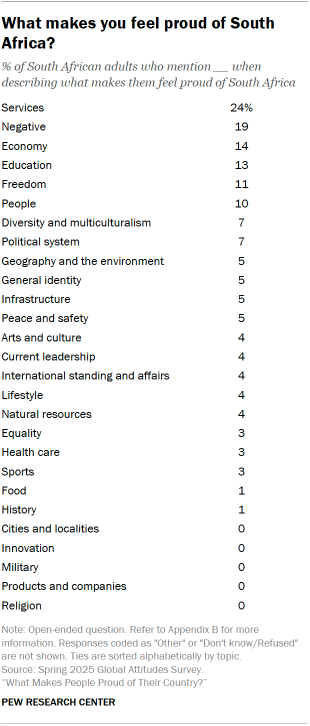
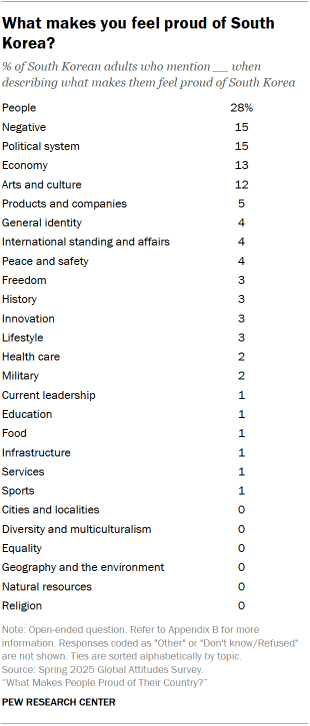
International affairs

In several countries, people are not proud of their country’s international standing. For example, in Japan, some people are displeased with how easily their country can be “swept away” on the world stage.

“I am not happy about how the country is governed, [the] EU is prioritized over the nation state, and Sweden is giving up its sovereignty in favor of the EU federation.”

– Man, 32, Sweden

Some are displeased with their relationship with other countries, especially those in current conflicts. A German man said, “If we support Ukraine, then I will be proud.” Said one Swedish woman, “I was proud when [Sweden] was independent, but not now, when they have joined NATO.” An American man said, “We should be condemning Israel but we don’t.”

As for Israelis, there is a stark difference in pride between Jews and Arabs. Though they are significantly less likely to answer the question, Israeli Arabs are 18 points more likely to say they are not proud of their country than Israeli Jews. One Arab said she is not proud because Israel “occupies another people.”

Acknowledgments

This report is a collaborative effort based on the input and analysis of the following individuals.

Laura Silver, Associate Director, Global Attitudes Research
Laura Clancy, Research Analyst
Maria Smerkovich, Research Associate
Sneha Gubbala, Research Analyst
William Miner, Research Analyst
Julia Armeli, Research Assistant
Andrew Prozorovsky, Research Assistant
John Carlo Mandapat, Information Graphics Designer
Janakee Chavda, Associate Digital Producer

Dorene Asare-Marfo, Senior Panel Manager
Peter Bell, Associate Director, Design and UX
Ethan Charlip, Communications Associate
Manolo Corichi, Research Analyst
Jonathan Evans, Senior Researcher
Moira Fagan, Research Associate
Janell Fetterolf, Senior Researcher
Shannon Greenwood, Digital Production Manager
Sofia Hernandez Ramones, Research Assistant
David Kent, Senior Editorial Specialist
Carolyn Lau, International Research Methodologist
Gar Meng Leong, Communications Manager
Kirsten Lesage, Research Associate
Jordan Lippert, Research Analyst
Patrick Moynihan, Associate Director, International Research Methods
Georgina Pizzolitto, Research Methodologist
Jacob Poushter, Associate Director, Global Attitudes Research
Dana Popky, Associate Panel Manager
Jonathan Schulman, Research Associate
Sofi Sinozich, International Research Methodologist
DeVonte Smith, Communications Associate
David Tully, Senior Researcher
Brianna Vetter, Senior Program Coordinator
Richard Wike, Director, Global Attitudes Research

Special thanks are also due to the team of Pew Research Center interns who contributed to coding for this project: Hannah Bates, Sofia Conway, Noah Killeen, Sawyer Reed, Devin Teehan and Skylar Thomas.

Appendix A: Survey methodology

About Pew Research Center’s Spring 2025 Global Attitudes Survey

Results for the survey are based on a mix of telephone, face-to-face and online interviews conducted under the direction of Gallup, Langer Research Associates and Social Research Centre. The results are based on national samples, unless otherwise noted. Read more about our international survey methodology and country-specific sample designs.

Some, but not all, of our international analyses and reports use demographic variables or categorizations based on external data. We explain these more below:

Ideology

We analyze respondents’ attitudes based on where they place themselves on an ideological scale. We asked about political ideology using several slightly different scales and categorized people as being on the ideological left, center or right.

  • In most countries, we asked people to place themselves on a scale ranging from “Extreme left” to “Extreme right.” The question was asked this way in Argentina, Australia, Brazil, Canada, France, Germany, Greece, Hungary, Israel, Italy, Mexico, the Netherlands, Nigeria, Poland, South Africa, Spain, Sweden, Turkey and the U.K.
  • In Japan and South Korea, ideology was measured on a scale from “Extremely progressive” to “Extremely conservative.”
  • In the U.S., ideology is defined as conservative (right), moderate (center) and liberal (left).
  • Ideology was not asked about in India, Indonesia or Kenya. 

Education

To compare educational groups across countries, we standardize education levels based on the United Nations’ International Standard Classification of Education (ISCED).

High- and middle-income countries

Countries are classified as either high or middle income based on categories from the World Bank that rely on per capita gross national income. This is a classification we have used in other Pew Research Center analyses, including when looking at global views of China, satisfaction with democracy, globalization and national identity.

The American Trends Panel survey methodology

Overview

Data in this report comes from Wave 177 of the American Trends Panel (ATP), Pew Research Center’s nationally representative panel of randomly selected U.S. adults. The survey was conducted from Aug. 18 to Aug. 24, 2025. A total of 5,153 panelists responded out of 5,525 who were sampled, for a survey-level response rate of 93%.

The cumulative response rate accounting for nonresponse to the recruitment surveys and attrition is 3%. The break-off rate among panelists who logged on to the survey and completed at least one item is 1%. The margin of sampling error for the full sample of 5,153 respondents is plus or minus 1.6 percentage points.

The survey includes an oversample of Non-Hispanic Asian adults in order to provide more precise estimates of the opinions and experiences of this smaller demographic subgroup. These oversampled groups are weighted back to reflect their correct proportions in the population.

SSRS conducted the survey for Pew Research Center via online (n=4,994) and live telephone (n=159) interviewing. Interviews were conducted in both English and Spanish.

To learn more about the ATP, read “About the American Trends Panel.”

Panel recruitment

Since 2018, the ATP has used address-based sampling (ABS) for recruitment. A study cover letter and a pre-incentive are mailed to a stratified, random sample of households selected from the U.S. Postal Service’s Computerized Delivery Sequence File. This Postal Service file has been estimated to cover 90% to 98% of the population.1 Within each sampled household, the adult with the next birthday is selected to participate. Other details of the ABS recruitment protocol have changed over time but are available upon request.2 Prior to 2018, the ATP was recruited using landline and cellphone random-digit-dial surveys administered in English and Spanish.

A national sample of U.S. adults has been recruited to the ATP approximately once per year since 2014. In some years, the recruitment has included additional efforts (known as an “oversample”) to improve the accuracy of data for underrepresented groups. For example, Hispanic adults, Black adults and Asian adults were oversampled in 2019, 2022 and 2023, respectively.

Sample design

The overall target population for this survey was noninstitutionalized persons ages 18 and older living in the United States. It featured a stratified random sample from the ATP in which non-Hispanic Asian adults were selected with certainty. The remaining panelists were sampled at rates designed to ensure that the share of respondents in each stratum is proportional to its share of the U.S. adult population to the greatest extent possible. Respondent weights are adjusted to account for differential probabilities of selection as described in the Weighting section below.

Questionnaire development and testing

The questionnaire was developed by Pew Research Center in consultation with SSRS. The web program used for online respondents was rigorously tested on both PC and mobile devices by the SSRS project team and Pew Research Center researchers. The SSRS project team also populated test data that was analyzed in SPSS to ensure the logic and randomizations were working as intended before launching the survey.

Incentives

All respondents were offered a post-paid incentive for their participation. Respondents could choose to receive the post-paid incentive in the form of a check or gift code to Amazon.com, Target.com or Walmart.com.  Incentive amounts ranged from $5 to $20 depending on whether the respondent belongs to a part of the population that is harder or easier to reach. Differential incentive amounts were designed to increase panel survey participation among groups that traditionally have low survey response propensities.

Data collection protocol

The data collection field period for this survey was Aug. 18 to Aug. 24, 2025. Surveys were conducted via self-administered web survey or by live telephone interviewing. 

For panelists who take surveys online:3 Postcard notifications were mailed to a subset on Aug. 18.4 Survey invitations were sent out in two separate launches: soft launch and full launch. Sixty panelists were included in the soft launch, which began with an initial invitation sent on Aug. 18. All remaining English- and Spanish-speaking sampled online panelists were included in the full launch and were sent an invitation on Aug. 19.

A table showing Invitation and reminder dates for web respondents, ATP Wave 177

Panelists participating online were sent an email invitation and up to two email reminders if they did not respond to the survey. ATP panelists who consented to SMS messages were sent an SMS invitation with a link to the survey and up to two SMS reminders.

For panelists who take surveys over the phone with a live interviewer: Prenotification postcards were mailed on Aug. 15. Soft launch took place on Aug. 18 and involved dialing until a total of five interviews had been completed. All remaining English- and Spanish-speaking sampled phone panelists’ numbers were dialed throughout the remaining field period. Panelists who take surveys via phone can receive up to six calls from trained SSRS interviewers.

Data quality checks

To ensure high-quality data, Center researchers performed data quality checks to identify any respondents showing patterns of satisficing. This includes checking for whether respondents left questions blank at very high rates or always selected the first or last answer presented. As a result of this checking, one ATP respondent was removed from the survey dataset prior to weighting and analysis.

Weighting

The ATP data is weighted in a process that accounts for multiple stages of sampling and nonresponse that occur at different points in the panel survey process. First, each panelist begins with a base weight that reflects their probability of recruitment into the panel. These weights are then calibrated to align with the population benchmarks in the accompanying table to correct for nonresponse to recruitment surveys and panel attrition. If only a subsample of panelists was invited to participate in the wave, this weight is adjusted to account for any differential probabilities of selection.

Among the panelists who completed the survey, this weight is then calibrated again to align with the population benchmarks identified in the accompanying table and trimmed at the 1st and 99th percentiles to reduce the loss in precision stemming from variance in the weights. Sampling errors and tests of statistical significance take into account the effect of weighting.

A table showing American Trends Panel weighting dimensions

The following table shows the unweighted sample sizes and the error attributable to sampling that would be expected at the 95% level of confidence for different groups in the survey.

A table showing Sample sizes and margins of error, ATP Wave 177

Sample sizes and sampling errors for other subgroups are available upon request. In addition to sampling error, one should bear in mind that question wording and practical difficulties in conducting surveys can introduce error or bias into the findings of opinion polls.

Dispositions and response rates

A table showing Final dispositions, ATP Wave 177
A table showing Cumulative response rate, ATP Wave 177

Appendix B: Coding methodology

This Pew Research Center report on sources of national pride uses data from nationally representative surveys conducted in 25 countries.

For non-U.S. data, this analysis draws on nationally representative surveys of 28,333 adults conducted from Jan. 8 to April 26, 2025. Surveys were conducted over the phone with adults in Canada, France, Germany, Greece, Hungary, Italy, Japan, the Netherlands, Poland, South Korea, Spain, Sweden and the United Kingdom. They were conducted face-to-face in Argentina, Brazil, India, Indonesia, Israel, Kenya, Mexico, Nigeria, South Africa and Turkey. In Australia, we used a mixed-mode probability-based online panel. All responses are weighted to be representative of the adult population in each country. Read more about international survey methodology.

In the United States, we surveyed 5,153 adults from Aug. 18 to 24, 2025. Everyone who took part in this survey is a member of the Center’s American Trends Panel (ATP), a group of people recruited through national, random sampling of residential addresses who have agreed to take surveys regularly. This kind of recruitment gives nearly all U.S. adults a chance of selection. Surveys were conducted either online or by telephone with a live interviewer. The survey is weighted to be representative of the U.S. adult population by gender, race, ethnicity, partisan affiliation, education and other categories. Read more about the ATP’s methodology.

Respondents in all countries were asked the following question: “What makes you feel proud of (survey country)? Please share as much detail as you would like.” For interviewer-administered surveys, responses were transcribed by interviewers in the language in which the interviews were conducted. More than 20,000 non-English substantive responses were collected in 35 different languages. They were translated by cApStAn, a professional translation firm.

A table showing Number of respondents and responses per language

In the U.S., respondents were then asked “And is there anything that makes you not feel proud of the United States? Please share as much detail as you would like.” In the 297 cases where respondents returned to the original question and modified their response, researchers analyzed the nature of the change:

  • If the modification changed the valence of the original response, such as switching it from negative to positive, we kept the original response.
  • If the modification provided a response after initially declining to answer, or if it lengthened or otherwise added detail to the original, we used the updated response.

In the sections that follow, we detail how we coded these responses to use for analysis, as well as properties of the responses.

Codebook development

A table showing Intercoder reliability scores by code

To develop a codebook that captures the main things that bring people pride across the 25 countries surveyed, six Center researchers iteratively reviewed random samples of English responses and non-English responses that were translated. These samples did not include U.S. responses, given the delayed field period. U.S. responses were coded to the codebook developed with these samples from the 24 other countries surveyed.

Researchers mapped out the key concepts that commonly appeared in the first sample of responses using open coding. After developing an initial codebook, researchers tested it on multiple random samples of a minimum of 120 responses to evaluate the codebook’s conceptual validity. After each round, they reviewed disagreements and refined the codebook before testing it again on another sample.

After four iterations of this process, researchers were able to determine that the codebook was clear enough for other coders to independently apply in a consistent manner. The codebook’s overall intercoder reliability, assessed by calculating Krippendorff’s alpha, was at least 0.70 for each of the 30 codes in the codebook. For the full codebook, refer to Appendix C.

Coding responses

To code the full set of responses, researchers trained seven additional Center coders to apply the codebook independently, using the intercoder reliability scores measured during codebook development as a benchmark of acceptable performance. Each coder was given a sample of 150 responses, drawn from the samples of responses that the researchers involved in codebook development had already coded and agreed on.

The additional coders were then evaluated for intercoder reliability against the coding results from Center researchers and were cleared to begin coding the full queue of responses. Those below 0.70 on any code were given additional feedback and, when needed, more samples of responses until they could apply the codebook independently.

Each researcher and additional coder from the Center coded between 959 and 7,786 responses. In total, 29,810 substantive responses in 36 different languages from 25 different countries were coded. (For more on nonresponse, go to Characteristics of the responses.)

Collapsing codes for analysis

The original codebook for this analysis contains 30 unique codes applied to each unit of information in responses. After coding was complete, Center researchers chose to treat “arts” and “culture” as one code for analysis.

Characteristics of the responses

A table showing Item nonresponse across 25 countries surveyed

Item nonresponse – the rate at which respondents say they “don’t know” or refuse to answer the question – varies across the 25 countries included in the survey. In about half the countries surveyed, just 5% or fewer did not provide an answer to the open-ended question, while 31% did not respond in India and 28% did not respond in the U.S. Additionally, one-in-ten or more did not answer the question in Australia, Turkey, Israel, Kenya and Poland.

Previous research has established that item nonresponse can be higher for open-ended questions than for closed-ended questions, which have a pre-fixed set of response options. Item nonresponse is also relatively high in the countries where we use web panels: the U.S. and Australia. Younger respondents in those countries are especially likely to not provide an answer.

People with lower levels of formal education were more likely not to answer the question in several countries surveyed, regardless of mode.

Countries also vary in how much detail the average respondent provided in a substantive response. For example, Spanish responses in Spain averaged 22 words, more than double the eight words in the average Spanish response in Argentina. While this particular gap may be attributable to mode differences – responses in Spain were collected over the phone, while responses in Argentina were collected in person – response length also varies between the publics that were surveyed in person. In Mexico, where the survey was also administered in Spanish and face-to-face, people provided an average of 14 words.

Whether due to mode or to cultural, demographic or other factors, variation in response length ultimately manifests as variation in the number of topics mentioned in a given substantive response. For example, across the 25 countries surveyed, a median of 54% mentioned only one topic in our codebook (e.g., diversity and multiculturalism). The share in South Korea is much higher, with 76% of those who answered the question suggesting only one source of pride. In comparison, about three-in-ten or more mention two topics in Canada, Hungary, Indonesia, Japan, Mexico, the Netherlands and South Africa. And in some countries it is common to mention even more sources of pride: 63% in Sweden and 54% in France name three or more sources of pride in their responses. 

These differences help explain why the share giving a particular answer in certain publics may appear much lower than others, even if it is the top-ranked source of pride. To give a specific example, 41% of respondents in Japan mention the people as a source of pride, while 20% do so in Turkey – yet the topic is ranked first in both countries. Given this discrepancy, researchers have chosen to analyze both the share of the public that mentions a given topic as well as its relative ranking among all topics coded.

Selection of quotes

Open-ended responses included in the report – both originally recorded in English and professionally translated – have been edited for clarity. They have been purposefully – not randomly – selected to illustrate key points and may not be representative of all responses for a given public. Quotes may also have been shortened in the report for brevity. Our analysis is not a fact check of participants’ views.

Appendix C: Codebook

Below is the coding scheme developed and used by researchers to code the responses to the open-ended question “What makes you feel proud of (survey country)? Please share as much detail as you would like.” Keywords listed with each code represent examples indicating how a unit of information could be coded and are not a complete list of all concepts per code.

Political system

Keywords: democracy, government system, monarchy, local government, political stability, government institutions, laws, voting, trust in government, elections, parliament, constitution, handling of current (or very recent) events

Freedom

Keywords: freedom (of speech, religion, expression, thought, etc.), secularism, right to protest

Current leaders

Keywords: PM/president (named or not), current politicians, representatives, politicians are good/effective, political party (or getting rid of past party)

Equality

Keywords: human rights, equality for all, equality, gender equality, human dignity

Services

Keywords: pensions, welfare, access to services, care for elderly, grants (from the government), social security, social system, safety net, police, labor rights, libraries

Health care

Keywords: health care, NHS, hospitals, access to health care, medicine, health policy

Infrastructure

Keywords: infrastructure, roads, public transportation, cleanliness, airport, electrical grid, nuclear power, neighborhood parks, access to water

Peace and safety

Keywords: safe, safety, no violence, physical safety, live in peace, peaceful, no civil wars

Education

Keywords: education, schooling, universities, learning

Diversity and multiculturalism

Keywords: multicultural, religious diversity, ethnic diversity, tribal groups, castes, indigenous, cultural diversity, different walks of life, inclusivity, tolerance, welcoming, accepting, immigration values, refugees

People

Keywords: the people, mateship, strength, spirit, national spirit, shared values, good people, generally a catch-all for any listed attribute that describes people (hardworking, kind, resilient, etc.), my generation, solidarity, unity, harmony, diaspora

Culture

Keywords: culture, language, traditions, monuments, celebrities, named royals, flag, national anthem, national animal, national symbols, sightseeing, tourism, hospitality, national holidays

Arts5

Keywords: art, artists (past or present), music, musicians, literature, TV, movies, media, people’s artistic abilities/know-how, architecture, crafts

History

Keywords: historical figures or events, past leaders, role in past conflicts, past era (e.g., Renaissance), longevity, persistence through previous eras (e.g., invasions)

Food

Keywords: food, gastronomy, cuisine

Sports

Keywords: sports, athletes (past or present), Olympic medals, national sports teams

Religion

Keywords: being a religious nation, religious buildings and monuments, religious leaders, religious values, “chosen people”

Economy

Keywords: economy, economic opportunities, (good) jobs, free markets, free trade, wealthy, stable economy, standard of living, can afford things, I have what I need, “can build a future,” development, stock market, economic powerhouse, economy is better than other countries’, things are getting better, progress, upward mobility, industry

Innovation

Keywords: innovation, inventions, scientific advancement, Nobel Prize, technological advancement and expertise

Natural resources

Keywords: mining, oil, gas, fertile soil, coal, agriculture, natural resources

Products and companies

Keywords: manufacturing goods, exports (including named products and companies), made in (country)

Lifestyle

Keywords: lifestyle, way of life, vibe, day to day, everything is good, things are easy, things are going well, status quo, the current situation, I am happy, I am comfortable, quality of life

Geography and the environment

Keywords: nature, natural beauty, the environment, landscapes, climate, weather, coasts, beaches, mountains, wildlife, fauna/flora, geographic position, care for the land

Cities and localities

Keywords: (city name), (town name), specific place, (state name)

International standing and affairs

Keywords: no wars, national security, diplomacy, strong alliances, EU, international aid, helping other countries, relations with other countries, stands up to invaders, cooperation, sovereignty, alliances, ability to travel, better than others, “not the U.S.,”, power compared to other nations, global superpower, powerful country, strong country

Note: Comparative mentions of a particular aspect of the country (e.g., our health care is better than others) should be coded as the topic mentioned. Only code the comparisons of one country to the other if the response is not more specific.

Military

Keywords: military, troops, tanks, fighter jets

General identity

Keywords: I am proud, born/raised/live here, naming nationality (e.g., “Proud to be Mexican,” “I am Kenyan”), personal heritage, citizenship, motherland, “roots,” family ties, “I have faith in my country”

Note: General claims of pride that are a part of a longer, more specific response do not need to be coded. For example, “I am proud, we have beautiful beaches” can be coded only as geography.

Negative

Keywords: I am not proud, I am no longer proud, shame, don’t believe in patriotism/nationalism, “once was proud, am not anymore,” nothing, not much at the moment

Other [TERMINAL CODE]

Don’t know/Refused [TERMINAL CODE]

Keywords: I can’t tell you, I can’t think of a response, no comment

Appendix D: Political categorization

For this analysis, we grouped people into two political categories: those who identify with the governing political party (or parties) in their country, and those who do not. These categories were coded based on the party or parties in power at the time the survey was fielded and on respondents’ answers to a question asking which political party, if any, they identify with in their country.6

In countries where multiple political parties govern in coalition (as is the case in many European countries), survey respondents who indicate support for any party in the coalition were grouped together. In Germany, for example, where the Social Democratic Party governed with Alliance 90/The Greens at the time of the 2025 survey, supporters of either party were grouped together. In countries where different political parties control the executive and legislative branches of government, the party holding the executive branch was considered the governing party.

Survey respondents who did not identify with any political party, or who did not answer the question, were categorized as not supporting the government in power.

The table below outlines the governing political parties in each survey country.

A table showing Political categorization

Appendix E: Detailed tables