Pew Research Center

FOR RELEASE MARCH 19, 2025

What Age Do People Around the World Think Is Best to Reach Major Life Milestones?

Across mostly middle-income survey countries, people say it’s ideal to be a spouse, parent and homeowner by 30, and to retire by 60

BY Janell Fetterolf, Christine Huang, Jordan Lippert and Sofia Hernandez Ramones

FOR MEDIA OR OTHER INQUIRIES:

Communications Department
202.419.4372
www.pewresearch.org

RECOMMENDED CITATION

Pew Research Center, March 2025, "What Age Do People Around the World Think Is Best to Reach Major Life Milestones?"

About Pew Research Center

Pew Research Center is a nonpartisan, nonadvocacy fact tank that informs the public about the issues, attitudes and trends shaping the world. It does not take policy positions. The Center conducts public opinion polling, demographic research, computational social science research and other data-driven research. It studies politics and policy; news habits and media; the internet and technology; religion; race and ethnicity; international affairs; social, demographic and economic trends; science; research methodology and data science; and immigration and migration. Pew Research Center is a subsidiary of The Pew Charitable Trusts, its primary funder.

© Pew Research Center 2026

Table of contents

  • About Pew Research Center
  • What Age Do People Around the World Think Is Best to Reach Major Life Milestones?
  • 1. What is the best age to get married?
  • 2. What is the best age to have a first child?
  • 3. What is the best age to buy a home?
  • 4. What is the best age to retire?
  • Appendix A: Marriage and retirement statistics
  • Appendix B: Best age to get married, by country
  • Appendix C: Best age to have a first child, by country
  • Appendix D: Best age to buy a home, by country
  • Appendix E: Best age to retire, by country
  • Acknowledgments
  • Methodology

What Age Do People Around the World Think Is Best to Reach Major Life Milestones?

Across mostly middle-income survey countries, people say it’s ideal to be a spouse, parent and homeowner by 30, and to retire by 60

How we did this

This Pew Research Center analysis examines what people see as the best age to get married, have a first child, buy a home and retire. It draws on nationally representative surveys of 23,022 adults across 18 countries: Argentina, Bangladesh, Brazil, Chile, Colombia, Ghana, India, Indonesia, Kenya, Mexico, Nigeria, Peru, the Philippines, South Africa, Sri Lanka, Thailand, Tunisia and Turkey. The surveys were conducted face-to-face from Jan. 5 to May 22, 2024.

To analyze the ages respondents provided, we first removed any values that were more than three standard deviations from the mean. This is a common way to remove outliers, which, in survey work that requires an interviewer to log responses on a tablet in the field, can sometimes be data entry errors. For each question, we averaged responses within each country (excluding outliers) and took an overall average based on these 18 values.

To compare educational groups across countries, we standardize education levels based on the United Nations’ International Standard Classification of Education (ISCED).

Here are the questions used for the report, along with responses, and the survey methodology.

When is the right time in life to get married or have a child? What is the best age to buy a home? Is there an ideal age for retirement? We asked adults in 18 mostly middle-income countries what they think is the best age to reach these life milestones. Overall, there is a lot of agreement around the world.
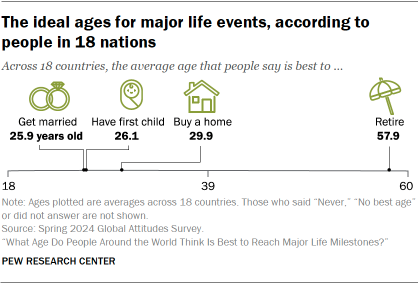
A chart showing The ideal ages for major life events, according to people in 18 nations

On average across the countries surveyed, people say it is best to get married and have a first child around 26 years old. They place the best age for buying a home at just under 30 and the ideal age for retirement at around 58.

And for each of these milestones, the average ages suggested by country are generally no more than a decade apart. For example, country averages for the ideal retirement age range from early 50s to early 60s – that is, 52.1 in Colombia to 62.7 in Nigeria. These averages give us a broad view of differences between countries, but we’re also able to take a closer look within each country at the much wider range of responses people provide.

Countries included in this analysis

We asked these questions about the ideal timing of life events in 18 countries where we conduct our surveys face-to-face: Argentina, Bangladesh, Brazil, Chile, Colombia, Ghana, India, Indonesia, Kenya, Mexico, Nigeria, Peru, the Philippines, South Africa, Sri Lanka, Thailand, Tunisia and Turkey.

In-person interviewing generally allows for greater rapport between the interviewer and respondent, and people are often more comfortable taking longer surveys in this setting.

The countries where we survey face-to-face are generally less wealthy than other nations. The World Bank classifies all countries included in this report (except Chile) as middle-income countries, while the United Nations classifies all 18 as developing economies. The middle-income nations we survey also tend to have younger populations than high-income nations, with a lower median age and life expectancy. Across the 18 countries in this analysis, the median age is 31.2 years, with a median life expectancy of 74.8 years.

Best age to get married

Generally, people across the 18 countries surveyed think it’s best to get married in one’s mid-20s. Average ideal ages range from 21.2 in Bangladesh to 28.9 in Argentina.

More than three-quarters of adults in Bangladesh say the best age for marriage is under 25. India is the only other country where a majority think the best age is under 25.

By contrast, in Argentina, Chile, Colombia, Peru, South Africa and Tunisia, roughly 10% of adults or more say the ideal age for marriage is 35 or older – the highest shares to say this among the countries surveyed. And 10% in Tunisia, 11% in Argentina and 16% in Chile say there is no best age for getting married.

People in the countries surveyed, on average, actually do get married in their 20s, according to data from the United Nations. But there is a gender gap, with women typically marrying at a younger age than men. Our survey finds a similar gender gap in views of the ideal age for marriage: In 14 of 18 countries, women say the best age to get married is slightly earlier in life, compared with men.

Read more in Chapter 1: What is the best age to get married?

And jump to Appendix A for the actual ages at which people around the world marry and become eligible for retirement benefits. 

Best age to become a parent

People across the 18 countries surveyed also largely agree that the best time to have a first child is in one’s mid-20s. Averages range from 23.5 years old in Bangladesh to 29.8 in Tunisia.

A third of adults or more in Bangladesh, India, Kenya and South Africa say it is ideal to have a first child before age 25. Similar shares in Argentina, Chile, Peru, Thailand and Tunisia say the best age to become a parent is 30 or older.

Read more in Chapter 2: What is the best age to have a first child?

Best age to buy a home

There is a little less agreement about what age is best to become a homeowner. Average ideal ages for buying a home range from 24.9 in Brazil to 36.3 in Ghana.

Roughly 20% of adults or more in South Africa, Sri Lanka and across Latin America say the best time to reach this milestone is before age 25. And in 11 countries, at least 10% say the ideal age to buy a home is 40 or older – including in Ghana, where 41% say this.

Read more in Chapter 3: What is the best age to buy a home?

Best age to retire

People across the countries surveyed generally say the ideal age for retirement is in one’s late 50s. Still, views vary somewhat: Colombians say 52.1 is the best age to retire, while Nigerians say it is 62.7, on average.

There are also a wide range of responses within countries. Around 20% of adults in Turkey and Colombia think the best age to retire is under 50, while similar shares in Kenya and Nigeria think the best age is 70 or older.

In most countries, the average ideal age for retirement is younger than the age at which people can start receiving age-based retirement benefits. For example, many people in Mexico may qualify for a pension at age 65, according to data from the International Social Security Association. But Mexican adults say the ideal age to retire is 56.6.

Of course, retirement may not look the same or even be possible for everyone. Many older adults may work informally – such as in agriculture, child care or part-time employment – or may not retire for various reasons. And differences in the labor force across countries may also affect retirement ages and rates.

For instance, Nigerians can start receiving retirement benefits at age 50, which is earlier than most other countries included in this study – yet they give the highest ideal age for this milestone (62.7). This finding may reflect the fact that most employed Nigerians are self-employed (84% in the first quarter of 2024) and thus not eligible for pensions.

Read more in Chapter 4: What is the best age to retire?

What do Americans think is the best age for each milestone?

We asked the same set of questions in the United States, with one major difference. In the non-U.S. countries, where we surveyed face-to-face, people were able to “volunteer” (i.e., spontaneously provide a response that is not among the options given to them) that there is no best age for each milestone. But because people in the U.S. took the survey online, they saw “There is no best age” as a response option.

Large shares of Americans – from about a third to half – say there is no best age for getting married, having a first child, buying a home or retiring. But among those who provided an age, the averages generally look very similar to what we found across the 18 mostly middle-income countries surveyed for this report.

On average, Americans say the ideal age for each life milestone is:

  • Getting married: 26.5
  • Having a child: 27.3
  • Buying a house: 28.8
  • Retiring: 61.8

Democrats and adults under 30 say it is best to get married and have a child slightly later in life, and to retire earlier in life, compared with Republicans and people ages 65 and older.

For more about how Americans answered these questions, read “Best age to get married, have a child, buy a home and retire? Here’s what Americans say”.

Age, gender and other factors affect views of the ideal timing for life events

The age people think is best for a certain milestone varies based on multiple demographic characteristics. A person’s own age is one of the most common contributing factors across countries.
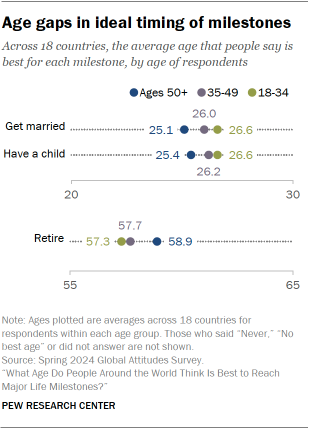
A dot plot showing Age gaps in ideal timing of milestones

Adults under 35 generally believe it is best to get married and have a child slightly later in life, compared with people ages 50 and older. On average across the 18 countries in this analysis, younger adults think 26.6 is the ideal age to get married and the best age to have a child. Older adults say 25.1 is the best age to get married and 25.4 is the best age to have a child.

However, younger adults generally suggest an earlier age for retirement than older adults. Looking across all 18 countries, adults under 35 say the best age for retirement is 57.3, while older adults say the best age is 58.9.

Views in Peru are a good example of this pattern:

  • Getting married: Young adults in Peru say the ideal age for this milestone is 29.6, while older adults say 26.2.
  • Having a child: 27.7 vs. 25.0
  • Retiring: 57.9 vs. 60.4

Older and younger adults in many countries agree on the best age to buy a home. In eight countries, however, younger adults think it is ideal to buy a home slightly earlier in life.

Views of ideal ages for life events also differ by:

  • Gender: In most countries, men give an older ideal age for getting married and having a first child, compared with women.
  • Education: People with more education tend to think it is best to get married and have a child later in life, compared with those who have less education.
  • Importance of religion: People who say religion is very important in their life tend to suggest marriage and parenthood at a younger age, compared with people who say religion is only somewhat, not too or not at all important to them.

Around half of adults across 18 countries say it’s ideal to get married, have a child and own a home by age 30

The average ages that people think are ideal for marriage, parenthood and homeownership generally fall around 30 or younger. But how large is the share of adults who say it is best to do all three by age 30? And do people generally agree on an ideal order for these life events?

A table showing What life milestones should people reach by 30, and in what order

Across the 18 countries surveyed, a median of 53% say the ideal age for reaching all three of these life events is 30 or younger. In Mexico and Sri Lanka, almost three-quarters of adults think it is best to get married, have a child and buy a home by age 30.

Fewer adults in Ghana and Tunisia hold this view; most think it’s best to buy a home later in life.

In half the countries surveyed, the ideal order for these events – based on average ages suggested in the survey – is marriage, then parenthood, then homeownership.

The ideal order in Colombia, Ghana, Mexico and the Philippines is having a child, then getting married, then buying a home.

In Argentina, Chile, Peru and South Africa, the ideal age for having a child is youngest, followed by homeownership, then marriage.

People in Brazil say the best order is buying a home, then getting married, then having a child.

CORRECTION (April 15, 2025): An earlier version of this report included data on women’s mean age at childbearing from the United Nations. We incorrectly reported it as the mean age that women have their first child. The data has been removed, but this change does not affect the overall findings of our survey data.

1. What is the best age to get married?

We asked people in 18 mostly middle-income countries what they think is the best age to get married. On average, respondents say 25.9 years old is the ideal age for marriage. But opinions vary by country.

A chart showing that On average, around 26 is considered the best age for marriage

For instance, Argentine adults say the best age to get married is 28.9 – on the older end when compared with other country averages. People in Chile, Colombia, Peru, South Africa and Tunisia also suggest ages on the older end, saying it is best to marry around 28 years old. 

Conversely, Bangladeshis say it’s best to get married younger – at 21.2 years old, on average. People in India and Indonesia generally agree that the ideal age for marriage is under 25.

The United Nations has global data on when men and women typically get married for the first time. Across the countries included in our analysis, actual ages at first marriage generally fall within the same range as the ideal ages suggested in our survey: between 20 and 29 years old.

Overall, the ideal and actual ages for marriage are positively related. In countries where the age of first marriage is older – Chile, South Africa and Tunisia – people tend to say it is best to get married later in life.

Refer to Appendix A for actual average ages at first marriage in each country.

A set of bar charts showing that the Suggested age for marriage varies both within and across countries

In addition to the average age suggested in each country, we can also look at the distribution of ages people in that country say are ideal for marriage. Here, we see even more variation. 

In Bangladesh for example, a majority of adults say the best age to get married is under 25. The largest share say the ideal age for this life event is between 20 and 24, and the next-largest share say under age 20 is best.

In Peru, however, we measure the opposite pattern. Only 11% of Peruvians say the best age for marriage is under 25. Instead, 39% of respondents think the ideal age is between 30 and 34, and 33% say it’s between 25 and 29. Another 10% say people should wait to get married until age 35 or older.

In Mexico, responses are more evenly distributed: 43% of Mexicans say the best age for marriage is between 25 and 29, while about equal shares say slightly older or slightly younger is ideal.

Generally, people in the Asian countries surveyed suggest younger ages for marriage, while people in the Latin American countries choose older ideal ages.

However, what is seen as the best age for marriage in many countries varies slightly based on some demographic factors.

Views by gender, age, education and religiousness

Men tend to say the best age for marriage is later in life, compared with women. There’s a similar gender gap in the actual ages of men and women at their first marriage.

Older adults generally say the best age to get married is earlier in life, compared with younger adults. In Chile, Colombia, Peru, and Thailand, the average ideal ages suggested by the oldest and youngest respondents differ by about three years. Ghana is the only country where younger adults say it is best to get married slightly earlier in life, compared with older adults.

Views also vary somewhat by education. On average, adults with more education say it is better to get married later in life, compared with those who have less education. This is especially the case across the Latin American countries surveyed.

In 11 countries, people who say religion is very important in their life suggest a younger age for marriage, compared with those who say religion is somewhat or less important to them. 

2. What is the best age to have a first child?

People across the 18 mostly middle-income countries surveyed say, on average, that 26.1 is the best age to have a first child. There is a lot of agreement on this timing, and in most countries, average ideal ages fall between 25 and 27. But there are some that stand out.

A chart showing that Many around the world say the best age to have a first child is around 26

People in Tunisia say the ideal age to have a first child is just under 30, on the higher end of the average ages suggested. And adults in Argentina say it is best to have a child at 27.7 years old.

By comparison, people in Bangladesh and South Africa say the ideal age to have a first child is before 25.

There is generally a lot of agreement within countries, too, about the best age to have a first child.

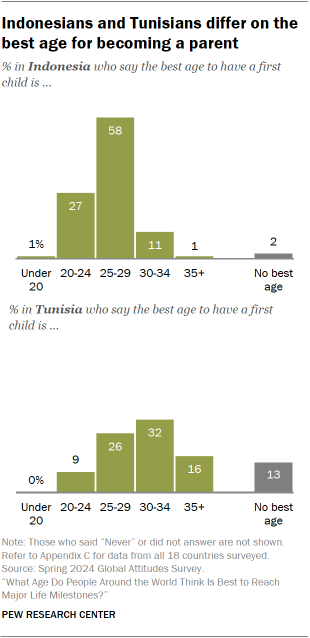
A set of bar charts showing that Indonesians and Tunisians differ on the best age for becoming a parent

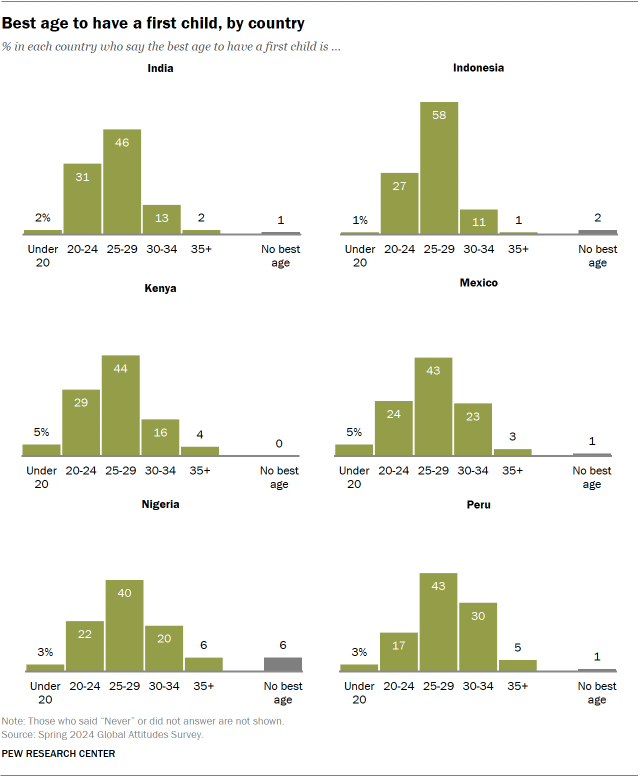
In 12 of the 18 countries surveyed, at least 40% of adults think sometime between the ages of 25 and 29 is ideal. Indonesians show a particular consensus: 58% say the ideal age is in this range; roughly a quarter say between 20 and 24 is best, and very few think it’s ideal to have a first child outside of one’s 20s.

Some countries have much less agreement. Responses in Tunisia, for example, are more evenly spread across age ranges.

Around a third of Tunisian adults think that the best age to have a child is between 30 and 34. And of the countries surveyed, Tunisia has the largest share of people who think age 35 or older is ideal for this milestone (16%).

Views by gender, age and education

Men generally suggest a slightly older ideal age for having a first child than women. The average ages men say are best range from 24.8 in South Africa to 31.4 in Tunisia, while the average ages women choose range from 22.1 in Bangladesh to 28.5 in Tunisia. The Philippines is the only country where men and women agree on the best age for this milestone (25.2).

Views of the best age for having a first child also vary by the age of respondents themselves. In most countries, adults under 35 think it is ideal to have a child slightly later in life, compared with adults ages 50 and older. In Peru, for instance, younger adults think the best age to become a parent is 27.7, while older adults suggest 25.0 (a gap of 2.7 years).

Opinions also vary by education. In 17 of the 18 countries surveyed, adults with more education say is it best to have a first child slightly later in life, compared with those who have less education. The gap is particularly stark in Latin American countries:

  • Chile: The average ideal age suggested by people with more education is 3.5 years older.
  • Argentina: 3.2 years older
  • Mexico: 3.2 years older
  • Colombia: 3.1 years older
  • Peru: 3.0 years older
  • Brazil: 2.6 years older

3. What is the best age to buy a home?

When asked about the ideal age to buy a home, people’s answers vary more than on other milestones we measured.

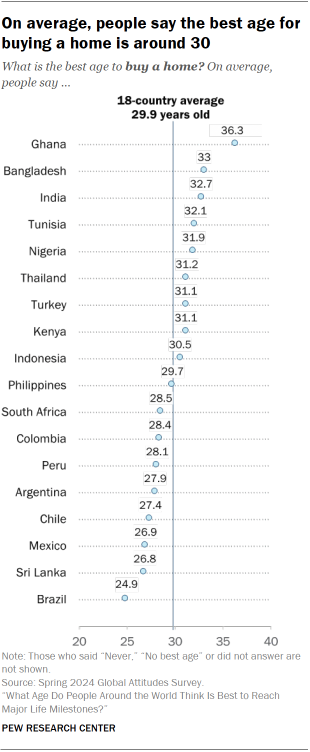
A chart showing that On average, people say the best age for buying a home is around 30

Brazilian adults suggest the youngest age for this life event (saying 24.9 years old is best, on average), while Ghanaian adults suggest the oldest age (36.3). Across the 18 mostly middle-income countries surveyed, people think the best age to buy a home is 29.9.

Adults in other Latin American countries agree with Brazilians that becoming a homeowner before 30 is ideal: People in Chile and Mexico, on average, say the best age for buying a home is around 27, while those in Argentina, Colombia and Peru say it’s around 28.

As on every milestone we asked about, people within each country suggest a variety of ages for this life event.

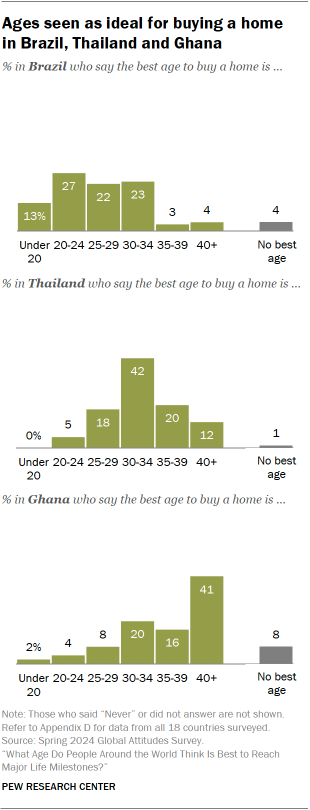
In Brazil, there are three age ranges that around a quarter of adults each see as ideal for first-time homebuying: ages 20 to 24, 25 to 29, and 30 to 34. In addition, 13% of Brazilians say the best time to buy a home is under age 20 – the highest share to say this among the countries surveyed.

A set of bar charts showing that Ages seen as ideal for buying a home in Brazil, Thailand and Ghana

In other countries, there is clearer consensus on the best time in life to buy a home. For instance, 42% of Thai adults think that the best time to reach this milestone is between ages 30 and 34. Roughly one-in-five say the ideal age is 25 to 29, and a similar share say it’s 35 to 39.

Conversely, roughly four-in-ten Ghanaian adults believe the best time to buy a home is at age 40 or older. That’s the highest share to suggest this age range in the survey.

Views by age

In eight out of 18 countries, the ideal age to buy a home differs slightly among younger and older adults. The largest difference is in Kenya, where adults under 35 say the ideal age to buy a home is 30.2, while those ages 50 and older say it’s 32.6.

Notably, there are not consistent education or income differences on this question.

4. What is the best age to retire?

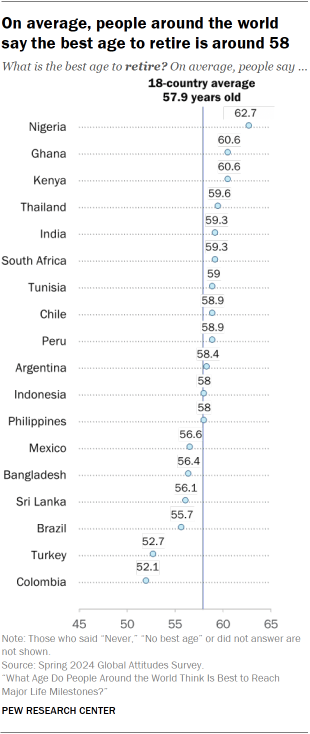
On average across 18 mostly middle-income countries surveyed, the ideal age for retirement is 57.9. Nigerians suggest the oldest ideal age for retirement (62.7, on average). Respondents in Ghana and Kenya also suggest a relatively high age (60.6 in each).

A chart showing that On average, people around the world say the best age to retire is around 58

Colombians give the youngest ideal age, saying 52.1 is the best age to retire. The ideal age is similarly low in Turkey (52.7).

By comparison, the real retirement age – defined here as the age people become eligible for age-related pensions – varies widely across countries. And in most nations surveyed, people say the best age to retire is younger than the age they are first eligible to receive these benefits.

For example, Mexico has one of the highest retirement ages of the countries surveyed: 65 years old. But Mexican adults say the best age for retirement is more than eight years earlier, placing it at 56.6.

There are also countries where the ideal retirement age is older than the actual threshold for receiving benefits. Nigerians, for instance, suggest the oldest ideal age for retirement in the survey, though eligibility for benefits starts at age 50 in Nigeria. People in Ghana, India, Indonesia, Kenya, Sri Lanka and Thailand also say it is best to retire after the age of eligibility.

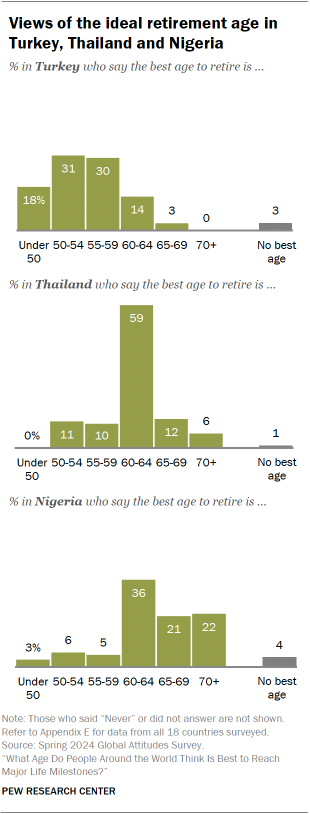
A set of bar charts showing that Views of the ideal retirement age in Turkey, Thailand and Nigeria

Refer to Appendix A for actual ages of eligibility for retirement benefits in each country.

The ideal retirement age also varies within countries. For example, though 31% of Turks say the best age to retire is between 50 and 54, a similar share think it’s between 55 and 59. Roughly one-in-five say it’s best to retire before 50, while 14% say the best age is between 60 and 64.

The preferred retirement age similarly varies in Nigeria, where the best age to retire is placed at 62.7. While about a third say the ideal age is between 60 and 64 (36%), substantial shares think it’s best to retire between 65 and 69 (21%) and at 70 or older (22%).

Views in Thailand are more uniform. A 59% majority say the best age to retire falls between 60 and 64, and roughly equal shares prefer older or younger age ranges.

Views by age and gender

In 11 of 18 countries, adults ages 50 and older prefer an older age for retirement than younger adults (those under 35) do.

Views of the ideal retirement age also vary between men and women in some countries. In seven – Argentina, Bangladesh, Chile, Colombia, Ghana, Mexico and Tunisia – men suggest a higher age than women. The opposite is true in India, Kenya, the Philippines and South Africa, where women suggest a higher age than men.

Notably, responses do not vary by education or income level in most countries surveyed.

Appendix A: Marriage and retirement statistics

To help place the ideal ages provided by respondents in context, we compiled data on when in life people around the world actually get married and become eligible for certain retirement benefits.

A table showing Marriage, childbirth and retirement statistics, by country

Average age at first marriage comes from the United Nations Department of Economic and Social Affairs (DESA), Population Division. Data points come from different years, most recently 2019. Ages are calculated separately for men and women.

In this analysis, we use the minimum age at which people in a country become eligible for age-based pensions as that country’s actual “retirement age.” This information comes from the International Social Security Association. Notably, not everyone who meets a country’s age requirements will be eligible for retirement benefits, including people who may work in informal employment; these people are often not considered part of the labor force.

Appendix B: Best age to get married, by country

A set of bar charts showing Best age to get married, by country, continued

Appendix C: Best age to have a first child, by country

A set of bar charts showing Best age to have a first child, by country, continued

Appendix D: Best age to buy a home, by country

A set of bar charts showing Best age to buy a home, by country, continued

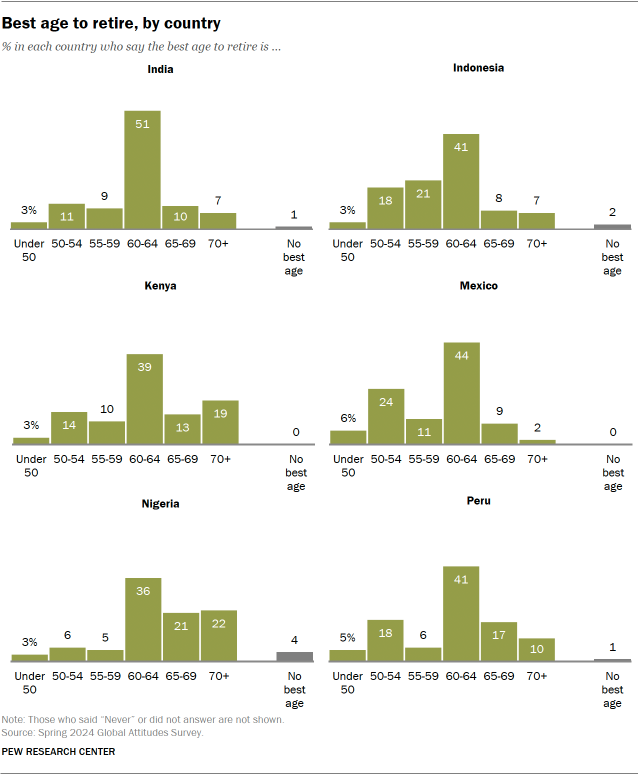
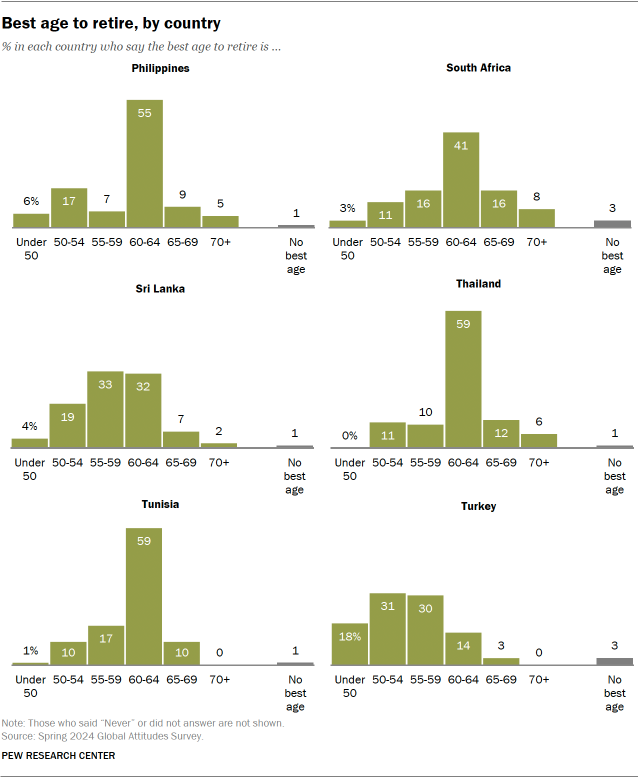
Appendix E: Best age to retire, by country

A set of bar charts showing Best age to retire, by country, continued

Acknowledgments

This report is a collaborative effort based on the input and analysis of the following individuals.

Janell Fetterolf, Senior Researcher
Christine Huang, Research Associate
Jordan Lippert, Research Analyst
Sofia Hernandez Ramones, Research Assistant

Peter Bell, Associate Director, Design and Production
Janakee Chavda, Associate Digital Producer
Laura Clancy, Research Analyst
Manolo Corichi, Research Analyst
Jonathan Evans, Senior Researcher
Moira Fagan, Research Associate
Shannon Greenwood, Digital Production Manager
Sneha Gubbala, Research Analyst
Jenn Hatfield, Writer/Editor
Anna Jackson, Editorial Assistant
Gar Meng Leong, Communications Manager
Kirsten Lesage, Research Associate
Carolyn Lau, International Research Methodologist
John Carlo Mandapat, Information Graphics Designer
William Miner, Research Analyst
Patrick Moynihan, Associate Director, International Research Methods
Georgina Pizzolitto, Research Methodologist
Jacob Poushter, Associate Director, Global Attitudes Research
Andrew Prozorovsky, Research Assistant
Laura Silver, Associate Director, Global Attitudes Research
Sofi Sinozich, International Research Methodologist
Maria Smerkovich, Research Associate
Kelsey Jo Starr, Research Analyst
Brianna Vetter, Administrative Associate
Richard Wike, Director, Global Attitudes Research

We appreciate the following individuals for advising us on strategic outreach: Eugenia Mitchelstein, Associate Professor of Communication at Universidad de San Andrés (Argentina); Naziru Mikail Abubakar, Executive Director and Editor-in-Chief at the Daily Trust (Nigeria); Sebastián Lacunza, Columnist at elDiarioAR.com (Argentina); Anton Harber, Executive Director at the Campaign for Free Expression and Founder of the Mail & Guardian (South Africa); Admire Mare, Associate Professor and Head of Department of Communication and Media Studies, University of Johannesburg (South Africa); and Monicah Waceke Ndungu, Chief Operating Officer, Nation Media Group (Kenya).

Methodology

About Pew Research Center’s Spring 2024 Global Attitudes Survey

Results for the survey are based on face-to-face interviews conducted under the direction of Gallup, Langer Research Associates and Verian. The results are based on national samples, unless otherwise noted. Here are more details about our international survey methodology and country-specific sample designs.