Pew Research Center

FOR RELEASE JANUARY 28, 2025

Comparing Levels of Religious Nationalism Around the World

By global standards, the U.S. has a relatively low level of religious nationalism, but it stands out from other high-income countries

BY Laura Silver, Jonathan Evans, Maria Smerkovich, Sneha Gubbala, Manolo Corichi and William Miner

FOR MEDIA OR OTHER INQUIRIES:

Communications Department
202.419.4372
www.pewresearch.org

RECOMMENDED CITATION

Pew Research Center, January 2025, "Comparing Levels of Religious Nationalism Around the World"

About Pew Research Center

Pew Research Center is a nonpartisan, nonadvocacy fact tank that informs the public about the issues, attitudes and trends shaping the world. It does not take policy positions. The Center conducts public opinion polling, demographic research, computational social science research and other data-driven research. It studies politics and policy; news habits and media; the internet and technology; religion; race and ethnicity; international affairs; social, demographic and economic trends; science; research methodology and data science; and immigration and migration. Pew Research Center is a subsidiary of The Pew Charitable Trusts, its primary funder.

© Pew Research Center 2026

Table of contents

  • About Pew Research Center
  • Comparing Levels of Religious Nationalism Around the World
  • 1. What impact do people around the world think religion has on their society?
  • 2. How important should religion be for a country’s leader?
  • 3. How important is following a specific religion to national belonging?
  • 4. Should religious texts influence national laws?
  • 5. What role should religion play in Muslim- and Jewish-majority countries?
  • Acknowledgments
  • Methodology
  • Appendix: Classifying European political parties

Comparing Levels of Religious Nationalism Around the World

By global standards, the U.S. has a relatively low level of religious nationalism, but it stands out from other high-income countries

How we did this

Pew Research Center conducted this survey to examine the role of religion in public life in 36 countries across the Asia-Pacific region, Europe, Latin America, the Middle East-North Africa region, North America and sub-Saharan Africa. The countries have a variety of historically predominant religions, including Buddhism, Christianity, Hinduism, Islam and Judaism.
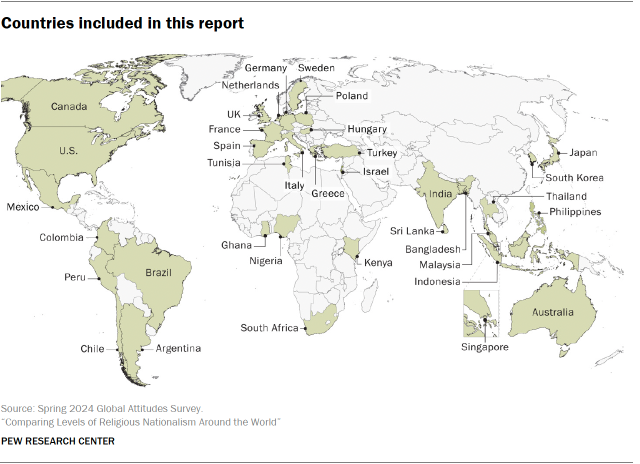
A map showing countries included in this report

For non-U.S. data, this report draws on nationally representative surveys of 41,503 adults conducted from Jan. 5 to May 22, 2024. All surveys were conducted over the phone with adults in Canada, France, Germany, Greece, Italy, Japan, Malaysia, the Netherlands, Singapore, South Korea, Spain, Sweden and the United Kingdom. Surveys were conducted face-to-face in Argentina, Bangladesh, Brazil, Chile, Colombia, Ghana, Hungary, India, Indonesia, Israel, Kenya, Mexico, Nigeria, Peru, the Philippines, Poland, South Africa, Sri Lanka, Thailand, Tunisia and Turkey. In Australia, we used a mixed-mode, probability-based online panel.

In the United States, we surveyed 12,693 adults from Feb. 13 to 25, 2024. Most of the respondents (10,642) are members of Pew Research Center’s American Trends Panel (ATP), an online survey panel recruited through national random sampling of residential addresses, which gives nearly all U.S. adults a chance of selection.

The remaining U.S. respondents (2,051) are members of three other panels: the Ipsos KnowledgePanel, the NORC Amerispeak Panel and the SSRS Opinion Panel. All three are national survey panels recruited through random sampling (not “opt-in” polls). We used these additional panels to ensure that the survey would have enough Jewish and Muslim respondents to be able to report on their views.

Additional survey questions were asked on a follow-up survey conducted from April 1 to 7, 2024, among 3,600 ATP members who had previously participated in the February survey.

The U.S. data is weighted to be representative of the U.S. adult population by gender, race, ethnicity, partisan affiliation, education, religious affiliation and other categories. Read more about the ATP’s methodology.

Throughout the report, we analyze respondents’ attitudes based on where they place themselves on an ideological scale, their support for populist parties, their religious identification, their educational attainment, their income, and whether they live in high- or middle-income countries. For more on each of these measures, visit the methodology.

Religious nationalism index

In this report, we classify some people as “religious nationalists.” Scholars do not fully agree on how to define religious nationalism, and the challenge is even more complicated when one tries to study the concept in multiple countries – and for multiple religious groups – concurrently. For example, scholars who measure Christian nationalism in the U.S. may consider whether the government should allow prayer in public schools, while those measuring Hindu nationalism in India may consider whether the government should regulate the protection of cows, which are sacred to many Hindus.

For the purpose of making cross-national comparisons, we focused on two concepts in our definition of religious nationalism:

  • How important people think identifying with the country’s historically predominant religion is for belonging – e.g., for being “truly” part of the country’s nationality
  • The role people want religion to play in their country’s leader and laws

We measured these two concepts among followers of each country’s historically predominant religion using four questions. For more information on how we designed our religious nationalism index and assessed its statistical reliability, go to the methodology.

This analysis was produced by Pew Research Center as part of the Pew-Templeton Global Religious Futures project, which analyzes religious change and its impact on societies around the world. Funding for the Global Religious Futures project comes from The Pew Charitable Trusts and the John Templeton Foundation (grant 63095). This publication does not necessarily reflect the views of the John Templeton Foundation.

Here are the questions used for this report, along with responses, and the survey methodology.

In many countries, religion and politics are deeply intertwined. The belief that a country’s historically predominant religion should be a central part of its national identity and drive policymaking is sometimes described as “religious nationalism.”

A wide range of movements have been described as religious nationalism, including in India, where Prime Minister Narendra Modi has campaigned and governed on the idea that Hindu faith and culture should shape government policies; and in Israel, where Prime Minister Benjamin Netanyahu is backed by a coalition that includes ultra-Orthodox and national religious parties.

But there is no universally accepted definition of religious nationalism, leaving lots of room for debate over who is, say, a Christian nationalist or a Hindu nationalist. This has made it difficult to assess how common such views are around the world.

To help fill this gap, Pew Research Center set out to measure – in an impartial, consistent way – what share of people in different countries view the dominant religious tradition as central to their national identity, want their leaders to share their religious beliefs, and want religious teachings to guide their laws.

We asked four key questions in nationally representative surveys of nearly 55,000 people, conducted from January to May 2024 in three dozen countries1:

  • How important is belonging to the historically predominant religion to being truly part of your national identity? (For example, how important is being a Muslim to being truly Indonesian, or being a Christian to being truly American?)
  • How important is it to you for your national leader to share your religious beliefs?
  • How much influence do you think the historically predominant religion’s sacred text should have on the laws of your country? (For example, how much influence should the Quran have on the laws of Turkey, or should the Bible have on the laws of Italy?)
  • When the sacred text conflicts with the will of the people, which should have more influence on the laws of your country? (This follow-up question was asked only of respondents who answered the previous question by saying that the sacred text should have a “fair amount” or “great deal” of influence on their country’s laws.)
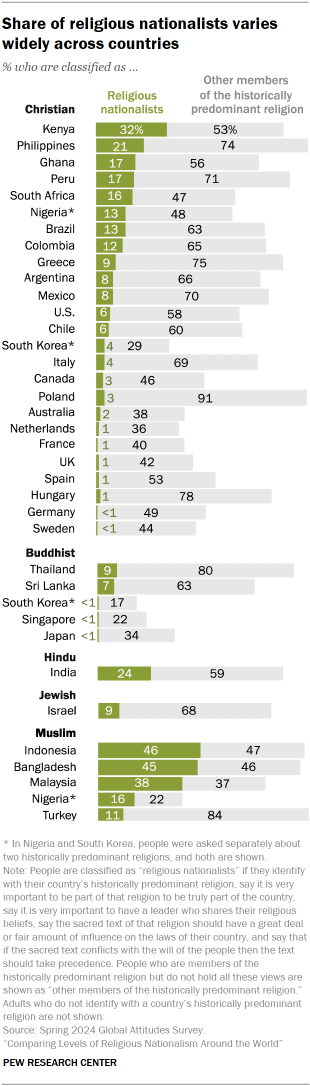
A bar chart showing that the Share of religious nationalists varies widely across countries

For this report, we define “religious nationalists” as people who identify with the historically predominant religion (also often the majority religion) and take a strongly religious position on all four of these questions.

In Turkey, for example, a religious nationalist would be a Muslim who says …

  • Being a Muslim is very important to being truly Turkish;
  • And it is very important that Turkey’s president shares their religious beliefs;
  • And the Quran should have at least a fair amount of influence over Turkey’s laws;
  • And when the Quran conflicts with the will of the people, the Quran should have more influence.

In Israel, a religious nationalist would be a Jew who says …

  • Being a Jew is very important to being truly Israeli;
  • And it is very important that Israel’s prime minister shares their religious beliefs;
  • And Jewish scripture should have at least a fair amount of influence over Israel’s laws;
  • And when Jewish scripture conflicts with the will of the people, Jewish scripture should have more influence.

In the United States, a religious nationalist would be a Christian who says …

  • Being a Christian is very important to being truly American;
  • And it is very important that the U.S. president shares their religious beliefs;
  • And the Bible should have at least some influence over U.S. laws;
  • And when the Bible conflicts with the will of the people, the Bible should have more influence.

Using this definition, the prevalence of religious nationalism varies widely across the 35 countries where we asked all four of these questions. Fewer than 1% of adults surveyed meet the criteria in Germany and Sweden, compared with more than four-in-ten in Indonesia (46%) and Bangladesh (45%).

In this global perspective, the U.S. does not stand out for especially high levels of religious nationalism.

Just 6% of U.S. adults are religious nationalists by the combination of these four measures, about the same level as several other countries surveyed in the Americas, such as Chile (6%), Mexico (8%) and Argentina (8%).Canada has a relatively low share of religious nationalists (3%), while Colombia (12%), Brazil (13%) and Peru (17%) have somewhat higher shares.

How we asked about different religions and religious texts

We asked people in 36 countries about the importance of being a member of a particular religion as well as the influence of specific religious texts on their national laws.

In each country, we selected the historically predominant religion(s) and corresponding sacred text(s). For example, in the United States, where Christianity has long been the majority religion, we asked about the importance of being a Christian to being truly American and about the influence of the Bible on U.S. laws. In Thailand, where the vast majority of the population is Buddhist, we asked about the importance of being a Buddhist to being truly Thai. And, because the concept of “religious texts” is somewhat more relevant in Western religious traditions, we asked about a comparable concept: the influence of Buddhist dharma on the country’s laws.

In Japan, Nigeria and South Korea, we asked all respondents separately about two religions and the influence of their religious texts. In Japan, we asked about Buddhism and Buddhist dharma as well as Shinto and Shinto teachings. A significant portion of the population there identifies as Buddhist, but Shinto has long been tied to national identity, and a quarter of Japanese adults say they feel a personal connection to the Shinto way of life.

In Nigeria, where large shares of the population identify as either Christian or Muslim, we asked about both of those religions, and about the influence of the Bible and the Quran. In South Korea, because sizable shares identify as either Christian or Buddhist, we asked about both religions, and about the Bible and Buddhist dharma.

The questions about the Quran were not asked in Tunisia, so that country is excluded from our analyses of religious nationalism and the influence of religious texts.

Here is a list of the religions and religious texts asked in each country:

ReligionReligious textCountry
ChristianityBibleUnited States, Canada, France, Germany, Greece, Hungary, Italy, Netherlands, Poland, Spain, Sweden, UK, Australia, Philippines, South Korea, Ghana, Kenya, Nigeria, South Africa, Argentina, Brazil, Chile, Colombia, Peru
CatholicismBibleMexico
IslamQuranBangladesh, Indonesia, Malaysia, Nigeria, Turkey, Tunisia
BuddhismBuddhist dharmaJapan, Singapore, South Korea, Sri Lanka, Thailand
HinduismHindu teachingsIndia
JudaismJewish scriptureIsrael
ShintoShinto teachingsJapan

CORRECTION (Feb. 6, 2026): Due to a translation error identified after publication, the question (Q34/Q36a) on the Mexico survey asked about the importance of being “Catholic” rather than being “Christian.” Refer to the errata for more information. Care should be taken when directly comparing Mexico to other countries on this question.

How this survey’s findings relate to other measures in the U.S.

There are many ways to define religious nationalism. In the U.S., previous Pew Research Center surveys have asked numerous questions about “Christian nationalism” and separation of church and state. A February 2024 survey, for example, found that 5% of U.S. adults have heard of Christian nationalism and view it favorably. And 13% said the federal government should declare Christianity the official religion of the United States.

Here’s how religious nationalists in the U.S. – as defined in the global survey – answer some of these related questions:

  • 53% of religious nationalists think the federal government should declare Christianity the official religion of the United States. Another 40% of religious nationalists think the federal government should promote Christian values but not declare Christianity the official religion. Only 4% of religious nationalists think the federal government should neither declare Christianity the official religion nor promote Christian values. By contrast, just 15% of U.S. Christians who are not religious nationalists want Christianity to be the official religion of the United States.
  • 84% of religious nationalists in the U.S. think liberals who are not religious have gone too far in trying to keep religious values out of the government and public schools. About six-in-ten Christians who are not religious nationalists (61%) say the same.

Ultimately, more Americans may support individual policies sometimes associated with Christian nationalism than the 6% classified as religious nationalists in this report. This stems from the high bar of needing to take a specific position on all four measures included in our index to be classified as a religious nationalist.

For more on religious nationalism in the U.S., read these Center publications:
  • 45% of Americans Say U.S. Should be a ‘Christian Nation’
  • A closer look at Americans who believe the U.S. should be a Christian nation
  • 8 in 10 Americans Say Religion Is Losing Influence in Public Life
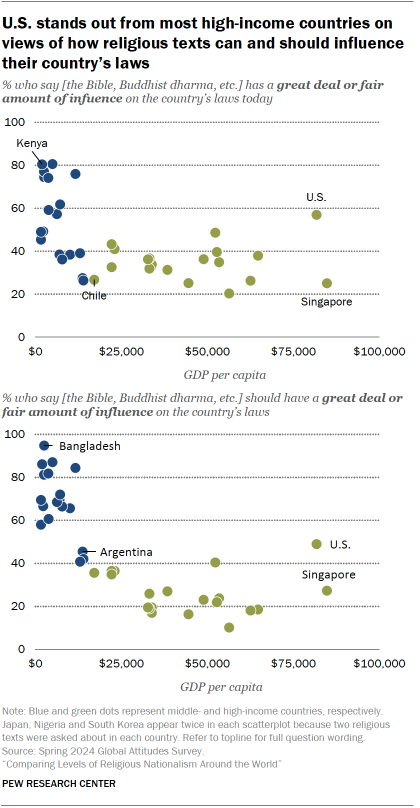
A dot plot showing that the U.S. stands out from most high-income countries on views of how religious texts can and should influence their country’s laws

However, the U.S. does stand out when compared with other high-income countries, particularly on questions about religious texts. U.S. adults are more likely than people in any other high-income country surveyed to say the Bible currently has either a great deal or some influence over the laws of their country (in other countries, people were asked about other texts).

And the U.S. public is also more inclined than people in other high-income countries to say that the Bible should have that kind of influence (again, relative to the sacred texts asked about in other places).

Americans are also among the most likely of any high-income public to:

  • Describe a religious identity (in this case, being a Christian) as very important to truly sharing in the national identity (being American)
  • Say it’s very important for their country’s political leader to have strong religious beliefs

Differences between wealthy and less wealthy countries

Why high- and middle-income countries?

Decades of scholarship have explored the relationship between economic development and secularization. One influential notion argues that as societies get wealthier and people feel more secure, religion and religious values become less important in people’s lives and they become more supportive of secular-rational values.

While secularization theory has many detractors and continues to be debated, the general pattern – that wealthier countries tend to see belief in God as less important for morality and that wealthier countries have lower rates of prayer – is one we have observed in our data for decades.

As a result, we analyze the data in this report in part according to each country’s income status, using high- and middle-income categories from the World Bank. The high-income countries have larger percentages of people who are religiously unaffiliated (atheist, agnostic or “nothing in particular”). They are also more likely than middle-income countries to have:

  • Highly established democracies. High-income countries are more likely to be classified as “full” democracies by the Economist Intelligence Unit (EIU), “high performing” by International IDEA, “free” by Freedom House, and “liberal” by Varieties of Democracy (V-Dem).
  • High rates of advanced education. High-income countries, on average, have more than double the share of the total population who have attained a tertiary education (such as a postgraduate degree).
A map of Countries included in this report, by income level
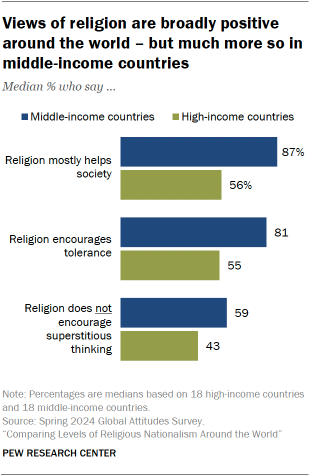
A bar chart showing that Views of religion are broadly positive around the world – but much more so in middle-income countries

The survey shows that, in general, high-income countries differ sharply from middle-income countries (as defined by the World Bank) when it comes to public attitudes about religion.

People in middle-income countries are more likely than people in richer countries to say:

  • Religion does more good than harm for society
  • Religion encourages tolerance rather than intolerance
  • Religion does not encourage superstitious thinking

Jump to Chapter 1 for more on how people around the world view religion’s role in society.

These differences are related to levels of religiousness. People who live in middle-income countries are more likely than people in high-income countries to have a religious affiliation, to pray regularly and to say religion is important in their lives.
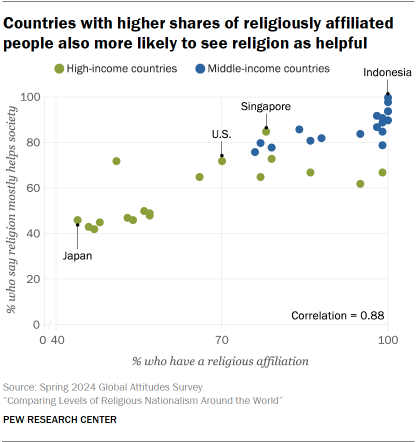
A dot plot showing that Countries with higher shares of religiously affiliated people also more likely to see religion as helpful

Religious people tend to favor a role for religion in public life. So it stands to reason that in countries where more people follow a religion, religion is more likely to be seen as a positive influence in society.

For example, in Bangladesh – where about nine-in-ten adults are Muslim – 94% say religion mostly helps society. But in Sweden – where fewer than half of adults surveyed (47%) have a religious affiliation – 42% say religion is helpful.

People in middle- and high-income countries also differ over the role they think religion should play in public life.

For example, in many middle-income countries, majorities want religious texts like the Bible or the Quran to have either a great deal or a fair amount of influence on their country’s laws. By contrast, in most high-income countries surveyed, only a minority of adults want religious texts to play this role.

In some wealthier countries, people also tend to prioritize the will of the people over religious texts when the two conflict. In middle-income countries, the opposite is true.

Jump to Chapter 4 for more on views of the role religious texts can and should play.

People in middle-income countries are also more likely than those in high-income countries to say it’s very important for the leader of their country to have religious beliefs that are the same as their own (and to have strong religious beliefs, period).

Jump to Chapter 2 for more on views of national leaders and their religious traits.

Religion plays more of a role in national identity in the middle-income countries than the high-income countries surveyed. While comparatively few people in most high-income countries say that sharing the country’s historically predominant religion is very important for being “truly” part of that nation, half or more in most middle-income countries see religion as a key part of national belonging.

Jump to Chapter 3 for more on religion and national identity.

People in middle-income countries are also more likely to be religious nationalists. Religious nationalists do not make up a majority of the population in any country surveyed. But in 13 of the 17 middle-income countries surveyed (since Tunisia is not included in our analysis of religious nationalism), there are double-digit shares of religious nationalists. These shares reach around a third or more in Kenya (32%), Malaysia (38%), Bangladesh (45%) and Indonesia (46%).

In most high-income countries, there are fewer religious nationalists. Indeed, in nine of the 18 high-income countries surveyed, 1% or less of the public meets the criteria. While the shares are somewhat higher in a few countries – 9% in Greece and Israel, for example – in no high-income country do religious nationalists make up a double-digit percentage of the overall public.

Demographics of religious nationalism

In many countries, people who pray daily are more likely than those who pray less frequently to be religious nationalists (under the definition used for this report). For example, in India, 27% of people who say they pray at least once a day are religious nationalists, compared with 17% of those who pray less frequently.

Older people in some countries are somewhat more likely than younger people to be religious nationalists. In Greece, 13% of people ages 50 and older are religious nationalists, compared with 8% of those ages 35 to 49 and only 1% of adults under 35.

In many countries, people with lower levels of education are also somewhat more likely to be religious nationalists than those with higher levels of education. In Kenya, 38% of people with less than a secondary degree are religious nationalists, compared with 22% of those with a secondary degree or more education.

In a few countries, people with lower incomes are more likely than those with higher incomes to be religious nationalists. This is the case in Brazil, where 17% of respondents with incomes at or below the median are religious nationalists, compared with 9% of those with higher incomes.

A dot plot showing that People on the ideological right are slightly more likely to be religious nationalists in many countries

In addition, people who place themselves on the ideological right are more likely to be religious nationalists than those in the center or on the left in many countries where the survey asked about political ideology. In Poland, for example, 8% of people on the right are religious nationalists, compared with 1% or fewer in the center and on the left.

In Europe, people with favorable views of several right-wing populist parties are also somewhat more likely than people with unfavorable views of those parties to be religious nationalists. (For more on how these parties were defined, refer to the Appendix.) Returning to the example of Poland, 10% of adults who hold a favorable view of the Law and Justice party (PiS) are religious nationalists, compared with 1% of those who see PiS unfavorably.

(Of course, in the case of ideology and party favorability, the relationship could also be reversed. That is, people who hold certain beliefs about religious nationalism may be more likely to have favorable views of specific right-wing populist parties or to place themselves on the right of the ideological spectrum than those who do not hold those beliefs.)

In Israel, Haredi and Dati Jews (33%) are much more likely than Masorti Jews (5%) and Hiloni Jews (1%) to be religious nationalists. (Because of sample size considerations, we combine Haredim and Datiim for analysis in this report.)

Jewish religious groups in Israel: Haredim, Datiim, Masortim and Hilonim

Nearly all Israeli Jews identify as either Haredi (commonly translated as “ultra-Orthodox”), Dati (“religious”), Masorti (“traditional”) or Hiloni (“secular”). The spectrum of religious observance in Israel – on which Haredim are generally the most religious and Hilonim the least – does not always line up perfectly with Israel’s political spectrum.

On some issues, including those pertaining to religion in public life, there is a clear overlap: Haredim are furthest to the right, and Hilonim are furthest to the left, with Datiim and Masortim in between. But on other political issues, including those related to the Israeli-Palestinian conflict and views of the United States, differences between religious groups do not always mirror those between people at different points on the ideological spectrum.

Because of sample size considerations, we combine Haredim and Datiim for analysis in this report.

For more information on the different views of these religious groups, read the Center’s 2016 deep dive on the topic, “Israel’s Religiously Divided Society.”

Can states have a religious character and be democratic?
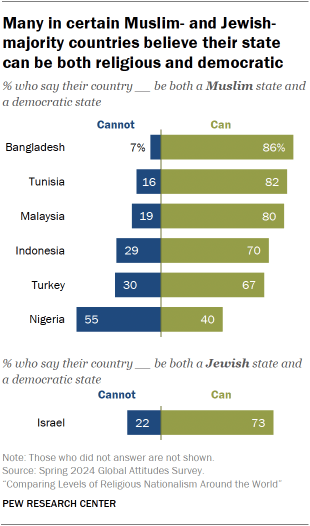
A bar chart showing that Many in certain Muslim- and Jewish- majority countries believe their state can be both religious and democratic

In a number of countries with sizable Muslim and Jewish populations, we also asked whether their country can be both democratic and a Muslim or Jewish country.

In countries with Muslim majorities, most do think the state can be both democratic and Muslim. The shares who believe this are particularly high in Bangladesh (86%), Tunisia (82%) and Malaysia (80%). (Islam is the official state religion in Bangladesh and Malaysia, and it was the official religion in Tunisia until 2022).

Slightly smaller majorities in Indonesia (70%) and Turkey (67%) agree that their country can be both Muslim and democratic at the same time. But in Nigeria – where Muslims are not the overwhelming majority of the population – only 40% think Nigeria can be both a Muslim state and a democratic state.

Israel defines itself as “Jewish and democratic,” and indeed, 73% of adults surveyed in Israel agree their country can be both. Only about a quarter say the country cannot be a Jewish state and a democratic state at the same time. Still, there are major differences by religion, as well as among Jewish religious groups.

Jump to Chapter 5 for more on the role religion should play in Muslim- and Jewish-majority countries.

These are among the key findings of a 36-country survey conducted by Pew Research Center in the first five months of 2024. This report includes chapters that explore the following questions:

  • What impact do people around the world think religion has on their society? (Chapter 1)
  • How important should religion be for a country’s leader? (Chapter 2)
  • How important is following a specific religion to national belonging? (Chapter 3)
  • Should religious texts influence national laws? (Chapter 4)
  • What role should religion play in Muslim- and Jewish-majority countries? (Chapter 5)

CORRECTION (June 5, 2025): The topline for this report has been updated. The changes do not substantively affect the findings of this report. Refer to the errata for more information.

CORRECTION (Feb. 6, 2026): Due to a translation error identified after publication, the question (Q34/Q36a) on the Mexico survey asked about the importance of being “Catholic” rather than being “Christian.” Refer to the errata for more information. Care should be taken when directly comparing Mexico to other countries on this question.

1. What impact do people around the world think religion has on their society?

Large shares of adults in most of the 36 countries we surveyed say religion helps society rather than harms it.2 Most also say religion encourages tolerance, not intolerance. But people are slightly more divided about whether religion encourages superstitious thinking.

Religion is generally seen more positively by:

  • People in middle-income countries, compared with those in high-income countries
  • Religiously affiliated people, compared with those who are unaffiliated
  • People who say they pray daily, compared with those who pray less often

Does religion help society?

Views of religion’s impact on society are broadly positive. A 36-country median of 77% say religion mostly helps society, while a median of 19% say it mostly hurts.

Views are particularly positive in parts of Asia, the Middle East and Africa. For example, at least 90% of adults surveyed in Bangladesh, Indonesia, Kenya, Malaysia, Sri Lanka, Thailand and Tunisia say religion helps society.

A bar chart showing that Majorities in most countries see religion as helpful to society

Elsewhere, people are somewhat more divided. Around six-in-ten or more adults in some high-income countries – Chile, Greece, Hungary, Israel, Italy, Poland, Singapore, South Korea and the U.S. – see religion as a positive force. But in Australia, the Netherlands, Sweden and the United Kingdom, around half or more say religion hurts society.

Does religion encourage tolerance?

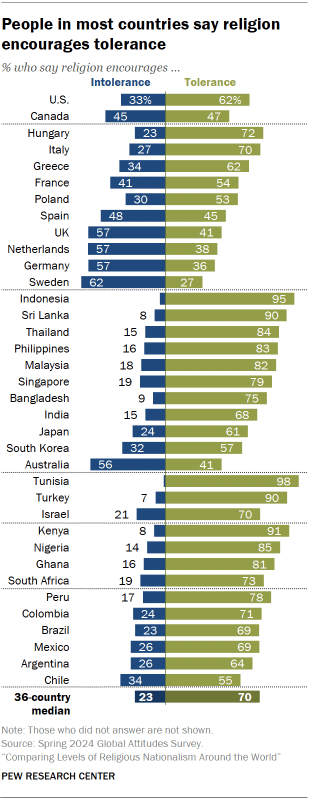
People also broadly view religion as encouraging tolerance rather than intolerance.

Adults in middle-income countries have more positive views of religion than adults in high-income countries. Nearly all Tunisians (98%) and Indonesians (95%) say religion encourages tolerance. So do majorities across most countries surveyed in South and Southeast Asia, Latin America, and sub-Saharan Africa.

A bar chart showing that People in most countries say religion encourages tolerance

High-income nations are divided on whether religion encourages tolerance or intolerance. Large shares in some high-income countries, including Singapore (79%), Hungary (72%), Italy (70%) and Israel (70%), say religion encourages tolerance. At the same time, small majorities in Sweden (62%), Germany (57%), the Netherlands (57%), the UK (57%) and Australia (56%) say religion encourages intolerance.

Does religion encourage superstitious thinking?

A bar chart showing that Publics are divided over whether religion encourages superstitious thinking

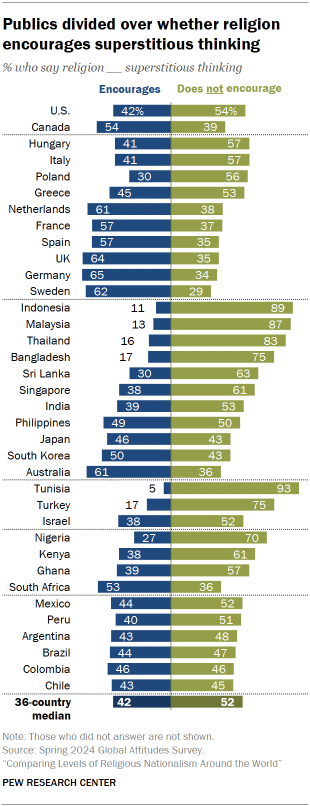
Globally, people are more divided when it comes to whether religion encourages superstition. A 36-country median of 52% say religion does not encourage superstition, while 42% say it does.

While people in middle-income countries are relatively more positive about religion’s impact on superstitious thinking than those in high-income ones, the gap is less pronounced than on the other two questions about religion’s impact on society.

For example, three-quarters of adults or more in middle-income countries like Bangladesh, Indonesia, Malaysia, Thailand, Tunisia and Turkey say religion does not encourage superstitious thinking. But in other middle-income countries – such as Argentina, Brazil, Colombia and the Philippines – views of religion’s impact are more evenly divided.

Among the high-income countries, Hungary, Italy, Poland and Singapore stand out as the only places where majorities say religion does not encourage superstition. In the other high-income countries surveyed, much smaller shares say this. And majorities in Australia, France, Germany, the Netherlands, Spain, Sweden and the UK say religion encourages superstition.

How do views of religion’s impact on society differ?

A dot plot showing that Adults who pray daily more likely than others to say religion helps society

Overall, people who pray at least daily are more positive about the impact of religion on society than those who pray less often. This is consistent across all three of the questions about religion and public life discussed in this chapter.

Similarly, people who say they belong to a religion themselves also tend to see religion in more positive terms – again, across all three questions – than those who are religiously unaffiliated (those who identify as atheist, agnostic or “nothing in particular”).

Views by religiousness

People who say they pray daily are more likely than others to say religion helps society, encourages tolerance and does not encourage superstitious thinking. In many cases, these differences are sizable. For example, 85% of Australians who pray at least once a day say religion mostly helps society, compared with 37% of Australians who pray less frequently.

These differences tend to be particularly large in less religious, high-income countries like the Netherlands and France. The differences are generally less pronounced or not significant in highly religious, middle-income countries like Bangladesh and Malaysia.

Views by religion

A dot plot showing that Religiously unaffiliated are less likely than religiously affiliated people to say religion encourages tolerance

The religiously affiliated tend to be more positive about religion than the unaffiliated in all countries where this analysis is possible – and across all questions asked about religion’s impact on society. For example, in Peru, 82% of Christians say religion encourages tolerance, compared with 53% of Peruvians who do not have a religious affiliation.

Peru exemplifies another pattern: In some middle-income countries, even the unaffiliated express mostly positive views of religion.

Across the 36 countries surveyed, certain religious groups stand out. Muslims are generally the most likely to say religion helps society, encourages tolerance and does not encourage superstition. For example, nearly all Muslims in Tunisia (99%) and Indonesia (95%) say religion encourages tolerance.

But it’s also the case in countries where Muslims are in the minority:

  • Muslim Israelis are more likely than Jewish Israelis to say religion encourages tolerance and helps society.
  • In the U.S., both Muslims (83%) and Christians (77%) overwhelmingly agree that religion encourages tolerance, compared with 52% of Jewish Americans and 32% of religiously unaffiliated Americans.
  • In India, similar majorities of Hindus and Muslims say that religion encourages tolerance.

Only in Sri Lanka are Muslims significantly less likely than other religious groups to say religion encourages tolerance, even though a large majority of Sri Lankan Muslims (75%) take this position.

Particularly in the Sub-Saharan African, Latin American and Asia-Pacific countries surveyed, large majorities of Christians also generally say religion helps society and encourages tolerance. For example, 96% of South Korean Christians say religion mostly helps society.

In some European countries, though, Christians are less positive about religion’s role in society – even if they remain more positive than unaffiliated people. In Sweden, only about one-third of Christians say religion encourages tolerance, and 54% of Swedish Christians say religion encourages intolerance.

Buddhists across Southeast Asia overwhelmingly say religion helps society and encourages tolerance. This is especially the case in Sri Lanka, where at least nine-in-ten Buddhists agree with each statement. Smaller majorities of Buddhists in South Korea and Japan say the same.

Hindus in Bangladesh are more likely to say religion helps society (95%) and doesn’t encourage superstitious thinking (70%) than are Indian Hindus (78% and 53%, respectively). However, India’s Hindu majority is similar to Bangladesh’s Hindu minority on the belief that religion encourages tolerance (68% vs. 62%).

Views by age

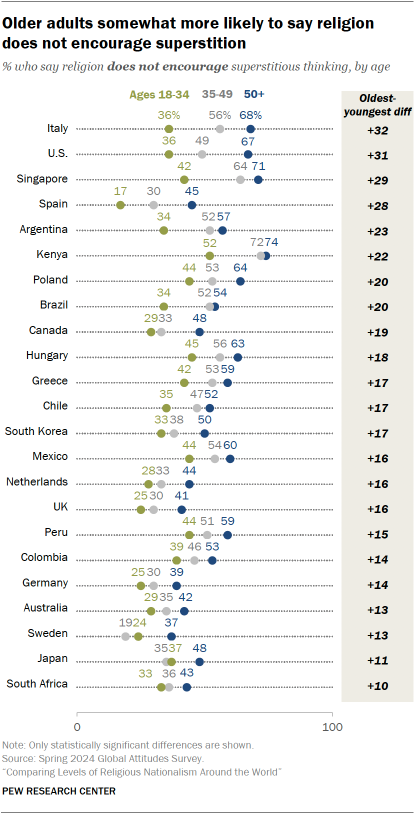
A dot plot showing that Older adults somewhat more likely to say religion does not encourage superstition

Older people are more likely than younger people to dismiss a connection between religion and superstition. This is true in more than half of the countries surveyed, and the pattern is more common in Latin America and Europe than in other regions. But age differences are somewhat muted when it comes to whether religion helps society and whether it increases tolerance.

Some of these age differences are also related to differences in religiousness, as younger adults tend to be less religiously observant in many countries.

2. How important should religion be for a country’s leader?

When asked about their national leader’s connection to religion, people are generally more likely to say it is very important to have a leader of their country who stands up for people with their religious beliefs than to have a leader whose religious beliefs are the same as their own, or to have a leader who has strong religious beliefs even if they are not the same as their own.3

In Kenya, for instance, 62% of adults say it is very important to have a president who stands up for people with their religious beliefs. Meanwhile, 55% of Kenyans say it is very important for their president to share their religious beliefs. And 54% of Kenyans say it is very important to have a president who has strong religious beliefs, even if those beliefs differ from their own.

People in middle-income countries tend to be more likely than people in high-income countries to say each of these things is very important in a national leader.

A table showing that In many countries, a leader standing up for people’s religious beliefs is seen as more important than a leader sharing one’s own religious beliefs

Views of these qualities are tied to how people otherwise engage with religion:

  • Those who are affiliated with a religion (such as Christianity) are consistently more likely than the religiously unaffiliated to say each trait is very important for their country’s leader to have.
  • People who pray daily are more likely than people who pray less often to view these traits as very important.
  • Adults who think religion helps society are more likely than those who think religion hurts society to say these religion-related traits are very important in a national leader.

How important is it to have leaders who stand up for people’s religious beliefs?

A bar chart showing that Many say it’s important to have a leader who stands up for people with their religious beliefs

A median of 30% across the 35 countries where we asked this question think having a leader who stands up for people with their religious beliefs is very important. People in middle-income countries are considerably more likely to say this than people in high-income countries.

For example, in Bangladesh and Indonesia, around seven-in-ten adults say it’s very important to have a prime minister or president, respectively, who stands up for people who share their beliefs. Large shares in several other South and Southeast Asian countries also say this is very important, as do about half of adults or more in the African nations surveyed.

In many high-income countries, though, fewer tend to say it’s very important to have a leader who stands up for people with their religious beliefs. Only 11% of adults in France and 5% in Japan say this trait is very important in their president or prime minister, respectively.

And 51% of Spanish adults say it is not at all important to have a prime minster who stands up for people with their religious beliefs.

Chile, Israel and the U.S. stand out among the high-income countries surveyed. In all three, about three-in-ten adults say it is very important that their national leader stands up for people with their religious beliefs.

Views by education

Across many of the surveyed countries, people who have lower levels of education are more likely than those with higher levels of education to say it is very important to have a leader who stands up for people with their religious beliefs. (This difference persists even after statistically controlling for religiousness.)

A dot plot showing that Adults with less education more likely to see importance in having a leader who stands up for people’s religious beliefs

In Turkey, for example, 61% of adults with lower levels of education say it is very important to have a president who stands up for people with their religious beliefs. This share falls to 37% among Turkish adults who have higher levels of education.

How important is it to have leaders who share people’s religious beliefs?

A bar chart showing that People differ over the importance of having a leader who shares their own religious beliefs

We also asked people whether it’s important that their national leader have the same religious beliefs as they do. A 35-country median of 22% say this is very important.

Adults in the 17 middle-income countries (48% median) are generally more likely than adults in the 18 high-income countries (10% median) to say having a leader who shares their religious beliefs is very important. Majorities in six middle-income countries say this, including about three-quarters of adults in Bangladesh and Indonesia.

Meanwhile, in every high-income country surveyed, about a quarter of the public or less take this position. For instance, 12% of U.S. adults say it is very important to have a president who shares their religious beliefs.

And in eight high-income countries, half or more say it is not at all important that their leader have the same religious beliefs they do. In Sweden, the share holding this view reaches 68%.

Europeans who support right-wing populist parties are more likely than nonsupporters to say a leader having the same religious beliefs as them is very important. (For more on populist parties, refer to the Appendix.) In Germany, 17% of those who express a favorable opinion of Alternative for Germany (AfD) say this is a very important trait for their chancellor to have, while only 6% of Germans with an unfavorable view of AfD agree.

As with other attitudes discussed in this chapter, adults with less education are more likely than those with higher levels of education to say it is very important that their leader have the same beliefs as they do.

Views by religion

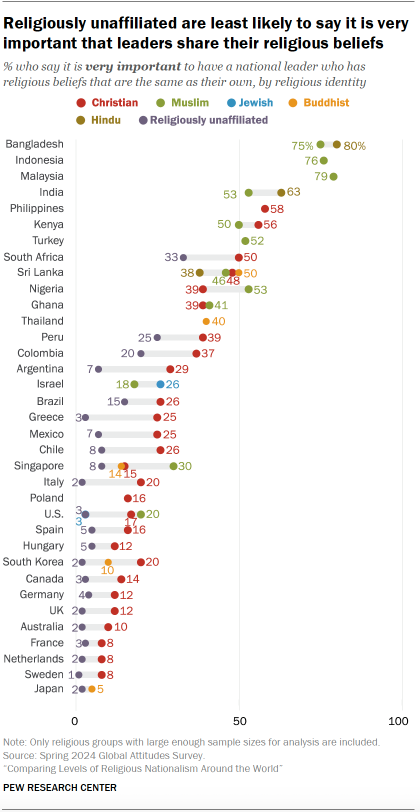
A dot plot showing that Religiously unaffiliated are least likely to say it is very important that leaders share their religious beliefs

Adults who are affiliated with a religion are consistently more likely than the religiously unaffiliated (those who identify as atheist, agnostic or “nothing in particular”) to say it is very important to have a national leader who shares their same religious beliefs.

This dynamic is readily apparent in countries that have sizable populations of both Christians and religiously unaffiliated people. In Chile, for example, Christians are about three times as likely as the unaffiliated to say having a president with the same beliefs as them is very important (26% vs. 8%).

In a few middle-income countries, though, religiously unaffiliated adults are more likely than the religiously affiliated in high-income countries to say this is a very important trait for their national leader to have.

For instance, 33% of unaffiliated adults in middle-income South Africa say it is very important to have a president who shares their religious beliefs. This surpasses the percentage of Christians who say this about national leaders in high-income South Korea (20%), Poland (16%) and France (8%).

Muslims in the surveyed countries tend to be among the most likely to say it is very important to have a leader who shares their religious beliefs. But in India, Hindus are more likely than Muslims to hold this view (63% vs. 53%).

How important is it to have leaders with strong religious beliefs?

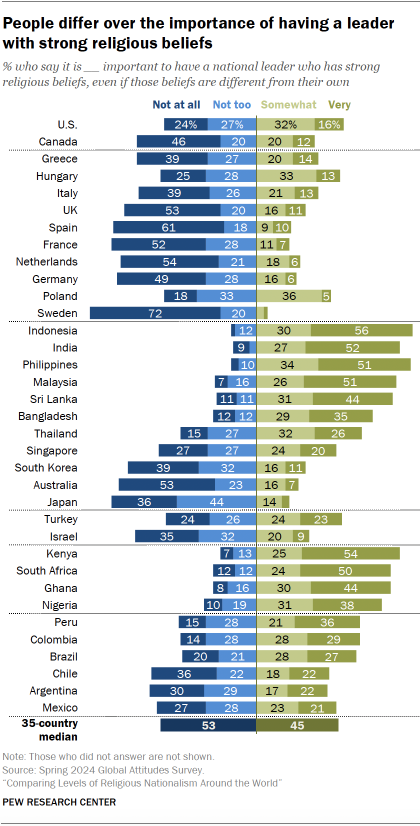
A bar chart showing that People differ over the importance of having a leader with strong religious beliefs

We also asked respondents how important it is for the leader of their country to have strong religious beliefs in general, even if the leader’s beliefs differ from their own.

In many countries, no more than about a quarter of adults say this quality is very important in a leader. This is the case in all the high-income countries surveyed, as well as in Thailand, Turkey and a few middle-income countries in Latin America.

In Australia and France, for example, 7% say it is very important that their prime minister or president, respectively, have strong religious beliefs, even if the beliefs differ from their own.

People in South and Southeast Asia and in Africa tend to see this trait as more important. For instance, 56% of Indonesians and 54% of Kenyans say it is very important to have a president with strong religious beliefs, even if the president’s beliefs differ from their own.

Views by religiousness

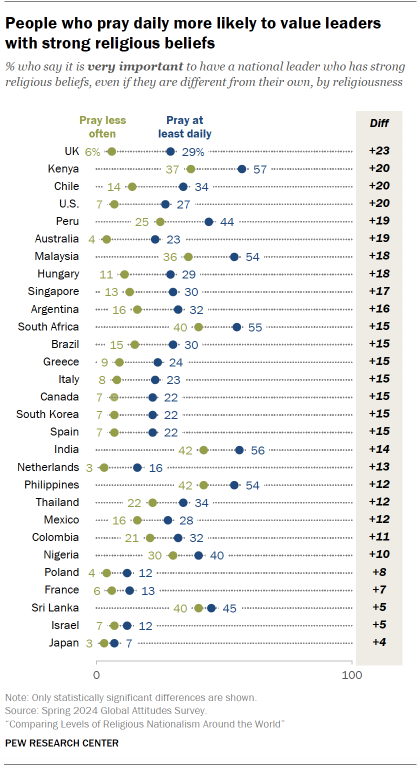
A dot plot showing that People who pray daily more likely to value leaders with strong religious beliefs

In most of the countries surveyed, adults who pray at least daily are significantly more likely than those who pray less often to say it is very important to have a national leader with strong religious beliefs.

In the UK, for instance, 29% of adults who pray daily say this trait in a prime minister is very important, compared with 6% of Britons who pray less often.

And 44% of Peruvian adults who pray daily say it is very important to have a president with strong religious beliefs, while 25% of Peruvians who pray less often hold this view.

3. How important is following a specific religion to national belonging?

Across the 36 countries surveyed, people’s views on the importance of religion to national identity vary widely.

Large shares in middle-income countries say being a member of the historically predominant religion in their country is very important to truly sharing the national identity – for example, to being truly Filipino or truly Nigerian. In high-income countries, though, many instead say religion is not at all important to national identity.

The importance of religion to a sense of national belonging varies within countries as well.

  • People who identify with the historically predominant religion in their country are more likely than those who don’t to say that being a member of that religion is very important to national identity.
  • People who pray daily are more likely than those who pray less frequently to say that belonging to the predominant religion is very important to sharing the national identity.
  • Older adults are more likely than younger people to view religion as a central part of national identity.
  • People on the ideological right tend to be more likely than those on the left to say being a follower of their country’s historically predominant religion is very important to being truly part of the nation.

How we asked about different religions

We asked people in 36 countries whether it’s important to be a member of a particular religion in order to “truly” share the national identity.

In each country, we selected the country’s historically predominant religion(s). For example, in the United States, where Christianity has long been the majority religion, we asked about the importance of being a Christian to being truly American. And in Thailand, where the vast majority of the population is Buddhist, we asked about the importance of being a Buddhist to being truly Thai.

In Japan, Nigeria and South Korea, we asked all respondents separately about two religions. In Japan, we asked about both Buddhism and Shinto. A significant portion of the population there identifies as Buddhist, yet Shinto has long been tied to national identity, and a quarter of Japanese adults say they feel a personal connection to the Shinto way of life.

In Nigeria, large shares of the population identify as either Christian or Muslim, so we asked about both religions separately. In South Korea, because sizable shares identify as either Christian or Buddhist, we asked about both religions.

Here is a list of the religions asked in each country:

ReligionCountry
ChristianityUnited States, Canada, France, Germany, Greece, Hungary, Italy, Netherlands, Poland, Spain, Sweden, UK, Australia, Philippines, South Korea, Ghana, Kenya, Nigeria, South Africa, Argentina, Brazil, Chile, Colombia, Peru
CatholicismMexico
IslamBangladesh, Indonesia, Malaysia, Nigeria, Turkey, Tunisia
BuddhismJapan, Singapore, South Korea, Sri Lanka, Thailand
HinduismIndia
JudaismIsrael
ShintoJapan

CORRECTION (Feb. 6, 2026): Due to a translation error identified after publication, the question (Q34/Q36a) on the Mexico survey asked about the importance of being “Catholic” rather than being “Christian.” Refer to the errata for more information. Care should be taken when directly comparing Mexico to other countries on this question.
How important is religion to national belonging?

The importance of religion to national identity varies widely across the 36 countries surveyed. As many as 86% in Tunisia say being a Muslim is very important to Tunisian identity, while as few as 3% of Swedes say the same about being a Christian in Sweden.

A set of bar charts showing that the Importance of religion as a part of national identity varies widely across countries

Views vary somewhat when comparing high- and middle-income countries.

Sizable majorities in many middle-income countries – including around three-quarters or more in Indonesia, the Philippines and Tunisia – consider being part of their country’s historically predominant religion very important for truly sharing the national identity. And in every middle-income country surveyed, roughly a quarter or more say this.

In high-income countries, much smaller shares emphasize religion as an aspect of national identity. Israel stands out as the only high-income country where at least a third say following the predominant religion – Judaism, in this case – is a very important element of national identity.

In other high-income countries, fewer than a quarter strongly agree. And in many high-income countries, roughly half or more say that being a member of the historically predominant religion is not at all important to being a true member of the nation.

Of the countries where we asked about the importance of Christianity to national identity, the Philippines stands out: Nearly three-quarters say being a Christian is very important for being truly Filipino. Around two-thirds of Kenyans say the same for being truly Kenyan.

In contrast, sizable majorities in Spain (71%) and Sweden (69%) say that being a Christian is not at all important for national belonging.

Views are also mixed across countries where we asked about the importance Buddhism. In Thailand (61%) and Sri Lanka (56%), majorities say being a Buddhist is very important for being truly Thai and Sri Lankan.

But in South Korea, only 4% take a similar position, and roughly half say that being a Buddhist is not at all important to being truly South Korean. (In South Korea, we also asked about Christianity; 14% of adults say that being a Christian is very important to being truly South Korean.)

And in countries where we asked about the importance of Islam, roughly half or more say being a Muslim is a very important piece of national identity. Among Indonesian adults, eight-in-ten say being a Muslim is very important to being truly Indonesian.

In India, where we asked about the importance Hinduism, 64% say being a Hindu is very important to being truly Indian.

Countries with multiple historically predominant religions

In Japan, Nigeria and South Korea, we asked about more than one historically predominant religion: Buddhism and Shinto in Japan, Christianity and Islam in Nigeria, and Christianity and Buddhism in South Korea. In all three countries, there are relatively small differences in the shares who say being a member of either religion is very important to national identity.

In Japan and South Korea, the shares emphasizing the importance of religion are relatively small, regardless of the religion in question. For example, in Japan, 6% say that being a Buddhist is very important to being truly Japanese, while 5% say the same of being a Shinto. In Nigeria, though, substantial shares say that being a Christian (49%) is very important to being truly Nigerian and 48% say being a Muslim is very important to being truly Nigerian.
How does religion compare in importance with other aspects of national identity?

Compared with other aspects of national identity we asked about – language, birthplace, and customs and traditions – religion tends to rank at, or near, the bottom in terms of importance, especially in the high-income countries surveyed. (Data about birthplace, language and customs comes from 2023 for some countries. Refer to the topline for more information.)

Israel is the only high-income country where religion does not rank least important of the four aspects of national identity asked. Instead, among Israelis, being a Jew (34%) ranks second only to speaking Hebrew (43%) in assessments of what is very important for being truly Israeli.

Tunisia stands out as the only country surveyed where religion is ranked most important of the four components of national identity we asked about. In Indonesia – where roughly three-quarters of adults or more say each component is very important to national identity – religion is tied with customs and traditions, ranking second.

For more analysis of the importance of various dimensions of national identity, read “What makes someone ‘truly’ belong in a country? Views differ on importance of language, birthplace and other factors.”

How do views of the importance of religion to national identity vary?

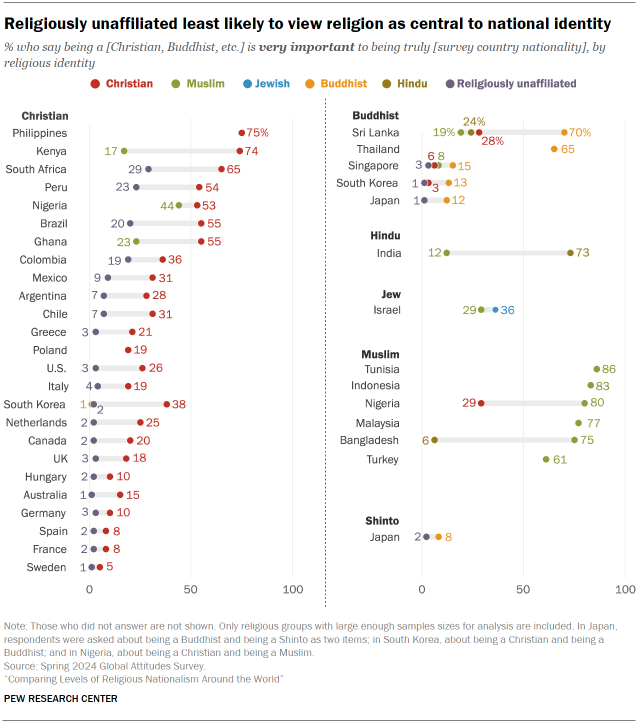
In every country where the sample size permits such analysis, people who identify with the historically predominant religion are more likely than those who don’t to say that being a member of that religion is very important to sharing the national identity.

A set of dot plots showing that Religiously unaffiliated are least likely to view religion as central to national identity

Adults who are affiliated with a religion are consistently more likely than the religiously unaffiliated (those who are atheist, agnostic or “nothing in particular”) to say it’s very important to be part of their country’s historically predominant religion in order to be truly part of its citizenry. But the share of the unaffiliated who see it as very important varies widely.

In some high-income countries (like Australia, Canada, France, Japan, South Korea, Spain and Sweden), almost none of the unaffiliated population sees being the country’s religion as very important. However, in some middle-income countries (including Brazil, Colombia, Peru and South Africa), around one-in-five or more unaffiliated see it as very important, even if they themselves are unaffiliated.

Views by religiousness

In many countries, people who pray at least daily are more likely than those who pray less often to say religion is very important to national identity.

For example, roughly seven-in-ten Malaysians who pray at least daily (69%) say being a Muslim is very important for being truly Malaysian, compared with a third of Malaysians who pray less often – a difference of 36 percentage points.

And in South Korea, nearly half of adults who pray daily (46%) say being a Christian is very important for being truly South Korean, while 3% of those who pray less frequently agree. South Koreans who pray daily are also somewhat more likely than those who pray less frequently to say that being a Buddhist is very important for being truly South Korean (8% vs. 2%).

Views by age

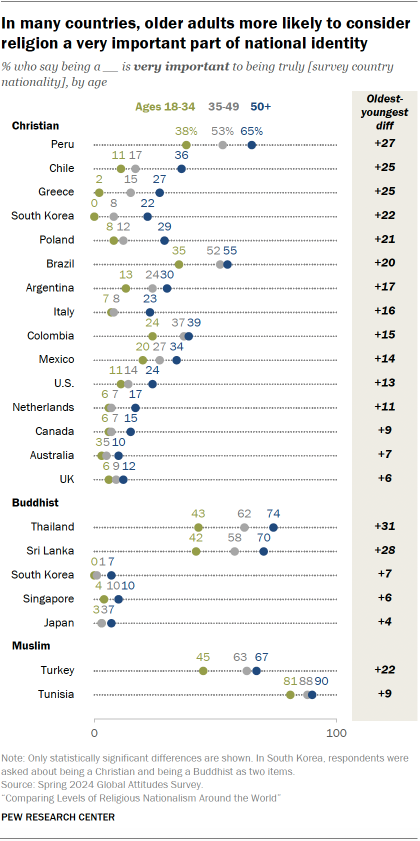
A dot plot showing that In many countries, older adults more likely to consider religion a very important part of national identity

Older adults in many countries are more likely than younger people to say that being part of the country’s historically predominant religion is a very important piece of national identity. (These differences persist even after statistically controlling for levels of religiousness.)

This gap is largest in Thailand, where roughly three-quarters of adults ages 50 and older say being a Buddhist is very important to being truly Thai, while roughly four-in-ten adults ages 18 to 34 say the same – a difference of 31 points.

Views by ideology

The perceived importance of religion to national identity also varies by ideology. People on the ideological right tend to be more likely than those on the ideological left to say being a member of the historically predominant religion is very important to truly sharing their national identity.

In Turkey, for example, three-quarters of those on the right say being a Muslim is very important for being truly Turkish, while roughly a third on the left say the same. And in the U.S., about a third of conservatives say that being a Christian is very important for being truly American, while 6% of liberals agree.

Views by populist party support

In some European countries, supporters of right-wing populist parties place greater importance on religion as an element of national belonging.

In Poland, for instance, four-in-ten supporters of the Law and Justice party (PiS) say being a Christian is very important for being truly Polish, while about one-in-ten nonsupporters say the same (40% vs. 11%). A similar pattern shows up among supporters of right-wing populist parties in France, Hungary, Italy, Spain and the UK. (For more information on how we classify populist parties, read the Appendix.)

4. Should religious texts influence national laws?

We asked people in 35 countries about the influence of specific religious texts on their national laws. The texts in question varied by country: For example, adults in predominantly Christian countries were asked about the influence of the Bible. And in Muslim-majority countries, they were asked about the influence of the Quran.

In most middle-income countries:

  • Majorities say the historically predominant religion’s text should have either a great deal or a fair amount of influence on the laws of their country.
  • People are more likely to say religious texts should take precedence over the will of the people if the two conflict.
  • Many say religious texts already have a great deal or a fair amount of influence on their country’s laws today.

On the other hand, in most high-income countries:

  • Majorities say religious texts should not shape their national laws.
  • People are about as likely, or slightly more likely, to say that the will of the people should win out over religious texts if the two conflict.
  • Most people say religious texts currently have little or no influence on their country’s laws.

The U.S. stands out from other high-income countries both for its high percentage of people who think the Bible currently influences the country’s laws and for its high percentage who think the Bible should have that kind of influence.

We asked people in 35 countries about the influence of specific religious texts on their national laws. (Tunisia was included in the 36-country survey, but the questions about the Quran were not asked there.)

In each country, we selected the sacred text(s) of the historically predominant religion(s). For example, in the United States, where Christians have long made up a majority, we asked about the influence of the Bible. And, because the concept of “religious texts” is somewhat more relevant in Western religious traditions, in Buddhist-majority nations like Thailand, we asked about a comparable concept: the influence of Buddhist dharma.

In Japan, Nigeria and South Korea, we asked all respondents separately about the influence of two religious texts. In Japan, we asked about Buddhist dharma and Shinto teachings. A significant portion of the population there identifies as Buddhist, yet Shinto has long been tied to national identity, and a quarter of Japanese adults say they feel a personal connection to the Shinto way of life.

In Nigeria, where large shares of the population identify as either Christian or Muslim, we asked about the influence of the Bible and the Quran. In South Korea, where sizable shares identify as either Christian or Buddhist, we asked about the Bible and Buddhist dharma.

Here is a list of the religious texts asked in each country:

Religious textCountry
BibleUnited States, Canada, France, Germany, Greece, Hungary, Italy, Netherlands, Poland, Spain, Sweden, UK, Australia, Philippines, South Korea, Ghana, Kenya, Nigeria, South Africa, Argentina, Brazil, Chile, Colombia, Mexico, Peru
QuranBangladesh, Indonesia, Malaysia, Nigeria, Turkey, Tunisia
Buddhist dharmaJapan, Singapore, South Korea, Sri Lanka, Thailand
Hindu teachingsIndia
Jewish scriptureIsrael
Shinto teachingsJapan

How much influence should religious texts have on laws?

A majority of adults in most middle-income countries surveyed believe the religious texts they were asked about should influence the laws of their country. This generally holds true despite people in different countries being asked about different texts – such as the Bible, the Quran, Buddhist dharma and Hindu teachings.

A set of bar charts showing that Countries diverge over level of influence religious texts should have on national laws

In Bangladesh, Brazil, Colombia, India, Indonesia, Kenya, Malaysia, the Philippines and Peru, half of adults or more say the texts they were asked about should have a great deal of influence on the laws of their country.

In contrast, people in high-income countries are more likely to say religious texts should have little or no impact on their national laws. In Australia, Canada, Germany, France, Italy, the Netherlands, Spain, Sweden and the UK, half or more say the Bible should have no influence at all on their laws.

In the United States, around a quarter say the Bible should have a great deal of influence on the country’s laws. The U.S. also stands apart from the other high-income countries surveyed for having the highest share of adults (49%) who say a religious text should influence national laws at least a fair amount.

Turkey also stands out: Of all the countries in which we asked about the Quran, Turkey has the highest share of adults saying the Islamic holy book should have no influence at all on the law (31%).

Views by religion

In most countries, followers of the historically predominant religion are more likely than people of other religions to say their religious text should influence the nation’s laws. For instance, 57% of Hindus in India say Hindu teachings should have great influence on India’s laws, while 26% of Indian Muslims take that position.

In Israel, 19% of Jews and 5% of Muslims believe Jewish scripture should have a great deal of influence on Israeli laws. And 52% of Haredi (“ultra-Orthodox”) and Dati (“religious”) Jews say Jewish scripture should greatly influence national law, compared with just 10% of Masorti (“traditional”) Jews and 2% of Hiloni (“secular”) Jews who say this.

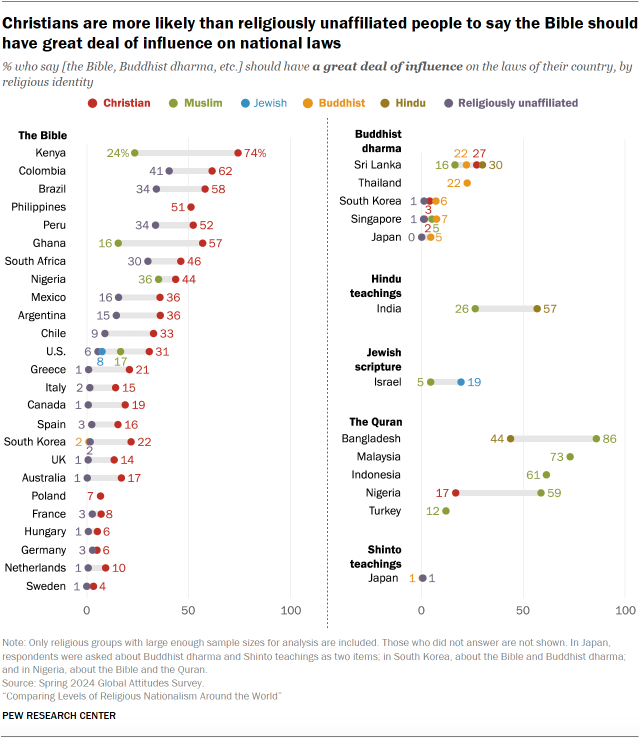
A set of dot plots showing that Christians are more likely than religiously unaffiliated people to say the Bible should have great deal of influence on national laws

Because Nigeria has significant shares of both Christians and Muslims, we asked about the influence of both the Bible and the Quran. Nigerian Christians are slightly more likely than Nigerian Muslims to say the Bible should have a great deal of influence on the law (44% vs. 36%), while Muslims are significantly more likely than Christians to say the Quran should have a great deal of influence (59% vs. 17%).

In nearly every country with enough Christians and religiously unaffiliated adults for analysis, Christians are more likely than the unaffiliated (those who identify as atheist, agnostic or “nothing in particular”) to say the Bible should have a great deal of influence on the law. For example, in Brazil, 58% of Christians say this about the Bible’s influence, compared with 34% of the religiously unaffiliated.

Notably, the religiously unaffiliated in most middle-income countries are more likely than the religiously affiliated in high-income countries to say the Bible should greatly influence the law. For instance, in Colombia, 62% of Christians and 41% of the unaffiliated hold this view. But in Spain, just 16% of Christians and 3% of the unaffiliated say the same.

Among U.S. adults, 31% of Christians say the Bible should greatly influence American laws, compared with 17% of Muslims, 8% of Jews and 6% of religiously unaffiliated Americans.

Views by religiousness

Adults who pray at least daily are more likely than those who pray less often to say the historically predominant religion’s sacred text should have a great deal of influence on the law of their country.

In nearly all countries where respondents were asked about the influence of the Bible, adults who pray at least daily are significantly more likely than other adults to say the Bible should have a great deal of influence on national laws. In Argentina, for example, 51% of adults who pray daily support the Bible having a great deal of influence on national laws, while 18% of those who pray less often say the same.

Notably, the U.S. has the second-largest difference between those who pray daily and those who pray less often – a gap of 31 points (40% vs. 9%).

Across all countries where we asked about the Bible, there are only three – Ghana, Kenya and Nigeria, all in sub-Saharan Africa – in which there are no differences by religiousness.

In countries where people were asked about the Quran, differences are generally minimal. Although in Malaysia and Nigeria, adults who pray at least daily are significantly more likely than others to say the Quran should greatly influence laws.

And in Israel, people who pray at least daily are more likely to support Israeli law being greatly influenced by Jewish scripture. This difference is driven by Jews who pray at least daily as opposed to Jews who pray less often (45% vs. 9%); there is a smaller but still significant difference between Muslims who pray at least daily and Muslims who pray less (7% vs. 1%).

Views by ideology

Ideology is sometimes related to how people feel about whether religious texts should influence their national laws.

For example, a larger share of Israelis on the right (27%) than on the left (7%) or in the center (4%) think Jewish teachings should have a great deal of influence on Israeli law. Similarly, those on the right in Australia, Canada, Greece, Mexico, the Netherlands, Poland, Spain, South Korea, Sweden and the UK are more likely than those on the left to say the Bible should have great influence. (Ideology was not asked in all countries.)

In the Philippines, Colombia and Peru, people on the right and the left are considerably more likely than those in the center to support the Bible shaping national law. In Colombia, 58% on the left and 63% on the right say the Bible should be highly influential in this regard, compared with 44% in the center.

In the U.S., adults who describe themselves as conservative (41%) are significantly more likely than moderates (16%) or liberals (7%) to say the Bible should have a great deal of influence on American laws. Conservative Republicans (42%) particularly stand out for this view, relative to moderate and liberal Republicans (17%), conservative and moderate Democrats (18%), or liberal Democrats (5%).

A set of dot plots showing that In many countries, people on the ideological right are more likely to support religious texts shaping national laws

Views by populist support

In Europe, people with a favorable view of right-wing populist parties in Greece, Hungary, Italy, Poland and Spain are considerably more likely than those with an unfavorable view of these parties to say the Bible should greatly influence national laws. For example, in Greece, 37% of Greek Solution (EL) supporters say this, compared with only 12% of those who have an unfavorable view of the party.

Views by attitudes toward the role of religion in society

People’s support for a religious text influencing their country’s laws is related to their opinion of religion’s impact on society as a whole.

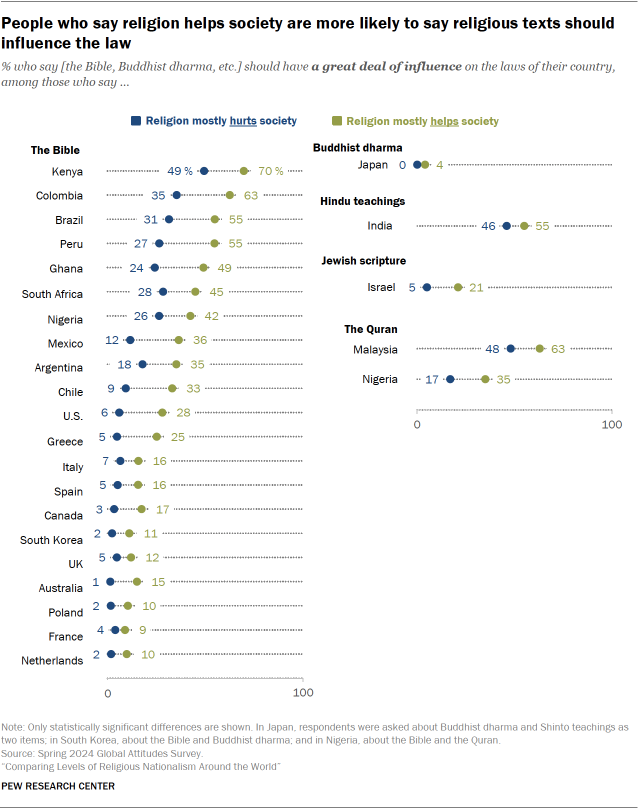
In over two-thirds of the countries surveyed, people who say religion mostly helps society are significantly more likely than those who say religion mostly hurts society to think that the religious text they were asked about should have a great deal of influence on their laws.

For example, 55% of Peruvians who believe religion mostly helps society think the Bible should have a great deal of influence on Peruvian law; 27% of those who say religion mostly hurts society share this view.

A set of dot plots showing that People who say religion helps society are more likely to say religious texts should influence the law

Should the will of the people or religious texts take priority in lawmaking?

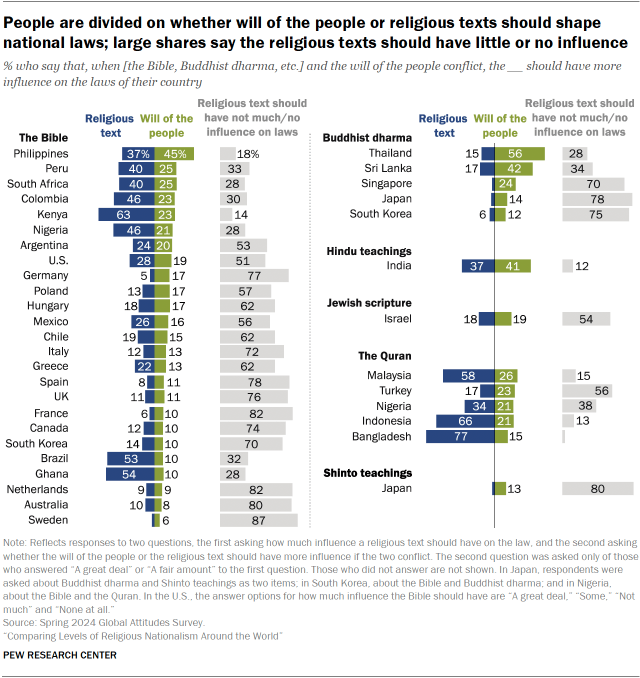
In each country surveyed, people who said the historically predominant religion’s text should have a great deal or fair amount of influence on the law were asked a follow-up question: If the religious text and the will of the people conflict with each other, which should have more influence on the laws of their country?

In countries where respondents were asked about Buddhist dharma, people are at least twice as likely to say the will of the people should win out over Buddhist dharma when the two conflict. In Sri Lanka, for example, 42% say the will of the people should have more influence on Sri Lankan laws, while 17% say the same about Buddhist dharma.

In three of the five countries where we asked about the Quran, the opposite is true. In Bangladesh, Indonesia and Malaysia, adults are more likely to say that the Quran should have more influence than the will of the people when the two conflict, including 77% who say this in Bangladesh. In Nigeria, opinion is more divided, though slightly more say the Quran should take precedence over the will of the people (34% vs. 21%). In Turkey, people are about as likely to say the will of the people should have more influence (23%) as to say the Quran should (17%).

Views differ among countries where we asked about the Bible. For example, in Argentina, Hungary and the UK, people who think the Bible should have influence on laws are rather equally split over whether the will of the people or the religious text should take precedence. On the other hand, in Colombia, Kenya and Nigeria, people tend to prioritize the religious text over the will of the people.

The Philippines stands out from other middle-income countries that were asked about the Bible: 45% of Filipinos say the will of the people should take precedence when shaping laws, the highest share among these countries.

A set of bar charts showing that People are divided on whether will of the people or religious texts should shape national laws; large shares say the religious texts should have little or no influence

Views by religiousness

People who pray daily tend to be more likely than other adults to say that religious texts should have more influence than the will of the people, should the two conflict.

In South Korea, where we asked about the influence of both the Bible and Buddhist dharma, adults who pray daily are more likely to say that either text should take priority over the will of the people. That is, South Koreans who pray daily are more likely than other South Koreans to say the Bible should be followed over the will of the people (39% vs. 5%) and that Buddhist dharma should be followed over the will of the people (12% vs. 4%).

Views by ideology

In many countries surveyed, people on the ideological right are also more likely than those on the left to say religious texts should be prioritized over the will of the people when the two conflict. In Canada, for instance, 22% of those on the right say the Bible should shape the law instead of the will of the people, compared with 5% on the left.

How much influence do religious texts have on laws today?

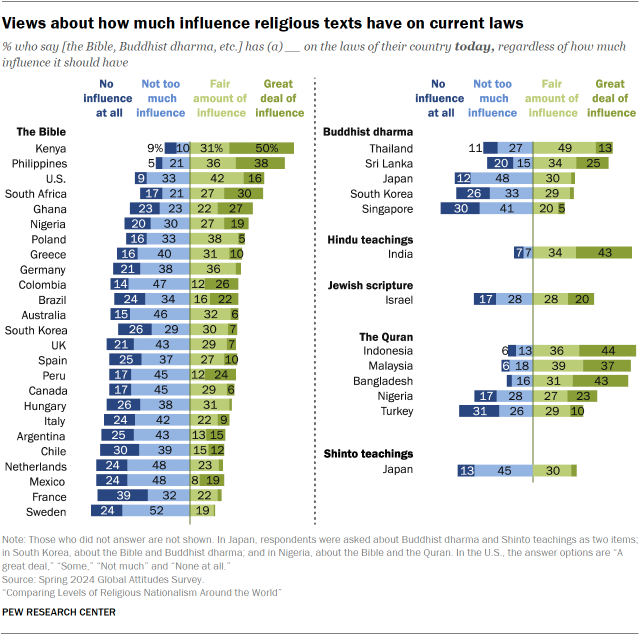
We also asked respondents to consider how much influence the religious texts currently have on their country’s laws, regardless of how much influence they think the texts should have.

In 10 of the 35 countries, more than half of adults say the religious text asked about has a fair amount or a great deal of influence. These include Thailand and Sri Lanka, countries that feature Buddhism prominently in their national constitutions.

On the other hand, majorities in most of the 35 countries say the religious text they were asked about currently has little or no influence at all on national laws.

The U.S. stands out as the only high-income country where a majority of adults believe a religious text already has a sizable influence on the law: 42% of Americans say the Bible has some influence on U.S. laws today, and an additional 16% say it has a great deal of influence.

A set of bar charts showing Views about how much influence religious texts have on current laws

Views by religion

Across much of Europe, religiously unaffiliated people are somewhat more likely than Christians to say that the Bible has influence on laws today – though views don’t differ much on whether the Bible has a great deal of influence. For instance, 56% of religiously unaffiliated Greeks say the Bible has a fair amount or a great deal of influence on Greek laws today, compared with 39% of Christian Greeks.

Similarly, in Israel, Haredi (“ultra-Orthodox”) and Dati (“religious”) Jews (56%), as well as Masorti (“traditional”) Jews (60%), are more likely than Hiloni (“secular”) Jews to say Jewish scripture influences Israeli laws today (43%), though Haredim/Datiim and Hilonim are more likely than Masortim to say there is a great deal of influence on the law.

In India, a greater share of Hindus than Muslims says that Hindu teachings have a great deal of influence on Indian laws today (44% vs. 33%).

In Kenya and Ghana, Christians are more likely than Muslims to think the Bible currently has a great deal of influence on national laws: 53% of Kenyan Christians and 33% of Ghanaian Christians say this, compared with 25% of Kenyan Muslims and 15% of Ghanian Muslims.

In Nigeria, the opposite is true: Muslims are more likely than Christians to say the Bible has a great deal of influence today (24% vs. 15%). And Nigerian Muslims are also more likely than Christians to say the Quran currently has a great deal of influence on Nigerian laws (40% vs. 12%).

Relationship between the current influence and preferred influence of religious texts

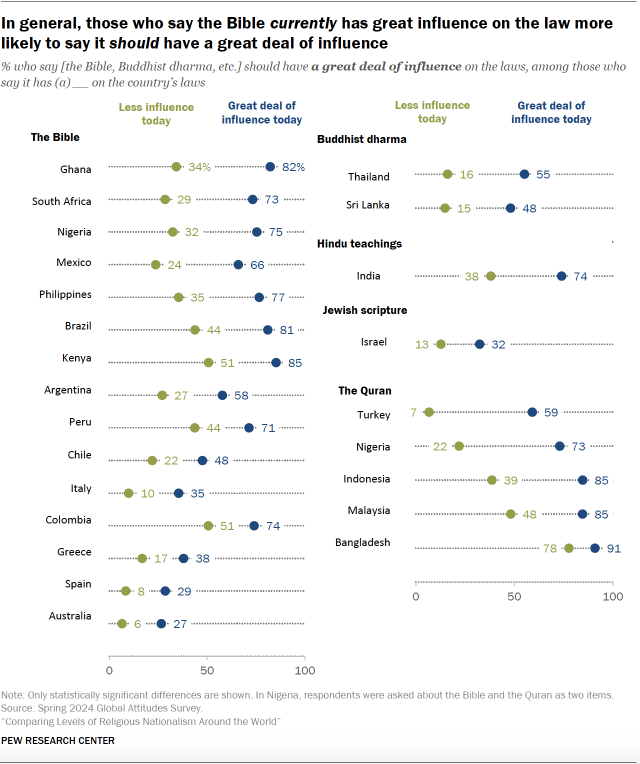
In the majority of the 35 surveyed countries, people who say religious textshave a great deal of influence on the law today also tend to think these texts should have a great deal of influence.

A dot plot showing that In general, those who say the Bible currently has great influence on the law more likely to say it should have a great deal of influence

For instance, in Mexico, 66% of people who say the Bible currently has a great deal of influence on Mexican laws today also say that the Bible should have a great influence. By comparison, 24% of those who say the Bible currently has less influence agree.

5. What role should religion play in Muslim- and Jewish-majority countries?

In a number of countries with sizable Muslim and Jewish populations, we asked Muslim and Jewish adults for their views on religion and governance – specifically, whether religious law should be the official or state law for people who share their religion, and whether their country can be both a democratic country and a Muslim or Jewish country.

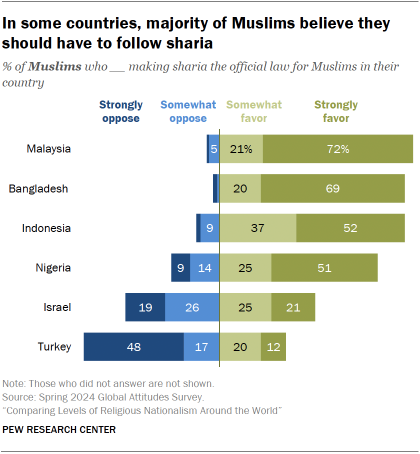
We find that large majorities of Muslims in Bangladesh, Indonesia, Malaysia and Nigeria believe sharia, or Islamic law, should be the official law for Muslims in their country. Much smaller shares of Muslims in Israel and Turkey agree.

Among Israelis who are Jewish, about a third support making halakha, or Jewish law, the state law for Jews in Israel.

When it comes to whether states can have a religious character and be a democracy:

  • Majorities of Bangladeshis, Indonesians, Malaysians, Tunisians and Turks say their country can be both a democracy and a Muslim state.
  • A minority of Nigerians think Nigeria can be both democratic and Muslim.
  • A majority of Israelis think Israel can be both democratic and Jewish – though Jewish Israelis are more than twice as likely as Muslim Israelis to say this.

Should Muslims be governed by sharia?

Support for Islamic religious law, also known as sharia, is widespread in several of the Muslim-majority countries surveyed.

What is sharia?

Sharia, or Islamic law, offers moral and legal guidance for nearly all aspects of life for Muslims, from marriage and divorce, to inheritance, contracts and criminal punishments. Sharia in its broadest definition refers to the ethical principles set down in Islam’s holy book (the Quran) and by examples of actions by the Prophet Muhammad (sunna). The Islamic jurisprudence that comes out of the human exercise of codifying and interpreting these principles is known as fiqh. Muslim scholars and jurists continue to debate the boundary between sharia and fiqh as well as other aspects of Islamic law.

A bar chart showing that In some countries, majority of Muslims believe they should have to follow sharia

About nine-in-ten Muslims in Bangladesh, Indonesia and Malaysia say they favor a legal system in which Muslims are bound by Islamic law. Roughly three-quarters of Nigerian Muslims agree. At least half of Muslims in each of these countries say they strongly favor making sharia the official law for those who share their religion.

Israeli Muslims, who make up about a fifth of their country’s population, are evenly split on the question: 46% favor making sharia the official law for Muslims in Israel, while 45% oppose this. An additional 9% did not answer the question.

Over 90% of Turkey’s population is Muslim. Yet only about a third of Turkish Muslims (32%) favor granting official status to Islamic law. Almost half – a 48% plurality – say they strongly oppose making sharia the law for Muslims in their country.

Support for making sharia the official law for Muslims is somewhat correlated with religiousness. Muslim populations with higher rates of daily prayer are more in favor of making sharia the law for Muslims in their country. For example, among Malaysian Muslims, 90% say they pray at least daily, and 93% are in favor of making sharia the official law. Meanwhile, in Israel, 58% of Muslims pray at least daily, and 46% support sharia.

Among Muslims in Israel and Turkey, opinions vary by age. In both countries, Muslims ages 50 and older are more likely than those ages 18 to 34 to favor making sharia the official law for Muslims.

In Turkey, about four-in-ten adults with lower levels of education believe sharia should be the law for Muslims. Only 22% of Turks with higher levels of education agree.

Also in Turkey, Muslim supporters of the governing Justice and Development Party are more than twice as likely as Muslims who don’t support the party to favor a legal system based on sharia (55% vs. 20%).

(For more on religion and governance in Turkey, read our October report: “Turks Lean Negative on Erdoğan, Give National Government Mixed Ratings”)

Should halakha be the law for Jews?

In Israel, the world’s only majority-Jewish country, we asked Jews whether halakha – the traditional set of rules and regulations that govern Jewish life – should be the state law for people who share their religion.

What is halakha?

Halakha, or Jewish law, refers to the set of rules and practices that govern Jewish life. They originate from the Torah (the first five books of the Hebrew Bible), the Oral Torah, other Jewish scripture and their interpretations by Jewish scholars over the years. There are halakhic laws to regulate how Jews pray, celebrate holidays, work, eat, dress and conduct their relationships with other Jews and non-Jews. Attitudes towards halakha generally follow the spectrum of religious observance: Haredim and other Orthodox Jews consider it essential to follow these rules, while less religious Jews tend to oppose enforcing halakha.

A bar chart showing that Most Jewish Israelis do not believe they should be legally obligated to follow halakha

About a third of Israeli Jews say they favor a legal system for Jews based on Jewish law, while six-in-ten or so oppose such a system. A plurality of 37% strongly oppose being legally bound by halakha.

Jews in Israel differ significantly in their views of halakha:

  • Haredi (“ultra-Orthodox”) and Dati (“religious”) Jews are significantly more likely to favor making halakha the official law for Jews in Israel than either Masorti (“traditional”) Jews or Hiloni (“secular”) Jews. About nine-in-ten Haredi and Dati Jews express this opinion, while 20% of Masorti Jews and 4% of Hiloni Jews agree. Haredim and Datiim, as well as Hilonim, feel strongly on the subject: Half of Haredim and Datiim strongly favor a legal system for Jews based on Jewish law, while 70% of Hilonim strongly oppose this.
  • Similarly, more than eight-in-ten Israeli Jews who pray at least daily say halakha should be the law for Jews in Israel. Only 13% of Jews who pray less often express this opinion.
  • Younger Jews (ages 18 to 34) are twice as likely as Jews ages 50 and older to say they strongly favor making halakha the official law for Jews in Israel (24% vs. 12%).
  • Only a quarter of Israeli Jews with a postsecondary education favor making halakha the state law for Jews. Among Jews with a secondary education or less, the share who agree is much higher, at 43%.

Can a country be both religious and democratic?

A bar chart showing that Many in certain Muslim- and Jewish- majority countries believe their state can be both religious and democratic

In countries with Muslim majorities, most do think their state can be both democratic and Muslim. The shares saying this are particularly high in Bangladesh (86%), Tunisia (82%) and Malaysia (80%). (Islam is the official state religion in Bangladesh and Malaysia, and it was the official religion in Tunisia until 2022).

Slightly smaller majorities in Indonesia (70%) and Turkey (67%) agree that their country can be both a Muslim state and a democratic state at the same time.

Of the countries where we asked this question, Nigeria is the only one in which Muslims are not the overwhelming majority of the population. Only 40% of Nigerians say Nigeria can be both Muslim and democratic – roughly half the shares expressing this opinion in Bangladesh, Malaysia and Tunisia. A slim majority of Nigerians (55%) say it cannot be both.

Over half of Nigerian Muslims (55%) say their country can be Muslim and democratic at the same time, while about a third of Nigerian Christians (31%) agree.

Views on the subject also differ by religiousness and education in a few countries surveyed:

  • In Malaysia, Nigeria and Turkey, people who pray at least daily are more likely than those who pray less often to say their country can be both Muslim and democratic. (However, Nigerians who pray daily are also more likely than other Nigerians to answer the question.)
  • Tunisians and Indonesians with less than a secondary education are more likely than those with more education to say their country can be both Muslim and democratic.

Can Israel be both democratic and Jewish?

Israel defines itself as “Jewish and democratic,” and indeed, 73% of adults surveyed in Israel say their country can be both. Only about two-in-ten Israelis say the country cannot be a Jewish state and a democratic state at the same time. Still, there are some significant differences on this question by religion and political ideology.

  • Israeli Jews are more than twice as likely as Israeli Muslims to say their country can be both Jewish and democratic (82% vs. 38%).
  • Among Jewish religious groups, Masortim are the most likely to say Israel can be Jewish and democratic at the same time (93%). Smaller majorities of Haredim/Datiim (81%) and Hilonim (77%) agree.
  • Israelis who place themselves on the ideological right (84%) and in the center (77%) are significantly more likely than Israelis on the left (48%) to say their country can be both Jewish and a democracy.

How people who believe their country can be both religious and democratic differ in their views

In some countries, attitudes toward religious texts and laws vary based on whether one thinks a country can be a Muslim or Jewish state and a democracy at the same time.

  • In Malaysia, those who believe their country can be both Muslim and democratic are 18 points more likely than those who say it cannot to think the Quran should influence Malaysian law a great deal (65% vs. 47%). Similar differences exist between these groups in Indonesia and Nigeria.
  • Indonesians and Nigerians who believe their country can be Muslim and democratic are also more likely to say the Quran currently has a great deal of influence on the law in their country.
  • Among Israelis who say their country can be both Jewish and democratic, 45% say Jewish scripture should influence the law in Israel. Among those who say Israel cannot be both a democracy and a Jewish state, fewer than a third (29%) agree.

Muslims in Indonesia, Malaysia and Nigeria who say their country can be Muslim and democratic at the same time are more likely than Muslims who say otherwise to support making sharia the law for those who share their religion.

A dot plot showing that Muslims who believe their country can be both religious and democratic also favor sharia as the law for Muslims – except in Turkey

In Turkey, the opposite is true: Muslim Turks who say their country can be both Muslim and democratic are less likely than those who say it cannot to favor sharia (29% vs. 40%).

Acknowledgments

This report is a collaborative effort based on the input and analysis of the following individuals:

Laura Silver, Associate Director, Global Attitudes Research
Jonathan Evans, Senior Researcher
Maria Smerkovich, Research Associate
Sneha Gubbala, Research Analyst
Manolo Corichi, Research Analyst
William Miner, Research Analyst

Dorene Asare-Marfo, Senior Panel Manager
Peter Bell, Associate Director, Design and Production
Janakee Chavda, Associate Digital Producer
Laura Clancy, Research Analyst
Alan Cooperman, Director, Religion Research
Moira Fagan, Research Associate
Janell Fetterolf, Senior Researcher
Shannon Greenwood, Digital Production Manager
Sofia Hernandez Ramones, Research Assistant
Christine Huang, Research Associate
Anna Jackson, Editorial Assistant
David Kent, Senior Copy Editor
Hannah Klein, Senior Communications Manager
Gar Meng Leong, Communications Manager
Kirsten Lesage, Research Associate
Jordan Lippert, Research Analyst
Carolyn Lau, International Research Methodologist
John Carlo Mandapat, Information Graphics Designer
Patrick Moynihan, Associate Director, International Research Methods
Georgina Pizzolitto, Research Methodologist
Jacob Poushter, Associate Director, Global Attitudes Research
Andrew Prozorovsky, Research Assistant
Dana Popky, Associate Panel Manager
Sofi Sinozich, International Research Methodologist
Kelsey Jo Starr, Research Analyst
Brianna Vetter, Administrative Associate
Richard Wike, Director, Global Attitudes Research

This analysis was produced by Pew Research Center as part of the Pew-Templeton Global Religious Futures project, which analyzes religious change and its impact on societies around the world. Funding for the Global Religious Futures project comes from The Pew Charitable Trusts and the John Templeton Foundation (grant 63095). This publication does not necessarily reflect the views of the John Templeton Foundation.

We appreciate the following individuals for advising us on strategic outreach: Eugenia Mitchelstein, Associate Professor of Communication at Universidad de San Andrés (Argentina); Naziru Mikail Abubakar, Executive Director and Editor-in-Chief at the Daily Trust (Nigeria); Sebastián Lacunza, Columnist at elDiarioAR.com (Argentina); Anton Harber, Executive Director at the Campaign for Free Expression and Founder of the Mail & Guardian (South Africa); Admire Mare, Associate Professor and Head of Department of Communication and Media Studies, University of Johannesburg (South Africa); and Monicah Waceke Ndungu, Chief Operating Officer, Nation Media Group (Kenya).

Methodology

About Pew Research Center’s Spring 2024 Global Attitudes Survey

Results for the survey are based on telephone, face-to-face and online interviews conducted under the direction of Gallup, Langer Research Associates, Social Research Centre and Verian. The results are based on national samples, unless otherwise noted. Here are more details about our international survey methodology and country-specific sample designs.

The American Trends Panel survey methodology

Results for the United States are based on surveys conducted on Pew Research Center’s American Trends Panel (ATP), a nationally representative panel of randomly selected U.S. adults. Panelists participate via self-administered web surveys. Panelists who do not have internet access at home are provided with a tablet and wireless internet connection. Interviews are conducted in both English and Spanish. The panel is being managed by Ipsos.

Data in this report is drawn primarily from ATP Wave 143, conducted from Feb. 13 to 25, 2024. A total of 12,693 panelists responded out of 14,762 who were sampled, for a response rate of 89% (AAPOR RR3). The survey includes an oversample of 2,051 Jewish and Muslim Americans from Ipsos’ KnowledgePanel, SSRS’s Opinion Panel and NORC at the University of Chicago’s AmeriSpeak Panel. These oversampled groups are weighted to reflect their correct proportions in the population. The cumulative response rate accounting for nonresponse to the recruitment surveys and attrition is 4%. The break-off rate among panelists who logged on to the survey and completed at least one item is less than 1%. The margin of sampling error for the full sample of 12,693 respondents is plus or minus 1.5 percentage points.

Additional survey questions were asked on ATP Wave 145, conducted from April 1 to 7, 2024, among 3,600 ATP members who had previously participated in Wave 143. Here is the methodology for Wave 145.

ATP Panel recruitment

The ATP was created in 2014, with the first cohort of panelists invited to join the panel at the end of a large, national, landline and cellphone random-digit-dial survey that was conducted in both English and Spanish. Two additional recruitments were conducted using the same method in 2015 and 2017, respectively. Across these three surveys, a total of 19,718 adults were invited to join the ATP, of whom 9,942 (50%) agreed to participate.

A table showing American Trends Panel recruitment surveys

In August 2018, the ATP switched from telephone to address-based sampling (ABS) recruitment. A study cover letter and a pre-incentive are mailed to a stratified, random sample of households selected from the U.S. Postal Service’s Delivery Sequence File. This Postal Service file has been estimated to cover as much as 98% of the population, although some studies suggest that the coverage could be in the low 90% range.4 Within each sampled household, the adult with the next birthday is asked to participate. Other details of the ABS recruitment protocol have changed over time but are available upon request.5

We have recruited a national sample of U.S. adults to the ATP approximately once per year since 2014. In some years, the recruitment has included additional efforts (known as an “oversample”) to boost sample size with underrepresented groups. For example, Hispanic, Black and Asian adults were oversampled in 2019, 2022 and 2023, respectively.

Across the six address-based recruitments, a total of 23,862 adults were invited to join the ATP, of whom 20,917 agreed to join the panel and completed an initial profile survey. Of the 30,859 individuals who have ever joined the ATP, 11,920 remained active panelists and continued to receive survey invitations at the time this survey was conducted.

The American Trends Panel never uses breakout routers or chains that direct respondents to additional surveys.

Sample design

The overall target population for ATP Wave 143 was noninstitutionalized persons ages 18 and older living in the U.S., including Alaska and Hawaii. All active panel members who completed the ATP wave which fielded from July 31 to Aug. 6, 2023 (ATP W132), or panelists who previously identified as Jewish or Muslim, were invited to participate in this wave.

The ATP was supplemented with an oversample of self-identified Jewish and Muslim American panelists from three other probability panels: Ipsos’ KnowledgePanel, SSRS’s Opinion Panel, and NORC at the University of Chicago’s AmeriSpeak panel. All panelists who met the selection criteria were selected with certainty.

Questionnaire development and testing

The questionnaire was developed by Pew Research Center in consultation with Ipsos, SSRS and NORC. The survey for ATP and KP panelists was programmed by Ipsos, while the survey for SSRS and NORC panelists was programmed by SSRS. A small number of SSRS panelists took their survey over the phone with an interviewer. Both web programs were rigorously tested on both PC and mobile devices by the Ipsos, SSRS and NORC project management teams and Pew Research Center researchers. The Ipsos project management team also populated test data that was analyzed in SPSS to ensure the logic and randomizations were working as intended before launching the survey.

Incentives

All ATP respondents were offered a post-paid incentive for their participation. Respondents could choose to receive the post-paid incentive in the form of a check or a gift code to Amazon.com or could choose to decline the incentive. Incentive amounts ranged from $5 to $20 depending on whether the respondent belongs to a part of the population that is harder or easier to reach. Differential incentive amounts were designed to increase panel survey participation among groups that traditionally have low survey response propensities.

Respondents from the Ipsos KnowledgePanel, SSRS Opinion Panel and AmeriSpeak were offered the cash equivalent of $10 for completing this survey.

Data collection protocol

The data collection field period for this survey was Feb. 13 to 25, 2024. Postcard notifications were mailed to a subset of ATP panelists with a known residential address on Feb. 12.6

Invitations were sent out in separate launches. Sixty ATP panelists and 300 KP panelists were included in the soft launch, which began with an initial invitation sent on Feb. 13. The ATP and KP panelists chosen for the soft launch were known responders who had completed previous surveys within one day of receiving their invitation. All remaining ATP and KP sampled panelists were included in the full launch and were sent an invitation on Feb. 14.

A table showing Invitation and reminder dates, ATP Wave 143

Overall, 129 SSRS panelists were included in the SSRS soft launch, which began with an initial invitation on Feb. 14. And 110 NORC panelists were included in the NORC soft launch, which began with an initial invitation on Feb. 15. All remaining SSRS and NORC sampled panelists were included together in the full launch and were sent an invitation on Feb. 15.

All panelists with an email address received an email invitation and up to four email reminders if they did not respond to the survey. All ATP panelists who consented to SMS messages received an SMS invitation and up to four SMS reminders.

Data quality checks

To ensure high-quality data, the Center’s researchers performed data quality checks to identify any respondents showing clear patterns of satisficing. This includes checking for whether respondents left questions blank at very high rates or always selected the first or last answer presented. As a result of this checking, six ATP respondents were removed from the survey dataset prior to weighting and analysis.

Weighting

The data was weighted in a multistep process that accounts for multiple stages of sampling and nonresponse that occur at different points in the survey process. First, each panelist begins with a base weight that reflects their probability of inclusion in the panel to which they belong. Separately for each of the four panels (ATP, KP, SSRS, NORC), the base weights for Muslim and Jewish respondents were scaled to be proportional to the group’s effective sample size. These weights were then combined and calibrated so that the overall proportions of Jewish and Muslim respondents respectively match the National Public Opinion Reference Survey (NPORS) benchmark.

A table showing American Trends Panel weighting dimensions

This weight is then calibrated again to align with the full set of population benchmarks identified in the accompanying table (which also includes the NPORS benchmarks for the shares of Jewish and Muslim adults). In order to reduce the loss in precision stemming from variance in the weights, the weights were trimmed separately among Jewish, Muslim, Hispanic, non-Hispanic Black and non-Hispanic Asian respondents at the 98th percentile, and among all other respondents at the 99.5th percentile. Sampling errors and tests of statistical significance take into account the effect of weighting.

The following table shows the unweighted sample sizes and the error attributable to sampling that would be expected at the 95% level of confidence for different groups in the survey.

A table showing Sample sizes and margins of error, ATP Wave 143

For questions asked on ATP Wave 143, this analysis reports the opinions of 6,712 U.S. Christians – slightly more than the 6,634 included in the previous analysis of U.S. data. This analysis also reports the opinions of 3,207 religiously unaffiliated adults in the U.S. – slightly more than the 3,205 included in the previous analysis. The sample size differences are attributable to small differences in the backcoding of religious identity questions across the two studies.

Sample sizes and sampling errors for other subgroups are available upon request. In addition to sampling error, one should bear in mind that question wording and practical difficulties in conducting surveys can introduce error or bias into the findings of opinion polls.

Dispositions and response rates

A table showing Final dispositions, ATP Wave 143
A table showing Cumulative response rate as of ATP Wave 143

Analysis

We analyze respondents’ attitudes based on where they place themselves on an ideological scale, their support for populist parties, their religious identification, their educational attainment, their income and whether they live in high- or middle-income countries. We also created an index to classify people as religious nationalists. More on each of these decisions can be found below.

Ideology

Throughout the report, we analyze respondents’ attitudes based on where they place themselves on an ideological scale. We asked about political ideology using several slightly different scales and categorized people as being on the ideological left, center or right.

  • In most countries, we asked people to place themselves on a scale ranging from “Extreme left” to “Extreme right.” The question was asked this way in Argentina, Bangladesh, Brazil, Canada, Chile, Colombia, France, Germany, Greece, Hungary, Israel, Italy, Mexico, the Netherlands, Nigeria, Peru, the Philippines, Poland, South Africa, Spain, Sweden, Turkey and the United Kingdom.
  • In Australia, the scale ranged from “Left” to “Right.”
  • In Japan, Singapore, South Korea and Thailand, ideology was measured on a scale from “Extremely progressive” to “Extremely conservative.”
  • In the U.S., ideology is defined as conservative (right), moderate (center) and liberal (left).
  • Ideology was not asked about in Ghana, India, Indonesia, Kenya, Malaysia, Sri Lanka or Tunisia.

Populist party support

Although experts generally agree that populist political leaders or parties display high levels of anti-elitism, definitions of populism vary. We use three measures to classify populist parties: anti-elite ratings from the 2019 Chapel Hill Expert Survey (CHES), Norris’ Global Party Survey and The PopuList. We define a party as populist when at least two of these three measures classify it as such. For more on these measures as well as which parties we classify as populist, refer to the Appendix.

Religious identification

In each country surveyed, people were asked about their current religious identification. We then analyzed religious groups with large enough sample sizes. Respondents of other religious backgrounds were not excluded from the surveys, even if their religious group was not able to be analyzed separately. In the U.S., for example, the survey included Hindus and Buddhists, though there were not enough respondents from these smaller groups to report on their answers separately.

Education

To compare educational groups across countries, we standardize education levels based on the UN’s International Standard Classification of Education (ISCED).

Income

To compare by income within countries, we create two income levels based on the approximate median income within each country. Respondents with a household income below or at the approximate country median are considered lower income. Those with an income above the approximate country median are considered higher income.

High- and middle-income countries

We classify the countries in this report as either high- or middle-income on the basis of categories from the World Bank. This is a classification we have used in multiple other Pew Research Center analyses, including when looking at global views of China, satisfaction with democracy, globalization and national identity.

High- and middle-income countries differ in myriad ways. People who live in middle-income countries are more likely to have a religious affiliation, to pray regularly and to consider religion to be important in their lives than are people in high-income countries. High-income countries are also more likely than low-income countries to be highly established democracies and to have high rates of tertiary education.

Religious nationalism index

In this report, we classify some people as “religious nationalists.” Scholars do not fully agree on how to define religious nationalism, and the challenge is even more complicated when one tries to study the concept in multiple countries – and for multiple religious groups – concurrently. For example, scholars who measure Christian nationalism in the U.S. may consider whether the government should allow prayer in public schools, while those measuring Hindu nationalism in India may consider whether the government should regulate the protection of cows, which are sacred to many Hindus.

For the purposes of making cross-national comparisons, we focused on two concepts in our definition of religious nationalism:

  • How important people think identifying with the country’s historically predominant religion is for belonging – e.g., for being “truly” part of the country’s nationality
  • The role people want religion to play in their country’s leader and laws

We measured these two concepts among followers of each country’s historically predominant religion using four questions:

  • How important is belonging to the historically predominant religion to being truly part of your national identity? (For example, how important is being a Muslim to being truly Indonesian, or being a Christian to being truly American?)
  • How important is it to you for your national leader to share your religious beliefs?
  • How much influence do you think the historically predominant religion’s sacred text should have on the laws of your country? (For example, how much influence should the Quran have on the laws of Turkey, or should the Bible have on the laws of Italy?)
  • When the sacred text conflicts with the will of the people, which should have more influence on the laws of your country? (This follow-up question was asked only of respondents who answered the previous question by saying that the sacred text should have a “fair amount” or “great deal” of influence on their country’s laws.)
Reliability at the country level

Before designing our measure of religious nationalism, we calculated Cronbach’s alphas to assess the reliability of these four questions. For the first three questions, which were asked of all respondents, we found the Cronbach’s alpha to be reliable at conventional levels for most countries. For example, the alpha is 0.82 in the U.S. and 0.65 or higher in most high-income countries. The alpha is lower in some middle-income countries – particularly Sri Lanka and Bangladesh.

Because the fourth question was only asked of a subset of people based on their answers to the third question, we calculate alphas that include the fourth question in two ways. One way looks at a recoded variable that combines the two questions – how much influence the historically predominant religion’s primary religious text should have and whether it should take precedence over the will of the people. Using the first two questions and the recoded variable, the Cronbach’s alpha in each country is broadly similar to those of the original analysis that included the first three questions (for example, in the U.S., the Cronbach’s alpha is 0.82).

Another way creates a binary variable where those who said the religious text should take precedence over the will of the people are coded as 1 and all others are coded as 0 – whether they received the fourth question or not. Alphas are somewhat lower using the binary variable but still remain at or above customary levels in some countries (in the U.S., for example, the Cronbach’s alpha is 0.72). Still, alphas in both of these analyses remain somewhat lower in middle-income countries.

Reliability among members of the historically predominant religion in each country

We restrict our analyses of religious nationalism to members of the historically predominant religion in each country. One reason is to ensure we are capturing people’s wishes or prescriptions rather than their observations about nationhood, which may be disaffected or angry. For example, Muslim Israelis are as likely as Jewish Israelis to say it’s very important to be a Jew to be truly Israeli. As a result, only Jewish Israelis who hold this view could be categorized as religious nationalists. (In Israel, the Cronbach’s alpha for the three questions asked of all adults is 0.61 for all Israelis but 0.71 for Jewish Israelis.)

A second reason is that our question about the leader’s religion asks the importance of a religious leader sharing your religious views. Restricting our analysis of this question only to those who share the same historically predominant religion helps us capture the dimension of religious nationalism we are most interested in. When restricted to members of the historically predominant religion, the questions remain reliable at customary levels in high-income countries.

Defining religious nationalists

Based on the investigations above, we decided not to create a combined measure through averaging across the variables. Instead, we created a measure that counts whether people take specific positions on each of the four items.

To that end, for this report, we define “religious nationalists” as people who identify with the historically predominant religion (also often the majority religion) and take a strongly religious position on all four of these questions.

In Turkey, for example, a religious nationalist would be a Muslim who says …

  • Being a Muslim is very important to being truly Turkish;
  • And it is very important that Turkey’s president shares their religious beliefs;
  • And the Quran should have at least a fair amount of influence over Turkey’s laws;
  • And when the Quran conflicts with the will of the people, the Quran should have more influence.

In Israel, a religious nationalist would be a Jew who says …

  • Being a Jew is very important to being truly Israeli;
  • And it is very important that Israel’s prime minister shares their religious beliefs;
  • And Jewish scripture should have at least a fair amount of influence over Israel’s laws;
  • And when Jewish scripture conflicts with the will of the people, Jewish scripture should have more influence.

In the United States, a religious nationalist would be a Christian who says …

  • Being a Christian is very important to being truly American;
  • And it is very important that the U.S. president shares their religious beliefs;
  • And the Bible should have at least some influence over U.S. laws;
  • And when the Bible conflicts with the will of the people, the Bible should have more influence.

We purposefully set a high bar for being counted as a religious nationalist because of the difficulty of defining the term cross-nationally. As a result, the shares identified as religious nationalists in this report may be conservative estimates. There is no country in the survey where a majority of the population is classified as religious nationalists – and in some countries, such as Germany and Sweden, it’s fewer than 1%.

Much larger shares may favor a role for religion in politics. For example, nearly a third of German Christians who are not classified as religious nationalists think the Bible should have at least “a fair amount” of influence on the laws in their country. But unless respondents expressed all four viewpoints required under our definition, they are not counted as religious nationalists.

Appendix: Classifying European political parties

Classifying parties as populist

Although experts generally agree that populist political leaders or parties display high levels of anti-elitism, definitions of populism vary. We use three measures to classify populist parties: anti-elite ratings from the 2019 Chapel Hill Expert Survey (CHES), Norris’ Global Party Survey and The PopuList. We define a party as populist when at least two of these three measures classify it as such.

CHES, which was conducted from February to May 2020, asked 421 political scientists specializing in political parties and European integration to evaluate the 2019 positions of 277 European political parties across all European Union member states. CHES results are regularly used by academics to classify parties with regard to their left-right ideological leanings, their key party platform positions and their degree of populism, among other things.

We measure anti-elitism using an average of two variables in the CHES data. First, we used “PEOPLE_VS_ELITE,” which asked the experts to measure the parties with regard to their position on direct vs. representative democracy, where 0 means that the parties support elected officeholders making the most important decisions and 10 means that “the people,” not politicians, should make the most important decisions. Second, we used “ANTIELITE_SALIENCE,” which is a measure of the salience of anti-establishment and anti-elite rhetoric for that particular party, with 0 meaning not at all salient and 10 meaning extremely salient. The average of these two measures is shown in the table below as “anti-elitism.” In all countries, we consider parties that score at or above a 7.0 as “populist.”

The Global Party Survey, which was conducted from November to December 2019, asked 1,861 experts on political parties, public opinion, elections and legislative behavior to evaluate the ideological values, issue position and populist rhetoric of parties in countries on which they are an expert, classifying a total of 1,051 parties in 163 countries. We used “TYPE_POPULISM,” which categorizes populist rhetoric by parties. We added only “strongly populist” parties using this measure. In Italy, experts were asked to categorize the Center-Right coalition instead of individual parties within the coalition. The coalition includes Lega, Forza Italia and Brothers of Italy. For all three parties, we have used the coalition rating of “strongly populist.”

The PopuList is an ongoing project to classify European political parties as populist, far right, far left and/or euroskeptic. The project specifically looks at parties that have “been represented in their country’s national parliament at least once” since 1989. It is based on collaboration between academic experts and journalists. The PopuList classifies parties that emphasize the will of the people against the elite as populist.7 This appendix uses The PopuList 3.0.

Classifying parties as left, right or center

We can further classify these traditional and populist parties into three groups: left, right and center. When classifying parties based on ideology, we relied on the variable “LRGEN” in the CHES dataset, which asked experts to rate the positions of each party in terms of its overall ideological stance, with 0 meaning extreme left, 5 meaning center and 10 meaning extreme right. We define left parties as those that score below 4.5 and right parties as those above 5.5. Center parties have ratings between 4.5 and 5.5.

A table showing European populist party classifications