Pew Research Center

FOR RELEASE SEPTEMBER 23, 2024

Brazilians Mostly Optimistic About Country’s Global Standing Ahead of G20 Summit

But large shares see partisan, racial and religious conflicts within their society

BY Christine Huang, Moira Fagan and Sofia Hernandez Ramones

FOR MEDIA OR OTHER INQUIRIES:

Communications Department
202.419.4372
www.pewresearch.org

RECOMMENDED CITATION

Pew Research Center, September 2024, "Brazilians Mostly Optimistic About Country’s Global Standing Ahead of G20 Summit"

About Pew Research Center

Pew Research Center is a nonpartisan, nonadvocacy fact tank that informs the public about the issues, attitudes and trends shaping the world. It does not take policy positions. The Center conducts public opinion polling, demographic research, computational social science research and other data-driven research. It studies politics and policy; news habits and media; the internet and technology; religion; race and ethnicity; international affairs; social, demographic and economic trends; science; research methodology and data science; and immigration and migration. Pew Research Center is a subsidiary of The Pew Charitable Trusts, its primary funder.

© Pew Research Center 2026

Table of contents

  • About Pew Research Center
  • Brazilians Mostly Optimistic About Country’s Global Standing Ahead of G20 Summit
  • 1. Brazilians’ views of their country
  • 2. Brazilians’ views of institutions and government systems
  • 3. Brazilians’ views of societal conflict
  • 4. Brazilians’ views of Lula and Bolsonaro
  • Appendix A: Political categorization
  • Acknowledgments
  • Methodology

Brazilians Mostly Optimistic About Country’s Global Standing Ahead of G20 Summit

But large shares see partisan, racial and religious conflicts within their society

How we did this

This Pew Research Center analysis examines how Brazilians see societal conflict in their country. The analysis also looks at Brazilian views of domestic institutions – including the government, various government systems, and their country’s international standing. These topics are examined within the context of long-term trend data.

The report draws on a nationally representative survey of 1,054 Brazilian adults conducted from Jan. 26 to March 11, 2024. The survey was conducted face-to-face and weighted to be representative of the Brazilian adult population with the following variables: gender, age, education, region, urbanicity and probability of selection of respondent.

Throughout the report, we analyze respondents’ attitudes based on where they place themselves on an ideological scale. We asked about political ideology using a scale ranging from “Extreme left” to “Extreme right.”

We also analyze attitudes based on respondents’ self-reported race. Only racial groups with large enough sample sizes for analysis are included.

Educational groups used in analysis are standardized based on the UN’s International Standard Classification of Education (ISCED).

Prior to 2024, combined totals were based on rounded topline figures. For all reports beginning in 2024, totals are based on unrounded topline figures, so combined totals might be different than in previous years. Refer to the 2024 topline to see our new rounding procedures applied to past years’ data.

Here are the questions used for the report, along with responses, and the survey methodology.

As Brazil prepares – for the first time – to host global leaders at this year’s G20 summit, most Brazilian adults are optimistic about their country’s status as an international power. Roughly four-in-ten say Brazil will eventually become one of the world’s most powerful nations, and about a quarter say Brazil is already among the top powers.
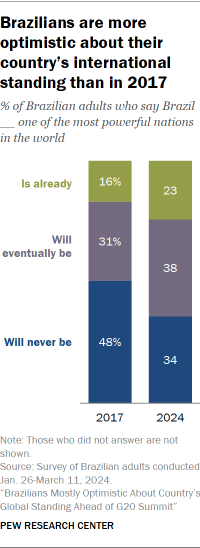
A bar chart showing that Brazilians are more optimistic about their country’s international standing than in 2017

Brazilians’ views of their country’s international standing are more positive than they were in 2017, when we last asked this question. At that time, Brazilians were decidedly more pessimistic about their country’s potential to become a top international power.

Related: How people in the Americas see Brazil ahead of the G20 summit

Brazilians have also become more optimistic about domestic affairs. The share of Brazilians who trust their national government to do what is right for the country has roughly doubled, from 23% in 2017 to 47% today. The share who are satisfied with democracy in Brazil has likewise increased from 28% to 44% over the same period. During the 2017 survey, the country was embroiled in a long-running corruption probe known as “Operação Lava Jato” or “Operation Car Wash,” which implicated a large number of high-level politicians and business executives, including directors of a major state-owned energy company. (For more on Brazilians’ views of their country, read Chapter 1.)

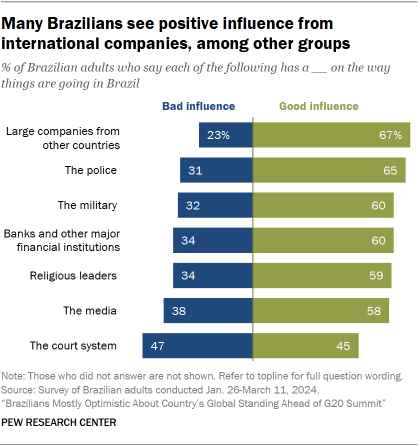
Positive views of certain groups and institutions in Brazil accompany the public’s relative optimism. Majorities say large foreign companies, the police, the military, financial institutions, religious leaders and the media have a good influence on how things are going in Brazil. But Brazilians are divided over whether the court system is having a positive or negative impact on the country.

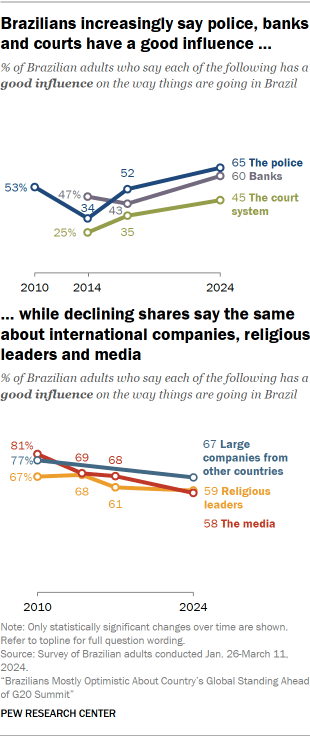
Views of some institutions have changed significantly since 2017. Brazilians are now more likely to say that financial institutions, the police and the court system have a good influence on the country. Conversely, views of the media have become more negative. The survey was conducted before Brazil’s Supreme Court upheld a ban on the social network X. (For more on how Brazilians see institutions and government systems, read Chapter 2.)
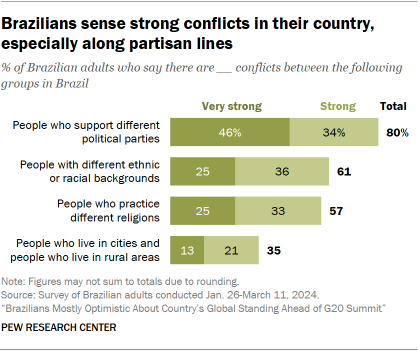
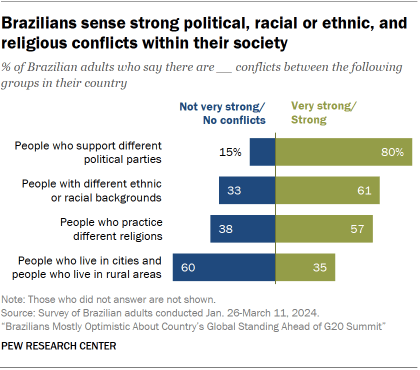
A bar chart showing that Brazilians sense strong conflicts in their country, especially along partisan lines

At the same time, Brazilians say their nation is divided across social groups – and they see especially strong conflicts between supporters of different political parties. Brazilians also see divisions between different racial and religious groups. (For more on views of conflict in Brazilian society, read Chapter 3.)

Support for Brazil’s president is also lukewarm. About half of Brazilians (48%) have a favorable view of President Luiz Inácio Lula da Silva. This is greater than the share who have a favorable view of his predecessor, opposition leader Jair Bolsonaro (40%). The survey took place before Brazilian authorities accused Bolsonaro in March of falsifying his COVID-19 vaccination records and in June of embezzling jewelry he received from foreign governments while serving as president. (For more on views of Lula and Bolsonaro, read Chapter 4.)

These are some of the key findings of a Pew Research Center survey of 1,054 Brazilian adults, conducted via face-to-face interviews from Jan. 26 to March 11, 2024.

Other major findings in this study

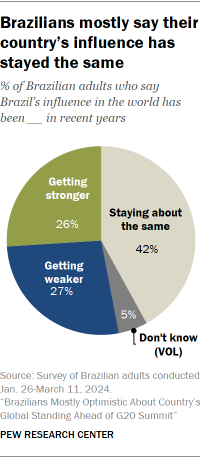
  • Brazilians tend to say that their country’s influence in the world has stayed the same in recent years; 42% hold this view. Smaller shares say it has been getting stronger (26%) or getting weaker (27%).
  • About six-in-ten Brazilian adults (59%) say representative democracy is a good way to govern. This is more than the shares who say the same of other political systems we asked about – but a relatively low level of support for representative democracy compared with those measured in other nations.
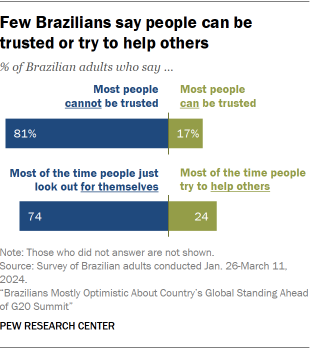
  • Brazilians view their peers with distrust. Only 17% say most people, in general, can be trusted, while 81% say they cannot. And 24% think people try to help others most of the time, while 74% say people mostly just look out for themselves. Men are more likely than women to say other people can generally be trusted.
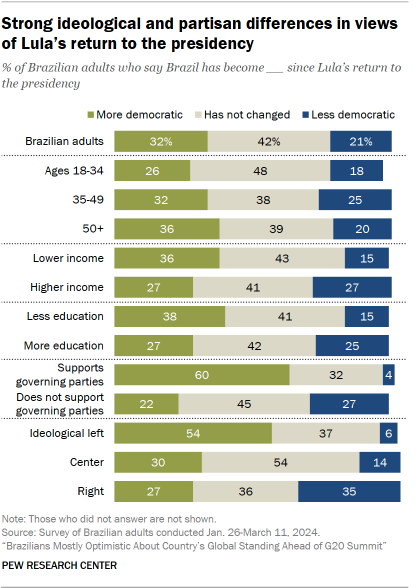
  • About a third in Brazil say their country has become more democratic (32%) since Lula’s return to the presidency. In comparison, only about one-in-five Brazilians (21%) say their country has become less democratic; 42% say the state of democracy has not changed.
1. Brazilians’ views of their country

Here are key takeaways about how Brazilians see their own country and its place in the world:

  • 42% of Brazilian adults say Brazil’s global influence has stayed about the same in recent years. Roughly a quarter each believe their country is getting stronger (26%) or getting weaker (27%).
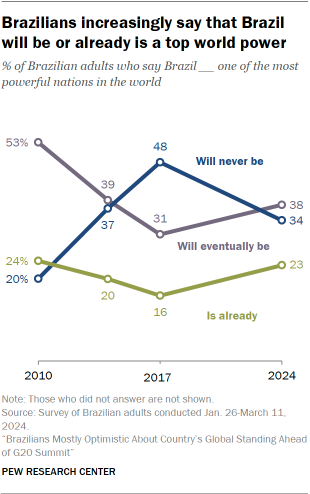
  • About six-in-ten Brazilians say their country either will eventually be (38%) or already is (23%) one of the most powerful nations in the world. However, 34% say Brazil will never reach this status.
  • Trust in the government to do what is right for the country is almost evenly divided: 49% do not trust their government to do what is right, while 47% do.
  • More Brazilians are dissatisfied than satisfied with the way democracy is working in their country (54% vs. 44%). But satisfaction has improved since last year.

Brazil’s international standing

Brazilians generally say that Brazil’s influence is unchanged in recent years, but many think their country is or may eventually be one of the most powerful in the world.

Brazil’s influence in the world

A pie chart showing that Brazilians mostly say their country’s influence has stayed the same

When asked how Brazil’s standing on the world stage has fared in recent years, a plurality of Brazilians (42%) say their country’s global influence has stayed about the same. Roughly a quarter each believe that Brazil is getting stronger (26%) or that it is getting weaker (27%). Another 5% did not respond.

Opinion about Brazil’s influence in the world varies by support for the country’s left-leaning governing coalition, which includes Lula’s Worker’s Party (PT). (Read Appendix A for more information on how we classify governing parties.)

Brazilians who feel close to any of the governing parties are 15 percentage points more likely than those who don’t feel close to these parties to say Brazil’s influence has been getting stronger. Those who don’t feel close to any of the parties in power are much more likely than governing party supporters to say Brazil has been getting weaker.

Brazil’s status as a powerful nation

Brazilian adults are somewhat optimistic about their country’s status in the world: 38% say Brazil will eventually be one of the most powerful nations in the world, and 23% say it is already among the most powerful nations. About a third (34%) believe Brazil will never be a top power.

A line chart showing that Brazilians increasingly say that Brazil will be or already is a top world power

The share of Brazilians who say their country will never be one of the most powerful is 14 points lower now than it was in 2017, when we last asked this question.

But Brazilians today are more likely to say their country will never be one of the most powerful than they were in 2010, during Lula’s first presidential term. Then, just 20% believed Brazil would never be a top power, a share that has risen 14 points in the intervening years.

Optimism about Brazil’s international standing varies by education level. Brazilians with less than a secondary education are significantly more likely than those with more education to say that Brazil is currently one of the most powerful nations in the world (33% vs. 17%). For their part, those with more education are more likely than those with less to say their country will eventually be one of the most powerful in the world (42% vs. 31%).

Brazilians who do not feel close to the parties in power (37%) are more likely than those who do (26%) to say Brazil will never be one of the more powerful nations in the world. And those with higher incomes are more likely to hold this view when compared with those who have lower incomes (39% vs. 30%).

Brazil’s government and political system

Looking domestically, Brazilians have some reservations about how their government and political system are working.

Trust in government

A bar chart showing that Brazilians’ trust in government has increased since 2017

Trust in the national government is about evenly divided, with 47% of Brazilians saying they trust the government to do what is right for the country and 49% saying they do not. This includes roughly four-in-ten (39%) who say they do not trust the government at all to do what is right for Brazil.

Although a substantial share has no trust in the government, trust has significantly improved since we last asked this question in 2017. The share of Brazilians who trust their government to do what is right has grown from 23% then to 47% today.

Brazilians who support parties in Lula’s governing coalition are far more likely than those who do not to trust the government (73% vs. 38%). Views also vary by ideology: Those who place themselves on the left are the most likely to say they trust the government to do the right thing (68%), followed by smaller shares of those in the center (51%) and on the right (39%).

White Brazilians are more skeptical of their government than Black or mixed-race Brazilians are. About a third of White Brazilians (36%) say they trust the national government to do what is right for Brazil, while around half or more among Black Brazilians (57%) and mixed-race Brazilians (51%) say the same. (White Brazilians are also less likely to support the governing parties.)

Those with higher incomes also express less trust than those with lower incomes (40% vs. 54%) and are also more likely to answer the question.

Satisfaction with democracy

A line chart showing that More Brazilians are satisfied with their democracy now than last year

When thinking about how democracy is working in their country, Brazilians are somewhat dissatisfied. Slightly more than half express dissatisfaction, including 30% who are not at all satisfied.

While evaluations of democracy in Brazil are more negative than positive, they have improved since last year. Satisfaction levels have risen 7 points since 2023.

Related: Satisfaction with democracy has declined in recent years in high-income nations.

Satisfaction with the way democracy is working in Brazil varies by race. Roughly half of Black and mixed-race Brazilians express satisfaction with the system (48% each), compared with 37% of White Brazilians.

Additionally, those on the ideological left are more likely than those on the right to say they are satisfied (56% vs. 35%). And Brazilians who support the governing parties are 25 points more likely than those who don’t to be satisfied with their democracy.

We observed a similar pattern during the administration of Jair Bolsonaro, a right-wing politician who held office from 2019 to 2023. In the first year of his term, Brazilians on the ideological right expressed more satisfaction with their democracy than those on the left (47% vs. 29%). And those who supported the parties in Bolsonaro’s government were more satisfied than those who did not (56% vs. 38%).

2. Brazilians’ views of institutions and government systems

Here are key takeaways about how Brazilians see organizations and institutions in their country, as well as their attitudes toward different political systems:

  • Majorities in Brazil believe large international companies, the police, the military and other groups have a positive influence in their country. However, while some institutions (such as the court system) are increasingly seen as having a positive influence, favorable views toward others (such as the media) have declined.
  • Most Brazilian adults say representative democracy is a good form of government, but there is substantial support for nondemocratic alternatives as well.

Influence of different groups and institutions in Brazil

A bar chart showing that Many Brazilians see positive influence from international companies, among other groups

In general, Brazilians see several organizations as having a good influence in their nation. Two-thirds believe large companies from other countries have a good influence in Brazil, for example.

About six-in-ten or more see the police, the military, banks, religious leaders and the media as having a positive impact on their country.

However, Brazilians are roughly split over the influence of the court system: 45% see it as having a good influence, while 47% say it has a bad influence in Brazil.

A set of line charts showing that Brazilians increasingly say police, banks and courts have a good influence, while declining shares say the same about international companies, religious leaders and media

(The survey was conducted before the Brazilian Supreme Court voted to uphold a nationwide ban on the social media platform X, and before federal police recommended charges against Bolsonaro for allegedly forging his COVID-19 vaccination records and embezzling jewelry he received while president.)

Brazilians ages 18 to 34 are more likely than older adults to say banks, the court system, international companies and the military have a good influence in their country. For example, 67% of younger Brazilians say the military has a good influence, while 52% of those ages 50 and older agree.

Views of groups and institutions over time

Brazilians’ opinions of the influence these groups exert in their country has shifted over time. For example, the share who believe the police have a good influence in the country has increased significantly since this question was first asked in 2010 (+12 points).

Positive views of the influence of the court system (+20) and banks (+13) in Brazilian society have also increased since those questions were first asked in 2014.

However, the share who see a positive influence from other institutions has decreased: Fewer Brazilians believe the media (-23), large international companies (-10) and religious leaders (-8) have a good influence than said the same in 2010.

Views of different forms of government

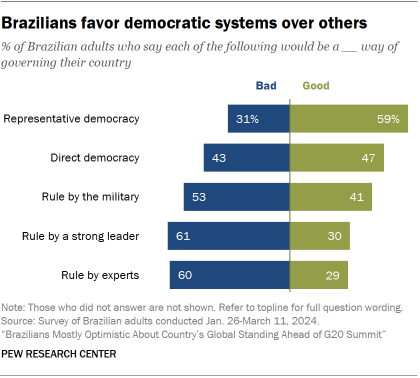
A bar chart showing that Brazilians favor democratic systems over others

We asked Brazilians to evaluate five different types of government systems: representative democracy, direct democracy, military rule, autocracy and technocracy.

Of these, Brazilians see representative democracy most favorably: A majority of adults (59%) believe that representative democracy, a system in which lawmakers are elected by citizens, is a good way to govern their country. About half (47%) also see direct democracy as a good way to govern.

Still, Brazilians’ support for these democratic forms of government is relatively low compared with levels of support measured in other nations, and substantial shares in Brazil also say certain nondemocratic systems would be good ways of governing.

About four-in-ten consider military rule a good way of governing Brazil, and this view is more common among those on the ideological right than the those on the left or in the center. Brazil was previously under right-wing military rule from 1964 to 1985.

Around three-in-ten think a technocracy (rule by experts) or autocracy (rule by a strong leader) make for good ways to govern Brazil.

Views of government systems over time

Support for three of the political systems we asked about has declined since 2023. The share in favor of a technocracy has seen the greatest decline (-13 points), followed by direct democracy (-9) and autocracy (-6). Views of representative democracy and rule by the military have stayed about the same.

3. Brazilians’ views of societal conflict

Here are key takeaways about how Brazilians view societal conflicts in their country, and about their trust in other people:

  • The vast majority of Brazilians (80%) see strong or very strong conflicts between people who support different political groups. Many also say there are strong conflicts among people with different ethnic or racial backgrounds and among people who practice different religions.
  • About three-quarters of Brazilians or more say that most people cannot be trusted (81%) and that most of the time people just look out for themselves over others (74%).

Societal conflicts

A bar chart showing that Brazilians sense strong political, racial or ethnic, and religious conflicts within their society

A majority of Brazilian adults see strong conflicts between people who support different political parties, people with difference ethnic or racial backgrounds, and people who practice different religions. Eight-in-ten see partisan conflicts in Brazil, including 46% who say this type of conflict is very strong.

Fewer see conflicts between people who live in cities and people who live in rural areas: Just 35% say this type of conflict is strong.

When considering conflicts between Brazilians who practice different religions, views vary across age and ideological groups. Those ages 18 to 34 are more likely than those ages 50 and older to say there are strong religious conflicts in Brazil (70% vs. 45%). And those on the ideological left are more likely than those on the right to say the same (69% vs. 51%).

Age is also a factor in perceptions of racial and ethnic divisions: Younger Brazilian adults are more likely than their older counterparts to say these conflicts are strong. And Brazilians across racial groups are aligned on this question, with similar shares saying that there are strong conflicts between people of different ethnic or racial backgrounds in their country.

Interpersonal trust and altruism

A bar chart showing that Few Brazilians say people can be trusted or try to help others

Large majorities of Brazilians say that most people cannot be trusted (81%) and that most of the time people just look out for themselves (74%). Just 17% believe most people can be trusted, and 24% think people generally try to help others.

Men in Brazil are slightly more likely than women to say that most people can be trusted.

Those with more education are more likely than those with less to say people mostly just look out for themselves (77% vs. 69%).

4. Brazilians’ views of Lula and Bolsonaro

Here are key takeaways about how Brazilians see their president and their country’s major opposition leader:

A bar chart showing that Roughly half of Brazilians hold a favorable view of Lula
  • Brazilian adults see President Luiz Inácio Lula da Silva slightly more favorably than his predecessor, opposition leader Jair Bolsonaro. While 48% hold a favorable view of Lula, 40% hold a favorable view of Bolsonaro.
  • About four-in-ten see Lula’s return to the presidency as having no effect on Brazil’s democracy (42%). About a third say Lula’s return has made Brazil more democratic, and around a fifth say it has made Brazil less democratic.

Favorability of Lula

Favorable views of Lula are about as common as unfavorable views (48% vs. 49%). This is largely unchanged from evaluations in early 2023.

Brazilians ages 18 to 34 are more likely than their older counterparts to see Lula in a positive light. Favorable views of Lula are also more common among Black or mixed-race Brazilians than among White Brazilians. And adults with less education and lower incomes report more favorable views of Lula than those with more education and higher incomes.

Stark ideological differences are present in evaluations of Lula. While 73% of Brazilians on the ideological left hold a favorable view of their president, only 49% of those in the center and 37% of those on the right see Lula positively.

Lula’s effect on democracy since returning to office

We asked Brazilian adults to evaluate what kind of change they’ve seen to Brazil’s democracy since Lula’s return to the presidency in January 2023. (He had previously held the office from 2003 to 2011.)

A bar chart showing that Strong ideological and partisan differences in views of Lula’s return to the presidency

The most common opinion is that democracy has not changed since Lula returned to office;  42% hold this opinion. Another 32% think Brazil has become more democratic, and 21% think it has become less democratic.

Though the prevailing view among both lower- and higher-income Brazilians is that democracy has not changed, those with lower incomes are more likely than those with higher incomes to say the country has become more democratic. For their part, those with higher incomes are more likely to say that the country has become less democratic since Lula’s return.

Across age groups, Brazilians ages 50 and older feel most strongly that Brazil has become more democratic since Lula’s return to the presidency: 36% say this, compared with 26% of adults under 35.

Six-in-ten of those who support Lula’s governing coalition say his return to the presidency has made Brazil more democratic. Only 22% of those who do not support the parties in power agree.

Favorability of Bolsonaro

A bar chart showing that 4 in 10 Brazilians see Jair Bolsonaro favorably

Bolsonaro, who served as president from 2019 to 2023, is seen somewhat less favorably by the Brazilian public. Only 40% hold a favorable view of Bolsonaro, compared with 58% who have an unfavorable view. (The survey took place before federal police recommended charges against Bolsonaro for allegedly forging his COVID-19 vaccination records and embezzling jewelry he received while president.)

Men see Bolsonaro more favorably than women do, as do those with higher incomes when compared with those with lower incomes. White Brazilians are at least 10 percentage points more likely than Black or mixed-race Brazilians to have a favorable opinion of Bolsonaro.

Ideological differences are also present. A 58% majority of those on the ideological right report a positive view of Bolsonaro. By comparison, only 33% of those in the center and 16% of those on the left see him positively.

Appendix A: Political categorization

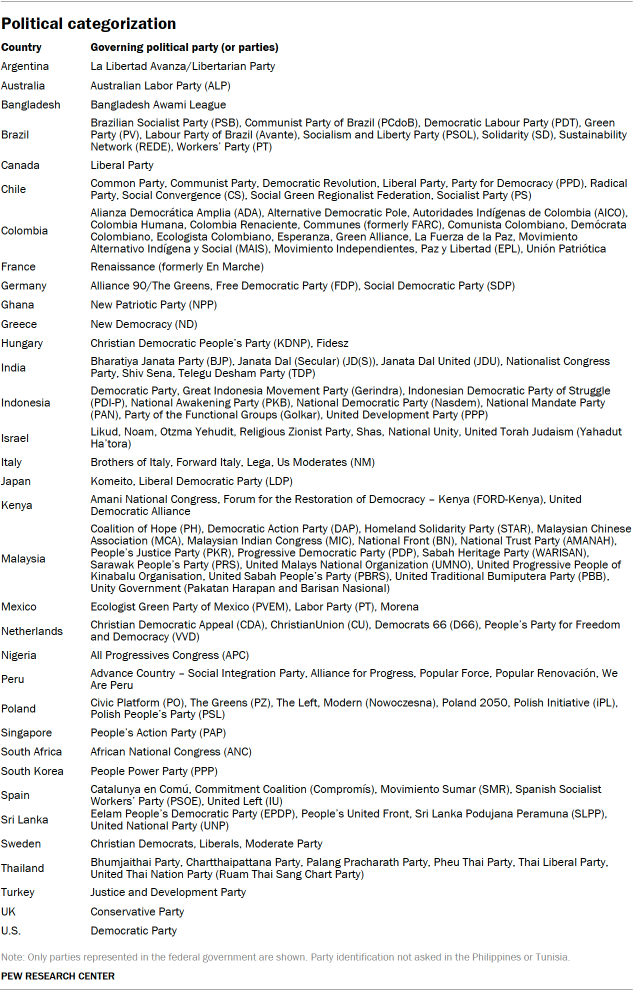
For this analysis, we grouped people into two political categories: those who support the governing political party (or parties) in their country, and those who do not. These categories were coded based on the party or parties in power at the time the survey was fielded and on respondents’ answers to a question asking which political party, if any, they identify with in their country.1

In countries where multiple political parties govern in coalition (as is the case in many European countries), survey respondents who indicate support for any party in the coalition were grouped together. In Germany, for example, where the Social Democratic Party governed with Alliance 90/The Greens and the Free Democratic Party at the time of the 2024 survey, supporters of any of the three parties were grouped together. In countries where different political parties control the executive and legislative branches of government, the party holding the executive branch was considered the governing party.

Survey respondents who did not indicate support for any political party, or who refused to identify with one, were categorized as not supporting the government in power. Party identification was not asked about in the Philippines or Tunisia.

The table below outlines the governing political parties in each survey country.

A table showing political categorization

Acknowledgments

This report is a collaborative effort based on the input and analysis of the following individuals.

Christine Huang, Research Associate
Moira Fagan, Research Associate
Sofia Hernandez Ramones, Research Assistant

Dorene Asare-Marfo, Senior Panel Manager
Sarah Austin, Research Assistant
Peter Bell, Associate Director, Design and Production
Janakee Chavda, Associate Digital Producer
Laura Clancy, Research Analyst
Manolo Corichi, Research Analyst
Jonathan Evans, Senior Researcher
Janell Fetterolf, Senior Researcher
Shannon Greenwood, Digital Production Manager
Sneha Gubbala, Research Analyst
Juliana Horowitz, Senior Associate Director, Research
Anna Jackson, Editorial Assistant
Hannah Klein, Senior Communications Manager
Gar Meng Leong, Communications Manager
Kirsten Lesage, Research Associate
Jordan Lippert, Research Analyst
Carolyn Lau, International Research Methodologist
John Carlo Mandapat, Information Graphics Designer
William Miner, Research Analyst
Patrick Moynihan, Associate Director, International Research Methods
Georgina Pizzolitto, Research Methodologist
Jacob Poushter, Associate Director, Global Attitudes Research
Andrew Prozorovsky, Research Assistant
Dana Popky, Associate Panel Manager
Laura Silver, Associate Director, Global Attitudes Research
Sofi Sinozich, International Research Methodologist
Maria Smerkovich, Research Associate
Kelsey Jo Starr, Research Analyst
Brianna Vetter, Administrative Associate
Richard Wike, Director, Global Attitudes Research

Methodology

About Pew Research Center’s Spring 2024 Global Attitudes Survey

Pew Research Center’s survey in Brazil was conducted as part of the Spring 2024 Global Attitudes Survey. Results for the survey are based on telephone, face-to-face and online interviews conducted under the direction of Gallup, Langer Research Associates, Social Research Centre and Verian. The results are based on national samples, unless otherwise noted. Here are more details about our international survey methodology and country-specific sample designs.