Pew Research Center

FOR RELEASE JUNE 11, 2024

Globally, Biden Receives Higher Ratings Than Trump

Still, most disapprove of how Biden has dealt with the Israel-Hamas war

BY Richard Wike, Janell Fetterolf, Maria Smerkovich and Sarah Austin

FOR MEDIA OR OTHER INQUIRIES:

Communications Department
202.419.4372
www.pewresearch.org

RECOMMENDED CITATION

Pew Research Center, June 2024, "Globally, Biden Receives Higher Ratings Than Trump"

About Pew Research Center

Pew Research Center is a nonpartisan, nonadvocacy fact tank that informs the public about the issues, attitudes and trends shaping the world. It does not take policy positions. The Center conducts public opinion polling, demographic research, computational social science research and other data-driven research. It studies politics and policy; news habits and media; the internet and technology; religion; race and ethnicity; international affairs; social, demographic and economic trends; science; research methodology and data science; and immigration and migration. Pew Research Center is a subsidiary of The Pew Charitable Trusts, its primary funder.

© Pew Research Center 2026

Table of contents

  • About Pew Research Center
  • Globally, Biden Receives Higher Ratings Than Trump
  • 1. Views of the U.S.
  • 2. Confidence in Joe Biden
  • 3. Confidence in Donald Trump
  • 4. Comparing confidence in Macron, Putin and Xi to ratings of Biden and Trump
  • 5. How well is Biden handling international issues?
  • 6. Is U.S. democracy a good example to follow?
  • Appendix A: Favorability of the United States since 2000
  • Appendix B: Confidence in the U.S. president since 2001
  • Acknowledgments
  • Methodology

Globally, Biden Receives Higher Ratings Than Trump

Still, most disapprove of how Biden has dealt with the Israel-Hamas war

How we did this

This Pew Research Center analysis focuses on public opinion of the United States, President Joe Biden and other world leaders. It also explores what people think about Biden’s handling of international issues and their perceptions of American democracy. The study includes publics in 34 countries across the Asia-Pacific region, Europe, Latin America, the Middle East, North America and sub-Saharan Africa.

This analysis draws on nationally representative surveys of 40,566 adults conducted from Jan. 5 to May 21, 2024. All surveys were conducted over the phone with adults in Canada, France, Germany, Greece, Italy, Japan, Malaysia, the Netherlands, Singapore, South Korea, Spain, Sweden and the United Kingdom. Surveys were conducted face to face in Argentina, Bangladesh, Brazil, Chile, Colombia, Ghana, Hungary, India, Israel, Kenya, Mexico, Nigeria, Peru, the Philippines, Poland, South Africa, Sri Lanka, Thailand, Tunisia and Turkey. In Australia, we used a mixed-mode probability-based online panel.

A map showing Countries included in this report

Throughout the report, we analyze respondents’ attitudes based on where they place themselves on an ideological scale. We asked about political ideology using several slightly different scales and categorized people as being on the ideological left, center or right.

  • In most countries, we asked people to place themselves on a scale ranging from “Extreme left” to “Extreme right.” The question was asked this way in Argentina, Bangladesh, Brazil, Canada, Chile, Colombia, France, Germany, Greece, Hungary, Israel, Italy, Mexico, the Netherlands, Nigeria, Peru, the Philippines, Poland, South Africa, Spain, Sweden, Turkey and the United Kingdom.
  • In Australia, the scale ranged from “Left” to “Right”.
  • In Japan, Singapore, South Korea and Thailand, ideology was measured on a scale from “Extremely progressive” to “Extremely conservative.”
  • Ideology was not asked about in Ghana, India, Kenya, Malaysia, Sri Lanka or Tunisia. 

Prior to 2024, combined totals were based on rounded topline figures. For all reports beginning in 2024, totals are based on unrounded topline figures, so combined totals might be different than in previous years. Refer to the 2024 topline to see our new rounding procedures applied to past years’ data.

Here are the questions used for the report, along with responses, and the survey methodology.
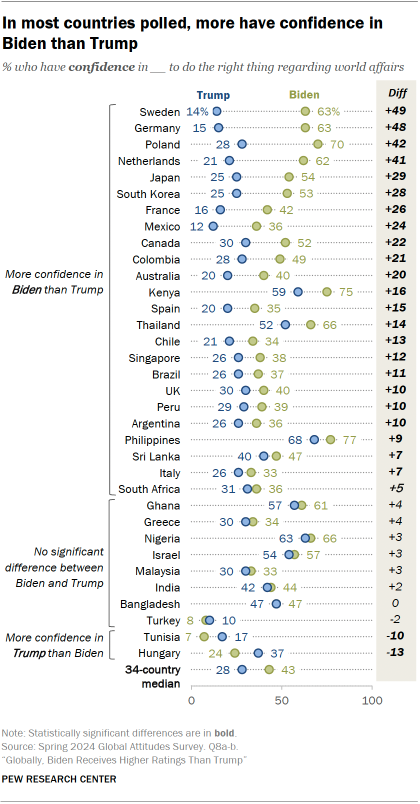
A dot plot showing that In most countries polled, more have confidence in Biden than Trump

With many around the world closely following the fiercely contested rematch between U.S. President Joe Biden and former President Donald Trump, a new Pew Research Center survey finds that, internationally, Biden is viewed more positively than his rival.

Across the 34 nations polled, a median of 43% have confidence in Biden to do the right thing regarding world affairs, while just 28% have confidence in Trump. The gap between ratings is quite wide in many countries, especially in Europe. Biden’s confidence rating is at least 40 percentage points higher than Trump’s in Germany, the Netherlands, Poland and Sweden.

However, there are exceptions. There is no statistically significant difference in ratings of Biden and Trump in eight nations we surveyed. And people in Hungary and Tunisia give Trump more positive reviews than Biden, although neither leader gets especially high marks there. (The survey was conducted before Trump’s conviction in a state criminal trial in New York.)

Even though Biden gets better assessments than Trump globally, ratings for the current U.S. president are down since last year in 14 of 21 countries where trends are available, including by double digits in Australia, Israel, Japan, Poland, South Africa, Spain, Sweden and the United Kingdom.
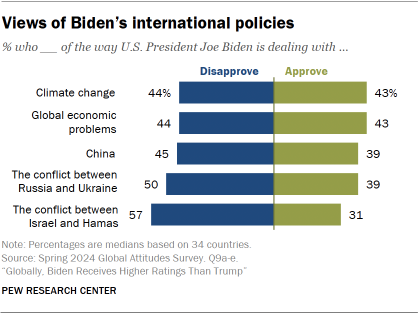
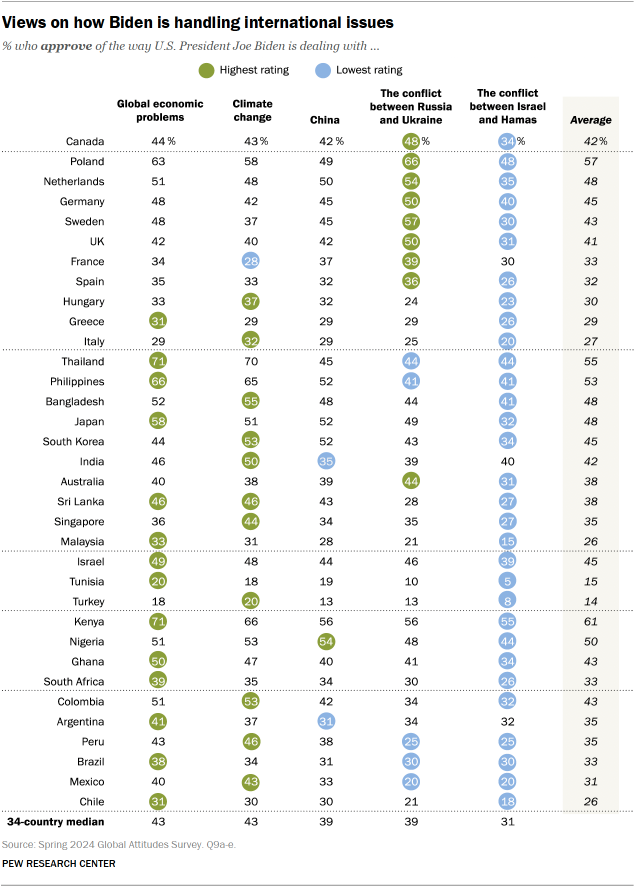
A bar chart showing Views of Biden’s international policies

The survey included a series of questions about how Biden is handling major international issues. Overall, opinions are divided on how he is dealing with climate change and global economic problems.

Across the 34 countries polled, a median of around four-in-ten approve of how Biden is dealing with China and with the war between Russia and Ukraine (39% each).

The president gets his most negative reviews on his handling of the Israel-Hamas war: A median of just 31% approve of the way he is handling the conflict, while 57% disapprove. (The survey was conducted prior to Biden announcing a proposal to end the conflict.)

Research in the West Bank and Gaza

Pew Research Center has polled the Palestinian territories in previous years, but we were unable to conduct fieldwork in Gaza or the West Bank for our Spring 2024 survey due to security concerns. We are actively investigating possibilities for both qualitative and quantitative research on public opinion in the region and hope to be able to share data from the region in the coming months.

Six-in-ten Israelis disapprove of how Biden is handling the war, including 53% of Jewish Israelis and 86% of Arab Israelis. (For more on how Israelis rate Biden, read “Israeli Views of the Israel-Hamas War.”)

Of the predominantly Muslim nations surveyed, large majorities in Malaysia, Tunisia and Turkey also disapprove of Biden’s handling of the Israel-Hamas war. Opinion is divided on this issue in Bangladesh.

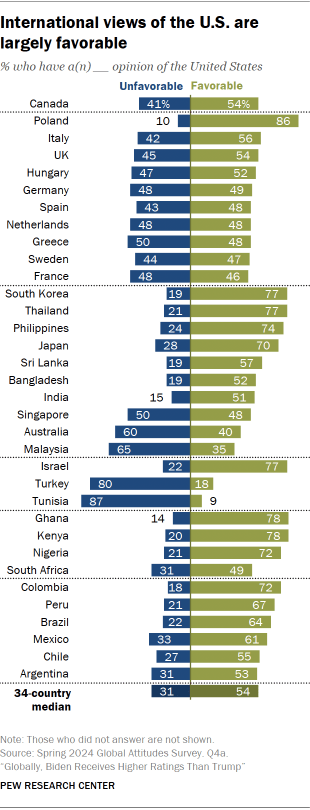
The new survey finds that overall attitudes toward the United States are generally positive: A median of 54% across the nations polled have a favorable view of the U.S., while 31% have a negative opinion.

However, criticisms of American democracy are common in many nations. We asked respondents whether U.S. democracy is a good example for other countries to follow, used to be a good example but has not been in recent years, or has never been a good example.
A bar chart showing that A median of 4 in 10 across 34 countries say the U.S. used to be a good example of democracy

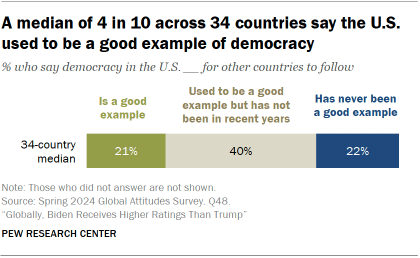
The predominant view in most countries is that the U.S. used to be a good model but has not been recently. Overall, a median of 21% believe it is currently a good example, while 22% say it has never been a good model for other countries.

In eight of the 13 countries where trends are available, fewer people say American democracy is a good example than said so in spring 2021, when we last asked this question.

For this report, we surveyed 40,566 people in 34 countries – not including the U.S. – from Jan. 5 to May 21, 2024. In addition to this overview, the report includes chapters on:

  • Attitudes toward the United States
  • Ratings of Biden
  • Ratings of Trump
  • Views of Biden and Trump compared with other world leaders
  • Views about Biden’s handling of major foreign policy issues
  • Is the U.S. a good example of democracy?

Read some of the report’s key findings below.

Views of the U.S.
A bar chart showing that International views of the U.S. are largely favorable

At least half of those in most countries surveyed express a favorable opinion of the U.S. Poles are the most positive, at 86% favorable. Of the European nations surveyed, ratings also lean positive in Italy, Hungary and the UK. Elsewhere in Europe, however, opinions tend to be closely divided.

Attitudes toward the U.S. are largely favorable in the Asia-Pacific nations polled, especially Japan, the Philippines, South Korea and Thailand. However, most Australians and Malaysians give the U.S. poor marks.

In the Middle East-North Africa region, a 77% majority of Israelis view the U.S. favorably, although this is down from 87% last year. Large majorities in Tunisia and Turkey offer an unfavorable opinion.

The U.S. gets mostly positive ratings in the sub-Saharan African and Latin American nations surveyed. Two-thirds or more see the U.S. favorably in Colombia, Ghana, Kenya, Nigeria and Peru.

Refer to Appendix A for long-term trends on views of the U.S.

Confidence in Biden, Trump and other world leaders

Pew Research Center has explored attitudes toward American presidents for over two decades, finding significant shifts in opinions over the years. Data from four Western European nations that we have surveyed consistently – France, Germany, Spain and the UK – shows long-term trends in views of recent presidents.

George W. Bush received low and declining ratings during his time in the White House, while Barack Obama got mostly high marks. Attitudes toward Donald Trump were overwhelmingly negative throughout his presidency. Biden has consistently received more positive reviews than his predecessor, but his ratings have declined in these four countries during his time in office.

A line chart showing Confidence in U.S. presidents across Western Europe
A chart showing Falling confidence in Biden since 2023

There are nine nations in this year’s survey where six-in-ten adults or more express confidence in Biden. Four are in Europe (Germany, the Netherlands, Poland and Sweden), two are in the Asia-Pacific region (the Philippines and Thailand) and three are in sub-Saharan Africa (Ghana, Kenya and Nigeria).

Since last year, confidence in Biden has dropped significantly in 14 nations: Seven in Europe, plus Australia, Canada, Israel, Japan, Mexico, South Africa and South Korea. Biden gets his lowest ratings in Turkey and Tunisia, where only about one-in-ten express confidence in him.

The two countries where at least six-in-ten adults have confidence in Trump are Nigeria and the Philippines. Like Biden, Trump gets one of his lowest ratings in Turkey, where just 10% view him favorably.

Confidence in Trump has increased slightly in a few European countries since we last asked about him in 2020, although his ratings remain quite low in Europe.

In contrast, Trump’s ratings have become more negative in Poland since 2019, which was the last year we asked about him there. Israeli views toward the former president have also become more negative over the past five years.

Refer to Appendix B for long-term trends in confidence in U.S. presidents.  

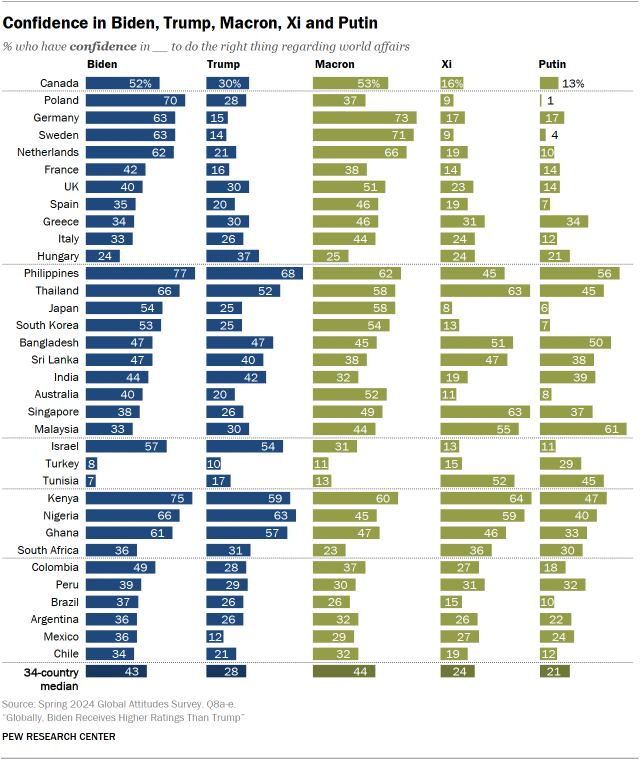
A bar chart showing Confidence in Macron, Biden, Trump, Xi and Putin

In addition to exploring confidence in Biden and Trump, the survey asked about trust in French President Emmanuel Macron, Russian President Vladimir Putin and Chinese President Xi Jinping.

Overall, Macron receives the most positive ratings across the countries in the study, followed closely by Biden. The French president gets higher ratings than his U.S. counterpart in many of the European nations surveyed. Both Xi and Putin receive mostly poor marks across the countries in the study.

Differences by ideology, age and gender

Ideology

A dot plot showing that Approval of Biden’s handling of the Israel-Hamas war is lower among those on the ideological left
  • In 17 of the 28 countries where political ideology is measured, people on the right are more likely to have a positive opinion of the U.S. than those on the left. For example, 65% of people on the right in Spain view the U.S. favorably, compared with 26% of people on the left.
  • In 18 countries, people on the right are more likely to express confidence in Trump than those on the left. The gap is especially large in Israel, where 75% of those on the right have confidence in him, compared with just 23% of Israelis on the left.
  • There are also some sizable ideological differences on views about Biden’s handling of the Israel-Hamas war. In several countries – including about half of the European countries surveyed – people on the right are more likely than those on the left to approve of how Biden is handling the conflict.

Age
A table showing that In many countries, men are more confident in Trump than women are
  • In several countries – including Canada, all Latin American countries surveyed and several countries in the Asia-Pacific region – adults under 35 are more likely to have a positive opinion of the U.S. when compared with adults ages 50 and older. Australia, Israel and Sweden are the only countries where younger adults have a less favorable view of the U.S.
  • In Canada, Australia and seven of the 10 European countries surveyed, young adults are less likely than older adults to approve of how Biden is dealing with the Israel-Hamas war.

Gender

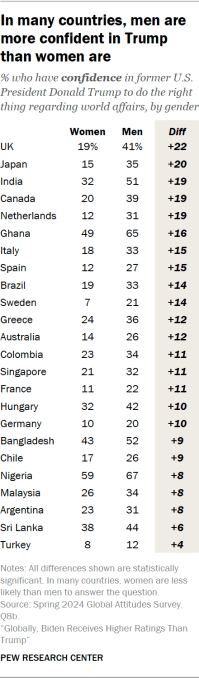
  • Men have more confidence in Trump than women do in many of the countries surveyed. The largest difference is in the UK, where men are about twice as likely as women to trust the former U.S. president. In many of the countries surveyed, women are less likely than men to answer this question at all.
1. Views of the U.S.

Overall, views of the U.S. are more positive than negative across the 34 countries surveyed. A median of 54% hold a favorable opinion of the U.S., while a median of 31% have an unfavorable opinion.

Poles are most likely to evaluate the U.S. positively: 86% hold a favorable view, though this share has declined 7 percentage points since last year. Half or more express a positive view in Hungary, Italy and the UK. In the other European countries surveyed, views of the U.S. are roughly split. 

In the Asia-Pacific region, 70% or more rate the U.S. positively in Japan, the Philippines, South Korea and Thailand. In contrast, half or more see the U.S. unfavorably in Australia, Malaysia and Singapore.

The U.S. receives the lowest ratings of the survey in Tunisia and Turkey, where 80% or more have a negative opinion. Roughly three-quarters of Israelis have a positive view of the U.S.

Publics in the sub-Saharan African and Latin American countries surveyed tend to view the U.S. favorably. 

A table showing that Positive views of the U.S. have declined in some countries since 2023

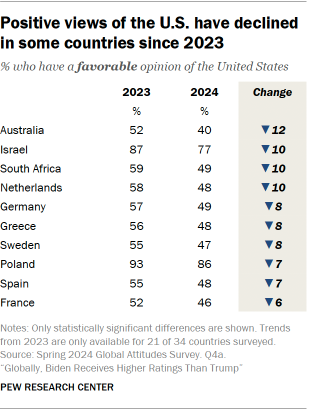
Opinions of the U.S. have grown less positive among some notable allies since last year. For example, 40% of Australians now hold a positive view of the U.S., compared with 52% in 2023. Ratings of the U.S. are also down among several key NATO allies.

Positive ratings have also declined in Tunisia, where we last surveyed in 2019. Then, 33% of adults viewed the U.S. favorably, compared with only 9% today.

In Turkey, which gives the second-lowest ratings of the U.S. in the survey, views have been consistently negative since we first started polling there in 2002.

In Chile, Colombia, Ghana and Peru, the share with a positive view of the U.S. has increased since we last asked this question in 2017. We have seen a similar increase in many other countries since 2017 – during the first year of Trump’s presidency – despite declines in the last couple years.

Views of the U.S. have also become slightly more positive since last year in two countries: Roughly half of adults in Hungary (52%) now have a positive view of the U.S., compared with 44% last year. In Kenya, where President William Ruto’s recent visit to the U.S. was announced right before fieldwork began, more have a favorable view of the U.S. today than in 2023 (78% vs. 71%).

Read Appendix A for views of the U.S. from 2000 to now.

Ideological and age differences

In many countries, people on the ideological right and adults under 35 are more likely than others to rate the U.S. positively.

Canada is a good example of the ideological divide: A majority of adults who place themselves on the right (66%) have a favorable opinion of the U.S., compared with only 37% of those on the left.

The age gap in positive views of the U.S. is seen in Canada, Hungary, India, Singapore, South Africa, South Korea, Sri Lanka, Thailand, Turkey and the Latin American countries surveyed. In Turkey, as an example, 29% of adults under 35 rate the U.S. favorably, compared with only 7% of those ages 50 and older.

In Australia, Israel and Sweden, the age pattern is reversed: For example, 85% of older Israelis and 72% of younger Israelis have a positive assessment of the U.S.

2. Confidence in Joe Biden

A median of 43% across 34 countries surveyed have confidence in Biden to do the right thing regarding world affairs. A similar share say they do not have confidence in him.

In Europe, seven-in-ten Poles trust Biden when it comes to world affairs, and majorities in Germany, the Netherlands and Sweden agree. But most adults in the other European countries surveyed do not have confidence in the U.S. president, ranging from 56% no confidence in France to 72% in Hungary.

Views are also varied in the Asia-Pacific region. Large shares in the Philippines and Thailand trust Biden’s handling of international affairs, while majorities in Australia, Malaysia and Singapore do not.

Biden receives his least positive assessments in Tunisia and Turkey, where nearly nine-in-ten do not have confidence in him to do the right thing regarding world affairs.

The U.S. president gets relatively positive ratings in most of the sub-Saharan African nations surveyed, but generally negative assessments across most of the Latin American countries in the study.

A table showing that Confidence in Biden has decreased since 2023 in several nations

Confidence in Biden has decreased in many of the countries where trend data is available.

In Australia and the UK, for example, 54% had confidence in Biden in 2023, compared with only 40% this year. Confidence in Biden has also dropped significantly in Poland since last year, though a large share there still says they have faith in the U.S. president when it comes to international relations.

Now, trust in Biden is the lowest it has been in many countries since he took office in 2021.

Refer to Appendix B for over 20 years of data on global confidence in U.S. presidents.

3. Confidence in Donald Trump

Though confidence in U.S. President Joe Biden has declined in recent years, even fewer people have confidence in former U.S. President Donald Trump to do the right thing regarding world affairs.

A bar chart showing that Across 34 countries, few trust Trump to handle world affairs

Across 34 countries surveyed, a median of 28% are confident in Trump; 69% are not. (The survey was conducted before Trump’s conviction in a state criminal trial in New York.)

Majorities in Canada and across Europe say they have no confidence in Trump. More than eight-in-ten adults hold this view in France, Germany and Sweden.

Trump also receives poor assessments in Latin America, where at least six-in-ten in every country surveyed – including 86% in Mexico – do not have confidence in him to do the right thing in world affairs.

There are more varied views of Trump in other regions of the world. Roughly half or more in Ghana, Israel, Kenya, Nigeria, the Philippines and Thailand express confidence in him. But large majorities in a few Asia-Pacific countries do not, including 79% in Australia. And in the Middle East-North Africa region, large majorities in Tunisia and Turkey view him negatively.  

Trump was in office at the start of the COVID-19 pandemic, and confidence in him was especially low in several countries at that time. Since then, views of Trump have improved in a few places.

For example, 20% of Canadians had confidence in Trump in 2020, compared with 30% today. Similar increases can be seen in Italy and the UK.

Hungary and Tunisia are the only countries surveyed where confidence in Trump is substantially higher than confidence in Biden, though ratings for both leaders are still largely negative there.

In some nations, the difference in views of the two U.S. presidents is very large. For example, 63% of Germans trust Biden, but only 15% trust Trump – a difference of nearly 50 percentage points.

Ideological and gender differences

A dot plot showing that People on the ideological right are more likely to have confidence in Trump

In 18 of the 28 countries where political ideology is measured, people on the right are more likely than those on the left to trust Trump’s handling of world affairs.

The divide is particularly large in Israel, where adults on the right are roughly three times more likely than those on the left to have confidence in the former U.S. president.

But differences of 20 points or more can be seen in several other countries. For example, 46% of Australians on the right have confidence in Trump, compared with only 6% of those on the left.

Views of Trump also differ by gender. In many countries, men are more likely than women to express confidence in Trump.

Throughout much of Europe, men are about twice as likely as women to trust the former U.S. president, though confidence in Trump is relatively low among both groups. In the Netherlands, for example, 31% of men and 12% of women trust Trump to do the right thing in world affairs. It’s worth noting that, in many countries, women are less likely than men to answer this question at all.

4. Comparing confidence in Macron, Putin and Xi to ratings of Biden and Trump

In addition to views of Biden and Trump, our survey asked people how much confidence they have in French President Emmanuel Macron, Russian President Vladimir Putin and Chinese President Xi Jinping.

  • People are roughly split in their ratings of Joe Biden: Across 34 countries, a median of 43% trust him to do the right thing regarding world affairs, while 46% do not. Ratings of Emmanuel Macron are similarly divided.
  • A median of 28% have confidence in Donald Trump. And roughly a quarter trust Xi Jinping to do the right thing in world affairs.
  • Vladimir Putin receives the lowest ratings globally, and views of the Russian leader are especially negative in Europe.
A bar chart showing Confidence in Biden, Trump, Macron, Xi and Putin

Confidence in Macron is similar, overall, to confidence in Biden: A median of 44% trust the French president to do the right thing in world affairs. People in Germany, the Netherlands and Sweden are particularly likely to have confidence in Macron, but few hold this view in Hungary, Tunisia or Turkey. Confidence in Macron is also low in South Africa, though more than four-in-ten there do not offer an opinion on him.

Views of Macron have not changed much since 2023, when this question was last asked in most countries. Greece and Israel are the only countries where confidence in Macron has fallen by more than 10 percentage points. In 2023, 42% of Israelis trusted the French president, compared with 31% now. The share of Greeks who give Macron a favorable assessment has dropped from 59% last year to 46% now.

Confidence in Xi and Putin is generally low across the countries surveyed. A median of 24% trust the Chinese president, while 21% trust the Russian leader.

Around one-in-ten adults in Australia, Japan, Poland and Sweden trust Xi’s handling of world affairs. But views of Xi are not negative everywhere: Half or more in Bangladesh, Kenya, Malaysia, Nigeria, Singapore, Thailand and Tunisia have confidence in him.

Putin’s ratings fare a bit worse, especially in Europe. No more than a third in any European country surveyed trust him to do the right thing in world affairs. Only 4% in Sweden and 1% in Poland report confidence in the Russian president.

5. How well is Biden handling international issues?

We asked respondents whether they approve or disapprove of how U.S. President Joe Biden is dealing with five major international concerns.

  • Global publics are divided over Biden’s handling of climate change and global economic problems.
  • A 34-country median of about four-in-ten approve of how he is dealing with China.
  • A median of 39% approve of how Biden is dealing with the Russia-Ukraine war, but Europeans generally see this as where the U.S. president is doing best.
  • Biden gets his lowest marks for his handling of the Israel-Hamas war. A median of 31% across the 34 countries surveyed approve of how he is dealing with the conflict.

Adults in some countries, including Kenya, Poland and Thailand, hold more positive assessments of how Biden has handled these five concerns. On the other hand, people in Tunisia and Turkey rate Biden extremely negatively on these issues. Biden also receives low approval ratings in these areas from Chileans, Greeks, Italians and Malaysians.

A chart showing Views on how Biden is handling international issues
A bar chart showing Divided views on Biden’s approach to the global economy

Views of how Biden is dealing with each issue strongly relate to confidence in Biden overall. People who approve of how he has handled global economic problems, climate change, China, the war in Ukraine or the Israel-Hamas war are all more likely to have confidence in the U.S. president. 

Biden’s handling of global economic problems

Publics are about equally as likely to rate Biden positively on global economic policy as they are to rate him negatively. A 34-country median of 43% approve of how he is dealing with international economic issues, while a median of 44% disapprove.

Support is much higher in some nations: For example, 71% approve of his approach in Kenya and Thailand, and more than six-in-ten say the same in the Philippines and Poland.

But similarly high shares say they disapprove of how Biden is handling this issue in Tunisia (71%), Turkey (69%), Italy (67%), Greece (64%), Malaysia (64%) and Hungary (63%).

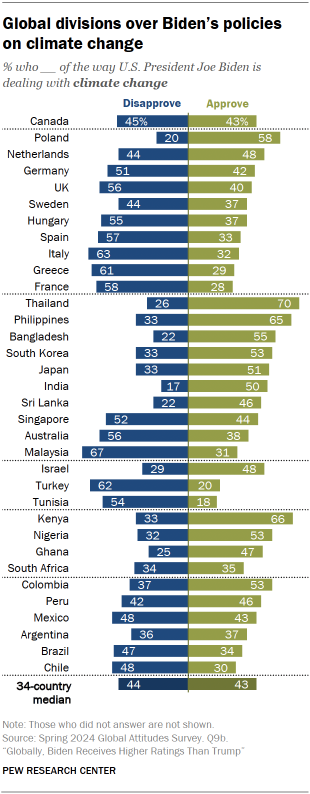
A bar chart showing Global divisions over Biden’s policies on climate change

Biden’s handling of climate change

Biden has made action on climate change a key priority throughout his presidency, rejoining the Paris Agreement in 2021 and signing the Inflation Reduction Act into law in 2022, which included several provisions designed to address climate change.

But publics are divided on his climate policy: A median of 43% say they approve of his approach, and a median of 44% say they disapprove.

Support for the way Biden is dealing with climate change is highest in Thailand, where seven-in-ten approve of his approach. Thailand is ranked ninth in the world for long-term climate risk and is expected to submit its first-ever climate change bill this summer.

In contrast, Biden receives his lowest approval ratings on climate change in Tunisia, where only 18% approve of how he is handling the issue. Still, Tunisians are not alone in their dissatisfaction: Fewer than three-in-ten adults approve in France, Greece and Turkey. 

A bar chart showing that Across 34 countries, nearly half disapprove of Biden’s China policy

Biden’s handling of China

A median of 39% across the nations surveyed approve of Biden’s approach to China, while a median of 45% disapprove.

Ratings are highest in Kenya – the only country where a clear majority (56%) approve of Biden’s China policy. Still, there are other countries in Europe, sub-Saharan Africa and the Asia-Pacific region where half or more evaluate Biden positively on this issue.

Views vary especially widely across the Asia-Pacific region. Roughly half or more in Japan, the Philippines and South Korea approve of Biden’s dealings with China. But majorities in Australia, Malaysia and Singapore disapprove.

Turkey is the least likely to approve of Biden’s approach: Only 13% are content with the way he is dealing with China.

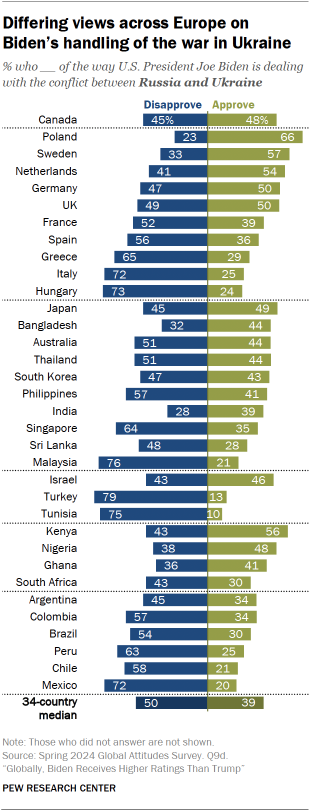
A bar chart showing Differing views across Europe on Biden’s handling of the war in Ukraine

Biden’s handling of the Russia-Ukraine war

When asked to assess Biden’s handling of the war between Russia and Ukraine, a median of 39% across 34 countries say they approve. A larger share – a 50% median – say they disapprove of the way Biden is dealing with the situation.

Since the start of the war in February 2022, the Biden administration has imposed strict sanctions on Russia and provided over $100 billion in aid to Ukraine. Biden signed the most recent aid package on April 24 after months of delay in the U.S. Congress.

Biden receives the most support on this issue from select NATO member states.

Roughly two-thirds of Poles (66%) approve of the way Biden has been handling the war between Russia and Ukraine. Poland, which borders both parties to the conflict, has taken in close to 1 million Ukrainian refugees since the war broke out.

A majority share in Sweden – NATO’s newest member – also approve of Biden’s handling of the war (57%).

His handling of the conflict is least popular in Turkey, another member of the alliance. Roughly eight-in-ten Turkish adults disapprove of the way Biden is dealing with the war in Ukraine, while only 13% approve.

Hungary also stands out as a NATO nation where people strongly disapprove of Biden’s Ukraine policies (73%). In all, half or more disapprove of Biden’s dealing with the Russia-Ukraine conflict in six of the 12 NATO members surveyed.

Biden’s handling of the Israel-Hamas war

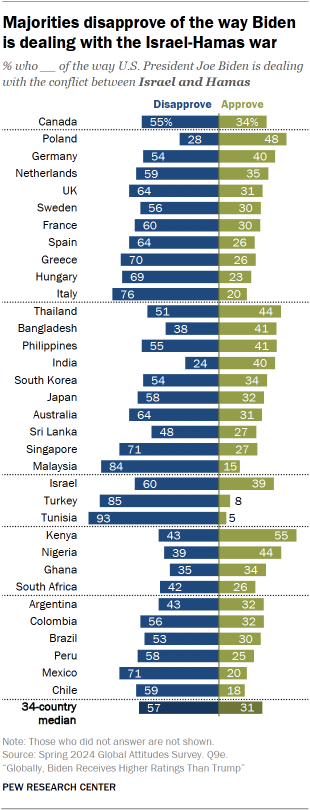
A bar chart showing that Majorities disapprove of the way Biden is dealing with the Israel-Hamas war

Of the five global issues we asked about, Biden receives his lowest ratings on the Israel-Hamas war: A median of 31% across the 34 countries surveyed say they approve of his handling of the conflict, while a median of 57% disapprove.

The Biden administration has played a significant role in the war thus far, providing military aid to Israel, as well as humanitarian aid to Gaza, while facilitating negotiations for a cease-fire. (The survey was conducted prior to Biden announcing a proposal to end the conflict.)

In nearly every country surveyed, fewer than half approve of the way he has been dealing with the war. Kenya is the only country where a majority see Biden’s handling of the war in a positive light.

Majorities in many countries say they disapprove of Biden’s handling of the war – including in Israel, where six-in-ten express this view. Israeli Arabs are more likely to disapprove than Israeli Jews (86% vs. 53%). For more on how people in Israel rate Biden, read “Israeli Views of the Israel-Hamas War”.

Disapproval rates are particularly high in some countries where a large majority of the population is Muslim, specifically Malaysia, Tunisia and Turkey. In Bangladesh, public opinion is divided on this issue.

Opinions vary along religious lines in a few countries with sizable Muslim populations. In Nigeria – where roughly half of the population is Muslim – 51% of Muslims disapprove of how Biden is dealing with the Israel-Hamas war, compared with 31% of Christians. Muslims in Nigeria are also more likely than Christians to express an opinion about the topic.

Similarly, 49% of Muslims in Ghana disapprove of Biden’s handling of the war, compared with 31% of Christians. And in India, Muslims (30%) are more likely than Hindus (23%) to disapprove, though more than a third in both groups say they are unsure.

Age and ideological differences

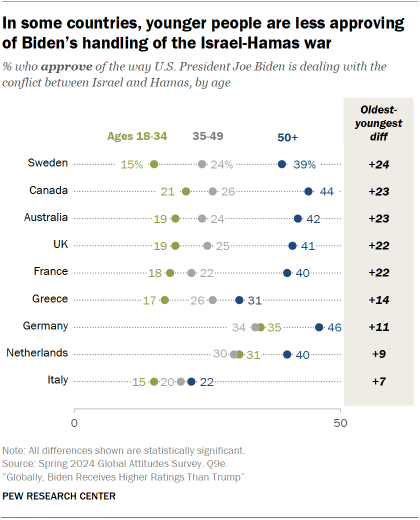
A dot plot showing that In some countries, younger people are less approving of Biden’s handling of the Israel-Hamas war

In Australia, Canada and most European countries surveyed, adults under 35 are less likely than those ages 50 and older to approve of Biden’s handling of the Israel-Hamas war. (In Australia and Canada younger adults are also less likely to answer to the question.)

For example, younger adults in France (18%) and the UK (19%) are roughly half as likely as older adults (40% and 41%, respectively) to rate him positively on this issue.

In Japan, South Africa, Sri Lanka and Thailand, younger adults are more likely than older ones to approve of how Biden is handling the war.

Opinions of how Biden has handled the Israel-Hamas war also differ by ideology in a subset of countries. In France, Greece, the Netherlands, Spain, Sweden and the UK – more than half of the European countries surveyed – people on the ideological right are more likely than those on the left to approve of how Biden is dealing with this issue.

Greeks are particularly divided. Only 6% of those on the left approve, compared with 38% on the right. Similar but smaller differences can also be seen in Argentina, Australia, Canada, Chile, Mexico and South Korea.

6. Is U.S. democracy a good example to follow?

The publics surveyed are largely skeptical that democracy in the U.S., at least in its current form, is a good example for other countries to follow. A median of four-in-ten across the 34 nations polled believe democracy in the U.S. used to be a good example for other countries to follow but has not been in recent years.

A bar chart showing What people around the world think of U.S. democracy

Roughly one-in-five say American democracy has never been a good example. A similar share say it is currently a good model for other countries.

Around the world, adults in advanced economies are more skeptical of U.S. democracy when compared with those in middle-income countries. In 16 of 17 high-income countries surveyed, the share of people who think American democracy used to be a good example is 40% or higher. By contrast, the share holding this opinion is under 40% in 13 of 17 middle-income countries surveyed.

The current state of American democracy receives some of its highest ratings in the sub-Saharan African nations included in the study. Half or more in Ghana, Kenya and Nigeria think U.S. democracy sets a good example for other countries. A similar share of Israelis hold this opinion.

On the other hand, in 18 of 34 countries surveyed, about a quarter or more of adults think that U.S. democracy has never been a good example to follow. Turkey stands out as the most critical of American democracy, with about half of adults (52%) holding this view.

A table showing that Fewer now say U.S. democracy is a good example for other countries to follow

Substantial shares of the public in several European democracies are also critical: At least three-in-ten say the U.S. has never been a good example in France, Greece, Italy, the Netherlands, Spain and Sweden.

Since spring 2021, the share who see American democracy as a good example has fallen in eight of the 13 countries where trends are available, mostly in Europe.

For instance, 32% of Italians said in 2021 that the U.S. was a good example of democracy, while 22% hold this view today. Smaller but significant decreases can be seen in Australia, Germany, Greece, the Netherlands, Spain, Sweden and the UK.

Appendix A: Favorability of the United States since 2000

Appendix B: Confidence in the U.S. president since 2001

Acknowledgments

This report is a collaborative effort based on the input and analysis of the following individuals.

Richard Wike, Director, Global Attitudes Research
Janell Fetterolf, Senior Researcher
Maria Smerkovich, Research Associate
Sarah Austin, Research Assistant

Dorene Asare-Marfo, Panel Manager
Peter Bell, Associate Director, Design and Production
Janakee Chavda, Assistant Digital Producer
Laura Clancy, Research Analyst
Manolo Corichi, Research Analyst
Jonathan Evans, Senior Researcher
Moira Fagan, Research Associate
Shannon Greenwood, Digital Production Manager
Sneha Gubbala, Research Assistant
Christine Huang, Research Associate
Anna Jackson, Editorial Assistant
Gar Meng Leong, Communications Manager
Kirsten Lesage, Research Associate
Jordan Lippert, Research Assistant
Carolyn Lau, International Research Methodologist
John Carlo Mandapat, Information Graphics Designer
William Miner, Research Assistant
Patrick Moynihan, Associate Director, International Research Methods
Georgina Pizzolitto, Research Methodologist
Jacob Poushter, Associate Director, Global Attitudes Research
Dana Popky, Associate Panel Manager
Andrew Prozorovsky, Research Assistant
Laura Silver, Associate Director, Global Attitudes Research
Sofi Sinozich, International Research Methodologist
Kelsey Jo Starr, Research Analyst
Brianna Vetter, Administrative Associate

We appreciate the following individuals for advising us on strategic outreach: Eugenia Mitchelstein, Associate Professor of Communication at Universidad de San Andrés (Argentina); Naziru Mikail Abubakar, Executive Director and Editor-in-Chief at the Daily Trust (Nigeria); Sebastián Lacunza, Columnist at elDiarioAR.com (Argentina); Anton Harber, Executive Director at the Campaign for Free Expression and Founder of the Mail & Guardian (South Africa); and Admire Mare, Associate Professor and Head of Department of Communication and Media Studies, University of Johannesburg (South Africa).

Methodology

About Pew Research Center’s Spring 2024 Global Attitudes Survey

Results for the survey are based on telephone, face-to-face and online interviews conducted under the direction of Gallup, Langer Research Associates, Social Research Centre and Verian. The results are based on national samples, unless otherwise noted. Here are more details about our international survey methodology and country-specific sample designs.