Pew Research Center

FOR RELEASE APRIL 23, 2024

What Are Americans’ Top Foreign Policy Priorities?

Protecting the U.S. from terrorism and reducing the flow of illegal drugs are top issues overall, but Democrats and Republicans have very different priorities

BY Jacob Poushter and Laura Clancy

FOR MEDIA OR OTHER INQUIRIES:

Communications Department
202.419.4372
www.pewresearch.org

RECOMMENDED CITATION

Pew Research Center, April 2024, "What Are Americans’ Top Foreign Policy Priorities?"

About Pew Research Center

Pew Research Center is a nonpartisan, nonadvocacy fact tank that informs the public about the issues, attitudes and trends shaping the world. It does not take policy positions. The Center conducts public opinion polling, demographic research, computational social science research and other data-driven research. It studies politics and policy; news habits and media; the internet and technology; religion; race and ethnicity; international affairs; social, demographic and economic trends; science; research methodology and data science; and immigration and migration. Pew Research Center is a subsidiary of The Pew Charitable Trusts, its primary funder.

© Pew Research Center 2026

Table of contents

  • About Pew Research Center
  • What Are Americans’ Top Foreign Policy Priorities?
  • Acknowledgments
  • Methodology

What Are Americans’ Top Foreign Policy Priorities?

Protecting the U.S. from terrorism and reducing the flow of illegal drugs are top issues overall, but Democrats and Republicans have very different priorities

How we did this

Pew Research Center conducted this analysis to better understand Americans’ long-range foreign policy priorities. For this analysis, we surveyed 3,600 U.S. adults from April 1 to April 7, 2024. Everyone who took part in this survey is a member of the Center’s American Trends Panel (ATP), an online survey panel that is recruited through national, random sampling of residential addresses. This way nearly all U.S. adults have a chance of selection. The survey is weighted to be representative of the U.S. adult population by gender, race, ethnicity, partisan affiliation, education and other categories. Read more about the ATP’s methodology.

Here are the questions used for this analysis, along with responses, and its methodology.

Americans have a lot on their plates in 2024, including an important election to determine who will remain or become again president. But the world does not stop for a U.S. election, and multiple conflicts around the world as well as other issues of global prominence continue to concern Americans.

A bar chart showing that, in the United States, younger adults and Democrats are more likely to view the United Nations positively.

When asked to prioritize the long-range foreign policy goals of the United States, the majority of Americans say preventing terrorist attacks (73%), keeping illegal drugs out of the country (64%) and preventing the spread of weapons of mass destruction (63%) are top priorities. Over half of Americans also see maintaining the U.S. military advantage over other countries (53%) and preventing the spread of infectious diseases (52%) as primary foreign policy responsibilities.

About half of Americans say limiting the power and influence of Russia and China are top priorities. A recent annual threat assessment from the U.S. intelligence community focused heavily on those countries’ strengthening military relationship and their ability to shape the global narrative against U.S. interests.

Fewer than half of Americans say dealing with global climate change (44%) and getting other countries to assume more of the costs of maintaining world order (42%) are top priorities. The partisan gaps on these two issues are quite large:

  • 70% of Democrats and Democratic-leaning independents say climate change should be a top priority, while 15% of Republicans and Republican leaners say this.
  • 54% of Republicans say getting other countries to assume more of the costs of maintaining world order should be a top priority, compared with 33% of Democrats.

About four-in-ten Americans see limiting the power and influence of North Korea and Iran as top priorities. (The survey was conducted before Iran’s large-scale missile attack on Israel on April 13.) And about a third say the same about the U.S. being a leader in artificial intelligence, a technology that governments around the world are increasingly concerned about.

When it comes to goals that focus on international engagement, like strengthening the United Nations and NATO or finding a solution to the Israeli-Palestinian conflict, fewer than a third of Americans mark these as top foreign policy priorities.

Related: Fewer Americans view the United Nations favorably than in 2023

Only about a quarter of Americans prioritize promoting human rights in other countries, leading other countries in space exploration and reducing military commitments overseas. And similar shares say supporting Ukraine (23%) and Israel (22%) are top issues.

At the bottom of this list of foreign policy priorities are promoting global democracy (a major policy push from the Biden administration) and aiding refugees fleeing violence around the world – about two-in-ten Americans describe these as top concerns. These assessments come amid a recent global surge in asylum claims. Still, in Center surveys, democracy promotion has typically been at the bottom of Americans’ list of foreign policy priorities, even dating back to George W. Bush’s and Barack Obama’s administrations.

Overall, a majority of Americans say that all 22 long-range foreign policy goals we asked about should be given at least some priority. Still, about three-in-ten Americans say supporting Israel (31%), promoting democracy (28%) and supporting Ukraine (27%) should be given no priority.
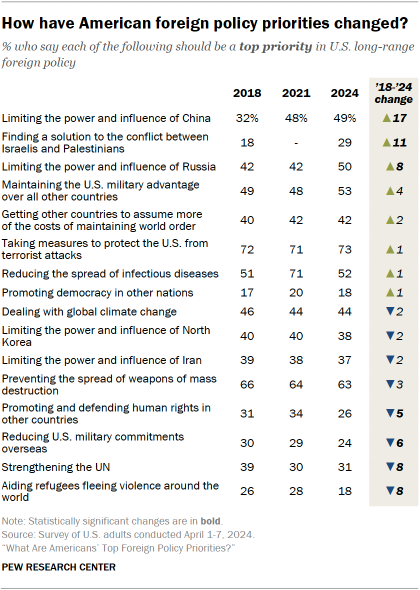
A table showing the change in priority Americans give to foreign policy issues between 2018, 2021 and 2024

The long-range foreign policy priority questions were also asked in 2018 and 2021, and since then there have been some significant shifts in responses:

  • Since 2018, the public has become significantly more likely to say limiting the power and influence of China (+17 percentage points) and finding a solution to the Israeli-Palestinian conflict (+11) are top foreign policy priorities.
  • Americans have also increased the emphasis they place on limiting the power and influence of Russia, particularly in the wake of the Russian invasion of Ukraine (+8 points since 2021).
  • On the decline since 2018 are strengthening the UN and aiding refugees (-8 points each), reducing foreign military commitments (-6), and promoting and defending human rights in other countries (-5).
  • Preventing the spread of infectious diseases is down 19 percentage points since 2021 – during the height of the COVID-19 pandemic – and about back to where it was in 2018.

These are among the findings from a Pew Research Center survey conducted April 1-7, 2024.

The survey of 3,600 U.S. adults shows that foreign policy remains a partisan issue. Republicans prioritize the prevention of terrorism, reducing the flow of illegal drugs into the country, and maintaining a military advantage over other nations. Meanwhile, Democrats prioritize dealing with climate change and preventing the spread of weapons of mass destruction (WMDs), but also preventing terrorist attacks.

A bar chart showing that 83% of Americans say President Joe Biden should be focusing on domestic policy more than foreign policy

There are also stark age differences on many of the policy goals mentioned, but for the most part, young adults are less likely than older Americans to say the issues we asked about are top priorities. The exceptions are dealing with climate change, reducing military commitments overseas, and promoting and defending human rights abroad – on these issues, 18- to 29-year-olds are significantly more likely than older Americans to assign top priority.

Even with these priorities, foreign policy generally takes the backset to domestic policy for most Americans: 83% say it is more important for President Joe Biden to focus on domestic policy, compared with 14% who say he should focus on foreign policy.

Americans are even less likely to prioritize international affairs than they were in 2019, when 74% wanted then-President Donald Trump to focus on domestic policy and 23% said he should focus on foreign policy.

Differences by partisanship

Americans’ foreign policy priorities differ greatly by party. The largest divide, by a significant margin, is the 55 percentage point gap between Democrats and Republicans on dealing with global climate change (70% vs. 15%, respectively, see it as a top priority).
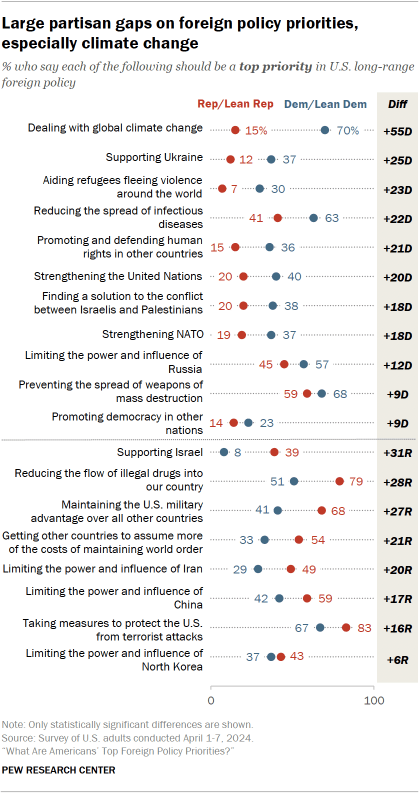
A dotplot showing large differences in the priority Republicans and Democrats give to different long-range foreign policy goals

Supporting Ukraine, aiding refugees, reducing the spread of diseases, protecting human rights, and strengthening the UN are also issues on which Democrats are at least 20 points more likely than Republicans to prioritize. For example, 63% of Democrats say reducing the spread of infectious diseases is a top priority, compared with 41% of Republicans.

Republicans prioritize supporting Israel, reducing the flow of illegal drugs and maintaining a military advantage over other countries – among other security and hard power issues – significantly more than Democrats do. For example, more than half of Republicans (54%) say getting other countries to assume more of the costs of maintaining world order should be a top focus in foreign policy. Only a third of Democrats say the same.

The priority assigned to several issues is divided even further by ideology within parties. Take support for Israel and Ukraine as examples. Supporting Israel is generally a higher priority for Republicans than Democrats, but within the Republican Party, 48% of conservatives say it’s a top concern, while 18% of moderates and liberals agree. Previous Center research shows that conservative Republicans are especially likely to favor military aid to Israel.

Supporting Ukraine, something Democrats emphasize more than Republicans, is a top priority particularly for liberal Democrats (47%), while about three-in-ten moderate and conservative Democrats agree (29%). Democrats have also shown more willingness than Republicans to provide aid to Ukraine in its conflict with Russia.
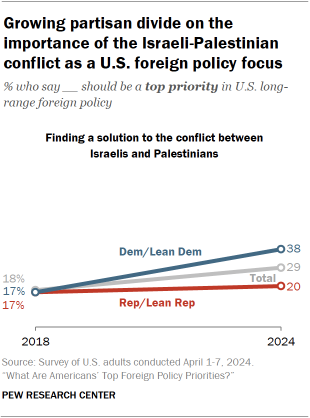
A line chart showing that Democrats are more likely to say finding a solution to the conflict between Israelis and Palestinians is a top priority than they were in 2018, while the share of Republicans stayed about the same

Generally, the partisan differences on the importance of several foreign policy issues have gotten smaller since 2021, when most of these questions were last fielded. This is especially true for items related to the relative power of major countries, like the U.S. maintaining a military advantage and limiting the power and influence of both Russia and China.

However, finding a solution to the conflict between Israelis and Palestinians – a priority that saw no partisan difference at all when it was last asked about in 2018 – has an emerging partisan gap today. The share of Democrats who call this a top priority has more than doubled, while the share of Republicans has changed little.

Differences by age

Age differences persist on foreign policy issues. Older Americans prioritize most of the issues we asked about at higher rates than those ages 18 t0 29.
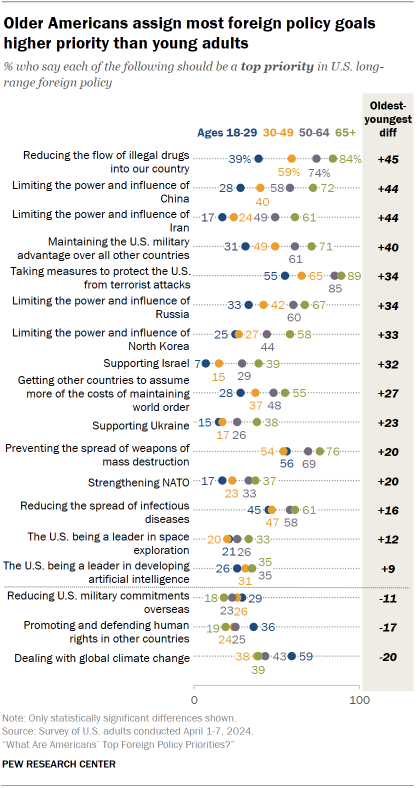
A dotplot showing that older Americans are significantly more likely to assign most foreign policy goals top priority than young adults

On four issues, there is at least a 40 percentage point gap between Americans ages 65 and older and young adults ages 18 to 29. The oldest Americans are more likely to prioritize reducing the flow of illegal drugs, limiting the power and influence of China and Iran, and maintaining a U.S. military advantage.

Those in the oldest age group are also more concerned than their younger counterparts on an additional 11 issues, ranging from support for Israel to U.S. leadership in space exploration.

For their part, young adults are more likely to say dealing with global climate change, reducing U.S. military commitments overseas, and promoting and defending human rights in other countries should be top foreign policy priorities.

Even starker patterns appear when looking at partisanship within two age groups – adults ages 18 to 49 and those 50 and older.

Among Democrats, older adults place particularly high priority on supporting Ukraine, strengthening NATO, and limiting the power and influence of Russia amid its war with Ukraine. Older Democrats are also more likely than younger ones to prioritize preventing the development of WMDs, curbing the spread of diseases, strengthening the UN and promoting democracy around the world, among other issues.

Among Republicans, those ages 50 and older are more likely than those ages 18 to 49 to prioritize supporting Israel, limiting the power and influence of Iran and China, getting other countries to assume more foreign policy costs, reducing the amount of illegal drugs entering the U.S., preventing terrorism, and maintaining a military advantage.
Acknowledgments

This report is a collaborative effort based on the input and analysis of the following individuals.

Jacob Poushter, Associate Director, Global Attitudes Research
Laura Clancy, Research Analyst

Dorene Asare-Marfo, Panel Manager
Sarah Austin, Research Assistant
Peter Bell, Associate Director, Design and Production
Janakee Chavda, Assistant Digital Producer
Manolo Corichi, Research Analyst
Jonathan Evans, Senior Researcher
Moira Fagan, Research Associate
Janell Fetterolf, Senior Researcher
Shannon Greenwood, Digital Production Manager
Sneha Gubbala, Research Assistant
Christine Huang, Research Associate
Anna Jackson, Editorial Assistant
Hannah Klein, Senior Communications Manager
Gar Meng Leong, Communications Manager
Kirsten Lesage, Research Associate
Jordan Lippert, Research Assistant
Carolyn Lau, International Research Methodologist
John Carlo Mandapat, Information Graphics Designer
William Miner, Research Assistant
Patrick Moynihan, Associate Director, International Research Methods
Georgina Pizzolitto, Research Methodologist
Dana Popky, Associate Panel Manager
Sofia Hernandez Ramones, Research Assistant
Laura Silver, Associate Director, Global Attitudes Research
Sofi Sinozich, International Research Methodologist
Maria Smerkovich, Research Associate
Kelsey Jo Starr, Research Analyst
Brianna Vetter, Administrative Associate
Richard Wike, Director, Global Attitudes Research

Methodology

The American Trends Panel survey methodology

Overview

The American Trends Panel (ATP), created by Pew Research Center, is a nationally representative panel of randomly selected U.S. adults. Panelists participate via self-administered web surveys. Panelists who do not have internet access at home are provided with a tablet and wireless internet connection. Interviews are conducted in both English and Spanish. The panel is being managed by Ipsos.

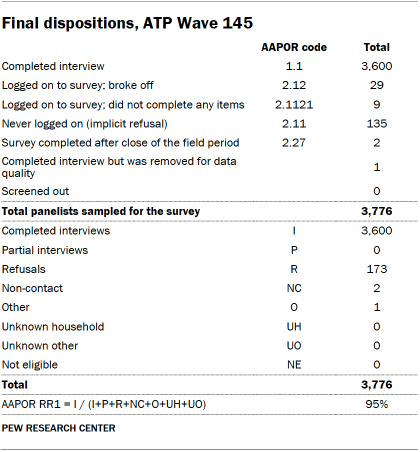
Data in this report is drawn from ATP Wave 145, conducted from April 1-7, 2024, among a sample of ATP members who had previously completed both of ATP Waves 132 and 143. It includes an oversample of non-Hispanic Asian adults, non-Hispanic Black men and Hispanic men in order to provide more precise estimates of the opinions and experiences of these smaller demographic subgroups. These oversampled groups are weighted back to reflect their correct proportions in the population. A total of 3,600 panelists responded out of 3,776 who were sampled, for a response rate of 95%. The cumulative response rate accounting for nonresponse to the recruitment surveys and attrition is 3%. The break-off rate among panelists who logged on to the survey and completed at least one item is 1%. The margin of sampling error for the full sample of 3,600 respondents is plus or minus 2.1 percentage points.

Panel recruitment

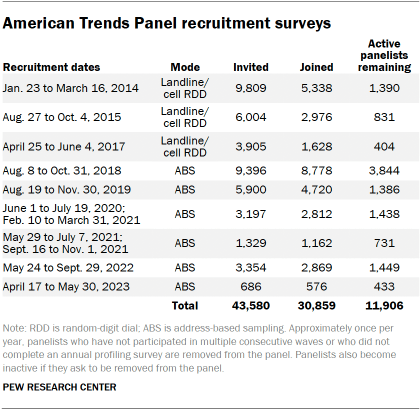
The ATP was created in 2014, with the first cohort of panelists invited to join the panel at the end of a large, national, landline and cellphone random-digit dial survey that was conducted in both English and Spanish. Two additional recruitments were conducted using the same method in 2015 and 2017, respectively. Across these three surveys, a total of 19,718 adults were invited to join the ATP, of whom 9,942 (50%) agreed to participate.

In August 2018, the ATP switched from telephone to address-based sampling (ABS) recruitment. A study cover letter and a pre-incentive are mailed to a stratified, random sample of households selected from the U.S. Postal Service’s Delivery Sequence File. This Postal Service file has been estimated to cover as much as 98% of the population, although some studies suggest that the coverage could be in the low 90% range.1 Within each sampled household, the adult with the next birthday is asked to participate. Other details of the ABS recruitment protocol have changed over time but are available upon request.2

A table showing American Trends Panel recruitment surveys

We have recruited a national sample of U.S. adults to the ATP approximately once per year since 2014. In some years, the recruitment has included additional efforts (known as an “oversample”) to boost sample size with underrepresented groups. For example, Hispanic adults, Black adults and Asian adults were oversampled in 2019, 2022 and 2023, respectively.

Across the six address-based recruitments, a total of 23,862 adults were invited to join the ATP, of whom 20,917 agreed to join the panel and completed an initial profile survey. Of the 30,859 individuals who have ever joined the ATP, 11,906 remained active panelists and continued to receive survey invitations at the time this survey was conducted.

The American Trends Panel never uses breakout routers or chains that direct respondents to additional surveys.

Sample design

The overall target population for this survey was noninstitutionalized persons ages 18 and older living in the U.S., including Alaska and Hawaii. It featured a stratified random sample of active ATP members who completed both ATP Wave 132 and Wave 143. Among the panelists who met these criteria, Hispanic men, non-Hispanic Black men and non-Hispanic Asian adults were selected with certainty. The remaining panelists were sampled at rates designed to ensure that the share of respondents in each stratum is proportional to its share of the U.S. adult population to the greatest extent possible. Respondent weights are adjusted to account for differential probabilities of selection as described in the Weighting section below.

Questionnaire development and testing

The questionnaire was developed by Pew Research Center in consultation with Ipsos. The web program was rigorously tested on both PC and mobile devices by the Ipsos project management team and Pew Research Center researchers. The Ipsos project management team also populated test data that was analyzed in SPSS to ensure the logic and randomizations were working as intended before launching the survey.

Incentives

All respondents were offered a post-paid incentive for their participation. Respondents could choose to receive the post-paid incentive in the form of a check or a gift code to Amazon.com or could choose to decline the incentive. Incentive amounts ranged from $5 to $20 depending on whether the respondent belongs to a part of the population that is harder or easier to reach. Differential incentive amounts were designed to increase panel survey participation among groups that traditionally have low survey response propensities.

Data collection protocol

The data collection field period for this survey was April 1-7, 2024. Postcard notifications were mailed to a subset of ATP panelists with a known residential address on April 1.3

Invitations were sent out in two separate launches: soft launch and full launch. Sixty panelists were included in the soft launch, which began with an initial invitation sent on April 1. The ATP panelists chosen for the initial soft launch were known responders who had completed previous ATP surveys within one day of receiving their invitation. All remaining English- and Spanish-speaking sampled panelists were included in the full launch and were sent an invitation on April 2.

All panelists with an email address received an email invitation and up to two email reminders if they did not respond to the survey. All ATP panelists who consented to SMS messages received an SMS invitation and up to two SMS reminders.

A table showing Invitation and reminder dates for ATP Wave 145

Data quality checks

To ensure high-quality data, the Center’s researchers performed data quality checks to identify any respondents showing clear patterns of satisficing. This includes checking for whether respondents left questions blank at very high rates or always selected the first or last answer presented. As a result of this checking, one ATP respondent was removed from the survey dataset prior to weighting and analysis.

Weighting

A table showing American Trends Panel weighting dimensions

The ATP data is weighted in a multistep process that accounts for multiple stages of sampling and nonresponse that occur at different points in the survey process. First, each panelist begins with a base weight that reflects their probability of selection for their initial recruitment survey. These weights are then rescaled and adjusted to account for changes in the design of ATP recruitment surveys from year to year. Finally, the weights are calibrated to align with the population benchmarks in the accompanying table to correct for nonresponse to recruitment surveys and panel attrition. If only a subsample of panelists was invited to participate in the wave, this weight is adjusted to account for any differential probabilities of selection.

Among the panelists who completed the survey, this weight is then calibrated again to align with the population benchmarks identified in the accompanying table and trimmed at the 2nd and 98th percentiles to reduce the loss in precision stemming from variance in the weights. This trimming is performed separately among non-Hispanic Black, non-Hispanic Asian, Hispanic and all other respondents. Sampling errors and tests of statistical significance take into account the effect of weighting.

The following table shows the unweighted sample sizes and the error attributable to sampling that would be expected at the 95% level of confidence for different groups in the survey.

A table showing Sample sizes and margins of error for ATP Wave 145

Sample sizes and sampling errors for other subgroups are available upon request. In addition to sampling error, one should bear in mind that question wording and practical difficulties in conducting surveys can introduce error or bias into the findings of opinion polls.

Dispositions and response rates

A table showing Final dispositions for ATP Wave 145
A table showing Cumulative response rate as of ATP Wave 145

© Pew Research Center 2024