Pew Research Center

FOR RELEASE OCTOBER 2, 2023

Poles and Hungarians Differ Over Views of Russia and the U.S.

Two-thirds in Poland want increased sanctions on Russia; fewer than one-in-ten Hungarians agree

BY Moira Fagan, Laura Clancy, Sneha Gubbala and Sarah Austin

FOR MEDIA OR OTHER INQUIRIES:

Communications Department
202.419.4372
www.pewresearch.org

RECOMMENDED CITATION

Pew Research Center, October 2023, "Poles and Hungarians Differ Over Views of Russia and the U.S."

About Pew Research Center

Pew Research Center is a nonpartisan, nonadvocacy fact tank that informs the public about the issues, attitudes and trends shaping the world. It does not take policy positions. The Center conducts public opinion polling, demographic research, computational social science research and other data-driven research. It studies politics and policy; news habits and media; the internet and technology; religion; race and ethnicity; international affairs; social, demographic and economic trends; science; research methodology and data science; and immigration and migration. Pew Research Center is a subsidiary of The Pew Charitable Trusts, its primary funder.

© Pew Research Center 2026

Table of contents

  • About Pew Research Center
  • Poles and Hungarians Differ Over Views of Russia and the U.S.
  • 1. Is Russia a threat to neighboring countries?
  • 2. Opinion of sanctions imposed on Russia
  • 3. Importance of relationships with the U.S. and Russia
  • 4. Support for taking refugees in Poland and Hungary
  • Appendix: Classifying European political parties
  • Acknowledgments
  • Methodology

Poles and Hungarians Differ Over Views of Russia and the U.S.

Two-thirds in Poland want increased sanctions on Russia; fewer than one-in-ten Hungarians agree

How we did this

This Pew Research Center analysis focuses on public opinion of Russia and the aftereffects of the war in Ukraine in Hungary and Poland. It explores views in these two countries of bilateral relationships with the U.S. and Russia, attitudes toward sanctions and refugees.

In Hungary, we surveyed 1,007 people from March 8 to April 21, 2023. The survey was conducted face-to-face and is weighted to be representative of the Hungarian adult population by gender, age, education, region and urbanicity. In Poland, we surveyed 1,022 people from March 13 to April 27, 2023. The surveyed was conducted face-to-face and is weighted to be representative of the Polish adult populist by gender, age, education, region and urbanicity.

Here are the questions used for the report, along with responses, and the survey methodology.

While both Hungary and Poland voted in favor of United Nations condemnation of Russia’s invasion of Ukraine in 2022, the two central European countries have since often diverged on dealing with Russia on the world stage. Poland pushed for the delivery of tanks to Ukraine and proposed additional sanctions on Russia, while Hungary’s government blocked military aid to Ukraine and continues to maintain an economic relationship with Russia.

Public opinion in the two countries reflects these differences, according to a Pew Research Center survey conducted in the spring of 2023 – prior to the September trade dispute between Poland and Ukraine.

A stacked bar chart showing that Poles are more likely than Hungarians to believe Russia is a major threat, prioritize relationship with U.S. and support increasing sanctions against Russia.

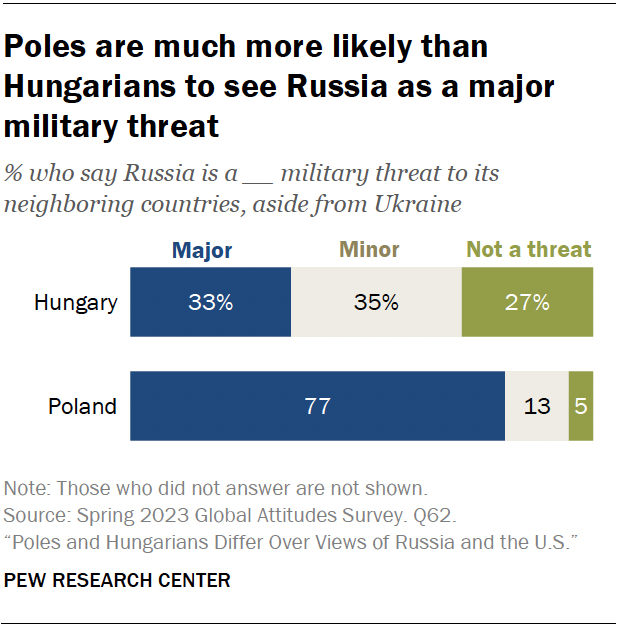
A much larger share in Poland than in Hungary believe Russia is a major military threat to its neighbors (77% vs 33%, respectively). Roughly a quarter in Hungary believe Russia is not a threat, compared with just 5% in Poland who say the same.

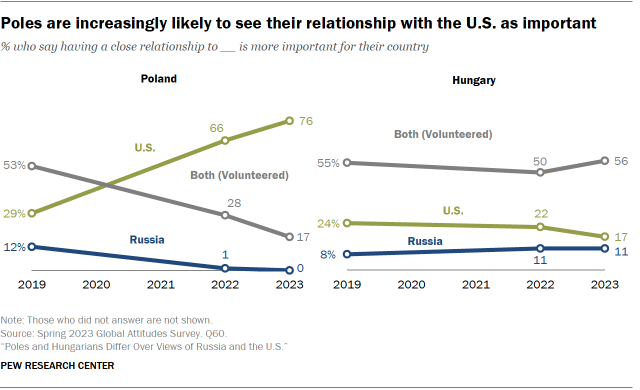
When asked whether a close relationship with the United States or Russia is more important for their country, 76% of Poles say it is more important to have a close relationship with the U.S. This is up 47 percentage points from when this question was first asked in 2019.

Just 17% of Hungarians say the same of their relationship with the U.S. About one-in-ten Hungarians say a close relationship with Russia is more important, while a majority volunteers that relationships with both the U.S. and Russia are equally important.

People in Hungary and Poland have different views on the future of the economic sanctions that the European Union and U.S. have imposed on Russia. Roughly half of Hungarians believe these sanctions should be decreased, while just 3% of Poles say the same. Most Polish people (67%) prefer instead to increase sanctions against Russia, while only 8% of Hungarians think sanctions should increase. The share in Poland who says sanctions should increase has risen 18 points since the question was initially asked in 2015, after Russia’s annexation of Crimea, which is not recognized by other countries.

Publics in both countries are more aligned on support for taking refugees: About half in both countries support their country taking in refugees from countries where people are fleeing violence and war. Support for this policy has also dropped by double digits in both Hungary and Poland since this question was last asked in 2022.

These findings come from a Pew Research Center survey conducted from March 8 to April 27, 2023, among 1,007 adults in Hungary and 1,022 adults in Poland.

Views of Russia, Putin and access to Russian energy
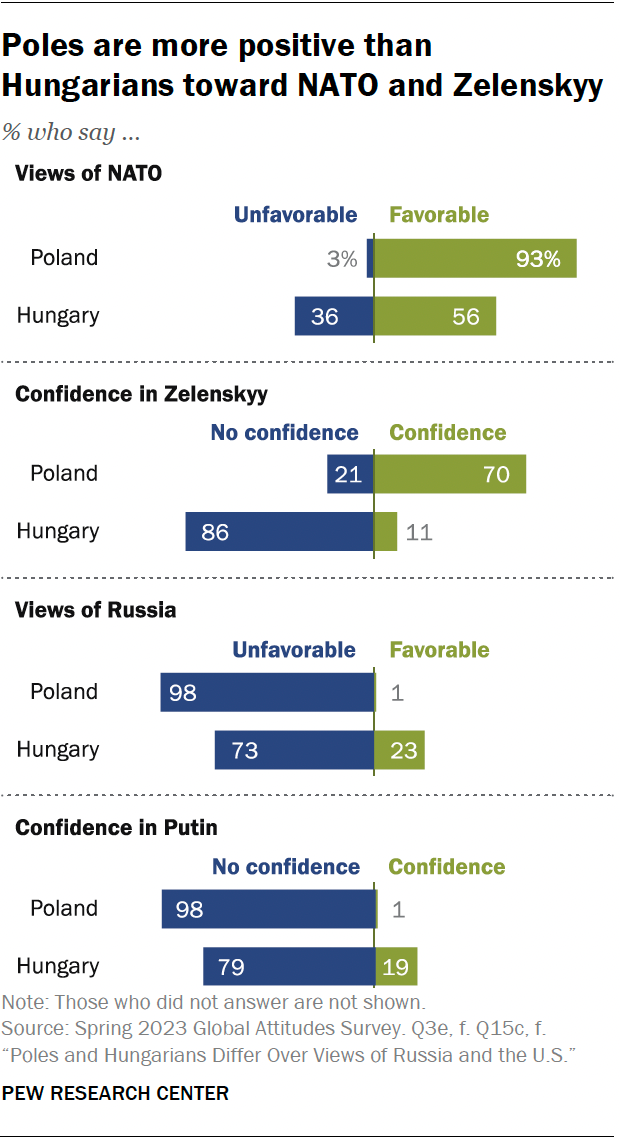
A bar chart showing that Poles are more positive than Hungarians toward NATO and Zelenskyy.

Among the European countries surveyed in 2023, Hungarians and Poles have some of the greatest differences when it comes to Russia. People in Poland express very negative views about both Russia and its president, while Hungarians tend to be more positive than most other European counterparts – even though large majorities are also unfavorable on Russia and Vladimir Putin.

Views of NATO differ across both countries: 93% of Poles are favorable toward the alliance, compared with 56% of Hungarians.

Seven-in-ten in Poland express confidence in Ukrainian President Volodymyr Zelenskyy, while just 11% in Hungary say the same. Hungarians express the least confidence in Zelenskyy compared with every other country included in the survey.

They also take different approaches to prioritizing Russian energy: 84% in Poland prefer being tough with Russia on Ukraine, while 76% in Hungary prefer maintaining access to Russian energy. For more on these attitudes concerning Russia, Putin, NATO and more, read “Large Shares See Russia and Putin in Negative Light, While Views of Zelenskyy More Mixed.”

Views of the U.S., Biden and the United States’ role in world affairs
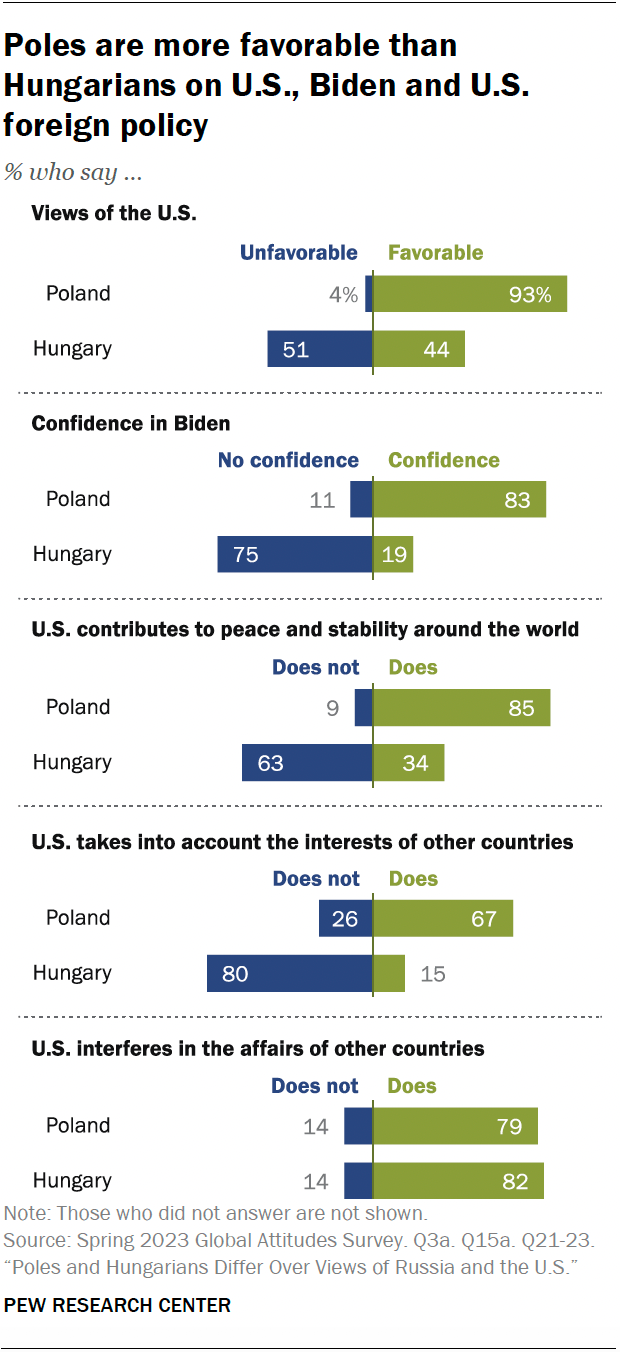
A bar chart showing that Poles are more favorable than Hungarians on U.S., Biden and U.S. foreign policy.

People in Poland and Hungary do not align on views of the U.S., its president or its role in world affairs. Poles stand out, in Europe and across all countries surveyed, as particularly positive on both the U.S. and President Joe Biden: 93% have a favorable view of the U.S. and 83% are confident in Biden’s ability to do the right thing regarding world affairs.

On the other hand, Hungarians are the most negative on the U.S. and Biden across all countries polled. About half in Hungary have an unfavorable view of the U.S., and 75% are not confident in Biden.

People in both countries also have different views of U.S. behavior on the world stage. Large majorities in Poland say the U.S. does contribute to peace and stability around the world and takes the interests of other countries into account. However, majorities of Hungarians say the opposite: The U.S. does not contribute to peace in the world or consider other countries’ interests.

Poles and Hungarians are more aligned on if the U.S. interferes in other countries’ affairs: 79% say this in Poland and 82% say the same in Hungary. For more information on perception of the U.S. on the world stage, read “International Views of Biden and U.S. Largely Positive.”
1. Is Russia a threat to neighboring countries?

Hungarians and Poles take different views on whether Russia poses a threat to its neighboring countries aside from Ukraine.

A horizontal stacked bar chart showing that Poles are much more likely than Hungarians to see Russia as a major military threat.

In Hungary, opinion is somewhat split. About a third of Hungarians, respectively, say Russia is a major threat or a minor military threat. And 27% do not consider Russia to pose a threat to neighboring countries. Those who place themselves on the ideological right in Hungary are more likely than those on the left to say Russia is not a threat.

Support for Hungary’s politically dominant right-wing populist party Fidesz plays a role on opinion here as well. Hungarians with a favorable view of Fidesz are less likely to say Russia is a major threat and more likely to say Russia is not a threat than those with an unfavorable view of the party.

In Poland, which shares a border with both Ukraine and the Russian province of Kaliningrad, 77% say Russia is a major threat to neighboring countries. Just 13% say Russia poses a minor threat, and 5% say it is not a threat at all. Those with a favorable view of the ruling right-wing populist party Law and Justice (PiS) are more likely to say Russia is a major threat than those with an unfavorable view of the party (85% vs. 74%, respectively). For more information on how we categorize populist parties, read the Appendix.

2. Opinion of sanctions imposed on Russia

People in Hungary and Poland take different views of the economic sanctions the EU has imposed on Russia. A plurality of Hungarians (48%) say these sanctions should be decreased. About a third say sanctions should be kept the same, and few overall – just 8% – believe they should be increased. Hungarians are also particularly favorable on maintaining access to Russian energy compared with other European countries. About three-quarters say maintaining access to Russian oil and gas is more important than being tough with Russia on Ukraine.

Charts showing that Hungarians prefer decreasing sanctions against Russia, while Poles have grown much more likely to favor increasing sanctions.

Those on the ideological right in Hungary are more than twice as likely as those on the left to favor decreasing sanctions against Russia (55% vs. 24%, respectively). And those with a favorable view of right-wing populist party Fidesz are also more likely to want to decrease sanctions than those who don’t have a positive view of the party. For more information on how we categorize populist parties, read the Appendix.

Poles take the opposite approach: 67% believe sanctions from the EU should be increased. About a quarter say they should be kept the same, and only 3% say they be decreased. This aligns with Polish opinion on responding to Russia: A large majority in Poland (84%) also says it is more important to be tough with Russia on Ukraine than to maintain access to Russia’s energy.

The share in Poland who want to increase sanctions against Russia has risen 18 percentage points since the question was last asked in 2015, after Russia’s annexation of Crimea (trend data is not available in Hungary). At the time, Poles stood out among other NATO countries as being particularly favorable toward increasing sanctions, and this sentiment has only grown stronger: Two-thirds want to increase sanctions.

3. Importance of relationships with the U.S. and Russia

When asked whether having a close relationship with the U.S. or Russia is more important for their country, Hungarians and Poles hold diverging opinions. Roughly three-quarters of Poles – who have the most favorable views of the U.S. of any country in our 2023 Global Attitudes survey – see their country’s relationship with the U.S. as more important than its relationship with Russia. Meanwhile, a majority of Hungarians volunteer that close relationships with the U.S. and Russia are equally important.

Two line charts showing that Poles are increasingly likely to see their relationship with the U.S. as important.

In 2019 – prior to Russia’s invasion of Ukraine – Hungarians and Poles held relatively similar views of their countries’ relationships with the U.S. and Russia. Just over half in each nation said close relationships with both countries were important. Roughly a quarter said relations with the U.S. were more important and about one-in-ten favored close relations with Russia.

While views in Hungary have changed relatively little in the last four years, opinion in Poland has shifted significantly. The share prioritizing a close relationship with Russia, or a relationship with both the U.S. and Russia, decreased significantly between 2019 and 2022. That downward trend continues in 2023. A large majority of Poles (76%) now say a close relationship with the U.S. is more important for their country – a 47-point increase from 2019 and a 10-point jump in the last year.

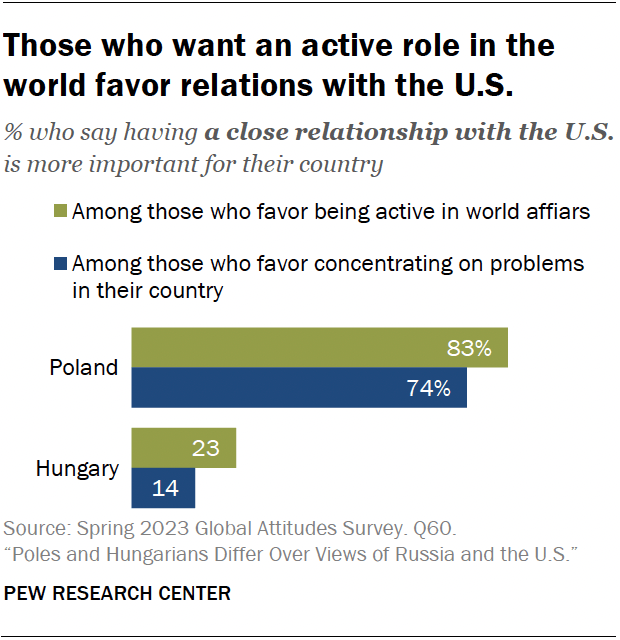
A bar chart showing that Poles are increasingly likely to see their relationship with the U.S. as important.

These ratings are tied to more general opinions of international engagement. In both Hungary and Poland, adults who say it is best for their country to take an active role in world affairs are 9 points more likely to prioritize close relations with the U.S. than those who say their country should be concentrating on problems at home. In Poland, for example, 83% who say their country should be active in world affairs also say a close relationship with the U.S. is more important, compared with 74% of Poles who think they should concentrate on problems in Poland.

A similar pattern exists between those who say their country should consider the interests of other countries, even if it means making compromises, and those who favor their country following its own interests, even when other countries strongly disagree. In Hungary, nearly three-in-ten (28%) who say other countries’ interests should be considered favor a closer relationship with the U.S., compared with 8% among those who want Hungary to follow its own interests.

4. Support for taking refugees in Poland and Hungary

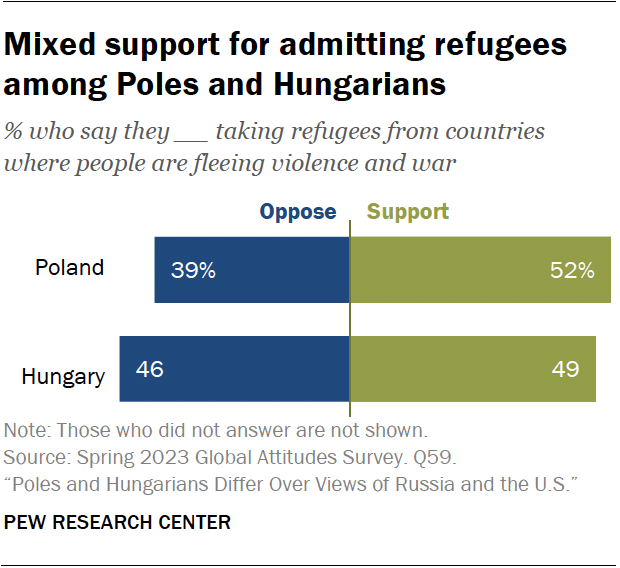
About half among both Poles and Hungarians support taking refugees from countries where people are fleeing violence and war. In Poland, 52% say they support admitting such refugees, while 39% oppose this measure. In Hungary, 49% approve of taking refugees from countries experiencing conflict, while 46% oppose.

A bar chart showing mixed support for admitting refugees among Poles and Hungarians.

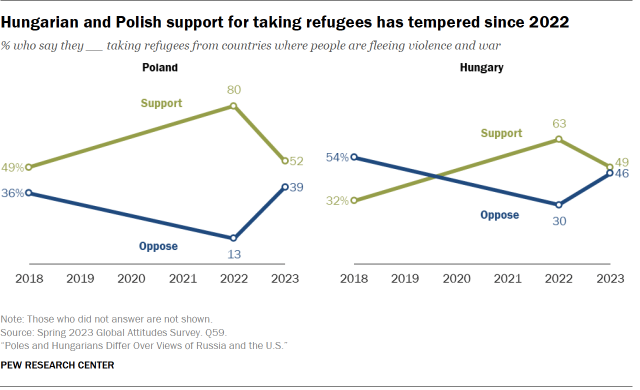
The shares expressing this opinion are down significantly in both countries from when the question was last asked in 2022, following the Russian invasion of Ukraine. According to data from the United Nations, the invasion resulted in over 15 million border crossings from Ukraine into Poland and over 3 million crossings into Hungary since February 2022 (data accessed Sept. 21, 2023).

Both countries have taken in a number of Ukrainian refugees: Poland has nearly 960,000 Ukrainian refugees living within its borders and Hungary hosts around 50,000 refugees (15.5% and 0.9% of the total refugee population, respectively, as of Sept. 21, 2023).

Two line charts showing that Hungarian and Polish support for taking refugees has tempered since 2022.

In 2022, eight-in-ten Poles and about six-in-ten Hungarians expressed support for taking refugees from countries where people are fleeing violent conflict. In 2023, approval for accepting such refugees is down 28 percentage points in Poland and 14 points in Hungary. The levels of support for taking refugees escaping war in 2023 approach those of when the question was first asked in 2018 (49% in Poland and 32% in Hungary), though approval in Hungary is somewhat higher in 2023 than in 2018. In Hungary, those who place themselves on the ideological left are more likely to support taking refugees than those who place themselves on the right (66% vs. 46%, respectively).

In both Hungary (57%) and Poland (60%), those who say their country should take into account the interests of other countries, even if it means making compromises with them, express support for taking refugees; 41% in Hungary and 48% in Poland who say their country should follow its own interests, even when other countries strongly disagree, support admitting refugees.

In Hungary, where favorability for Russia is higher than in most European countries, those who have a favorable view of Russia are less likely to support admitting refugees. In Poland, there is not a sufficient sample size of those with a favorable view of Russia for analysis. Positive views of Russia in Poland are the lowest among all 24 countries surveyed in 2023.

Appendix: Classifying European political parties

Classifying parties as populist

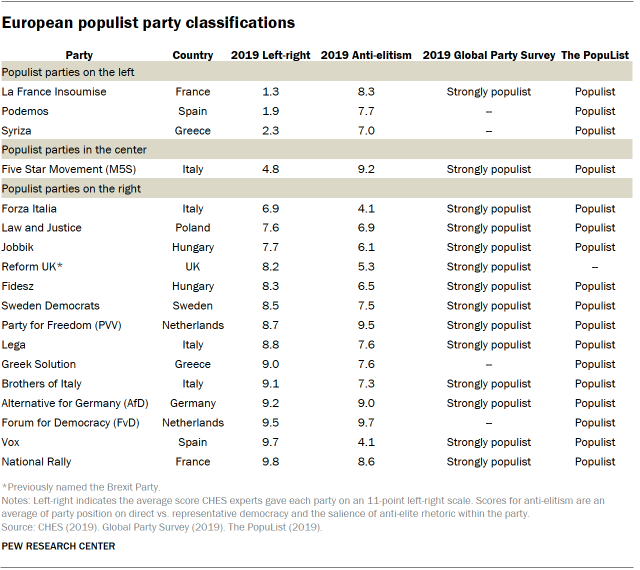
Although experts generally agree that populist political leaders or parties display high levels of anti-elitism, definitions of populism vary. We use three measures to classify populist parties: anti-elite ratings from the 2019 Chapel Hill Expert Survey (CHES), Norris’ Global Party Survey and The PopuList. We define a party as populist when at least two of these three measures classify it as such.   

CHES, which was conducted from February to May 2020, asked 421 political scientists specializing in political parties and European integration to evaluate the 2019 positions of 277 European political parties across all European Union member states. CHES results are regularly used by academics to classify parties with regard to their left-right ideological leanings, their key party platform positions and their degree of populism, among other things.

We measure anti-elitism using an average of two variables in the CHES data. First, we used “PEOPLE_VS_ELITE,” which asked the experts to measure the parties with regard to their position on direct vs. representative democracy, where 0 means that the parties support elected officeholders making the most important decisions and 10 means that “the people,” not politicians, should make the most important decisions. Second, we used “ANTIELITE_SALIENCE,” which is a measure of the salience of anti-establishment and anti-elite rhetoric for that particular party, with 0 meaning not at all salient and 10 meaning extremely salient. The average of these two measures is shown in the table below as “anti-elitism.” In all countries, we consider parties that score at or above a 7.0 as “populist.”

The Global Party Survey, which was conducted from November to December 2019, asked 1,861 experts on political parties, public opinion, elections and legislative behavior to evaluate the ideological values, issue position and populist rhetoric of parties in countries on which they are an expert, classifying a total of 1,051 parties in 163 countries. We used “TYPE_POPULISM,” which categorizes populist rhetoric by parties. We added only “strongly populist” parties using this measure. In Italy, experts were asked to categorize the Center-Right coalition instead of individual parties within the coalition. The coalition includes Lega, Forza Italia and Brothers of Italy. For all three parties, we have used the coalition rating of “strongly populist.”

The PopuList is an ongoing project to classify European political parties as populist, far right, far left and/or euroskeptic. The project specifically looks at parties that “obtained at least 2% of the vote in at least one national parliamentary election since 1998.” It is based on collaboration between academic experts and journalists. The PopuList classifies parties that emphasize the will of the people against the elite as populist.1

Reform UK, formerly the Brexit Party, is only classified as populist on one measure but is still included for analysis in the report. It is not included in the PopuList and does not meet our anti-elite CHES threshold of 7.0, but is considered a right-wing populist party by the Global Party Survey and other experts.

Classifying parties as left, right or center

We can further classify these traditional and populist parties into three groups: left, right and center. When classifying parties based on ideology, we relied on the variable “LRGEN” in the CHES dataset, which asked experts to rate the positions of each party in terms of its overall ideological stance, with 0 meaning extreme left, 5 meaning center and 10 meaning extreme right. We define left parties as those that score below 4.5 and right parties as those above 5.5. Center parties have ratings between 4.5 and 5.5.

A table showing European populist party classifications.

Acknowledgments

This report is a collaborative effort based on the input and analysis of the following individuals.

Moira Fagan, Research Associate
Laura Clancy, Research Analyst
Sneha Gubbala, Research Assistant
Sarah Austin, Research Assistant

Laverne Acheampong, Administrative Associate
Dorene Asare-Marfo, Panel Manager
Peter Bell, Associate Director, Digital Production
Janakee Chavda, Assistant Digital Producer
Janell Fetterolf, Senior Researcher
Shannon Greenwood, Senior Digital Producer
Beshay Sakla, Associate Digital Producer
Christine Huang, Research Associate
Hannah Klein, Senior Communications Manager
Gar Meng Leong, Communications Manager
Clark Letterman, Former Senior Survey Manager
Jordan Lippert, Research Assistant
Carolyn Lau, International Research Methodologist
John Carlo Mandapat, Information Graphics Designer
Patrick Moynihan, Associate Director, International Research Methods
Jacob Poushter, Associate Director, Global Attitudes Research
Laura Silver, Associate Director, Global Attitudes Research
Sofi Sinozich, International Research Methodologist
Richard Wike, Director, Global Attitudes Research

Methodology

About Pew Research Center’s Spring 2023 Global Attitudes Survey

Results for the survey are based on face-to-face interviews conducted under the direction of Gallup. The results are based on national samples, unless otherwise noted. More details about our international survey methodology and country-specific sample designs are available here.