Pew Research Center

FOR RELEASE MAY 5, 2021

Views About National Identity Becoming More Inclusive in U.S., Western Europe

Large ideological divides persist on views of tradition, national pride and discrimination, especially in the U.S.

BY Laura Silver, Moira Fagan, Aidan Connaughton and Mara Mordecai

FOR MEDIA OR OTHER INQUIRIES:

Communications Department
202.419.4372
www.pewresearch.org

RECOMMENDED CITATION

Pew Research Center, May 2021, "Views About National Identity Becoming More Inclusive in U.S., Western Europe"

About Pew Research Center

Pew Research Center is a nonpartisan, nonadvocacy fact tank that informs the public about the issues, attitudes and trends shaping the world. It does not take policy positions. The Center conducts public opinion polling, demographic research, computational social science research and other data-driven research. It studies politics and policy; news habits and media; the internet and technology; religion; race and ethnicity; international affairs; social, demographic and economic trends; science; research methodology and data science; and immigration and migration. Pew Research Center is a subsidiary of The Pew Charitable Trusts, its primary funder.

© Pew Research Center 2026

Table of contents

  • About Pew Research Center
  • Views About National Identity Becoming More Inclusive in U.S., Western Europe
  • 1. National identity
  • 2. Immigration
  • 3. Discrimination in society
  • 4. Political correctness and offensive speech
  • 5. National pride and shame
  • 6. Tradition vs. change
  • Acknowledgments
  • Methodology
  • Appendix A: About the focus groups
  • Appendix B: Classifying European political parties

Views About National Identity Becoming More Inclusive in U.S., Western Europe

Large ideological divides persist on views of tradition, national pride and discrimination, especially in the U.S.

How we did this

This report focuses on attitudes in the U.S., France, Germany and the UK about what it takes to be truly part of the country’s nationality. It also includes questions about the importance of tradition and national pride, among other issues.

For this analysis, we use data from nationally representative telephone surveys of 4,069 adults from Nov. 10 to Dec. 23, 2020, in the U.S., France, Germany and the UK. In addition to the survey, Pew Research Center conducted focus groups from Aug. 19 to Nov. 20, 2019, in cities across the U.S. and UK (see here for more information about how the groups were conducted). We draw upon these discussions in this report.

Here are the questions used for the report, along with responses, and the survey methodology.

As issues about culture and identity continue to be at the center of heated political debates in the United States and Europe, a new Pew Research Center survey finds that views about national identity in the U.S., France, Germany and the UK have become less restrictive and more inclusive in recent years. Compared with 2016 – when a wave of immigration to Europe and Donald Trump’s presidential campaign in the U.S. made immigration and diversity a major issue on both sides of the Atlantic – fewer now believe that to truly be American, French, German or British, a person must be born in the country, must be a Christian, has to embrace national customs, or has to speak the dominant language.

People in all four nations have also become more likely to believe that immigrants want to adopt the customs and ways of life in their countries. Nearly two-thirds of Americans (65%) now hold this opinion, up from 54% in 2018, and the share of the public expressing this view in Germany has jumped from 33% to 51% over the same time period.
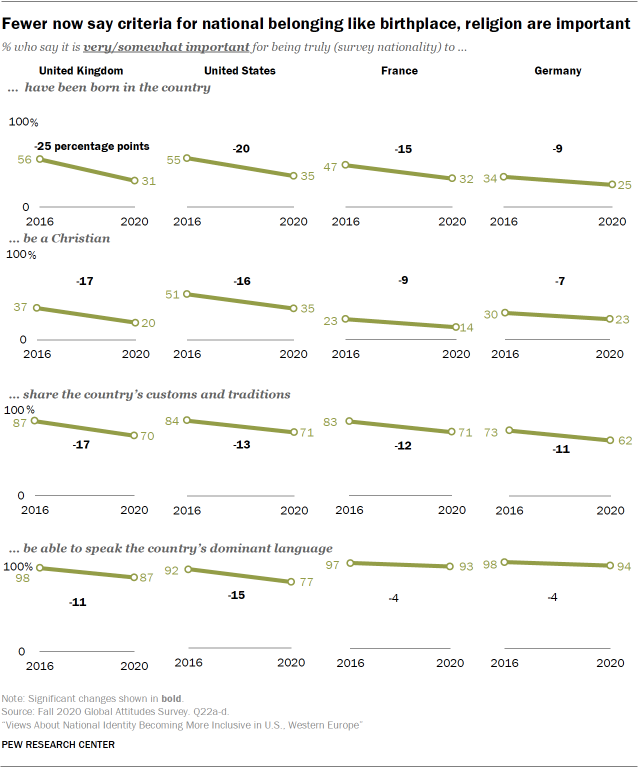
Fewer now say criteria for national belonging like birthplace, religion are important
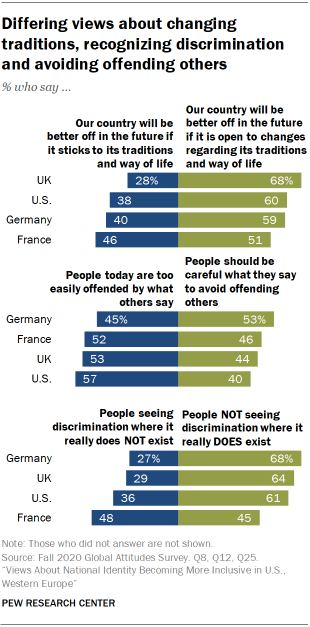
Differing views about changing traditions, recognizing discrimination and avoiding offending others

The survey also finds that more people think their countries will be better off in the future if they are open to changes regarding traditional ways of life. Still, this issue is divisive, as a substantial minority in every country prefer to stick to traditions.

Other cultural issues also divide these publics. For example, when it comes to issues of “political correctness,” at least four-in-ten in every country say people should be careful what they say to avoid offending others – even while around half or more in every country but Germany say people today are too easily offended by what others say.

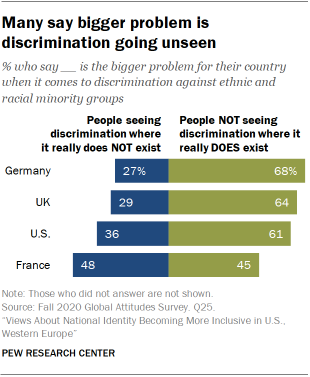
Outside of France, more people say it’s a bigger problem for their country today to not see discrimination where it really does exist than for people to see discrimination where it really is not present.
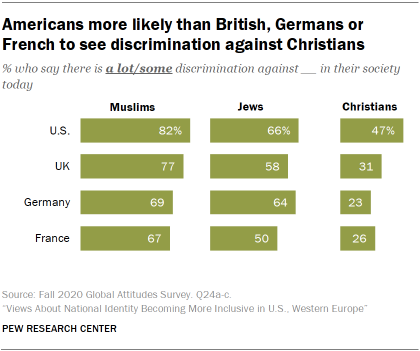
Americans more likely than British, Germans or French to see discrimination against Christians

Depending on the country, people are also divided over which groups are facing discrimination in society today. In the U.S., for example, nearly half say Christians face at least some discrimination, though fewer than a third say the same in the European countries surveyed. Similarly, in France, the public is somewhat evenly divided over whether Jews face discrimination. In every country surveyed, though, a large majority think Muslims face discrimination.
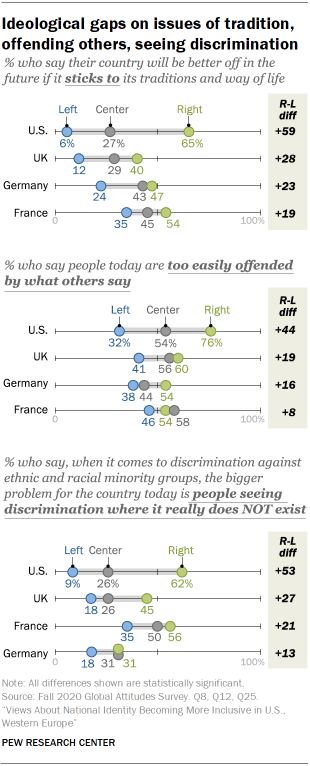
Ideological gaps on issues of tradition, offending others, seeing discrimination

All of these issues are also ideologically divisive.1 In every country surveyed, those on the right are more likely than those on the left to prioritize sticking to traditions, to say people today are too easily offended by what others say, and to say the bigger societal problem is seeing discrimination where it does not exist.

Those on the right are also more likely to say each factor asked about – being born in the country, adopting its customs and traditions, speaking the dominant language and being Christian – are very important for being part of the citizenry.

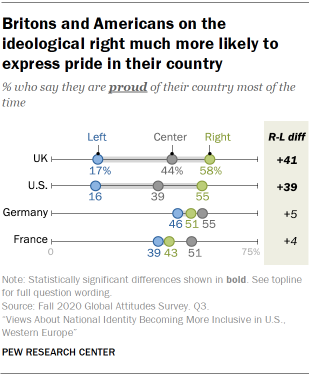
Even issues of national pride have become ideologically tinged in the U.S. and UK. In every country, around four-in-ten say they are proud of their country most of the time, one-in-ten or fewer say they are ashamed of their country most of the time, and the balance say they are both proud and ashamed. But, while those on the left and right are equally likely to say they are proud most of the time in both France and Germany, in the U.S. and UK, those on the right are more than three times as likely to say they are proud most of the time than those on the left (or conservatives are about three times as likely to say they are proud most of the time than liberals, in American parlance). In these two countries, those on the left are equally likely to describe themselves as ashamed most of the time as to say they tend to be proud.
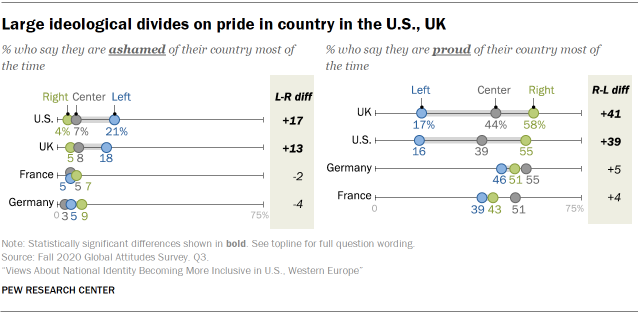
Large ideological divides on pride in country in the U.S., UK
Focus groups in U.S., UK find that left and right see the same aspects of history through a very different lens

Focus groups conducted in the U.S. and UK during the fall of 2019 shed light on which issues were points of pride and shame for Americans and Britons in their countries, respectively. Most notably, issues of pride for some were often sources of shame for others. In the UK, one such issue was the concept of empire. Those on the ideological right praised the historic empire for its role in spreading English and Western culture overseas, while those on the ideological left discussed how the UK had disrupted local cultures and often left chaos in its wake in its former colonies.

“Why would you be ashamed of history?”
–Woman, 55, Birmingham, Right Remainer

“Although it’s an impressive feat to expand the empire as far as it went, that came with quite a lot of shameful things.”
–Man, 34, Newcastle, Right Leaver

In the U.S., too, whereas groups composed of Republicans discussed American history through the lens of opportunity, groups composed of Democrats stressed the inadequacy of how American history is taught – and how it often glosses over racism and inequitable treatment of minority groups. Republican participants, for their part, even brought up how political correctness itself makes them embarrassed to be American – while Democratic participants cited increased diversity as a point of pride. 

Themes of pride and shame were also present in focus group discussions in these two countries regarding what it means to be British or American, respectively. These conversations revealed that national identities are changing, driven in part by globalization and multiculturalism. Quotations from the focus groups appear throughout this report to provide context for the survey findings. They do not represent the opinion of all Americans or Britons on any given topic. They have been edited lightly for grammar and clarity.

How the focus groups were conducted

Pew Research Center conducted 26 focus groups from Aug. 19 to Nov. 20, 2019, in cities across the U.S. and UK (for details on how the groups were stratified, see the methodology). All groups followed a discussion guide designed by Pew Research Center and were asked questions about their local communities, national identities and globalization by a trained moderator.

This report draws from those discussions, and we have included quotations which have been lightly edited for grammar and clarity. Quotations are chosen to provide context for the survey findings and do not necessarily represent the majority opinion in any particular group or country.

“I think [America] was better [in the past], pre-cancel culture, which is the weaponization of difference, basically … Now that politics is so divided, to be blunt, the left, myself included, have just been like no, if you are not living up to my ideals, I don’t need to interact with you. I think it has become problematic and that is why you have this polarity and extremism.”

–Man, 34, Seattle, Democrat

While Britons are as ideologically divided as Americans on issues of pride, when it comes to every other cultural issue asked about in this report, Americans stand out for being more ideologically divided than those in the Western European countries surveyed. For example, on whether the country will be better off in the future if it sticks to its traditions and way of life, the gap between the left and right in the U.S. is 59 percentage points – more than twice the gap found in any other country (the UK is the next most divided country, at 28 points). The ideological divide in the U.S. is also around two times larger than that in any other country when it comes to whether people today are too easily offended by what others say (a 44-point liberal-conservative gap in the U.S.) and whether it is a bigger problem for the country today that people see discrimination where it does not exist (a 53-point liberal-conservative gap).

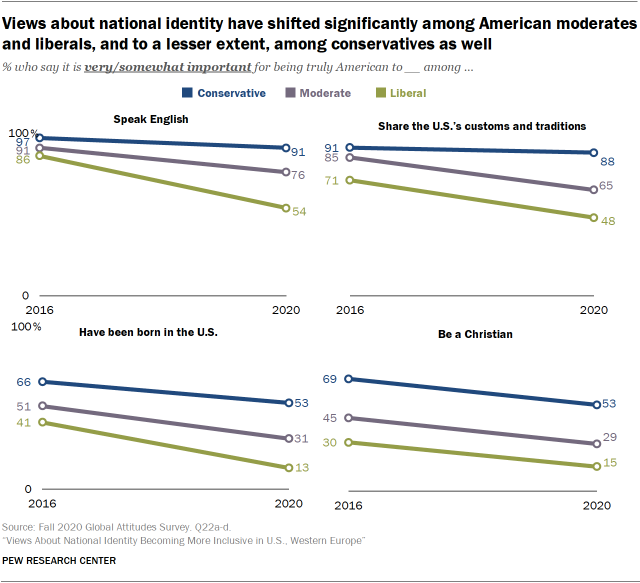
The ideological gap between liberals and conservatives has also widened in recent years over what it takes to be truly American. While liberals and conservatives are equally less likely today to say being Christian is important for being truly American compared to the past, on each of the other criteria asked about, liberals have shifted significantly more than conservatives. For example, 54% of liberals now say it’s important to speak English to be truly American, down from 86% who said the same in 2016. But among conservatives, 91% say it’s important to speak English, largely unchanged from the previous 97%. Still, conservative opinions have shifted markedly on the issue of whether it’s important to have been born in the U.S. and whether immigrants want to adopt the country’s customs. For more on how the U.S. stands out ideologically, see “Ideological divisions over cultural issues are far wider in the U.S. than in the UK, France and Germany.”

These are among the findings of a new Pew Research Center survey conducted from Nov. 10 to Dec. 23, 2020, among 4,069 adults in the France, Germany, the UK and the U.S. This report also includes findings from 26 focus groups conducted in 2019 in the U.S. and UK. In addition to ideological divisions, the survey also finds that cultural attitudes split along other dimensions including age, populist party support and religion. For example:

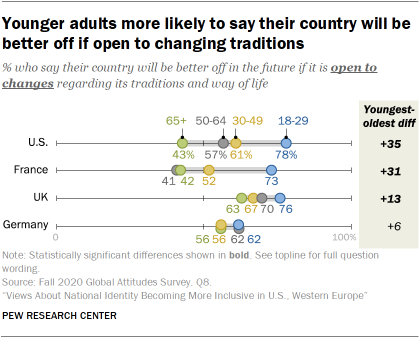
  • Younger people – those under 30 – are less likely to place requirements on Christianity, language, birth or adopting the country’s traditions to be part of their country than older age groups. They are also more likely to say their country will be better off if it is open to changes. The notable exception to this pattern is Germany, where opinion differs little by age.
  • Supporters of right-wing populist parties are less likely to see discrimination against Muslims in their society. They are also more likely to say birthplace, adherence to national traditions and customs and being Christian is key to belonging in their country, as well as to prioritize tradition over change. 
  • Christians are more likely to say there is a great deal of discrimination against Christians in their society than against non-Christians. They are also more likely to say that being Christian is essential to truly being part of their country’s citizenry. But they are also more likely to say other key factors – including speaking the language and being born in the country – are essential components of national belonging. On other issues, too, they stand apart from non-Christians. For example, they tend to be more likely to say they are proud of their country and to favor sticking to traditions and customs.
1. National identity

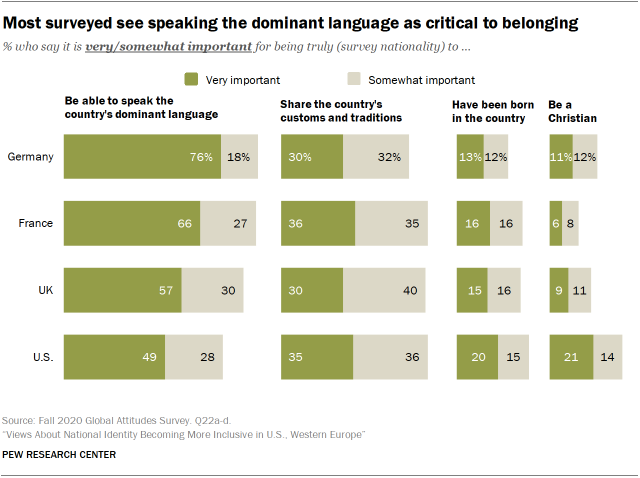
In all four nations surveyed, sizable majorities see speaking their country’s dominant language and sharing its customs and traditions to be at least somewhat important to truly being part of their countries. In Germany, for example, this view is nearly ubiquitous, with 94% saying speaking German is critical to being German, and around three-quarters saying it is very important. Similarly, roughly nine-in-ten in France and the UK think speaking the official language is at least somewhat important, and majorities think it is very important. In the U.S., the share who think speaking English is necessary to being truly American is somewhat lower, though still 77% agree it’s at least somewhat important.

Most surveyed see speaking the dominant language as critical to belonging

Partaking in national customs is also viewed by most as an integral part of national identity. In France, the U.S. and the UK, about seven-in-ten think sharing their country’s customs and traditions is an important part of being one of them. Among Germans, a smaller majority of roughly six-in-ten say sharing the country’s customs and traditions is at least somewhat important.

By contrast, relatively few in the four countries see birthplace or Christianity as important to belonging in their country. For example, only a quarter think it is important to have been born in Germany in order to be German. Minorities of roughly a third in the UK, France and the U.S. agree. And in most countries, even fewer think identifying as Christian is central to being a part of their country. Only 14% of French think it is important, and about one-in-five Britons and Germans feel the same. Americans are the most likely to think it is important to be Christian, with 35% saying this, including 21% who say it’s very important.

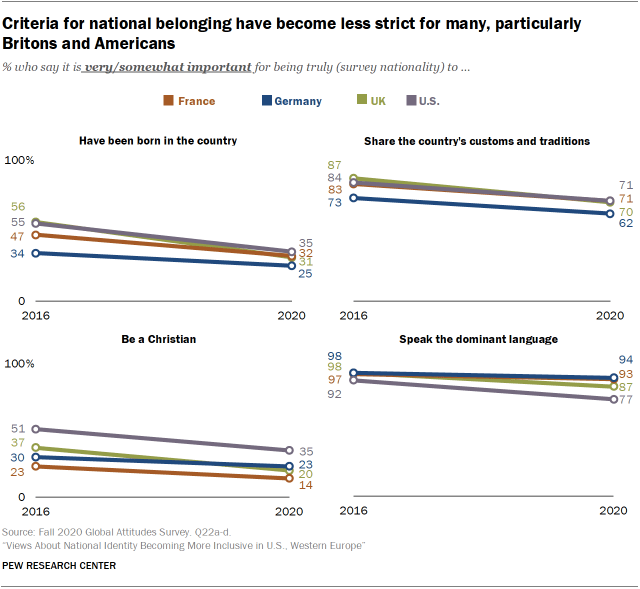
Over the past four years, attitudes about belonging have evolved. In all four countries, people are significantly less likely than they were in 2016 to see being born in their country, sharing national customs and being Christian as important, with declines ranging from about 10 to 25 percentage points. For example, in the U.S. and UK, the share saying that having been born in the country is important to being American or British has fallen 20 and 25 percentage points, respectively.

When it comes to language, those in the U.S. and UK are now less likely to say speaking English is important (down 15 and 11 points in each country, respectively). However, Germans and French are about as likely to consider speaking their countries’ official languages important to being truly German or French today as they were in 2016.

Criteria for national belonging have become less strict for many, particularly Britons and Americans

Among the three European publics, these shifts were largely consistent across ideological groups, with similar declines occurring across the spectrum. In the U.S., too, on the importance of being Christian, the shift has been largely consistent across liberals and conservatives, with shifts of around 15 percentage points among each group, respectively. Liberals and conservatives are also both significantly less likely to say it’s important to have been born in the U.S. than they were in 2016, though the shift has been a larger 28 percentage points among liberals compared with 13 points among conservatives.

But, liberal Americans and those in the center have driven much of the change when it comes to attitudes about the importance of speaking English and sharing the country’s customs and traditions. Take, for example, changing attitudes toward sharing American traditions. While the share who thinks this is important fell by 20 points or more among liberals and moderates, there has been no significant change in opinion among conservatives.

Views about national identity have shifted significantly among American moderates and liberals, and to a lesser extent, among conservatives as well
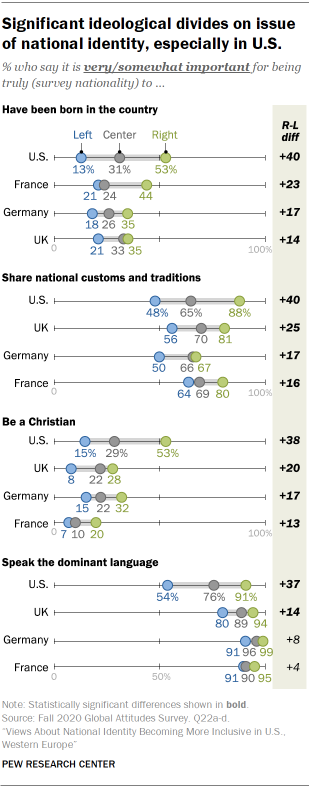
Significant ideological divides on issue of national identity, especially in U.S.

Despite these declines, some groups continue to see many of these criteria as more necessary to belong in their country than others. Across all countries, for example, Christians are more likely than non-Christians to see all four criteria as important parts of belonging in their country, with divides being especially sharp on the importance of being Christian. In the U.S., for instance, Christians are four times more likely than non-Christians to think being Christian is an important part of being American (48% vs. 12%).

Additionally, across all four countries surveyed, those who think their country will be better off sticking to traditions are generally more likely than those who prioritize being open to changes to think all four qualities are important to being part of their country. For instance, French who support a more traditional direction for their country are about twice as likely to think people must be Christian to be truly French compared with those who think their country should evolve.

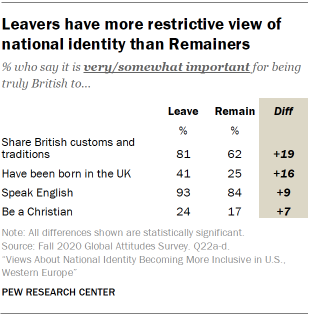
Leavers have more restrictive view of national identity than Remainers

Those on the ideological right, too, are more likely than those on the left to say most of these factors are an important part of fitting in. The only exception is on speaking the dominant language. Those on the left and right in Germany and France are equally likely to think speaking the language is a critical piece of belonging.

“You’ve got a lot of people coming into the country now who don’t want to be British, they don’t want to integrate. They don’t want to mix … I wouldn’t go to Spain and start ranting on about being English.”

–Man, 41, Birmingham, Left Leaver

The ideological divides are deepest in the U.S. Those on the right are around 40 percentage points more likely than those on the left to say every facet of belonging asked about is important.

These divides are also stark between Britons with different attitudes toward Brexit, with Leavers being 19 points more likely than Remainers to say sharing British customs is important. Leavers and Remainers also diverge over the importance of being born in the UK, speaking English and being Christian.

In the UK and U.S., focus group participants with different ideological and partisan identities clashed over what it takes to be British and American

Focus groups highlighted the way ideology and views about Brexit intertwined to inform opinions about what qualifies someone as British. When asked what being British means and whether people from other cultures can be British, focus groups composed of Leavers, and particularly Leavers on the right, frequently brought up speaking English, adhering to British values and, to a lesser extent, being Christian, as necessary. Some Leavers on the right talked about these issues in very explicit terms, viewing the presence of people who do not meet their criteria of Britishness – e.g., by not speaking English in public or by following customs of their countries of origin, including wearing traditional dress – as a personal affront and threat to the integrity of Britain. One right-leaning woman who voted to leave the EU noted that hearing people speak other languages in public was “awful” and created a “hostile environment” for her. Others complained about immigrants following customs of their countries of origin (e.g., eating with their hands) instead of adapting British traditions, further suggesting that their presence has burdened social services and that special accommodations were made for them.

Right-leaning Remainers and left-leaning Leavers echoed some of these concerns about immigrants assimilating. They often saw the presence of people from other cultures in the UK as positive, on the condition that those individuals follow British traditions – described in focus groups as queuing or having a “stiff upper lip,” among other traits. Remainers on the ideological left were unlikely to mention any of these criteria for Britishness and were clear that not only can people from other cultures be British, but that multiculturalism and cultural exchange added value to British society.

Differences of opinion emerged along partisan lines in the U.S. focus groups. When asked what it means to be American and whether people from other cultures can be American, groups consisting of Republicans were the only ones to mention Christianity as a part of being American and to focus on the importance of speaking English and adopting American values, particularly following laws. Like in the UK, many said a failure to learn English and adhere to American customs puts a strain on resources and threatens the country. One example cited by a Republican in Seattle was about the cost school districts had to bear to hire interpreters, and a feeling that immigrants are less likely to learn English today compared with the past, because of these accommodations.

When these questions were posed to groups comprising Democrats, responses often focused on the diversity of the U.S. as a positive thing. And like left-leaning Remainers in the UK, Democrats tended to agree that people from other cultures could be American without any caveats, though some agreed with Republicans that certain standards like following U.S. customs must be met. However, they rarely framed a failure to meet these standards as a burden for the U.S. or a threat to other Americans. And those that did not see any of these criteria for being American largely agreed that diversity and immigration added value to their country.

Republicans have more restrictive view of national identity than Democrats

Political affiliation also plays a role, and like the ideological divides, the differences between partisans is especially stark in the U.S., where Republicans and those who lean toward the Republican party are significantly more likely than their Democratic counterparts to see all four qualities as crucial to American identity.

“[What it takes to be one of us is to] assimilate into the culture and understand the history of the country, the values of the country, what entrepreneurship is, what freedom of speech is, the right to bear arms, to understand why this country is the greatest country in the world … The key to keeping it great is for those individuals to assimilate into the culture.”

–Man, 58, Seattle, Republican

Across the Atlantic, those with positive views of right-wing populist parties are more likely to view birthplace, adherence to national customs and being Christian as key to belonging in their countries. For instance, Germans who support Alternative for Germany (AfD) are roughly three times as likely as those who do not to think being Christian is a critical part of being German. When it comes to language, though, supporters of populist parties and nonsupporters largely agree that it’s important to speak the national language.

Supporters of right-wing populist parties more likely to see criteria for belonging in their country

Age is also related to opinion: Older people have stricter requirements about what it takes to belong in their country than younger ones. In all four countries surveyed, those 65 and older are more likely than adults under 30 to say following national customs is necessary. Similar divides are seen in France, the UK and the U.S. on the importance of speaking the dominant language and being born in the country, though German views on these criteria is consistent across age groups. Outside of the UK, older adults are more likely than younger ones to see being Christian as important for national identity.

Older people have stricter views on national belonging

In addition, across all four nations, those with less education are more likely than those with more education to think being born in their country, following local customs and being Christian were important. However, only in the U.S. is education related to opinions about speaking the dominant language.2

2. Immigration

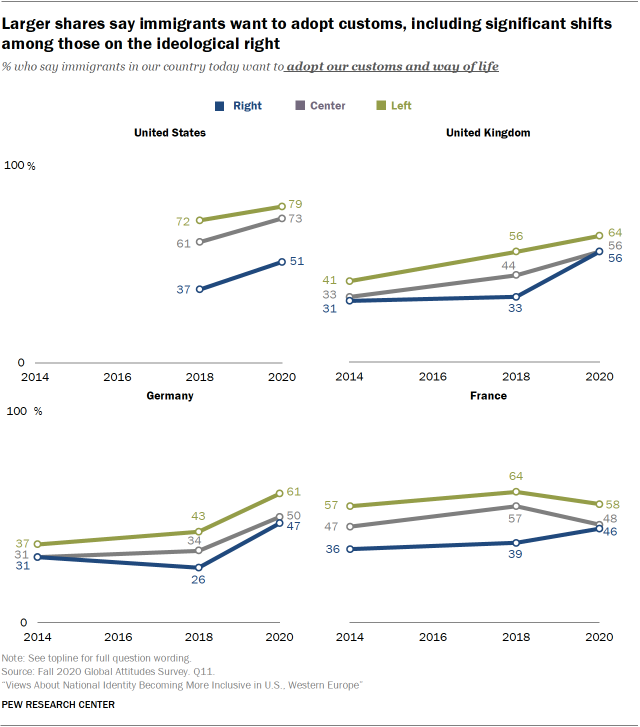
The share who say immigrants in their country today want to adopt their customs and way of life has increased significantly since 2014 in the UK, Germany and France (the question was not asked in the U.S. until 2018).

Rising shares say immigrants want to adopt way of life of their new country

“It’s good to have a mix of different cultures and backgrounds, but I think it can sometimes be negative if … people will come into the country and not learn the language. They’ll close themselves off and they don’t integrate. Then I think that can be a negative.”

–Man, 34, Newcastle, Left Leaver

Attitudes shifted dramatically between 2018 and 2020 in Germany, the UK and the U.S., with the share who say immigrants want to adopt the country’s customs increasing by at least 10 percentage points in each country. In France, attitudes toward immigrants grew more positive from 2014 to 2018 but have stayed relatively stable since then.

Much of the movement in these attitudes has been driven by growing shares of those on the ideological right saying immigrants want to assimilate. For instance, the share who hold this view among those on the ideological right in the UK has increased from 33% to 56% since 2018. Among those on the ideological right in Germany, it has grown from 26% to 47% over the same period.

Larger shares say immigrants want to adopt customs, including significant shifts among those on the ideological right

Republicans in the U.S. and Leavers in the UK point to importance of assimilation; Democrats and Remainers see benefits in multiculturalism

In focus groups, Republicans, Leavers stressed assimilation

When discussing what it takes to be American or British, focus group participants in the U.S. and the UK often pointed to the importance of assimilation. With both countries experiencing rising rates of foreign-born residents, the topic was discussed at length in many groups. On the whole, this conversation was concentrated in the Leaver and Republican groups, though the topic was raised in many groups.

In both Leaver and Republican groups, one of the most prominent themes was the idea that immigrants need to contribute to society in order to be accepted. The exact form of these contributions differed, but participants focused on the importance of working and paying taxes. Both types of groups also focused on the necessity of bringing in the “right kind” of immigrants, i.e., well-educated and wealthy immigrants instead of immigrants who would take advantage of welfare programs. Leavers and Republicans also saw issues with immigrants refusing to assimilate and retaining their value systems from their home countries.

Many said that immigrants would not even make an attempt to assimilate, refusing to learn English, living in insular communities and retaining value systems from their home countries.

Focus group participants in the UK frequently brought up instances where they felt like they were in the cultural minority. One London group noted that “the minute [they] get on the tube, [they] feel like [they’re] in a foreign land” and described it as a “quite hostile environment.” Leavers particularly focused on feelings of entitlement among immigrants, as well as instances of immigrant parents refusing to let their children assimilate, noting that sometimes it seems like immigrants “don’t want to integrate their kids” in school.

Republicans characterized assimilation somewhat differently than Leavers, with a focus on the importance of patriotism as part of assimilation. One group in Pittsburgh went so far as to say “you have to love America to be an American,” stressing that even those born in the U.S. who criticize the country are then not “true Americans.”

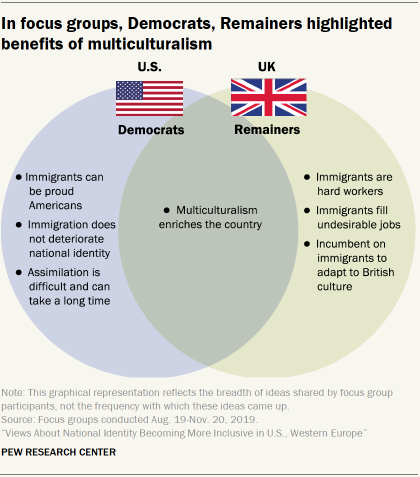
In focus groups, Democrats, Remainers highlighted benefits of multiculturalism

Remainers, Democrats and some independents in the U.S. also discussed assimilation, but rather than focusing on cultural differences that separate immigrants from the dominant native-born culture, they asserted that multiculturalism is the dominant culture and that assimilation itself is unnecessary. Indeed, many of these groups were extremely positive about how multiculturalism enriches the national culture. One Seattle man argued that “diversity gives us many, many more points of view, which can only make us stronger, more reasonable and more tolerant.”
Remainers tended to focus on the benefits that immigrants can bring in terms of being hard workers that fill “loads of jobs that [their] parents didn’t want.” One Birmingham man pushed back on the idea of complaining about immigrants: “As long as you are giving back and working, how can anyone complain?” Some Remainers still asserted that it was incumbent on immigrants to adopt British culture and learn the language.

Democrats and independents in the U.S. often brought up assimilation in the context of national identity, arguing that rather than “deteriorating” national identity, immigration could strengthen the country. Other participants noted that the immigration and assimilation process can be long and emotionally taxing but that does not mean immigrants cannot be proud Americans.

“Who’s the arbiter for what is ‘American?’ You have to like a hot dog and wear a baseball hat to be an American? It goes back to what I said about our culture. It’s from all over.”

–Man, 35, Pittsburgh, Independent

“Back then, [immigrants from other countries] came and they learned our language. They followed our laws, they became Americans. Now I feel people come and they just want to do whatever they want to do just because.”

–Woman, 52, Seattle, Republican

Among Republicans and Republican-leaning independents in the U.S., the share who say immigrants want to assimilate has increased significantly from 31% in 2018 to 53% in 2020, while opinions among Democrats and leaners have stayed stable at around three quarters holding that view. (Previous research has shown shifts in Republican views drove an increase in warm feelings toward immigrants, though attitudes toward immigrants assimilating remained largely stable among Republicans through 2018.) In the UK, Conservative Party supporters and Labour Party supporters alike have shown similar movement in attitudes toward immigrants.

3. Discrimination in society

About eight-in-ten Americans say there is a lot or some discrimination against Muslims in their society, and two-thirds or more in the UK, Germany and France agree.

In every country but Germany, significantly more say there is discrimination against Muslims than say the same of Jews. In Germany, 64% say Jews are discriminated against – and similar numbers of Americans (66%) say the same. Fewer Britons (58%) and French (50%) agree.

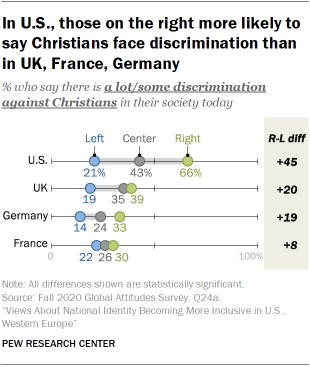
The share who believe there is discrimination against Christians in their society is lower across all four countries than the share who say the same of Jews or Muslims. Still, Americans stand out: 47% see a lot or some discrimination against Christians.3 In the UK, France and Germany, no more than about three-in-ten say the same. In Germany, about half (49%) say there is no discrimination at all against Christians in their society.

Outside of Germany, those who are Christian are more likely to perceive discrimination against people of their faith than those who are not.4 In the U.S., for example, 56% of Christians say there is at least some discrimination against Christians, compared with 30% of non-Christians. The gap is a smaller 15 percentage points in the UK and 11 percentage points in France.

In U.S., those on the right more likely to say Christians face discrimination than in UK, France, Germany

Ideology is related to views of discrimination against Christians in every country surveyed. In the U.S., the UK and Germany, those who place themselves on the right of the ideological spectrum are more likely than those on the left to say there is discrimination against Christians. This divide is particularly wide in the U.S., where about two-thirds (66%) of those on the right say Christians face discrimination, compared with just 21% of those on the left.

Such ideological differences are reflected in the differences between those with favorable and unfavorable views of right-wing populist parties. In the UK, those with favorable views of the Brexit Party (Reform UK) are significantly more likely to say there is a lot or some discrimination against Christians in society. In France, 37% of National Rally supporters say Christians are discriminated against compared to 23% of those with an unfavorable view of National Rally. In contrast, supporters of the left-wing populist party La France Insoumise are less likely to say there is discrimination against Christians in society.

British focus group participants highlighted discrimination against Christians

During focus groups conducted in the UK, several right-leaning groups brought up what they perceived to be the decline or “erasure” of Christian traditions to accommodate other religions. People cited the removal of “Christmas” from holiday greetings or an event name, such as school concerts for children that were rebranded as “winter” events. They argued that these traditions were changing so as not to cause offense to those who practice other religions but, in so doing, were harming Christians and their traditions. Most often, the changing nature of traditionally Christian events was contrasted with Islam and Islamic traditions.

“At my children’s school, we had to change the name of everything from being Christmassy because it wasn’t multicultural enough, and I think that’s just bizarre. Because you wouldn’t rename other religious festivals and give them a different name to make them sound more English or British. You know we had the Christmas fair, we had the Christmas concert, the Christmas dinner and that all had to be Winter.”

– Woman, 41, London, Right Remainer

Fewer right-wing populist party supporters say Muslims face discrimination

In contrast, supporters of the three right-wing populist parties asked about on the survey are less likely than nonsupporters to say there is a lot or some discrimination against Muslims in their society.

This difference is widest in Germany, where 52% of those with a favorable view of the right-wing Alternative for Germany (AfD) believe there is discrimination against Muslims, compared with 72% of those with an unfavorable view of the party. Double-digit differences are present between supporters and nonsupporters of the other two right-wing parties: UK’s Brexit Party (Reform UK) and France’s National Rally. Equal shares of those who support the French left-wing populist party La France Insoumise say there is discrimination against Muslims in their society.

In the U.S., Republicans and Republican-leaning independents are more likely than their Democratic counterparts to say there is discrimination against Christians (62% vs. 32%, respectively). In contrast, Democrats are more likely than Republicans to say Jews and Muslims face discrimination. For example, 62% of Democrats say there is a lot of discrimination against Muslims in their society, compared with just 23% Republicans.

Many think discrimination going unseen is a bigger problem for their country

Many say bigger problem is discrimination going unseen

Majorities in Germany, the UK and the U.S. think that when it comes to discrimination against ethnic and racial minorities, people not seeing discrimination where it really does exist is a bigger problem for their country than people seeing it where it does not exist. Six-in-ten or more hold this view in all three countries, including 68% of Germans. French people are divided, with about equal shares professing each opinion.

Views differ widely by age, with people ages 18 to 29 significantly more likely than those 65 or older to think discrimination against ethnic and racial minority groups going unseen is a bigger problem for their country. Such double-digit age gaps appear in each country surveyed, with the largest gap appearing in France (32 percentage points).

Younger and more educated people more concerned about discrimination

Small educational gaps exist in every country but Germany. For example, 72% of Britons with a postsecondary education or higher say the bigger problem is people not seeing discrimination where it really does exist, 13 points higher than those with a secondary education or less (59%).

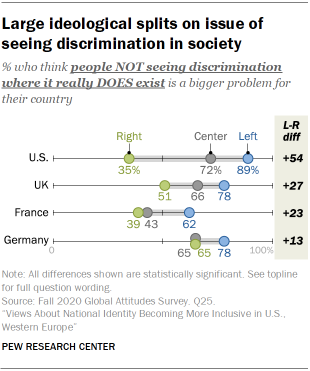
Large ideological splits on issue of seeing discrimination in society

Again, these opinions are colored by ideology in every country surveyed. Those on the ideological left are significantly more likely to think discrimination going unseen is a bigger problem for their country than those on the right.

The ideological gap is largest in the U.S., with 89% of those on the left stressing that it’s a bigger problem that people do not see discrimination where it does exist and only 35% of those on the right agreeing.

In France, those with a favorable view of the left-wing populist party La France Insoumise are more likely than those with an unfavorable view of the party to say the bigger problem for their country is discrimination going unseen. In contrast, those with a favorable view of the right-wing populist parties AfD and the Brexit Party (Reform UK) are more likely to say the bigger problem is people seeing discrimination where it really does not exist.

4. Political correctness and offensive speech

In all three European countries surveyed, respondents are closely divided over whether people today are too easily offended or whether people should be careful what they say to avoid offending others. However, only four-in-ten Americans think people should be careful what they say to avoid offending others, with a majority (57%) saying people today are too easily offended by what others say.

“I think people get scared to be passionate about being British these days because you get labeled as being a racist.”

–Man, 40, Birmingham, Right Leaver

Those ages 65 or older in France and Germany are more likely than those ages 18 to 29 to say people should be careful what they say to avoid offending others, while in the U.S. and UK there are no significant age differences.

Ideological left more concerned with avoiding offense with what they say

Ideological leanings play a role in how American, British and German adults feel. The ideological gap is largest in the U.S., where 65% of those on the ideological left think people should be careful to avoid offending others, compared with about one-in-four on the right, a gap of 42 percentage points. The left-right difference is 17 points in the UK and 15 points in Germany.

“There are all these things that growing up you just accepted it as that’s the name of that place. You don’t know what it is. And when you actually find out who that person was or what they were responsible for. I mean times were different and I understand that there were different considerations, but we know now that that was all wrong. It was wrong and I think it should be addressed.”

–Woman, 38, Edinburgh, Left Remainer

While there is no significant difference between the left and right in France, those in the ideological center are less likely than those on the ideological left to think people should be careful what they say to avoid offending others.

In the U.S., these ideological differences are closely related to partisanship. Six-in-ten Democrats and Democratic-leaning independents say people should be careful what they say to avoid offending others, while only 17% of Republicans and GOP-leaners say the same. Women in the U.S. are also more likely to think people should be careful what they say than men.

In the UK, those who identify as Remainers are much more likely than those who identify as Leavers to say people should be careful what they say to avoid offending others (53% vs. 27%, respectively).

In the U.S. and the UK, political cleavages drove discussion of politically correct culture

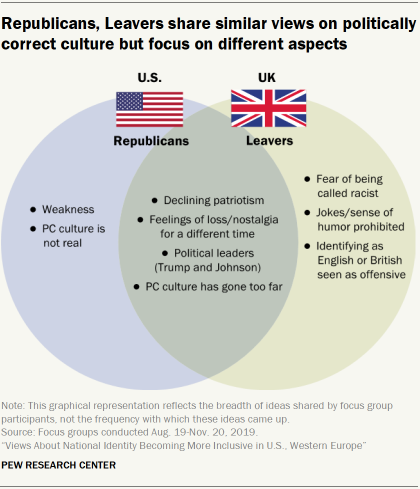
Republicans, Leavers share similar views on politically correct culture but focus on different aspects

Though there was no explicit question in the focus groups dealing with issues of political correctness (or “PC culture,” as the focus group participants often said), many in both the U.S. and UK brought up the topic themselves, especially when prompted to discuss the biggest issues facing the country as well as what makes them proud or embarrassed to be British or American.

Leavers in the UK and Republicans in the U.S. overwhelmingly highlighted the negative aspects of PC culture or “cancel culture,” as they saw it. These groups stressed what they perceived as declining patriotism as a result of PC culture. Leavers pointed to stereotypes they felt existed in the UK that those who fly the St. George’s Cross or who are proud to be English are racists. Similarly, Republicans in the U.S. discussed declining respect for the American flag, the Pledge of Allegiance and “the pride of America and being an American … being dwindled away.”

Some participants pointed with nostalgia to a time when people were not “forced to tolerate things in this country.” Leavers and Republicans also brought up President Donald Trump and Prime Minister Boris Johnson in the context of PC culture. Leavers looked to Johnson as a positive example of someone who bucks the trend of PC culture, while Republicans brought up instances where President Trump and his supporters were victimized by PC culture.

Some aspects of PC culture were characterized differently in the U.S. and the UK, however. UK participants pointed to the role of media in enforcing PC culture and the prohibition of certain jokes for being racist. For instance, one London group said they “should be able to make a racist joke, but it might not be perceived as a joke.” In the U.S., one group of Republicans discussed how PC culture reflects underlying weakness among “the little snowflakes.”

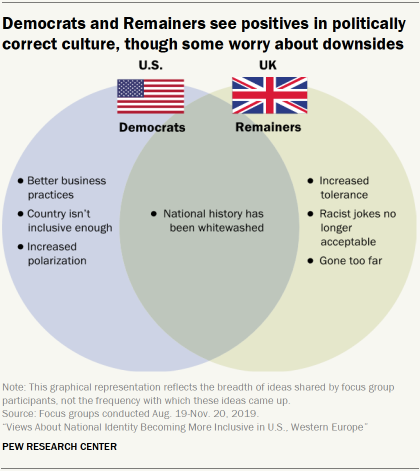
Democrats and Remainers see positives in politically correct culture, though some worry about downsides

Still, not all participants viewed PC culture as a negative. Some Democrats and Remainers discussed how PC culture has led to a reckoning with national history. Edinburgh participants discussed the necessity of renaming statues and monuments (the focus groups were conducted in fall of 2019, prior to racial justice demonstrations calling for the removal of statues and monuments related to the transatlantic slave trade). One Seattle Democrat stated that shameful events “did happen and it affects our country and how people think of other people and ourselves.”

Remainer and Democratic groups also focused on different issues when it came to PC culture. Remainers thought PC culture was responsible for more tolerance in society. In Birmingham, one person discussed racist cartoons from the 1970s, arguing that “if you were to see it nowadays, you’d think ‘oof’ because things have just changed … it’s stamped out now.” Similarly, one group of Democrats argued that one “instance where cancel culture is helping” is through boycotts of certain products to combat harmful business practice abroad.

Some Democrats and Remainers were worried that PC culture could end up being a harmful force, however. Some Remainers thought PC culture had “gone too an extreme” and that it meant always being afraid of offending someone. Democrats worried that the “weaponization of difference” could exacerbate polarization.

5. National pride and shame

Publics are split when it comes to personal feelings of pride, shame or both for their country. Only in Germany do roughly half (53%) say they feel proud of their country most of the time. In France and the UK, roughly equal shares of the public say they are proud of their countries as say they are both proud and ashamed. In the U.S., only 39% say they are proud most of the time.

“A patriot is somebody who would be willing to die for you even if they disagree with you.”

–Man, 58, Houston, Independent

In the UK, a majority of those who place themselves on the right of the political spectrum say they are proud of the UK most of the time, 41 percentage points more likely than those who place themselves on the left. The difference between the right and the left is similarly large in America (39 points).

Britons and Americans on the ideological right much more likely to express pride in their country

While relatively few across all countries say they are ashamed of their country most of the time, about one-in-five of those on the left in the U.S. and UK express this view. Similar shares of those on the left in the U.S. and UK say they are ashamed of their country as say they are proud of it.

“I like to think that patriotism is a good word, but every experience I have ever had with anybody using it has always been negative.”

–Man, 57, Seattle, Independent

Attitudes toward tradition shape personal feelings of pride among those in the U.S., the UK and France. Those who feel their country will be better off sticking to its traditions are more likely than those who feel their country will be better off if it is open to changes to say they are proud of their country.

Christians are more likely than non-Christians to say they are proud of their country in every country surveyed. (In Germany and the UK, non-Christians were less likely to respond to the question.) This divide is largest in the U.S., where 48% of Christians say they are proud of their country most of the time, compared with 22% of non-Christians.

U.S. and UK focus group participants share points of pride and shame in their countries

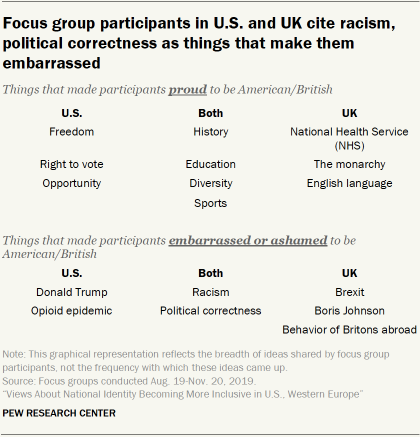
Focus group participants in U.S. and UK cite racism, political correctness as things that make them embarrassed

Focus group participants in the U.S. and UK were prompted to name things that made them proud and ashamed to be American or British. Shared points of pride between participants in both countries included history, education, diversity and sports. U.S. discussions, for their part, focused more on freedom, the right to vote and being known as a land of opportunity. In Britain, the emphasis was on the National Health Service, the royal family and the widespread usage of the English language.

Participants in both countries cited being ashamed about racism and political correctness. Those on the left in both the U.S. and UK tended to cite racism as a source of shame, while those on the right mentioned “PC culture.” Both Americans and Britons also named their respective head of state as a source of embarrassment (focus groups were conducted in 2019, when Donald Trump was president). And while U.S. participants also named the opioid epidemic as a source of shame, UK groups brought up Brexit and the behavior of British people abroad.

What does it mean to be a patriot?

Focus groups conducted in 2019 across the U.S. were asked to describe a strong patriot. Often, the first characterization was someone who serves or served in the military. Participants who identified as Republican, independent and Democratic all cited military service or respect for the military in general as elements of a patriot.

In general, Republican participants tended to see “patriot” as a positive label. However, other respondents hesitated to embrace the word. For example, a discussion among independents in Houston suggested that “patriot” as a term has been co-opted and has grown to mean something more extreme or even racist. People also expressed a tension between the concept of patriotism and what they imagined patriots to look like. For example, Democratic participants often cited “patriots” as those who wore “Make America Great Again” hats, but noted this as a tension or distortion of what they viewed as patriotism in its ideal sense.

The American flag was commonly evoked in the conversation, but differently depending on political persuasion. Republican participants, for their part, described patriots as people who would stand up for the flag. (Around the time focus groups were conducted, Colin Kaepernick, a former NFL quarterback well known for kneeling during the national anthem, was in the news regarding a workout with the Atlanta Falcons.) And while participants of all political stripes discussed how patriots are likely to embrace or fly the flag, Democrats often criticized the flag as something people “hide behind.”

UK focus group participants were asked to describe someone with a strong British national identity and some echoed the concerns expressed in U.S. groups: that patriotism is often distorted to validate extreme viewpoints, such as racism. One discussion among Remain voters suggested that Leavers were more associated with “Britishness,” but in an exclusionary way, hence the need to leave Europe. A participant in a focus group of right-leaning Leavers felt she couldn’t express patriotism for risk of offending others. The example discussed by the group centered around putting up flags, another parallel to U.S. group discussion of patriots and patriotism.

6. Tradition vs. change

In every country surveyed, more say their country will be better off in the future if it is open to changes regarding its traditions and way of life than say their country will be better off sticking to its traditions. This ranges from a high of 68% in the UK who are open to changes to a low of 51% in France.

Those on the left are consistently much more likely than those on the right to say their country will be better off if it is open to traditions changing. This difference is particularly stark in the U.S., where those on the left are 60 percentage points more likely than those on the right to be open to changes regarding traditions. However, differences of 20 percentage points or more are present in the UK, Germany and France.

Younger adults more likely to say their country will be better off if open to changing traditions

Younger people – those ages 18 to 29 – are more open to changes to tradition than older adults in every country but Germany, and in the U.S. and France, this divide is particularly large.

Education is also related to openness to change. In all countries surveyed, those with a postsecondary education or above are more likely than those with a secondary education or less to say their country will benefit from being open to changes. This difference is largest in Germany, where 68% of those with more education say their country should be open to changes, compared with 55% of those with less education.

Right-wing populist supporters in Germany, UK, France more likely than nonsupporters to say their country should stick to its traditions

Support for populist parties is also related to attitudes about tradition and change. In Germany, for example, AfD supporters are 31 percentage points more likely than nonsupporters to say their country will be better off if it sticks to its traditions and way of life. This difference is also present between supporters and nonsupporters of the Brexit Party (Reform UK) and France’s National Rally.

Supporters of France’s left-wing populist La France Insoumise party, on the other hand, are less likely to say France will be better off in the future if it sticks to its traditions and ways of life than nonsupporters.

Acknowledgments

This report is a collaborative effort based on the input and analysis of the following individuals.   

Laura Silver, Senior Researcher
Moira Fagan, Research Analyst
Aidan Connaughton, Research Assistant
Mara Mordecai, Research Assistant       

James Bell, Vice President, Global Strategy
Alexandra Castillo, Research Methodologist
Stefan S. Cornibert, Communications Manager       
Claudia Deane, Vice President, Research    
Kat Devlin, Research Associate
Janell Fetterolf, Research Associate
Shannon Greenwood, Digital Producer
Christine Huang, Research Analyst
Michael Keegan, Senior Information Graphics Designer
David Kent, Senior Copy Editor
Nicholas O. Kent, Research Assistant
Gar Meng Leong, Communications Associate
Clark Letterman, Senior Survey Manager
Gracie Martinez, Administrative Coordinator
Travis Mitchell, Copy Editor
J.J. Moncus, Research Assistant
Martha McRoy, Research Methodologist
Patrick Moynihan, Associate Director, International Research Methods
Julia O’Hanlon, Communications Associate
Stacy Pancratz, Research Methodologist
Jacob Poushter, Associate Director, Global Attitudes Research
Shannon Schumacher, Research Associate
Richard Wike, Director, Global Attitudes Research

Methodology

About Pew Research Center’s Fall 2020 Global Attitudes Survey

Results for the survey are based on telephone interviews conducted under the direction of Gallup and Abt Associates. The results are based on national samples, unless otherwise noted. More details about our international survey methodology and country-specific sample designs are available here.

Appendix A: About the focus groups

Pew Research Center conducted a series of focus groups to better understand national identity and globalization. We conducted 26 focus groups from Aug. 19 to Nov. 20, 2019 in cities across the U.S. and UK, grouped by political and geographic attributes as described below in the table (for more, see the methodology). All groups were asked questions about their local communities, national identities and globalization by a trained moderator. The questions were based on a discussion guide designed by Pew Research Center.

Focus groups

In the UK, four groups each were conducted in London, Birmingham and Newcastle, and two groups were conducted in Edinburgh, Scotland. These groups took place Aug. 19 to 29, 2019. In the U.S., four groups each were conducted in Seattle, Houston and Pittsburgh from Oct. 28 to Nov. 20, 2019. Participants in both countries were recruited using a screening questionnaire designed by Pew Research Center. All participants were given financial renumeration for their time.

The data from these discussions was primarily analyzed for a data essay exploring local, national and globalized identities in the U.S. and UK. But, throughout this report, we have also drawn on these discussions and included quotations to illustrate how some of the topics of this report – such as democratic satisfaction and attitudes toward elites – were talked about in these groups.

Quotations were chosen to provide context for the survey findings and do not necessarily represent the majority opinion in any particular group or country. Quotations may have been edited for grammar and clarity.

Appendix B: Classifying European political parties

Classifying parties as populist

Although experts generally agree that populist political leaders or parties display high levels of anti-elitism, definitions of populism vary. We use three measures to classify populist parties: anti-elite ratings from the 2019 Chapel Hill Expert Survey (CHES), Norris’ Global Party Survey and The PopuList. We define a party as populist when at least two of these three measures classify it as such.

CHES, which was conducted from February to May 2020, asked 421 political scientists specializing in political parties and European integration to evaluate the 2019 positions of 277 European political parties across all European Union member states. CHES results are regularly used by academics to classify parties with regard to their left-right ideological leanings, their key party platform positions and their degree of populism, among other things.

We measure anti-elitism using an average of two variables in the CHES data. First, we used “PEOPLE_VS_ELITE,” which asked the experts to measure the parties with regard to their position on direct vs. representative democracy, where 0 means that the parties support elected officeholders making the most important decisions and 10 means that “the people,” not politicians, should make the most important decisions. Second, we used “ANTIELITE_SALIENCE,” which is a measure of the salience of anti-establishment and anti-elite rhetoric for that particular party, with 0 meaning not at all salient and 10 meaning extremely salient. The average of these two measures is shown in the table below as “anti-elitism.” In all countries, we consider parties that score above a 7.0 as “populist.”

The Global Party Survey, which was conducted from November to December 2019, asked 1,861 experts on political parties, public opinion, elections and legislative behavior to evaluate the ideological values, issue position and populist rhetoric of parties in countries on which they are an expert, classifying a total of 1,051 parties in 163 countries. We used “TYPE_POPULISM,” which categorizes populist rhetoric by parties. We added only “strongly populist” parties using this measure.

The PopuList is an ongoing project to classify European political parties as populist, far right, far left and/or Euroskeptic. The project specifically looks at parties that “obtained at least 2% of the vote in at least one national parliamentary election since 1998.” It is based on collaboration between academic experts and journalists. The PopuList classifies parties that emphasize the will of the people against the elite as populist.1

The Brexit Party in the UK (now called Reform UK) is only classified as populist on one measure but is still included for analysis in the report. It is not included in the PopuList and does not meet our anti-elite CHES threshold of 7.0, but is considered a right-wing populist party by the Global Party Survey and other experts.

Classifying parties as left, right or center

We can further classify these traditional and populist parties into three groups: left, right and center. When classifying parties based on ideology, we relied on the variable “LRGEN” in the CHES dataset, which asked experts to rate the positions of each party in terms of its overall ideological stance, with 0 meaning extreme left, 5 meaning center and 10 meaning extreme right. We define left parties as those that score below 4.5 and right parties as those above 5.5. Center parties have ratings between 4.5 and 5.5.

European populist party classifications