
British, French and German Publics Give Biden High Marks After U.S. Election
Most are optimistic about U.S. policies and trans-Atlantic relations
This analysis focuses on views of President-elect Joe Biden among three major U.S. allies: France, Germany and the United Kingdom. The survey examines optimism about trans-Atlantic relationships and expectations for U.S. foreign policy under Biden’s administration. Views of the United States and the newly elected president are considered in the context of long-term trend data.
For this report, we use data from nationally representative telephone surveys of 3,066 adults from Nov. 12 to Dec. 23, 2020, in France, Germany and the UK. Additional data is included from a survey conducted among 1,003 adults in the U.S. from Nov. 10 to Dec. 7, 2020.
Here are the questions used for the report, along with responses, and the survey methodology.
Throughout his presidency, Donald Trump was broadly unpopular internationally, and his poor ratings have had a negative impact on America’s overall image, especially among key allies and partners of the United States. By contrast, early reviews for his successor, President-elect Joe Biden, are much more positive, according to a new Pew Research Center survey in France, Germany and the United Kingdom. People in all three countries express confidence in Biden and optimism that relations with the U.S. will improve now that he is moving into the White House.
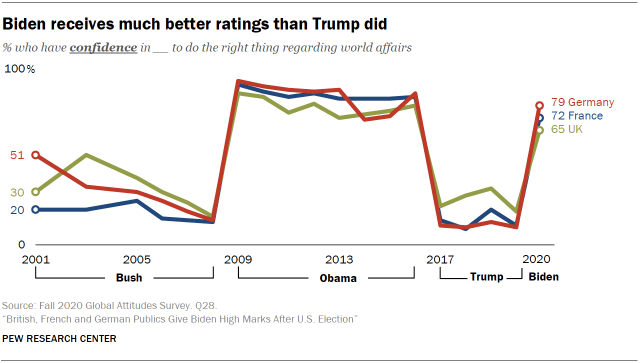
Large majorities in Germany (79%), France (72%) and the UK (65%) say they have confidence in Biden to do the right thing in world affairs – a dramatic change from the low ratings Trump received in a survey conducted in the summer of 2020 in these three nations. As he prepares to begin his presidency, Biden’s ratings are only slightly lower than the ratings Barack Obama received near the end of his second term.
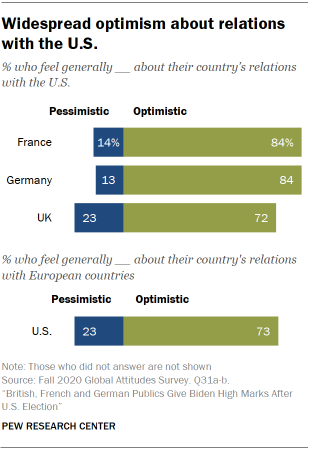
Large majorities also say that, when thinking of the future of their country, they are optimistic about their country’s relations with the U.S., including more than eight-in-ten in Germany and France and roughly seven-in-ten in the UK.
There is also considerable optimism on the other side of the Atlantic: 73% of Americans feel optimistic about U.S. relations with European countries. This view is especially widespread among Democrats and Democratic-leaning independents (83%), but also held by a majority of Republicans and Republican-leaning independents (62%).
In the three European countries surveyed, people have high expectations for the Biden administration on major policy issues. Substantial majorities believe that with Biden in the White House U.S. policies will improve on issues such as foreign policy, climate change and dealing with the coronavirus outbreak.
In this moment of transition between the Trump and Biden eras, overall ratings for the U.S. are mixed. About half in the UK and France and 40% in Germany have a favorable opinion of the U.S., representing in each case a significant increase from the summer 2020 survey but still somewhat lower favorability than in the last years of Obama’s presidency.
The survey finds that even before the violent storming of the U.S. Capitol in early January by a mob of Trump’s supporters, there were widespread concerns about the health of U.S. democracy among three of America’s closest allies: 73% of Germans, 64% of the French and 62% of the British think the U.S. political system needs to be subject to either major changes or completely reformed. (See “Even before riot at Capitol, most people in Germany, France and the UK had concerns about U.S. political system” for more on this question, as well as other findings on attitudes regarding the health of American democracy.)
These are among the key findings from a Pew Research Center survey conducted among 3,066 adults in France, Germany and the UK from Nov. 12 to Dec. 23, 2020. Additional data comes from a survey of 1,003 U.S. adults conducted from Nov. 10 to Dec. 7, 2020.
Confidence in Biden high
Ratings for Donald Trump were consistently negative in these three countries throughout his time in office. For instance, only about one-in-ten Germans expressed confidence in Trump in the four surveys Pew Research Center conducted in Germany during his presidency. In contrast, 79% now have confidence in Biden.
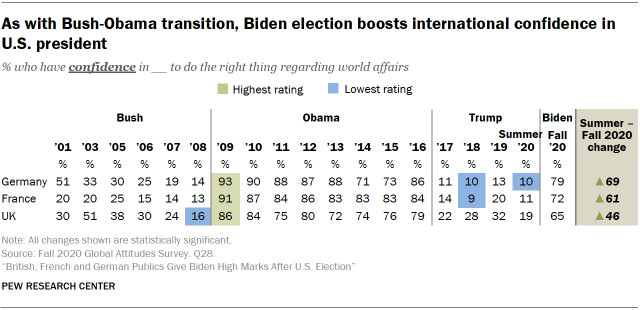
Whereas Trump’s low marks often resembled the poor ratings received by George W. Bush during his administration, Biden’s reviews are closer to some of the highly positive ones for Obama during his two terms as president. (A Pew Research Center survey to be conducted later in 2021 will explore whether Biden’s ratings change once he takes office.)
At this point, there are few significant ideological differences between the left and the right regarding attitudes toward Biden in these three nations. He receives roughly the same positive reviews among people who place themselves on the left, center and right of the political spectrum. However, Biden generally gets somewhat lower ratings from supporters of right-wing populist parties. For example, just 51% of Germans with a favorable view of Alternative for Germany (AfD) have confidence in Biden, compared with 84% of those with an unfavorable opinion of the party. Smaller but still significant differences exist between supporters and nonsupporters of the Brexit Party (now called Reform UK) in the UK and National Rally in France. (See appendix for more information on European populist parties.)
In the UK, views about Biden also differ according to how people feel about Brexit. While 76% of those who identify as “remainers” express confidence in Biden, it’s just 52% among “leavers.”
Optimism about U.S. policies under Biden

Reflecting widespread trust in Biden, majorities in France, Germany and the UK are hopeful that America’s handling of various international issues will improve once he takes office.
Just under 60% in the UK and roughly two-thirds in Germany and France think U.S. foreign policy will improve under Biden’s administration. About 65% in each country anticipate improvements in America’s response to climate change. And roughly 70% in all three countries say the same about America’s response to the coronavirus outbreak.
Overall, fewer than a third in any country do not expect changes in any of these areas when Biden becomes president. And only around one-in-ten or fewer believe things will get worse.
The survey did not reference specific potential policy changes under Biden. The substance of Trump policies engendered considerable criticism abroad, suggesting that many believe there is considerable room for improvement. In 2019, 85% in the UK and 90% in both France and Germany disapproved of Trump’s withdrawal from international climate change agreements. And fewer than one-in-five in each of the three countries rated America’s response to the coronavirus positively in summer 2020.
In the absence of policy particulars, optimism about U.S. policies tends to be more pronounced on the political left than right in France, Germany and the UK. This is particularly true when it comes to America’s response to the coronavirus outbreak. In the UK, people on the left are 16 percentage points more likely than those on the right to say America’s response to the outbreak will get better. In France and Germany, 80% of those on the left vs. 68% of those on the right share this view.
Optimism about policy changes under Biden is also muted among supporters of right-wing populist parties – a segment that tended to express relatively positive views of Trump and his policies. Yet even among these supporters, the prevailing view is that America’s response to the coronavirus pandemic, climate change and overall foreign policy will improve under the new U.S. president. For example, roughly half (51%) of Germans with a favorable view of AfD think the U.S. response to climate change will improve when Biden takes office; in the UK, a 56% majority of Brexit (Reform UK) supporters agree, as do 58% of National Rally backers in France.
Upbeat view of future relations with U.S.
A generally positive outlook extends to trans-Atlantic relations as well. More than eight-in-ten in France and Germany are optimistic about their country’s future relations with the U.S., and roughly seven-in-ten in the UK share this view.
In Germany, this optimism follows a recent low point in bilateral relations. In a survey conducted by Körber-Stiftung in September 2020, 79% of Germans described present relations between their country and the U.S. as bad, and many did not view the U.S. as a partner on important international issues.

In all three countries polled, people who express confidence in President-elect Biden to do the right thing in world affairs are much more likely to be optimistic about bilateral relations with the U.S. Among those who have confidence in Biden, overwhelming majorities in France (92%), Germany (91%) and the UK (79%) say they are optimistic on future relations. However, even among those who do not trust Biden, most are hopeful about their country’s relations with the U.S., including 64% in France, 62% in Germany and 60% in the UK.
Nearly three-in-four Americans are also optimistic about relations between their country and countries in Europe. This opinion is particularly common among Democrats and Democratic-leaning independents (83%), but a majority of Republicans and Republican leaners (62%) also hold this view.
A slight uptick in ratings of the U.S.
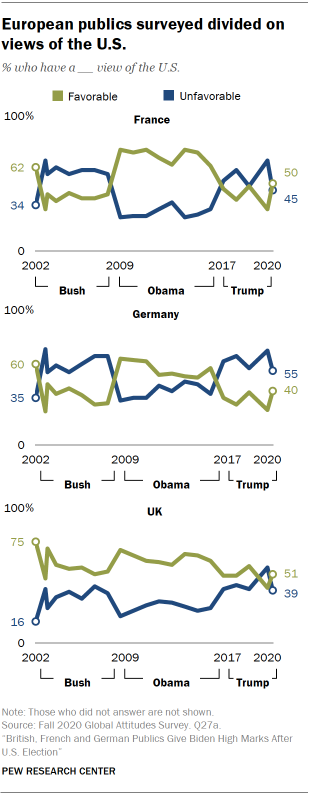
Overall views of the U.S. in the three European countries surveyed are lukewarm. In France and the UK, about half see the U.S. favorably while about four-in-ten or more see the country unfavorably. Germans are especially critical, with a majority holding an unfavorable view of the U.S. and only four-in-ten viewing the U.S. positively.
Still, these evaluations of the U.S. are more sanguine than the ratings the U.S. received last summer. In France, the share who see the U.S. favorably has increased by 19 percentage points, and the share has increased by 14 and 10 points in Germany and the UK, respectively. For the French and Germans, these are also the most favorable views of the U.S. expressed during the Trump presidency.
The increase in positive ratings for the U.S. is not as great as the increase observed in our 2009 survey, following the election of Barack Obama, in which ratings improved dramatically from the lower marks seen throughout much of George W. Bush’s presidency. A Pew Research Center survey to be conducted later this year will examine whether views of the U.S. shift further once Biden takes office.
Although those on the ideological left are in some cases more optimistic about the direction of policy change under a Biden administration, it is those on the right who have more favorable attitudes toward the U.S. overall. For instance, six-in-ten Britons on the ideological right have favorable view of the U.S., compared with only about a third of their compatriots on the left. A similar pattern holds in France, where 56% on the right are favorable toward the U.S., versus 38% on the left. The difference between those on the left and on the right is not statistically significant in Germany.
Ratings of the U.S. also differ with views of right-wing populist political parties. In all three countries surveyed, those who have favorable views of a right-wing populist party are more likely than those with unfavorable views to also see the U.S. favorably.
For those in the UK, attitudes are additionally divided by views about Brexit. Those who think of themselves as “remainers” are 14 percentage points less likely to have a favorable view of the U.S. than those who see themselves as “leavers.”
