Pew Research Center

FOR RELEASE FEBRUARY 27, 2020

Democratic Rights Popular Globally but Commitment to Them Not Always Strong

Most say elected officials are out of touch

BY Richard Wike and Shannon Schumacher

FOR MEDIA OR OTHER INQUIRIES:

Communications Department
202.419.4372
www.pewresearch.org

RECOMMENDED CITATION

Pew Research Center, February 2020, "Democratic Rights Popular Globally but Commitment to Them Not Always Strong"

About Pew Research Center

Pew Research Center is a nonpartisan, nonadvocacy fact tank that informs the public about the issues, attitudes and trends shaping the world. It does not take policy positions. The Center conducts public opinion polling, demographic research, computational social science research and other data-driven research. It studies politics and policy; news habits and media; the internet and technology; religion; race and ethnicity; international affairs; social, demographic and economic trends; science; research methodology and data science; and immigration and migration. Pew Research Center is a subsidiary of The Pew Charitable Trusts, its primary funder.

© Pew Research Center 2026

Table of contents

  • About Pew Research Center
  • Democratic Rights Popular Globally but Commitment to Them Not Always Strong
  • 1. Attitudes toward democratic rights and institutions
  • 2. Attitudes toward elected officials, voting and the state
  • 3. Satisfaction with democracy
  • Appendix: Classifying European political parties
  • Acknowledgments
  • Methodology

Democratic Rights Popular Globally but Commitment to Them Not Always Strong

Most say elected officials are out of touch

How we did this

This analysis focuses on democratic values and democratic satisfaction in 34 countries. Democracy is one of the core topics we explore in our annual Global Attitudes Survey. This report also includes views about elected officials, voting and whether the state is run for the benefit for all people.

For this report, we used data from a survey conducted across 34 countries from May 13 to Oct. 2, 2019, totaling 38,426 respondents. The surveys were conducted face-to-face across Africa, Latin America and the Middle East, and on the phone in United States and Canada. In the Asia-Pacific region, face-to-face surveys were conducted in India, Indonesia and the Philippines, while phone surveys were administered in Australia, Japan and South Korea. Across Europe, the survey was conducted over the phone in France, Germany, the Netherlands, Spain, Sweden and the UK, but face-to-face in Bulgaria, the Czech Republic, Greece, Hungary, Italy, Lithuania, Poland, Russia, Slovakia and Ukraine.

Here are the questions used for the report, along with responses, and the survey methodology.

Over the past few years, numerous scholars have found evidence that the health of democracy is in decline around the world, using terms such as “democratic backsliding” or “democratic recession” to describe an overall deterioration of democratic rights and institutions.

Chart shows support for democratic principles

As a new 34-nation Pew Research Center survey highlights, democracy remains a popular idea among average citizens, but commitment to democratic ideals is not always strong. And many are unhappy with how democracy is working.

As previous Pew Research Center studies have shown, people who are dissatisfied with how democracy is functioning are often less committed to representative democracy, and one important driver of dissatisfaction with democracy is frustration with political elites. In the current survey, a median of 64% across the countries polled believe elected officials do not care what people like them think. And, in nearly every nation surveyed, those who think politicians don’t care about average citizens are more likely to be dissatisfied with the way democracy is functioning in their country.

Overwhelming majorities say the democratic principles tested on the survey are at least somewhat important. However, a stronger measure of commitment to democracy is the share of people who say it is very important to have these things in their country. Often, underwhelming percentages describe democratic rights and institutions as very important.
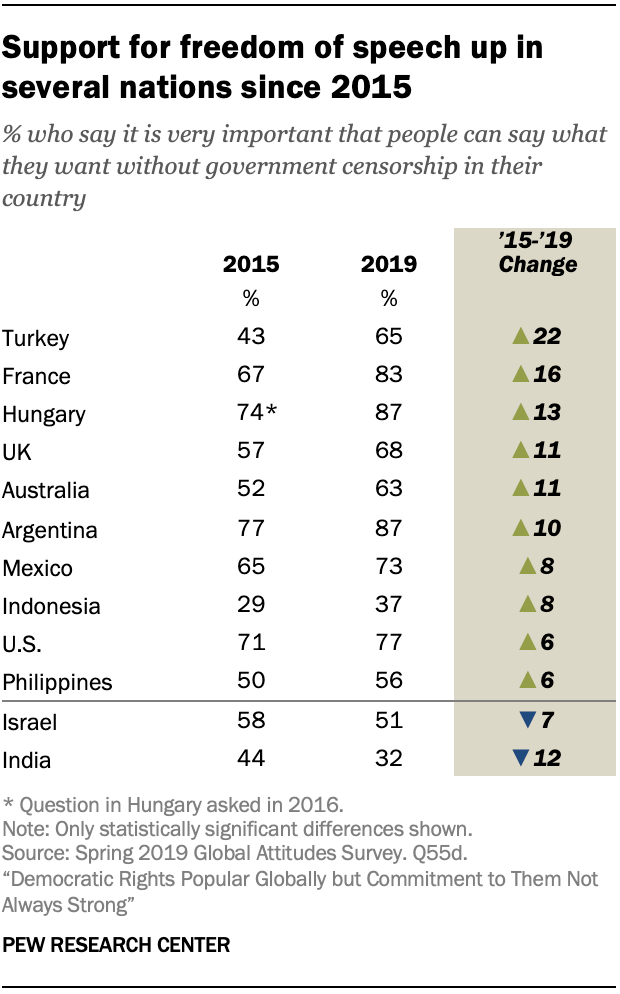
Chart shows support for freedom of speech up in several nations since 2015

The survey highlights important differences among nations regarding democratic attitudes. Despite recent concerns about the health of democracy in the United States, Europe and Latin America, respondents from these places are often more likely than those from other regions to voice strong support for democratic principles. The largest shares of the public describing all nine rights and institutions tested as very important are in the U.S. and Hungary; still, only a third in these countries (33%) consider all nine very important. In eight nations, the share of the public expressing this view is in the single digits.

Around the globe people make distinctions between the various principles tested – while a median of 82% across 34 nations say it is very important to live in a country where the judicial system treats everyone the same, fewer say the same about having a political system that allows human rights organizations or opposition parties to operate freely.

Chart shows support for freedom of press up in several nations since 2015

Attitudes toward democratic principles have remained generally stable since the Pew Research Center first asked many of these questions in 2015; however, there have been a few notable changes. For example, support for freedom on the internet, freedom of the press, free speech and gender equality has risen in many countries. Support for press freedom is up significantly in a few nations, where organizations such as Reporters Without Borders and V-Dem have documented declines in media freedom over the past several years, such as in Turkey and the United States.

In the U.S., the percentage of people who said that freedom of the press is very important rose by 13 percentage points from 2015 to 2019. However, this increase occurred mostly among Democrats and Democratic-leaning independents, rising from 64% to 85%. Among Republicans and Republican-leaning independents, it remained largely unchanged (72% to 77%).

These are among the major findings from a Pew Research Center survey conducted among 38,426 people in 34 countries from May 13 to Oct. 2, 2019.

Many are frustrated with how democracy is functioning

There is considerable dissatisfaction with the way democracy is working in many countries. Across the nations polled, a median of 52% are dissatisfied with how their democracy is working, while 44% are satisfied. Greeks, Bulgarians and Nigerians register the highest levels of dissatisfaction. In general, people with lower incomes and those who do not support the ruling party are more likely to be dissatisfied with the functioning of democracy. Further, in many European countries, supporters of right-wing populist political parties are especially likely to hold this view. Supporters of Poland’s Law and Justice Party and Hungary’s Fidesz Party – two governing populist parties – show the opposite pattern.

One way in which people are unhappy with the way democracy works is that they see political elites as out of touch. Across the nations surveyed, a median of 64% disagree with the statement “Most elected officials care what people like me think.” This opinion is particularly widespread in Europe – a median of 69% express this view. Further, 71% share this view in the U.S. In contrast, fewer say this in the three Asian emerging economies included in the study: India (31%), the Philippines (29%) and Indonesia (18%).
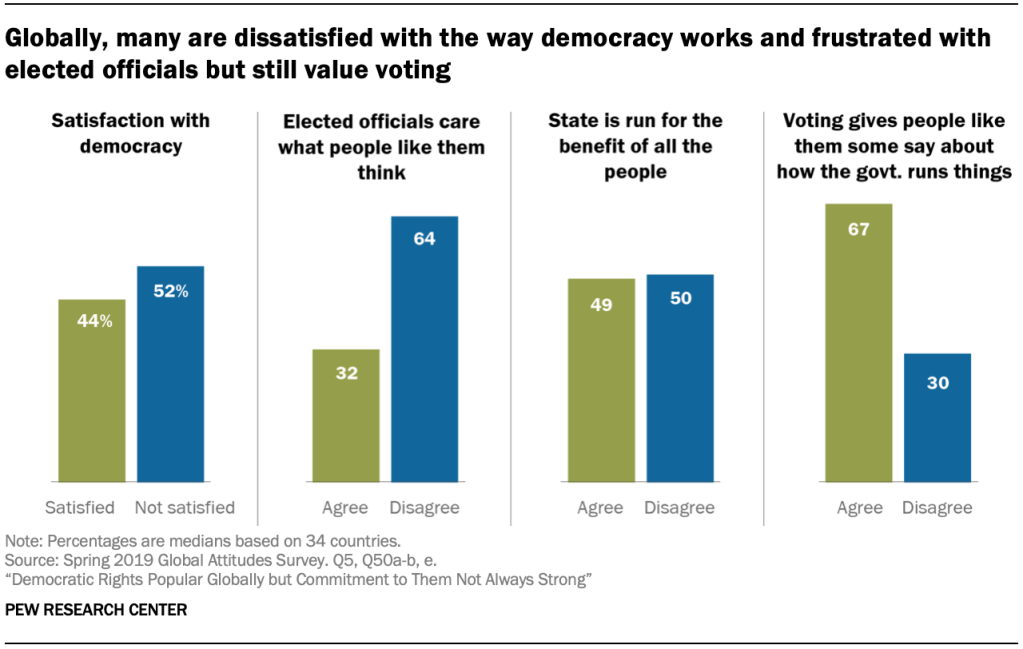
Chart shows that globally, many are dissatisfied with the way democracy works and frustrated with elected officials but still value voting

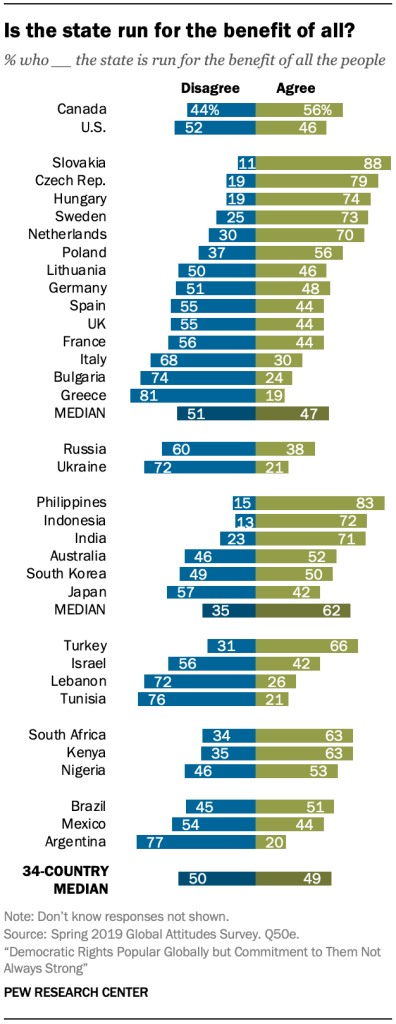
When asked whether the state is run for benefit of all the people, global publics are almost evenly divided: A median of 49% say yes, while 50% say no. But there are large differences across countries. For instance, 88% in Slovakia believe the state is run for the benefit of all, but just 19% hold this view in Greece. Overall, the share of the public saying the state is run to benefit everyone in society has declined in many nations since the Pew Research Center asked the question in 2002. Three nations – Japan, the Czech Republic and Slovakia – have seen an increase in the share who say the state is run for the benefit of all since 2002.
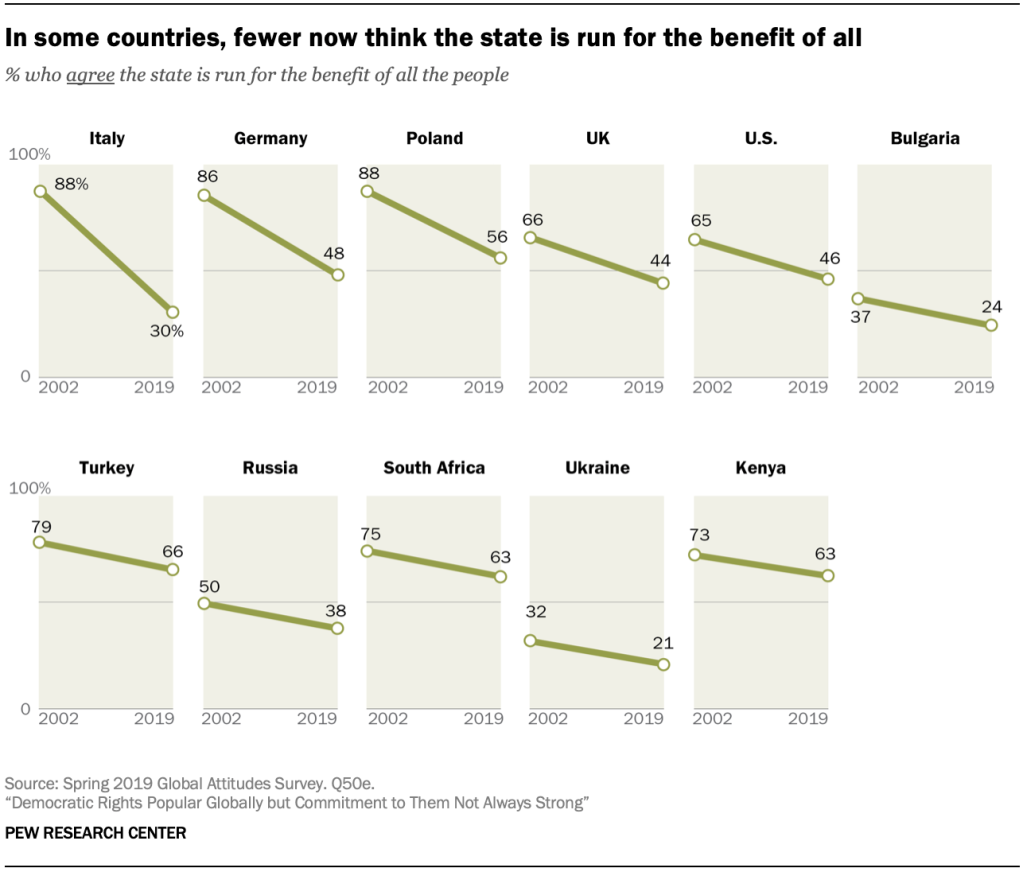
Chart shows in some countries, fewer now think the state is run for the benefit of all

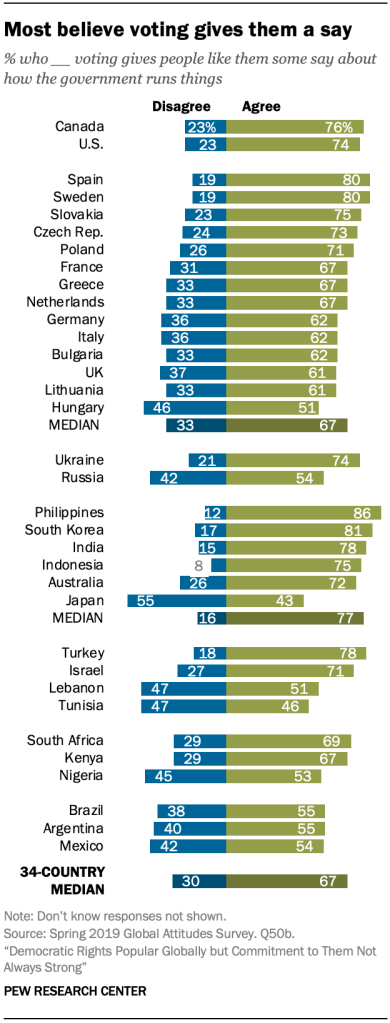
Despite the frustration many people feel about political leaders and the way their political systems are working, they have not given up on democracy, and most still believe they can have a voice in the process. A median of 67% agree that voting gives ordinary people some say about how the government runs things.

Differing attitudes toward democratic rights and institutions

The nine democratic rights and institutions tested on the survey receive widely different levels of support from global publics. The idea of a fair judiciary is the most vital – a median of 82% say it is very important, and, of the nine items tested, it has the highest percentage describing it as very important in 19 countries (it has the second-highest percentage in 10 countries). Gender equality is next – a median of 74% say it is very important, and it is either the first- or second-highest rated principle in most nations, although it is the lowest priority in Nigeria.

Freedom of religion also garners a great deal of support. Across the nations polled, a median of 68% consider it very important, and it is the top priority in all three sub-Saharan African nations in the study as well as in Turkey, Indonesia and India. However, it is the lowest priority in several more secular nations, especially in Europe, where the French, Swedes, Spanish and Dutch all rate it their lowest priority. The same is true in Japan, South Korea and Canada.

Holding regular elections with at least two political parties is considered very important by a median of 65% across the nations polled, and more than half hold this view in every nation surveyed except Russia.

There is general support for the three forms of free expression tested on the survey – free speech, freedom of the press and freedom on the internet – although the strength of that support varies cross-nationally. Freedom of speech is the second-highest priority in seven countries, although the share of the public rating it very important dips below 50% in Tunisia, India, Indonesia, Lebanon, Kenya and Russia. Roughly half or fewer say this about press freedom in eight nations. Internet freedom receives somewhat lower support overall (a median of 59% consider it very important), and in seven countries the share rating it very important is below 50%.

While freedom of expression is mostly endorsed by publics around the world, it is also worth noting that previous Pew Research Center studies have shown that how people define free expression can vary substantially across nations. A 38-nation 2015 survey found that, even among those who value free expression, there are widely different views about the types of speech governments should allow.

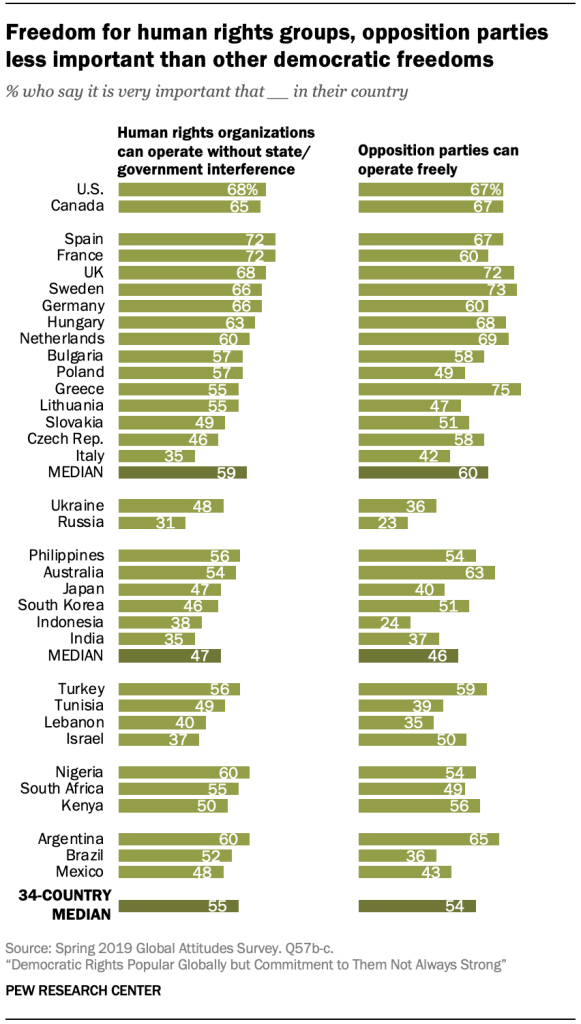
Having a system where civil society organizations such as human rights groups can operate freely (a median of 55% say it is very important) and having freely operating opposition parties (54%) are the two lowest-rated principles.

Chart shows fair judiciary and gender equality highest-rated democratic principles

1. Attitudes toward democratic rights and institutions

When it comes to institutional factors important to democracy, having a judicial system that treats everyone fairly was the value most likely to garner support across the countries surveyed. Across the 34 countries, a median of 82% say a fair judiciary is very important. Support is highest in Greece and Hungary (95%) and lowest in India (58%).

A fair judiciary is seen as particularly important among Europeans, though more so in the West than in the East. Large majorities in Middle Eastern and North African and Latin American countries surveyed also say that they think a fair judiciary is very important, while support is somewhat weaker in sub-Saharan Africa and the Asia-Pacific.

Regular and competitive elections

Chart shows majorities in many countries support regular competitive elections

Global publics are somewhat less enthusiastic in their support for regular elections with more than one party. Still, a median of 65% across the nations polled consider competitive elections very important. Only in Russia do fewer than half say it is very important for their country.

Among the 25 countries where the question was previously asked in 2015 or 2016, support for regular elections rose significantly in eight countries and declined in five. More cite them as very important in Turkey (+22 percentage points), Israel (+14), France (+12), Indonesia (+11), the Philippines (+11), Hungary (+8), India (+8) and Argentina (+6). Support is down in Germany (-6), Ukraine (-7) and Brazil (-7). Sizable declines in support for regular and competitive elections are evident in Italy (-14 percentage points) and in Russia (-17), where the survey was conducted prior to President Vladimir Putin’s announcement to change the constitution.

Attitudes toward free expression

Chart shows most say free speech, uncensored media and internet freedom are very important

The right to say things without government censorship is held in high regard among Western Europeans, Canadians and Americans, of whom about seven-in-ten or more say that it is very important to have free speech, free press and freedom of expression on the internet in their country.

These values receive less widespread support in Central and Eastern European nations such as Poland and Slovakia.

Support is also generally less widespread across the Middle East and North Africa, sub-Saharan Africa and Asia-Pacific. Within these regions, people in Turkey, South Africa and Australia stand out as the strongest supporters of these values compared with their neighbors. In Latin America, eight-in-ten Argentines or more say all three principles are very important, while about six-in-ten or more in Mexico and Brazil say the same.

A median of 64% across the nations surveyed rate freedom of speech as very important, although, there is variation across countries; only 32% say this in India and Tunisia compared with 87% in Greece, Hungary and Argentina.

Support for freedom of the press also varies around the world. While more than half in most countries say that a free press is very important, support is weaker in countries like Lebanon (28%) and Tunisia (33%) as well as most of the Asian-Pacific countries surveyed.

Freedom of speech on the internet ranks the lowest among the three items related to censorship. In most of the countries surveyed, large majorities say that they see internet freedom as at least somewhat important. Yet, when it comes to what is very important in their country, only in the Netherlands does internet freedom rank as the most important censorship issue for the public.

Internet users are much more likely than non-users to say it is very important that people can use the internet without censorship. For example, in the Czech Republic, only 31% of internet non-users say internet freedom is very important, compared with 75% of users.

In an era of increasing concern about misinformation, the share of people who say it is very important to have internet freedom, free speech and freedom of the press has risen in a number of countries around the world, most significantly in France (+16 percentage points or more on all three items), the UK (+11 or more), Indonesia and Argentina (both +8 or more).

In the countries for which trends and a measure of ideology are available, changes in the number of people who believe these measures of freedom of expression are very important often cuts across ideology. That is, all ideological groups are trending in the same direction in their views on free speech, free press and free internet. For example, in France, the percentage of people saying freedom of the press is very important grew from 46% in 2015 to 65% in 2019, including double-digit increases among all ideological groups: the left (+14 points), the center (+19) and the right (+24).

In the U.S., however, the increase occurred mostly among Democrats and Democratic-leaning independents, rising from 64% to 85%. Among Republicans and Republican-leaning independents, it remained largely unchanged (72% to 77%).

The increase on all three measures of support for free expression in Turkey has taken place disproportionately among those with a negative view of Prime Minister Recep Tayyip Erdoğan’s Justice and Development Party (AKP), though those who favor AKP saw modest increases in the share that view free speech and press as very important. The growth in support of free expression among Argentines has been driven by people in the political center.

Gender equality and religious freedom

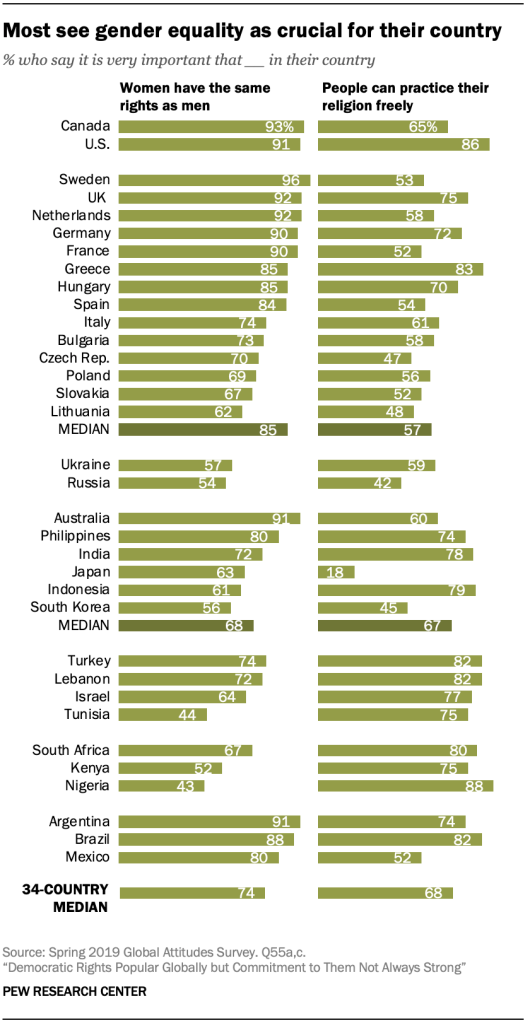
Chart shows most see gender equality as crucial for their country

In every country surveyed, strong majorities say gender equality is very important with notable exceptions in Russia, Tunisia, Kenya and Nigeria.

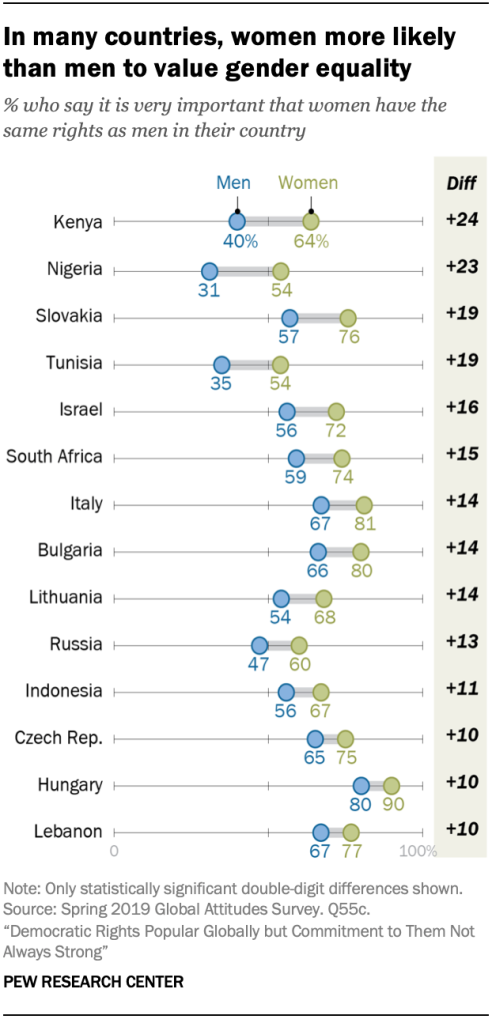
Women having the same rights as men is one of the most widely supported values among both men and women across most of the countries surveyed. In some countries, mostly in Central and Eastern Europe, the Middle East and North Africa and sub-Saharan Africa, gender equality is seen as more important among women than men.

The percentage of people saying gender equality is very important declined from 2015 in only three nations, Nigeria  (-11 percentage points), South Korea and Italy (both ‑8). Meanwhile, support rose in nine countries, most significantly in Turkey (+26), the Philippines (+21) and Indonesia (+17).

Chart shows in many countries, women more likely than men to value gender equality
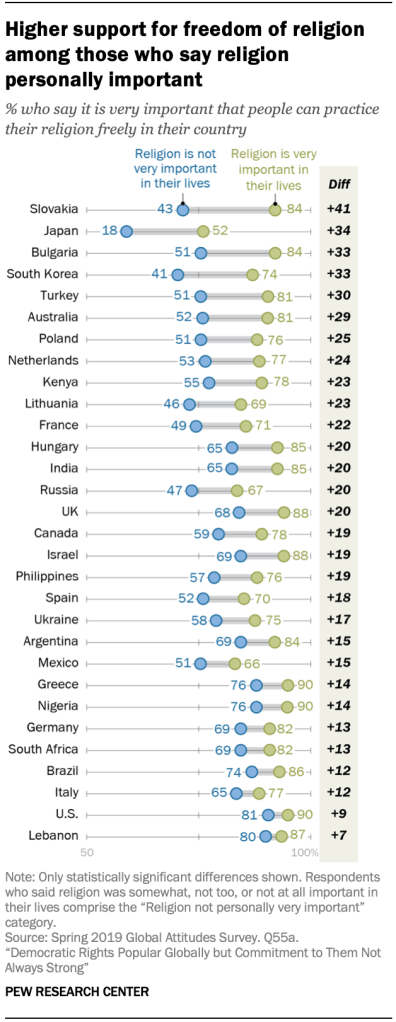
Chart shows higher support for freedom of religion among those who say religion personally important

​

Across the nations polled, a median of 68% say it is very important for people to be able to practice their religion freely, with especially strong support in the Middle East and Africa as well as in the U.S., Greece, Indonesia and India. Support is lowest in Japan (18% very important) and Russia (42%).

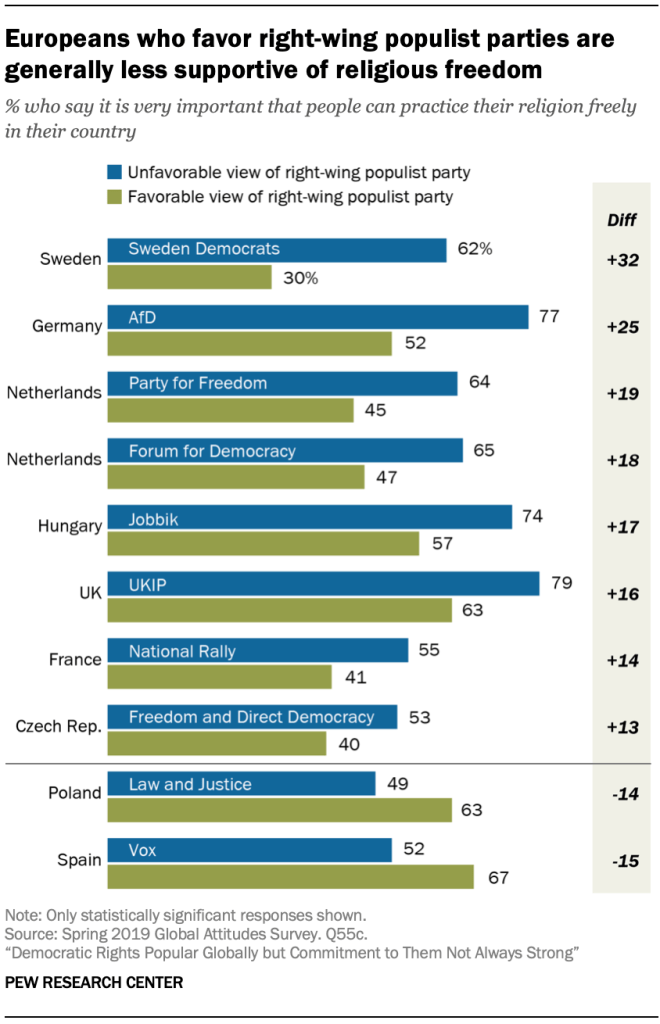
Chart shows Europeans who favor right-wing populist parties are generally less supportive of religious freedom

Public support for freedom of religion was largely stable from 2015/2016 to 2019, with increases in three nations and declines in four of 25 countries surveyed in both time periods. Increases in support were seen most notably among people in Turkey (+25) and the UK (+7), while larger declines were seen among publics in Mexico (-12), Italy (-14) and Russia (‑18).

In over half the countries surveyed, those who say religion is very important in their lives are more likely to believe religious freedom is very important.

In Europe, those who support right-wing populist parties are often less supportive of religious freedom than those who do not support these parties. For instance, 30% of those with a favorable view of the Sweden Democrats say religious freedom is very important, compared with 62% of Swedes expressing a negative opinion of the right-wing populist party.

Free operation of human rights organizations and opposition parties

Freedom for human rights groups, opposition parties less important than other democratic freedoms

A median of 55% believe it is very important for human rights organizations to operate freely in their country. Civil society’s ability to act without state or government interference is most valued in France and Spain (both 72%) and is held in the lowest regard in Russia (31%). Fewer than half say that it is very important in about one-third of the countries surveyed, with support generally lowest in the Middle East and North Africa and parts of the Asian-Pacific region.

The free operation of opposition political parties garners the least support of the nine values asked about in the survey with a global median of 54% rating it as very important.

The importance of this value is generally highest in Western Europe and lowest in Russia, where one-party rule under Putin’s United Russia has been the norm over the past two decades, though opposition parties have made gains in recent years.

2. Attitudes toward elected officials, voting and the state

In regions around the globe, many ordinary citizens believe politicians do not listen to them. Across the 34 countries surveyed, a median of 64% disagree with the statement “most elected officials care what people like me think.”

The most positive reviews for elected officials are found in Southeast Asia, among Indonesians and Filipinos. There are only five other nations where even half of the public says political officials care what their constituents think.

Frustration with political elites is especially high in many European nations. Seven-in-ten or more in the UK, Hungary, Czech Republic, France, Spain and Bulgaria say elected officials don’t care, and 84% hold this view in Greece, the highest percentage on the survey.

The perception that politicians are out of touch is also particularly widespread in Ukraine, Tunisia, Argentina and Japan.

In the United States, 71% believe elected officials don’t care about average citizens. On this issue, there is essentially no partisan divide. Among Republicans and Republican-leaning independents, 72% say elected officials don’t care, and 69% of Democrats and Democratic-leaning independents agree.

In many other countries, however, there are significant partisan gaps. In 20 nations, supporters of governing parties are more likely to say that elected officials care about what people like them think.

Is the state run for the benefit of all?

When asked whether they agree with the statement “the state is run for the benefit of all the people,” global publics are divided: A median of 49% across 34 countries agree, while 50% disagree.

The American public is also closely divided on this issue, with 46% believing the state is run for the benefit of all, while 52% disagree with this view. Disagreement is much more common among Democrats and Democratic-leaning independents (59%) than Republicans and Republican-leaning independents (41%). Elsewhere, in most countries supporters of governing parties are more likely to believe the state is run for the benefit of all.

Responses to this question vary considerably across Europe. Large majorities believe the state is run for the benefit of all in Slovakia, the Czech Republic, Hungary, Sweden and the Netherlands. But two-thirds or more disagree with this view in Greece, Bulgaria and Italy.

Filipinos, Indonesians and Indians are particularly likely to agree the state is run for the benefit of everyone, while disagreement is especially prevalent in Argentina, Tunisia, Lebanon and Ukraine.

In some countries, fewer now think the state is run for the benefit of all

In 11 of 20 countries where this question was asked in 2002 and 2019, the share of the public saying the state is run for the benefit of all has declined significantly. In 2002, for instance, 88% of Italians held this view, compared with just 30% today.

Chart shows most believe voting gives them a say

Despite the frustrations most have with politicians, and the belief many hold that the state is run in an unfair manner, people still feel they have a political voice. Across the nations polled, a median of 67% agree that voting gives ordinary people some say about how the government runs things.

Strong majorities in most nations hold this view, including 74% in the U.S. In Spain, Sweden, the Philippines and South Korea, eight-in-ten or more express this opinion.

Still, substantial shares of the public do not believe their vote matters in many places, including 55% in Japan and nearly half in Tunisia, Lebanon, Hungary and Nigeria. In most nations, the belief that one’s vote does not have an impact is especially common among those who do not view the governing party favorably.

3. Satisfaction with democracy

Discontent with the way democracy is working is common in many nations around the world. Across 34 countries surveyed, a median of 52% are dissatisfied with the way their democracy is functioning, compared with 44% who are satisfied.

However, views vary across and within regions. For example, roughly two-thirds or more are satisfied with the way democracy is working in Sweden, the Netherlands, Poland and Germany, but about two-thirds or more hold the opposite view in Spain, Italy, the UK, Bulgaria and Greece.

Those in the Asia-Pacific region tend to be satisfied with how democracy is working in their countries, although Japan is an exception.

Views differ in the Middle East and North Africa. Most Israelis are satisfied with the way democracy is working, but Tunisian and Lebanese publics are among the most dissatisfied in the survey. Opinion in Turkey is divided.

Kenyans are overall satisfied with the functioning of democracy, while most South Africans and Nigerians hold the opposite view. Majorities are dissatisfied in all three Latin American nations surveyed.

Chart shows dissatisfaction with how democracy is working up in five nations since 2018, down in nine

Between 2018 and 2019, publics grew increasingly dissatisfied with democracy in five out of 27 countries surveyed in both years, while dissatisfaction dropped in nine.

Dissatisfaction declined by more than 20 percentage points in Mexico and Brazil, both of which held national elections between the 2018 and 2019 surveys.

Discontent is often more common among people with lower incomes. In 16 of the 34 nations polled, lower-income respondents are more likely to say they are dissatisfied with the way democracy is working.

In Europe, discontent is often found among supporters of right-wing populist parties. Specifically, in Sweden, Germany, Hungary, the Netherlands and France, people with a favorable view of out-of-power right-wing populist parties are more likely than those who rate these parties unfavorably to say the democracy is not working well. However, in Poland, supporters of the governing right-wing populist Law and Justice Party are more satisfied with the functioning of democracy by 40 percentage points.

Across the nations polled, supporters of the ruling party are consistently more content about the functioning of the political system. In 28 of 34 countries, they are more satisfied than others with the way democracy is working. (In six such countries, those who did not support the governing party were more likely to not answer the question.)

Negative economic views linked to dissatisfaction

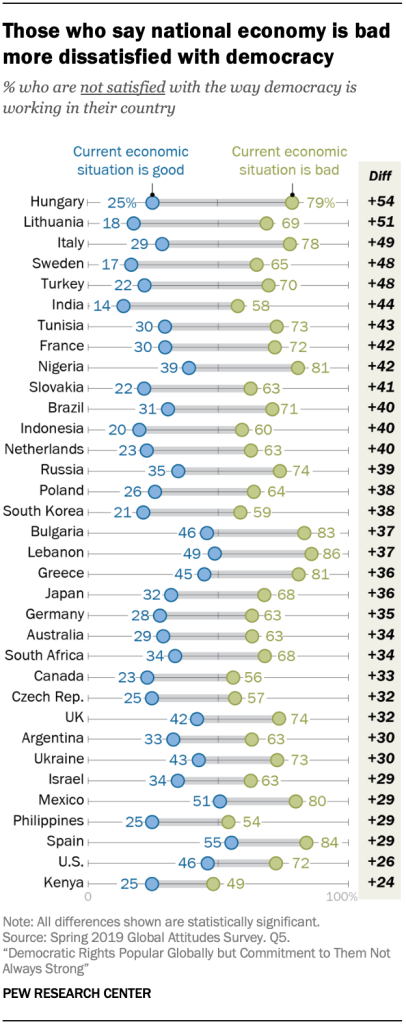
Opinions about how democracy is working are associated with economic assessments. In every country surveyed, people who say the economy is doing poorly are more dissatisfied with the functioning of democracy. For example, 79% of Hungarians who believe their national economy is in bad shape say their democracy is not working well; among those who think the economy is in good shape, just 25% express this view.

Those who say national economy is bad more dissatisfied with democracy

Assessments of democracy are also related to opinions about the long-term economic future. In each nation polled, the view that democracy is not working well is especially prevalent among those who are pessimistic about the next generation’s economic prospects. For instance, among Slovaks who say that when children in their country today grow up they will be financially worse off than their parents, 68% are unhappy with the state of democracy; 22% among those who believe today’s children will be better off financially express the same sentiment.

Chart shows those who think children will be worse off more dissatisfied with democracy

Frustration with political elites tied to dissatisfaction

Beyond views about economic attitudes, perceptions of politicians play an important role in shaping people’s views about democratic performance. Those who believe political officials don’t care about average citizens tend to be more unhappy with democracy.

In nearly every country, respondents who say elected officials don’t care what ordinary people think are much more likely to be dissatisfied. For example, 77% of Lebanese who don’t think politicians listen to average citizens are dissatisfied with how democracy is working; among those who believe politicians do listen, 43% share this sentiment.

Those who believe elected officials do not care are more dissatisfied with democracy


Appendix: Classifying European political parties

Although experts generally agree that populist political leaders or parties display high levels of anti-elitism, definitions of populism vary. We use three measures to classify populist parties: anti-elite ratings from the 2017 Chapel Hill Expert Survey (CHES), Inglehart and Norris’s populism party scale and The PopuList. We define a party as populist when at least two of these three measures classify it as such.

CHES, which was carried out in January and February 2018, asked 228 regional experts to evaluate the 2017 positions of 132 European political parties across 14 European Union member states. CHES results are regularly used by academics to classify parties with regard to their left-right ideological leanings, their key party platform positions and their degree of populism, among other things.

We measure anti-elitism using an average of two variables in the CHES data. First, we used “PEOPLE_VS_ELITE,” which asked the experts to measure the parties with regard to their position on direct vs. representative democracy, where 0 means that the parties support elected officeholders making the most important decisions and 10 means that “the people,” not politicians, should make the most important decisions. Second, we used “ANTIELITE_SALIENCE,” which is a measure of the salience of anti-establishment and anti-elite rhetoric for that particular party, with 0 meaning not at all salient and 10 meaning extremely salient. The average of these two measures is shown in the table below as “anti-elitism.” In all countries, we consider parties that score above a 7.0 as “populist.”

We also used CHES’s “FAMILY” variable to further classify populist groups. Per CHES, family attribution is based on a combination of “a) membership or affiliation with [European Parliament] party families, b) Parlgov classifications and c) self-identification.”

Inglehart and Norris emphasize the cultural views of populist parties and created a populist party scale using the 2014 CHES data for classification.1 This scale aggregates expert ratings of the party on the following positions and attitudes: 1) support for traditional social values, 2) opposition to liberal lifestyles, 3) promotion of nationalism, 4) favorable toward tough law and order, 5) favorable toward assimilation for immigrants and asylum seekers, 6) support for restrictive immigration policies, 7) opposition to more rights for ethnic minorities, 8) support for religious principles in politics and 9) support for rural interests. The scale ranges from 0 to 100, and parties with a score of more than 80 are classified as populist.

The PopuList is an ongoing project to classify European political parties as populist, far right, far left and/or euroskeptic. The project specifically looks at parties that “obtained at least 2% of the vote in at least one national parliamentary election since 1998.” It is based on collaboration between academic experts and journalists. The PopuList classifies parties that emphasize the will of the people against the elite as populist.2

Two parties are missing data for at least two of the measures used for classification but are still included for analysis in the report. Vox in Spain is considered a right-wing populist party by experts, but was not included in any of the measures used due to its relatively recent rise in popularity. Similarly, Forum for Democracy (FvD) in the Netherlands did not achieve a large enough share of the votes to be included in the PopuList analysis and was founded in 2016, after data collection for the Inglehart and Norris analysis. Experts in the most recent round of CHES classify this party as a right-wing populist party, and its score on the anti-elitism scale exceeds the cut-off.

Classifying parties as left, right or center

We can further classify these traditional and populist parties into three groups: left, right and center. When classifying parties based on ideology, we relied on the variable “LRGEN” in the CHES dataset, which asked experts to rate the positions of each party in terms of its overall ideological stance, with 0 meaning extreme left, 5 meaning center and 10 meaning extreme right. We define left parties as those that score below 4.5 and right parties as those above 5.5. Center parties have ratings between 4.5 and 5.5.

European populist party classifications

Acknowledgments

This report is a collaborative effort based on the input and analysis of the following individuals.   

Richard Wike, Director, Global Attitudes Research Shannon Schumacher, Research Associate 

James Bell, Vice President, Global Strategy Alexandra Castillo, Research Associate Jeremiah Cha, Research Assistant Aidan Connaughton, Research Assistant Stefan S. Cornibert, Communications Manager        Claudia Deane, Vice President, Research     Kat Devlin, Research Associate James Dryden, Copy Editor, courtesy ServiceScape Moira Fagan, Research Analyst Janell Fetterolf, Research Associate Shannon Greenwood, Digital Producer Christine Huang, Research Analyst Michael Keegan, Senior Information Graphics Designer David Kent, Copy Editor Nicholas O. Kent, Research Assistant Colin Lahiff, Communications Associate Gar Meng Leong, Communications Associate Clark Letterman, Senior Researcher J.J. Moncus, Research Assistant Martha McRoy, Research Methodologist Mara Mordecai, Research Assistant Patrick Moynihan, Associate Director, International Research Methods Reem Nadeem, Associate Digital Producer Stacy Pancratz, Research Methodologist Jacob Poushter, Associate Director, Global Attitudes Research Audrey Powers, Senior Operations Associate Laura Silver, Senior Researcher

Methodology

Results for the survey are based on telephone and face-to-face interviews conducted under the direction of Gallup and Abt Associates. The results are based on national samples, unless otherwise noted. More details about our international survey methodology and country-specific sample designs are available here.