Europe’s Unauthorized Immigrant Population Peaks in 2016, Then Levels Off
New estimates find half live in Germany and the United Kingdom
BYPhillip Connor and Jeffrey S. Passel
About Pew Research Center
Pew Research Center is a nonpartisan, nonadvocacy fact tank that informs the public about the issues, attitudes and trends shaping the world. It does not take policy positions. The Center conducts public opinion polling, demographic research, computational social science research and other data-driven research. It studies politics and policy; news habits and media; the internet and technology; religion; race and ethnicity; international affairs; social, demographic and economic trends; science; research methodology and data science; and immigration and migration. Pew Research Center is a subsidiary of The Pew Charitable Trusts, its primary funder.
Europe’s Unauthorized Immigrant Population Peaks in 2016, Then Levels Off
New estimates find half live in Germany and the United Kingdom
Editorial note to readers (March 19, 2025):
This project estimated the number of unauthorized immigrants living in 32 European countries during the mid- to late-2010s. We used what were then the best available data sources from different governments and from the European Union. After our report was published in November 2019, researchers at the University of Oxford’s Migration Observatory identified a problem with the official data from the United Kingdom’s Office for National Statistics (ONS) on the number of legal immigrants residing in the UK.
The ONS data on legal immigrants that we used in our report did not include those with “indefinite leave to remain” (ILR), a group legally residing in the country. Including the ILR group among legal UK residents results in lower estimated total numbers of unauthorized immigrants for both the United Kingdom and Europe in 2017 and other years. The updated estimates for the number of unauthorized immigrants in 2017 (without waiting asylum seekers) are 700,000-900,000 for the UK and 2.8 million-3.5 million for Europe. Updated estimates can be found in this table but are not reflected elsewhere in this report.
Europe has experienced a high level of immigration in recent years, driving debate about how countries should deal with immigrants when it comes to social services, security issues, deportation policies and integration efforts. Among these recently arrived immigrants are many who live in Europe without authorization. Coupled with unauthorized immigrants who were already in Europe, their numbers reach into the millions, though together they make up a small share of Europe’s total population.
A new Pew Research Center analysis based on European data sources estimates that at least 3.9 million unauthorized immigrants – and possibly as many as 4.8 million – lived in Europe in 2017. The total is up from 2014, when 3.0 million to 3.7 million unauthorized migrants lived in Europe, but is little changed from a recent peak of 4.1 million to 5.3 million in 2016.1
Overall, unauthorized immigrants accounted for less than 1% of Europe’s total population of more than 500 million people living in the 28 European Union member states, including the United Kingdom, and four European Free Trade Association (EFTA) countries (Iceland, Liechtenstein, Norway and Switzerland). And among the roughly 24 million noncitizens of EU-EFTA countries living in Europe, fewer than one-fifth were unauthorized immigrants in 2017.
The recent rise in Europe’s long-standing unauthorized immigrant population from nations outside of EU-EFTA countries is largely due to a surge of asylum seekers who mostly arrived in 2015, when more than 1.3 million people applied for asylum in EU-EFTA countries. Many from that wave have been approved to remain in Europe. Many others, however, have had their applications rejected. Some have appealed those denials. Still others whose applications were rejected or withdrawn continue to live in Europe.
Meanwhile, many asylum seekers in Europe are still awaiting a decision on their pending application, a group that is part of our estimates, and accounted for nearly a quarter (20% to 24%) of Europe’s unauthorized immigrant population in 2017. Although asylum seekers waiting for a decision have a temporary legal standing, their future in Europe is uncertain. Most entered their country of residence without permission, and the majority of applicants are now seeing their applications rejected. Consequently, many have been or could be subject to deportation orders in the future.
Since asylum seekers waiting for a decision have a temporary lawful status, the Center also produced estimates of the unauthorized immigrant population without this group. These estimates are lower – 2.9 million to 3.8 million in 2017 – yet still show an apparent increase from 2014 before the asylum seeker surge, when the unauthorized immigrant population without asylum seekers waiting for a decision was an estimated 2.4 million to 3.2 million. (For estimates of the unauthorized immigrant population in Europe and by country without waiting asylum seekers, see Appendix C.)
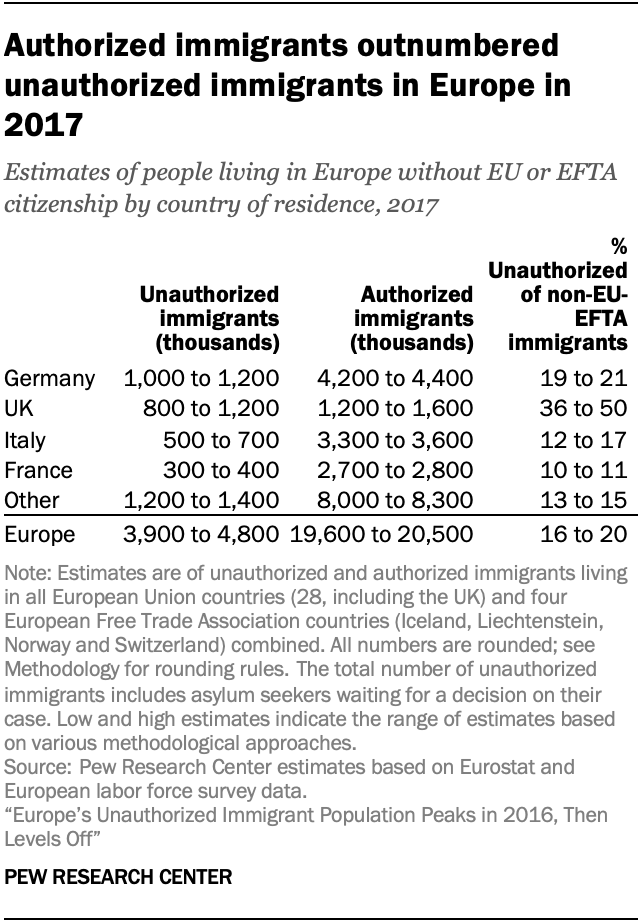
Unauthorized immigrants made up roughly one-fifth (16% to 20%) of Europe’s total non-EU-EFTA population in 2017, according to estimates, with 4% being unauthorized immigrants with a pending asylum claim that year. This means authorized non-EU-EFTA citizens living in Europe outnumbered unauthorized immigrants by about four to one.
Who’s counted as an unauthorized immigrant?
Unauthorized immigrants in this report are people living without a residency permit in their country of residence who are not citizens of any European Union or European Free Trade Association (EFTA) country. Most unauthorized immigrants entered an EU-EFTA country without authorization, overstayed a visa, failed to leave after being ordered to do so or have had their deportation temporarily stayed. The unauthorized population also includes those born in EU-EFTA countries to unauthorized immigrant parents, since most European countries do not have birthright citizenship. Finally, the European unauthorized immigrant population estimate includes asylum seekers with a pending decision. This last group makes up nearly a quarter (20% to 24%) of Europe’s estimated total unauthorized immigrant population.
Many different immigrant groups can be counted as unauthorized immigrants, as there is no universal definition and the inclusion of some groups over others is a point of debate. A broad definition could include anyone who entered the country without authorization and has yet to procure permanent residency. This definition could include those with subsidiary protection status, a group that does not qualify for refugee status but receives humanitarian protection that can be renewed for one or two years at a time. Those with this status can sometimes sponsor family members and after several years apply for permanent residency.
By contrast, a narrower definition for unauthorized immigrants would not include those with legal protection from deportation, even if such protection is temporary. From this perspective, unauthorized immigrant populations would not include asylum seekers waiting on a decision, those whose deportation has been deferred or stayed, or children of unauthorized immigrants.
Pew Research Center has selected an approach that considers a combination of authorized entry, legal certainty and likely permanency. In the U.S., the Center considers those with deportation relief (for example, Deferred Action for Childhood Arrivals or Temporary Protected Status) as well as asylum seekers waiting on their cases as unauthorized immigrants. Although these groups are authorized to work, many entered without permission and their legal future in the U.S. is uncertain, as evidenced by recent policy changes implemented by the U.S. government and subsequent court cases.
In the same way in EU-EFTA countries, deportees with a stayed or deferred deportation who have a legal right of residence and may even be allowed to work are included as unauthorized immigrants. Children born in Europe to unauthorized immigrant parents are considered part of the unauthorized immigrant population. Similarly, asylum seekers with a pending decision, of whom many entered without permission and whose acceptance rates continue to fall, are also included as unauthorized immigrants. Since the definition of an unauthorized immigrant is a point of debate, the Center has published estimates without asylum seekers awaiting a decision on their application (see Appendix C). Waiting asylum seekers, at nearly 1 million people in Europe in 2017, are likely the largest of unauthorized immigrant groups with an uncertain legal status.
The Center’s new estimates come at a time when publics across Europe express mixed opinions on the place of immigrants in their societies. A 2018 multi-nation survey from the Center found that majorities in several European countries support the deportation of immigrants living in their countries illegally. On the other hand, when asked about refugees fleeing war and violence, the 2018 survey also found that majorities across Europe support taking them in, a group that has often entered Europe without permission and claims asylum.
This is the first time Pew Research Center has estimated the size of Europe’s unauthorized migrant population. The methodology used for these new estimates builds on the Center’s more than 15 years of experience in estimating the size of the unauthorized immigrant population in the United States. The unauthorized immigrant population in the U.S. is more than double the size (10.3 million to 10.7 million in 2017) of that in Europe (3.9 million to 4.8 million); has been decreasing in number since 2007; and makes up a larger share of the total population (roughly 3% in the U.S. compared with less than 1% in Europe). (See our related blog post for more details on how unauthorized immigrant populations and their characteristics differ between Europe and the U.S.)
The Center’s estimates are also the first comprehensive estimate for Europe in a decade. Europe’s unauthorized migrant population was last estimated for 2008 by an EU-funded team of European researchers called the Clandestino project. At that time, the number living in the EU was estimated to be 1.9 million to 3.8 million, not including asylum seekers with pending decisions. By comparison, our estimate for 2017 for EU countries only, excluding asylum seekers with a pending application, is 2.8 million to 3.7 million – the upper end of Clandestino’s 2008 estimate.2
The Center’s estimates compared with others
Pew Research Center’s unauthorized immigrant estimates in Europe are in line with other reputable data, including estimates from previous studies, statistics on the number of unauthorized immigrants regularized by governments and analysis of recent migration flows.
In Germany, for example, a separate 2014 estimate using a different method than the one used by the Center and that did not include waiting asylum seekers, estimated the number of unauthorized immigrants to have been 180,000 to 520,000. For the same year, the Center estimated the number of unauthorized immigrants in Germany to be between 300,000 and 400,000 without waiting asylum seekers, within the 2014 study’s range. Moving forward, our 2017 estimate for Germany of 600,000 to 700,000 unauthorized immigrants, excluding asylum seekers waiting for a resolution in their case, is in line with expected trends. For more, see our Germany estimate methodology.
Meanwhile, in the UK, a London School of Economics study placed the number of unauthorized immigrants residing in the country between 417,000 and 863,000 in 2007. Ten years later, after hundreds of thousands of additional migrants from non-EU-EFTA countries entered and stayed in the UK, our 2017 estimate of 800,000 to 1.2 million unauthorized immigrants with waiting asylum seekers would be consistent with recent migration trends. For more methodological background, see our UK estimate methodology.
In Italy, hundreds of thousands of asylum seekers have landed on the country’s shores during the past decade. Many have had their asylum cases rejected, and some have remained in Italy without authorization. Adjusting for regularizations of unauthorized immigrants to authorized status during the past decade, deaths, out-migration and additional arrivals, our estimate of 500,000 to 700,000 for 2017, including asylum seekers with a pending asylum case, is similar to the estimate published by the Iniziative e Studi sulla Multietnicità Foundation. For more information, see our Italy estimate methodology.
In France, our estimate shows between 300,000 and 400,000 unauthorized immigrants lived in the country in 2017, including some 38,000 asylum seekers waiting for a decision on their case. This estimate is similar to that cited by government leaders as well as several French demographers. Also, some 300,000 people in 2017 were enrolled in a government medical plan accessed by unauthorized immigrants. For more, see our methodology for our France estimate.
Terminology
Europe refers to the 28 European Union (EU) member countries in 2017 and the four European Free Trade Association (EFTA) countries – Iceland, Liechtenstein, Norway and Switzerland. This 32-country grouping includes the United Kingdom. The terms “Europe” and “EU-EFTA countries” are used interchangeably throughout this report.
The term noncitizens refers to residents of Europe who are not EU-EFTA citizens, most of whom were not born in EU or EFTA countries.
Authorized immigrants are noncitizens with residency status in an EU-EFTA country, often for a period of 12 months or longer. In Europe, this includes those granted refugee status after making an asylum claim and asylum seekers given subsidiary protection status.
Unauthorized immigrants are noncitizens living in their country of residence without a residency permit. Unauthorized immigrants entered their country of residence without authorization, overstayed a visa or did not leave after being ordered to do so. Children born to unauthorized immigrant parents are also part of the unauthorized immigrant population since most European countries do not have birthright citizenship, even though these children may have never migrated. Unauthorized immigrants include asylum seekers waiting for a decision on their case, as their future residential status is uncertain. Similarly, those waiting for deportation, even if temporarily suspended, are also considered unauthorized immigrants. This definition does not include those with forged or false documents that enabled immigrants to enter and/or stay in Europe with authorization from the viewpoint of authorities; data systems do not permit researchers to capture this population.
The terms asylum seekers and asylum applicants are used interchangeably and refer to individuals who have applied for asylum in a European country after reaching Europe. All family members, whether male or female, children or adults, file individual applications for asylum. While the application is being considered, the applicant is temporarily protected from deportation. During this time, they are considered an asylum seeker waiting on a decision or an unauthorized immigrant with a pending asylum claim. Seeking asylum does not mean applicants will necessarily be permitted to stay in Europe. However, if an asylum application is approved, the asylum seeker is granted refugee status and given the right to work and remain in Europe. If the application is rejected, the applicant can file an appeal.
1. Four countries account for the majority of Europe’s unauthorized immigrant population
Editorial note to readers (March 19, 2025):
This project estimated the number of unauthorized immigrants living in 32 European countries during the mid- to late-2010s. We used what were then the best available data sources from different governments and from the European Union. After our report was published in November 2019, researchers at the University of Oxford’s Migration Observatory identified a problem with the official data from the United Kingdom’s Office for National Statistics (ONS) on the number of legal immigrants residing in the UK.
The ONS data on legal immigrants that we used in our report did not include those with “indefinite leave to remain” (ILR), a group legally residing in the country. Including the ILR group among legal UK residents results in lower estimated total numbers of unauthorized immigrants for both the United Kingdom and Europe in 2017 and other years. The updated estimates for the number of unauthorized immigrants in 2017 (without waiting asylum seekers) are 700,000-900,000 for the UK and 2.8 million-3.5 million for Europe. Updated estimates can be found in this table but are not reflected elsewhere in this report.
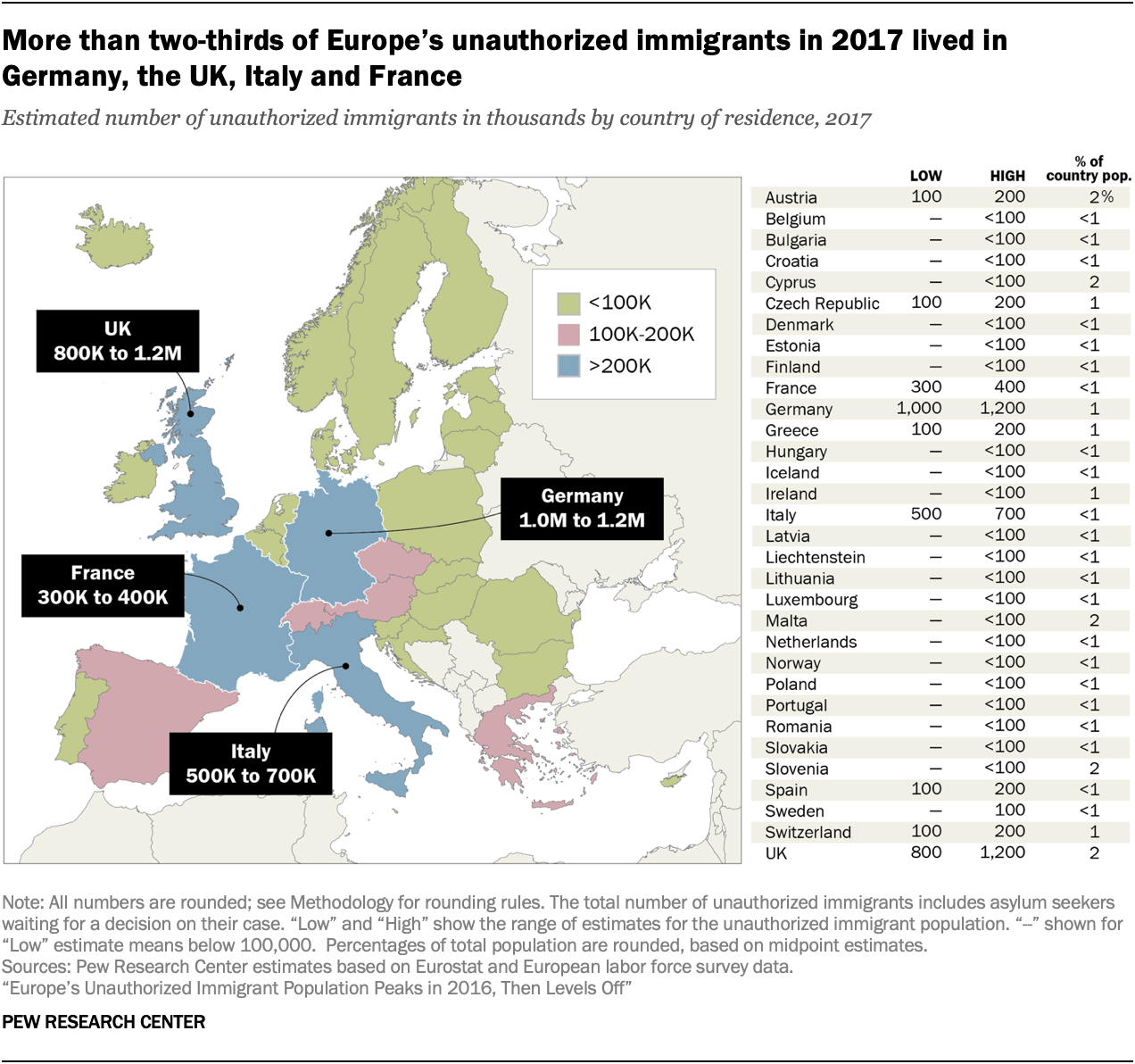
While each of the 32 nations in the EU and EFTA had some unauthorized immigrants in 2017, the largest numbers were in Germany and the United Kingdom, amounting to about half of Europe’s total. Substantial shares also lived in Italy and France. Together, these four countries were home to more than two-thirds (70%) of Europe’s unauthorized immigrants. By comparison, Germany, the UK, Italy and France accounted for slightly more than half of Europe’s total population in 2017.
How we estimated the number of unauthorized immigrants in Europe
We used four different methods to estimate the unauthorized immigrant population in Europe:
Residual method – the total number of authorized immigrants in a country subtracted from the total number of non-EU-EFTA citizens – is the primary method used to estimate the size of the unauthorized immigrant population in EU-EFTA countries. This is the method used for countries where estimates show six-in-ten (60%) of Europe’s unauthorized immigrant population resided in 2017. This approach has been used by Pew Research Center and other research organizations in the United States for many years to estimate the size of the U.S. unauthorized immigrant population. In Europe, the “residual” method has previously been used by other researchers, including some country-level estimates published by the Clandestino project in 2008.
Demographic components method, where the unauthorized immigrant population is demographically updated from the last reliable estimate published in 2008 (17% of Europe’s unauthorized immigrants were in these countries in 2017).
Regularization method (accounting for 3% of Europe’s unauthorized immigrants in 2017), where counts of unauthorized immigrants who moved from an unauthorized to an authorized status in prior years provide an indication of the minimum number of unauthorized immigrants who lived in the country.
Proportional ratio method (20% of unauthorized immigrants in 2017 lived in countries where this method was used), which relies on a proxy ratio of unauthorized immigrants to total non-EU-EFTA citizens from countries with similar immigration patterns. These types of methods were also employed by the Clandestino project in 2008 with about the same proportions for the total Europe-wide estimate of the unauthorized immigrant population published then. For more on our methods, see the report’s methodology, our methodology video and a methods Q&A with our researchers.
A range of estimates are presented to reflect different data, methodological approaches and adjustments in estimating the size of the unauthorized immigrant population in each European country. Our estimates of the unauthorized immigrant population in Europe include annual estimates for 2014 to 2017. The year 2014 was the first year Eurostat, Europe’s statistical agency, began releasing noncitizen population numbers for every European country, a needed component for the estimation methods used in this report.
Between 1.0 million and 1.2 million unauthorized migrants were estimated to live in Germany in 2017, with roughly the same number (800,000 to 1.2 million) in the UK. Meanwhile, between 500,000 and 700,000 are estimated to have lived in Italy and another 300,000 to 400,000 lived in France that year. In each of these countries, anywhere from less than 1% to slightly more than 2% of country populations were estimated to be unauthorized immigrants in 2017.
Among noncitizens, authorized immigrants outnumbered unauthorized immigrants in 2017. An estimated four times as many authorized (19.6 million to 20.5 million) as unauthorized immigrants (3.9 million to 4.8 million) lived in Europe in 2017. That ratio was about the same in Germany, while it was closer to one-to-one in the UK. Meanwhile, the estimated ratio of authorized to unauthorized non-EU-EFTA citizens is much higher in France (nearly nine times as many), Italy (nearly six times as many) and all other EU-EFTA countries as a combined group (about six times as many).
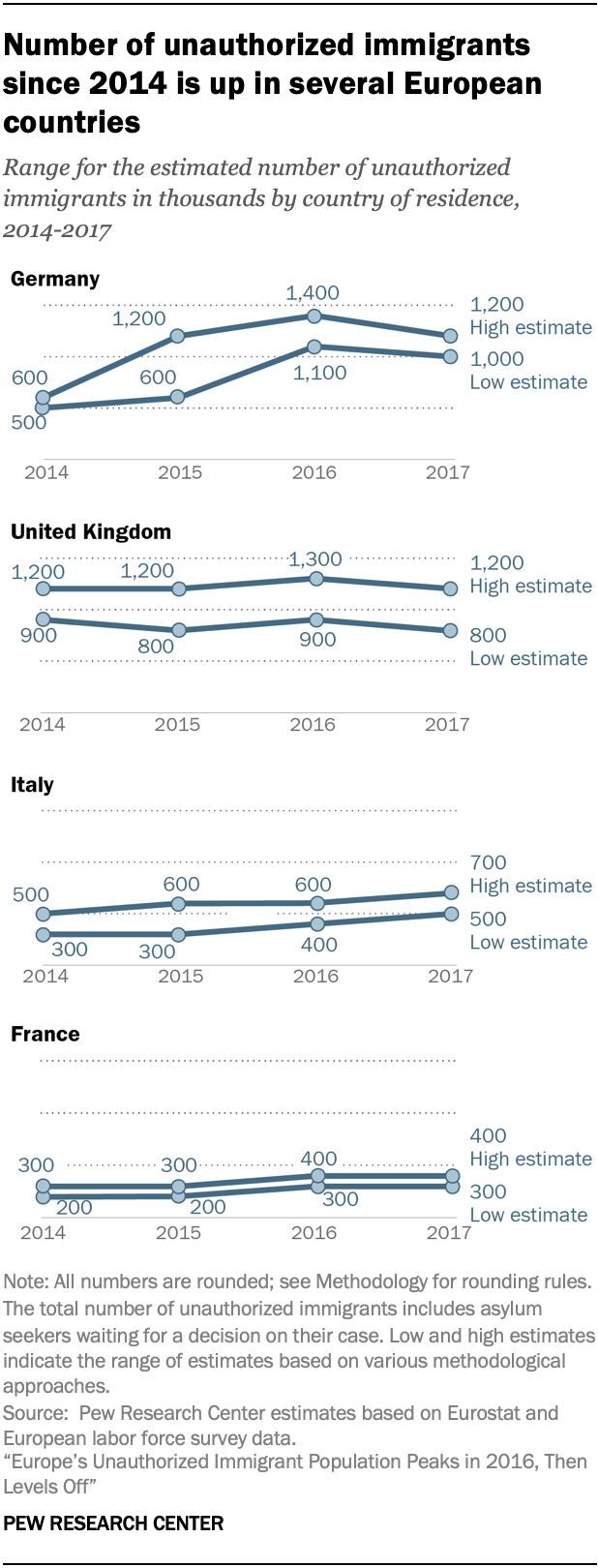
In many, though not all European countries, the number of unauthorized migrants residing in them increased between 2014 and 2016. For some, the unauthorized migrant population peaked in 2016 and then either leveled off or fell in 2017.
In Germany, the number of unauthorized immigrants roughly doubled between 2014 and 2016, when it reached a peak of 1.1 million to 1.4 million. By 2017, the population appeared to decline slightly (1.0 million to 1.2 million), though it is within the broader 2016 range. Consequently, the range of estimates indicates no sizable change between 2016 and 2017. Similarly, the trend for Germany’s unauthorized immigrant population when not including asylum seekers waiting for a decision on their case also peaked in 2016, to between 500,000 and 800,000, before appearing to decline slightly in 2017. (See Appendix Cfor estimates of the size of Germany’s unauthorized immigrant population without asylum seekers waiting for a decision.)
By contrast, the UK estimates show little change between 2014 (900,000 to 1.2 million) and 2017 (800,000 to 1.2 million) in the number of unauthorized immigrants. With such a wide range, however, it is possible that a change in the population size happened during this period. Notably the UK was not a top destination for the recent 2015 surge of asylum seekers in Europe. As a result, most of the UK’s unauthorized immigrant population is likely people who have overstayed their visas or asylum seekers who have remained in the UK after not seeing their cases approved.
In Italy, the estimated number of unauthorized immigrants increased between 2014 and 2017. This might be due to a continued flow of asylum seekers arriving in Italy through 2017, as well as tighter border inspections by Italy’s northern and western neighbors that has kept some asylum seekers from moving on to other European countries. If asylum seekers waiting for a decision on their applications are excluded from the total, there was only a marginal increase in the number of unauthorized immigrants in Italy between 2014 and 2017 (see Appendix C for estimates without waiting asylum seekers).
In France, a similar peak in estimates occurred in 2016, but the total did not decline through 2017. Some 300,000 to 400,000 unauthorized immigrants are estimated to have lived in France in 2017, up from 200,000 to 300,000 in 2014. Compared with other large immigrant destinations in Europe, France has a relatively lower number of unauthorized immigrants.
A possible reason for this is that some unauthorized immigrants can obtain authorized residency after living there for several years when meeting certain criteria.
Fewer than a third of Europe’s unauthorized immigrants in 2017 lived in the other 28 EU-EFTA countries. This amounted to an estimated 1.2 million to 1.4 million people. Among these countries, many had fewer than 100,000 unauthorized immigrants in 2017. Others, like Austria, the Czech Republic, Greece, Spain and Switzerland, had an estimated 100,000 to 200,000 unauthorized immigrants in 2017.
The combined number of unauthorized immigrants living in these 28 countries also increased since 2014 (when there were an estimated 1.0 million to 1.1 million), peaking in 2016 (1.3 million to 1.7 million) before appearing to decrease in 2017 (1.2 million to 1.4 million). The same pattern is true if waiting asylum seekers are not included. For this smaller combined group, the estimated number of unauthorized migrants increased between 2014 (700,000 to 900,000) and 2017 (900,000 to 1.2 million). (Annual estimates for the number of unauthorized immigrants living in each European country between 2014 and 2017 can be found in Appendix B. See Appendix C for estimates of the unauthorized immigrant population when not including waiting asylum seekers.)
2. The origins, time in country and demographics of unauthorized immigrants in Europe
Editorial note to readers (March 19, 2025):
This project estimated the number of unauthorized immigrants living in 32 European countries during the mid- to late-2010s. We used what were then the best available data sources from different governments and from the European Union. After our report was published in November 2019, researchers at the University of Oxford’s Migration Observatory identified a problem with the official data from the United Kingdom’s Office for National Statistics (ONS) on the number of legal immigrants residing in the UK.
The ONS data on legal immigrants that we used in our report did not include those with “indefinite leave to remain” (ILR), a group legally residing in the country. Including the ILR group among legal UK residents results in lower estimated total numbers of unauthorized immigrants for both the United Kingdom and Europe in 2017 and other years. The updated estimates for the number of unauthorized immigrants in 2017 (without waiting asylum seekers) are 700,000-900,000 for the UK and 2.8 million-3.5 million for Europe. Updated estimates can be found in this table but are not reflected elsewhere in this report.
Unauthorized immigrants residing in Europe in 2017 were from a diverse set of origin countries, had lived in Europe for a relatively short period of time and were relatively young. More than half were male.
Our estimates of characteristics of unauthorized immigrants in Europe do not cover the entire population because of data limitations, but they represent 84% of Europe’s unauthorized immigrant population – an overwhelming majority of the total. The data on characteristics covers asylum seekers waiting for decisions in all 32 EU-EFTA countries, as well as the unauthorized immigrant populations in 18 of the 32 EU-EFTA countries.3 Additionally, separate estimates were produced for the two countries with the largest unauthorized immigrant populations – Germany and the UK. (See the Methodology for more information on how characteristics of unauthorized immigrants in Europe were estimated.)
The diverse origins of Europe’s unauthorized immigrants
The unauthorized immigrant population of EU and European Free Trade Association countries comes from around the world. Three-in-ten unauthorized immigrants in 2017 were estimated to be from Asia-Pacific countries, including Afghanistan and Pakistan, while an estimated 23% were from European countries outside of the EU and European Free Trade Association, including Russia and Turkey.4 Some 21% were from countries in the Middle East-North Africa region such as Syria and Iraq. Meanwhile, 17% were from sub-Saharan African countries such as Nigeria and Eritrea, and 8% were from countries in the Americas.
In Germany, an estimated third (32%) of unauthorized immigrants in 2017 had European nationalities of non-EU-EFTA countries. Another three-in-ten (30%) were from Middle East-North Africa region countries, and close to a quarter (22%) were from countries in the Asia-Pacific region.
In the UK, about half (52%) of all unauthorized immigrants were estimated to have nationalities from the Asia-Pacific region in 2017, while a fifth (20%) had nationalities from sub-Saharan African countries.
The origins of Europe’s unauthorized immigrants stand in contrast to those of unauthorized immigrants living in the U.S., where the Center has been estimating the characteristics of unauthorized immigrants for many years. There, the overwhelming majority (78%) in 2017 were from only one region, the Americas, with Mexicans alone making up nearly half of all unauthorized immigrants.
Most unauthorized immigrants in Europe have lived there less than five years
In 2017, more than half (56%) of Europe’s unauthorized immigrants are estimated to have lived in their country of residence for less than five years. Almost half of these shorter-term residents were asylum seekers waiting for decisions on their applications.
Another estimated 16% of unauthorized immigrants in Europe in 2017 had lived in their country of residence between five and nine years, while 27% had lived there 10 years or longer.
In Germany, about two-thirds (66%) of unauthorized immigrants had lived in the country for less than five years; many of them were asylum seekers with a pending decision on their application. On the other hand, unauthorized immigrants in UK were more likely to be long-term residents – the majority (57%) had lived there for five years or longer, while 43% had lived there for less than five years.
By comparison, most unauthorized immigrants in the U.S. in 2017 were much more settled, with longer periods of residence. The majority, or about two-thirds (65%), had lived in the U.S. 10 years or longer, 15% for five to nine years, and 20% for less than five years.
More than half of unauthorized immigrants in Europe are male
Men and boys made up a slight majority (54%) of unauthorized immigrants in Europe in 2017. That share was even higher in Germany (60%), while unauthorized immigrants in the UK were about equally male (48%) as female (52%), according to estimates.
Meanwhile, the majority (65%) of Europe’s unauthorized immigrants were younger than 35 in 2017. Similarly, majorities of unauthorized immigrants living in Germany (65%) and the UK (58%) were younger than 35.
By comparison, a slight majority (54%) of unauthorized immigrants in the U.S. in 2017 were also male. But, unlike in Europe, fewer than half (42%) of U.S. unauthorized immigrants were younger than 35. This difference in age reflects both the longer duration of residence of unauthorized immigrants in the U.S. compared with those in Europe and the fact that U.S.-born children of unauthorized immigrants are U.S. citizens, not unauthorized immigrants.5 A larger share of unauthorized immigrants in the U.S. entered the country a decade ago or more, many in their late teens and 20s. By contrast, a young population of asylum seekers entered Europe only a few years ago, and many of them remained part of the unauthorized immigrant population in 2017.
Acknowledgments
This report was written by Phillip Connor, Senior Researcher, and Jeffrey S. Passel, Senior Demographer.
Editorial guidance was provided by Mark Hugo Lopez, Director of Global Migration and Demography Research; Neil G. Ruiz, Associate Director of Global Migration and Demography Research; James Bell, Vice President of Global Strategy; D’Vera Cohn, Senior Writer and Editor; and Jens Manuel Krogstad, Senior Writer and Editor.
The report was number-checked by Luis Noe-Bustamante, Research Assistant, and Abby Budiman, Research Analyst. Travis Mitchell and Shannon Greenwood, Digital Producers, produced the report. David Kent copy edited the report.
Throughout the estimation and editorial process, more than 25 European migration experts, including many who were part of the 2008 Clandestino project, were consulted on our estimation methods and our estimates. Migration statisticians at national statistical offices throughout Europe, policymakers and academic researchers were also consulted.
Additionally, the report was formally reviewed by the following external reviewers at various stages of preparation:
Christian Dustmann, University College London
Catherine Fieshi, Queen Mary University of London and director of Counterpoint
Albert Kraler, Danube University
Victoria Rietig, German Council on Foreign Relations
Anna Triandafyllidou, Ryerson University and former professor of European University Institute
Carlos Vargas-Silva, Oxford University
Hania Zlotnik, former Director of United Nations Department of Economic and Social Affairs Population Division
Final methodological and editorial decisions reflect those made by Pew Research Center researchers and not necessarily those of reviewers.
This project estimated the number of unauthorized immigrants living in 32 European countries during the mid- to late-2010s. We used what were then the best available data sources from different governments and from the European Union. After our report was published in November 2019, researchers at the University of Oxford’s Migration Observatory identified a problem with the official data from the United Kingdom’s Office for National Statistics (ONS) on the number of legal immigrants residing in the UK.
The ONS data on legal immigrants that we used in our report did not include those with “indefinite leave to remain” (ILR), a group legally residing in the country. Including the ILR group among legal UK residents results in lower estimated total numbers of unauthorized immigrants for both the United Kingdom and Europe in 2017 and other years. The updated estimates for the number of unauthorized immigrants in 2017 (without waiting asylum seekers) are 700,000-900,000 for the UK and 2.8 million-3.5 million for Europe. Updated estimates can be found in this table but are not reflected elsewhere in this report.
Estimates presented in this report for Europe’s unauthorized immigrant population are for the size of this population residing in the European Union (all 28 countries, including the United Kingdom) and European Free Trade Association countries (Iceland, Liechtenstein, Norway and Switzerland), a total of 32 European nations. Estimates are presented for the end of each year, or Dec. 31, in 2014, 2015, 2016 and 2017. Most of the estimates are based on data from Eurostat, Europe’s statistical agency.
Estimates of the unauthorized immigrant population for EU-EFTA countries are based on four different methodologies:
Residual method, considered the best methodology for estimating unauthorized immigrant populations. This method was used in 11 of the 32 European countries, which together accounted for more than half (about 60%) of the estimated unauthorized immigrant population in Europe in 2017.
Demographic components method, a second-best methodology for estimating the unauthorized immigrant population, which was used when the residual method was not possible. This technique was used in Italy and Greece, which together accounted for about 17% of the unauthorized immigrant population in Europe in 2017.
Regularization method, based on government data indicating the number unauthorized immigrants achieving authorization. This methodology was used for the unauthorized immigrant population estimate in Spain, which accounted for about 3% of the unauthorized immigrant population in Europe in 2017.
Proportional ratio method, used in countries where the three preferred methods were not possible to implement due to data limitations. This method was used for the majority of countries in the EU-EFTA, 18 of the 32, which together accounted for about one-fifth (20%) of the total unauthorized immigrant population in Europe in 2017.
Many of these same methods were used in the 2008 Clandestino project, the last time a comprehensive estimate of the size of the unauthorized immigrant population in Europe was published. Each of these methods are presented in detail and specifics are further described for the four largest countries – Germany, the UK, Italy and France.
For every country, we provide a range for the estimated number of unauthorized immigrants to reflect the inherent uncertainty in attempting to measure a hidden population. Our analysis focuses on the low and high ends of the range. In some countries, the range reflects different adjustments (for example, adjustments for undercounts in surveys). In other countries, the range reflects alternative methods for estimating the unauthorized immigrant population.
Unauthorized immigrants include those who enter a country without authorization, usually by crossing a border without encountering immigration officials (i.e., clandestine entrants) and continue to not have authorized status. A second group are those who enter with documents permitting residence or temporary stay but stay beyond the expiration of the permit (i.e., visa overstayer).6
A third group of non-EU-EFTA citizens who take up residence in a country without permission to immigrate are people seeking asylum after entry. Although some researchers have excluded asylum seekers from their unauthorized immigrant estimates, most asylum seekers entered their country of residence without authorization and are in an uncertain status as they wait for their application to be processed. Due to their uncertain future in the country, they are included as unauthorized immigrants in this report.
Methods used to estimate the number of unauthorized immigrants in Europe
Residual method
The residual method is based on this simple formula:
Unauthorized immigrants =
Total foreign, noncitizens – Authorized noncitizens
(U) = (F) – (A)
EU and EFTA countries annually report to Eurostat estimates of the number of non-EU-EFTA citizens, or foreign citizens, (F) living in their countries. Some of these estimates stem from demographic estimates based on 2011 censuses. Data from large-scale surveys and migrant flows are used to update population estimates that countries send to Eurostat.7
European countries with noncitizen population estimates that are based on censuses and surveys presumably include unauthorized immigrants in their totals, since these surveys cover the entire resident population. European countries where we used the residual method are Bulgaria, Croatia, Cyprus, France, Germany, Ireland, Liechtenstein, Luxembourg, Malta, Portugal and the UK. These countries together account for about 60% of the estimated total number of unauthorized immigrants in Europe.
These same European countries annually report to Eurostat the total number of people which are authorized (A) to live in the country with a residence permit.8 These data contain information on nationality, length of permitted stay (less than 12 months or 12 months and longer) and type of permit (education, family, occupation, refugee or other).9 To remain consistent with population data, which defines residents as those living or intending to live in the country for 12 months or longer, only permits of 12 months or longer are used for our unauthorized immigrant estimates.10
One exception to this general rule is the UK, where permit figures are calculated differently than in other European countries. (See UK Methodology for more details.)
Population estimates for Europe’s non-EU-EFTA-citizen population in many countries include the asylum seeker population waiting for their case to be decided.11 For Bulgaria, Croatia, Liechtenstein and Malta, asylum seekers are not included in the noncitizen population estimate. They were added to our estimates of unauthorized immigrants.
It is widely known that noncitizen populations are regularly under sampled in surveys and censuses.12 Consequently, the high estimates represent a 10% adjustment to account for under-coverage in the underlying survey and census data.13
The adjustment is the addition of 10% of the low estimate of unauthorized immigrants without asylum seekers. One exception to this adjustment factor was Germany, which has a very high response rate for its large-scale surveys. Instead, the low estimate used the non-EU-EFTA-citizen share found in Germany’s large-scale labor force survey in 2017, while the high estimate used the noncitizen population figure reported to Eurostat.
Demographic components method
Some European countries such as Italy and Greece have experienced a rapid inflow of migrants over an extended period. Census-based estimates and population registers are often less suitable for estimating unauthorized immigrant populations because the rapid nature of population change due to migration may not be included in these national statistics.
Consequently, an alternative method must be employed to estimate the size of the unauthorized immigrant population. One such method is to start with a previous reliable estimate of the unauthorized immigrant population and apply demographic techniques (in-migration, out-migration, deportations, regularizations, deaths and births) to project forward the unauthorized immigrant population to the years estimated in this report.
In Italy, for example, our estimates start with 2008 estimates from the Clandestino project that used large-scale surveys in the 2000s to measure the unauthorized immigrant population. Then we carried the 2008 estimate forward to 2014 through 2017 with standard demographic techniques based on data for fertility, mortality and migration, all drawn from Eurostat’s aggregate data. Additionally, the number of asylum seekers submitting a first-time application between 2008 and 2017 were added to these totals, adjusting for asylum rejections, withdrawn cases and deportations of unauthorized immigrants.14 Finally, a conservative estimate of visa overstayers based on first-time visas granted between 2008 and 2017 was added to the total. Our range of estimates uses the Clandestino low and high estimates for 2008 as different starting populations.
A similar demographic components method was applied to data from Greece in estimating its unauthorized immigrant population. The 2008 base estimates (low and high) were drawn from the Clandestino project, an estimate originally based on the residual method.
Regularization method
Spain’s data for the noncitizen population is based on the nation’s population register, a listing that may not include unauthorized immigrants and so is not suitable for use in a residual estimate.15 However, unauthorized immigrants in Spain can regularize (apply for temporary residency) after living in the country for two or three years. Data on this regularization of unauthorized status provides a series of data points for a minimum number of unauthorized immigrants that lived in the country before their regularization.
By adding regularizations over a three-year period, an estimate for the earliest year can be produced. For example, by adding years 2014 to 2016, a figure for 2014 can be estimated. For regularizations beyond 2017, regularization trends over a four-year period were extrapolated.16 Because of this method, the estimate for Spain is considered a lower-bound estimate as it is expected some unauthorized immigrants either do not qualify for the regularization program or choose to not take part in it. Finally, asylum seekers waiting on decisions, a population that has grown in recent years in Spain, were added.
Proportional ratio method
The residual method cannot be applied to countries that estimate the size of their total populations with a population register each year. Population registers rarely include unauthorized immigrants; consequently, a different method is required. The proportional ratio method is based on a ratio of unauthorized immigrants to authorized non-EU-EFTA citizens from countries with similar migration patterns. A ratio method was used by the Clandestino project in 2008 for many countries with smaller immigrant populations.17
These ratios, excluding asylum seekers, were applied to countries with similar immigration histories and immigration policies as proxy countries. The ratio of unauthorized to authorized immigrants in Germany, for example, was applied to the total number of non-EU-EFTA citizens in Austria, Belgium, the Netherlands and Switzerland. Then, asylum seekers in each country waiting for a decision were added to each country’s estimates.
Similarly, Bulgaria serves as a proxy country for many Central/Eastern European countries because it is the only one in the region that uses a census-based estimate for its population and one of the few with a population register that has a financial incentive for residents to de-register upon leaving the country, an important consideration in estimating the non-EU-EFTA population in the country.18 Thus, it is the only country in the region where the residual method can be used to estimate the relatively small unauthorized immigrant population.
Bulgaria is used as a proxy in the proportional ratio method for the Czech Republic, Hungary, Poland, Romania, Slovakia and Slovenia. Bulgaria also serves as a proxy in estimating the unauthorized immigrant populations for Estonia, Latvia and Lithuania, but these countries require special adjustments because of the presence of Russians and other citizens of the former Soviet Union.19 Asylum seekers waiting for a decision on their cases for most countries in this group were added to the final estimates since they are not part of the noncitizen population cited in Eurostat data.
Finally, in Nordic countries (Denmark, Finland, Iceland, Norway and Sweden), a base ratio of 5% for the lower bound estimate and 10% for the higher bound estimate was multiplied by the non-EU-EFTA citizen population in each country. Asylum seekers waiting on final decisions were then added to these numbers.
These ratio levels for Nordic countries were based on research about the number of unauthorized immigrants in the Nordic region. A recent study in Finland, for example, estimated the number of unauthorized immigrants in that country to be below 5,000 in 2017, or less than 5% of the total non-EU-EFTA population.20 Meanwhile, a study in Norway found 12,000 unauthorized immigrants working in Norway in 2015, or about 7% of its non-EU-EFTA population.21 Similarly, in 2016, the Swedish migration agency estimated approximately 50,000 unauthorized immigrants working in various industries including hospitality, transportation, construction and food services.22 This amounted to about 10% of the total non-EU-EFTA citizens. Based on these and other research reports, it is assumed that unauthorized populations not seeking asylum are relatively small in Nordic countries, as many aspects of life (employment, medical care, use of financial institutions) might require country citizenship or a residence permit.
Rounding, ranges and total estimates
The size of the noncitizen population in some European countries can be small, especially when subdivided by country of nationality. And with few border controls between most of the European countries contained in this analysis, people – even those with permits in a particular country – are relatively free to move and reside in other European countries. Consequently, the report places unauthorized immigrant population totals within the larger EU-EFTA population context.
For these reasons, estimates for unauthorized immigrant populations are rounded to the nearest 100,000 to avoid the appearance of unwarranted precision in the estimates.23
The range for Europe’s estimated unauthorized immigrant population is not based on a survey’s margin of error. Instead, the range of estimates reflects different methodological approaches and adjustments to estimates.
Lower bounds of ranges are rounded to the lower 100,000 level unless the unrounded value is within 25,000 of the higher 100,000 level. For example, if the lower-bound value before rounding is between 100,000 and 175,000, it is rounded to 100,000. However, if the unrounded lower bound is 175,000 or higher but less than 200,000 it is rounded to 200,000.
Higher bounds of ranges are rounded to the higher 100,000 level unless the unrounded value is within 25,000 of the lower 100,000 level. For example, if the higher-bound value before rounding is 125,000 or more but less than 200,000, it is rounded to 200,000. But, if the higher-bound value before rounding is between 100,000 and 125,000, it is rounded to 100,000.24
Midpoint estimates between low and high estimates are used to compute shares for the total number of noncitizens living in EU-EFTA countries and the share of unauthorized immigrants of countries’ total populations. Because each figure is rounded separately, rounded estimates may not add to rounded totals. Similarly, shares in this report are computed using unrounded numbers.
The total number of non-EU-EFTA citizens living in Europe is based on data from Eurostat plus additional unauthorized immigrants estimated by the Center that are likely not included in Eurostat data on citizenship.
Detailed methods for countries with the largest unauthorized immigrant population estimates
Methodology for Germany
Pew Research Center used the residual method to estimate the size of the unauthorized immigrant population in Germany. Estimates for the total non-EU-EFTA-citizen population for Germany were drawn from Eurostat’s figures for non-EU-EFTA citizens. This is the usual resident population (12 months or longer) based on census, population register and migration flow data. As this non-EU-EFTA-citizen population estimate from Eurostat is partially based on register and earlier German census data that may be out of date, another estimate of this base population was derived from Germany’s labor force survey, a compulsory, annual survey based on addresses in the population register and updates of other addresses in Germany, regardless of legal status of residents.
For the residual high estimate, the number of non-EU-EFTA citizens with 12-month or longer residency permits, as reported by Germany to Eurostat, was deducted from the total non-EU-EFTA-citizen population figure based on the census and population register reported to Eurostat. A separate, low estimate used the same residency permits figure from Germany but subtracted it from the non-EU-EFTA citizen population as measured by Germany’s labor force survey. Unlike many other European countries, an undercount adjustment was not added to the survey total since Germany’s labor force survey has a very high response rate, about 96% in 2017. These procedures lead to unauthorized immigrant population estimates between 1.0 million and 1.2 million in 2017.
These estimates include several different categories of unauthorized immigrants – defined in this report as non-EU-EFTA citizens without permanent residency. The groups include: (1) those waiting for an asylum decision (444,000 in 2017); (2) those with officially tolerated statuses (temporary protection from deportation) such as Duldung (about 166,000 in 2017); (3) deportees without toleration (about 63,000 in 2017); (4) those waiting on a residency permit (as many as 200,000 in 2017);25 and (5) a remainder category of other unauthorized immigrants (roughly 100,000 to 300,000 additional people).26
Comparison with previous estimates for Germany
[27.Suspected crimes are those recorded by the police to the public prosecutor or Ausgangsstatistik.]
Given the volume of asylum seekers in 2015 and 2016 who entered Germany and the hundreds of thousands who have seen their asylum applications rejected, our annual estimates for the country are in line with expectations from Vogel’s earlier 2014 estimate and trend. As a further robustness check, the Center replicated Vogel’s method and found that the Center’s 2017 estimate is within the range of the “multiplier” method for that year. The result was about 300,000 to nearly 1.1 million unauthorized immigrants, without asylum seekers or those in a tolerated deportation status. The lower end of this alternative estimation method is similar to the combined number of unauthorized immigrants in the Center’s residual method without waiting asylum seekers or those under deportation orders, roughly some 300,000 to 500,000 people.27
Methodology for the United Kingdom
The Center used the residual method in estimating the size of the unauthorized immigrant population in the UK. Estimates for the total non-EU-EFTA-citizen population were drawn from those submitted by the UK to Eurostat. These figures are estimated based on census and survey data.28 Then, the number of noncitizens with residency permits reported by the UK to Eurostat were deducted from noncitizen population estimates from Eurostat. Since these permit data are calculated differently in the UK than in other European countries, a range of estimates based on the duration of the permits were produced. The low estimates use permits of three months or longer. The high estimates use permits of 12 months or longer, the approach used for most other European countries. High estimates were adjusted for undercount in the census-based total population figures following the approach used by the UK Home Office for the 2001 estimate of the unauthorized immigrant population. An undercount adjustment of 10% was added to the preliminary low unauthorized immigrant population estimate without asylum seekers with pending cases.29 Then, the number of noncitizens with residency permits reported by the UK to Eurostat were deducted from noncitizen population estimates from Eurostat. Since these permit data are calculated differently in the UK than in other European countries, a range of estimates based on the duration of the permits were produced. The low estimates use permits of three months or longer. The high estimates use permits of 12 months or longer, the approach used for most other European countries. High estimates were adjusted for undercount in the census-based total population figures following the approach used by the UK Home Office for the 2001 estimate of the unauthorized immigrant population. An undercount adjustment of 10% was added to the preliminary low unauthorized immigrant population estimate without asylum seekers with pending cases.29
Comparison with previous UK estimates
The UK Home Office estimated that between 310,000 and 570,000 unauthorized immigrants lived in the UK in 2001 using the residual method, with a further 175,000 temporary or quasi-legal immigrants, mostly people waiting on their asylum claims.31 Several years later, a separate London School of Economics study updated the Home Office estimates to be between 417,000 to 863,000 in 2007.32 Ten years later, after hundreds of thousands additional migrants from non-EU-EFTA countries have entered and stayed in the UK, our 2017 estimate of 800,000 to 1.2 million unauthorized immigrants is in line with migration trends.
Meanwhile, Georges Lemaître, an economist formerly with the Organization for Economic Cooperation and Development, estimated the number of unauthorized immigrants living in the UK to have been between 617,000 and 861,000 in 2011. Alasdair Palmer and David Wood, former Home Office staff, stated that it was well above 1.2 million in 2017, but no methodology was provided for their estimate.
Methodology for Italy
We used a demographic components method for estimating the size of Italy’s unauthorized immigrant population. Our estimate for Italy starts with the range of 2008 estimates from the Clandestino project, which are based on large-scale surveys in the 2000s of immigrants in the country. Then, this starting point is adjusted for subsequent years by demographic components (fertility, mortality, migration) drawn from Eurostat’s aggregate data for Italy. A quasi-general fertility rate for non-EU-EFTA-citizen women ages 15 to 64 in Italy was applied to the high estimate. The fertility rate was then divided by half to take into account disrupted fertility experienced by migrants as well as the possibility of a child’s father authorized to be in the country, potentially leading to a child who can also live in Italy with authorization. The mortality rate was calculated from annual deaths of non-EU-EFTA nationals and applied to both low and high estimates. Demographic and migration components were distributed by sex and age (<15, 15-64, 65+).
Italy experienced significant economic recessions in 2008-2009 and 2012-2013, impacting the nation’s residents, including authorized and unauthorized immigrants living there. This event, combined with large-scale movement of migrants by sea over the same period, have made estimating the size of the total non-EU-EFTA population living in Italy difficult. Also, the Italian government’s own estimates of its non-EU-EFTA population are based on population registers, which likely do not include many unauthorized immigrants.
The number of asylum seekers in Italy between 2008 and 2017 were added to these totals, adjusting for asylum rejections, withdrawn cases and removals of unauthorized immigrants as reported by the Italian government to Eurostat. Finally, an estimate of visa overstayers based on first-time visas issued between 2008 and 2017 was added to the total. In all, between 500,000 and 700,000 unauthorized immigrants were estimated to have lived in Italy at the end of 2017.
Italy has detected hundreds of thousands of migrants entering the country without authorization during the past decade. Some have applied for asylum in Italy, as per the Dublin agreement. The agreement states that the first EU country the asylum seeker enters is responsible for reviewing the asylum seeker’s application for asylum. Among these asylum applicants, some have been given refugee status and can stay in Italy with authorization. Others have moved on to other EU countries. And still others have had their application for asylum rejected, yet they remain in Italy without authorization. These inflows and outflows of unauthorized migrants must be added to the number of unauthorized migrants who were already living in Italy before the growing number of asylum seekers began a decade ago.
Comparison with previous Italy estimates
Our annual estimates are slightly higher than those reported by Gian Carlo Blangiardo in Fondazione ISMU’s report on migration in Italy as well as more recent estimates of Italy’s unauthorized immigrant population. The major difference between our estimate and ISMU’s estimates are births of unauthorized immigrant children added to annual totals. In this report, children born to unauthorized immigrant parents are also part of the unauthorized immigrant population, even though certain protections are awarded to unaccompanied migrant children. The 2017 high estimate would be about 600,000 unauthorized immigrants when children, regardless of being unaccompanied or having family, are not included, or about 100,000 lower than the high estimate shown in this report.
Methodology for France
We used the residual method in estimating the unauthorized immigrant population in France. Estimates for the total non-EU-EFTA citizen population in France were taken from Eurostat. These estimates are census-based for the resident population (12 months or longer), including those living in overseas territories and according to INSEE (Institut National de la Statistique et des Etudes Economiques) include all immigrants, regardless of legal status. The number of authorized immigrants is drawn from resident permit data also provided by Eurostat, of which permits of 12 months or longer were used. These permit data also include those living in overseas territories.
As with many other European countries, survey undercount adjustments of 10% of the unauthorized immigrant population, excluding asylum seekers, were added to reach the higher-bound estimates. A range of 300,000 to 400,000 unauthorized immigrants were estimated to live in France in 2017 when including asylum seekers waiting for a decision on their case.
Comparison with previous French estimates
Generating an estimate of the unauthorized immigrant population in France is challenging, but government leaders as well as demographers have estimated it to be in the vicinity of 300,000 and 400,000, partially based on the number of people enrolled on a government medical plan available to unauthorized immigrants. There were an estimated 300,000 unauthorized immigrants on this plan in 2017.
Measuring characteristics of unauthorized immigrants
Data on the demographic characteristics of Europe’s unauthorized immigrant population (e.g., age, sex, origins) are developed with an adaptation of Pew Research Center’s methods for measuring the demographic characteristics of unauthorized immigrants in the U.S. Specifically, the methods involve assigning authorized status probabilistically to noncitizen respondents in large-scale surveys.
The application of these methods depends on the coverage, quality and sample size of the survey in each country as well as the relative size of the estimated unauthorized immigrant population in the country. Accordingly, the figures shown in this report are based on the noncitizen samples in Eurostat’s labor force surveys (LFS) that rely on a census or an address-based sample. Surveys using an address-based sample likely include unauthorized immigrants. By contrast, surveys based exclusively on population registers, used by many European countries as the sampling frame for their labor force surveys, are less likely to include unauthorized immigrants.
Consequently, demographic characteristics presented in this report are based on labor force survey data for 18 countries: Bulgaria, Croatia, Cyprus, the Czech Republic, Estonia, France, Germany, Greece, Hungary, Ireland, the Netherlands, Poland, Portugal, Romania, Slovakia, Spain, Switzerland and the UK. The resulting data on demographic characteristics are combined with data on the demographic characteristics of asylum seekers waiting for a decision in all 32 EU-EFTA countries. These two groups together make up the overwhelming majority of Europe’s unauthorized immigrant population (84%). More detailed demographic profiles of unauthorized immigrant populations are presented for Germany and the UK – the two countries with the largest unauthorized immigrant populations and a sufficiently high number of respondents in their surveys to present a profile of these groups.
The LFS is a household survey conducted throughout the year by each European country. Each country annually sends individual-level data to Eurostat for compilation. These micro-data were obtained by the Center through a research agreement with Eurostat.33
Citizenship questions are asked of LFS respondents, with most countries asking first whether they are a citizen of their current country of residence. These data define the sample of non-EU-EFTA citizens within the labor force surveys that are assigned as either a likely authorized or likely unauthorized foreign citizen.
Those who are highly likely to be authorized residents are assigned status first. All non-EU-EFTA citizens living in their current country of residence for 25 years or longer, for example, are considered to have authorized residence. It is assumed that noncitizens living in Europe for that length of time were authorized to be in the country from the start of their residence or have found some way to obtain authorized status during this period. Additionally, unauthorized immigrants living in Spain for more than five years and Greece for more than 15 years are considered authorized immigrants because these two countries have had relatively recent regularizations of their unauthorized immigrant populations.
Those ages 15 and older (of working age in the survey) who stated they are not working because they are attending school are assumed to also have authorized residence. Those who registered with public employment offices and/or are receiving public employment benefits are also considered to be authorized residents. Individuals in the military are considered authorized residents, as are those working in occupations that would require official licensure (for example, scientists, architects, medical professionals, educators, airline pilots). Government officials and employees are also considered authorized residents.34
Households were analyzed for possible links of authorized residence with other household members. Spouses and children of citizen adults, for example are considered to be authorized in the country. It is also assumed that minor children are authorized to be in the country if they have a parent in the home who is a citizen or has authorized status. These authorized assignments were repeated for multigenerational households as well.
The remaining noncitizens are considered potential unauthorized immigrants in labor force surveys. Assignment of unauthorized immigrant status among potential unauthorized immigrants is based on probabilities drawn from the estimation step of the study for each country of residence. The probability that a noncitizen in the survey is an unauthorized immigrant is the share of the unauthorized immigrant population estimate in the country (without asylum seekers).35
Respondents with a potential unauthorized status are then randomly assigned as authorized or unauthorized according to country of residence probabilities. This process is done in a series of iterations, repeating the household rules for spouses and children described earlier so that unauthorized immigrants across household members are consistent with earlier assignments. This iterative process is closed once the number assigned as unauthorized immigrants agrees with the estimated number of unauthorized immigrants in the country.
Survey weights were applied to nationality, time in country and demographics for identified unauthorized immigrants in each country’s survey. The shares were then applied to the estimated number of unauthorized immigrants in each country without asylum seekers. Counts for asylum seekers waiting for a resolution in their case according to nationality, time in country and demographic breakdowns were added to estimates from the labor force survey.36
Appendix A: Nationalities by regional classification
Five regions for the nationality of unauthorized immigrants are used in this report. They come from two different data sources: (1) labor force surveys and (2) asylum seeker data for those with pending decisions. A single asterisk (*) indicates a country or territory that appears in the country list of regions coded in labor force surveys, but not in the country list of asylum seekers with a pending decision. On the other hand, a double asterisk (**) indicates a country or territory appears in the country list of asylum seekers with a pending decision but was not part of the country list for regions coded in labor force surveys. (Note that some countries in the pending asylum seeker list had no asylum seekers in any EU-EFTA country between 2014 and 2017. Also, asylum seekers with unknown or no nationality (stateless) were considered to have an unknown nationality.)
Americas
Antigua and Barbuda
Anguilla*
Argentina
Aruba*
Barbados
Bahamas
Belize
Bermuda*
Bolivia
Brazil
British Virgin Islands*
Canada
Caribbean Netherlands
Cayman Islands*
Chile
Colombia
Costa Rica
Cuba
Dominica
Dominican Republic
Ecuador
El Salvador
Falkland Islands*
French Southern Territories
Grenada
Greenland*
Guatemala
Guyana
Honduras
Haiti
Jamaica
Montserrat
Mexico
Nicaragua
Panama
Paraguay
Peru
Puerto Rico
St. Barthelemy*
St. Kitts and Nevis
St. Lucia
St. Martin*
St. Pierre and Miquelon*
St. Vincent and the Grenadines
Suriname
Trinidad and Tobago
Turks and Caicos Islands*
United States
Uruguay
Venezuela
Asia-Pacific
Afghanistan
Australia
Bangladesh
Brunei
Bhutan
Burma (Myanmar)
Cambodia
China
Cook Islands**
East Timor
Federated States of Micronesia
Fiji
French Polynesia*
India
Indonesia
Japan
Kiribati
Laos
Malaysia
Maldives
Marshall Islands
Mongolia
Nauru
Nepal
New Caledonia*
New Zealand
North Korea
Pakistan
Palau
Papua New Guinea
Philippines
Pitcairn*
Samoa
Singapore
Solomon Islands
South Korea
Sri Lanka
Taiwan
Thailand
Tonga
Tuvalu
Vanuatu
Vietnam
Wallis and Futuna*
Europe
Andorra
Albania
Bosnia-Herzegovina
Belarus
Faroe Islands*
Gibraltar*
Guernsey
Isle of Man
Jersey
Kosovo
Monaco
Montenegro
Republic of Macedonia
Moldova
Russia
San Marino
Serbia
Turkey
Ukraine
Vatican City
Middle East-North Africa
Algeria
Armenia
Azerbaijan
Bahrain
Egypt
Georgia
Iran
Iraq
Israel
Jordan
Kazakhstan
Kuwait
Kyrgyzstan
Lebanon
Libya
Morocco
Oman
Palestine terr.
Qatar
Saudi Arabia
Syria
Tajikistan
Tunisia
Turkmenistan
United Arab Emirates
Uzbekistan
Western Sahara**
Yemen
Sub-Saharan Africa
Angola
Benin
Botswana
Burkina Faso
Burundi
Cameroon
Cape Verde
Central African Republic
Chad
Comoros
Democratic Republic iiiof the Congo
Djibouti
Ethiopia
Equatorial Guinea
Eritrea
Gabon
Gambia
Ghana
Guinea
Guinea-Bissau
Ivory Coast
Kenya
Lesotho
Liberia
Madagascar
Malawi
Mali
Mauritania
Mauritius
Mayotte*
Mozambique
Namibia
Niger
Nigeria
Republic of the Congo
Rwanda
Sao Tome and Principe
Senegal
Seychelles
Sierra Leone
Somalia
South Africa
South Sudan
St. Helena*
Sudan
Swaziland
Tanzania
Togo
Uganda
Zambia
Zimbabwe
Appendix B: Unauthorized immigrant population trends with waiting asylum seekers, by country
Editorial note to readers (March 19, 2025):
This project estimated the number of unauthorized immigrants living in 32 European countries during the mid- to late-2010s. We used what were then the best available data sources from different governments and from the European Union. After our report was published in November 2019, researchers at the University of Oxford’s Migration Observatory identified a problem with the official data from the United Kingdom’s Office for National Statistics (ONS) on the number of legal immigrants residing in the UK.
The ONS data on legal immigrants that we used in our report did not include those with “indefinite leave to remain” (ILR), a group legally residing in the country. Including the ILR group among legal UK residents results in lower estimated total numbers of unauthorized immigrants for both the United Kingdom and Europe in 2017 and other years. The updated estimates for the number of unauthorized immigrants in 2017 (without waiting asylum seekers) are 700,000-900,000 for the UK and 2.8 million-3.5 million for Europe. Updated estimates can be found in this table but are not reflected elsewhere in this report.
Appendix C: Unauthorized immigrant population trends without waiting asylum seekers, by country
Editorial note to readers (March 19, 2025):
This project estimated the number of unauthorized immigrants living in 32 European countries during the mid- to late-2010s. We used what were then the best available data sources from different governments and from the European Union. After our report was published in November 2019, researchers at the University of Oxford’s Migration Observatory identified a problem with the official data from the United Kingdom’s Office for National Statistics (ONS) on the number of legal immigrants residing in the UK.
The ONS data on legal immigrants that we used in our report did not include those with “indefinite leave to remain” (ILR), a group legally residing in the country. Including the ILR group among legal UK residents results in lower estimated total numbers of unauthorized immigrants for both the United Kingdom and Europe in 2017 and other years. The updated estimates for the number of unauthorized immigrants in 2017 (without waiting asylum seekers) are 700,000-900,000 for the UK and 2.8 million-3.5 million for Europe. Updated estimates can be found in this table but are not reflected elsewhere in this report.
Appendix E: Updated unauthorized immigrant population estimates for Europe and the United Kingdom, 2014-2017
Editorial note to readers (March 19, 2025):
This project estimated the number of unauthorized immigrants living in 32 European countries during the mid- to late-2010s. We used what were then the best available data sources from different governments and from the European Union. After our report was published in November 2019, researchers at the University of Oxford’s Migration Observatory identified a problem with the official data from the United Kingdom’s Office for National Statistics (ONS) on the number of legal immigrants residing in the UK.
The ONS data on legal immigrants that we used in our report did not include those with “indefinite leave to remain” (ILR), a group legally residing in the country. Including the ILR group among legal UK residents results in lower estimated total numbers of unauthorized immigrants for both the United Kingdom and Europe in 2017 and other years. The updated estimates for the number of unauthorized immigrants in 2017 (without waiting asylum seekers) are 700,000-900,000 for the UK and 2.8 million-3.5 million for Europe. Updated estimates can be found in this table but are not reflected elsewhere in this report.