Pew Research Center

FOR RELEASE OCTOBER 15, 2019

European Public Opinion Three Decades After the Fall of Communism

Most embrace democracy and the EU, but many worry about the political and economic future

BY Richard Wike, Jacob Poushter, Laura Silver, Kat Devlin, Janell Fetterolf, Alexandra Castillo and Christine Huang

FOR MEDIA OR OTHER INQUIRIES:

Communications Department
202.419.4372
www.pewresearch.org

RECOMMENDED CITATION

Pew Research Center, October 2019, "European Public Opinion Three Decades After the Fall of Communism"

About Pew Research Center

Pew Research Center is a nonpartisan, nonadvocacy fact tank that informs the public about the issues, attitudes and trends shaping the world. It does not take policy positions. The Center conducts public opinion polling, demographic research, computational social science research and other data-driven research. It studies politics and policy; news habits and media; the internet and technology; religion; race and ethnicity; international affairs; social, demographic and economic trends; science; research methodology and data science; and immigration and migration. Pew Research Center is a subsidiary of The Pew Charitable Trusts, its primary funder.

© Pew Research Center 2026

Table of contents

  • About Pew Research Center
  • European Public Opinion Three Decades After the Fall of Communism
  • 1. Political and economic changes since the fall of communism
  • 2. Democratic values
  • 3. Democratic satisfaction
  • 4. The European Union
  • 5. National conditions
  • 6. Minority groups
  • 7. Gender equality
  • 8. Political parties
  • Acknowledgments
  • Methodology
  • Appendix A: Classifying European populist parties
  • Appendix B: Governing party categorization

European Public Opinion Three Decades After the Fall of Communism

Most embrace democracy and the EU, but many worry about the political and economic future

Thirty years ago, a wave of optimism swept across Europe as walls and regimes fell, and long-oppressed publics embraced open societies, open markets and a more united Europe. Three decades later, a new Pew Research Center survey finds that few people in the former Eastern Bloc regret the monumental changes of 1989-1991. Yet, neither are they entirely content with their current political or economic circumstances. Indeed, like their Western European counterparts, substantial shares of Central and Eastern European citizens worry about the future on issues like inequality and the functioning of their political systems.

Most in former Eastern Bloc approve of shift to multiparty and free market systems

Those in Central and Eastern European nations that joined the European Union generally believe membership has been good for their countries, and there is widespread support in the region for many democratic values. Still, even though most broadly embrace democracy, the intensity of people’s commitment to specific democratic principles is not always strong.

When asked about the shifts to multiparty democracy and a market economy that occurred following the collapse of communism, former Eastern Bloc publics surveyed largely approve of these changes. For instance, 85% of Poles support the shifts to both democracy and capitalism. However, support is not uniform – more than a third of Bulgarians and Ukrainians disapprove, as do roughly half in Russia.

These questions about democracy and a market economy were first asked in 1991, and then again in 2009. In a few nations – Hungary, Lithuania and Ukraine – support for both declined between 1991 and 2009 before bouncing back significantly over the past decade. Russia is the only country where support for multiparty democracy and capitalism is down significantly from 2009.

Most in Central, Eastern Europe say post-communist era has been good for education, living standards and national pride

The varying levels of enthusiasm for democracy and free markets may be driven in part by different perspectives about the degree to which societies have made progress over the past three decades. Most Poles, Czechs and Lithuanians, and more than four-in-ten Hungarians and Slovaks, believe the economic situation for most people in their country today is better than it was under communism. And in these five nations, people are more likely to hold this view now than was the case in 2009, when Europe was struggling with the effects of the global financial crisis.

However, in Russia, Ukraine and Bulgaria, more than half currently say things are worse for most people now than during the communist era.

When asked whether their countries have made progress over the past three decades across a range of issues, the Central and Eastern European publics surveyed feel most positive about issues like education and living standards. But opinions are more divided about progress on law and order and family values, and most say the changes have had a negative impact on health care.

There is widespread agreement that elites have gained more from the enormous changes of the past 30 years than average citizens have. Large majorities in all Central and Eastern European nations polled think politicians and business leaders have benefited, but fewer say this about ordinary people.

Just as there are different views about the progress nations have made in the recent past, opinions differ about the future as well. Across the former communist nations included in the survey, people are relatively optimistic about the future of their country’s relations with other European nations, but mostly pessimistic about the functioning of the political system and specific economic issues like jobs and inequality.

Homosexuality more accepted in Western Europe

Across Europe, attitudes on some topics reflect a sharp East-West divide. On social issues like homosexuality and the role of women in society, opinions differ sharply between West and East, with Western Europeans expressing much more progressive attitudes.

More optimism about the economic prospects for the next generation in Central and Eastern Europe

There is also a divide on views about the economic future. Regarding the economic prospects for the next generation, hope is somewhat more common in former Eastern Bloc nations. Around six-in-ten Ukrainians, Poles and Lithuanians believe that when children in their country grow up, they will be financially better off than their parents. In contrast, roughly a quarter or fewer hold this view in Greece, Spain, Italy, the United Kingdom and France.

On views about the state of the current economy, however, the main division is often between a relatively satisfied northern Europe and a mostly unhappy south, where many people have not recovered from the economic crisis of a decade ago.

EU member states are mostly united in their support for the broad European project. The EU gets largely favorable ratings, most say membership has been good for their countries, and most believe their countries have benefited economically from being a part of the EU, although positive reviews for the institution are hardly universal. The most favorable ratings for the EU are found in former communist nations Poland and Lithuania, both of which became member states in 2004.

As previous Pew Research Center studies have shown, Europeans tend to believe in the ideals of the EU, but they have complaints about how it functions. Most have said the EU stands for peace, democracy and prosperity, but most also believe it is intrusive and inefficient and that Brussels does not understand the needs of average citizens.

The two former communist nations in the survey that have not joined the EU – Russia and Ukraine, both of which were part of the Soviet Union – look very different from the EU nations surveyed on a number of measures. They are less approving of the shifts to democracy and capitalism, less supportive of specific democratic principles and less satisfied with their lives.

These are among the key findings from a new Pew Research Center survey of 17 countries, including 14 EU nations, Russia, Ukraine and the United States. The survey covers a broad array of topics, including views about the transition to multiparty politics and free markets, democratic values, the EU, Germany, political leaders, life satisfaction, economic conditions, gender equality, minority groups and political parties.

The survey was conducted among 18,979 people from May 13 to Aug. 12, 2019. This study builds upon two previous surveys by Pew Research Center and its predecessor. The first was conducted by the Times Mirror Center for the People & the Press (a forerunner of Pew Research Center) from April 15 to May 31, 1991. The second was a poll conducted by Pew Research Center from Aug. 27 through Sept. 24, 2009, just prior to the 20th anniversary of the fall of the Berlin Wall.

The 1991 survey took place prior to the dissolution of both Czechoslovakia and the Soviet Union. Even though Czechoslovakia was a single country in 1991, we show 1991 results for geographic areas that correspond to the present-day Czech Republic and Slovakia. In 1991, Lithuania, Russia and Ukraine were surveyed as republics of the Soviet Union. In Ukraine in 2019, we do not survey in Crimea or areas under conflict in the eastern oblasts of Luhansk and Donetsk. For more information, see the Methodology.

Most Europeans support democratic values, but many worry about how democracy is working

Across all 14 EU countries included in the study, as well Russia, Ukraine and the United States, there is broad support for specific democratic rights and institutions. Respondents were presented with nine different features of liberal democracy, then asked how important it is to have each one in their country. Majorities in every nation polled said all of these nine factors are at least somewhat important, and in most countries, large majorities expressed this view.

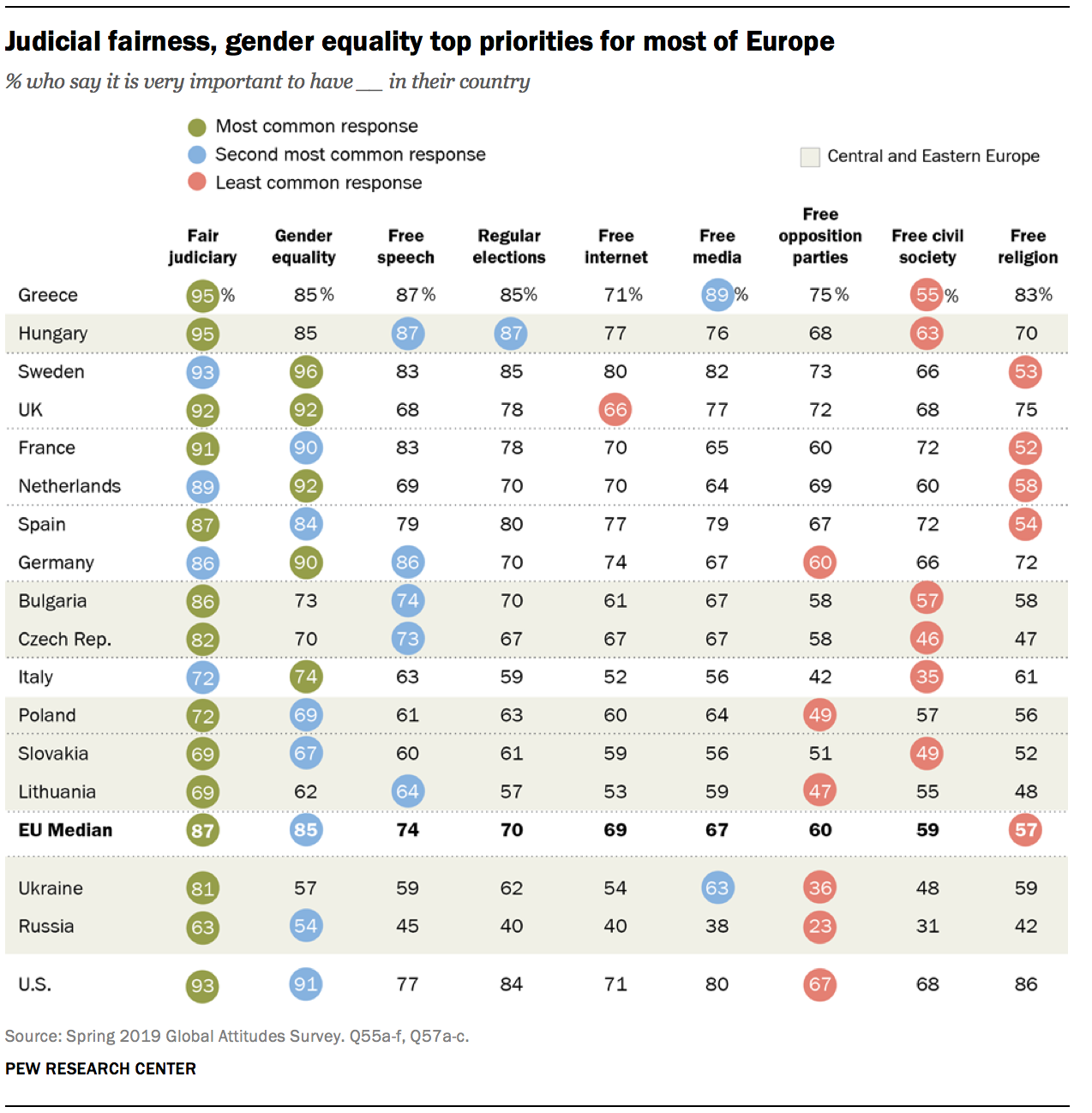
However, attitudes differ regarding whether these principles are very important. Large majorities typically consider having a fair judicial system and gender equality very important, but support for religious freedom and allowing civil society groups to operate freely is in some cases less enthusiastic.

Judicial fairness, gender equality seen as very important priorities across Europe

And there are notable differences across countries. Western Europeans are generally more likely than Central and Eastern Europeans to rate these rights and institutions as very important. Russians consistently express the lowest levels of support. Americans, meanwhile, are often especially likely to consider these principles very important.

This is consistent with other Pew Research Center surveys, which have found that while democracy is a popular idea around the world, the intensity of people’s commitment to it is not always strong. For instance, representative democracy is widely embraced, but significant shares of the public in many nations are open to nondemocratic forms of government as well. People support free expression, but there are strong differences across nations regarding the appropriate boundaries of permissible speech. And, as the current survey shows, fundamental democratic rights and institutions are widely embraced, but some give those principles a less than full-throated endorsement.

There are also large cross-national differences on how people view the current state of democracy in their country. In Sweden, the Netherlands, Poland and Germany, 65% or more are satisfied with the way democracy is working, while in Greece, Bulgaria, the UK, Italy and Spain two-thirds or more are dissatisfied.

Few believe elected officials care what they think

One factor driving dissatisfaction with the way democracy is working is frustration with political elites, who are often perceived as out of touch with average citizens. Across the EU nations polled, a median of 69% disagree with the statement “Most elected officials care about what people like me think.” Majorities also share this perspective in Russia, Ukraine and the U.S.

In former Eastern Bloc nations, there is a widespread perception that politicians – and to a somewhat lesser extent, business people – have benefited greatly from the changes that have taken place since the end of the communist era. The belief that ordinary people have benefited is much less common, although the share of the public expressing this view has increased in many countries since 2009.

Another sign of frustration with political elites and institutions is the poor ratings for most European political parties. The survey asked respondents whether they have a favorable or unfavorable opinion of major parties in their country. In total, we asked about 59 parties across the 14 EU nations surveyed – but only six of these parties receive a favorable rating from half or more of the public.

Despite the misgivings many have about the way democracy is working, most still believe they can have an influence on the direction of their country. In every nation surveyed, roughly half or more agree with the statement “Voting gives people like me some say about how the government runs things.” And about seven-in-ten or more express this view in Spain, Sweden, Slovakia, Ukraine, the Czech Republic and Poland, as well as in the U.S.

Mostly positive attitudes toward the EU

One of the most significant political developments of the past three decades has been the integration of many Central and Eastern European nations into the European Union. Of course, another major development in recent years has been the rise of populist political parties and movements throughout Europe that have questioned the value of European integration and railed against Brussels on a variety of fronts. The United Kingdom has gone so far as to vote to leave the EU.

Overall, attitudes toward the EU are positive. Roughly half or more in every member state surveyed express a favorable opinion of the institution. The EU gets its highest ratings in Poland and Lithuania, two nations that did not join the union until 2004, and its third highest rating is in Bulgaria, which didn’t join until 2007. In the UK, Greece, Czech Republic and France, attitudes toward the EU are less positive, though still on balance favorable.

Largely positive views about the EU and its impact on member states

When asked to reflect on their country’s EU membership, respondents mostly say it has been a good thing, especially in Germany, Poland and Spain, where at least two-in-three express this view. In contrast, only half or fewer believe membership has been good in Italy, the UK and the Czech Republic.

Publics are somewhat more lukewarm about the economic impact of EU membership. When asked whether the economic integration of Europe has strengthened or weakened their country’s economy, a median of 56% across the 14 member states surveyed say it has strengthened it. However, just 42% in France, 35% in Greece, 25% in Bulgaria and 22% in Italy share this opinion.

Overall, views about the general impact of EU membership, and the specific economic impact of membership, have improved in recent years as economic concerns have eased somewhat in many nations. Even, for example, in a country like France, where there is still a lot of skepticism about the value of economic integration, opinions have improved – in 2015, just 31% felt integration had helped their economy, compared with the 42% registered in the current survey.

Life satisfaction is up significantly over the past three decades

Among the survey’s most positive findings is that people in former communist nations, as well as in Western Europe and the United States, are feeling better about their own lives than was the case when these countries were surveyed in 1991. The improvement in several of the Central and Eastern European countries that have joined the EU is dramatic. In 1991, as Poland was still coming to grips with the transition to democracy and capitalism, just 12% of Poles rated their lives a 7, 8, 9 or 10 on a 0-10 scale, where 10 represents the best possible life and 0 the worst possible life. Today, 56% do so.

Since 1991, life satisfaction has improved across Europe


However, improvements are not limited to the former Eastern Bloc. Even though their countries have experienced economic challenges in recent years, people in France and Spain are much more positive about their lives than they were almost three decades ago.

Overall, life satisfaction tends to be higher in wealthier nations. The four countries with the highest per capita incomes in this study – the U.S., the Netherlands, Germany and Sweden – also have the highest levels of life satisfaction, while the nation with the lowest per capita income, Ukraine, has the lowest level.

Europeans are both hopeful and apprehensive about the future

Most are optimistic about relations with other European nations and their own country's culture

When thinking about the future of their countries, Europeans express a mixture of optimism and pessimism. Regarding the economic prospects for the next generation, hope is more common in Central and Eastern Europe. Around six-in-ten Ukrainians, Poles and Slovaks believe that when children in their country grow up, they will be financially better off than their parents. In contrast, roughly a quarter or fewer hold this view in Greece, Spain, Italy, the UK and France.

When asked how they feel about the future of different topics in their countries, opinions vary widely across issues. People are largely optimistic about the future of their country’s relations with other European nations, and they feel the same way about their country’s culture. However, there is considerably less optimism about the future regarding well-paying jobs and the way the political system works. European publics are especially pessimistic about reducing economic inequality – across the 14 EU nations surveyed, a median of just 23% are optimistic about reducing the gap between rich and poor in their country.

More optimism among young people

Younger groups are more optimistic about children's financial future

On a host of issues, young people have a relatively positive outlook about the past, present and future of their countries. In former communist nations, 18- to 34-year-olds are generally more likely than their older counterparts to believe the shift to a market economy has been good for their country, and they are also more likely to think the changes that have taken place over the past three decades have benefited ordinary people.

Across many European countries, those under 35 are more satisfied with the current direction of their countries. They also express more favorable opinions of the EU, more positive attitudes toward Muslims and are more accepting of homosexuality.

And there is greater optimism about the long-term economic future among young people. In 12 nations, those ages 18 to 34 are more likely than those 60 and older to believe that children in their country will be better off financially than their parents when they grow up.

Perceptions of gender equality

Women more likely than men to view gender equality as very important

Although Europeans tend to place a high priority on having gender equality in their countries, in several nations women are more likely than men to hold this view. In nine of the nations surveyed, women are especially likely to say it is very important that women have the same rights as men in their country. Double-digit gender gaps on this question are found in Slovakia, Italy, Bulgaria, Lithuania, Russia, Hungary and the Czech Republic.

In many European nations, attitudes toward gender roles and marriage have shifted since 1991, with more people now preferring a marriage where both the husband and wife have jobs and take care of the household, rather than one where the husband provides for the family and the wife takes care of home and children. For instance, in 1991, 57% of Poles preferred traditional marriage roles, compared with just 27% today.

When it comes to gender and the economic sphere, majorities in most countries disagree with the statement “When jobs are scarce, men should have more right to a job than women.” Still, substantial shares of the public agree with this statement in several nations, including roughly six-in-ten in Slovakia and four-in-ten or more in Greece, Poland, Bulgaria and Italy.

Right-wing populists more distrustful of EU, minorities

Views of Muslims more unfavorable among supporters of right-wing populist parties

Political systems in Europe and elsewhere have been disrupted over the past few years by the growth of anti-elite sentiments and the rise of populist parties, leaders and movements – mostly, but not exclusively, on the political right. Numerous issues have fueled the spread of populism, and the current survey highlights a variety of topics where supporters of populist parties stand out.

People who express a favorable opinion of right-wing populist parties are generally more likely to hold unfavorable views of the EU and to believe the economic integration of Europe has been bad for their countries. For more on how this survey defines populist parties in Europe, see Appendix A.

They are also less accepting of homosexuality and more negative toward minority groups. For instance, 59% of Swedes with a positive opinion of the right-wing populist Sweden Democrats express an unfavorable opinion of Muslims in their country; among those with a negative view of the Sweden Democrats, just 17% see Muslims negatively. How people feel about right-wing populist parties also shapes attitudes toward Muslims in Germany, the Czech Republic, the Netherlands, France, Italy, Spain, the UK and Hungary.

A different pattern emerges, however, regarding left-wing populist parties. In France, Greece and Spain, people with favorable views of left-wing populist parties tend to have more positive attitudes toward Muslims in their country.

A map of East and West Germany

Country Spotlights:

Germany

The survey has certain questions that were asked only in former East Germany, and on many other questions there are substantial differences between those Germans living in the East and the West.

  • Around nine-in-ten Germans living in both the West and East say that German unification was a good thing for Germany. However, majorities on both sides of the former Iron Curtain say that since unification, East and West have not achieved the same standard of living.
  • East Germans are less satisfied with the way democracy is working in Germany and the overall direction of the country than those in the West. And fewer East Germans have a favorable view of the European Union.
  • Life satisfaction in East Germany has skyrocketed since 1991 and now is closing in on opinions in the West. In 1991, 15% of those living in former East Germany said their life was a 7, 8, 9, or 10 on a 0-10 scale, but in 2019 that ballooned to 59%. Meanwhile, life satisfaction in the West has also increased since 1991, from 52% to 64% today.

United States

While American and European attitudes are similar on some key issues, there are others where the two sides of the Atlantic have less in common.

  • Americans are more likely than Europeans to say most tenets of democracy are very important for the country, but especially the ability for the media to report without government censorship and freedom of religion. Americans are about as likely as Western Europeans to say that honest, regular elections with at least two parties are very important for their country, and both see this as more important than most in Eastern Europe.
  • When it comes to attitudes about LGBT rights, Americans are generally more progressive than Central and Eastern Europeans. For example, today 72% of Americans say homosexuality should be accepted by society. While lower than the median of 86% in Western Europe, this is much higher than the median of 46% who say the same in Central and Eastern Europe.
  • Regarding attitudes about individualism, Americans are less likely than Europeans to say forces outside of people’s control determine success in life.


Roadmap to the report

The chapters that follow discuss these findings and others in more detail:

  • Chapter 1 examines attitudes in Central and Eastern Europe toward the political and economic changes that occurred following the fall of communism as well as how these changes have influenced different groups and aspects of society.
  • Chapter 2 explores the democratic institutions and rights that people across Europe view as important for their country.
  • Chapter 3 looks at satisfaction with the way democracy is working, including whether voting gives people a say in what happens in their country.
  • Chapter 4 reviews attitudes toward the European Union and major European leaders, and examines people’s optimism, or pessimism, about various aspects of their society.
  • Chapter 5 explores national conditions, such as views about the current economic situation, as well as life satisfaction.
  • Chapter 6 considers European attitudes toward minority groups such as Muslims, Jews and Roma.
  • Chapter 7 reviews beliefs about gender equality in society, marriage and employment.
  • Chapter 8 examines ratings of European political parties.    

1. Political and economic changes since the fall of communism

When asked about changes that have taken place since the end of the communist era, people across the former Eastern Bloc express support for the shift from one-party rule and a state-controlled economy to a multiparty system and a market economy. However, Russians in particular are less supportive of these changes.

The move to a multiparty system garners the strongest approval from Poles (85%), those in former East Germany (85%) and Czechs (82%). But majorities in Slovakia, Hungary and Lithuania also approve. Roughly half or more in Bulgaria and Ukraine also support the change, even though there are more who disapprove in those countries. Only in Russia do fewer than half express support for the change to a multiparty system.

Support for the shift to a market economy is also robust in most of the countries surveyed, with majority support for the economic change found in many countries where majorities also favor the change to the political system. However, only 38% in Russia approve of the economic change, while 51% disapprove.

In some countries, support for the transition to a multiparty system and a free-market economy has rebounded, although support in Russia has declined

People in many of the countries surveyed are less supportive of the changes to the political and economic systems now than they were in 1991. However, since 2009, there has been a notable uptick in positive sentiment toward these changes in about half of the countries surveyed. Russia, a notable exception, is the only country where support has decreased since 2009.

Young people are more likely to approve of movement to a capitalist economy than older generations

For example, in Hungary, 74% in 1991 said they approved of the change to a multiparty system, and 80% liked the movement to a market economy. But when surveyed again in 2009, only 56% approved of the change to the political system since 1989 and 46% were positive on the change to the economic system. Now, however, 72% of Hungarians approve of the multiparty system and 70% like the capitalist system.

People with more education favor shift to a market economy

Russians, however, are even more pessimistic than they were in in the past about these changes. In 1991, 61% of Russians welcomed the multiparty system, but that figure is 43% today, an 18 percentage point decline. And positive views toward the market economy are also down significantly since 1991.

Young people in general are keener on the movement away from a state-controlled economy in many of the countries surveyed. For example, in Slovakia, 84% of 18- to 34-year-olds are in favor of this change, compared with 49% of those ages 60 and older. Double-digit age gaps also appear in Bulgaria, Ukraine, Russia and Lithuania.

Mixed views on whether the economic situation changed for the better after communism

In most of the countries surveyed, those with more education are more likely to favor the movement to a capitalist economy than are those with less education. In Bulgaria, 78% of those with more than a secondary education favor the change to a capitalist economy, while only 49% of those with less education do. These differences are also significant for the change to a multiparty system.

Similar differences appear when it comes to income, not just for the movement to a free-market economy but also for the change to a multiparty system. In all countries, those with incomes at or higher than the country median are more likely to approve of these changes than are those with incomes below the country medians.

Except in Russia, uptick in those saying economic situation is better than under communism

The transition from a state-controlled economy to a capitalist one is much more highly regarded now than in 2009, during the recession. Perhaps because of an improved economic outlook (see Chapter 5), many more now see the economic benefits of the new system compared with communism. However, there are sharp divides across countries on how the change affected most people.

Despite no universal agreement on whether the economic situation is better today than it was under communism, the belief that it is better has become more common in every country since 2009, except Russia. In Poland, 47% held this view in 2009, but today that figure has jumped to 74%. However, in Russia fewer people now say the economic situation is better than under communism.

In Poland, the Czech Republic and Lithuania, majorities say the economic situation for most people is better today than it was under communism. In Hungary and Slovakia, more people say it is better, but substantial minorities still say it is worse. And in Bulgaria, Ukraine and Russia, more than half believe the economic situation is worse today than it was under communism. (This question was not asked in Germany.)

Most Russians characterize end of USSR as great misfortune

Most Russians see great misfortune in dissolution of Soviet Union

More than six-in-ten Russians agree with the statement “It is a great misfortune that the Soviet Union no longer exists.” This represents an increase of 13 percentage points since 2011. Only three-in-ten disagree with the statement.

Russians who lived most of their lives under the Soviet Union are more likely to say its dissolution was a great misfortune than are those who grew up under the new system. Among Russians ages 60 and older, roughly seven-in-ten (71%) agree it is unfortunate that the USSR no longer exists, compared with half of Russians ages 18 to 34.

Germans view unification positively but feel the East has been left behind economically

Germans are in strong agreement that the 1990 unification of East and West was a good thing for Germany. Roughly nine-in-ten Germans, living in both the regions that correspond with the former West Germany and East Germany, agree with this statement.

However, when asked whether East and West Germany have achieved the same standard of living since unification, only three-in-ten Germans say this is the case.

Since 2009 there has not been much overall movement on this question in Germany as a whole. In former East Germany, however, people are about twice as likely now to say the standard of living is equal to that of the West than they were the last time this question was asked. Still, majorities of Germans from both regions say the East has not yet achieved equal economic footing with the West.

Germans view unification positively but feel the East has been left behind

Politicians and business people seen as gaining from changes since the end of communism, more so than ordinary people

Majorities in all the former Soviet orbit countries surveyed say politicians and business people have benefited a great deal or fair amount since the fall of communism. And in all cases, more people say political and business leaders have prospered than say changes have benefited ordinary people.

Most see politicians and business people benefiting from changes since end of communism, more so than ordinary people

People are especially inclined to believe politicians have benefited. Roughly nine-in-ten or more express this view in every nation where the question was asked, with the exception of Russia (still, 72% of Russians agree). Roughly three-quarters or more in every country also say business people have profited from the changes at least a fair amount, including 89% of those in the Czech Republic, Poland and Ukraine.

Publics are less inclined to believe ordinary people have been the beneficiaries of such changes. In Bulgaria, Ukraine and Russia, about one-in-five say this. On the other hand, nearly seven-in-ten Poles think ordinary people have prospered under the new system, as well as 54% of Czechs.

Increased optimism that changes in 1989/1991 benefited ordinary people

Nonetheless, more now say ordinary people have benefited than was the case 10 years ago. In 2009, a median of 21% across the seven countries surveyed said ordinary people were helped by the changes, while 77% said they were not. Now, a median of 41% across these same countries say ordinary people have benefited from the change, with 56% saying they have benefitted little or not at all.

Within countries, there are divides on how people see average citizens making out in the change from communism to a free market. In every country where the question was asked, those with higher incomes are more likely than those with lower incomes to say the changes have benefited ordinary people. For example, in Hungary, those with an income at or above the national median are 20 percentage points more likely than those with lesser means to hold this view.

Those with higher incomes more likely to say ordinary people benefited from changes since end of communism

Education is also a dividing line on this question. In every country but Russia, those with more education are generally more likely to say regular people have prospered in the post-Soviet era than are those with less education.

People who lived under communism more convinced ordinary people did not benefit from societal changes

Additionally, those who lived through the communist era are much more likely to say the changes that took place have had not too much or no influence on ordinary people compared with those who were born near or after the changes took place. For example, in Slovakia, 70% of those ages 60 and older say ordinary people did not benefit from the change to capitalism and a multiparty system, compared with 39% who say this among 18- to 34-year-olds. Double-digit differences of this nature appear in every country surveyed, highlighting how those who lived through communism have a more negative view of the post-communist era.

Central and Eastern Europeans say post-communist era has had both positive and negative effects on society

When asked whether the changes since 1989 and 1991 have benefited specific aspects of life in the post-communist era, people tend to believe education, the standard of living and pride in their country has improved. But they see downsides as well, and there are sharp differences between countries on the overall benefits of these changes.

Many say education, standard of living and national pride have improved in post-communist era, worry about effects on law and order, health care and family values

For example, majorities of Poles, Lithuanians and Germans say the changes have had a good influence across every category asked, including education, standard of living, pride in their country, spiritual values, law and order, health care and family values. On the other end, roughly half or fewer Bulgarians, Ukrainians and Russians say the changes have had a good influence on these various issues, with the exception of the positive influence on pride in their country among Russians (54%) and Ukrainians (52%).

Sentiment is more mixed in Slovakia, the Czech Republic and Hungary, with people generally seeing the benefits of the changing standard of living and pride in their country. But worries persist about spiritual values in the Czech Republic and health care in Slovakia and Hungary.

Large increase in people saying the standard of living has improved after 1989/1991 changes

Since 1991, there have been significant increases in those in each survey country who say the changes taking place have had a good influence on various aspects of life. This is fairly consistent across countries and issues surveyed, but the degree of change varies from country to country and question to question.

The most prominent increase is in the percentage of people who think the changes in 1989 and 1991 have had a good influence on the standard of living within each country. In many of the countries surveyed, there have been multifold increases in this sentiment from 1991 to today. For example, in Lithuania, only 9% of people in 1991 said that the recent changes had a positive influence on the standard of living for people in the country at the time. But in 2019, that figure has shot up to 70%, more than a sevenfold increase.

Large changes of this nature occurred in all the countries surveyed on this question from 1991 to 2019, even though there are still skeptics of the positive effect these changes have had on economic prosperity in Ukraine, Bulgaria and Russia.

On law and order, the changes are also more welcome now than in 1991 in every country surveyed. For example, 27% of Germans in 1991 said that recent events had had a positive influence on law and order in the country, compared with 64% who say this now.

And on pride in their country, there have been strikingly large increases in the share who believe changes have had a good influence in Russia and Ukraine. In 1991, around one-in ten said the changes to the political and economic systems were good for civic pride in Russia (9%) and Ukraine (11%), but now 54% and 52% say this, respectively.

The only instances where significantly fewer now say these changes have had a good influence on society for any of these various aspects tested are in the Czech Republic, Lithuania and Slovakia on spiritual values and in Lithuania on national pride.

Perceptions about changing standard of living differ by income level

On views of the standard of living, people with higher incomes and more education are more likely to say the changes since 1989 and 1991 have had a good influence in their countries. In Slovakia, those who have an income at or above the country median are 30 percentage points more likely to say the changes since 1989 have had a good influence on the standard of living compared with those who have a household income below the median. Significant differences of this nature appear in eight of the nine countries where this question was asked.

A similar pattern applies for education. Those with more education are more likely than those with less to say the changes that have taken place since 1989 and 1991 had a good influence on standard of living in all countries besides Russia.

Young people see benefits of changes to health care system since 1989/1991

Young people are more likely to say the changes to a capitalist economy and a multiparty system have had a positive effect on health care in their country. In Slovakia, 56% of 18- to 34-year-olds say the societal changes had a good influence on the health care system, compared with only 27% of those ages 60 and older. Significant double-digit age gaps of this nature appear in seven of the nine countries where this question was asked.

In Ukraine, those who only speak Ukrainian generally see a more positive influence of the societal changes on each issue than Russian-only speakers or those who speak both languages at home.

Those in West and East Germany differ on whether some changes to society and culture were good

In Germany, there are many divides on whether the changes since 1989 have had a good influence on national conditions among those who currently live in the West versus those in the East, though overall sentiment in Germany toward these changes is quite positive.

For example, those in the West are 20 percentage points more likely than those in the East to say the changes have had a good effect on the education system. Western Germans are also more likely to see the changes as a good influence on law and order and spiritual and family values compared with the East. However, there are no real differences of opinion between the West and East on how changes have benefited standard of living, health care and pride in their country.

2. Democratic values

Across Europe, there is relative agreement about which political institutions and rights are most important to have. When presented with nine different factors that people may or may not see as important to their country, majorities in every country polled – in most cases, large majorities – say each one of the nine factors is at least somewhat important.

Judicial fairness, gender equality top priorities for most of Europe

When it comes to what people deem to be very important, though, certain factors stand out. Across every country surveyed, having a judicial system that treats everyone equally is always named as one of the two most important facets. In most countries, women having the same rights as men is also one of the top two things people consider “very important” for their country to have.

But, while the relative ranking of the preferred factors varies little across the European continent, Western Europeans generally are more likely to see each factor as very important for their country than are Central and Eastern Europeans. And, by and large, Americans stand out for the relative import they place on most of these elements of democracy – even compared with Western Europeans. Russians stand out in the opposite direction, often being the least likely of all countries surveyed to say each factor is very important for their country.

Generally, people with higher levels of education are more likely than those with less education to say almost all of these factors are very important for their country. In contrast, younger and older people largely agree on the relative importance of most of these elements, as do men and women.

Fair judiciary seen as more important than regular elections

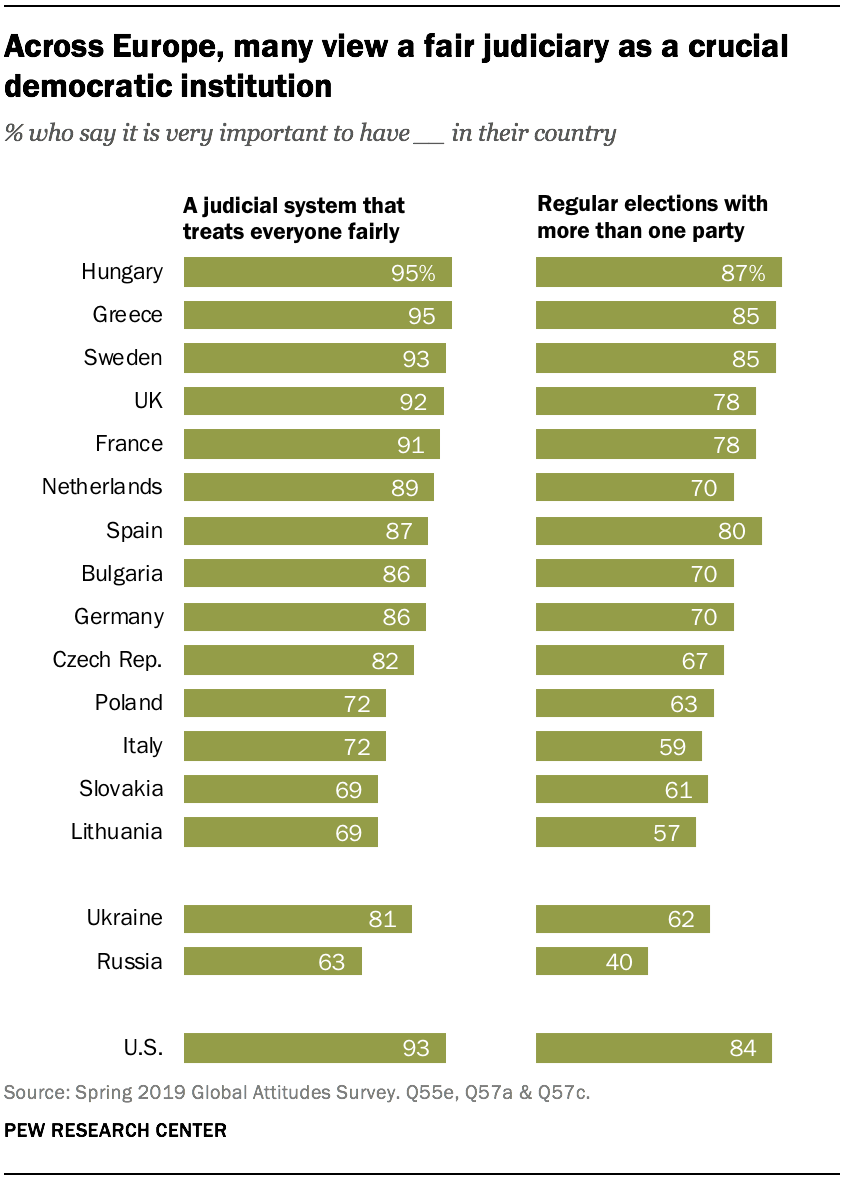
Across Europe, many view a fair judiciary as a crucial democratic institution

When it comes to two institutional factors that many would consider crucially important to democracy – a fair judiciary and free, regular elections – publics largely prioritize the former. More than six-in-ten in every country surveyed say a fair judiciary is very important for their country. This opinion ranges from 63% in Russia to 95% who say the same in Greece and Hungary.

In contrast, while majorities in most countries say honest elections being held regularly with a choice of at least two political parties is very important for their country, outside of Hungary it is not one of the top two issues in any country surveyed.

Among the countries asked this question in 2015 or 2016 and 2019, the perceived importance of regular elections has decreased in some but risen in others. Fewer now say regular elections are very important in Russia (down 17 percentage points since 2015), Italy (-14 points), Ukraine (‑7) and Germany (‑6), while more cite them as very important in both Hungary (+8 points since 2016) and France (+12 since 2015).

Most say it is very important that opposition parties, civil society can operate freely

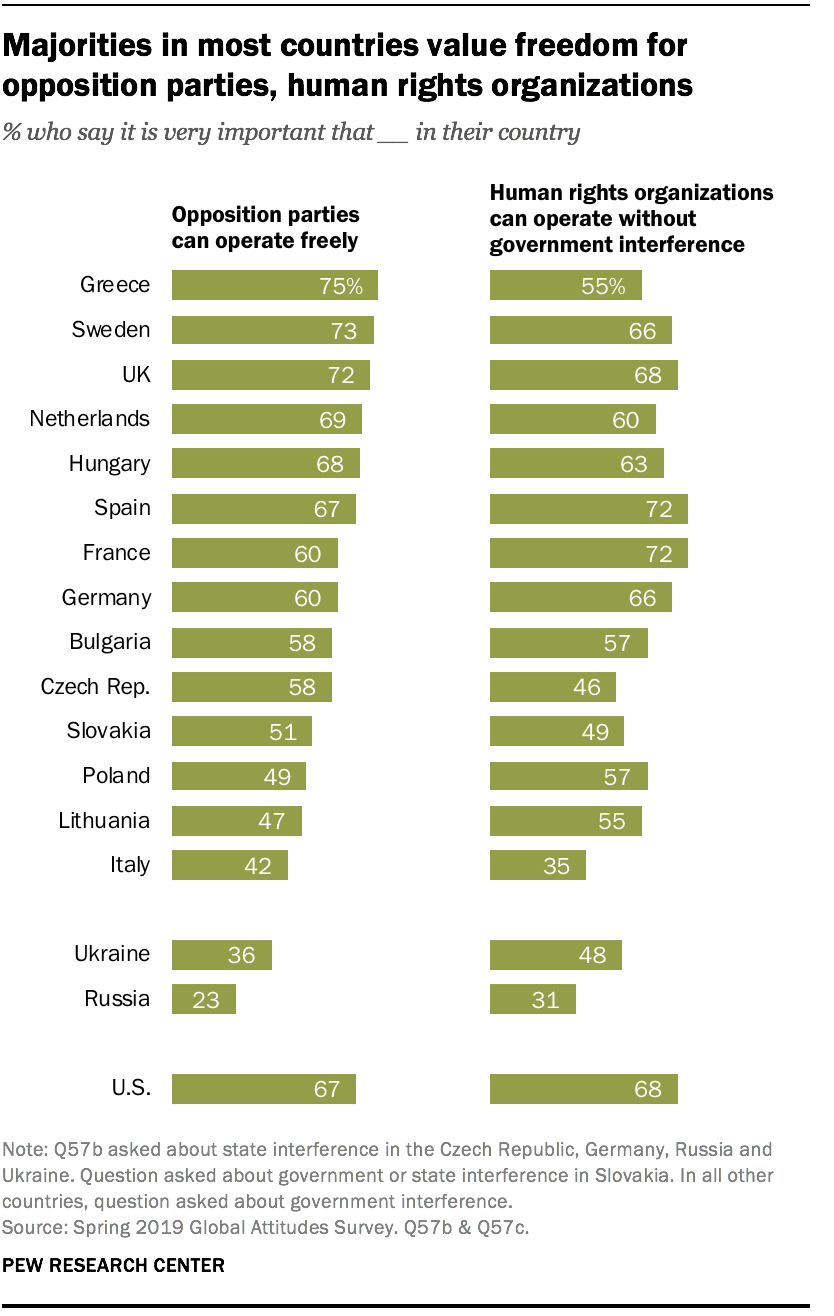
Majorities in most countries value freedom for opposition parties, human rights organizations

In many countries surveyed, majorities say opposition parties operating freely in their country is critical. But people in Central and Eastern Europe are somewhat less likely to say it is very important for opposition parties to operate unencumbered. For example, roughly half or fewer in Slovakia, Poland and Lithuania say this facet of democracy is crucial. In Russia and Ukraine, this tenet is even less revered; only 36% and 23%, respectively, see opposition parties operating freely to be very important for their country.

Many also see human rights organizations operating without government interference as very important. Western Europeans appear to prize civil society’s ability to act freely at somewhat higher rates than Central and Eastern Europeans (medians of 66% and 56%, respectively). But there is a great deal of variation across these EU member states, ranging from a high of 72% in Spain and France to a low of 35% in Italy. Russians (31%) are the least likely to say civil society groups operating freely is “very” important among all of the countries surveyed.

Equal rights for women are prized; less so religious freedoms

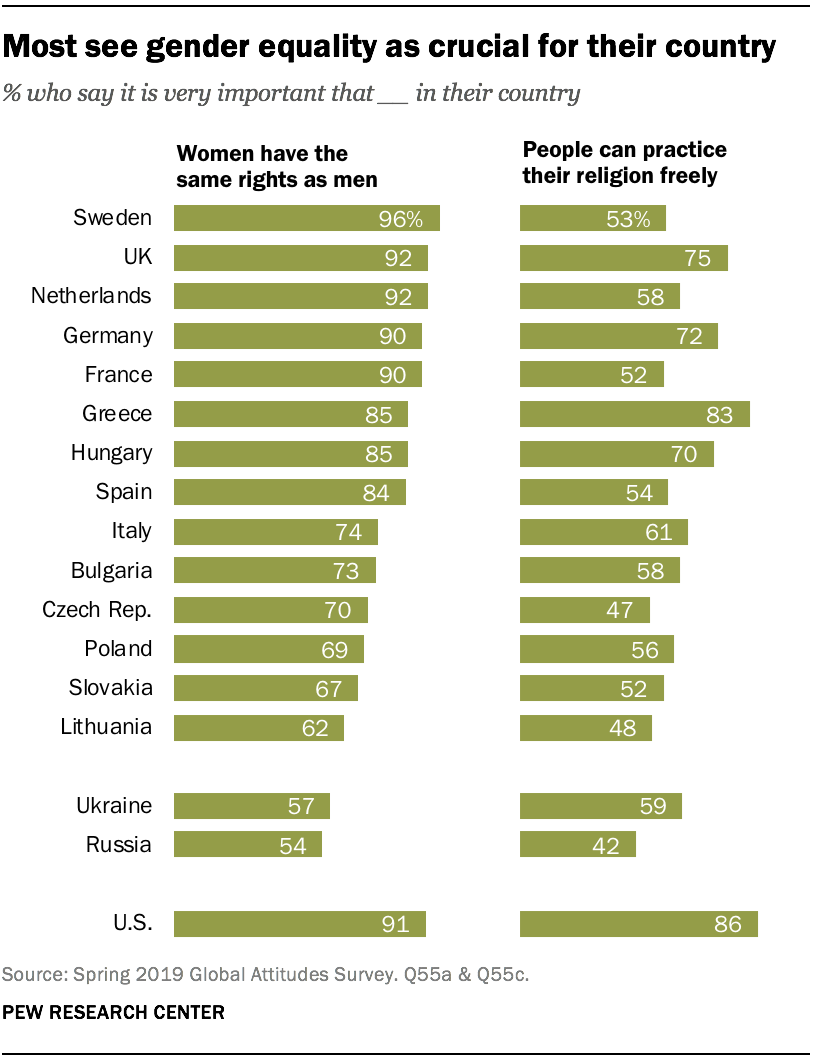
Most see gender equality as crucial for their country

Women having the same rights as men is seen as one of the most important elements for a country across most of the countries surveyed. In fact, in Sweden (96%), the Netherlands (92%), the UK (92%), Germany (90%) and Italy (74%) it is the one facet of democracy of nine tested in the survey that garners the most people saying it is “very important” for their country. While generally seen as somewhat less important across Central and Eastern Europe, as well as in Russia and Ukraine, at least half or more still say gender equality is very important in every country surveyed.

Across Europe, the more religious are more likely to value religious freedom

Fewer people say it is very important for people to be able to practice their religion freely. This varies widely across Europe, however, with around three-quarters or more in Greece, the UK and Germany saying free religious practice is very important, compared with only around half saying the same in Sweden, France and the Czech Republic. Russia and the U.S. again stand out at opposite ends of the spectrum, with Americans being most likely to say it is very important for people to be able to practice their religion freely (86%) and Russians being the least likely (42%).

In most countries that were also asked this question in 2015, opinions are relatively unchanged. The notable exceptions are Russia and Italy, where the percentage saying it is very important fell 18 and 14 points, respectively. Over the same period, Britons grew more likely to say religious freedoms are very important.

In each of the countries surveyed, those who say religion is very important to them are also more likely to say it is very important for people to be able to practice religion freely.

Most see freedom of expression – especially free speech – as crucial

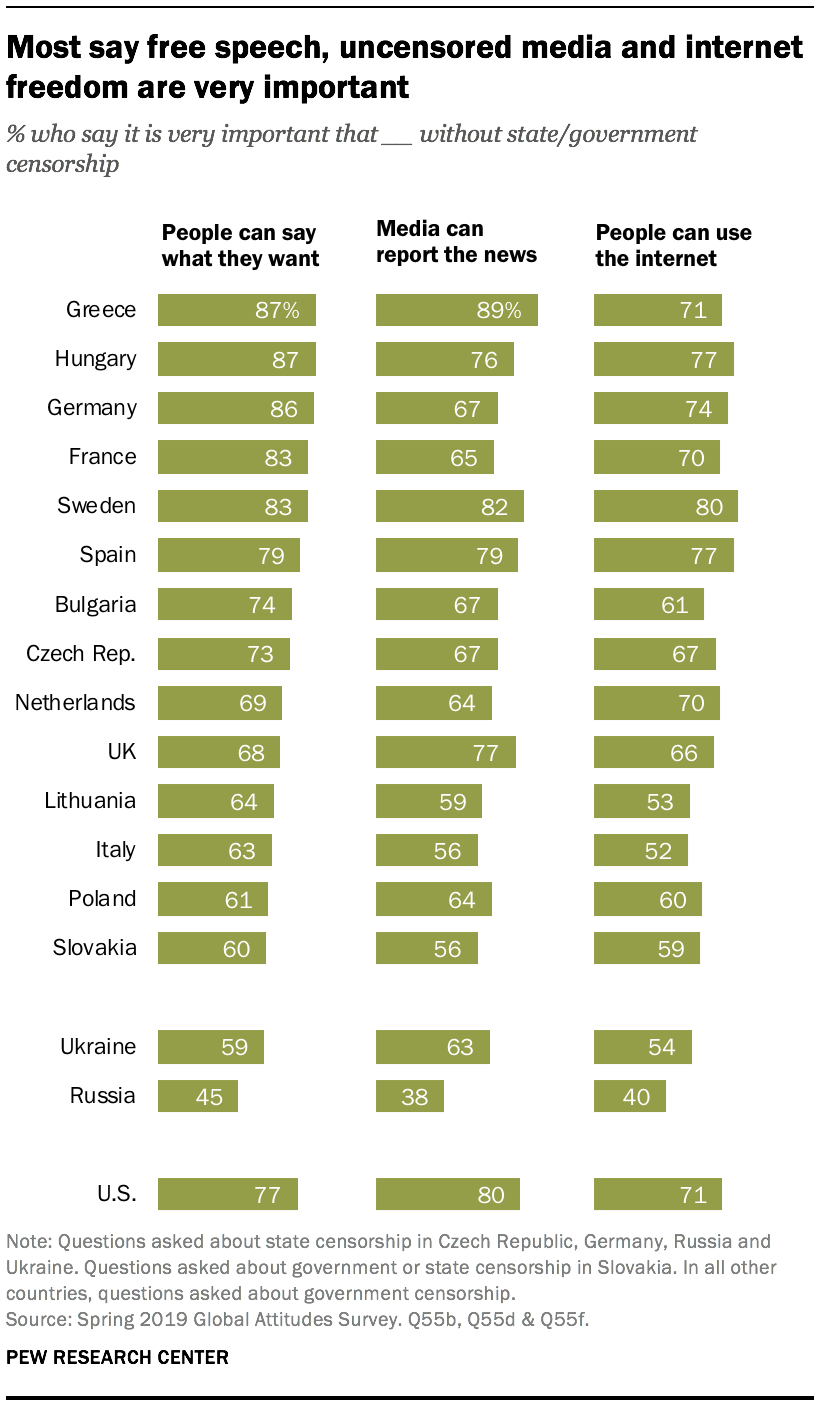
Most say free speech, uncensored media and internet freedom are very important

People’s right to say what they want without state or government censorship is a key issue for many across the continent. With the exception of Russia, around six-in-ten or more in all nations polled say it is very important that people can speak freely – including more than eight-in-ten in Greece, Hungary, Germany, France and Sweden. In most countries, more people say it is very important that people can speak without government censorship than say the same of the media reporting news or people using the internet without censorship – even though all three are generally seen to be important. In France, Hungary and the UK, freedom of speech has increased as a key value since 2015 or 2016 when the question was last asked (up 16, 13 and 11 percentage points, respectively).

The ability for the media to report the news without state or government interference is also very important for many of the publics polled. In Greece, the U.S., Spain, the UK, Poland and Ukraine, publics rate media censorship as most crucial to avoid of the three censorship types asked about. And, outside of Russia, majorities in every country say press freedom is very important.

The relative importance of this issue, though, has shifted somewhat among the countries that were also asked this in 2015 and 2016. In the UK and France, the shifts have been dramatic: In each country, the percentage saying it is very important that the media can report freely has increased 19 points. In the U.S. and Poland, there has been a double-digit increase in people saying that this is crucial (+13 and +10 points, respectively). But in Russia (-8 points), Italy (-8) and Germany (-6), fewer now say censorship-free reporting is very important for their country.

Only in the Netherlands does the ability to use the internet without state or government interference the type of censorship rank as most important for the public. But, in all but Russia, around half or more still say the ability to use the internet freely is very important. As with the other forms of censorship, Western Europeans are more likely than Central and Eastern Europeans to prioritize an open internet. The relative importance of this issue has risen in France (up 20 percentage points), the UK (+13 points), Hungary (+9) and Spain (+8) since these countries were last asked in 2015 and 2016, even while it has fallen in Italy (-9).

In most countries, internet users are much more likely than non-users to say it is very important that people can use the internet without censorship. For example, in Greece, 83% of internet users say it is very important that people can use the internet freely, compared with only around half (47%) of non-users. In general, non-users are less likely to offer an opinion on the importance of an unrestricted internet across most of the countries surveyed.

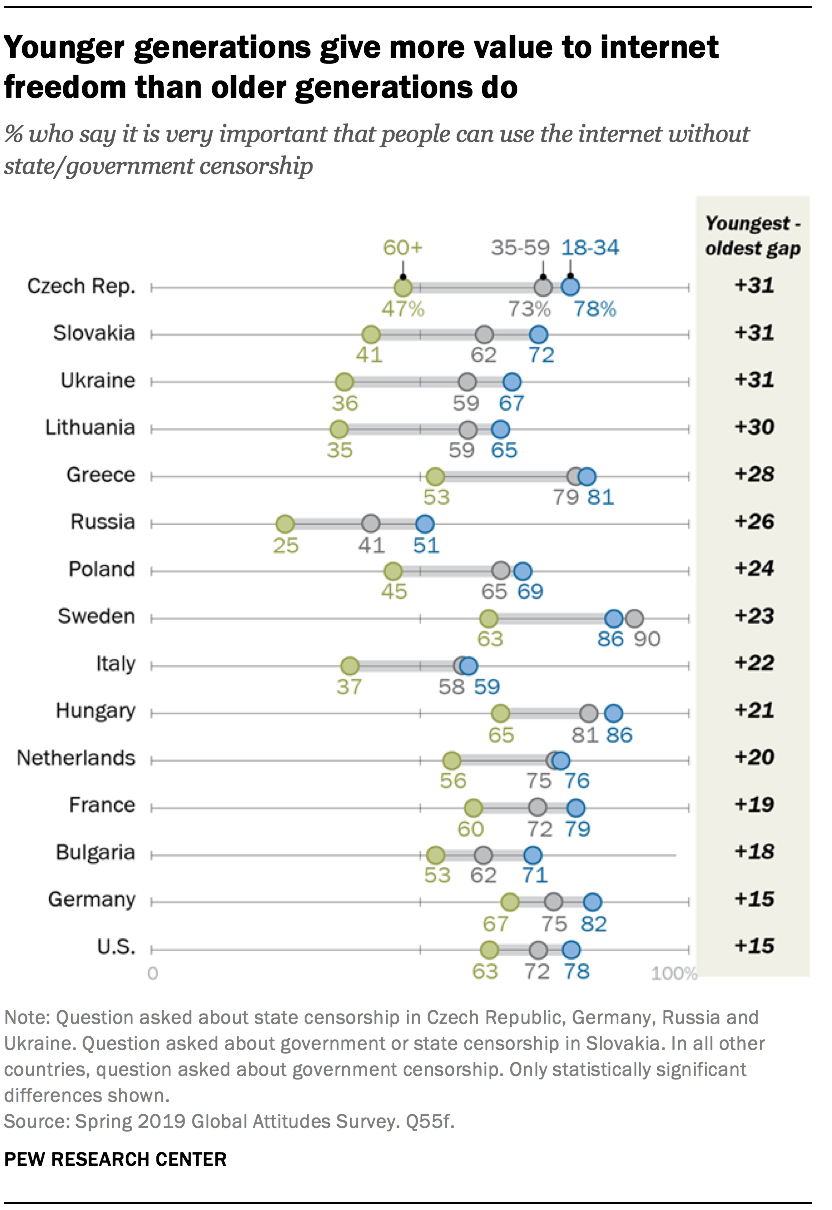
Younger generations give more value to internet freedom than older generations do

Notably, across most of the facets asked about in the survey, younger people diverge little from older people in their assessments of which institutions or freedoms are very important. But, when it comes to the freedom to use the internet without state or government censorship, younger people are much more likely than older people to say it is very important in almost every country surveyed. For example, in the Czech Republic, around three-quarters of those ages 18 to 34 say it is very important that people can use the internet without interference, compared with only around half of those ages 60 and older. In many of these same countries, older people are less likely to give a response than younger people.


3. Democratic satisfaction

Across Europe, satisfaction with democracy is mixed. In Sweden, the Netherlands, Poland and Germany, roughly two-thirds or more are satisfied with the state of democracy in their country (72%, 68%, 66% and 65%, respectively). By contrast, in Greece, the UK, Italy, Spain and France, majorities are dissatisfied with how democracy is functioning. By a more than two-to-one margin, Greeks, Britons, Italians and Spaniards are also more dissatisfied with democracy in their country than satisfied.

Across the six Central and Eastern European countries surveyed, satisfaction is somewhat higher. But this varies from a high in Poland, where about two-thirds are satisfied, to a low of 27% in Bulgaria. Relatively few Ukrainians (34%) or Russians (30%) are satisfied.

Within Germany, those who live in West Germany are somewhat more satisfied (66%) with the way democracy is working than those who live in East Germany (55%).

Democratic satisfaction has increased across Central and Eastern Europe

Satisfaction with democracy higher than a decade ago in most of former Eastern Bloc

Across most of Central and Eastern Europe, satisfaction with democracy is significantly higher than a decade ago. Changes are most pronounced in Lithuania, where around six-in-ten are satisfied with democracy today, up from about a third (35%) in 2009. Similarly, in Hungary, more than twice as many are satisfied with democracy now (45%) than reported so a decade ago (21%). Satisfaction also increased over this time in Poland and Ukraine (+13 percentage points), the Czech Republic (+8 points) and Bulgaria (+6 points).

Elsewhere, even since last year, there have been some marked shifts in democratic satisfaction. For example, in Greece, although satisfaction remains relatively low overall (26%), it increased 9 percentage points since last year. In Spain, which had an election in April of this year, satisfaction with democracy has increased 12 points.

Elsewhere, satisfaction with democracy has declined. Since UK voters approved a referendum in 2016 to leave the European Union, satisfaction has dropped from 52% in 2017, to 42% in 2018, to the current 31%. In France, too, which was roiled by weeks of “yellow vest” protests, satisfaction with democracy has fallen, from 48% to 41% since 2018.

Those with more education tend to be more satisfied with democracy

Across these and many other countries surveyed in prior years, those who express positive views of political parties that are in power tend to be more satisfied with democracy than those who have unfavorable views of those parties. (For more information on which parties are in power in the countries surveyed, see Appendix B.) For example, in France, 85% of those who support President Emmanuel Macron’s En Marche party are satisfied with democracy, compared with 34% of those who do not support it. Similarly, in the UK, Conservative Party supporters are more satisfied (44%) than those who are partisans of other parties (28%). The difference is largest in Hungary, where more than three-quarters of those who support Prime Minister Viktor Orban’s Fidesz Party are satisfied with democracy, compared with only around a quarter (26%) of those who do not.

Across most of the countries surveyed, those with more education tend to be more satisfied with democracy than those with less education. For example, 37% of French with a secondary degree or less say they are satisfied with democracy, compared with roughly half (53%) of those with more schooling.

The United States and Poland stand out, though, for being the only countries surveyed where this pattern reverses. In the U.S., 42% of those with lower levels of education are satisfied with democracy, compared with 34% of those with higher levels.

Few think elected officials care about people like them

Most across Europe are skeptical of their governing elite

One factor that corresponds with democratic dissatisfaction and unites most EU nations – as well as the U.S., Russia and Ukraine – is a shared sense that elected officials do not care about their constituents. Only in Sweden does a majority say elected officials care what people like them think. The Dutch and Polish publics are roughly split on this question, but elsewhere majorities do not believe politicians care what they think. Greeks are the most negative when it comes to evaluations of their politicians: Only 13% say elected officials in their country care about people like them.

People with favorable views of six right-wing populist parties (Lega in Italy, PiS and Kukiz’15 in Poland, SNS in Slovakia, and Jobbik and Fidesz in Hungary) are more likely to agree that elected officials care what people like them think. For example, people with a favorable view of Fidesz in Hungary are more likely to say elected officials care (36%) than those who dislike the party (13%). But, among those with favorable opinions of the PVV and FvD in the Netherlands and the Sweden Democrats in Sweden, the opposite is true.

Post-communist countries split in their view of ruling elites over time

In post-communist countries, Poles, Russians and Slovaks have become more likely to say elected officials care about people like them since 1991. For example, 45% of Poles hold this view today, compared with 24% in 1991. In contrast, Czechs, Hungarians and Ukrainians are less likely now than in 1991 to see their politicians as caring about the ordinary person.

Europeans disagree about whether states are run for everyone’s benefit

More Central, Eastern Europeans see state governed for benefit of all

While relatively united in their skepticism of elected officials, publics across Europe diverge in their assessments of whether the state is run for the benefit of all the people in the country. Generally, Central and Eastern Europeans stand out as more likely to agree than Western Europeans.

But, within each region, there is substantial variation. For example, across Central and Eastern Europe, agreement ranges from a high of 88% in Slovakia to a low of 24% in Bulgaria. And, in Western Europe, northern countries tend to be relatively more sanguine – Sweden (73%) and the Netherlands (70%) in particular – and southern European countries more negative. The sense that the state benefits everyone is particularly low in Greece (19%) and Italy (30%). Similarly, in Ukraine (21%) and Russia (38%), only minorities agree that the state benefits everyone.

In many post-communist countries, more now say state acts in their interest

To the degree that opinions have shifted, many increasingly see benefits flowing to everyone. For example, in Hungary, whereas only around a third (34%) thought the state was run for the benefit of all in 1991, today, roughly three-quarters (74%) express this view. Change has also been positive and pronounced in Poland (+25 percentage points), the Czech Republic (+18 points) and Slovakia (+17 points). In Russia, agreement is up 11 percentage points. In Lithuania, while opinion is unchanged since 1991, it nonetheless is up markedly since a relative low point in 2009. Among Central and Eastern Europeans, only Bulgarians are significantly less likely to agree that the state is run for the benefit of all now than in 1991 (-31 points).

In Western Europe, opinion is more mixed. In Spain and the UK, fewer agree the state is run for the benefit of all now than in 1991. Germans and Italians, in contrast, are now more likely to agree.

With regard to right-wing populist sympathies, supporters are split. Those with favorable views of five right-wing populist parties – UKIP in the UK, PiS and Kukiz’15 in Poland, SNS in Slovakia and Fidesz in Hungary – are more likely to say the state is run for the benefit of all. For supporters of AfD in Germany, PVV and FvD in the Netherlands, Sweden Democrats in Sweden, and SPD in the Czech Republic, this pattern reverses.

Most see value to voting

Most Europeans think voting gives people like them a say

Despite mixed assessments about whether government is run for the benefit of all citizens, in every country surveyed, most people agree voting gives people like them some say in how the government runs things. A median of two-thirds in Europe generally think voting gives them a voice in their country’s politics, though levels of agreement range from a low of 51% in Hungary to a high of 80% in Spain and Sweden.

Many in post-communist countries now see more value in voting

In most post-communist countries, people generally are more likely to agree today that voting affords them some influence than almost 30 years ago. Poles and Slovaks, for example, are around 30 percentage points more likely to say voting gives people like them a say than they were in 1991. Only in Lithuania and Bulgaria do fewer people say voting gives them a say now than said the same in 1991. In Russia and Ukraine, more now say voting gives them a voice – up 7 and 27 percentage points, respectively.

Across Western Europe, only the French are less likely to agree now that voting gives people like them a say than said the same in 1991, though most shifts in opinion have been relatively modest. For example, in Germany, whereas 54% agreed that voting gave them a say in 1991, today that number has climbed 8 percentage points to 62%.

Across most of the countries polled, people with higher levels of education are more likely to agree that voting allows them a say in their countries.

For supporters of five right-wing populist parties (AfD in Germany, PVV and FvD in the Netherlands, Vox in Spain and Sweden Democrats in Sweden), those who have favorable views of these right-wing populist parties are less likely to agree, though supporters of both populist parties in Poland, Fidesz supporters in Hungary and OLaNO-NOVA supporters in Slovakia stand apart as exceptions.

4. The European Union

The European Union gets mostly favorable marks from the countries surveyed, but not everyone is happy with the Brussels-based institution. Across the 14 EU member countries surveyed, a median of 67% hold favorable views of the European Union while 31% have an unfavorable view.

Many of the Central and Eastern European countries surveyed hold strongly positive views of the political union. Roughly seven-in-ten or more in Poland, Lithuania, Bulgaria, Slovakia and nonmember Ukraine give the EU favorable marks, including at least two-in-ten among these countries who say they have a very favorable view. Likewise, majorities in Sweden, Germany, Hungary, Spain, the Netherlands and Italy hold a positive outlook toward the EU.

While more people see the EU in a positive light than not in the UK, Greece, the Czech Republic and France, these countries also have sizable portions of the public – more than four-in-ten – that voice negative opinions. In Russia, 44% have a negative view of the EU, while 37% give it a thumbs-up.

Views of the European Union over time

In recent years, even as euroskeptic parties have gained political momentum and British voters passed the 2016 referendum to leave the EU, short-term views of the European Union have rebounded in several countries. Greece has seen a 26 percentage point surge in favorable views of the EU from 2016 to 2019. Spain (+19 points) and France (+13) have seen large upticks in the last three years despite publics being less positive than in 2007. Among EU countries surveyed, Germany, Sweden, the Netherlands, Poland, the UK, Hungary and Italy also increasingly expressed affirmative views of the EU from 2016 to 2019.

However, long-term favorable views of the EU have not changed much in several nations polled since 2007. Germany, Poland, the UK, Ukraine, Bulgaria and the Czech Republic hold similarly positive views of the EU today compared with 12 years ago. Swedes are now 13 points more favorable toward the EU than when first asked in 2007.

But five nations have deteriorating opinions of the EU. Italy (where favorability has fallen 20 points), Spain (-14), France (-11) and Slovakia (-9) have become less pleased with the EU in the past 12 years. And non-EU member Russia shows the greatest decrease in favorable views of the European economic area, down 25 points since 2007. Still, despite some of these long-term trends, in almost every country surveyed since 2016 there has been a significant increase in favorable views of the EU.

Young Europeans more keen on the EU

In 13 countries, younger people (ages 18 to 34) have more favorable views than older counterparts (ages 60 and older) when it comes to the EU. For example, while two-thirds of young adults in the UK have a positive view of the EU, just 43% of those 60 and older share that perspective, a 24 percentage point gap.

Large gaps also exist in the Czech Republic (29-point gap between youngest and oldest), Russia (+28 points), Ukraine (+27), Hungary (+26) and Slovakia (+26). However, in several of these nations, those ages 60 and older are less likely to offer any opinion about the EU. For example, 26% of older Russians give no response.

Many with a favorable view of right-wing populist parties less happy with EU

In most of the EU countries surveyed with right-wing populist parties, people with positive views of these parties tend to be much less favorable toward Brussels. The starkest difference appears in Germany, where favorable views of the EU are 34 percentage points higher among those who do not support the right-wing Alternative for Germany (AfD) party.

In 10 countries included in this survey, those with more education have more positive opinions of the EU; the same is true of those with higher incomes in 11 of the nations surveyed. However, in many of these countries, those with less education and lower incomes are less likely to answer the question. In six countries, people in urban areas are more likely than those outside of urban centers to have favorable views of the EU.

Those living in pre-1990 West Germany (71%) see the EU more favorably than those living in former East Germany (59%). People in Ukraine who only speak Ukrainian at home more frequently voice enthusiasm for the EU (88%), although 71% of those who speak only Russian also express a positive opinion.

Views of the economy play a large role in how people generally view the European Union. Those who think their country’s economic situation is good are more likely to have a favorable opinion of the EU in most countries surveyed. In Sweden, for example, 81% of those who think the Swedish economy is in good shape also have a positive view of the EU; just 42% of those who think the economy is functioning poorly share that sentiment.

People who think EU membership has strengthened economy are more positive about EU

Likewise, those who think their country has benefited economically from European economic integration have more positive opinions of the Brussels-based institution. In the Czech Republic, 76% of those who think their national economy has strengthened because of economic integration have a favorable view of the EU. Among Czechs who think joining the EU has weakened their economy, just 22% are satisfied with the EU, a 54 percentage point difference. Similarly wide margins can be found in Greece (+52 points), France (+51), the UK (+51), Slovakia (+47), the Netherlands (+45) and Italy (+40).

Many see benefits to EU membership

Most believe EU membership has generally benefited their country

Among the 14 European Union member nations in the survey, most say joining the EU was a good thing for their country. Nearly three-quarters of Germans hold this view. Roughly half or more in all but the Czech Republic concur that EU membership has been a net positive for their country.

Despite generally positive reactions to their country’s EU membership, sizable groups in each country say European integration has been “neither good nor bad” or “both good and bad,” or didn’t give an answer.

In the United Kingdom, a nation embroiled in a fierce debate about Brexit, more than a quarter (28%) say their country’s membership in the EU has been a bad thing, the highest negative measure on this issue of all countries surveyed. This negative view is more prominent among Britons in rural and suburban areas (34% and 30%, respectively) than with those in UK cities (14%). British people ages 60 and older are more than three times as negative as those ages 18 to 34 about EU membership (37% bad vs. 11%). Likewise, those in the UK with less education are more likely to feel EU membership has set their country back.

Western Europeans more content with EU membership now than during euro crisis

Several EU countries have become more positive about joining the EU over the past few years after some fluctuation amid economic uncertainty. Poland, Spain, Italy and France each saw a significant drop between 2009 and 2012 in those saying EU membership was good, as many nations were feeling the full effects of the European sovereign debt crisis. In these four countries, attitudes toward joining the EU have since rebounded to mirror acceptance levels prior to austerity and the euro crisis.

In Germany, contentment with EU membership has gained steadily since 2009, increasing by 11 percentage points over the past decade from 63% to 74%. The UK’s attitudes toward participation in the European Union started at much lower levels than in other Western European nations. Today, the UK still has the lowest level measured among Western European countries in the survey, though positive feelings about joining the EU have climbed by 17 points since 2009.

Many people say EU membership has strengthened their national economies

When it comes to the long-term economic effects of EU integration in their own nation, at least half of publics in 10 EU countries say their country’s overall economy has been strengthened by the economic integration of Europe; Poland, Germany, Hungary and Lithuania top this list.

While most people in the Netherlands, Spain, the UK and Sweden see positive economic effects from joining the EU, sizable groups in each of these countries – roughly four-in-ten – believe their economy has suffered due to economic integration.

Most in Slovakia and the Czech Republic think their country has prospered, but smaller groups in both believe joining the EU has had a negative economic effect or has been neither good nor bad overall.

Many who support right-wing parties think European integration has hurt their nation's economy

In France, Greece and Bulgaria, roughly half think European integration has weakened their national economy, and a majority in Italy agree.

Those with more education are especially prone to say integration has helped their economy in most countries, as are those with incomes at or above the national median.

In many countries, those who support right-wing populist parties are more likely to think joining the EU has weakened their national economy. Those with favorable views of Hungary’s Fidesz party, and OLaNO-NOVA supporters in Slovakia, buck this trend and tend to think their countries have benefited economically from European integration.

Many of the nations surveyed are more positive about the economic benefits of the EU now than they were a decade ago. This is especially true in several Central and Eastern European countries.

Since 2009, more say European integration has helped individual economies

For example, in 2009, just 9% of Hungarians said joining the EU had benefited their economy. By 2019 that number ballooned to 65%, a 56 percentage point increase. Double-digit increases can also be found in Lithuania, the UK, the Czech Republic, Germany, Poland and Slovakia.

Since 2013, some nations have seen a resurgence in positive attitudes about the EU’s effects on the national economy. French attitudes about their economy benefiting from European integration dipped down to 22% in 2013 but have since rebounded by 20 points to 42% today. Italy, likewise, dropped to 11% in 2013 but in the last six years has doubled to 22%. The six other countries surveyed in both 2013 and 2019 – Poland, the UK, Greece, the Czech Republic, Spain and Germany – have all seen significant increases over the same period.

Angela Merkel more trusted in world affairs than other European leaders

Only German leader Angela Merkel earns positive ratings across EU

German Chancellor Angela Merkel fares the best among the four leaders asked about in the survey when it comes to public confidence. A median of more than half across the 14 EU members surveyed have confidence in Merkel, who has said she will leave politics after Germany’s 2021 federal election, while a median of around a third voice no confidence. Similar to last year, Merkel’s strongest support comes from Sweden, the Netherlands and France, which rate her higher than those in her native Germany. Still, nearly three-quarters of Germans have confidence in Merkel to do the right thing when it comes to world affairs, including 75% of those who live in former West Germany and 68% in former East Germany, where Merkel grew up. Majorities in Spain, the UK, Ukraine and Lithuania also voice confidence in the German leader.

Merkel fares worse in other countries: Fewer than four-in-ten give her positive ratings in Slovakia, Hungary, the Czech Republic and Greece. And only about one-in-three Russians have confidence while roughly half do not.

French President Emmanuel Macron receives mixed reviews from the surveyed nations: A median of 45% across the 14 EU member countries have confidence in him, while 45% say they do not. Majorities in Germany, the Netherlands, Sweden, Spain and the UK all rate the French leader favorably. In his home country of France, 48% voice confidence in Macron.

Among EU nations surveyed, Macron’s largest detractors outside of France can be found in Italy and Greece (65% and 58% lack confidence in him, respectively). The French president also does not fare well in some Central and Eastern European countries, such as Hungary, Poland, Bulgaria and the Czech Republic, where about half say they have no confidence in Macron, but roughly one-in-five respondents or more in these nations do not give any opinion of the French leader.

A median of 28% in the 14 EU countries surveyed have confidence in Russian President Vladimir Putin. Putin receives the highest marks in Russia, where nearly three-quarters have confidence in their leader. About half or more Bulgarians, Greeks and Slovaks also view the Russian leader positively. One-quarter or fewer have confidence in Putin in Lithuania, Sweden, Spain, Poland and the Netherlands. And in neighboring Ukraine, only a scant 11% have confidence in Putin.

Merkel garners more confidence than other European leaders

Hungarian Prime Minister Viktor Orban garners the lowest median confidence across the 14 EU nations when it comes to world affairs, with just 27%. Orban fares best in his home nation of Hungary, Poland and neighboring Slovakia. Hungarians ages 60 and older have more confidence in Orban’s ability to handle world affairs. The Hungarian leader comes off poorly in Sweden, Russia, Ukraine, Italy and Greece, with fewer than 20% voicing confidence in each nation. However, a median of 21% across the 14 countries surveyed offer no opinion about Orban. Six-in-ten or more in Ukraine (67%) and Russia (60%) also give no opinion of the Hungarian leader.

Support for a right-wing populist party and views of European leaders are related. In 10 countries, those with favorable views of a right-wing populist party are also more likely to have confidence in Putin when it comes to world affairs; the same pattern appears for Orban. At the same time, those who dislike a right-wing group tend to hold positive views of Angela Merkel (seven countries) and Emmanuel Macron (eight countries).

Views of Germany positive except in Greece

Most like Germany, except in Greece

Germany, the largest economy in the EU, enjoys favorable reviews from most other European publics surveyed. Majorities in 11 EU nations have a positive outlook toward Germany, as do Ukrainians and Russians. While roughly half of those in the Czech Republic and Italy share favorable views of Germany, about four-in-ten voice negative opinions.

The main dissenters when it comes to views of Germany are the Greeks: Roughly two-thirds (64%) have a negative opinion of Germany, while just 34% hold positive opinions. This frustration is not new. As far back as 2012, Greece most frequently named Germany as the least trustworthy, most arrogant and least compassionate country in the EU. However, overall favorable views of Germany among the Greeks are up 13 percentage points from 2012, when just 21% gave Germany a favorable rating amid austerity and the Greek debt crisis.

Young adults in the former Eastern Bloc and Italy see Germany favorably

Views of Germany in several former Eastern Bloc nations diverge across age groups. In seven of eight of these nations, younger people ages 18 to 34 are more positive than those ages 60 and older when it comes to Germany. One of the largest gaps can be found in Slovakia, where 74% of younger Slovaks see Germany favorably compared with just 48% of their older counterparts. Older Lithuanians and Russians are also more likely to not provide a response.

In Western Europe, an age divide exists only in Italy: 65% of the younger generation has positive opinions about Germany while just 42% of older Italians agree.

Education also plays a role in perceptions of Germany: In 13 nations, those with more education are more favorable toward Germany than those with less education. In Hungary, those with less education are also less likely to provide a response.

Attitudes toward Germany positive but falling in some European countries

In several countries, attitudes toward Germany have soured a bit over the past decade or so. There have been double-digit declines in positive views since 2007 in Italy, the Czech Republic, Russia, Slovakia and France.

Assessments of Germany have remained largely unchanged – and overwhelmingly positive – in Poland, Spain, the UK and Ukraine over the last 12 years. The only country that has become more positive toward Germany over the same time frame is Sweden, where favorable views have increased by 8 percentage points.

In six European countries, those with favorable views of a right-wing populist party have less favorable views of Germany. For instance, in the Czech Republic, only 45% of those who sympathize with the Freedom and Direct Democracy (SPD) party offer up a favorable view of Germany, compared with 55% of those who do not support SPD.

Europeans most optimistic about their culture, relations with other European nations

A median of 68% across 14 EU member countries say that, when thinking about the future of their country, they are optimistic when it comes to their country’s relations with other European nations as well as their national culture. In fact, their own country’s culture was the first- or second-most named area for optimism in every nation surveyed; all but Italy and the UK also chose relations with other countries in Europe as a source of optimism.

Most Europeans optimistic about relations with other European nations, pessimistic about reducing inequality

For 54% of Italians and 46% of Britons, their nation’s education system was the second most commonly cited reason for feeling optimistic about the future. While not a top choice elsewhere, at least half of publics in seven other countries also felt hopeful about their education system.

When it comes to the availability of well-paying jobs, a median of just 37% feel a sense of optimism. And while the EU’s overall unemployment rate has fallen to its lowest point in almost a decade, the job situation is not equally hopeful in each individual EU member country. In Greece, for example, where only 17% voice optimism about their country’s job prospects, the unemployment rate was 19.3% in 2018, the highest such rate in the EU by far. Fellow employment pessimists in Spain and Italy have relatively high unemployment rates of 15.4% and 10.8%, respectively. Across the 14 EU member nations in the survey, nations with higher unemployment rates tend to voice more pessimism about their prospects for well-paying jobs.

People also expressed a lack of confidence when it comes to politics: A median of 31% across the 14 EU countries said they were optimistic about the way their country’s political system functions. In most countries, supporters of the current governing party or coalition of their government are more optimistic about their political system than nonsupporters.

Only 23% across the 14 EU countries are optimistic about reducing inequality, and in most countries surveyed, people are the least optimistic about this issue.

5. National conditions

Half or more say they are dissatisfied with the way things are going in their country today in nine of the countries surveyed, a pattern that is mirrored in the U.S. In Greece, Bulgaria and the UK, about three-quarters or more are dissatisfied with the direction of their country, and roughly two-thirds or more are similarly dissatisfied in Italy, Spain and France.

In the former Soviet republics of Russia and Ukraine, 50% and 66% are dissatisfied, respectively.

In contrast, roughly two-thirds in the Netherlands and Poland and majorities in Sweden and Germany are satisfied with the direction of the country today.

Younger people are more satisfied with direction of country, except in Russia

In most European countries, those ages 18 to 34 are more satisfied with the direction of their country than those 60 and older. As an example, younger Lithuanians are 27 percentage points more satisfied with the direction of their country than those over 60. In Russia, however, the pattern is reversed: Russians 60 and older are more satisfied with the way things are going in their country than their younger counterparts.

Similarly, in most countries, those with more education, people with higher incomes and supporters of their country’s governing party are more satisfied with the direction of their country.

Those living in areas corresponding to pre-1990 West Germany (61%) are more satisfied with the country’s direction than those living in former East Germany (50%).

Unlike in previous years, many Europeans say the current economic situation is good

Half or more in many European countries say the current economic situation is good

Around half or more say the current economic situation is good in nine of the 16 European countries surveyed. Roughly three-quarters or more describe the current economic situation as good in the Netherlands, Germany, Sweden and Poland. U.S. views of the economic situation are also positive.

However, around three-quarters or more in Greece and Italy describe the current economic situation as bad. Publics in Russia and Ukraine agree with this sentiment. Roughly four-in-ten Ukrainians (39%) even describe the current economic situation as very bad.

Since the global economic crisis of 2009, evaluations of the economic situation have grown rosier in most countries. Larger shares describe the economic situation as good today than in 2009 in 13 of 14 countries polled in both years. This includes a 58 percentage point increase in Lithuania and a 51-point jump in Germany. In Italy, there has been no significant change.

In much of Europe, views of the economy have improved since 2009

Those with more education are more likely to describe the current economic situation as good in most countries. For instance, in France, 50% of people with a postsecondary education or more say the economic situation is good, compared with only 32% among those with less education. In Russia, however, those with less education are more likely to describe the economic situation as good.

Regional differences about whether children will be better off financially than their parents

By and large, publics in Central and Eastern Europe as well as in former Soviet republics are more optimistic about the financial future of children today than Western Europeans and Americans. Roughly six-in-ten Ukrainians, Lithuanians and Poles say children today will be better off financially than their parents. On the other end of the spectrum, about one-quarter of Greeks, Spaniards, Italians and Britons, along with 16% of the French, share this optimism.

Former Eastern Bloc countries are generally more optimistic about financial future of children

Of the countries surveyed in both 2013 and 2019, shares who say children today will be better off financially than their parents have greatly increased in Poland (+31 percentage points) and Germany (+20 points), while Italy (+9) and France (+7) have seen modest upticks. Ukrainians, who were first asked this question in 2014, have also seen a 10-point increase in those saying children will be better off. Opinion has not significantly changed in the other countries.

Younger groups are more optimistic about children's financial future

In a majority of countries, those ages 18 to 34 are more positive about the financial future of children than those ages 60 and older. In Sweden and Bulgaria, this gap is 19 percentage points.

Those who support the governing party are more optimistic about the financial status of children than those who do not support the governing party.

In most countries, those with lower incomes are more likely to say that when children today grow up, they will be worse off financially than their parents.

Life satisfaction has improved for Europeans

Life satisfaction varies substantially throughout Europe

Most Europeans are relatively satisfied with their lives. More than half in nine of the 16 countries surveyed place themselves as a 7, 8, 9 or 10 on a ladder of life, where the top of the ladder represents the best possible life. Three-quarters or more place themselves on the top rungs of the ladder in the Netherlands and Sweden, while only one-quarter say the same in Ukraine.

As has been found in previous Pew Research Center analyses, life satisfaction continues to be strongly related with economic factors. For example, the Netherlands has the highest per capita income of the European countries surveyed, and 78% of the Dutch say their life is a 7 or higher on a 0-10 scale. On the other end of the spectrum, Ukrainians have the lowest national income per capita and the lowest share who rate their quality of life highly.

Strong association between GDP per capita and life satisfaction

Life satisfaction is also strongly associated with positive views about the nation’s economic situation.

Life satisfaction has increased in many countries since 1991

In all countries originally surveyed in 1991, life satisfaction has improved, sometimes dramatically. The largest changes have occurred in Central and Eastern European countries such as Poland, where the percentage of people placing themselves as a 7 or higher on the ladder of life has increased by 44 percentage points since 1991. Whereas only 12% of Poles rated themselves highly nearly 30 years ago, now 56% do so.

Those who live in former East Germany have also experienced a considerable increase in life satisfaction. In 1991, only 15% of East Germans rated their life highly; today around six-in-ten say their life is a 7 or higher on the ladder of life. West Germans – those in pre-1990 Federal Republic of Germany – have also seen an increase in the share who rate their life highly (+12 percentage points).

In the three former Soviet republics surveyed, life satisfaction has improved, but fewer than half place themselves high on the ladder of life. Russians are 21 percentage points more likely to rate themselves highly in 2019 than in 1991. Despite this improvement, though, only around one-quarter of Russians say they are a 7 or higher on the ladder today. Russians were the only group to see a significant decline in life satisfaction from 2009 to 2019: More Russians placed themselves highly on the ladder of life in 2009 than in 2019 (35% vs. 28%).

Younger populations, those ages 18 to 34, rate themselves higher on life satisfaction than older populations, those ages 60 and older, in 13 of the 16 European countries surveyed. Those with more education and higher incomes are also more likely to say that their quality of life is a 7 or higher in all countries.

Europeans generally agree success in life is determined by forces outside their control

European publics tend to think success in life is determined by outside forces; Americans disagree

When it comes to whether success in life is determined by forces outside their control, publics across Europe are largely in agreement. Around half or more agree success in life is determined by outside forces in most of the countries surveyed. The UK and Sweden are the exceptions, with majorities disagreeing that success is determined by forces outside their control. These publics are like that of the U.S., where two-thirds disagree with the statement.

While one-quarter or more in Spain and Russia completely agree success is determined by outside forces, around three-in-ten in the U.S. and Sweden completely disagree.

More disagree that success in life determined by outside forces today

In most countries surveyed, more disagree that success in life is determined by forces beyond their control today than was the case in 1991.

For example, people in Bulgaria and Hungary increasingly disagree that success in life is pretty much determined by forces outside their control (+22 and +21 percentage points, respectively, since 1991). Lithuanians are 19 points more likely to disagree that success in life is determined by outside forces in 2019 than in 1991, whereas Ukrainians have seen an 8-point change over time.

Those with higher levels of education are more likely to disagree that success in life is determined by forces beyond their control in most countries.


6. Minority groups

There is a wide divergence across Europe in attitudes toward Muslims. Generally, more favorable views of Muslims exist in Western Europe, Russia and Ukraine while more negative attitudes persist in Southern, Central and Eastern Europe.

Solid majorities of people in the United Kingdom, France, the Netherlands, Germany and Sweden have positive opinions of Muslims in their country. And attitudes toward Bulgarian Muslims, who constitute around 12% to 14% of the country’s population, are also favorable. (In Bulgaria, the question specifically asked about “Bulgarian Muslims.”)

However, majorities in Slovakia, Poland, the Czech Republic, Hungary, Lithuania, Greece and Italy have unfavorable views of Muslims.

Meanwhile, views in Russia and Ukraine are mostly positive, and similar to attitudes in Western and Northern Europe.

In many European countries, unfavorable opinions of Muslims have become less common

Despite these negative views of Muslims in Eastern and Southern Europe, unfavorable opinions have actually decreased in a number of nations since the question was asked in 2016, when millions of refugees from the Middle East and North Africa poured onto the continent. For example, in Hungary, where the current government has issued strict immigration controls, unfavorable views of Muslims have actually declined 14 percentage points since 2016. The same is true in Italy, where the anti-immigrant Lega party was part of a governing coalition during the period when this survey was fielded.

Supporters of populist parties and their views of Muslims

Despite the decline in negative sentiments toward Muslims, there are still sharp divides across the continent on favorability of the religious minority depending on support for populist parties.

In Sweden, for example, those with a favorable view of the Sweden Democrats, a party that opposed increased multiculturalism and especially immigration, are 42 percentage points more likely to have an unfavorable opinion of Muslims than those with a negative view of the Sweden Democrats. And supporters of AfD in Germany are 41 points more likely to have an unfavorable view of Muslims than nonsupporters. Similar divisions apply to supporters and nonsupporters of the Freedom and Direct Democracy party (SPD) in the Czech Republic, PVV and FvD in the Netherlands, National Rally in France, Lega in Italy, Vox in Spain, UKIP in the UK and the ruling Fidesz in Hungary.

On the other hand, those who support more left-leaning populist parties in France (Insoumise), Greece (Syriza) and Spain (Podemos) are more favorable toward Muslims. The only centrist populist party tested whose supporters show less positive attitudes toward Muslims than its detractors is ANO 2011 in the Czech Republic.

In Europe, those with less education are more likely to view Muslims unfavorably

In addition, those who have less education in many of the countries surveyed are more likely to have unfavorable views of Muslims. In the Czech Republic, 71% who have a secondary education or less have a negative opinion of Muslims, compared with 42% among those with more education. These educational divides exist in nine of the countries surveyed.

Older Europeans view Muslims more unfavorably than younger adults

In Western Europe especially, negative attitudes toward Muslims are much more common among older people. In Sweden and France, people ages 60 and older are over 25 percentage points more likely to have an unfavorable opinion of Muslims than those ages 18 to 34. This pattern is also evident in Italy, Greece, Germany, the Czech Republic, Slovakia, the UK and the Netherlands. But there are few differences by age in most of the surveyed countries that lie in the eastern half of the continent.

Favorable views of Jews prevail across Europe

Across the European countries surveyed, half or more express favorable views of Jews in their country. This includes roughly nine-in-ten or more in the Western European nations of the Netherlands (92%), Sweden (92%), the UK (90%) and France (89%).

Half or more in all European countries surveyed have a favorable view of Jews

Among the countries surveyed, only in Greece do more than a third have an unfavorable opinion of Jews in their country, where 38% say this.

In Ukraine and Russia, at least three-quarters of the population has a favorable view of Jews in their country – increases of 15 and 16 percentage points since 2009, respectively.

Other countries that have seen a change in favorable views of Jews in their country since 2009 include Italy (+25 points), Lithuania (+19), Poland (+12) and Germany (+8). And in Germany, the share of the public with favorable views of Jews has risen 33 percentage points, from just over half (53%) in 1991 to 86% in 2019. The rise in positive views of Jews in Germany comes from people living in both pre-1990 West Germany and former East Germany.

There are few demographic differences in attitudes toward Jews. However, in many of these countries, those with more education tend to have more positive attitudes than do those with less education, though majorities at both levels have favorable views. The biggest such difference is in the Czech Republic, where 81% of those with more education have a favorable view of Jews, compared with 60% among those with less education.

Many in Europe view Roma unfavorably

Unfavorable views of Roma are widespread in Central, Eastern Europe

Of the minority groups tested on the survey, Roma stand out for the negative sentiments expressed toward them. In 10 of the 16 countries polled, half or more have an unfavorable view of Roma. The strongest such anti-Roma sentiment is in Italy, where roughly eight-in-ten (83%) say they have unfavorable views of Roma.

Positive attitudes toward Roma are more common in northern Europe. Around two-thirds in Sweden and the Netherlands have a favorable view of the group, as do around six-in-ten in the UK and Spain.

In many nations, ratings for Roma have actually improved from when this question was last asked in 2016. For example, in 2016, only a third of French people had a positive view of Roma vs. 50% who do now. Double-digit increases in favorability have also occurred in the UK (+14 points), Sweden (+13), the Netherlands (+13) and Spain (+12).

In general, those with more education and who are left-leaning in ideology tend to have more favorable opinions of Roma than those with less education or who are more right-leaning ideologically.

In addition, those who express favorable views of right-wing populist parties in Sweden, Germany, the Czech Republic, France and Italy are significantly more likely to have a negative view of Roma than those who have unfavorable views of these parties. For example, in Germany, supporters of AfD are 19 percentage points more likely to have a negative opinion of Roma than are those who do not support AfD.

East-West divide in Germany

Unfavorable views of minority groups more common in East Germany than West Germany

On many of these questions, there are sharp divides between those living in former West Germany and those in the former East. For instance, on views of Roma, those in the East are 14 percentage points more likely to have an unfavorable opinion of the minority group than are those in the West. And on views of Muslims, more than a third in the East (36%) say they have an unfavorable view of Muslims in their country, compared with 22% who say this in the West.

Views of Jews are more closely aligned, with few in either the West or East saying they have an unfavorable opinion of Jews in their country.

Acceptance of homosexuality is common in Western Europe, but more divided elsewhere

Homosexuality more widely accepted in Western Europe

When asked whether homosexuality should be accepted by society or not, there is a sharp divide between Western Europe and the post-Soviet countries. Three-quarters or more in Sweden, the Netherlands, Spain, Germany, France, the UK and Italy say homosexuality should be accepted by society. But roughly three-quarters in Russia and about seven-in-ten in Ukraine say homosexuality should not be accepted by society.

Sentiment is more mixed in many of the Central and Eastern European countries surveyed, with the Czech Republic and Hungary on balance accepting of homosexuality and Bulgaria and Lithuania not accepting.

In the U.S., about seven-in-ten say homosexuality should be accepted by society.

One of the sharpest demographic divides on this question has to do with religiosity. In 14 of the European countries surveyed, those who say religion is very or somewhat important in their lives are less likely to say homosexuality should be accepted by society. This extends to the U.S. as well.

In Greece, for example, 75% of those who say religion is not too or not important at all to them personally say homosexuality should be accepted by society, compared with 41% among those who say religion is very or somewhat important, a 34 percentage point difference.

Young people in Europe are more accepting of homosexuality

And in 12 of the surveyed countries, including the U.S., those ages 18 to 34 are far more accepting of homosexuality than those 60 and older. These differences are especially acute in Central and Eastern Europe. In Lithuania, for example, 18- to 34-year-olds are 36 percentage points more likely to say that homosexuality should be accepted by society than are those ages 60 and older.

There is also a political divide when it comes to views of homosexuality. In Poland, the Czech Republic, the UK, Sweden, Spain, Germany and France, those who support right-wing populist parties are more likely to say homosexuality should not be societally accepted than are those who do not support such parties.

For example, in Poland, supporters of Law and Justice (PiS) are 21 percentage points more likely to say homosexuality should not be accepted by society than are those who do not support PiS. And in Germany and France, supporters of National Rally and AfD, respectively, are about three times more likely than nonsupporters to say they do not accept homosexuality. But, even among these right-wing populist supporters in Western Europe, majorities still support the acceptance of homosexuality in society.


7. Gender equality

There is near unanimity in each of the countries surveyed that it is important for women to have the same rights as men. Nearly all people in Sweden, the Netherlands, France, Germany, Greece, Spain, the UK and Hungary hold this view. Even in the countries with the smallest share saying gender equality is important – Lithuania and Ukraine – roughly nine-in-ten (88%) believe this.

Widespread belief that gender equality is important

Although most publics think men and women having equal rights is important, the strength of this sentiment varies across the countries surveyed. At least nine-in-ten in Sweden, the Netherlands, the UK, France and Germany – as well as the U.S. – believe gender quality is very important.

By comparison, roughly seven-in-ten in Bulgaria, the Czech Republic, Poland and Slovakia say it is very important for women to have the same rights as men in their country.

The former Soviet nations of Lithuania, Ukraine and Russia are the least likely to believe gender equality is very important, though more than half in each country hold this view.

Gender equality since the fall of communism

Women's rights seen as improved in many countries since fall of communism

In former Eastern Bloc nations, at least four-in-ten in each country say women have more social and legal rights now than they had under communism.

More say women gained rights after regime change

Yet, substantial minorities in several of the nations surveyed believe women’s rights remain unchanged, even though nearly 30 years have passed. Roughly a quarter or more in Hungary, Slovakia, Ukraine, Poland and Bulgaria believe women have the same rights now as they had under communism.

Since 1991, the share of people saying women’s rights have improved since the regime change has increased significantly in every country where trend data is available. However, few people saw any improvement in women’s social and legal rights immediately following the fall of communism.

Many Europeans prefer egalitarian marriage

Most Europeans view an egalitarian marriage as a more satisfying way of life

At least half in each surveyed country say a marriage where both the husband and wife have jobs and take care of the household is a more satisfying way of life than one where the husband provides and the wife takes care of the house and children.

Publics in Sweden, France and Spain are the most likely to believe an egalitarian marriage is satisfying. And roughly eight-in-ten in Germany, the Netherlands and Greece share this preference.

Though preference for an egalitarian marriage is high in Central and Eastern Europe, roughly a quarter or more in Hungary, Poland, Slovakia, the Czech Republic and Lithuania believe a traditional marriage would be more satisfying. Roughly three-in-ten in Russia (29%) and Ukraine (28%) agree.

Preference for traditional marriage roles has dropped since 1991

Since 1991, preference for a marriage with more traditional gender roles has dropped substantially in most countries. This change over time is especially pronounced in Central and Eastern European countries, where over half in most countries expressed a preference for this type of marriage in 1991.

For example, six-in-ten in Hungary preferred a traditional marriage in 1991. This year, 25% hold the same view, a 35 percentage point drop. Similar patterns can be seen in Poland, Lithuania, Slovakia and Ukraine.

Younger adults less likely to prefer a marriage with traditional roles

In most countries, adults ages 60 and older are more likely than those ages 18 to 34 to think a marriage in which the husband provides and the wife cares for the home and children is a satisfying way of life. For example, 47% of adults 60 and older in the Czech Republic prefer a marriage with more traditional gender roles, compared with only 23% of younger adults.

Russia is the only country where the opposite pattern emerges. Roughly a third (32%) of younger adults say a traditional marriage is a more satisfying way of life, compared with only 19% of older adults.

Education is also related to preferences for a traditional marriage in the Czech Republic, Greece, the Netherlands, Hungary, Lithuania, Italy, Poland, Slovakia, the UK, Bulgaria and Spain. People with lower educational attainment in these countries are significantly more likely than those with higher educational attainment to prefer a traditional marriage.

Gender and employment

Most do not think men have more right to a job than women when jobs are scarce

The view that men have more right to a job than women in tough economic times is a minority position in nearly all countries polled. Yet, notable shares of the public express the opinion in many Central and Eastern European countries, as well as Greece and Italy, where overall employment rates are relatively low.

Slovakia is the only country where a majority says men deserve preferential treatment when jobs are scarce. But four-in-ten or more share this view in Italy, Bulgaria, Poland, Ukraine, Russia and Greece.

By comparison, fewer than a quarter in most Western European countries, as well as the U.S., think men have more right to a job than women during economic hardship. In Sweden – the European Union’s most gender-egalitarian country, according to the European Institute for Gender Equality– only 7% say men should be given priority for jobs when jobs are scarce.

People with lower incomes say men have more right to a job than women during times of economic hardship

Those who earn a lower income – less than the median for their country – are more likely than those with higher incomes to believe men have more right to a job than women in nearly every country surveyed. For example, roughly half (48%) of Italians with a lower income think men should receive preferential treatment when jobs are scarce, compared with one-third of Italians who make an income higher than the national median. Similar income differences can be found in the U.S., as well as other countries across Europe: Bulgaria, Hungary, the UK, the Czech Republic, France, the Netherlands, Spain and Germany.

A similar educational difference can be found in all countries except Sweden and Lithuania. Compared with people with more education, those with less education are more likely to agree that men have more right to a job than women when jobs are scarce.

The largest educational differences on this issue – more than 20 percentage points – are in Greece, Italy, the Czech Republic and Bulgaria. Roughly half of Greeks with less education (51%) think men should be given preferential treatment for jobs during tough economic times. Only around a quarter of Greeks with more education (24%) share this opinion.

Men and women’s views of gender equality

Overall, men and women tend to have similar opinions about gender equality in their society, but some gender differences emerge.

Women more likely than men to view gender equality as very important

In most of the Central and Eastern European countries surveyed, women are more likely than men to say that it is very important for women to have equal rights in their country. The largest gender difference is found in Slovakia, where roughly three-quarters (76%) of women view gender equality as very important, compared with 57% of men. The U.S. public follows a different pattern; men are slightly more likely than women to think it is very important for women to have the same rights as men (93% vs. 89%).

Notably, men and women generally agree on their preference for a marriage where both the husband and wife work and take care of the house and children. There are only a few countries, mostly in Western Europe, where women show a greater preference than men for an egalitarian marriage. For example, 82% of women in the Netherlands think an egalitarian marriage is the more satisfying way of life, compared with 74% of Dutch men. Similar differences can also be found in France (94% of women vs. 88% of men) and Germany (82% vs. 77%).

Men and women also tend to be similarly opposed to giving men preferential treatment in employment when jobs are scarce. Men are more likely than women to think men have more right to a job in only five countries: Bulgaria, Italy, Slovakia, the Czech Republic and Lithuania.


8. Political parties

Across the 14 European Union countries surveyed, few express positive views of political parties. Only six parties (of the 59 tested) are seen favorably by half or more of the population. Populist parties across Europe also receive largely poor reviews. Of the 21 populist parties asked about in the survey, only six receive positive reviews by four-in-ten or more of the population; all six were also part of the government in their respective countries when the survey was fielded.
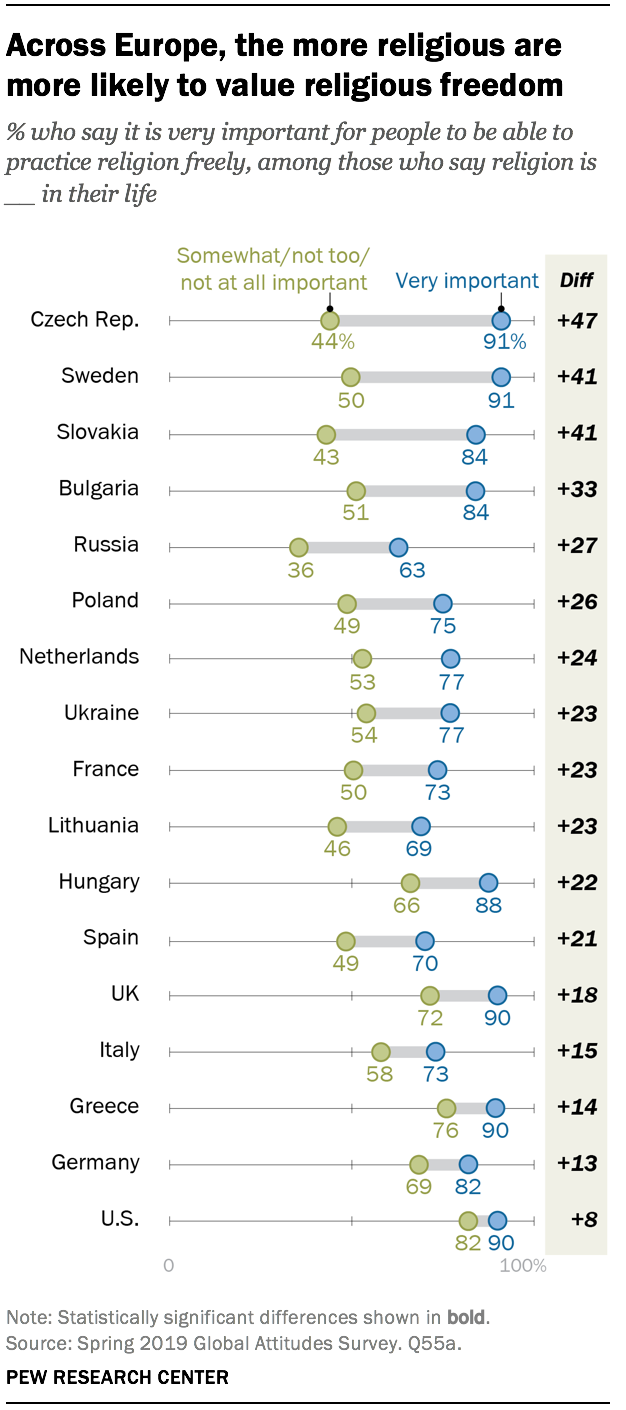
EPP holds largest share of seats in the European Parliament

Parties in the European Parliament are grouped into supranational political groups based on political affiliation. In the current legislative period, which will continue until 2024, there are seven political groups: the Group of the European People’s Party (EPP), the Group of the Progressive Alliance of Socialists and Democrats in the European Parliament (S&D), the European Conservatives and Reformists Group (ECR), Renew Europe Group (RE), the Confederal Group of the European United Left/Nordic Green Left (GUE/NGL), the Group of the Greens/European Free Alliance (Greens/EFA) and Identity and Democracy (ID). There are also non-attached members of parliament (NI) who are not affiliated with any of the political groups.

Political party favorability in Western European countries

Few political parties in Western Europe seen favorably by more than half

Compared with other nations, political parties in the Netherlands receive relatively positive reviews. The Labour Party (PvdA) is seen favorably by 60% of the public, and majorities give favorable ratings for the governing parties Democrats 66 (D66) and the People’s Party for Freedom and Democracy (VVD), with 57% and 55%, respectively. About half (48%) hold a positive view of the Socialist Party (SP). In contrast, the right-wing populist Forum for Democracy (FvD), which won the largest share of seats in the 2019 provincial elections, is seen favorably by 35%. Geert Wilders’ right-wing populist Party for Freedom (PVV) receives positive evaluations from about a quarter of the Dutch.

Sweden’s governing party, the Swedish Social Democratic Party (SAP), is seen favorably by 54% of the country’s population, a 9 percentage point increase from 2018. The Moderate Party is viewed positively by roughly half of Swedes, and the right-wing populist Sweden Democrats get positive reviews from about a quarter of Swedes (26%).

In Germany, a majority of 63% say they have a favorable view of Alliance 90/The Greens, making it the top-rated party in Germany and in the EU. This is a 10 percentage point increase from the share who said the same last year. The two governing parties asked about are seen favorably by about four-in-ten or more Germans, with 47% expressing positive views of the Christian Democratic Union (CDU) and 42% saying the same of the Social Democratic Party of Germany (SPD). The Left is seen positively by 37%, and the right-wing populist Alternative for Germany (AfD) by only 15% of Germans.

Spain’s governing Spanish Socialist Workers’ Party (PSOE), which won the April elections but failed to form a government, receives the most positive reviews in Spain. Roughly half (48%) see the party favorably, a 9-point increase from 2018. Podemos, a left-wing populist party, saw a similar increase, with 38% saying they have a favorable view of the party today compared with 30% last year. The Citizens party is seen positively by a similar share (36%). Vox and the former governing party, the People’s Party (PP), are held in a positive light by 29% and 18%, respectively.

The Liberal Democrats are seen favorably by 47% of Britons, making it the party with the greatest share of positive evaluations in the UK, up 13 percentage points from last year. The Labour Party is seen positively by 33% of Britons, a 12-point drop, and only three-in-ten have positive views of the governing Conservative Party. The right-wing populist UK Independence Party (UKIP) is seen positively by about a quarter of Britons, an increase of 7 points.

Before Italy’s right-wing populist Lega withdrew from a governing coalition with the Five Star Movement (M5S), the party was seen favorably by 44% of Italians. M5S received favorable ratings from four-in-ten. These ratings make the two parties among the most favorably seen populist parties in Europe. Still, this marks a 9 percentage point decline from 2018 for M5S. The other two parties included in the survey, the Democratic Party (PD) and Forza Italia (FI), are seen favorably by only about a fifth of the population (23% and 22%, respectively).

Among the French political parties tested, President Emmanuel Macron’s On the Move/En Marche receives the most positive reviews. A third say they have a favorable view of the party, but this marks a 14 percentage point decline since 2018, when 47% held that view. The Socialist Party and the Republicans (LR) both receive positive evaluations from 26% of the public. Left-wing populist party La France Insoumise receives favorable ratings from a quarter of the French, while Marine Le Pen’s right-wing populist National Rally (FN, formerly known as National Front) is seen positively by 22% of the French, a 10-point increase from 2018. This makes FN the only French party that has seen an increase in the share of people who see it positively.

In Greece, New Democracy (ND) – the party of newly elected Prime Minister Kyriakos Mitsotakis – is perceived positively by the largest share of people, albeit still under half the public.1 With nearly four-in-ten saying they have a favorable view of ND, this is a 15 percentage point increase from 2018. The former governing party, Syriza, saw a similar increase, with 33% of Greeks holding a positive view of the party this year compared with only 16% last year. Movement for Change (Kinima Allagis-KINAL) is seen favorably by 16% of Greeks, and the right-wing populist Golden Dawn (XA) by only 7%.

Political party favorability in Central and Eastern European countries

All Central and Eastern European political parties rated favorably by fewer than half

Slovaks feel most positively about the right-wing populist Slovak National Party (SNS), one of the country’s governing parties. This party is seen favorably by 41% of the population. Freedom and Solidarity (SaS) is similarly seen favorably by around four-in-ten (39%). In contrast, two other parties asked about in the survey are only viewed in a positive light by around one-third of Slovaks: the right-wing populist Ordinary People and Independent Personalities (OLaNo-NOVA), and Direction–Social Democracy (Smer-SD).

Ahead of parliamentary elections in fall 2019, 45% of Poles express favorable views of Law and Justice (PiS), the current right-wing populist governing party. Civic Platform (PO), founded by former prime minister Donald Tusk, comes second with 36% of Poles seeing it favorably, a 7 percentage point increase from 2018. Nowoczesna has also seen a large increase in its favorability rating, with 32% of Poles having a favorable view of the party now compared with 22% in 2018. The other two parties, Polish People’s Party (PSL) and Kukiz’15, both members of the Polish Coalition, receive similar shares of positive evaluations (36% and 35%, respectively).

The share of Czechs with favorable opinions of each political party is also relatively low. The governing party Action of Dissatisfied Citizens (ANO 2011) – a centrist populist party that is part of Renew Europe in the European Parliament – receives the largest proportion of positive views (41%). The Czech Pirate Party (Pirati) is seen positively by 34%, while the right-wing populist Freedom and Direct Democracy (SPD) and liberal-conservative Civic Democratic Party (ODS) are viewed similarly (28% and 27%, respectively).

Views of the political parties show little variation in Lithuania; the shares of Lithuanians expressing favorable views of each party fall within a 6 percentage point range. The Social Democratic Party of Lithuania (LSDP) and center-right Homeland Union–Lithuanian Christian Democrats (TS-LKD) are tied, with both being seen favorably by 33% of Lithuanians. The Lithuanian Farmers and Greens Union (LVŽS), which is also in the governing coalition, is seen positively by 29%, and the Liberal Movement of the Republic of Lithuania (LRLS) by 27%.

In Bulgaria, few see the three parties included in the survey favorably. The governing party Citizens for European Development of Bulgaria (GERB) is seen favorably by only 36% of the population. The Bulgarian Socialist Party (BSP) comes in second (26% favorable), and the Movement for Rights and Freedoms (DPS) receives the smallest share of positive evaluations (22%).

The governing party in Hungary, Fidesz, is seen far more positively than the two other Hungarian political parties asked about in the survey. Led by Prime Minister Viktor Orban, the right-wing populist party garners favorable views from 46% of Hungarians, a rating that is unchanged from last year. In comparison, 13% and 12% of Hungarians have positive views of the right-wing populist Jobbik (Movement for a Better Hungary) and social-democratic Hungarian Socialist Party (MSZP), respectively. For Jobbik, this is a 6 percentage point decline from the share who saw it favorably in 2018.

Acknowledgments

This report is a collaborative effort based on the input and analysis of the following individuals.   

Richard Wike, Director, Global Attitudes Research Jacob Poushter, Associate Director, Global Attitudes Research Laura Silver, Senior Researcher Alexandra Castillo, Research Associate Kat Devlin, Research Associate Janell Fetterolf, Research Associate Moira Fagan, Research Analyst Christine Huang, Research Assistant Christine Tamir, Research Assistant    

James Bell, Vice President, Global Strategy Jeremiah Cha, Research Assistant Andrew Cohen, Director, Communications Stefan S. Cornibert, Communications Manager Claudia Deane, Vice President, Research Michael Keegan, Senior Information Graphics Designer David Kent, Copy Editor Colin Lahiff, Communications Associate Clark Letterman, Senior Researcher Travis Mitchell, Digital Producer Dan Morrison, Vice President, Communications Martha McRoy, Research Methodologist Mara Mordecai, Research Assistant Patrick Moynihan, Associate Director, International Research Methods Stacy Pancratz, Research Methodologist Audrey Powers, Senior Operations Associate Stacy Rosenberg, Associate Director, Digital Production

Methodology

About Pew Research Center’s Spring 2019 Global Attitudes Survey

Results for the survey are based on telephone and face-to-face interviews conducted under the direction of Gallup and Abt Associates. The results are based on national samples, unless otherwise noted. More details about our international survey methodology and country-specific sample designs are available here.

About Times Mirror Center’s Spring 1991 Pulse of Europe Survey

This report reexamines many key questions included in a survey conducted April 15 to May 31, 1991, by the Times Mirror Center for the People & the Press (the forerunner of Pew Research Center). For that survey, interviews were conducted in local languages with 12,569 people in Bulgaria, Czechoslovakia, France, Germany, Hungary, Italy, Poland, Spain and the United Kingdom, as well as three republics of the Soviet Union: Lithuania, Russia and Ukraine. All samples were nationally representative, with the exception of Russia, which did not include respondents living east of the Ural Mountains.

Methodological notes:

  • Even though in 1991 Czechoslovakia was surveyed as a single country, for the purposes of this report, we show the 1991 results for the geographic areas that correspond to the present-day Czech Republic and Slovakia. The 1991 survey included 638 responses from geographic areas corresponding to the present-day Czech Republic and 282 responses from areas corresponding to present-day Slovakia.
  • Survey coverage in Ukraine since 2015 has excluded Crimea, as well as areas under conflict in the eastern districts of Luhansk and Donetsk. These areas were included in the survey in 2014 and earlier. Throughout this report, we include all years for comparison, even as these deviations reflect changes in the composition of the Ukrainian population. In all years when Crimea was included, it represented less than 10% of the total weighted sample, limiting the effect of its exclusion on survey estimates for Ukraine as a whole.
  • In 1991, Germany was a reunited country. Analysis in this report compares results for geographic areas that correspond to the former East Germany, including East Berlin, and former West Germany, including West Berlin.
  • In 1991, the adult population was defined as ages 16 years and older in Lithuania and the UK. The Hungarian sample from that year also includes a small number of 17-year-old respondents. The total number of respondents under 18 years old in the 1991 survey is as follows:
    • Hungary: 2
    • Lithuania: 20
    • UK: 12

In all other countries and survey years, the adult population is defined as ages 18 and older.

The following pages present the details on the methodology for the 1991 survey, including information on sample design, survey mode, the languages in which the interviews were conducted, fieldwork dates, sample sizes and the margins of sampling error based on all interviews conducted in that country.


Appendix A: Classifying European populist parties

Classifying parties as populist

Although experts generally agree that populist political leaders or parties display high levels of anti-elitism, definitions of populism vary. We use three measures to classify populist parties: anti-elite ratings from the 2017 Chapel Hill Expert Survey (CHES), Inglehart and Norris’s populism party scale and The PopuList. We define a party as populist when at least two of these three measures classify it as such.

CHES, which was carried out in January and February 2018, asked 228 regional experts to evaluate the 2017 positions of 132 European political parties across 14 European Union member states. CHES results are regularly used by academics to classify parties with regard to their left-right ideological leanings, their key party platform positions and their degree of populism, among other things.

We measure anti-elitism using an average of two variables in the CHES data. First, we used “PEOPLE_VS_ELITE,” which asked the experts to measure the parties with regard to their position on direct vs. representative democracy, where 0 means that the parties support elected officeholders making the most important decisions and 10 means that “the people,” not politicians, should make the most important decisions. Second, we used “ANTIELITE_SALIENCE,” which is a measure of the salience of anti-establishment and anti-elite rhetoric for that particular party, with 0 meaning not at all salient and 10 meaning extremely salient. The average of these two measures is shown in the table below as “anti-elitism.” In all countries, we consider parties that score above a 7.0 as “populist.”

[European Parliament]

Inglehart and Norris emphasize the cultural views of populist parties and created a populist party scale using the 2014 CHES data for classification.2 This scale aggregates expert ratings of the party on the following positions and attitudes: 1) support for traditional social values, 2) opposition to liberal lifestyles, 3) promotion of nationalism, 4) favorable toward tough law and order, 5) favorable toward assimilation for immigrants and asylum seekers, 6) support for restrictive immigration policies, 7) opposition to more rights for ethnic minorities, 8) support for religious principles in politics and 9) support for rural interests. The scale ranges from 0 to 100, and parties with a score of more than 80 are classified as populist.

The PopuList is an ongoing project to classify European political parties as populist, far right, far left and/or euroskeptic. The project specifically looks at parties that “obtained at least 2% of the vote in at least one national parliamentary election since 1998.” It is based on collaboration between academic experts and journalists. The PopuList classifies parties that emphasize the will of the people against the elite as populist.3

Two parties are missing data for at least two of the measures used for classification but are still included for analysis in the report. Vox in Spain is considered a right-wing populist partyby experts, but was not included in any of the measures used due to its relatively recent rise in popularity. Similarly, Forum for Democracy (FvD) in the Netherlands did not achieve a large enough share of the votes to be included in the PopuList analysis and was founded in 2016, after data collection for the Inglehart and Norris analysis. Experts in the most recent round of CHES classify this party as a right-wing populist party, and its score on the anti-elitism scale exceeds the cut-off.

Classifying parties as left, right or center

We can further classify these traditional and populist parties into three groups: left, right and center. When classifying parties based on ideology, we relied on the variable “LRGEN” in the CHES dataset, which asked experts to rate the positions of each party in terms of its overall ideological stance, with 0 meaning extreme left, 5 meaning center and 10 meaning extreme right. We define left parties as those that score below 4.5 and right parties as those above 5.5. Center parties have ratings between 4.5 and 5.5.

European populist party classifications

Appendix B: Governing party categorization

For this report, we grouped people into two political categories: those who support the governing political party (or parties) and those who do not. These categories were coded based on the party or parties in power at the time the survey was fielded, and on respondents’ answers to a question asking them which political party, if any, they identified with in their country.4

In countries where multiple political parties govern in coalition, survey respondents who indicated support for any party in the coalition were grouped together. In Germany, for example, where the center-right CDU/CSU governed with the center-left SPD at the time of the survey, supporters of each of the three parties were grouped together. In countries where different political parties occupy the executive and legislative branches of government, the party holding the executive branch was considered the governing party.

Survey respondents who did not indicate support for any political party, or who refused to identify with one, were considered as not supporting the government in power. Below is a table that outlines the governing political parties in each country.

Appendix: Political categorization