Pew Research Center

FOR RELEASE JUNE 19, 2018

Social Media Use Continues to Rise in Developing Countries but Plateaus Across Developed Ones

Digital divides remain, both within and across countries

BY Jacob Poushter, Caldwell Bishop and Hanyu Chwe

FOR MEDIA OR OTHER INQUIRIES:

Communications Department
202.419.4372
www.pewresearch.org

RECOMMENDED CITATION

Pew Research Center, June 2018, "Social Media Use Continues to Rise in Developing Countries but Plateaus Across Developed Ones"

About Pew Research Center

Pew Research Center is a nonpartisan, nonadvocacy fact tank that informs the public about the issues, attitudes and trends shaping the world. It does not take policy positions. The Center conducts public opinion polling, demographic research, computational social science research and other data-driven research. It studies politics and policy; news habits and media; the internet and technology; religion; race and ethnicity; international affairs; social, demographic and economic trends; science; research methodology and data science; and immigration and migration. Pew Research Center is a subsidiary of The Pew Charitable Trusts, its primary funder.

© Pew Research Center 2026

Table of contents

  • About Pew Research Center
  • Social Media Use Continues to Rise in Developing Countries but Plateaus Across Developed Ones
  • 1. Across 39 countries, three-quarters say they use the internet
  • 2. Smartphone ownership on the rise in emerging economies
  • 3. Social network adoption varies widely by country
  • Acknowledgments
  • Methodology
  • Appendix A: Economic categorization
  • Appendix B: Country-specific examples of smartphones
  • Appendix C: Country-specific examples of social networking sites
  • Appendix D: Detailed tables

Social Media Use Continues to Rise in Developing Countries but Plateaus Across Developed Ones

Digital divides remain, both within and across countries

In recent years, there have been doubts raised about the overall benefits of internet access and social media use. Concerns or no, the share of people who use the internet or own a smartphone continues to expand in the developing world and remains high in developed nations. When it comes to social media use, people in emerging and developing markets are fast approaching levels seen in more advanced economies. In addition, as people in advanced economies reach the upper bounds of internet penetration, the digital divide continues to narrow between wealthy and developing countries.
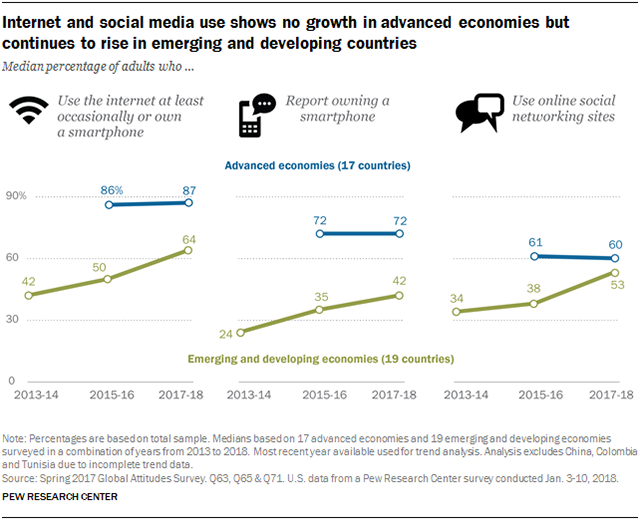
Charts showing that internet and social media use shows no growth in advanced economies but continues to rise in emerging and developing countries.

There has been a steady increase in internet use over the past five years among the 19 emerging and developing economies surveyed. Between 2013 and 2014, a median of 42% across these countries said they accessed the internet at least occasionally or owned a smartphone. By 2017, a median of 64% were online. Meanwhile, internet use among the 17 advanced economies surveyed has remained relatively flat, with a median of 87% across these nations using the internet at least occasionally in 2017, similar to the 86% who said this in 2015 or 2016.

A similar story is seen in smartphone use. In 2013-14, about a quarter of people in emerging and developing economies reported owning a smartphone, i.e., a mobile phone that can access the internet and apps. By 2017, that share had risen to 42%. Among the advanced economies, 72% report owning a smartphone in 2017, the same rate as in 2015-16.

Social media use has also increased in emerging markets. In 2015-16, roughly four-in-ten adults across the emerging nations surveyed said they used social networking sites. As of 2017, 53% use social media. Over the same period, social media use has been generally level in many of the advanced economies surveyed.

Despite growing internet use and smartphone ownership, the world remains digitally divided. It is still the case, for example, that people in wealthier countries have higher rates of internet use and smartphone ownership. However, among people who use the internet, those in developing countries often turn out to be more likely than their counterparts in advanced economies to network via platforms like Facebook and Twitter.

Within countries, too, digital divides persist. Age, education, income and in some cases gender still differentiate who uses the internet and who does not, who is active on social media and who is inactive.

These are among the major findings of a Pew Research Center survey conducted in 37 countries from Feb. 16 to May 8, 2017, among 40,448 respondents. It also includes analysis from Pew Research Center surveys conducted in the United States among 2,002 people in 2018 and in China among 3,154 people in 2016.

Majorities use the internet in much of the world, but sub-Saharan Africa and India still lag

While the gap in internet use between emerging and advanced economies has narrowed in recent years, there are still large swaths of the world where significant numbers of citizens do not use the internet.

Internet penetration rates – as measured by internet use or smartphone ownership – remain high in North America and much of Europe, as well as in parts of the Asia-Pacific. Among the countries surveyed, South Korea stands out as the most heavily connected society, with 96% of adults reporting internet use. Yet, others are not far behind. In Australia, the Netherlands, Sweden, Canada, the U.S., Israel, the United Kingdom, Germany, France and Spain, roughly nine-in-ten report internet use.
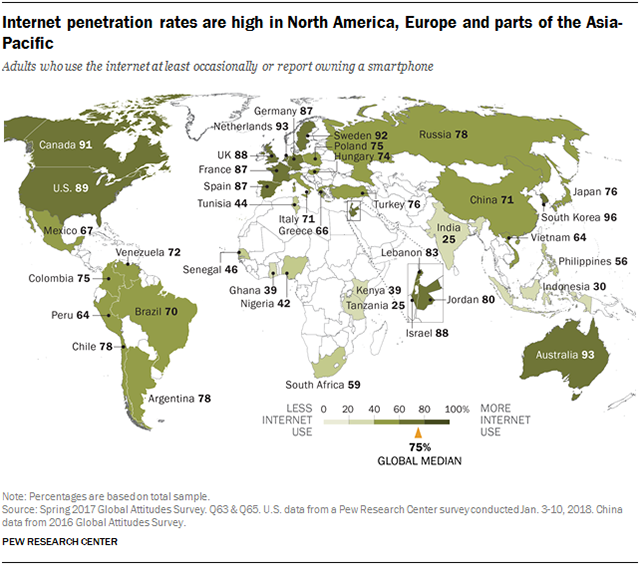
Map showing that internet penetration rates are high in North America, Europe and parts of the Asia-Pacific.

Internet use continues to lag in many developing economies. Only one-in-four Indians, for instance, report using the internet or owning a smartphone. Regionally, sub-Saharan Africa is one of the least wired parts of the globe.

The global digital divide is largely an economic story. Richer countries, as measured by gross domestic product per capita (purchasing power parity), tend to have higher rates of internet use, while poorer countries tend to have lower rates. This pattern has been consistent across prior surveys and remains today for both internet use and smartphone ownership.
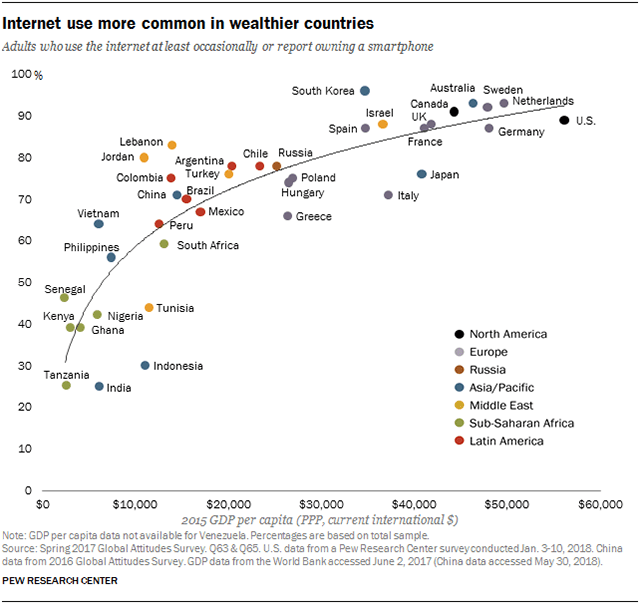
Chart showing that internet use is more common in wealthier countries.

Smartphones are increasingly common around the globe

Smartphones – mobile phones that can use the internet and access apps – are very common around the world. Across the 39 countries surveyed, a median of 59% report owning a smartphone, such as a Galaxy or iPhone (see Appendix B for country-specific details). A further 31% report owning another type of mobile device, such as a flip or feature phone. Only about one-in-ten (8%) across the 39 countries report having no mobile device at all.

The pattern of smartphone ownership is similar to internet use, with people in wealthier countries exhibiting higher rates of ownership. But the gap in smartphone ownership is narrower than in the past, as many move directly from not owning a phone at all to owning a mobile device. Landline phones are simply being skipped by large numbers of people in emerging and developing markets.
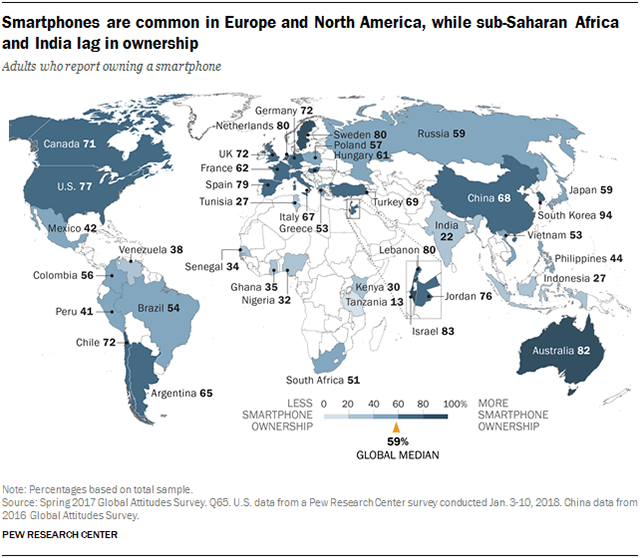
Map showing that smartphones are common in Europe and North America, while sub-Saharan Africa and India lag in ownership.

Despite the increasing levels of smartphone use, ownership still lags in India, Indonesia and Africa. Among these, only in South Africa do at least half report owning a smartphone.

Rate of social media use varies in developed world

Social media is popular among many internet users. Usage rates are high in many of the advanced economies surveyed. This includes two-thirds or more of all adults in the U.S., Australia, South Korea, Canada, Israel and Sweden.

But high rates of social media use are also found in emerging and developing economies. For example, 75% of adult Jordanians say they use social media; this means that of the eight-in-ten Jordanians who use the internet, 94% are active on social media platforms. Social media use is also widespread among internet users in the Philippines, Indonesia, Lebanon and Tunisia.
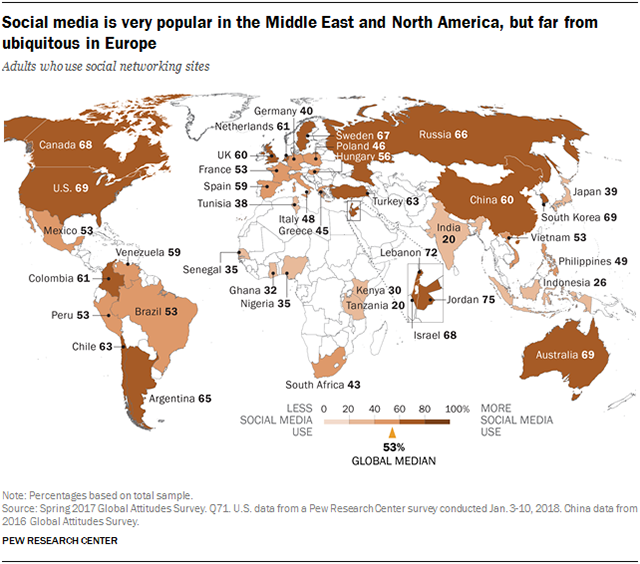
Map showing that social media is very popular in the Middle East and North America, but far from ubiquitous in Europe.

In contrast, in some countries with high rates of internet use, relatively small shares of adults report using social media. In Germany, for instance, where 87% of people use the internet, less than half say they use social media.

Tracking internet use, smartphone ownership and social media use over time

The interactive below provides data for levels of internet use, smartphone ownership and social media usage over time. All figures are based on total sample and include all data available for each year. You can also sort data by country.

[ps_interactive id=”40312″ title=”true”]
1. Across 39 countries, three-quarters say they use the internet

Access to the internet is considered so vital that in 2016 the United Nations passed a nonbinding resolution to make disruption of internet access a violation of human rights. And while governments and private companies are working to increase access to the internet the world over, many in emerging and developing countries remain non-internet users.

Across the 39 countries, a median of 75% say they either use the internet occasionally or own a smartphone, our definition of internet use. In many advanced economies, nine-in-ten or more use the internet, led by South Korea (96%). Greece (66%) is the only advanced economy surveyed where fewer than seven-in-ten report using the internet. Conversely, internet use is below seven-in-ten in 13 of the 22 emerging and developing economies surveyed. Among these countries, it is lowest in India and Tanzania, at a quarter of the adult population.

Regionally, internet use is lowest in sub-Saharan Africa, where a median of 41% across six countries use the internet. South Africa (59%) is the only country in the region where at least half the population is online.

Although they still lag behind most advanced economies in internet use, emerging and developing economies have seen greater gains in recent years. There has been a significant increase in internet use in 11 of the 19 emerging or developing economies surveyed since 2015.

The most substantial increases in internet use since 2015 were in South Africa and Lebanon, which each experienced a 17-percentage-point increase. The Philippines and Senegal also saw large increases in internet penetration since 2015.

Globally, young people use the internet more than older generations

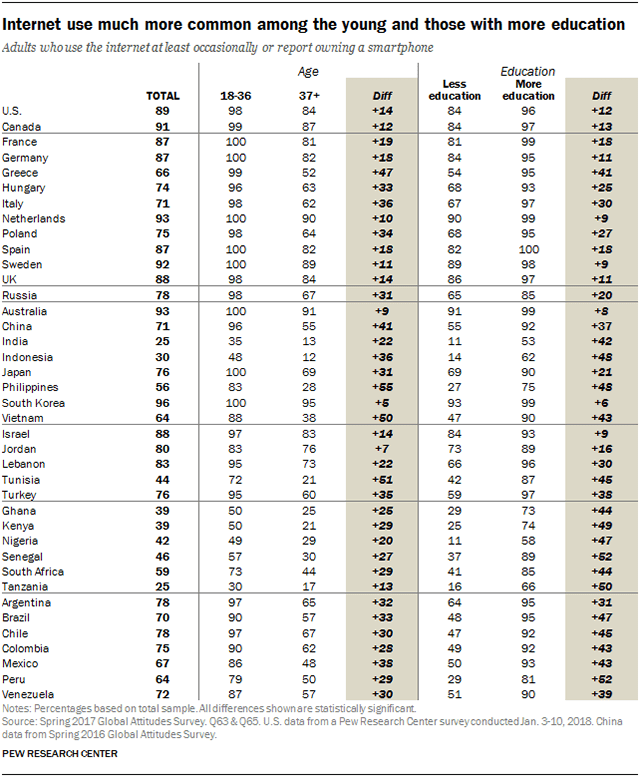
Across the countries surveyed, young people (18 to 36 years old as of 2017) are more likely than older generations to use the internet. Those with more education are also more likely to use the internet than less-educated adults.

In three countries, there is at least 50-percentage-point gap between younger and older generations: the Philippines (55-percentage-point gap), Tunisia (51 points) and Vietnam (50 points). Among advanced economies, the largest generational divides in internet use are found in Greece (47-point gap), Italy (36 points), Poland (34 points) and Hungary (33 points).

Education is also a dividing factor on internet use, with significant gaps between those with more and less education in all countries surveyed. In all but five, these differences are in the double digits.

Table showing that internet use is much more common among the young and those with more education.

While age and education gaps on internet use were found in all countries surveyed, gender gaps are far less pervasive. There are significant differences between men’s and women’s use of the internet in just 12 of the countries surveyed. And in only one of these 12 countries – Lebanon – are women more likely than men to use the internet (87% and 79%, respectively).

The gender gap is most apparent in Africa, with men more likely than women to use the internet in Tunisia, Ghana, Kenya, Nigeria, Tanzania and Senegal. There are also double-digit gender gaps on internet use in India and Japan.

2. Smartphone ownership on the rise in emerging economies

Mobile phones, like the internet, play an important role in modern society. And in poorer countries where fixed internet use is not as widespread, mobile phones can be extremely important tools – whether helping poor people gain access to financial services or providing much-needed assistance with health or agricultural needs.

While mobile phone ownership is widespread across the countries surveyed, smartphone ownership is far less common. At least three-in-four or more adults report owning a mobile phone in every country surveyed. But while a global median of 59% report owning a smartphone, in just nine of the countries surveyed do about three-quarters or more say they own a smartphone.

In 12 of the 22 emerging and developing nations surveyed, fewer than 50% report owning a smartphone. And in India and Tanzania, fewer than one-quarter report owning smartphones, the lowest among the countries surveyed.

Among emerging and developing nations, Middle Eastern countries in particular have high rates of smartphone ownership, including 80% in Lebanon and 76% in Jordan.

Similar to internet use, smartphone ownership is lowest in sub-Saharan Africa, where a median of 33% report owning a smartphone.

Asia-Pacific (53%) and Latin America (54%) are closer to Europe (70%) in median smartphone ownership than they are to sub-Saharan Africa.

Smartphone ownership growing

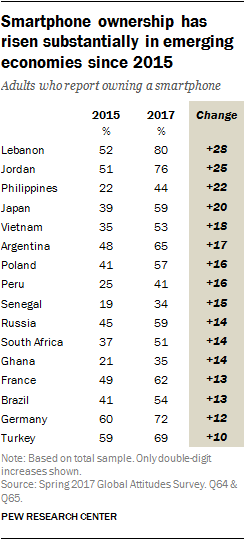
Table showing that smartphone ownership has risen substantially in emerging economies since 2015.

Smartphone ownership has been on the rise since 2015, with especially large increases occurring in Lebanon (+28 percentage points), Jordan (+25) and the Philippines (+22).

Similar to internet use, smartphone ownership varies by age and educational attainment in every country surveyed. The largest generational divide is in Greece, where 93% of those ages 18 to 36 own a smartphone, compared with 38% of those 37 or older.

The educational divide in smartphone ownership is much more prevalent among emerging and developing economies. The gap in smartphone ownership between those with more and less education is 40 percentage points or more in 12 of the countries surveyed. Just one of these 12 countries is an advanced economy: Greece (40-point gap).

There is also a significant divide by individual income levels when it comes to smartphone ownership. The biggest income gap is in Peru, where six-in-ten among those with higher incomes say they own a smartphone, compared with only 24% among those with lower incomes. But significant, double-digit divides by income on smartphone ownership exist in all the other countries surveyed, with the exception of Lebanon.

Gender is a less common divide in smartphone ownership, but still exists in 13 of the countries surveyed. Men are at least 10 percentage points more likely than women to own smartphones in India, Mexico, Ghana, Kenya, Chile and Hungary. Notably, Lebanese women are more likely than men to own a smartphone, while men are more likely than women to own a basic mobile phone.

3. Social network adoption varies widely by country

Across 39 countries, a median of 53% say they use online social networking sites like Facebook or Twitter. However, that figure conceals large differences around the world, and the relationship between social media use and national wealth is not as strong as it is for overall internet use and smartphone ownership.

For example, the Middle East stands out for its relatively high levels of social media usage compared with other regions, despite the fact that only one country there, Israel, is an advanced economy. Across the five Middle Eastern and North African countries surveyed, a median of 68% say they use social networking sites. And across the seven Latin American countries surveyed, none of which is considered an advanced economy, 59% use social media, compared with 55% across the 10 European countries surveyed, all considered developed.

Some large advanced economies also stand out for relatively low levels of social media use. In particular, in Germany (40%) and Japan (39%), about four-in-ten use social media – similar to the percentages in South Africa (43%) and Tunisia (38%).

Just one-in-five adults in India and Tanzania use social networks, and all five sub-Saharan African countries surveyed report social media use below the global median.

When looking at social media use among internet users, many countries with relatively limited internet use have seen their share of social media users skyrocket relative to advanced economies. In the Philippines, for example, while overall levels of social media use stand at about half of the population, among internet users, that figure is closer to nine-in-ten (88%). And in Jordan, an astounding 94% of internet users are also on social networking sites. Only 46% of internet users in Germany use social media, the lowest such measure among the countries surveyed.

In a few countries, social media adoption rose dramatically between 2015 and 2017. For example, only 49% of Lebanese adults used social media in 2015; in 2017 that number is 72%. Similarly, just two years ago only 51% of South Korean adults were on social media, compared with almost 69% in 2017.

Generational divide on social media use

Across the globe, younger adults are much more likely to report using social media than their older counterparts. For example, in the Philippines, nearly eight-in-ten adults age 36 and under (78%) are on social media, compared with just two-in-ten older adults – a 58-percentage-point difference. This generational divide is prominent in every country surveyed.

Divergent aging patterns might also help explain variations in social media use across certain countries. For example, in Japan and Germany, social networking sites are quite popular among young adults; 82% and 74% of those ages 18 to 36 are on social media, respectively. However, the median age is 47 in both Japan and Germany. There simply aren’t many young adults in these countries.

By contrast, like many Arab countries, Lebanon and Jordan are experiencing a “youth bulge”: The median age is 31 in Lebanon and 23 in Jordan. The age differences in these countries aren’t as drastic as in Germany and Japan – a 34-point gap in Lebanon and 8 points in Jordan – but the large youth population contributes to high social media use.

In some emerging and developing countries, men are much more likely to use social media – in Tunisia, for example, 49% of men use social networking sites, compared with just 28% of women.

However, in advanced countries, social networking is often more popular among women. In the U.S., Spain, Sweden and Israel, women are more likely to use social networking sites, even when accounting for internet use. In Sweden, more women are on social media than men (72% to 63%), even though men are more likely to use the internet than women (94% to 90%).

There are significant differences in social media use across other demographic groups. Those with higher levels of education and those with higher incomes are more likely to use social network sites.

Acknowledgments

This report is a collaborative effort based on the input and analysis of the following individuals.

Jacob Poushter, Senior Researcher Caldwell Bishop, Former Research Associate Hanyu Chwe, Former Research Assistant

Danielle Alberti, Web Developer James Bell, Vice President, Global Strategy      Abigail Chen, Intern     Stefan Cornibert, Communications Manager Danielle Cuddington, Research Analyst Claudia Deane, Vice President, Research     Kat Devlin, Research Associate Moira Fagan, Research Assistant Janell Fetterolf, Research Associate Courtney Johnson, Research Associate Michael Keegan, Information Graphics Designer David Kent, Copy Editor                                                                Martha McRoy, Research Methodologist Patrick Moynihan, Associate Director, International Research Methods Courtney Nelson, Research Assistant                     Audrey Powers, Administrative Manager Ariana Rodriguez-Gitler, Digital Producer                 Laura Silver, Senior Researcher Katie Simmons, Associate Director, Research                        Rhonda Stewart, Senior Communications Manager           Bruce Stokes, Director, Global Economic Attitudes Kyle Taylor, Research Assistant Richard Wike, Director, Global Attitudes Research

Methodology

About Pew Research Center’s Spring 2017 Global Attitudes Survey

Results for the survey are based on telephone and face-to-face interviews conducted under the direction of D3 Systems Inc., ORB International, Princeton Survey Research Associates International, Kantar Public UK and Voices! Research & Consultancy. The results are based on national samples, unless otherwise noted. More details about our international survey methodology and country-specific sample designs are available here.

Detailed information on survey methods for this report

General information on international survey research

Appendix A: Economic categorization

For this report we grouped countries into three economic categories: “advanced,” “emerging” and “developing.” These categories are fairly common in specialized and popular discussions and are helpful for analyzing how public attitudes vary with economic circumstances. However, no single, agreed upon scheme exists for placing countries into these three categories. For example, even the World Bank and International Monetary Fund do not always agree on how to categorize economies.

In creating our economic classification of the 39 countries in our survey, we relied on multiple sources and criteria. Specifically, we were guided by: World Bank income classifications; classifications of emerging markets by other multinational organizations, such as the International Monetary Fund; per capita gross domestic product (GDP); total size of the country’s economy, as measured by GDP; and average GDP growth rate between 2010 and 2015.

Below is a table that outlines the countries that fall into each of the three categories. The table includes for each country the World Bank income classification, the 2015 GDP per capita based on purchasing power parity (PPP) in current prices, the 2015 GDP in current U.S. dollars and the average GDP growth rate between 2010 and 2015.

Appendix B: Country-specific examples of smartphones

Country-specific examples of smartphones

Some cellphones are called “smartphones” because they can access the internet and apps. Is your cellphone a smartphone, such as ___ ?

Canada iPhone, Android, Blackberry, Windows, Samsung Galaxy
France iPhone, BlackBerry, Android, Windows phone, Wiko or Samsung S4
Germany iPhone , Android, Blackberry, Windows phone, Samsung Galaxy or similar
Greece iPhone, Android, Blackberry, Windows phone or Samsung Galaxy
Hungary iPhone, Android, Blackberry, Windows phone, Samsung Galaxy or Sony Xperia
Italy iPhone, Android, Blackberry, Windows phone or Samsung Galaxy
Netherlands iPhone, Android, Blackberry, Windows phone or Samsung Galaxy
Poland iPhone, Blackberry, Samsung Galaxy or other smartphone with Android or Windows phone operating system
Spain iPhone, Android, Blackberry, Windows phone or Samsung Galaxy
Sweden iPhone, Android, Blackberry, Windows phone, Samsung Galaxy or similar
UK iPhone, Android, Blackberry, Windows phone, Samsung, or other Android phone
Russia iPhone, Android, Blackberry, Windows phone, Samsung Galaxy, HTC, LG
Australia iPhone, Android, Blackberry, Windows phone, Samsung Galaxy, etc.
India iPhone, Android, Blackberry, Windows phone, Samsung smartphone, or Micromax
Indonesia iPhone, Android, Blackberry, Windows phone
Japan iPhone, Android, Blackberry, Windows phone, Galaxy, Xperia etc.
Philippines iPhone, Android, Blackberry, Windows phone, Samsung S3, Sony Ericsson Xperia, HTC
South Korea No examples listed
Vietnam iPhone, Android, Blackberry, Windows phone, Samsung Galaxy, Nokia Lumia
Israel iPhone, Samsung Galaxy, LG, HTC, Sony Android
Jordan iPhone, Blackberry, Samsung Galaxy, Android, Windows phone
Lebanon iPhone, Blackberry, Samsung Galaxy, Android, Windows phone
Tunisia iPhone, Android, Blackberry, Windows phone, Samsung
Turkey iPhone, Android, Blackberry, Windows phone, Samsung Galaxy, Nokia E5, Venus and Huawei
Ghana iPhone, Android, Blackberry, Windows phone
Kenya iPhone, Android, Blackberry, Windows phone
Nigeria iPhone, Android, Blackberry, Windows phone
Senegal iPhone, Android, Blackberry, Windows phone
South Africa iPhone, Android, Blackberry, Windows phone
Tanzania iPhone, Android, Blackberry, Windows phone
Argentina iPhone, Samsung Galaxy (Android), Blackberry, Nokia Lumia (Windows)
Brazil iPhone, Android (for example, Samsung Galaxy), Blackberry, Windows Phone, etc.
Chile iPhone, Samsung Galaxy (Android), Blackberry, Nokia Lumia (Windows)
Colombia iPhone, Blackberry, Samsung (Android), HTC or Nokia Lumia (Windows)
Mexico iPhone, Blackberry, Galaxy (Android), Nokia Lumia (Windows)
Peru iPhone, Samsung Galaxy (Android), Blackberry, Nokia Lumia (Windows)
Venezuela iPhone, Samsung Galaxy (Android), Blackberry, Nokia Lumia (Windows)

Source: Spring 2017 Global Attitudes Survey. Q65.

Pew Research Center

Appendix C: Country-specific examples of social networking sites

Country-specific examples of social networking sites

Do you ever use online social networking sites like ___ ?

Canada Facebook, Twitter or Instagram
France Facebook, Twitter or Dailymotion
Germany Facebook, Twitter, Xing or Instagram
Greece Facebook, Twitter or Instagram
Hungary Facebook, Twitter or Vimeo
Italy Facebook or Twitter
Netherlands Facebook, Twitter or Instagram
Poland Facebook or Twitter
Spain Facebook or Twitter
Sweden Facebook, Twitter or Instagram
UK Facebook, Twitter or Instagram
Russia Facebook, Twitter, Odnoklassniki, Vkontakte, Instagram, Moi Mir or Moi Krug
Australia Facebook, Twitter, Instagram, etc.
India Facebook or Twitter
Indonesia Facebook, Twitter, Path or LinkedIn
Japan Facebook or Twitter
Philippines Facebook, Twitter, Plurk, Google+ or LinkedIn
South Korea Facebook, Twitter, Naver, Band or Kakao Story
Vietnam Facebook, Twitter, Google+, LinkedIn or Zingme
Israel Facebook, Twitter, Instagram, LinkedIn, etc. (LinkedIn not included in Arabic translation)
Jordan Facebook, Twitter or Instagram
Lebanon Facebook, Twitter or Instagram
Tunisia Facebook, Twitter or Instagram
Turkey Facebook, Twitter, Pinterest, Snapchat or Instagram
Ghana Facebook, Twitter, Instagram, LinkedIn, Hi5, Badoo, WhatsApp, YouTube, SnapChat or Skype
Kenya Facebook, Twitter or WhatsApp
Nigeria Facebook, Twitter, Instagram, Linda Ikeji Social or LinkedIn
Senegal Facebook or Twitter
South Africa Facebook, Twitter, Instagram or Pinterest
Tanzania Facebook, Twitter, Instagram or Pinterest
Argentina Facebook, Twitter, LinkedIn, Instagram, etc.
Brazil Facebook, Twitter or Orkut
Chile Facebook, Twitter, Instagram, etc.
Colombia Facebook, Twitter or Instagram
Mexico Facebook, Twitter, Myspace or Instagram
Peru Facebook, Twitter, Instagram or LinkedIn
Venezuela Facebook, Twitter or Instagram

Source: Spring 2017 Global Attitudes Survey. Q71.

Pew Research Center

Appendix D: Detailed tables

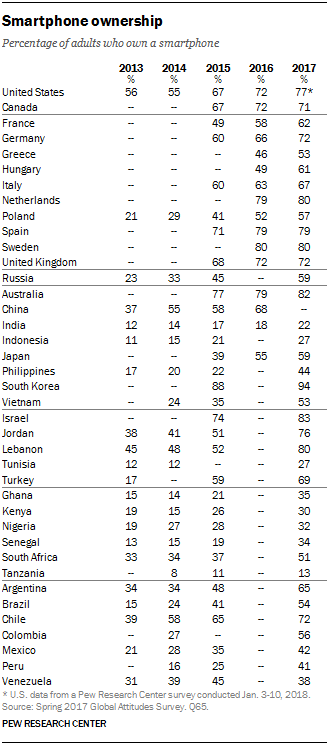
Table showing smartphone ownership worldwide over time.
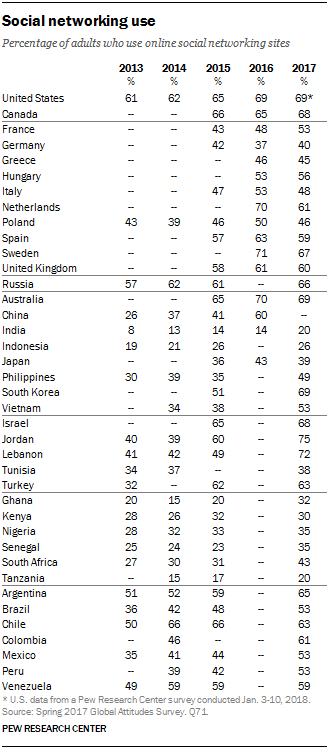
Table showing social networking use worldwide over time.