Pew Research Center

FOR RELEASE JANUARY 11, 2018

Publics Globally Want Unbiased News Coverage, but Are Divided on Whether Their News Media Deliver

Deep political divides in many nations on satisfaction with news media; greatest is in the U.S.
BY Amy Mitchell, Katie Simmons, Katerina Eva Matsa and Laura Silver

FOR MEDIA OR OTHER INQUIRIES:

Communications Department
202.419.4372
www.pewresearch.org

RECOMMENDED CITATION

Pew Research Center, January 2018, "Publics Globally Want Unbiased News Coverage, but Are Divided on Whether Their News Media Deliver"

About Pew Research Center

Pew Research Center is a nonpartisan, nonadvocacy fact tank that informs the public about the issues, attitudes and trends shaping the world. It does not take policy positions. The Center conducts public opinion polling, demographic research, computational social science research and other data-driven research. It studies politics and policy; news habits and media; the internet and technology; religion; race and ethnicity; international affairs; social, demographic and economic trends; science; research methodology and data science; and immigration and migration. Pew Research Center is a subsidiary of The Pew Charitable Trusts, its primary funder.

© Pew Research Center 2026

Table of contents

  • About Pew Research Center
  • Publics Globally Want Unbiased News Coverage, but Are Divided on Whether Their News Media Deliver
  • 1. Global publics want politically balanced news, but do not think their news media are doing very well in this area
  • 2. Publics around the world follow national and local news more closely than international
  • 3. People in poorer countries just as likely to use social media for news as those in wealthier countries
  • Methodology
  • Acknowledgments
  • Appendix A: Detailed tables
  • Appendix B: Political categorization
  • Appendix C: Economic categorization
  • Appendix D: Country-specific examples of social media

Publics Globally Want Unbiased News Coverage, but Are Divided on Whether Their News Media Deliver

Deep political divides in many nations on satisfaction with news media; greatest is in the U.S.

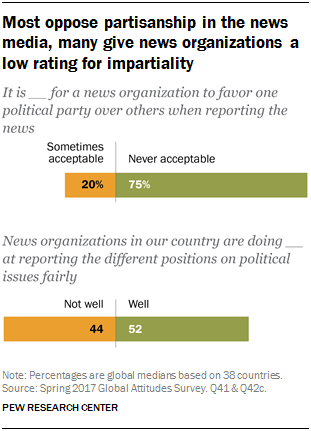
Chart showing that most oppose partisanship in the news media, many give news organizations a low rating for impartiality

Publics around the world overwhelmingly agree that the news media should be unbiased in their coverage of political issues, according to a new Pew Research Center survey of 38 countries. Yet, when asked how their news media are doing on reporting different political issues fairly, people are far more mixed in their sentiments, with many saying their media do not deliver. And, in many countries, there are sharp political differences in views of the media – with the largest gap among Americans.

To build off Pew Research Center’s earlier findings about U.S. news media habits and attitudes, this new cross-national survey begins to study these dynamics globally. The survey finds that a median of 75% across 38 countries say it is never acceptable for a news organization to favor one political party over others when reporting the news. Just 20% say this is sometimes okay. People in Europe show the greatest opposition to political bias in their news, including 89% in Spain and 88% in Greece who think this is unacceptable. In the United States, 78% say the news media should never favor one political party over another. In only five countries do at least three-in-ten believe it is okay to favor one side.

What is a median?

Throughout this report, median percentages are used to help readers see overall patterns. The median is the middle number in a list of figures sorted in ascending or descending order. In a survey of 38 countries, the median result is the average of the 19th and 20th figures on a list of country-level findings ranked in order. In addition to medians of respondents across the survey’s 38 countries, this report sometimes refers to the median among a specific subset of respondents and/or countries by region or economic grouping. For example, we can look at a median across the seven Asian-Pacific countries, where the median is the fourth figure when the countries are listed from highest to lowest. We can also calculate the medians across 10 European nations, five Middle East-North African nations, six sub-Saharan African nations and seven Latin American nations.

While publics around the globe place a premium on politically unbiased news media, this is precisely the performance area, among four asked about, where publics are least likely to say their news media are doing well. A median of only 52% across the 38 nations polled say the news media in their country do a good job of reporting on political issues fairly, while 44% say they do not. And although majorities of the public in 18 countries say their news media are performing well in this area, attitudes are more negative in the remaining 20 nations surveyed. The most critical are Spain, Greece, South Korea, Lebanon and Chile, where at least six-in-ten say their news media do not do well on reporting the news fairly.

News media receive considerably higher marks in other performance areas. Broad majorities say their news media do a good job of covering the most important stories (median of 73%), reporting the news accurately (62%), and reporting news about government leaders and officials (59%). People in sub-Saharan Africa and the Asia-Pacific are more satisfied with their news media, while Latin Americans are the most critical. The U.S. public tends to fall roughly in the middle across the different performance areas asked about.

Within countries, political identification tends to be the strongest divider of media attitudes, more so than education, age or gender.
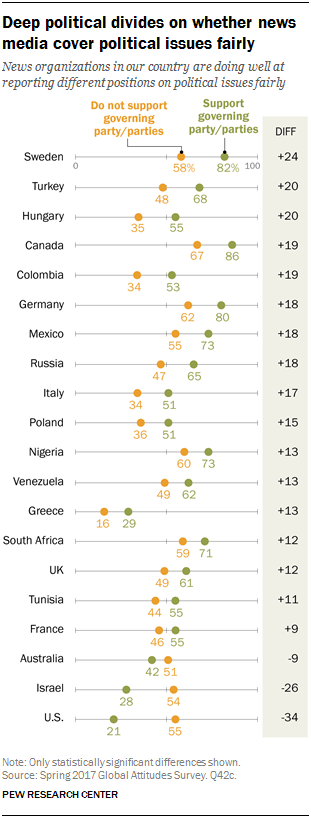
Chart showing that deep political divides exist on whether news media cover political issues fairly

Political party systems vary considerably across countries, but one consistent measure for comparing political divides is support for the governing party or parties. Individuals who identify with the governing party or parties are categorized as supporters, everyone else as nonsupporters. In the U.S., this means that people who identify with the Republican Party, which currently controls all branches of the federal government, are considered governing party supporters. People who identify with the Democratic Party, say they are independent, identify with some other party or do not identify with any political party are categorized as nonsupporters. (For more details on the categorization, please see Appendix B.)

Using this approach, large gaps in ratings of the media emerge between governing party supporters and nonsupporters. On the question of whether their news media cover political issues fairly, for example, partisan differences appear in 20 of the 38 countries surveyed. In five countries, the gap is at least 20 percentage points, with the largest by far in the U.S. at 34 percentage points. The next highest partisan gap is in Israel, with a 26-point difference.

The U.S. is also one of only a few countries where governing party supporters are less satisfied with their news media than are nonsupporters. In most countries, people who support the political party currently in power are more satisfied with the performance of their news media than those who do not support the governing party. For example, in Sweden, the Social Democratic Party and the Green Party are the two parties that currently form the governing coalition in the country. About eight-in-ten Swedes (82%) who identify with these two parties say their news media do a good job of covering political issues fairly. Just 58% of Swedes who do not identify with these two parties agree.

The partisan gaps found in the survey indicate that, rather than being consistently tied to a particular ideological position, satisfaction with the news media across the globe is more closely related to support for the party in power – whether that party is left or right. Public satisfaction with the news media also links closely to trust in one’s national government and a sense that the economy is doing well, which reinforces the point that, for most countries surveyed here, satisfaction with the media aligns with satisfaction on other country conditions rather than along a left-right spectrum.

These are among the major findings of a Pew Research Center survey conducted among 41,953 respondents in 38 countries from Feb. 16 to May 8, 2017. In addition to the topics discussed above, the study also focuses on individuals’ use of the internet and social media to get news, as well as the types of news people follow.

Online news is making inroads in many countries around the world

Digital technology is influencing news habits across the globe, though its use is still far from universal. Overall, a median of 42% among the 38 countries surveyed say they get news on the internet at least once a day. In 14 countries, half or more adults get news online daily.

In general, internet access has been shown to be higher in wealthier countries, and this plays out to a greater likelihood of using the internet for news as well. For example, 61% in Australia – which had a 2015 gross domestic product (GDP) per capita of $46,271 – get news at least once a day through the internet. Just 20% in Senegal, with a GDP per capita of $2,421, do the same.
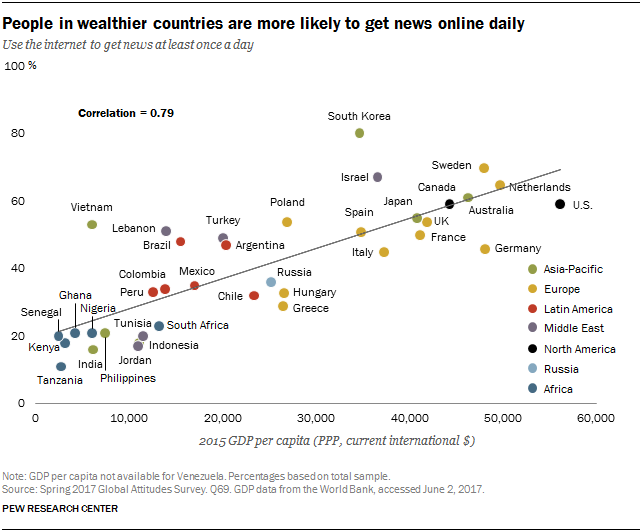
Scatter plot showing that people in wealthier countries are more likely to get news online daily

The survey also asked a separate question about how often people get news specifically on social media sites. Unlike getting news on the internet generally, the percentage that gets news on social media is not strongly related to country wealth. In fact, the median percentages of people who get news at least once a day through social media are about the same in emerging and developing economies as in advanced ones (33% and 36%, respectively). Overall, a global median of 35% get news daily through social media, with the highest levels in South Korea (57%), Lebanon (52%) and Argentina (51%).

What are advanced, emerging and developing countries?

For this report, we grouped countries into three economic categories: “advanced,” “emerging” and “developing.” In creating our economic classification of the countries in this report, we relied on multiple sources and criteria. Specifically, we were guided by: World Bank income classifications; classifications of emerging markets by other multinational organizations, such as the International Monetary Fund; per capita gross domestic product (GDP); total size of the country’s economy, as measured by GDP; and average GDP growth between 2010 and 2015. For more information, see Appendix C.

Public is highly engaged with news, but more so with news that’s close to home

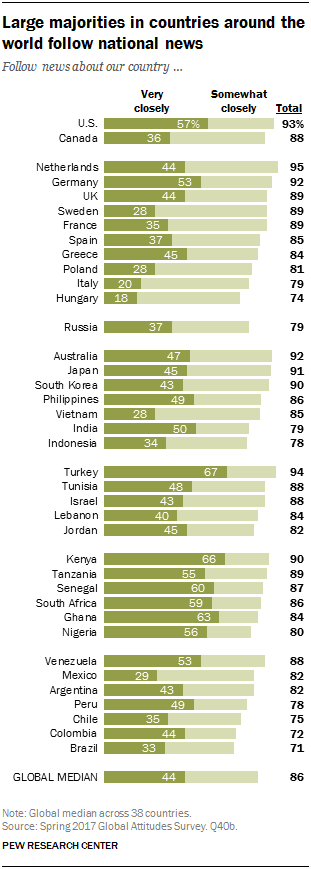
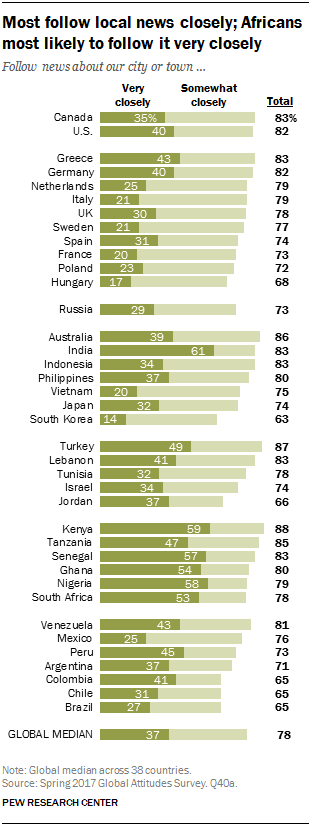
Overall interest in the news has implications for how news media landscapes develop alongside technological change. Large majorities around the world say they follow national and local news closely (global medians of 86% and 78% respectively). In all 38 countries, more than two-thirds say this of news about their own country. The same is true of news about their city or town in 32 countries.

People are much less interested in news about other countries (global median of 57%). In only six countries do more than two-thirds say they pay close attention to news about the rest of the world. People outside of the U.S. express a similarly low level of interest in news specifically about the U.S. (48%).
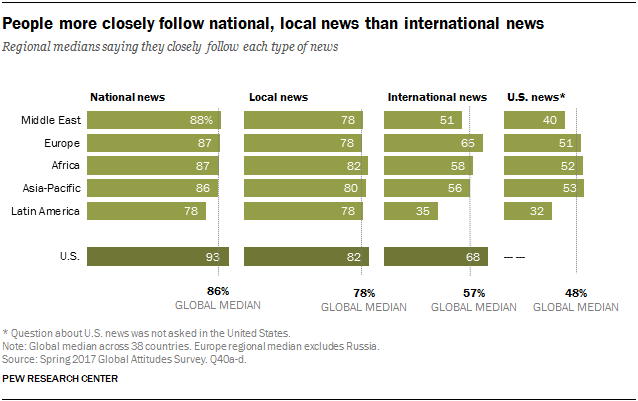
Chart showing that people more closely follow national, local news than international news

Young more likely to get news online; older people more likely to follow the news overall

Across all 38 countries, young people – those ages 18 to 29 – are more likely to get news online than adults 50 and older. In 11 countries, the age gap is 35 percentage points or greater.

At the same time, older people tend to be more interested in the various types of news asked about than the younger generation. The biggest gaps are in news about one’s own city or town. In 20 countries, people ages 50 and older are significantly more likely than people younger than 30 to closely follow local news. The age gap is at least 15 percentage points in 11 of the countries. Only in the Philippines and Brazil is the pattern reversed; there, young people are more likely to follow local news.

For international news, age is less of a factor. In general, men and those with more education are more likely to follow international news.

1. Global publics want politically balanced news, but do not think their news media are doing very well in this area

Across the globe, there is a great deal of consensus on how the news media should report on political issues. Large majorities in nearly every country surveyed say that their news media should always be unbiased in their coverage. At the same time, while people are generally satisfied with their news media’s performance, publics around the globe give the lowest ratings for reporting on different political positions fairly. In contrast, they largely approve of the job their news media are doing covering the most important stories of the day, providing accurate news and covering government leaders and officials. Within a majority of countries, satisfaction differs based on one’s political orientation; people who support the governing political party tend to be more satisfied with their news media than those who do not.

Widespread preference for an impartial news media

Despite differences in news media and political structures, clear majorities in 35 of the 38 nations surveyed agree that it is never acceptable for a news organization to favor one political party over others when reporting the news. Globally, a median of three-quarters (75%) say such media bias is never permissible, compared with 20% who say it is sometimes acceptable.

The one country where more say it is sometimes acceptable than never acceptable for a news organization to favor one political party is India. Among adults there, 41% say it is acceptable for news organizations to, at times, favor one political party, compared with 25% who say it is never acceptable. A third of Indians express no opinion on the matter.

Israel and the Philippines also stand as relative exceptions to the strong global consensus. In both of these countries, about four-in-ten say it is acceptable for news organizations to sometimes favor one political party over others.

Within some countries, there are education differences on this measure. In 11 of the 38 countries, people with higher levels of education are significantly more likely than those with less education to say that media bias is never acceptable.1 These gaps are largest in several Latin America nations, with differences of more than 20 percentage points in Mexico, Colombia and Brazil. For example, in Mexico, 79% of people with at least a secondary education think media bias is never acceptable, compared with 56% of those with less education.

News media get highest rating on coverage of most important issues

Respondents were asked to evaluate their news media on four different measures: covering important issues, providing accurate news, covering government officials, and reporting the different positions on political issues fairly. For all four, the global medians tend to be more positive than negative, but overall views vary across performance area.

Reporting on the most important news events garnered the highest rating overall, with a global median of 73% saying their news media do very or somewhat well in this area. The degree of satisfaction differs somewhat by region, from a high of 82% in sub-Saharan Africa to a low of 59% in Latin America. And in most countries, far more express moderate satisfaction than strong satisfaction. A global median of just 26% say their news media are doing very well on reporting on the most important news events. Only in sub-Saharan Africa do more than half say this.

There are only two countries in which majorities say their news media are not doing a good job reporting on the most important news events: Greece (57%) and South Korea (55%).

CORRECTION (Feb. 2018): Due to a typographical error, a previous version of the chart “Most say news media do good job covering most important stories,” gave an incorrect “Total well” percentage for South Korea. The correct number is 44%. This correction does not materially change the analysis of the report.

Many say news media do well at providing accurate news

Publics also largely agree that news organizations are doing a good job at reporting the news accurately. A global median of 62% say they do very or somewhat well on this measure, with at least half in 29 of the 38 countries expressing this sentiment. Once again, however, the highest levels of approval are sparse; a global median of only 18% say their news media are doing very well on reporting news accurately.

Regionally, ratings of the news media on providing accurate facts are highest in the Asia-Pacific (median of 80% well) and sub-Saharan Africa (75%), and lowest in Latin America (51%).

Greece and South Korea again stand out as countries in which majorities think that their news media are not doing a good job on this item (78% and 62% respectively), though majorities in Colombia and Chile also express disapproval.

Many say news media are also doing well covering government

Global ratings of the media’s performance for reporting on government officials and leaders are slightly lower than evaluations of their ability to report on the most important stories and accuracy. Still, a global median of 59% say their news media are doing well on this dimension.

Positive evaluations are highest in sub-Saharan Africa (median of 73%) and the Asia-Pacific (72%) and more mixed in Europe (52%) and the Middle East (52%). In Latin America, fewer than half (43%) say their news media are doing a good job reporting on government officials and leaders.

Within Latin America, disapproval is highest in Chile (61%), Argentina (57%) and Peru (55%) – though, outside of the region, Greece (72%) and South Korea (72%) once again stand out.

Publics most critical of the news media’s reporting on political issues

Among the four issues tested, evaluations are most negative when it comes to whether news organizations are doing a good job at reporting different positions on political issues fairly. Globally, a median of only about half (52%) think their news media are performing well in this domain.

Regionally, medians of less than half approve in the Middle East (46%), Europe (45%) and Latin America (42%). Still, majorities in sub-Saharan Africa (69%) and the Asia-Pacific (65%) praise their media’s performance.

Looking country to country, dissatisfaction continues to be highest in Greece (80%) and South Korea (72%). But disapproval of the media’s performance on this topic is more widespread; across 14 countries, roughly half or more say new organizations are not doing well on this key role. In the U.S., for example, 52% think their news media are doing a poor job reporting different positions on political issues fairly, compared with 47% who say they are doing well.

In 22 of the 38 countries surveyed, those who say that it is never acceptable for the media to favor one political party over others when reporting the news are also more likely to think the media are doing poorly with regard to reporting on different political positions fairly. The gap is largest in the United States. Among Americans who think it is never acceptable for news organizations to favor one political party over another, roughly six-in-ten (57%) say their media are doing a poor job reporting fairly on politics. In contrast, among Americans who say it is sometimes acceptable for news organizations to favor one political party, only about one-third (31%) rate their media negatively – a 26-point gap.

News media satisfaction is related to support for governing party, satisfaction with country conditions

To examine how the public’s satisfaction with the news media varies within countries, researchers constructed an index. Respondents are classified as “satisfied” if they say news organizations are doing very or somewhat well on at least three of the four issues they were asked about. Everyone else is categorized as dissatisfied.

An individual’s political orientation tends to be one of the strongest factors underlying attitudes about the news media, more so than age, education or gender. In 21 countries, how people feel about their news media is linked to support for the governing party (for more on this measure of political orientation that can be applied across all countries, see Appendix B). In most cases, those who identify with the party in charge tend to be more sanguine about the news media. The gap is particularly large across Europe. For example, in Hungary, supporters of Fidesz and coalition partners the Christian Democratic People’s Party are 20 percentage points more likely to be satisfied news consumers than nonsupporters.

In the United States and Israel, however, supporters of the governing party are significantly more likely to be dissatisfied with the media. The gap is largest in the U.S., where 24% of Republicans are mostly satisfied news consumers, compared with 58% of people who do not identify with the Republican Party, a 34-point difference.

Since the governing parties in power across these countries vary in their ideological leanings, the gaps found on media satisfaction based on support for the party in power show that there is not a particular ideological position that is consistently tied to satisfaction. Instead, the general relationship between partisanship and news media satisfaction appears to be more about people who are satisfied with the party in power.

Satisfaction with the news media also aligns with two key attitudes about country conditions. The first is whether respondents trust the national government to do what is right for the country. The relationship here is strong at the country level. For example, satisfaction with the news media is highest in the nations surveyed in sub-Saharan Africa and lowest in Latin America – areas with relatively high and low levels of governmental satisfaction, respectively.

Trust in government is also related to media satisfaction at the individual level. Within many countries, people who express confidence in the national government are more likely to be satisfied with the news media than those who are less confident. The gap is largest in Vietnam, Sweden and the United Kingdom. In the United States, there is no difference in media satisfaction between those who trust the government and those who do not (for more on trust in government, see “Globally, Broad Support for Representative and Direct Democracy”).

A second way to measure attitudes about country conditions is by individuals’ opinions about the national economy. Similar to trust in government, the survey finds that in 28 countries people who say the economy is doing well also tend to be more satisfied with their news media.

2. Publics around the world follow national and local news more closely than international

Publics around the globe consume all types of news, but they are most interested in news that’s close to home. Among the four key news topics asked about, global medians of at least three-quarters say they follow news about their country (86%) or city and town (78%) closely, compared with fewer than six-in-ten who say the same when it comes to news about other countries generally (57%) and the U.S. specifically (48%).

The type of news people follow closely varies by age and education level. In roughly half of the countries surveyed, those ages 50 and older are more likely to pay attention to news about their city or town than are younger people. And those with more education are more likely to follow international and U.S. news than those with less education. There are also differences between women and men on interest in news, especially international news and news about the U.S. specifically.

Globally, broad majorities follow national news

An overwhelming majority follows national news closely (global median of 86%), including a median of 44% who do so very closely.

Chart showing that large majorities in countries around the world follow national news

While there are few differences by region in the portions following national news closely, some significant differences emerge in the percentage that follows it very closely. Fewer than half in most regions say they follow national news very closely, but majorities in all six sub-Saharan African countries do so. Some countries across the other regions also stand out, including Turkey (67%), the U.S. (57%), Germany (53%), Venezuela (53%) and India (50%). At the other end of the spectrum, the lowest rate of following national news very closely occurs in Hungary (18%) and Italy (20%).

Widespread interest in local news

As with national news, majorities follow local news closely in all 38 countries surveyed. A global median of 78% say they follow news about their city or town closely, including 36% who follow local news very closely.

Chart showing that globally, most follow local news closely; Africans most likely to follow it very closely

There is relatively little difference across regions in whether people follow local news closely, but more variation when it comes to following it very closely. Again, strong interest is highest in sub-Saharan Africa (median of 56% very closely), while it is lowest in Europe (24%). Across other regions, India stands out for its percentage that follows local news very closely (61%).

In most of the countries surveyed, interest in local news is equal to or lower than interest in national news. People follow local news more than national news in just two countries – India and Indonesia.

International and U.S. news a lesser part of people’s media diet

Publics in 37 of the 38 countries surveyed are less likely to closely follow news about other countries than they are to follow national or local news. A global median of 57% say they follow international news closely, and just 16% follow it very closely.


Interest in international news varies by geographic region. Europeans are most likely to say they follow international news closely (median of 65%), while people in Latin America express the lowest level of interest in this type of news (35%). There is little variation, on the other hand, in the percentage that follows international news very closely; in all countries surveyed, no more than three-in-ten say they follow international news very closely.

Even fewer people follow news specifically about the U.S. than international news generally, with a global median of 48% saying they follow it closely. Still, majorities in 10 nations follow news about the U.S. closely. In five of these countries, more than seven-in-ten follow news about the U.S. closely: Canada (78%), the Netherlands (75%), Japan (74%), Germany (73%) and Australia (71%).

Demographic divides in news interest

In 20 countries, people ages 50 and older are more likely than those ages 18 to 29 to follow local news closely. The greatest difference is in Japan, where 84% of those 50 and older follow local news closely, compared with just 47% of those 18-29. The differences tend to be largest in Europe: Sweden, Greece, France, the Netherlands, Spain and Germany all show age gaps of at least 20 percentage points. The only countries where this pattern is reversed are the Philippines and Brazil, where 85% and 69% of those 18-29 follow local news closely, respectively.


Older people also follow national, international and U.S. news more closely than younger people, but the differences are less stark. Those 50 and older are more likely than people younger than 30 to follow national news in 12 countries; more likely to follow international news in nine countries; and more likely to follow U.S. news in five. Similar to local news, the differences between the oldest and youngest on national and international news consumption are greater in Europe than in other regions.

In 26 of the 38 countries surveyed, people with a higher education are more likely than those with a lower education to follow international news in particular. Education differences are smaller and less common for national and local news.

This education gap on following international news is at least 10 percentage points in 18 countries. The difference is especially high in Latin America, where six of the seven countries surveyed show a 10-point gap or more.

Men are more likely than women to follow international news closely in 13 countries. The gender gap is largest in Nigeria (22 percentage points) and Tanzania (16 points). Men are also more likely than women to closely follow news about the U.S. in 12 countries.

3. People in poorer countries just as likely to use social media for news as those in wealthier countries

While access to digital technology is increasingly common, the use of the web generally, as well as social media in particular, for getting news still varies considerably across countries. In 14 of the 38 countries studied, at least half of adults use the internet to get news daily. This is true of social media and news use in just three countries.

With few exceptions, age, education level and income connect closely to online and social media news use.

People in wealthier countries more likely to get news online

Across countries, a global median of 42% say they use the internet to get news at least once a day (either once a day or several times a day). Another 20% go online less than once a day to get news and 35% say they never do so.

Online news use varies considerably by country-level wealth. People in advanced economies (median of 54%) are much more likely to get news online at least once a day than people in emerging or developing economies (23%; for more details on the economic categorization, please see Appendix C).

South Korea and Sweden have the highest percentage of adults who get news online daily (80% and 70% respectively). It is less common in the United States (59%), though nearly half of the American public goes online to get news several times a day (46%).

Tanzania, one of the poorest nations surveyed, has the lowest percentage that accesses the internet daily for news (11%).

People in poorer countries just as likely to use social media for news as those in wealthier countries

A global median of 35% say they use social media to get news daily, while 13% use it less than once a day to get news. About half (52%) say they never use social networking sites to get news.

Compared with internet use for news – where the relationship between national economic status and online news use is evident – social media news use is not strongly related to country-level wealth. People in advanced economies (median of 36%) use social media daily for news at similar rates to those in emerging or developing economies (33%).

Daily online use of social networking sites for news is highest in South Korea (57%), Lebanon (52%) and Argentina (51%).

And, similar to getting news online more generally, only one-in-ten Tanzanian adults use social networking sites to get news daily.

Within countries, younger, highly educated and wealthier people more likely to get news using social media

In almost all countries surveyed, people who are younger, are more highly educated and have a higher income are more likely than their counterparts to use social networking sites to get news daily.

In 37 of the 38 countries studied, adults ages 18 to 29 are more likely than those 50 and older to use social media at least once a day for news. In 10 countries, the gap is at least 50 percentage points, with the largest differences in Vietnam (78 points) and Poland (65 points).

In several countries, accessing news through social networking sites is almost exclusively an activity of the young. In Vietnam, for example, 81% of people ages 18-29 use social media daily to access news, while only 3% of those ages 50 and older do so. In Poland, Mexico, and Greece, over half of 18- to 29-year-olds use social media this way, compared with about 10% or less of those ages 50 and older.

In most countries, less than a quarter of the population ages 5o and older reports using social media daily for news. One notable exception is South Korea, where 45% of people 50 and older use social networking sites daily to access news.

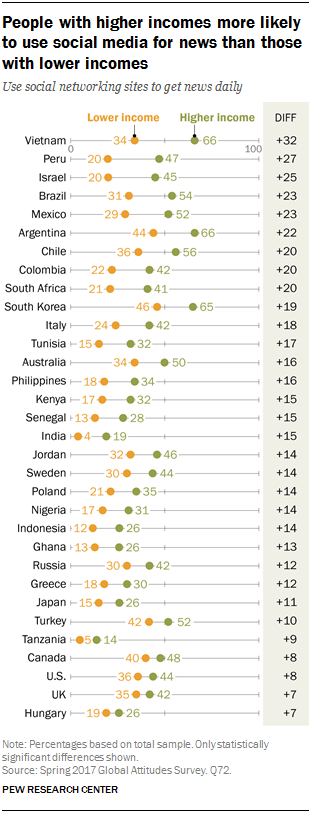
Chart showing people with higher incomes are more likely to use social media for news than those with lower incomes

Greater use of social media for news is not only more common among the young but also among the more highly educated. In 35 of the 38 countries studied, people with a higher level of education are more likely to use social networking sites to get news daily than those with less education.

Developing and emerging economies tend to have the largest education gaps in accessing the news on social media. Differences of at least 40 percentage points arise in Vietnam, Kenya, Brazil, Ghana, Turkey and Chile. The United States and Israel, both advanced economies, have some of the smaller education gaps, while there is no significant education difference in Germany, Sweden and the Netherlands.

Even though country-level wealth is not related to social media news use, individual-level income is. In 32 of the 38 countries surveyed, higher-income people are more likely than those with lower incomes to use social media daily for news.2

Vietnam, Peru and Israel have the largest income gaps, with differences of at least 25 percentage points. By comparison, the U.S. and Canada have smaller income gaps (8 points).

The survey finds similar differences by age, education and income when it comes to daily internet news use. Additional detailed tables on both questions are available in Appendix A.

Methodology

About Pew Research Center’s Spring 2017 Global Attitudes Survey

Results for the survey are based on telephone and face-to-face interviews conducted under the direction of D3 Systems Inc., ORB International, Princeton Survey Research Associates International, Kantar Public UK and Voices! Research & Consultancy. The results are based on national samples, unless otherwise noted. More details about our international survey methodology and country-specific sample designs are available here.

Detailed information on survey methods for this report

General information on international survey research

Acknowledgments

This report is a collaborative effort based on the input and analysis of the following individuals.

Amy Mitchell, Director, Journalism Research Katie Simmons, Associate Director, Research Katerina Eva Matsa, Associate Director, Research Laura Silver, Senior Researcher Elizabeth Grieco, Senior Writer Elisa Shearer, Research Analyst

Danielle Alberti, Web Developer James Bell, Vice President, Global Strategy Caldwell Bishop, Research Associate Hanyu Chwe, Research Assistant Stefan Cornibert, Communications Manager Danielle Cuddington, Research Analyst Claudia Deane, Vice President, Research Janell Fetterolf, Research Associate Courtney Johnson, Research Associate Michael Keegan, Information Graphics Designer David Kent, Copy Editor Hannah Klein, Communications Associate Dorothy Manevich, Research Analyst Martha McRoy, Research Methodologist Patrick Moynihan, Associate Director, International Research Methods Courtney Nelson, Research Assistant Jacob Poushter, Senior Researcher Audrey Powers, Administrative Manager Ariana Rodriguez-Gitler, Digital Producer Steve Schwarzer, Senior Research Methodologist Rhonda Stewart, Senior Communications Manager Bruce Stokes, Director, Global Economic Attitudes Kyle Taylor, Research Assistant Mason Walker, Research Assistant Rachel Weisel, Communications Manager Richard Wike, Director, Global Attitudes Research Margaret Vice, Senior Researcher

Appendix A: Detailed tables

[ps_interactive slug=”media-habits-table” showtitle=”true”]

Appendix B: Political categorization

For this report, we grouped people into two political categories: those who support the governing political party (or parties) and those who do not. These categories were coded based on the party or parties in power at the time the survey was fielded, and on respondents’ answers to a question asking them which political party, if any, they identified with in their country.3

In countries where multiple political parties govern in coalition (as in many European countries), survey respondents who indicated support for any parties in the coalition were grouped together. In Germany, for example, where the center-right CDU/CSU governed with the center-left SPD at the time of the survey, supporters of all three parties were grouped together. In countries where different political parties occupy the executive and legislative branches of government, the party holding the executive branch was considered the governing party.

Survey respondents who did not indicate support for any political party, or who refused to identify with one, were considered to be not supporting the government in power. In the United States, for example, only those who supported the Republican Party were considered to be supporters of the governing party. Democrats, independents and those who don’t know which party they feel closest to were considered nonsupporters of the governing party.

In some countries, no respondents identified with one or more of the parties currently in a coalition government. For example, the National Democratic Alliance in India officially consists of dozens of political parties, but many of those were not identified by any respondent as the party they felt closest to. Countries where an insufficient number of people identified with any party in government have been excluded from the analysis. Below is a table that outlines the governing political parties in each country; only political parties mentioned by respondents are shown.

Appendix C: Economic categorization

For this report we grouped countries into three economic categories: “advanced,” “emerging” and “developing.” These categories are fairly common in specialized and popular discussions and are helpful for analyzing how public attitudes vary with economic circumstances. However, no single, agreed upon scheme exists for placing countries into these three categories. For example, even the World Bank and International Monetary Fund do not always agree on how to categorize economies.

In creating our economic classification of the 38 countries in our survey, we relied on multiple sources and criteria. Specifically, we were guided by: World Bank income classifications; classifications of emerging markets by other multi-national organizations, such as the International Monetary Fund; per capita Gross Domestic Product (GDP); total size of the country’s economy, as measured by GDP; and average GDP growth rate between 2010 and 2015.

Below is a table that outlines the countries that fall into each of the three categories. The table includes for each country the World Bank income classification, the 2015 GDP per capita based on purchasing power parity (PPP) in current prices, the 2015 GDP in current U.S. dollars and the average GDP growth rate between 2010 and 2015.

Appendix D: Country-specific examples of social media