
Pew Research Center

FOR RELEASE OCTOBER 17, 2017

Japanese Divided on Democracy’s Success at Home, but Value Voice of the People

Public sees threats abroad amid declining views of U.S.
BY Bruce Stokes

FOR MEDIA OR OTHER INQUIRIES:

Communications Department
202.419.4372
www.pewresearch.org

RECOMMENDED CITATION

Pew Research Center, October 2017, "Japanese Divided on Democracy’s Success at Home, but Value Voice of the People"

About Pew Research Center

Pew Research Center is a nonpartisan, nonadvocacy fact tank that informs the public about the issues, attitudes and trends shaping the world. It does not take policy positions. The Center conducts public opinion polling, demographic research, computational social science research and other data-driven research. It studies politics and policy; news habits and media; the internet and technology; religion; race and ethnicity; international affairs; social, demographic and economic trends; science; research methodology and data science; and immigration and migration. Pew Research Center is a subsidiary of The Pew Charitable Trusts, its primary funder.

© Pew Research Center 2026

Table of contents

  • About Pew Research Center
  • Japanese Divided on Democracy’s Success at Home, but Value Voice of the People
  • 1. Japanese more satisfied with economy, but doubts about future persist
  • 2. Mixed feelings on Japan’s democracy
  • 3. No love lost with China
  • 4. Troubles with the U.S. relationship?
  • 5. Few see Russia as a threat
  • Acknowledgments
  • Methodology

Japanese Divided on Democracy’s Success at Home, but Value Voice of the People

Public sees threats abroad amid declining views of U.S.

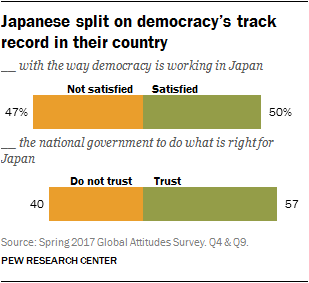
Chart showing Japanese split on democracy's track record in their country

The Japanese public is largely divided over the quality of democracy at home: 50% say they are satisfied with the way democracy is working in their country, while 47% are dissatisfied, according to a new Pew Research Center survey of Japanese public opinion.

Trust in government is more widespread – a 57% majority expresses confidence in the national government to act in the country’s best interests, but only 6% of Japanese have a lot of trust in the national leadership.
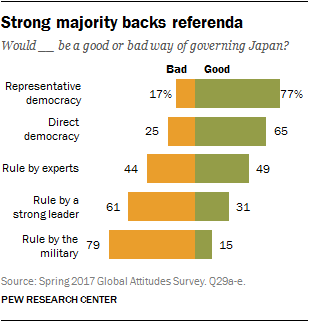
Chart showing Strong majority backs referenda

Despite these somewhat lukewarm assessments of their current political system, Japanese remain solidly supportive of democracy. Roughly three-quarters (77%) endorse representative democracy, while almost two-thirds (65%) say referenda on major policy issues would be good for Japan – something that has never happened in post-World War II Japan.

The public is generally divided over the wisdom of relying on experts to govern their country. Meanwhile, clear majorities reject the idea of turning to a strong leader or the military to govern Japan.

These are some of the key findings from a Pew Research Center survey conducted among 1,009 adults in Japan, between March 8 and April 2, 2017.

New doubts about the U.S.
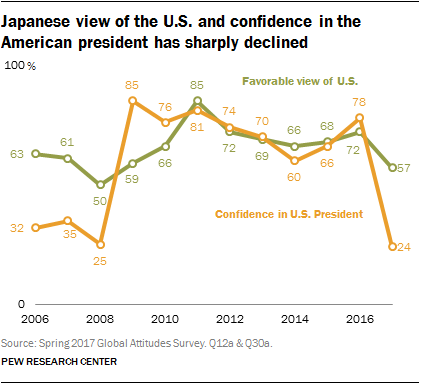
Chart showing Japanese view of the U.S. and confidence in the American president has sharply declined

Along with a democratically elected government, another defining feature of Japan’s post-WWII existence has been its close relationship with the United States. Japanese attitudes toward America have oscillated over the past decade, but in 2017 public opinion about both the U.S. and its newly elected president took a decidedly negative turn.

Today, just 57% of Japanese see the U.S. favorably – down 15 percentage points from a year ago. This is the steepest year-over-year decline in Japanese opinion of the U.S. going back a full decade. Support for the U.S. in Japan is now at its lowest level since 2008. Japanese judgment of their longtime ally is lower than that in the Philippines (78%) or South Korea (75%), but higher than that in Australia (48%). And the Japanese are not alone in their growing wariness of the U.S.: Favorability of America is down 14 percentage points in the Philippines, 12 points in Australia and 9 points in South Korea. (For more on global views of the U.S., see “U.S. Image Suffers as Publics Around the World Question Trump’s Leadership.”)
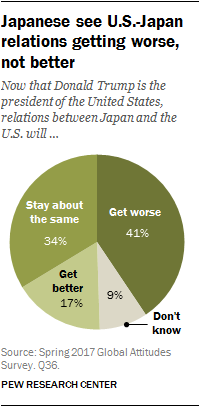
Chart showing Japanese see U.S.-Japan relations getting worse, not better

Few Japanese trust U.S. President Donald Trump. Roughly a quarter (24%) express confidence in him to do the right thing in world affairs. Such faith is significantly below that in the Philippines (69%), somewhat lower than in Australia (29%), but higher than in South Korea (17%). Japanese confidence in Trump is 54 points lower than that expressed in 2016 for his predecessor Barack Obama. By comparison, trust in the current U.S. chief executive is down 71 points in South Korea, 55 points in Australia and 25 points in the Philippines.

Reflecting their declining opinion of the U.S. and their lack of confidence in the new U.S. president, more than twice as many Japanese worry that the alliance between the two countries will deteriorate as believe the relationship will improve now that Trump is president. About four-in-ten Japanese (41%) think relations will get worse. Just 17% believe things will get better and 34% expect them to stay the same. Nearly twice as many Japanese ages 18 to 29 (25%) as Japanese ages 50 and older (13%) expect things will get better. And men (22%) are more likely than women (12%) to expect an improvement.

Global threats
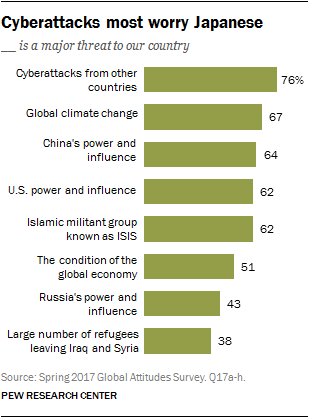
Chart showing Cyberattacks most worry Japanese

Many Japanese see the world as a threatening place. Their principal concern is the possibility of cyberattacks from other countries: 76% see this as a major threat, a concern shared by all age groups and greater than their worry about U.S. or Chinese power and influence. The Japanese, along with South Koreans, are more worried about cyberattacks than are the remaining 36 nations polled in the 2017 Pew Research Center survey. (For views on global threats, see “Globally, People Point to ISIS and Climate Change as Leading Security Threats.”)

Two-thirds of Japanese (67%) see global climate change as a major danger. About six-in-ten (62%) voice the view that the Islamic militant group known as ISIS is a major threat to Japan. But only 38% say a large number of refugees leaving countries such as Iraq and Syria pose a major peril. In 2016 Japan took in only 28 refugees from all countries.

The Korea problem
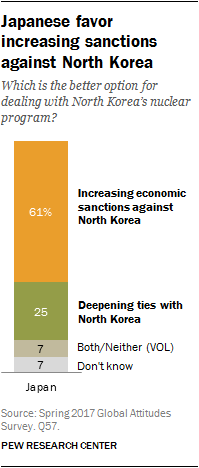
Chart showing Japanese favor increasing sanctions against North Korea

North Korea, which is rapidly building up a nuclear arsenal, poses an existential threat to many Japanese. Two-thirds (66%) are very concerned about Pyongyang having nuclear weapons, and this question was asked before North Korea tested a number of long-range missiles and nuclear weapons. This level of apprehension is comparable to that among Americans (65%) but higher than among South Koreans (59%).

Roughly six-in-ten Japanese (61%) support increasing economic sanctions against North Korea to deal with Pyongyang’s nuclear program. Only 25% back deepening ties with North Korea. Notably, however, 41% of young Japanese support deepening ties, while only 21% of their elders, those ages 50 and older, agree.

In their preferred approach to Pyongyang, the Japanese are again closely aligned with Americans, but their views differ from those of South Koreans, who are more supportive of closer ties with the North.

Japan also has a troubled history with South Korea, having occupied the Korean Peninsula for much of the first half of the 20th century.

Just 26% of Japanese hold a favorable opinion of South Korea, comparable to recent public sentiment but down from 57% who held a positive view in 2008. Again, there is a generational divide in Japan about South Korea: 40% of young Japanese voice a favorable view, but only 18% of older Japanese agree.

Japan’s image in Asia
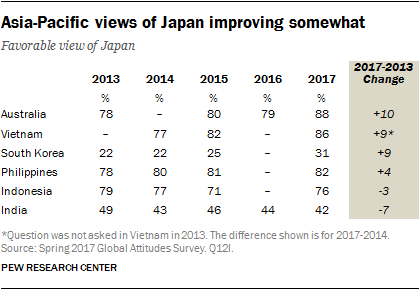
Table showing Asia-Pacific views of Japan improving somewhat

Japan’s relations with its neighbors are in part defined by how other nations see Japan. Among its Asian neighbors, Japan is generally popular, except in South Korea, where there are long-standing animosities, and in India, where many people do not have an opinion about Japan.

Overwhelming majorities in Australia (88%), Vietnam (86%), the Philippines (82%) and Indonesia (76%) have a favorable opinion of Japan, including 47% of Vietnamese and 33% of Filipinos who hold a very favorable view. Since 2013 and 2014, Japan’s image has improved in both Australia and Vietnam, respectively.

In contrast, just 31% of South Koreans see Japan favorably. Such sentiment has improved a bit since 2013, but is still below the 47% who expressed a positive opinion in 2008. One continuing source of tension between the two nations stems from World War II, when Japanese soldiers pressed Korean women into serving as “comfort women,” or prostitutes.

In India, a nation with which Japan is trying to deepen economic and military ties, 42% voice a favorable opinion of Japan and only 15% have an unfavorable assessment, but 42% also express no view.

1. Japanese more satisfied with economy, but doubts about future persist

People in Japan believe their lives have improved dramatically over the past two generations. Roughly two-thirds (65%) say life in Japan today is better for people like them than it was 50 years ago. The Japanese are much more upbeat than Americans (37%) who were asked to compare their lives today to a half century ago.

Japanese also feel better about their country’s current economic situation than they did a year ago. In spring 2017, roughly four-in-ten (41%) said economic conditions were good, up from three-in-ten (30%) in 2016. While hardly a ringing endorsement of their nation’s economic health, the Japanese express a more positive view of their economy than at any time since Pew Research Center began asking this question in 2002.

The echoes of Japan’s long-struggling economy are evident among Japanese ages 30 to 49 – they are the most negative about the current economy. Roughly two-thirds (65%) of this age group say economic conditions are bad.

Although overall economic satisfaction is on the rise in Japan, concerns about the future persist.

About half of Japanese (51%) believe the condition of the global economy poses a major threat to Japan. (Concern about this issue is substantially lower than for a number of other threats such as cyberattacks.) Worries about external economic turbulence are particularly strong among the young: 65% of those ages 18 to 29 are worried, compared with 43% of those ages 50 and older.

When it comes to the global economic balance of power, just 7% of Japanese believe that Japan is the world’s leading economic power. Such lack of faith in the country’s economic pre-eminence has been prevalent for years.

When asked about the economic prospects of the next generation, only 19% believe that today’s children will be better off financially than their parents, while 72% say kids will be worse off when they grow up. But there is a more hopeful note on this issue: About a third (32%) of younger Japanese believe children will be better off, while pessimism is stronger among those ages 30 to 49 and those 50 and older: Only 18% and 16% respectively in those age groups think today’s youngsters will prosper financially.

Unease over immigration and cultural diversity

Japan’s population is expected to decline by 30% over the next half century, thanks to aging and a low birthrate. One way to meet that demographic challenge is through immigration. But as of 2015, only about 2 million immigrants lived in Japan, making up about 2% of the population – far less than other aging societies, such as Germany (15%) and the U.S. (14%).

But increasing Japan’s immigrant population may face domestic reluctance. Just 24% of Japanese believe that having people of many different backgrounds – diverse ethnic groups, religions and races – makes their country a better place to live. A majority (57%) says it makes Japan a worse place to live. One sign that Japanese views may change: 44% of Japanese ages 18 to 29 say diversity makes for a better country, compared with 17% of those ages 50 and older.

2. Mixed feelings on Japan’s democracy

The Japanese public is split in its overall satisfaction with Japan’s democracy, while expressing slightly more trust in the national government.

Though just 6% of Japanese have a lot of trust in their national government to do what is right for Japan, 51% have some trust. Such confidence (a total of 57%) is lower than in the Netherlands (71%), Germany (69%), or Sweden (67%). But Japanese trust is higher than that expressed by people in the United States (51%), the United Kingdom (49%) and Australia (48%).

Meanwhile, only half the Japanese are happy with the state of Japan’s democracy: 5% say they are very satisfied with the way democracy is working in their country, and another 45% are somewhat satisfied. Meanwhile, 47% are not satisfied. It is Japanese ages 30 to 49 (50% dissatisfied) and those ages 50 and older (48% dissatisfied) who are most uneasy. Just 32% of those ages 18 to 29 are displeased.

Notably, those who are dissatisfied with Japanese democracy overwhelmingly do not trust the government to do the right thing, and those who do not trust the government are widely dissatisfied with Japanese democracy.

Divided in their views on the functioning of Japanese democracy, some see value in other ways of running the nation. While 77% say a good way to govern the country is a democratic system where representatives elected by citizens decide what becomes law, 65% also believe it would be good if citizens, not elected officials, vote directly on major national issues to decide what becomes law. Another 49% say it would be good if experts, not elected officials, make decisions according to what they think is best for the country.

About three-in-ten (31%) favor a strong leader to make decisions without interference from parliament or the courts. Roughly a third (35%) of those Japanese with a secondary school education or less favor a government run by a strong leader, while only a quarter (25%) of those with more than a secondary education agree.

Just 15% support military rule and 49% say this type of governance – similar to that of Japan during World War II – would be a very bad way to rule the country. But among the small minority who favor military control, those with a secondary education or less (19%) are about twice as likely as those with more than a secondary education (8%) to back such rule.

Young Japanese (ages 18 to 29) are more satisfied than their elders (ages 50 and older) with the way Japanese democracy is working, with a 10-percentage-point generation gap. But they are more supportive of government decision-making by experts. There is an 18-point difference in views on a technocracy: 63% of 18- to 29-year-old Japanese but just 45% of those ages 50 and older favor experts, not elected officials, making decisions according to what they think is best for the country.

3. No love lost with China

Japan is the world’s third largest economy and has the seventh-most powerful military. It plays a major role on the world stage, where its interactions with other nations are increasingly consequential.

Japan’s adversarial relationship with China dates from the 13th century and the Yuan Dynasty’s attempted invasions of the Japanese archipelago. The first and second Sino-Japanese Wars between 1894 and 1945 renewed animosity. Today, nearly two-thirds of Japanese (64%) see China’s power and influence as a major threat, though this is down 10 percentage points from 2013, the last time Pew Research Center asked this question. Notably, it is older Japanese (68% of those 50 and older) who are more troubled by China than younger Japanese (55% of those ages 18 to 29). But the Japanese are also less worried about their regional rival than are South Koreans (83% of whom see Beijing as a major threat) and Vietnamese (80%).

Overall, roughly eight-in-ten Japanese (83%) have an unfavorable view of China, including 35% who hold a very unfavorable opinion of Beijing. Just 13% of Japanese see China positively.

Few Japanese trust China’s President Xi Jinping. Only 11% have confidence in him to do the right thing regarding world affairs, while 81% express little or no confidence. Middle-aged and older Japanese (ages 30 to 49 and ages 50 and older, both 82%) are more likely to express a lack of confidence in the Chinese leader than are younger Japanese (68%).

Roughly one-in-ten Japanese (9%) believe that Beijing respects the personal freedoms of its people, while more than eight-in-ten (85%) say it does not.

Japanese have starkly differing views of Chinese economic and military power. Just 19% think China is currently the world’s leading economic power (versus 62% who say it’s the U.S.). More than half (53%) believe that China’s growing economy is a good thing for Japan, though this is down from 68% a decade ago. And just 4% of Japanese believe China’s growing military power is a good thing for Japan, a sentiment that has barely changed over the years.

4. Troubles with the U.S. relationship?

Notably, despite a long military alliance with the United States and deep trans-Pacific economic ties, 62%% of Japanese name U.S. power and influence a major threat to Japan. Such public concern about the U.S. is up 10 percentage points in the past year. Young Japanese (68%) and women (67%) are more likely to see Washington as a major threat than older Japanese (58%) and men (56%).

Nevertheless, a majority of Japanese (57%) hold a favorable view of the U.S. But this backing for America is down 15 points from 2016. Currently, men (61%) are more upbeat about America than women (53%). And three-quarters of Japanese (75%) voice a favorable view of Americans. Notably, Japanese who closely follow news specifically about the U.S. are more likely to have a favorable opinion of America (62%) than people who do not follow such news closely (45%).

One reason many Japanese continue to hold a positive impression of America may be that nearly seven-in-ten (69%) say the U.S. respects the personal freedoms of Americans. And roughly six-in-ten (62%) name the U.S. as the world’s leading economic power.

Japanese adults also express great trust in their country’s longtime ally. Two-thirds believe that the U.S. would use military force to defend them against China and eight-in-ten (82%) think Washington would stand with them in a military conflict with North Korea.

But the Japanese have little good to say about current U.S. President Donald Trump. Only 24% trust Trump to do the right thing regarding world affairs, with men (32%) expressing twice as much confidence as women (16%). By contrast, an overwhelming 78% trusted Barack Obama’s international leadership in 2016.

More than half (54%) of Japanese think the U.S. president is charismatic. And about half (51%) say he is a strong leader. Yet majorities say Trump is arrogant (80%), intolerant (62%) and even dangerous (56%). This may help explain why just 15% of Japanese people believe that Trump is well-qualified to be president.

Many Japanese disagree with some of Trump’s signature policy proposals. Nearly eight-in-ten (78%) reject the president’s desire to build a wall along the border between the U.S. and Mexico. Roughly two-thirds (66%) oppose his expressed desire to withdraw U.S support for major trade agreements. In addition, 65% disapprove of his plan to introduce tighter restrictions on those entering the U.S. from some Muslim-majority countries.

Even before Washington pulled out of the Paris climate accord (which included Japan), a majority of Japanese disapproved of Trump’s plan to withdraw from international climate agreements (72%).

Japanese views of the U.S. divide along generational lines. Roughly two-thirds (67%) of Japanese ages 18 to 29 hold a favorable opinion of the U.S., but only about half (51%) of those ages 50 and older agree. And it is older Japanese who are most likely to have lost faith in the U.S.: 69% of them held a favorable view of America just one year ago.

Similarly, while 31% of younger Japanese have confidence in Trump, only 20% of older Japanese agree.

Young Japanese generally hold more positive views of Trump’s character. They are more likely than older Japanese to say he is a strong leader and charismatic. Although they see him as arrogant, they are less judgmental than their elders. And despite their criticism, young people are nearly three times as likely as older Japanese to believe Trump is well-qualified to be president and nearly twice as likely to say Trump cares about ordinary people.

5. Few see Russia as a threat

Japanese adults are far less worried about Russia than they are about China or the U.S. Only about four-in-ten (43%) think Russia poses a major threat to Japan. And nearly two-thirds (64%) voice an unfavorable view of Russia, while just 26% see Moscow favorably.

There is, however, a significant generational difference in perceptions of Russia: 53% of Japanese ages 18 to 29 hold a positive view of their northwestern neighbor, but only 16% of Japanese ages 50 and older agree.

This generation gap may be due to the young-old divide over Russia’s civil liberties record. Overall, 23% of Japanese say Russia respects the personal freedoms of its own people and 61% say it does not. But 60% of young Japanese believe Moscow respects the human rights of its people, while only 11% of older Japanese agree.

Most Japanese do not trust Russian President Vladimir Putin. Nearly two-thirds (64%) lack confidence in him to do the right thing regarding world affairs. Just 28% express confidence. But perception of Putin divides along age and gender lines. Among the young, 49% voice confidence, while only 17% of older Japanese trust his handling of international relations. And men (33%) are more confident in the Russian leader than women (24%).

Acknowledgments

This report is a collaborative effort based on the input and analysis of the following individuals.

Bruce Stokes, Director, Global Economic Attitudes

James Bell, Vice President, Global Strategy Caldwell Bishop, Research Associate Hanyu Chwe, Research Assistant             Stefan Cornibert, Communications Manager     Danielle Cuddington, Research Analyst Claudia Deane, Vice President, Research           Janell Fetterolf, Research Associate Courtney Johnson, Research Associate Michael Keegan, Information Graphics Designer David Kent, Copy Editor Dorothy Manevich, Research Analyst              Patrick Moynihan, Associate Director, International Research Methods Courtney Nelson, Research Assistant Jacob Poushter, Senior Researcher Audrey Powers, Administrative Manager Ariana Rodriguez-Gitler, Digital Producer Steve Schwarzer, Senior Research Methodologist               Laura Silver, Senior Researcher Katie Simmons, Associate Director, Research                         Rhonda Stewart, Senior Communications Manager            Kyle Taylor, Research Assistant Richard Wike, Director, Global Attitudes Research Margaret Vice, Senior Researcher     Benjamin Wormald, Web Developer

Methodology

About the Pew Research Center’s Spring 2017 Global Attitudes Survey

Results for the survey are based on telephone and face-to-face interviews conducted under the direction of Princeton Survey Research Associates International and Kantar Public UK. The results are based on national samples, unless otherwise noted. More details about our international survey methodology and country-specific sample designs are available here.

Detailed information on survey methods for this report

General information on international survey research