
Pew Research Center

FOR RELEASE JUNE 26, 2017

U.S. Image Suffers as Publics Around World Question Trump’s Leadership

America still wins praise for its people, culture and civil liberties

BY Richard Wike, Bruce Stokes, Jacob Poushter and Janell Fetterolf

FOR MEDIA OR OTHER INQUIRIES:

Communications Department
202.419.4372
www.pewresearch.org

RECOMMENDED CITATION

Pew Research Center, June 2017, "U.S. Image Suffers as Publics Around World Question Trump’s Leadership"

About Pew Research Center

Pew Research Center is a nonpartisan, nonadvocacy fact tank that informs the public about the issues, attitudes and trends shaping the world. It does not take policy positions. The Center conducts public opinion polling, demographic research, computational social science research and other data-driven research. It studies politics and policy; news habits and media; the internet and technology; religion; race and ethnicity; international affairs; social, demographic and economic trends; science; research methodology and data science; and immigration and migration. Pew Research Center is a subsidiary of The Pew Charitable Trusts, its primary funder.

© Pew Research Center 2026

Table of contents

  • About Pew Research Center
  • U.S. Image Suffers as Publics Around World Question Trump’s Leadership
  • 1. The tarnished American brand
  • 2. Worldwide, few confident in Trump or his policies
  • 3. Less confidence in Trump compared with Merkel and other world leaders
  • Acknowledgements
  • Methodology

U.S. Image Suffers as Publics Around World Question Trump’s Leadership

America still wins praise for its people, culture and civil liberties

Although he has only been in office a few months, Donald Trump’s presidency has had a major impact on how the world sees the United States. Trump and many of his key policies are broadly unpopular around the globe, and ratings for the U.S. have declined steeply in many nations. According to a new Pew Research Center survey spanning 37 nations, a median of just 22% has confidence in Trump to do the right thing when it comes to international affairs. This stands in contrast to the final years of Barack Obama’s presidency, when a median of 64% expressed confidence in Trump’s predecessor to direct America’s role in the world.

Low global confidence in Trump leads to lower ratings for U.S.

The sharp decline in how much global publics trust the U.S. president on the world stage is especially pronounced among some of America’s closest allies in Europe and Asia, as well as neighboring Mexico and Canada. Across the 37 nations polled, Trump gets higher marks than Obama in only two countries: Russia and Israel.

Obama received much higher ratings at the end of his presidency than Trump gets today

In countries where confidence in the U.S. president fell most, America’s overall image has also tended to suffer more. In the closing years of the Obama presidency, a median of 64% had a positive view of the U.S. Today, just 49% are favorably inclined toward America. Again, some of the steepest declines in U.S. image are found among long-standing allies.

Since 2002, when Pew Research Center first asked about America’s image abroad, favorable opinion of the U.S. has frequently tracked with confidence in the country’s president. Prior to this spring, one of the biggest shifts in attitudes toward the U.S. occurred with the change from George W. Bush’s administration to Obama’s. At that time, positive views of the U.S. climbed in Europe and other regions, as did trust in how the new president would handle world affairs.

Even though the 2017 shift in views of the U.S. and its president is in the opposite direction compared with eight years ago, publics on balance are not necessarily convinced that this will affect bilateral relations with the U.S. The prevailing view among the 37 countries surveyed is that their country’s relationship with the U.S. will be unchanged over the next few years. Among those who do anticipate a change, however, more predict relations will worsen, rather than improve.

Confidence in President Trump is influenced by reactions to both his policies and his character. With regard to the former, some of his signature policy initiatives are widely opposed around the globe.

His plan to build a wall along the U.S.-Mexico border, for example, is opposed by a median of 76% across the 37 countries surveyed. Opposition is especially intense in Mexico, where more than nine-in-ten (94%) oppose the U.S. government erecting a wall.

Similar levels of global opposition greet Trump’s policy stances on withdrawing from international trade agreements and climate change accords. And most across the nations surveyed also disapprove of the new administration’s efforts to restrict entry into the U.S. by people from certain Muslim-majority nations.

Trump’s intention to back away from the nuclear weapons agreement with Iran meets less opposition than his other policy initiatives, but even here publics around the world disapprove of such an action by a wide margin.

Trump’s character is also a factor in how he is viewed abroad. In the eyes of most people surveyed around the world, the White House’s new occupant is arrogant, intolerant and even dangerous. Among the positive characteristics tested, his highest rating is for being a strong leader. Fewer believe he is charismatic, well-qualified or cares about ordinary people.

While the new U.S. president is viewed with doubt and apprehension in many countries, America’s overall image benefits from a substantial reservoir of goodwill. The American people, for instance, continue to be well-regarded – across the 37 nations polled, a median of 58% say they have a favorable opinion of Americans. U.S. popular culture, likewise, has maintained appeal abroad, and many people overseas still believe Washington respects the personal freedoms of its people.

These are among the major findings from a new Pew Research Center survey conducted among 40,448 respondents in 37 countries outside the U.S. from Feb. 16 to May 8, 2017.

U.S. favorability declines

The drop in favorability ratings for the United States is widespread. The share of the public with a positive view of the U.S. has plummeted in a diverse set of countries from Latin America, North America, Europe, Asia and Africa. Favorability ratings have only increased in Russia and Vietnam.
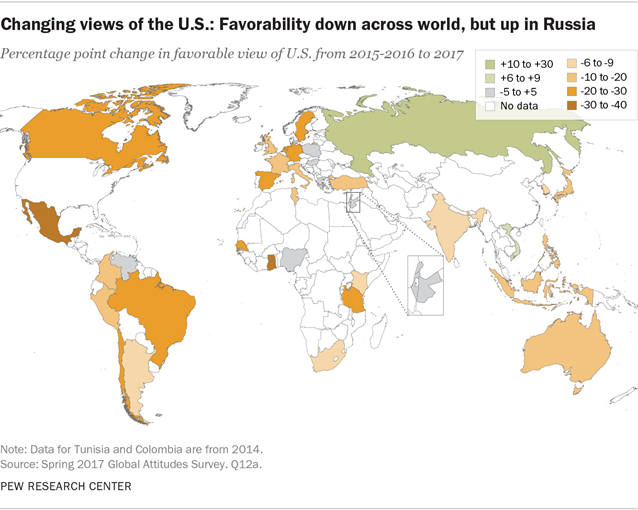
Changing views of the U.S.: Favorability down across world, but up in Russia

Changing views of U.S. presidents over past decade and a half

As Pew Research Center’s global surveys from George W. Bush’s presidency illustrated, many of Bush’s key foreign policies were unpopular, and by the time he left office Bush was viewed negatively in most of the countries we polled. His successor, Obama, generally received more positive ratings throughout his White House tenure.

Today, in many countries, ratings for President Trump look very similar to those for Bush at the end of his term. This pattern is especially clear in Western Europe. In the UK, France, Germany and Spain, the low levels of confidence in Trump are very similar to the poor ratings for Bush in 2008.

Trump's ratings in Western Europe similar to those for Bush in 2008

Trump, Putin and Xi all unpopular; Merkel gets highest marks
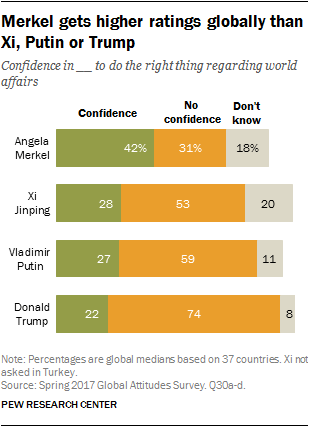
Merkel gets higher ratings globally than Xi, Putin or Trump

In addition to exploring global views of President Trump, this survey also examines attitudes toward three other major leaders on the international stage. The results demonstrate that Trump is not the only world leader in whom global publics lack confidence. Chinese President Xi Jinping and Russian President Vladimir Putin also get poor marks, though neither is rated as negatively as the U.S. president. Across the 37 nations surveyed, a median of 28% voice confidence in Xi, while 27% feel this way about Putin.

In contrast, 42% express confidence in the long-serving German Chancellor Angela Merkel, while just 31% lack confidence in her. A median of 60% in Europe have confidence in Merkel, and her ratings are particularly strong on the political left, even though she hails from the right-of-center Christian Democratic Union (CDU).

Xi and Merkel are somewhat less well-known than Trump and Putin. Roughly one-in-five globally do not offer an opinion about the Chinese and German leaders.

What is a median?

On questions throughout this report, median percentages are reported to help readers see overall patterns. The median is the middle number in a list of figures sorted in ascending or descending order. In a survey of 37 countries, the median result is the 19th on a list of country-level findings ranked in order.

In addition to medians of respondents across the survey’s 37 countries, this report sometimes refers to the median among a specific subset of respondents and/or countries by region. For example, we can look at European medians across 10 countries, where the median is the average of the fifth and sixth figures when the countries are listed from highest to lowest. We can also calculate the medians across seven Asian-Pacific nations, five Middle East-North African nations, six sub-Saharan African nations and seven Latin American nations.

Most disapprove of Trump’s policies

The 2017 survey examines attitudes toward five major policy proposals that President Trump has supported. Globally, none of them are popular.

As a candidate, Trump repeatedly pledged to withdraw the U.S. from the nuclear weapons agreement with Iran, though he has yet to do so as president. On balance, global publics oppose this idea. Only in Israel and Jordan do majorities support U.S. withdrawal from the agreement.

About a third globally express support for Trump’s proposed ban on people entering the U.S. from certain Muslim-majority nations, although there are four countries – Hungary, Israel, Poland and Russia – where more than half endorse this proposal. Opposition is especially strong in several countries with Muslim-majority populations, including Jordan, Lebanon and Senegal.

Widespread disapproval of Trump's signature policy proposals

The survey, which was conducted before Trump officially announced that the U.S. would pull out of the Paris climate change accord, finds widespread opposition to the U.S. withdrawing from international climate change agreements. A median of only 19% support the U.S. backing away from accords like the one signed in Paris – similar to the low level of support for the U.S. rejecting major trade agreements. (Trump pulled the U.S. out of the Trans-Pacific Partnership trade deal early in his administration.) Opposition to the U.S. withdrawing from climate and trade agreements is especially strong in the European nations polled.

A median of just 16% endorse Trump’s plan to build a wall between the U.S. and Mexico. Fully 94% of Mexicans oppose the wall, and the wall is strongly rejected throughout Latin America, as well as in much of Europe. There is no country among the 37 surveyed in which a majority endorses a border wall between the U.S. and Mexico.

Global views of Trump's characteristics

Most say Trump is arrogant, intolerant, dangerous, but also strong leader

Survey respondents were read a list of positive and negative characteristics, and for each one, were asked whether it describes Donald Trump. Around the globe, people associate a number of negative characteristics with the U.S. leader. Most say he is arrogant, intolerant and dangerous, while few think of him as well-qualified or as someone who cares about ordinary people. Describing Trump as charismatic is more common, although global publics on balance do not think of him as charismatic either. They do, however, see Trump as a strong leader – a median of 55% across the nations polled describe him this way.

The world’s wider view of America

Attitudes toward the U.S. president and American foreign policy have a major impact on how people around the world view the United States, but other factors are important too. The nation’s culture, ideas and people – elements of what is sometimes referred to as “soft power” – also shape how people around the world see the country. In this poll, as in previous Pew Research Center surveys, some aspects of American soft power have stronger global appeal than others.

The American people are core to how the U.S. is perceived around the globe. Overall, Americans are seen more positively than the U.S. as a country. Across the nations polled, a median of 58% say they have a favorable impression of Americans. Positive views are especially common in Asia and Europe. They are less common, however, in the Middle East – Turkey, Jordan and Lebanon are the only nations polled where majorities express an unfavorable opinion of Americans.

Along with its citizens, America’s popular culture is often well-regarded abroad. Roughly two-thirds across the countries surveyed like American music, movies and television. Europeans and Asians are particularly likely to find U.S. pop culture appealing, while these types of cultural exports are less popular in several Muslim-majority nations.

Mixed ratings for American soft power

Despite the doubts sown several years ago by revelations of American spying on foreign leaders and citizens, across the 37 countries polled this spring a median of 54% believe the U.S. government respects the personal freedom of its people. In Europe, America’s reputation for individual liberty was damaged by the U.S. National Security Agency’s spying revelations and has not recovered – today, a median of 52% across the 10 European nations polled say Washington respects personal freedoms, while nearly as many (a median of 44%) say it does not. The U.S. gets higher marks on this issue in Asia and Africa.

But America’s influence around the world is not always welcome. For example, even though many people say they personally like American popular culture, a global median of 54% worry that the influx of U.S. customs and ideas into their country is a bad thing.

A U.S. export that not all publics embrace is American-style democracy. While publics around the world generally endorse broad democratic principles, they offer mixed views regarding American ideas about democracy: Globally, a median of 43% say they like these ideas, while 46% say they dislike them. As with several other aspects of U.S. soft power, U.S.-style democracy is particularly popular in the African and Asian nations surveyed.

Prevailing view is that relations with U.S. will stay about the same
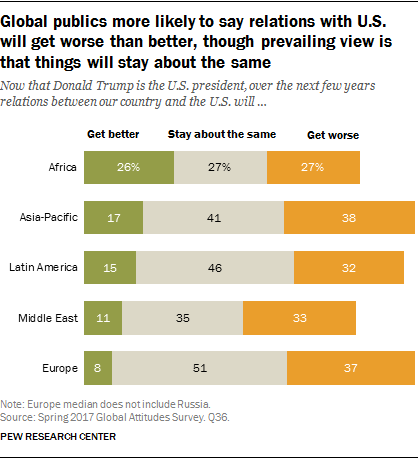
Global publics more likely to say relations with U.S. will get worse than better, though prevailing view is that things will stay about the same

Respondents were asked whether, now that Trump is president, they think relations between their country and the U.S. will improve over the next few years, get worse, or stay about the same.

In many countries, a majority or plurality believes relations will remain about the same. However, in most regions of the world, the share of the public that believes things will worsen outweighs the share that thinks relations will improve by a ratio of two-to-one. While relatively few say they expect relations to improve, more than half hold this view in Russia and Israel.

Country spotlights: Russia, Israel, Germany, Mexico, Canada

Looking at findings on U.S. favorability and confidence in the American president in Russia, Israel, Germany, Mexico and Canada illustrates different patterns Pew Research Center surveys have discovered over time regarding attitudes toward the U.S. and its leader.

Russia: U.S. favorability is up and Trump is relatively popular
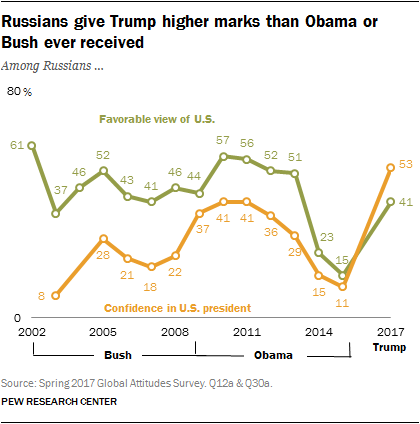
Russians give Trump higher marks than Obama or Bush ever received

Amid ongoing controversies and investigations into allegations of links between the Trump presidential campaign and Russia, attitudes toward the U.S. have turned more positive in Russia. Following the outbreak of the Ukraine crisis in 2014, ratings for both the U.S. as a country and for President Obama plummeted. However, since 2015 – the last time the Center polled in Russia – favorable opinions of the U.S. have become much more common there. And President Trump gets more-positive reviews in Russia than either of his predecessors ever did.

Israel: Consistently positive about U.S., but views of U.S. presidents have varied
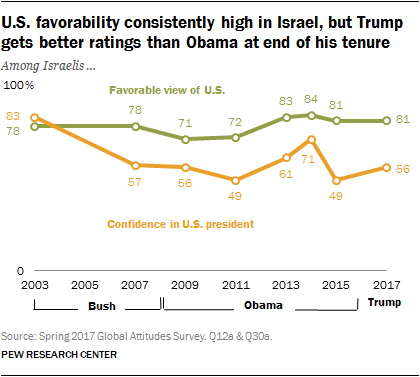
U.S. favorability consistently high in Israel, but Trump gets better ratings than Obama at end of his tenure

In survey after survey, Israelis give the U.S. some of its highest favorability ratings, and that’s true again this year, with 81% saying they have a positive view of the U.S. Assessments of American presidents, however, have fluctuated. In 2003, President George W. Bush received very high ratings, but those declined a bit over the course of his presidency. Obama’s confidence ratings varied from 49% to 71% in the Center’s polling in Israel during his administration. Between 2014 and 2015, his ratings dipped substantially, reflecting tensions between Obama and Prime Minister Benjamin Netanyahu over the Iran nuclear deal. Israel is one of only two countries (Russia being the other) in which Trump’s ratings are higher than Obama’s during the final two years of his administration.

Germany: Dramatic shift in views of American president, U.S. favorability drops
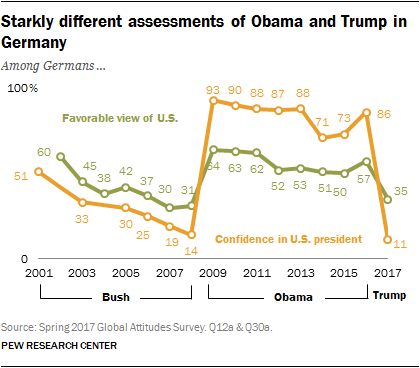
Starkly different assessments of Obama and Trump in Germany

In Germany – and in several of its Western European neighbors – attitudes toward the U.S. have followed a clear pattern over the past decade and a half. President George W. Bush was not very popular at the outset of his presidency, and he grew less so over the next few years, amid widespread German opposition to key elements of his foreign policy. This in turn had a negative impact on America’s overall image in the country. President Obama, in contrast, was extremely well-regarded (although his ratings did decline somewhat following the NSA eavesdropping scandal), and this coincided with an improvement in attitudes toward the U.S. Today, German confidence in Trump is low, and U.S. favorability is near where it was at the end of the Bush years.

Mexico and Canada: Ratings plunge among America’s closest neighbors

America’s image has turned negative in the two nations with which it shares a border.
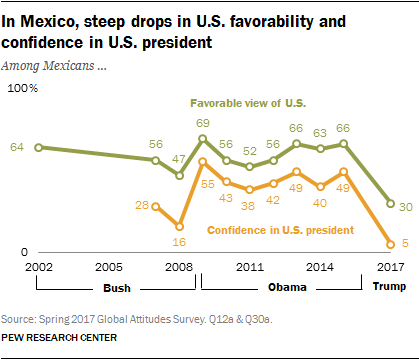
In Mexico, steep drops in U.S. favorability and confidence in U.S. president
Trump, U.S. get lowest ratings from Canada in 15 years

Over the past decade, U.S. presidents have gotten mixed or negative reviews in Mexico, but at 5% Donald Trump registers the lowest confidence rating of any U.S. leader in Mexico since Pew Research Center began surveying there. This 5% rating is also the lowest among the 37 nations polled in 2017. The proposed wall between the U.S. and Mexico has been a high-profile position for Trump since he declared his candidacy for president, and more than nine-in-ten Mexicans oppose it. U.S. favorability has typically been higher than confidence in the American president in Mexico. That remains the case this year, although the share of the public with a positive view of the U.S. has dropped steeply since 2015.

Trump receives dramatically lower ratings than his predecessor in Canada. And for the first time since the Center began polling in Canada, the share of Canadians expressing a favorable opinion of their neighbor to the south has slipped to below 50%. Just 43% of Canadians now have a positive view of the U.S.

1. The tarnished American brand

The share of the global public that voices a favorable view of America is on the decline. Across the 37 countries that Pew Research Center has tracked over the past several years, only in Russia has the image of the United States improved by a large margin. Elsewhere, attitudes have taken a dramatic turn for the worse, especially in Western Europe and Latin America.

Global publics voice mixed views of American soft power: Most like American entertainment, but there is little consensus about U.S.-style democracy and many oppose the spread of American ideas and customs around the world.

At the same time, much of the world still believes the U.S. respects the personal freedoms of its people. And most publics around the world continue to have a favorable opinion of Americans.

Mixed views globally

Today, a global median of 49% hold a favorable view of the U.S. This is a considerable drop from the median of 64% recorded across the same countries in the final years of the Obama administration.

In just four of 10 EU countries surveyed is the public positively inclined toward the U.S. The most widespread support is found in Poland (73%), Hungary (63%) and Italy (61%). In spite of the “special relationship” between America and the United Kingdom, only 50% of the British see the U.S. favorably. The most negative views of the U.S. are in Germany (62% unfavorable), Spain (60%) and the Netherlands (59%). And in the past year the share of the Spanish public that expresses a very unfavorable opinion has roughly tripled from 7% to 23%.

Only about four-in-ten Canadians (43%) and Russians (41%) express a favorable view of America.

There is strong support for the U.S. in Vietnam (84%), the Philippines (78%) and South Korea (75%). A majority of Japanese (57%) agree. But Australians are evenly split (48% favorable, 48% unfavorable). And roughly half of Indians (49%) have a positive view, although 42% express no opinion.

In the Middle East, roughly eight-in-ten Israelis (81%) voice positive sentiment toward the U.S. But they stand isolated in the region. Only about a third of Lebanese (34%) and roughly a quarter of Tunisians (27%) say they have a favorable opinion of America. And roughly eight-in-ten in Turkey (79%) and Jordan (82%) have an unfavorable opinion. This includes 58% in Turkey who are very negative toward the U.S., up 26 percentage points since 2015.

In sub-Saharan Africa, publics are generally positive toward the U.S. More than half in all six nations surveyed offer a favorable assessment, sometimes exceeding the share with negative views by two-to-one. The most widespread support is in Nigeria (69%). But intensity of positive opinion has waned in all six African societies since 2015: The share saying they have a very favorable view of the U.S. is down by a large margin in Senegal (39 percentage points), Ghana (35 points) and Tanzania (31 points).

Compared with sub-Saharan Africa, Latin America tends to be less enthusiastic about the U.S. Only about half of Colombians (51%), Peruvians (51%) and Brazilians (50%) express a positive attitude toward the U.S. Mexicans are unfavorable by more than two-to-one (30% positive, 65% negative). And this includes 42% of Mexicans who are very unfavorable, a seven-fold increase since 2015.

A

s has been quite common in Pew Research Center surveys in recent years, America’s image is strongest among young adults in a number of countries. In 16 of the countries surveyed in 2017, those ages 18 to 29 have a more favorable view of the U.S. than do people 50 and older. And the differential is often quite large. For instance, young Brazilians (72%) are about twice as likely as older ones (33%) to see the U.S. favorably. The young-old generation gap is also quite large in Vietnam, France, Hungary, the Netherlands and Mexico.

Views of the U.S. also divide along ideological lines in many countries. In 16 of the 21 nations in which respondents are asked to self-identify on a left-right ideological scale, those on the political right are significantly more likely than those on the left to have a favorable view of the U.S. This ideological gap is particularly large in Venezuela, where people on the right (64%) are nearly three times as likely to be positive about America as are people on the left (22%). There is roughly a two-to-one right-left divide in Australia, Canada and Sweden. And this ideological difference exists even in nations, such as South Korea, Israel and Poland, where the public overall is quite pro-American.

In a number of countries, U.S. seen more favorably by men

A gender gap divides views of the U.S. in 10 of the nations surveyed. Men voice a more favorable opinion of America than do women in half the European countries surveyed – including a gender divide of 19 percentage points in Sweden, 15 points in Germany and 12 points in the Netherlands. Similar gaps exist in Australia and Canada.

And there are some notable differences in views of the U.S. in select countries with significant religious and ethnic diversity in their populations. In Israel, 89% of Jews express a positive opinion of the U.S., but only 51% of Arabs agree. In Nigeria, 75% of Christians are favorably disposed toward America, while only 64% of Muslims share that view. And in Lebanon, 59% of Christians favor the U.S., while just 36% of Sunni Muslims and 7% of Shia Muslims do.

An eroding image

America’s standing in the world’s eyes has changed markedly in a very short period of time. In more than half of the 37 nations surveyed, positive views of the U.S. experienced double-digit drops in 2017.

In 10 countries, majorities had positive views of the U.S. in the recent past, but now the share of the public that is favorable toward the U.S. is in the minority. For example, in Mexico, U.S. favorability has roughly halved, down 36 points from 66% to 30%.

In 14 nations the decline in U.S. favorability has been significant, but the U.S. nevertheless retains support from half or more of the public. In Japan, for instance, positive views of the U.S. have declined 15 points, but 57% of Japanese still favor the U.S.

Finally, there are three countries in which America has not enjoyed majority support for some time, so any decline this year only made things worse. In Turkey, where positive assessment of the U.S. is down 11 points, it was already quite low (29%) in 2015.

In only eight countries are views of America largely unchanged in recent years.

There has been a large improvement in U.S. image in only one nation: Russia, where the favorable view of America is up 26 points, from 15% in 2015 to 41% in 2017.

The shift in views of America has been particularly notable in several European countries. In 2016 a median of 61% held a favorable opinion across France, Germany, Poland, Spain and the UK, compared with 26% who had an unfavorable assessment. In 2017 the medians among these countries are 46% positive, 52% negative. This is the first time since 2008, the last year of the George W. Bush presidency, that these European publics have voiced more unfavorable than favorable views of the U.S.

In some European countries, America’s image has also suffered more among women than men. From 2016 to 2017, favorable ratings of the U.S. in Sweden fell 37 points among women and 14 points among men. In Germany, it declined 28 points among women and 13 points among men. And it declined 23 points among French women and 13 points among French men.

Americans well liked

Over the past 16 years, whatever their views of the United States and whoever sits in the White House, global publics have often maintained a favorable impression of Americans.

Today, a median of 58% in 37 nations say they look favorably on Americans. The American people are particularly well thought of in most of the Asia-Pacific region: 86% of South Koreans and Vietnamese, 85% of Filipinos, and 75% each of Australians and Japanese have a positive view. Europeans are also well disposed toward Americans: 80% of Swedes, 74% of the Poles and British, 73% of the French and 71% of the Dutch say they hold a favorable opinion. Even 56% of Russians rate Americans positively.

Majorities in all six African countries surveyed see Americans favorably, including 70% of Nigerians. But these numbers are down significantly in four of the five nations surveyed in both 2017 and 2013, the last time this question was asked. The falloff has been 27 points in Ghana, 21 points in both Kenya and Senegal, and 11 points in South Africa.

Latin Americans voice more mixed views of Americans. Half or more of Colombians (56%), Peruvians (55%), Brazilians (53%) and Venezuelans (50%) are positive about their neighbors to the north. But only 48% of Chileans, 41% of Mexicans and 39% of Argentines agree. Moreover, since 2013, positive opinion of Americans has fallen 18 points in Mexico and 16 points in both Brazil and Chile.

Americans do not enjoy a positive image in the Middle East, except in Israel, where 76% say they have a favorable view of people in the U.S. Only 43% in Lebanon, 37% in both Jordan and Tunisia and 24% in Turkey express warmth for Americans. Low favorability has generally been the case in these nations except in Lebanon, where Americans enjoyed widespread approval for a decade between 2003 and 2013 only to have positive sentiment fall 15 points between 2013 and 2017.

Mixed views of American soft power

Soft power describes the ability of a nation to attract and persuade others through the appeal of its values, ideas and culture. American soft power has long been seen as a core strength for the U.S. However, the Center’s latest survey suggests that publics around the globe do not equally embrace the elements of U.S. soft power.

To begin with, publics in most nations do not think it is good that American ideas and customs are spreading to their country.

Europeans are particularly wary. Among the 10 EU countries surveyed, no majorities support such Americanization. Only about a third of the Dutch (32%) and Spanish (31%) and a quarter of the Germans (26%) say the proliferation of this U.S. soft power is a good thing.

Similarly, only a quarter of Russians (27%) approve of the spread of American ideas and customs.

There is even less public appreciation for American ideas and customs in Latin America. A median of just 39% think their spread is a good thing. Mexicans (26%) and Argentines (25%) are particularly unenthusiastic, with Mexican sentiment down 15 points since 2013.

In sub-Saharan Africa, roughly half in South Africa (52%) and Nigeria (51%) think the spread of American influence is a good thing, but only a quarter of the public in Tanzania (27%) agrees. Since 2013, support for U.S. ideas and customs has fallen 32 points in Senegal and 13 points in Kenya.

Israel (53%) is the only country surveyed in the Middle East where there is widespread support for this aspect of U.S. soft power. Just 15% in Jordan and 13% in Turkey share that view. And in both those countries such anti-Americanization sentiment has not changed much over the years.

Publics in the Asian-Pacific region are generally more positive toward American ideas and customs. Seven-in-ten Vietnamese (71%) and 62% of both Japanese and Filipinos say the spread of such American attributes is a good thing for their country. Over half of South Koreans (54%) agree. But just a third of Australians (33%) and 15% of Indonesians say these aspects of American soft power are beneficial.

In many countries, the appeal of U.S. ideas and customs is strongest among the young. In 21 of 37 countries, those ages 18 to 29 are more likely than those 50 and older to say such Americanization is a good thing for their society. This generation gap is quite large in Japan (35 points), Spain, Russia and Brazil (all 28 points) and Hungary (24 points). There is also a 12-point young-old divide in Mexico, despite the fact that only 26% of the overall public thinks sees the spread of American ideas and customs as good.

Mixed reactions to U.S.-style democracy

Globally, publics – even those in well-established, liberal democracies – express diverse views of American democratic ideas.

In Europe, a median of only 42% like American notions of democracy. This includes 34% in France and 37% in Germany. Such support is down 9 percentage points in France and 8 points in Germany since 2012, the last time this question was asked in Europe. About half of the public in both Italy (53%) and Hungary (52%) expresses support for U.S.-style democracy. The British, meanwhile, are divided: 43% like and 44% dislike their former colonial subjects’ ideas about democracy.

In Latin America, U.S.-style democracy fails to earn majority support in any of the seven countries surveyed. Only 25% of Mexicans and 28% of Argentines like American democratic ideas. And since 2013 the share of the public that expresses approval for such American concepts is down 18 points in Mexico and Brazil, 13 points in Chile and 10 points in Argentina.

Africans generally find American-style democracy appealing. Half or more in five of the six countries surveyed in that region like this aspect of U.S. soft power. At the same time, backing for U.S. democratic ideas has fallen sharply in a number of African nations even though a majority still supports them. Support is down 24 points in Senegal, 22 points in Kenya and 16 points in Ghana.

In the Asia-Pacific region majorities in South Korea (78%), Vietnam (69%), Japan (63%) and the Philippines (57%) also like American democratic ideas. But only about a third of Indonesians (35%) concur.

Middle Eastern countries are slightly more supportive of U.S. ideas about democracy than they are about the spread of other American ideas and customs. Nearly two-thirds of Israelis (65%) like these ideas, as do roughly half of Lebanese (52%). More people dislike than like such U.S. ideas in Jordan and Tunisia, though four-in-ten Jordanians (43%) and Tunisians (41%) do express support. Only the Turks (23%) have little faith in U.S.-style democracy.

In 13 of the nations surveyed, men are significantly more likely than women to express admiration for American democratic ideas. This gender gap is particularly large in Australia (21 points: men 54%, women 33%), Sweden (20 points: men 48%, women 28%), Nigeria (17 points: men 76%, women 59%), Ghana (16 points: men 66%, women 50%), Germany (16 points: men 45%, women 29%) and Greece (15 points: men 48%, women 33%).

U.S. protection of individual rights

A median of 54% in 37 countries think that the United States government respects the personal freedoms of its own people.

In comparison, a median of 61% say France protects such rights, but 31% say Russia does and just 25% think China respects these liberties. Such median views of the U.S. performance mask wide regional differences, however.

Most publics in the Asia-Pacific region overwhelmingly see the U.S. as a defender of civil liberties. This includes 87% of Vietnamese, 84% of South Koreans, 73% of Filipinos and 69% of Japanese. Only 42% of Indians laud U.S. defense of personal freedoms, but that may be because 45% don’t know or refuse to answer.

America’s reputation as a defender of individual rights is also quite strong in some parts of Africa, where 77% of Nigerians and 68% of Kenyans say “yes,” the U.S. respects personal freedoms. But even though 60% of Ghanaians agree, that share is down 19 points since 2015. And just 44% of Tanzanians see U.S. behavior on civil liberties in a positive light, down 21 points from 2015.

Many Latin Americans do not see the U.S. as a protector of personal freedoms. A median of just 45% in the region say the U.S. respects its own people’s rights, including just 35% in Argentina and 32% in Mexico. This part of America’s soft-power image has taken a particular hit in Chile, where it is down 34 points since 2015, and in Mexico, where it is down 24 points.

Europeans are divided in their views of the U.S. as a guarantor of civil liberties, but opinions vary widely across the region. Fully 70% of Hungarians and 65% of Italians think America respects the personal freedoms of its people. But only 43% of Swedes and 38% of Spanish respondents agree. This relatively low level of trust in the U.S. is not a recent phenomenon. America’s reputation as a guardian of people’s rights may have been affected by revelations in June 2013 that the U.S. National Security Agency had listened in on telephone conversations, even those of European leaders. And in a number of European countries that reputation has not recovered. The share of publics in both France and Germany who say the U.S. respects the personal freedoms of its people is down 31 points since immediately before the revelations in 2013. Now only about half of French and Germans see America as a defender of civil rights. (For more global opinions on American electronic surveillance, see “Global Opposition to U.S. Surveillance and Drones, but Limited Harm to America’s Image.”)

Notably, six-in-ten Russians (61%) think the U.S. respects the personal freedoms of Americans. Such sentiment is up 20 points from 2015, when 41% held that view.

In 11 of the 37 countries surveyed, perceptions of America’s record on domestic civil liberties differ by gender. Women are less likely than men to say the U.S. government respects the personal freedoms of its own people in Sweden, where the gender gap is 21 points (54% of men, 33% of women), in Canada (19 points: 55% of men, 36% of women), France (15 points: 57% of men, 42% of women), Colombia (14 points: 53% of men, 39% of women), the UK (13 points: 60% of men, 47% of women), Mexico (12 points: 38% of men, 26% of women) and Germany (12 points: 54% of men, 44% of women).

Broad affection for American pop culture

For most people around the world, U.S. movies, music and television are a popular aspect of the American brand. Half or more of the public in 30 of 37 nations surveyed say they like U.S. cultural products. And this has been the case in most countries since the question was first asked in 2002.

It is notable, however, that in the six Muslim-majority nations surveyed, a median of just 40% find American pop culture appealing.

Europeans overwhelmingly embrace American cinema, TV programs and music. This includes 88% of Swedes and 82% of the Dutch, publics that were divided over or opposed to the spread of U.S. ideas and customs and American ideas about democracy.

Eight-in-ten Australians and roughly seven-in-ten Japanese, Filipinos and South Koreans like U.S. cultural products. Only 37% of Indonesians find them appealing. Notably, Indonesians are also overwhelmingly opposed to the spread of U.S. ideas and customs.

A median of 60% of Latin Americans find American cinema, music and TV to their liking. This includes roughly two-thirds of Venezuelans (67%) and Argentines (65%), two countries where half or more of the public say the spread of American ideas and customs is bad.

African attitudes toward American cultural products vary. For example, they are well liked in South Africa (76%), but only roughly half that share in Senegal (36%) finds them appealing.

In the Middle East, the appeal of U.S. movies, music and TV is low: A median of only 45% say they like American cultural exports. The exceptions in this region are Israel (66%) and Lebanon (62%).

In almost every country, young people tend to like American pop culture more than older people. And the age gap is often quite substantial, even in those nations where both young and old find American movies, music and television attractive. The median young-old difference over 37 societies is 25%. This includes generational differences of 57 points in Vietnam, 39 points in Russia and Brazil, 36 points in France and 34 points in Colombia.

2. Worldwide, few confident in Trump or his policies

Relatively few people across the globe have confidence in U.S. President Donald Trump to do the right thing when it comes to world affairs. And some of his most prominent policy proposals – such as building a wall between the U.S. and Mexico, withdrawing from trade and climate agreements, and restricting people from some Muslim-majority countries from entering the U.S. – are deeply unpopular. Opposition to the United States’ possible withdrawal from the Iran nuclear agreement is less intense worldwide, and such a move would be welcomed by a majority of the public in Jordan and Israel.

In terms of personal characteristics, Trump is seen by most publics around the world as arrogant, intolerant and even dangerous. At the same time, he is seen by sizable percentages as a strong leader.

Despite widespread unease over the new U.S. president’s character and his policies, the prevailing view across the publics surveyed is that the relationship between the U.S. and their country will not change during Trump’s tenure. Those who do anticipate change, however, are more likely to expect relations to worsen rather than improve, particularly in Western Europe.

With Trump in office, confidence in U.S. president drops precipitously

Across the 37 countries surveyed in 2017, a median of only 22% say that they have at least some confidence in Trump to do the right thing regarding world affairs. Almost three-quarters (74%) have little to no confidence in the new U.S. leader.

Trump’s greatest support in the current poll comes from Filipinos, 69% of whom say they have confidence in the U.S. president. Other publics in which more than half offer a positive opinion of him include a diverse array of countries such as Nigeria (58%), Vietnam (58%), Israel (56%) and Russia (53%).

In contrast, only 5% in Mexico and 7% in Spain have confidence in Trump. He gets consistently low ratings across Latin America and Europe, where medians of only 14% and 18% respectively have confidence in him.

Around the globe, confidence in the U.S. president is at some of the lowest levels measured by Pew Research Center over the past decade and a half.

Looking back to earlier in the century, President George W. Bush’s ratings fell in the aftermath of the Iraq invasion in 2003 and never fully recovered in some countries. Across 26 countries the Center surveyed near the end of his term, from 2007 to 2008, a median of only 27% had confidence in Bush’s ability to handle international affairs. This included 2% in Turkey, 7% in Jordan and Argentina and 8% in Spain. However, he did retain relatively strong support in sub-Saharan Africa, including 72% confidence in Kenya and 69% in Ghana as of 2007.

In 2009, with the election of Barack Obama, ratings for the U.S. president soared in many countries, especially in Europe and Asia. And despite a dip in confidence in some nations coinciding with increased use of drone strikes and the 2013 spying scandal with the U.S. National Security Agency, by 2015 and 2016 Obama had retained or improved upon most of his global support. Across the 37 countries surveyed in that time period, he enjoyed a median confidence rating of 64%. This included support from roughly nine-in-ten or more in the Philippines (94%), Sweden (93%), the Netherlands (92%) and South Korea (88%). However, despite concerted efforts to improve America’s image in the Middle East, only 14% in Jordan, 27% in Tunisia and 36% in Lebanon expressed a positive view of his leadership. Additionally, only 11% in Russia had confidence in Obama by 2015.

With the election of Donald Trump, confidence in the U.S. president’s ability to do the right thing regarding world affairs has plummeted in many of the countries surveyed, often back to levels that are similar to or lower than what Bush received in many countries. And in every country surveyed – except Russia (where confidence rose 42 percentage points) and Israel (+7 points) – Trump’s ratings are lower than Obama’s at the end of his term. This includes precipitous drops of as many as 83 percentage points in Sweden, 75 points in Germany and 71 points in South Korea. Even in Kenya and Ghana, where about half have confidence in Trump, his ratings are significantly lower than those of either Obama or Bush.

For a complete trend on views of the U.S. president over time, see Appendix A.

Trump’s image up slightly in Europe from 2016

Although strong majorities across Europe have little to no confidence in President Trump, opinions of Trump have lifted slightly in a handful of countries since he was a presidential candidate. For example, in spring 2016, when Trump had not yet secured the Republican nomination for president and Pew Research Center surveyed publics in Europe, Asia and Canada, only 12% in the UK had confidence in Trump’s international abilities. But in 2017, 22% now have confidence in Trump, a rise of 10 percentage points. A similar jump occurred in the Netherlands (+10), as well as in Canada (+8), Japan (+15) and Australia (+18) outside of Europe.

Views of Trump also improved between 2016 and 2017 in Greece (+16), Hungary (+9) and Poland (+8), but those changes might be on account of the large number of people who did not answer the question in 2016. For example, 42% of Poles had no opinion of Trump in 2016 vs. 21% in 2017.

Confidence in Trump differs by gender and ideology

In some countries in Europe and the Asia-Pacific, men are more likely than women to say they have confidence in President Trump to handle international affairs. The biggest gender gaps in attitudes toward the new U.S. president are found in Canada, the UK and Japan. Men in Germany, the Netherlands, Poland, Sweden, Australia and South Korea are also more likely than women in those countries to express confidence in Trump.

There are also significant ideological differences for confidence in Trump in many of the countries surveyed. For example, among people on the right in Australia, 51% have confidence in Trump’s ability to handle international affairs, compared with only 8% among Australians on the left.

There are also stark divides on confidence in Trump among people of different races, ethnicities and religious affiliations in a few countries surveyed. In Lebanon, for example, a third of Christians say they have confidence in Trump’s international leadership abilities, compared with only 12% among Sunni Muslims and 0% among Lebanese Shia. A similar pattern holds in Israel, where 64% of Jews have confidence in his ability to lead, compared with only a quarter of Arabs. And in Nigeria, seven-in-ten Christians have confidence in Trump compared with less than half (46%) among Nigerian Muslims.

Trump also gets greater confidence from supporters of populist parties on the ideological right in Europe. For example, among people in France who have a favorable view of Marine Le Pen’s National Front, 39% have confidence in Trump, compared with only 6% confidence among those with an unfavorable view of the right-wing party. Similar divides exist among United Kingdom Independence Party (UKIP) supporters and detractors in the UK; Lega Nord in Italy; PVV (Geert Wilders’ Party for Freedom) in the Netherlands; Sweden Democrats; and the Alternative for Germany Party (AfD). However, even among these right-wing party supporters, among no group is there majority confidence in Trump.

Global reaction to Trump’s international policies

As a candidate and newly elected president, Donald Trump has either taken or promised action on a number of important policy fronts with international ramifications. Generally, publics around the world disapprove of the policy directions that Trump has embraced.

Border wall

Trump’s proposal to erect a wall along the border between Mexico and the U.S. generates the greatest opposition in the countries surveyed. Globally, a median of 76% disapprove of building the wall, while only 16% approve. Publics in Europe and Latin America are the most negative, with a median of about 85% in both regions voicing disapproval. In Mexico, 94% oppose building a wall on their border.

The idea of building a wall between the U.S. and Mexico receives the greatest support among Jordanians (44% approve) and Israelis (42%), but even in these countries, public opinion is split on the issue.

In North America and Europe, men are more likely than women to support building a physical wall between the U.S. and Mexico. Australia has the largest gender gap in approval ratings for the border wall: 26% of men vs. 12% of women support Trump’s announced intention.

Climate accord

Prior to the actual decision by the Trump administration to withdraw from the Paris climate accord, a median of roughly seven-in-ten (71%) worldwide said they would disapprove of such a move.

In 32 of the 37 countries polled, majorities oppose the U.S. pulling out of climate change agreements. Western European publics object strongly; nine-in-ten or more in Germany (93%), Sweden (93%), the Netherlands (91%), Spain (91%) and France (90%) disapprove of such a step by the U.S.

In Africa and the Asia-Pacific region, publics react less harshly to the idea of the U.S. withdrawing from climate agreements. A regional median of 30% in Africa and 25% in the Asia-Pacific region approve of such a move.

International trade agreements

In his first week in office, President Trump signed an executive order withdrawing the U.S. from the Trans-Pacific Partnership free-trade agreement (TPP), following through on part of his promise to remove the U.S. from several international trade agreements. Majorities in 32 of the 37 countries polled oppose America’s withdrawal from such agreements.

Globally, a median of 72% disapprove of Trump’s proposal to withdraw the U.S. from international trade pacts. Roughly eight-in-ten in Canada (78%) and Mexico (80%) disagree with this policy; both nations are TPP members, and many Canadians and Mexicans see the North American Free Trade Agreement (NAFTA) as a good thing for their country. Other TPP member countries feel similarly about the U.S. backing away from trade agreements, with roughly a quarter or fewer in Vietnam (26%), Peru (21%), Australia (19%), Japan (16%) and Chile (11%) supporting this policy.

As is the case for many of his other policies, Trump’s proposal to withdraw the U.S. from trade agreements is met with the strongest opposition in Europe (median of 77%).

Restricting immigration

Majorities in only three of the 37 countries surveyed approve of moves by President Trump to restrict immigration from some Muslim-majority countries. Globally, a median of 62% reject this policy stance – nearly twice the percentage that support it.

About one-third support the travel ban in Europe (a median of 36%), Africa (35%), Latin America (32%) and Asia (31%). Majorities in Hungary (70%) and Poland (56%) back tightening restrictions on people entering the U.S. from some Muslim-majority countries. More than four-in-ten in Vietnam (47%), Australia (45%), Greece (45%) and Italy (44%) also approve of the proposal.

A majority of Israelis (63%) and more than half of Russians (53%) also support this policy. In comparison, these policies receive extreme disapproval in Jordan (96%) and Lebanon (88%), both Muslim-majority countries with large refugee populations. Similarly, a strong majority in Senegal (82%) – where more than 90% of the population is Muslim – also disagrees with Trump’s policy to tighten restrictions on people entering the U.S. from some Muslim-majority countries.

Religious and ethnic divides on the proposed ban also emerge in some countries. For example, Muslims in Nigeria and Lebanon are much more likely to disapprove of the Muslim ban than are Christians in each country. And in Israel, views of this policy diverge strongly along ethnic lines. Among Israeli Jews, 76% approve of the proposed ban, compared with only 12% of Israeli Arabs.

In many countries, those on the right of the political spectrum are more likely to approve of Trump’s intention to restrict entry from Muslim-majority countries than those in the center or on the left. In Israel, this ideological divide is especially large: 83% of those on the right approve of this policy, compared with only 21% of those on the left – a 62-percentage-point difference. Australians show the second-largest ideological gap: 64% of those on the right but only 15% of those on the left approve of the travel ban, for a 49-point ideological gap.

Iran nuclear deal

As a candidate, Donald Trump publicly indicated his intention to withdraw support from the Joint Comprehensive Plan of Action, informally known as the Iran nuclear deal. Globally, a median of only 34% approve of such an initiative, while 49% disapprove.

Nations in the Middle East voice more support than other regions: A median of 42% across the region favor the U.S. backing out of the Iran deal. The public in Israel (67%), where Prime Minister Benjamin Netanyahu and other government officials have opposed the deal from the onset, displays the strongest support for the U.S. abandoning the current agreement with Iran. A majority of Jordanians (59%) also approves.

In Russia, one of the nations involved in the negotiations for the Iran agreement, the public is split on this issue: 38% approve of the U.S. withdrawing support for the deal while another 38% disapprove. Opposition is high, though, in the other countries involved in negotiations. Majorities in the UK (58%), France (62%) and Germany (71%) do not want the U.S. to back out of the deal.

Trump seen as strong leader, but not well-qualified

Survey respondents were read a list of four positive and three negative characteristics, and were asked whether each was something that described President Trump. Among the positive characteristics tested, Trump gets his highest marks for being a strong leader. Half or more in 23 of the countries surveyed say this about him. Across 37 countries, a median of 55% describe him as strong. Even in places where confidence in Trump is low, such as in Latin America and parts of Europe, majorities say that Trump displays strong leadership.

Across the other three positive characteristics tested, Trump fares less well. When asked whether Trump is charismatic, in only 10 nations do half or more say this describes the U.S. president, with a global median of 39% holding this view. Trump gets his highest marks for charisma in places where people have confidence in him, such as Israel (71%), Vietnam (68%) and Russia (62%). But he also gets relatively high marks on charisma in places with lower confidence in him, such as Hungary (58%), Poland (53%) and France (52%) in Europe and South Korea (62%) and Japan (54%) in Asia.

In 14 countries, men are more likely than women to see Trump as charismatic. For example, in Sweden, 51% of men see Trump as charismatic compared with only 32% among Swedish women.

On whether Trump is well-qualified to be president of the U.S., most publics say that he is not. A median of only 26% see Trump as qualified. The strongest support for Trump’s qualifications comes from Vietnam, the Philippines, Russia, Ghana and Nigeria. Across Europe, the Middle East and Latin America, as well as most of Asia, few see Trump as well-qualified, including only 6% of Germans, 11% of Mexicans and 15% of Japanese.

In 12 nations, men are more likely than women to see Trump as well-qualified. For example, 29% of men in Australia say that Trump is qualified, compared with only 16% of Australian women.

Trump based much of his presidential campaign on connecting with “ordinary” Americans, but when asked whether they think Trump cares about ordinary people, a global median of only 23% say that he does.

World sees arrogance as Trump’s most defining characteristic

Across all the characteristics tested, positive and negative, President Trump is most likely to be described as arrogant. Across the 37 nations, a median of 75% say this. Half or more in 29 of these countries consider Trump arrogant, with this sentiment especially common in Europe, Latin America, the Middle East and parts of Asia. This includes 94% in Spain, 93% in Canada, 92% in Jordan and 91% in Mexico.

Many also describe Trump as intolerant, with a global median of 65% expressing this view. In 28 countries, half or more say that Trump is intolerant. Once again, the countries most likely to describe Trump in this way are in Europe and Latin America, but also many in the Middle East and Asia share this view.

When asked whether they think of Trump as dangerous or not, a median of 62% across the world say that he is. In 26 nations, half or more consider him a danger. These fears are most evident in Mexico (83%), but also acute across most of Europe and Latin America. In contrast, only around a third or less of Russians, Nigerians, Ghanaians and Indians describe Trump as dangerous.

Ideology is often linked to whether publics see Trump as dangerous. In many of the European countries, as well as Australia, South Korea, Israel and Canada, those who place themselves on the left of the ideological spectrum are more likely to say that Trump is dangerous compared with those on the right. For example, 63% of those on the left in Israel say Trump is dangerous, compared with only 30% on the right.

In a few additional countries, such as Peru and Brazil, it is actually those in the center ideologically who are most concerned about Trump as a danger.

Many anticipate little overall change in relations with U.S. under President Trump

Despite widespread opposition to many of the Trump administration’s key policies and a lack of confidence in the new U.S. leader, many around the world believe their country’s relationship with the U.S. will not change much over the next few years. Across the nations surveyed, a median of 41% say they expect their country’s relations with the U.S. will stay about the same. A median of only 15% expect the relationship to improve over the next few years, while roughly twice as many (32%) believe U.S. relations with their country will worsen.

Among the most optimistic are publics in Africa, where a median of 27% expect relations between their country and the U.S. to improve in the coming years. Nigeria (54%) and Ghana (51%) have especially high levels of optimism.

Russians (53%) have similarly positive expectations for the future of U.S.-Russia relations. Only 10% believe the relationship will deteriorate under President Trump.

In the Middle East and North Africa, three times as many people say their relationship with the U.S. will worsen (33%) as say it will improve (11%). Israel is an outlier in the region, with 65% of Israelis saying they anticipate a better relationship with the U.S. now that Trump is president.

By contrast, Mexicans are the most pessimistic about their relationship with their neighbor to the north. Two-thirds in Mexico expect relations with the U.S. to worsen under Trump. About half that number (a median of 32%) share that view across the seven Latin American nations surveyed.

Europeans are the most likely to think that their relationship with the U.S. will not change over the next few years; roughly half (51%) across 10 European countries assert this view. Yet, a majority in Germany (56%) and almost half in Sweden (48%) are pessimistic about future U.S. relations.

3. Less confidence in Trump compared with Merkel and other world leaders

The United States occupies the world stage with other major powers that, especially at a regional level, may even rival the U.S. in terms of influence. The Center’s 2017 survey asked about confidence in the leaders of three other major powers besides the U.S.: German Chancellor Angela Merkel, Chinese President Xi Jinping and Russian President Vladimir Putin. Of the four, President Donald Trump is the least trusted to do the right thing when it comes to world affairs. Overall, a global median of 74% express no confidence in the U.S. leader, while only 22% express confidence in him.

By contrast, Merkel enjoys fairly widespread confidence among publics in much of Europe, Canada and Asia. This includes 89% who express confidence in her in the Netherlands and Sweden. Overall, half or more in 15 of the countries surveyed say they have confidence in Merkel to do the right thing in international affairs.

Merkel is not trusted in Turkey (14%) and Greece (16%), both of which have experienced tensions with Germany over economic and refugee issues.

Xi Jinping gets negative ratings in many of the countries surveyed. Across 10 EU countries, a median of only 18% have confidence in the Chinese leader to do the right thing in world affairs. Japanese (11%) and Indians (21%) also lack confidence in Xi, though a majority of Indians (56%) do not have an opinion.

On the other hand, there is strong confidence in Xi in sub-Saharan Africa, where China has made heavy investments over the past decade. Nearly two-thirds in Tanzania (66%) and more than half in Nigeria (54%) and Senegal (53%) have a positive view of his international leadership. Xi also gets significant support in Russia and the Philippines (53% each), both countries with leaders who have pursued improved ties with China.

Putin inspires little confidence as an international leader. Roughly six-in-ten across the 37 countries surveyed say they have little or no confidence in him. Outside of Russia, only in Vietnam (79%) does a majority say they trust Putin’s handling of world affairs. About half or more in the Philippines (54%) and Tanzania (51%) say the same.

In Europe, with the exception of Greece, relatively few have confidence in Putin when it comes to international affairs. Poles (4%) express the least confidence. In Canada, roughly two-in-ten (19%) have confidence in the Russian leader.

Acknowledgements

This report is a collaborative effort based on the input and analysis of the following individuals.

Richard Wike, Director, Global Attitudes Research Bruce Stokes, Director, Global Economic Attitudes Jacob Poushter, Senior Researcher Janell Fetterolf, Research Associate    

James Bell, Vice President, Global Strategy Caldwell Bishop, Research Associate Hanyu Chwe, Research Assistant             Stefan Cornibert, Communications Manager    Danielle Cuddington, Research Analyst Claudia Deane, Vice President, Research         Simona Griffith, Intern Courtney Johnson, Research Associate Michael Keegan, Information Graphics Designer David Kent, Copy Editor Dorothy Manevich, Research Analyst               Travis Mitchell, Digital Producer Patrick Moynihan, Associate Director, International Research Methods Audrey Powers, Administrative Coordinator Ariana Rodriguez-Gitler, Digital Producer Guilherme Russo, Research Associate Steve Schwarzer, Research Methodologist                         Laura Silver, Senior Researcher Katie Simmons, Associate Director, Research                        Rhonda Stewart, Senior Communications Manager      Kyle Taylor, Research Assistant Margaret Vice, Senior Researcher     Benjamin Wormald, Web Developer

Methodology

About the Pew Research Center’s Spring 2017 Global Attitudes Survey

Results for the survey are based on telephone and face-to-face interviews conducted under the direction of D3 Systems, Inc., Kantar Public UK, ORB International, Princeton Survey Research Associates International, and Voices! Research & Consultancy. The results are based on national samples, unless otherwise noted. More details about our international survey methodology and country-specific sample designs are available here.

Detailed information on survey methods for this report

General information on international survey research