Pew Research Center

FOR RELEASE JUNE 5, 2017

Global Publics More Upbeat About the Economy

But many are pessimistic about children’s future

BY Bruce Stokes

FOR MEDIA OR OTHER INQUIRIES:

Communications Department
202.419.4372
www.pewresearch.org

RECOMMENDED CITATION

Pew Research Center, June 2017, "Global Publics More Upbeat About the Economy"

About Pew Research Center

Pew Research Center is a nonpartisan, nonadvocacy fact tank that informs the public about the issues, attitudes and trends shaping the world. It does not take policy positions. The Center conducts public opinion polling, demographic research, computational social science research and other data-driven research. It studies politics and policy; news habits and media; the internet and technology; religion; race and ethnicity; international affairs; social, demographic and economic trends; science; research methodology and data science; and immigration and migration. Pew Research Center is a subsidiary of The Pew Charitable Trusts, its primary funder.

© Pew Research Center 2026

Table of contents

  • About Pew Research Center
  • Global Publics More Upbeat About the Economy
  • 1. Mixed views as some economies recover, others slow
  • 2. Public divided on prospects for the next generation
  • Acknowledgments
  • Methodology
  • Appendix

Global Publics More Upbeat About the Economy

But many are pessimistic about children’s future

Nearly a decade after the worst economic downturn since the Great Depression, economic spirits are reviving. Many Europeans, Japanese and Americans feel better today about their economies than they did before the financial crisis. More broadly, in 11 of 18 countries from across the globe that were surveyed in both 2016 and 2017, publics feel more positive about their economy than they did a year ago. The Dutch, Germans, Swedes and Indians see their national economies in the most positive light. While global publics are increasingly upbeat about economic conditions, the overall view of the economy is still in negative territory in many countries. Overall, a median of only 46% in the 32 nations surveyed this year say their current economy is doing well.

At the same time, many are concerned about the future: A median of just 41% believe that a child in their country today will grow up to be better off financially than their parents. The most pessimistic about prospects for the next generation are the French, Japanese and Greeks.
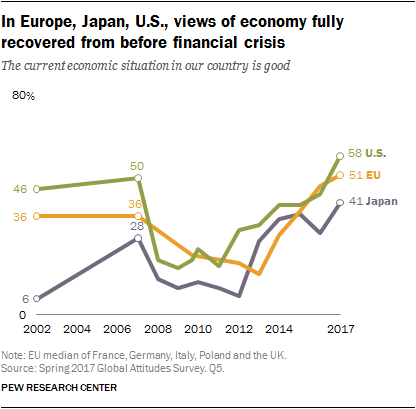
Across five large European economies, Japan, and the United States, public assessment of national economic conditions is now more positive than it was in 2007, immediately before the global financial crisis.

Nearly six-in-ten Americans (58%) believe the economic situation in the U.S. is good. The U.S. economy has experienced roughly 80 months of job growth and the unemployment rate was only 4.9% in 2016. In the spring of 2009, when the jobless rate was 9.3%, just 17% thought economic conditions were good. In 2007, before the economic downturn, 50% said conditions were favorable.

In France, Germany, Italy, Poland and the United Kingdom, a median of 51% now give their economy a positive grade. This comes in the wake of an average 1.7% growth in 2016 in the five European Union countries and an unemployment rate of 7.4%. The public’s view of the economy is up from a low of 15% across the five EU nations in 2013, when their economies grew at an annual average of only 0.6% and joblessness stood at 9.0%. In 2007, a median of 36% in those countries said their economic situation was good.

In Japan, 41% now voice the view that their economy is doing well. The Japanese economy grew by 0.8% in 2016, with unemployment at 3.1%. In 2012, despite economic growth at 1.7%, only 7% held the view that their economy was good – possibly because the unemployed accounted for 4.4% of the labor force. In 2007, before the financial crisis, 28% of Japanese said economic conditions were good.

These are among the key findings of a new Pew Research Center survey conducted among 34,788 respondents in 32 countries from Feb. 16 to April 28, 2017.
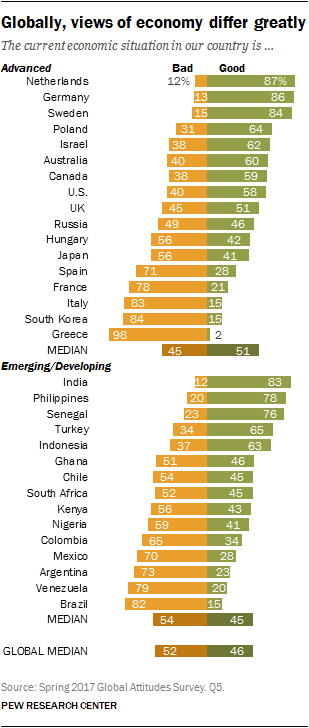
Advanced economies more upbeat than emerging markets, developing countries

The modest but sustained economic recoveries in Australia, Canada, Europe, Japan and the U.S. since the 2007-2008 financial crisis have finally buoyed public spirits about economic conditions in those countries. A median of 51% in the 17 advanced economies surveyed believes that their current economic situation is good, 45% think it’s bad. Strong upbeat sentiment in northern Europe in particular offsets quite downbeat views in southern Europe and South Korea.

Emerging market and developing economies have slowed in recent years, especially in key nations in Africa and Latin America, and public opinion in those societies reflects that slowdown. Only 45% in the 15 emerging and developing markets surveyed voice the view that current economic conditions in their nation are good, 54% believe they are bad. Positive views in India and the Philippines are offset by very negative sentiment in Venezuela and Brazil.

Emerging markets, developing countries guardedly optimistic for kids
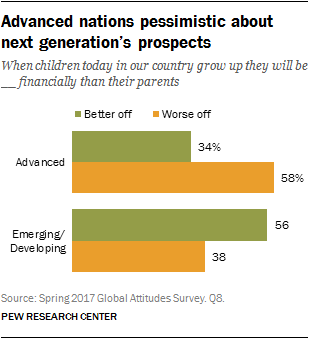
While publics in emerging markets and developing countries are not that happy about their current economic condition, a median of 56% nevertheless believe that when those who are children today in their countries grow up they will be better off financially than their parents. Just 38% voice the view that they will be worse off. Indians (76%), Nigerians (72%) and Chileans (69%) are particularly optimistic about economic prospects for the next generation.

Publics in advanced economies are quite pessimistic about young people’s financial prospects, just 34% believe they will be better off than the current generation. Such despair is particularly strong in Greece, Japan, France, Australia, Canada, Spain and the UK, where roughly seven-in-ten people say today’s children will be worse off.

The recent rise in satisfaction with current economic conditions seems to have had an impact on optimism about the future in Poland in particular. The share of Poles who think the economy is doing well has gone up 26 percentage points since 2015, and the proportion that believes the future will be better for the country’s children has risen 14 points.

Economic sentiment improved
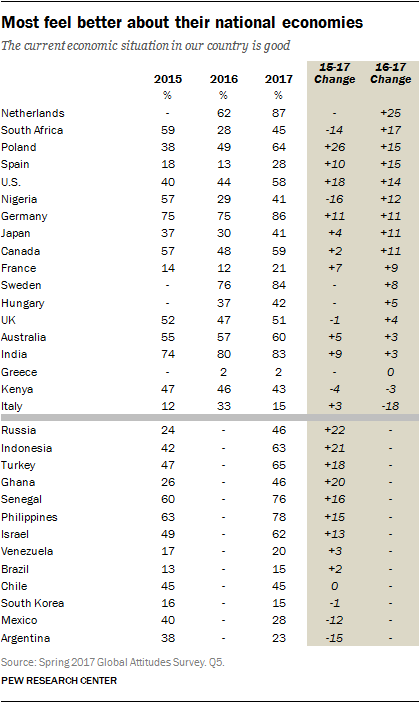
In most nations surveyed, public views of the economic situation in their country are up, whether measured from 2015 to 2017 or 2016 to 2017.

In Russia, the share of the population that says the economy is good has almost doubled, from 24% in 2015 to 46% in 2017. This improvement came despite the fact that the Organization for Economic Co-operation and Development (OECD) reports that the Russian economy actually contracted in 2016.

Over that same period there has been a 21-point improvement in the public’s assessment of economic conditions in Indonesia and a 20-point uptick in Ghana.

In just the past year, from 2016 to 2017, economic sentiment has improved by 25 points in the Netherlands and 15 points in Spain.

The greatest erosion in public contentment with the economy has been in Italy (down 18 points since 2016), where economic satisfaction is now back to roughly 2015 levels, and in Argentina (down 15 points since 2015).

Young people more upbeat than their elders about the future
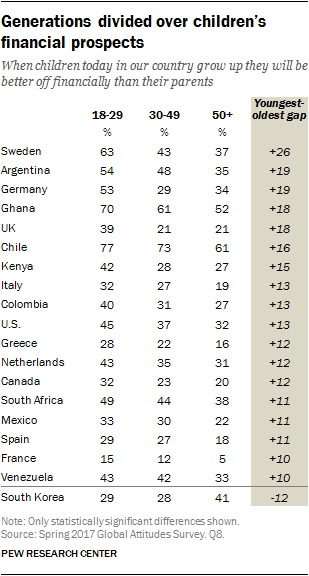
In more than half of the countries surveyed, people ages 18 to 29 are more optimistic than those ages 50 and older about the next generation’s financial prospects. This is true in nations where people feel quite positive about their economy and in societies where people are very negative.

Swedes of all ages feel good about current economic conditions, but there is a generational gap in views of the future. Fully 63% of young Swedes believe the future is bright, but only 37% of older Swedes agree, a 26-point differential.

Argentines of all ages are negative about their economy. But more than half of young people are positive about the next generation’s financial prospects, while only about a third of older Argentines agree.

In many emerging economies, such as India, Turkey and Brazil, more than half of the public across generations share optimism about their children’s financial future.

Sentiment about current economy and children’s prospects not always linked
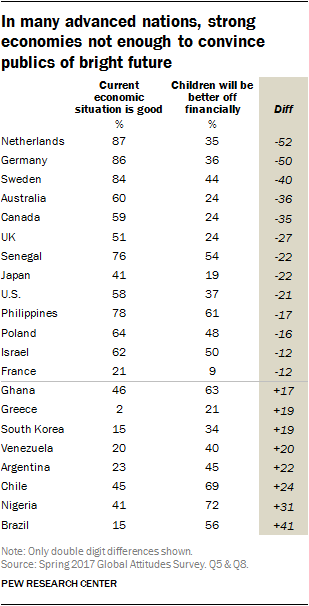
Perceptions of current economic conditions do not seem to be directly linked to expectations for the future in most nations.

Americans, Canadians and some Europeans feel relatively good about their economies today. Nevertheless, few are very optimistic about the financial future for their children. While 87% of Dutch people say their economy is good, only 35% believe today’s children will be better off than their parents, a 52-point difference. There is a similar 50-point gap in German economic sentiment and a 40-point divide in Swedish views.

At the same time, only 15% of Brazilians believe their country’s economic situation is good, while 56% say the country’s children will do better than their parents, a 41-point differential. In Nigeria there is also a downbeat view of the current economy: Just 41% believe it is doing well. Yet this is coupled with an optimistic expectation for the future: 72% of Nigerians say the nation’s kids will be better off, a 31-point difference.

Those ideologically aligned with the party in power more positive than opposition
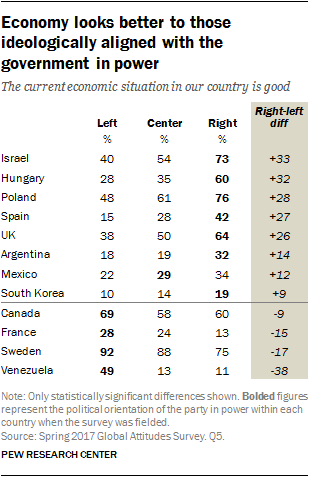
In many countries surveyed, those who are ideologically aligned with the party in power are more positive about their country’s economic situation than those on the other end of the spectrum.

This is particularly true in Israel, where 73% of those on the right say the Israeli economic situation is good, compared with only 40% on the left. There is a similar 33-percentage-point gap between the economic views of Hungarians on the right (60%) and those on the left (28%). And a 28-point right-left divide exists in Poland, a 27-point division in Spain and a 26-point disparity in the UK.

Meanwhile, people on the left (49%) are far more upbeat about the economy than those on the right (11%) in Venezuela. And in Sweden, where more than eight-in-ten people in the public overall are positive about the economic situation, there is still a significant 17-point left-right divide in public opinion.

In many of the countries where those on the right are more upbeat about the national economy, right-of-center governments are in power. And where those on the left are more optimistic about the economy, left-of-center governments were in power at the time of the survey.

CORRECTION (June 2017): The data in this report and the accompanying topline have been corrected to reflect a revised weight for Greece, Italy and the Philippines in 2017 and corrected 2015 data for Brazil. The changes due to this adjustment are very minor and do not materially change the analysis of the report.
1. Mixed views as some economies recover, others slow

North America more upbeat than Europe

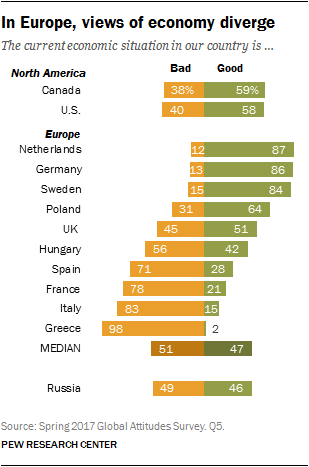
What a difference a year can make – or possibly an election, a rise in the stock market and a falloff in the U.S. unemployment rate. The U.S. economy grew by 1.5% in 2016, down from 2.6% growth in 2015, according to OECD data. Nevertheless, six-in-ten people in the United States (58%) say the economic situation is very or somewhat good. In 2016 just 44% of the American public described the economy as good.

This is the most upbeat assessment of U.S. economic conditions and only the second time that half or more of those surveyed have given the economy a positive rating since 2007. Newfound satisfaction among Republicans over the past year is driving this increase.

There is currently no major partisan difference in public views of the economy. Roughly six-in-ten Republicans (61%) and Democrats (60%) say conditions are good today. But positive sentiment among Republican Party supporters has roughly doubled in the past year, from 31% in 2016.

Americans who are older, wealthier and have more education are also more satisfied with the economy. Notably, there is a 14-percentage point difference in positive views of the economy between those who have a college education or more and those with a high school education or less.

Canadians have an equally bright view of their economic situation: 59% say it is good, up 11 points from 2016 but largely unchanged from 2015. In 2007, before the financial crisis, 80% of Canadians were upbeat about their economic conditions.

As in the U.S., partisan politics play a role in Canadians’ views of their economy. Nearly eight-in-ten Canadians who identify with the ruling Liberal Party (78%) believe economic conditions are good. Only 46% of Conservatives agree, as do 55% of those who identify with the New Democratic Party. Conservatives’ views are unchanged from 2016. Liberals’ opinion has improved 22 points and NDP supporters’ views are up 13 points.

Since the 2008 financial crisis, most Europeans have been quite dispirited about economic conditions in their country. Now, as the economy in a number of nations has begun to recover, the public mood is brightening. Among the Dutch, 87% believe economic conditions are good, as do nearly two-thirds of the Poles (64%). That’s a 25-point increase in the Netherlands and a 15-point increase in Poland from 2016. And while only 28% of the Spanish say their economy is doing well, their views are also up 15 points. Even in Germany (86%) and Sweden (84%), where publics have felt good about their economic situation for some time, this year such sentiment is up 11 points in Germany and 8 points in Sweden. Even in France, where only 21% say the economy is good, that assessment is up 9 points from 2016.

Asian-Pacific nations mostly pleased with economy

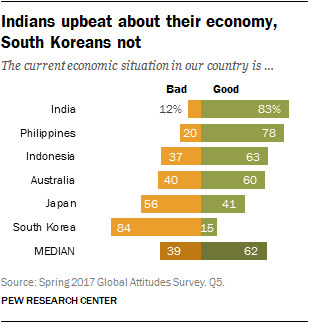
In the Asian-Pacific nations surveyed, Indians and Filipinos are the most positive about their economic conditions. The South Koreans are the most downbeat.

Roughly eight-in-ten in India (83%) and the Philippines (78%) say the state of their economy is good. Notably, 30% of Indians believe their economy is very good, the strongest such sentiment among any country in the survey. Since 2015, Filipino positive assessment of their economy has improved 15 points.

Australia has not experienced a recession for a quarter-century. And Australians are upbeat about their economic conditions: 60% say they are good.

Japan, by comparison, has struggled with slow growth for more than two decades and is only now showing some signs of recovery. Roughly four-in-ten Japanese (41%) believe their economic situation is good, but that is up 11 points from 2016.

South Koreans are troubled by their economy: Only 15% think it is going well, while 84% voice the view that economic conditions are bad.

Largely negative economic assessments in Africa and Latin America

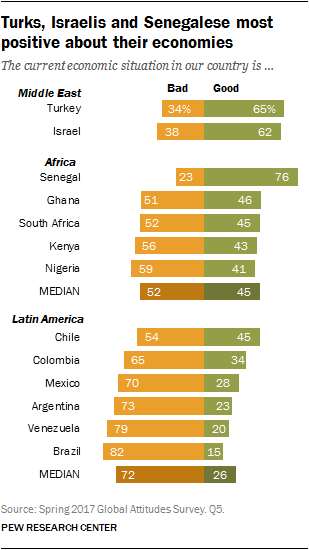
In Turkey (65% good) and Israel (62%), the two Middle Eastern countries surveyed, publics are fairly positive. And both assessments are up significantly since 2015: 18 points in Turkey, 13 points in Israel.

Half or more in four of five African nations give their economies a thumbs-down. Only in Senegal (76%) do people say their economic conditions are good. Just four-in-ten South Africans (45%), Kenyans (43%) and Nigerians (41%) agree. South Africans ages 50 and older are particularly downbeat – only 38% see their economy as doing well.

Majorities in all Latin American countries say economic conditions are bad. Just 15% of Brazilians believe their economy – which shrank by 3.4% in 2016, according to the OECD – is in good shape. Venezuelans – whose economy contracted an estimated 18% in 2016 – and Argentinians are not that much more upbeat, with 20% and 23% respectively having positive views of their economies. The most satisfied with their economic situation among the Latin Americans surveyed are the Chileans. And even there only 45% say the economy is good.

2. Public divided on prospects for the next generation

Americans, Canadians and Europeans generally pessimistic

U.S. may be one of the richest countries in the world, with one of the highest per capita gross domestic products among major nations, but Americans are fairly pessimistic about economic prospects for their country’s children.

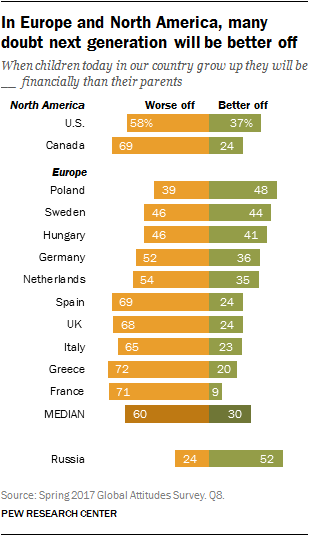
Just 37% of Americans believe that today’s children will grow up to be better off financially than their parents. Such sentiment is relatively unchanged from 2015.

Americans ages 18 to 29 are significantly more optimistic than Americans over age 50. But even 49% of 18- to 29-year-olds still hold the view that the next generation will be worse off. Americans ages 50 and older are particularly downbeat: Just 32% say children will be better off, and 61% think they will be worse off.

As in their views about the current state of the economy, Americans are divided along party lines when thinking about the financial future for today’s children. Republicans are split about the next generation’s financial prospects, with 45% saying today’s children will be better off and 50% saying they’ll be worse off. Democrats and independents are more pessimistic: Only about a third of Democrats (33%) and independents (36%) say they think today’s children will be better off financially than their parents.

In Canada, people are even glummer about the future. Just 24% believe children will be better off financially, a number that is largely unchanged from 2015. As in the U.S., 18- to 29-year-olds (32%) are more optimistic about prospects for the next generation than are people 50 and older (20%). And Liberal Party adherents (33%) are roughly twice as likely as both Conservative Party (17%) and NDP backers (16%) to expect today’s children to be better off than their parents.

While their views of current economic conditions may be improving, Europeans remain fairly downbeat about their children’s economic futures. A median of only 30% in Europe believe that when children in their country grow up they will be better off financially than their parents. The most optimistic are the Poles, 48% of whom think today’s children will be better off. Such confidence is up 14 points since 2015. Swedes (44%) and Hungarians (41%) are also somewhat hopeful. The most pessimistic are the French: Only 9% see today’s children doing better than their parents.

Like their American and Canadian peers, French, German, Spanish, Swedish and British young adults are more likely than older people to believe today’s children will do better financially than their parents. However, younger adults in France and Spain are still pessimistic overall: Only 15% of French 18- to 29-year-olds and 29% of Spanish 18- to 29-year-olds think today’s children will be better off than their parents, compared with 63% of Swedish young adults and 53% of German young adults.

By more than two-to-one (52% better off, 24% worse off) Russians believe that today’s children will be better off. A majority of Russian young adults (56%) are optimistic.

Conflicting views in Asia-Pacific about children’s prospects

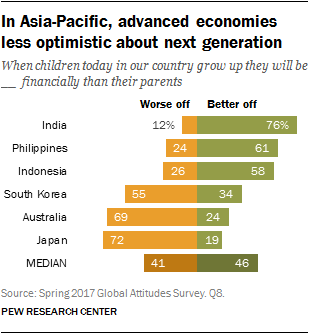
Among the Asian-Pacific nations surveyed, two very distinct views about the youngest generation’s financial future emerged. Majorities of Indians, Filipinos and Indonesians believe that when today’s children grow up they will be better off than their parents. But majorities of South Koreans, Australians and Japanese think today’s kids will be worse off.

In India, the public is particularly upbeat: 76% see a bright future for Indian children. Roughly six-in-ten in the Philippines (61%) and Indonesia (58%) agree. Filipinos ages 30 to 49 (65%) are more optimistic than their older compatriots.

In sharp contrast, roughly seven-in-ten Japanese (72%) and Australians (69%) believe that when today’s children in their country grow up they will be worse off financially than their parents. Japanese and South Korean women are particularly worried about kids’ financial futures.

Nigerians and Ghanaians optimistic about next generation’s future

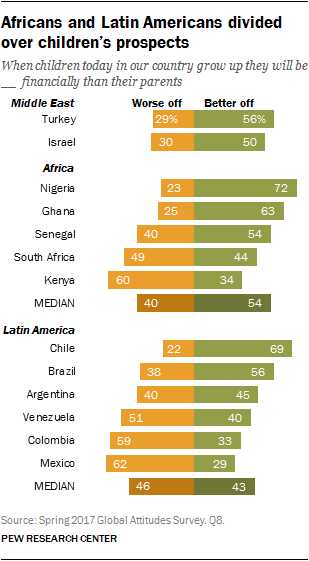
Roughly seven-in-ten in Nigeria (72%) and six-in-ten in Ghana (63%) voice the view that today’s children have bright financial prospects. Younger Ghanaians are particularly optimistic, as are Nigerian women.

More than half of Senegalese (54%) are optimistic about the economic future for their country’s children. But just 44% of South Africans and 34% of Kenyans expect today’s children to be better off. South Africans ages 50 and older are particularly downbeat compared with those ages 18 to 29.

In Latin America, majorities in Chile (69%) and Brazil (56%) expect today’s children to be better off financially. Chilean men are particularly optimistic. In Argentina people are divided on such economic prospects. And roughly half in Venezuela (51%) and six-in-ten in Colombia (59%) and Mexico (62%) believe kids will be worse off than their parents.

As in their view of the current economy, the Turks and Israelis are generally upbeat about the future for today’s children. Half or more Turks (56%) and Israelis (50%) believe the youngest generation will be better off financially than their parents.

Acknowledgments

This report is a collaborative effort based on the input and analysis of the following individuals.

Bruce Stokes, Director, Global Economic Attitudes

James Bell, Vice President, Global Strategy Caldwell Bishop, Research Associate Hanyu Chwe, Research Assistant Stefan Cornibert, Communications Manager Danielle Cuddington, Research Analyst Claudia Deane, Vice President, Research Janell Fetterolf, Research Associate Courtney Johnson, Research Associate Michael Keegan, Information Graphics Designer David Kent, Copy Editor Dorothy Manevich, Research Analyst Travis Mitchell, Digital Producer Patrick Moynihan, Associate Director, International Research Methods Jacob Poushter, Senior Researcher Audrey Powers, Administrative Coordinator Guilherme Russo, Research Associate Steve Schwarzer, Research Methodologist Laura Silver, Senior Researcher Katie Simmons, Associate Director, Research Rhonda Stewart, Senior Communications Manager Kyle Taylor, Research Assistant Margaret Vice, Senior Researcher Richard Wike, Director, Global Attitudes Research Benjamin Wormald, Web Developer

Methodology

About the Pew Research Center’s Spring 2017 Global Attitudes Survey

Results for the survey are based on telephone and face-to-face interviews conducted under the direction of D3 Systems, Inc., ORB International, Princeton Survey Research Associates International, Kantar Public UK and Voices! Research & Consultancy. The results are based on national samples, unless otherwise noted. More details about our international survey methodology and country-specific sample designs are available here.

Detailed information on survey methods for this report

General information on international survey research


Appendix

Economic categorization

For this report we grouped countries into three economic categories: “advanced,” “emerging” and “developing.” These categories are fairly common in specialized and popular discussions and are helpful for analyzing how public attitudes vary with economic circumstances. However, no single, agreed upon scheme exists for placing countries into these three categories. For example, even the World Bank and International Monetary Fund do not always agree on how to categorize economies.

In creating our economic classification of the 32 countries in this report, we relied on multiple sources and criteria. Specifically, we were guided by: World Bank income classifications; classifications of emerging markets by other multi-national organizations, such as the International Monetary Fund; per capita Gross Domestic Product (GDP); total size of the country’s economy, as measured by GDP; and average GDP growth rate between 2010 and 2015.

Below is a table that outlines the countries that fall into each of the three categories. The table includes for each country the World Bank income classification, the 2015 GDP per capita based on purchasing power parity (PPP) in current prices, the 2015 GDP in current U.S. dollars and the average GDP growth rate between 2010 and 2015.