Number of Refugees to Europe Surges to Record 1.3 Million in 2015
Recent wave accounts for about one-in-ten asylum applications since 1985
A record 1.3 million migrants applied for asylum in the 28 member states of the European Union, Norway and Switzerland in 2015 – nearly double the previous high water mark of roughly 700,000 that was set in 1992 after the fall of the Iron Curtain and the collapse of the Soviet Union, according to a Pew Research Center analysis of data from Eurostat, the European Union’s statistical agency.


Today, Eastern European countries like Kosovo and Albania still contribute to the overall flow of asylum seekers into the EU, Norway and Switzerland, but about half of refugees in 2015 trace their origins to just three countries: Syria, Afghanistan and Iraq. Conflicts, both fresh and long-standing, in each of these states have led to the displacement of hundreds of thousands of people. Some have been displaced within their homelands; others have sought refuge in neighboring countries; and still others have made the often perilous journey to Europe (and elsewhere) to seek asylum.
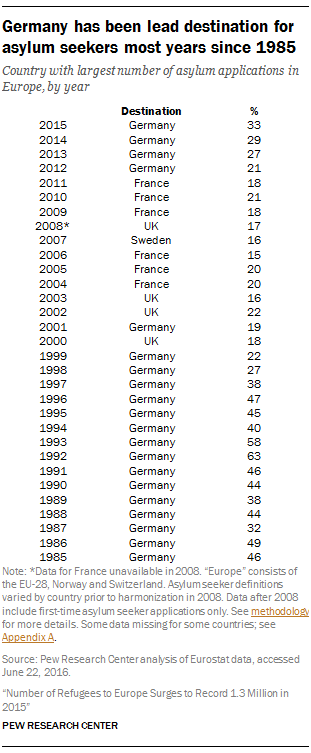
Since 2012, Germany has been the primary destination country for asylum seekers in Europe, receiving 442,000 asylum applications in 2015 alone. Following Germany, Hungary (174,000 applications) and Sweden (156,000) received the highest number of asylum applications in 2015. Meanwhile, France (71,000) and the UK (39,000) received roughly the same number of applications in 2015 as in years just prior to the refugee surge in 2015.
Refugees did not disperse equally across Europe, with some countries taking in more asylum seekers than the European average. In 2015, the EU-28, Norway and Switzerland as a whole had 250 asylum applicants per 100,000 residents. By comparison, Hungary had 1,770 applicants per 100,000 people (the highest of any country) and Sweden had 1,600 applicants per 100,000 people. Meanwhile, Germany had 540 applicants per 100,000 people, still well above the total European rate. By contrast, France had only 110 applicants per 100,000 people in its total population in 2015 and the UK had only 60 asylum seekers per 100,000 people.
Refugee? Asylum seeker? Migrant?
Much debate has focused on the terms used to describe the rapid rise in the number of people moving into Europe from other countries, many of whom are from the Middle East. Should these people be described as refugees? Asylum seekers? Or as migrants? Since the principal data source for this report is asylum-seeker application data as published by Eurostat, Europe’s statistical agency, the report mostly uses the terms asylum seekers or asylees to describe this population. However, the report also uses the term migrant interchangeably with asylum seeker and asylee to describe the migration process. The term refugee is also used in the report to describe the internationally-recognized status many had before arriving in Europe. (For more on the asylum application process in Europe, see the textboxes in this overview).
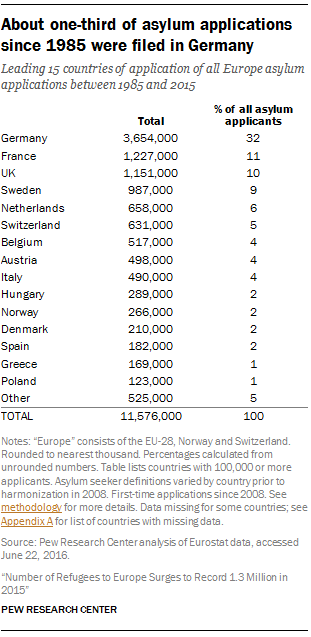
The 2015 surge marked the largest annual flow of asylum seekers to Europe since 1985. By comparison, the second largest came in 1992, following the fall of the Berlin Wall, when 697,000 applied for asylum to the nations that make up current EU countries, Norway and Switzerland. 1 Europe again experienced an uptick in asylum applications during conflicts in Kosovo in the late 1990s, with asylum applications peaking at 463,000 in 2002. However, 2015’s surge stands out not only as a record year for asylum applications, but for the fact that it had more applicants than the previous peak years of 1992 and 2002 combined. Since 1985, Europe received about 11.6 million asylum applications – meaning that last year’s 1.3 million amounted to about one-tenth of all applications received during the past 30 years by current EU countries, Norway and Switzerland.
Earlier this year, the EU and Turkey reached an agreement that has largely halted the flow of migrants from points east through Turkey, on to Greece and eventually to other parts of the EU. According to the United Nations High Commissioner for Refugees (UNHCR), about 8,000 migrants arrived in Greece between April and July 2016 after the agreement with Turkey was put into full effect. Before the agreement, about 150,000 migrants had arrived in Greece between January and March 2016.
At the same time, some of the movement toward Europe is shifting to a southern Mediterranean route to Italy, with flows of largely sub-Saharan African migrants (not Syrians, Afghans or Iraqis) on the rise. Italy has received about 90,000 migrants on its shores since the start of 2016, roughly similar to the first half of 2015. The UNHCR also estimates that over 2,500 people have lost their lives in the Mediterranean between January and May of 2016.
The terms “asylum seekers,” “asylees” and “asylum applicants” are used interchangeably throughout this report and refer to individuals who have applied for asylum after reaching Europe. As of 2008, all family members, whether male or female, children or adults, file applications for asylum. Seeking asylum does not mean applicants will necessarily be permitted to stay in Europe. However, if an asylum application is approved, the asylum seeker is granted refugee status and given the right to remain in Europe.
“Refugees” denotes both the group of people fleeing conflict and those whose asylum application in Europe has been approved. For the latter group, the term “refugee” denotes a legal status.
“Migrants” refers to people moving across international borders, regardless of their motivation for movement. Someone moving from one European country to another European country within the European Union would be considered a migrant, for example. The term “migrants” also refers to newcomers who are citizens of countries outside of the EU-28, Norway or Switzerland.
The term “Europe” is used in this report as a shorthand for the 28 nation-states that form the European Union (EU) as well as Norway and Switzerland, for a total of 30 countries. At the time of the production of this report, the UK was still part of the European Union even though the country voted on June 23, 2016, to leave the EU. EU member states, Norway and Switzerland are bound by the Dublin Regulation: Asylum seekers must apply for asylum in the first EU country they enter, and if they do not they can be returned to the first country they enter for the processing of their applications. Most EU countries, Norway and Switzerland are also part of the Schengen agreement, which permits people to cross between countries without border stops.
The terms “origin country” and “source country” are used interchangeably throughout this report. These terms refer to the country of citizenship for asylum seekers, not the most recent country asylum seekers passed through prior to reaching their country of application.
The term “destination country” refers to the country of application where an asylum seeker first applied for asylum in Europe. Although the Dublin Regulation calls for asylum applicants to apply for asylum in the first European country they enter, the destination country where they apply is not always the same as their first entry point into Europe.
“Corridor” refers to the migration flow from a particular origin to particular destination country, even if migrants cross through several transit countries before reaching their final destination. The Syria-Germany corridor, for example, refers to Syrians migrating to Germany, even though many Syrian refugees in 2015 passed through other countries such as Turkey or Greece before finally reaching Germany.
Europeans disapprove of how the EU has handled the refugee issue

European publics have been far from satisfied with how the EU has handled the historic number of refugees arriving there. A spring 2016 Pew Research Center survey conducted across 10 EU member states following the EU-Turkey agreement found that majorities in each country disapproved of how the EU was dealing with the refugee issue.
Disapproval was generally greatest in countries with the highest number of asylum seekers in 2015. For example, 94% of Greeks and 88% of Swedes said they disapprove of how the EU has handled the refugee issue. Sweden received the third highest number of asylum applications in 2015. And while Greece was not the final destination for most refugees in 2015, it was their main point of entry, with about 850,000 arrivals in 2015 alone.
Even in countries with a lower number of asylees, disapproval of the EU’s handling of the refugee issue was widespread, including in France (70%), the UK (70%) and the Netherlands (63%). And in Germany, which had the most asylum applications in 2015, fully two-thirds faulted the EU’s approach to the refugee crisis.
At the same time, half or more in eight of the 10 EU countries Pew Research Center surveyed this spring believe that incoming refugees increase the likelihood of terrorism in their country. Many Europeans are also worried that refugees will be an economic burden, with half or more in five nations saying that refugees will take jobs and social benefits.
NOTE (April 2017): After publication, the weight for the Netherlands public opinion data was revised to correct percentages for two regions. The impact of this revision on the Netherlands public opinion data included in this report is very minor and does not materially change the analysis. For a summary of changes, see here. For updated demographic figures for the Netherlands, please contact info@pewresearch.org.
When an asylum seeker travels through one of Europe’s external borders (such as a seaport, a land border or an airport), they can apply for asylum at the first European country they enter. When that happens, applicants are fingerprinted by authorities and given necessary food, medicine, legal aid and shelter as they wait for their case to be reviewed by immigration personnel.
If the decision is positive, asylum applicants are deemed refugees and are given certain legal rights for residency in Europe, including access to the job market and other social benefits such as government provided health care. If the decision is negative, asylum applicants can appeal the decision and have the case reviewed again. Or, if no appeal is taken by the asylum seeker, they are returned to their country of citizenship or the last country they left before entering Europe.
The European Union’s 28 member states operate under the Asylum Procedures Directive — a common set of rules and regulations for handling asylum seekers that was revised in 2013 and took full effect in July 2015. The law sets standards for processing and evaluating asylum cases as well as the minimum welcome aid (food, medicine, shelter) given to applicants while they wait for their cases to be reviewed.
The cornerstone of the Asylum Procedures Directive is the first-country rule or more formally titled the Dublin Regulation (named after the city where the earliest agreement was reached in 1990). Asylum seekers are to apply for asylum in the first country they enter, and can be transferred back to that first country for processing if they are found in another country. This first-country rule, however, is not always followed in practice. Germany, for example, waived this provision during 2015 when Greece was overwhelmed by the sudden surge of migrants.
With thousands of new asylum requests through the first part of 2016, along with over 1 million in 2015, first-instance decisions can now take several months or up to a year to process. These delays do not include appeals asylum seekers may make after a negative first-time decision. Appeals can take up to an additional year to be adjudicated.
Rapid increase in the number of asylum seekers from non-European and European countries alike between 2013 and 2015

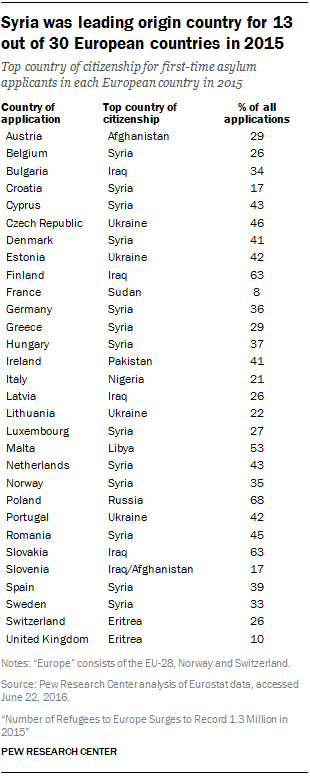
In 2014, nearly 600,000 asylum applications were filed in the EU, Norway and Switzerland, a 47% increase over the more than 400,000 applications filed in 2013. In 2015, the number of asylum applications grew again, this time more than doubling 2014’s record to reach about 1.3 million (a 122% increase). The overall increase from 2013 to 2014 and again between 2014 and 2015 was reflected in the trajectory of new asylum seekers arriving from each of the three leading origin countries: Syria, Afghanistan and Iraq.
Refugees from Syria numbered 378,000 in 2015, accounting for 29% of all of Europe’s asylum seekers – the highest share of any nation. This was up from 125,000 in 2014 and 49,000 in 2013, helping to drive the recent surge in asylum applications. An additional quarter of asylum seekers in 2015 were from other relatively new origin countries, including 193,000 from Afghanistan (up from 23,000 in 2013 and 39,000 in 2014) and another 127,000 from Iraq (up from 9,000 in 2013 and 15,000 in 2014).
Some of the origins of Europe’s asylum seekers in 2015 were regions that have sent past waves of migrants. Nearly one-in-five asylum seekers in 2015 (17%) came from European countries outside the EU, Norway and Switzerland, including asylum seekers from Kosovo (68,000 in 2015, up from 35,000 in 2014), Albania (67,000 in 2015, up from 16,000 in 2014) and Ukraine (21,000 in 2015, up from 14,000 in 2014), regions that had once sent migrants when they were a part of the former Yugoslavia and USSR. (See detailed chart in Appendix B noting the increase in origin countries besides Syria, Afghanistan and Iraq.)
The success rate for asylum seekers varies dramatically by country of citizenship. In 2015, for example, nearly all asylum seekers from Syria (97%) whose applications were processed were given refugee status in the first decision round. The great majority of Eritreans and Iraqis also received positive decisions. And between 60% and 70% of Afghani, Iranian and Somalian asylum seekers were deemed refugees in 2015. All other leading nationalities of asylum seekers in Europe had positive decision rates well below 50%. Meanwhile, less than 5% of asylum cases from other European countries such as Kosovo, Albania and Serbia were given positive decisions in 2015.
Once an application and all appeals for asylum are denied, the state deports the asylum seeker, either by force or through voluntary means. These returns, however, are not always straightforward. Some asylum seekers fall below the radar and illegally remain in Europe. Others have their return orders halted due to worsening security in the origin country or for other humanitarian reasons.
Germany is leading destination; UK, France receive fewer asylum seekers
Germany received an unprecedented 442,000 individual first-time asylum applications in 2015 – the highest annual number ever received by a European country over the past 30 years. Asylum applicants to Germany alone accounted for about one-third of Europe’s 2015 asylum seekers.
Germany has long been a primary destination for asylum seekers. In the late 1980s and 1990s, it received nearly half of Europe’s annual asylum applications. And over the past 30 years, Germany has received at least 3.6 million asylum applications, or nearly one-third (32%) of all asylum applications in Europe over the period.
France and the UK were once leading destinations of Europe’s asylum seekers. Between 2000 and 2010, France was the leading destination of asylum seekers for five years and the UK was the leading destination for four years. However, in 2015, both the UK and France had far fewer asylum applicants than Germany, Hungary or Sweden. The UK received only 39,000 asylum applications last year, while France received 71,000 applications. 2
Hungary received the second largest number of asylum applicants in 2015. In all, Hungary received 174,000 asylum applications or about 13% of Europe’s asylum seekers in 2015.
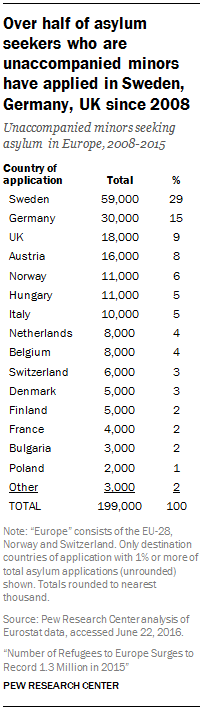
Sweden received the third highest number of asylum applicants in 2015. Its share of Europe’s asylum seekers has grown to about 10% or more of all asylum seekers in recent years, posting a record 156,000 applicants in 2015. Sweden alone accepted more asylum seekers than France and the UK combined. Sweden was also the most popular destination country for unaccompanied asylum seekers under age 18, receiving 35,000 applicants from this group in 2015.
Germany is once again the leading destination of Europe’s asylum seekers
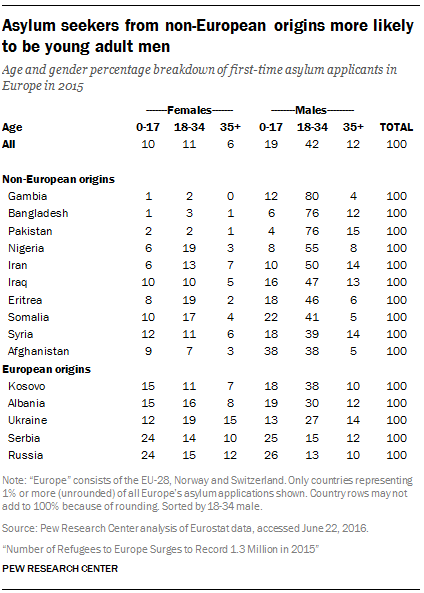
Asylum seekers to Europe are largely young and male

Over half (53%) of asylum seekers to the European Union, Norway and Switzerland in 2015 were young adults – those ages 18 to 34. This was also generally the top age group among asylum seekers in Europe from the three leading origin countries. Roughly half of those from Syria (50%), Iraq (56%) and Afghanistan (45%) were young adults in 2015.
In addition, men made up nearly three-fourths (73%) of Europe’s asylum seekers in 2015. Refugees from leading origin countries such as Syria (71%), Iraq (75%) and Afghanistan (80%) were also predominately male in 2015. By contrast, asylum seekers from other top origin countries, such as Gambia (97% male), Pakistan (95% male) and Bangladesh (95% male), were almost entirely male.
As a result, about four-in-ten asylum seekers in Europe in 2015 (42%) were young men ages 18 to 34. This was also true for most leading origin countries: 39% of those from Syria were young men, as were 38% of those from Afghanistan and 47% of those from Iraq. Young adult males made up a larger share of asylum seekers from some origin countries. For example, roughly three-fourths of asylum seekers from Gambia (80%), Pakistan (76%) and Bangladesh (76%) were young adult men in 2015.
The demographic profile of asylum seekers in destination countries varies considerably. About four-in-ten asylum seekers applying in Germany (39%) in 2015 were young adult males, about the same level as asylum seekers to Europe (42%) as a whole. In Hungary, about half (51%) of asylum seekers were more young adult men. In Sweden, just 28% of asylum seekers were young men in 2015. Meanwhile, young adult men made up 74% of asylum seekers in Italy, the highest share of any country in 2015.
Europe has also seen a spike in the number of unaccompanied minors (children under 18 who arrived in Europe without adult guardians) applying for asylum in recent years. Between 2008 and 2015, 198,500 unaccompanied minors applied for asylum in the European Union, Norway and Switzerland, of which nearly half (48% or about 96,000) arrived in 2015. Among all first-time asylum applications in 2015, nearly 7% were from unaccompanied minors, the highest share since data on unaccompanied minors became available in 2008.
The impact of asylum seekers and migrants on Europe’s population
European Union countries, Norway and Switzerland are leading destinations for asylum seekers and other migrants alike. Prior to the 2015 surge of asylum seekers, 35 million immigrants born outside of the EU, Norway and Switzerland lived in these countries, representing fully 14% of the world’s international migrants.
Even though a record number of asylum seekers arrived in Europe in 2015, the surge has had a limited impact on the share of the overall resident population in the EU, Norway and Switzerland that is foreign born. That share is up only 0.3 percentage points, from 11.0% foreign born in 2015 to 11.3% in 2016. It has had a large impact, however, in leading destination countries like Sweden, Hungary and Austria, whose foreign-born shares rose by more than 1 percentage point in a single year. By way of comparison, the foreign-born share of the U.S. population increased by 1 percentage point between 2005 and 2015. (The U.S. has about one-fifth of the world’s immigrants and has historically been the world’s top destination for international migrants.)
Although Europe has received a large number of Syrian asylum seekers since the Syrian conflict began, only about one-in-ten displaced Syrians worldwide are living in Europe. The vast majority is internally displaced within Syria or is living as refugees in countries that border Syria.
About the data
Asylum seeker data presented in this report are based on asylum applications as reported by European Union member states, Norway and Switzerland to Eurostat, the EU’s statistical agency. Since 2008, these countries have provided Eurostat with data on their asylum seekers using standardized definitions. So as to avoid duplication of asylum seekers, only first-time applications (not appeals) were used in the report’s analysis for years 2008 through 2015.
Data prior to 2008 and reported by Eurostat were voluntarily provided by European countries, and were often based on definitions of asylum seekers that were inconsistent across countries and across years. Historical data from prior to 2008 are used only to put the current migration wave into a greater 30-year context. Asylum application data for 2016, while available, are incomplete and subject to Eurostat revisions. As a result, data on asylum applications for 2016 have not been included in this report. For more information on the report’s data analysis and the Eurostat data, see the report’s methodology.
The number of European Union member states has grown since 1985, with significant increases in 1995, 2004 and 2007. Although data for some countries in some years are missing (see Appendix A), historical estimates of asylum seekers in this report include all 30 countries (EU-28 plus Norway and Switzerland), even though many of these countries were not considered part of the EU until recent years. At the time of the publication of this report, the UK was still part of the European Union, even though the country voted on June 23, 2016, to leave the EU.
This report focuses on the migration of first-time asylum seekers in Europe. The analysis does not include the net number of people who remain in Europe after asylum cases are decided. It also does not explore overall international migration patterns to Europe. Although applying for asylum has become a common way for migrants to enter Europe, migrants also enter via family ties or employment visas.
Road map to the report
Chapter 1 looks at the origins of asylum seekers, both in 2015 and in earlier years. Chapter 2 examines the changing destinations of asylum seekers. Meanwhile, Chapter 3 puts origins and destinations together to track the geographic flows between countries. Finally, Chapter 4 is a demographic profile of recent asylum seekers, including their age and sex, and includes a special focus on unaccompanied minors.