Indians Give Their Prime Minister and Economy High Marks, Worry about Crime, Jobs, Prices, Corruption
BYBruce Stokes
About Pew Research Center
Pew Research Center is a nonpartisan, nonadvocacy fact tank that informs the public about the issues, attitudes and trends shaping the world. It does not take policy positions. The Center conducts public opinion polling, demographic research, computational social science research and other data-driven research. It studies politics and policy; news habits and media; the internet and technology; religion; race and ethnicity; international affairs; social, demographic and economic trends; science; research methodology and data science; and immigration and migration. Pew Research Center is a subsidiary of The Pew Charitable Trusts, its primary funder.
Indians Give Their Prime Minister and Economy High Marks, Worry about Crime, Jobs, Prices, Corruption
What a difference a couple of years can make. With a rising economic tide, a new captain at the helm and a buoyant public mood, the Indian ship of state has the wind at its back.
In late 2013, Indians were mired in dissatisfaction with the way things were going in their country. They were only moderately satisfied with economic conditions. And barely half had a favorable view of then-Prime Minister Manmohan Singh, a member of the long-ruling Indian National Congress party (INC).
Modi’s appeal is a driving force behind this upsurge in Indians’ positive mood. Those who have a lot of confidence in Modi voice greater satisfaction with the direction of the country today than those with only some confidence in the prime minister. Respondents who have a lot of confidence in Modi also say the nation’s economic situation is very good.
And those who have a lot of confidence in Modi are more likely to expect the economic situation in India to improve a lot over the next 12 months.
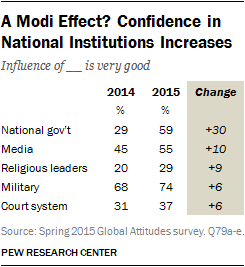
Moreover, Modi’s aura has reinvigorated Indians’ faith in their government. About two-thirds of respondents who have a lot of confidence in the prime minister say the influence of the national government is now very good.
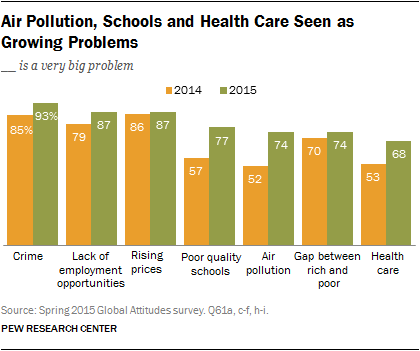
Nevertheless, Indians believe their country still faces myriad challenges. More than eight-in-ten say crime, jobs, inflation and corruption are very big problems. Concern about air pollution is up 22 points in just the past year, complaints about poor-quality schools are up 20 points and worry about health care is up 15 points.
And Indians see the world as a challenging place. Nearly three-quarters say they are very concerned about global climate change. A similar proportion say neighboring Pakistan poses a very serious threat to India.
These are among the main findings of a new Pew Research Center survey conducted among 2,452 respondents in India from April 6 to May 19, 2015.
1. The Modi Phenomenon
Prime Minister Narendra Modi is, by far, India’s most popular political figure. And the intensity of his support is much stronger than that enjoyed by other leading politicians. He enjoys robust backing among both his own party members and adherents of the opposition, and in rural areas as well as in cities.
Modi is popular across the demographic spectrum – to both men and women, and among all age groups, educational backgrounds and income levels. As might be expected, 94% of BJP followers support the leader of their party.
Those who are satisfied with the direction of the country are more likely to have a lot of confidence in Modi than those who are dissatisfied with the country’s direction. And Indians who view the current economic situation as very good are more likely to have a lot of confidence in Modi than those who think the current economic situation is only somewhat good.
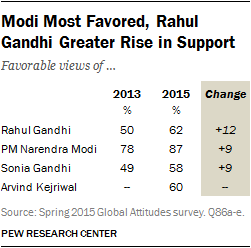
Not surprisingly, 77% of Congress party members are favorably disposed toward Gandhi. But it is notable that 60% of BJP backers also see him in a positive light.
About two-thirds of Indians living in rural areas (66%) have an affirmative view of Gandhi, possibly reflecting the long-standing rural base of the Congress party. Roughly half of urban dwellers (53%) express a favorable opinion of him. And Indians with a primary school education or less (63%) are more supportive than those with at least some college education (54%).
Gandhi’s mother, Sonia Gandhi – president of the Congress party – is seen favorably by 58% of those surveyed. Her positive rating is up 9 points since 2013. But only 21% voice a very favorable view of Sonia Gandhi. As with her son, rural Indians (61%) are more likely than city dwellers (50%) to support her. Younger Indians and those with a lower income are more positive about Mrs. Gandhi than are older Indians and those who make more than the median income. And she enjoys bipartisan favorability: 78% by Congress adherents and 54% by BJP backers.
Kiran Bedi, another anti-corruption activist who was the BJP’s 2015 losing candidate for chief minister in Delhi, enjoys a 48% favorable rating. Only 14% see her in a very favorable light and 20% voice no opinion, making her the least well-known of the political figures in the survey. It is better-educated Indians who voiced her strongest support: 62% among those with some college education compared with just 42% among those with a primary school education or less. And while 54% of BJP followers favor her, only 37% of Congress supporters back Bedi.
A majority (58%) of Indians also have a favorable view of the AAP. There are no significant age, gender or urban-rural differences in that support.
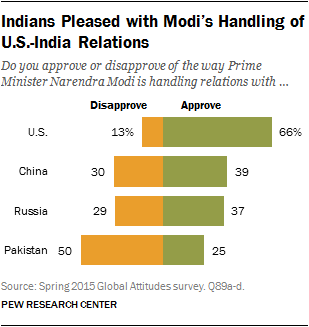
Indians’ backing for their prime minister translates into faith in him to do the right thing regarding world affairs. Roughly nine-in-ten (91%) have confidence in Modi’s handling of international relations, including more than seven-in-ten (73%) of those surveyed who express a lot of confidence. Again, the intensity of his own party’s support is striking: 83% of BJP adherents have a lot of confidence in Modi as a statesman, compared with strong support from 63% of Congress backers. In 2011, 80% of Indians surveyed had confidence in the foreign policy approach of Modi’s predecessor, Congress party Prime Minister Manmohan Singh. This included 56% who had a lot of confidence.
There are regional differences in the intensity of public confidence in Modi’s record on foreign affairs. The greatest support is among Indians living in the eastern states (81% very confident) and the northern states of Delhi, Rajasthan, Haryana, Punjab, Madhya Pradesh and Uttar Pradesh (80% very confident). Indians in the southern states (63% very confident) as well as the western states (62% very confident) are relatively less intense in their backing of the prime minister’s handling of world affairs.
Notably, public confidence in Modi’s handling of international affairs has not translated into broad support for his relations with two other world powers: China and Russia. Despite visits to India by both Russian President Vladimir Putin and Chinese leader Xi Jinping, and Modi’s reciprocal visits to Russia and China, just 39% approve of the prime minister’s handling of relations with China and only 37% approve of his dealings with Russia. This low level of support in part reflects the fact that about three-in-ten or more in those surveys voiced no opinion on either topic.
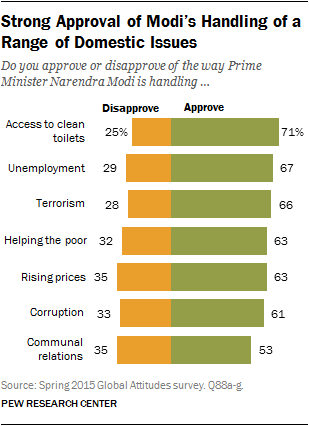
But Indians do approve of Modi’s handling of a range of domestic issues. This may be due to the fact that, contrary to their lack of knowledge about the prime minister’s conduct in foreign affairs, almost all Indians have an opinion about Modi’s domestic policies.
Roughly two-thirds of Indians also approve of Modi’s efforts to deal with unemployment and terrorism. BJP followers (71%) are more supportive of the prime minister’s handling of terrorism than are Congress adherents (56%).
AAP followers are particularly critical of the prime minister’s handling of corruption, their signature issue: Just 40% approve, while 51% disapprove. And half disapprove of his efforts to combat unemployment.
Modi’s lowest approval on domestic issues comes in his management of communal relations – the day-to-day interaction between majority Hindus and minority Muslims, Jains, Sikhs and Christians among others, as well as the relationship between the various castes in the country. Communal relations are a particularly sensitive issue for Modi and his Hindu nationalist party.
In 2002, while he was chief minister of Gujarat, Modi was accused of abetting some of the most deadly communal violence in recent Indian history. Modi was subsequently cleared of any wrongdoing by a special investigative team set up by the Indian Supreme Court. But distrust remains, perhaps in part because incidents of communal violence were up by nearly a quarter in the first five months of 2015, under BJP rule, compared with a comparable period in 2014 when a Congress-led government was in power. (The 2015 Pew Research Center survey was conducted before August 2015 rioting in Gujarat.)
Just over half (53%) of those surveyed approve of Modi’s stewardship of communal issues, while 35% disapprove. Indians with at least some college education (64%) are more likely than Indians with a primary education or less (48%) to back his handling of these tensions. And, as might be expected, BJP supporters (57%) are somewhat more positive about his record on communal issues than are Congress followers (47%).
2. Country, Economy Seen Headed in Right Direction, but Public Says Problems Persist
Part of this satisfaction with the way things are going can be attributed to the performance of the Indian economy. In the fourth quarter of 2013, around the time of Pew Research Center survey work there, India was growing at a seasonally adjusted rate of 7.1%. In the first quarter of 2015 it grew at 7.5%.
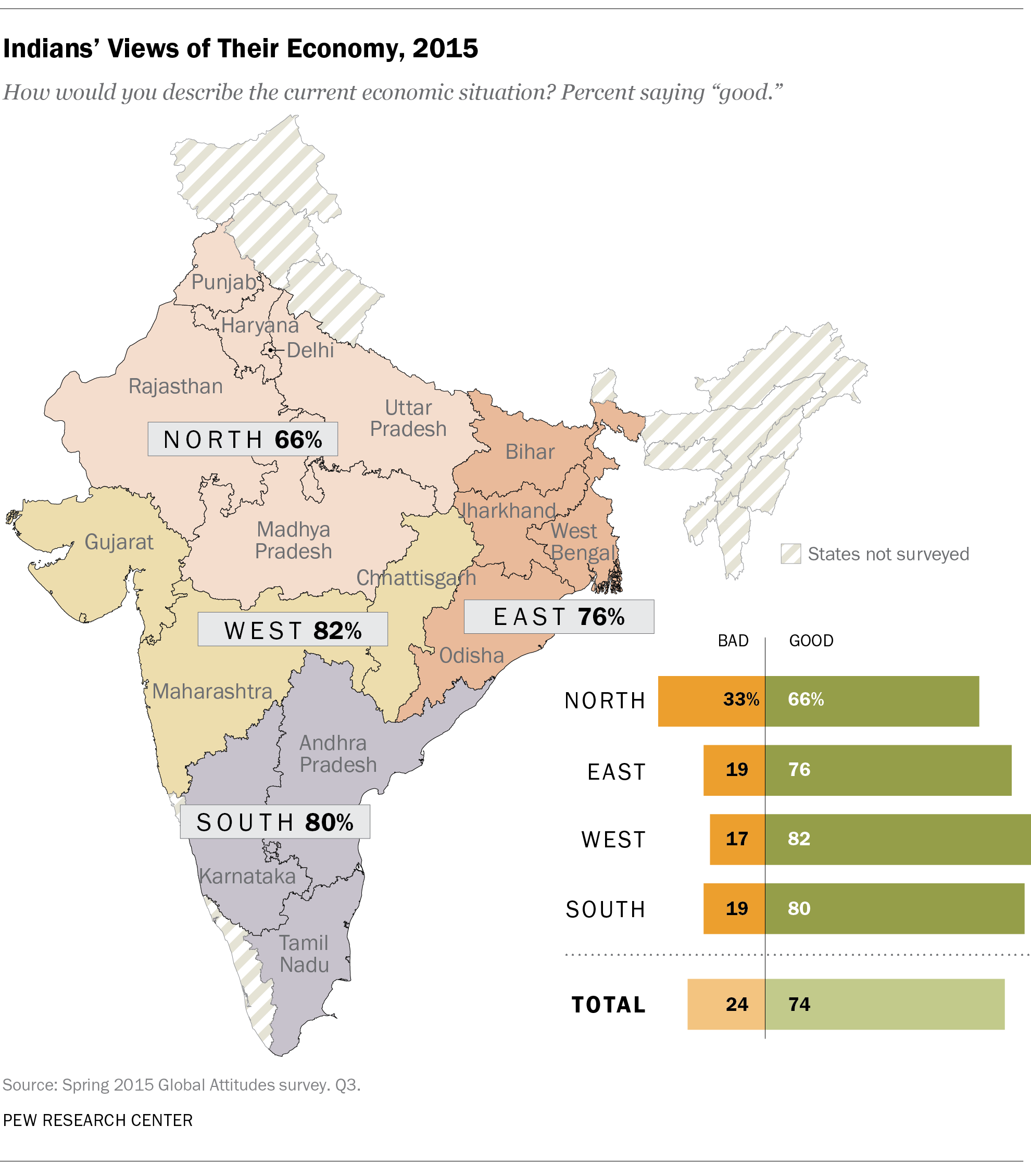
This persistence in relatively good economic performance has translated into a growing sense of satisfaction with economic conditions. In 2013, 57% of Indians thought their economy was in good shape. In 2015, 74% describe economic conditions as good, including 27% who say they are very good (up from 10% who were that enthusiastic less than two years ago).
Within India there are regional differences in economic perceptions. Roughly eight-in-ten Indians (82%) living in the western part of the country – the states of Chhattisgarh, Gujarat and Maharashtra – believe economic conditions are good. Just 66% of those living in the north – the states of Delhi, Haryana, Madhya Pradesh, Punjab, Rajasthan and Uttar Pradesh – agree.
Moreover, Indians’ expectations for the next generation have risen. In 2013, 64% thought that when Indian children grew up they would be better off financially than their parents. In 2015, 74% voice such optimism. Notably, 88% of those living in the south – the states of Andhra Pradesh, Karnataka and Tamil Nadu – see a bright future for today’s children. But only 68% of people living in the eastern states of Bihar, Jharkhand, Odisha and West Bengal are as hopeful. Indians with at least some college education (83%) are more likely than those with a primary school education or less (70%) to be hopeful for the next generation.
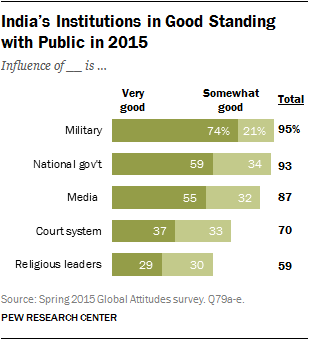
As the economy has picked up and the Modi administration has settled in, public satisfaction with a range of national institutions has improved. This is particularly the case with public perception of the national government.
Not surprisingly, since their party now runs the central administration, about two-thirds (66%) of BJP adherents believe the national government is having a very good influence. In contrast, just 50% of Congress supporters give the national government high marks, and only 43% of AAP backers agree.
Public support for the military – 95% say it is a good influence – is high, including 74% who say the armed forces are having a very good influence on the nation.
Indian television, radio, newspapers and magazines also enjoy a great deal of public support: 87% believe they have a good impact on the way things are going in the country. However, just 55% say the media’s influence is very good, comparable to the intensity of backing for the government but far less than that for the military.
Seven-in-ten Indians give high marks to the court system. But only 37% say it is having a very good influence. There is a partisan difference in such sentiment: 38% of BJP supporters rate the courts highly, but only 23% of AAP followers agree.
Religious leaders are the least respected of the five institutions tested in the survey. Nearly six-in-ten Indians (59%) believe these leaders have a positive effect on the nation, but only 29% say they are a very good influence. Here again there is a sharp partisan difference of opinion. Supporters of the Hindu nationalist BJP (62%) are more likely to laud the influence of religious leaders; 53% of Congress party backers follow suit. But only 34% of AAP supporters see religious figures in that positive of a light. Urban dwellers (67%) are also more likely than those in rural areas (57%) to attribute an affirmative influence to religious leaders.
Despite widespread satisfaction with their economy, their institutions and Modi, Indians nonetheless believe they face a range of very serious problems. And, in some cases, their concern is on the rise.
Criticism of corrupt officials rivals concern about economic conditions: 86% say it is a very big problem. Such sentiment is comparable to what it was in 2013. Notably, Indians are slightly less concerned about corrupt business people. Roughly three-quarters (74%) say they are a very big problem for the country. And such concern is down 9 points from 2013.
Concern about terrorism (85%) is similar to Indians’ worries about economic issues and about government corruption.
Roughly three-in-four (77%) Indians say poor-quality schools are a very big national problem. And such concern is up 20 percentage points in the past year.
Nevertheless, anxiety about air pollution is a sentiment shared nationwide: Urban and rural Indians are equally concerned. However, BJP (77%) supporters are far more worried about air quality than AAP backers (57%).
Roughly seven-in-ten Indians (72%) believe that access to clean toilets is a major national problem. India accounts for about six-in-ten of the people around the world without toilets. And the World Bank estimates that lack of access to such sanitation facilities costs the Indian economy $54 billion a year thanks to the diarrhea and cholera spread by human excrement that pollutes groundwater, crops and waterways.
Roughly two-thirds of Indians (68%) think health care is a very big problem. Medical care spending in India as a percentage of the gross domestic product is less than half of the OECD average. The number of doctors per 1,000 Indians is less than a quarter the ratio in richer countries, and the ratio of nurses is one-eighth of the OECD average. BJP and Congress adherents (both 70%) are far more worried about health care than are AAP supporters (50%). Notably, people living in southern states (86%) are far more likely to say health care is a grave concern than are people living in western states (43%).
About two-thirds (68%) of Indian respondents see as a very big problem the situation in Kashmir, where India and Pakistan have long had competing territorial claims.
3. How Indians See the World
The election of Prime Minister Modi thrust India onto the front pages of newspapers around the world. After taking office in late May 2014, Modi made a number of high-profile international trips to the United States, China, Japan and Russia. And he has welcomed numerous foreign leaders to Delhi. The Indian public seems pleased with Modi’s and India’s role in the spotlight on the world stage.
Indians’ pride in their country has grown in recent years. Fully 85% of the public has a very favorable opinion of India, up from 72% in 2014.
Roughly three-quarters (73%) of those surveyed also have a lot of confidence in Modi doing the right thing regarding world affairs. But there is a definite partisan split in such support: 83% of BJP followers express a lot of confidence, yet only 63% of Congress backers and 61% of AAP followers agree.
Indians look with less favor on other nations. Just 43% have a positive view of Russia, relatively unchanged over the past few years. About four-in-ten (41%) see China favorably, yet that sentiment is up 10 points from 2014. And just 28% are favorably disposed toward Iran. In each case, those with at least some college education have a better opinion of other countries than do those with a primary education or less.
But, for many Indians, especially those living in rural areas, other countries are truly foreign. Roughly four-in-ten Indians express no opinion about Iran and Russia, almost three-in-ten have no view on China, and about two-in-ten say they don’t know how they feel about the U.S.
However, despite each of these foreign leaders’ recent visits to India and a Modi trip to their countries, 49% of Indians surveyed have no opinion of Putin, 47% voice no view of Abe and 42% express no sentiment about Xi. The only foreign leader who is relatively well-known is Obama (just 17% don’t know him).
Despite growth in confidence in their own nation, as well as in appreciation for foreign countries and their leaders, Indians see the world as a challenging place. Nearly three-quarters (73%) say they are very concerned about global climate change. And there is a strong regional difference in such anxieties. Nearly nine-in-ten respondents living in northern states are very worried about climate change, compared with about two-thirds in other parts of the country. Indians with some college education or more (80%) are more concerned than those with primary schooling or less (68%).
Similarly, almost half the public (49%) is quite concerned about global economic instability; 45% of Indians are very worried about cyberattacks on governments, banks and corporations; and 41% are quite concerned about the militant Islamic group ISIS. In each case, better-educated Indians, those with at least some college education, are more worried than those with a primary education or less. (For more on how Indians’ perceptions of global threats compare with sentiment in other nations, see this Pew Research Center report.)
Indians living in rural areas (63%) are greater proponents of such discussions than those living in cities (54%). And AAP (74%) followers are slightly more likely to support talks than are BJP (60%) backers.
But Pakistan is not the only security challenge seen by Indians. Roughly two-thirds (65%) of the public believes that the Naxalites – a Maoist guerilla group that originated in northeast India – pose a very serious threat to the country. AAP (77%) supporters are more concerned than Congress (59%) followers.
About six-in-ten Indians (61%) say the Pakistan-based terrorist group Lashkar-e-Taiba poses a very serious threat to the nation. Again, concern differs by party: AAP (79%) backers are more worried than BJP (62%) or Congress (51%) adherents.
Just 42% of the public voices the view that China is a very serious threat to India. This sentiment is relatively unchanged since 2013. There is a notable partisan divide on China. Fully 71% of AAP supporters see China as quite threatening, but only 43% of BJP backers and 35% of Congress followers agree. And geography matters. In northern states, 63% of respondents see China as a very serious threat. But few in the east (36%), south (27%) and west (24%) are that concerned.
Methodology
About the Pew Research Center’s Spring 2015 Global Attitudes Survey
Results for the survey are based on face-to-face interviews conducted under the direction of Princeton Survey Research Associates International. The results are based on national samples, unless otherwise noted. More details about our international survey methodology and country-specific sample designs are available here.