Pew Research Center

FOR RELEASE SEPTEMBER 16, 2015

Health Care, Education Are Top Priorities in Sub-Saharan Africa

Most Are Optimistic about Economic Future

BY Richard Wike and Katie Simmons

FOR MEDIA OR OTHER INQUIRIES:

Communications Department
202.419.4372
www.pewresearch.org

RECOMMENDED CITATION

Pew Research Center, September 2015, "Health Care, Education Are Top Priorities in Sub-Saharan Africa"

About Pew Research Center

Pew Research Center is a nonpartisan, nonadvocacy fact tank that informs the public about the issues, attitudes and trends shaping the world. It does not take policy positions. The Center conducts public opinion polling, demographic research, computational social science research and other data-driven research. It studies politics and policy; news habits and media; the internet and technology; religion; race and ethnicity; international affairs; social, demographic and economic trends; science; research methodology and data science; and immigration and migration. Pew Research Center is a subsidiary of The Pew Charitable Trusts, its primary funder.

© Pew Research Center 2026

Table of contents

  • About Pew Research Center
  • Health Care, Education Are Top Priorities in Sub-Saharan Africa
  • 1. Concerns and Priorities in Sub-Saharan Africa
  • 2. Views of Government, Aid Organizations and Business
  • Methodology

Health Care, Education Are Top Priorities in Sub-Saharan Africa

Most Are Optimistic about Economic Future

As the United Nations prepares to ratify new global development goals, a new Pew Research Center survey finds that people in major sub-Saharan African nations are feeling more optimistic about the future than many others around the world. Having experienced relatively high rates of economic growth in recent years, African publics are more likely than citizens of many wealthier nations to believe their economies will improve in the short run, and that in the long run the next generation will be better off financially.

Nonetheless, throughout sub-Saharan Africa people recognize that their countries face tremendous challenges. Even though extreme poverty around the world has been cut by more than half since the last round of UN development targets (the Millennium Development Goals) were adopted in 2000, economic challenges persist, especially a lack of jobs.1

Health Care Seen as Top Priority for Improvement in Sub-Saharan Africa

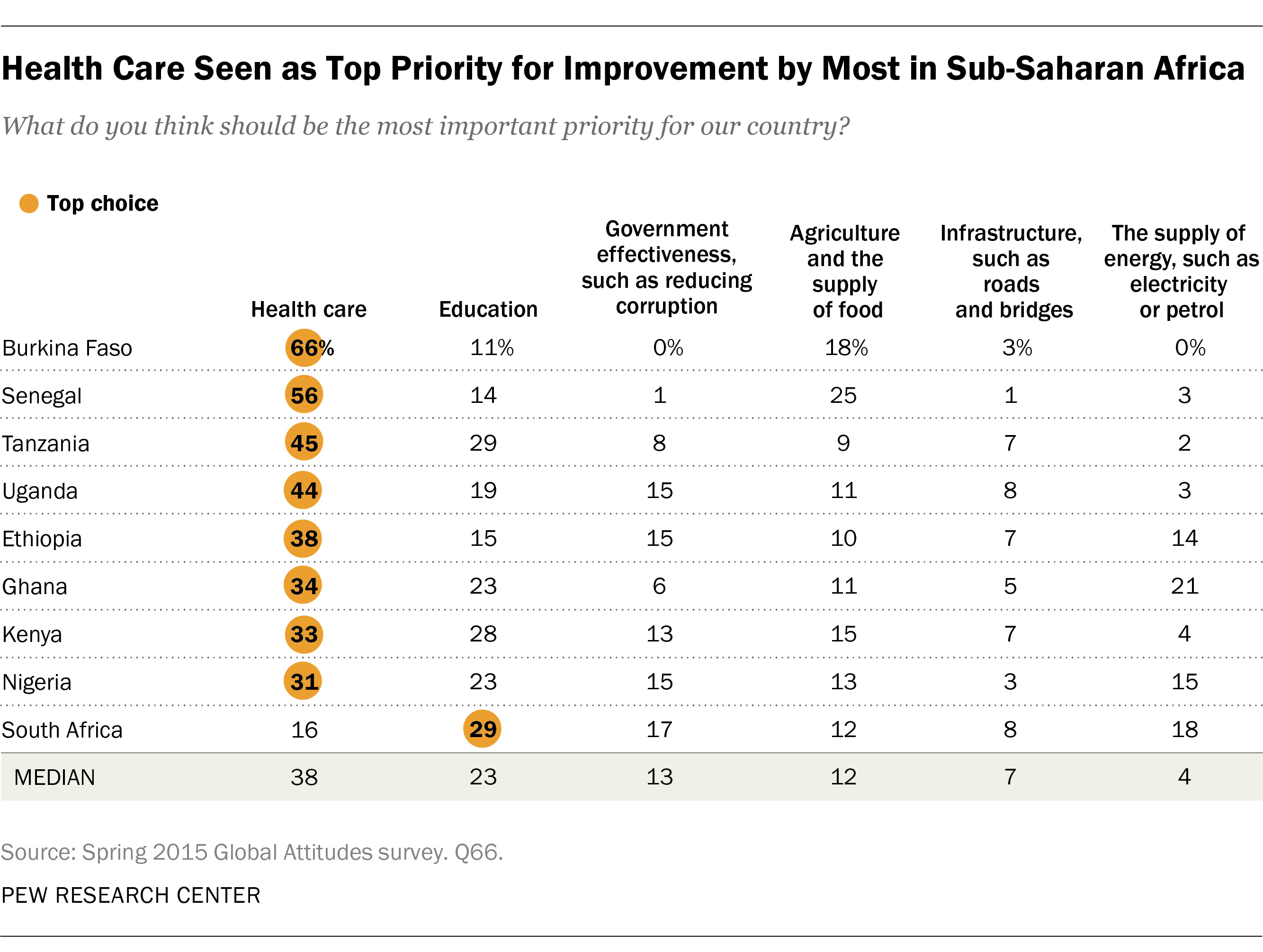
Asked which of six pressing issues should be the most important priority for their country, a median of 38% across the nations polled name health care, including more than four-in-ten in Burkina Faso, Senegal, Tanzania and Uganda. In eight of nine countries, improving health care is the number one priority.

Education is also an important concern. A median of 23% say improving education should be their nation’s top priority. In South Africa, education is named more often than any other option. To a lesser extent, people in the region are also worried about issues such as corruption, food supply, infrastructure and energy.

Most Say More Foreign Aid Needed

These are among the key findings of a new Pew Research Center survey, conducted in nine nations among 9,062 respondents from March 25 to May 21, 2015. Pew Research Center is a subsidiary of The Pew Charitable Trusts, its primary funder. This report was made possible by The Pew Charitable Trusts, which received support for the survey from the Bill & Melinda Gates Foundation.

Development in Africa


Confidence in Government, Aid Groups, Private Sector, but Concerns Too

Most Express Confidence in Government, Aid Groups, Domestic and Foreign Companies

Overall, people in the region express at least some confidence that major institutions will be able to deal with the challenges facing their countries. Most believe that governments, foreign aid organizations and businesses can help solve key problems. However, people believe that these institutions have both important strengths and significant weaknesses.

In most countries polled, people express the greatest faith in their own national governments. A median of 78% across the eight countries where the question was asked say they are at least somewhat confident that their national government will help solve major problems in the country.

Foreign donor groups also receive largely favorable ratings. A median of 70% across all nine countries surveyed are at least somewhat confident that these organizations can help solve major problems in their country, including majorities in every nation polled. A median of 68% describe foreign aid programs as effective and 60% say they benefit people in need. Still, these positive views are tempered with doubts. Smaller, yet still significant, shares perceive these foreign assistance programs as corrupt (median of 53%) or inefficient (45%). And there is no country in which a majority is very confident in international aid organizations.

Most also believe the private sector can help address the challenges facing their country. A median of 66% express confidence in domestic companies, and 60% say this about foreign businesses.

Views of Foreign Companies in the Extractive Industries

More specifically, foreign companies involved in extractive industries are seen in a mostly positive light. In eight nations, respondents were asked about the impact of the mining industry in their country, while in Nigeria, where oil is a major export, people were asked about the oil and petrol industry.

In all countries, more than half say these companies are having a positive impact, including about seven-in-ten or more in Kenya, Nigeria and Uganda. A median of 67% across the nations polled say extractive companies are providing jobs for local workers and 59% believe they contribute to economic growth.

At the same time, as is true for the government and nonprofit sectors, people have some concerns about these for-profit industries as well. A median of 61% believe foreign extractive companies in Africa are causing environmental damage, while about half (51%) say the mines and oil rigs are unsafe for workers and 45% say these firms do not pay their share of taxes.

Economic Optimism in the Short, Long Term

The survey finds that, compared with other parts of the world, people in sub-Saharan Africa are feeling relatively positive about the economy. Many nations in the region have enjoyed strong growth in recent years, and it is clearly having an impact on public attitudes.

Africans More Positive on Economy Compared with Other Regions

Across the nine nations polled, a median of 48% say their national economy is in good shape. While still less than half, this is a significantly higher share of the public than in other parts of the world, with the exception of the Asia-Pacific region. Positive economic ratings are especially common in Ethiopia, Senegal, South Africa and Nigeria, where majorities believe their country is doing well economically. (For more on global public opinion on economic issues, see this recent report based on Pew Research Center’s 40-nation Spring 2015 survey, which includes the nine countries featured here.)

And when asked about the near-term economic future, sub-Saharan Africa is the most positive region of the world. A median of 60% believe their nation’s economy will improve in the next 12 months. Latin America is a distant second at 44%, and Europe trails the world at 24%.

Average GDP Growth Since 2005 and Optimism for Next Generation

Globally, optimism about the economic future is closely linked to a country’s recent economic past. Nations that have enjoyed strong gross domestic product (GDP) growth since 2005 also tend to be more optimistic about the financial well-being of the next generation. Overall, there is a 0.75 correlation between a country’s average GDP growth from 2005 to 2014 and the share of the public who think today’s children will be better off financially than their parents.

In African nations that have experienced high growth rates in recent years, such as Nigeria, Ethiopia and Burkina Faso, large majorities believe the next generation will be better off. The same pattern is found in Asian nations that have had strong growth, like China, India and Vietnam.

In contrast, many wealthy nations that have struggled with the Great Recession and its aftereffects are relatively pessimistic about the future. For example, in France, Italy and Japan, less than 20% say children in their country will surpass their parents financially.

1. Concerns and Priorities in Sub-Saharan Africa

Sub-Saharan African countries have experienced some of the highest economic growth rates globally over the past 10 years. While this means that people in these nations tend to be more satisfied with their current economies and more optimistic about their economic future than other people around the world, they still face myriad problems. In addition to unemployment, broad majorities rank health care, education, government corruption, crime, access to clean water and energy shortages as some of the biggest issues their countries face. When asked what their nations should focus on improving for the future besides the economy, health care and education emerge as clear priorities.

Sub-Saharan African Publics Happier with Economy than Others around the World

Current Economic Situation

Majorities of Ethiopians, Senegalese, South Africans and Nigerians say their economy is doing well. Tanzanians and Kenyans, however, are divided over current economic conditions. And more than half in Ghana, Uganda and Burkina Faso are unhappy with the economy.

Despite negative sentiment in some countries, publics in this region tend to be much more content with their current economy than other people around the world. A median of 48% across the nine countries surveyed say their economy is doing well. Fewer than four-in-ten in Latin America (median of 36%), the Middle East (31%) and Europe (28%) say the same. Americans are also down on their economy (40% good). Only in the Asia-Pacific region (median of 51%) are economic sentiments somewhat more positive.

Optimism for the Future

Many people in sub-Saharan Africa are optimistic about the future. A median of 60% across the nine countries surveyed say their economy is going to improve in the next 12 months, and 56% believe the next generation will be better off financially than their parents. This is a much higher level of optimism than expressed by many others around the world.

Similar to attitudes about the economy today, opinions about the future are also affected by the nation’s economic performance. Across the globe, publics who have seen their economies grow consistently over the past decade are much more likely to believe that their children will face a brighter financial future. For example, Nigerians experienced an average of 7% GDP growth between 2005 and 2014. More than eight-in-ten in Nigeria say that children in their country will do better financially than their parents. Meanwhile, average GDP growth over the past decade in France has been 1% and just 14% say the next generation will be better off.

Jobs a Top Concern among Many Problems

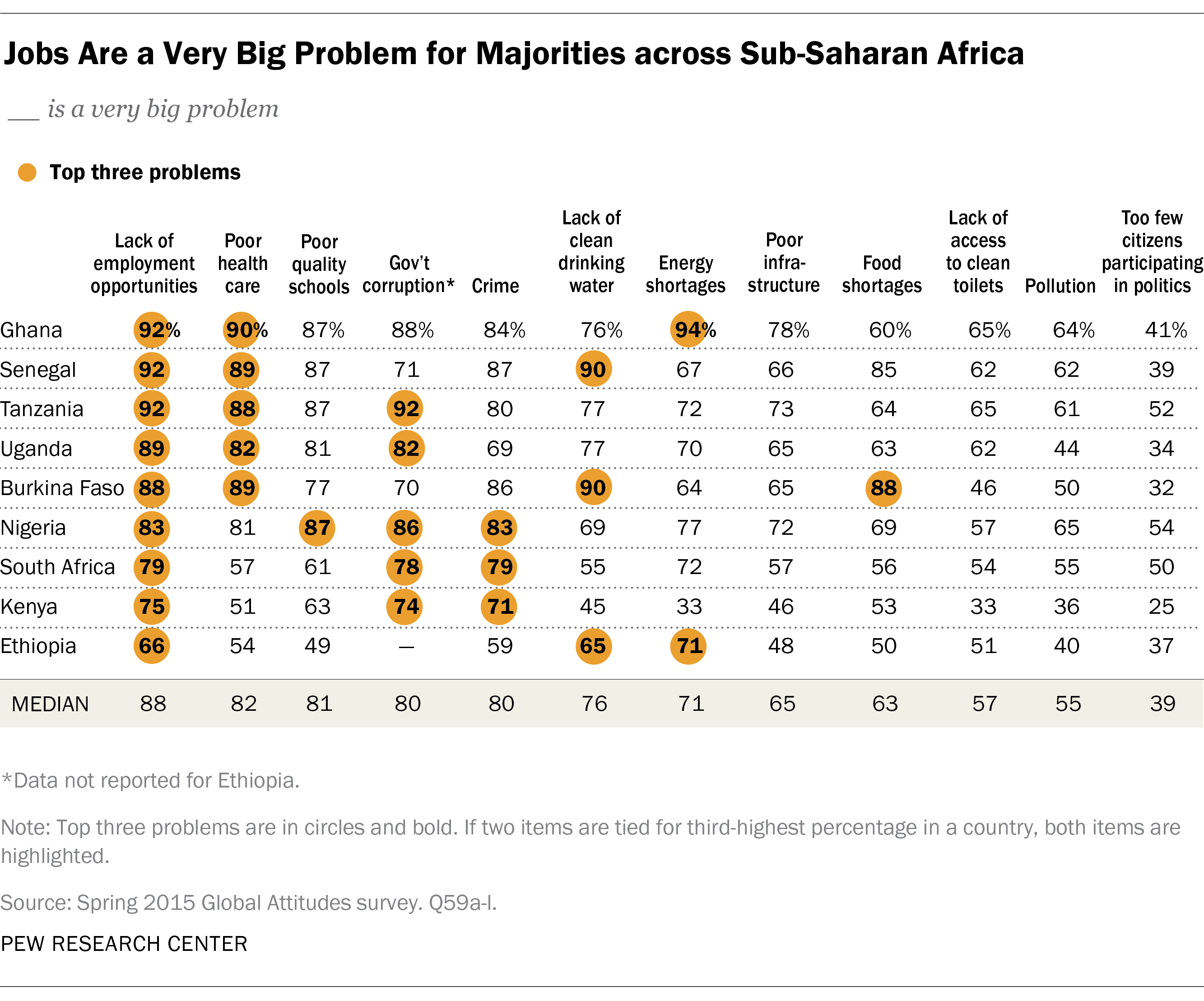
Sub-Saharan African publics are concerned about a range of issues in their country. In each of the nine countries surveyed, a lack of employment opportunities ranks as one of the three most important problems. A median of 88% across all nine countries say jobs are a very big problem in their nation, including 92% in Ghana, Tanzania and Senegal.

Jobs Are a Very Big Problem for Majorities across Sub-Saharan Africa

Education also tops the list of problems with a median of 81% citing it as a major concern. Nigerians rank poor-quality schools among their three biggest worries.

Government corruption ranks as a very big concern (median of 80% across eight countries asked the question) and is among the top three problems in Tanzania, Nigeria, Uganda, South Africa and Kenya. Broad majorities also say crime (median of 80% across all nine countries) is a very big problem in their country. Crime ranks among the top concerns for Kenyans, Nigerians and South Africans.

Somewhat lower down the list of concerns, though still considered major issues, are lack of access to clean drinking water (median of 76%) and energy shortages, such as electricity blackouts or fuel scarcity (71%). A lack of clean water is cited as one of the three most important problems in Senegal, Burkina Faso and Ethiopia, while energy shortages rank among the biggest three worries in Ghana and Ethiopia.

Fewer people – though still majorities – express concern over poor infrastructure (median of 65%), food shortages (63%), lack of access to clean toilets (57%) and pollution (55%). At the bottom of the list is the issue of too few citizens participating in politics (39%). None of these concerns ranks in the top three for any public surveyed, except for food shortages in Burkina Faso.

In most of the countries polled, people who live in urban areas are more concerned than those in rural areas about crime and government corruption. There is an urban-rural divide over the problem of crime in South Africa (+15 percentage points), Senegal (+13), Ethiopia (+11), Ghana (+10), Uganda (+10) and Burkina Faso (+8). Similarly, those in urban areas are at least 10 points more likely than rural residents to say government corruption is a very big problem in Senegal (+18), Burkina Faso (+15), Kenya (+12) and South Africa (+12).

In Nigeria, opinions about the country’s challenges vary somewhat along ethnic lines. Respondents from the Igbo and Yoruba ethnic groups are generally more likely than Hausa respondents to describe the issues included on the survey as very big problems.

Most Important Priorities for the Future Are Health Care, Education

Health Care Seen as Top Priority for Improvement by Most in Sub-Saharan Africa

Addressing government effectiveness, such as reducing corruption (median of 13%), is a somewhat lower priority, as is improving the supply of food (12%). The share ranking government effectiveness as their top priority is highest among South Africans, while Senegalese and Burkinabe are the most likely to say it is very important to address the food supply first.

At the bottom of the priority list are investing in infrastructure, such as roads and bridges (median of 7%) and improving the energy supply within the country (4%). In a few countries – Ghana, South Africa, Nigeria and Ethiopia – energy supply ranks much higher than it does elsewhere. No more than one-in-ten in any nation say infrastructure should take top billing.

When asked which among these six issues would be their second priority to improve, publics are generally split between education (median of 30%) and health care (25%). Food supply also is seen by many as a secondary priority (16%). Government effectiveness (8%), infrastructure (8%) and energy supply (6%) continue to be seen as less important.

Education Is Higher Priority for Young in Many African Nations

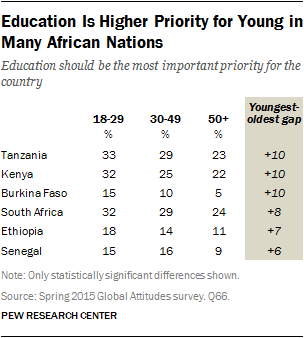
Within countries, there are some clear demographic differences over the importance of certain issues. Young people, ages 18 to 29, place a higher priority on addressing education than those ages 50 and older in Tanzania (+10 percentage points), Kenya (+10), Burkina Faso (+10), South Africa (+8), Ethiopia (+7) and Senegal (+6). In Senegal and South Africa, lower-income individuals are more likely than higher-income people to say that the food supply should be a top priority (+10 and +7, respectively) and less likely to say education is most important (-5 and -9, respectively).1 Finally, in South Africa, whites (27%) and people who are mixed-race (25%) rank addressing government effectiveness as a much higher priority than blacks (14%).

2. Views of Government, Aid Organizations and Business

The nine sub-Saharan African publics surveyed express mostly positive views about the ability of governments, foreign aid organizations and businesses to help solve major problems in their country. Majorities across these nations say they have at least some confidence in these institutions, though few say they are very confident.

Moreover, government, aid groups and businesses are also perceived to have flaws. Most say government is run for the benefit of the few, rather than the benefit of all. And while foreign aid programs are seen as effective and as assisting people who need help, many also say such programs are corrupt and inefficient. As for mining and oil companies, although they are seen as having a positive impact overall, many worry about the environmental impact of these extractive industries.

Confidence in Institutions and Organizations

For the most part, people in the nations surveyed believe their governments can help solve major national problems. Across the eight nations where the question was asked, a median of 78% are very or somewhat confident that their national government will help address the major problems facing the country.

In five nations, people express higher levels of confidence in national governments than in the three other types of organizations included on the survey. Still, Nigeria (57%) is the only country where a majority is very confident in their national government.

In South Africa, views about government differ along racial lines. Three-in-four blacks have confidence in the national government, compared with just 44% of people who are mixed-race and 43% of whites.

Most Say Government Helps the Few

Most Say Government Is Run for Benefit of a Few Groups

Even though majorities express at least some confidence that their government can help solve major problems, there is also a widely shared perception that government does not serve everyone equally. Aside from Burkina Faso, over half in every other nation where the question was asked say the government is run for the benefit of only a few groups. This view is especially common in Ghana (67%), Nigeria (61%) and Tanzania (60%).

In Kenya, opinions differ by ethnicity. Most members of the Kalenjin (60%) and Kikuyu (54%) ethnic groups say the government is run for the benefit of all (current President Uhuru Kenyatta is Kikuyu, and all presidents since the country’s independence have been either Kikuyu or Kalenjin). Only about four-in-ten from the Luhya (42%) and Luo (40%) groups believe the government works to benefit everyone.

Taxes and Government Services

Divide on Taxes and Government Services

When asked whether they would rather have higher taxes, so the government can provide more services, or lower taxes, even if that means fewer services, views are somewhat divided across the nine nations polled. In Ethiopia, Senegal, Ghana, Nigeria and South Africa, the balance of opinion favors more taxation. Kenyans, Ugandans and Burkinabe lean toward lower taxes. Tanzanians are closely divided (49% higher, 43% lower).

For comparative purposes, the same question was asked in the United States, where just over half (54%) favor lower taxes, even if that means fewer services; 42% want higher taxes and more services. There are huge partisan differences on this issue in the U.S., with 71% of Republicans and 60% of independents preferring lower taxes and fewer government services, compared with only 34% of Democrats.

Most Say More Foreign Aid Is Needed

Perception of Foreign Aid Received

Among those surveyed, there is no country where a majority says their nation receives a lot of foreign aid. A median of 37% across these publics believe their country gets a lot of aid, while 30% say they receive some aid. A median of 17% think their country receives “very little” foreign assistance.

Most See Need for More Foreign Aid

The percentage saying their country gets a lot of aid is fairly consistent across nations, with between 36% and 41% expressing this view in seven of nine countries. Slightly fewer in Kenya (32%) hold this opinion. Meanwhile, South Africans are significantly less likely to say their country receives a great deal of assistance from abroad. (For more on how much foreign aid countries receive and how they have performed since 2000 on the Millennium Development Goals, see the African Development Bank Group.)

There is a clear desire for more aid in the nations surveyed. Majorities in seven nations believe their country needs more foreign assistance than it currently receives, including more than eight-in-ten in Senegal, Burkina Faso and Uganda. Nearly half in Ethiopia (49%) think their country needs to get more aid.

South Africa is again the outlier. Just 26% of South Africans believe their country needs more foreign assistance, while an equal percentage says it needs less aid.

Characteristics of Foreign Aid Programs

Foreign Aid Seen as Effective, Benefiting Those in Need, but Some Also See It as Corrupt, Inefficient

In six of nine countries, people associate the phrase “benefit people in need” with foreign aid programs. Seven-in-ten or more express this view in Ethiopia and Kenya. However, just 41% of Senegalese and 26% of Burkinabe say the same.

While large numbers believe international assistance is effective and that it helps those who need it most, many also think these programs are hampered by corruption. Majorities in Tanzania, Uganda, Kenya and Burkina Faso say the term “corrupt” describes aid programs in their country well.

To a lesser extent, those surveyed associate the term “inefficient” with foreign assistance. Half or more say this in Tanzania, Kenya and Nigeria.

Foreign Extractive Companies Seen as Having Positive Impact, but Many Worry about Environmental Toll

Positive Views of Foreign Companies in Extractive Industries

Overall, people believe foreign companies involved in extractive industries are having a positive impact on their countries. Over half in each country polled say these companies are having a favorable impact, including about seven-in-ten or more in Kenya, Nigeria and Uganda. (In Nigeria, respondents were asked about the oil and petrol industry; elsewhere, respondents were asked about the mining industry.)

In general, people who live in regions of the country where extractive industries are concentrated tend to be more positive toward foreign extractive companies. For example, South Africans who live in the northeast are the most likely to say these companies are having a good influence on their country. In Nigeria, people in the southeast are among the most positive.

However, even though they are seen as a good influence overall, people believe foreign extractive companies are having both positive and negative effects on their countries. Across the nine nations polled, a median of 67% say the phrase “provide jobs for local workers” describes foreign companies involved in extractive industries very or somewhat well, with majorities in all nine countries expressing this view. Kenyans, Ugandans and Ethiopians are especially likely to think these companies provide jobs.

Foreign Oil, Mining Companies Seen as Providing Jobs

Similarly, majorities in all nine nations believe foreign extractive companies contribute to economic growth (median of 59%). Again, Kenyans, Ugandans and Ethiopians stand out for their positive views on this measure.

Fewer say these companies’ mines and oil rigs are unsafe for workers (median of 51%). Still, half or more hold this opinion in Burkina Faso, Ghana, Nigeria, Kenya, Tanzania and Uganda. A median of just 45% believe the phrase “they don’t pay their share of taxes” describes foreign extractive companies well, and there is no country in which a majority voices this view, although in several nations a relatively large share of the public does express an opinion on this question.

Methodology

About the Pew Research Center’s Spring 2015 Global Attitudes Survey

Results for the survey are based on face-to-face interviews conducted under the direction of Princeton Survey Research Associates International. The results are based on national samples, unless otherwise noted. More details about our international survey methodology and country-specific sample designs are available on our website.

For more detailed information on survey methods for this report, see here: https://alpha.pewresearch.org/pewresearch-org/global/international-survey-methodology/?year_select=2015

For more general information on international survey research, see here: https://alpha.pewresearch.org/pewresearch-org/methodology/international-survey-research/