Pew Research Center

FOR RELEASE JUNE 10, 2015

NATO Publics Blame Russia for Ukrainian Crisis, but Reluctant to Provide Military Aid

In Russia, Anti-Western Views and Support for Putin Surge

BY Katie Simmons, Bruce Stokes and Jacob Poushter

FOR MEDIA OR OTHER INQUIRIES:

Communications Department
202.419.4372
www.pewresearch.org

RECOMMENDED CITATION

Pew Research Center, June 2015, "NATO Publics Blame Russia for Ukrainian Crisis, but Reluctant to Provide Military Aid"

About Pew Research Center

Pew Research Center is a nonpartisan, nonadvocacy fact tank that informs the public about the issues, attitudes and trends shaping the world. It does not take policy positions. The Center conducts public opinion polling, demographic research, computational social science research and other data-driven research. It studies politics and policy; news habits and media; the internet and technology; religion; race and ethnicity; international affairs; social, demographic and economic trends; science; research methodology and data science; and immigration and migration. Pew Research Center is a subsidiary of The Pew Charitable Trusts, its primary funder.

© Pew Research Center 2026

Table of contents

  • About Pew Research Center
  • NATO Publics Blame Russia for Ukrainian Crisis, but Reluctant to Provide Military Aid
  • 1. NATO Public Opinion: Wary of Russia, Leery of Action on Ukraine
  • 2. Russian Public Opinion: Putin Praised, West Panned
  • 3. Ukrainian Public Opinion: Dissatisfied with Current Conditions, Looking for an End to the Crisis
  • Methodology

NATO Publics Blame Russia for Ukrainian Crisis, but Reluctant to Provide Military Aid

In Russia, Anti-Western Views and Support for Putin Surge

Publics of key member nations of the North Atlantic Treaty Organization (NATO) blame Russia for the ongoing conflict in Ukraine. Many also see Russia as a military threat to other neighboring states. But few support sending arms to Ukraine. Moreover, at least half of Germans, French and Italians say their country should not use military force to defend a NATO ally if attacked by Russia.

NATO Publics More Supportive of Economic than Military Aid for Ukraine
Many NATO Countries Reluctant to Use Force to Defend Allies

NATO nations are hesitant, however, to escalate their involvement in the conflict, especially militarily. Comparatively few support sending arms to Ukraine (median of 41%). And many allied countries are reluctant to uphold Article 5 of the North Atlantic Treaty, which requires NATO members to defend an ally with armed force if necessary. A median of 48% among these publics say their country should use military force if Russia gets into a serious military conflict with a neighboring nation that is a NATO ally, while 42% are opposed.

Russian Ratings of U.S., EU Collapse

As the crisis in Ukraine has dragged on, mutual animosity between Russia and the West has become more entrenched. A median of just a quarter of NATO publics now say they have a favorable view of Russia. Meanwhile, only 12% of Russians give NATO a positive rating. And Russians’ favorable views of the U.S. and the European Union have plummeted by more than 30 percentage points since 2013, before the beginning of the crisis. Half of Russians say NATO is a major military threat to their nation. And Russians overwhelmingly oppose Ukraine becoming a member of either NATO (83% oppose) or the EU (68%).

Putin Receives High Marks in Russia

Meanwhile in Ukraine, the security situation on the ground posed a serious challenge to safely surveying the public. Pew Research Center was, however, able to interview in all regions of the country except Luhans’k, Donets’k and Crimea.1 The areas covered by the survey represent roughly 80% of the Ukrainian population. Among those surveyed, a majority of Ukrainians (67%) support becoming a member of the EU. They also favor joining NATO by a 53%-to-32% margin. At the same time, a plurality (47%) expresses support for negotiating with the rebels and Russia. Roughly a quarter (23%) says using military force to fight the separatists is the best way to end the conflict in the east, and another 19% volunteer either both or neither.

National differences in the preferred outcome for negotiations may continue to complicate reaching a settlement. While most Ukrainians outside of Donbas and Crimea say Luhans’k and Donets’k should remain part of Ukraine, either on the same terms with the national government as before (51%) or with increased regional autonomy (33%), a majority of Russians believe these two oblasts should secede, becoming either independent states (35%) or part of Russia (24%).

These are the key findings of a Pew Research Center survey of 11,116 respondents in eight NATO member countries, including Canada, France, Germany, Italy, Poland, Spain, the United Kingdom and the United States, as well as Russia and Ukraine. The survey was conducted from April 6 to May 15, 2015.

Surveying Ukraine in 2015: Security Conditions Limit Access to Eastern Regions

In 2014, Pew Research Center surveyed Ukraine from April 5 to April 23, coming out of the field just days before violence began in Odesa and other cities in the east. While the increasingly tense atmosphere in spring 2014 presented some obstacles, the survey included the oblasts of Luhans’k and Donets’k (also referred to as the Donbas region), as well as Crimea. This year, however, security conditions in the Donbas region deteriorated to the point where it was unsafe to conduct face-to-face interviews, especially on the topics covered in this poll. In addition, the survey was too politically sensitive to conduct in Crimea. For these reasons, Luhans’k, Donets’k and Crimea are not included in the 2015 survey of Ukraine. The map below illustrates which areas surveyed in 2014 were not able to be surveyed this year, as well as the west-east regional divide used throughout the report for analysis.

Excluding the Donbas region and Crimea can have an effect on the national results, particularly on topics related to Russia and the crisis. To assess this impact, we analyzed the 2014 survey with and without Luhans’k, Donets’k and Crimea in the sample. The findings show that, in general, when the Donbas region and Crimea are included, the national results are more favorable toward Russia, less favorable toward Western countries, and more supportive of secession. The variations on these topics were in the range of 5 to 12 percentage points. Despite these exclusions, the 2015 survey still covers a significant portion of the eastern population and was designed to be able to capture the variety of attitudes within the eastern region. The survey also continues to reveal deep divides between Ukraine’s west and east in attitudes about Russia, Western countries and the crisis, similar to last year.

To make it possible to compare 2015 results to those from 2014, in this report we show the 2014 national data excluding the Donbas region and Crimea. This is to ensure that any change reported between 2014 and 2015 in Ukraine is based on comparable populations. Therefore, results for the 2014 survey reported here may differ somewhat from results published at the time, which were based on a survey including Luhans’k, Donets’k and Crimea.

For more on the full methods for the survey, see here. For a discussion of the survey sampling design, see here.
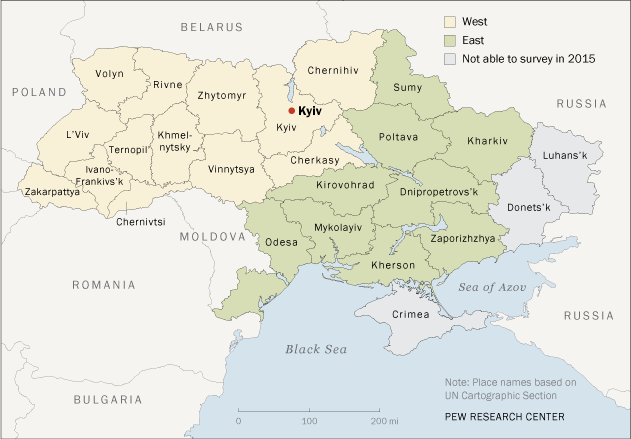
Surveying Ukraine in 2015 Map


NATO Publics Back Economic Aid to Ukraine, but Oppose Sending Arms

NATO Publics Support Ukraine, but Ukrainians Want More

NATO publics broadly support sending Ukraine economic aid to address the current crisis. And, with the exception of Germany and Italy, majorities say Ukraine should become a member of the alliance.

However, other measures to address the crisis receive much weaker support among these allies, or at the least are more divisive. Roughly half or more of Germans (54% oppose), French (53%) and Italians (47%) oppose allowing Ukraine to join the EU, while the Spanish (65% support), Poles (60%), and British (53%) support the idea.

Most Say U.S. Would Defend NATO against Russia

NATO Countries Believe U.S. Will Come to Defense of Allies

Most NATO publics surveyed are reluctant to live up to the promise in Article 5 of the North Atlantic Treaty that member countries will assist allies who are attacked, including with armed force. Roughly half or fewer in six of the eight countries surveyed say their country should use military force if Russia gets into a serious conflict with a neighboring country that is a NATO ally, including just 40% in Italy and 38% in Germany. Only in the U.S. (56%) and Canada (53%) do more than half say their nation should use military action in such a situation.

Contrary to their attitudes about what their own country should do, widespread majorities of most NATO publics believe the U.S. would use military force to defend a fellow NATO country. Poles stand out as less certain that the U.S. would come to an ally’s aid (49% would, 31% would not).

Americans and Germans Disagree over Best Course

U.S.-German Divide Over Ukraine

U.S. President Barack Obama and German Chancellor Angela Merkel have made considerable efforts to downplay any disagreements they have over how to address the Ukrainian crisis. But it is clear their respective publics hold different views. Roughly six-in-ten Americans (62%) believe Ukraine should become a member of NATO and just under half (46%) support sending military assistance to the Ukrainian government. Few Americans (10%) think sanctions on Russia should be decreased. And a majority of Americans (56%) believe the U.S. should use military force to defend a NATO ally. Among Americans, Republicans are much more supportive than Democrats of allowing Ukraine to join NATO as well as sending military aid to the Ukrainian government.

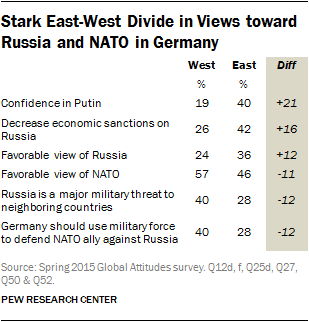
Meanwhile, just 19% of Germans support sending arms to Ukraine and roughly four-in-ten or fewer believe Ukraine should join either the EU (41%) or NATO (36%). Germans (29%) are the most likely among allied nations to say that sanctions on Russia should be decreased. And only 38% of Germans say their country should use military force to protect a NATO ally if attacked by Russia. Within the country, western Germans are more favorable of NATO and using military force to defend an ally than eastern .

Poles Concerned about Russia, Want Action from NATO

Poland Takes a Tougher Line on Russia

Poles are more concerned about Russia’s role in the current crisis than other NATO publics. Seven-in-ten Poles say Russia is a major threat to neighboring countries, compared with a median of 49% of the other seven allied countries surveyed. Similarly, Poles are more likely to blame Russia for the crisis and to have an unfavorable view of the former Cold War power than their NATO counterparts.

Perhaps because of this anxiety about Russia’s intentions, nearly half of Poles (49%) would increase economic sanctions on Moscow. Only a median of 25% in the other countries say the same. And 50% back sending arms to Kyiv (Kiev), while just 40% of other NATO member publics agree.

Increasing Animosity between Russia and the West

NATO Publics Have Negative View of Russia as Russian Ratings of West Plummet

Russians Rally around the Flag –  and Putin

Russians Express Greater Pride in Russia, Confidence in Putin in International Affairs

National pride has reached new heights in Russia. The percentage of Russians who say they have a very favorable image of their own country has continued to climb, from 29% in 2013, to 51% in 2014, to 63% today – the highest it has been in Pew Research Center polling since first asked in 2007. Roughly seven-in-ten (69%) also say it is a bad thing that the Soviet Union dissolved.

Ukrainians Ready to Negotiate with Russia, but Little Common Ground

Ukrainians Prefer Negotiations, but Want Donbas to Stay in Ukraine

A plurality of Ukrainians (47%) living outside of the Donbas region and Crimea say the best way to resolve the conflict in the east is to negotiate a settlement with the rebels and Russia. Roughly a quarter (23%) would prefer to use military force to fight the separatists, and 19% volunteer both or neither. Eastern Ukrainians are more supportive of negotiations than those in the west (56% vs. 40%), though this is still the most common answer in each region. Among eastern Ukrainians, those who live closest to the conflict areas – the bordering oblasts of Kharkiv, Dnipropetrovs’k and Zaporizhzhya – are the most eager for a settlement (65%).

However, negotiations may be difficult, as they have proved to be so far, because of the large divide between Ukrainians and Russians over the future of the Donbas region. As was true in 2014, an overwhelming majority of Ukrainians would prefer Ukraine to remain one country (85%) rather than allow regions to secede (10%). Both western and eastern Ukrainians support unity (91% and 77%, respectively).

Ukrainians Want Donbas to Remain Part of Ukraine; Russians Want It to Secede

1. NATO Public Opinion: Wary of Russia, Leery of Action on Ukraine

In recent years, Russia’s relationship with Western countries, specifically with members of the North Atlantic Treaty Organization (NATO), has been on a roller-coaster ride. In 2010, U.S. President Barack Obama and Russian President Dmitry Medvedev signed a New START agreement that reduced the number of deployed strategic warheads on each side by roughly 30%. But Russian annexation of Crimea in 2014 and its ongoing support for separatist forces in eastern Ukraine has once more strained relations between Russia and Western nations.

Going forward, most NATO members are willing to provide economic aid to Ukraine and offer it NATO membership. But they generally shy away from sending arms to Kyiv or escalating economic sanctions against Moscow. And at least half in Germany, France and Italy are unwilling to use military force to defend other NATO allies against Russian aggression.

Russia, Putin in Disfavor

NATO Views of Russia and Putin Both Negative

Russia’s current image problems are especially bad in Poland. Poland has had a long, painful relationship with Russia, having been invaded, dismembered and occupied by a series of Russian and Soviet regimes. Thus it is hardly surprising that just 15% of Poles have a favorable view of Russia. But the Poles have not always despaired of their ties with their neighbor. As recently as 2010, 45% of Poles had a favorable view of Russia – three times the current share. Just as striking, in 2010 only 11% had a very unfavorable opinion of Russia. Now more than three times that number, 40%, intensely dislike Russia.

The British have similarly turned against Russia. Only 18% in the United Kingdom voice a favorable view of the country. This is down from 25% of the British in 2014 and 50% in 2011. It is also notable that in 2011 only 7% of the British said they held very unfavorable views of Russia. In 2015, that proportion has quadrupled to 28%.

Only 22% of Americans express a favorable opinion of Russia. This is largely unchanged from last year, but down from 49% in both 2010 and 2011. At the same time, however, intense animosity toward Russia seems to be waning in the past year. The proportion of Americans holding very unfavorable views is down 11 percentage points, from 38% in 2014 to 27% in 2015. Still, older Americans are more than three times as likely as younger Americans (40% vs. 11%) to see Russia in a negative light.

Fewer than three-in-ten Germans (27%) hold a favorable view of Russia. This assessment has improved 8 points since last year. But it is down from a recent high of 50% in 2010. German men are twice as likely as women to have a positive opinion of Russia.

Views of Putin in NATO countries have historically been very low and have dropped even further in some countries in recent years. Putin’s peak popularity was in 2003, a heady time when 75% of Germans (rivaling the 76% of Russians with faith in Putin), 54% of Canadians, 53% of British, 48% of French, 44% of Italians and 41% of Americans had confidence in him to do the right thing regarding world affairs.

Putin has never again attained this level of trust in the West. Today, fewer than a quarter voice confidence in his leadership in any country, including just 9% in Poland and 6% in Spain. These attitudes are largely unchanged from 2014. It is older and more highly educated people in both the UK and the U.S. who are most likely to voice no confidence in Putin.

Russia Seen as Threat to Neighbors

Poland Most Worried about Russian Military Threat
In NATO Countries, Russia Bears Largest Share of Blame for Violence in Ukraine

Other actors in the Ukraine drama are seen as less culpable for the hostilities in eastern Ukraine. Three-in-ten French, 25% of Germans and 22% of Italians say pro-Russian Ukrainian separatists are responsible for the violence there. Few say the responsibility lies with the Ukrainian government itself. And only in Germany (12%) does a double-digit minority believe that the actions of Western governments in Europe and the U.S. are accountable for the hostilities.

Views of NATO Generally Favorable

The North Atlantic Treaty Organization is the Western alliance created in 1949 to provide collective security for its members in the face of the military threat then posed by the Soviet Union. NATO now includes 28 countries from Europe and North America. The eight NATO members surveyed by Pew Research Center in 2015 account for 78% of NATO countries’ population, 88% of their gross domestic product and 94% of their defense spending.

NATO Support Declining in Germany, Rising in Poland

Given their contentious history with Russia and their proximity to the fighting in Ukraine, it is not surprising that 74% of Poles hold a favorable opinion of NATO and the security reassurance membership in it provides. Polish support for the alliance is up 10 percentage points from 2013. Six-in-ten or more French (64%), Italians (64%) and British (60%) also hold a favorable view of NATO. However, roughly a third of the French (34%) and about a quarter of Italians (26%) express an unfavorable attitude toward NATO.

The greatest change in support for NATO has been in Germany, where favorability of the alliance has fallen 18 points since 2009, from 73% to 55%. Germans living in the east are divided – 46% see it positively, 43% negatively.

What to Do about Ukraine

In response to the situation involving Russia and Ukraine, publics in NATO member countries were given options as to what, if anything, they wanted to do about it. The survey suggests they support economic aid for beleaguered Ukraine, but comparatively few favor doing much else.

Majorities in Most NATO Countries Back Economic Aid to Ukraine

Ukraine’s relationship with NATO has long been the topic of contentious debate, both within the country and among the members of the Western security pact. Since the end of the Cold War, governments in Kyiv have wavered between a desire to eventually join the alliance and a desire to remain nonaligned.

Germans Oppose Ukraine Joining NATO

NATO membership for Ukraine is backed more by older (66%) than younger Americans (55%). Conversely, younger Germans (51%), French and Poles (both 64%) favor it more than their elders (32% of Germans, 52% of French and 54% of Poles).

Notably, despite recent developments, support for Ukrainian membership in NATO is relatively unchanged in a number of alliance countries – France, Germany, Italy, Poland – compared with attitudes expressed in 2009, when Pew Research Center asked publics a standalone question: if they favored Ukraine joining NATO in the next decade. Among the nations surveyed, support for Ukrainian membership in the defense alliance has increased by double digits in the U.S., the UK and Spain.

Division over Ukraine Joining EU
Many NATO Countries Oppose Supplying Ukraine with Arms Against Russia

There is relatively little support among NATO members for sending arms to the Ukrainian government. A median of only 41% back such action. Despite Poles’ general antipathy toward Russia, their concern about the military threat posed by Russia and their blaming Moscow for the current violence in Ukraine, only half (50%) want NATO to give arms to Kyiv. Americans are divided on the issue: 46% support sending weaponry, 43% oppose it. A majority of older Americans (56%) favor arming the Ukrainians, while more than half of younger Americans (54%) oppose it. And majorities in four of the eight nations are against helping arm the Ukrainians. The strongest opposition is in Germany (77%), Spain (66%) and Italy (65%).

In a related question concerning the situation involving Russia and Ukraine, Americans, Canadians and publics in the six EU member states in the survey were asked if they thought that the economic sanctions imposed on Russia by the EU and the U.S. should be increased, decreased or kept about the same as they are now. Outside of Poland, there is little appetite for escalating financial penalties. About half of Poles (49%) back ratcheting up economic sanctions. Roughly three-in-ten Italians (30%), Canadians (28%) and Americans (28%) agree. But only about a quarter of the French (25%) and the Spanish (24%) go along. Only one-in-five Germans want more economic pressure applied to Moscow. There is also relatively little interest in decreasing sanctions, except in Germany (29%). Most publics – including 53% of both Americans and British – want to keep the penalties about where they are now.

Mixed Views on Coming to the Aid of NATO Allies

[they]

NATO Countries Divided on Using Military Force to Defend Allies

Roughly half or fewer in six of the eight countries surveyed say their country should use military force if Russia attacks a neighboring country that is a NATO ally. And at least half in three of the eight NATO countries say that their government should not use military force in such circumstances. The strongest opposition to responding with armed force is in Germany (58%), followed by France (53%) and Italy (51%). Germans (65%) and French (59%) ages 50 and older are more opposed to the use of military force against Russia than are their younger counterparts ages 18 to 29 (Germans 50%, French 48%). German, British and Spanish women are particularly against a military response.

More than half of Americans (56%) and Canadians (53%) are willing to respond to Russian military aggression against a fellow NATO country. A plurality of the British (49%) and Poles (48%) would also live up to their Article 5 commitment. And the Spanish are divided on the issue: 48% support it, 47% oppose.

Germany: Old Divisions over Russia and NATO Remain

There is also internal German disagreement on what to do about Ukraine and Russia. German reunification has not closed the east-west divide in that country, a division that has its origins in the Cold War.

Major Partisan Split in the U.S.

Republicans and Democrats in the U.S. are strongly divided on the situation in Ukraine and what to do about it. Members of both parties see Russia as a major military threat to neighboring countries, but to a different degree. Two-thirds of the GOP sees Russia in that light, but only 56% of Democrats share their fear. And while half of Republicans say Russia is to blame for the violence in eastern Ukraine, just 39% of Democrats agree.

Partisan Divide in U.S. on What to Do about Russia-Ukraine Situation

With regard to U.S. and EU economic sanctions on Russia, substantial percentages of both parties favor keeping them about the same (44% of GOP and 54% of Democrats). However, 40% of Republicans would increase those sanctions, but only 23% of Democrats approve of such action.

Members of both parties support NATO membership for Ukraine. Such support is greater among the GOP (71%) than among Democrats (59%). Moreover, there is a partisan difference about U.S. obligations to come to the military assistance of other NATO members. Nearly seven-in-ten Republicans (69%) say that Washington should come to the aid of its allies in the event of Russian aggression. But only 47% of Democrats back that long-standing U.S. treaty obligation, while 48% oppose it.

2. Russian Public Opinion: Putin Praised, West Panned

As Russia deals with a dramatic fall in the price of oil and Western sanctions over its actions in Ukraine, fewer Russians say the economy is good and that Russian President Vladimir Putin’s actions in Ukraine have led to more favorable views of Russia. Nonetheless, Putin, who has entered his 11th year as leader of the country, garners overwhelming support from the Russian people on both his domestic and foreign policies, including record-high confidence in his ability to handle international affairs.

Concurrently, views of Western foreign leaders and powers have plummeted within Russia to their lowest levels of the Putin era. And many consider NATO and Western countries a military threat to Russia. Nationalism is on the rise within the country – very favorable views of the homeland are up sharply, Russians agree that parts of other countries belong to them and a majority says it is a bad thing that the USSR no longer exists. Regarding Ukraine, Russians believe the Luhans’k and Donets’k regions should secede, either becoming independent states or part of Russia. But Russians are divided about Ukraine’s place within the Eurasian Economic Union.

Russians See Downward Trend on Economy and International Image

Russian Views of Economy Souring

Young Russians, those ages 18 to 29, are the most likely to hold positive views about the economy, yet only 32% say it is doing well, compared with 19% of Russians ages 50 and older.

Russians Blame Sanctions and Falling Oil Prices for Economic Woes

Most Russians agree that Western sanctions are having an effect on the economy, but there is a split as to whether it is those sanctions or falling oil prices that are the main culprit for the economic downturn. In all, 45% of Russians say sanctions are having a major effect on the economy, with a further 41% saying they are having a minor effect. Only 8% say they are having no effect at all.

A third of Russians say that Western sanctions are causing the most harm to their economy, and another third say that falling oil prices are to blame. Only a quarter fault the economic woes on current government policies.

More Russians Say Putin’s Handling of Ukraine Crisis Has Led to Worsening International Opinion of Russia

There is a slight gender gap on this question. Women (31%) are more likely than men (22%) to say Putin’s actions have made Russia’s international image more favorable.

Putin Gets Widespread Job Approval from the Russian Public

Russians Overwhelmingly Support Putin’s Foreign and Domestic Policies

At the top of the list, nine-in-ten Russians approve of Putin’s handling of relations with China. The two countries have seen a marked increase in cooperation recently, as energy ties and opposition to U.S. policies have forged a common cause between the two powers. But Russians also praise Putin for his relations with the U.S. (85% approve), Ukraine (83%), and the EU (82%), even as he faces sanctions from the U.S. and EU for his actions in eastern Ukraine.

While not as robust as his foreign policy ratings, seven-in-ten or more in Russia approve of Putin’s energy policy (73%) and handling of the economy (70%), despite recent negative trends in the price of oil and a subsequent slowdown of the Russian economy. Putin also receives majority approval for a common concern in many emerging countries around the world: corruption. About six-in-ten Russians (62%) approve of Putin’s handling of corruption, though a significant minority (29%) disapproves on this particular issue.

Russians Have High Confidence in Putin’s Handling of International Affairs

Russian Confidence in Putin at New High

Along with their high approval ratings for Putin’s international and domestic policies, Russians also have great confidence in their leader’s ability to handle international affairs. Nearly nine-in-ten (88%) have confidence in Putin to do the right thing regarding world affairs, including 66% who say they have a lot of confidence. Only 9% express little or no confidence in the Russian leader.

Regardless of whether Russians blame Western sanctions, falling oil prices or current government policies for harming their economy, vast majorities still have confidence in Putin’s handling of international affairs and relations with Ukraine. However, those Russians who approve of Putin’s handling of relations with Ukraine are more likely to blame Western sanctions for their economic woes, while those few who disapprove are more likely to name current government policies as the cause of the economic downturn.

Russians Hold Negative Views of U.S. and Other Western Powers

Russians Hold Very Negative Views of U.S. and NATO

Russians have very negative opinions of Western powers. Majorities in Russia have unfavorable views of the U.S., NATO, the EU and Germany. And these feelings of dislike have intensified in recent years.

In the current survey, around eight-in-ten Russians have an unfavorable opinion of the U.S. (81%) and NATO (80%). This includes about half who have a very unfavorable opinion of the U.S. (49%) and NATO (50%). Only 15% and 12% respectively have favorable opinions of these Western entities.

Views of Western Powers Plummet in Russia

While opinions of the EU and Germany are not as bleak, majorities in Russia have negative views of these powers. Six-in-ten Russians have an unfavorable opinion of the EU, and 56% have a negative view of the EU’s largest economic power, Germany. Only around a third have positive opinions of the EU (31%) and Germany (35%).

Russians’ Faith in Merkel, Obama Wanes

Similarly, favorable opinions of the EU have fallen 32 points and views of NATO are down 15 points since 2013. Perhaps most strikingly, since 2011, favorable views of Germany have collapsed in Russia. In 2011, 78% of Russians had a positive opinion of the Federal Republic, but that stands at only 35% today, a fall of 43 percentage points in four years, including 18 points in the past year alone.

Half in Russia Say NATO Is a Major Military Threat

Meanwhile, only 28% have confidence in German Chancellor Angela Merkel’s international policies, with 66% expressing little or no confidence. And U.S. President Barack Obama gets even worse ratings – only 11% of Russians have confidence in his role regarding world affairs, with 86% expressing no confidence.

Russian Nationalism on the Rise

Overwhelming Majority of Russians Say Breakup of USSR Was Bad for Russia

As the Putin era draws on, Russian nationalism is getting stronger. More than nine-in-ten Russians (93%) have a favorable opinion of their own country. And in the past year, the percentage who have a very favorable opinion of their homeland is up 12 percentage points.

Older Russians are much more likely to say that the breakup of the USSR was a bad thing (85%). Only 44% of young Russians say the same, though around a quarter (27%) have no opinion, probably owing to the fact that 18- to 29-year-olds were only children or not even born when the Soviet Union collapsed in the early 1990s.

Russians Increasingly See Their Government as Respecting Personal Freedoms

Russians also increasingly say that their government respects the personal freedoms of its people. In 2015, 63% of Russians say this is the case, while only 29% disagree. Since 2008, belief that the Russian government respects its people’s rights is up 18 percentage points.

Russians Support Secession for Eastern Ukraine

Half in Russia say that Western countries, such as those in Europe and the U.S., are to blame for the violence in eastern Ukraine. A further 26% faults the government in Kyiv for the conflict. Only 4% see rebels from Luhans’k and Donets’k as the cause and a measly 2% say Russia itself is to blame.

Russians Prefer Donbas to Secede

Russians are also clear that they do not prefer the Luhans’k and Donets’k regions to remain part of Ukraine. Only about a third (32%) say they would like those regions to remain part of Ukraine, either with the same terms as before the crisis (11%) or with greater autonomy from Kyiv (21%). But 35% would like the Donbas region to become independent, and a further 24% say those regions should become part of Russia.

Russians Opposed to Ukraine Joining NATO or EU, Split on EEU Membership

Russians also do not want Ukraine to turn westward. Few support Ukraine joining NATO or the EU. Only 3% and 14%, respectively, support Ukraine joining those Western institutions.

3. Ukrainian Public Opinion: Dissatisfied with Current Conditions, Looking for an End to the Crisis

Pew Research Center interviewed in all regions of Ukraine except Luhans’k, Donets’k and Crimea, due to the security situation on the ground.1 The survey represents roughly 80% of the Ukrainian population. While Luhans’k and Donets’k are populous oblasts within the eastern region, the survey still covers a substantial proportion of the east and was designed to allow for analysis of the regional divide in attitudes.

Overall, Ukrainians living outside the Donbas region and Crimea continue to be very dissatisfied with their country’s economy. They are also increasingly critical of their national government and see little progress in the confrontation in the east. And while many Ukrainians – especially those in the east – would like to negotiate a peaceful end to the conflict with the rebels and Russia, few want the disputed oblasts to secede, and most would prefer to continue to get closer with Western nations rather than with Russia.

Discontent with Economy and Government

Unhappy with Economy

In addition to dissatisfaction with economic conditions, Ukrainians express little faith in some of their country’s major institutions. The public is especially critical of their court system. Just 11% say the judiciary is having a good influence on their nation. Roughly three-quarters (76%) say its influence is bad, including 45% who think it is very bad.

Few in Ukraine Say National Government Has Good Influence

The country’s media fares much better, with a majority (57%) saying they have a good impact on the country. And Ukrainians rate the military most highly (72%). Eastern Ukrainians outside of the Donbas region are somewhat less happy with the military than those in the west. Nonetheless, majorities in both regions give the armed forces positive reviews (63% good influence in east vs. 79% in west).

Ukrainians give both their president and prime minister negative marks. A plurality disapproves of President Petro Poroshenko’s job performance (43%), while just a third approves. A majority (60%) is unhappy with the way Prime Minister Arseniy Yatsenyuk is handling his job. Roughly half or more of eastern Ukrainians give Poroshenko (49%) and Yatsenyuk (66%) negative reviews. Western Ukrainians also give Yatsenyuk bad marks (55%) but are divided on Poroshenko (39% approve, 39% disapprove).

Most Ukrainians Disapprove of Poroshenko’s Handling of Key Issues

The one bright spot for Poroshenko is the European Union. About half of Ukrainians (52%) approve of his handling of relations with the Western organization, and just 33% disapprove.

Poroshenko has continued to pursue EU membership for Ukraine, as well as has attempted to convince EU nations to provide military aid. Ukrainians appear to approve of these efforts, though support on this issue is higher in the west (58%) than the east (46%).

Western Ukraine Increasingly Critical of Government in Kyiv

As was true in 2014, eastern Ukrainians are more negative about their national government than those in the west. However, western Ukrainians have become increasingly critical of Kyiv in the past 12 months. More than half (54%) in the west now say the national government is having a bad influence on the country. In 2014, only 28% of western Ukrainians gave Kyiv negative reviews and 60% were happy with its performance.

Ukrainians See Little Progress, Blame Russia for Conflict

Ukrainians Blame Russia for Violence, See Russia as Military Threat

Few Ukrainians living outside of Donbas and Crimea think the military is making progress in its campaign against the separatists in the east (23%). Most say things are about the same as they have been (40%) or that the military is actually losing ground (21%). Eastern Ukrainians in the areas outside of Donbas are somewhat more likely than those in the west to say the military is losing to the rebels (25% in east vs. 18% in west). These impressions may be linked to the aftermath of the peace agreement that was signed in February of this year. It led to a fragile cease-fire that has been punctuated repeatedly by violent violations.

Western Countries’ Aid Welcomed in Response to Crisis

Ukrainians Wants Aid from the West

Regardless of their opinions about the EU or NATO, a broad majority of Ukrainians (72%) oppose joining the Eurasian Economic Union with Russia. This includes 82% of western Ukrainians and 61% of eastern Ukrainians living outside of Donbas. Similarly, nearly two-thirds of Ukrainians (65%) support increasing Western countries’ sanctions on Russia. Just 13% say they should stay at the same level as they are now, and only 12% say they should be decreased. Three-quarters of western Ukrainians support ratcheting up economic punishment of Russia, while 52% in the east agree.

Hope for a Peaceful End, but Little Support for Donbas Independence

Ukrainians Prefer Donbas to Remain in Ukraine

Similarly, a majority of Ukrainians prefer that Luhans’k and Donets’k remain part of Ukraine – either on the same terms with the national government as before the crisis (51%) or with greater regional autonomy (33%). Western Ukrainians are more supportive of the pre-crisis status quo (61%) than giving Donbas increased decision-making authority (27%). Eastern Ukrainians outside of Donbas are divided – 41% support greater autonomy while 37% prefer no change. Ukrainians living along the border of the conflict – the oblasts of Kharkiv, Dnipropetrovs’k and Zaporizhzhya – are more supportive (45%) than other easterners (36%) of granting increased authority to the Donbas region. Few Ukrainians in either the east or the west, however, want Luhans’k and Donets’k to become independent states or part of Russia.

To end the crisis, a plurality of Ukrainians (47%) would prefer a negotiated settlement with the separatists and Russia. Roughly a quarter (23%) thinks the best approach is to use military force to fight the rebels. Ukrainians from the country’s west are more supportive of military action than those from the east (31% in west vs. 13% in east). Nonetheless, a plurality or more in each region say negotiations are best (40% in west vs. 56% in east). Ukrainians living in the border oblasts are the most supportive of negotiations to end the conflict (65%).

Ukraine Looks West

Germany Seen Most Favorably by Ukrainians, Russia Least
East-West Divide in Ukrainian Views of Leaders, Except Putin

Roughly half or more of Ukrainians express confidence in German Chancellor Angela Merkel (56%) and U.S. President Barack Obama (51%) to do the right thing in world affairs. However, west and east Ukraine disagree over these two leaders. Majorities in the west express confidence in both Merkel and Obama, but less than half in the east outside of Donbas say the same about either. One person both western and eastern Ukrainians agree on is Russian President Vladimir Putin – 10% of Ukrainians express confidence in him and 84% do not.

Similarly, a broad majority of Ukrainians (78%) believe the government of Russia does not respect the personal freedoms of its citizens. Just 12% says Moscow does protect civil liberties. There is less disagreement between eastern and western Ukrainians on this issue.

EU Seen as More Important to Ukraine than Russia

Young Ukrainians, those ages 18 to 29, are the most positive toward Western countries and organizations. Nearly eight-in-ten young people have a positive image of the EU (80% favorable) and the U.S. (79%), compared with less than seven-in-ten among those ages 50 and older (66% EU, 62% U.S.). Younger Ukrainians are also much more supportive of closer ties with the EU (67%) than their elders (51%). Meanwhile, despite equally negative views of Russia today among the young and old, Ukrainians ages 50 and older express much greater fondness for the Soviet Union (47% bad thing it dissolved) than younger Ukrainians (18%) who were born around the time of the fall of the Soviet Union, or a few years after.

Methodology

About the 2015 Spring Pew Global Attitudes Survey

Results for the survey are based on telephone and face-to-face interviews conducted under the direction of Princeton Survey Research Associates International. The results are based on national samples, unless otherwise noted. More details about our international survey methodology and country-specific sample designs are available on our website.

For more detailed information on survey methods for this report, see here: https://alpha.pewresearch.org/pewresearch-org/global/methods-database/

For more general information on international survey research, see here: https://alpha.pewresearch.org/pewresearch-org/methodology/international-survey-research/