Pew Research Center

FOR RELEASE MARCH 19, 2015

Internet Seen as Positive Influence on Education but Negative on Morality in Emerging and Developing Nations

Internet Usage More Common Among the Young, Well-Educated and English Speakers

FOR MEDIA OR OTHER INQUIRIES:

Communications Department
202.419.4372
www.pewresearch.org

RECOMMENDED CITATION

Pew Research Center, March 2015, "Internet Seen as Positive Influence on Education but Negative on Morality in Emerging and Developing Nations"

About Pew Research Center

Pew Research Center is a nonpartisan, nonadvocacy fact tank that informs the public about the issues, attitudes and trends shaping the world. It does not take policy positions. The Center conducts public opinion polling, demographic research, computational social science research and other data-driven research. It studies politics and policy; news habits and media; the internet and technology; religion; race and ethnicity; international affairs; social, demographic and economic trends; science; research methodology and data science; and immigration and migration. Pew Research Center is a subsidiary of The Pew Charitable Trusts, its primary funder.

© Pew Research Center 2026

Table of contents

  • About Pew Research Center
  • Internet Seen as Positive Influence on Education but Negative on Morality in Emerging and Developing Nations
  • 1. Communications Technology in Emerging and Developing Nations
  • 2. Online Activities in Emerging and Developing Nations
  • 3. Influence of Internet in Emerging and Developing Nations
  • Appendix A
  • Appendix B
  • Methods in Detail

Internet Seen as Positive Influence on Education but Negative on Morality in Emerging and Developing Nations

Internet Usage More Common Among the Young, Well-Educated and English Speakers

As more people around the world gain access to all the tools of the digital age, the internet will play a greater role in everyday life. And so far, people in emerging and developing nations say that the increasing use of the internet has been a good influence in the realms of education, personal relationships and the economy. But despite all the benefits of these new technologies, on balance people are more likely to say that the internet is a negative rather than a positive influence on morality, and they are divided about its effect on politics.

Publics in emerging and developing nations are more convinced that the internet is having a negative effect on morality. A median of 42% say it is a bad influence on morality, while only 29% see the internet as a good influence. And in no country surveyed does a majority say that the internet’s influence on morality is a positive.

However, many in these emerging and developing nations are left out of the internet revolution entirely. A median of less than half across the 32 countries surveyed use the internet at least occasionally, through either smartphones or other devices, though usage rates vary considerably. Computer ownership also varies, from as little as 3% in Uganda to 78% in Russia.
Globally, Internet Access Varies Widely

But accessing the internet no longer requires a fixed line to a computer, and in many nations cell phones are nearly universal, while landlines are almost unheard of. In some countries, such as Chile and China, smartphone usage rates are comparable to that of the United States.

Internet access and smartphone ownership rates in these emerging and developing nations are greatest among the well-educated and the young, i.e. those 18- to 34-year-olds who came of age in an era of massive technological advancement. People who read or speak English are also more likely to access the internet, even when holding constant other key factors, such as age and education.1 Overall, across the countries surveyed, internet access rates are higher in richer, more developed economies.

Online, Socializing and Getting Information Are Popular Activities in Emerging and Developing Nations

Once online, internet users in emerging and developing nations have embraced socializing as their most preferred type of digital activity. Majorities of internet users in all countries surveyed with large enough sample sizes to analyze say they stay in touch with friends and family online. Many also use cyberspace for getting information about politics, health care and government services. Less common are commercial and career activities, such as searching or applying for a job, making or receiving payments, buying products and taking online classes.

Social networkers in these countries share information on popular culture, such as music, movies and sports. To a lesser extent, they share views about commercial products, politics and religion. Regardless of what internet users choose to do online, most in these emerging and developing countries are doing it daily.

These are among the main findings of a Pew Research Center survey conducted among 36,619 people in 32 emerging and developing countries from March 17 to June 5, 2014. All interviews were conducted face-to-face. Comparison figures from the U.S. are from a Pew Research telephone survey conducted April 22 to May 11, 2014, among 1,002 people, unless otherwise noted.

Internet Influence Seen as Positive on Education, Negative on Morality

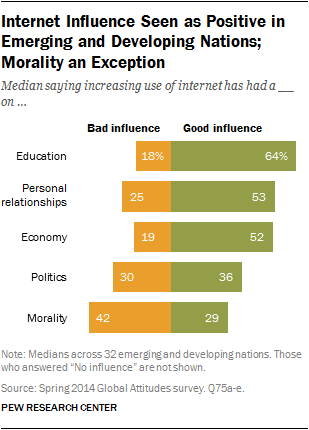
A clear majority of people in these emerging and developing countries see the internet as a positive influence on education. A median of 64% among the general population (including non-internet users) in the 32 emerging and developing nations surveyed say the internet is a good influence on education. People are also keen on the internet and its influence on personal relationships (53% good influence) and the economy (52%). Few people say that the internet has no influence on these aspects of life.
Internet Users More Likely to See Access to the Net as a Positive

Publics are less enthused about the internet’s effect on politics. A median of just 36% say it is a positive for their country’s political system, while three-in-ten say it is a bad influence.

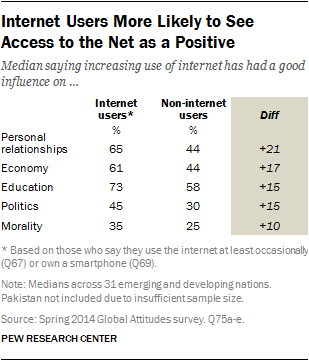
Generally, people who have access to the internet are more positive about its societal influence. For example, 65% of internet users in these emerging and developing nations say the increasing use of the internet is a positive for personal relationships, while only 44% of non-internet users agree. Similar gaps appear on the positive influence of the internet on education, the economy and politics.

Highly educated respondents are also more likely to say the internet is a positive influence. Six-in-ten of those with a secondary education or more say the increasing use of the internet is a good influence on personal relationships, compared with 44% among people with less education.

Internet Access Lacking in Many Countries, but More Common in Wealthier Nations

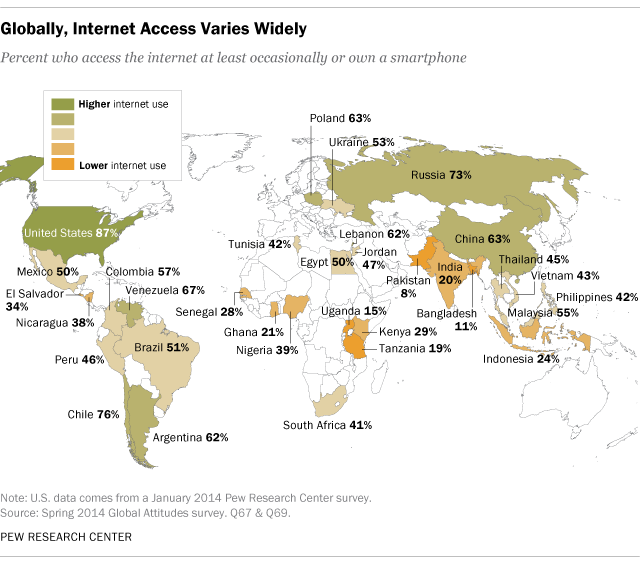
Even as general publics see the influence of the internet increase in their everyday lives, there are still many people without access to the internet in these emerging and developing countries. Across the 32 nations surveyed, a median of 44% use the internet at least occasionally, either through smartphones or other devices. Comparatively, as of early 2014, 87% of adults in the U.S. use the internet, according to Pew Research Center studies.

Access rates vary considerably across the emerging and developing nations surveyed. Two-thirds or more in Chile (76%), Russia (73%) and Venezuela (67%) have access to the internet, as do six-in-ten or more in Poland, China, Lebanon and Argentina. Yet less than half in Vietnam (43%) and the Philippines (42%) have internet access. And in nations that are less economically developed, such as those in sub-Saharan Africa, internet access rates lag even further.

Toward the bottom in terms of access rates are some of the world’s most heavily populated nations in South and Southeast Asia. These include Indonesia, where only 24% of the population has access to the internet, India (20%), Bangladesh (11%) and Pakistan (8%). Combined, these countries account for approximately a quarter of the world’s population.

[ps_interactive id=”32288″ showtitle=”h3″]

For example, 70% of young Vietnamese (18-34 years old) use the internet, while only 21% of those age 35 and older do. And three-quarters of Vietnamese with a secondary education or higher have access to the net, while only two-in-ten with less than a secondary education do. A similar gap appears for Vietnamese who can speak or read at least some English (83%) versus those who cannot (20%).

In addition to these factors, having a higher income, being male and being employed have a significant, positive impact on internet use, though to a lesser degree.

Socializing Most Popular Form of Internet Activity

In Emerging and Developing Nations, Internet Users on Social Networks

Along with social networking, an equally popular use of the internet is staying in touch with friends and family. A median of 86% of internet users across the emerging and developing nations surveyed say they have used the internet this way in the past year.

While not as popular as socializing, many internet users also like to access digital information, whether it is political (a median of 54% among internet users), medical (46%) or governmental (42%). Getting online political news is particularly prevalent in Middle Eastern countries, like Tunisia (72%), Lebanon (70%) and Egypt (68%).

Utilizing the internet for career and commerce is a less popular activity. Among internet users, medians of less than four-in-ten say they look and apply for jobs (35%), make or receive payments (22%), buy products (16%) or take online classes (13%).

In certain countries, these professional and commercial online activities are more common. For example, 62% of internet users in Bangladesh and 55% in India say they have used the internet to look for or apply for a job. In China, home to internet commerce giants such as Baidu and Alibaba, 52% of internet users say they have purchased a product online in the last year.
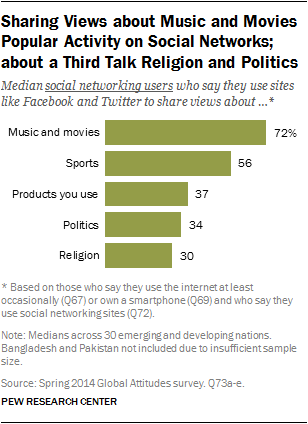
Sharing Views about Music and Movies Popular Activity on Social Networks; about a Third Talk Religion and Politics

Sharing information about personal views regarding religion and politics and purchases is less common. Less than four-in-ten social networkers in emerging and developing nations say they share views about products (37%), politics (34%) and religion (30%). But there is a range of interest in debating these topics online, from the 8% among social networkers in Russia and Ukraine who discuss religion to the 64% in Jordan who say the same. Similar ranges can be found for sharing views about politics and products on social networks.

Smartphones Have Not Yet Replaced Regular Mobile Phones

In several of the countries surveyed, sizeable percentages access the internet from devices other than a computer in their home. Across the 32 emerging and developing nations, a median of 38% have a working computer in their household. In 10 countries, computer ownership is roughly two-in-ten or less. By contrast, 80% in the U.S. and 78% in Russia have a computer in working order in their house.

Cell Phones Commonplace; Smartphone Ownership Varies

But smartphones – and the mobile access to the internet that they make possible in some locations – are not nearly as common as conventional cell phones. A median of only 24% say they own a cell phone that can access the internet and applications (See Appendix B for a full list of devices in each country). In the U.S., 58% owned a smartphone as of early 2014.

These cell phones and smartphones are critical as communication tools in most of the emerging and developing nations, mainly because the infrastructure for landline communications is sparse, and in many instances almost nonexistent. In these emerging and developing nations, only a median of 19% have a working landline telephone in their home. In fact, in many African and Asian countries, landline penetration is in the low single digits. This compares with 60% landline ownership in the U.S.

Cell phones also have the added benefit of being capable of more than just vocal communication. Among cell phone owners across the 32 countries, 76% use text messaging via their phones. This is similar to the 83% of cell owners in the U.S. who text. And an additional 55% of mobile owners in these emerging and developing nations use their phones for taking pictures or video.

1. Communications Technology in Emerging and Developing Nations

Internet access differs substantially across the 32 emerging and developing countries polled, with the lowest rates of internet use in South Asian and sub-Saharan African nations. Within countries, computer owners, young people, the well-educated, the wealthy and those with English language ability are much more likely to access the internet than their counterparts. To access the internet, people increasingly use smartphones rather than more cumbersome fixed landline connections and computers. Around the world, both smartphones and basic-feature phones alike are used for sending messages and taking pictures.

Internet Usage in Emerging and Developing Nations

Across these 32 nations, the percentage of people who use the internet varies widely. Overall, a median of 44% access the internet, including half or more in 13 countries. Internet use is highest in the wealthiest of the emerging nations, particularly in Chile and Russia, where more than seven-in-ten have internet access. Though these rates are relatively high, they lag behind the U.S., where 87% have online access. The lowest internet rates are in some of the poorest countries surveyed. Just 8% of Pakistanis and 11% of Bangladeshis either say they access the internet at least occasionally or own a smartphone. Two-in-ten or fewer have access in Uganda (15%), Tanzania (19%) and India (20%).

Within countries, internet access differs substantially by a number of key demographics, including age and education. Younger people ages 18 to 34 are more likely to report accessing the internet than their older counterparts in every country polled, including differences of more than 15 percentage points in all but three countries available for analysis. Especially large differences occur in Asia, with age differences of 40 points or more in five countries. For example, in Thailand 83% of young people are online, compared with just 27% of older Thais.

Young, Higher Educated and English Speakers More Likely to Access Internet

Education is also associated with internet use rates. In all nations surveyed with a sufficient sample size to analyze, those with a secondary education or higher were more likely to access the internet than those with less than a secondary degree. These divisions are especially prominent in Latin America. In six of the nine Latin American countries surveyed, the well-educated access the internet at rates of 50 percentage points or more than less-educated people. This difference is particularly stark in Chile, where 87% of well-educated people use the internet, compared with 18% of those with less than a secondary degree.

In addition to age and education, internet use is more common among people who have some English language ability. In every nation surveyed with a sufficient sample size to analyze, those who can speak or read some English, or completed the survey in English, accessed the internet at much higher rates than those who have no facility with English.

Explaining Internet Usage

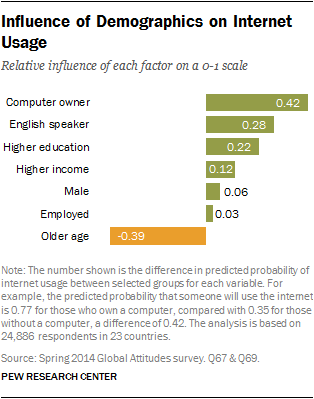
To further explore the relationship between demographics, English language ability and internet usage, we used a statistical technique called multivariate regression, which allowed us to test the individual impact of a number of factors on internet usage while holding other variables constant (see Appendix A for details). Overall, we find that computer ownership, age, English language ability and education have the biggest impact on whether or not someone uses the internet.

Those who own computers, those who can speak or read some English, and those with a secondary education or higher are considerably more likely to use the internet. In addition to these factors, having a higher income, being male and being employed have a significant, positive impact on internet use, though to a lesser degree.

Age also has a significant influence on internet use, controlling for other demographics. In emerging and developing markets, older people are significantly less likely than their younger counterparts to engage in online activity.

Internet Capable Technology

Global Computer Ownership

Around the world, people often log on to the internet using home computers and internet-capable smartphones. Overall, a median of 38% across the 32 nations surveyed say they have a working computer in their household. In 11 countries, half or more own computers, including 78% in Russia – comparable to the 80% of Americans who say they have a computer in their household. Computer ownership is relatively high in a number of Latin American nations. Majorities in Chile (72%), Venezuela (61%), Argentina (58%) and Brazil (55%) have computers in their homes. Computer ownership rates are lowest in sub-Saharan African nations. Roughly a quarter or fewer have computers at home in every one of these countries, with the fewest in Uganda, where just 3% say they have a computer.

Those with higher incomes are more likely than their poorer neighbors to own computers in all countries available for income analysis. Similarly, in all countries available for analysis, those with a secondary education or higher are considerably more likely to own a computer than those with less than a secondary education. For example, 81% of well-educated Chileans have computers in their home, compared with 26% of those with less than a secondary education. Young people are also more likely than those 35 and older to own computers in 20 emerging and developing nations.

Most Own a Cell Phone

A small but growing number of people use internet-capable smartphones – a median of 24% in emerging and developing countries own this type of device. Only in two of the countries polled do more than half have a smartphone – 58% in Chile and 55% in China, on par with the 58% of Americans who report owning this kind of device. A third or more of people in 10 countries say they own a smartphone, including 48% in Lebanon and 47% in Malaysia. About 10% or fewer Tanzanians, Bangladeshis, Ugandans and Pakistanis own smartphones.

In every country surveyed, there is a significant age difference on smartphone ownership. Young people (those under 35) are significantly more likely than their older counterparts to own an iPhone, BlackBerry, Android or other internet-capable mobile phone.

Large age gaps occur in a number of Asian countries in particular. For instance, in Malaysia, 72% of 18- to 34-year-olds own a smartphone, while only 27% of those 35 and older own one. Differences of 30 percentage points or more also exist in China, Thailand and Vietnam.

Smartphone ownership is also higher among the more educated. In all of the nations polled, those with a secondary degree or higher are more likely to own a smartphone than the less educated. This is especially true in Jordan, where 67% of the well-educated own a smartphone, compared with just 13% of those with less education – a difference of 54 percentage points. A similar gap exists in Chile.

Many Own Cell Phones, Few Have Landlines

Beyond smartphone ownership, cell phone ownership more broadly is very common, with a median of 84% in emerging and developing nations owning some type of cell phone. In eight emerging and developing countries, about nine-in-ten or more own mobile phones, comparable to the 90% of Americans with cell phones. Unlike other technologies, people in sub-Saharan African nations, including Nigeria, Senegal and Ghana, use mobile phones at similar rates to the rest of the emerging and developing world. Pakistan is the only country surveyed where less than half (47%) have a mobile phone.

Few in Africa, Asia Have Landlines

While cell phone ownership has increased drastically over the past decade, particularly in Africa, landline connections have remained relatively low – likely due to the lack of infrastructure required for reliable connections. Across the 32 countries surveyed, a median of just 19% say they have a working landline connection in their home, including as few as 1% in Ghana, Nigeria, Uganda and Bangladesh. Instead of waiting for landline access, many in emerging and developing nations have bypassed fixed phone lines in favor of mobile technology.

Landline use is highest in Lebanon, where 79% report having a fixed telephone connection, considerably more than the 60% of Americans who do. (The share of wireless-only households in the U.S. has been growing rapidly over the past decade as landline ownership falls). About half or more in Venezuela (59%) and Argentina (51%) also have landline telephones.

As with cell phones, the well-educated and those with higher incomes are more likely to have landline connections. In 23 countries, those with a secondary education or higher are more likely to have a landline phone in their house. The wealthy are more likely to have fixed telephone lines in 17 of the countries polled.

Texting Most Popular Use of Cell Phones

Text Messaging More Frequent than Pictures, Video

Whether they are using basic feature cell phones or internet-capable smartphones, most cell phone owners use their mobile devices for more than simple phone calls. A median of 76% in emerging and developing markets say they have used their cell phones to send text messages in the past 12 months. In a number of countries, texting is nearly universal. In the Philippines, Venezuela, Indonesia and South Africa, 95% or more of cell phone owners say they text regularly. By comparison, 81% of American cell phone owners report ever sending a text message, according to a 2013 Pew Research poll. Half or more in all but two countries – Thailand and Pakistan –regularly send texts.

While fewer people report taking pictures or video with their mobile phones, a median of 55% do so. Taking pictures and video is most popular in several Latin American countries – about two-thirds or more of Venezuelans (75%), Chileans (72%), Mexicans (68%) and Argentines (66%) regularly snap photos with their phones.

Though texting and taking photos or video on their mobile phones are relatively frequent for all people, young people are much more likely to do so. Young people, those ages 18 to 34, text more regularly than those 35 and older in 30 countries. In particular, young Nicaraguans text considerably more than their older counterparts – 89% of cell phone owners ages 18 to 34 text, compared with fewer than half of older people (45%). Significant age gaps also exist in taking photos and video on mobile phones in 31 countries. In Tunisia, where video of local protests helped ignite the Jasmine Revolution, 60% of young people take pictures or video on their phones, compared with just 25% of those age 35 and older. Age differences of 35 percentage points or more occur in more than a third of the countries surveyed.

2. Online Activities in Emerging and Developing Nations

For internet users in emerging and developing nations, social relationships are a fundamental aspect of their interaction with the virtual world. Majorities in most nations use the internet every day, and they use their time online to stay in touch with friends and family and access social networks, sharing views about music, movies and sports freely with their friends and acquaintances. Overall, internet users also like to get information about politics and health care and to a lesser extent access government services online. Career and commerce activities are even less common, with fewer people looking and applying for jobs, making or receiving payments, buying products and taking online classes. However, there is much variation for these activities across the nations surveyed.

Internet Use a Daily Activity for Most

Half or more of internet users in 27 of 32 emerging and developing nations say they use the internet daily. The most avid internet consumers are found in Chile and Lebanon, where 83% of internet users say they use it once a day or more. And three-quarters or more of users in Poland, Jordan, Tunisia, Argentina and Brazil use the internet in their daily lives.

Meanwhile, only about a third of internet users in Nicaragua (32%) and Uganda (32%) access the internet every day. And 37% of Filipino and 38% of Senegalese internet users say the same.

As with other aspects of internet use, younger users are much more likely to say they access the internet daily, compared with older people. For example, 95% of internet users in Lebanon under 35 years of age say they access the internet daily, while only 67% of those over 34 years say the same. In all, there is a significant age gap on daily internet use in 19 of the countries surveyed.

Internet Activities: Socializing Most Popular

When asked about various online activities, internet users in emerging and developing nations are clear that one activity in particular, staying in touch with friends and family, is the most popular. Overall, a median of 86% across the nations surveyed say they have contacted close relations via the internet in the past year. In fact, across the eight activities tested, staying in touch with friends and family is the predominant choice in every country surveyed (excluding Pakistan, which had insufficient sample size for internet activity analysis). Of those online, 100% of Senegalese, 93% of Ukrainians and 92% of Chileans socialize with family and friends online. Indian internet users are the least likely to say they do this, though still 63% of the online population use the internet to socialize.

Internet Activities: Getting Information Is Common

Getting various types of information, such as political news, health information and government services, is the next tier of internet use. A median of 54% among internet users in emerging and developing nations say they get political news online. Fully eight-in-ten Ukrainian and Vietnamese internet users say they get information about politics online. And 72% of internet users in Tunisia, 70% in Lebanon and 68% in Egypt say they get political information from the Web. Six-in-ten or more of online people in Russia (68%), Poland (66%), Kenya (62%) and China (62%) get political information online.

Most Use Internet to Socialize and Get Information; Less for Career and Commerce

Getting information about health and medicine for individuals and their families is done by a median of 46% of internet users across the countries surveyed. More than six-in-ten among internet users in Ukraine (64%), Poland (64%) and Russia (63%) say they have gotten health information online in the past 12 months. Female internet users in Poland (72%), Russia (68%) and Ukraine (68%) are more likely than male users (56%, 56% and 59% respectively) to access this online medical data. In Latin America, about six-in-ten or more of internet users in Venezuela, Peru, Nicaragua and Chile say they get medical information online.

A median of about four-in-ten internet users (42%) in emerging and developing nations use the internet to get information about government or public services. This includes half or more of internet users in Tunisia, Russia, Tanzania, Senegal, Nigeria and Ukraine.

Internet Activities: Online Career and Commerce Less Common

Participation in commerce and career advancement is in the bottom tier of internet activities within emerging and developing nations. In this category, looking or applying for a job is the most common activity, representing a median of 35% among internet users across the countries surveyed. More than half of internet users in Bangladesh (62%), India (55%) and Kenya (53%) say they have looked or applied for a job online in the past 12 months, but only 18% in Lebanon say the same.

A median of only 22% conduct financial transactions online, but there is great variation on this activity. For instance, two-thirds of internet users in Poland make or receive payments online. And in one of the largest global financial markets, China, 44% of internet users say they use online banking in some form. Online payments are also more common among adult internet users in Tanzania, Chile, Russia and Kenya (where many make or receive payments with their cell phones).

As is the case with online banking, few internet users in emerging and developing nations (a median of 16%) say they have bought a product online in the last year. However, the activity is much more common in China, one of the largest online global shopping markets. About half (52%) of online Chinese say they have a bought a product in the last 12 months. This is the highest percentage in this category among the countries surveyed besides Poland (58%).

The least common activity online among the eight tested is taking an online class or course that leads to a certificate. A median of only 13% among internet users in emerging and developing nations say they have taken a class in the past year.

Men Use Internet for Politics and Young Prefer Online Job Hunting, Socializing

Men More Likely to Use Internet for Politics

Across most of these online activities there is little variation by gender among internet users in emerging nations. However, when it comes to getting news and information about politics, many male internet users are more avid online news readers than females. For instance, 65% of online Nigerian men get political news from the internet, while only 40% of Nigerian women do the same.

Similar numbers of online adults ages 18 to 34 and 35 and older, with few exceptions, use the internet to get health information, news about politics, or information on public services; buy products; do online banking; or take online classes.

However, there are larger differences when it comes to staying in touch with friends and family and looking or applying for jobs. In 19 countries, internet users ages 18 to 34 use the internet to stay in touch with close friends or relatives more frequently than those 35 and older. And adults under the age of 35 use the internet to look for job opportunities more frequently than their older counterparts in 20 emerging and developing countries.

Social Networking Very Popular Among Internet Users

Socializing among internet users also applies to accessing social networks, and this is a very popular activity. Among internet users in the emerging and developing countries surveyed, a median of 82% use their internet connections to access social networking sites, such as Facebook, Twitter and other country-specific platforms.

Young More Likely to Use Social Networking Sites

Majorities of internet users in all the countries surveyed with sufficient sample size to analyze say that they use social networking. The highest percentage can be found in the Philippines, where 93% of online adults use social networking sites. But high levels of use are found in all the countries surveyed, including 88% of internet users in Kenya and Venezuela, as well as 87% in Chile, Senegal and Tunisia.

The only countries surveyed where less than two-thirds of online adults use social networking sites are India, where 65% of internet users say they use social networks, Poland (62%) and China (58%).

As with overall internet access, social networking is more popular among young people than among those ages 35 and older. In the most extreme example, 85% of Poles ages 18-34 who have internet access say they use social networks. Only 44% of older Poles say the same, an age gap of 41 percentage points. Large and significant age gaps on social media usage appear in 22 of the countries surveyed.

Sharing Views about Music, Movies and Sports Popular on Social Networks

Among social networkers in emerging and developing nations, the most common online activity, besides staying in touch with friends and family, is sharing views about music and movies. But majorities also use social networks to talk about sports. Less discussed topics include the products people use, politics and religion.

Overall, a median of 72% of social networkers in emerging and developing nations say they use these platforms to share views about music and movies. In fact, among the items tested, this is the top use of social media in 26 of the countries surveyed. Talking about music and movies is especially popular among social networkers in Vietnam (88%), Thailand (86%), China (83%) and Mexico (83%). But half or more of social networkers in every country surveyed say they participate in sharing views about music and movies.

Sharing views about sports is also popular. A median of 56% of social networkers say they have talked about sports on social media sites. Talking about sports is popular in Africa and Asia, including 73% of social networking users in Kenya and 71% in Ghana. And 72% of Indian social networking users are keen on sharing views about this topic.

Music and Movie Opinions Most Shared on Social Networking Sites

Of less interest among social networkers in emerging and developing nations is sharing views about the products they use, politics and religion. But there are some notable exceptions. For example, while only a median of 37% say they share information about products they use on social networks, 75% do so in Tunisia, while 69% in Vietnam and 64% in China do.

When it comes to politics, Middle Easterners share information with their friends and family with greater frequency. In Lebanon, three-quarters of social networking users say they share information about politics on these platforms. And 66% of Egyptians and 63% of Jordanian social networkers agree.

Religion is the least shared topic. But 64% of social networking users in Jordan and 58% each in Nigeria and Egypt say they share their views about religion online.

Male social networkers are much more likely to say they use the sites to share views about sports compared with their female counterparts. For example, in Tunisia, 82% of male social networkers say they talk about sports but only 31% of females do. And overall, men who use social networks share views about sports more often than women users in 25 countries.

And while there are age differences in some of these countries among the social networking activities tested, they are particularly pronounced in sharing views about music and movies. In 16 countries with sufficient sample sizes to analyze, 18- to 34-year-olds are more likely to say they use social networks to share views about music and movies than those 35 and older.

3. Influence of Internet in Emerging and Developing Nations

When asked whether greater use of the internet has a good or bad influence on various aspects of society, general populations in 32 emerging and developing nations say this trend has a good influence on education, as well as on personal relationships and economics. People are more doubtful of the internet’s impact on politics, and morality in particular. However, those who have access to the internet and the highly educated are more likely to say the internet’s growing use is a good influence in these nations.

Internet Seen as Good for Education, Bad for Morality

Internet Influence Seen as Positive in Emerging and Developing Nations; Morality an Exception

Overall, a median of 64% across the 32 nations surveyed say that increasing internet use has a good influence on education, with only 18% saying it has a bad influence. In 24 nations, a majority say the internet has a good influence on education in their country. While the internet is seen as a positive influence on education in all regions, it is especially true among countries in sub-Saharan Africa and Latin America.

A median of 53% across all the countries see the internet as a good influence on personal relationships, with a quarter saying the influence is bad. While people are not as enthusiastic about the internet’s effect on interpersonal relations as on education, it is still generally seen as a benefit in most countries. A similar percentage (52%) say increasing internet usage is good for the economy. This is particularly true for countries in sub-Saharan Africa and Asia.

The increasingly connected world is not, however, seen as much of a positive influence on politics. A median of only 36% among those surveyed say the internet has a good influence on politics, with a nearly equal 30% saying it has a bad influence. Positive views of the internet’s influence on politics range from 53% in Nicaragua to 20% in Pakistan. Meanwhile, in Lebanon, 53% say that the internet has a bad influence on politics.

Growing Internet Use Seen as Positive for Education, but Negative for Morality

The aspect of the internet that generates the greatest concern is its effect on a nation’s morals. Overall, a median of 42% say the internet has a negative influence on morality, with 29% saying it has a positive influence. The internet’s influence on morality is seen as the most negative of the five aspects tested in 28 of the 32 countries surveyed. And in no country does a majority say that the influence of the internet on morality is a positive.

The Young, Educated and Internet Users See Internet as Better Influence

Internet Users More Positive on Internet

While most people surveyed believe the internet has a good influence on many aspects of life, there are certain segments of the population that are more positive about the internet’s effect. One major subgroup that sees the internet positively is internet users themselves. For example, while a median of only 44% among non-internet users across the countries surveyed say that the internet is a good thing for personal relationships, that number jumps to 65% among internet users. And while a median of 58% among non-internet users in these countries say that the internet has a positive for education, it is 74% among internet users. Similar gaps appear for the internet’s influence on the economy and politics.

Highly Educated More Likely to See Positive Influence of Internet

As with internet use and activities, in many countries young people (18-34 years old) are much more likely to say that the internet has a good influence compared with older people (ages 35+). This is especially true on its influence of morality, education and personal relationships. For example, 48% of Vietnamese ages 18 to 34 say that the internet has a good influence on morality, yet only 33% of those 35 and older agree. And in Ukraine, 73% of young people say the internet has a positive influence on education, while only 54% of those over 34 agree. Meanwhile, 71% of Lebanese youth say the internet has a good effect on personal relationships, while only 43% of older Lebanese agree.

Additionally, the highly educated are much more likely to see the internet as a positive force in their country. For example, across the 29 countries with sufficient sample sizes to analyze, 70% of those with a secondary education or more say the internet is a good influence on education, while only 59% of people with less than a secondary education say the same. Similar gaps between the more and less educated appear on the perceived influence of the internet on all aspects tested.

Appendix A

Factors that Influence Internet Usage

To explore the relationship between demographics and internet usage, we estimated a weighted, mixed-effects logit model with random intercepts by country and robust standard errors using the Stata program gllamm for estimating generalized linear latent and mixed models. Alongside this pooled model, we evaluated the robustness of the results by estimating the models for each country separately. These country-specific models yielded similar conclusions.

Influence of Demographics on Internet Usage

Overall, we find that computer ownership has a strong positive influence on individual internet use. A person with a working computer in their household has a predicted probability of using the internet of 0.77 on a scale from 0 to 1, or 77%. A person without a computer has a predicted internet use of 0.35 (35%) – a difference of 0.42, or 42 percentage points. In addition to computer ownership, English language ability (+0.28), having a secondary education or higher (+0.22), having a higher income (+0.12), being a man (+0.06) and employed (+0.03) all have a statistically significant, positive impact on internet use.

Age also has a significant influence on internet use, controlling for other demographics. Older people have a lower level of internet use than their younger counterparts. For example, the probability that a 26-year-old will use the internet is 0.59 or 59%, compared with a 50-year-old who has a predicted probability of internet use of .20 (20%) for a difference of 39 percentage points (-0.39).

The demographic analysis of internet use comprises a sub-sample (countries=23, n=24,886) of the 32 nations asked the questions, excluding countries in which 20% or more of the sample answered “Don’t know” or “Refused” when asked their household income.2

The dependent variable is internet use, a dichotomous variable where 1 indicates the respondent uses the internet and 0 means they do not use the internet. Internet use consists of individuals who state that they use the internet at least occasionally or say they own a smartphone.

The independent or predictor variables for education, gender, employment, computer ownership, English language ability and income were recoded as dummy variables, where 1 means secondary education or higher, female, employed, owns a computer, English language capable and income at or above the approximate country median. English language ability includes respondents who state that they can either speak or read some English and those who took the survey in English. Age is treated as a continuous variable, ranging from 18 to 97. All independent variables are significant at the p < .05 level.

The graphic above shows the difference in predicted values for the following groups:

  • Computer ownership: Computer in household minus no computer in household
  • English: English language capable minus no English ability
  • Education: Secondary education or higher minus less than secondary education
  • Income: Income at or above the approximate median minus income below the approximate median
  • Employment: Employed minus not employed
  • Male: Male minus female
  • Age: Age 50 minus age 26

Reference

Skrondal, Anders and Sophia Rabe-Hesketh. “Multilevel logistic regression for polytomous data and rankings.” Psychometrika 68.2 (2003b): 267-287.

Appendix B

Methods in Detail

About the 2014 Spring Pew Global Attitudes Survey

Results for the survey are based on telephone and face-to-face interviews conducted under the direction of Princeton Survey Research Associates International. Survey results are based on national samples. For further details on sample designs, see below.

The descriptions below show the margin of sampling error based on all interviews conducted in that country. For results based on the full sample in a given country, one can say with 95% confidence that the error attributable to sampling and other random effects is plus or minus the margin of error. In addition to sampling error, one should bear in mind that question wording and practical difficulties in conducting surveys can introduce error or bias into the findings of opinion polls.

Country: Argentina
Sample design: Multi-stage cluster sample stratified by locality size
Mode: Face-to-face adults 18 plus
Languages: Spanish
Fieldwork dates: April 17 – May 11, 2014
Sample size: 1,000
Margin of error: +/-3.9 percentage points
Representative: Adult population (excluding dispersed rural population, or 6.5% of the population)
Country: Bangladesh
Sample design: Multi-stage cluster sample stratified by administrative division and urbanity
Mode: Face-to-face adults 18 plus
Languages: Bengali
Fieldwork dates: April 14 – May 11, 2014
Sample size: 1,000
Margin of error: +/-3.8 percentage points
Representative: Adult population
Country: Brazil
Sample design: Multi-stage cluster sample stratified by region and size of municipality
Mode: Face-to-face adults 18 plus
Languages: Portuguese
Fieldwork dates: April 10 – April 30, 2014
Sample size: 1,003
Margin of error: +/-3.8 percentage points
Representative: Adult population
Country: Chile
Sample design: Multi-stage cluster sample stratified by region and urbanity
Mode: Face-to-face adults 18 plus
Languages: Spanish
Fieldwork dates: April 25 – May 5, 2014
Sample size: 1,000
Margin of error: +/-3.8 percentage points
Representative: Adult population (excluding Chiloe and other islands, or about 3% of the population)
Country: China
Sample design: Multi-stage cluster sample stratified by region and urbanity
Mode: Face-to-face adults 18 plus
Languages: Chinese (Mandarin, Fuping, Renshou, Suining, Xichuan, Hua, Shanghai, Chenzhou, Anlong, Chengdu, Yingkou, Guang’an, Zibo, Jinxi, Yantai, Feicheng, Leiyang, Yuanjiang, Daye, Beijing, Yangchun, Nanjing, Shucheng, Linxia, Yongxin, Chun’an, Xinyang, Shangyu, Baiyin, Ruichang, Xinghua and Yizhou dialects)
Fieldwork dates: April 11 – May 15, 2014
Sample size: 3,190
Margin of error: +/-3.5 percentage points
Representative: Adult population (excluding Tibet, Xinjiang, Hong Kong and Macau, or about 2% of the population). Disproportionately urban. The data were weighted to reflect the actual urbanity distribution in China.
Note: The results cited are from Horizonkey’s self-sponsored survey.
Country: Colombia
Sample design: Multi-stage cluster sample stratified by region and urbanity
Mode: Face-to-face adults 18 plus
Languages: Spanish
Fieldwork dates: April 12 – May 8, 2014
Sample size: 1,002
Margin of error: +/-3.5 percentage points
Representative: Adult population (excluding region formerly called the National Territories and the islands of San Andres and Providencia, or about 4% of the population)
Country: Egypt
Sample design: Multi-stage cluster sample stratified by governorate and urbanity
Mode: Face-to-face adults 18 plus
Languages: Arabic
Fieldwork dates: April 10 – April 29, 2014
Sample size: 1,000
Margin of error: +/-4.3 percentage points
Representative: Adult population (excluding frontier governorates, or about 2% of the population)
Country: El Salvador
Sample design: Multi-stage cluster sample stratified by department and urbanity
Mode: Face-to-face adults 18 plus
Languages: Spanish
Fieldwork dates: April 28 – May 9, 2014
Sample size: 1,010
Margin of error: +/-4.5 percentage points
Representative: Adult population
Country: Ghana
Sample design: Multi-stage cluster sample stratified by region and settlement size
Mode: Face-to-face adults 18 plus
Languages: Akan (Twi), English, Dagbani, Ewe
Fieldwork dates: May 5 – May 31, 2014
Sample size: 1,000
Margin of error: +/-3.8 percentage points
Representative: Adult population
Country: India
Sample design: Multi-stage cluster sample stratified by region and urbanity
Mode: Face-to-face adults 18 plus
Languages: Hindi, Bengali, Tamil, Telugu, Marathi, Kannada, Gujarati, Odia
Fieldwork dates: April 14 – May 1, 2014
Sample size: 2,464
Margin of error: +/-3.1 percentage points
Representative: Adult population in 15 of the 17 most populous states (Kerala and Assam were excluded) and the Union Territory of Delhi (roughly 91% of the population). Disproportionately urban. The data were weighted to reflect the actual urbanity distribution in India.
Country: Indonesia
Sample design: Multi-stage cluster sample stratified by province and urbanity
Mode: Face-to-face adults 18 plus
Languages: Bahasa Indonesian
Fieldwork dates: April 17 – May 23, 2014
Sample size: 1,000
Margin of error: +/-4.0 percentage points
Representative: Adult population (excluding Papua and remote areas or provinces with small populations, or 12% of the population)
Country: Jordan
Sample design: Multi-stage cluster sample stratified by governorate and urbanity
Mode: Face-to-face adults 18 plus
Languages: Arabic
Fieldwork dates: April 11 – April 29, 2014
Sample size: 1,000
Margin of error: +/-4.5 percentage points
Representative: Adult population
Country: Kenya
Sample design: Multi-stage cluster sample stratified by province and settlement size
Mode: Face-to-face adults 18 plus
Languages: Kiswahili, English
Fieldwork dates: April 18 – April 28, 2014
Sample size: 1,015
Margin of error: +/-4.0 percentage points
Representative: Adult population
Country: Lebanon
Sample design: Multi-stage cluster sample stratified by region and urbanity
Mode: Face-to-face adults 18 plus
Languages: Arabic
Fieldwork dates: April 11 – May 2, 2014
Sample size: 1,000
Margin of error: +/-4.1 percentage points
Representative: Adult population (excluding a small area in Beirut controlled by a militia group and a few villages in the south of Lebanon, which border Israel and are inaccessible to outsiders, or about 2% of the population)
Country: Malaysia
Sample design: Multi-stage cluster sample stratified by state and urbanity
Mode: Face-to-face adults 18 plus
Languages: Bahasa Malaysia, Mandarin Chinese, English
Fieldwork dates: April 10 – May 23, 2014
Sample size: 1,010
Margin of error: +/-3.8 percentage points
Representative: Adult population (excluding difficult to access areas in Sabah and Sarawak, or about 7% of the population)
Country: Mexico
Sample design: Multi-stage cluster sample stratified by region and urbanity
Mode: Face-to-face adults 18 plus
Languages: Spanish
Fieldwork dates: April 21 – May 2, 2014
Sample size: 1,000
Margin of error: +/-4.0 percentage points
Representative: Adult population
Country: Nicaragua
Sample design: Multi-stage cluster sample stratified by department and urbanity
Mode: Face-to-face adults 18 plus
Languages: Spanish
Fieldwork dates: April 23 – May 11, 2014
Sample size: 1,008
Margin of error: +/-4.0 percentage points
Representative: Adult population (excluding residents of gated communities and multi-story residential buildings, or less than 1% of the population)
Country: Nigeria
Sample design: Multi-stage cluster sample stratified by region and urbanity
Mode: Face-to-face adults 18 plus
Languages: English, Hausa, Yoruba, Igbo
Fieldwork dates: April 11 – May 25, 2014
Sample size: 1,014
Margin of error: +/-4.3 percentage points
Representative: Adult population (excluding Adamawa, Borno, Cross River, Jigawa, Yobe, and some areas in Taraba, or roughly 12% of the population)
Country: Pakistan
Sample design: Multi-stage cluster sample stratified by province and urbanity
Mode: Face-to-face adults 18 plus
Languages: Urdu, Pashto, Punjabi, Saraiki, Sindhi
Fieldwork dates: April 15 – May 7, 2014
Sample size: 1,203
Margin of error: +/-4.2 percentage points
Representative: Adult population (excluding the Federally Administered Tribal Areas, Gilgit-Baltistan, Azad Jammu and Kashmir for security reasons, areas of instability in Khyber Pakhtunkhwa [formerly the North-West Frontier Province] and Baluchistan, military restricted areas and villages with less than 100 inhabitants – together, roughly 18% of the population). Disproportionately urban. The data were weighted to reflect the actual urbanity distribution in Pakistan.
Country: Peru
Sample design: Multi-stage cluster sample stratified by region and urbanity
Mode: Face-to-face adults 18 plus
Languages: Spanish
Fieldwork dates: April 11 – May 2, 2014
Sample size: 1,000
Margin of error: +/-4.0 percentage points
Representative: Adult population
Country: Philippines
Sample design: Multi-stage cluster sample stratified by region and urbanity
Mode: Face-to-face adults 18 plus
Languages: Tagalog, Cebuano, Ilonggo, Ilocano, Bicolano
Fieldwork dates: May 1 – May 21, 2014
Sample size: 1,008
Margin of error: +/-4.0 percentage points
Representative: Adult population
Country: Poland
Sample design: Multi-stage cluster sample stratified by province and urbanity
Mode: Face-to-face adults 18 plus
Languages: Polish
Fieldwork dates: March 17 – April 8, 2014
Sample size: 1,010
Margin of error: +/-3.6 percentage points
Representative: Adult population
Country: Russia
Sample design: Multi-stage cluster sample stratified by Russia’s eight geographic regions, plus the cities of Moscow and St. Petersburg, and by urban-rural status
Mode: Face-to-face adults 18 plus
Languages: Russian
Fieldwork dates: April 4 – April 20, 2014
Sample size: 1,000
Margin of error: +/-3.6 percentage points
Representative: Adult population (excludes Chechen Republic, Ingush Republic and remote territories in the Far North – together, roughly 3% of the population)
Country: Senegal
Sample design: Multi-stage cluster sample stratified by region and urbanity
Mode: Face-to-face adults 18 plus
Languages: Wolof, French
Fieldwork dates: April 17 – May 2, 2014
Sample size: 1,000
Margin of error: +/-3.7 percentage points
Representative: Adult population
Country: South Africa
Sample design: Multi-stage cluster sample stratified by metropolitan area, province and urbanity
Mode: Face-to-face adults 18 plus
Languages: English, Zulu, Xhosa, South Sotho, Afrikaans, North Sotho
Fieldwork dates: May 18 – June 5, 2014
Sample size: 1,000
Margin of error: +/-3.5 percentage points
Representative: Adult population
Country: Tanzania
Sample design: Multi-stage cluster sample stratified by region and urbanity
Mode: Face-to-face adults 18 plus
Languages: Kiswahili
Fieldwork dates: April 18 – May 7, 2014
Sample size: 1,016
Margin of error: +/-4.0 percentage points
Representative: Adult population (excluding Zanzibar, or about 3% of the population)
Country: Thailand
Sample design: Multi-stage cluster sample stratified by region and urbanity
Mode: Face-to-face adults 18 plus
Languages: Thai
Fieldwork dates: April 23 – May 24, 2014
Sample size: 1,000
Margin of error: +/-3.9 percentage points
Representative: Adult population (excluding the provinces of Narathiwat, Pattani, and Yala, or about 3% of the population)
Country: Tunisia
Sample design: Multi-stage cluster sample stratified by governorate and urbanity
Mode: Face-to-face adults 18 plus
Languages: Tunisian Arabic
Fieldwork dates: April 19 – May 9, 2014
Sample size: 1,000
Margin of error: +/-4.0 percentage points
Representative: Adult population
Country: Uganda
Sample design: Multi-stage cluster sample stratified by region and urbanity
Mode: Face-to-face adults 18 plus
Languages: Luganda, English, Runyankole/Rukiga, Luo, Runyoro/Rutoro, Ateso, Lugbara
Fieldwork dates: April 25 – May 9, 2014
Sample size: 1,007
Margin of error: +/-3.9 percentage points
Representative: Adult population
Country: Ukraine
Sample design: Multi-stage cluster sample stratified by Ukraine’s six regions plus ten of the largest cities – Kyiv (Kiev), Kharkiv, Dnipropetrovsk, Odessa, Donetsk, Zaporizhia, Lviv, Kryvyi Rih, Lugansk, and Mikolayev – as well as three cities on the Crimean peninsula – Simferopol, Sevastopol, and Kerch
Mode: Face-to-face adults 18 plus
Languages: Russian, Ukrainian
Fieldwork dates: April 5 – April 23, 2014
Sample size: 1,659
Margin of error: +/-3.3 percentage points
Representative: Adult population (Survey includes oversamples of Crimea and of the South, East and Southeast regions. The data were weighted to reflect the actual regional distribution in Ukraine.)
Country: United States
Sample design: Random Digit Dial (RDD) probability sample of landline and cell phone households
Mode: Telephone adults 18 plus
Languages: English, Spanish
Fieldwork dates: April 22 – May 11, 2014
Sample size: 1,002
Margin of error: +/-3.5 percentage points
Representative: Telephone households with English or Spanish speakers (roughly 96% of U.S. households)
Country: Venezuela
Sample design: Multi-stage cluster sample stratified by region and parish size
Mode: Face-to-face adults 18 plus
Languages: Spanish
Fieldwork dates: April 11 – May 10, 2014
Sample size: 1,000
Margin of error: +/-3.5 percentage points
Representative: Adult population (excluding remote areas, or about 4% of population)
Country: Vietnam
Sample design: Multi-stage cluster sample stratified by region and urbanity
Mode: Face-to-face adults 18 plus
Languages: Vietnamese
Fieldwork dates: April 16 – May 8, 2014
Sample size: 1,000
Margin of error: +/-4.5 percentage points
Representative: Adult population