Pew Research Center

FOR RELEASE MAY 22, 2014

One Year after Morsi’s Ouster, Divides Persist on El-Sisi, Muslim Brotherhood

Frustration Mounts as Confidence in Democracy Wanes

FOR MEDIA OR OTHER INQUIRIES:

Communications Department
202.419.4372
www.pewresearch.org

RECOMMENDED CITATION

Pew Research Center, May 2014, "One Year after Morsi’s Ouster, Divides Persist on El-Sisi, Muslim Brotherhood"

About Pew Research Center

Pew Research Center is a nonpartisan, nonadvocacy fact tank that informs the public about the issues, attitudes and trends shaping the world. It does not take policy positions. The Center conducts public opinion polling, demographic research, computational social science research and other data-driven research. It studies politics and policy; news habits and media; the internet and technology; religion; race and ethnicity; international affairs; social, demographic and economic trends; science; research methodology and data science; and immigration and migration. Pew Research Center is a subsidiary of The Pew Charitable Trusts, its primary funder.

© Pew Research Center 2026

Table of contents

  • About Pew Research Center
  • One Year after Morsi’s Ouster, Divides Persist on El-Sisi, Muslim Brotherhood
  • Chapter 1.  National Conditions in Egypt
  • Chapter 2.  Egyptian Views of Leaders, Organizations, Institutions
  • Chapter 3.  Democratic Values in Egypt
  • Egypt Survey Methods

One Year after Morsi’s Ouster, Divides Persist on El-Sisi, Muslim Brotherhood

Frustration Mounts as Confidence in Democracy Wanes

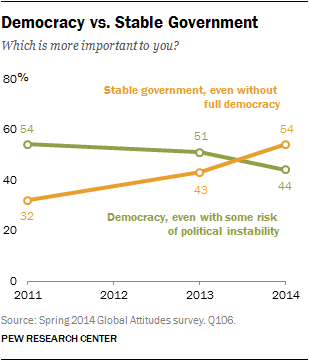
Nearly a year of tumult and violence has drained Egyptians of their optimism and battered the images of key players in the post-Mubarak era, according to a new survey by the Pew Research Center. As a controversial presidential election approaches, 72% of Egyptians are dissatisfied with their country’s direction, and although most still want democratic rights and institutions, confidence in democracy is slipping. In a shift from previous years, Egyptians are now more likely to say that having a stable government (54%) is more important than having a democratic one (44%).

Last July’s military takeover wins support from a slender majority: 54% favor it; 43% oppose. And while the next president is almost certain to be Abdel Fattah El-Sisi, the former general who has been the most powerful figure in the country since last year’s overthrow of the government, the new poll finds that his popularity is limited. Sisi receives a favorable rating from 54% of Egyptians, while 45% view him unfavorably, a more mixed review than many media reports from Egypt over the last year might suggest.
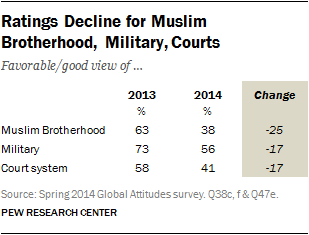
Ratings Decline for Muslim Brotherhood, Military, Courts

Meanwhile, ratings have declined for former President Mohamed Morsi, the man Sisi removed from power. Currently, 42% express a favorable opinion of Morsi, down from 53% in last year’s survey, which was conducted just weeks before his ouster. However, the fact that roughly four-in-ten Egyptians still hold a positive opinion of the jailed former president may be a surprise to many, given the government’s crackdown on Morsi’s organization, the Muslim Brotherhood.

Ratings for the Brotherhood have also dropped, although again about four-in-ten Egyptians continue to have a positive view of the nearly 90-year-old group, which has been banned by the current regime and seen most of its leaders arrested.

Attitudes toward other major institutions in the country have also turned more negative over the last year. Most notably, support for the military is down. Fifty-six percent say the military is having a good impact on the country and 45% say it is having a negative influence. A year ago, 73% described the military influence as positive and 24% as negative. In a 2011 poll, conducted weeks after the overthrow of Hosni Mubarak, 88% gave the military a good rating, while only 11% assigned it a negative one.

The image of the courts, which have issued numerous controversial verdicts in the past year, has also suffered. Now, just 41% believe the court system is having a positive impact on the country; 58% say the impact is negative. Last year, opinions were the exact opposite: 58% saw the courts positively, 41% negatively.

These are among the major findings from the latest survey of Egypt by the Pew Research Center. Based on face-to-face interviews conducted between April 10 and April 29, 2014, among a representative sample of 1,000 randomly selected adults from across the country, the poll also finds that relatively secular and liberal leaders and groups receive mostly poor ratings. Hamdeen Sabahi, often described as a Nasserist or leftist politician, and the only major figure challenging Sisi in the presidential race, is seen favorably by just 35% of Egyptians, down from 48% in 2013.

Attitudes towards Mohamed ElBaradei, a former head of the International Atomic Energy Agency who supported the removal of both Mubarak in 2011 and Morsi in 2013, have soured steadily since 2011. Then, 57% had a positive opinion of ElBaradei; currently, just 27% hold this view.

Meanwhile, the April 6th Movement, a largely youth-led, relatively secular group that was active in the Tahrir Square protests that led to Mubarak’s downfall, has seen its positive rating fall to 48%, compared with 2011 when seven-in-ten Egyptians regarded the group favorably.

A Dismal Public Mood
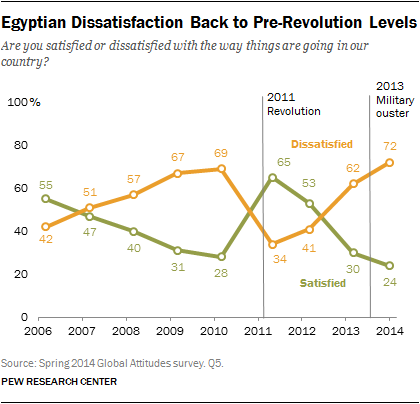
Egyptian Dissatisfaction Back to Pre-Revolution Levels

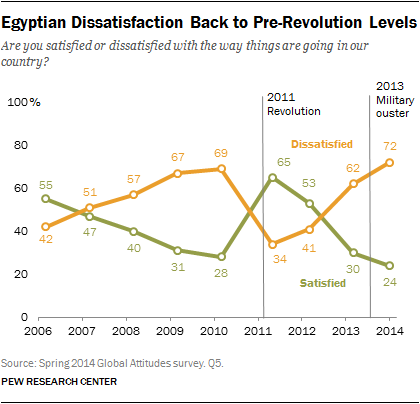
By a 3-to-1 margin, Egyptians are more dissatisfied (72%) than satisfied (24%) with their country’s direction. Dissatisfaction is up significantly from last year’s already high 62%, and in fact, is roughly the same today as it was before the revolution that removed Mubarak from office.

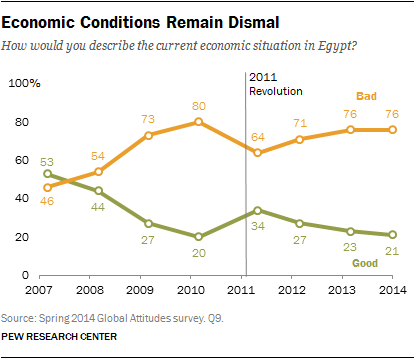
In addition to declining trust in leaders and institutions, Egyptians continue to have deep concerns about their economy. Only 21% say the economy is in good shape, essentially unchanged from last year. And the public is almost evenly divided between those who think the economy will improve over the next 12 months (31%), those who believe it will worsen (35%), and those who expect it to stay about the same (31%).

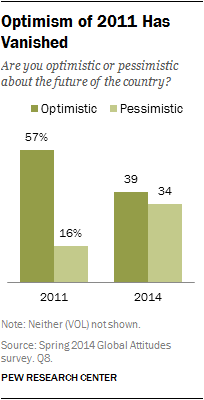
More generally, the public’s sense of optimism about the future has waned since the 2011 revolution. At that time, 57% were optimistic about the future of the country and just 16% were pessimistic. Today, there are almost equal numbers of optimists (39%) and pessimists (34%), while 22% volunteer that they are neither.

Most Still Want Democracy, but Enthusiasm Is Waning

As they have in the past, most Egyptians continue to embrace the concept of democracy. Roughly six-in-ten (59%) say it is the best form of government, although this is down from 66% last year and 71% in 2011. And most still say it’s important to live in a country with basic democratic rights and institutions, but within the past year support has declined for some key pillars of democracy, such as free speech, freedom of the press, and honest, competitive elections.
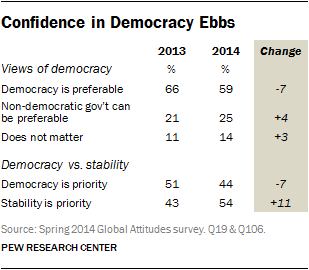
Confidence in Democracy Ebbs

And when asked which is more important, having a democratic government, even if there is a risk of instability, or having a stable government, even if there is a risk it will not be fully democratic, a narrow majority (54%) chooses stability. Forty-four percent take the other view, saying the priority should be democracy. In contrast, last year 51% prioritized democracy, while just 43% said a stable government is more important.

In another notable shift this year, the Egyptian government receives poor marks for its record on protecting the freedoms of the Egyptian people.
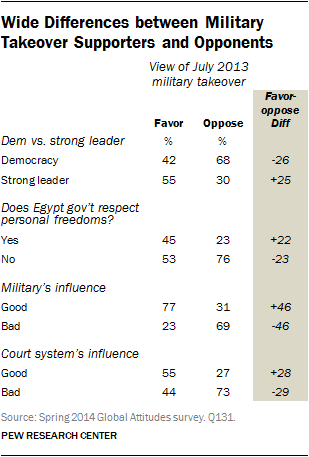
Wide Differenecs between Military Takeover Supporters and Opponents

Sixty-three percent say the government does not respect personal liberties, up from 44% in 2013.

A Sharp Division

Unsurprisingly, the ouster of Mohamed Morsi last July has emerged as a sharp dividing line in Egyptian politics.

On issue after issue, there are large differences between those who favor and those who oppose Morsi’s removal from power. For instance, those who oppose the removal are more likely than its supporters to favor democracy over a strong leader. Meanwhile, people who back the ouster are more likely to say the government respects personal liberty and to give the military and the courts positive ratings.
Chapter 1.  National Conditions in Egypt

Egyptians are deeply dissatisfied with the way things are going in their country. And the hopefulness of 2011, when a majority was optimistic about the future of Egypt, has vanished. Additionally, the public continues to say that economic conditions are bad and does not hold high expectations for any improvements in the upcoming year. While Egyptians of all stripes are down on the state of the country and its future, those who have positive attitudes toward presidential candidate Abdel Fattah El-Sisi and favor last year’s military takeover are slightly more optimistic.

Most Egyptians Are Dissatisfied with Country Direction

Egyptian Dissatisfaction Back to Pre-Revolution Levels

Nearly three-in-four Egyptians (72%) are dissatisfied with the way things are going in their country, with only around a quarter (24%) saying that they are satisfied. This represents a steep drop in country satisfaction from the levels seen in 2011, just weeks after the overthrow of the Mubarak government. Then, 65% of Egyptians were satisfied with the direction of the country, with only about a third (34%) dissatisfied.

Optimism of 2011 Has Vanished

In fact, the levels of dissatisfaction seen today mirror the country’s mood in 2010, just months before the 2011 revolution (28% satisfied, 69% dissatisfied).

There is also much less optimism today among Egyptians for the future. Currently, only 39% of Egyptians are optimistic for their country’s future, while a similar number (34%) are pessimistic (and 22% volunteered that they are neither).

In 2011, a majority (57%) were hopeful about the future of Egypt, with just 16% saying they were gloomy (26% said neither).

Economic Past, Present, and Future Look Grim in Egypt

An overwhelming majority of Egyptians say that current economic conditions in their country are bad (76%), while only 21% say the economy is good. Perceptions of economic conditions in Egypt have been quite poor for some time. In Pew Research polls, only in 2007 did more than half of Egyptians (53%) have a positive view toward the country’s economy, although even then nearly half (46%) thought the economy was in bad shape.

Economic Conditions Remain Dismal

When asked about economic conditions over the next 12 months, Egyptians are split in their opinion. Only 31% say that the economy will improve over the coming year, while an equal number say economic conditions will remain the same. About another third of Egyptians say economic conditions will worsen (35%).

As with views about the country in general, Egyptian perceptions of future economic conditions were more positive in the aftermath of the 2011 revolution than they are now. Then, a 56%-majority in Egypt said economic conditions would improve over the next 12 months, while only 17% said they would worsen.

Sisi and Military Takeover Supporters Slightly More Optimistic

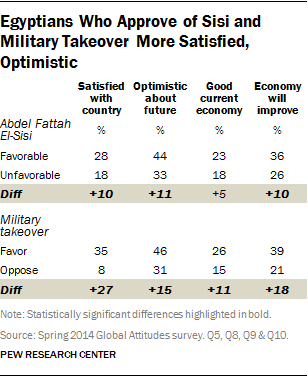
Egyptians Who Approve of Sisi and Military Takeover More Satisfied, Optimistic

Views about Egypt’s direction and the state of the economy tend to be somewhat more positive among supporters of Sisi and last year’s military takeover. However, even among these groups ratings are generally negative. For example, 28% of Egyptians who have a favorable view of Sisi are satisfied with the country’s direction, compared with 18% of those with an unfavorable opinion of the former defense minister. And among those who favor the ouster of the Morsi government, 35% say the country is moving in the right direction, while only 8% of those who oppose last year’s ouster agree. The same pattern is generally seen for current and future economic conditions.

Chapter 2.  Egyptian Views of Leaders, Organizations, Institutions

A narrow majority of Egyptians support the military’s removal of Mohamed Morsi from power last year, and the same percentage has a positive opinion of the man who replaced him as the country’s most powerful figure, Abdel Fattah El-Sisi.

Split over Morsi's Ouster

Support for Morsi and his organization, the Muslim Brotherhood, is down significantly from 2013, although about four-in-ten Egyptians continue to back the former president and the now outlawed Brotherhood.

At the same time, the military is increasingly criticized for being a negative influence on the country. The tumultuous year has also damaged the image of the courts, religious leaders and the media. In addition, a broad majority of Egyptians say the government does not respect citizens’ personal freedoms.

Divisions over Morsi’s Ouster

A year later, Morsi’s removal from office divides Egyptians. Overall, 54% say they favor the military’s ousting of Morsi. A significant minority (43%) opposes it.

The issue highlights clear rifts within Egyptian society. Younger people are more supportive of Morsi’s removal than those age 50 and older. Low-income Egyptians are considerably more likely to say they favor the military’s ouster of Morsi than wealthier people.1 And Egyptians who do not want their laws to strictly adhere to the Quran are happier that Morsi is no longer in power than those who say the legal system should closely follow the Quran.

El-Sisi Modestly Popular

Disappointment with Political Leadership

Abdel Fattah El-Sisi, whom many observers expect to win the controversial upcoming presidential elections, receives lukewarm reviews from the public. Little more than half of Egyptians (54%) say they have a favorable image of Sisi, while 45% rate him negatively. There are few demographic divisions over Sisi – young and old, rich and poor, men and women alike give the presidential candidate a moderately favorable rating.

Just 42% of Egyptians hold positive views of former President Mohamed Morsi, down from the 53% who rated him favorably last year. Low-income Egyptians are particularly unlikely to give Morsi a positive rating (30%) compared with middle-income (42%) and high-income people (46%). Those who would like to limit the influence of the Quran on Egypt’s legal system (34%) are less enamored of Morsi than those who prefer a central legal role for the Islamic holy book (49%).

Besides these two key figures in Egyptian politics, other leaders inspire little confidence from the public. Roughly a third (35%) gives favorable reviews to Hamdeen Sabahi, the only other declared candidate for the presidential election. A similar percentage (33%) says the same about Abdel Moneim Aboul Fotouh, a former Muslim Brotherhood member and 2012 presidential candidate who is boycotting the upcoming elections. Mohamed ElBaradei, a more secular leader who was an advocate for the removal of both Mubarak in 2011 and Morsi in 2013, is also broadly unpopular (27% favorable, 69% unfavorable).

There also appears to be no nostalgia for former President Hosni Mubarak, who was recently convicted of embezzlement. Roughly eight-in-ten Egyptians (81%) rate Mubarak unfavorably, including 56% who view him very unfavorably. However, the public’s dislike of Mubarak has softened somewhat in the past three years – in 2011, 76% said they had a very unfavorable opinion of him.

Leading Political Organizations Fare Poorly

Few Give High Ratings to Political Organizations

Egyptians are decidedly unhappy with many of the organizations that have played a central role in the political drama of the last several years. The April 6th Movement – a relatively secular group that helped topple Mubarak as well as Morsi, but is now outlawed – fares the best: nearly half (48%) say they have a favorable view of the movement while a roughly equal percentage (50%) rate it negatively.

Muslim Brotherhood Popularity Declines

The Tamarod Alliance, the leading organization that spearheaded the protests that helped to unseat Morsi, is less popular. Just four-in-ten Egyptians give the group positive reviews, and nearly six-in-ten (58%) have a negative opinion.

Roughly four-in-ten (38%) rate the now banned Muslim Brotherhood favorably. The organization’s popularity has declined considerably since the spring of 2013 when it stood at 63%.

The Al-Nour party, a Salafist political party that supported Morsi’s removal in 2013, is disliked by a majority of Egyptians (59%). Little more than a third (36%) give the group positive ratings.

Declining Satisfaction with Major Institutions

Influence of National Institutes

The military has garnered widespread positive reviews over the past few years. But while a majority of the public (56%) continues to say the military has a good influence on the way things are going in Egypt, more than four-in-ten (45%) say the military’s influence is bad. And support for the armed forces is considerably lower today than it was just last year, when nearly three-quarters said the military had a positive impact (73%).

Respect for the court system has also dropped substantially in the past 12 months.2 In 2013, about six-in-ten Egyptians (58%) thought the courts had a good influence on their country. Today, just 41% say the same.

Similarly, religious leaders are less likely to be seen as a positive force in the nation. Three-quarters of the public gave religious leaders high ratings in 2013, compared with 60% now.

Nearly six-in-ten Egyptians (59%) think the media is having a good impact on the way things are going in the country – also a drop since 2013 (67%). Roughly half (53%) give the Central Security Forces high ratings. And the local police force’s image has rebounded somewhat from 35% positive last year to 42% this year. Finally, at the bottom of the list are the acting President Adly Mansour (35% good) and the national government more broadly (33%).

Does Egyptian Government Respect Personal Freedoms?

One reason the government may be faring so poorly is that a broad majority (63%) of the public believes the government does not respect the personal freedoms of Egyptians. This is a significant shift from 2013, when people were more likely to say the government upheld civil liberties (51% said it does, 44% said it does not).

Those who are favorable toward the Muslim Brotherhood are particularly likely to say the national government does not respect Egyptians’ personal freedoms (71%). Still, 58% of people who have a negative opinion of the Muslim Brotherhood also believe the current government violates people’s civil liberties.

Overall, low-income Egyptians are much more likely than wealthier individuals to give the government, the acting president, the military and the courts high ratings. In addition, 46% of low-income people say the government respects personal freedoms while few middle-income (35%) and upper-income Egyptians (30%) agree.

Chapter 3.  Democratic Values in Egypt

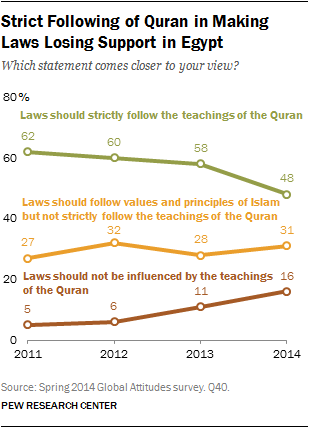
In the wake of the 2011 revoluti0n and July 2013 military takeover, Egyptians still support the concept of democracy, believe democratic values are important and prefer democratic governance. But, there are some signs that their enthusiasm for democracy is slipping, and that stability and a strong leader are becoming greater priorities. Generally, supporters of last year’s removal of President Morsi are less supportive of democratic governance compared with those who oppose Morsi’s ouster. While most Egyptians still believe the country’s legal system should be influenced by Islam, the number of people who think laws should strictly follow the Quran has fallen significantly over the last year.

Egyptian Support for Democratic Governance

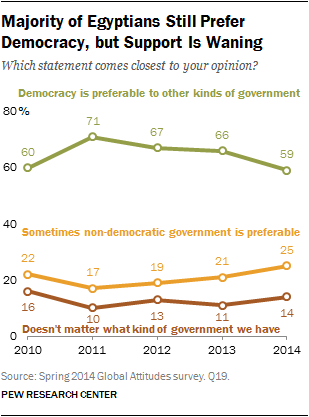
Majority of Egyptians Still Prefer Democracy, but Support Is Waning

Roughly six-in-ten Egyptians (59%) believe that democracy is preferable to any other kind of government, with a quarter saying in some circumstances a non-democratic form of government is preferable, and 14% saying the type of government does not matter.

Support for democratic governance is down from the 66% who said it was preferable in 2013 and the 71% who said so in 2011, just weeks after the revolution. Since that time, Egyptians have also shown slightly more acceptance of a non-democratic government.

There is a significant gender gap on preference for democracy. Nearly seven-in-ten Egyptian men (67%) think that democracy is preferable, while only around half of women (51%) agree. Roughly three-in-ten Egyptian women (29%) say that non-democratic government is preferable in some circumstances, with a further 18% saying that the type of government does not matter. Only 21% of Egyptian men think not having a democracy can be preferable and an additional 11% think it does not matter.

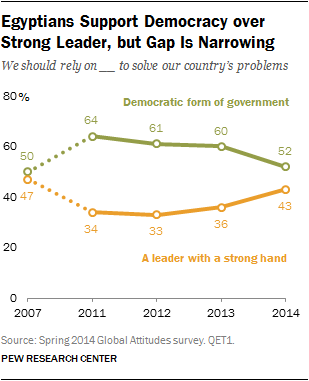
Egyptians Support Democracy over Strong Leader, but Gap Is Narrowing

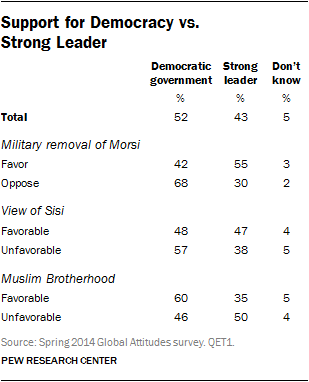
About half of Egyptians (52%) now say that to solve their country’s problems they should rely on a democratic form of government, while 43% think that a leader with a strong hand is the best way to deal with Egypt’s myriad challenges. In the aftermath of the 2011 overthrow of President Mubarak, nearly two-thirds (64%) thought a democratic form of government was the proper solution for Egypt’s woes, with only around a third (34%) favoring a strong leader.

Preference for a democratic government versus a strong leader is related to views of the 2013 military removal of President Morsi, as well as attitudes towards the Muslim Brotherhood and Abdel Fattah El-Sisi. Egyptians who favor the 2013 overthrow of the government and have a favorable view of Sisi also show greater support for strong leadership.

Support for Democracy vs. Strong Leader

On the other hand, those with a favorable view of the Muslim Brotherhood are much more apt to say a democratic form of government is the best way to tackle Egypt’s problems.

Beyond these political measures, poorer Egyptians show a greater inclination towards a strong leader. A majority (55%) of low-income Egyptians think a leader with a strong hand is the best way to solve problems, while only 39% of high-income Egyptians agree.3

The Egyptian public is split on whether a good democracy (49%) or a strong economy (49%) is more important to them. Views on this question have remained relatively stable since 2011.

Poorer Egyptians are more willing to give up good democratic rule for a stronger economy. Only 31% of lower-income Egyptians say that they would chose a good democracy, with 66% wanting a stronger economy instead. High-income Egyptians are split on whether they prefer good democracy or a strong economy. Additionally, Egyptians who opposed the 2013 military takeover (56%) are more inclined toward a good democracy than those who supported it (44%).

Democracy versus Stability

Democracy vs. Stable Government

When asked about the tradeoff between democracy and stability, a narrow majority of Egyptians (54%) now say that having a stable government is more important, even if there is a risk it will not be fully democratic. Just 44% believe it is more important to have a democratic government, even if there is some risk of political instability. This is greatly changed from 2011, when 54% of Egyptians thought democracy was more important, compared with the 32% who prioritized stability. Just in the last year, support for a stable government is up 11 percentage points, while the percentage preferring democracy is down seven points.

Specific Democratic Rights and Institutions

Law and Order, Fair Judiciary and Improved Economy High on the List for Egypt's Future

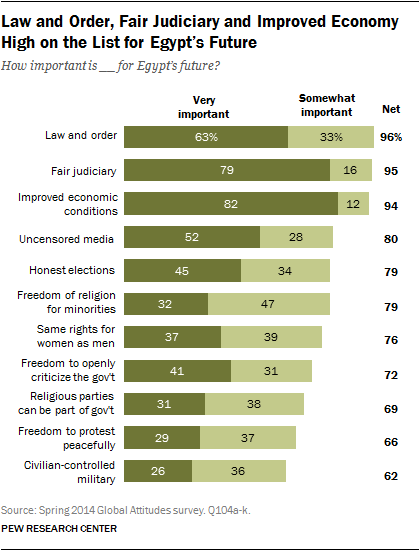
Majorities in Egypt say that values commonly associated with democracy are important for Egypt’s future. However, strong support for these values ranges from 79% who say that a fair judiciary is very important for Egypt’s future to just 26% who say that a civilian controlled military is very important.

Overall, 82% say that improved economic conditions are very important for Egypt’s future. And nearly eight-in-ten (79%) say that a judicial system that treats everyone in the same way is very important. Similarly, 63% of Egyptians say law and order is critically important to their country’s future.

Religious Parties, Honest Elections, and Free Speech Less Valued since 2013

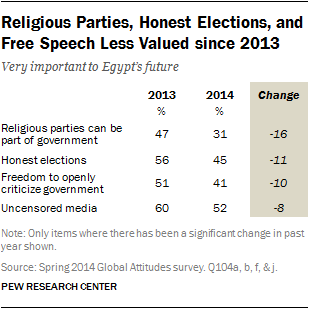
Fewer Egyptians think that an uncensored media (52% very important), honest elections (45%), and freedom to openly criticize the government (41%) are essential for Egypt’s future. And support for these fundamental democratic rights has diminished in the last year.

Less than four-in-ten say having the same rights for men and women (37%), freedom of religion for religious minorities such as Copts (32%), and allowing religious parties to be part of the government (31%) are very important. The importance of having religious parties in government has dropped 16 percentage points since 2013, the steepest drop among any of the democratic values asked.

Over the last few years, Egypt has experienced multiple mass demonstrations, but the freedom to protest peacefully (29% very important) ranks relatively low on the list of democratic values respondents believe are important for Egypt’s future.

Last on the list is civilian control of the military. Just 26% say having a military under control of civilian leaders is very important. This is largely unchanged from the 27% registered in 2013, before the removal of Morsi from power.

Generally, men are more likely than women to see the freedom to openly criticize the government and honest elections as very important, but on other items, there are fewer differences. Overall, these democratic values are shared across Egyptian society.

Islam and Egyptian Democracy

Strict Following of Quran in Making Laws Losing Support in Egypt

About half of Egyptians (48%) agree that laws should strictly follow the teaching of the Quran. While this still represents the plurality opinion in Egypt, agreement with this principle is down 10 percentage points since 2013 and 14 points since 2011. Around a third (31%) say laws should follow the values and principles of Islam, but not strictly follow the Quran. Only 16% say that laws should not be influenced by the teachings of the Quran. However this is a significantly more common viewpoint today than three years ago.

It was widely acknowledged that the Muslim Brotherhood-led Morsi government wanted to shape Egyptian society to more closely follow Islamist teachings. To that effect, Egyptians who have a favorable view of the Muslim Brotherhood are more likely to say that laws should strictly follow the Quran (56%), compared to those with an unfavorable view of the Brotherhood (43%). Similarly, those who oppose the July 2013 overthrow of the Morsi government are more likely to support a strict interpretation of Islam for their laws (55%) than those who favored the overthrow (45%).

Egypt Survey Methods

Pew Research Center Spring 2014 Survey

The survey in Egypt was conducted under the direction of Princeton Survey Research Associates International.

Results for the survey in Egypt are based on 1,000 face-to-face interviews with adults 18 and older, between April 10 and April 29, 2014. Interviews were conducted in Arabic. The survey is representative of the country’s adult population, excluding for security reasons about 2% of the population that lives in frontier governorates. The survey is based on an area-probability design, which entailed proportional allocation of interviews by governorate and urbanity. The primary sampling units were administrative districts.

The margin of sampling error is ±4.3 percentage points. For the results based on the full sample, one can say with 95% confidence that the error attributable to sampling and other random effects is plus or minus the margin of error. In addition to sampling error, one should bear in mind that question wording and practical difficulties in conducting surveys can introduce error or bias into the findings of opinion polls.