Pew Research Center

FOR RELEASE MAY 12, 2014

A Fragile Rebound for EU Image on Eve of European Parliament Elections

EU Favorability Rises, but Majorities Say Their Voice Is Not Heard in Brussels

FOR MEDIA OR OTHER INQUIRIES:

Communications Department
202.419.4372
www.pewresearch.org

RECOMMENDED CITATION

Pew Research Center, May 2014, "A Fragile Rebound for EU Image on Eve of European Parliament Elections"

About Pew Research Center

Pew Research Center is a nonpartisan, nonadvocacy fact tank that informs the public about the issues, attitudes and trends shaping the world. It does not take policy positions. The Center conducts public opinion polling, demographic research, computational social science research and other data-driven research. It studies politics and policy; news habits and media; the internet and technology; religion; race and ethnicity; international affairs; social, demographic and economic trends; science; research methodology and data science; and immigration and migration. Pew Research Center is a subsidiary of The Pew Charitable Trusts, its primary funder.

© Pew Research Center 2026

Table of contents

  • About Pew Research Center
  • A Fragile Rebound for EU Image on Eve of European Parliament Elections
  • Chapter 1. Despair about Economy Leavened by Hope
  • Chapter 2. Crisis of Confidence in the EU Ending?
  • Chapter 3. Most Support Limiting Immigration
  • Chapter 4. Views of Roma, Muslims, Jews
  • Methods in Detail

A Fragile Rebound for EU Image on Eve of European Parliament Elections

EU Favorability Rises, but Majorities Say Their Voice Is Not Heard in Brussels

Support for the European Union may be rebounding just in time for the European Parliament elections, according to a new survey of seven EU nations by the Pew Research Center. After a dramatic decline in the wake of the euro crisis, EU favorability is now on the rise in France, the United Kingdom, and Germany. And faith in one of the EU’s founding principles – that European economic integration is good for their own country – is up in the UK, Poland and Germany.

… Yet Frustration with Brussels

But, as the electorate heads to the polls beginning May 22, publics across Europe overwhelmingly think that their voice is not heard in Brussels, home to the EU. Majorities in most countries complain that the EU does not understand their needs and is intrusive and inefficient. And they express little enthusiasm for giving the EU greater power on economic issues.

Moreover, in most of the countries surveyed, ratings for the EU have yet to return to pre-crisis levels. Italians are increasingly critical of the institution and are divided over whether to keep using the euro as their currency. And Greeks, who have suffered most from the economic downturn, remain deeply skeptical of many aspects of the European project.

Meanwhile, conflicting politics complicate the upcoming European Parliament elections. In the United Kingdom, Italy, Poland and Germany, people on the right of the political spectrum are generally more judgmental of the EU. In Greece and Spain, the institution’s strongest critics are on the left. And concern about immigration adds to the public’s disgruntlement. Majorities in Italy, Greece, France and the UK, express a desire to curb immigration, in part because many believe that immigrants fail to assimilate, and that they take citizens’ jobs and government social benefits.

These are some of the findings from a new Pew Research Center survey of 7,022 people in seven European Union member countries – France, Germany, Greece, Italy, Poland, Spain and the United Kingdom – conducted from March 17 to April 9, 2014.

Sentiment toward the European Project May Be Rebounding

The euro crisis that began in 2008 dealt a savage blow to the image of the European Union. Between 2007 and 2013, EU favorability fell by 34 percentage points in Spain, 21 points in France and 20 points in Italy.

But views of the EU and the European project may have begun to recover in the past year. Median EU favorability across the seven countries is up from 46% in 2013 to 52% in 2014, led by a 13-point improvement in French opinion. Median belief that European economic integration strengthens a person’s national economy also increased, from 26% to 38%, driven by a 15-point increase in the UK and a 12-point rise in Poland.

Low Support for European Institutions

Support for the euro, Europe’s common currency, remains strong; large majorities in Germany (72%), Greece (69%), Spain (68%) and France (64%) want to keep it as their currency. Only Italians flirt with leaving the euro area – 44% now want to return to using the lira.

The principal institutions of the European Union do not fare nearly as well with the public, however. A median of just 36% express a positive view of the European Parliament. A median of only 34% say the same about the European Commission. And a mere 30% have a favorable view of the European Central Bank. Poles hold the EU and all its institutions in the highest regard. Greeks are the most critical.

And Europeans despair about their personal interaction with the EU. Majorities in all seven countries surveyed think their voice does not count in the EU. Italians (81%) and Greeks (80%) are particularly disheartened.

Publics Both Idealistic about EU and Very Frustrated

A median of 65% say the EU does not understand their needs, including 85% in Greece and 77% in Italy.

Moreover, a median of 63% see the EU as intrusive, a trait that Greeks (86%) find particularly galling. But that is a sentiment shared by more than half the public in the other six countries surveyed. And a median of 57% hold the view that the EU is inefficient, a sentiment held by majorities in four of the seven countries.

Despite these reservations, however, many Europeans still maintain an idealistic vision of the European Union, holding on to views reminiscent of the ambitious goals propounded by the creators of the European Common Market more than a half century ago. A median of seven-in-ten think the EU promotes peace, with Germans (84%) and Poles (76%) the most likely to hold that view. About half see the EU as a world power (51%), with the publics in France (59%), Greece (59%) and Spain (57%) most supportive of this opinion.

Opinions about Economy More Positive in Germany and UK, Not So Elsewhere

But less than half the public in four of the seven countries – including less than a third in Greece (30%) and Italy (31%) – buy the argument that the EU promotes prosperity. Such sentiment underscores the continued debilitating effect that Europe’s abysmal economic performance over the past few years has had on attitudes toward the European project. In most of the countries surveyed, views about the economy and the direction of the country remain negative and largely unchanged since 2013.

A median of just 22% are satisfied with the way things are going in their country. The least pleased are Greeks (5%), Spanish (8%), and Italians (9%). Only in Germany (59%) does more than half the public say their nation is headed in the right direction. For the most part, sentiment about economic conditions tracks views on country direction. The proportion of the population that says the economy is faring well is in single digits in Greece (2%), Italy (3%) and Spain (8%).

Between 2007, before the crisis, and 2013, positive assessments of the economy fell 61 percentage points in Spain, 54 points in the UK, 22 points in Italy and 21 points in France. But such gloom may have bottomed out in many nations in the past year. Again it is Germans who are the most upbeat, with 85% saying their economy is performing fine, a dramatic improvement from the 28% registered in 2009. And the proportion of British who give their economy a thumbs up has nearly tripled in the past year.

A Decline in Economic Pessimism

There has also been a marked decline in hopelessness: a new public sense that the worst is now over. The proportion of those surveyed who say their economy will worsen over the next 12 months has declined in the past year by 26 points in Spain, 20 points in the UK, 13 points in France, 12 points in Italy, 11 points in Greece and seven points in Poland.

Unemployment Remains Top Worry

People still complain about specific economic problems, however. A median of 77% say a lack of job opportunities is a very big challenge. And six-in-ten or more see public debt (65%), rising prices (64%) and the gap between the rich and the poor (60%) as very big problems. But all those concerns are stable or down from last year.

Most notably, as inflation has slowed in Europe, concern about rising prices has fallen by 13 points in Poland and eight points in Germany. And it is the once-inflation-phobic Germans who now have the least concern, with only 23% saying rising prices are a very big problem.

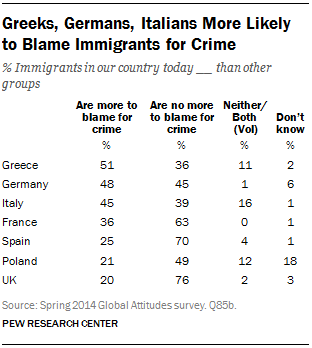
Attitudes toward immigrants and minority groups also shape the public mood in the run-up to the parliamentary election. A median of 55% want fewer immigrants admitted to their country. This includes particularly strong anti-immigrant sentiment in Greece (86%) and Italy (80%). A median of 52% say immigrants are a burden because they take jobs and social benefits, 48% complain they want to be distinct from the local society, and 36% say they are to blame for crime. People on the right of the political spectrum are generally more critical of immigration.

Anti-Roma, Anti-Muslim Sentiments Common in Several Nations

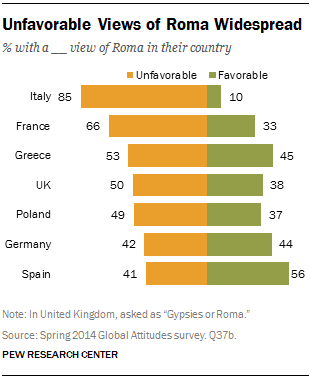
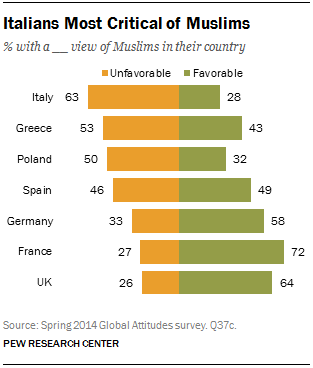
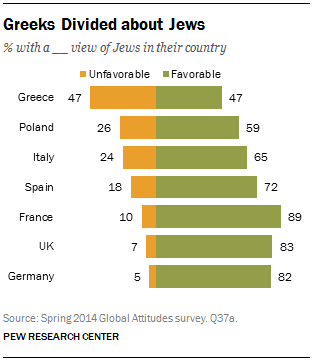
Views of minorities vary widely, both between countries and about specific minority populations. Roma are viewed unfavorably by a median of 50% of those surveyed, with Italians (85%) holding particularly negative sentiments. A median of 46% hold anti-Muslim views. Again it is Italians (63%) who see Muslims in the most negative light. And Jews are seen negatively by a median of 18%, with Greeks (47%) harboring the strongest anti-Jewish sentiment. Negative sentiments about all three groups are consistently more common among people on the ideological right.

Turnaround in the UK

British Mood Brightens

There has been a dramatic turnaround in the British mood in just the past year. Thanks in part to a rebounding economy, 43% of the public say the nation’s economy is now doing well, up 28 points since 2013. And 45% expect continued improvement, up 23 points from the optimism expressed last year. Just 17% expect the economy to worsen and an improved economic outlook may have bolstered support for the European project: 52% of the British public now has a positive view of the European Union. And belief that European economic integration has been good for the UK is up by 15 points.

Half of the British Now Want to Remain in the EU

And with this turnaround, British support for remaining in the European Union has picked up. By 50% to 41%, the British now want to remain in the EU. In 2013 the public was divided, with 46% wanting to stay and an equal share wanting to leave.

Poland’s Love Affair with the EU

Poles: Strongest Supporters of EU

Among all the European publics surveyed, Poles are on balance the most committed to all aspects of the European Union. Roughly seven-in-ten Poles (72%) have a favorable view of the Brussels-based institution, compared with a median of 51% in the other six member states surveyed. Roughly half of Poles (52%) hold the view that European economic integration strengthened their economy, compared with a median of only 32% elsewhere. Half or more of Poles give a thumbs up to the European Parliament (57%), the European Commission (56%) and the European Central Bank (52%). In each case, such backing is more than 20 points stronger than median favorability across other EU societies.

Italians’ Sour Mood

Italians Disgruntled

Italy’s continuing economic woes and political dysfunction have contributed to growing public disgruntlement across the board.

Almost all Italians (96%) say their economy is performing poorly, and about three-quarters (74%) say economic integration has weakened Italy’s economy. Half of the Italian public has a negative view of the EU, second only to Greece in disfavor toward the Brussels-based institution, and only 46% of Italians have a favorable opinion of the EU, the first time that measure has dipped below the break-even point since the euro crisis began.

And 56% voice disapproval of the European Commission. Moreover, 44% want to abandon the euro and return to using the lira; that’s a 19-point drop in support of the common European currency in just one year.

Germany: A Nation Apart

Stark attitudinal differences continue to differentiate Germans from other Europeans. Germans are 75 percentage points more likely than the median of the other six European nations to say their economy is doing well and 31 points more likely to think their country has been strengthened by economic integration with the rest of Europe.

Germans Live on a Different Continent?

Roughly two-thirds of Germans (66%) have a favorable impression of the EU, compared with just half the publics in the six other EU nations surveyed. They are more inclined to complain that Brussels has already provided other EU countries with too much financial assistance. And Germans share with other Europeans the view that their voice is not heard in the EU. This may be one reason that opposition to giving more decision-making power to the EU has grown in Germany from 44% in 2013 to 50% in 2014.
Chapter 1. Despair about Economy Leavened by Hope

Europe is showing signs of recovering from the double-dip recession it experienced in the wake of the economic crisis in 2008. After growing by a mere 0.2% in 2013, the economy of the 28-country European Union is expected to expand by 1.6% in 2014, according to the International Monetary Fund. The smaller euro area, those 18 nations that use the single European currency, is doing less well. The economy of the euro area continued to shrink by -0.5% in 2013 and may grow by only 1.2% in 2014. And national economic prospects vary widely. The United Kingdom’s economy is expected to expand by 2.9% in 2014, France by only 1%, Spain by 0.9% and Italy by 0.6%.

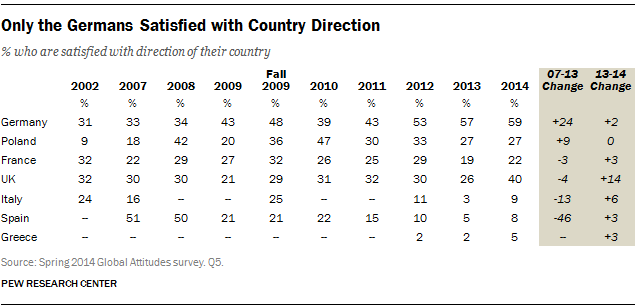
Given these economic conditions in the seventh year of the euro crisis, few Europeans are satisfied about the trajectory of their society. Just 5% of the public in Greece, 8% in Spain and 9% in Italy and only 22% in France and 27% in Poland say they are satisfied with the way things are going in their country. Such sentiment remains largely unchanged in those nations compared with 2013. And in a number of societies – France, Italy and Poland – this lack of satisfaction predates the euro crisis.

Only the Germans Satisfied with Country Direction

By comparison, Germans (59%) remain relatively upbeat about national conditions and are now 26 points more positive about Germany’s direction than they were in 2007.

Elsewhere, declining satisfaction seems to have halted. The greatest mood swing in Europe over the past year has occurred in the UK, where satisfaction with the nation’s direction has risen from 26% to 40%. While a majority (55%) are still dissatisfied with national conditions, negative sentiment is down 13 percentage points since 2013.

A closer look at the demography of the public’s disgruntlement reveals some notable cleavages within European society. In recent months, the news media have focused a great deal of attention on anger among those on the right of the political spectrum, especially in France and Greece. The French right (83%) is significantly more dissatisfied with the way things are going in the country than the French public on the left (70%). In Greece, it is the left (97%) that is somewhat more upset than the right (87%).

In addition, people 50 years of age and older in France (83%), Poland (76%) and the UK (60%) are much more dissatisfied than those under 30 in France (71%), Poland (65%) and the UK (37%). Similarly, those without a college degree in the UK, Poland, Germany and France are significantly more dissatisfied with the state of their nation than are people in their societies with a college degree.

Economic Sentiment Bottoms Out

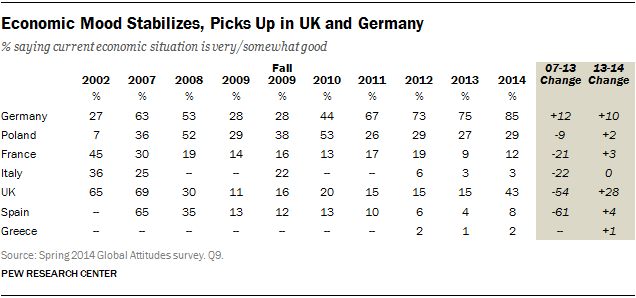
Views about national trajectory largely correspond with public sentiment about the economy. Except in Germany, European publics overwhelmingly agree that economic conditions are bad. Just 2% of Greeks, 3% of Italians, 8% of Spanish and 12% of French see their economy in a positive light. For southern Europeans, the euro crisis is clearly not over. More than nine-in-ten people in Spain, Italy and Greece have held extremely sour views about the economy for the past three years.

Economic Mood Stabilizes, Picks Up in UK and Germany

Nevertheless, the first signs of a turnaround in extreme displeasure with the economy may be evident in the United Kingdom and Spain. The proportion of people saying their economy is in very bad shape has shrunk by 21 percentage points in the United Kingdom (from 39% to 18%) and 16 points in Spain (from 79% to 63%).

Meanwhile, despite sluggish 0.5% growth in 2013 and modest 1.7% anticipated expansion in 2014, Germans are increasingly upbeat about their economy: 85% say economic conditions are good, up from 75% who held such views last year and just 28% who were bullish about the German economy as recently as 2009.

Again, the greatest change in economic mood is found in the United Kingdom. While 55% of the British public still say economic conditions are bad, 43% now say conditions are good, up 28 percentage points in just the past year. This change in perception was in part driven by the attitude of people 50 years of age and older. In 2013, just 11% of older British thought the economy was doing well. In 2014, 44% had a positive take on economic conditions.

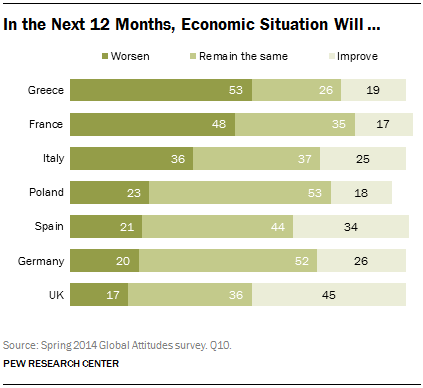
In the Next 12 Months, Economic Situation Will …

There is little optimism about the immediate future of the economy. Just 17% of the French, 18% of Poles and 19% of Greeks see things getting better in the next 12 months. Only a quarter of Germans (26%) and Italians (25%) agree.

Yet some in Spain and the UK voice the belief that their long national economic nightmare may be coming to an end. Fully 45% of the public in the UK and 34% in Spain expect economic conditions to improve over the next year. Such optimism is up 23 points from 2013 in Britain and 11 points in Spain. Again, it is older British (50%) who are more upbeat than those ages 18 to 29 (36%).

Future Looks Less Grim

In another potentially positive sign, in a number of countries the proportion of the public that expects their economy to worsen has sharply declined.

In 2013, 61% of the French expected their economy to slow further. In 2014, only 48% are bearish. Similarly, in Greece pessimism about the future of the economy has fallen from 64% to 53%.

For many Europeans, however, expectations are that the coming year will be much like the previous one. About half of those surveyed in Poland (53%) and Germany (52%), and 44% in Spain, say economic conditions are likely to remain the same.

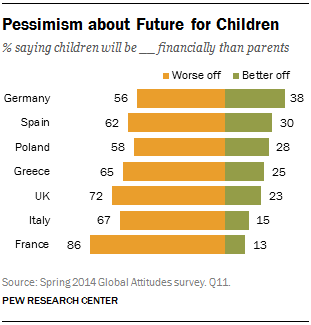
Pessimism about Future for Children

Looking ahead, many Europeans are deeply pessimistic about prospects for the next generation. More than eight-in-ten French (86%), seven-in-ten British (72%) and roughly two-thirds of Italians (67%) and Greeks (65%) say that they expect that when today’s children grow up they will be worse off financially than their parents. In most nations, such pessimism remains unchanged from 2013, suggesting that the recent uptick in economic performance has not substantially altered Europeans’ glum views about the long-term future.

What limited optimism there is about the future is largely the preserve of young people and then only in a few societies. People ages 18 to 29 in Spain (42%) and the UK (40%) are more likely than older Spanish (23%) and British (19%) to say that today’s children will be better off.

One reason for Europeans’ ongoing sense of economic foreboding is their persistent concern about a number of nagging economic problems. The public remains intensely worried about joblessness, public debt, inflation and inequality. But, in line with the ever-so-slight moderation in economic gloom in some nations, the intensity of public concern about these challenges seems to be ebbing.

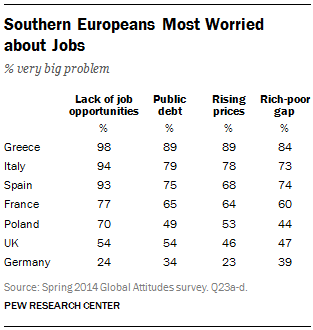
With February 2014 unemployment in the euro area at 10.6%, including 27.5% in Greece (in December 2013) and 25.6% in Spain, according to Eurostat, the lack of job opportunities remains a major public worry. More than nine-in-ten Greeks (98%), Italians (94%) and Spanish (93%) see it as a very big problem, as do more than seven-in-ten French (77%), nearly as many Poles (70%) and half of the British (54%). Only Germans (24%) lack intense concern about unemployment.

Annual EU inflation was a mere 0.6% in March 2014, down from 1.9% a year earlier, according to Eurostat. Thus, it is little wonder that intense concern – the median of those who say rising prices are a very big problem – is down four percentage points from 2013. In particular, inflation worry has dropped thirteen points in Poland, eight points in Germany, four points in France and six points in Italy.

Southern Europeans Most Worried about Jobs

Public debt in EU countries remains high: equal to 171.8% of GDP in Greece, 132.9% in Italy and 93.4% in Spain, according to Eurostat. And about nine-in-ten Greeks (89%), roughly eight-in-ten Italians (79%) and more than seven-in-ten Spanish (75%) are very worried. Notably, however, despite rising debt levels in a number of countries, concern has plateaued.

Finally, there is continuing concern about the gap between the rich and the poor. A median of 60% hold the view that inequality is a very big problem. But the intensity of such concern has ebbed, down 12 points in Germany and 10 points in Poland.

Given Germans’ exuberance about the current state of their economy, it is not surprising that Germans are notably less worried than any of the other Europeans surveyed about the whole gamut of current economic problems. Contrary to the narrative propounded by many German officials – that their people have been permanently scarred by the hyperinflation of the 1920s, thus ruling out any support by Berlin for an easier monetary policy by the European Central Bank – just 23% of Germans say rising prices are a very big problem. Far more (39%) are worried about the gap between the rich and the poor.

Chapter 2. Crisis of Confidence in the EU Ending?

The European project – the creation of a single market, the European institutions that are the pillars of that effort and the public’s faith that their collective future is best secured through ever-closer cooperation among nations – has been one of the principal casualties of the euro crisis. Support for European economic integration and the European Union has suffered greatly since the economic crisis began.

But, in 2014, declining public trust in the European project and EU institutions has bottomed out and now seems to be rebounding in a number of countries, although support generally has yet to return to pre-crisis levels.

The founding rationale for the Treaty of Rome, which created the then six-nation European Common Market in 1957, was that economic integration would be beneficial to all participating nations.

In the wake of the euro crisis, the European public began to doubt that assumption. Between 2009 and 2013, belief that integration strengthened the economy had fallen by 21 points in France, 20 points in Italy and 16 points in Spain. In 2013, a median of only 26% said economic integration was positive for their national economy.

In 2014, however, belief that integration strengthens European economies has begun to return. The proportion of the public that sees value in removing trade and investment barriers within Europe has increased by 15 percentage points since last year in the UK, nine points in Germany (where 63% say integration has strengthened the economy) and 12 points in Poland (where 53% now see integration as a positive). And the median in the seven nations surveyed is now up 12 points, to 38%.

Majorities in Italy (74%), Greece (73%), France (73%) and Spain (56%) still believe that economic integration has weakened their economies. So the damage done to the founding assumption of the European project has yet to be repaired. But the erosion of that cornerstone principle seems to have stopped.

EU Favorability on the Rise

A similar rebound has occurred in public sentiment toward the European Union. Majorities in Poland (72%) and Germany (66%) and half the public in France (54%), the UK (52%) and Spain (50%) now have a favorable view of the EU. In all of these nations, that assessment is roughly equal to or better than what it was in 2013. And in France the positive assessment of the EU is up 13 percentage points. Nevertheless, in many countries EU support is still below what it was before the euro crisis, especially in Italy and Spain. In Germany, this rise in EU support is highest among those who think current economic conditions are good. In France and the United Kingdom, improved EU favorability is greatest among those who think the economy will improve over the next year.

People under 30 Regaining Confidence in European Project

Notably, support for both the EU and for European economic integration among the next generation of EU citizens has rebounded in most countries. In 2013, favorability of the EU was down everywhere, including by 42 points in Spain and 28 points in France compared with 2007 among people ages 18 to 29. In 2014 the image of the EU has begun to recover among the young. In the past year, it is up 17 points in the UK and 16 points in France. Similarly, young people’s appreciation for the benefits of economic integration, which in most countries had fallen off dramatically between 2009 and 2013, seems to be recovering. However, in most countries, their judgment of both aspects of the European project has not regained previous levels.

There is also generally greater backing for the European Union than for its constituent institutions. A median of only 34% back the European Commission, the EU’s day-to-day executive branch. Poland is the only country where the Commission enjoys the support of more than half the public; 56% voice a positive opinion. The weakest support for the Commission is in Greece (22%).

And a median of a mere 30% have a favorable view of the European Central Bank, which sets euro area monetary policy. Views of the ECB are largely unchanged from last year, except in Italy, where favorability is down ten percentage points. Again, the strongest support is found in Poland (52%). Poles are the only public with a positive view of the ECB.

European Parliament Image: Left-Right Differences

A median of just 36% percent favors the European Parliament. In 2009, voter turnout for the European Parliament elections totaled just 43%. Who turns up to vote this year may depend on whether the left-leaning or right-leaning voters are more animated. In the run-up to voting, those on the left of the political spectrum are more supportive of the European Parliament in three of the seven countries surveyed. For instance, the British left is 17 points more favorable than the right toward the European Parliament. However, the right is more favorable than the left toward the Parliament in Spain (by 19 points) and in Greece (by 17 points).

Notably, there are particularly high “don’t know” responses about the ECB in Poland (27%) and the UK (28%), which is also not in the euro area. “Don’t know” responses are also high with regard to the European Commission in Poland (22%), the UK (21%) and Germany (17%). And 19% of Poles offer no opinion on the European Parliament.

Euro Support Strong

Support for Euro Remains Strong, Except in Italy

The euro has weathered the crisis fairly well. Despite ups and downs because of economic turbulence within the euro area, the euro’s current value is virtually unchanged from what it was five years ago. And the commitment of most Europeans to their single currency remains strong. Sentiment for keeping the euro and not returning to their previous national currency has actually strengthened over the past year in Germany (72%, up from 66%) and remains virtually unchanged in Greece (69%), Spain (68%) and France (64%). Only in Italy has there been a serious erosion in the euro’s appeal, with the desire to keep the single currency falling from 64% to 45%.

Italians are now divided on whether to stay in the euro area or to exit it and return to using the lira. This is the first time euro support has fallen below 50% in any of the five euro area countries surveyed since 2010.

In UK: Young, Well-Educated and the Left Want to Stay in EU

British flirtation with leaving the European Union also seems to have ebbed. Facing a possible national referendum in 2017 on EU membership, the British, by 50% to 41%, express a desire to remain in the EU. In 2013, the public was evenly divided on the issue: 46% wanted to leave, and 46% wanted to stay.

There are notable demographic differences on EU membership. Men (46% stay, 47% go) are currently divided on membership, while women (55% remain, 36% leave) support it. By more than two-to-one (63% to 29%), people ages 18 to 29 want the UK to continue as an EU member as opposed to leaving, as do people with a college education (66%). People on the left (62%) of the political spectrum are much more likely than those on the right (46%) to back continued EU membership.

No to Giving EU More Power

Despite signs that the decline in public support for elements of the European project has bottomed out, and evidence in some countries that backing is actually rebounding, there is no indication of any widespread public desire for a stronger, more activist European Union.

Less than half the population in each of the seven countries surveyed favors giving more decision-making power to Brussels to deal with Europe’s economic problems. Support for a stronger EU is actually down 11 points in Italy (from 49% in 2013 to 38%). And outright opposition is particularly strong in the United Kingdom and (76%) and Greece (71%). Only Poles voice an increased desire for transferring more authority to Brussels: up from 38% in 2013 to 44%.

Many Think EU’s Aid Is Enough

Moreover, only in Italy and Greece – two of the countries where the euro crisis has hit hardest – do the publics express a desire for the EU to provide more financial assistance to EU countries experiencing major financial problems.

Roughly three-quarters of Greeks (74%) and half of Italians (53%) say the EU has not provided enough aid. Overwhelming majorities in Germany, France, the UK and Spain and more than half the public in Poland say EU assistance has already been too great or just about right.

Idealism Remains High

Idealism about EU Remains

More broadly, while Europeans profess continued faith in some of the ideals that led them to embark on the European project, they are highly critical of many attributes of the European Union.

After two world wars in half a century, a foundational goal of the European project was to ensure that European nations would never again make war on each other. And Europeans believe the EU has accomplished that aim. A median of 70% say the European Union promotes peace. Such sentiment is particularly strong in Germany (84%).

Another aim of the European Union’s forbearers was to restore Europe’s stature on the world stage. Today, a median of roughly half of all Europeans (51%) surveyed consider the EU a world power. The French (59%) are among the most likely to hold that view, Germans (39%) the least likely.

But Few Think It Listens

But a median of only 47% think that the EU promotes prosperity, arguably the most tangible objective of European unification. This underwhelming endorsement of such a core EU competence echoes the meager 38% median that say European economic integration strengthens their economy. Greeks (30%) and Italians (31%) are the least likely to credit the EU with fulfilling this mission. Poles (66%) are the most likely to praise the EU’s economic performance.

Public sentiment is equally as damning when it comes to EU institutional attributes that touch citizens in their everyday lives.

Public Frustrated with How EU Acts

A median of roughly two-in-three Europeans (65%) surveyed think that the European Union does not understand their needs. Greeks (85%) and Italians (77%) are the most frustrated of those surveyed. Notably, it is people on the left of the political spectrum in Greece and Spain who are the most critical of the EU in this regard, while in France, the UK and Poland it is people on the right.

A median of similar proportions (63%) voice the view that the EU is intrusive in their daily lives. Again it is Greeks (86%), who have experienced Brussels-imposed austerity and economic reforms that have contributed to high unemployment, who most resent EU meddling. In France, Germany, Poland and the UK, this is a particular concern of people 50 years of age and older and those on the right.

And a median of more than half (57%) of those surveyed think the EU is inefficient. Greeks (67%) complain the most about EU disorganization and waste; Poles (30%) complain the least. Notably, Germans, often called the paymasters of Europe, have a relatively benign view of EU inefficiency, with only 43% seeing Brussels in that light.

Finally, in what may be the most telling public criticism of the EU, especially in the run-up to European Parliament elections, a median of about seven-in-ten Europeans (71%) express the view that their voice does not count in the European Union. The greatest frustration is in Italy (81%) and Greece (80%). And even in Germany, where 66% of the public has a favorable view of the EU, a strong majority says average citizens lack influence in Brussels (71%). People on the right in Italy and the UK are particularly aggrieved by their lack of voice. In France, Germany and the United Kingdom, it is people who lack a college education who are most troubled by not being heard in the EU. In Spain, where the youth unemployment rate has recently been calculated at 55.5%, according to Eurostat, people ages 18 to 29 are more frustrated by not being heard than are people ages 50 and older. Meanwhile, in the UK it is older people who feel more ignored than younger people.

A median of only 28% of those surveyed say their voice counts in the EU, with the greatest such belief in France (44%). By comparison, a median of 40% of Europeans say their voice counts in their own country. The French (71%) are most confident of their influence in Paris, while Italians (17%) are the least assured that their voice is heard in Rome.

Chapter 3. Most Support Limiting Immigration

Immigration has been a contentious issue in Europe over the past several years, and in the seven EU nations polled many would like to see fewer immigrants allowed into their countries. This is especially true in Greece and Italy, where views about immigrants and their impact on society tend to be particularly negative.

Concerns about immigration include both cultural and economic issues. Many believe that immigrants do not want to adopt their new country’s customs and ways of life, and many think immigrants are taking jobs away from native-born citizens.

Consistently, college graduates express more positive attitudes toward immigration than those with less education. Meanwhile, negative views about immigration are more common on the political right than on the left.

Many Want Less Immigration

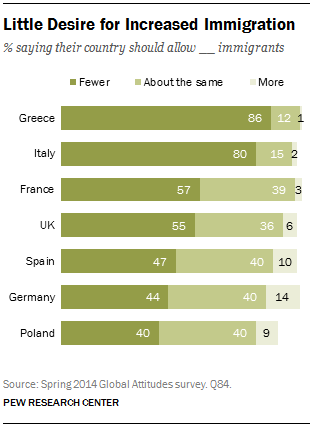
Little Desire for Increased Immigration

Huge majorities in both Greece (86%) and Italy (80%) say they want fewer immigrants allowed into their countries. More than half in the United Kingdom and France hold this view, as do 47% in Spain. In Germany and Poland, the public is closely divided between those who want less immigration and those who say immigration levels should remain about the same as they are now.

Very few people in these EU nations want increased immigration. The percentage saying they believe more immigrants should be allowed into their country ranges from 14% in Germany to only 1% in Greece.

Views on Immigration Differ by Ideology

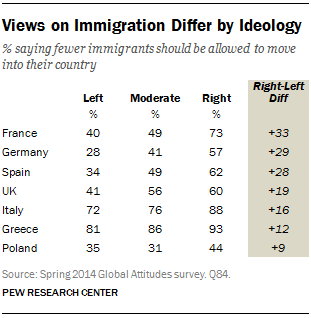
The desire for less immigration is particularly strong among people on the right side of the ideological spectrum. For example, in France 73% of those on the political right want fewer immigrants allowed into the country, compared with 40% among those on the left of the political spectrum. Double-digit right-left gaps also exist in Germany, Spain, the UK, Italy and Greece.

In several countries, people with less than a college education are particularly likely to call for reduced immigration. In the UK, among those who have not graduated from college, seven-in-ten favor less immigration, compared with just 36% of college graduates. Roughly half of Germans without a college degree (49%) back reduced immigration; only 22% of college graduates agree.

Few Think Immigrants Want to Assimilate

Immigrants Seen as Not Assimilating

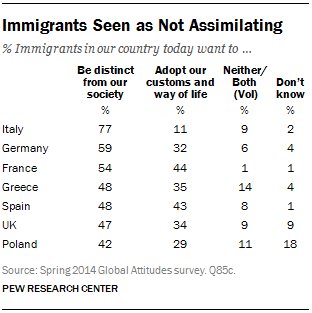
When asked whether they believe immigrants want to adopt national customs and ways of life or remain distinct from the broader society, many in these EU countries, including more than half the public in Italy, Germany and France, express frustration over immigrants’ perceived failure to assimilate. And at least four-in-ten express this view in Greece, Spain, the UK and Poland.

In Germany, the UK, Greece and Spain, respondents who have not graduated from college are more likely than those who have to believe that immigrants want to be distinct from society. In France, the UK and Italy, this view is especially prevalent on the ideological right.

The Economic Role of Immigrants

Most Greeks, Italians See Immigrants as an Economic Burden

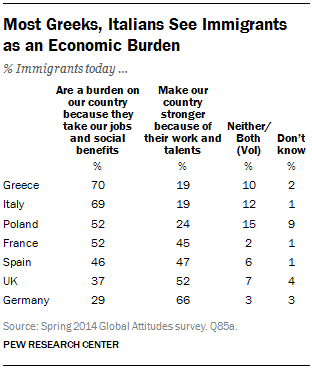
Public opinion regarding the economic impact of immigration varies considerably across the nations polled. Roughly seven-in-ten Greeks and Italians say immigrants are a burden on the country because they take jobs and consume social benefits. On balance, Poles and the French also lean more toward this position.

In contrast, the British and even more so Germans tilt toward saying immigrants make their country stronger because of their work and talents. Opinion is closely divided on this question in Spain.

People without a college degree are more likely than college graduates in all seven nations to see immigrants as an economic burden. For instance, only 18% of British college graduates hold this view, compared with 51% of those with less education.

Right More Likely to See Immigrants as a Burden

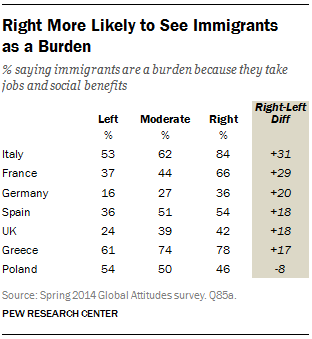
Attitudes on this issue are also related to ideology. People who identify themselves as being on the political right are consistently more likely to characterize immigrants as a burden on the country’s economy. The gap between left and right is especially wide in Italy (31 percentage points), although double-digit gaps are also found in France, Germany, Spain, the UK and Greece.

Immigration and Crime

Greeks, Germans, Italians More Likely to Blame Immigrants for Crime

Greece is the only country where at least half (51%) say that immigrants are more to blame for crime than other groups, although nearly as many Germans (48%) and Italians (45%) also hold this view. Less than a third of the public in Spain, Poland and the UK believe immigrants are more to blame for crime than other groups.

Again, right-of-center respondents express more negative opinions about immigrants on this question. For example, 54% of Italians on the political right place more blame for crime on immigrants than other groups, compared with 35% among those on the left.

Chapter 4. Views of Roma, Muslims, Jews

Many people in the seven European Union nations surveyed express negative views about minority groups in their country. In particular, negative attitudes toward Roma (sometimes also known as Gypsies) are common, while many also give Muslims unfavorable ratings. Negative attitudes toward Jews are less pervasive, although substantial minorities express an unfavorable opinion about Jews as well, especially in Greece where nearly half the public hold this view. Negative sentiments about all three groups are consistently more common among people on the ideological right.

Anti-Roma Sentiments Common

Unfavorable Views of Roma Widespread

In Italy and France – countries where policies toward Roma communities have generated tremendous controversy in recent years – large majorities have unfavorable opinions of the Roma who live in their country. Fully 85% of Italians and 66% of French express this view. In Greece, Britain and Poland, about half give Roma negative ratings, as do at least four-in-ten in Germany and Spain.In Germany, since 1991, unfavorable sentiment toward Roma has declined from 60% to 42%. In Spain, over the same period, it has fallen from 50% to 41%.

There is a strong relationship between ideology and attitudes toward Roma. People who place themselves on the right side of the political spectrum tent to offer more negative opinions, although these views are not uncommon among those on the left.

More than half of respondents (54%) on the ideological left in France say they have a negative view of Roma, but this opinion is even more pervasive on the right (76%). Similarly, 31% of left-of-center respondents in Germany give Roma an unfavorable rating, compared with 51% of those on the right. Double-digit gaps also exist in the UK, Greece and Italy.

Mixed Views of Muslim Minorities

Italians Most Critical of Muslims

At least half of those surveyed in Italy, Greece and Poland say they have a negative opinion of the Muslims who live in their country. Public opinion is divided on this question in Spain, while in Germany and the UK a majority says they have positive views of Muslims. The most favorable ratings are registered in France (72% favorable), which among the seven nations surveyed has the highest percentage of Muslims in the national population.1

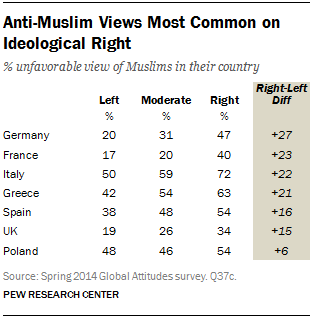
Anti-Muslim Views Most Common on Ideological Right

As is the case with attitudes toward Roma, views about Muslims are tied to ideology. While 47% of Germans on the political right give Muslims an unfavorable rating, just 20% on the left do so. The gap between left and right is also more than 20 percentage points in France, Italy and Greece. And significant differences are found in Spain and the UK as well.

Attitudes are also linked to age, with negative sentiments more pervasive among older respondents. In Spain, about half of those age 50 and older (51%) give Muslims in their country an unfavorable rating; only a third of people under age 30 say the same. Significant differences between people 50 and older and 18- to 29-year-olds are also found in France (a gap of 12 percentage points), Germany (13 points), Italy (12 points) and the UK (9 points).

Fewer Negative Views toward Jews

Greeks Divided about Jews

Compared with Roma and Muslims, Jews receive relatively higher ratings. Still, 47% of Greeks say they have an unfavorable opinion of Jews in their country, and notable minorities in Poland (26%), Italy (24%) and Spain (18%) say the same. In France, the UK and Germany, 10% or fewer hold a negative view. In Germany, since 1991, unfavorable views of Jews have fallen from 24% to 5%. And in Poland they have declined from 34% to 26%.

In Poland, Italy and Greece – the three countries where unfavorable ratings are most common – anti-Jewish sentiments are more pervasive among those on the right of the political spectrum than on the left.

Methods in Detail

About the 2014 Spring Pew Global Attitudes Survey

Results for the survey are based on telephone and face-to-face interviews conducted under the direction of Princeton Survey Research Associates International. Survey results are based on national samples. For further details on sample designs, see below.

The descriptions below show the margin of sampling error based on all interviews conducted in that country. For results based on the full sample in a given country, one can say with 95% confidence that the error attributable to sampling and other random effects is plus or minus the margin of error. In addition to sampling error, one should bear in mind that question wording and practical difficulties in conducting surveys can introduce error or bias into the findings of opinion polls.

Country: France
Sample design: Random Digit Dial (RDD) sample of landline and cell phone households with quotas for gender, age and occupation and stratified by region and urbanity
Mode: Telephone adults 18 plus
Languages: French
Fieldwork dates: March 17 – April 1, 2014
Sample size: 1,003
Margin of Error: +/-4.1 percentage points
Representative: Telephone households (roughly 99% of all French households)
Country: Germany
Sample design: Random Digit Dial (RL(2)D) probability sample of landline households, stratified by administrative district and community size, and cell phone households
Mode: Telephone adults 18 plus
Languages: German
Fieldwork dates: March 17 – April 2, 2014
Sample size: 1,000
Margin of Error: +/-4.0 percentage points
Representative: Telephone households (roughly 99% of all German households)
Country: Greece
Sample design: Multi-stage cluster sample stratified by region and urbanity
Mode: Face-to-face adults 18 plus
Languages: Greek
Fieldwork dates: March 22 – April 9, 2014
Sample size: 1,000
Margin of Error: +/-3.7 percentage points
Representative: Adult population (excluding the islands in the Aegean and Ionian Seas, or roughly 6% of the population)
Country: Italy
Sample design: Multi-stage cluster sample stratified by region and urbanity
Mode: Face-to-face adults 18 plus
Languages: Italian
Fieldwork dates: March 18 – April 7, 2014
Sample size: 1,000
Margin of Error: +/-4.3 percentage points
Representative: Adult population
Country: Poland
Sample design: Multi-stage cluster sample stratified by province and urbanity
Mode: Face-to-face adults 18 plus
Languages: Polish
Fieldwork dates: March 17 – April 8, 2014
Sample size: 1,010
Margin of Error: +/-3.6 percentage points
Representative: Adult population
Country: Spain
Sample design: Random Digit Dial (RDD) probability sample of landline and cell phone-only households stratified by region
Mode: Telephone adults 18 plus
Languages: Spanish/Castilian
Fieldwork dates: March 17 – March 31, 2014
Sample size: 1,009
Margin of Error: +/-3.2 percentage points
Representative: Telephone households (roughly 97% of Spanish households)
Country: United Kingdom
Sample design: Random Digit Dial (RDD) probability sample of landline households, stratified by government office region, and cell phone-only households
Mode: Telephone adults 18 plus
Languages: English
Fieldwork dates: March 17 – April 8, 2014
Sample size: 1,000
Margin of Error: +/-3.4 percentage points
Representative: Telephone households (roughly 98% of all households in the United Kingdom)