Pew Research Center

FOR RELEASE MAY 8, 2014

Despite Concerns about Governance, Ukrainians Want to Remain One Country

Many Leery of Russian Influence, as Putin Gets Boost at Home

FOR MEDIA OR OTHER INQUIRIES:

Communications Department
202.419.4372
www.pewresearch.org

RECOMMENDED CITATION

Pew Research Center, May 2014, "Despite Concerns about Governance, Ukrainians Want to Remain One Country"

About Pew Research Center

Pew Research Center is a nonpartisan, nonadvocacy fact tank that informs the public about the issues, attitudes and trends shaping the world. It does not take policy positions. The Center conducts public opinion polling, demographic research, computational social science research and other data-driven research. It studies politics and policy; news habits and media; the internet and technology; religion; race and ethnicity; international affairs; social, demographic and economic trends; science; research methodology and data science; and immigration and migration. Pew Research Center is a subsidiary of The Pew Charitable Trusts, its primary funder.

© Pew Research Center 2026

Table of contents

  • About Pew Research Center
  • Despite Concerns about Governance, Ukrainians Want to Remain One Country
  • Chapter 1. Ukraine: Desire for Unity Amid Worries about Political Leadership, Ethnic Conflict
  • Chapter 2. Ukraine: Russian Influence Unwelcome
  • Chapter 3. Russia: Public Backs Putin, Crimea’s Secession
  • Methods in Detail

Despite Concerns about Governance, Ukrainians Want to Remain One Country

Many Leery of Russian Influence, as Putin Gets Boost at Home

A clear majority of Ukrainians agree that their country should remain a single, unified state, according to a pair of new surveys conducted by the Pew Research Center in Ukraine and Russia – after Crimea’s annexation by Russia, but prior to recent violence in Odessa and other cities. The survey in Ukraine also finds a clearly negative reaction to the role Russia is playing in the country. By contrast, the poll in Russia reveals a public that firmly backs Vladimir Putin and Crimea’s secession from Ukraine.

Among Ukrainians, 77% say Ukraine should remain united, compared with 14% who think regions should be permitted to secede if they so desire. In Ukraine’s west, which includes the central region around Kyiv (Kiev), as well as portions of the country that border Poland, Slovakia and Hungary, more than nine-in-ten (93%) think their nation should remain unified. A smaller majority (70%) in the country’s east – which includes areas along the Black Sea and the border with Russia – also prefer unity. Only in the breakaway territory of Crimea do more than half (54%) voice support for the right to secede.

… But Regional Divisions Over Language

The survey in Ukraine finds that ethnic Ukrainians and ethnic Russians largely have favorable views of one another. Nonetheless, there are stark regional divides, especially when it comes to the issues of official languages and governance. In western Ukraine, nearly two-thirds (66%) think only the Ukrainian language should have legal standing. By contrast, roughly seven-in-ten in eastern Ukraine (73%) say both Russian and Ukrainian should be official state languages. This view is especially widespread among the region’s Russian-only speakers1: 86% in this group think the Russian and Ukrainian languages should share official status. Meanwhile, in Crimea nearly three-quarters (74%) say both languages should have legal status on the Crimean peninsula.

Eastern Ukraine Unhappy with Kyiv

Lack of confidence in the central government is pronounced. Not including Crimea, fewer than half of Ukrainians (41%) say the current government in Kyiv is having a good influence on the way things are going in the country. Similar to views on official state languages, sharp regional divides are evident: six-in-ten in the country’s west rate Kyiv’s influence favorably, compared with only about a quarter in eastern Ukraine (24%) who share this assessment.

Ukrainians are also divided in their hopes for the upcoming presidential elections. About six-in-ten in the country’s west (59%) expect the May 25th vote to be free and fair, compared with fewer than three-in-ten who share this view in eastern Ukraine (27%) and Crimea (20%).

Whoever leads Ukraine next will face a steep challenge when it comes to repairing the public’s faith in the central government. Although half in western Ukraine say they trust Kyiv to guarantee personal freedoms, far fewer in eastern Ukraine (21%) and Crimea (7%) agree. Moreover, majorities in both the country’s east (71%) and west (55%) point to the nation’s lack of political leadership as a very big problem.

These are the principal findings from the latest survey in Ukraine by the Pew Research Center. Based on face-to-face interviews between April 5-23, with 1,659 randomly selected adults from across the country, the poll finds that along with questions about the country’s leadership, Ukrainians are far from satisfied with the involvement of foreign powers to date. The European Union fairs best in the eyes of Ukrainians, with a 45%-plurality describing its influence in Ukraine as good. Meanwhile, assessments of the U.S. impact on Ukraine are split: 38% positive, 38% negative.

Ukrainians More Positive toward EU, U.S. than Russia

Russia is viewed with the greatest suspicion. Three times as many Ukrainians say Russia is having a bad influence on their country as say it is having a good impact (67% vs. 22%). At the same time, overall confidence in Putin’s handling of world affairs has plummeted from 56% in 2007 to 23% today.

While overall attitudes toward Russia are not positive, a substantial minority of Russian-only speakers in eastern Ukraine are favorably inclined toward Russia. Roughly four-in-ten in this group (43%) express confidence in Vladimir Putin’s handling of international affairs, while 41% say that Russia is having a positive influence on the situation in Ukraine. By comparison, barely one-in-five Russian-only speakers in eastern Ukraine voices confidence in President Obama (19%) or thinks the U.S. is playing a positive role in their country (14%).

Divided Views on Crimea’s Status

Crimean residents are almost universally positive toward Russia. At least nine-in-ten have confidence in Putin (93%) and say Russia is playing a positive role in Crimea (92%). Confidence in Obama is almost negligible at 4%, and just 2% think the U.S. is having a good influence on the way things are going on the Crimean peninsula.

International attention has focused on Crimea in large part due to the March 16th referendum on seceding from Ukraine and joining Russia. According to the reported results, most of the Crimean residents who participated voted for secession. However, the legitimacy of the referendum has been hotly disputed, and few in the international community have accepted the outcome.

Russians Look Beyond Current Borders

For their part, Crimeans seem content with their annexation by Russia. Overwhelming majorities say the March 16th referendum was free and fair (91%) and that the government in Kyiv ought to recognize the results of the vote (88%).

In Russia proper, the public also sees the matter as closed. More than eight-in-ten Russians (84%) think the March 16th referendum was fair and even more (89%) say Kyiv ought to validate the results, according to a new Pew Research survey in Russia, conducted among 1,000 randomly selected adults between April 4-20. The same survey finds that majorities of Russians (61%) agree that there are parts of neighboring countries that belong to Russia, and that the collapse of the Soviet Union was a great tragedy (55%). While the poll did not explicitly ask Russians whether they supported the Kremlin taking military action to protect ethnic Russians in Ukraine, nearly two-thirds (65%) agree that military action is sometimes necessary to maintain order in the world.

Putin appears to have scored a political victory at home with his handling of the Ukraine crisis. More than eight-in-ten Russians (83%) express confidence in Putin to handle world affairs. At the same time, 92% have a favorable view of their country, including 51% who express a very favorable opinion of their homeland – up 22 percentage points from last year. When it comes to Russia’s image abroad, a 43%-plurality of Russians think Putin’s response to the situation in Ukraine has made people in other countries more favorably inclined toward Russia; just 26% think it has had the opposite effect.

West, East Want Unity; Crimea Supports Secession

Chapter 1. Ukraine: Desire for Unity Amid Worries about Political Leadership, Ethnic Conflict

Ukrainians widely agree that their country should remain a single, unified state. Only residents of Crimea are a clear exception, with overwhelming numbers backing secession and the new government in Simferopol. Yet, as much as Ukrainians outside Crimea desire unity, they also worry about the lack of national leadership and growing ethnic tensions. One of the more divisive issues in Ukraine concerns the legal status of the Russian language, with opinions in the country’s west and east diverging on whether both Ukrainian and Russian should be officially recognized by the state. Russian-only speakers in the east, in particular, say Russian should have equal standing with the Ukrainian language.2

Not a House Further Divided –  Yet

Ukrainians Broadly Support Remaining One Country

A broad majority of Ukrainians say their country should remain a unified state (77%). Fewer than two-in-ten (14%) believe that regions that want to leave should be allowed to secede.

Support for maintaining Ukraine’s borders is especially widespread in the country’s west (93%). A majority of east Ukraine also wants to be one country (70%), including nearly six-in-ten Russian-only speakers (58%). Still, a significant minority of Russian-only speakers in the east support allowing regions to secede (27%).

In Crimea, just 12% say Ukraine should remain united, compared with 54% who say regions that want to leave should be allowed to secede, while 34% say they either don’t know or do not want to offer an opinion.

When asked specifically about the Crimean referendum on secession, majorities of Ukrainians believe it was not free and fair (60%) and say that the government in Kyiv (Kiev) should not recognize the results (57%).

Accept Results of Crimea Referendum?

Western Ukrainians are clearly unified in their opinions on Crimea. More than eight-in-ten (84%) say the referendum was not free and fair, and a roughly equal percentage (82%) says Kyiv should reject the results. Crimeans are also nearly unanimous, but in the opposite direction – 91% say the referendum was fair and 88% say the government in Kyiv should recognize the results.

Attitudes in the country’s east, meanwhile, are more closely divided – 35% say the referendum was fair, while 44% say it was not. Similarly, 40% in this region say Kyiv should affirm the outcome, but 41% disagree. Russian-only speakers in the east are especially likely to say the election was fair (51%) and should be recognized as legitimate (60%).

Rising Concerns about Ethnic Tensions

When asked their attitude toward different ethnic groups, overwhelming majorities in Ukraine say they have a favorable opinion of ethnic Ukrainians (96%), Jews (87%), Russians (84%) and Tatars (84%). With regard to ethnic Ukrainians, favorable attitudes are highly uniform across the territory of the country. Views toward ethnic Russians, however, are more positive in the country’s east (93% favorable) than either the far west or center west (60% and 81% favorable, respectively).3 Meanwhile, there are smaller differences by language, with Russian-only speakers more favorable toward ethnic Russians (94%) than either bilingual (85%) or Ukrainian-only speakers (73%).

Ukrainians’ Concern about Ethnic Conflict Increasing

Nonetheless, concern about ethnic conflict within Ukraine’s borders has spiked in 2014. Overall, 73% of Ukrainians say ethnic conflict is a big problem in their country, including 40% who say it is a very big problem. In 2009, just 37% said such conflict was a big problem, including only 15% who thought it was a very big concern. Western Ukrainians (77% big problem) and those in the east (74%) are nearly equally worried about ethnic conflict in Ukraine. Among eastern Ukraine, Russian-only speakers and other language speakers, alike, express concern. Relatively few Crimeans, on the other hand, say they are plagued by ethnic conflict – just 32% think it is a big problem in Crimea.

The survey also asked respondents about the “Right Sector,” a nationalist organization that played a major role in the Maidan protests and whose presence has sparked worries about anti-Semitism and racism in Ukraine. Barely two-in-ten Ukrainians (19%) say supporters of the Right Sector are having a good influence on the country, compared with almost two-thirds (65%) who say the organization is having a negative impact. Overall, few in the country’s west (34%) or east (7%) give the Right Sector positive evaluations, although Ukrainians in the far west are somewhat more likely to describe the Right Sector as having a good influence (42%).

While these results suggest that Ukraine is not characterized by deep-seated ethnic hatreds, the politics of ethnic identity are still evident, especially on the question of whether the Russian language should share official status with Ukrainian. According to a 2012 law, regions in Ukraine with significant Russian populations are allowed to use Russian to conduct official government business. However, an attempt in the early days following President Viktor Yanukovych’s removal from office to repeal the law has brought the status of the Russian language to the fore. Today, a bare majority of Ukrainians (54%) think both Ukrainian and Russian should be official languages, while 41% say Ukrainian should be the only legally-recognized language.

Deep Divide Over Official Language

There are clear and deep divides on this issue by regions and by language spoken. Among western Ukrainians, nearly two-thirds (66%) say Ukrainian should be the only official language, while just 30% say both Ukrainian and Russian. Support for a Ukrainian-only policy is widespread in the far west (79%), but a majority (56%) in the center west also agrees. In the east, opinion is the reverse – 25% say just Ukrainian should be legally recognized, while 73% say both. Russian-only speakers in the east (86% both) are particularly supportive of both languages being legally recognized.

A broad majority of Crimeans (74%) say both Ukrainian and Russian should be official languages in Crimea. About two-in-ten (21%) say it should be Russian only and nearly no one says it should be Ukrainian only.

Eastern Ukrainians Lack Faith in Kyiv

Easterners Unhappy with Kyiv

Despite a widespread desire for unity, there is little confidence among Ukrainians in the new government in Kyiv. Not including Crimea, a majority of Ukrainians (63%) say a lack of political leadership is a very big problem in their country. Eastern Ukrainians (71%) are much more concerned about inadequate political leadership than those in the country’s west (55%).

Roughly four-in-ten Ukrainians (41%) say the government in Kyiv is having a good influence in the country, while 49% say the new government’s impact is bad. Six-in-ten western Ukrainians think Kyiv is doing well, compared with just about a quarter of those in the country’s east (24%). Russian-only speakers in the east (82% bad) are particularly sour on the new administration.

Does the Ukrainian Government Respect Personal Freedoms?

Ukrainians are split on acting President Oleksandr Turchynov’s performance — 42% say his influence on the country is good while 46% say it is bad.4 Western Ukrainians (59%) give Turchynov much higher marks than easterners (27%). In the east, negative attitudes toward Turchynov are more concentrated among Russian-only speakers (82% bad influence).

In addition to negative views of the current government, many Ukrainians doubt Kyiv’s commitment to protecting citizens’ rights. Overall, roughly a third of Ukrainians (34%) say the new government in Kyiv protects individuals’ rights, while more than half (53%) say it does not. In the country’s east, people are particularly skeptical – about two-in-ten (21%) say Kyiv respects personal freedoms, compared with nearly two-thirds (66%) who say it does not. Western Ukrainians, on the other hand, have a more positive image of the new regime, with half saying it respects personal rights, although about four-in-ten in the west (37%) disagree.

Will May 25th Presidential Election Be Fair?

Perhaps due to a lack of confidence in the new political leadership and pervasive concerns about rights violations, fewer than half believe the upcoming presidential election in Ukraine will be fairly conducted. About four-in-ten (41%) say the vote is likely to be honest, while half say a fair election is unlikely. Western Ukrainians have much more faith that the approaching election will be fair (59%) than easterners (27%). In the east, Russian-only speakers are particularly skeptical about the upcoming election: just 19% say it will be fair, compared with 75% who say it will not.

Crimeans Happy with Simferopol, Critical of Kyiv

Crimeans Satisfied with Government

Crimeans are very satisfied with the leadership in Simferopol. Roughly eight-in-ten (83%) say Prime Minister Sergey Aksyonov is having a good influence on the way things are going in Crimea. Similarly, 82% give the government in Simferopol high marks.

A majority of Crimeans (65%) also say the self-defense forces have had a positive impact on Crimea. Self-defense forces played a major role in the events leading up to the referendum vote in Crimea. On April 17, Russian President Putin said he had sent the Russian military into Crimea to support the self-defense forces prior to the election.

In stark contrast, Crimeans are extremely critical of the government in Kyiv. Fewer than one-in-ten (7%) think the Ukrainian government respects personal freedoms. And just two-in-ten say the upcoming elections for the next administration in Kyiv will be conducted fairly.

Chapter 2. Ukraine: Russian Influence Unwelcome

Most Ukrainians have soured on Russia, with many saying Russia is having a negative influence in their country and that it is more important for Ukraine to have strong ties with the European Union. Nonetheless, Ukrainians are divided in their evaluations of the influence of western nations in their country and express doubts about German Chancellor Angela Merkel’s and U.S. President Barack Obama’s handling of foreign affairs. In addition, Russian-speakers in the east, as well as residents of Crimea, have greater confidence in Russia than either the EU or the U.S.5

In Choice Between Russia and EU, Ukrainians Lean West

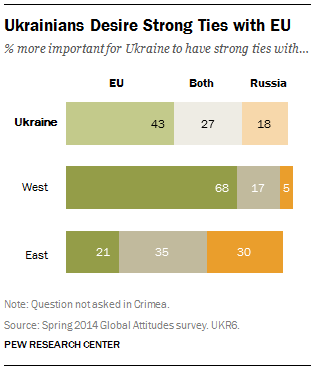
Ukrainians Desire Strong Ties with EU

Not including Crimea, a plurality of Ukrainians (43%) say it is more important to have strong ties with the EU instead of Russia. Less than half as many prioritize relations with Russia (18%), while 27% say it is important for Ukraine to have strong ties with both.

Residents of western Ukraine are the most supportive of strong ties with the EU (68%) – just 5% say relations with Russia should take precedence. Eastern Ukrainians are divided: roughly two-in-ten (21%) say good relations with the EU are more important, 30% say the same about ties to Russia and 35% say both relationships are important. Within the east, Russian-only speakers lean more toward Russia (42%) than the EU (12%), although a sizable percentage says both (34%).

In addition to these regional divisions, younger Ukrainians, ages 18-29, are more likely to prefer strong ties with the EU (53%) than those 50 or older (36%).

Wariness toward Foreign Influence

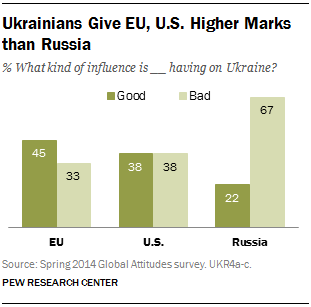
Ukrainians Give EU, U.S. Higher Marks than Russia

Among the foreign nations and organizations asked about in the survey, the EU receives the highest rating for having a positive influence on Ukraine, with particularly high ratings in the western part of the country. Still, fewer than half of Ukrainians (45%) overall say the EU is having a good impact on their country. This result is similar to the last time the question was asked in 2009 (40% good), even as negative evaluations have roughly doubled over the past five years from 15% in 2009 to 33% today.

Nearly four-in-ten (38%) give the U.S. positive reviews for its role in Ukraine, but the same percentage (38%) says American influence is bad. Unlike the EU, evaluations of the U.S. have improved, increasing from 24% to 38% positive between 2009 and 2014.

Russia’s image, by contrast, has sharply declined over the same period. In 2009, 46% of Ukrainians thought Russia was having a good influence on the way things were going in their country, while just a quarter saw Russia’s role as negative. Today, opinion has reversed: just 22% say Russia’s impact is positive, compared with two-thirds who say Russia’s influence is very bad (49%) or mostly bad (18%).

Unfavorable opinion of Russia may be linked, in part, to doubts that the Kremlin sincerely cares about civil liberties in Ukraine, let alone in Russia itself. When asked, six-in-ten Ukrainians respond that Moscow does not respect the personal freedoms of its own citizens.

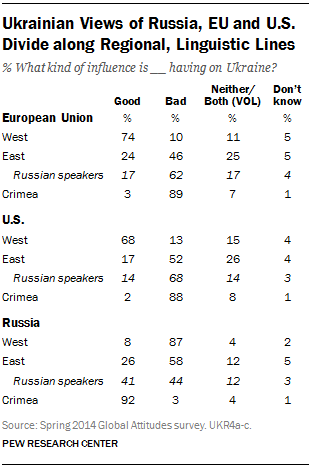
Ukrainian Views of Russia, EU and U.S. Divide along Regional, Linguistic Lines

Within Ukraine, there are deep regional and language divides over the influence of foreign nations and organizations. Western Ukrainians are much more positive toward the EU (74%) and the U.S. (68%) than those in the east (24% for EU, 17% for U.S.). Meanwhile, residents of Crimea overwhelmingly rate the EU and the U.S. as having a negative influence on Crimea (89% bad for EU, 88% bad for U.S.).

Regarding Russia, majorities in both western and eastern Ukraine say their neighbor is having a bad influence on Ukraine (87% and 58%, respectively). Russian-only speakers in the east are divided on Moscow’s influence (41% good, 44% bad), but notably give higher marks to Russia than they do to either the EU (17% good) or the U.S. (14%).

When asked separately about Russia’s influence on their territory, Crimeans are unequivocal in describing Moscow’s impact as positive (92%).

Crisis in International Leadership

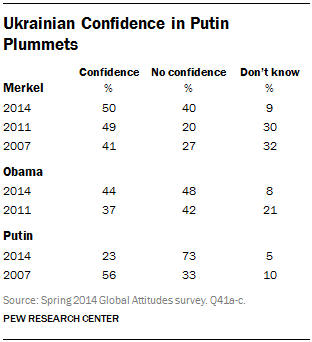
Ukrainian Confidence in Putin Plummets

The public in Ukraine has little confidence in some of the key international leaders involved in the nation’s crisis. Vladimir Putin, in particular, fares poorly. Just 23% of Ukrainians have confidence in the Russian president to do the right thing when it comes to world affairs – down 33 percentage points since the question was last asked in 2007.

Few Ukrainians in either the country’s west or east have faith in Putin (7% and 28%, respectively). However, trust in Putin is significantly higher among Russian-only speakers in eastern Ukraine (43% confidence). By contrast, Crimeans are clearly enamored of Putin: 93% express confidence in the Russian president, including 80% who say they have a great deal of confidence in his handling of foreign affairs.

Looking to the U.S. and Western Europe, Ukrainian opinion of U.S. President Obama remains divided, much as it was three years ago. Today, 44% express confidence in him and 48% do not. As in recent years, German Chancellor Merkel is generally trusted, with 50% of Ukrainians expressing faith in her decision-making on foreign affairs. However, lack of confidence in the German leader has increased from 20% in 2011 to 40% today.

Western Ukrainians express much more confidence in the German head of state (71%) and the American president (70%) than easterners (37% and 27%, respectively). Again, Russian-only speakers in the east express less positive attitudes toward the German and U.S. leaders than Vladimir Putin. Just 27% of Russian-only speakers in the east say they have confidence in Merkel, while 19% say the same about Obama. In Crimea, few trust either Merkel (13%) or Obama (4%).

Chapter 3. Russia: Public Backs Putin, Crimea’s Secession

Russian President Vladimir Putin’s handling of the crisis in Ukraine has met with considerable opposition in Western nations and much of the international community, as well as in Ukraine itself, but Russians have largely rallied around their leader. Putin is overwhelmingly popular, and Russian national pride appears to be on the rise. In fact, a plurality thinks Putin’s handling of the crisis has improved Russia’s international stature.

Russians Express Confidence in Putin

A large majority of Russians believe the recent referendum in Crimea was free and fair, and that Kyiv (Kiev) should accept the results and allow Crimea to join Russia. Crimea is only one of Russia’s territorial grievances, and as they have in previous surveys, a majority of Russians say they believe there are parts of neighboring countries that really belong to Russia.

Meanwhile, tensions with the West have led to a dramatic spike in negative views about the U.S. and the European Union. Similarly, both U.S. President Barack Obama and German Chancellor Angela Merkel are held in low regard.

High Ratings for Putin

Roughly eight-in-ten Russians (83%) say they have confidence in President Putin to do the right thing in world affairs, up from 69% in 2012, the last time this question was asked. Fully 52% say they have a lot of confidence in the Russian leader, compared with 37% two years ago.

However, Putin has received similarly high ratings before. For instance, in 2008, when Putin was nearing the end of his second term as president, his ratings were nearly identical – 83% said they had confidence in him and 53% expressed a lot of confidence.

Russians Say Crimea Should Be Allowed to Join Russia

Russians Overwhelmingly Say Kyiv Should Recognize Crimea Referendum

Few in the international community have recognized the legitimacy of the March 16th referendum in which Crimeans voted to leave Ukraine and join Russia. Russians, however, see the issue very differently. More than eight-in-ten (84%) say the referendum was free and fair. And roughly nine-in-ten (89%) think the Ukrainian government in Kyiv should recognize the results and allow Crimea to join Russia.

Throughout the crisis, many in the Russian government and media have expressed concern about the treatment of Russian minorities within Ukraine. (The Ukrainian government strongly disputes allegations of mistreatment). The survey findings suggest most Russians agree with the Kremlin’s criticisms: nearly three-in-four Russians (73%) say the government in Kyiv does not respect the personal freedoms of its people.

Few See Crisis Hurting Russia’s Image

Many Say Ukraine Crisis Has Improved Russia’s Reputation

A 43%-plurality of Russians say that President Putin’s handling of the situation in Ukraine has led people in other countries to have a more positive opinion of Russia. Just 26% believe the way Putin has handled the crisis has led people in other nations to have a less favorable view. Another 22% say there has been no impact on Russia’s international image.

Russians’ views of their own country have become more positive over the last year. Roughly half (51%) now have a very favorable opinion of their homeland, compared with 29% in 2013.

Russian views about how their government treats its citizens are now also largely positive – 57% say the government respects the personal freedoms of its people, while 32% believe it does not. This is a significant change from 2008, when the public was essentially divided, with 45% saying the Russian government respected the rights of its people, and 44% saying it did not.

Ratings Up for Russian Military

Military Influence

The Russian military receives overwhelmingly positive ratings. Nearly eight-in-ten Russians (78%) say the military is having a good influence on the country. A dozen years ago, when the Pew Research Center first asked this question, views were more mixed – at that time, 53% described the military’s impact as positive, while 34% said it was negative.

Almost two-thirds of Russians (65%) say that military force is sometimes necessary to maintain order in the world. Just 29% disagree with this view. This is a notable change from 2011, when 52% agreed force was sometimes necessary, while 38% disagreed with this position.

Nostalgia for the Soviet Era

Misfortune USSR Does Not Exist

In the past, Vladimir Putin has described the collapse of the Soviet Union as a “catastrophe,” and many Russians seem to concur. A 55%-majority agree with the statement: “It is a great misfortune that the Soviet Union no longer exists.” Views on this question have been relatively steady since Pew Research first asked it five years ago. In 2009, 58% described the collapse of the USSR as a great misfortune, and 50% expressed this opinion in 2011.

Nostalgia for the Soviet era is particularly common among older Russians. About seven-in-ten Russians age 50 and older (71%) characterize the end of the Soviet Union as a great misfortune, compared with 46% of people ages 30 to 49 and 40% of those under 30.

Most Say Parts of Other Countries Belong to Russia

The dissolution of the Soviet Union led to a redrawing of political maps throughout the former Eastern Bloc, and Russians clearly believe that parts of their country were unfairly lost in the process. Roughly six-in-ten (61%) agree with the statement “There are parts of neighboring countries that really belong to us.” Only 28% disagree.

Views on this question have remained largely consistent since 2002. However, results were quite different in the early 1990s, as the Soviet empire dissolved. For instance, in a fall 1992 poll, conducted by the Times Mirror Center for the People & the Press less than a year after the Soviet Union’s demise, just 36% agreed that parts of neighboring countries belonged to Russia while 26% disagreed. Nearly four-in-ten (37%) offered no opinion.

Interestingly, 48% of Russians believe areas of Russia that wish to secede should be allowed to do so, while only 39% say such regions should not be allowed to break away. Urban respondents (52%) are somewhat more likely than those in rural areas (38%) to think regions should be allowed to secede.

Increasingly Negative Views of U.S., EU

U.S. Image Plummets in Russia

Russian opinions of the U.S. are at their lowest point since Pew Research began polling in Russia 12 years ago. Only 23% give the U.S. a favorable rating, down sharply from 51% last year.

Previously, the lowest favorability rating for the U.S. was 37%, registered in May 2003, shortly after the start of the Iraq war, when ratings for the U.S. were at a nadir in many countries.

Attitudes toward the U.S. are slightly more positive among people under 30 (29% favorable) than among those age 50 and older (19%). Still, even among 18-29 year-olds, a solid majority (64%) express an unfavorable opinion.

Negative Ratings for Obama in Russia

Ratings for President Obama are also negative. Only 15% of Russians say they have confidence in the American leader to do the right thing in world affairs.

Eight-in-ten lack confidence in Obama, up from 51% last year and 44% in 2012.

Attitudes toward the EU have also turned sharply negative. Only 39% of Russians express a favorable opinion of the institution, down from 64% in 2011.

Russians Sour on U.S., EU and Germany

Ratings for Germany have also declined. About half of Russians (53%) still have a favorable opinion of Germany, but this is down from the 78% registered in 2011. Just 31% say they are confident German Chancellor Angela Merkel will do the right thing in world affairs, compared with 48% in 2012.

Methods in Detail

About the 2014 Spring Pew Global Attitudes Survey

Results for the survey are based on face-to-face interviews conducted under the direction of Princeton Survey Research Associates International. Survey results are based on national samples. For further details on sample designs, see below.

The descriptions below show the margin of sampling error based on all interviews conducted in that country. For results based on the full sample in a given country, one can say with 95% confidence that the error attributable to sampling and other random effects is plus or minus the margin of error. In addition to sampling error, one should bear in mind that question wording and practical difficulties in conducting surveys can introduce error or bias into the findings of opinion polls.

Country: Russia
Sample design: Multi-stage cluster sample stratified by Russia’s eight geographic regions, plus the cities of Moscow and St. Petersburg, and by urban-rural status.
Mode: Face-to-face adults 18 plus
Language: Russian
Fieldwork dates: April 4 – April 20, 2014
Sample size: 1,000
Margin of error: +/-3.6 percentage points
Representative: Adult population (excludes Chechen Republic, Ingush Republic and remote territories in the Far North – together, roughly 3% of the population)
Country: Ukraine
Sample design: Multi-stage cluster sample stratified by Ukraine’s six regions plus ten of the largest cities – Kyiv (Kiev), Kharkiv, Dnipropetrovsk, Odessa, Donetsk, Zaporizhia, Lviv, Kryvyi Rih, Lugansk, and Mikolayiv – as well as three cities on the Crimean peninsula – Simferopol, Sevastopol, and Kerch.
Mode: Face-to-face adults 18 plus
Languages: Russian, Ukrainian
Fieldwork dates: April 5 – April 23, 2014
Sample size: 1,659
Margin of error: +/-3.3 percentage points
Representative: Adult population (Survey includes oversamples of Crimea and of the South, East and Southeast regions. The data were weighted to reflect the actual regional distribution in Ukraine)