
Pew Research Center

FOR RELEASE OCTOBER 24, 2013

Survey Methods

About the 2013 Spring Pew Global Attitudes Survey Results for the survey are based on face-to-face interviews conducted under the direction of Princeton Survey Research Associates International. Survey results are based on national samples. For further details on sample designs, see below. The descriptions below show the margin of sampling error based on all interviews […]

FOR MEDIA OR OTHER INQUIRIES:

Communications Department
202.419.4372
www.pewresearch.org

RECOMMENDED CITATION

Pew Research Center, October 2013, "Survey Methods"

About Pew Research Center

Pew Research Center is a nonpartisan, nonadvocacy fact tank that informs the public about the issues, attitudes and trends shaping the world. It does not take policy positions. The Center conducts public opinion polling, demographic research, computational social science research and other data-driven research. It studies politics and policy; news habits and media; the internet and technology; religion; race and ethnicity; international affairs; social, demographic and economic trends; science; research methodology and data science; and immigration and migration. Pew Research Center is a subsidiary of The Pew Charitable Trusts, its primary funder.

© Pew Research Center 2026

Table of contents

  • About Pew Research Center

Survey Methods

About the 2013 Spring Pew Global Attitudes Survey Results for the survey are based on face-to-face interviews conducted under the direction of Princeton Survey Research Associates International. Survey results are based on national samples. For further details on sample designs, see below. The descriptions below show the margin of sampling error based on all interviews […]

About the 2013 Spring Pew Global Attitudes Survey

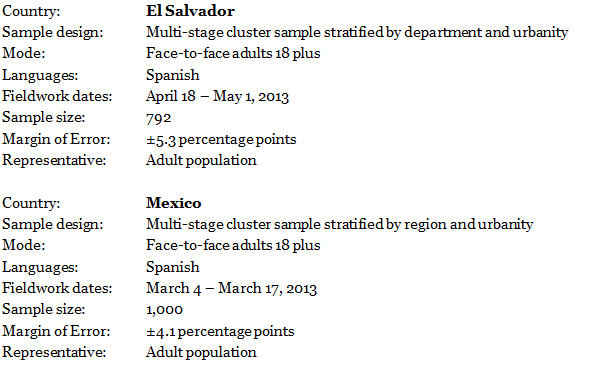
Results for the survey are based on face-to-face interviews conducted under the direction of Princeton Survey Research Associates International. Survey results are based on national samples. For further details on sample designs, see below.

The descriptions below show the margin of sampling error based on all interviews conducted in that country. For results based on the full sample in a given country, one can say with 95% confidence that the error attributable to sampling and other random effects is plus or minus the margin of error. In addition to sampling error, one should bear in mind that question wording and practical difficulties in conducting surveys can introduce error or bias into the findings of opinion polls.
Mex-ElSal 20