Pew Research Center

FOR RELEASE MAY 23, 2013

Economies of Emerging Markets Better Rated During Difficult Times

Overview Publics around the world are decidedly unhappy about their nations’ economies. Most are displeased with current economic conditions and concerned about rising economic inequality; few are optimistic about the coming year. However, at the same time, most global publics say their personal finances are in better shape than their national economies, according to a […]

FOR MEDIA OR OTHER INQUIRIES:

Communications Department
202.419.4372
www.pewresearch.org

RECOMMENDED CITATION

Pew Research Center, May 2013, "Economies of Emerging Markets Better Rated During Difficult Times"

About Pew Research Center

Pew Research Center is a nonpartisan, nonadvocacy fact tank that informs the public about the issues, attitudes and trends shaping the world. It does not take policy positions. The Center conducts public opinion polling, demographic research, computational social science research and other data-driven research. It studies politics and policy; news habits and media; the internet and technology; religion; race and ethnicity; international affairs; social, demographic and economic trends; science; research methodology and data science; and immigration and migration. Pew Research Center is a subsidiary of The Pew Charitable Trusts, its primary funder.

© Pew Research Center 2026

Table of contents

  • About Pew Research Center
  • Economies of Emerging Markets Better Rated During Difficult Times
  • Chapter 1. National and Economic Conditions
  • Chapter 2. Personal Economic Conditions
  • Chapter 3. Inequality and Economic Mobility
  • Chapter 4. Regional Breakdowns
  • Survey Methods
  • Appendix

Economies of Emerging Markets Better Rated During Difficult Times

Overview Publics around the world are decidedly unhappy about their nations’ economies. Most are displeased with current economic conditions and concerned about rising economic inequality; few are optimistic about the coming year. However, at the same time, most global publics say their personal finances are in better shape than their national economies, according to a […]

Overview

ECON44

Publics around the world are decidedly unhappy about their nations’ economies. Most are displeased with current economic conditions and concerned about rising economic inequality; few are optimistic about the coming year. However, at the same time, most global publics say their personal finances are in better shape than their national economies, according to a new 39-nation survey.

But one of the most striking divides in global economic attitudes is that citizens of emerging market countries are overall more pleased with their economies than are people in advanced or developing economies.

In 2013, a median of 53% in emerging markets say their national economy is doing well, compared with 33% in developing countries and 24% in advanced economies. Attitudes are particularly grim in European countries, such as France (9% good), Spain (4%), Italy (3%) and Greece (1%). Publics in emerging markets such as China (88%) and Malaysia (85%) say their economy is doing especially well.

People in emerging markets also appear to have weathered the recent economic downturn more easily than others around the world. Attitudes in these countries have changed very little or even improved between 2007 and 2013. For example, today, 58% of Chileans say their economy is doing well, compared with 49% in 2007. Meanwhile, among countries surveyed in both 2007 and 2013, a median of 49% in the developing economies said the economy was doing well before the crisis, but just 25% say the same today. Similarly, positive ratings of the economy have declined by 20 percentage points in the advanced economies (44% in 2007 vs. 24% in 2013).1

ECON43

Despite unhappiness with the national economy in most countries, many around the world say they are doing well personally. Medians of roughly half or more in each type of economy say their personal finances are good. In the advanced and developing economies, the median percentage who are satisfied with their personal situation is much higher than ratings of the national economy. Among advanced economies, personal financial well-being is rated 34 percentage points higher than national conditions; in the developing countries, the gap is 14 points. And among both the developing and emerging economies, the publics are also optimistic about the future of their personal finances (medians of 53% and 52% say they will improve in the next year, respectively). Only 24% feel the same in the advanced economies.

Nonetheless, despite concerns about their personal economic outlook, people in advanced economies are much less likely than publics in either emerging or developing economies to report lacking the money to purchase food, health care or clothing for their family.

ECON42

Economic inequality is a common concern for publics around the world. Most people agree that the economic system favors the wealthy. Majorities in most countries say the gap between the rich and the poor has increased in the past five years. This attitude is particularly prevalent among those who live in advanced economies. And at least half in most countries say the wealth gap is a very big problem in their nation, with the developing economies expressing especially high levels of anxiety.

Notwithstanding these concerns, nearly every public surveyed wants the government to focus on creating jobs or taming inflation as a top priority, rather than on reducing economic inequality.

These are among the key findings of a new survey by the Pew Research Center conducted in 39 countries among 37,653 respondents from March 2 to May 1, 2013.2

Gloomy Economic Context

ECON41

Publics’ attitudes reflect their economic reality – and the global downturn that started after 2007 has had a profound impact on many countries’ economies. Annual growth rates have slowed over recent years in most nations surveyed. This slowdown has been particularly severe in the advanced economies, which had a median annual growth rate of 3.5% in 2007 but just 1.4% in 2012. Growth has also declined in the developing economies (median of 6.8% to 3.6%) and the emerging markets (median of 6.3% to 3.9%).

Despite a drop in growth rates for the advanced economies, this group of countries continues to be much wealthier than the emerging markets, even as the gap has closed somewhat. And the developing economies continue to be considerably poorer than the two other types of economies.

Dissatisfaction with the Economy

ECON40

Majorities in 26 of the 39 countries surveyed think their economy is faring badly. Among the advanced economies, this includes roughly eight-in-ten or more in Greece (99%), Italy (96%), Spain (96%), France (91%), Britain (83%), the Czech Republic (80%) and South Korea (79%). In the developing economies, the Lebanese (90%), Tunisians (88%) and Pakistanis (81%) express comparable levels of dissatisfaction. Publics in the emerging markets, meanwhile, are less likely to say they are unhappy with their national economies – fewer than half in many of these countries say things are going poorly in their nation.

In many of the advanced and developing economies, economic satisfaction has declined precipitously over the course of the global downturn. Among the advanced economies with comparable data, the biggest declines in positive views of the economy since 2007 have been in Spain (-61 percentage points) and Britain (-54 points). In the developing economies, attitudes among Pakistanis (-42 points) and Egyptians (-30) have soured the most. Many other countries in these two groups have experienced declines of at least 10 points or more.

In the emerging markets, meanwhile, only in Mexico (-13) have good reviews of the economy fallen by more than 10 points since 2007. Everywhere else, the change has either been minimal or the mood has improved.

The emerging markets also tend to be somewhat more optimistic about the coming year than others – a median of 48% say they expect national economic conditions to improve in the next 12 months, while only 17% say things will get worse. A median of roughly four-in-ten (43%) in developing economies also think things will get better, but 21% say they expect the economy to decline. The advanced economies are the most pessimistic – a median of just 25% say the economy is going to improve, while nearly a third (32%) think things will get worse in the coming year. The Greeks (64%) and French (61%) are the most pessimistic about the next 12 months.

ECON39

The culprits for these widespread economic woes are both a lack of employment opportunities and rising prices. Creating jobs is clearly the top priority among the publics in advanced and developing economies (medians of 49% and 44%, respectively). However, people in emerging markets are more divided – a median of 33% name employment as the top priority while an equal percentage says the same about inflation.

Personal Finances Better than National Economy

ECON38

Despite gloomy national conditions, many say their personal economic situation is good. This is one area where the emerging markets are not alone in their positive attitudes – a median of 57% among emerging market publics say things are going well personally, and a nearly equal percentage (58%) among the advanced economies feels good about their family finances. Publics in developing economies are somewhat less satisfied with their personal situation (47%).

Publics’ positive views of their personal situation have also changed little during the recession. Among the 20 countries surveyed in 2008, the first time the question was asked, and in 2013, satisfaction with personal finances declined by 10 percentage points or more in only five countries – Poland (-19 percentage points), Spain (-17 points), Mexico (-12 points), Pakistan (-11 points) and France (-10 points). Meanwhile, among some publics – especially in the emerging markets – positive reviews of their personal finances have gone up since 2008, including by 12 percentage points in Turkey, nine points in Indonesia, eight points in South Africa and six points in Argentina.

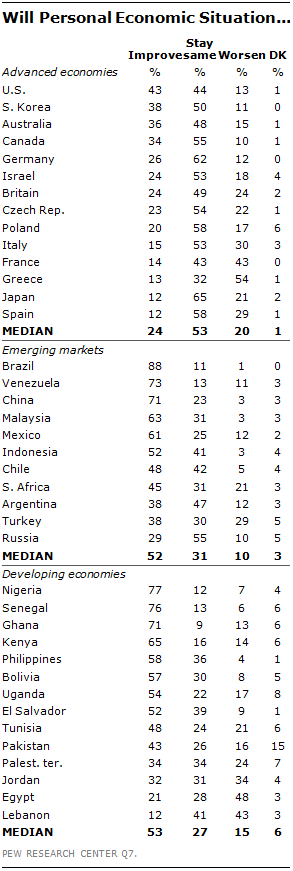
In addition, many are optimistic about their personal future. Medians of at least half in the developing economies (53%) and the emerging markets (52%) say they expect their own finances to improve over the next year. Publics in the advanced economies, however, are decidedly less optimistic about their personal outlook – a median of just 24% expect their own finances to get better in the next 12 months.

ECON37

While people in advanced economies are most bearish about their economic situation, they report very low levels of deprivation relative to others around the world, including people in emerging nations who are more positive and optimistic about economic conditions.

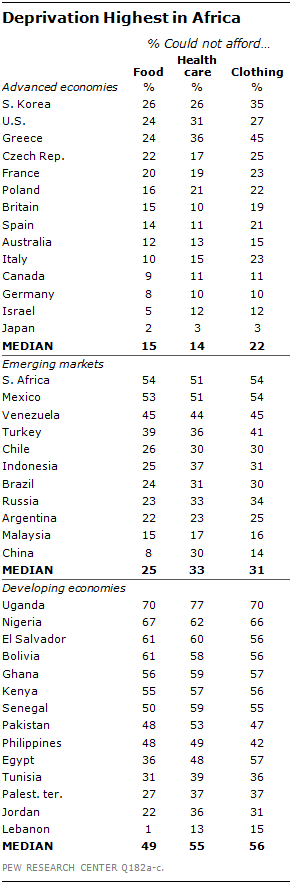
Medians of roughly two-in-ten or fewer in advanced economies say they have been unable to afford the food, clothing or health care their families needed at some point in the past year. In the emerging markets and the developing economies, reports of deprivation are much higher. Among the emerging markets, medians of at least a quarter say they have had trouble getting basic necessities for their families. In the developing economies, roughly half or more in most countries report not being able to afford food, health care or clothing, especially in the African nations surveyed.

Reports of deprivation are closely related to national wealth. For example, in Australia, Canada and Germany – three of the richest countries surveyed in terms of 2012 GDP per capita – roughly one-in-ten or fewer have struggled in the past year to afford food. Meanwhile, in Uganda, Kenya and Senegal – among the poorest countries surveyed – half or more say food for their family has been hard to come by.

The United States is a clear outlier from this pattern. Despite being the richest country in the survey, nearly a quarter of Americans (24%) say they had trouble putting food on the table in the past 12 months. This reported level of deprivation is closer to that in Indonesia or Greece rather than Britain or Canada.

ECON36

Inequality Seen as Rising

ECON35

Even though inequality is not a top priority, it is a major concern for the publics surveyed. Clear majorities in most countries say the gap between the rich and the poor is a very big problem for their nation. Concern is especially high in developing economies, where a median of 74% say they are very worried. Somewhat fewer – though still high percentages – say the same in the emerging markets (67%) and the advanced economies (53%).

In addition, broad majorities in 31 of the 39 countries surveyed say the income gap has increased over the past five years. Reports of a rise in income inequality are particularly high in the advanced economies, where a median of 80% say things have gotten worse, compared with medians of 70% in the developing economies and 59% in the emerging markets.

An uneven distribution of wealth in a country may be due to an imbalanced economic system. Roughly two-thirds or more in most countries say their economic system favors the wealthy. Only in Malaysia (56%), Venezuela (53%) and Australia (51%) do at least half say the economic system is fair to most people in their country.

People are also skeptical about the potential for the next generation to move up. Across the 39 countries surveyed, fewer than half in 25 countries believe their nation’s children will be better off financially than their parents. Despair over the future is particularly high in the advanced economies, where roughly four-in-ten or fewer say things will get better for young people. Among this group, South Korea is the sole exception – 56% think children will be better off.

Chapter 1. National and Economic Conditions

Across the globe, few are happy with the direction of their country – less than half in 34 of the 39 countries surveyed say things are going well. Satisfaction is particularly low in advanced and developing economies, while publics in emerging markets tend to be somewhat more content.

Among the advanced economies, only in Germany (57%) and Canada (55%) do more than half of those surveyed say their country is moving in the right direction. In most countries, a third or fewer are satisfied with their nation’s path, including just 5% of the Spanish, 3% of Italians and 2% of Greeks.

Similarly, roughly four-in-ten or fewer in most of the developing economies surveyed say things are going well in their countries. Tunisians (13% satisfied), Palestinians (12%), Nigerians (12%), Lebanese (11%) and Pakistanis (8%) are particularly disappointed.

Overall, country satisfaction is somewhat higher in the emerging markets – at least three-in-ten in most countries say their nation is on the right track. Nonetheless, even among this group, few publics give positive reviews of how things are going in their country. The Chinese (85%) and Malaysians (82%) stand out as particularly satisfied, but nowhere else does a clear majority say their country is moving in the right direction.

Widespread Dissatisfaction with Economy

ECON33

Publics around the world are also unhappy with the current economic situation in their nations. Fewer than half in 27 of the 39 countries surveyed say their economy is doing well. People in advanced economies are very dissatisfied with the economic performance of their nation, particularly in European countries as well as Japan and South Korea. Germans, Canadians and Australians, meanwhile, stand out as especially satisfied, with two-thirds or more saying things are going well.

Among the developing economies surveyed, economic attitudes are also grim. Things look particularly bleak in the Middle East, including Egypt (23% good), the Palestinian territories (22%), Tunisia (11%) and Lebanon (10%). Only in the Philippines (68%), Bolivia (54%) and Kenya (52%) do roughly half or more say the economy is doing well.

Emerging market nations, by contrast, are more satisfied with current economic conditions. In many of these countries, more than half say their economy is doing well, including clear majorities in China (88%), Malaysia (85%), Brazil (59%) and Chile (58%). However, in Venezuela (44%), Argentina (39%), Mexico (38%), Indonesia (37%) and Russia (33%), fewer than half say the same.

Little Hope for the Coming Year

ECON32

In addition to publics’ relatively grim assessment of current conditions, many across the globe are skeptical that things will improve over the next 12 months. Fewer than half in 28 of the 39 countries surveyed expect the economy will get better in the next year.

Optimism is particularly low in the advanced economies. In every country surveyed in this group, four-in-ten or fewer say the economy will get better in the next year, with the exception of Americans (44%), who are only slightly more optimistic. Europeans continue to stand out as particularly despairing over their economy, with fewer than two-in-ten who say things will improve in Italy (19%), Poland (15%), the Czech Republic (15%), Greece (14%) and France (12%).

Overall, publics in both the developing economies and emerging markets tend to be more optimistic. In the emerging markets, majorities in China (80%), Brazil (79%), Venezuela (64%), Malaysia (64%) and Mexico (56%) say things will get better in the coming months. However, less than a third agree in Argentina (29%) and Russia (24%).

Among the developing economies, many in the African nations surveyed predict conditions will improve, including roughly six-in-ten or more in Senegal (69%), Nigeria (66%), Ghana (60%) and Kenya (59%). Meanwhile, publics in the Middle East tend to be less optimistic, such as the Jordanians (28% improve), Palestinians (27%) and Lebanese (19%).

Jobs and Prices Are Major Problems

Among the four economic issues asked about on the survey – inflation, unemployment, inequality and public debt – a lack of employment opportunities and rising prices emerge as the major problems that concern publics. Two-thirds or more in most countries say these two issues are very big problems.

ECON31

In 11 of the 14 developing economies, more than eight-in-ten say that unemployment is a very big problem. In the emerging markets – despite a higher level of satisfaction with their economic conditions – a median of 76% are very concerned about jobs, including eight-in-ten or more in South Africa (87%), Venezuela (85%), Mexico (82%) and Chile (80%). And unemployment is also a leading worry in the advanced economies (median of 68%), particularly in the European countries of Greece (99%), Italy (97%), Spain (94%) and France (80%).

Inflation is seen as another big challenge around the world, though people in advanced economies tend to be less preoccupied with rising prices. Medians of more than eight-in-ten in the developing economies (88%) and the emerging markets (83%) say rising prices are a very big problem in their country. Among these countries, concern about inflation is expressed by nearly everyone in Pakistan (99%) and Senegal (97%). In advanced economies, a smaller median of 57% are very worried about rising prices, but concern is particularly high in Greece (94%), Italy (84%), Israel (70%), Spain (69%) and France (68%).

In most countries, people are somewhat less worried about economic inequality and public debt. Nonetheless, at least two-thirds in 18 of the 39 countries say the gap between the rich and the poor is a very big problem. Lebanese (86%), Pakistanis (85%), Greeks (84%), Tunisians (82%) and Ghanaians (81%) are especially concerned about inequality. Similarly, two-thirds or more in 18 countries say public debt is a top challenge for their nation. In particular, publics in Greece (92%), Lebanon (89%), Italy (84%), Pakistan (82%) and the Philippines (81%) are very worried about public debt.

ECON30

When asked which of the four issues – inflation, unemployment, inequality or debt – the government should address first, nearly every public surveyed says jobs or rising prices.

Among the advanced economies, dealing with unemployment is the top priority in almost every country. Roughly six-in-ten or more agree this should be the government’s main focus in Spain, Italy, the Czech Republic and Poland. The two exceptions to this pattern are Israel, where more people want their government to focus on inflation, and Germany, where the top priority is inequality.

Similarly, many publics in the developing economies prioritize addressing the issue of jobs. In nine of the 14 countries surveyed, at least four-in-ten say unemployment should be the government’s first concern. However, inflation rises to a top priority for Pakistanis, Tunisians and Jordanians.

Attitudes are more divided among the emerging markets. In four of the 11 nations surveyed, pluralities place more of a priority on unemployment. The issue of rising prices tops the list in another four countries. And in the remaining three countries, opinion is split.

Chapter 2. Personal Economic Conditions

While assessments of national economic conditions are quite negative in many parts of the world, people are generally more positive about their personal finances. At least half in 23 of the 39 countries surveyed say their personal economic situation is good. Overall, people in economically advanced nations and emerging markets are more likely than those from developing countries to describe their personal situations positively.

Among wealthier nations, Canadians, Germans and Australians stand out as especially satisfied with their personal finances. All three also tend to have more positive views about the state of their national economies.

While Americans and the British tend to give negative assessments of national economic conditions, more than six-in-ten describe their personal situations as good.

The economically advanced nations with the most negative evaluations are Italy, Poland, South Korea, Japan and especially Greece – only 15% of Greeks say their personal economic situation is good, the lowest percentage among the 39 nations surveyed.

Looking at countries where trends are available from 2008, there have been significant changes in some European Union nations. The percentage of people describing their circumstances as good has fallen by double digits since 2008 in Poland (-19 points), Spain (-17), and France (-10). At the same time, it has increased by 10 percentage points in Germany.

In nine of the 11 emerging nations polled, more than half say their situation is good. Evaluations are especially positive in Malaysia, Brazil and China.

While personal assessments are generally less positive in developing nations, there are nonetheless several countries where solid majorities rate their personal economic circumstances favorably, including the Philippines, Bolivia, Senegal and Pakistan. In contrast, ratings are especially negative in the Arab nations of Jordan, Lebanon and Egypt.

Developing, Emerging Countries Optimistic about Future

ECON28

People in the poorest countries tend to be the most optimistic about their personal economic future. Across the 14 developing nations, a median of 53% believe their economic situation will improve in the next 12 months, 27% think it will stay the same and only 15% say it will get worse.

More than six-in-ten believe things will get better in four sub-Saharan African nations: Nigeria, Senegal, Ghana and Kenya. However, fewer than four-in-ten hold this view in four nations at the heart of the Middle East: Lebanon, Egypt, Jordan and the Palestinian territories.

In emerging markets, views also tend to be optimistic. A median of 52% think their personal economic situation will improve over the next 12 months, while 31% believe it will stay the same and just 10% expect it to worsen.

Brazilians are the most optimistic public surveyed: 88% predict their situation will improve in the coming 12 months. Venezuelan (73% improve), Chinese (71%), Malaysian (63%) and Mexican (61%) respondents are also optimistic. Among emerging nations, Argentines, Turks and Russians are the least likely to say things will improve.

In economically advanced countries, there is relatively little optimism – in fact, there is no advanced economy in which a majority of people expect their situation to improve over the next 12 months.

In Greece, more than half (54%) think their personal economic situation will grow worse. Assessments are also especially grim in France, Italy and Spain. Meanwhile, Americans are the most optimistic, followed by South Koreans, Australians and Canadians.

Many in Developing Nations Unable to Afford Necessities

ECON27

Questions measuring deprivation highlight the extent to which many people in developing nations struggle to afford life’s basic necessities. Across the 14 developing countries surveyed, a median of 49% say there have been times during the past year when they did not have enough money to buy food for their family. A median of 55% report there have been times when they could not afford health care, and 56% say this about clothing.

Deprivation is especially high in Africa. For instance, at least seven-in-ten Ugandans have been unable to purchase food, health care or clothing in the past year. At least half say the same in Nigeria, Ghana, Kenya and Senegal. Similarly, in emerging market South Africa, more than half report difficulties in buying basic necessities.

But these problems are hardly limited to Africa. In El Salvador and Bolivia, for example, majorities have been unable to afford food, health care or clothing. And at least half say the same in emerging nation Mexico.

And while deprivation levels are much lower in wealthier countries, significant minorities are nonetheless unable to afford food, health care or clothing. More than one-in-five in South Korea, the United States and Greece report being unable to buy these things for their families within the past year.

Chapter 3. Inequality and Economic Mobility

Inequality is on the rise in most advanced economies, according to the Organization for Economic Cooperation and Development (OECD) in Paris. People at the upper end of the income and wealth distribution in most societies receive far more income and control significantly more wealth than those at the lower end. A 2013 report from the OECD shows that income inequality among OECD countries “has increased by more over the past three years to the end of 2010 than in the previous twelve.” The increase has been especially large in many of the countries that have been hit hardest by the economic crisis, including Spain and Greece, as well as in France.

[emerging economies]

Latin America is the exception. Income inequality is actually falling in most countries in the region, according to the World Bank. In the first decade of the 21st century, inequality fell in Mexico, Argentina, Brazil, El Salvador, Bolivia and Chile. “This is not just a statistical anomaly,” said Augusto de la Torre, the World Bank’s chief economist for Latin America and the Caribbean. “It is a significant reduction in inequality.”

Economic mobility – long seen as an antidote to inequality in many societies – varies among economies. A 2010 OECD report concluded that among OECD countries: “Low mobility across generations, as measured by a close link between parents’ and children’s earnings, is particularly pronounced in the United Kingdom, Italy, the United States and France, while mobility is higher in the Nordic countries, Australia and Canada.”

ECON46

Meanwhile, people in developing nations are the most worried about the current gap between the rich and the poor. Those surveyed in advanced economies are the most likely to believe that inequality has grown over the past five years. And people in advanced economies, emerging markets and developing countries all agree that the economic system generally favors the wealthy. Nevertheless, reducing inequality is a relatively low public priority for governmental action across most countries and types of economy. Only in Germany do people want their leaders to first focus on narrowing the gap between the rich and the poor.

Notably, in Greece, Italy and Spain, three victims of the euro crisis, concern about inequality is quite high. And, overall, the highest level of anxiety is expressed by the Lebanese and Pakistanis.

Malaysians are one of the least troubled with inequality. They are among the least concerned about it as a problem, the least likely to think it is growing, and one of the least likely to say the economic system is unfair.

Publics also differ over whether economic mobility will enable children to be better off than their parents. Many people in advanced economies think kids will be worse off. A median of roughly six-in-ten of those surveyed in 11 emerging markets believe children will do better, as do 45% in 14 developing nations.

Inequality Is a Major Concern

ECON25

In 31 of the 39 countries surveyed, half or more of the population believe that the gap between the rich and the poor is a very big problem in their societies.

This is particularly true in developing economies, where a median of 74% cite inequality as a major issue. This includes 86% of Lebanese, 85% of Pakistanis and 82% of Tunisians, as well as 81% of Ghanaians and 78% of Nigerians and Senegalese.

Publics in the emerging markets are also very concerned about the gap between the rich and the poor. Clear majorities in eight of the 11 countries surveyed say this issue is a very big problem for their nation, including 79% of Chileans and 75% of Brazilians.

The range of opinion about the wealth gap is quite wide in advanced economies, where 84% of Greeks say inequality is a very big problem, but only 47% of Americans and 45% of Canadians agree.

Rich-Poor Gap Seen as Increasing

ECON24

Publics are also broadly convinced that the gap between the rich and the poor has increased in the past five years.

This concern is particularly prevalent in advanced economies, where a median of 80% believe inequality has gotten worse. Europeans overwhelmingly hold such sentiments: nine-in-ten Spanish (90%) and almost as many Germans (88%), Italians (88%) and Greeks (88%) say the rich-poor gap is getting bigger. But only 66% of Americans, 64% of Australians and 58% of Japanese agree.

Emerging market economies (median of 59%) are the least likely to think the gap between the rich and the poor has gotten worse in recent years. This may be driven in part by the particular emerging markets surveyed in Latin America, a region where the World Bank reported a decline in inequality. By comparison, roughly two-thirds of Chinese (69%) say inequality is growing in their society.

Malaysians (32%), Bolivians (32%), Salvadorans (38%) and Venezuelans (40%) are the least likely among the 39 publics surveyed to think inequality has risen in the past half decade. And in most of these countries – as well as Brazil (25%) – roughly a quarter of the public surveyed thinks the rich-poor gap has actually declined over that period.

Notably, some of the countries with the least intense concern about inequality are also nations with the greatest perception that the rich-poor gap has grown: Germany, Canada and Australia.

System Favors the Wealthy

ECON23

Publics in advanced (median of 74%), emerging (70%) and developing (70%) economies are mostly in agreement that the current economic system generally favors the wealthy and is not fair to most people in their country.

This antagonism toward the established economic order is particularly strong in Greece (95%) and Ghana (94%). Among advanced economies, such frustration is notable in southern Europe, particularly Spain (89%) and Italy (86%) in addition to Greece.

The greatest satisfaction with the economic system can be found in Malaysia (56%), Venezuela (53%) and Australia (51%), where about half or more of the public actually thinks the current economic order is fair to most people.

Reducing Inequality Not a Priority

Despite widespread concern about inequality, a belief that it is on the rise and a sense that the economic system is unfair, in no country does a majority believe that narrowing the gap between the rich and the poor should be the government’s number one priority. And only in Germany does even a plurality believe this should be a major policy objective. (Creating more employment opportunities is overwhelmingly the priority of publics in advanced economies and a strong priority in developing countries as well. In emerging markets, publics are split over whether the priority should be jobs or curbing inflation.)

About a quarter of Chinese (26%) and Koreans (24%) would make reducing inequality their government’s main priority, among the options tested. About a fifth of the Canadians (22%), the French (21%) and Chileans (21%) agree. A much longer list of publics accord a low priority to closing the rich-poor gap, including Filipinos (3%), Palestinians (3%) and Venezuelans (3%).

Contrasting Ghanaian perceptions is illustrative. Fully 81% of Ghanaians say the gap between the rich and the poor is a very big problem, above the developing country median. But only 6% see it as their biggest priority for government action. This may be because they are even more worried about joblessness and inflation.

Real Divisions in Faithin Economic Mobility

ECON22

Differences over generational economic mobility divide publics in rich economies from those in both societies on the rise and in developing economies. Nearly two-thirds (median of 64%) of those surveyed in advanced economies think that children will be worse off when they grow up than their parents. Meanwhile, 58% of publics in emerging markets believe kids will be better off, as do 45% of those in developing economies.

In just two of the 14 advanced economies surveyed – South Korea (56%) and Israel (41%) – are publics more likely than not to think children will be better off economically. Meanwhile, in seven of 11 emerging markets, respondents are more likely than not to think kids will outdo the current generation, as are people in eight of 14 developing economies.

There is particularly strong faith in economic mobility in China (82%), Brazil (79%), Chile (76%) and Malaysia (72%), all emerging markets that, with the exception of Brazil, have experienced relatively robust economic growth in recent years.

The single most pessimistic country by far about the economic fortunes of the next generation is France (90%), followed by Japan (76%).

Just 33% of Americans think today’s children will end up better off financially than their parents. Recent economic studies suggest they may be right. The Horatio Alger story that young people can rise from rags to riches in the United States is becoming a myth. A majority of Americans do have an income that exceeds that of their parents’ family incomes, according to a 2012 study by the Pew Charitable Trusts. But that achievement is not always enough to move them up the economic ladder. “Only 4 percent of those raised in the bottom quintile make it all the way to the top as adults,” the study concluded.

Chapter 4. Regional Breakdowns

North American Economic Outlook

ECON60

The North American results of the 39-country 2013 Pew Research Center survey are a tale of one continent but two distinct public moods. By almost every measure, publics in Canada and the United States see the world they are experiencing through different lenses. Canadians are generally happier with their economic lives, although the U.S. public is more optimistic about the future.

More than half of the Canadians (55%) surveyed are satisfied with the way things are going in Canada today. About a third of the public in the United States (31%) is pleased with the direction their country is taking. Two-thirds of Canadians (67%) say their economy is good. Only a third of people in the United States agree. Canadians and the U.S. public also see their personal finances in different lights. Fully 82% of Canadians say they are doing well personally versus 67% of those surveyed in the United States.

However, the U.S. public is more optimistic about national economic conditions: 44% think they will improve over the next 12 months, compared with 29% in Canada. And people in the United States are more upbeat about their personal finances over the next year: 43% believe they will improve versus 34% in Canada.

Canadians and their U.S. cousins see more eye-to-eye on the economic future for children in their societies. But that future is not expected to be good. Only a third of the U.S. public and about a quarter of the Canadian public think children will be better off than their parents.

The U.S. public is more worried than Canadians about all sorts of economic problems. By 51% to 38%, people in the United States fret more about inflation; by 58% to 37%, they complain more about unemployment; and by 61% to 40%, they feel public debt is a major issue. In all three cases, economic statistics suggest the problem is worse in the United States.

Less than half in the United States (47%) and Canada (45%) say the gap between the rich and the poor is a very big problem, among the lowest levels of concern in the current survey. But 66% of the U.S. public and 76% of Canadians think inequality has gotten worse in the past five years. And 61% of people in the United States and 58% of Canadians think that the current economic system favors the wealthy.

In a possible commentary on the differences in the social welfare systems in Canada and the United States, just 9% of Canadians say that there have been times in the past year when they did not have enough money to buy food for their families, compared with 24% of Americans. Similarly, only 11% of Canadians report that there were occasions in the past 12 months when they could not afford health or medical care for their family. Nearly three times as many people in the United States (31%) faced that problem. Similarly, 11% of Canadians complain they did not have the funds to buy clothing for their family in the past year, while 27% of the U.S. public faced that problem.

European Economic Outlook

The euro crisis has had a devastating impact on public opinion in Europe. The European Union economy actually shrank by 0.2% in 2012, according to the International Monetary Fund. And expectations are for no growth in 2013. The public mood in the nine European countries surveyed reflects that grim economic experience. (For more on the economic crisis in the EU, see “The New Sick Man of Europe: the European Union,” released May 13, 2013.)

Among the six geographic regions surveyed, the Europeans are the most dissatisfied with the direction of their country and the most upset about current economic conditions. A median of just 19% of Europeans are happy with how things are going in their nations, with the Germans (57%) the only public where a majority is satisfied. And a median of only 15% of Europeans think their economies are in good shape. The Germans (75%) are again the most content, with the Greeks (1%), the Italians (3%) and the Spanish (4%) the least likely to think economic conditions are good. Europeans (a median of 19%) are also the least likely among the regions surveyed to think their economy will improve over the next 12 months. The French are the gloomiest; just 11% think things will get better. The Germans are the most optimistic, but still only 27% expect economic conditions to improve.

ECON20

Europeans are slightly more upbeat about their personal finances. Roughly half (a median of 51%) say their personal economic situation is good. And this includes 77% of the Germans and 65% of the British. But a median of only 20% of Europeans think that their personal finances will improve over the next year, making them the least optimistic public in any region surveyed.

There is also little confidence in Europe about the economic prospects for children in their societies. A median of just 26% believe that kids today in their country will grow up to be better off financially than their parents. Just 9% of the French see a brighter future for children. The most optimistic for the next generation are the Russians: 40% say children will do better than their parents.

In their sixth year of economic crisis, Europeans are beset with problems. A median of 75% complain that a lack of employment opportunities is a very big problem. This includes 99% of Greeks, whose unemployment rate was 27.0% in February 2013, and 97% of Italians, whose jobless rate was 11.5% in March. The least worried about unemployment are the Germans (28%).

A median of 70% of Europeans are very worried about public debt. This includes 92% of Greeks, whose national debt in 2012 was 156.9% of the gross national product. Notably, the Russians (39%) and the Germans (37%) are the least troubled by public debt.

Majorities in most countries say inflation is a very big problem, a sentiment that corresponds with relatively low inflation rates in most nations. Again the Greeks (94%) are the most concerned and the Germans (31%) the least troubled.

ECON19

A median of nearly six-in-ten (59%) Europeans think the gap between the rich and the poor is a very big economic problem. The least concerned are the British (50%), and the most concerned are the Greeks (84%). Europeans (median of 82%) are the most likely among the regional populations surveyed to think that inequality has grown over the past five years. Nearly nine-in-ten Spanish (90%), Germans (88%), Italians (88%) and Greeks (88%) think that income and wealth disparities have worsened. It is little wonder then that a median of nearly eight-in-ten Europeans (78%) believe that the current economic system favors the wealthy.

Their concern about inequality notwithstanding, by an overwhelming margin Europeans (a median of 52%) think their governments’ first priority should be to create more jobs.

Despite the severity and prolonged nature of the euro crisis, Europeans report experiencing less economic deprivation than people in most other regions of the world, possibly thanks to the strength of the European social safety net. A median of just 23% of Europeans say they did not have enough money to buy clothing for their family at some point in the past year. Only 17% report they lacked the funds to pay for needed medical and health care. And 16% complain they did not have enough money to buy food that their family needed. The levels of deprivation across the board were highest in Greece and second highest in Russia.

Middle Eastern Economic Outlook

The Middle East is marked by great diversity in public opinion across a range of economic issues, with Turks and Israelis generally the most satisfied and Lebanese the least.

ECON18

A median of just 30% among the seven countries surveyed in the region are happy with the direction of their country today, but this ranges from a low of 11% in Lebanon to 51% in Turkey. Even fewer (median of 23%) are satisfied with the state of their economy, again with the Lebanese (10%) and the Turks (53%) defining the range of views. A median of just 28% think their economy will improve over the next 12 months, with the Tunisians (50%) the most optimistic.

People in the region are slightly more pleased with their personal finances; a median of 42% say they are good. But this is the lowest regional satisfaction in the 39-country survey. The Israelis (59%) are the most happy with their personal economic situation, the Egyptians (21%) the least pleased. A median of 32% think their family finances will improve over the next year, with the Tunisians (48%) the most optimistic.

Publics in the Middle East are particularly gloomy about the economic prospects for the next generation. A median of just 31% think children today will be better off financially than their parents. Only the Europeans (26%) and North Americans (30%) are as pessimistic. The Egyptians (22%) have the least hope for kids in their society, along with the Palestinians (23%).

As in other regions, Middle Eastern publics (median of 73%) are highly concerned about the lack of employment opportunities, especially the Lebanese (91%) and the Tunisians (90%). Nearly as many people (median of 72%) complain about inflation, particularly the Lebanese (92%) and Tunisians (90%). Slightly fewer (median of 63%) say public debt is a very big economic problem. When asked what they think should be the government’s top priority in fixing the economy, a median of 31% say taming inflation while 27% name creating jobs.

A median of fully 60% of publics in the region think the growing gap between the rich and the poor is a very big problem and 71% believe that such inequality has grown over the past half decade. The Lebanese (86%) and Tunisians (82%) are the most concerned. And across the region a median of 70% complain that the present economic system generally favors the wealthy.

Medians of more than three-in-ten of the region’s publics say that there have been times in the past 12 months when they could not afford to buy clothing or pay for health care for their family. And 27% report that they have had trouble putting food on the table. The Egyptians have had a particularly tough time: 57% say they have had trouble paying for clothing in the past year, 48% say they could not afford medical care, and 36% complain about not having enough money to buy food that their family needed in the past 12 months.

Asian/Pacific Economic Outlook

In the Asian/Pacific region, many publics are happy about the state of their national and family finances, optimistic about the economic prospects for the next generation and relatively untroubled by inequality. But given the range of countries in the survey of the region – advanced economies such as Australia, Japan and South Korea; emerging market countries such as China, Indonesia and Malaysia; and developing nations such as Pakistan and the Philippines – there is a wide diversity of views on almost every topic.

ECON17

A median of just 39% of publics in the region is satisfied with the way things are going in their country. But 52% think their national economy is doing well. The Chinese (88%) are the most pleased with current economic conditions. And well they should be — their economy grew by 7.8% in 2012, according to the International Monetary Fund, more than twice as fast as the world as a whole. The Pakistanis (17%) are the least satisfied, despite the fact that their economy grew by 3.7% last year. The Chinese (80%) are also the most optimistic about their economy improving over the next year, and Pakistanis (26%) the least hopeful. The Australians are among the most satisfied with their economy (67% good) – a plurality (41%) expects conditions to stay the same over the next year while 31% think things will improve.

Among the six regions surveyed, people in the Asian/Pacific region are among the most pleased with their personal financial situation: 63% say their family finances are good. Malaysians (82%), Australians (77%) and Filipinos (76%) are particularly pleased. However, a minority of Koreans (40%) and Japanese (38%) think their personal economic situation is good.

When asked whether they think that when today’s children grow up they will be better off than their parents, a median of 57% in the Asian/Pacific region say the next generation will do better financially, making people in the region some of the most upbeat of the regional publics in the survey. In fact, majorities in five of the eight nations in the Asian/Pacific region think children will be more economically successful than their parents. Nevertheless, there were wide disparities in views. Roughly eight-in-ten Chinese (82%) think kids will do better than this generation, but only 15% of Japanese agree.

Despite their general satisfaction with the economy, publics in the Asian/Pacific region do have significant economic concerns. Yet they are among the least worried of the regional publics about both jobs and inequality.

In six of the eight countries surveyed, majorities say rising prices are a very important problem, a median of 65%. This includes an overwhelming 99% of Pakistanis. Only in Australia (39%) and Japan (36%) do people not consider inflation a major challenge and for good reason. In 2012, Australia experienced an inflation rate of just 1.8% and Japan has been experiencing deflation off and on since 1995.

A median of 64% of people in the Asian/Pacific region complain about the lack of job opportunities, including 94% of Pakistanis and 84% of Filipinos. Only 28% of the Chinese fret about joblessness, possibly because the official unemployment rate in 2012 was only 4.1%. Roughly six-in-ten people in the region (median of 63%) worry that the public debt is a very big problem. Again it is Pakistanis (82%) and Filipinos (81%) who are the most concerned and the Chinese (13%) who are the least troubled.

ECON16

While roughly half of the publics in the Asian/Pacific region (median of 49%) express strong unease about the gap between the rich and the poor, such concern is the lowest among all the regions but North America. In four of the eight countries surveyed, less than half the public thinks inequality is a very big problem, including just 34% of the Japanese and 33% of the Australians. Nevertheless, majorities in seven of the eight countries think that the rich-poor gap has widened in the past five years. Such fears are particularly strong in Pakistan (83%). But only 32% of Malaysians think inequality in their society has worsened. Overall, publics in the Asian/Pacific region (median of 61%) are among the least likely in the survey to say that the economic system generally favors the wealthy. In fact, 56% of Malaysians and 51% of Australians think that the economic system is fair to most people in their country.

A median of 40% of publics in the Asian/Pacific region want their government to make a priority of fighting inflation. This is particularly important to people in Pakistan (68%) and China (53%). And, perhaps given Japan’s recent bout of falling prices, inflation fighting is a very low priority for the Japanese (9%). About half the Japanese (52%) prioritize job creation, as do 46% of Filipinos and 41% of Koreans. And about a quarter of the Chinese (26%) and South Koreans (24%) want their governments to work first on reducing the gap between the rich and the poor.

In the past year, medians of less than a third of people in the region report having had trouble affording food, health care or clothing. But within the region is wide diversity in experience with such deprivation. A median of 24% say that there was a time over the past 12 months when they did not have enough money to buy the clothing needed by their family. But this ranges from 47% of Pakistanis to 3% of Japanese. A median of 28% in the region complain that they did not have the funds to pay for needed medical care in the last year. Again this ranges from 53% of Pakistanis to 3% of Japanese. And a median of just 20% say they did not have enough money to buy food, ranging from 48% of Pakistanis and Filipinos to 2% of Japanese.

Latin American Economic Outlook

Latin Americans (a median of 40%) are among the most pleased with the direction of their country of the publics surveyed. This includes 44% of Brazilians and 43% of Chileans. And Latin Americans are also fairly satisfied with the state of their economy: a median of 44% among the seven countries surveyed think economic conditions are good. Again the Brazilians (59%) and Chileans (58%) are the happiest, suggesting a close link between people’s attitudes toward the economy and public sentiment about their country’s direction. Such sentiment also exposes differences between experience and public opinion. Brazil’s economy grew by only 0.9% in 2012, according to the International Monetary Fund. Chile’s grew by 5.5%.

ECON15

More than four-in-ten Latin Americans (median of 44%) think their economy will improve over the next 12 months. The range in such optimism across countries is quite large: 79% of Brazilians expect economic conditions to get better, but only 29% of Argentines agree. Along with the Chinese (80%), the Brazilians are the most upbeat about their economy’s future of any of the publics in the 39 nations surveyed.

Latin Americans are generally positive about their personal finances. A median of 57% say they are good, including 74% of Brazilians. And a median of 57% among the publics surveyed think their family economic fortunes will improve over the next year. Again it is the Brazilians (88%) who are the most optimistic.

Roughly half of Latin Americans (median of 51%) also think that children today in their country will be better off financially when they grow up than their parents. Brazilians (79%) and Chileans (76%) have the greatest expectations for kids’ future, while Argentines (44%), Mexicans (44%) and Salvadorans (40%) are not nearly so sure about prospects for the next generation.

Rising prices are one of the top economic problems that concern Latin Americans, with a median of 84% saying inflation is a very big economic challenge. This includes 88% of Venezuelans and Salvadorans, 84% of Argentines and Chileans, and 83% of Brazilians and Mexicans. In 2012 the inflation rate was 10% in Argentina but only 3% in Chile. A similar percentage (median of 80%) cites a lack of job opportunities. A median of 69% also point to public debt. But when asked which issue their government should address first, a median of 46% of Latin Americans say jobs.

Latin Americans are also concerned about inequality. A median of 68% say a very pressing economic issue facing their country is the gap between the rich and the poor. This includes 79% of Chileans but 58% of Bolivians. However, Latin Americans (a median of 50%) are the least likely among those surveyed to say that inequality has risen in the last five years. This includes just 32% of Bolivians, who, along with Malaysians (32%), are the least likely to think there has been a rise in the gap between the rich and the poor. Nevertheless, a median of 70% of Latin Americans think that the current economic system favors the wealthy, including 86% of Chileans. Notably, Bolivians (44%) and Venezuelans (32%) stand out as much less likely to say the economic system is unfair.

Bolivians may be the least concerned about inequality in the region, but their lives are ones of deprivation. Fully 61% of Bolivians say that there have been times in the past year when they did not have enough money to buy food, 58% complain that there have been times when they could not afford medical and health care for their families, and 56% say there have been times when they could not pay for clothing.

Many of the publics surveyed in Latin America report high levels of deprivation. Overall, a median of 44% describe an inability to afford medical treatment for their family, 45% say they could not buy clothing and 45% complain that they could not buy food for their families at some point over the past 12 months.

African Economic Outlook

A median of roughly three-in-ten (28%) of the six African countries surveyed are satisfied with how things are going in their country today, including just 12% of Nigerians. The most satisfied are the Kenyans (48%), but even then roughly half (51%) are dissatisfied.

More say their economy is doing well (median of 46%). Among Africans, the most satisfied are South Africans (53%), whose economy grew by 2.5% in 2012 according to the International Monetary Fund, and Kenyans (52%), whose economy expanded by 4.7%. The Nigerians (32%) are the least content with the economic situation despite the fact that their economy grew by 6.3% in 2012.

However, regardless of their relative dissatisfaction with current conditions, Africans (median of 60%) are the most likely to think that their economy will improve over the next 12 months. They are more than twice as optimistic as publics in the Middle East (28%) and more than three times as hopeful as people in Europe (19%). The most optimistic Africans are the Senegalese, of whom 69% think their economy will improve. The most pessimistic are the South Africans and the Ugandans, 23% of whom believe economic conditions will worsen.

ECON14

Publics in Africa feel only marginally better – a median of 50% – about their personal finances than they do about their national economy. The Ghanaians (46%) and the Ugandans (43%) are the least satisfied. Notably, among the regional publics surveyed it is also the Africans (median of 68%) who are most likely to think that their personal financial situation will improve over the next year. However, Africans are less sure of the future for kids in their societies. A median of just 53% think that when children today in their country grow up they will be better off than their parents. (People in the Asian/Pacific region – 57% – are slightly more optimistic about the next generation.) The most hopeful for today’s kids are the Ghanaians and the Nigerians (65% each). The least optimistic are South Africans and Ugandans (39% each).

Among the regional groups surveyed, Africans are the most worried about jobs (a median of 91% say a lack of employment opportunities is a very big problem), one of the most troubled by inflation (89%) and the most upset about the gap between the rich and the poor (76%). The Senegalese are the most concerned about a lack of job opportunities (95%) and rising prices (97%). Ghanaians (81%) are the most upset about inequality. Africans are about as worried about public debt (median of 68%) as are Europeans (70%) and Latin Americans (69%), with the Senegalese (75%) being the most troubled. And Africans (47%) are clear; creating more jobs is their number one priority for government action.

Concern about inequality is widespread in Africa. Roughly seven-in-ten Africans (median of 72%) think that the gap between the rich and the poor has increased in the past five years, including 80% of Kenyans and Nigerians. And a median of 78% think that the economic system generally favors the wealthy, a level of discontent with modern capitalism comparable to that in Europe. The greatest level of dissatisfaction is in Ghana, where 94% think the current system is unfair to most people.

ECON13

Deprivation – as measured by the inability to afford food, health care or clothing at some time over the previous 12 months – is pervasive in the six African nations surveyed. Medians of more than half report that they could not pay for medical attention (59%), clothes (57%) or food (56%) at some point in the past year. Ugandans in particular seem to be suffering, with 77% saying they experienced shortages of health care and 70% reporting that they could not afford food or clothing.

Survey Methods

About the 2013 Spring Pew Global Attitudes Survey

Results for the survey are based on telephone and face-to-face interviews conducted under the direction of Princeton Survey Research Associates International. Survey results are based on national samples. For further details on sample designs, see below.

The descriptions below show the margin of sampling error based on all interviews conducted in that country. For results based on the full sample in a given country, one can say with 95% confidence that the error attributable to sampling and other random effects is plus or minus the margin of error. In addition to sampling error, one should bear in mind that question wording and practical difficulties in conducting surveys can introduce error or bias into the findings of opinion polls.

ECON58
ECON57
ECON56
ECON55
Methods_5
ECON53
ECON52
ECON51
ECON50
ECON49
ECON48
ECON47

Appendix

Economy Categorization:

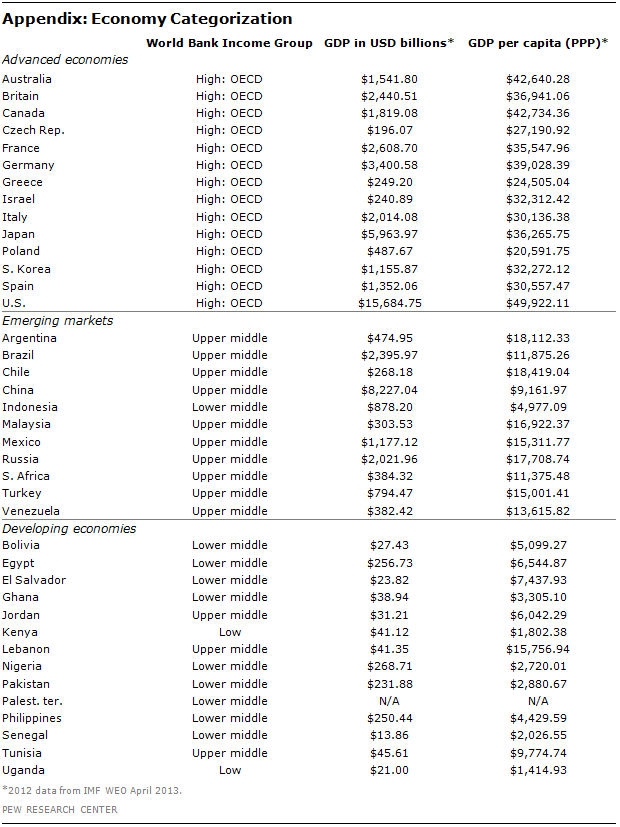
To categorize the 39 countries surveyed into three categories – advanced economies, emerging markets and developing economies – we started with the World Bank classification of countries by income. The World Bank classifies countries into high income, upper middle income, lower middle income and low income groups. In general, we categorized countries that are considered high income as advanced economies; countries that are considered upper middle income as emerging markets; and countries that are considered lower middle or low income as developing economies.

Next, we used the absolute size of the economy as well as the relative wealth per capita to determine whether the emerging markets and developing economies were classified correctly. To categorize emerging markets, we set a general cutoff point for 2012 gross domestic product (GDP), current prices at $300 billion U.S. dollars. Using this cutoff, Indonesia was recategorized as an emerging market and Lebanon, Tunisia and Jordan were recategorized as developing economies. While Chile does not quite meet the $300 billion cutoff, the country’s 2012 per capita wealth based on purchasing power parity is the highest among the upper middle income countries. Given this, we categorized Chile as an emerging market.

Finally, we cross-referenced our coding of the countries against expert classifications, such as the International Monetary Fund.

Below is a table which outlines the countries that fall into each of the three categories. The table includes for each country the World Bank income classification, the GDP in current prices, and the GDP per capita based on purchasing power parity (PPP).

ECON00

Regional Categorization:

For analysis, we grouped the 39 countries surveyed into six regions – North America, Europe, Middle East, Asia/Pacific, Latin America and Africa.

North America includes: • Canada • United States

Europe includes countries from both Western and Eastern Europe: • Britain • France • Germany • Italy • Spain • Greece • Poland • Czech Republic • Russia

Middle East includes countries and territories from the Middle East and North Africa, as well as Turkey: • Turkey • Egypt • Jordan • Lebanon • Palestinian territories • Tunisia • Israel

Asia/Pacific includes countries from Asia and the Pacific region: • Australia • China • Indonesia • Japan • Malaysia • Pakistan • Philippines • South Korea

Latin America includes countries from North, Central and South America: • Argentina • Bolivia • Brazil • Chile • El Salvador • Mexico • Venezuela

Africa includes countries from sub-Saharan Africa: • Ghana • Kenya • Nigeria • Senegal • South Africa • Uganda