Pew Research Center

FOR RELEASE MAY 13, 2013

The New Sick Man of Europe: the European Union

Overview The European Union is the new sick man of Europe. The effort over the past half century to create a more united Europe is now the principal casualty of the euro crisis. The European project now stands in disrepute across much of Europe. Support for European economic integration – the 1957 raison d’etre for […]

FOR MEDIA OR OTHER INQUIRIES:

Communications Department
202.419.4372
www.pewresearch.org

RECOMMENDED CITATION

Pew Research Center, May 2013, "The New Sick Man of Europe: the European Union"

About Pew Research Center

Pew Research Center is a nonpartisan, nonadvocacy fact tank that informs the public about the issues, attitudes and trends shaping the world. It does not take policy positions. The Center conducts public opinion polling, demographic research, computational social science research and other data-driven research. It studies politics and policy; news habits and media; the internet and technology; religion; race and ethnicity; international affairs; social, demographic and economic trends; science; research methodology and data science; and immigration and migration. Pew Research Center is a subsidiary of The Pew Charitable Trusts, its primary funder.

© Pew Research Center 2026

Table of contents

  • About Pew Research Center
  • The New Sick Man of Europe: the European Union
  • Chapter 1. Dispirited over National Conditions
  • Chapter 2. Economic Crisis Now an EU Crisis
  • Chapter 3. Mixed Views of Leaders and Each Other
  • Chapter 4. France in Free Fall
  • Survey Methods

The New Sick Man of Europe: the European Union

Overview The European Union is the new sick man of Europe. The effort over the past half century to create a more united Europe is now the principal casualty of the euro crisis. The European project now stands in disrepute across much of Europe. Support for European economic integration – the 1957 raison d’etre for […]

Overview

The European Union is the new sick man of Europe. The effort over the past half century to create a more united Europe is now the principal casualty of the euro crisis. The European project now stands in disrepute across much of Europe.
2013-EU-01

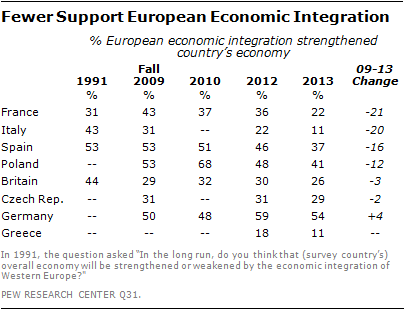
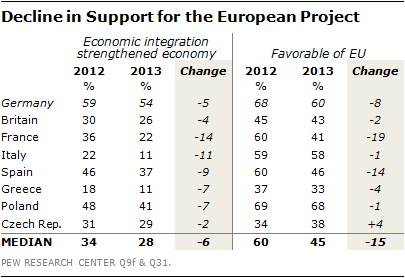
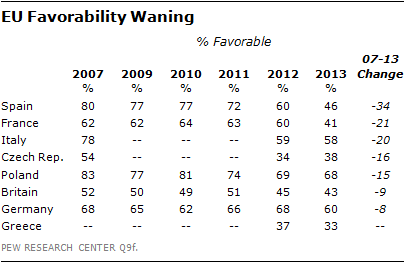
Support for European economic integration – the 1957 raison d’etre for creating the European Economic Community, the European Union’s predecessor – is down over last year in five of the eight European Union countries surveyed by the Pew Research Center in 2013. Positive views of the European Union are at or near their low point in most EU nations, even among the young, the hope for the EU’s future. The favorability of the EU has fallen from a median of 60% in 2012 to 45% in 2013. And only in Germany does at least half the public back giving more power to Brussels to deal with the current economic crisis.

The sick man label – attributed originally to Russian Czar Nicholas I in his description of the Ottoman Empire in the mid-19th century – has more recently been applied at different times over the past decade and a half to Germany, Italy, Portugal, Greece and France. But this fascination with the crisis country of the moment has masked a broader phenomenon: the erosion of Europeans’ faith in the animating principles that have driven so much of what they have accomplished internally.

The prolonged economic crisis has created centrifugal forces that are pulling European public opinion apart, separating the French from the Germans and the Germans from everyone else. The southern nations of Spain, Italy and Greece are becoming ever more estranged as evidenced by their frustration with Brussels, Berlin and the perceived unfairness of the economic system.

These negative sentiments are driven, in part, by the public’s generally glum mood about economic conditions and could well turn around if the European economy picks up. But Europe’s economic fortunes have worsened in the past year, and prospects for a rapid turnaround remain elusive. The International Monetary Fund expects the European Union economy to not grow at all in 2013 and to still be performing below its pre-crisis average in 2018. Nevertheless, despite the vocal political debate about austerity, a clear majority in five of eight countries surveyed still think the best way to solve their country’s economic problems is to cut government spending, not spend more money.

These are among the key findings of a new study by the Pew Research Center conducted in eight European Union nations among 7,646 respondents from March 2 to March 27, 2013.

A Dyspeptic France

No European country is becoming more dispirited and disillusioned faster than France. In just the past year, the public mood has soured dramatically across the board. The French are negative about the economy, with 91% saying it is doing badly, up 10 percentage points since 2012. They are negative about their leadership: 67% think President Francois Hollande is doing a lousy job handling the challenges posed by the economic crisis, a criticism of the president that is 24 points worse than that of his predecessor, Nicolas Sarkozy. The French are also beginning to doubt their commitment to the European project, with 77% believing European economic integration has made things worse for France, an increase of 14 points since last year. And 58% now have a bad impression of the European Union as an institution, up 18 points from 2012.

2013-EU-02

Even more dramatically, French attitudes have sharply diverged from German public opinion on a range of issues since the beginning of the euro crisis. Differences in opinion across the Rhine have long existed. But the French public mood is now looking less like that in Germany and more like that in the southern peripheral nations of Spain, Italy and Greece.

Positive assessment of the economy in France have fallen by more than half since before the crisis and is now comparable to that in the south. The French share similar worries about inflation and unemployment with the Spanish, the Italians and the Greeks at levels of concern not held by the Germans. Only the Greeks and Italians have less belief in the benefits of economic union than do the French. The French now have less faith in the European Union as an institution than do the Italians or the Spanish. And the French, like their southern European compatriots, have lost confidence in their elected leader.

Disillusionment with Elected Leaders

2013-EU-03

Compounding their doubts about the Brussels-based European Union, Europeans are losing faith in the capacity of their own national leaders to cope with the economy’s woes. In most countries surveyed, fewer people today than a year ago think their national executive is doing a good job dealing with the euro crisis. This includes just 25% of the public in Italy, where the sitting Prime Minister Mario Monti was voted out while this survey was being conducted. Even the Germans, who overwhelmingly back their Chancellor Angela Merkel, are slightly more judgmental of her handling of Europe’s economic challenges than they were last year. And Merkel faces the voters in an election in September 2013.

Nevertheless, Merkel remains the most popular leader in Europe, by a wide margin. She enjoys majority approval for her handling of the European economic crisis in five of the eight nations surveyed. But in Greece (88%) and Spain (57%), majorities now say she has done a bad job, as do half (50%) of those surveyed in Italy.

Economic Gloom

2013-EU-04

Most Europeans are profoundly concerned about the state of their economies. Just 1% of the Greeks, 3% of the Italians, 4% of the Spanish and 9% of the French think economic conditions are good. Only the Germans (75%) are pleased with their economy.

And the economic mood has worsened appreciably since before the euro crisis began. Positive sentiment is down 61 percentage points in Spain, 54 points in Britain, 22 points in Italy and 21 points in both the Czech Republic and France.

But despair about the economy may have bottomed out in some nations since 2012. Sentiment seems to have stabilized in the Czech Republic and Poland. And the mood can’t get much worse in Spain, Italy and Greece.

Most Europeans are almost as gloomy about the future. Just 11% of the French, 14% of the Greeks and Poles, and 15% of the Czechs think that their national economic situation will improve over the next 12 months.

2013-EU-05

A median of 78% in the eight countries surveyed say a lack of jobs is a very big problem in their country. And a median of 71% cite the public debt. Except in Germany, overwhelming majorities in many countries say unemployment, the public debt, rising prices and the gap between the rich and the poor are very important problems. Unemployment is the number one worry in seven of the eight countries. Inequality is the principle concern in Germany.

2013-EU-06

Apprehension about economic mobility and inequality is also widespread. Across the eight nations polled, a median of 66%, including 90% of the French, think children today will be worse off financially than their parents when they grow up. A median of 77% believe that the economic system generally favors the wealthy. This includes 95% of the Greeks, 89% of the Spanish and 86% of the Italians. A median of 60% think the gap between the rich and the poor is a very big problem; that sentiment is felt by 84% of the Greeks and 75% of both the Italians and the Spanish. And a median of 85% say such inequality has increased in the past five years, a concern particularly prevalent among the Spanish (90%).

Absolute economic deprivation has long been less of an issue in Europe than in some other countries, thanks to the relatively robust European social safety net. But in the wake of economic hard times, deprivation in France is on the rise, where roughly one-in-five say they could not afford food, health care or clothing at some point in the past year.

The Southern Challenge

The euro crisis has created a southern challenge for the European Union. Spain, Italy and Greece have suffered greatly during the economic downturn. And the public mood in these countries is extremely bleak in both absolute and relative terms.

More than seven-in-ten Spanish (79%) and Greeks (72%) say economic conditions are very bad. A majority of Italians (58%) say the same. This compares with a median of 28% for the rest of Europe. More than nine-in-ten in Greece (99%), Italy (97%) and Spain (94%) think the lack of employment opportunities is a very big problem (official unemployment in January 2013 was 27.2% in Greece and in March 2013 was 26.7% in Spain and 11.5% in Italy). Fully 94% of Greeks, 84% of Italians and 69% of Spanish complain that inflation also poses a very big challenge. This compares with a median of 58% elsewhere. And roughly seven-in-ten or more in all three countries fault their leader’s handing of the economic crisis.

2013-EU-07

Such economic gloom has fed disgruntlement with the European Union. In Greece, 78% now believe that economic integration has weakened the Greek economy, a sentiment about their economy shared by 75% of the Italians and 60% of the Spanish. As a result, nearly two-thirds (65%) of Greeks and about half (52%) of the Spanish have an unfavorable view of the EU. This compares with medians of 59% who question integration and 48% who take a critical view of the EU in the other five countries surveyed.

Concern about inequality is widespread throughout Europe, particularly in the south. A view that the economic system generally favors the wealthy is shared by 95% of the Greeks, 89% of the Spanish and 86% of the Italians. Such frustration exceeds the median of 72% in the other five nations surveyed. Similarly, 84% of the Greeks and 75% of the Italians and Spanish say the gap between the rich and the poor is a very big problem. That compares with a median of just 54% of the Europeans surveyed outside the region who hold such critical views.

So What to Do about the Euro Crisis?

When asked which of the economic challenges facing their countries their government should address first, people in seven of the eight nations choose the lack of employment opportunities. A median of 57% first want their elected leaders to create more jobs. And employment is a particular priority in Spain (72%), Italy (64%) and the Czech Republic (64%).
2013-EU-08

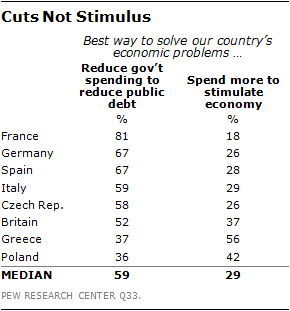
Europeans are of two minds about public debt, which has been at the center of the debate over the euro crisis since it began. A majority in six of the eight countries surveyed consider debt a very big problem. When pressed to choose between reducing public expenditures and more spending, most publics choose the former, even in Spain (67%) and Italy (59%), despite the fact that people there have already experienced cutbacks in government spending, economic contraction and record high unemployment. Across Europe a median of 59% believe that reducing public debt is the best way to solve their country’s economic problems. But a median of only 17% think debt reduction should be their government’s number one economic priority.

2013-EU-09

Some Good News

Despite rising disillusionment with the European project, the euro, the common currency for 17 of the 27 European Union members, remains in public favor. More than six-in-ten people want to keep the euro as their currency in Greece (69%), Spain (67%), Germany (66%), Italy (64%) and France (63%). And support for the euro has actually increased in Italy and Spain since last year.

2013-EU-10

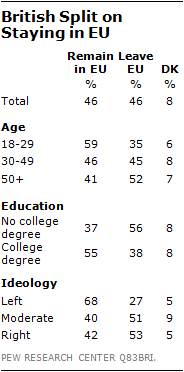
Moreover, notwithstanding the fact that only 26% of the British public think being a member of the European Union has been good for their economy and just 43% hold positive views of the European Union, the British, who will hold a referendum on continued EU membership in 2017, remain evenly divided on leaving the EU: 46% say stay and 46% say go.

Differences Abound

Overall, the 2013 survey highlights more starkly than ever the differences between the views of Germans and other Europeans on a range of issues. And it underscores that, in some cases, those differences are growing. Germans feel better than others about the economy (by 66 points over the EU median), about their personal finances (by 26 points), about the future (by 12 points), about the European Union (by 17 points), about European economic integration (by 28 points) and about their own elected leadership (by 48 points).

2013-EU-100

And the survey contradicts oft-repeated narratives about the Germans: that they are paranoid about inflation, disinclined to bail out their fellow Europeans and debt-obsessed. To the contrary, Germans are among the least likely of those surveyed to see inflation as a very big problem and the most likely among the richer European nations to be willing to provide financial assistance to other European Union countries that have major financial problems. And while Germans are worried about public debt, they are more concerned about inequality and equally concerned about unemployment.

The prominent role Germans have played in Europe’s response to the euro crisis has evoked decidedly mixed emotions from their fellow Europeans. In every country except Greece, people consider Germans the most trustworthy. At the same time, in six of the eight nations surveyed, people see the Germans as the least compassionate. And in five of the eight, they are considered the most arrogant. In the wake of the strict austerity measures imposed in Greece, Greek enmity toward the Germans knows little bound. Greeks consider the Germans to be the least trustworthy, the most arrogant and the least compassionate. But the Greeks themselves do not fare that well. They are considered the least trustworthy by the French, the Germans and the Czechs.

2013-EU-12

Chapter 1. Dispirited over National Conditions

After a year in which the European Union slipped back into recession, more than two-thirds of the public are dissatisfied with the direction of their country in seven of the eight nations surveyed. The most dissatisfied are the Greeks (97%), the Italians (96%) and the Spanish (94%). Only in Germany is more than half the population content with its country’s direction.

Given the overall level of dissatisfaction across Europe, there is little difference in attitudes among demographic groups on their country’s direction, with some exceptions. Young German adults, those aged 18 to 29, and Germans with a college degree are more likely to be satisfied than people 50 years of age and older or the less educated. The same holds true for young people and the better educated in France, the Czech Republic and Britain.

The debilitating effect on the public psyche of the prolonged euro crisis is evident in the erosion of satisfaction in some but not all countries. Since 2007, before the euro crisis began, national contentment is down 46 percentage points in Spain, 13 points in Italy and 7 points in the Czech Republic. But in Germany (+24 points) and Poland (+7), people are feeling better about the state of their nation.

2013-EU-14

National ennui reflects profound negativity about the economy everywhere but Germany. Positive economic assessments are down 61 points in Spain and 54 points in Britain since 2007 and are now in single digits in four of the eight European Union nations surveyed. Just 1% of the Greeks, 3% of the Italians, 4% of the Spanish and 9% of the French describe the current economic situation in their country as good. Opinion in Britain (15%) and the Czech Republic (20%) is not much better.

And there is a clear north-south divide in the degree of economic pessimism. An overwhelming 79% of the Spanish, 72% of the Greeks and 58% of the Italians say their economy is performing very badly. Only 3% of the Germans are that downbeat.

2013-EU-15

Such extremely bleak assessments of the economy have risen a bit in France (9 percentage points) and Spain (7 points) in the past year. But the really notable changes have come since 2007. Since then, the proportion of the public who thinks their national economic situation is very bad is up 74 points in Spain, 44 points in Italy, 31 points in Britain and 21 points in France.

Only in Germany, where the economy grew a modest 0.7% in 2012, yet faster than the overall European Union average of -0.3%, does most (75%) of the population think the economy is doing well. This represents a significant improvement over sentiment in 2009, when only 28% saw economic conditions in a good light, despite the fact that the German economy was growing at 3.3% at the time.

Given overwhelming public negativity about the economy, it is not surprising that there is little difference in attitudes among demographic groups within societies. However, older people in Britain and the Czech Republic, those 50 years of age and older, are more worried about the economy than the young. Germans and Czechs without a college education are significantly less satisfied than those who have graduated from college. And women in Germany and Poland are more downbeat than men about the economy.

Such economic despair may have reached its nadir, however. Sentiment cannot get much worse in Spain, Italy and Greece and has very little further to fall in France. Notably, economic concern has not changed much in Britain or Poland over the past three years.

2013-EU-16

European publics are generally only slightly more upbeat about their nation’s economic prospects over the next 12 months than they are about the current state of their economy. Just 11% of the French and 14% of the Greeks expect the economic situation in their country to improve. Optimism about the future of the economy is largely unchanged compared with sentiment held last year, although it has declined 11 points in France and 10 points in Britain.

A majority of the Greeks (64%) and the French (61%) and a plurality of the Italians (48%) and Spanish (47%) actually expect things to get worse. About half of Poles (51%), Germans (49%) and Czechs (47%) and four-in-ten British (40%) see economic conditions remaining the same over the next year. But in the Czech Republic and Britain, no change means continued economic stagnation. The Czech economy contracted by -1.3% in 2012 and Britain’s grew by an anemic 0.3%.

2013-EU-17

As in past Pew Research surveys, most Europeans are much more satisfied with their personal finances than they are with their national economy. At least half of the people in five of the eight countries surveyed characterize their personal finances as good, including roughly three-quarters (77%) of the Germans. Only in Greece does an overwhelming portion of the public (85%) think their own finances are bad.

The college educated are significantly happier with their economic situation than are those who do not have a university degree in seven of the eight countries surveyed: by 24 percentage points in the Czech Republic and 23 points in France. But in most societies there is no statistically significant difference in attitudes between the attitudes of the young and the old or between men and women.

Nevertheless, even this relatively positive indicator has eroded as the euro crisis has persisted. People’s assessments of their personal economic situation are down 19 points in Poland, 17 points in Spain and 10 points in France since 2008. However, they are up 10 points in Germany.

Europeans are generally not that much more optimistic about the future of their personal finances than they are about the future of their national economy. Majorities or pluralities in every country but Greece and France think their personal economic situation will remain unchanged over the coming year.

Moreover, people are deeply pessimistic about the economic prospects for the next generation. Nine-in-ten (90%) in France and nearly three-quarters in Britain (74%) and Italy (73%) think that when today’s children grow up they will be worse off financially than their parents. The plight of the next generation is a particular concern among people 50 years of age and older in Germany, Britain and Spain. The perception that there is a large gap between the rich and the poor in their society drives this pessimism. In all nations surveyed, those who see inequality as a very big problem are more likely to think that today’s children face a bleak economic future.

Cascading Economic Problems

Economic bad times both reflect underlying troubles afflicting national economies and heighten public concern about those issues.

At the heart of the euro crisis has been spreads in borrowing rates for different countries, bank failures, and losses by bond holders and depositors. Such financial sector uncertainty is seen as a major threat in all the European countries surveyed, particularly in those that have experienced or fear banking problems. Fully 95% of the Greeks, 75% of the Italians and 70% of the Spanish say international financial instability is a major threat to their country. Roughly two-thirds of the French (66%) agree.

2013-EU-18

Inflation, unemployment, inequality and debt are also widely shared concerns throughout Europe, except in Germany. Among the eight European Union nations surveyed, a median of 78% of the publics cite a lack of employment opportunities as a very big problem. Fully 71% are strongly concerned about public debt, 67% about rising prices and 60% about the gap between the rich and the poor. The intensity of worry varies widely among countries depending on the topic, with Germans’ relative lack of concern about any of these challenges the most notable. This German exceptionalism has policy implications as European governments sort out how best to deal with the problems cascading from the euro crisis.

The economic downturn has exacted a heavy toll on employment across Europe. In March 2013 the jobless rate hit a record 10.9% in the 27-member European Union. The rate was 26.7% in Spain and 11.5% in Italy, but only 5.4% in Germany. Youth unemployment – those people aged 25 and under – was even higher, at 55.9% in Spain and 59.1% in Greece (January 2013 figures).

In seven of the eight nations surveyed, joblessness is most often cited as a country’s premier economic challenge. At least nine-in-ten Greeks (99%), Italians (97%) and Spanish (94%) think a lack of jobs is a very big problem in their country. Their intensity of concern is shared by eight-in-ten French (80%). It is noteworthy, however, that in Germany, where the jobless rate was only 5.4%, just 28% complain that unemployment is a very big problem.

Public debt plagues a number of European economies. Indebtedness as a portion of the domestic economy is 159% in Greece, 127% in Italy and 90% in France, according to 2012 estimates by the International Monetary Fund. And this debt-to-GDP ratio is unlikely to change soon. The IMF predicts that in 2018, it will still be 123% in Italy and 88% in France. Most Europeans view public debt as a very big problem, especially in Greece (92%), Italy (84%) and Spain (77%). However, seven-in-ten Czechs (70%) are extremely worried about public indebtedness, even though of the countries surveyed, the Czech Republic carries the lowest debt burden. And Germany’s debt is roughly comparable to that of Spain’s, yet only 37% of Germans are deeply troubled by their public liability.

People without a college education are debt hawks in most countries surveyed. Women more than men are intensely worried about public finances in Britain, Spain and the Czech Republic. Notably, however, there is no across-the-board ideological split on public debt. In Britain and France, people on the right are the most concerned. But in other countries, people all along the political spectrum share roughly the same worries.

As the International Monetary Fund noted in its Spring 2013 World Economic Outlook, inflation is the dog that hasn’t barked in the wake of the Great Recession. Despite unprecedented monetary easing through various conventional and unconventional measures by both the European Central Bank and the Bank of England, prices in the European Union are falling. In the 12 months ending in March 2013, the annual EU inflation rate was 1.7%, down from 2.7% a year earlier. Prices were rising by only 1.8% in Germany and 1.1% in France.

Nevertheless, majorities in six of the eight countries surveyed think rising prices are a very big problem. The Greeks are the most worried, with 94% saying inflation is a major issue. But official statistics show that in March, Greek prices were actually falling at an annual rate of -0.2%. The Italians are the second most concerned (84%) and with more reason. Annual inflation in Italy was running at 1.8% at the time of the survey.

Despite a national narrative that the German psyche has been permanently scarred by the hyperinflation of the 1920s, rendering modern Germans inflation-phobic, only 31% of Germans think rising prices are a very big problem.

It is notable, however, that less educated people are worried about inflation more than better educated people in five of the eight nations surveyed. And in seven of the countries, women are more worried than men about rising prices.

Concern about Rising Inequality

One consequence of the euro crisis has been concern about income inequality in many parts of Europe. Inequality can be measured in various ways. One gauge is how much more of national income is earned by the top fifth of the population compared with that controlled by the bottom fifth. In most nations, that ratio did not increase between 2010 and 2011, the last year for which data is available. But, in 2010 the top 20% of Italian earners commanded 5.2 times as much of Italy’s national income as did people living in the bottom 20% of the income distribution. By 2011 that ratio had risen to 5.6. Similarly, in Greece the income inequality ratio grew from 5.6 to 6.0.

As the rich have gotten richer, people across Europe have noticed, and they do not like it. They think that the economic system favors the wealthy, that the gap between the rich and the poor has increased and that the rich-poor gap is a very big problem. But they do not necessarily see it as a priority for government action.

2013-EU-19

A strong majority (median of 77%) of Europeans surveyed think that the current economic system generally favors the wealthy. This includes an overwhelming 95% of the Greeks, 89% of the Spanish and 86% of the Italians. Even seven-in-ten Germans (72%) say the system is rigged. As might be expected, such sentiments are more likely to be held by people on the left of the political spectrum and low-income people than by those on the right and those who are relatively well off. But even then, conservatives and higher income people agree that the system is stacked in favor of the rich.

Moreover, the vast majority of all Europeans (a median of 85%) surveyed overwhelmingly agree that the gap between the rich and the poor has increased in the past five years. This is an almost universally shared sentiment, with nearly nine-in-ten Spanish (90%), Germans (88%), Italians (88%) and Greeks (88%) agreeing. Eurostat data confirm Spanish and German fears: Inequality in those nations rose between 2006 and 2011.

2013-EU-20

And half or more people in all eight EU countries surveyed think the gap between the rich and the poor is a very big problem. This is a particular concern in Greece (84%), Spain (75%) and Italy (75%). Political ideology helps drive sentiment on this issue. People on the left of the political spectrum are generally more likely to see inequality as a very big problem than are people on the right, with left-right differences of 32 percentage points in Britain, 23 points in France and 20 points in Italy and Spain. People of all ages are worried about this issue, but there is a generation gap in France and the Czech Republic, with those 50 years of age and older more worried than those age 18 to 29. In France, women (72%) are much more concerned about inequality than men (57%).

Notably, inequality is, by far, the Germans’ greatest economic concern among the issues tested, with 51% saying it is a very big problem. Since before the economic crisis, income inequality in Germany has declined somewhat, from 4.9 in 2007 to 4.5 in 2011. But in Germany the top 20% of the population has 12.8 times as much wealth – such as real estate and financial assets – as  the bottom 20% of the population, according to a recent analysis of European Central Bank data by economists Paul De Grauwe and Yuemei Ji. Judged by this criterion, Germany has the most unequal distribution of wealth in Europe among the nations studied.

2013-EU-21

Twenty-three years after reunification, the east and west Germans see eye-to-eye on many issues. But 79% of Germans in the east say the economic system is unfair, compared with 71% of those in the west. Fully 62% of easterners but only 48% of westerners believe the gap between the rich and the poor is a very big problem. This may be due to the fact that 41% of those in the east think joblessness is also a very big issue, compared with only 25% in the west.

Personal Deprivation

Personal deprivation is yet another consequence of the euro crisis, but not as much as might be expected given the recent economic downturn and rise in unemployment. This may, in part, be due to the strong social safety net in most European countries, combined with cultures of extended families in some societies. Since 2007, the proportion of people who say that there have been times during the past year when they did not have enough money to buy food has more than doubled among the British (6% to 15%) and more than tripled among the French (from 6% to 20%). Nearly one person in four in Greece (24%) now reports difficulty paying for food. In Italy, Spain, Poland and Germany there has not been a significant increase in personal deprivation.

The share of the population that says there have been times during the past year when they did not have enough money to buy clothing for their family has nearly doubled in Britain (from 10% to 19%) and France (from 12% to 23%) since the recession began. And fully 45% of Greeks say affording needed clothing is an issue.

As might be expected, given their relatively good economic performance, the Germans are the least likely to complain about an inability to pay for food or clothing.

Despite government-supported health care services across Europe, the proportion of people saying that there have been times during the past year when they did not have enough money to pay for medical care for their family has more than doubled in the Czech Republic (from 7% to 17%) and nearly quadrupled in France (from 5% to 19%) since 2007. In Greece, 36% lament their inability to pay for needed health services.

2013-EU-22

Deprivation hits hardest at the poorest and the least educated, who are often one and the same, even in Germany, where the portion of the population that is doing without is the smallest. Large minorities of low-income Spanish (45%), Czechs (44%) and French (43%) report problems affording clothing. In addition, 40% of low-income Czechs, 37% of low-income French and 32% of low-income Spanish say they have had trouble affording food. And low educational attainment is strongly associated with deprivation. Those without a college degree are often two, three or four times as likely as those with a college education to say they have had trouble finding the money for food, clothing or medical care.

Recent economic troubles have clearly made life worse in much of Europe. But in those countries that have experienced good economic performance over time, the benefits are clear. In Poland, where the economy has averaged 4.3% annual growth over the last decade, the portion of the population worried about putting dinner on the table has fallen from 35% in 2002 to 16% in 2013. And the portion that cannot afford health care in Poland has also halved, from 42% to 21%.

Priorities for Action

2013-EU-23

The euro crisis has created a laundry list of economic concerns, but Europeans generally agree on which challenge they want their government to tackle first: jobs, jobs, jobs. In seven of eight nations, publics prefer that their governments act first on unemployment. About two-thirds of the Spanish (72%), the Italians (64%) and the Czechs (64%) say the most important issue to address is the lack of employment opportunities. Roughly half of the Greeks (52%) and the French (51%) and nearly half of the British (46%) agree.

Public debt intensely concerns more than half the population in seven of the eight countries surveyed. But those same people do not see it as a governmental priority. About one-in-five in Britain (22%), Germany (21%) and France (20%) wants their government to first cut the debt. Only 9% of Italians say debt reduction should be the priority, despite the fact that Italy’s debt is 127% of GDP.

Despite the public’s profound concern about inequality, in most countries it is a lesser priority for governmental action. Only in Germany does a plurality (42%) believe that the gap between the rich and the poor is the economic problem the government should address first.

For all the angst in financial circles about the possibility of asset bubbles and inflation as the result of loose monetary policy, European publics place a low priority on governmental initiatives to curb inflation. A median of only 9% think rising prices is the first issue their governments should address.

Reducing Debt versus Spending?

In the past year, an ever more visible and vocal public policy debate has emerged in Europe over the right course of action to pull the European Union out of its double-dip recession. Fiscal conservatives advocate even greater efforts to rein in spending to reduce government indebtedness. Others argue that budgetary rectitude will have to wait, that more spending is needed now to jump-start economies stuck in neutral.

While policy makers and pundits debate, European publics have already made up their minds. When faced with the stark choice of reducing government debt or pump priming, most Europeans clearly prefer belt-tightening as the means of climbing out of their economic hole.

2013-EU-24

People’s intense worry about jobs and their strong desire to see government take action to increase employment does not translate into support for more government spending to stimulate the economy. A median of just 29% across Europe want to see increased public outlays as a means of solving their country’s economic problems. Only in Greece (56%) does a majority advocate more spending. In France, which in 2012 elected a socialist government, just 18% back a Keynesian solution to their woes.

About half or more of the population in six of the eight European countries surveyed says that the best way to solve their economic problems is for government to cut public spending to reduce the public debt.

Cutting government debt has particularly strong backing in France (81%), followed by Germany (67%) and Spain (67%), despite the fact that these three countries have had significantly different experiences with belt tightening. The French and Germans have yet to experience major austerity. In 2012, government expenditures still grew by 1.4% in France and Germany, compared with a decline of 3.7% in Spain.

Notably, it is older people, those age 50 and above, who prefer action on the debt in France. But it is younger people, those aged 18 to 29, in Poland and the Czech Republic who are deficit hawks. And it is people without a college education in Britain, France, Germany and Spain who are more concerned about public debt than their better educated peers.

Chapter 2. Economic Crisis Now an EU Crisis

Europe’s ongoing economic crisis has engendered a crisis of confidence in the European project. Europeans have declining faith in European economic integration as a means of strengthening their national economy. Many no longer look favorably on the European Union as an institution. And most Europeans do not favor ceding more decision-making power to the European Union in order to better deal with Europe’s economic problems.

Public faith in the European project is now weakest in Greece, among the eight European Union countries surveyed. And it remains strongest in Germany. But since 2009 the decline in support for a united Europe has been greatest in France and Spain.

In 1957, six European nations signed the Treaty of Rome, establishing the European Economic Community. The widely shared rationale behind this European project was that removing barriers to trade and investment among these economies would spur economic growth. Over a half century, the appeal of this prospect became ever more compelling. These six founding partners grew to a European Union of 27, soon to be 28 with the addition of Croatia.

2013-EU-25But the euro crisis has shaken Europeans’ assumption that a deeper and broader European Union is in their self-interest. A median of only 28% think European economic integration has strengthened their economy. This includes just 11% of the Greeks and Italians and only 22% of the French, the latter two citizens of founding members of the European Community.
Such sentiments are not a one-year phenomenon. Since the fall of 2009, support for a more integrated European economy has dropped sharply: by 21 points in France, 20 points in Italy, 16 points in Spain. In Poland, where enthusiasm for integration peaked at 68% in 2010, that support has fallen by 27 points.

In most countries, people with a college education are more likely than those without a university degree to still believe in economic integration.

Confidence in EU Wanes

2013-EU-26People’s confidence in the European Union as an institution is waning even faster. A median of only 45% now think favorably of the Brussels-based organization. That support is down 34 percentage points in Spain since 2007, before the euro crisis began. It has declined 21 points in France and 20 points in Italy. Even in Germany, where three-in-five people are still favorably inclined toward the EU, support of the institution is down 8 points.
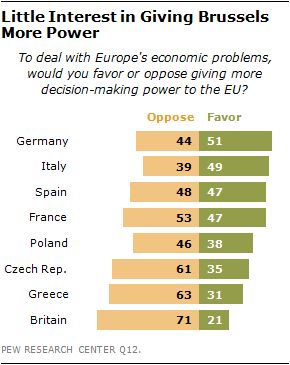
2013-EU-27Given the EU’s declining stature within Europe, it is not surprising that few Europeans want to give more decision-making authority to the European Union to deal with Europe’s economic problems. Only in Germany (51%) and Italy (49%) does such centralization enjoy even modest support. Fully 71% of the British oppose giving Brussels more power. The euro-skepticism of British conservatives plays a big role in such sentiment: 82% of people on the right of the political spectrum in Britain are against any such centralization of authority within Europe. In addition, 63% of the Greeks oppose moving more decision making to the EU, as do more than half (53%) of the French.
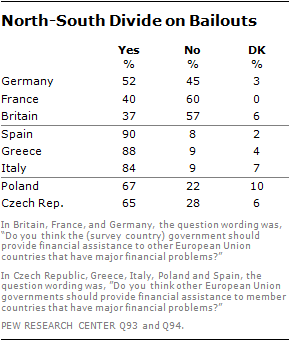
One means of assessing continued fealty to the ambition of a united Europe in the face of the euro crisis is public willingness to help other European Union members in distress. Repeated bailouts – of Ireland, Portugal, Greece and Cyprus – have sorely tested such European solidarity.

2013-EU-28Support for assistance to other EU countries that have major financial problems has actually grown in Germany, where a majority (56%) opposed such bailouts in 2010 and now roughly half (52%) back them. But the crisis has had the opposite effect on French public opinion: 53% supported helping others in 2010, and now a strong French majority (60%) is against such efforts. The British have always looked askance at action to help others in financial distress.
Meanwhile, in Greece, which has been the beneficiary of a bailout, and Italy and Spain, which might one day benefit from extensive aid, overwhelming majorities think such assistance is good and proper.

Future Challenges

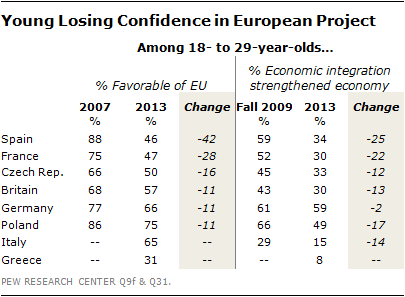
2013-EU-29Complicating matters for the future of the European Union, young adults ages 18 to 29, the next generation of EU citizens, have also lost some of their faith in the European Project, with the declines on par with the souring of the mood among the EU’s founding generation of those age 50 and older. In Spain, among the young, favorability of the EU is down 42 points since 2007 and support for economic integration is down 25 points since 2009, possibly reflecting the heavy toll unemployment has taken among Spain’s youth. In France, backing for the EU is down 28 points and belief in the benefits of integration has fallen 22 points. There have been double digit declines among the young in support for these two pillars of European identity in the Czech Republic, Italy, Britain and Poland.
EU Image Abroad Remains Strong

The European Union has long held itself out as an alternative economic and political model for the world: a successful experiment in economic integration, intergovernmental decision making and peaceful resolution of long-standing territorial disputes. These soft power attributes have been tested by the euro crisis and, for the most part, the EU’s reputation remains strong.

A median of 54% of 29 countries not members of the European Union have a favorable view of the EU. (This compares with a median of 45% within the EU.) Fully 63% of Russians, 61% of Japanese, 54% of Brazilians, 50% of Americans and 37% of Chinese see the EU in a positive light. Among those 21 nations for which there is comparable data, a median of 53% had a positive impression of the EU in 2007 and 50% have a favorable view today.

Keep the Euro

Another test of the impact of the euro crisis is whether continued participation in various aspects of the European project – use of the euro as a currency, continued membership in the European Union – remains attractive to Europe’s people. Here the story is mixed.

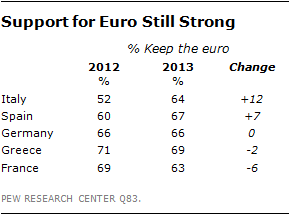
2013-EU-30Support for the euro is strong. Solid majorities in Greece (69%), Spain (67%), Germany (66%), Italy (64%) and France (63%) want to keep using the currency and not return to their previous national scrip. These percentages are largely unchanged over the past two to three years, and backing for the euro has actually gone up in Italy and Spain since 2012.
Clearly, the euro crisis is not yet a crisis of the euro. Nonetheless, among those who think European economic integration has not been good for their country, nearly half of those Germans (49%) want to revive the mark, and a substantial minority of those French (45%) and Spanish (43%) want to revive the franc and the peseta, respectively. And 41% of Germans ages 18 to 29 want to return to the mark, compared with only 26% of people ages 50 and older. Moreover, the proportion of young people who want to return to the mark has grown from 21% in 2010. In every country, those without a college education are far more likely than those with a university degree to want to return to their national currency.

2013-EU-101Despite growing public dissatisfaction with the European Union, only the United Kingdom is openly considering leaving the institution. The British people are divided on the issue. Prime Minister David Cameron has promised to conduct a national referendum on continued British membership in the EU no later than the end of 2017. At this early date, 46% of the public want to remain in the EU and 46% want to depart. Support for continued membership is strongest among those on the left (68%), those ages 18 to 29 (59%) and those with a college education (55%).

Chapter 3. Mixed Views of Leaders and Each Other

The prolonged aftereffects of the Great Recession have undermined the stature of political leaders in almost all the European nations surveyed. Their handling of the fallout from the economic downturn has weakened public trust in their competence. And the euro crisis has exposed intra-European divisions over German leadership and attitudes toward Germans in general, while reinforcing general stereotypes among Europeans about each other.

2013-EU-32

In 2012, Angela Merkel was the most popular politician in Europe, except in Greece. In 2013, the German Chancellor’s handling of the economic downturn now gets mixed marks. Majorities in five of the eight nations surveyed – Merkel’s home country (74%), along with France (73%), Poland (72%), the Czech Republic (61%) and Britain (56%) – think she has done a good job dealing with the economic crisis. Yet her support has declined over the past year in five nations: by 24 points in Spain, 19 points in Italy, 10 points in Britain, and six points in both the Czech Republic and Germany. Notably, Merkel is more popular in east Germany (81%), the area of her birth, than in the west (73%).

In the wake of the German government’s hardline stance in dealing with the financial troubles plaguing southern European countries, antipathy toward Merkel is particularly strong across the region. An overwhelming 88% of the Greeks say she is doing a bad job, including 64% who say a very bad job. A majority of the Spanish (57%) also judge Merkel harshly, as do 50% of the Italians.

British Prime Minister David Cameron inspires far less confidence than Merkel in his economic management. A majority of the Poles (58%) say he is doing a good job, as do half (50%) the French, who express greater approval for the job he is doing than do the British people. But beyond that, Cameron’s support is weak: Just 25% of the Germans and 17% of the Greeks give him a good grade. And in some countries, Cameron’s marks have declined since 2012: by 14 points in his own country and by 9 points in France.

French President Francois Hollande fares even worse. Just 33% of his own people and 30% of the British and the Greeks say he is doing a good job. More than half the Spanish (57%) and the Germans (53%) think he is handling the economic crisis well. Yet German opinion of Hollande’s economic management is down 22 points from their assessment of the work of his predecessor, Nicolas Sarkozy.

In general, European political leaders in 2013 are judged more harshly by their own people than the leaders who were in power in 2012. Former Italian Prime Minister Mario Monti, who was just leaving office the month the survey was conducted, experienced the greatest loss of trust. His poor showing in the March 2013 Italian election can, in part, be explained by the fact that just 25% of the public thought he was doing a good job handling the European economic crisis, a 23-point decline in support in just a year. France’s Hollande (33%), who had been in office only 10 months at the time of the survey, was also running 23 points behind the approval given Sarkozy in 2012, despite the fact that the French people chose Hollande over Sarkozy for the country’s presidency in May 2012. Spanish Prime Minister Mariano Rajoy, who remained in office, saw his support go from 45% in 2012 to 27%, an 18-point decline. And incumbent Cameron suffered a 14-point drop in British backing, from 51% to 37%. In Greece, Prime Minister Antonis Samaras had the support of only 22% of his population, down from the 32% backing given Lucas Papademos in 2012.

2013-EU-33

When asked about attributes of their fellow Europeans, many national stereotypes are reinforced. People are most likely to see Germans as trustworthy, including 43% of the French who see the Germans in this light and 25% of the Spanish.

The Italians (along with the Greeks) are seen as the least trustworthy by the Germans (18%). Additionally, Italians are named as the least trustworthy in Spain (17%) and in Italy (23%) itself. The French are characterized as the most arrogant by the British (30%) and the Germans (20%), as well as by the French (26%) themselves.

Self-congratulation is common across Europe, while self-criticism is in short supply. The Greeks and the Germans each see themselves as the most trustworthy, the most compassionate and the least arrogant. In fact, people of every nationality consider themselves to be the most compassionate people in Europe. In addition, the British, the Spanish, and the Poles see themselves as the least arrogant. The French characterize themselves as both the most arrogant and the least arrogant.

Notably, the Italians vote themselves as the least trustworthy people in Europe, but the most compassionate, which is exactly the opposite of the way they view the Germans.

Chapter 4. France in Free Fall

The euro crisis first undermined France’s economy, and now there is strong evidence that it has severely eroded French public attitudes toward the economy, the European project and the country’s domestic leadership. Moreover, France has always bridged Europe’s north and south. French language and culture has Latin roots, but France has historically been considered in the same economic and political league as Germany and Britain. And in their public attitudes, the French were neither Northerners nor Southerners, but a hybrid of the two. Now, measured by a number of indicators, the French look less like Germans and a lot more like the Spanish, the Italians and the Greeks.

In 2007, France’s GDP grew by 2.3%, according to the IMF. Between then and 2012 , its economy effectively stagnated. Official unemployment reached 10.2% last year. And public debt as a portion of the economy rose from 64% in 2007 to 90% in 2012.

So, in recent years the French have not had much reason to feel good about their economy. In the current poll such sentiment reaches a new low, with just 9% saying the economy is performing well. And that judgment is down 21 points since 2007. Only 11% of the French think their economy will improve over the next 12 months, making the French among the most pessimistic of Europeans. And just 9% think their children will be better off financially than their parents, by far the gloomiest forecast for the next generation.

The economic downturn over the past six years has also sharply increased the portion of the French population suffering basic deprivation. And reported incidences of not having enough money to pay for food and health care over the past year have increased more in France since 2007 than in any other of the EU countries surveyed.

The French have long had their doubts about whether European economic integration has been good for the French economy. In 1991, the year before creation of the single European market, a plurality of 44% feared that integration would weaken France. Today, these doubts have morphed into strong convictions. Nearly three-quarters (77%) of the French think closer business ties with the rest of Europe have undermined their overall economy.

Despite such doubts, the French have generally supported the European Union. In 2004, 69% had a positive opinion about the Brussels-based institution. But by 2013, just 41% have a favorable view. Moreover, more than half (53%) of the French oppose giving more decision-making power to Brussels. And only 40% would consider financial assistance to other EU nations facing economic distress, down from 53% in 2010. Nevertheless, 63% of the French want to keep the euro and not go back to the franc.

2013-EU-34

The French mood has soured sharply in absolute terms but it has also worsened relative to the sentiment of the Germans, their European partner.

In 2007, 30% of the French and 63% of the Germans thought their national economies were doing well. That was certainly not a similar sentiment. Yet, since then, public attitudes on each side of the Rhine have gone in opposite directions. That 33-point difference six years ago is now a 66-point difference, as just 9% of the French and 75% of Germans see their economy as good.

Moreover, the French and the Germans differ so greatly over the challenges facing their economies that they look as if they live on different continents, not within a single European market. Fully 80% of the French say unemployment is a very big problem; less than a third (28%) of the Germans agree. About two-thirds (68%) of the French think inflation is a major issue, while just 31% of Germans are similarly worried about rising prices. And 71% of the French are very troubled about public debt; only 37% of the Germans share such intensity of concern.

In 2009, 43% of the French were of the view that European economic integration had strengthened the French economy and 50% of Germans thought integration had benefited Germany, a 7-point difference. In 2013, just 22% of the French are positively disposed toward integration, while 54% of Germans laud its rewards, a 32-point difference.

The French and Germans have also parted ways in their views of the European Union as an institution. In 2007, before the euro crisis, 62% of the French and 68% of the Germans had a favorable opinion of the Brussels-based body. In 2013, just 41% of the French still hold such positive views, while 60% of the Germans do. A 6-point gap in attitudes has grown to a 19-point gap.

2013-EU-35

The French and the Germans also disagree on whether to help out other European Union nations in distress. And their positions have flip-flopped. In 2010, roughly half (53%) the French backed bailouts, while only 42% of Germans agreed. Today, about half (52%) of the Germans support such financial assistance, while just 40% of the French do so.

However, the French and Germans do roughly see eye-to-eye on whether the European Union should be given more power to deal with the euro crisis. About half of Germans (51%) and French (47%) are willing to grant more authority to Brussels. And both would like to keep the euro.

The darkening mood in France makes French public opinion look less like that in Germany and more like attitudes in southern Europe: Spain, Italy and Greece.

2013-EU-36

More than nine-in-ten Spanish, Italians and Greeks think their economy is doing poorly, as do roughly nine-in-ten French. About two-thirds or more in all four countries think their governmental leader has done a bad job handling the economic crisis. Nearly three-quarters of the French, Greeks and Italians believe that economic integration has been bad for their country. More than half of the French, Spanish and Greeks look unfavorably on the EU. And by all of these indicators, French attitudes have worsened dramatically since 2007, much as has sentiment in Spain and Italy, for which there are comparable data.

Survey Methods

About the 2013 Spring Pew Global Attitudes Survey

Results for the survey are based on telephone and face-to-face interviews conducted under the direction of Princeton Survey Research Associates International. Survey results are based on national samples. For further details on sample designs, see below.

The descriptions below show the margin of sampling error based on all interviews conducted in that country. For results based on the full sample in a given country, one can say with 95% confidence that the error attributable to sampling and other random effects is plus or minus the margin of error. In addition to sampling error, one should bear in mind that question wording and practical difficulties in conducting surveys can introduce error or bias into the findings of opinion polls.

2013-EU-37

2013-EU-38
2013-EU-39
2013-EU-40
Methods_5
2013-EU-42
2013-EU-43
2013-EU-44
2013-EU-45
2013-EU-46
2013-EU-47
2013-EU-48